Tag: Detroit

  • Detroit — The Movie

    I guess there was always going to be a difference between the Detroit film I wanted and the Detroit film that was produced.

    “Detroit”, the new big-budget exploration by director Kathryn Bigelow that goes into the details of one of Motor City’s most defining events, came out this weekend to strong critical acclaim but less than outstanding popular success. As a native Detroiter I was intrigued from the outset about the film’s premise and how it would present such a tense and difficult subject — and if the film could offer any potential for resolving the issues that still plague the city 50 years later. In an attempt to connect 1967 Detroit to present-day concerns over police brutality, the film succeeds in making us feel brutality, but fall just short of explaining how it became a tool of oppression and how it can be undone.

    As someone whose absolute earliest memory is of watching National Guardsmen drive down residential streets in fatigues and pointing rifles, while in my mother’s arms, I had envisioned a film that would provide context for the uprising. One that would provide meaning. I envisioned an epic, sweeping, panoramic film that would establish the economic and social roots of the riot. Possibly develop the perspectives of people on multiple sides of the uprising — police, looters, white and black riot resisters, dispassionate suburbanites. Something that would acknowledge that before 1967, there was 1943, there was 1941, there was 1925, and a host of other indignities large and small. The film begins with that potential, but loses it along the way.

    The film starts with a well done animated montage that describes, basically, how the cauldron that would eventually explode was built. But it does so in a way that doesn’t convey the sense of desperation felt by many blacks, nor is particularly specific to Detroit. Blacks moved up from the South for jobs. They were confined to the worst neighborhoods and the worst jobs. Efforts by blacks to gain better housing and better economic opportunity were met with resistance — sometimes procedural and administrative, others visceral and violent — by the white majority. That’s the case in hundreds of cities nationwide, but I feel as if Detroit still needs more context.

    The film then moves into the event that spurred the riot itself — the police raid of a Vietnam War veteran’s welcome home party at a “blind pig”, or unlicensed after-hours club. The montage may seem sanitized, but the raid itself and the start of the riot seems very real.

    We then see the first three days of the disturbance played out. Looting, buildings burning, exasperated black residents in conflict with overwhelmed, but quite angry, Detroit police officers, state police, and National Guardsmen. Perhaps as a metaphor for dreams dashed and never realized, we’re introduced to a group of young black singers known as the Dramatics (a real group, dramatized) hoping to make it big with a performance to Motown executives at Detroit’s Fox Theater, but police tell guests to evacuate the theater just prior to their performance.

    Then the film sharply narrows its focus to its depiction of events at the Algiers Motel. In fact, a strong case could be made that the film should have been named “Algiers” instead of “Detroit”, because of its focus. But any film that would try to tackle a topic as significant as Detroit’s 1967 conflict would have to have the city’s name in it. Spoiler alert for those who wish to see the film (but the film is based on actual and easily found events): the Algiers Motel incident was a deeply tragic and brutal injustice in which police officers killed three young black men and severely beat five other men and (white) women. Police respond to a perceived sniper attack coming from the motel by seizing it, gathering its occupants and then engaging in truly evil torture and intimidation. Police were later acquitted on all charges in the murders and beatings, but never served on the Detroit police force again.

    The Algiers Motel scenes, making up almost half of the film, extremely violent, claustrophobic, and visceral. It is hard to watch. Without question, if one wants to see what it looks like to be under the control of a deranged sociopath, this is the film. But is this what racism is? Or all that racism is? Did it require hundreds of thousands of similarly deranged people to terrorize Detroit’s black community? Not at all. And that’s where the film fails. It reduces racism to the violent actions of deranged individuals, who have no regard for the lives of the people they’re supposed to protect.

    The racism that led to the conflict in 1967 was far more subtle, until it wasn’t. Redlining, urban renewal, interstate highway construction, job and educational disparities, and more — they weren’t practices explicitly tailored to diminish black progress, but those who supported them knew they did the trick. And all it took to support them was a nod of agreement.

    In an attempt to find a connection between the tragedy of Detroit then and recent police killings, from Ferguson to Baltimore to St. Paul, we lost out on a chance to develop greater meaning and understanding of what happened 50 years ago.

    For what it’s worth, it seems the film, or the process of completing the film, or the healing powers of time itself, has had a redemptive impact for residents of metro Detroit. The 1967 conflict kicked off a decade of controversy in Detroit — the Algiers Motel trials, a contentious mayoral race for control of the city, tense fights over metro-level school busing, all while the auto industry slipped into decline and violent crime moved steadily upward. Many white residents fled the city during that time and afterward, believing “one day our city was fine, and the next it was on fire”, and never looked back. But more are beginning to acknowledge a sense of pain and loss from their dislocation from the city. If the film has that effect on Detroiters, then it’s succeeded despite its flaws.

    This piece originally appeared on The Corner Side Yard.

    Pete Saunders is a Detroit native who has worked as a public and private sector urban planner in the Chicago area for more than twenty years.  He is also the author of “The Corner Side Yard,” an urban planning blog that focuses on the redevelopment and revitalization of Rust Belt cities.

    Photo: Actors Will Poulter (left) and Anthony Mackie in a scene from “Detroit”. Source: parlemag.com

  • The Precariat Shoppe

    The precariat is a term coined to describe the segment of the population that lives without security or predictability. These days it often refers to the former American middle class that’s currently experiencing reduced circumstances. There’s always been a precariat, but it usually includes a minor subset of the population that no one really likes or cares about. Indentured Irish servants, black slaves, Jewish and Italian sweatshop workers, Mexican field hands, Puerto Rican cleaning ladies… It’s a long list. People are up in arms now because the “wrong people” have fallen in to the precariat that didn’t used to “belong” there. There’s been a sudden realization that sometimes the structure of the economy itself institutionalizes their personal decline. Shocking! I’m not a political animal so I’ll leave those discussions to others to hash out. Instead, I’m interested in how people adapt to the circumstances they find themselves in.

    We’re all familiar with the ice cream man whose truck rolls around with the happy music playing on hot summer days. This one is in Detroit – and it’s an ice cream lady. She bought an old delivery vehicle, did a bit of hand painting, fitted it with chest freezers, and opened for business. It’s a fast, low cost, and flexible way to get a business off the ground even in the most challenging economic environments.

    The ubiquitous food truck fills the gap between the cost, complexity, and risk of opening a brick and mortar restaurant vs. working for someone else. A well constructed food truck isn’t necessarily cheap, but it’s within the reach of many more people than anything in a building. This one is in Los Angeles.

    Here’s a twist on the mobile shop theme that’s a direct result of rising commercial rents. This woman ran a successful second hand clothing boutique for many years and was driven out when her shop rent hit $5,400 a month. You have to sell a lot of schmatta to make that nut. Now she follows various fairs and pubic gatherings with her merchandise in a repurposed school bus. She goes directly to where her customers are most likely to find her. As I’ve heard many times from shopkeepers around the world – it’s not how much money you earn, it’s how much you have left over after all the thieves are paid.

    Here’s a mobile veterinary clinic. Dogs, cats, horses… As the cost of a medical degree, insurance, and real estate have skyrocketed even doctors are taking a long hard look at the whole medical office building situation. The transition from a practice with a full team of professionals to a solo gig in a tricked out custom van can be described as a positive lifestyle change, but it’s almost certainly about money.

    I stumbled on this mobile grocery store complete with fresh produce, real bread, and dairy products. The offerings and prices were substantially better than what can be found at the alternative in this location – a classic food desert where people without access to a car have little choice but to buy low quality industrial food-like products at inflated prices at gas stations.

    Down the street I found a similar grocery truck. I chatted with the family that runs the business. There was a need in the community to bring in groceries as well as an opportunity to make money. The usual chain stores on the main arterial road don’t always work well for either customers or potential shopkeepers. The trucks do. They arrive exactly when and where they’re needed and stock what people want. I noticed health department certificates and Weights and Measures seals. Both trucks were Grade A.

    Here’s a mobile woodworker’s tool shop. These are specialty items not typically found in most hardware stores. This man has a relationship with various brick and mortar lumber yards who find his presence good for business. Social media alerts customers of his schedule. Mobile shops have the ability to specialize and cover a wider territory more economically than a stationary establishment burdened with overhead and a limited static customer base.

    The irony here is that all around the parking lots that host occasional mobile vendors are empty buildings that once housed chain pharmacies, banks, and such. Sometimes new buildings are constructed to house updated versions of the same stores in the same town. Sometimes there’s simply less need for physical operations as activity migrates to the interwebs. But repurposing the vacated spaces is hard. The size, configuration, and cost of these places is fundamentally at odds with the creation of new small scale mom and pop enterprises. The numbers don’t add up. I’ve had nearly everyone I talked to tell me some version of the same story. The combination of expenses, regulations, and the culture of distant corporate management is all agressively hostile to their efforts. And taking on a single employee is often the difference between making money and failing within the first year.

    Here’s one example of the challenges of opening a brick and mortar shop even if you have a generous budget. A prosperous California winery decided to open a tasting room in town to promote its products. The building had been a family paint store since the 1950s. The 2008 financial crash forced it to close. The new owners gave the old nondescript concrete block building a designer facelift. But it was a bumpy road. The climate controlled warehouse in the back was subject to a design review board that spent months rejecting the proposed color of the structure. White was preferred by the owner since it reflected heat most effectively. Evidently pure white was not in keeping with the character of the community. There was a back and forth with the oversight committee over various shades of off white, beige, and creme anglaise. Each time the committee rejected a color the process had to start all over again which delayed the opening of the shop by several weeks – which all costs money.

    The fire marshal insisted on the installation of this bit of plumbing that cost $65,000. I can’t think of anything more flammable than 1950s era paint – not even wine – yet somehow the building managed not to burn for sixty odd years. But no new business could open in this spot until this valve was installed. And then there was the requirement that each seat and stool in the tasting room have a corresponding parking spot on site while not interfering with the ability of a giant fire truck to completely encircle the entire property.

    Here’s the other end of the spectrum. A mother and daughter sell cold drinks at a busy bus stop from an ice chest. Totally ADA compliant!

    But the award for creative entrepreneurial capitalism goes to this mobile video game kiosk that regularly parks outside a San Francisco bar on weekend evenings. Comfortably liquified patrons settle in to folding chairs and play electronic games on the sidewalk. Free! (But please keep the tips coming.) It’s been in the same spot for so long the bar owners must not mind. This is how you work a side hustle when you’re part of the precariat.

    This piece first appeared on Granola Shotgun.

    John Sanphillippo lives in San Francisco and blogs about urbanism, adaptation, and resilience at granolashotgun.com. He’s a member of the Congress for New Urbanism, films videos for faircompanies.com, and is a regular contributor to Strongtowns.org. He earns his living by buying, renovating, and renting undervalued properties in places that have good long term prospects. He is a graduate of Rutgers University.

  • How Does Housing Stock Affect Urban Revitalization?

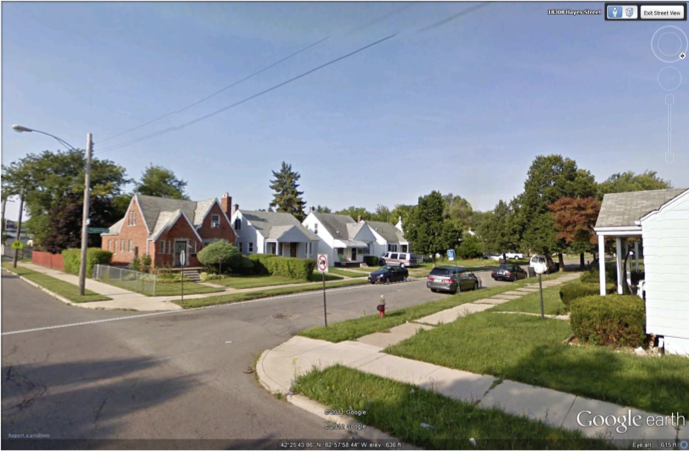
    The second of Pete Saunders’ nine reasons why Detroit failed is “poor housing stock,” particularly its overweighting towards small, early postwar cottages. Here’s a sample:


    Here’s what Pete had to say:

    Detroit may be well-known for its so-called ruins, but much of the city is relentlessly covered with small, Cape Cod-style, 3-bedroom and one-bath single family homes on slabs that are not in keeping with contemporary standards for size and quality…..The truth, however, is that Detroit may have one of the greatest concentrations of post-World War II tract housing of any major U.S. city….True, Detroit has more than its share of abandoned ruins that negatively impact housing prices. But it also has many more homes that simply don’t generate the demand that higher quality housing would. That is a major contributor to the city’s abundance of very cheap housing.

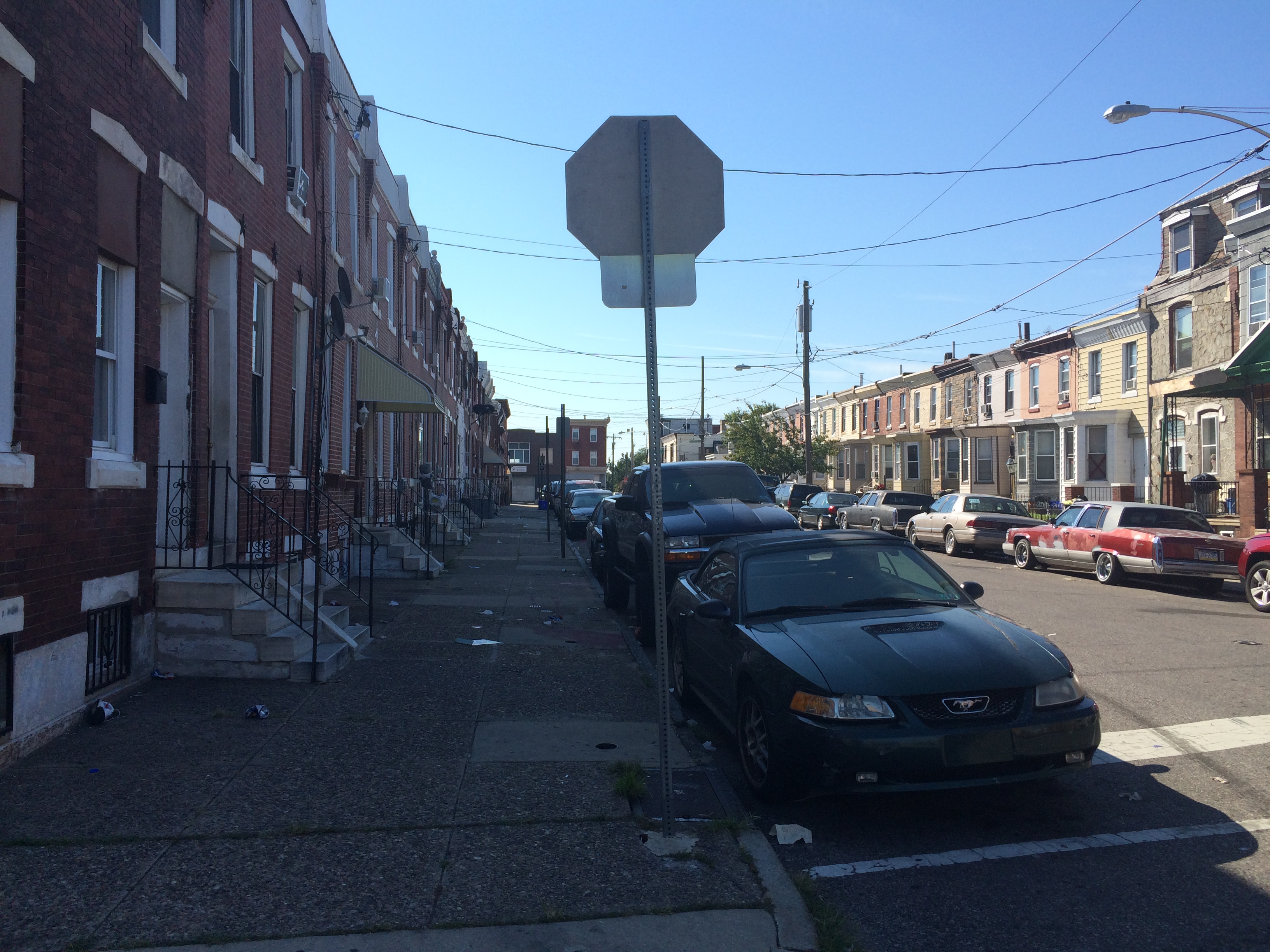
    I have often been struck by the same thing in Philadelphia. There are some districts of great buildings, but most of the city is made up of mile after mile of two-story, very small row houses. Here’s a snap I took in the Kensington neighborhood that provides a sample.

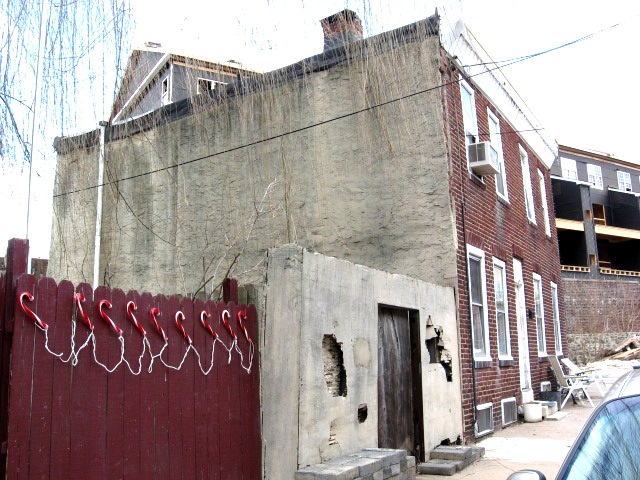
    This is decent density of these to be sure. However, keep in mind that most of these row houses contain a single unit. The Upper West Side brownstone I live in has been converted into ten units. Also, many of these rowhouse units are extremely shallow. Here’s a picture I found online that illustrates a typical depth.

    Photo credit: Flickr/pwbaker CC BY-NC 2.0

    As it happens, there has been some redevelopment activity in Kensington, both in residential and industrial spaces. (Some neighborhoods nearby are seeing significant redevelopment).

    Someone I know recently bought and renovated a rowhouse in the neighborhood, so I got to tour it. It’s a two-bedroom unit, but very small. It’s barely bigger than your average one bedroom apartment. Unsurprisingly, the person who bought it is in her 20s and single.

    As nice as this unit was, it’s basically a starter home, much like those Detroit Cape Cods. Cities need to have housing like that, but if it is overwhelmingly dominant, that’s not healthy.

    It’s similar to how so many downtowns are seeing tons of Millennial targeting apartment construction. Older families can have trouble finding housing in these areas because there isn’t great housing to take you through your full lifecycle.

    Philadelphia should be fine in the near term. The city has great bones and I really find it compelling in a lot of ways. But I wonder if this type of housing stock is one reason the city has seen less demand than other old major tier one urban centers with great transit.

    I put out a poll on Twitter about this and most people didn’t seem to agree with me on the potential negative of being overweight very small rowhouses. We will see how this plays out for Philly.

    Aaron M. Renn is a senior fellow at the Manhattan Institute, a contributing editor of City Journal, and an economic development columnist for Governing magazine. He focuses on ways to help America’s cities thrive in an ever more complex, competitive, globalized, and diverse twenty-first century. During Renn’s 15-year career in management and technology consulting, he was a partner at Accenture and held several technology strategy roles and directed multimillion-dollar global technology implementations. He has contributed to The Guardian, Forbes.com, and numerous other publications. Renn holds a B.S. from Indiana University, where he coauthored an early social-networking platform in 1991.

    This piece originally appeared on Urbanophile.

    Top photo by Aaron M. Renn.

  • Detroit’s Recovery? Oh Yeah, It’s Real Alright

    So it seems the debate has begun.  There’s been enough progress in Detroit to discuss whether its rebound is for real, or not.

    Two academics, Laura Reese of Michigan State University and Gary Sands of Wayne State University, wrote a piece for the Atlantic a couple weeks ago to counter the spreading narrative of Detroit’s comeback.  The article notes the Motor City’s rebound has caught the attention of the national media and parts of academia, but they aren’t so certain that the trend is real, or if it is, whether it’s indeed sustainable.  From the article:

    “These rosy descriptions were not consistent with the reality of what we continued to see in many Detroit neighborhoods. To provide perspective on Detroit’s comeback story, we examined trends in a variety of indicators including population, poverty, income disparities, business recovery, unemployment, residential sales prices and vacancies, and crime.

    Two major conclusions emerged from our data. First, by a number of measures Detroit continues to decline, and even when positive change has occurred, growth has been much less robust than many narratives would suggest. Second, within the city recovery has been highly uneven, resulting in increasing inequality.”

    In response to this article, blogger Lyman Stone added his take on Detroit’s recovery.  He seems to agree with Reese and Sands that, whatever is happening in Detroit, it’s not touching growing numbers of city residents, and therefore it’s not exactly a comeback:

    “I tend to be on team “Abandon all hope ye who enter here.” Saving Detroit is likely to be extremely costly while still holding a high risk of failure, in my opinion. But this view is predicated on a certain perspective of what it means to succeed. To some, success means population decline stops. To some, success means fewer empty buildings. To some, success means balanced municipal finances. To some, success means increasing employment. To me, I tend to think success means that huge population outflows will stop, and that population will begin to rise. Others may espouse other views, but I tend to think a locality’s ability to provide prosperity only matters in a general equilibrium framework, so a place that makes locals rich by culling the herd of non-rich locals is not “succeeding.” Success means that you offer prosperity to a rising share of the general population.”

    However, Stone notes that there are some positive demographic trends that are evident in Detroit, and seems to make the case that if Detroit is to get out of its hole, it’s at least stopping digging.

    The City Observatory’s Joe Cortright took a positive spin on Detroit in the Atlantic, going against the grain of both pieces and suggesting that Detroit’s comeback shouldn’t be dismissed:

    “Is Detroit “back?” As best I can tell, no one’s making that argument. The likelihood that the city will restore the industrial heyday of the U.S. auto industry, replete with a profitable oligopoly and powerful unions that negotiate high wages for modestly skilled work, just isn’t in the cards…

    That said, there’s clear evidence that Detroit has stanched the economic hemorrhage. After a decade of year-over-year job losses, Wayne County has chalked up five consecutive years of year-over-year job growth. True, the county is still down more than 150,000 jobs from its peak, but it has gained back 50,000 jobs in the past five years.”

    Honestly, I think each of the pieces — indeed, most people — underestimate the depths of Detroit’s collapse, and therefore underestimate the significance of its current recovery.  Detroit’s collapse was not simply an economic one, but a cultural, social and demographic one as well.  It lost virtually all connections with the networks of wealth and information that drive economic growth, and the city had such a pervasive negative perception that it was effectively erased from the minds of many.  What’s happening now is Detroit is reconnecting itself to the national and international network of cities, slowly returning to life among the living.  This is a necessary step for Detroit before any rebound that improves the lives of the majority its residents. 

    I view things this way.  While Detroit suffered immensely from the restructuring and decline of the auto industry, it likely suffered even more from demographic collapse.  Four years ago, I wrote a piece that showed the strength of the city’s demographic vacuum.  It’s not just that the city lost jobs and people moved.  People soured on Detroit in ways no other major city experienced, and left behind a city of concentrated poverty. I’ve often brought this graphic out, and it still amazes me:


    To his credit, Joe Cortright gets this in his article.  Where Reese and Sands argue that Detroit’s economic boost in the downtown and Midtown areas and some select nearby neighborhoods is raising income inequality, Cortright responds with a comment from the Brooking Institution’s Alan Berube: “Detroit does not have an income inequality problem—it has a poverty problem. It’s hard to imagine that the city will do better over time without more high-income individuals.”

    And that’s indeed the critical first step for Detroit.  It has to once again attract a critical mass of middle income and upper income residents who are ready, willing and able to invest in the city, before it can effectively take on its greater economic challenges. The post Great Recession recovery we’re witnessing now means the city is getting closer to being able to take on greater tasks.

    Pete Saunders is a Detroit native who has worked as a public and private sector urban planner in the Chicago area for more than twenty years.  He is also the author of “The Corner Side Yard,” an urban planning blog that focuses on the redevelopment and revitalization of Rust Belt cities.

    Top photo source tomabouttown.wordpress.com

  • Detroit’s New Streetlights Show Service Rebuilding in Action

    I’ve been arguing that one thing struggling post-industrial cities need to do is take care of their own business, doing things like addressing legacy liabilities and rebuilding of core public services.

    Last week I write about Buffalo doing just this by completely re-writing its zoning code and creating a new land use map of the city to bring its planning ordinances up to date for the 21st century.

    Michael Kimmelman, architecture critic at the New York Times, recently wrote a feature on another good example: the replacement of Detroit’s entire street light inventory.

    Detroit had 88,000 street lights, but only about half of them worked. Many of them were ridiculously old, some dating to the early 20th century I believe. Many of these were historic and charming as a result, but alas they didn’t work and couldn’t be maintained either. What’s more, thieves kept stealing the wire out of them for the copper.

    The new system consists of 65,000 new LED lamps. As the Times puts it:

    Let’s hope that if anyone writes a history of Detroit’s rejuvenation, a chapter is devoted to the lights returning. Like picking up the trash, fixing potholes and responding to emergencies, these efforts signal that no matter where you live in Detroit, you are no longer forgotten — that government here can finally keep its basic promises.

    This is where the new lights come in. They’re spread all across town. The project cost $185 million, paid by the city and the state. The Public Lighting Authority of Detroit, backed by the mayor, received a critical assist from the Obama administration: Energy Department experts advised local officials to swap out the old, costly, broken-down sodium lamps, which vandals had been stripping bare for copper wire.

    They recommended LED technology. Investments by the Obama administration in energy-efficient lighting have reduced costs, making LEDs feasible for a city like Detroit. Three years ago, nearly half the 88,000 streetlights in the city were out of commission. The more potent LED lights allow the authority to replace those 88,000 old fixtures with 65,000 new ones, strong enough for you to read one of those glossy magazines after dark.

    Detroit said that it needed to actually deliver high quality services to its residents. Streetlighting is literally a high visibility service. And unlike some human services areas or economic development, it’s a straightforward piece of physical infrastructure that should be well within the ability of the city to actually deliver. And the new lighting authority did deliver:

    The whole thing came in under budget and on time. When was the last time anyone could say that about a major infrastructure project in Detroit? “An example of how good government should work,” as Lorna L. Thomas, chairwoman of the lighting authority, put it at the switch-flipping ceremony.

    It’s also an example of how one smart urban-design decision can have ripple effects. Some residents here grumbled about fewer lights. That said, the stronger new ones turn out to save Detroit nearly $3 million in electric bills. They use aluminum wiring, which nobody wants to strip, discouraging crime. The technology even cuts carbon emissions by more than 40,000 tons a year — equivalent to “taking 11,000 cars off of your streets,” [said Shaun Donovan].

    Part of creating a willingness to spend more money on government is recreating a sense that government is actually competent. Delivering a project on time, under budget, that will save millions in operating costs, reduce theft, and be more environmentally friendly is a step in the right direction.

    I’m not the biggest fan of LEDs and might be with the grumblers on wanting a higher density solution. But my preferences for gold level services aren’t always realistic. This appears to be a high quality, cost effective solution the city should feel good about. Other post-industrial cities should take note.

    Click over to read the rest of the Times piece.

    Image via Laura McDermott/The New York Times

    Aaron M. Renn is a senior fellow at the Manhattan Institute, a contributing editor of City Journal, and an economic development columnist for Governing magazine. He focuses on ways to help America’s cities thrive in an ever more complex, competitive, globalized, and diverse twenty-first century. During Renn’s 15-year career in management and technology consulting, he was a partner at Accenture and held several technology strategy roles and directed multimillion-dollar global technology implementations. He has contributed to The Guardian, Forbes.com, and numerous other publications. Renn holds a B.S. from Indiana University, where he coauthored an early social-networking platform in 1991.

  • Carrier and the Commonwealth

    I was asked by Fortune to contribute a piece about Trump’s Carrier deal. They had gotten a lot of people criticizing it and were looking for someone who would give a different perspective. I think many of the criticisms are valid in a sense, but miss the larger context. So I wrote the piece which is now online. Here’s an excerpt:

    Alexis de Tocqueville pointed out that one of the keys to America’s unique success was its sense of enlightened self-interest. Americans worked and competed hard for themselves, their families, and their businesses, but they understood that a purely selfish mindset was self-destructive in the long term. Tocqueville observed inDemocracy in America, “Each American knows when to sacrifice some of his private interests to save the rest; we [the French] want to save everything, and often we lose it all.

    Businessmen once understood this link between national, local, and personal success. The men of the Commercial Club of Chicago who commissioned Daniel Burnham to create his famed 1909 plan for that city had personal fortunes deeply tied to Chicago. They needed the city as a whole to succeed for them to succeed. Likewise, General Motors CEO Charles Erwin Wilson once famously said, “For years I thought what was good for our country was good for General Motors, and vice versa.” He understood that his company’s fortune and America’s were intertwined: GM couldn’t make any money if no one could afford to buy its cars.

    As these restrictions were lifted, these businesses left enlightened self-interest behind in favor of quarterly profits. They forgot their community in favor of global capital. Their business models evolved to delink profits and executive compensation from broad-based American prosperity. They could take a portfolio view of local communities and even countries. It was all very economically efficient. These firms and their managers could thrive even while much of America fell into ruin. Or so they thought.

    Click through to read the whole thing.

    Some people were a bit critical, saying, “Why not say this when Obama bailed out the auto industry?” or “Why is it only good when Trump does it?” In fact, I’ve actually written on this theme before.

    Back in November 2008, shortly after Obama’s election, I posted a piece in which I criticized the auto companies’ management and came out in favor of a federally backed restructuring of the auto industry. While I am critical of some aspects of how Obama handled this, the idea of bailing out the car companies was something I was on record as supporting before it happened. Here are some excerpts from that:

    Even if you assume a lot of this [auto company management behavior] is exaggerated for effect or outright BS, I’ve heard so many similar type things from people who’ve been associated with the auto industry that there must be a kernel of truth in it somewhere. I lead with this because it is so common to blame the UAW and its $73/hour or some such wage packages for the problems facing the Big Three. And indeed in the modern era that is not sustainable. But there has been particularly little focus on the management excesses of the auto industry, and the corporate cultures of those companies, and by analogy that of Detroit.

    I’ve seen estimates that 2-3 million jobs could be lost and that chaos would ensue if the auto makers went bankrupt. That’s probably true if GM, Ford, and Chrysler just waltz down to the court house and file. But it is not the case if they have a government sponsored, pre-packaged bankruptcy.

    Even so, we can’t lose track of the fact that there are real human beings, labor and management, with real trauma in their lives. Even if they are at least partially to blame for the mess they are in, that doesn’t mean they deserve what they are getting. It’s like a Greek tragedy: the suffering is disproportionate to the crime. And there but for the grace of God go you and I. I also work in a restructuring industry, and may yet join the auto workers in their pain.

    The stories you hear in the Detroit papers are heartbreaking. One that really stuck with me was about people losing their life’s possessions when they couldn’t pay the rental fees on storage lockers. People who had already lost their homes to foreclosure put their possessions in storage, only to lose them too as the storage companies auctioned them to pay the bills. I’m not an emotional guy, but this makes me sick to my stomach. I don’t know about you, but I don’t think this should be happening in a country like America. People who made decisions in good faith, who showed up to work every day, who did the right things to care for their families, shouldn’t be left to lose everything because of the action of economic forces they can’t understand or control. Not in America. That’s why we absolutely need a federal safety net program here. Michigan alone can’t fund this.

    I probably anticipated more of a bite the bullet approach than actually happened (which is one reason restructuring is still ongoing), and my views have probably changed somewhat in eight years, but clearly the same general themes are present.

    Where I would take issue with Trump, is in the idea of “bringing the jobs back” as the theme. This sort of nostalgia for a bygone idyllic era that never really was is powerful in the Midwest. It’s very backwards looking and based on a language of resentment. I can understand why the appeal to this works rhetorically, but as an actual policy goal it’s not realistic. The ship has already sailed too far to return to the harbor. That doesn’t mean we should double down on the status quo, but we’ll have to chart a different path forward to the future, not roll back the clock. (Fortunately, Trump’s working class supporters seem realistic on this point and don’t expect him to literally do every single thing he said).

    This perhaps explains why I’m more positive on intervention to save existing jobs than to try to lure new ones. That and the difference in the price tags. It’s one thing to try to preserve actually existing businesses already woven into the fabric of the community, but it’s another to try to speculatively create something new. I’m not under any illusion that we’ll get rid of economic incentives, but it does seem excessive to me to spend, say, $750 million (corruptly, as it appears to have turned out) to lure a solar panel factory to Buffalo. I’m ok with the idea of spending a billion dollars of state money in Buffalo, but there have to be better ways to do it. (Mayor Stephanie Miner of Syracuse said if she had a billion, she’d spend three fourths of it to fix her city’s water pipes – a prescient pledge made prior to the Flint debacle).

    It’s also the case that we need to be willing to face the unpleasant reality that many communities are poorly positioned for the future economy. That doesn’t mean abandoning them, but we do have to level with them. And those communities, not just the federal government, also need to be willing to make some changes.

    But all that doesn’t mean that simply pushing forward with more of what we’ve already been doing is a viable option. Trump understood that, and beyond the politics of it, the Carrier deal was a symbol that he intends to pursue a new direction.

    Update: In line with these themes, a commenter pointed me at this recent blog post by South Bend mayor Pete Buttigieg.

    Aaron M. Renn is a senior fellow at the Manhattan Institute, a contributing editor of City Journal, and an economic development columnist for Governing magazine. He focuses on ways to help America’s cities thrive in an ever more complex, competitive, globalized, and diverse twenty-first century. During Renn’s 15-year career in management and technology consulting, he was a partner at Accenture and held several technology strategy roles and directed multimillion-dollar global technology implementations. He has contributed to The Guardian, Forbes.com, and numerous other publications. Renn holds a B.S. from Indiana University, where he coauthored an early social-networking platform in 1991.

    Photo: By Carrier Corporation (http://www.teamworkmarinesxm.com/) [Public domain], via Wikimedia Commons

  • A Capital Improvement and Revitalization Idea for Detroit

    You may have heard that Detroit is in the midst of a modest but enduring revival in and around its downtown. Residents and businesses are returning to the city, filling long-vacant skyscrapers, prompting new commercial development and revitalizing adjacent old neighborhoods. As a former Detroiter I’m excited to see the turnaround. After so many false starts, Detroit’s post-bankruptcy rebound seems very real.

    However, there seems to be a growing awareness that the city’s current revival has its limits. On one hand, what’s happening now in Detroit could be considered a rather elongated recovery for the city instead of growth, as the city races to catch up with cities that have had a 20-year head start on urban revitalization. One could argue that the Motor City is slowing losing its taint, and the investment that’s coming to the city now is investment that never left, or never left at such a scale, in other cities. Maybe its reclamation rather than revitalization.

    But more broadly speaking, there’s a sentiment that the city’s revival hasn’t been inclusive. In a majority-black city, startlingly few African-Americans appear to be involved in the rebound, either as developers, homebuyers or even consumers of new amenities. Because of this, two vastly different kinds of fears seem to trouble much of the city’s black community — the revitalization could burn through the city like a wildfire and lead to widespread displacement, or the rebound could peter out before it has a chance to transform even more of the city.

    How can that be? Maybe because people and businesses are coming back not because of an economic change in the city, but a socio/cultural one. Detroit is still the Motor City, and that won’t change anytime soon. Detroit will remain the headquarters of American auto production and be a key manufacturing center for generations to come, and it will continue to ride the wave of manufacturing ebbs and flows. That’s why I say the economy is driving little of what’s happening in Detroit today. The Big Three are only eight years away from a true existential threat, and are still in the process of righting the ship. By my eyes, Detroit still hasn’t found a new economic raison d’etre that could vault it into the next phase of its development.

    As the fears that drove white and middle-class flight from the city from the 1960’s onward recede into the distant memory, many people are willing to reconsider Detroit and return.

    Detroit is at an interesting juncture in its history. After 125 years of focusing on its national and global economic prominence and leaving city-building behind, maybe now Detroit can focus on being a thriving, livable city. For everyone. There is an opportunity for Detroit to build on its rich urban design legacy to include more of the city, and more of its people, in its revival. There is an opportunity to set the stage for good — even innovative — urban development in the Motor City as the city continues to search for a new economic catalyst.

    I believe the city should undertake a capital improvement/revitalization plan that utilizes its grand arterial streets — Gratiot, Woodward Grand River and Michigan avenues — and Grand Boulevard, the parkway necklace around the city’s inner core, as assets and foundations for growth. After that, the city could extend similar improvements to the locations where the arterial streets intersect with the defunct Detroit Terminal Railroad, further out from the city center. Finally, the improvements could be extended even further outward to Detroit’s other boulevard necklace, Outer Drive, near the city limits. Just as interstate highway development had the net impact of opening up outer bands of suburbia to city residents, this plan could open up languishing parts of the city for revitalization.

    Here’s the five-phase process:

    • Transform Gratiot, Woodward, Grand River and Michigan avenues into true boulevards — landscaped medians, streetscaping, wide sidewalks, bike lanes, etc. — from their sources in downtown Detroit to their intersections with Grand Boulevard.

    • Establish public squares where each new boulevard intersects with Grand Boulevard.

    • Develop a connected greenway along the path of the former Detroit Terminal Railroad.

    • Extend boulevard treatment along Gratiot, Woodward, Grand River and Michigan avenues to a new terminus at Outer Drive.

    • Complete and connect Outer Drive where necessary, and establish new public squares where the boulevards intersect with Outer Drive.

    Each step of the plan would include zoning changes along the affected areas with the intent of increasing residential and commercial development choice, and send a signal that the city is ready for transformation.

    Here’s how this project would look conceptually, looking at the entirety of Detroit:

    image of detroit

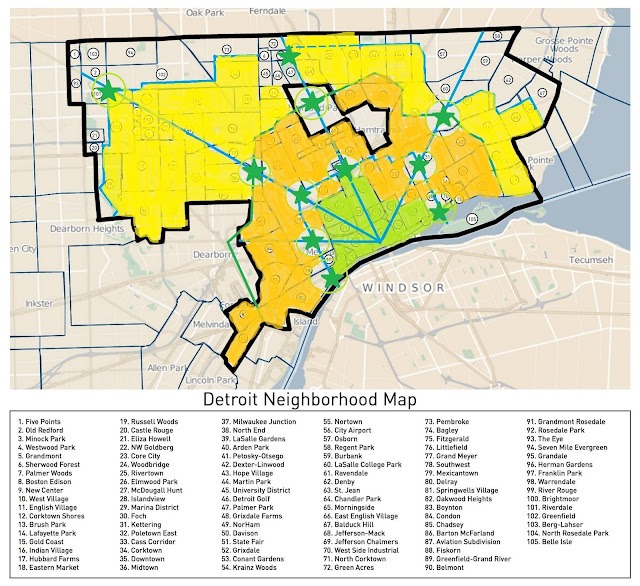
    First, please excuse my crude Microsoft Paint illustration. Hey, it serves its purpose. Second, let’s consider the broad areas of the city highlighted in various colors. The green areas are the downtown and downtown-adjacent areas that have been experiencing a pretty significant rebound over the last 5-10 years. In fact, you could say that revitalization took hold there with the opening of the Comerica Park baseball stadium in 2000 and the Ford Field football stadium in 2002. This area also includes the Midtown area north of downtown that includes Wayne State University and a host of city cultural institutions. The orange areas are the parts of the city that capture the dystopian imagination of Detroit. This area is quite — but not totally — abandoned, where much of the city’s older residential and industrial treasures have been lost. There’s still some intact neighborhoods that have a solid walkable foundation, but they’re often disconnected from each other by some serious abandonment. The yellow areas are the areas that might be described as imperiled; they could soon look like the orange zone if action isn’t taken, and in fact some parts of it (like the Brightmoor neighborhood, on the far west side, are quite abandoned already). The gray or uncolored areas on the far northeast and northwest edges of the city represent the most stable residential neighborhoods of the city, but they, too, are threatened by the challenges experienced by the rest of the city.

    When you hear Detroiters expressing concern that downtown revitalization isn’t reaching the neighborhoods, they often come from the yellow and gray/uncolored areas, with fewer and fewer voices coming from the relatively open orange areas. Viewed this way it can be understood that people see the city’s rebound as having a low ceiling; there is a half-empty quarter that sits between them and the promise of revitalization.

    My idea is to utilize strategic infrastructure investment and zoning reform to attract new development to key corridors, utilizing the city’s radial network. The radial blue lines on the map emanating from their intersection downtown represent (clockwise, from the left) Michigan, Grand River, Woodward and Gratiot avenues. The blue line that connects them, just outside the green revitalization area, is Grand Boulevard. The blue line that connects the radial streets further out is Outer Drive. The green stars represent public squares or plazas that could be built, and the light green circles indicate an approximate extent of impact outward from the squares or plazas. The green line that serves as the dividing line between the yellow and orange areas is the Detroit Terminal Railroad, and it would become a connecting trail.

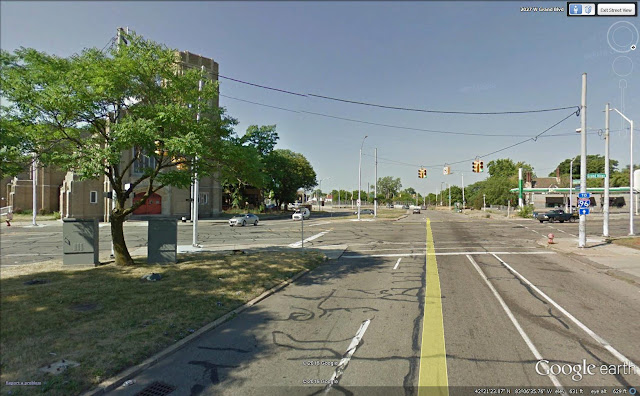
    Detroit was blessed early on with an excellent radial street system, but it quickly abandoned it as growth took hold in the early 20th century. Detroit missed an opportunity for grand public spaces at the same time that other cities were incorporating them into their urban fabric — and those public spaces became the foundation for their rebound. Consider this image, where Grand River Avenue intersects with Grand Boulevard:

    google image of grand river avenue intersecting with Grand Boulevard

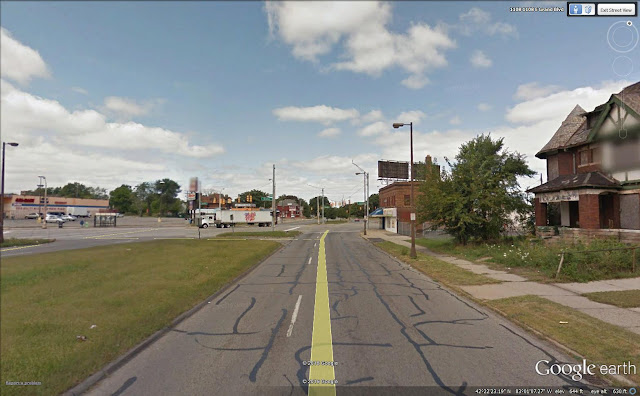
    Or, worse yet, where Gratiot Avenue and Grand Boulevard meet:

    google image of Gratiot Avenue and Grand Boulevard

    This was a missed opportunity for Detroit to have majestic entryways into neighborhoods beyond the city center. This was also a missed opportunity to develop areas that could become more mixed use and multifamily in character, as opposed to the dominant single-family home city that Detroit is today.

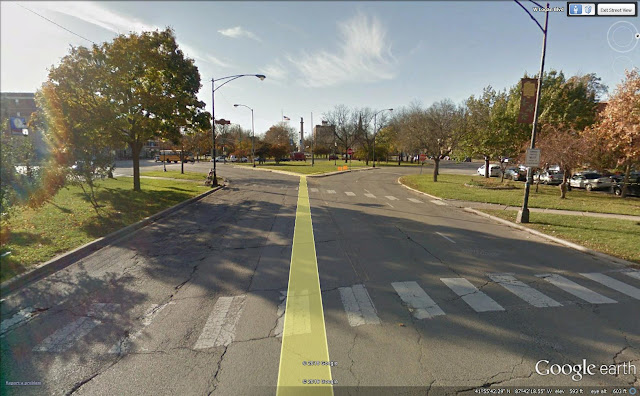
    If Detroit had the foresight 100 years ago to make strategic infrastructure investments, it could have put in place something like Chicago’s Logan Square, located at Milwaukee Avenue and Logan Boulevard (also a radial street and boulevard intersection):

    google image of Chicago's Logan Square

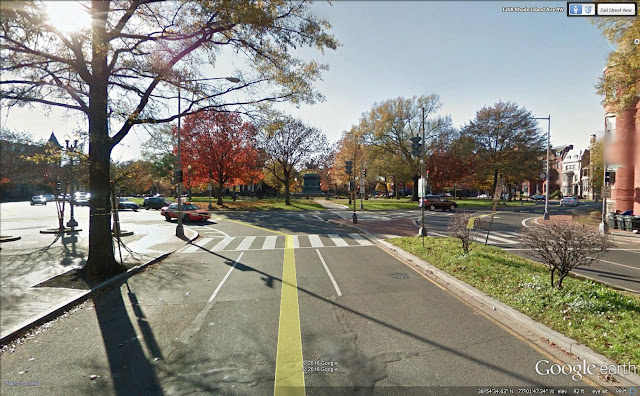
    Or Logan Circle, in Washington, DC:

    google image of Logan Circle

    The public squares on the radial avenues could have the effect of drawing development and revitalization outward from the city center, as has happened in Chicago and DC. This could continue outward to the DTR trail and Outer Drive, if the city sees success in such a measure, finds the appropriate resources and desires to extend it further.

    Detroit should certainly see the merits of such an investment. The city renovated and rededicated a new Campus Martius Park in 2004, and it has become a focal point for downtown revitalization.

    Without a doubt, this would be a costly measure, maybe even a folly for a city just out of municipal bankruptcy and still struggling to provide basic city services. that’s why I would envision this as a long term proposal, perhaps a 10-year project.

    That’s the basis of the idea. I’ll follow up with more details soon.

    Top photo: detroit.curbed.com

    Pete Saunders is a Detroit native who has worked as a public and private sector urban planner in the Chicago area for more than twenty years.  He is also the author of “The Corner Side Yard,” an urban planning blog that focuses on the redevelopment and revitalization of Rust Belt cities.

  • Homesteading Detroit

    I was in Detroit recently for the Congress for New Urbanism, the Strong Towns gathering, and a Small Developers Workshop. I used Airbnb instead of the corporate hotel option while in town.


    c5c26459-7aac-4bb9-8551-4f32bbe3ee04

    IMG_3272 (1024x683)

    3d8901d3-8940-41c7-b3ee-3f1ab363ef85

    dc613c34-9a0e-4703-a6b2-f617c096ad49

    e295af4c-4a56-4511-8a36-f51d779bff0a

    66b0716b-00d9-4a6c-bff8-248ad7e70d50

    dff01bb7-2176-4b01-8a4c-60199b81f376

    IMG_3340 (1024x683)

    This is what $13,000 buys you in Detroit. Well… $13,000 and four years of blood, sweat, and tears. Detroit allows people with the right attitude to substitute personal effort for money. This solid brick century old duplex is within bicycle distance of downtown and it came with the adjacent vacant lots. This young couple paid cash from savings and is homesteading in the city. They live upstairs and rent out the downstairs to visitors like me.

    IMG_3251 (1024x683)

    IMG_3261 (1024x683)

    IMG_3132 (1024x683)

    IMG_3188 (1024x683)

    When people have a spacious comfortable place to live with no rent or mortgage they have time to pursue their real interests. Gardening, woodworking, metalworking, fashion, painting…

    IMG_3087 (1024x683) (2)

    87333c7d-b83c-488e-942c-0de9c1ac2d9d

    58e21315-c170-4107-b1ac-9a446e914272

    IMG_3229 (1024x683)

    IMG_3203 (1024x683)

    Instead of taking jobs that would chain them to someone else’s schedule and values the couple continuously cultivates small ventures from their home. The internet allows them to reach out to a global customer base with their Frontier Industry.

    IMG_4695 (1024x683)

    IMG_4702 (1024x683)

    IMG_4795 (1024x683)

    IMG_4782 (1024x683)

    IMG_4709 (1024x683)

    I’ve said this before. I’ll say it again. If you’re tired of spending $1,000 a month for your share of a rented two bedroom apartment with five room mates in Brooklyn or San Francisco… do what Americans have always done. Hitch up your Conestoga wagon and head out to the territories. It’s a big country. Be a pioneer.

    John Sanphillippo lives in San Francisco and blogs about urbanism, adaptation, and resilience at granolashotgun.com. He’s a member of the Congress for New Urbanism, films videos for faircompanies.com, and is a regular contributor to Strongtowns.org. He earns his living by buying, renovating, and renting undervalued properties in places that have good long term prospects. He is a graduate of Rutgers University.

  • The Evolving Urban Form: Detroit

    Probably no city in the high income world evokes impressions of urban decline more than Detroit — and for good reason. The core city of Detroit has lost more of its population than any developed world city of more than 500,000 since 1950. The city’s population peaked at 1,850,000 residents in 1950 and at its decline rate since 2010 could drop below 650,000 residents by 2020 census.

    It was not always this way. During the first half of the 20th century Detroit was one of the fastest-growing core cities in the United States. Among the 20 largest core cities in 1950, only Los Angeles grew faster, percentage wise, than Detroit. The city of Los Angeles grew from 102,000 in 1900 to 1,970,000 in 1950. The city of Detroit almost matched that, growing from 286,000 to 1,850,000.

    The city’s nearly 1.6 million population increase exceeded that of all other US municipalities except Los Angeles, Chicago and New York, which grew at an unprecedented pace over the period, adding more than 4.5 million residents.

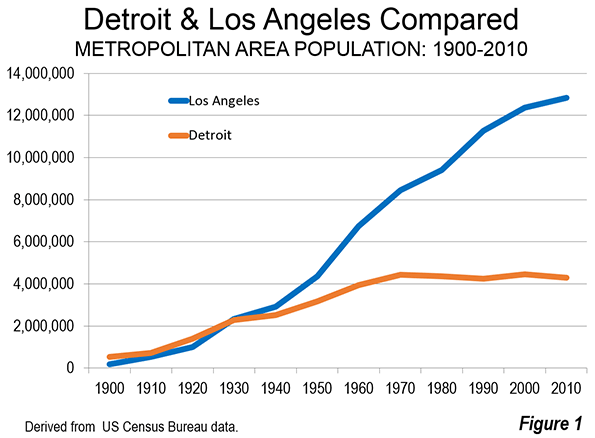
    The current defined area of the Detroit metropolitan area grew by 1950 to nearly 6 times its 1900 population, to 3,170,000 from 530,000. The growth of the metropolitan area from 1900 to 1940 closely tracked that of the fast growing Los Angeles metropolitan area, which widened its lead substantially through the end of the century (Figure 1). The Los Angeles area, which was only slightly larger than the Detroit area in 1940 reached a population of more than three times that of Detroit by 2010

    The city of Detroit began to lose population after 1950. It lost 180,000 people between 1950 and 1960 and   approximately 155,000 between 1960 and 1970. The 1970s were a particularly bad time for the many large core cities, and Detroit lost more than 300,000 people, or 20% of its population by 1980. But if Detroit was exceptional, it was not alone; virtually all large US core cities that did not annex territory between 1950 and 1980 lost population.

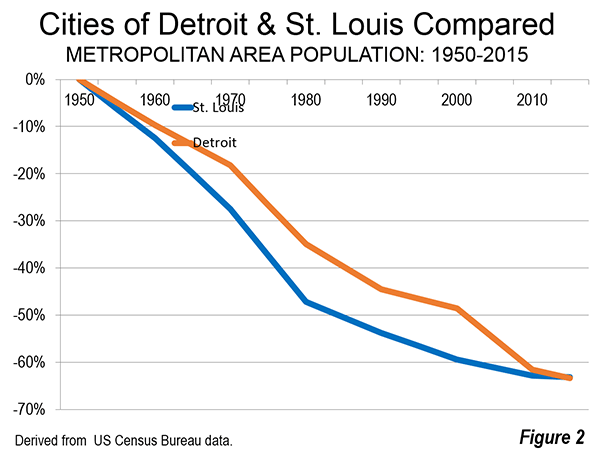
    In fact, Detroit’s loss was not even the worst. During the 1970s, the city of St. Louis lost 27% of its population, dropping to little more than half its 1950 size, from 857,000 to 452,000. At this point and through 2010, St. Louis had the less than enviable record of the largest population loss for a major high income world municipality. As of 2010, the city of St. Louis had lost 62.8% of its population, more than the city of Detroit’s 61.6% (Figure 2).

    But things were about to change. Between 2010 and 2015 the decline rate in both cities was moderated. But city of Detroit’s loss was large enough to wrest away the title for the largest decline from the city of St. Louis. According to the US Census Bureau’s 2015 estimates, Detroit has lost 63.3% of its population since 1950 while St. Louis lost somewhat less, at 63.1%.

    Having spent considerable time in both cities, however, one does not get the same sense of urban devastation in St. Louis as in Detroit. The urban decline of city of St. Louis has been far more graceful than the city of Detroit. A long-time Detroit and St. Louis resident and commentator writing in the St. Louis Beaconcalled the differences “quite striking,” noting that Detroit’s devastation was far wider spread and that neighborhoods continue to thrive in large parts of the city of St. Louis.

    Obviously, Detroit has faced huge challenges and probably greater challenges than St. Louis or the Rust Belt cities of Pittsburgh, Cleveland and Buffalo. Indeed, one of Pittsburgh’s strengths is its strong civic community downtown, with its large banks, its still strong neighborhoods and striking physical location. One of Detroit’s banks moved its headquarters to Dallas.

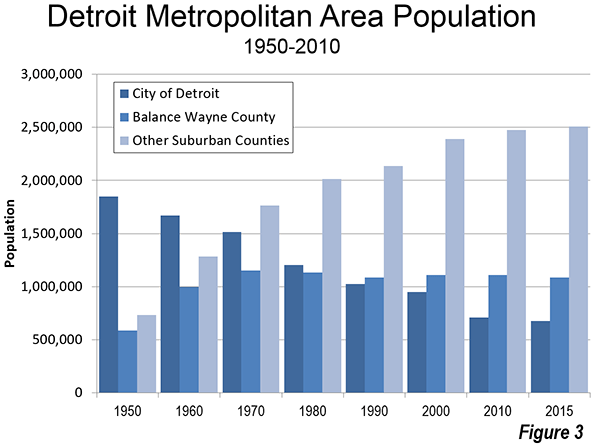
    Figure 3 graphically illustrates the population trends in the Detroit metropolitan area since 1950. The city of Detroit’s massive loss is indicated by the first bar for each year. But despite the city’s losses between 1950 and 1970, totaling more than 340,000 residents, the balance of Wayne county (of which Detroit is the county seat) nearly doubled in population, from 585,000 to 1,150,000. However, since that time, suburban Wayne County (outside the city of Detroit) has stagnated downward to 1,088,000 residents (Figure 3).

    The other suburban counties have done far better. The largest of these are Oakland County to the northwest of the city and Macomb County, which is straight north from downtown. Since 1950, Oakland County has grown from 400,000 residents to nearly 1.25 million in 2015. Macomb County, famous for the “Reagan Democrat” blue-collar worker vote, grew from 190,000 in 1950 to 860,000 in 2015. The smaller counties of Lapeer, Livingston and St. Clair also expanded strongly. Overall, the suburbs outside Wayne County grew by 240%, from 735,000 in 1950 to more than 2.5 million in 2015.

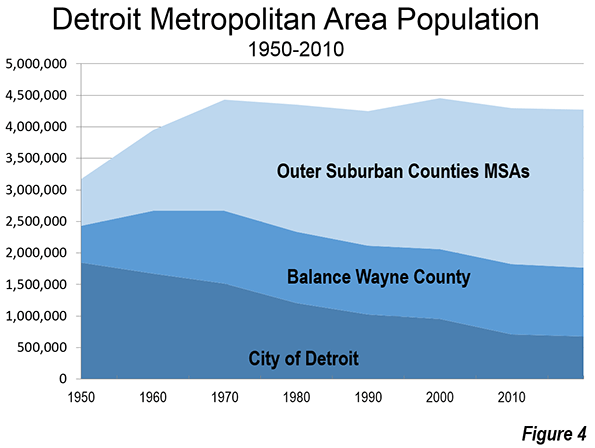
    Early on, the metropolitan area continued to add people strongly. Between 1950 and 1970, the metropolitan population rose by 40%, to more than 4.3 million. The population dropped in both the 1980 and 1990 censuses. But in 2000, a new peak of 4.45 million was reached. The metropolitan area losses resumed with lower figures indicated for the 2010 census and in the 2015 estimates (4.275 million). The "ups and downs" of the metropolitan population are illustrated in Figure 4.

    Given my own experience, the decline of Detroit is particularly surprising. As a consultant to Oakland County Executive Daniel T. Murphy between 1985 and 1990, I had the pleasure of witnessing firsthand cooperative efforts between the suburban leadership and the city of Detroit (under then Mayor Coleman Young) on transportation issues. Murphy and Young had established a regional cooperative process referred to as the "Big Four" along with Wayne County Executive Bill Lucas and then Wayne County Executive Edward H McNamara (and current Detroit mayor Mike Duggan, who was Deputy County Executive), along with the leadership of the Macomb County Commission. It was clear to me that there was a very real commitment on the part of all four to deal with the pressing problems of the area.

    The good news is that there are signs of a turnaround in Detroit. I doubt we will ever see Detroit return to a its peak population of 1.85 million or even 1 million. Even the lower figure would require a reversal unprecedented in developed world urban history, made far more unlikely by the slow population growth of the Upper Midwest and laggard fertility rates nationally. (Note). But, for the first time in decades, there are signs of hope out of the city and its leadership. Good luck, city of Detroit and Mayor Duggan.

    Note: See Wendell Cox, “International Shrinking Cities, Analysis, Classification and Prospects,” in Harry W. Richardson and Chang Woon Nam, Shrinking Cities: A Global PerspectiveRoutledge, 2014.

    Wendell Cox is principal of Demographia, an international pubilc policy and demographics firm. He is a Senior Fellow of the Center for Opportunity Urbanism (US), Senior Fellow for Housing Affordability and Municipal Policy for the Frontier Centre for Public Policy (Canada), and a member of the Board of Advisors of the Center for Demographics and Policy at Chapman University (California). He is co-author of the “Demographia International Housing Affordability Survey” and author of “Demographia World Urban Areas” and “War on the Dream: How Anti-Sprawl Policy Threatens the Quality of Life.” He was appointed to three terms on the Los Angeles County Transportation Commission, where he served with the leading city and county leadership as the only non-elected member. He served as a visiting professor at the Conservatoire National des Arts et Metiers, a national university in Paris.

    Photo: downtown Detroit

  • When Detroit Stood Tall and Shaped the World

    My recent post about how urban planning decisions helped lead to the Motown sound in Detroit was inspired by David Maraniss’ new book Once in a Great City: A Detroit Story.

    The book takes a deep dive into Detroit 1963, a city that was, although in some ways already in decline, in others near its zenith.

    It’s a great read, in particularly for the depth of characterization. Too often Detroit writing is a story of heroes, villains, and victims. Maraniss rejects that approach and provides mostly nuanced portrayals of Detroiters that allows them to be the actual real, red-blooded human beings that they are.

    I just posted a review of the book over at City Journal.  Here’s an excerpt:

    In his new book, Once in a Great City: A Detroit Story, Pulitzer Prize winner David Maraniss takes a fascinating and engrossing look at the Motor City during this fateful year. Under Henry Ford II (“the Deuce”) and hard-charging salesman Lee Iacocca, the Ford Motor Company was set to unveil its revolutionary Mustang. The civil rights struggle was creating tensions in Detroit and elsewhere, but Mayor Jerome Cavanagh was committed to addressing discrimination and reforming the police. Detroit was about to transform the American musical landscape with Motown Records, whose roster of superstar artists included Smokey Robinson, Diana Ross and the Supremes, Stevie Wonder, and Marvin Gaye. The United States Olympic Committee even nominated Detroit as the American representative to host the 1968 summer Olympics, though it lost out to Mexico City. On the more dubious side, the mafia had a powerful presence in the Motor City, where colorful mob boss Tony Jack Giacalone rode around town in his garish “Party Bus” painted blue and silver, the colors of the NFL’s Detroit Lions.

    Click through to read the whole review or buy the book.

    Aaron M. Renn is a senior fellow at the Manhattan Institute and a Contributing Editor at City Journal. He writes at The Urbanophile, where this piece originally appeared.