Tag: Detroit

  • Visions of the Rust Belt Future (Part 1)

    “Men often applaud an imitation and hiss the real thing”–Aesop

    There are interesting developments being played out in the Rust Belt. Some cities, like Detroit, seem to be embarking whole hog down the creative class path. Others, like Pittsburgh, have their own thing going on, a thing Economic Geographer Jim Russell has delineated as the “Rust Belt Chic” model of economic development, with no modest amount of success. How a given Rust Belt city reinvests will have a large say in its future.

    Part 1 of this series, below, examines the nascent creative classification of Detroit. Part 2 analyzes whether or not there is a new way forward for post-industrial cities, using the lessons from Pittsburgh and Cleveland as the building blocks to developing an alternative set of strategies for struggling cities.

    Detroit Rock (Ventures) City

    In Detroit, the scene is playing out as such: rampant disinvestment in the core and extreme poverty around it. To help fix this, ties between Rock Ventures head and real estate billionaire Dan Gilbert, urbanist Richard Florida, and the non-profit Project for Public Spaces have been initiated. The goal, laudable enough, is to reinvest in downtown. And while the renewal formula planned is not new, the extent that the milieu is a controlled environment for an urban experiment is perhaps ahistorical, if only because Detroit’s level of disinvestment has created a vacuum that, naturally, power abhors.

    To wit, a recent New York Time’s article entitled “A Missionary’s Quest to Remake Motor City” hints at the level Dan Gilbert—who  has bought $1 billion in downtown property in what has been called a “skyscraper sale”—and his advisors have been handed the keys:

    “My job,” said Dave Bing, the Detroit mayor and former National Basketball Association star, “is to knock down as many barriers as possible and get out of the way.”

    And:

    “Mr. Gilbert met in a conference room for his twice-a-month Detroit real estate meeting, with about a dozen people who work for him, plus a lawyer and leasing agent. If Detroit 2.0, as this group often calls the effort, has a planning committee, this is it.”

    And:

    “[H]e and his staff will apparently have a largely free hand.”

    Now, the plan, and how the plan for Detroit’s future came about.

    A wealthy investor, Dan Gilbert, buys downtown properties. That investor goes on the record as to the importance of reinvesting into the urban core. That investor moves his mortgage company’s employees from suburban office parks into his own downtown real estate. Then, the investor, taking cues from his consultants, throws in something about innovation, which, at its lowest common denominator, means designing your way to a “culture of innovation”. Thus, the investor encourages that Romper Room-style office setting complete with what some would say is tacky décor wholly out of line with the soul of “the D”, but yet which is said to fun-birth inspiration—i.e., “[A] karaoke machine sat in an aisle. Guys threw footballs to one another; one employee shot at colleagues with a Nerf gun”; and “A Quicken promotional video solidifies the company’s attempts at over-the-top marketing, prominently featuring the space’s inexplicable Pac-Man theme”—despite the fact that your primary product line, i.e., mortgages,  needs far less innovation than it does a modicum of conventionality and ethics. Nonetheless, the sentiment of creative destruction is there.
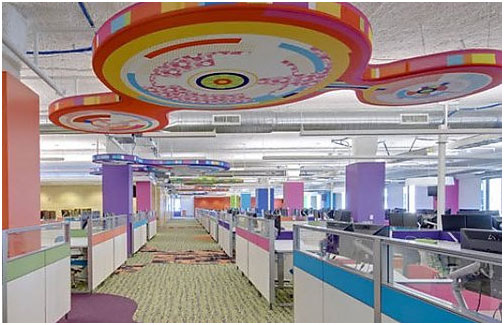

    This basic process, then, is multiplied out from the office setting into strategic urban space, particularly around Gilbert’s real estate. The idea here is to design space so as to create vibrancy so as to galvanize commerce so as to ignite broad economic growth.

    Enter the partnership with the Project for Public Spaces, who is working with Gilbert’s group to do a set of “Lighter, Quicker, Cheaper” placemaking interventions, including pop-up shops. The conceptual girth behind the plan, according to a recent article “Detroit Leads the Way on Place-Centered Revitalization”, is described as such:

    “We proposed developing a Placemaking vision for the major public spaces, and refining the plan through the Power of 10 concept,” says Meg Walker, a Vice President at PPS who worked on the project. “…A lot of developers aren’t as enlightened as Dan Gilbert…they wouldn’t necessarily think about the glue that’s holding this all together.”

    “The Power of 10 framework suggests that a great city needs at least ten great districts, each with at least ten great places, which in turn each have at least ten things to do. Great public spaces produce an energy and enthusiasm that spills over into surrounding areas…

    With the conceptual description as a guide, this is a classic case of the urbanists’ version of trickled-down economics, in which an influx of capital into finite corridors is meant to attract wealth that “spills over” into surrounding areas. Unfortunately, there is little by way of evidence that this works, as was recently admitted by Richard Florida himself. What it may do, however, is fill real estate supply by pursuing a select target market, as placemaking can act as a grease to create pockets of creative class demand to support condos or retail and office space. And while one can certainly argue it beats rampant core disinvestment, it’s not the path of a bold new way that will measurably change the trajectory of Detroit, so says U of M Professor Michael Gordon. In effect, it’s simply shifting people from one set of real estate to another, with nothing undertaken on a systemic level to tackle Detroit’s real problem: poverty and disenfranchisement in its neighborhoods. Worse, re-urbanization as such is likely to exacerbate class and race divides that have plagued Detroit for decades, thus worsening Detroit’s real problem: poverty and disenfranchisement in its neighborhoods.

    Besides, we have been here before. Michigan via its Cool Cities campaign had a plan based off the same Detroit 2.0 premise, switch out the window dressing. Design place, accrue vibrancy, growth wealth. Obviously, the multi-million dollar economic development initiative didn’t work. Neither have similar initiatives across the whole of the Rust Belt.

    So, where’s the beef? What makes Detroit 2.0 different?  

    Naturally, this is where the economic development buzzwords “start-up” and “tech district enter into the Detroit 2.0 lexicon; that is, creating dense city areas will nurture spontaneous interactions that will foster Detroit’s innovation community, putting it firmly on the path to be the “Silicon Valley of the Midwest”. But every city wants this (or at least they are informed they do)—e.g., “Miami Wants to Be the Next Big Start-Up City”—and so the effort ultimately comes off as anything but visionary, rather visionless, trying.

    Cue the Onion. From an article entitled “St. Louis Mayor Has Sad Little Plan For Turning City Into High-Tech Hub”:

    In what appears to be a completely earnest attempt to revitalize a sluggish local economy, St. Louis mayor Francis G. Slay unveiled Thursday a detailed, ambitious, and truly depressing plan to turn his city into a major technology hub. “We’re going to show America, and the rest of world, just how innovative and cutting-edge St. Louis can be,” said the mayor, who displayed genuine optimism as he outlined a desperate strategy to woo major players in the high-tech sector with a sad little series of subsidies and tax incentives his city cannot afford… The mayor ended his presentation by pleading with reporters to dub the hopelessly untenable project “St. Louis 2.0.”

    In all, the current Detroit economic development approach is copycat urbanism at its finest, as there is nothing inherently “Detroit” about it. Nothing that intrinsically builds off its only true competitive advantage: itself.

    For instance, Motor City is Motor City for a reason: it builds things. It designs things. Like, for instance, cars, which, by last count, are still being used, with over 254 million registered passenger vehicles in the US in 2009 alone. And while technology-based automation is increasing manufacturing output at the expense of jobs, production is still huge business in the Rust Belt, with automotive-related STEM jobs (i.e., science, technology, engineering and mathematics-related employment)—i.e., the creative class before the “creative class” became the “creative class”)—aiding Detroit’s regional resurgence, with its 10.5% STEM job growth leading the country from 2010 to 2012. And no, this is not to say Detroit will recoup manufacturing jobs lost from its heyday. But it’s absurd for Detroit to neglect training and flexing its muscle—or its legacy of concept, design, and production—for a future with no middle between start-ups and baristas. I mean, advanced manufacturing isn’t nostalgia. It exists.

    So, why this path? Why pretty Detroit? Why make it culturally less distinct? Why embark on a plan of hyper-modern ephemerality when your distinction is resilience, making things, and hard work? Why? Where is the evidence that this even works? What in the hell is even going on here?

    To get to the bottom of this you need to be aware of parallel events in Cleveland. There, Dan Gilbert has hands in that city’s Downtown redevelopment as well. But it is not what you think. And therein lies the problem.

    You see, if the Detroit Dan Gilbert is the urbanists’ Dr. Jekyll than in Cleveland he becomes the anti-urban Mr. Hyde. In fact, the Cleveland Dan literally embarks on nearly all the urbanists’ seven deadly sins, including owning and running a casino placed right beside the city’s iconic Public Square, demolishing historic buildings for the creation of a VIP valet center, planning to ruin the iconic Terminal Tower by connecting an enclosed pedestrian tunnel from a parking garage into its face—the Plain Dealer architecture critic stated it was akin to “poking a straw in Mona Lisa’s nose”—and, more generally, pissing off Millennials.

    From a recent Atlantic Cities piece entitled “If Other Cities Are Demolishing Skywalks, Why Does Cleveland Want a New One?”, the author, who omits Dan Gilbert’s name, writes:

    “In the last decades of the 20th century, many American cities built skywalks in a desperate attempt to seem modern, hoping to create a sanitized urban experience that would compete with the sanitized suburban experience of indoor malls.

    For the most part, it didn’t work, and now cities…are tearing down the skywalks…in an effort to return pedestrian life and vitality to the street.

    Meanwhile, in Cleveland, the owners of the year-old Horseshoe Casino downtown are planning to build a brand-new skywalk…For many of the young people moving to Cleveland in search of a 21st-century urban experience – pedestrian-friendly, with lots of people out and about – it seems like a step backward in time.”
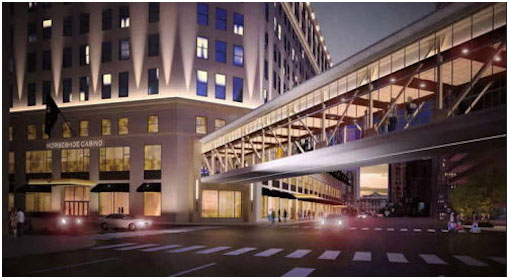

    Why is Gilbert going all anti-urban in Cleveland, then? In a word: money, as Moody’s just issued a report saying a walkway would help the casino reach predicted income streams, as it has been underperforming. Obviously casino ownership is a no frills money-making operation, as is real estate. With each: immediate financial return trumps the nurturing of human and community capital to support a vision of long-term economic growth.

    But Detroit Dan is different, right? He is a walkability guru’s guru. One of the “enlightened developers” as was stated above.

    Well, you be the judge. Here’s a blog post excerpt covering the recent Placemaking Leadership Council hosted in Detroit, with Detroit 2.0 taking center stage.

    Dan Gilbert, head of Rock Ventures and Quicken Loans, genuinely seemed to defer to Kent [the Project for Public Spaces head] when it came to his part of the presentation Thursday. Gilbert, who has millions of hours of public-speaking practice behind him, often turned to Kent to fill in the details on the upcoming renovations to Campus Martius, Cadillac Square, Capitol Park, Grand Circus Park and Paradise Valley.

    “Genuinely seemed to defer” is right. Or just bored as hell.

    And then there is this. This. Courtesy of a Curbed Detroit blog post called “Development In Downtown Detroit Is Playing Out Like A Huff Po Blog Post From 2009”. The referenced Huffington Post piece is by Detroiter Toby Barlow that is called “How a Billionaire Can Make a Billion Dollars”. The strategy? Buy Detroit, not “metaphorically” but “literally”, yet do it “very quietly, so as not to inflate any prices”. Then, according to Barlow, since a billionaire owns thing, he moves his employees to his buildings and gives them “incentives to live down near their work so that they’ll buy your residential property”. Barlow concludes:

    So, I don’t have to spell out the rest, do I? Real estate values will quickly soar as other companies, encouraged by your brazen move, make similar leaps into what will still be an incredibly affordable market. The momentum will build as the ever-frenzied media piles on.

    Yes, Detroit’s plan for the future pre-dated by a Huff Po blog entry from 2009.

    The big revelation here?

    Look, in the end, the Dan Gilbert’s of the world are in their line of work for one reason and one reason only: to make money. They will don whatever mask they need to play the part, be it the urban-loving Jekyll or the anti-urban Hyde. That’s the problem with creative class urbanism. It is dependent on developers who could care less. It is a means to an end for those who implement it.

    Too bad this end is not the beginning of a true path forward for a real Rust Belt recovery.

    Detroiters, like most Rust Belters, have been through enough. They deserve better.

    Richey Piiparinen is a writer and policy researcher based in Cleveland. He is co-editor of Rust Belt Chic: The Cleveland Anthology. Read more from him at his blog and at Rust Belt Chic.

  • Genealogy Of Rust Belt Chic

    Some people don’t like the term “Rust Belt”. Others absolutely hate the word “chic”. Please don’t call the shifting mesofacts of dying Great Lakes cities “Rust Belt Chic”. Given the reaction, a lot of it negative, I decided to blog about how I came up with Rust Belt Chic. Way back in 2006, Shittsburgh was associated with a kind of urban chic. The South Side Slopes celebrated in the New York Times:

    “If Pittsburgh’s market were on steroids like New York’s, this would’ve happened a long time ago,” said one developer, Ernie Sota, referring to the recent spark of interest here. “But Pittsburgh’s kind of like an eddy. Things move slowly here.”

    Mr. Sota, 56, is a prolific local developer who is constructing a series of nine ‘green’ town houses, called Windom Hill Place, into a lush hillside here. He was drawn to the Slopes by the views and villagelike feel, which, for him, conjure memories of visits to Prague and Budapest.

    It’s just kind of quirky, funky and real, more organic, built by Europeans and other immigrants,” he explained. “The only other American cities that I find as geographically interesting are maybe San Francisco and Asheville, N.C.”
    Emphasis added. At the time, I thought of Sota’s sense of Pittsburgh place as unique to the city. I’m not from Pittsburgh. I don’t live in Pittsburgh. I didn’t go to school there. I’m a geographer. Pittsburgh appeals to my sensibilities. Pittsburgh is my Paris.

    The geographic scope of Pittsburgh urban chic became Rust Belt Chic upon meeting Phil Kidd and John Slanina in Erie, PA for a Rust Belt Bloggers summit. They introduced me to Youngstown. I was hooked.

    Rust Belt Chic always will be ironic. People are attracted to shrinking city hellholes. However, the hellhole part is misunderstood. What I mean is seeing opportunity hiding in a community struggling with survival. There’s just something about Youngstown that stirs passion in me. I’m not gawking at ruin porn or glossing over everything that is wrong. I love Rust Belt cities. I love Rust Belt culture. I’m proud to be from the Rust Belt. That’s what Rust Belt Chic now means to me. It’s personal. It’s who I am.

    For Pittsburgh, I could sense the tide turning. I see the same transformation taking place in other Rust Belt cities. A pejorative, Rust Belt-ness is an asset. It’s a starting point for moving forward, not a finish line or a civic booster campaign. Rust Belt Chic is in the same vein as rasquache:

    Rasquache sensibility that has become an important component of Chicana and Chicano art. The word, rasquache can be used in several senses. Its most common use is negative and relates to an attitude that is lower class, impoverished, slapdash and shallow. For this reason Tomás Ybarra Frausto who has written the cogent essay “Rasquachismo: A Chicano Sensibility” begins by stating, “One is never rasquache, it is always someone else, someone of a lower status, who is judged to be outside the demarcators of approved taste and decorum (in Richard Griswold del Castillo and others, Chicano Art: Resistance and Affirmation, 1965-1985. Los Angeles: Wight Gallery, UCLA, 1991, p. 155)

    However, as the case of several other terms and concepts (most notably the term and concept Chicano itself, which traditionally had a negative sense), the Chicano movement has turned the traditional notion of rasquache on its head. This important Chicano cultural sensibility has been particularly used to address, by means of a stance of resistance that is humorous and ironic rather than confrontational or hard-edged, the harrassments of external authorities such as the police, the immigration service, government officials, social services bureaucrats, and others. Chicano art that is rasquache usually expresses an underdog, have-not sensibility that is also resourceful and adaptable and makes use of simple materials including found ones, such as Luján’s cardboard, glue, and loose sand. 

    Rust Belt Chic turns the traditional notion of Rust Belt on its head. The Rust Belt is lower class, impoverished, slapdash, and shallow. At least, that’s how it looks from the coast, in New York City. Rust Belt Chic as a place to be is a form of resistance. It’s also a hot new trend and a threat to those neighborhoods that make my heart beat faster. From San Antonio:

    “I see a lot of progressiveness happening lightning quick now. When I came from Los Angeles as a visitor in 1992, I saw all these magic spaces you could rent for 300 or 400 a month. But I would laugh because there was little or nothing going on. I could get together some event with a friend or two and everybody thought it was so cool and innovative – I was just copping what I had seen in LA.

    San Antonio has gotten a lot more popular with Austin and California types discovering what a jewel this town is. Eclectic little restaurants and coffee places and shops growing up along Broadway and throughout Southtown. We’re being seen by a lot more cutting edge people by being open to contemporary signage and logos and creative design. With that, unfortunately, comes more expensive retail spaces and taxes are going up.

    There is a charm and real-ness to San Antonio I hope we don’t lose in the process. San Antonio is a non-materialistic town; people aren’t looking at your shoes or what kind of car you drive. When I leave San Antonio, it’s that real-ness that brings me back, every time. I left LA, and I left Austin because I got so tired of the trendy-ness. We’re growing fast, we’re drawing an eclectic market that will support artists. However, there will be a compromise. I don’t want to see it get too uptight.”

    –Robert Tatum

    Pittsburgh is Rust Belt Chic Paris. San Antonio is Rasquache Paris. When Richey Piiparinen and I were in San Antonio to do fieldwork, we were both struck by the Rust Belt Chic qualities of the city. At the time, we weren’t familiar with rasquache. We are now. I see a lot of similarities between Pittsburgh and San Antonio, particularly the way both places are under-appreciated. They enjoy a cult following. Hopefully, neither one will become the next Austin or Portland.

    Rasquache is further along, much further, than Rust Belt Chic. In fact, Rust Belt Chic is rasquache:

    This called to mind a passage I’d read in Have You Seen Marie? It’s an unusual book for a writer whose work has been at turns bawdy, avant-garde, and politically trenchant. Entirely autobiographical, Marie is a short, illustrated story with a childlike tone about Cisneros searching the streets of King William for a friend’s lost cat while mourning the loss of her mother, who died in 2010. I read Cisneros the passage I’d thought of: “ ‘King William has the off-beat beauty of a rasquache, and this is what’s uniquely gorgeous about San Antonio as a whole.’ ”

    She smiled. “Rasquache is when you make or repair things with whatever you have at hand. You don’t go to Home Depot. If you have a hole in your roof, you put a hubcap on there. Or you fix your fence with some rope. That’s rasquache. And then there’s ‘high rasquache,’ which is a term the art critic Tomás Ybarra-Frausto coined. He lives here. Danny Lozano knew high rasquache. He’d serve you Church’s fried chicken on beautiful porcelain and use Lalique crystal for flowers he’d cut from an empty lot.”

    “And that was one of the qualities that drew you to King William?”

    “Not just King William but San Antonio. A kind of elegance of found things. San Antonio has that soul. It’s not, ‘We gotta copy what we saw in New York.’ No! It’s going to come out of our own idea of what we think is beautiful.” She stared at me as if to make sure I understood. “But that’s also what’s getting lost. People feel like the city’s got to look like someplace else. Our mayor needs a stylist. He thinks he has to dress like a Republican. Pues, he’s Chicano! He’s got this gorgeous indigenous look, and he would look so cool if Agosto Cuellar, one of our local designers, dressed him, or someone like Franco, or Danny, or John Phillip Santos—he dresses totally San Antonio cool. He should do a style column for Texas Monthly.”

    I allowed that Santos, who is a regular contributor to this magazine, does have singular style (the last time I saw him, in December, he was wearing a horsehair charro tie and ringneck python boots) but joked that there might be a preponderance of leather pants in his fashion advice. Cisneros waved the joke aside.

    “Our problem is that we can’t recognize or celebrate what we have. We have this inferiority complex in Texas that we have to look elsewhere. Well, who knows more about inferiority than Chicanos? We grew up being ashamed because the history that is taught to us makes us ashamed. The whole colonial experience surrounding the Alamo is meant to make you feel ashamed.”

    In writer Sandra Cisneros, I sense a kindred spirit. As a Rust Belt native, Erie no less, I felt ashamed. I come from failure. I have no culture worth celebrating. Anywhere else must be better. That’s why we leave. Brain drain.

    I, too, was drawn to King William while in San Antonio. It is New Orleans (creole) and Pittsburgh (parochial). It’s like nothing I’ve experienced before. I get that boom town vibe of a place that is cool before anyone knows it is cool:

    Russell has seen what’s coming before. “When the buzz starts – when San Antonio embraces the brain gain, goes in the right direction on the talent economy and hipsters start to get wise to the neighborhood assets that are here – once the hipsters get wind of it – you’ll have to beat them away with a stick,” he said.

    I think that’s the concern of Robert Tatum. About a year ago, such a notion was unfathomable to Cleveland. What will the compromise with gentrification look like in Ohio City? Will somebody utter the words, “He dresses totally Cleveland cool”?

    Danny Lozano knew high rasquache. He’d serve you Church’s fried chicken on beautiful porcelain and use Lalique crystal for flowers he’d cut from an empty lot.

    Rust Belt Chic is served.

    Jim Russell is a talent geographer with particular interest in the Rust Belt. Read his blog at Burgh Diaspora, where this piece originally appeared.

  • Why Inmigration Really Matters, Particularly to the Rust Belt

    Cleveland Mayor Frank Jackson’s recent comment about immigration has drawn some local ire. At his annual remarks on the state of the city, the Mayor—in response to a question of how Cleveland can end its population decline by attracting immigrants—stated: “I believe in taking care of your own”.

    To be fair, the Mayor contextualized the statement by inferring that the best attraction strategy is to build a city that works for those who reside in it. In some respects I agree. In fact America attracts immigrants not because of “attraction strategies”, but because it offers the prospects of a better quality of life. So, if a city can nail that down, well, that is a hell of a pull.

    The problem, though, is that historically inward-facing legacy cities such as Cleveland have had a hard time moving the needle toward progress because fresh blood is lacking, and so a “taking care of your own” strategy often devolves into policies that simply further fossilize the status quo.

    Why?

    Because such cities—with low rates of inmigration, and a long lineage of social capital that can tip to the side of insularity and territorial encampment—have too much inertia, which is defined as “the resistance of an object to change its state of motion or rest”.

    Inertia is real, not simply in physics, but in organizational behavior, such as city politics and policy. And the more historical it is, the thicker the status quo, and thus the harder it is for a city to change—meaning the future, or the momentum of the city, can be like a train chugging to constant stops of stagnation unless a “force outside the system…act[s] upon the system for a long enough period of time to have any effect on changing the momentum.”

    Enter the importance of outsiders, be they immigrants, returning expats, or just new people from other parts of the country. Without them cities get stuck. People see the same things, talk the same things over. Bullshit territorial divides like East- versus West-side of the Cuyahoga River reign, effectively cutting a city’s “brain” in half. Business is business as usual, then. Hence the post-industrial-sixty-year decline.

    Writes Aaron Renn over at Urbanophile:

    I previously noted how it generally takes a critical mass of outsiders, enough to create a constituency for change in its own right, to drive real disruptive change in a community. These are the people who aren’t invested in the status quo. Absent that, getting reform that works will be a difficult challenge.

    Echoes migration expert and blogger Jim Russell:

    Without migration, there are no cities. An urban landscape is more than a draw for talent. Metros thrive on churn, both the influx and egress of people…

    … The very act of moving, particularly to the top tier of global cities, is entrepreneurial. You are surrounded by risk-takers and innovation. The competition is fierce. The cream of the crop is seeking any edge, looking for any opening.

    I am learning about the power of migration first hand. You see, I am a lifelong Clevelander, a West Sider, one well-versed in the how things are customarily done around here, and what thoughts and words are commonly produced if only through a Rust Belt inertia that can be cloaked in “tradition”. My partner, Andiara Lima, is a relative newcomer from Vale do Aço, or the “Steel Valley” of Brazil. Before I met her I was ignorant to the presence of the Brazilian community in Cleveland. Now, I no longer am, and the experience provides me with on-the-ground lessons as to the importance of migration in evolving the Rust Belt “way”.

    brazil house party


    For instance, individually speaking, my panorama is being broadened, with the dominant cultural connotations of Cleveland defined primarily by whiteness or blackness taking a needed hit. For instance, I was at a Brazilian-hosted house party not long back, and it was like nothing I ever experienced. The dining room was cleared, bodies moved, sweat poured, people screamed and shook ass. A band was set up to play bossa nova along a window seat. And it was happening all in the neighborhood of my childhood, but way beyond my childhood. Rather a feeling of something forward.  Not just past. Not identity politics, but a freshness needed so that crusty legacy and power can be dampened if only to bust identity politics up.

    No doubt, these identity politics hurt the region’s ability to welcome and catalyze emerging groups. For instance, I am reminded of a recent Facebook comment on a local politician’s page that discussed a community forum about how Cuyahoga County government reform would affect race relations. The commenter notes:

    The whole panel was black or white people. The Asians and Latinos were in the back of the room wondering “what about us?”

    “What about us?”

    It’s a good question, and one local leaders shouldn’t underestimate given the region’s need for fresh blood. And we aren’t just talking bodies, but talent, as migrants are “economic ass-kickers”, particularly due the fact that migration is in itself an act of entrepreneurialism.

    For instance, my partner Andiara studies the Brazilian trade market for a local investment company. Her informational network into the country, both professionally and informally, is deep. For me, she is a link between two Rust Belt worlds, shattering my sense of restrictive locality for a borderless view that gets me thinking about how to position Cleveland not just regionally, but globally.

    For Cleveland, she is a reserve for local industry that should be both cultivated and tapped, especially since—as the US Ambassador to Brazil recently said at Cleveland’s Union Club—“Brazil is an economic and democratic power the United States needs as a partner”.


    And there is Luca Mondaca and Moises Borges, both acclaimed Brazilian musicians who are plugging (into) and broadening (out) Cleveland’s musical legacy. Yet there is frustration, particularly for Luca, as she feels isolated, untapped, and sometimes lost in the culture of a city that—while desperate for freshness—has difficulty getting beyond the inertia that comes with being comfortably stale. And while I am hopeful that the city is in fact becoming more welcoming—and that the opportunity afforded by the region’s affordability and legacy assets can further open the inmigrant sluicegates—passive optimism is not an option.

    Neither is parochial playmaking.

    In fact, Andiara Lima, Luca Mondaca, and Moises Borges are Cleveland’s “own”. But without that recognition, they may not be for very much longer.

    Richey Piiparinen is a writer and policy researcher based in Cleveland. He is co-editor of Rust Belt Chic: The Cleveland Anthology. Read more from him at his blog and at Rust Belt Chic.
  • Detroit Future City

    Recently the Detroit Works Project released their long awaited strategic plan for the city. This is the one led by Toni Griffin that produced a lot of public controversy because of suggestions it would result in the planned shrinkage or decommissioning (or even forced residential relocations) in sparsely populated neighborhoods.

    Called “Detroit Future City,” this plan doesn’t shy away from facing the tough realities that face Detroit, but its recommendations are somewhat muted with regards to shrinkage. Nevertheless, the message is clear: in a broke, declining city, neighborhood triage is a must.

    The full document is 184 pages. I perused it, but wasn’t able to review at the level of detail I normally like to. Partially this is because it was published in a hyper-annoying “cinemascope” type format that makes it almost impossible to read on screen without magnification and lots of horizontal scrolling. This aspect of the plan’s publication was an immediate knock against it in my view. However, it will share a few observations I gleaned.

    Neighborhood Development

    The plan is notable for admitting that Detroit can never be repopulated. In fact, its only goal is to stabilize population loss 20 years from now, and settle in for a population of 600-800,000 people, or approximately the same as now.

    The plan is frank about the scale of the challenges, including 150,000 vacant and abandoned parcels, empty land equal to the area of Manhattan, and vastly oversized infrastructure relative to the population and industrial base, along with poor service delivery in areas ranging from public safety (Detroit has the second highest violent crime rate in the country) to street lighting (about half of the street lights don’t work).

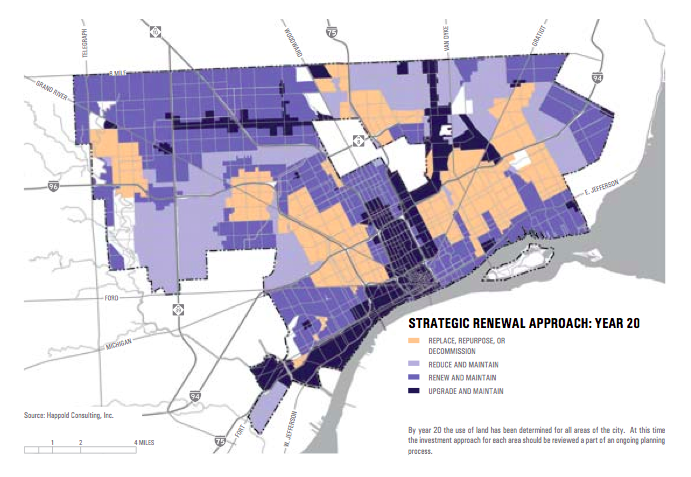
    Part of that does involve identifying how to deploy infrastructure in neighborhoods. Here’s a graphic on that which will no doubt get some airplay:


    Some areas are slated for upgrades, others reductions, and some perhaps “decommissioning.”

    The strength of the plan, however, is in its approach to development in which the core concept is to develop a multi-nodal network of neighborhoods, and to have neighborhoods that are strategically differentiated from each others. This is very different from the core-centric or “hub and spoke” model that exists today, and is somewhat similar to my “100 Monument Cirles” concept for Indianapolis. Suffice it to say, I like it. What was missing from this was strengthening neighborhood identify, something Pete Saunders identified as a key weakness of the city.

    A lot of the content behind this is disappointingly standard, however. The focus is green infrastructures, transit, mixed use neighborhoods, etc. This is basically planning conventional wisdom that would be at home in lots of different cities.

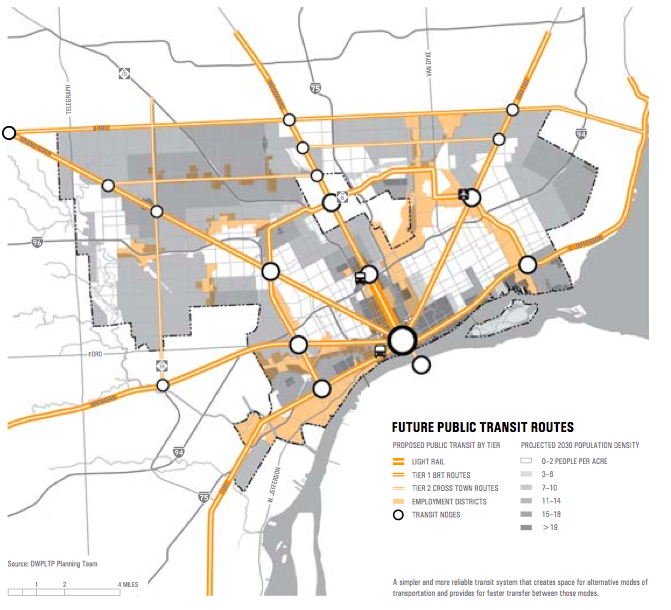
    I was pleased to see that they de-emphasized rail transit. Only the M-1 light rail on Woodward remains. The rest of the core network would be BRT. I’d argue that reliable and higher frequency “plain old bus service” is the core need, however. There’s the proposed transit map:


    Some may decry this, but in a city that’s over-infrastructured as it is, the last thing you need is more physical plant to maintain over time.

    And perhaps the focus on green is to some extent understandable given the vast quantity of vacant land in Detroit. One of their intriguing concepts is “landscape as infrastructure”, though it didn’t fully connect with me. They did talk about ideas like medium intensity agriculture and new urban forest typologies. The Hanzt Farm example shows this already underway.

    Lastly, the focus, and especially the near term recommendations around, regulatory restructuring is critical. Detroit benefits today from a sort of laissez-faire environment because government is so ineffective. If government effectiveness were restored, it could easily strangle the good things happening in Detroit, which are largely non-conforming. The answer is to get the regulatory system up to date with what we want to see. I would have preferred to see some types of harder targets around this, such as “85% of new development approved as of right.”

    Economic Development

    The plan considers boosting the number of jobs in Detroit as the most important mission. The city today has the 5th lowest number of jobs per resident of any of the top 100 cities in America, this despite large population losses. Jobs in the city are needed both for residents and rebuild the tax base.

    The numbers on this seemed a bit squishy though. The report says that there is one job for ever four residents of Detroit. As there are about 700,000 residents, this would mean about 175,000 jobs. Yet they say there are 350,000 jobs. (If the resident figure included only working age adults, the projected number of current jobs would be even lower than my estimate).

    The goal by 2030 is to increase this to between 2 and 3 jobs for every resident. This implies simply staggering job growth. Their mid-point population estimate for 2030 is still 700,000, so to go from 0.25/1 to 2/1 or 3/1 implies 700-1100% job growth. This is a CAGR of 11-13% – off the charts. To put it in perspective, metro Houston’s job growth CAGR from 2000 to 2011 was only 1.3%.

    I may be totally off base on what they were getting at in these numbers, but having solid and realistic projections is critical, and, alas, all too rare. Unrealistic growth rate assumptions are common in civic plans, as I highlighted in the example of Cincinnati’s Agenda 360 plan.

    [ Update: I was contacted by someone from the study’s technical committee indicating that the 2 or 3 jobs per resident figure was an error in the PDF that was not present in the official version of the plan. There are apparently about 193,000 jobs in the city, with the plans actual goal a doubling of that over 30 years. Still ambitious, but not mathematically impossible. ]

    The job growth is projected to come from four key target sectors: eds and meds, digital and creative, industrial, and local entrepreneurship. These sectors are reasonable as these things go given where Detroit is, but seem unlikely to drive the major growth they seek, excepting possibly entrepreneurship.

    Neither Wayne State nor Detroit’s health care/life science infrastructure is nation leading. Every city and state in America is chasing eds and meds, and as I noted, the great growth curve in these industries may be over. Additionally, the trend nationally seems to be towards more decentralization of health care infrastructure in metro areas. While I’m sure there will be some growth here, I’m not optimistic about major expansion.

    Similarly, digital and creative jobs are the fad du jour. I strongly doubt anyone will even consider there to be categories of jobs called “digital” or “creative” by 2030. These will be absorbed into industry generally. These are also the same types of sectors being pursued everywhere. Detroit certainly has a concentration of these because of its auto design cluster and just simply being a big city. But other than autos, does it really have a competitive advantage here? The big expansion opportunity would seem to be mostly suburban relocations of the type spearheaded by Dan Gilbert. I wonder how much gas is left in that tank, however.

    The other two are more promising. Local entrepreneurship is a catch-all, but clearly indigenous startups are a great way to boost the economy. The report’s focus on equipping and facilitating minority entrepreneurship was especially relevant. Given the collapse of the city, Detroit’s residents have had to become innovative and self-sufficient of necessity. These skills from the school of hard knocks are in many ways worth much more than formal education when it comes to starting a business. If the city can figure out how to marry these “survival skills” of residents with a commercial orientation, it could be powerful. The same recipe of figuring how to do business in unstable and tough environments is common in the Middle East, where there’s a longstanding entrepreneurial and trading tradition. Unsurprisingly, Middle Easterners have been prominent among those who’ve thrived in Detroit. The challenge is how to activate the similar skills in other ethnicities for business purposes.

    Industrial employment would also seem to be a possible area of growth, but not in the way envisioned in this plan. Industrial employment has been in decline, and new industrial facilities have tended to locate in outlying areas, not traditional urban manufacturing zones.

    However, there are types of industrial businesses that can have a hard time finding a home. For places that are willing to welcome them, there could be opportunity. I noted this around the heavy industrial zone in Northwest Indiana.

    This involves being willing to take on more brown than green industry, however. And it raises a whole host of issues around environmental justice, etc. However, Detroit, as this plan notes, is desperate for jobs. Trade-offs at least need to be considered. Rather than “focusing on the look and feel” of industrial areas, as the plan put it, why not roll out the red carpet for businesses like tanneries, scrap metal processing, etc. that are increasingly unwelcome in places like Chicago? Being friendly to to these types of businesses is probably the most likely road to success in industrial employment.

    Conclusion

    On first read, there’s some interesting stuff in here. They plan is less creative than I’d hoped overall, but probably takes the most aggressive line that was politically realistic. The real questions is, what happens next? Can any of this actually be actioned, or will fiscal and other problems effectively render it a dead letter? Only time will tell.

    Aaron M. Renn is an independent writer on urban affairs and the founder of Telestrian, a data analysis and mapping tool. He writes at The Urbanophile, where this piece originally appeared.

  • Rust Belt Cities: Invest in Odysseus, Not Barney Fife

    Given its legacy of shrinking, the Rust Belt has issues. The issues arose naturally, and relate to the fact things leave, or that so much has left. Particularly, when things leave, the mind—both the individual and the collective city mind—can get protective and restrictive. Neediness arises. The smell of desperation ensues like a pall that can tend to hang over cities, influencing decision making on all levels.

    Enter “brain drain”, or that term coined to refer to the outmigration of an area’s educated citizens, particularly it’s young. You know the drill: Johnny goes to State college, comes back home for a spell, but then leaves Cleveland, Ohio for Chicago or New York. That is brain drain. And city leaders hate it, spending billions of dollars to stop it—often at the cost of coming off ridiculous, lame.

    For instance, in Pittsburgh, there was a civic booster campaign thought up to keep educated folks from going. It was called “Boarder Guard Bob”. According to researcher Chris Briem, “Bob” was a Smokey-the-Bear-type of public service announcement made into a Barney Fife character, with the billboard-size messaging of “Bob” intended to “stop young people at Western Pennsylvania’s borders before they had a chance to leave for other cities”. And while this particular retention strategy (luckily) never went to print, various “plug the brain drain” strategies persist in one form or another at exorbitant cost to taxpayers.

    But beyond the near-pitiful messaging, there are major problems with the brain drain approach, especially from an economic development perspective. For example, when, as a community, you are intentionally telling your citizen’s not to go, you are asking them to sacrifice personal development for the benefit of a place. To this point, my colleague, Jim Russell—a leading thinker in brain drain boondoggles and blogger at Burgh Diaspora—says it best, stating: “Discouraging geographic mobility is the same as restricting access to higher education”. In other words, it’s like telling Johnny to stick with his high school diploma so as to forego leaving the community for a 4-year degree.

    What’s more, getting people to stay put does little to grow a local economy. In fact it hurts it. Because leaving home is often a rite of passage. It develops a person. I mean, can you imagine if there was no odyssey in the epic Odyssey? If so, Odysseus wouldn’t be the changed man with perspective and experience as he was when he returned back to his homeland, and so there’d be no “there” there. In this sense, the Rust Belt needs to engage their young to embark on their own “Hero Journey” if only to gain skills and broaden geographic connections. This is international economics 101 (see China, India, Brazil, etc.). It should be a domestic economic priority for the Rust Belt, and it would be if only the Cleveland’s of the world could let go of the protectionism that defines their longstanding existential fears of shrinking into one big pile of ruin porn.

    Of course confidently encouraging outmigration is part and parcel with an understanding that many expats will “boomerang” back. But many are, and at a faster rate. To wit: as the alpha cities of the America like NYC get too expensive or creatively-class cute, many Rust Belt refugees are pivoting back from a certain left-wanting lifestyle if only for the opportunity, tradition, and honest-to-god reality that is “Rust Belt Chic”. And when they do, they often become “economic ass kickers”, which is term Russell uses to exemplify the fruits of the Hero Journey that is not only individually experienced, but felt in the local economy as well.

    Take Sean Watterson, the co-proprietor of the wildly successful restaurant the Happy Dog on Cleveland’s Near West Side. He moved back from D.C. because, according to a recent Plain Dealer article, “Cleveland-ness is like Polish-ness or Irish-ness. It’s an ethnicity”. Here, Watterson not only runs a great hot dog business, but uses his establishment to advance a circulation of ideas by hosting a variety of events like “Life, the Universe, and Hot Dogs”, which is a series hosted by researchers from the Institute for the Society of Origins. Another big hit is the live performances by members of the Cleveland Orchestra called Classical Revolutions.

    Cool sounding events, sure. But there is more to it than that, as such happenings spark cross-fertilization between parts of Cleveland—the blue collar West Side and the intelligentsia of the East Side—that have long been divided, often at the cost of Cleveland as a place of cultural and economic innovation. And how exactly does Watterson’s own “Hero Journey” come into play in his self-stated goal to break down barriers “between east and west and between high culture and low culture”? It likely relates to the fact he experienced experience outside of a legacy city bubble that enabled him to see and cross bridges that others have difficulty envisioning.

    Now, does this mean that cities simply need to let people leave to prosper? Obviously not. If the place expats are boomeranging back to is stagnant and disparate, with openness and connection disabled by a collective insular mentality that: “that’s just the way things are done around here”, well, the boomeranging effect won’t hold. And the economic ass-kickers won’t ass-kick.

    The goal, then, of cities should be on fostering return migrant connections, or to know who they are, why they are there, and to help get them together so that their collective unchained perspective can pop bubbles of inert status quo. This need is real. For instance, take this first-hand return migrant account published in Rust Belt Chic by Dana Marie Textoris:

    Funny how your location-based identity, your physical and mental place in the world, can flip like a switch: Before I was a Clevelander managing to make it in San Francisco….right now I feel a lot like a San Franciscan stuck in Cleveland. In either place, I felt just a little bit Other. A bit of a novelty. Just a tad on the outside looking in. Where does that leave me? Where is home? As I type this, I realize, with sort of an internal groan, that the place I’m left in, the guide to what I’m searching for, is probably just right here, inside me, where my two lives — West Coast and Midwest — are now combined. I’m not really a true Clevelander anymore…I’ve picked up way too much San Francisco for that. The balance I’ve become, a little of this and that, is just what I’m hoping I’ll find, one day.

    So, to all Rust Belt cities—this is where your attention must be turned: not on the ones who are leaving for good reason, but on those returning who have not left for good. They have brought the path of their self-discovery back to your doorstep.

    Don’t close the door by screaming at the backs of others.

    Richey Piiparinen is a writer and policy researcher based in Cleveland. He is co-editor of Rust Belt Chic: The Cleveland Anthology. Read more from him at his blog and at Rust Belt Chic.
  • The New Places Where America’s Tech Future Is Taking Shape

    Technology is reshaping our economic geography, but there’s disagreement as to how. Much of the media and pundits like Richard Florida assert that the tech revolution is bound to be centralized in the dense, often “hip” places where  “smart” people cluster. Some, like Slate’s David Talbot, even fear the new tech wave may erode whatever soul is left to increasingly family free, neo-gilded age San Francisco.

    Such claims have been bolstered by the tech boom of the past few years — especially the explosion of social media firms in places like Manhattan and San Francisco. Yet longer-term trends in tech employment suggest such favored media memes will ultimately prove well off the mark. Indeed, according to an analysis by the Praxis Strategy Group, the fastest growth over the past decade in STEM (science, technology, engineering and mathematics-related) employment has taken place not in the most fashionable cities but smaller, less dense metropolitan areas.

    From 2001 to 2012, STEM employment actually was essentially flat in the San Francisco and Boston regions and  declined 12.6% in San Jose. The country’s three largest mega regions — Chicago, New York and Los Angeles — all lost tech jobs over the past decade. In contrast, double-digit rate expansions of tech employment have occurred in lower-density metro areas such as Austin, Texas; Raleigh, N.C.; Columbus, Ohio; Houston and Salt Lake City. Indeed, among the larger established tech regions, the only real winners have been Seattle, with its diversified and heavily suburbanized economy, and greater Washington, D.C., the parasitical beneficiary of an ever-expanding federal power, where the number of STEM jobs grew 21% from 2001 to 2012, better than any other of the 51 largest U.S. metropolitan statistical areas over that period.

    The question is whether the last two to three years, during which places like San Francisco, New York and Boston have enjoyed stronger STEM growth than their peripheries, represents a paradigm shift or is just a cyclical phenomenon. As with tech in general, the long-term trends are not so city-centric; over the past decade,  the core counties nationwide overall have lost about 1.1% of their tech jobs while more peripheral areas have experienced a gain of 3.5%.

    Today’s urban tech boom looks a lot like a rerun of the dot-com boom of the late 1990s. In that period media-savvy dot-com startups proliferated in such places as South of Market in San Francisco and the Silicon Alley in lower Manhattan. At their height, these firms and their founders were as likely to be covered in the fashion and lifestyle sections as on the business pages.

    Yet by the early 2000s, many of these dot-com darlings had merged, been acquired or simply gone out of business. Anchored largely on hype, they fell victim to flawed business models, and rapid industry consolidation.  In San Francisco, for example, tech employment crashed from a high of 34,000 in 2000 to barely 18,000 four years later. Silicon Alley suffered a similar downward trajectory, losing 15,000 of its 50,000 information jobs in the first five years of the decade.

    The peaking social media boom, marked by the weak performance of Facebook’s IPO last year, suggest another bust at the end of the “hype cycle.” Urban darlings such as  San Francisco’s Zynga and Chicago’s Groupon have floundered in spectacular fashion. More are likely to join them.

    These firms may have generated buzz, but they have done not so well at the mundane task of making money. One problem may be that  the most avid users of social media are largely young people from the “screwed” generation who lack much in the way of spending power — a clear turnoff to advertisers. Now , with venture capital flows declining overall,  cooler heads in the Valley are shifting bets to more business-oriented engineering and research-intensive fields more grounded in marketplace realities.

    And what about the future of the Valley — still home to virtually all the Bay Area’s top tech firms? Its glory days as a job generator and economic exemplar seem to have passed. Between 1970 and 1990 the number of people employed in tech in the Valley more than doubled to 268,000, and then burgeoned to over 540,000 in the 1990s. At the peak of the last tech boom in 2001, the unemployment rate in Santa Clara County was a tiny 3%; the Silicon Valley Manufacturing Group confidently predicted there would be another 200,000 jobs by 2010.

    However, at what may be the peak of the current boom, the number of tech jobs in the Valley remains down from a decade ago and unemployment is over 7.7%, just around the national average. In reality, social media was never going to reverse the downward trajectory in the rate of job growth. Old-line companies like  Hewlett-Packard or Intel, with over 50,000 employees in the U.S. alone, were capable of creating a broad range of opportunities for workers; in contrast, the social media big three of Facebook, LinkedIn and Twitter together have less than 6,500 employees.

    As the social media industry matures and consolidates,   employment is likely to continue shifting to less expensive, business-friendly areas. The Bay Area, where the overall cost of living is 68% higher than the national average and housing is the most expensive in the nation, may continue to attract and retain only the highest-end, best-paid workers. But for the most part they will follow the path of established tech firms such as  Apple, Intel, Adobe, eBay and IBM  to lower-cost places like Austin, Columbus and Salt Lake City. A similar phenomena also can be seen in other urban-centered industries, such as entertainment and finance where  virtually all employment growth is in places like St. Louis, Des Moines and Phoenix, even as the largest centers, New York, Chicago, Boston, Los Angeles and San Francisco have suffered significant job losses.

    Demographic forces may further accelerate these trends. The critical fuel for tech growth, educated labor, is now expanding faster in places like Columbus, Austin, Raleigh, Dallas and Houston than in Boston, San Jose and San Francisco. The old centers may still enjoy a lead in brains, but other places are catching up rapidly.

    Companies may also discover that with many millennials starting to hit their 30s, some may seek to leave their apartments to buy houses and start families. In California new local regulations essentially ban the construction of new single-family homes in some of the state’s biggest metro areas, pricing this option out of reach for all but a few, and forcing a key demographic group to seek residence elsewhere.

    Under these conditions, Silicon Valley will be forced to rely increasingly on inertia and mustering of financial resources than innovation. As a result, the nation’s tech map will continue to expand from the Bay Area, Boston, Seattle and Southern California to emerging metropolitan areas in North Carolina, Texas, Utah, Colorado and the Pacific Northwest. In the future parts of Florida, Phoenix, and even Great Plains cities like Sioux Falls and Fargo could also achieve some critical mass.

    Ultimately, one of the main dynamics of the information age — that even sophisticated tasks  can be done from anywhere — works against the dominion of single hegemonic industry centers like Wall Street, Hollywood and Silicon Valley. The tech sector is particularly vulnerable to declustering, due in large part thanks to the freedom from geography created by technologies of its own making.   Silicon Valley may continue to reap riches from the periodic technology  gold rush , but in the longer term, tech growth will continue its long-term dispersion to ever more parts of the country.

    STEM Occupations in the Nation’s 51 Largest Metropolitan Areas
    MSA Name 2001 – 2012 Growth 2005 – 2012 Growth 2010 – 2012 Growth 2012 Location Quotient LQ Change, 2001 – 2012
    Washington-Arlington-Alexandria, DC-VA-MD-WV 21.1% 12.7% 3.7% 2.19 10.6%
    Riverside-San Bernardino-Ontario, CA 18.6% -1.4% 2.2% 0.57 1.8%
    San Antonio-New Braunfels, TX 18.3% 17.2% 4.5% 0.83 1.2%
    Baltimore-Towson, MD 17.9% 11.4% 3.9% 1.37 15.1%
    Raleigh-Cary, NC 17.9% 14.6% 6.2% 1.53 0.0%
    Las Vegas-Paradise, NV 17.2% -2.6% 0.8% 0.52 4.0%
    Salt Lake City, UT 16.3% 18.1% 7.4% 1.16 4.5%
    Houston-Sugar Land-Baytown, TX 15.7% 17.2% 6.6% 1.20 -2.4%
    Seattle-Tacoma-Bellevue, WA 15.4% 22.2% 6.7% 1.86 8.1%
    Jacksonville, FL 13.0% 6.5% 2.4% 0.87 8.7%
    Austin-Round Rock-San Marcos, TX 12.2% 17.2% 9.1% 1.82 -8.5%
    San Diego-Carlsbad-San Marcos, CA 11.3% 8.0% 2.1% 1.38 6.2%
    Columbus, OH 10.4% 12.8% 4.7% 1.27 7.6%
    Orlando-Kissimmee-Sanford, FL 9.4% -1.1% 0.8% 0.84 -3.4%
    Indianapolis-Carmel, IN 6.9% 6.5% 2.7% 1.04 2.0%
    Nashville-Davidson–Murfreesboro–Franklin, TN 6.7% 3.5% 2.4% 0.77 -1.3%
    Sacramento–Arden-Arcade–Roseville, CA 6.4% 3.5% 0.4% 1.33 2.3%
    Oklahoma City, OK 5.5% 9.6% 6.4% 0.89 -1.1%
    Pittsburgh, PA 5.3% 10.3% 4.9% 1.07 5.9%
    Virginia Beach-Norfolk-Newport News, VA-NC 4.8% 2.3% 0.5% 1.10 3.8%
    Charlotte-Gastonia-Rock Hill, NC-SC 4.3% 8.2% 5.7% 0.99 -3.9%
    Kansas City, MO-KS 4.0% 5.8% 4.6% 1.12 4.7%
    Richmond, VA 3.8% 4.4% 3.4% 0.99 0.0%
    Cincinnati-Middletown, OH-KY-IN 3.7% 5.5% 6.8% 1.02 4.1%
    Buffalo-Niagara Falls, NY 3.2% 6.4% 3.6% 0.90 4.7%
    Dallas-Fort Worth-Arlington, TX 3.1% 11.4% 5.5% 1.19 -5.6%
    San Francisco-Oakland-Fremont, CA 2.5% 15.0% 9.9% 1.63 5.8%
    Phoenix-Mesa-Glendale, AZ 2.3% 3.5% 3.9% 1.05 -6.3%
    Minneapolis-St. Paul-Bloomington, MN-WI 2.2% 6.7% 5.9% 1.31 1.6%
    Portland-Vancouver-Hillsboro, OR-WA 1.6% 6.4% 5.4% 1.19 -3.3%
    Louisville/Jefferson County, KY-IN 0.9% 9.6% 6.9% 0.76 0.0%
    Denver-Aurora-Broomfield, CO 0.5% 10.8% 3.7% 1.43 -2.1%
    Atlanta-Sandy Springs-Marietta, GA -1.0% 5.5% 6.5% 1.07 -2.7%
    Boston-Cambridge-Quincy, MA-NH -1.3% 11.2% 6.0% 1.64 -1.2%
    Providence-New Bedford-Fall River, RI-MA -1.5% -1.6% 1.9% 0.88 2.3%
    Philadelphia-Camden-Wilmington, PA-NJ-DE-MD -2.8% -1.4% 1.4% 1.06 -1.9%
    Hartford-West Hartford-East Hartford, CT -4.5% 1.5% 0.3% 1.10 -3.5%
    New York-Northern New Jersey-Long Island, NY-NJ-PA -4.6% 2.8% 3.2% 0.90 -6.2%
    St. Louis, MO-IL -4.8% -1.7% 1.4% 1.05 -0.9%
    Milwaukee-Waukesha-West Allis, WI -6.1% -0.8% 4.0% 1.00 0.0%
    Tampa-St. Petersburg-Clearwater, FL -6.3% -4.3% 2.5% 0.89 -3.3%
    Miami-Fort Lauderdale-Pompano Beach, FL -6.4% -8.3% 0.6% 0.67 -8.2%
    Los Angeles-Long Beach-Santa Ana, CA -7.1% -3.5% 3.1% 0.98 -5.8%
    Memphis, TN-MS-AR -7.3% -4.0% 0.7% 0.62 -4.6%
    Cleveland-Elyria-Mentor, OH -8.8% -2.1% 4.3% 0.89 1.1%
    Chicago-Joliet-Naperville, IL-IN-WI -10.8% -1.4% 3.5% 0.87 -7.4%
    Birmingham-Hoover, AL -11.4% -8.0% -2.0% 0.76 -8.4%
    Rochester, NY -12.0% -2.1% 4.1% 1.14 -10.2%
    San Jose-Sunnyvale-Santa Clara, CA -12.6% 12.4% 8.3% 3.18 -4.8%
    New Orleans-Metairie-Kenner, LA -16.0% -7.4% -2.4% 0.74 0.0%
    Detroit-Warren-Livonia, MI -17.7% -10.3% 10.5% 1.42 -3.4%
    Analysis by Mark Schill, Praxis Strategy Group
    Data Source: EMSI 2012.4 Class of Worker – QCEW Employees, Non-QCEW Employees & Self-Employed 

    The LQ (location quotient) figure in the table above is the local share of jobs that are STEM occupations divided by the national share of jobs that are STEM occupations. A concentration of 1.0 indicates that a region has the same concentration of STEM occupations as the nation. The analysis covers 80 STEM occupations in all industries.

    Joel Kotkin is executive editor of NewGeography.com and a distinguished presidential fellow in urban futures at Chapman University, and a member of the editorial board of the Orange County Register . He is author of The City: A Global History and The Next Hundred Million: America in 2050. His most recent study, The Rise of Postfamilialism, has been widely discussed and distributed internationally. He lives in Los Angeles, CA.

    This piece originally appeared at Forbes.com.

    Computer engineer photo by BigStockPhoto.com.

  • Detroit: America’s Whipping Boy Needs a Second Chance

    Every so often, Detroit seems to pop up in our popular consciousness in a negative way.  Ever since the ’67 riots, a steady stream of bad press has altered the national perception of the Motor City.  Right now the city’s efforts to prevent state takeover because of its fiscal problems seems to shape discussion about Detroit.  The most recent demonstration of this is the State of Michigan’s proposal to make Detroit’s Belle Isle Park, the jewel of the city’s park system, into a state park through an extended lease agreement. 

    But I’ve had a rather counterintuitive thought for some time – Detroit is our nation’s urban “boogeyman”, our poster child for urban decline, and we are the ones who prevent the city’s revitalization because we won’t let that image go.  America needs Detroit to be our national whipping boy. 

    Whipping boys came into prevalence in 15th Century England.  I think Wikipedia’s entry on the subject captures it well:

    They were created because of the idea of the divine right of kings, which stated that kings were appointed by God, and implied that no one but the king was worthy of punishing the king’s son. Since the king was rarely around to punish his son when necessary, tutors to the young prince found it extremely difficult to enforce rules or learning.

    Whipping boys were generally of high status, and were educated with the prince from birth. Because the prince and whipping boy grew up together they usually formed a strong emotional bond, especially since the prince usually did not have playmates as other children would have had. The strong bond that developed between a prince and his whipping boy dramatically increased the effectiveness of using a whipping boy as a form of punishment for a prince. The idea of the whipping boys was that seeing a friend being whipped or beaten for something that he had done wrong would be likely to ensure that the prince would not make the same mistake again (emphasis added).

    If that doesn’t accurately describe Detroit’s position in our nation’s collective conscience, I don’t know what does.

    I grew up in Detroit.  Like so many others, I’ve long since moved away (been gone for 30 years), but I occasionally come back to visit family.  I left the city as a teen, but I remain an avid fan of the city’s sports teams.  I regularly read about events and happenings in the city via the Internet.  And, if given a chance, I could still navigate pretty easily throughout the city.  I heartily root for the city’s revitalization.

    I sincerely believe that growing up in 1970s Detroit contributed to my ultimate career path.  As a kid, I remember news reports of people leaving the city for the suburbs or any number of Sun Belt cities – Houston, Dallas, Atlanta, Phoenix.  I remember reports of arson fires to abandoned buildings.  I remember Mayor Coleman Young taking such a defiant political stance on most issues that he may have urged (if not necessarily directly so) continued “white flight” and suburban expansion.  And, of course, I remember the tag that dug deep – “Murder Capital of the World”.  That kind of environment might prompt – did prompt – many people to just give up on cities in general and Detroit in particular, but I always had the vague notion that someone should stick around and try to make the city better.  I was first exposed to the field of urban planning during an eighth-grade career fair, and I later made it my career choice.

    It was clear, however, that most people did not react to Detroit’s decline as I did.  The city’s decline allowed it to be pushed into the recesses of the American mindscape.  It was only to be recalled as a foreboding reminder of the evils of cities.

    In my mind, four films from the last fifteen years seem to capture the general national image of Detroit and continue to shape our perceptions.  The 1997 film Gridlock’d features Tupac Shakur and Tim Roth as heroin addicts traversing a bleak urban environment, trying without success to get the help they need to drop the habit.  The much more celebrated 2002 Eminem film 8 Mile takes place in the same stark physical environment and details the visceral world of MC battling.  The 2005 film Four Brothers covers yet again the same desolate setting as four adopted young men seek to avenge the senseless murder of their mother.  And 2008’s Gran Torino, featuring Clint Eastwood, put a different spin on the meme by putting an elderly white widower into the same gritty landscape, full of resentment toward the people around him who represent the city’s demise. 

    Of course, we don’t need films to tell us what to think about Detroit.  Journalists, business leaders, artists, and others are more than happy to report on a physical environment that is a gray and gritty, post-industrial collection of smokestacks, abandoned buildings.  Everyone knows that Detroit is a city with huge swaths of vacant land and substandard housing.   Time Magazine famously purchased a house in Detroit to provide a launching pad for reporters to chronicle the city’s collapse.  On more than one occasion I’ve heard people suggest that Detroit is undergoing a “slow-motion Hurricane Katrina”.  The image of the city’s people is one of, at best, ordinary blue-collar, hockey-loving, working-class slugs, holding on but facing inevitable economic obsolescence because of an inability to compete in today’s bottom-line global economy.  At worst, they are poorly educated and isolated miscreants who relish burning buildings every October 30th (“Devil’s Night”), and causing mayhem when one of the local sports teams actually wins a championship.

    There are aspects of this in virtually every large city in America.  You can find Detroit in Cleveland, St. Louis, Buffalo, Milwaukee, Baltimore and Philadelphia.  You can find it in Indianapolis, Minneapolis, Cincinnati, Columbus and Louisville.  You can find it in Atlanta, Miami, Houston, Dallas and Phoenix.  You can find it in Las Vegas, Seattle, San Francisco and Portland.  And yes, you can definitely find it in New York, Chicago, Los Angeles and Washington, DC.  You can find elements of the Detroit Dystopia Meme ™ in every major city in the country.  Yet Detroit is the only one that owns it and shoulders the burden for all of them.

    Why is Detroit our national whipping boy?

    The image of Detroit serves as a constant reminder to cities of what not to become. This is the real Boogeyman syndrome right here.  City leaders around the nation can always refer to Detroit as the quintessential urban dystopia, invoking images of crime and crumbling infrastructure.  By doing this they can garner support for (or just as likely, against) a local project, because if this project does or doesn’t happen, you know what could happen to our fair city?  We could become like Detroit!

    The image of Detroit allows the rest of the nation’s cities to avoid facing their own issues – urban and suburban. As long as Detroit’s negative image remains prominent in people’s minds, they can forget about trying to improve what may be just as bad, or even worse, in their own communities.  I remember visiting Las Vegas about twelve years ago, and was astounded by the amount of homelessness I saw, away from the Strip.  No one immediately associates homelessness with Las Vegas, but such an issue would be completely understandable for discussion to the average guy when talking about Detroit.  Cities like Miami and New Orleans have long histories of high crime rates, but that perception rarely registers like Detroit’s because they have other assets like South Beaches and French Quarters to mitigate it.  Cities like Memphis and Baltimore have a violent crime profile similar to Detroit’s, but they fail to excite in the way Detroit does.

    The image of Detroit allows the rest of the nation to maintain a smug arrogance and sense of superiority. I imagine a nation pointing its collective finger at Detroit and saying its situation is the result of its own bad decisions.  Shame on Detroit, they say, for going all in on auto manufacturing.  Shame on Detroit for aligning itself so closely with labor unions.  Or the Big Three.  Shame on Detroit for not dealing with its racial matters.  Shame on Detroit for its political failures and corruption.  And I imagine this being said without the slightest bit of irony by the American people.  We are not you, they say, because we made better choices.  But the truth is dozens of cities made the same choices but escaped a similar impact, or had other physical or economic assets that could conceal the negatives.  This is a conceit that prevents not only Detroit’s revitalization, but that of former industrial cities around the nation.

    Detroit needs a reprieve.  It needs a second chance.  Motown needs our nation to let go of its past and allow it to move on into the future.  There are millions of people who have had troubled lives in the past, but do we continually hold that against them?  There are corporations that betray the public trust, but we go back to buying their products.  There are Hollywood actors who make atrocious movies, but we go back to see their latest flick.  There are politicians who’ve been disgraced out of office, and even they are able to come back.  Detroit needs to be allowed to move into its next act.

    More importantly, we must recognize that Detroit’s story is not unique.  It is the story of every American former industrial city, just writ large.  America is the land of second chances – we need to let go of our “at-least-we’re-not-Detroit” smugness and support this city.  Detroit has paid its dues, and it is long past time for the city to cash in.

    By allowing Detroit to move on, we’ll find that it will free up other communities across the nation to actually focus on their own problems.  There’s a checklist of activities that require urban leadership.  Dealing with foreclosures.   Crushing income inequality and economic disparities.  Mind-numbing traffic congestion on our roads.  Crumbling infrastructure.  Unsustainable sprawl development.  The impact of global climate change on water availability in the Sun Belt.  That represents just the tip of the iceberg. Certainly, other cities certainly have their fair share of problems.

    But I look at Detroit like this.  To paraphrase Frank Sinatra in his song “New York, New York” – if it can be fixed there, it can be fixed anywhere.

    Pete Saunders is a Detroit native who has worked as a public and private sector urban planner in the Chicago area for more than twenty years.  He is also the author of "The Corner Side Yard," an urban planning blog that focuses on the redevelopment and revitalization of Rust Belt cities.

    Photo: The “Detroit” we’ve all come to love — and expect

  • Faking It: The Happy Messaging of Placemaking

    Picasso said “Art is a lie that tells the truth”. Nowadays, there’s less truth to that, as the creative process is increasingly about prettying up and papering over what’s broke.

    More on that shortly, but first, about the breakage: it’s legitimate. Said Nobel laureate Joseph E. Stiglitz in a recent NY Times piece that plain-talks our economic conditions: “Increasing inequality means a weaker economy, which means increasing inequality, which means a weaker economy.”

    That assessment—from a very smart man studying the problem—isn’t good. But in the American feel-good milieu you wouldn’t know it: “We’re coming out if it.” “Tomorrow is forever.” “Start-ups will save the U.S.” Etc. And while tone deaf, this kind of brushing off of problems isn’t new, but part of what social critic Barbara Ehrenreich refers to as America’s “cult of cheerfulness”, and it’s a “cult” that has spawned a longstanding and growing American feel-good industry.

    Recently, researcher Jeff Faux—in his book The Servant Economy: Where America’s Elite is Sending the Middle Class—says the feel-good industry has disarmed social urgency and unrest with “cheerful denial”, particularly as it relates to declining standards of living. Faux writes:

    [T]he positive-thinking industry has gone from publishing self-improvement books and training sales people to smile even when they don’t feel like it to loosely constructed system of social engineering that distracts and discourages Americans from dealing with what is happening to their society.

    This form of social control is wide and far-reaching, ranging from the smiley face Wal-Mart logo to motivational seminars for laid off workers that spoon feed a “can do” attitude like it’s castor oil, regardless if it is the context that really “can’t.” Increasingly, cheerful denial has become the purview of artists and designers; that is, instead of using aesthetics to tear down—like did Picasso, Duchamp, and Matta-Clark—we use aesthetics to prop up.

    Enter placemaking, or that medium of developing “place” in our cities through shared efforts of artists and designers alike.

    Placemaking does a lot of good. Parks, festivals, and various urban design interventions can create for a myriad of positive attributes related to happiness, worth, and reinvestment. But placemaking in its pervasive search for vibrancy can often come off as Pollyannaish, or yet another means at happy messaging. At its worst, placemaking not only distracts from pressing concerns if only to provide a place to collectively clap, but—when done in exceedingly high rent spots continuously immune to economic downturns—can also serve to reinforce the bubble mentality of the elite.

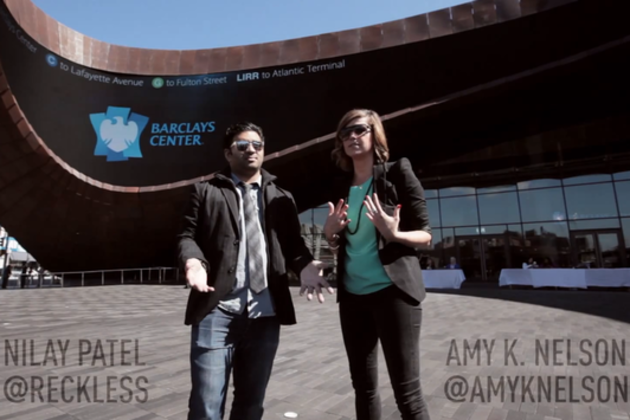
    One needs to go no further than America’s cultural capital, New York City, to see this operating. For instance, in a recent article called the “How Rust Became the New Urban Luxury Item”, the author talks about how the aesthetic of rust is being remade from a reality into a motif. The new billion-dollar Barclays Center was made rusty on purpose, and a new section of the High Line—the park made from an abandoned rail line—will most certainly retain its wear, with its decay polished if need be.


    Courtesy of Techcat

    Why is this occurring? The author writes:

    [R]ust has become fashionable. It’s a sign of street cred, kind of like the pre-fab holes in a pair of $500 designer jeans…

    …The kind of rust you find on the Barclays Center and in the refurbished High Line park is a luxury item. In places like Cleveland and Detroit and the parts of New York without corporate sponsorship, rust is still just rust.

    There is a lot of truth there: rust is still just rust in places that have come to exist in post-industrialization, but for others: rust is luxury, rust is christened from the landscape of one’s hard times up to the decor of the powerful’s play areas.

    On one hand, there is nothing new here. Beautification efforts to attend to social ills is a longstanding method of inflicting good feelings over hard realities. There was the City Beautiful Movement, the Urban Renewal Movement, etc. But what’s rarer is the fact that the aesthetics of disinvestment—in this case rust, and its “hard time” connotations—are being brought in to “dirty” the pretty up. In other words, by “street cred-ing” spaces for the elite, design is used to legitimize the extravagant via images of the honest-to-god consequences of the all-too every day.

    The problem of course is that it elevates how things look and feel in places like the Rust Belt into a luxury status. But in reality, the Rust Belt has been anything but. And while rust is a genuine and pulsating aesthetic in post-industrial America, it is more so akin to the look of a scar: or a character-molding image of resilience that’s now part of the culture’s flesh, and as such can come off as lame when it’s fabricated to make the appearance of something look “harder” than what is.


    Courtesy of Vagabondish

    Of course this adopting of the Rust Belt aesthetic is but part of a cultural authenticity movement that has been going on for some time. People are tiring of the flighty, ephemeral, and the rootless. People want reminders of where America came from and the fight it has in it. But designing for authenticity, according to scholar Jeanne Liedtka, is not only foolhardy—“the authentic emerges; it is not summoned…”—but yet another indication that America is spending more energy on faking it then fixing it.

    Richey Piiparinen is a writer and policy researcher based in Cleveland. He is co-editor of Rust Belt Chic: The Cleveland Anthology. This piece originally appeared at his blog.

    Happy smiley photo by Bigstock.

  • Review: Driving Detroit, The Quest for Respect in the Motor City

    For more than a century, the city of Detroit has been an ideological and at times actual battleground for decidedly different views about the economy, labor and the role of government.  At one time it was the center of a can-do entrepreneurialism that helped launch the American automobile industry.  By 1914, for example, no fewer than 43 start-up companies were manufacturing automobiles in the city and surrounding region.  Following a wave of sit-down strikes that began almost immediately after FDR’s landslide victory in 1936, the economic character of the city changed dramatically.  Detroit soon became the quintessential union town, producing in the first decades after World War II the closest facsimile of Social Democracy that the United States has ever seen and in all likelihood will ever see again.    

    Detroit also specialized in race riots.  In 1943, for example, a brawl that broke out at a popular getaway on a Sunday evening in June quickly escalated into mob attacks that resulted in the death of nine whites and 25 blacks.  Because the white police force could not or would not restrain the violence, the mayor asked the governor to call in federal troops.  Twenty four years and one month later in 1967, another Sunday riot broke out.  This time most of the violence occurred between black residents and the police and National Guard.  The death toll was similar, 10 whites and 33 blacks.  Property damage, on the other hand, was far more extensive.  Before the week was out, President Johnson appointed the Kerner Commission to make sense of the conflict and the growing unrest that was afflicting numerous cities all across America. 

    The next major event in the history of Detroit occurred in 1973, when Coleman Young was elected as the city’s first African-American mayor.   He would go on to serve five terms.  While clearly a reflection of the changing demographics in Detroit, Young also personified the city’s long history of union activism, having first gained prominence in the early 1950’s as the leader of the National Negro Labor Council.  In the early 1980’s, in response to persistent economic decline, Young also led the fight to increase the city’s income tax, which included a tax on commuters.  This signaled an important shift in progressive politics in Detroit and elsewhere.  Rather than trying to wring additional revenue from private sector shareholders, labor and its political allies would now focus on the public sector as the preferred vehicle for income redistribution.

    In Driving Detroit: The Quest for Respect in the Motor City, George Galster employs a multi-layered technique to bring the history of the city to life and help explain its current economic predicament.  The title, for example, invokes the R&B classic “Respect” released by Aretha Franklin in 1967.  Lyrics from other popular songs are also quoted, as well as a steady stream of poems by local Detroit poets.  In addition, Galster weaves the stories of select individuals and families into the broader narrative that he constructs.  At the very end, we learn that among the people we have gotten to know are his German-American parents and their forebears.   And finally, Galster, who is the Clarence Hilberry Professor of Urban Affairs at Wayne State University, tries to explain the development of the city and region through what he calls geology, but in urban economics would more commonly be called geography.  This may be the book’s most interesting contribution.

    Galster emphasizes respect, which he defines as a combination of physical, social and psychological needs, because he argues that for many people in Detroit, for a long period of time, these needs were not adequately met.  This was true for blacks, who faced racial prejudice.  It was also true for factory workers, who historically had to endure dangerous working conditions, the monotony of the assembly line, and cyclical unemployment.  The labor movement helped soften the sharper edges of factory work, but Galster shows that it was far less successful at promoting racial harmony.  In part, this was a function of history.  The largest boom in Detroit occurred during World War II, when the city was dubbed the Arsenal of Democracy.  Because immigration had been stopped in the 1920’s, many of the new transplants came from the old South, often bearing well practiced well animosities.  Solidarity in this context was difficult to achieve.   

    Along with the burden of history, another major challenge that Detroit faces today, surprisingly enough, is geography.  In traditional terms, Detroit was an excellent place to build a city, located on a river that has never flooded and soon reaches Lake Erie.  But in modern times, the local topography has proven something of a curse in disguise.  Galster calls this topography a “featureless plain.”   From the beginning, the city and region grew in a land extensive way.   Assembly line manufacturing contributed to lower land use density, because efficiency required large, one story buildings.   Typically, these factory buildings were interspersed among residential communities.  This arrangement made for an attractive and prosperous lifestyle, but with de-industrialization, Detroit has not been able to fall back on a vibrant “old city” that could attract new and creative businesses.

    So what kind of future can Detroit expect?  Galster does not address this question directly, but clearly he appreciates the magnitude of the challenges at hand.  The phenomena that characterize the metropolitan region are not unique, he says, but “Greater Detroit is distinguished by the intense degrees of all these phenomena and their special origins.”  So perhaps the best take-away of Galster’s analysis is that the experience of Detroit should not be used to reach broad conclusions about the prospects of older industrial cities in general.  Rather, it should be used as a cautionary case study.  Detroit cannot alter its topography, but it can address problems like political chauvinism and sub-standard governance that Galster demonstrates have clearly had a negative impact on the business climate.  Progress here in combination with a low cost-of-living and the revolution in natural gas production might then make it possible to attract the investment that the economy needs to re-invent itself.   Certainly that would be the best case scenario.

    Eamon Moynihan is Managing Director for Public Policy at EcoMax Holdings, a specialty finance company that focuses on the redevelopment of previously used properties. 

  • Brewster and Me: Photo Essay Exploring One of Detroit’s Notorious Abandoned Housing Projects

    This year marks the sixtieth anniversary of the Brewster-Douglass housing projects of Detroit Michigan and there is nothing to celebrate. More accurately, there is no one to celebrate. For several years now this section of the city, already infamous for its vacancy, has been completely abandoned. Rows of houses, full apartment blocks, schools empty.

    A cursory Google search will reveal many details regarding the architecture and planning employed at Brewster-Douglass . Diana Ross lived there. For my part, I didn’t want an explanation, but an experience.

    Throughout my years as an urban archeologist (an entirely fictitious title created to legitimate my somewhat antisocial tendencies), I have encountered and explored many beautiful and surreal derelict places. Churches, schools, insane asylums, power stations, you name it – many of these in Detroit itself. An entire abandoned neighborhood, though, had eluded my experience. Brewster-Douglass seemed like a good fit, the logical next step in my quest to photograph unseen urban space.  

    My online research regarding the Brewster-Douglass projects revealed almost nothing concerning the current internal state of the buildings. Friends would later tell me that even local explorers don’t venture inside the towers.  

    On my initial look over the massive property, I noticed that even the window-frames had been stripped from the four remaining 1952 brick towers. The roofs of the houses were torn to ribbons.  

    A car had to be stashed in some bushes, and where I would usually wait for traffic to die down before entry, I merely crossed the street. There were no other cars around. A maze of walkways made almost invisible by the overgrowth lead me past several rows of abandoned townhouses to a square, each corner marked by a virtually identical 14-storey red brick tower. Save for two benches, most of everything has been smashed to bits.

    "Great architecture has only two natural enemies: water and stupid men,” writes noted Chicago photographer Richard Nickel. The clouds in the sky that day were light, and there was no one around. So much for great architecture; this was Pruitt-Igoe without the wrecking ball.

    Let’s make a pilot for a television show here. We can call it ‘What Not to Plan’. I could see right through one house. Nature had made a convertible of its neighbor. Richard Nickel was buried alive when a section of a building he was documenting collapsed. I had better take care.

    From the roof of one of the towers, I gained a clearer view of the pathways below . In the middle sits the remains of a wooden playground, now splintered, scattered and sprayed. Here it is, Le Corbusier’s Radiant City — in ruins. I’ve found Paradise Lost, The Waste Land.   

    Visit this Flickr image set to view higher resolution versions of these photographs.

    If I were filling out a form for Brewster-Douglass, it would have many blank spaces, like the projects themselves — ‘not applicable.

    To understand Brewster-Douglass, one would have to understand Detroit. To understand Detroit, one would have to understand urban racial issues, the nature of the growth of cities, the nature of suburbs (‘sprawl’), and social demography. Economics might help as well. I do not pretend to understand any of these with any authority. I take photographs, and no, I don’t do weddings.

    Supposedly, plans for demolition of the Brewster-Douglass ruins have been set in order to make room for new housing developments. But like so much news from Detroit, I will believe it when I see it.  

    Visit this Flickr image set to view higher resolution versions of these photographs.

    Jonathan Castellino lectures on architectural photography at a school of restoration arts in Southern Ontario (CAN). His work has appeared in the Globe and Mail, Toronto Star, ToNight, Infiltration, Cardus’ Comment, and numerous city websites and publications.