Tag: development

  • USC Extorted by the City of Los Angeles

    With California State Redevelopment Agency money gone, the city of Los Angeles ought to welcome new large-scale private development, and the economic stimulus and job creation it brings, with open arms. City Hall, faced with an anemic municipal budget, could also use the increased tax revenue. One such project that would help abate the city’s budget woes and create new jobs for the city is the University of Southern California’s proposed $1.1 billion “The Village at USC” project.

    Surprisingly (or perhaps not), the city’s Planning and Land Use Management Committee delayed approval of the project for the second time last week, citing a need for more time to digest data regarding the project’s gentrifying effects on the surrounding community. The city is not fooling anyone – the delay amounts to nothing short of extortion – an attempt to ensure that committee members receive their proper concessions.

    The site for “The Village at USC” is located directly north of the campus on University-owned land. Currently a dilapidated retail center, the new project calls 350,000 square feet of retail and will add up to 5,200 much needed student beds. The project would also create 12,000 new jobs for the city (8,000 permanent and 4,000 construction-related).

    Comprehending the short-sightedness of delaying the project requires an understanding of USC’s role in its surrounding neighborhood (full disclosure: this writer is a graduate of USC). The university was founded in 1880, when LA was nothing more than a far outpost of western American expansion. Situated just 2 miles south of downtown, the city grew outward around the campus. Once an upscale neighborhood, the area immediately adjacent to USC lost its luster with the development of the city’s Westside, including Hollywood and Beverly Hills. Post WWII suburban expansion and the construction of the 110 and 10 freeways further eroded the area.

    Today the area surrounding USC’s campus is racially and economically polarized. Part of LA’s notorious South Central (now more politically correct referred to as “South LA”), the area was hard hit by the riots of 1992. Yet while crime is still an issue, the area has markedly improved since the riots. Much of the improvement is thanks to a shift in the University’s relationship to its surrounding neighborhood post-1992. Rather than continuing to see itself as an island fortress in a sea of urban chaos, USC reached out to the local community, sponsoring programs for community members and supporting local businesses. The University’s extensive community outreach efforts led it to be named TIME magazine’s “University of the Year” in 2000.

    As Los Angeles developed, USC had several opportunities to relocate its campus to other parts of the city and even Orange County, but its commitment to staying in the city’s center stood the test of time. The University is the largest private employer in Los Angeles and serves as a wellspring of knowledge and talent for the city. Given these contributions to LA, it is unfortunate and even appalling that the city’s Planning and Land Use Management Committee would question the University’s intentions and delay its plans to develop on land it owns with its own money (and without any handouts from the city or state).

    Adam Nathaniel Mayer is an American architectural design professional. In addition to his job designing buildings he writes the China Urban Development Blog. Follow him on Twitter: @AdamNMayer.
  • Houston’s Walled Garden

    My friend Neal and I were in a tall building recently looking out over the city, and noted that there is an interesting phenomenon in Houston.  There are now enough tall buildings to almost outline a new zone.  If you go from the Medical Center up to Downtown, west along Allen Parkway/Memorial, south along 610/Post Oak, back east to Greenway Plaza, and then southeast to return to the Medical Center (here’s a satellite map of the area – sorry I’m not skilled enough to overlay an outline) there is an almost continuous – well not continuous – but a substantial line of skyscrapers.  And it’s pretty green within that zone, as least from an elevated viewpoint.  And we named it "The Walled Garden".  Somewhat similar aesthetically to New York’s Central Park or Chicago’s Millennium Park, but much larger and, of course, not a public park.  It does, in my stretched definition, contain the key parks of central Houston: Hermann, Discovery Green, Eleanor Tinsley/Buffalo Bayou, and Memorial (my concept, my boundaries ;).  It also contains such key areas as the Galleria, Highland Village, River Oaks, Upper Kirby, Montrose/Neartown, Midtown, the Museum District, Rice University and the Rice Village.

    "Inside the Loop" is a very common phrase you’ll hear in Houston.  I’d like to think "The Walled Garden" could be a similar such phrase describing a narrower zone where young singles want to live (as evidenced by the explosion in apartment construction within it) vs. more family-oriented areas like West U, Bellaire, The Heights, or the various neighborhoods of the east side.  It could also be used for branding and attracting young talent to Houston, like the way people talk about the Near North Side/Lincoln Park in Chicago or Santa Monica in LA or Manhattan in NYC.  By having a unifying label over the area, it’s easier to promote it.  And I think "Houston’s Walled Garden" has a pretty appealing ring to it.

    Now if only they could only fill in the gaps a bit, maybe with a tower somewhere near Ashby and Bissonnet?… 😉

    I’ll end with a few small misc items to close out the post:

    Finally, I completely agree with the recent op-ed in the Chronicle advocating to keep the Battleship Texas at the San Jacinto battlefield (WSJ story).  They attract far more visitors as a combination than separate.  Trying to get kids to go see an empty battlefield?  Boring.  Oh, there’s a real battleship there too.  Cool!

    This piece first appeared at Houston Strategies blog.

  • A Better Plan to Save the Astrodome

    Setting aside my own wishes for the Astrodome, and just looking at the plan recently presented by the HCSCC to Commissioners Court, there is a very simple fix that will make saving the Astrodome *much* more likely.

    Current Plan

    • $270m to convert Astrodome into multi-purpose venue
    • $385m to demolish and rebuild a new Astrohall/Reliant Arena

    Net cost estimated to be $523m after tax credits.

    MAJOR PROBLEM = getting voters to approve a half-billion dollar bond issue (!)

    Better Plan

    Tear down an obsolete Reliant Arena and fold whatever functions a new one would have into a renovated Astrodome.  It’s not like the Astrodome doesn’t have enough space.  Heck, it could probably do just about everything they wanted to do in it originally and still have room for everything they want to do in a new Arena.  We lose a building nobody cares about and preserve a building everybody wants to save at probably less than half the price of the current proposal (something voters might actually approve).

    A big win-win, yes?  If you agree, please contact your County Commissioner asap and let them know.  They’re meeting to make some decisions on this plan very soon – possibly this week.

    This post originally appeared at Houston Strategies.

  • Development Plans for Old Hong Kong Airport Announced

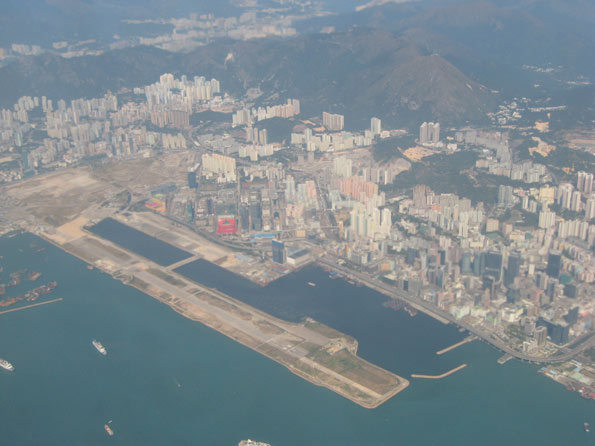
    The government of the Hong Kong Special Administrative Region has outlined plans to create a "second central business district" at Kai Tak in eastern Kowloon, site of the now former international airport. Kai Tak airport was abandoned in 1998 when the new Hong Kong International Airport at Chep Lap Tok opened.

    Kai Tak is in the middle of the most dense urban development in the high income world. The government intends that the development will have 43 million square feet of office space (4 million square meters) and will cost HK$100 Billion (approximately $13 billion).

    The development would be served by a monorail, which would connect with MTR (metro) lines at Kwun Tong and to a proposed central link MTR line to the new town of Sha Tin.

    Photo: Kai Tak Airport and East Kowloon (by author)

  • Blight Envy – How Development Works in LA

    I never thought I’d say this, but I think I want to live in a blighted neighborhood. Well, actually, a community redevelopment area (CRA). They used to be one and the same, but no longer. Apparently you have to live or do business in a redevelopment area to get any “love” in Los Angeles … love being when the government takes your tax dollars and gives them to someone else no more needy.

    Let me explain.

    The City Council of Los Angeles just approved a program to loan CRA money to businesses in the Hollywood redevelopment area, which extends from Franklin Avenue south to Santa Monica Boulevard. If borrowers meet certain conditions, loans for storefront improvements never have to be paid back … wow, free money!

    As a card-carrying member of the Los Angeles Area Chamber of Commerce, I certainly don’t begrudge businesses financial support to help improve their prospects, including the streetscape, when the whole community benefits.

    But let’s be real: Many parts of the Hollywood redevelopment area, which includes the Hollywood & Highland complex, Sunset + Vine and the Roosevelt Hotel, are no more blighted than any other part of the city.

    That includes my neighborhood council district, which lies south of the designated redevelopment area and encompasses Melrose Avenue, West Third Street and Wilshire Boulevard on the Miracle Mile. But there’s no money for our businesses. Or businesses on West Pico Boulevard. Or businesses on Van Nuys Boulevard. We are chopped liver.

    There is a place for redevelopment, to be sure, but this program illustrates exactly why the CRA has so many critics. In this case, the problem isn’t the program — storefront improvement loans are a great idea. The problem is in the execution. This should be a citywide program, with funds shared among all Council districts in Los Angeles and doled out based on objective criteria.

    It’s time to rethink redevelopment.

    Cary Brazeman, a former executive with CB Richard Ellis in Los Angeles, is a neighborhood council member and founder of LA Neighbors United. Contact him through www.LAneighbors.org

  • Zhengzhou Ghost City Alive!

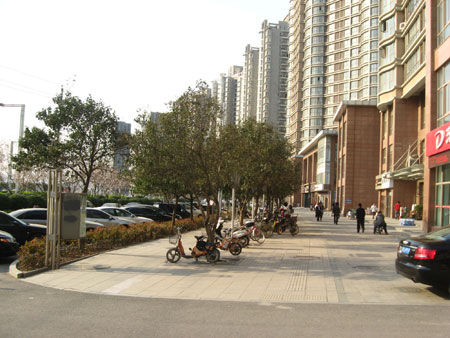
    Zhengzhou, Henan, China (March 28, 2011): In December, London’s Daily Mail reported that the Zhengzhou New Area was China’s largest “Ghost City.” A visit to the Zhengzhou New Area indicates exactly the opposite. Chinese “Ghost Cities” are large areas of new development that are virtually unoccupied. The most famous example is Ordos, a new and reportedly empty city, built to replace an older city in Inner Mongolia.

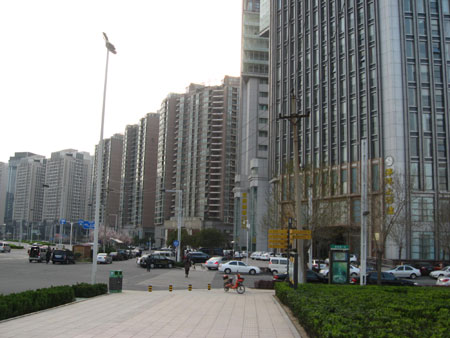
    Zhenghou is an urban area of approximately 2.5 million population and is the capital of Henan province. The Zhengzhou New Area is located in the northeastern quadrant of Zhengzhou. It is circular in design, with two parallel roads, high-rise condominium buildings on the inner ring and commercial buildings on the outer ring. The interior of the circle includes the Henan Arts Center and a skyscraper that is under construction. A new high speed rail station is under construction to serve the new Guangzhou to Beijing line. The station is to be one of the largest in Asia.

    Our visit revealed anything but a Ghost City. Granted, no-one would mistake the traffic for Beijing Third Ring Road volumes, but virtually all of the parking spaces were taken and there was traffic on the streets (Figure 1). That ultimate indicator of Chinese urbanization, the availability of frequent taxicab service was well in evidence. Two of the city’s bus rapid transit lines serve the interior circle road, again indicating a substantial threshold of non-ghost urbanization.

    There were people on the sidewalks, though not the numbers typical of an older, more dense section of a Chinese urban area (Figure 2). It was clear from the laundry hanging in glass enclosed patios that many of the condominiums were occupied, though it is to be expected that many would not be, given the Chinese propensity to invest in multiple residential properties (a tendency the central government seeks to curb). Many of the commercial skyscrapers were occupied, and some were still under construction. There are also shopping centers, small stores and fast food restaurants.

    Zhengzhou New Area is intended by the developers to become the new central business district for Zhengzhou. There is much more planned than this first phase. Eventually, the Zhengzhou New Area is intended to cover 105 square kilometers (41 square miles), generally further to the northeast. City maps already show the planned street pattern, not unlike 19th century maps of some US cities.

    In short, the Zhengzhou New Area is alive and not a Ghost City. It may well be that it took longer than expected for the place to come alive. But it is clear that the life of the Zhengzhou New Area began more than four months ago.

  • Vancouver Olympic Villiage Scandal Gets Worse

    The Vancouver Olympic Village scandal continues to worsen.  During construction, the City of Vancouver was forced to take over financing of the project, as the developer’s initial lender backed out due to cost overruns.  At the end of last August, the developer fell behind its payment schedule, and the City placed the property into receivership in November.  The development has been a spectacular failure, with fewer than half of the 737 units being sold.  The outstanding debt to the city is $743 million.  To make things worse, a quarter of the tenants are now suing the City. 

    One might expect that a billion dollar development for Olympic athletes would be pretty posh.  Prices ranged from $530,900 for a 566 square foot studio, to $4.8 million for three bedroom units.  Even in unaffordable Vancouver, you’d expect that to come with a bedroom big enough to fit a bed.   According to tenants, they didn’t even get that.  What they did get was bizarre leaks, cracking ceilings, and inadequate heating.  The project sounds like something out of Arrested Development, or as the tenants’ legal counsel put it, “It’s like they were sold a BMW and they got a broken Toyota. And even if they manage to fix everything, it’s still a Toyota.”  The units are far from the luxury accommodations buyers were lead to believe they were getting.

    In short, the lawsuits seem perfectly legitimate, and are likely to cost the City another $50 million dollars.  It’s also hard to imagine this quagmire will help the value of the units on the market.  Even before the horrendous conditions of the condo units were made public, reports claimed that the development was worth $150-200 million less than what was owed to the city.  It is hard to imagine a scenario where the city isn’t stuck with hundreds of millions of dollars of losses. 

    Of course, none of this should come as a surprise.  Government housing projects generally fail.  And if governments can’t build adequate housing for the poor, it’s hard to imagine them building upscale housing at a price that the market will bear.  Hence the shoddy work.  The lesson here is a simple one, that history proves again and again: governments make bad landlords.

  • English Goddess

    Chandra Bhan Prasad, a political activist from Northern part of India, has recently constructed a temple enshrining “Goddess English” in Bankagaon, near Lakhimpur in Utter Pradesh, India. The statue resembles the Statue of Liberty (but no crown; just a hat), carries a copy of the Indian constitution, and holds a fountain pen. Representing the unshaken belief by many Indians that English is a passport for good education, well respected and good paying jobs, and a modern outlook, no wonder the Goddess English stands on a personal computer. The temple will have symbols and formulae of chemistry, mathematics and physics engraved on the walls, and current plans are to build the staircase in the form of a computer keyboard replica.

    India is a country with over 1,652 languages spoken by its 1.2 billion residents. Hindi is one of its two official languages, spoken by about 350 million people, and the primary language of North India. But about 300 to 350 million Indians speak English. Most linguists rank India as the largest English language user in the world.

    Knowledge of English is one of the key factors in India’s new prosperity. You can feel the correlation between English language acceptance and personal income. India’s haves and have-nots are basically divided by their knowledge of the English language.

    Do we see similar pattern in the border states of the United States? The USA, as a single language country, has been engulfed in multi-language education controversies, especially in California, Arizona and Texas. A very unacceptable high school dropout rate can be observed in school districts where English is not spoken well, and the per capita income of the non-English speaking Latino population is substantially lower than US median household income.

    Is there a lesson to be learned?

  • A New Word in Development

    In the old days a “blurb” was a positive promotional recommendation statement on a book jacket. I have done a few myself. Now we are informed by the developer of Civita, an urban infill project in San Diego, that “blurb” really means a cross between suburban and urban.

    Are they going to put a picture of it on a book jacket?

    As for villages, I live in one myself. Fine and dandy, Very nice to have shops, bars, and restaurants you can walk to. But most people are not going to want to be limited to the retail and recreational opportunities of their “village,” nor even to those one can reach by good public transport from said “village.” Most particularly, most people are not going to be able to be limited to the job opportunities reachable on foot or by public transit from one’s “village.”

  • Satellite Cities for Beijing? Yes, But….

    China Daily ran an article on the continuing urbanization of Beijing. In Build upward or outward: City’s growth dilemma, Daniel Garst notes that Beijing is not as centralized as other urban areas, with its multiple business districts and comparatively low density in its inner areas. He indicates a preference for the urbanization of Shanghai, with its stronger center (both Pudong and Puxi), but suggests that it would be a mistake to replace the historic low density development with the high rises that would be necessary to change Beijing’s urban form.

    Actually, Beijing’s form is not that unusual for Asian urban areas. Tokyo has multiple office centers rather than a single dominant center and has comparatively low residential densities, even within the Yamanote Loop. Bangkok, Manila and Jakarta are similarly multi-centric. Chinese urban areas like Shenyang, Xi’an, Wuhan, Suzhou and Changsha are closer (but smaller) replicas of Beijing than Shanghai. Garst also misunderstands the dynamics of traffic congestion in his belief that roads and metros (subways) would be less congested with a more centralized form. In fact, higher densities routinely produce more intense congestion, not only on the roads but also on the rails and buses, a point recently made by Michael Matusik on this site.

    However, Garst may be onto something with respect to a suggestion that Beijing’s growth should be directed to new satellite towns, in which residents work rather than commuting to Beijing. This is good theory, but there is an important caveat, which we outlined in a comment at China Daily on the article.

    Satellite cities are not a reasonable answer unless they are so far from the Beijing urban area that commuting to Beijing is not possible. The idea of self-contained satellite cities, where people live and work in them has not worked anywhere. There are good examples of failure in London, Cairo, Stockholm, etc. So long as the large urban area can be reached, people will commute there.

    Cairo provides a useful example. Egyptian planners have long decried the continuing commute pattern into the urban area from the new towns of 6th of October and 10th of Ramadan, which are within commuting distance. On the other hand, the new town of Anwar Sadat, more remote from the urban area, has been more successful in keeping its residents in its labor market.

    Locating new satellite towns far enough to make commuting infeasible will be a real problem for Beijing. There just is not enough territory in the provincial level municipality. That means the new towns would have to be in the province Hebei, which along with the province level municipality of Tianjin surrounds Beijing.

    Short of remote new towns and forcing population and economic growth away from Beijing, the key to minimizing traffic congestion will be to minimize work trip distances by achieving a dispersion of comparatively lower density employment to match the lower density suburban dispersion. Economists Peter Gordon and Harry W. Richardson have found that “suburbanization has been the dominant and successful mechanism for reducing congestion.” in the United States. This applies no less to Beijing.

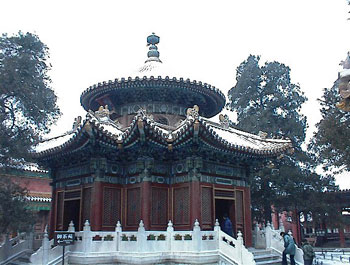
    Photograph: Forbidden City, Beijing (by author)