Tag: development

  • Vancouver Olympic Villiage Development Becoming a Burden to Taxpayers

    The former Olympic athlete’s village in Vancouver is in the news again, but this time no one is celebrating. The billion dollar plus development, originally built to house athletes then converted to a residential housing development, was primarily financed by a loan from the city of Vancouver. Millennium Development Corp., developer of the project, currently owes the city $731 million. Millennium was scheduled to pay back the first $200 million by August 31st, but came up $8 million short. They managed to find another $5 million by September 20th, but they are still $3 million short. On top of this, they have another $75 million due in January. The city is considering legal action against the developer.

    This isn’t the first we’ve heard about financial troubles with the project. The city actually took over the loan from Millennium’s initial lender due to cost overruns. The repayment schedule was considered feasible, given the strength of the Vancouver real estate market. Unfortunately for them, sales have been slow. While 223 units sold during the presale, only 36 units have moved since. This leaves more than half of the units. 454, lingering on the market. The city has actually been forced to take over the 252 units of social housing that were required to be built due to the city’s inclusionary zoning laws.

    Amidst this turmoil, the city is doing everything it can to ensure that the remaining units are neither sold off cheaply nor rented out, since this would reduce the long run selling price. Their solution is to wait for the market to rebound. Councilor Raymond Louie stated that “the benefit of being the city is that we are lasting and we can stay forever…it’s a paper loss for now, but we can wait for the market to recover.” Of course, if this were a wise decision, why are private brokers and developers not doing the same? The answer is simple: the assets are depreciating anyways, so they may as well cut their losses. The problem here seems to be that the sitting government is afraid that it will look bad for them if the sale of the units doesn’t cover the full loan amount. By telling the developer to sit on the assets, they can claim that the debt will be repaid when the market recovers (and they are happily retired from council).

    The British Columbia government reported that the cost of the Olympics to BC taxpayers was $925 million. The original estimate was $600 million. On top of this, the federal government kicked in $1 billion for security costs. That also doesn’t count the $700 million they spent on highway upgrades, $2 billion for a light rail extension, or $885 million for a convention center. Millennium’s financial troubles threaten to add to the losses incurred by taxpayers. Reports claim that the development is worth between $150-200 million less than what they owe the city. On top of that, at least 15 of the pre-sale buyers are trying to back out of their purchases. The bad news for taxpayers just keeps coming.

    While the city was forced to back the loan in order to live up to its Olympic commitments, there is a clear lesson here: cities should not be in the housing business. Even though they’ve managed to keep housing prices artificially high, they can’t break even on a housing development that was advertised to the whole world. Either the housing market will overheat again, and the project will become solvent, or the taxpayers will lose a couple hundred million dollars. Potential home owners in Vancouver can’t seem to win. The best thing the city can do at this point is admit failure, and allow Millennium to have a fire sale. It won’t do much about the cost of living in the city, but at least a few people will pick up bargains. Of course, politicians aren’t likely to cut their losses. Better to pass the buck to the next council.

  • China: Two Modernizations (Decentralization and Living Away from the Job)

    American and European planners have long sought to improve the “jobs-housing” balance, seeking to place residents and jobs within walking or cycling distance. Of course, planners don’t place people anywhere. Not surprisingly, their efforts have largely failed, from the new towns of the London area, where people travel about as far to work as anywhere else, to fabled failures of Stockholm, where high rise housing close to suburban employment centers now houses migrants who tend to have far lower incomes than native Swedes.

    In the time of Mao Zedong, China had achieved perhaps the ultimate in the jobs-housing balance. Companies provided housing for their workers, who were able to walk to their jobs in the same compound. However, the economic reforms instituted by Deng Xiaoping and his successors has led to an abandonment of this model (Danwei housing) and millions of Chinese households have been lifted out of poverty into affluence. Most Chinese households do not aspire to “living on top” of the factory or office.
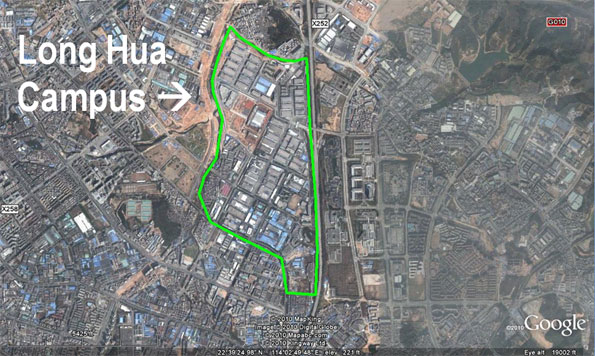
    Foxconn (Hon Hai Precision Industry), one of the world’s largest companies, is among the last to provide large amounts of housing to its workers. In its Shenzhen “Long Hua Campus,” which covers only one square mile, Foxconn employs 450,000 people (Figure). They are housed on the campus or nearby in company provided units.

    Shenzhen directly borders Hong Kong and Dongguan, which borders the Guangzhou-Foshan urban area. All together, these contiguous Pearl River Delta urban areas, along with others down the western shore to Macao have nearly 50 million people, more than live in any geographic area of the same size anywhere else in the world. These Guangdong province urban areas, along with the special economic regions of Hong Kong and Macau have become one of the world’s leading manufacturing and export areas. Shenzhen itself has been estimated to have a population of between 10 million and 15 million, depending on how the migrant workers are estimated. Shenzhen and other major manufacturing centers of China are estimated to house as many as 200 millions migrants from other parts of China (especially rural areas), coming to work in jobs that pay far higher wages than can be earned at home.

    Foxconn itself is the world’s largest manufacturer of consumer electronic technology, producing Apple’s I-Pod and I-Phone and making products for Dell, Hewlett-Packard, Sony, as well as the Nintendo, Wii entertainment systems.

    According to a report in The Wall Street Journal, Foxconn has plans to abandon its Danwei housing and move away from its “perfect” jobs-housing balance to the spatial arrangements that Chinese, Americans and Europeans routinely choose — to work where they like and live where they like.

    Foxconn has had its share of difficulties. There have been the multiple employee suicides at the Long Hua Campus. The company has faced rising costs in its Pearl River Delta operations, including higher wage costs. In its attempt to retain competitiveness, Foxconn is seriously rethinking its business model and appears likely not only get out of the housing business, but will also move many of its operations into central and western China, where costs and wages are lower. This also makes sense in relation to government policy, which seeks to develop the center and west.

    Overall, Taiwan headquartered Foxconn employs 920,000 people in China, the equivalent of the entire work force in the Portland or Kansas City metropolitan areas.

    Foxconn plans to increase its workforce in China from 920,000 to 1,300,000 and intends for many of its employees to be in new facilities in places like Chengdu (capital of Sichuan), Wuhan (capital of Hubei), Zhengzhou (capital of Henan) and Chongqing (capital of the provincial level Chongqing municipality). Foxconn’s decentralization, and the location of other new and expanded businesses in the center and west is strongly supported by China’s substantial infrastructure investment. The nation already has more than 40,000 miles of interstate equivalent highways. When all of the gaps are completed, trucks will be able to reach east coast ports from Zhengzhou or Wuhan in about days drive and little more than two days from Chongqing and Chengdu.

    At the same time, corporate executives can get to Beijing, Shanghai and the Pearl River Delta and other East Coast urban areas in 2.5 hours or less through some of the world’s most modern airports.

    Finally, the more decentralized operations will allow the migrant workers to live much closer to their homes, rather than having to travel all the way to the East Coast. This will make more frequent visits to rural villages and families possible.

    —-

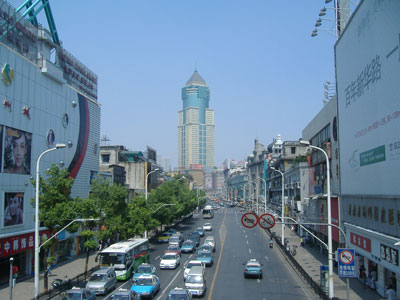
    Photo: Wuhan (photo by author)

  • City of Austin Approves Big Greenfield Development

    Despite its smart growth policies, the city of Austin has approved a new development on the urban fringe that will include new detached housing starting at $115,000.

    Austin is the third fastest growing metropolitan area with more than 1,000,000 residents in the United States, following Raleigh, North Carolina and Las Vegas. The city of Austin accounted for 53% (672,000) of the metropolitan area’s 1.27 million population in 2000, but has seen more than 70% of the growth since that time go to the suburbs. Now the metropolitan area has 1.65 million people, and the city has 785,000.

    The Austin metropolitan area managed to experience only modest house price increases during the housing bubble, though other metropolitan areas in Texas (Dallas-Fort Worth, Houston and San Antonio) did even better (see the Demographia International Housing Affordability Survey). Austin’s Median Multiple (median house price divided by median household income) peaked at 3.3, slightly above the historic maximum norm of 3.0. Like other Texas markets, there has been little price decline during the housing bust, illustrating the lower level of price volatility and speculation identified by Glaeser and Gyourko with less restrictive land use regulation. This stability has helped Texas weather the Great Recession better than its principal competition, the more intensely regulated states of California and Florida.

    The city of Austin, however, is rare in Texas for generally favoring the more restrictive (smart growth) land use policy devices that have been associated with the extreme house price escalation in California, Florida, Portland, and many other metropolitan areas. The city’s freedom, however, to implement the most draconian policies and drive house prices up is severely limited by far less restrictive land use policies in the balance of its home county (Travis), neighboring Williamson County (usually among the fastest growing in the nation), Hayes County and the other counties in the metropolitan area.

    Austin is competing. This is illustrated by the recent Austin city council action to approve a new “mega” development on the urban area’s eastern fringe that could eventually add 5,000 new houses, town houses and apartments. The first phase will be 350 detached houses that the developer indicates will be priced from $115,000 to $120,000 (including land), an amount less than a building lot San Diego, Los Angeles, Vancouver and Australia.

    By comparison with other developments in the Austin area, however, these houses may be expensive. One home builder is currently advertising new detached houses, only 7 miles from downtown Austin for $90,000. These are not the least expensive in Texas. Detached houses in Houston are being advertised for $79,000.

    A case study in the 3rd Annual Demographia International Housing Affordability Survey showed that the median income Austin household could purchase the median priced house for 11 years less income than in Perth, Australia (this includes mortgage interest). While both Austin and Perth have been growing rapidly, Austin’s faster growth is evidence of stronger demand, which, all things being equal, would have been expected to drive house prices up more than in Perth. But, with more restrictive land use regulation, all things are never equal.