Tag: economic development

  • You Can Grow Your Own Way

    A confluence of potent forces is creating an era of localism and decentralization across the planet making local decision-making and action more important than ever before. This is particularly true in the economic realm, where cities and regions must take full advantage of their unique combination of resources, culture, infrastructure, core competencies in industry and agriculture and the skills of entrepreneurs and workers.   

    There is no single formula for success for any place in the 21st century. Your economic strategy may need a shot in the arm (or a kick in the butt), a total remodel or perhaps it needs to be meaningfully modernized.

    The NewGeography Economic Opportunity & Growth Forum is a one-day strategy event that helps leaders, innovators and entrepreneurs develop strategies for grappling with challenges and seizing opportunities that will propel local growth.

    The one-day Forum addresses the basic fundamentals to propel growth including policies that stress essential physical infrastructure, investments in basic and skill-oriented education, and a favorable business environment that facilitates free enterprise and entrepreneurship.

    Joel Kotkin, an internationally recognized authority on economic and social trends and, a founder and Executive Editor of NewGeography.com, begins each forum with a high-level look at consequential trends and circumstances that affect local and regional growth. This is followed by an economic assessment of the local and regional economy and subsequent panel discussions involving key local leaders in business, government, education and the civic sectors.

    Each Forum culminates in afternoon strategy sessions that lead to the identification of priorities where enhanced collaboration is needed and action steps are identified for building support and mobilizing resources and talents to put your city or region on a solid growth trajectory.

    NewGeography anticipates doing only two to three Forums in the remainder of 2017 so contact us at your earliest convenience to get the ball moving. Download this pdf for more information about how to bring the forum to your community. For e-mail inquiries contact Delore Zimmerman at delore@praxissg.com.

  • Uber! Regulations Mean San Francisco Loses While Phoenix and Pittsburgh Win

    Any business person who has dealt with California’s frustrating laws, regulations and bureaucrats was nonetheless surprised to see the story headlined, "Uber Ships Self-Driving Cars to Arizona After California Ban."

    Really? A state ban on Uber? The poster child of the billion-dollar-plus startup, tech-guru, market-disruptor club? Why would Sacramento give Uber, of all people, a bad time?

    Reuters said Uber Technologies Inc. pulled its fleet of self-driving cars from the streets of San Francisco and sent them to Arizona’s friendlier territory:

    The California Department of Motor Vehicles banned Uber’s self-driving cars from San Francisco just days after they first deployed. In response, Uber picked up and moved out. "Our cars departed for Arizona this morning by truck, Uber said… . We’ll be expanding our self-driving pilot there in the next few weeks, and we’re excited to have the support of Governor Ducey."

    Gov. Doug Ducey wooed Uber on social media the evening when the ride-hailing company pulled its self-driving test from San Francisco. “California may not want you; but AZ does!” he wrote on Twitter. The next morning, Uber’s fleet was headed his way.

    California moved to revoke registrations for Uber’s automobiles, but Uber said its vehicles require oversight by a human driver and shouldn’t qualify under California’s autonomous-driving rules. Nonetheless, the state Attorney General and soon-to-be Senator, Kamala Harris (loyal to unions and hostile to business interests), threatened legal action if the company continued operating automobiles without a permit.

    Uber in Arizona

    Anthony Levandowski, the head of Uber’s Advanced Technologies Group, argued that because the company’s self-driving system is an early prototype and requires test drivers to keep their hands on the steering wheel at all times. It’s no different from driver-assist systems already on the market — and those are exempt from the requirement for a California permit.

    Levandowski said that it isn’t clear why the DMV is requiring a permit now when they’ve known that Ubers have been on the streets of San Francisco over a month and have been operating safely for months in Pittsburgh, "where policymakers and regulators are supportive of our efforts."

    Last year, Uber opened its Center for Excellence in Phoenix, where it serves U.S. customers and Uber users worldwide. Now, it seems that more development work will occur in Phoenix. That’s what happens when a state is friendly to business interests.

    Uber in Pittsburgh

    Uber has been successfully testing autonomous-driving vehicles in Pittsburgh for some time. An extensive Wall Street Journal story in September — Uber’s Self-Driving Cars Debut in Pittsburgh — described how Uber is turning the city into an "experimental lab" where it will have as many as 100 specially equipped Volvo XC90s operating. Also, reported the WSJ, the city has its quirks – like the "Pittsburgh left turn" – which makes it a great location for testing autonomous vehicles:

    It is customary for the first driver at a stoplight who is signaling a left turn to have priority over oncoming traffic when the light turns green. People in the oncoming lanes generally allow that leftward dash and are puzzled or even angry if it doesn’t occur. Uber has programmed its cars to allow other cars to make the ‘Pittsburgh left’ but not to make it themselves. The city is also notoriously difficult to drive through with steep hills and three rivers that make streets twist and turn unpredictably… . “If you can drive successfully in Pittsburgh, you’re pretty much done,” said Ragunathan Rajkumar, a professor at [Carnegie Mellon University] who specializes in autonomous vehicles.

    Last year Uber opened an Advanced Technologies Center in Pittsburgh and this year is developing its second research facility there, which will be part of a massive brownfield redevelopment site. Uber says it likes Pittsburgh’s “world-class research universities and engineers and a thriving technology community.”

    Uber entered into a strategic partnership with Carnegie Mellon University to help create its new technology center and also to rely on the university’s National Robotics Engineering Center to do R&D in mapping, vehicle safety and autonomy technology. Safety is one of Uber’s major concerns.

    Uber also selected Pittsburgh because of the clustering of robotics companies such as Carnegie Robotics and RedZone Robotics.

    Although California prides itself on the pool of technical talent found in San Francisco and Silicon Valley, Uber has found justification to praise Phoenix and Pittsburgh for the talent available from local universities and the community support of technology and innovation.

    Uber’s experience in San Francisco shows that venture capitalists, Ph.Ds in robotics and software engineers are no match for an all-knowing California bureaucracy.

    Joseph Vranich is the Principal of Spectrum Location Solutions, an Irvine-based Site Selection firm that helps companies identify optimum locations to accommodate growth or to improve competitiveness. On such projects he conducts an in-depth analysis of business taxes, the regulatory climate, labor rates, logistics options and lifestyle factors.

  • California Companies Head for Greatness – Outside of California

    Why would companies located in one of the most beautiful states in the country – California – undertake the costly proposition of relocating to places with less scenic appeal and less-than-ideal weather?

    There are three answers and they relate to California’s business environment: Regulations, taxes and anxiety.

    Let’s take anxiety first. Corporate leaders and business owners fear what will happen in the future regarding proposals to raise taxes on business property, extend the Proposition 30 taxes that were supposed to be “temporary,” raise cap-and-trade fees to curb carbon emissions, and impose new workplace regulations regarding family leave and health care. We’re talking about billions of dollars in new operating and ownership costs.

    Some of those proposals were defeated this year. But the energy level of the zealotry in California’s legislature means they are certain to rise again in 2016 and 2017. Projecting the resulting cost and complexity in future operations causes leaders in corporations and small businesses to worry – then they worry some more over the unpredictability of it all.

    About taxes: This could be discussed for hours, but suffice to say that the Tax Foundation’s 2015 State Business Tax Climate Index lists California at No. 48.

    The regulatory environment can be brutal. Examples include fines for trivial errors such as a typo on a paycheck stub – not on the check, just the stub – and putting into law costly overtime provisions that in most states aren’t codified in a statute.

    Last year, when Gov. Jerry Brown was asked about business challenges, he revealed his aloofness by saying, “We’ve got a few problems, we have lots of little burdens and regulations and taxes, but smart people figure out how to make it.” The Wall Street Journal responded: “California’s problem is that smart people have figured out they can make it better elsewhere.”

    In short, California is so difficult that companies relocate entirely or, if they keep their headquarters here, find other places to expand.

    In an effort to offset Sacramento’s head-in-the-sand approach to business concerns, my firm completed a new study that provides details of business disinvestments in the state. Over the seven-year period that includes last year, the study estimates that 9,000 businesses disinvested in California in favor of other locations.

    The study shows that 1,510 California disinvestment events have become public knowledge and provides details on each and every event. Site selection experts I’ve been in touch with conservatively estimate that a minimum of five events fail to become known for every one that does. One reason is that when companies with fewer than 100 employees relocate it almost never becomes public knowledge. Hence, it is reasonable to conclude that about 9,000 California disinvestment events have occurred in the last seven years.

    Los Angeles County #1 in Losses

    The study found that the Top Fifteen California counties with the highest number of disinvestment events put Los Angeles with the most losses at No. 1, followed by (2) Orange, (3) Santa Clara, (4) San Francisco, (5) San Diego, (6) Alameda, (7) San Mateo, (8) Ventura, (9) Sacramento, (10) Riverside, (11) San Bernardino, (12) Contra Costa tied with Santa Barbara, (13) San Joaquin, (14) Stanislaus and (15) Sonoma.

    The report excluded instances of companies opening new out-of-state facilities to tap a growing market, acts unrelated to California’s business environment. It also points to shortcomings in Federal and state reporting systems that result in underreporting of business migrations. Those factors reduced the number of California losses.

    It is easy to verify circumstances described in the report since every disinvestment event is public information, is outlined in detail and sources are identified in endnotes.

    When a company launches a site search, it always wants to examine potential costs. I’ve seen many business people smile upon learning that operating cost savings are between 20 and 35 percent in other states. By the way, the appeal isn’t necessarily to the lowest-cost states, but to lower-cost states with the proper workforce.

    Winning Locations

    The Top Ten States to which businesses migrated puts Texas in the No. 1 spot, followed by (2) Nevada, (3) Arizona, (4) Colorado, (5) Washington, (6) Oregon, (7) North Carolina, (8) Florida, (9) Georgia and (10) Virginia. Texas was the top destination for California companies each year during the study period.

    Metropolitan Statistical Areas (MSAs) benefiting from California disinvestment events, in the order starting with those that gained the most, are: (1) Austin-Round Rock-San Marcos, (2) Dallas-Fort Worth-Arlington, (3) Phoenix-Mesa-Scottsdale, (4) Reno-Sparks, (5) Las Vegas-Paradise, (6) Portland-Vancouver (WA)-Hillsboro, (7) Denver-Aurora-Lakewood, (8) Seattle-Tacoma-Bellevue, (9) Atlanta-Sandy Springs-Marietta and (10) Salt Lake City tied with San Antonio.

    Offshoring still occurs, and the Top Ten Foreign Nations that gained the most put Mexico at No. 1, followed by (2) India, (3) China, (4) Canada, (5) Malaysia, (6) Philippines, (7) Costa Rica, (8) Singapore, (9) Japan and (10) United Kingdom.

    Capital diverted to out-of-state locations totaled $68 billion, a small fraction of actual experience because only 16 percent of public source materials provided capital costs for the 1,510 events. Moreover, the top industry to disinvest in California is manufacturing, a capital-intensive sector, and more detailed knowledge of this industry alone would likely increase the capital diversion.

    As California companies relocated or expanded facilities elsewhere they transferred more than capital – they also shifted jobs, machinery, taxable income, intellectual capital, training facilities and philanthropic investments.

    Indicators are that California’s business climate will worsen, enhancing prospects that more companies will seek places that are friendlier to business interests.

    The report is based exclusively on news stories and company reports to the U.S. Department of Labor, the Securities and Exchange Commission and the California Employment Development Dept. Although all entries are based on public information, it’s rare for so much data to be gathered into one report.

    Read the full study: “Businesses Continue to Leave California – A Seven-Year Review” available as a PDF here.

    Joseph Vranich is the Principal of Spectrum Location Solutions, a Site Selection firm that helps companies identify optimum locations to accommodate growth or to improve competitiveness. In doing so, he conducts an in-depth analysis of business taxes, the regulatory climate, labor rates and lifestyle factors.

  • In Keystone XL Rejection, We See Two Americas At War With Each Other

    America has two basic economies, and the division increasingly defines its politics. One, concentrated on the coasts and in college towns, focuses on the business of images, digits and transactions. The other, located largely in the southeast, Texas and the Heartland, makes its living in more traditional industries, from agriculture and manufacturing to fossil fuel development.

    Traditionally these two economies coexisted without interfering with the progress of the other. Wealthier gentry-dominated regions generally eschewed getting their hands dirty so that they could maintain the amenities that draw the so-called creative class and affluent trustifarians. The more traditionally based regions focused, largely uninhibited, on their core businesses, and often used the income to diversify their economies into higher-value added fields.

    The Obama administration has altered this tolerant regime, generating intensifying conflict between the NIMBY America and its more blue-collar counterpart. The administration’s move to block the Keystone XL oil pipeline from Canada to the Gulf of Mexico represents a classic expression of this conflict. To appease largely urban environmentalists, the Obama team has squandered the potential for thousands of blue-collar jobs in the Heartland and the Gulf of Mexico.

    In this way, Obama differs from Bill Clinton, who after all recognized the need for basic industries as governor of poor and rural Arkansas. But the academic and urbanista-dominated Obama administration has little appreciation for those who do the nation’s economic dirty work.

    NIMBY America’s quasi-religious devotion to the cause of global warming is the current main reason for their hostility to the basic economy. But it is all a part of a concerted, decades-long jihad to limit the dreaded “human footprint,” particularly of those living outside the carefully protected littoral urban areas.

    Oddly, in their self-righteous narcissism, the urbanistas seem to forget that driving production from more regulated areas like California or New York to far less controlled areas like Texas or China, may in the end actually increase net greenhouse gas emissions. The hip, cool urbanistas won’t stop consuming iPads, but simply prefer that the pollution making them is generated far from home, and preferably outside the country.

    The perspective in the Heartland areas and Texas, of course, is quite different. They regard basic industries as central to their current prosperity. Oil and gas, along with agriculture and manufacturing, have made these areas the fastest growing in terms of jobs and income over the past decade.

    Of course, the apologists for the NIMBY regions can claim that they, too, create economic value. And to be sure, Silicon Valley — now in a midst of one of its periodic boom periods — Wall Street and Hollywood constitute some of the country’s prime economic assets. Similarly, highly regulated cities such as New York, San Francisco, Seattle, Boston and Chicago offer a quality of life, at least for the well-heeled, that draws talent and capital from the rest of the world.

    But the NIMBY model suffers severe limitations. For one thing, these high cost areas generally lag in creating middle-skilled jobs; New York and San Francisco, for example, have suffered the largest percentage declines in manufacturing employment of the nation’s 51 largest metropolitan areas. Indeed with the exception of Seattle, the NIMBY regions have all underperformed the national average in job creation for well over a decade.

    These areas are becoming increasingly toxic to the middle class, especially families who are now fleeing to places like Texas, Tennessee, North Carolina and even Oklahoma. NIMBY land use regulations — designed to limit single-family houses — usually end up creating housing costs that range up to six times annual income; in more basic regions, the ratio is around three or lower.

    Ironically, America’s most ardently “progressive” areas turn out to be the most socially regressive, with the largest gaps between rich and poor. Even the current tech bubble has not been of much help to heavily Latino working-class areas like San Jose, where unemployment ranges around 10%, nor across the Bay in devastated Oakland, where the jobless rate surpasses 15%.

    To succeed, America needs both of its economies to accommodate the aspirations not only of its current population but the roughly 100 million more Americans who will be here by 2050. If the regions that want to maintain NIMBY values want to do so, that should be their prerogative. But stomping on the potential of other, less fashionable areas seems neither morally nor socially justifiable.

  • Interactive Data Visualization: The Connection Between Manufacturing Jobs and Exports

    By Hank Robison and Rob Sentz

    We recently observed that there are only about 50 manufacturing sectors out of 472 (6-digit NAICS) that actually gained jobs over the past 10 years. This made us wonder because we keep hearing that manufacturing output is actually improving. Politicians and policymakers tend to assume that an uptick in output would naturally result in an uptick in employment. So we investigated.

    What we found

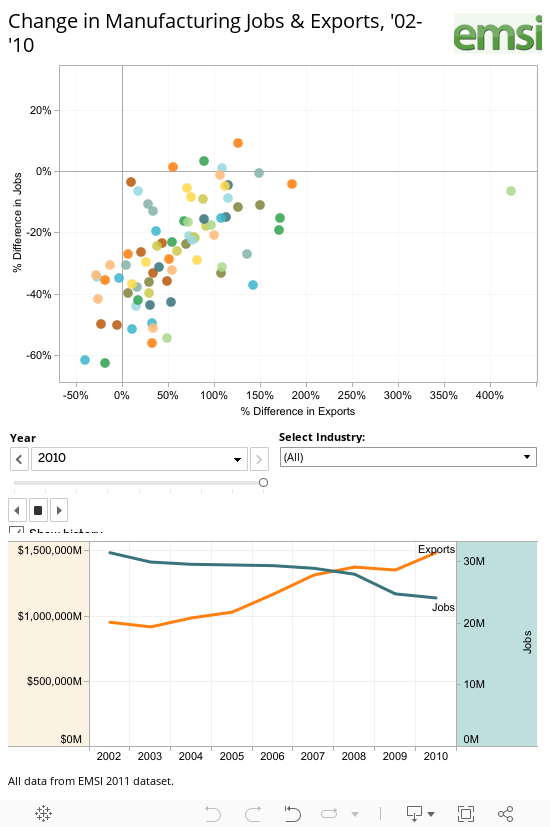
    We placed national export data on top of job totals for each of the 472 manufacturing sectors, and found that manufacturing exports (inflation-adjusted) actually grew by 56% from 02-10 while manufacturing jobs contracted by 23%. Growth in exports have clearly not resulted in more domestic jobs. See the interactive graphic at the bottom of this post for a visualization.

    Across the manufacturing sectors we are actually seeing a predominantly inverse relationship between jobs and exports. To explore this further, we placed each of the 472 industries into one of four categories (again see the graphic):
    1) Those that gained both exports and jobs,
    2) Those that gained exports but lost jobs,
    3) Those that lost exports but gained jobs, and
    4) Those that lost both exports and jobs.

    Some observations

    Those advocating for increased exports as a way of resuscitating jobs in manufacturing need to look at this data. Only 11% of all manufacturing sectors showed gains in jobs and exports, which is not a huge surprise given manufacturing decline. 19% lost jobs AND exports at the same time. Now here is the stat really worth noting — 71% of all manufacturing sectors increased their exports while decreasing their domestic workforce.

    There are some political ramifications here. The Obama Administration has proposed exports as a key to kick-starting the U.S. labor market (see this post from Brookings). Economists and policy experts as well as all of us here at EMSI are huge fans of improving exports. Exports are a principal source of foreign exchange and an important driver for U.S. goods. Export industries also tend to pay higher wages and connect with the rest of the economy through greater multiplier effects, which mean they are key for income and job formation.

    However, as the data suggests things are not that simple. Domestic manufacturers appear to be outsourcing large parts of their work to foreign suppliers. In the process, they employ fewer domestic workers but become more competitive in foreign markets. As a result, exports go up while employment goes down. This is something that policymakers need to consider before pinning too much hope on exports as a way of reviving manufacturing sector employment.

    Conclusion

    There may be a conflict of goals here. On one hand we want high-wage, high-benefit jobs; on the other, “full employment.” But in manufacturing can we have both? If wages, and benefits are pushing producers to outsource then either wages go down (an unattractive prospect), or we adopt policies that spawn productivity growth needed to support high-wages. Are there any other choices?

    Data Graphic

    In this interactive graphic, you can explore EMSI’s data on manufacturing jobs and exports. The data is based on 4-digit NAICS manufacturing sectors. NOTE: 6-digit data was used in the previous analyis.

    Click on the chart to highlight an industry or use the drop-down box. Data in the top half of the graphic shows percentage change in jobs (on the y-axis) and exports (on the x-axis). The bottom line graph simply compares manufacturing jobs and exports over time.

    As we highlighted above, 71% of all manufacturing sectors increased their exports while decreasing their domestic workforce from 2002 to 2010.

    For more information, email Rob Sentz.

  • Telecommuting and Satellite Cities

    Smaller satellite cities throughout the Midwest may have an advantage that they have yet to realize: strong bases for telecommuters. Cities such as Iowa City, IA; Albert Lea, MN; and Hastings, NE have this advantage, where over four percent of the city’s population works from home according to American Community Survey’s information from 2009. The average rates for larger metros tended to be in the mid 3% range. Here are a few Midwestern cities that were of note:


    % Population working from home

    Albert Lea, MN

    5.7

    Athens, OH

    5.0

    Brainerd, MN

    6.4

    Dubuque, IA

    4.1

    Freeport, IL

    4.8

    Hastings, NE

    5.7

    Iowa City, IA

    4.7

    La Crosse, WI

    4.7

    Source:  U.S. Census American Community Survey, 2009

    These cities have similar attributes: relatively small populations, mostly remote locations, and within 200 miles of a large metro. These characteristics may be a foundation for increased telecommunication in these cities. Could these cities one day become far-flung constituents of a larger conurbation?

    For example, of the eight cities cited above, three of them could call Chicago their focal city. Other cities that act as cardinal municipalities in this list are Madison, Minneapolis, and Omaha. While millions from the labor force pile into large, over-populated metros throughout the Midwest for work, others may be able to find integral employment in these smaller regions, while still in close enough proximity to benefit from the larger markets.

    Telecommuting may also have a positive affect on the quality of life of the individuals who take advantage of the opportunity. A smaller city often makes for lower costs, cheaper housing, less time driving from place to place, and more access to the community. On top of this, rising oil prices have less affect on the telecommuter. Furthermore, some of the cities listed are in an optimal location for natural amenities of the region to be factored in. For instance, Brainerd’s prime location amidst a plethora of lakes and forestry helps to add to the city’s natural lure, while remaining twice daily flight or a 130 mile drive to downtown Minneapolis. 

    If these satellite cities can adapt to be friendly to telecommuters, they may be able to help strengthen the regional economies with a more specialized, more productive workforce. Businesses in the area must be inclined to initiate telecommuting as a part of their workforce and have trust in their workers. A smaller community may make this an opportune place for this, as it forms a more cohesive social unity amongst citizens.

    If these smaller places can maintain reasonable air and telecommunications access, affordable housing, high-end schools and child care, and perhaps flexible small office space or business assistance for lone eagle entrepreneurs, these places could become hubs for this growing segment of workers.  However, the big incentive for those desiring and learning about telecommuting work may simply be the opportunity to do important work in their pajamas.

  • US House Gives Small Business the Huggem-Muggem

    “In public Congress hugs them, in private they mug them!” So said the late Milt Stewart, one of the architects of the Small Business Innovation Research (SBIR) Program in the 1980s and a renowned advocate for America’s small businesses.

    I first met Milt in 1992 and eagerly joined forces with him and others from business and government to generate more research opportunities for America’s small businesses – then and now, the most potent force for innovation and job creation on the planet.

    Unfortunately, small business continues to get what Fred Patterson, echoing Milt Stewart, calls the “Huggem-Muggem”: lots of lip service but very little productive legislative action that facilitates their creation of jobs.

    Case in point is the current plight of the SBIR program, which has received considerable bi-partisan support in the Congress for more than 25 years. The Senate of the 111th Congress wanted to reauthorize the SBIR but their counterparts in the House leadership played the old “Huggem-Muggem” game.

    The outgoing Chairman of the House Small Business Committee, Nydia Velazquez (D-NY), blocked all efforts to openly debate many Small Business Administration (SBA) initiatives, including the SBIR Program, before her committee. The incoming committee chair, Sam Graves (R-MO), has previously aligned with her to thwart SBIR reauthorization. Their opposition to reauthorization appears to center on the fact that companies which are majority-owned by venture capital firms are now ineligible to apply for SBIR funds.

    The National Small Business Association puts the facts on the line. “Despite the remarkable achievements of SBIR, federal R&D funding is still skewed against small businesses. Today, small R&D companies employ 38 percent of all scientists and engineers in America. This is more than all U.S. universities and more than all large businesses. Furthermore, these small companies produce five times as many patents per dollar as large companies and 20 times as many as universities—and more small-business innovations are commercialized. Yet small companies receive only 4.3 percent of the federal government’s R&D dollars. The SBIR program provides more than half of this amount.”

    If our country is serious about innovation, competitiveness and job creation it makes sense that we put our resources where they have the most impact. Instead, we are served up the same old tired “Huggem-Muggem” game by those who profess to be advocates for small business.

    I’ve said it before, and will say it again- instead of weakening the SBIR program we should be doubling, if not tripling, our country’s investment in the program. At a minimum a $5 billion SBIR program should be put in place. It will give us much more job growth than the Treasury bailouts of domestic banks and, as we now know, foreign banks too. The SBIR program represents both what America wants and needs in these times of economic stress: job growth driven by small business innovation.

    Delore Zimmerman is President of Praxis Strategy Group and publisher of newgeography.com

  • Supporting Small Business in NYC: The Harlem Metro Market Project

    The Harlem Community Development Corporation has come up with a rather unique plan to combat high real estate prices in the district. It proposes establishing an open-air market under the Metro North tracks spanning one mile, or 22 city blocks. This new market would accommodate about 900 vendors, helping to increase the now low number of local entrepreneurs and independent retail stores in Harlem.

    The market would not only attract vendors, but tourist traffic as well, which would help rejuvenate a neighborhood hampered by soaring commercial real estate costs. It costs anywhere from $125 to $225 per square foot for commercial space in Harlem’s prime locations, resulting in only 42 stores for every 10,000 residents. The Metro market project would ease pressure on small, independent retailers and allow potential entrepreneurs the chance to create viable businesses in the city.

    This need for such a project reflects the economic trends and challenges facing the larger New York urban area’s middle class. New York City has the nation’s highest cost of living, and like the rest of the nation, is still experiencing the effects of the recession. The middle class, including small business owners facing high rents, struggles to make the six-figure salaries needed to meet the city’s high cost of living.

    Harlem’s Metro market project, which would encourage an independent entrepreneurial spirit, embodies the required plan of action for New York City. The city needs to find inventive ways to deal with its economic reality in order to reverse the recession and revitalize its appeal to the energetic and the ambitious.

  • Sao Paulo: Upward Mobility through Music

    In a city notorious for its vast gap between rich and poor and the involvement of children in gang activity and drug trafficking, a music school is providing an opportunity for the young people of the favelas to put their energies to better use in performing for themselves and their communities. The school’s band has now toured the world and received visits from heads of state. This documentary tells the story of Sao Paulo’s Meninos Do Morumbi and how it has affected the lives of its students.

  • What Houston can learn from the Israeli model to boost entrepreneurship

    While Houston is not a Silicon Valley, or even an Austin, it has come a long way in cultivating a small but vibrant entrepreneurial scene in the last decade. But there’s always room for improvement, and we might be able to learn some lessons from Israel, of all places. First, there is this conclusion from an Economist article on the mostly-sad story of government strategies for cultivating entrepreneurship:

    The country that has led the world in promoting entrepreneurship has also done the most to plug itself into global markets. The Israeli government’s venture-capital fund, which was founded in 1992 with $100m of public money, was designed to attract foreign venture capital and, just as importantly, expertise. The government let foreigners decide what to invest in, and then stumped up a hefty share of the money required. Foreign venture capital poured into the country, high-tech companies boomed, domestic venture capitalists learned from their foreign counterparts and the government felt able to sell off the fund after just five years.

    Last year Israel, a country of just over 7m people, attracted as much venture capital as France and Germany combined. Israel has more start-ups per head than any other country (a total of 3,850, or one for every 1,844 Israelis), and more companies listed on the NASDAQ exchange, a hub for fledgling technology firms, than China and India combined. It may not have the same comforting ring as “the Swedish model” or “the polder model”, but when it comes to promoting entrepreneurship, “the Israeli model” is the one to emulate.

    What’s Israel’s ‘secret sauce’? This book review from Newsweek lays it out:

    How does Israel—with fewer people than the state of New Jersey, no natural resources, and hostile nations all around—produce more tech companies listed on the NASDAQ than all of Europe, Japan, South Korea, India, and China combined? How does Israel attract, per person, 30 times as much venture capital as Europe and more than twice the flow to American companies? How does it produce, for its size, the most cutting-edge technology startups in the world?

    There are many components to the answer, but one of the most central and surprising is the Israeli military’s role in breaking down hierarchies and—serendipitously—becoming a boot camp for new tech entrepreneurs.

    While students in other countries are preoccupied with deciding which college to attend, Israeli high-school seniors are readying themselves for military service—three years for men, two for women—and jockeying to be chosen by elite units in the Israeli military, known as the Israel Defense Forces, or IDF.

    I goes on to detail the elements of the military culture there that carry over into the entrepreneurial world: innovation, improvisation, flat, anti-hierarchical, informal, flexible, multi-disciplinary, diversity, challenging, meritocratic, and intense ‘crucible leadership experiences’ to forge deep social bonds and networks that are later leveraged to create startups.

    Now obviously Houston (or Texas or the U.S.) won’t be instituting mandatory military service anytime soon. But could we form a local civilian corps of high school and pre-college youth to create a similar environment, focused on tough social problems and charitable work. If we modeled the corps on Israel’s military culture, and made sure to craft the experience to be very attractive to college admissions departments, there’s a lot of potential here to attract youth, work on some of the city’s toughest problems, and cultivate a generation of entrepreneurs to add economic vibrancy to our city for decades to come. Oh, and we could match them up with older philanthropists and retirees to provide both funding and mentorship.

    Combine that with new sources of local venture capital, and we could really turbocharge the local startup scene. I’d love to hear your thoughts on how we might structure such a corps and the problems it might work on in the comments.