Tag: Economy

  • The New American Heartland

    How can Middle America tap into its potential to drive the nation’s economy?

    At “The New American Heartland” forum, hosted by the City Club of Cleveland, J.D. Vance, author of Hillbilly Elegy: A Memoir of a Family and Culture in Crisis, discussed the economic and cultural challenges facing Middle America. Decline in civic institution participation, drug addiction, and childhood trauma hit lower-income communities higher than anyone else. The key to lifting these communities up is to create economic opportunity because, as Vance explained, “…a good job isn’t just a paycheck, a good job is about having a community, a good job is about going to work and doing something that’s meaningful and dignified…” The source of that opportunity in our country comes from small, but high-growth start-ups, which are largely based on the coasts. However, industries based in the Heartland, such as transportation and energy, are prime for similar innovation which in turn would spur job growth.

    Joel Kotkin and Michael Lind, authors of The New American Heartland: Renewing the Middle Class by Revitalizing Middle America report, define the “New American Heartland” as the region between the Appalachians and the Rockies, and from the Gulf of Mexico to the Canadian border. This region holds about half of the country’s population with the power to propel the whole nation’s economy forward. The Heartland’s lower cost of living, high-paying manufacturing employment, and productive power has the potential to foster the middle class and fuel economic growth across the United States.

    It is time to change the narrative about Middle America.

    Watch the City Club of Cleveland’s video of the event here and read a recap, from Peter Krouse of cleveland.com, here.

  • California’s Fading Promise: Millennial Prospects in the Golden State

    Homeownership continues to be the most important part of the American dream for millennials, but California’s rising house prices continue to force them out of the state.

    This video is part of the larger report “California’s Fading Promise: Millennial Prospects in the Golden State”, conducted by Joel Kotkin and Chapman University researchers, in partnership with the California Association of Realtors.

  • California Companies Head for Greatness – Outside of California

    Why would companies located in one of the most beautiful states in the country – California – undertake the costly proposition of relocating to places with less scenic appeal and less-than-ideal weather?

    There are three answers and they relate to California’s business environment: Regulations, taxes and anxiety.

    Let’s take anxiety first. Corporate leaders and business owners fear what will happen in the future regarding proposals to raise taxes on business property, extend the Proposition 30 taxes that were supposed to be “temporary,” raise cap-and-trade fees to curb carbon emissions, and impose new workplace regulations regarding family leave and health care. We’re talking about billions of dollars in new operating and ownership costs.

    Some of those proposals were defeated this year. But the energy level of the zealotry in California’s legislature means they are certain to rise again in 2016 and 2017. Projecting the resulting cost and complexity in future operations causes leaders in corporations and small businesses to worry – then they worry some more over the unpredictability of it all.

    About taxes: This could be discussed for hours, but suffice to say that the Tax Foundation’s 2015 State Business Tax Climate Index lists California at No. 48.

    The regulatory environment can be brutal. Examples include fines for trivial errors such as a typo on a paycheck stub – not on the check, just the stub – and putting into law costly overtime provisions that in most states aren’t codified in a statute.

    Last year, when Gov. Jerry Brown was asked about business challenges, he revealed his aloofness by saying, “We’ve got a few problems, we have lots of little burdens and regulations and taxes, but smart people figure out how to make it.” The Wall Street Journal responded: “California’s problem is that smart people have figured out they can make it better elsewhere.”

    In short, California is so difficult that companies relocate entirely or, if they keep their headquarters here, find other places to expand.

    In an effort to offset Sacramento’s head-in-the-sand approach to business concerns, my firm completed a new study that provides details of business disinvestments in the state. Over the seven-year period that includes last year, the study estimates that 9,000 businesses disinvested in California in favor of other locations.

    The study shows that 1,510 California disinvestment events have become public knowledge and provides details on each and every event. Site selection experts I’ve been in touch with conservatively estimate that a minimum of five events fail to become known for every one that does. One reason is that when companies with fewer than 100 employees relocate it almost never becomes public knowledge. Hence, it is reasonable to conclude that about 9,000 California disinvestment events have occurred in the last seven years.

    Los Angeles County #1 in Losses

    The study found that the Top Fifteen California counties with the highest number of disinvestment events put Los Angeles with the most losses at No. 1, followed by (2) Orange, (3) Santa Clara, (4) San Francisco, (5) San Diego, (6) Alameda, (7) San Mateo, (8) Ventura, (9) Sacramento, (10) Riverside, (11) San Bernardino, (12) Contra Costa tied with Santa Barbara, (13) San Joaquin, (14) Stanislaus and (15) Sonoma.

    The report excluded instances of companies opening new out-of-state facilities to tap a growing market, acts unrelated to California’s business environment. It also points to shortcomings in Federal and state reporting systems that result in underreporting of business migrations. Those factors reduced the number of California losses.

    It is easy to verify circumstances described in the report since every disinvestment event is public information, is outlined in detail and sources are identified in endnotes.

    When a company launches a site search, it always wants to examine potential costs. I’ve seen many business people smile upon learning that operating cost savings are between 20 and 35 percent in other states. By the way, the appeal isn’t necessarily to the lowest-cost states, but to lower-cost states with the proper workforce.

    Winning Locations

    The Top Ten States to which businesses migrated puts Texas in the No. 1 spot, followed by (2) Nevada, (3) Arizona, (4) Colorado, (5) Washington, (6) Oregon, (7) North Carolina, (8) Florida, (9) Georgia and (10) Virginia. Texas was the top destination for California companies each year during the study period.

    Metropolitan Statistical Areas (MSAs) benefiting from California disinvestment events, in the order starting with those that gained the most, are: (1) Austin-Round Rock-San Marcos, (2) Dallas-Fort Worth-Arlington, (3) Phoenix-Mesa-Scottsdale, (4) Reno-Sparks, (5) Las Vegas-Paradise, (6) Portland-Vancouver (WA)-Hillsboro, (7) Denver-Aurora-Lakewood, (8) Seattle-Tacoma-Bellevue, (9) Atlanta-Sandy Springs-Marietta and (10) Salt Lake City tied with San Antonio.

    Offshoring still occurs, and the Top Ten Foreign Nations that gained the most put Mexico at No. 1, followed by (2) India, (3) China, (4) Canada, (5) Malaysia, (6) Philippines, (7) Costa Rica, (8) Singapore, (9) Japan and (10) United Kingdom.

    Capital diverted to out-of-state locations totaled $68 billion, a small fraction of actual experience because only 16 percent of public source materials provided capital costs for the 1,510 events. Moreover, the top industry to disinvest in California is manufacturing, a capital-intensive sector, and more detailed knowledge of this industry alone would likely increase the capital diversion.

    As California companies relocated or expanded facilities elsewhere they transferred more than capital – they also shifted jobs, machinery, taxable income, intellectual capital, training facilities and philanthropic investments.

    Indicators are that California’s business climate will worsen, enhancing prospects that more companies will seek places that are friendlier to business interests.

    The report is based exclusively on news stories and company reports to the U.S. Department of Labor, the Securities and Exchange Commission and the California Employment Development Dept. Although all entries are based on public information, it’s rare for so much data to be gathered into one report.

    Read the full study: “Businesses Continue to Leave California – A Seven-Year Review” available as a PDF here.

    Joseph Vranich is the Principal of Spectrum Location Solutions, a Site Selection firm that helps companies identify optimum locations to accommodate growth or to improve competitiveness. In doing so, he conducts an in-depth analysis of business taxes, the regulatory climate, labor rates and lifestyle factors.
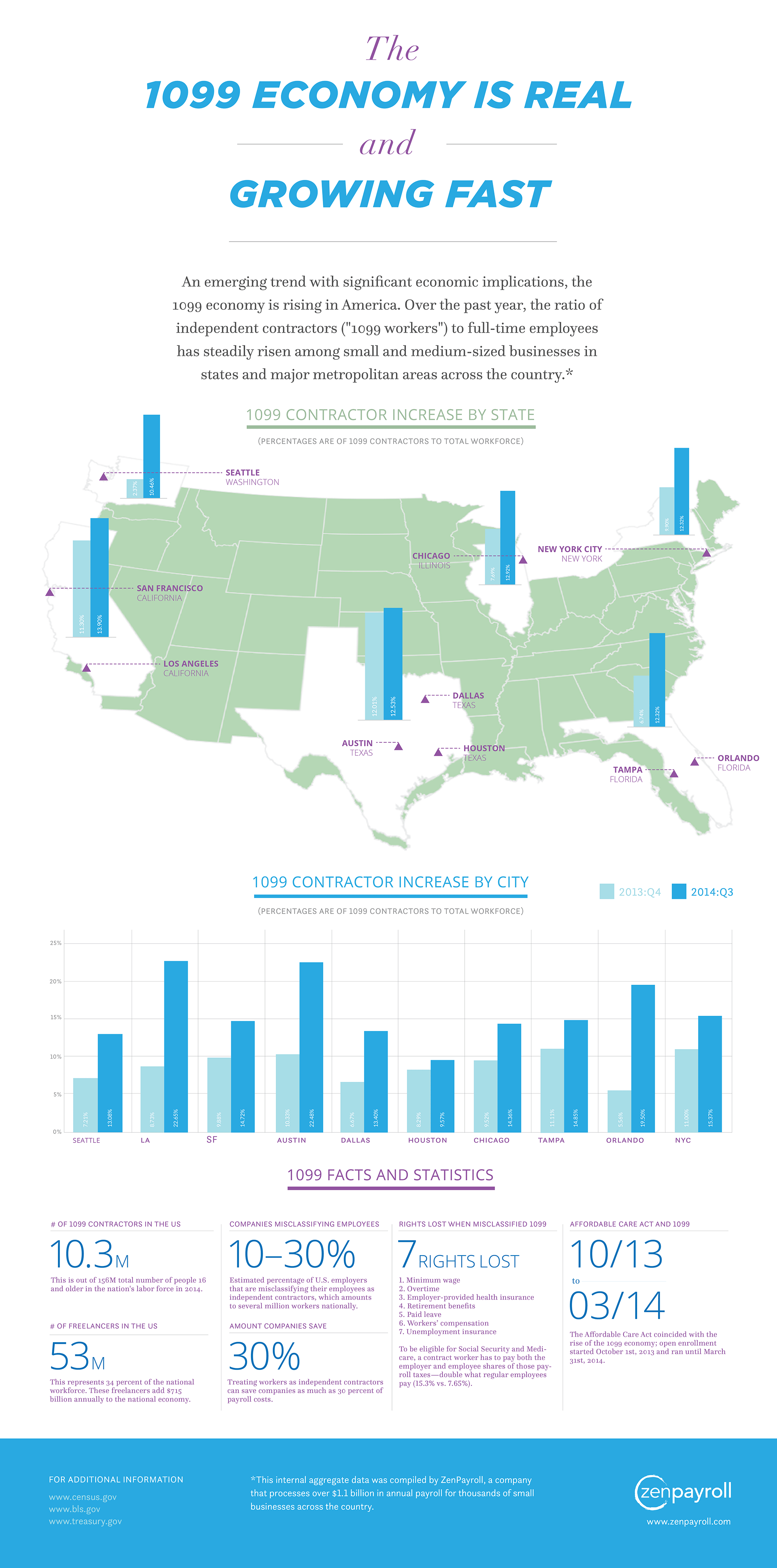

  • 1099 Economy on the Rise

    Here at ZenPayroll, we care a lot about how compensation is done, and the effect compensation can have on the relationship between employers and employees. Using the employment data we have as a payroll provider, we decided to look at whether the 1099 economy, which has garnered quite a bit of media attention recently, is really growing as fast as people think.

    The short answer is that over the past year, the ratio of independent contractors to full-time employees has meaningfully risen among small and medium-sized businesses in states and major metropolitan areas across the country.

    The nature of work is changing given the decline of lifetime employment. Today, very few people plan to work for the same company their whole life, and people often have several jobs at one time. As a result, and as shown by ZenPayroll’s data, more small business owners are employing contractors as a part of running their business. There are a number of other reasons for this general trend toward a more flexible work structure.

    Click the image to enlarge.

    First, employees want to have more choices when it comes to where and when they work, but also who they work for. Millennials in particular are frequently asking themselves whether they’re fulfilled by what they’re doing. Jess Ostroff, founder of a full-service virtual assistance agency called Don’t Panic Management, said that some of her contractors in New York City are aspiring actors, and they do contract work to support themselves as they pursue longer-term passions and ambitions. 

    Others do contract work purely for the flexibility — one of the first contractors to work for the Don’t Panic Management team is a mother of three who has her own cooking show and also runs a photography business. She supplements those jobs by contracting so she can earn money while spending time with her family.

    For some entrepreneurs, hiring independent contractors is key to their business. Lina Pakrosnyte is the founder and owner of UrbanLeash, a professional pet care company based in Chicago. There are four full-time employees on her team, but she works with over 30 contractors for tech and marketing help, as well as dog walking and cat sitting. With the high turnover in pet care professionals, Lina needs to keep finding contractors to serve her UrbanLeash clients.

    I’ve also talked to many small business owners who prefer having a remote or distributed workforce. Adam McLane, founder of a youth ministry resources company called The Youth Cartel, is one example. Because his business requires expert writers and public speakers, he works with over a hundred contractors from all over the country to produce content and events.

    After the economic downturn several years ago, many people who lost their full-time jobs found contract and part-time work as a way to fill that gap. When times are uncertain, employers also tend to prefer contractors. With the government promising to crack down on employers who misclassify their workers as contractors rather than employees, it’s important for business owners to know the distinction between the two. We published a post recently on the ZenPayroll blog to help small business owners avoid misclassifying their workers

    The future isn’t set in stone, and there will be ongoing debate about the responsibility employers have towards their workers, whether they are employees or contractors. It is important to care of your people if you want to attract and retain great talent.

  • Texas & Oklahoma Dominate Metropolitan Economic Growth

    Texas metropolitan areas continue to dominate economic growth, according to the latest Metro Monitor, produced by the Brookings Institution. The four top metropolitan areas in overall economic growth through the recession and "recovery" (our parentheses) have been:

    1. Austin
    2. Houston
    3. Dallas-Fort Worth
    4. San Antonio

    Oklahoma City took the 5th position. Oklahoma City, located 200 miles north of Dallas-Fort Worth may be experiencing some "overspill" economic growth from nearby Texas.

  • Book Review: “The Fate of the States: The New Geography of American Prosperity” by Meredith Whitney

    In December 2010, Meredith Whitney, the financial analyst, appeared on 60 Minutes, where she predicted that the United States would see between 50 and 100 defaults of municipal bonds. Since she was one of the earliest analysts to predict the financial meltdown, publishing a research report in October 2007 that said that because of mortgage losses Citigroup might have to cut its dividend, it was not surprising that her statement attracted a great deal of attention, but also significant pushback from industry representatives, who insisted that municipal bonds were safe.  This book, "Fate of the States: The New Geography of American Prosperity" is her effort to elaborate on that call.    

    Whitney begins her analysis with a review of the housing bubble and banking crisis, which by now is well trod ground, but she does so in a highly informed and balanced way.  Where some commentators want to place most of the blame on government, others on Wall Street, and yet others on the Federal Reserve Bank for keeping interest rates too low for too long, she argues that everyone behaved badly.  The self-destructive behavior that she witnessed on the part of many banks and financial institutions during this period remains an enduring and puzzling part of the story.   

    Readers of New Geography will be familiar with two of the themes that she articulates.  One is the rise of a zone of prosperity from the Gulf Coast through the heartland and up to North Dakota that has been built on pro-active energy policy and strong global demand for agricultural commodities.  A second theme she articulates is the striking disparity in the cost of living between states like California and New Jersey compared with far more affordable states like Texas.  Low cost states, she says, will continue to attract new investment and jobs.

    In arguably the core section of the book, she explains how the housing bubble interacted with banking and government to create what she calls “The Negative Feedback Loop from Hell.”  By way of background, it should be noted that the underlying economics of banking are unusual.   As economist Joseph Stiglitz demonstrated in the 1980s, the price of money does not necessarily clear markets.  Instead, banks often employ credit rationing in order to control risk.  As she argues, this is exactly what happened in the states where the housing bubble inflated the most. These are the states where the subsequent economic decline was the greatest.    

    As Whitney shows, it was also these states, where government officials handed out the most generous pay packages, including large back loaded pensions. On top of that, these states often piled on the most government debt, which nearly doubled between 2000 and 2010.  The result has been significant retrenchment on core government services, from police and fire protection to public education. In her view, this is the negative feedback loop from hell, and the reason that she believes that fiscal stress will continue for a long period of time.

    As the fight for limited resources works itself out, she believes that besides government there will be three parties at the negotiating table. Two are straightforward enough: the bondholders, who expect to be paid back the money they lent, and the public sector employees, who expect to receive the pensions they were promised. But she also sees a third party. Writing shortly before the bankruptcy in Detroit, she presciently recognized that citizens will also have a claim on resources, arguing that they need and deserve the services that government is supposed to provide.

    Although the sub title of the book mentions geography, Whitney largely dismisses what a contemporary textbook on economics and geography calls the “who, why, and where of the location of economic activity.” This is not surprising. There are probably few people who are aware that this branch of economics even exists.  (Among professional economists, more attention has been paid in recent years with the advent of New Economic Geography as championed by Paul Krugman, although, ironically, empirical research indicates that key elements of  of Krugman’s theoretical work are almost certainly wrong.)

    While Whitney rightly focuses on the economic growth that distinguishes many of the states in the central corridor of the country, she cites data that shows that most economic activity continues to occur elsewhere.  She observes, “These so-called flyover states contributed 25 percent of U.S. GDP in 2011, up from 23 percent in 1999.” That is nearly a 10 percent increase, but obviously from a lower base. A current and highly visible example of the importance of geography is the huge growth in the number of warehouses along the New Jersey Turnpike, as engineering projects deepen New York harbor and expand the Panama Canal. Access to water will always be important.    

    Additionally, I would argue that the issues that Whitney addresses cannot be fully understood without taking into account the challenges that continue to face older industrial cities. All economies must constantly re-invent themselves. In the case of cities with a large industrial legacy, however, intrinsic market failures caused by asymmetric and imperfect information have made redevelopment significantly more difficult.  Theoretical and empirical work in recent years has also shown that joint and several liability under U.S. environmental law undermines efficient price discovery for properties that once had an industrial use.      

    These issues aside, Whitney has written a book that is both provocative and necessary. Clearly, certain states have instituted policies that are far more effective at attracting business and new residents. At the same time, other states appear unable to reform. Perhaps her central insight is that problems associated with debt can take on a life of their own. Therefore, her message is clear. States that properly manage their debt and pension obligations will enjoy a prosperous future. States that do not will encounter severe problems.  Investors and public sector employees take note.

    Eamon Moynihan is the Managing Director for Public Policy at EcoMax Holdings, a specialty finance company that focuses on the redevelopment of previously used properties.

  • New York and California: The Need for a “Great Reset”

    Despite panning Texas Governor Rick Perry’s initiative to draw businesses from New York, Slate’s business and economics correspondent, Matt Yglesias offers sobering thoughts to growth starved states along on the West Coast and in the Northeast.

    “…the Texas gestalt is growth-friendly because, quite literally, it welcomes growth while coastal cities have become exceptionally small-c conservative and change averse. But if New York and New Jersey and California and Maryland and Massachusetts don’t want to allow the construction of lots of housing units, then it won’t matter that Brooklyn, N.Y.; and Palo Alto, Calif.; and Somerville, Mass.; are great places to live—people are going to live in Texas, where there are also great places to live, great places that actually welcome new residents and new building.”

    The entire country would benefit if states like California, New York, Massachusetts and New Jersey were to enact policies to compete with Texas, as Yglesias suggests.

  • The 2012 Year in Unemployment

    I recently looked at the changes in jobs in metro areas for 2012. Here’s a follow-on look at unemployment. First a look at the national unemployment rate picture, which has improved remarkably.


    2012 Unemployment Rate by County

    To put this in perspective, here’s the corresponding map for 2009:


    2009 Unemployment Rate by County

    It’s interesting to see where there has been improvement versus where there hasn’t, though I stop thresholding at 10% so that if people we well above it but dropped to just merely above it, my maps wouldn’t show that improvement.

    Here’s a look at the large metro areas, ranked by total decline in unemployment rate.

    Rank by Total Improvement Metro Area 2011 2012 Total Change
    1 Las Vegas-Paradise, NV 13.5 11.2 -2.3
    2 Orlando-Kissimmee-Sanford, FL 10.2 8.4 -1.8
    3 Tampa-St. Petersburg-Clearwater, FL 10.6 8.8 -1.8
    4 Miami-Fort Lauderdale-Pompano Beach, FL 10.2 8.5 -1.7
    5 Jacksonville, FL 9.9 8.3 -1.6
    6 Sacramento–Arden-Arcade–Roseville, CA 11.9 10.4 -1.5
    7 Birmingham-Hoover, AL 7.9 6.4 -1.5
    8 Cincinnati-Middletown, OH-KY-IN 8.6 7.1 -1.5
    9 Riverside-San Bernardino-Ontario, CA 13.6 12.1 -1.5
    10 Nashville-Davidson–Murfreesboro–Franklin, TN 8.1 6.6 -1.5
    11 Louisville/Jefferson County, KY-IN 9.7 8.3 -1.4
    12 San Jose-Sunnyvale-Santa Clara, CA 10.0 8.6 -1.4
    13 Columbus, OH 7.5 6.1 -1.4
    14 Kansas City, MO-KS 8.0 6.6 -1.4
    15 Houston-Sugar Land-Baytown, TX 8.1 6.8 -1.3
    16 Charlotte-Gastonia-Rock Hill, NC-SC 10.8 9.5 -1.3
    17 Seattle-Tacoma-Bellevue, WA 8.7 7.4 -1.3
    18 San Francisco-Oakland-Fremont, CA 9.4 8.1 -1.3
    19 Los Angeles-Long Beach-Santa Ana, CA 11.4 10.1 -1.3
    20 Salt Lake City, UT 6.7 5.5 -1.2
    21 Phoenix-Mesa-Glendale, AZ 8.5 7.3 -1.2
    22 St. Louis, MO-IL 8.8 7.6 -1.2
    23 Dallas-Fort Worth-Arlington, TX 7.8 6.7 -1.1
    24 San Diego-Carlsbad-San Marcos, CA 10.0 8.9 -1.1
    25 Detroit-Warren-Livonia, MI 11.6 10.5 -1.1
    26 Portland-Vancouver-Hillsboro, OR-WA 9.3 8.2 -1.1
    27 Atlanta-Sandy Springs-Marietta, GA 9.8 8.8 -1.0
    28 Austin-Round Rock-San Marcos, TX 6.8 5.8 -1.0
    29 San Antonio-New Braunfels, TX 7.5 6.5 -1.0
    30 Memphis, TN-MS-AR 10.0 9.0 -1.0
    31 Chicago-Joliet-Naperville, IL-IN-WI 9.8 8.9 -0.9
    32 Minneapolis-St. Paul-Bloomington, MN-WI 6.3 5.5 -0.8
    33 Raleigh-Cary, NC 8.5 7.7 -0.8
    34 Providence-Fall River-Warwick, RI-MA – Metro 11.1 10.3 -0.8
    35 Richmond, VA 7.1 6.4 -0.7
    36 New Orleans-Metairie-Kenner, LA 7.2 6.5 -0.7
    37 Cleveland-Elyria-Mentor, OH 7.8 7.1 -0.7
    38 Oklahoma City, OK 5.5 4.8 -0.7
    39 Denver-Aurora-Broomfield, CO 8.6 7.9 -0.7
    40 Hartford-West Hartford-East Hartford, CT – Metro 9.0 8.4 -0.6
    41 Milwaukee-Waukesha-West Allis, WI 8.0 7.4 -0.6
    42 Indianapolis-Carmel, IN 8.4 7.8 -0.6
    43 Baltimore-Towson, MD 7.7 7.2 -0.5
    44 Virginia Beach-Norfolk-Newport News, VA-NC 7.1 6.6 -0.5
    45 Boston-Cambridge-Quincy, MA-NH – Metro 6.6 6.1 -0.5
    46 Washington-Arlington-Alexandria, DC-VA-MD-WV 6.0 5.6 -0.4
    47 Philadelphia-Camden-Wilmington, PA-NJ-DE-MD 8.6 8.6 0.0
    48 Pittsburgh, PA 7.2 7.2 0.0
    49 New York-Northern New Jersey-Long Island, NY-NJ-PA 8.6 8.8 0.2
    50 Rochester, NY 7.8 8.1 0.3
    51 Buffalo-Niagara Falls, NY 8.1 8.5 0.4
  • Portland’s Slothful Creative Class?

    In an article entitled "Portland area’s college-educated workers depress metro earning power by choosing low-paying fields, shorter hours," The Oregonian’s Betsy Hammond reports on a new study decrying the less than robust economic impact of Portland’s younger college graduates, especially males. According to Hammond, " the Portland metro area’s young college-educated white men are slackers when it comes to logging hours on the job, and that’s one reason people here collectively earn $2.8 billion less a year than the national average." The report is characterized as finding that "Portlanders tend to choose majors, careers and work hours that lead to low pay."

    The report, "Higher Education & Regional Prosperity; The Story Behind Portland-Metro’s Income Decline," was commissioned by the Value of Jobs Coalition. It documents a "startling decline in per capita income relative to the US" metropolitan average. Since 1997, metropolitan Portland’s per capita income has fallen from 5% above the national metropolitan average to 5% below.

    The report indicates that "the biggest driver of this trend is our college educated workers, who work less and earn less, creating a significant income gap," though cautiously notes that it is not clear whether” the lower hours and earnings are the result of a lack of higher-paying/time-intensive jobs available or the result "life style choice(s)" to not work in higher-paying jobs."

    The report found the largest differences compared to other metropolitan areas to be among white males from 25 to 39 years old. The differences with the rest of the country were substantially less among older white males.

  • Will New York’s Economy Strangle Itself With Success?

    Big cities have been on a bit of a roll in recent years. But sometimes you can have too much success, as we may be seeing in the case of New York. This week the New York Times reported that finance firms are moving mid-level jobs away from Wall Street to places like Salt Lake City and Charlotte.

    There’s a lot going on here. First, a lot this is driven by New York’s success, not its failure. New York is increasingly valuable as a site of high end production. As a result, lower value activities get squeezed out and replaced with higher ones. Despite the exodus of Wall Street jobs, New York City has been booming, and a stat from last year showed that the city was within 60,000 jobs of its all time employment high. This sort of churn is somewhat normal when high value and lower value economic geographies come into contact within the same physical space, as I noted regarding California in “Migration: Geographies in Conflict.”

    It might be tempting for city leaders to actually celebrate this, but they shouldn’t. In a city that is desperate for middle class jobs, these are white collar middle class positions that are being lost. New York has stunningly high levels of income inequality – Joel Kotkin has noted it is the same as Namibia’s – and this can’t be making it any better.

    Also, is there any precedent for a city being successful and dynamic, over a longer term purely as a production center for ultra-high end activities (with perhaps an associated servant class)? Sure, places like Aspen can do it. Imperial capitals seem to have been able to do something of the sort. Perhaps that’s how New York’s leaders like to see their city, but they are taking an awful risk.

    New York is too concentrated in high end activities already, notably the high end of finance, as Ed Glaeser noted in his article “Wall Street Is Not Enough.” This renders it extremely vulnerable to downturns in that sector.

    It might seem like exporting finance jobs would be part of that re-balancing, but when they are lower end positions, all you are doing is re-concentrating finance at more elite levels. Because to these types of businesses cost is almost literally no object, they have driven the cost of New York real estate through the roof.

    When one industry becomes super-dominant in a neighborhood, Jane Jacobs noted it could lead to a situation she called “the self-destruction of diversity,” where a particular type of user – generally banks – gobble up the land and ultimate sterilize what formerly drew them to the area.

    I wrote about this in regard to Chicago in a speculative piece called “Chicago: Corporate Headquarters and the Global City” in which I note a flow of corporate headquarters back into global cities, albeit reconstituted executive headquarters only).

    This puts the bigger cities in a tough spot. They have to continue to go up the value chain because smaller cities are rapidly eroding their competitive advantage at lower ends. Ultimately we’ll see where this leads but I don’t think it’s healthy in the long term at all. Figuring this out is just one piece of the rebuilding our overall economy for the 21st century that needs to be accomplished.

    Aaron M. Renn is an independent writer on urban affairs based in the Midwest. This piece originally appeared at The Urbanophile