Tag: Economy

  • China: Two Modernizations (Decentralization and Living Away from the Job)

    American and European planners have long sought to improve the “jobs-housing” balance, seeking to place residents and jobs within walking or cycling distance. Of course, planners don’t place people anywhere. Not surprisingly, their efforts have largely failed, from the new towns of the London area, where people travel about as far to work as anywhere else, to fabled failures of Stockholm, where high rise housing close to suburban employment centers now houses migrants who tend to have far lower incomes than native Swedes.

    In the time of Mao Zedong, China had achieved perhaps the ultimate in the jobs-housing balance. Companies provided housing for their workers, who were able to walk to their jobs in the same compound. However, the economic reforms instituted by Deng Xiaoping and his successors has led to an abandonment of this model (Danwei housing) and millions of Chinese households have been lifted out of poverty into affluence. Most Chinese households do not aspire to “living on top” of the factory or office.

    Foxconn (Hon Hai Precision Industry), one of the world’s largest companies, is among the last to provide large amounts of housing to its workers. In its Shenzhen “Long Hua Campus,” which covers only one square mile, Foxconn employs 450,000 people (Figure). They are housed on the campus or nearby in company provided units.
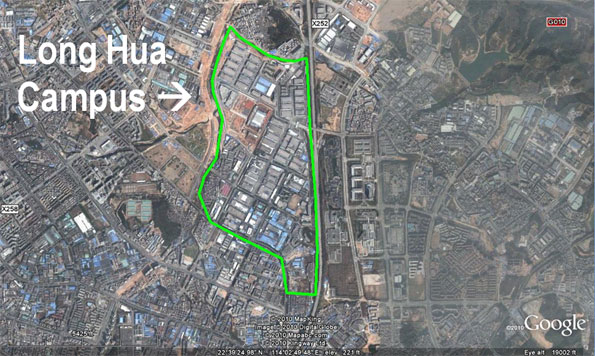
    Shenzhen directly borders Hong Kong and Dongguan, which borders the Guangzhou-Foshan urban area. All together, these contiguous Pearl River Delta urban areas, along with others down the western shore to Macao have nearly 50 million people, more than live in any geographic area of the same size anywhere else in the world. These Guangdong province urban areas, along with the special economic regions of Hong Kong and Macau have become one of the world’s leading manufacturing and export areas. Shenzhen itself has been estimated to have a population of between 10 million and 15 million, depending on how the migrant workers are estimated. Shenzhen and other major manufacturing centers of China are estimated to house as many as 200 millions migrants from other parts of China (especially rural areas), coming to work in jobs that pay far higher wages than can be earned at home.

    Foxconn itself is the world’s largest manufacturer of consumer electronic technology, producing Apple’s I-Pod and I-Phone and making products for Dell, Hewlett-Packard, Sony, as well as the Nintendo, Wii entertainment systems.

    According to a report in The Wall Street Journal, Foxconn has plans to abandon its Danwei housing and move away from its “perfect” jobs-housing balance to the spatial arrangements that Chinese, Americans and Europeans routinely choose — to work where they like and live where they like.

    Foxconn has had its share of difficulties. There have been the multiple employee suicides at the Long Hua Campus. The company has faced rising costs in its Pearl River Delta operations, including higher wage costs. In its attempt to retain competitiveness, Foxconn is seriously rethinking its business model and appears likely not only get out of the housing business, but will also move many of its operations into central and western China, where costs and wages are lower. This also makes sense in relation to government policy, which seeks to develop the center and west.

    Overall, Taiwan headquartered Foxconn employs 920,000 people in China, the equivalent of the entire work force in the Portland or Kansas City metropolitan areas.

    Foxconn plans to increase its workforce in China from 920,000 to 1,300,000 and intends for many of its employees to be in new facilities in places like Chengdu (capital of Sichuan), Wuhan (capital of Hubei), Zhengzhou (capital of Henan) and Chongqing (capital of the provincial level Chongqing municipality). Foxconn’s decentralization, and the location of other new and expanded businesses in the center and west is strongly supported by China’s substantial infrastructure investment. The nation already has more than 40,000 miles of interstate equivalent highways. When all of the gaps are completed, trucks will be able to reach east coast ports from Zhengzhou or Wuhan in about days drive and little more than two days from Chongqing and Chengdu.

    At the same time, corporate executives can get to Beijing, Shanghai and the Pearl River Delta and other East Coast urban areas in 2.5 hours or less through some of the world’s most modern airports.

    Finally, the more decentralized operations will allow the migrant workers to live much closer to their homes, rather than having to travel all the way to the East Coast. This will make more frequent visits to rural villages and families possible.

    —-

    Photo: Wuhan (photo by author)

  • Striking a Balance

    As noted by Wendell Cox, commuting and congestion have a large economic cost. Time spent behind the wheel, slowed by traffic, is time that could otherwise be put to more productive economic pursuits. Commuting and congestion also have social costs. Every minute lost trapped in snarled traffic is time that might have been spent with family, friends, relaxing, or getting involved in community building activities. Commuting can also lead to elevated stress levels, with studies showing finding that “greater exposure to congestion is related to elevated psycho-physiological stress among automobile commuters.”

    One proposed solution to the challenges presented by commuting and congestion is an enhanced embrace of telecommuting. Proponents argue that businesses looking to increase productivity, burnish their “green” credibility and reduce fuel use, and allow workers to strike a better balance between life and work should offer employees the option to work from home. Whatever the motivation, it does appear that there has been a rise in the adoption of telecommuting. According to varying estimates, somewhere between 20 and 35 million individuals telecommute occasionally. Numbers appear to be on the rise, with projections showing up to 63 million workers will be making use of some form of telecommuting by 2016.

    As businesses increase their adoption of telecommuting, they may also want to provide workers with increased schedule flexibility. A recent study conducted by BYU finds that workers given the option to make use of telecommuting and flex-scheduling had a much higher “breaking point” at which family life and work begin to interfere with one another. According to the study, “for office workers on a regular schedule, the breaking point was 38 hours per week. Given a flexible schedule and the option to telecommute, employees were able to clock 57 hours per week before experiencing such conflict.” As the study points out, this added flexibility allows workers to potentially make use of the equivalent of an “Extra Day or Two” in each work week, adding to productivity. According to the lead researcher, E. Jeffery Hill, the use of flexible scheduling can also contribute to greater worker satisfaction and morale. In challenging economic times the promise of increased worker productivity, improved worker happiness, and potential cost savings realized through reduced office space and facilities should be an attractive spur to increased corporate adoption of telecommuting.

  • 2009: A Year of US Entrepreneurial Activity

    The Kauffman Index of Entrepreneurial Activity produced good news for the year 2009: Americans have created businesses at its fastest rate in 14 years. This past year, 558,000 businesses were created each month, marking a 4% increase from 2008. Though this comes in the midst of economic recession, president and CEO of the Kauffman foundation Carl Schramm seems to think the unsavory results of massive layoffs have fostered these higher rates of entrepreneurship, serving as “a motivational boost” for the newly unemployed to become their own boss. He sees the recent rates in business startups as a favorable sign for economic recovery.

    Using the monthly Current Population Survey from the US Census Bureau and US Bureau of Labor Statistics, the Kauffman index has tracked the demographic makeup of business creators, as well as their location. Though African Americans lag behind other groups in terms of the number of entrepreneurs, they saw the largest increase from 2008 to 2009 from an index of .22 to an index of .27. Both the 35-44 and 55-64-year-old groups have increased to an index of .40 percent, also the greatest of their demographic category.

    The index followed predictable trends in terms of location of entrepreneurial activity, showing that the largest rate increases occurred in the south and west in states like Oklahoma, Montana, Texas, and Arizona while Mississippi, Nebraska, and Pennsylvania floundered. However, business creation rates in the Midwest and South outdid those of the west, which actually declined from 0.42 to 0.38 percent from 2008 to 2009.

    You can find interactive data on entrepreneurial activity for the period spanning 1996-2009 on the Kauffman Foundation’s website at www.kauffman.org/kiea.

    Kirsten Moore is an undergraduate at Chapman University majoring in US history and screenwriting.

  • Random Wall Street Walking

    There was a popular book in 1973 – A Random Walk Down Wall Street. (by Burton Malkiel, now in its 9th edition, 2007) – that pooh-pooh’ed the idea that one investor’s stock picks could always be better than another investor’s stock picks. The punch line is that you could randomly throw darts at the Wall Street Journal financial pages and do just as well as anyone else investing in the stock market. I first read it in 1980, while taking Investment 101 in business school at night and editing economic research documents for the Federal Reserve Bank of San Francisco during the day. I had a very memorable argument with John P. Judd, then senior research economist and more recently special advisor to the Bank president and CEO Janet Yellen.

    John thought the Wall Street brokers were crazy for thinking they could make more than average returns on investment. I thought the Federal Reserve was crazy for thinking they could control the money supply. John was already a PhD economist; I was still working on my Bachelor degree in business administration.

    Twenty years later I also have a PhD in economics, but there are still two camps pulling in different directions in their dangerous tug-of-war on the economy. There are the double-dip pessimists led by Yale Economist Bob Shiller and most recently discouraged by Paul Ferrell of MarketWatch. And there are the “Mad Money” optimists who believe that Jim Cramer will tell them everything they need to know to get and stay rich, while Ben Bernanke consoles them with sound bites like “increased optimism among consumers … should aid the recovery.”

    At the heart of the problem is the same, original argument I had with John Judd – “is there a way to beat the averages” – except that this time around Wall Street is in bed with the Federal Reserve. You can no longer tell the crazies apart.

    Which brings me back to the Random Walk. If Wall Street has their way, they will inflate the market just enough to induce you to put your money back in. Don’t forget the Weenie Roast of 2008. If the government – either Congress or Treasury or the Federal Reserve – has their way, they will let it crash again, too. Don’t forget that it was only Wall Street that got bailed out the last time. I think the chances are 50-50 either way.

  • The State of Illinois’ Long Term Decline

    Barack Obama’s home state is in the news but not for positive reasons. Fitch downgraded Illinois debt. At the end of March, according to the Bond Buyer:

    Fitch Ratings late Monday downgraded Illinois’ general obligation rating one notch to A-minus and warned of possible further action by leaving the state’s credit on negative watch ahead of $1.3 billion of short- and long-term GO issuance in three deals over the coming weeks.
    Gov. Pat Quinn had hoped that the General Assembly’s passage last week of pension reforms would stave off any negative rating actions and buy the state some additional time to address a nearly $13 billion budget deficit and liquidity crisis in the current legislative session.

    Fitch isn’t Illinois’ only problem. The Chicago Tribune wrote a devastating editorial concerning Illinois’ economic performance:

    once-thriving Illinois in February had 475,000 fewer jobs than it did in November 2000. Even replacing every one of those jobs wouldn’t fix the sorry state of this state: Factoring in population growth over the last decade, Illinois needs 600,000 new jobs just to get the employment level back to where it was. The cumulative cost to Springfield of those lost jobs: $6 billion in tax revenues through fiscal ’09 and, barring some miracle, $10 billion through fiscal ’11.

    Illinois politicians keep trying to blame job losses on the Great Recession. But this is only the latest bad patch in two decades during which Illinois has lagged the nation at growing jobs. Geoffrey Hewings, head of the U. of I.’s Regional Economics Applications Laboratory, says something else has to explain why Illinois unemployment keeps running well above the national rate: “Our economy looks like the U.S. economy” in terms of its blend of manufacturing, service and other sectors. “Yet since 1990, we’ve underperformed the U.S. in job creation.”

    In fact, for the decade before this recession began, other researchers have pegged Illinois’ job creation rate at 48th in the U.S., ahead of moribund Ohio and Michigan. Can’t blame recession for that.

    Illinois lawmakers spent much of the last 20 years treating private-sector employers as if they were stupid — unable to understand that they and their workers eventually would have to pay for too much state spending, borrowing and promises of future obligations — none more egregious than the now severely underfunded retirement benefits for public employees.

    This kind of editorial might scare away future business expansion in Illinois. It wasn’t easy for the Tribune to write this one because it’s so negative that it even might scare advertisers away. But, the truth can’t be ignored much longer. Special interest groups are thriving, but taxpayers are not. The long time Illinois Speaker of House is more responsible than any individual for Illinois’ persistent financial problems. Illinois declines, but Madigan’s property tax appeals law firm thrives.

  • MILLENNIAL PERSPECTIVE: Education Economics

    Almost three years ago, shortly after graduating from college, Jeffrey Rogers found himself with a degree and no job. The economy had just taken a dramatic turn for the worse and he was struggling to get by.

    “He was literally living off peanut butter and jelly sandwiches,” said Kathryn Rogers, his younger sister and a first-year graduate student at Chapman University in Southern California.

    Jeffrey went to their father for help in a last-ditch effort to meet his monthly living expenses, but his Dad refused. “He definitely is into tough love,” said Kathryn. “He said, ‘He’ll make ends meet in one way or another…’ [his] attitude is, ‘Once you graduate, you’re cut off’.”

    Jeffrey ended up borrowing money from friends to pay rent for the next six months. But Kathryn is grateful for her father’s “tough love”. She believes it has strongly contributed to her own sense of financial responsibility. While her parents paid her rent and tuition, with the help of an academic scholarship during her four years of undergraduate studies, she was in charge of everything else. “I paid for food, I paid for gas, I paid for activities, I paid for my sorority,” she said.

    Kathryn has always had a job since the age of 16. Being aware of how much things actually cost has helped her keep her budget balanced now that she is on her own. But not having that awareness is a huge problem for many college students. “If you’ve always had everything given to you, you wouldn’t think about [cost of things] because it wouldn’t be an issue,” she said.

    A majority of Kathryn’s student acquaintances don’t know the basics of personal finances. “You talk to people our age, they’re 18 and they have $12,000 in credit card debt or they don’t know how to pay bills or how to do their taxes,” she said.

    Kathryn believes a financial management class in high school should be mandatory. “If your parents don’t teach you, where are you supposed to learn?” she asks.

    Catie Robbins, a senior screenwriting major at Chapman, agrees. “Your parents figure you’re going to learn along the way. But then you always feel so much guilt and disappointment when you’re not being responsible with your money. It’d be nice if there was more guidance available.”

    Robbins has taken out student loans and receives financial aid, which helps her parents pay for her tuition. But they also take care of her rent, food, and other necessities.

    “Basically I don’t have to pay for anything. But it’s scary because they only send me enough money for my food and lodging, so I can’t buy anything else,” she said. “If you want to do fun, random stuff or if you go overboard on your food expenditures, you can be very poor. It’s fine – it’s just kind of sad to be dependent on my parents.”

    Robbins looks forward to graduating and getting a job. But right now her financial aid package limits the amount of money she can make from employment to $2,000 a year, which she said she can easily earn during the summer. “As soon as I make that much, I have to quit,” she said. She points out that, counter-intuitive as it is, students are given financial aid because they don’t have enough money, but then are stopped from earning more because of the aid they receive.

    There is also a certain irony in being given dreams and goals during college, and then being unable to fulfill them because of the financial burden of college.

    “Originally, I had all these ideas for traveling,” said Robbins, who has studied abroad. “But you definitely can’t just take off after school and be youthful and pursue all these silly things. You have to be responsible. I am kind of excited to finally be free and living on my own, and not having to ask my parents for money,” she added.

    While financial aid is limiting for some students, and asking your parents for money is never easy, it is definitely a preferable alternative to being entirely dependent on student loans. That’s the situation in which junior Dave Casey finds himself.

    Without the minimum required 2.0 GPA, Casey was not eligible for federal student aid this semester. Taking out loans was his only option for staying in college. Currently, he owes about $60,000 with two more years of school to go. He is paying a monthly $187 in interest alone.

    “I could have gone to the University of Rhode Island for $6,000 a year,” said Casey, a native of Warwick, R.I. “But I didn’t want to. I was willing to pay because I wanted to go off, I wanted to experience something else, I wanted to be surrounded by a different environment, different people. And I think that’s how you really learn.”

    Casey’s father helps him out with rent, and he works over 20 hours a week at a local restaurant. “What stresses me out is that my mother is on food stamps, and I have no money to give her,” said Casey, whose parents are divorced. “I can’t [help], because I’m in a hole myself. Do I send hundreds of dollars a month back to my mom, or do I pay off these loans and then turn to help her? Either way there’s not enough money to go around.” Like Kathryn Rogers and Robbins, Casey’s only hope is to get a steady job after he’s graduated and start paying off his mountainous debt.

    “The only reason why I’m not freaking out hardcore about this is because I can’t comprehend it. Set $60,000 in front of me; I’d like to see it. It’s so abstract to me,” he said. “These loan agencies definitely benefit from our naiveté.”

    Donald Booth, a professor of economics at Chapman and board member of Consumer Credit Counseling Service, thinks that technology is a major contributor to the lack of financial knowledge.

    “The traditional way was the bill came to your house, you wrote a check, licked a stamp and mailed it back. Now you have automatic pay, it withdraws it from your account,” he said. “[People] don’t even know what they have in their checking account.”

    The transition to so much financial activity online has been difficult for generations both young and old. “Don’t think it’s just students who don’t know how to manage money – it’s almost everybody,” he said.

    Older people are naturally resistant to new technology because they like doing things the way they’re used to, according to Booth. On the other hand, there was no one to teach students to use the Internet as a financial tool.

    So we’re basically in the banks’ pockets now, because people aren’t keeping track of the money they’re spending, how much they have, how much they owe. “And everything seems free. You almost never get turned down anytime you want to buy something. Until it catches up with you.”

    Rachel Yeung is a senior at Chapman University in Orange County, California.

  • Oregon Tries to Catch California – On the way down!

    Oregon’s voters will soon give their judgment on Measures 66 and 67, measures that will raise income and corporate taxes in the recession-ravaged state – with unemployment at 11.1 percent, the eighth highest in the nation. Besides leaving the state with the highest marginal rate in the country, tied with Hawaii, more insidiously measure 67 will impose a minimum tax based on sales, not profits, implying an infinite marginal tax rate for low-profit companies.

    This is not good news for businesses and citizens of Oregon. In a report titled Tax Policy and the Oregon Economy: The Effects of Measures 66 and 67, Two Cascade Policy Institute economists, Eric Fruits and Randall Pozdena, thoroughly review the literature on the impacts of tax increases on jobs and domestic migration, and they rigorously analyze the measures’ impact on Oregon jobs and migration.

    They estimate the new measures through 2018, will cost Oregon employment losses of “approximately 47,000.”

    Finally, Fruits and Pozdena examine the impacts of measures 66 and 67 on migration. They find that adoption of measures 66 and 67 will result in the loss of approximately 80,000 Oregon tax filers with a loss of $5.6 billion in adjusted gross income.

    These results have to be taken as the minimum impacts. Fruits and Pozdena are careful researchers. They do nothing that is not completely defensible. Consequently, because of statistical issues, some of the potential impacts, particularly those of measure 67’s minimum tax based on sales are almost surely under measured.

    Clearly Oregon , where many residents look down on the increasingly bedraggled Golden State seems anxious to follow California’s decline trajectory. We all know how that story ends: high unemployment, domestic out-migration, declining jobs, declining opportunity, and a vanishing middleclass.

    I am not alone in seeing the warning signs.

    The PEW Center on the States issued a report in November 2009 titled Beyond California: States in Fiscal Peril. PEW created an index using foreclosure rates, job losses, state revenues, budget gaps supermajority requirements, and money-management practices. The index resulted in values ranging from 6, Wyoming, to 30 California. Higher values are bad here, and the closer to California’s 30, the more a state is at risk of California-style fiscal problems. Oregon, with a value of 26 is listed as one of nine states that the PEW researchers consider at high risk.

    Then there’s Small Business & Entrepreneurship Council’s recently released Small Business Survival Index. They use a much larger set of variables to create their index of public policy climates for entrepreneurship, a total of 39 indicators covering tax policy, regulation, crime rates, costs, and more. This index results in values ranging from 25.7 for South Dakota to 84 for the District of Columbia. As with the previous index, high numbers are bad. California, with a score of 77.7 is the second worst state, behind only New Jersey. Oregon’s score is 65.2, the 38th among states, and dangerously close to California’s score.

  • A Milestone on the Road to Becoming a Third-World Economy

    Northrop Grumman Corp started California’s New Year by announcing it is moving its headquarters to the Washington D.C. area. Unfortunately, they are neither the first nor the last major corporation to leave Southern California. It is a trend, one that may not last much longer, though since aren’t that many major corporations still headquartered in greater Los Angeles.

    For decades, Southern California was the center of the aerospace world, a basic part of the Southern California’s DNA. Now, once Northrop leaves, there will be no major aerospace companies still headquartered in Southern California.

    Aerospace is not the only industry abandoning Southern California. The region was once host to financial giants, like Bank of America, Security Pacific Bank, Countrywide, and First Interstate. Today, there are none. California was once a major automobile manufacturing state, with a dozen plants. Even the entertainment industry is slowly shifting away from its Hollywood roots.

    When you lose corporate headquarters, you lose more than jobs. You lose the tax base, the leadership, the philanthropic giving, and the intangibles. Corporate headquarters are usually very good citizens.

    Many local political leaders ignore this business’ exodus, or make excuses. The decline of the U.S. defense spending, aerospace spending in particular, is often given as a reason for the decline. But the last decade was not a bad one for defense; the industry thrived, just not in Southern California.

    The reasons for this exodus are both simpler and less flattering than those usually given. One big reason is selfishness. California’s decline chose to consume, and not to produce. Wealthy, aging, Baby Boomers control the state. In the cause of “quality of life,” or “the environment,” they have succeeded in limiting opportunity for everyone else.

    The other big reason for decline lies with governments, state and local, that now exist to serve themselves and not their citizens. The level of government goods and services, even infrastructure and basics, has declined, but state spending, adjusted for inflation and population, has continued to soar. The difference has been going into public employee’s pockets, through higher salaries, benefits, and generous retirement programs.

    Remarkably, no Southern California economic sector is in ascendancy. Unemployment remains well above the national average, particularly in the middle class Inland Empire. The growth in bankruptcies has been about twice that of the United States. The state is becoming less equitable, the divide between those who have and those who do not have constantly growing, the middle class declining.

    Southern California is starting to look a lot like a third-world economy, service based, inequitable, serving a wealthy, mostly aging few, with little opportunity for younger workers and a large underclass. Changing the region’s prospects will be very difficult. Nothing short of a major generational change in leadership is likely to change the current sad trajectory.

  • The Essence and Future of Texas vs. California

    I know there have been a lot of articles and references to Texas vs. California recently in this blog, but, well, there’s a new one with some genuinely new contributions to the argument ("America’s Future: California vs. Texas", Trends magazine, hat tip to Jeff). And it says some nice things about Houston too, so how can I pass on it? The beginning of the article is here – including an overview of both states’ situations – but here are some key additional excerpts:

    …Both the Brookings Institution and Forbes Magazine studied America’s cities and rated them for how well they create new jobs. All of America’s top five job-creating cities were in Texas. It’s more than purely economics and regulation can explain, though. Texas – and Houston in particular – has a broad mix of Hispanics, whites, Asians, and blacks with virtually no racial problems. Texas welcomes new people and exemplifies genuine tolerance. When Hurricane Katrina hit, Houston took in 100,000 people. Not surprisingly, Houston has more foreign consulates than any American city other than New York and Los Angeles.

    But, how did this happen? What’s wrong with California, and what’s right with Texas? It really comes down to four fundamental differences in the value systems embodied in these states:

    First, Texans on average believe in laissez-faire markets with an emphasis on individual responsibility. Since the ’80s, California’s policy-makers have favored central planning solutions and a reliance on a government social safety net. This unrelenting commitment to big government has led to a huge tax burden and triggered a mass exodus of jobs. The Trends Editors examined the resulting migration in “Voting with Our Feet,” in the April 2008 issue of Trends.

    Second, Californians have largely treated environmentalism as a “religious sacrament” rather than as one component among many in maximizing people’s quality of life. As we explained in “The Road Ahead for Housing,” in the June 2009 issue of Trends, environmentally-based land-use restriction centered in California played a huge role in inflating the recent housing bubble. Similarly, an unwillingness to manage ecology proactively for man’s benefit has been behind the recent epidemic of wildfires.

    Third, California has placed “ethnic diversity” above “assimilation,” while Texas has done the opposite. “Identity politics” has created psychological ghettos that have prevented many of California’s diverse ethnic groups and subcultures from integrating fully into the mainstream. Texas, on the other hand, has proactively encouraged all the state’s residents to join the mainstream.

    Fourth, beyond taxes, diversity, and the environment, Texas has focused on streamlining the regulatory and litigation burden on its residents. Meanwhile, California’s government has attempted to use regulation and litigation to transfer wealth from its creators to various special-interest constituencies.

    They go on to make six forecasts:

    1. …expect to see California’s loss of jobs to Nevada accelerate…
    2. …expect to see a backlash in California and across the country against regulations, especially green initiatives that can’t clearly demonstrate a positive ROI…
    3. Watch for the smart money, including venture capital, to begin migrating to Texas for start-ups in many areas, including energy, info-tech, manufacturing, and biotech. Just as Delaware’s tax laws once encouraged numerous businesses to incorporate there, even when they had no connection to the state, Texas will become a magnet for new businesses by offering cheap land, a favorable regulatory environment, a business-friendly culture, and a large supply of skilled labor. Unless California revamps dramatically, expect to see its economy languish, even as the recovery takes off.
    4. To make its business climate even more business-friendly, Texas will invest heavily in secondary education and work hard to attract the best talent to its research universities (note the recent Tier 1 proposition and funding). Keep an eye especially on the University of Texas, which already has a first-rate campus and faculty. Within 10 years, UT, as the locals call it, may well rival Stanford or Berkeley.
    5. Other states will adopt tort reform measures pioneered in Texas. Unlike California and most other states, Texas has been aggressive in minimizing the enormous burden of frivolous lawsuits
    6. Look to Texas to become a cutting-edge cultural mecca. Houston has always offered a vibrant cultural scene, ever since the Alley theater company was founded there in 1947 by Nina Eloise Whittington Vance. In the 1950s, John and Dominique de Menil moved to Houston with one of the most significant private collections of art in the world and began donating art and money to the Houston Museum of Fine Arts. Both institutions have grown to world-class status since then. In the coming years, this trend will spread to the major cities of Texas (take that, Dallas!), attracting the best talent and money and shifting the cultural balance of the nation away from New York and San Francisco.

    I can personally vouch for #5. I was just visiting my brother out in CA, and a friend of his with a small store was being hit with a large disability discrimination lawsuit for a minor oversight (handicapped parking was marked on the ground and had the requisite walkways and ramps, but lacked a pole sign). Evidently this has become a cottage industry in California, where lawyers guide the disabled through stores looking for very minor violations of a vague law (things like high shelves or tables), then sue (expecting a quick settlement, of course). Under CA law, discrimination guilt is assumed if there’s anything in the store the disabled can’t do that a normal customer can do, regardless of the availability of employees to provide assistance. His friend was clearly exasperated with the unwinnable situation. Just plain nuts.

    As Jim Goode says, "You might give some serious thought to thanking your lucky stars you’re in Texas."

  • Texas Dominates Milken’s New Best Performing Cities Index

    Texas metropolitan regions hold down four of the top five and nine of the top 16 places in Milken’s new Best Performing Cities Index, released this morning. The rankings were authored by previous New Geography Contributor Ross DeVol, director of Regional Economics at Milken.

    It’s refreshing to see a set of rankings attempting to take an objective, hard data-based look at comparative analysis. The Milken Rankings are a combination of job growth, wage and salary growth, high-tech GDP growth, and high-tech location quotients (see page 8 of the report).

    A region’s industry mix plays a big role in its ranking; you can see energy-centric regions scoring well. But remember that these rankings also explicitly factor in high tech growth and high tech concentration.

    Regions that avoided real estate inflation and those maintaining what they have or simply avoiding rapid decline tend to score better.

    “‘Best performing’ sometimes means retaining what you have,” said DeVol. “In a period of recession, the index highlights metros that have adapted to weather the storm. As we move forward in a recovery that still lacks jobs, metros will be further tested in their ability to sustain themselves.”

    The rankings include 324 regions, breaking them into two groups based on region size.

    You can view the full lists at Milken’s interactive rankings website, and the full report includes analyses of the top large and small places.

    Here’s the top and bottom 25 Large places:

    Top 25 Large Regions Bottom 25 Large Regions
    2009 rank 2008 rank Metropolitan area 2009 rank 2008 rank Metropolitan area
    1 4 Austin-Round Rock, TX MSA 176 97 Bradenton-Sarasota-Venice, FL MSA
    2 13 Killeen-Temple-Fort Hood, TX MSA 177 150 Birmingham-Hoover, AL MSA
    3 3 Salt Lake City, UT MSA 178 144 Memphis, TN-MS-AR MSA
    4 7 McAllen-Edinburg-Mission, TX MSA 179 117 Miami-Miami Beach-Kendall, FL MD
    5 16 Houston-Sugar Land-Baytown, TX MSA 180 120 Cape Coral-Fort Myers, FL MSA
    6 21 Durham, NC MSA 181 183 Spartanburg, SC MSA
    7 9 Olympia, WA MSA 182 178 Wilmington, DE-MD-NJ MD
    8 5 Huntsville, AL MSA 183 189 Dayton, OH MSA
    9 14 Lafayette, LA MSA 184 73 Merced, CA MSA
    10 2 Raleigh-Cary, NC MSA 185 191 Hickory-Lenoir-Morganton, NC MSA
    11 15 San Antonio, TX MSA 186 193 Cleveland-Elyria-Mentor, OH MSA
    12 29 Fort Worth-Arlington, TX MD 187 170 Providence-New Bed.-Fall Riv., RI-MA MSA
    13 23 Dallas-Plano-Irving, TX MD 188 186 South Bend-Mishawaka, IN-MI MSA
    14 37 El Paso, TX MSA 189 185 Kalamazoo-Portage, MI MSA
    15 45 Wichita, KS MSA 190 197 Canton-Massillon, OH MSA
    16 88 Corpus Christi, TX MSA 191 192 Ann Arbor, MI MSA
    17 17 Seattle-Bellevue-Everett, WA MD 192 187 Atlantic City, NJ MSA
    18 40 Baton Rouge, LA MSA 193 188 Youngstown-Warren-Board., OH-PA MSA
    19 72 Tulsa, OK MSA 194 190 Grand Rapids-Wyoming, MI MSA
    20 20 Greeley, CO MSA 195 196 Lansing-East Lansing, MI MSA
    21 8 Tacoma, WA MD 196 199 Holland-Grand Haven, MI MSA
    22 48 Fort Collins-Loveland, CO MSA 197 198 Warren-Troy-Farmington Hills, MI MD
    23 54 Little Rock-N. Little Rock-Conway, AR MSA 198 194 Toledo, OH MSA
    24 67 Shreveport-Bossier City, LA MSA 199 200 Detroit-Livonia-Dearborn, MI MD
    25 41 Wash.-Arl.-Alex., DC-VA-MD-WV MD 200 195 Flint, MI MSA

    And the top and bottom 25 Small regions:

    Top 25 Small Regions Bottom 25 Small Regions
    2009 rank 2008 rank Metropolitan area 2009 rank 2008 rank Metropolitan area
    1 1 Midland, TX MSA 100 110 Vineland-Millville-Bridgeton, NJ MSA
    2 7 Longview, TX MSA 101 94 Parkersburg-Marietta-Vienna, WV-OH MSA
    3 5 Grand Junction, CO MSA 102 114 Williamsport, PA MSA
    4 26 Tyler, TX MSA 103 117 Mansfield, OH MSA
    5 10 Odessa, TX MSA 104 85 Jackson, TN MSA
    6 29 Kennewick-Pasco-Richland, WA MSA 105 115 Muncie, IN MSA
    7 15 Bismarck, ND MSA 106 63 Flagstaff, AZ MSA
    8 6 Warner Robins, GA MSA 107 112 Racine, WI MSA
    9 11 Las Cruces, NM MSA 108 70 Dothan, AL MSA
    10 17 Fargo, ND-MN MSA 109 105 Sheboygan, WI MSA
    11 45 Pascagoula, MS MSA 110 97 Niles-Benton Harbor, MI MSA
    12 23 Sioux Falls, SD MSA 111 100 Altoona, PA MSA
    13 8 Bellingham, WA MSA 112 95 Terre Haute, IN MSA
    14 38 College Station-Bryan, TX MSA 113 59 Redding, CA MSA
    15 2 Coeur d’Alene, ID MSA 114 122 Lima, OH MSA
    16 12 Cheyenne, WY MSA 115 75 Janesville, WI MSA
    17 81 Texarkana, TX-Texarkana, AR MSA 116 96 Elkhart-Goshen, IN MSA
    18 27 Waco, TX MSA 117 119 Anderson, SC MSA
    19 16 Houma-Bayou Cane-Thibodaux, LA MSA 118 113 Dalton, GA MSA
    20 44 Laredo, TX MSA 119 120 Springfield, OH MSA
    21 40 Abilene, TX MSA 120 84 Lewiston-Auburn, ME MSA
    22 25 Iowa City, IA MSA 121 116 Muskegon-Norton Shores, MI MSA
    23 72 Glens Falls, NY MSA 122 121 Saginaw-Saginaw Township North, MI MSA
    24 24 Billings, MT MSA 123 123 Battle Creek, MI MSA
    25 64 Ithaca, NY MSA 124 124 Jackson, MI MSA