Tag: Economy

  • Unemployment Rate Nowhere Near White House Predictions

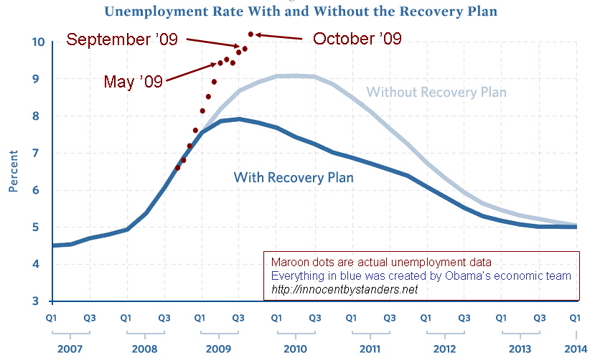
    Check out this chart from geoff at Innocent Bystanders plotting the actual recent unemployment rates against the predicted stimulus-reduced rate from Obama’s recovery team:

    Google’s chart interface is one of the easiest ways to explore unemployment data, allowing for easy comparisons for any state or county.

  • The Fog of Stimulus

    The news is full of stories about the the impact of the ARRA on job creation, including this one from the The Wall Street Journal about a shoe store owner who created or saved nine jobs with less than $900.

    In the story, the Army Corps of Engineers spent $889.60 buying boots from shoe store owner Buddy Moore of Kentucky. Because the boots were purchased with ARRA funds, the Corps asked Buddy to report how many jobs the boot order had “created or saved.” He and his daughter struggled with paperwork, online forms, and a “helpline,” only to make a wild guess 15 minutes before the reporting deadline that they had created nine jobs.

    Though not completely spelled out in the article, the impression is that Buddy and his daughter reasoned that they had created or saved nine jobs, because their boots had “helped nine members of the Corps to work.”

    This sort of misreporting is now fodder for ARRA opponents, and is the last thing that the White House wanted on its hands. In July the Office of Management and Budget (OMB) issued this memorandum and created a series of PowerPoints and PDFs intended to assist ARRA recipients with their reporting.

    These documents do not appear to be currently available on the White House website, but you can find the Google doc here. This list (also not directly available) shows that the Army Corps of Engineers is and was considered a primary recipient. Given its status, it is the one required in the initial PowerPoint to report the “job creation narrative and number.”

    As a prime recipient, the Corps should have been briefed on the fact that the key data issue to avoid was: “Significant Reporting Errors: (which are) instances where required data is not reported accurately and such erroneous reporting results in significant risk that the public will be misled or confused by the recipient report in question.”

    They also would have had to listen in to this presentation on data quality, which stresses that prime recipients are fully responsible for the quality of the data. The Corps could have caught the reporting mistake by running a simple math equation, which would have indicated that the shoe store had created a full-time job for every $98.84.

    If this were true, only $2 billion (administered by Buddy Moore) would have reemployed every single unemployed person in the US, a savings of $785 billion to the American taxpayer.

    In the end, it turns out that because the payment made by the Corps was less than $25,000, the Corps (while responsible for reporting the total number and amount of small sub-awards less than $25,000) was not required to have Buddy Moore report anything.

    Prime recipients are still responsible to report a total jobs creation estimate based off what sub-recipients and vendors do with the funds they disperse. To do that, the Corps could have called up Buddy and asked him to estimate the extra hours he worked for that specific order, and calculated Full Time Equivalents using those hour(s) by “… adding the total hours worked by all employees in the quarter, and dividing by the total hours in a full-time schedule.”

    In this case, let’s assume he worked an extra hour filling the boot order. A quarter-year full-time job would take 520 hours to complete, so he would report that the Corps funds created 1/520 of a quarterly FTE (.001923 FTE), or just about 2/1000th’s of a full-time job for a quarter of the year. The shoe store’s estimate of job creation, therefore, was 4,680 times too big.

    The OMB’s method of job reporting is, by our estimation, a good way of quantifying job creation. The problem, highlighted by the WSJ article, is that average businesses and recipients have had a hard time understanding what data was needed in the first place, and then what they were supposed to do with it.

    Mark Beauchamp is a customer service representative at Economic Modeling Specialists Inc., an Idaho-based data and economic analysis firm.

    Illustration by Mark Beauchamp.
  • New Job Market Report from Jobbait Adds New Data

    Mark Hovind over at Jobbait.com released his monthly job market report, and this month he’s expanded it significantly with sector-level data by state and metropolitan area.

    Mark offers the numbers in an easily digestible format organized by state in color coded tables. It’s a great way to get a feel for what’s happening in your region or nationally.

    Mark hopes this will help identify sectors with job prospects, even in regions where overall employment is declining.

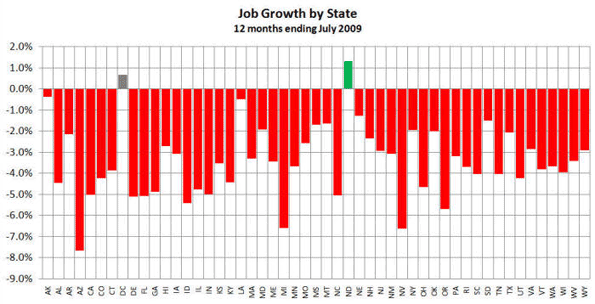
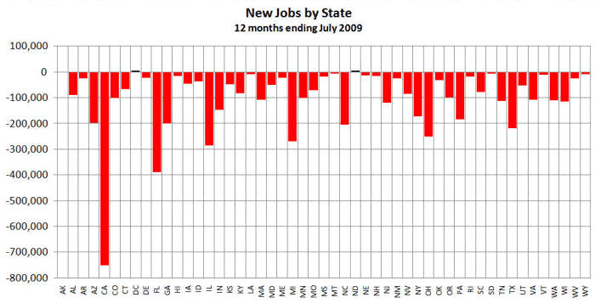
    Looking at total job growth, North Dakota is still the only state showing year-over-year employment growth, followed by Washington, DC.

    Fastest declining states by growth rate are Arizona, Michigan, Nevada and Oregon.

    Fastest declining states by sheer numbers are California, Florida, Illinois, Michigan, Ohio and Texas.

    See Jobbait.com for the full report.

  • Britain, the Big Blue State

    This week in the UK saw the publication of a much-awaited report on social mobility. Member of Parliament Alan Milburn chaired the “Panel on Fair Access to the Professions,” which studied which segments of the British population are advancing upward into the professional class. The report has generated coverage and discussion in nearly every media outlet. So what did the report conclude? Essentially, it found that, in increasing measure, the more affluent a child’s family, the more likely he or she will get a professional job such as a lawyer, doctor, or teacher, while children in poorer families will not. It further concludes that the UK’s track record on social mobility is not good and, since professional jobs require higher educational attainment, education reform must be a top priority in the next British government.

    In some ways, these conclusions were anti-climactic, because they repeated what observers of intergenerational mobility have already seen, namely that the UK has had flatter social mobility compared to other European countries (consider this Sutton Trust report). And it’s hardly news that the present economy places a premium on services and knowledge-based industries, which in turn makes education all the more important. The report, as a product of a Labour government, should be applauded for going so far as to recommend school vouchers as a way to improve educational attainment.

    But the report’s logic regarding the “professions”—those valuable occupations that hold the key to upward mobility—has gone untested in the media’s coverage of the findings. The report claims that there are currently 11 million jobs in Britain that qualify as “professional” occupations. The largest single group within this elite cohort is listed as “local government,” which accounts for 2.25 million jobs. The next largest is NHS, the UK’s national health program, at 1.4 million. The third largest is teaching at 700,000, the majority of which are presumably government-funded salaries. Together, these three groups account for 40 percent of the total.

    Are the other 60 percent of professional jobs supposed to generate the tax revenue that will pay for the other 40 percent? Probably not. Financial sector jobs, which create a sizable portion of British GDP, are not included in the list of “professions.” Therefore it seems that an unstated aspect of the report’s logic is that the UK needs to ensure that financial services continue to generate enough income that can be taxed at high rates to pay for “ the professions.” Or, perhaps to be fairer, new types of professional jobs (the report cites a rapid growth in “creative industries” such as music, fashion, and TV) will be created to pay the bill.

    Either way, it is odd that a government report puts forward a strategy for increasing upward mobility that relies so heavily on government-funded jobs—especially considering that the government plans to tax top earners at 50 percent next year, a rate that would presumably affect a fair number of professional people. And all of this is on top of a general agreement that government spending needs to be reduced somehow in order for the UK’s economy to recover.

    Does this problem sound familiar? Regular readers will surely have noted Joel Kotkin’s important July 22 article on the meltdown in blue states, a key ingredient of which is bloated public sector employment. These are the same states that have relied upon the self-defeating strategy of raising taxes to pay for it all. And these are the same states that have a disproportionate effect on the logic that Obama and Congress use to make economic decisions. Britain is, in some way, a big blue state. The U.S. is not yet a blue country. How and whether it increases the rolls of government-funded jobs as an overall percentage of the workforce will be a key indicator of how blue it becomes. This is clearly a live issue Obama’s healthcare, energy, and stimulus spending priorities.

    Ryan Streeter is a senior fellow at the Legatum Institute.

    This blog entry originally appeared at The American.

  • Balancing the California Budget

    The battle to find ways to close California’s gaping $24 billion budget shortfall continues, with Governor Schwarzenegger calling for deep cuts and reorganization throughout state government. Last week, making a “rare speech to a joint session of the Legislature,” Gov. Schwarzenegger argued that the state has “run out of time,” and faces a situation where “Our wallet is empty, our bank is closed, and our credit is dried up”.

    The challenges facing California’s policy makers in balancing the budget can be examined by checking out the Los Angeles Times’ “Interactive California Budget Balancer”. While the state has many different options available to it, making cuts to potentially popular programs will only serve to irritate interest groups which argue for the efficacy and essential nature of their favored programs. Couple this reluctance to make cuts with popular resistance to tax increases, recently seen when voters rejected a set of measures on May 19, and one can better understand the true magnitude of the budget impasse facing the state.

  • Economic Resilience in Rural America?

    This week Reuters is hosting a Food and Agriculture Summit in Chicago. On Tuesday presenters, including leading agribusiness executives and business economists, reported that despite the challenging global economic climate, the U.S. rural economy has weathered the recession better than most sectors due to steady demand for agricultural products, stable land prices and healthy credit lines for farmers”.

    Jim Borel, a VP at DuPont Co stated that “fundamentally, food demand is there,” as “people need to eat,” which “helps to stabilize things.” According to Reuters such claims were echoed by other participants, including Mark Palmquist, CEO of CHS Inc, who noted that the world keeps “adding mouths to feed,” and that “food demand… tends to be pretty insensitive to what the global economy is doing.”

    While there appears to be some anticipation of stability at large agribusiness corporations, such optimism may be tempered among farmers, who have seen commodity prices drop by 50% or more over the past year. Such drops will create a more difficult business environment for producers. However, there is some hope that the strong prices received by farmers over the past couple of years will make them better able to, as one agricultural official in Wisconsin stated recently, “ride it out for somewhat longer than otherwise would have been the case”.

  • The bailouts payments mount, the budget expands, the deficit widens, the national debt increases. How high is up?

    How far can the totals go? Federal Reserve Chairman Ben Bernanke testified before the Senate Budget Committee on March 3, 2009. He believes that the markets will be “quite able” to absorb the debt issued by the US government over the next couple of years to cover all the bailout and stimulus payments “if there is confidence that the US will get it [the economy] under control.” When Senator Lindsey Graham (R-SC) suggested an “outer limit” at which the national debt was three times gross domestic product, Bernanke said that “it wouldn’t happen because things would break down before that.” They’ll be lending to homeowners who have higher debt ratios than that. Frankly, I’d rather lend to the US government at that ratio, and I suspect a lot of investors – both domestic and foreign – feel the same way.

    On the one hand, Bernanke spoke like a “Master of the Universe” when he told the Senators that he wasn’t worried that printing all this extra money would generate future inflation. He said that when the economy begins to grow again, the Federal Reserve is “very comfortable” they will be able to deflate their bloated balance sheet. On the other hand, he did not sound like a Federal Reserve Chairman when Bernanke said “We don’t know for sure what the future will bring.” Of the two Bernankes I like the second one better: no one knows exactly what the future will bring. Why pretend that you know what the best action to take three years from now will be – or what impact it will have. I find it disconcerting, to say the least.

    There are a few things we can watch for in the coming weeks and months. The President’s budget came out yesterday and will go through Congress now for approval. Don’t get too distracted by it though – virtually everything in it can change. Instead, work with what you know. The stimulus package was passed and the states are getting details now on how much and for what they can expect money from Washington. Focus on where that money is going. The best way to minimize the damage being done by the Federal Reserve’s printing presses is to be sure that money is spent in the real economy. That means roads, bridges, schools, sewer systems – and not research and development on sources of alternative fuel or studies on global warming. We are in the middle of a crisis. This is not the time to spend on wishes and dreams. If the money is spent on real infrastructure projects, it can help to mitigate the potential inflationary effects later.

    The Treasury and the Federal Reserve have no choice but to keep their foot planted fully on the accelerator. Setting infrastructure in place now means we’ll get good traction later when the economy starts moving forward.

  • Ten Year loss in the S&P 500 on Par with the Great Depression

    In the ten-year stretch from Sept. 1929 to Sept. 1939, spanning the worst years of the Great Depression, the stock market dropped a full 50%, adjusted for inflation. Look out, the current decade (Feb. 17, 1999 to Feb. 17, 2009) appears to yield the same decrease: the Standard & Poor’s 500 stock index is down roughly 50%, also adjusted for inflation.

    But this difficult period has not been all skull and cross-bones: six-month certificates of deposit “have yielded a real total return of roughly 12%” and the value of residential homes in large cities has increased 30% over the same period, according to Business Week’s Michael Mandel.

    With many investors’ savings sitting in once-promising equities, the question of whether to stay in stocks or bail out is on many people’s minds.

    Staying in stocks could decrease the value of your investments to the point that they “may never reach their original value, much less show a profit.”

    On the flipside, bailing out and going into safer assets says “you are giving up on any potential of an upside” if the market has a big rebound.

    The market will always fluctuate and whether your glass is half-empty or half-full, and long term history says more growth is ahead. But as they say on TV, “past returns are no guarantee for future performance.” How much are you willing to bet on the long-term future of the US economy?

  • Business Journalists Blew the Story on the Economy

    The business sections of newspapers have become doomsayers for the nation. Sensationalistic journalism decries of the failings and crises that have done our economy irreparable harm.

    Rewind to a couple of years ago, and the print media was content with profiles of personable CEOs and pages upon pages devoted to the kitschy Mergers and Acquisitions. Where was the hard-hitting reporting that could’ve opened the public’s eyes to the failing economy much sooner?

    “I’ll attest that business journalists as a rule are as smart, sophisticated, and plugged-in as they seem”, notes former Wall Street Journal reporter Dean Starkman in a recent article for Mother Jones. And yet that army of professional business reporters – an estimated 9,000 or so nationwide in print alone – for all practical purposes missed the biggest story on the beat. Why?”

    Starkman suggests the print industry’s own declining financial health may play a role. In the last decade alone, the New York Times profit margins have fallen from 24 percent to a meager 8.5.The newspaper industry’s failing has also resulted in a 25 percent loss of jobs in the business reporting field alone.

    He adds that business journalism’s insistence on clinging to outdated formulas could play a role. The focus on consumer-pleasing and personality-driven stories – “not deconstructing balance sheets or figuring out risks” – seems part of the problem.

  • Railcars as Economic Indicators

    With the nation locked in the firm grips of recession, one indicator of our country’s import demand and manufacturing capacity is being stockpiled in Montana. Just south of Great Falls, along the Missouri River, Burlington Northern Santa Fe (BNSF) Railway Co. is stockpiling flatbed container cars – a lot of flatbed cars. By some accounts, there are about 1,500 railcars, or 1.5 percent of the North American flatbed fleet and roughly 5 percent of the BNSF fleet, parked between Great Falls and Helena suggesting that Americans are buying and importing less from foreign manufacturers and manufacturing less for foreign consumption. If and when they are brought back into rotation will depend on freight demand – driven by American consumption.