Tag: Education

  • The Monuments of Gentry Liberals in Chicago: White Students Dominate the Test-Admittance Public Schools

    According to the U.S. Census Bureau, Chicago’s population peaked a long time ago.  In 1950, Chicago had 3. 6 million people. Recent estimates put Chicago’s population at 2.7 million. With the growth of American suburbs, many Chicago families have fled to public schools in the suburbs. Chicago’s horrible public schools have been an embarrassment for Chicago’s elite. A recent Chicago Tribune editorial estimated that only “only 8 of 100 freshmen who enter Chicago public high schools manage to get a college diploma.”  

    In an attempt to keep white families from fleeing Chicago, the second Mayor Daley came up with a plan:  test-admittance-only public high schools. This was a reasonable solution for gentry liberals who pay high property taxes but didn’t want to leave the city or couldn’t afford to send their children to private schools. These select public high schools produce college bound students while “limiting” gentry liberal’s children from being exposed to children from “troubled backgrounds”. This is a sensitive subject because Chicago’s Public School System is only 9.2% white, while being 39.7% African-American.

    Being admitted to these select magnet schools can often determine whether a family stays in Chicago or moves elsewhere. Recently, Daniel Hertz made news by graphically showing how Chicago’s middle class has being largely eliminated since 1970. The new Chicago is still a one-party town, but is now a coalition of rich and poor with a residual government worker middle class. White children have left Chicago’s Public School system leaving minorities as the majority. But, who gets into the selective public high schools?  The Chicago Sun-Times reports:

    More white students are walking the halls at Chicago’s top four public high schools.

    At Walter Payton College Prep on the Near North Side, more than 41 percent of freshmen admitted the past four years have been white, compared to 29 percent in 2009, a Chicago Sun-Times analysis of Chicago Public Schools data has found.

    At Jones College Prep in the South Loop, 38 percent of this year’s freshman class is white, compared to 29 percent four years ago.

    In 2010 — the first year race was no longer used to determine the makeup of Chicago schools — the percentage of white freshmen at Northside College Prep in North Park rose from 37 percent to 48 percent.
    And at Whitney Young College Prep on the Near West Side, the percentage of black freshmen has steadily declined in the past three years, while the percentage of whites has risen.

    As these schools attract white students, Mayor Rahm Emanuel had to shut down 50 public schools which according to Democracy Now affected” 30,000 students, around 90 percent of them African American.” While Chicago is closing public schools, it is getting ready to build a new school. Not just any public school, but an expensive test only admittance high school named after Chicago’s glorious leader who went far. The new high school will be named Barack Obama College Preparatory High School.

    Gentry liberals leaders have told us with enormous conviction that public education is an “investment”. Yet, President Barack Obama and Mayor Rahm Emanuel send their children to elite private schools. What’s interesting in Rahm Emanuel’s case is he couldn’t find one public school in all of Chicago good enough to send his children. Mayor Rahm Emanuel is so committed to public education that he sends his children to a private school 15 miles away from where his children live.

  • Infographic: Growth of All Occupations by Industry & Education, 2001-2011

    We recently partnered with Catherine Mulbrandon at VisualizingEconomics.com to create a series of treemaps that illustrate important aspects of the labor market. In this post we provide a sneak peek at two of the graphics she created. The remainder will be posted in An Illustrated Guide to Income in the United States, a booklet from Catherine set to be released this summer.

    These two graphics are based on EMSI’s labor market database, which is a combination of over 80 public and private data sources. More specifically, the first table shows job change for all occupations by industry (based on 2-digit supersectors, as defined by the North America Industry Classification System) and the second shows occupation change by education level. The data is from 2001-2011.

    Red indicates decline and blue indicates growth.

    Each square on the graphic indicates a specific 5-digit occupation classified by the Standard Occupational Classification system. There are over 800 unique squares present on the charts. Large squares, like the ones on the upper right and in the retail trade sector, indicate a lot of jobs for the specific occupation code. Smaller squares indicate occupations with less jobs.

    In the graphic above we have pulled together occupation data related to all 20 NAICS supersectors. Government, health care, and retail trade have the largest employment. Utilities, mining, and management of companies have the fewest jobs. Also note the size of the squares within each industry sector. Here are a few observations:

    • Broad momentum. It is interesting to note how each broad industry sector tended to either be dominated by growth or decline. For instance, with very few exceptions, almost every occupation within the manufacturing sector declined from 2001-2011. The same holds true for construction, information, agriculture, and, to a certain extent, retail trade. Conversely, sectors like health care, educational services, professional/scientific/technical services, accommodation and even arts tended to show occupational growth.
    • Mixed sectors. Other industry sectors like finance, administrative, real estate, wholesale trade, and government were much more mixed.

    The graphic above shows the distribution of jobs across all levels of educational attainment. We use the same 5-digit SOC codes and group them according to what their typical educational attainment is. Where possible, occupation titles are included so you can get a sense of where certain jobs fall. Here are a few quick observations:

    • The OJT sectors (on-the-job training) are huge. This includes short-term OJT (lower right), moderate-term OJT (upper left), long-term OJT (middle right), and work experience in a related field (center). Also notice how the occupations in these sectors are less stable than the others. This is consistent with what was observed in the latest recession — jobs with higher education levels tend to perform better in tough economic times.
    • Advanced degrees showed growth. Over the past 10 years, every occupation associated with a more advanced degree (master’s, doctoral, professional) showed some sort of growth.
    • The other sectors have mixed results. Bachelor’s degrees showed more stability over the past 10 years, but there are a handful of occupations that declined since 2001. The same holds true for associate’s, postsecondary vocational awards, and degrees plus work experience.
  • Kalamazoo Leads Michigan’s Education System

    The city of Kalamazoo in southwestern Michigan may be a shining pinnacle in an otherwise economically withering state. The secret may lie within the city’s well-educated population and its incentives to support an enlightened oasis. For 25-year-olds and older in Kalamazoo, 84.2% have finished high school or higher; 32.7% have accomplished a bachelor’s degree or higher; and 14.4% can boast a graduate or professional degree.

    Compare this to Detroit’s much more bleak statistics: 69.9% of 25-year-olds have graduated high school; 11% have attained a bachelor’s degree; and a petty 4.2% have acquired a graduate or professional degree. The percentage of unemployed in Detroit is 13.8%, while 12.5% are unemployed in Kalamazoo.

    These numbers reflect a well-educated workforce that hasn’t had such an apparent impact from the declining industries in the area. It seems that the answer may be in Kalamazoo’s education services. The most common industries for men and women are educational services, where 13% of men and 17% of women are employed. The area also employs 4% of men and 4% of women in professional, scientific, and technical services, which may lend the city with a more developed economy. Universities such as Western Michigan University and Davenport University help diversify Kalamazoo’s employment base opposed to the historically more manufacturing dependent Michigan .

    Unsurprisingly, Detroit’s leading industry for males is transportation equipment (includeing auto manufacturing) at 15% of the workforce. The share in educational services is much lower than Kalamazoo with only 4% of males and 10% of females employed in the area. Figures for professional, scientific, and technical services were not listed.

    Kalamazoo also has incentive programs for students in the local school systems. The “Kalamazoo Promise” is a program funded by anonymous donors who provide scholarships for students who attend and finish high school in Kalamazoo. Scholarships can total up to 100% of the student’s college tuition. The program started in 2006 and has likely contributed to the area’s 3% growth in student enrollment. In 2008, Detroit began a similar program in hopes of replicating the small economic boom that the Kalamazoo Promise instigated.

    If the city can leverage its higher education institutions and its surging base of high school students entering college, it could ultimately become a prime example of a community improving itself through education. Incentives and opportunities provide citizens with a solid and encouraging way out of a weakening economy inthe state while still providing a standard that the rest of Michigan can attempt to replicate.

    For more Kalamazoo facts and figures, visit http://www.city-data.com/city/Kalamazoo-Michigan.html.

  • The Amazing Truth About PISA Scores: USA Beats Western Europe, Ties with Asia

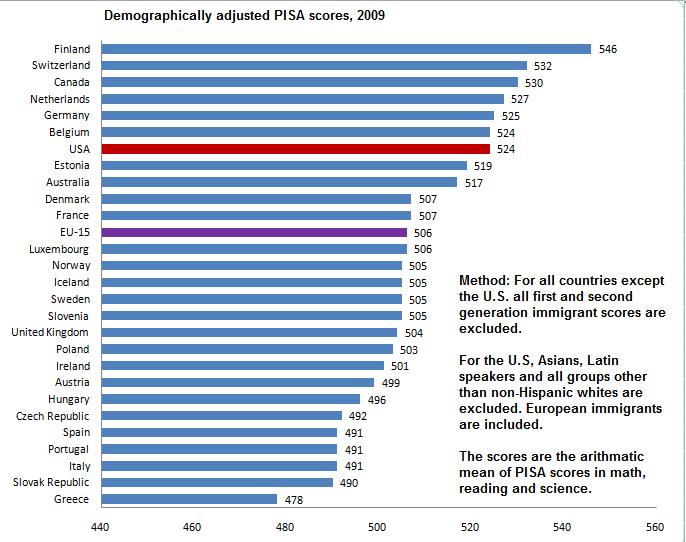
    Once we correct (even crudely) for demography in the 2009 PISA scores, (PISA is the Program for International Student Assessment) American students outperform Western Europe by significant margins and tie with Asian students. Jump to the graphs if you don’t want to read my boring set-up and methodology.

    The main theme in my blog is that we shouldn’t confuse policy with culture, and with demographic factors.

    For instance, education scholars have known for decades that the home environment of the kids and the education levels of the parents are very important for student outcomes. We also know that immigrant kids have a more difficult time at school, in part because they don’t know the language.

    Take me as an example. The school me and my brother attended was in a basement in Tehran, had no modern resources, and largely focused on religious indoctrination. But we had a good home background. Our father attended a college in the west a few years (our mother didn’t, despite stratospheric scores test scores, because at the time you didn’t send a good Kurdish girl to another city to study). So we did well in school. Conversely, the first few years in Sweden I had bad grades, in part because I didn’t master the language.

    The point I am trying to make is that the school in Sweden was objectively superior to the school in Iran. But I scored lower in Sweden, because of factors outside the control of the education system. If you want to compare the effect of the school, you have to isolate those external factors and make an apples-to-apples comparison.

    However, this is not at all how the media is presenting the recent PISA scores. For example there is a lot of attention of the score of the kids in Shanghai, the according to the NYT is supposed to “stun” us or something.

    It’s dumb to compare one of the most elite cities in a country with entire nations, and to draw policy-inference from such a comparison. Shanghai has 3 times the average income of China! It is also naive to trust the Chinese government when they tell us the data is representative of the entire nation. Either you compare Shanghai to New York City, or you compare the entire country of China, including the rural part, with other large nations. Most of the news and policy conclusions we read about PISA-scores in the New York Times is thus pure nonsense.

    1. Correcting for the demography:

    In almost all European countries, immigrants from third world countries score lower than native born kids.

    Why? No knows exactly why. Language, culture, home environment, income of parents, the education level of the parents and social problems in the neighborhood and peer groups norms are among likely explanations. But it is generally not true that the schools themselves are worse for immigrants than natives. In welfare states, immigrants often (thought not always) go to the same or similar schools and have as much or likely more resources per student.

    So the fact that immigrant students in mixed schools do worse than Swedish kids used to a few decades ago in homogeneous schools does not it out of itself prove that Swedish public schools have become worse.

    Of course, the biggest myth that the media reporting of PISA scores propagates is that the American public school system is horrible.

    The liberal left in U.S and in Europe loves this myth, because they get to demand more government spending, and at the same time get to gloat about how much smarter Europeans are than Americans. The right also kind of likes the myth, because they get to blame social problems on the government, and scare the public about Chinese competitiveness.

    We all know that Asian students beat Americans students, which “proves” that they must have a better education system. This inference is considered common sense among public intellectuals. Well, expect for the fact that Asian kids in the American school system actually score slightly better than Asian kids in North-East-Asia!

    So maybe it’s not that there is something magical about Asian schools, and has more to do with the extraordinary focus on education in Asian culture, with their self-discipline and with their favorable home environment.

    There are 3 parts to the PISA test, Reading, Math, and Science. I will just make it simple and use the average score of the 3 tests. This is not strictly correct, but in practice it doesn’t influence the results, while making it much easier for the reader. (the reason it doesn’t influence the results is that countries that are good at one part tend to be good at other parts of the test.)

    The simplest thing to do in order to get an apples-to-apples comparison is to at least correct for demography and cultural background. For instance, Finland scores the best of any European country. However first and second generation immigrant students in Finland do not outperform native Swedish, and score 50 points below native Finns (more on this later).

    On PISA, 50 points is a lot. To give you a comparison, 50 points is larger than the difference between Sweden and Turkey. A crude rule of thumb here is that 50 points is 0.5 standard deviations.

    The problem is that different countries have different share of immigrants. Sweden in 2009 PISA data had 17%, and Finland 4%. It’s just not fair to the Swedish public school system to demand that they must produce the same outcome, when Sweden has many more disadvantaged students. Similarly schools with African-American students who are plagued by racism, discrimination, crime, broken homes, poverty and other social problems are not necessarily worse just because their students don’t achieve the same results as affluent suburbs of Chicago. In fact, the most reliable data I have seen suggests that American minority schools on average have slightly more money than white schools. It’s just that the social problems they face are too much to overcome for the schools. It is illogical to blame the public school system for things out of its hands.

    So let’s start by removing those with foreign background immigrants from the sample when comparing European countries with each other. I define immigrants here as those with a parent born outside the country, so it includes second generation immigrants. This is fairly easy for Europe.

    In the case of America, 99% of the population originates from other countries, be they England, Italy, Sweden, India, Africa, Hong-Kong or Mexico. If we want to isolate the effect of the United States public school system, we should compare the immigrant groups with their home country. For those majority of Americans whose ancestors originate from Europe, we obviously want to compare them with Europe. For some groups, such as Indians, this is inappropriate. The reason is that mainly the most gifted Indians get to migrate to America to work or study.

    However, as I have argued previously, there is strong reason to believe that this problem of so called biased selection does not apply to historic European migration to the United States at the aggregate level. The people who left Europe were not better educated than those who stayed. Immigrants were perhaps more motivated, but often poorer than average.

    So similar to my comparison of GDP levels, let us compare Americans with European ancestry (about 65% of the U.S population, and not some sort of elite) with Europeans in Europe. We remove Asians, Mexicans, African-Americans and other countries that are best compared to their home nations. In Europe, we remove immigrants.

    The results are astonishing at least to me. Rather than being at the bottom of the class, United States students are 7th best out of 28, and far better than the average of Western European nations where they largely originate from.


    The mean score of Americans with European ancestry is 524, compared to 506 in Europe, when first and second generation immigrants are excluded. So much for the bigoted notions that Americans are dumb and Europeans are smart. This is also opposed to everything I have been taught about the American public school system.

    For Asian-American students (remember this includes Vietnam, Thailand and other less developed countries outside Northeast Asia), the mean PISA score is 534, same as 533 for the average of Japan, South Korea, Singapore and Hong Kong. Here we have two biases going in opposite directions: Asians in the U.S are selected. On the other hand we are comparing the richest and best scoring Asian countries with all Americans with origin in South and East Asia.


    2. Policy-Implications

    Libertarians in the United States have often claimed that the public school system (which has more than 90% of the students) is a disaster. They blame this on government control and on teachers unions. However, it is completely unfair to demand that a public school in southern California where most of the students are recent immigrants from Mexico whose parents have no experience in higher education (only 4% of all Mexican immigrates have a college degree, compared to over 50% of Indian immigrants) should perform as well as a private school in Silicon Valley.

    The libertarians have no answer why European and Asian countries that also have public school systems score higher than the United States (unadjusted for demography). Top scoring Finland has strong teacher unions, just as California.

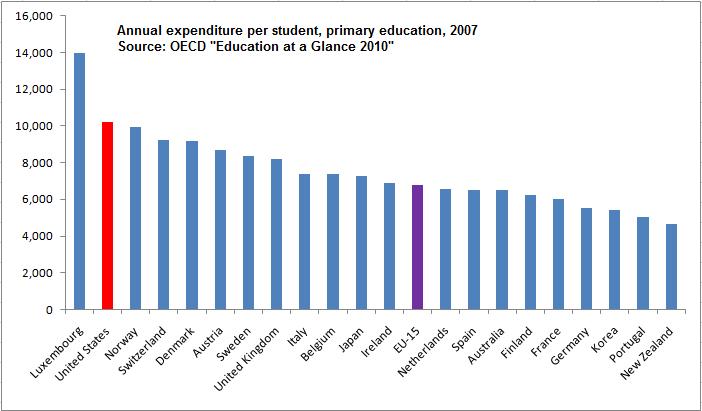
    Similarly, the left claims that the American education system is horrible, because Americans don’t invest enough in education. The left has no answer when you point out that the United States spends insanely more than Europe and East Asia on education. According to the OECD, the United States spends about 50% more per pupil than the average for Western Europe, and 40% more than Japan.


    Another policy implication is that Europe can learn from American public schools, which appear to be better than most European countries. I can only compare Sweden with the U.S, but I can tell you that from my experience, the American system is superior. I always thought this was just anecdotal evidence, but I am beginning to realize that American schools are indeed better.

    For example, we don’t have any real equivalent to Advanced Placements classes. We have cheaper and worse textbooks. The teachers on average have far less education. I could go on.

    Nor is it any longer a mystery to me why Americans spend so much more on education and (falsely appear) to get out less in output.

    But of course the biggest implication is that most Europeans and all American liberals have lost the bragging right about their side being smarter than Americans.

    3. Immigrant PISA scores compared to natives

    This is again the mean difference of the 3 parts of PISA.


    Australia is the only country with a negative gap, which means Australian immigrants actually score better than natives. Canada is similar. The Australian-Canadian skill based migration system is at work here, generating less inequality (even short term).

    The other pattern appears to be that the gap is almost constant in the remaining Western European countries. This may be important to keep in mind, whenever people claim that uniquely Swedish policies are causing poor immigrant educational outcomes.

    Tino Sanandaji is of Kurdish origins, and was born in Iran in 1980. In 1989 he moved together with his mother and brother to Sweden. He has a degree from the Stockholm School of Economics, his M.A in Economics from the University of Chicago and is expected to receive his PhD in Public Policy from the University of Chicago in 2011. His work has appeared in The Wall Street Journal, The New York Times, National Review, and numerous Swedish newspapers. Tino has been a resident of Hyde Park Chicago, since 2004.

  • MILLENNIAL PERSPECTIVE: Education Economics

    Almost three years ago, shortly after graduating from college, Jeffrey Rogers found himself with a degree and no job. The economy had just taken a dramatic turn for the worse and he was struggling to get by.

    “He was literally living off peanut butter and jelly sandwiches,” said Kathryn Rogers, his younger sister and a first-year graduate student at Chapman University in Southern California.

    Jeffrey went to their father for help in a last-ditch effort to meet his monthly living expenses, but his Dad refused. “He definitely is into tough love,” said Kathryn. “He said, ‘He’ll make ends meet in one way or another…’ [his] attitude is, ‘Once you graduate, you’re cut off’.”

    Jeffrey ended up borrowing money from friends to pay rent for the next six months. But Kathryn is grateful for her father’s “tough love”. She believes it has strongly contributed to her own sense of financial responsibility. While her parents paid her rent and tuition, with the help of an academic scholarship during her four years of undergraduate studies, she was in charge of everything else. “I paid for food, I paid for gas, I paid for activities, I paid for my sorority,” she said.

    Kathryn has always had a job since the age of 16. Being aware of how much things actually cost has helped her keep her budget balanced now that she is on her own. But not having that awareness is a huge problem for many college students. “If you’ve always had everything given to you, you wouldn’t think about [cost of things] because it wouldn’t be an issue,” she said.

    A majority of Kathryn’s student acquaintances don’t know the basics of personal finances. “You talk to people our age, they’re 18 and they have $12,000 in credit card debt or they don’t know how to pay bills or how to do their taxes,” she said.

    Kathryn believes a financial management class in high school should be mandatory. “If your parents don’t teach you, where are you supposed to learn?” she asks.

    Catie Robbins, a senior screenwriting major at Chapman, agrees. “Your parents figure you’re going to learn along the way. But then you always feel so much guilt and disappointment when you’re not being responsible with your money. It’d be nice if there was more guidance available.”

    Robbins has taken out student loans and receives financial aid, which helps her parents pay for her tuition. But they also take care of her rent, food, and other necessities.

    “Basically I don’t have to pay for anything. But it’s scary because they only send me enough money for my food and lodging, so I can’t buy anything else,” she said. “If you want to do fun, random stuff or if you go overboard on your food expenditures, you can be very poor. It’s fine – it’s just kind of sad to be dependent on my parents.”

    Robbins looks forward to graduating and getting a job. But right now her financial aid package limits the amount of money she can make from employment to $2,000 a year, which she said she can easily earn during the summer. “As soon as I make that much, I have to quit,” she said. She points out that, counter-intuitive as it is, students are given financial aid because they don’t have enough money, but then are stopped from earning more because of the aid they receive.

    There is also a certain irony in being given dreams and goals during college, and then being unable to fulfill them because of the financial burden of college.

    “Originally, I had all these ideas for traveling,” said Robbins, who has studied abroad. “But you definitely can’t just take off after school and be youthful and pursue all these silly things. You have to be responsible. I am kind of excited to finally be free and living on my own, and not having to ask my parents for money,” she added.

    While financial aid is limiting for some students, and asking your parents for money is never easy, it is definitely a preferable alternative to being entirely dependent on student loans. That’s the situation in which junior Dave Casey finds himself.

    Without the minimum required 2.0 GPA, Casey was not eligible for federal student aid this semester. Taking out loans was his only option for staying in college. Currently, he owes about $60,000 with two more years of school to go. He is paying a monthly $187 in interest alone.

    “I could have gone to the University of Rhode Island for $6,000 a year,” said Casey, a native of Warwick, R.I. “But I didn’t want to. I was willing to pay because I wanted to go off, I wanted to experience something else, I wanted to be surrounded by a different environment, different people. And I think that’s how you really learn.”

    Casey’s father helps him out with rent, and he works over 20 hours a week at a local restaurant. “What stresses me out is that my mother is on food stamps, and I have no money to give her,” said Casey, whose parents are divorced. “I can’t [help], because I’m in a hole myself. Do I send hundreds of dollars a month back to my mom, or do I pay off these loans and then turn to help her? Either way there’s not enough money to go around.” Like Kathryn Rogers and Robbins, Casey’s only hope is to get a steady job after he’s graduated and start paying off his mountainous debt.

    “The only reason why I’m not freaking out hardcore about this is because I can’t comprehend it. Set $60,000 in front of me; I’d like to see it. It’s so abstract to me,” he said. “These loan agencies definitely benefit from our naiveté.”

    Donald Booth, a professor of economics at Chapman and board member of Consumer Credit Counseling Service, thinks that technology is a major contributor to the lack of financial knowledge.

    “The traditional way was the bill came to your house, you wrote a check, licked a stamp and mailed it back. Now you have automatic pay, it withdraws it from your account,” he said. “[People] don’t even know what they have in their checking account.”

    The transition to so much financial activity online has been difficult for generations both young and old. “Don’t think it’s just students who don’t know how to manage money – it’s almost everybody,” he said.

    Older people are naturally resistant to new technology because they like doing things the way they’re used to, according to Booth. On the other hand, there was no one to teach students to use the Internet as a financial tool.

    So we’re basically in the banks’ pockets now, because people aren’t keeping track of the money they’re spending, how much they have, how much they owe. “And everything seems free. You almost never get turned down anytime you want to buy something. Until it catches up with you.”

    Rachel Yeung is a senior at Chapman University in Orange County, California.

  • Urban Youth Deserve Chance to Hear About Service Academies

    Here’s a disturbing thought as Veterans Day approaches: Some teachers and administrators of the Los Angeles Unified School District (LAUSD) refuse to allow visits to high school campuses by representatives of the service academies that train young officers.

    The service academies have all earned reputations as fine academic institutions that go further on training future officers. There is the U.S. Military Academy; the U.S. Naval Academy; the U.S. Air Force Academy; the U.S. Coast Guard Academy; and the U.S. Merchant Marine Academy. They all offer full scholarships and require five years of service after graduation.

    Candidates must meet demanding standards on academics, physical fitness, and extra-curricular activity. They are generally required to secure a nomination from a member of the U.S. Congress, the president, or the vice president.

    The merit involved in gaining a nomination, along with the geographic apportionment by Congressional districts, offers the chance to draw candidates from across the socio-economic spectrum. Graduation from a service academy offers young officers from every corner of society the chance to reach significant rank.

    Measure that against the LAUSD teachers and administrators who deem a career as a military officer to be unworthy of a hearing at high school campuses. Some will tell you that they object because our wars are fought by too many young persons of color. Others view the “don’t ask, don’t tell” policy on gays in the military as contemptible prejudice.

    These objections are absurd. Our civilian leadership decides the actions and policies of the military. War or peace? That’s in the hands of the president and Congress. Gays in the military? Same story.

    It’s true that our military stands ready for war if so directed by the civilian leadership of our democracy. It’s also notable that never in the course of history has any institution possessed the war-making might of the U.S. military. And never has an institution in such a position yielded so loyally to the will of unarmed leadership. This sense of duty has lasted through good and bad, gallant victories and horrific mishaps. Never has there been a serious challenge to civilian oversight.

    All of that is overlooked by LAUSD teachers and administrators—and their boycotts have an effect. Some members of Congress who represent Los Angeles have chronic difficulty in filling the number of nominations they are allowed to make to the service academies each year. They aren’t coming up short on qualified candidates. They can’t even get that far—not enough young achievers know about the possibilities of the service academies.

    It’s time that someone gave these alleged educators who forbid any discussion of service academies a lesson on the honorable history of our military. They should also be reminded that it will require representatives from throughout our society—rich and poor, all colors and creeds, town and country—to keep this line of honorable service intact.

    Keeping knowledge of the service academies away from youngsters in our city is nothing short of demographic censorship. It is time for LAUSD to put an end to the practice.

  • More Machinists, Fewer Poets?

    Politicians from both parties, while on the campaign trail, often argue that they will work to make a college education accessible and affordable to all Americans. Very rarely will one hear calls for “better quality” of education at our colleges and universities, with such debates seemingly being restricted to our K-12 educational system. An opinion piece in the Chronicle of Higher Education claims, however, that many of our institutes of higher learning are failing to meet the challenge of providing a good return on investment for those attending their institutions.

    In his piece, education consultant Marty Nemko argues that “college is a wise choice for far fewer people than are currently encouraged to consider it,” and that colleges and universities need to be held accountable for their “defective products: students who drop out or graduate with far too little benefit for the time and money spent.”

    Nemko points out that over 40 percent of students who enter four-year institutions do not graduate in six years, and cites the “killer statistic,” that,

    “Among high-school students who graduated in the bottom 40 percent of their classes, and whose first institutions were four-year colleges, two-thirds had not earned diplomas eight and a half years later.”

    Nemko also takes issue with the quality of education received by those who do graduate, stating that “50 percent of college seniors scored below “proficient” levels on a test,” requiring them to perform basic tasks, and that “the percentage of college graduates deemed proficient in prose literacy has actually declined from 40 to 31 percent in the past decade.”

    Many young people, Nemko argues, should look to other routes of career development and education, such as apprenticeships and other vocational training.

    Other options do exist, even in the face of a difficult economy. Around the nation, there are communities reporting a need for more skilled workers, requiring training not necessarily linked to gaining a bachelors degree. Manufacturers in northeast Wisconsin face a shortage of new workers, with one company president noting that the local technical school, Northeast Wisconsin Technical College,

    “had 40 job openings posted for CNC technicians. They graduated seven people. In mechanical design, they had 85 job postings and graduated nine people. In electro-mechanical technology they had 75 job openings and graduated four people.”

    Austin, MN, faces a shortage of maintenance mechanics. According to one local technical instructor,

    “If we can’t get more [people] interested in two-year college educations and jobs that require a specialized skill like industrial maintenance mechanics or carpentry and electricians, we’re going be in a deep world of hurt in about five years when all these people retire and we can’t produce goods we need to produce.”

    Communities around the nation will need to find ways to meet such shortages, and build their productive economies. Failure to do so may lead to a loss of potential economic growth. According to the technical instructor, in the face of shortages of skilled workers, “companies may back off on the expansion or growth. Or they may end up relocating to a place where they can find these employees.” Convincing young people that there are other good career options outside the four year degree path will be among the many challenges faced in building our nation’s economic future.