Tag: Energy

  • Obama Still Can Save His Presidency

    A good friend of mine, a Democratic mayor here in California, describes the Obama administration as “Moveon.org run by the Chicago machine.” This combination may have been good enough to beat John McCain in 2008, but it is proving a damned poor way to run a country or build a strong, effective political majority. And while the president’s charismatic talent – and the lack of such among his opposition – may keep him in office, it will be largely as a kind of permanent lame duck unable to make any of the transformative changes he promised as a candidate.

    If Obama wants to succeed as president he must grow into something more than movement icon, become more of a national leader. In effect, he needs to hit the reset button. Here are five key changes that Obama can implement to re-energize and save his presidency.

    1. Forget the “Chicago way.” The Windy City is a one-party town with a shrinking middle class and a fully co-opted business elite. The focused democratic centralism of the machine – as the University of Illinois’ Richard Simpson has noted – worked brilliantly in the primaries and even the general election campaign. But it is hardly suited to running a nation that is more culturally and politically diverse.

    The key rule of Chicago politics is delivering the spoils to supporters, and Obama’s stimulus program essentially fills this prescription. The stimulus’s biggest winners are such core backers as public employees, universities and rent-seeking businesses who leverage their access to government largesse, mostly by investing in nominally “green” industries. Roughly half the jobs saved form the ranks of teachers, a highly organized core constituency for the president and a mainstay of the political machine that supports the Democratic Party.

    The other winners: big investment banks and private investment funds. People forget that Obama, even running against a sitting New York senator, emerged as an early favorite among the hedge fund grandees. As The New York Times’ Andrew Sorkin put it back in April, “Mr. Obama might be struggling with the blue-collar vote in Pennsylvania, but he has nailed the hedge fund vote.”

    At best, the president’s policy seems like Karl Rove in reverse, essentially smooching the core and ignoring the rest. This is a formula for more divisiveness, not the advertised “hope” Americans expected last November.

    2. Focus on Real Jobs, Not Favored Constituencies . The Chicago approach works better in a closed political system controlled by a few powerbrokers than in a massive continental economy like the U.S. Health care and education, which depend on government largesse, are surviving. But the critical production side of the economy that generates good blue-collar jobs – like agriculture, manufacturing and construction – is getting the least from the stimulus.

    These industries need more large-scale infrastructure spending, as well as more focused skills training and initiatives to free capital for politically unconnected entrepreneurial businesses. Instead, productive industries face the prospect of more regulation while capital for small businesses continues to dry up.

    Those in post-industrial bastions tied to speculative capital – think Manhattan and the Hamptons – are the ones most benefiting from Obamanomics. College towns like Cambridge, Mass., Madison, Wis., Berkeley, Calif., and Palo Alto, Calif., will also prosper, becoming even richer and more self-important. It seems, then, that Obama has done best for elite graduates of Harvard and Stanford and other members of the “creative class.”

    The rest of America, however, is still waiting for a real sustained recovery. Industrial and office properties remain widely abandoned not only in Detroit but Silicon Valley. The future sustainability of our economy depends mostly on what happens to those who previously staffed these facilities – those who produced actual goods and services – not just on a relative handful of people working at Google or the national laboratories. In other words, we need jobs for machinists, welders and marketers as well as scientists with Ph.D’s.

    3. Step on the Gas. Providence has handed America – and Obama – an enormous gift in the now recoverable deposits of natural gas found across the continent. Proven levels have been soaring and now amount to 90 years’ supply at current demand. More will be found, and across a wide section of the country.

    Natural gas may be a fossil fuel, but it is relatively clean and thus the perfect intermediate solution to our energy problems. The problem: The president’s green advisers will seek to prevent developing these resources.

    Although Obama should support strong environmental controls on gas extraction, the greens should not be allowed to block this unique and historic opportunity to shift economic power back to North America. Along with modest increases in domestic and Canadian oil, natural gas could end our dependence on fossil fuels from outside North America. This would relieve our military from the onerous task of defending other people’s oil supplies. But most important, the new energy sources could expand our industrial and agricultural economies so they can capitalize on the huge potential growth from markets at home and in the developing world.

    The natural gas era could then finance continued research and deployment of renewable fuels. Let’s give it the 10 or 20 years that great transformations require. Quick fixes will lead us to subsidize the purchase of rapidly dated technology from China or Europe; we should aim at the energy equivalent of the moon shot, helping forge a huge technological advantage.

    4. Rediscover America. As a candidate, Obama spoke movingly about his Kansas roots, but lately he seems to have become all big city all the time. This administration offers very little to people who live in places like Kansas, as many of my heartland Democrat friends complain.

    Urbanites often forget that this is an enormous country. Crowded into dense cities themselves, they fail to look down from the window when crossing the country by plane. The vast majority of America is, well, vast – sparsely settled, if settled at all.

    Moreover, Obama’s people need to understand that 80% of America live in suburbs or small towns. They do not want to live in dense cities or realize a move there would mean living in less than idyllic conditions. If Obama wants to shape a green America, he must find ways that work with the majority’s preferences.

    But so far the president’s housing, transport and planning advisers seem to be pushing the death of suburbia and promoting ever more densification. It’s hardly surprising, then, that suburbs and small towns feel left out. After finally starting to inch toward the Democrats, they are now turning again to the right. If Democrats want to retain their majority, they need the strong support of these constituencies – without it the Congressional majority will be gone by the end of the second term, if not the first.

    5. Chuck the Nobel; Embrace Exceptionalism. Many progressives love Obama because they see him as one of them in the struggle with what the immortal Bill Maher calls “a stupid country.” But the president should remind himself that the country may not be quite as dumb as it sometimes looks from Oslo – or from Dupont Circle, Cambridge or Soho.

    Being smart was part of the reason the Republicans lost the majority. The voters understood the country was wasting resources – and young people – on internecine conflicts for energy that we could produce at home. The Bush years also undermined any GOP claim to fiscal responsibility.

    Initially Obama allowed us to redefine American exceptionalism as something more than monomaniacal use of force and overconsumption. He spoke to our traditions of inclusiveness, adaptability and idealism. He offered the perfect vehicle because he and his story are so exceptional. Yet Obama sometimes seems more interested in serving as the apologizer rather than as commander in chief. His vision appears less American than pseudo-European.

    This is not the path to success for American presidents. Whether Ronald Reagan or Franklin Roosevelt, Harry Truman or even Bill Clinton, a president has to be a spokesman for his country. Right now, on the world stage, Obama is looking more and more like Jimmy Carter.

    I suggest these things because, for all his missteps over the past year, Barack Obama is my president and I want him to succeed. But to do so, first he needs to hit his own reset button – and the sooner the better. Unlike some, I do not believe the Obama presidency is already doomed. Presidents often grow in office: Despite his exceptionalism in other areas, let’s hope that Obama proves the norm here.

    This article originally appeared at Forbes.com.

    Joel Kotkin is executive editor of NewGeography.com and is a distinguished presidential fellow in urban futures at Chapman University. He is author of The City: A Global History. His next book, The Next Hundred Million: America in 2050, will be published by Penguin Press early next year.

    Official White House Photo by Pete Souza
  • Getting Real About “Green” Jobs

    Over the past year, Economic Modeling Specialists, Inc. (EMSI) has been fielding questions from local planners (workforce boards, community colleges, and economic developers) on how to look at green jobs, particularly at the regional level. Perhaps nothing has been more hyped, or misunderstood, than the potential impact of this sector on local economies.

    In order to wade through the rhetoric and often overblown expectations, we’ve been doing our best to link labor market data to potential green sectors so people can gain an understanding of trends, earnings, education levels, and skills associated with “green occupation clusters”. So far, we have made three general observations:

    1. Many of these jobs are going to fall within the construction and manufacturing sectors (e.g., welders, roofers, HVAC installers, etc.),
    2. Based on a lack of understanding, concrete information, and large scale demand, green jobs pose a very difficult development mission for local planners, and
    3. It is vital to speak “from the data” as much as possible.

    Such realism is necessary. Given the recession, job loss, and our nation’s otherwise dismal financial condition, many are now questioning the continued emphasis on green jobs, climate change, and cap-and-trade legislation. In recent months we have seen a sizable pushback against some of this policy from groups ranging from the American Farm bureau and even the educational community. Recently, for example, Inside Higher Ed wrote about how “some leaders in workforce development are concerned that more traditional skill trades within the manufacturing and construction fields are being deemphasized by community colleges looking for federal dollars to support newfangled programs.”

    The public is also getting skeptical. A Gallup poll indicated that the recession has dried up some of the support for increased environmental regulation. Similar surveys by Rasmussen and Pew suggest a similar trend in popular opinion.

    None of this suggests that most Americans, or most business, oppose environmental protection. It’s just that that economic growth and environmental protection should not be mutually exclusive.

    Increasingly we find ourselves at a crossroads between two competing points of view – one that thinks that we need to restore economic stability before we deal with environmental issues, and one that believes that if we fail to address environmental concerns aggressively right now, we are forfeiting our future.

    Chasing Trends vs. Being Demand Driven

    The promise of “green jobs” has the allure to square this circle, and reconcile the needs of the economy and the environment. This causes a kind of thinking reminiscent of that associated with the ‘90s dot-com boom. In that era, software and information was the next big thing. Many regional developers tried to get into the game, and some failed miserably. When the bubble burst, many were left empty-handed and embarrassed that they had essentially just wasted a lot of the public’s time, energy, and money on something that they frankly didn’t understand or have any real reason (in a regional context) to be pursuing.

    Given this experience, it’s not surprising that green is being met with skepticism by some local planners, who can and should be rigorously dedicated to spending their dollars wisely and only on things that will advance their region’s businesses and people. This seems to come from an understandable concern that economic development should essentially be “demand-driven” and in touch with needs of the local community.

    At the same time, regional development can be traced back to the needs of local industry. The activities, interests, and employment of local industries directly and indirectly drive much of the employment and earnings in an area (the concept of an economic base). This leads some loath to invest resources into an emerging sector or a new policy, such as green, where there is little demand, enough jobs, or the background to justify the efforts.

    “Policy” vs. “Environment”

    Right now, the primary struggles with green development come from: (1) actually understanding what “green” is and (2) knowing which industries people need to be prepared/trained for. Some of the problem stems from the fact that green is happening according to a top-down, policy driven approach rather than an industry driven one.

    In the U.S. we often see industry development happening from the ground up (e.g., from the local level and up to the national level). Industries develop hubs of production (e.g., Silicon Valley, the Research Triangle, and Hollywood). Regions benefit from this and become specialized and competitive at producing and exporting something that is demanded by the larger economy. This gives rise to specific skill and knowledge sets which further enhance the development of a region. Green jobs don’t really work this way. The “greening” of our economy has sprouted from a particular ideological point of view (global warming, overpopulation, etc.), that drive the initiatives, many of them associated with the stimulus.

    As is often the case, it is not particularly easy to translate the broad rhetoric, concepts, and policy (things like “clean tech”) into local industries, impacts, skills, training programs, and demand. At the local level, it is also incredibly difficult to project future trends of what jobs and industries will begin to thrive or fail. Those who try to use only national predictions to implement new regional training programs or to develop local policies could find their new programs may not result in tangible benefits to the region. In a recession folks need and want jobs (in some cases, any job will do), and discussions about how something like clean tech is going to be the next big thing can be really frustrating (think “dot-com” bubble).

    Finally, a big part of the frustration around green jobs actually comes down to semantics. Politicians and news anchors often refer to green jobs as some sort of new “industry.” Yet in reality green is much less about “what” is being produced than “how” things are produced.

    In this sense, in order to have “green” industry, you first need to have an industry that can be, if you will, “greened”. Here is an illustration that points out the nuance: let’s imagine you have two tire manufacturers. One produces tires using traditional “non-green” methods and the other uses recycled materials and can be classified as “green.” At the end of the day are they both manufacturing tires? Well, yes of course. Are they part of different industries? No. Both companies also likely employ the same sort of people, use the same sort of equipment, and have similar sales and supply chains. Also, from a training/workforce development perspective these industries are going to look pretty identical – with maybe a few minor skills differences.

    Seen from this angle, green is not actually about creating a new industry sector in either a general or specific sense. Rather, it’s more about changing and retooling all existing industry sectors to make them operate differently.

    It Needs to Be Data-Driven

    In the United States, we have a huge amount of data at our disposal for development decisions. Our nation has over 1,800 (and counting) well-established industry codes (NAICS codes) that are standardized for the entire country. The 20 big industry sectors that compose our economy exist because of broad, long-lasting, nationwide demand. But right now, local developers cannot take such a well-researched, data-driven approach to green. There are a lot of people who are highly in favor of green, but in many ways, they don’t bring the sort of objectivity needed to hash things out for the sake of the local workforce. What if green actually isn’t a good idea for a specific community? Something like Biotech is great if you can have it, but if it’s not the right fit for the community, forcing it can be a bad thing.

    Final Remark

    For green to work at the local level, it needs to be demand-driven. It needs to be harmonized with local development efforts, and it must complement and not fight against regional economies. This means helping and not hurting local industries with too much regulation, and allowing regional developers to stay focused on longer-term efforts as opposed to short-term trends.

    Do we want green to succeed? Well, sure. However, as the polls show, we will not have these things at the expense of economic growth. All this is to say that people are going to be more supportive of the green movement if it embraces another aspect of sustainability – economic sustainability. The green movement and economic considerations are not mutually exclusive. If the economy continues to suffer, the green movement will suffer as there will be no money or opportunities to invest in green technologies. Only a broad based economic recovery – based in the revival of productive industry – can make green industry not only desirable, but practicable.

    Rob Sentz is the marketing director at EMSI, an Idaho-based economics firm that provides data and analysis to workforce boards, economic development agencies, higher education institutions and the private sector. He is the author of a series of green jobs white papers.

    Illustration by Mark Beauchamp

  • GOP Needs Economic Populism

    You would think, given the massive dissatisfaction with an economy that guarantees mega-bonuses for the rich and continued high unemployment, that the GOP would smell an opportunity. In my travels around the country — including in midstream places like suburban Kansas City and Kentucky — few, including Democrats, express any faith in the president’s basic economic strategy.

    Ask a local mayor or chamber of commerce executive in Kentucky or Kansas City about the stimulus, and at best you get a shrug. Many feel the only people really benefiting from Obamanomics are Wall Street grandees, public employees, subsidized “green” companies and various other professional rent seekers.

    It’s not surprising, then, that most Americans — upward of 60 percent — feel the country is headed in the “wrong direction.” Most of these malcontents are not zealots such as those you might find at a tea party. They are more akin to villagers watching in horror as two armies, each fighting in their name, wage war on each other, leaving desolation in their wake.

    Yet it’s unlikely that the independent-minded will move to the GOP until the party comes up with a credible economic plan that addresses popular concerns. One big problem lies in the very nature of the Republican Party. Since Theodore Roosevelt, the party has devolved into a de facto shill for large corporate interests. One notable exception, to some extent, was Ronald Reagan, whose rise challenged the hegemony of some in the corporate establishment, first in California, when he was governor, and later nationally.

    Republicans may now find it convenient to rail against the Troubled Asset Relief Program, but it’s something many supported under George W. Bush. Even now, most are loath to fight excessive pay and bonuses at places like Goldman Sachs. Instead, it’s populists like North Dakota Democrat Byron Dorgan and Vermont independent Bernie Sanders who seem most outraged by the massive rip-off of taxpayers.

    Republicans also do not seem sympathetic to pro­posals by former Fed chief Paul Volcker and others to break up “too big to fail” banks or reimpose distinctions between investment and mainstream banks. If anything, this illustrates that for all the rhetoric about self-sufficiency and small business, they remain more attuned to Wall Street and K Street than Main Street.

    Yet there may be new opportunities for Republicans on the economic front. This winter, the focus of political debate will shift from health care to energy legislation. Whatever the negatives associated with President Barack Obama’s proposals, Republicans’ long-standing inability to reform clearly flawed health care systems has undermined their credibility. The health insurance industry and right-wing ideologues may applaud their efforts, but it’s unlikely to impress the many middle- and working-class Americans for whom the current system is not working.

    In sharp contrast, the coming debate over energy and climate plays to the weaknesses of the Democrats. All the administration’s talk of reducing our “addiction” to foreign energy can be painted as fraudulent, since the powerful green lobby will militate against developing our country’s huge natural gas and other fossil-fuel deposits, as well as nuclear power.

    In the past election, some of the few good moments for John McCain came in the wake of his embracing a nationalistic, growth-oriented “Drill, baby, drill” agenda. This approach remains popular not only with conservatives but also with moderates and independents, particularly in energy-producing states.

    Obama’s climate change proposals offer an additional opportunity. The mainstream media remain slavishly tied to the Al Gore warming thesis, but skepticism toward the anti-carbon jihad is building via the Web. In recent months, Gallup, Pew and Rasmussen have reported reduced enthusiasm for radical steps to battle climate change. Right now, this seems to be a major concern for barely one in three Americans.

    Yet the “cap and trade” proposals could prove a boon to some of the very corporate interests — on Wall Street and among utilities — still considered core supporters by some Republicans. GOP leaders seem simply incapable of comprehending the discreet charm that Timothy Geithner’s collusive capitalism holds for many corporate chieftains. In this, they resemble the boyfriend who ignores the implications of finding someone else’s Jockeys on his girlfriend’s bed.

    Sadly, those who do tend toward populism, like current front-runners Mike Huckabee and Sarah Palin, appear too socially regressive to appeal to the suburban independents who will decide the elections in 2010 and 2012. Americans may yearn for an economically populist alternative, but not if they think it will bring back the Inquisition.

    In the end, economic populism, not social conservatism, can transform Republicans into something other than a scarecrow party. And they could make this strategy work, if they only had a brain.

    This article originally appeared at Politico.com.

    Joel Kotkin is executive editor of NewGeography.com and is a distinguished presidential fellow in urban futures at Chapman University. He is author of The City: A Global History. His next book, The Next Hundred Million: America in 2050, will be published by Penguin Press early next year.

  • Home-Based Businesses: Residential Zoning and The Cyber Village

    Currently in the United States about 27% of all homes have some form of a home based business. These businesses can be key to conservation efforts that lower our carbon footprint by reducing transportation needs, eliminating redundant facilities, and consolidating equipment. They provide significant opportunities for two solutions to problems that face today’s growth issues.

    My software company was founded in Dallas, where I worked from the dining room table in an apartment. I yearned for the day my business could operate out of a real office. After the business started generating a positive cash flow the apartment was left behind, and my office moved to a location in the newly built Dallas Galleria. My 104 square feet of office space was complimented with a separate meeting room, receptionist, and a parking space in the garage. All this cost me $600 a month. After the initial six month lease was up the rent skyrocketed and parking was no longer free; however, the 104 square feet remained the same.

    Oh, how I yearned for a nice dining room table to work from!

    Soon I decided that the money spent on rent — both apartment and Galleria office — could build a really nice home. In 1982 I built a home specifically designed for a residence and my business. With about 4,000 square feet, of which about one third was dedicated business space with a separate office entrance, we had a viable base from which to live and work.

    The IRS allowed us to write-off one third of the total housing expenses without question. By not having to pay office rent we could double the home payments, and the 30 year mortgage was paid in full in less than 10 years.

    Maple Grove, the lakefront suburban Minnesota community where we had built, allowed a home business occupation via ordinance limited to one non-family employee. At first we complied, but the business grew. At times there were up to 6 employees at the home, but neighbors did not complain.

    I was not the only lake front home operating a big business. Across the lake, a major manufacturer of car radar warning units operated out of the basement of a house. This was a husband-and-wife business, but it was no small operation. The company had full page ads in leading automotive magazines. I sometimes visited; I’d hear the phone ring with an order, and the wife would say ‘I’ll see if we have any in stock at the warehouse, can you hold?’ She would then call down to the basement and ask if they could make an A-50 unit for shipping. Nobody but the UPS man would know the truth!

    Solution #1: The Residential/Business
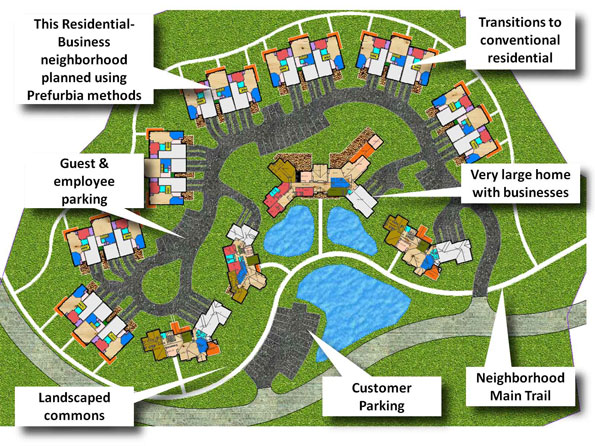
    The Residential/Business (RB zoning) would be an entirely new land use, sort of a morphing of an office center and a neighborhood of luxury single family homes. Office complexes typically have a higher degree of landscaping and architectural detail than single family developments. In the RB neighborhood, homes would be large and impressive with heavily landscaped commons that serve as pedestrian access to the businesses that are located within the home structure.

    Family members and employees would park in the rear, with multiple garage spaces and outside parking for the employees. From the arterial streets abutting these developments it would be an impressive sight, giving a sense of wealth to the neighborhood and municipality. The types of businesses would be restricted to low traffic professional services, including medical services, but also could include very light manufacturing. The RB zones would be an excellent transition (buffer) from commercial centers to residential ones. The RB residential structures would house the entire business and home, serving as the main hub for all of the business needs.

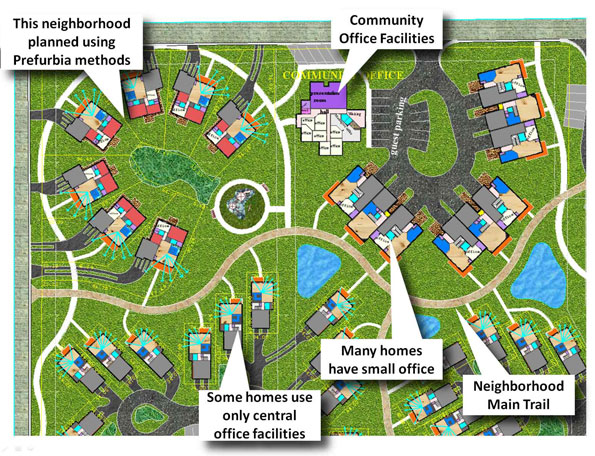
    Below, a Residential/Business community

    There could be some overlap of business functions into the residential elements of the home. For example, a conference center with an 80 inch screen for presentations could be used for Monday night football on occasion. From a financial standpoint, for a small to medium sized business owner this is a win-win situation. It delivers the advantages that I had experienced in my own situation in a comprehensive, specifically designed development plan.

    Solution #2: The Cyber Village
    George E. Van Hoesen, of Global Green Building, LLC, has developed an alternative solution, the Cyber Village.

    The proliferation of computers and cell phones, as well as video conferencing and express delivery, has made the notion of the at-home cyber office an excellent solution for growth issues. New definitions of work, recreation, and education have brought the family home again. Residential design and community planning can begin to address the increasing needs of these new households while keeping the neighborhood’s primarily residential character.

    Unlike the Residential/Business solution, homes in the Cyber Village need not be as business intensive or change the character of a neighborhood. A main component of the Cyber Village is the Cyber Office, serving as the community foundation for business activity. This facility, complete with offices, reception services, mail services, meeting rooms, board rooms, reference libraries and office equipment, would serve subscribers (businesses within the neighborhood) for their out-of-office and administrative needs. This Cyber Office location could serve as the hub for deliveries, recycling, storm shelter, resource center, rideshare, and other community resource needs. Subscribers would choose the level of access to the facility based on their own individual business needs. The features of the cyber office would lend credibility and added professionalism to a residence-based business without breaking the bank.

    Below, a Cyber Village

    The neighborhood Cyber Office could be managed as a for-profit business, providing services for a fee. Communities could also manage a Cyber Office as a part of the homeowners association. A mix of services could be provided, depending on the needs of the community. The overall concept reduces the carbon footprint of the home-based business and addresses the needs of the changing work place.

    Zoning Both Solutions
    Both solutions fall outside the scope of conventional zoning. The Cyber Village may comply more easily with existing regulations, especially those that allow a home to operate a business with a few employees. If a city’s regulations are flexible enough, it may be possible to design and implement a Cyber Village that complies with city code now. The Residential/Business solution, with its more aggressive business size, would compete with — or make obsolete — office complexes. Office “use” is often taxed at a higher rate than residential use. Since cities do not like to lose tax revenue, it is likely that municipalities would require a new basis to tax the RB residents.

    Creating a new zoning class and tax classification is not difficult, but it might be time consuming. The current slow market allows cities to restructure their zoning and tax codes, so now is the time to act.

    Both solutions would have a significant reduction on the carbon footprint of land development. They offer alternatives to the Smart Growth solutions in which shop owners are encouraged to live over their stores in high density developments. Both the Residential/Business and the Cyber Village alternatives curb traffic and sprawl…and at the same time, provide residential settings with enough space for family enjoyment.

    Rick Harrison is President of Rick Harrison Site Design Studio and author of Prefurbia: Reinventing The Suburbs From Disdainable To Sustainable. His website is rhsdplanning.com.

  • American Agriculture’s Cornucopia of Opportunity and Responsibility

    A complex agriculture, along with urban culture, is one of the fundamental pillars of human civilization, and one of the fundamental bulkwarks of American prosperity. For families and communities involved in farming and ranching it’s also a way of life that is cherished, oftentimes passed on through generations, taking on reverential if not religious overtones.

    At the same time in today’s overwhelmingly urban culture, cooking has become prime time entertainment, dining a social event, and what a person eats is increasingly associated with a healthy body and mind – sometimes a sort of spiritual well being. This elevates agriculture to an important issue even among those who have never spent a day on a farm.

    Sadly, recent years have seen mounting efforts to discount the value, in particular, of the industry’s productive core. A just published feature story in Time magazine – Getting Real About the High Price of Cheap Food – makes the following claim. “With the exhaustion of the soil, the impact of global warming and the inevitably rising price of oil — which will affect everything from fertilizer to supermarket electricity bills — our industrial style of food production will end sooner or later.”

    Yet it is industrial, highly commercialized agriculture that first transformed America – and increasingly such countries as Australia, Brazil, Argentina and Canada – major forces in the world economy. The trend towards smaller-scale specialized production is indeed a welcome addition to our agricultural economy, but it is principally large-scale, scientifically advanced farming that produces the vast majority of the average family’s foodstuffs and accounts for all but a tiny percentage of our exports.

    The attack on “industrial” agriculture reflects a growing trend by environmentalists to subordinate all productive industry to their own particular agenda. Some extremists in the local food movement would discourage cold climate inhabitants from the luxury of a midwinter tropical fruit because of the energy used in shipping. Others propose elaborate schemes for urban farming so that land can be left to nature instead of cultivation.

    For others agriculture is guilty of producing a calorie-heavy, protein-rich diet that has made Americans unhealthy. In this lexicon ranchers, corn, and wheat farmers are not far removed from Afghan poppy growers or coca cultivators in South America.

    The assault on agricultural production and the food system as we know it is certainly not limited to the United States. Farmers in Great Britain, where the often well-heeled advocates of bucolic romanticism hold great sway, have faced withering criticism. The National Farmers Union recently stated that the pressures on land use and practices could seriously damage the agricultural economy, with serious global and moral consequences.

    Farming, they argue, depends “crucially on the productive core business remaining profitable. Without this core, British agriculture would “wither on the vine”, reducing both the global supply of food and making the UK ever more dependent on imports.

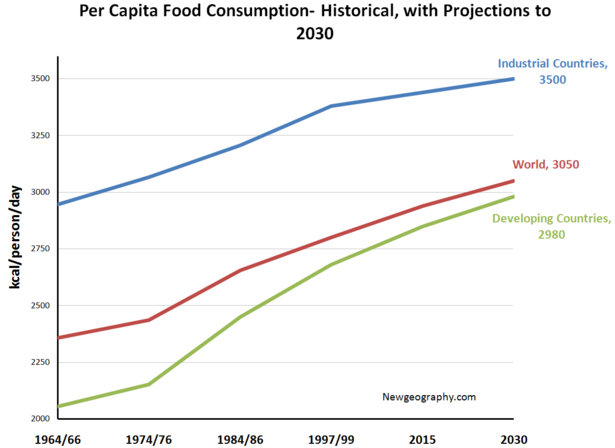
    When applied to the United States, the world’s largest food exporter, the consequences could be devastating. By 2050 the population of the planet will reach around 9 billion people with more than 85 percent of the world’s population located in developing countries. Roughly half will live in developing-country cities. In the United States the population is expected to grow by another 100-milion people by 2050.

    In this context, taking steps to reduce large-scale efficient production does not seem to be either a practical or humane choice. Certainly, better production and stewardship practices should be implemented and consumers can and could do more to drive these practices by making better nutritional decisions and choosing more responsible lifestyles.

    But these concerns should not obscure the fact that American agriculture stands at the core of meeting the challenge of feeding the world’s expanding population. It does this not only by producing a staggeringly diverse array of crops with amazing efficiency, but also by leading the world in the export of the agricultural technology that helps other countries, notably in the developing world, feed their own people.

    Greater Food Security and a Stronger Economy
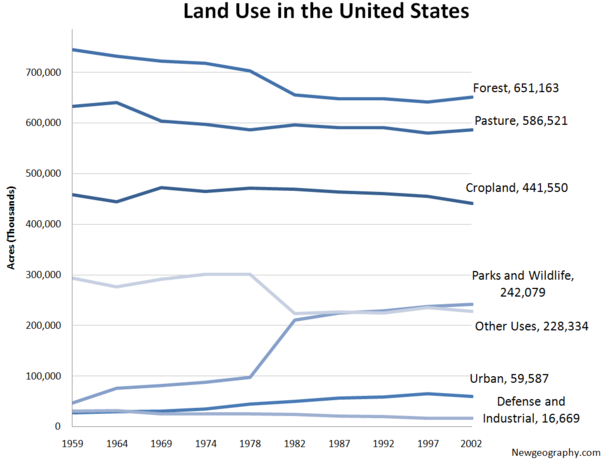
    America’s agricultural producers have never been more productive and efficient than they are today. In 1953, the nation had a total of 5 million farms, working a total of 1.2 billion acres of land – the peak in production at that time. Over fifty years later, the number of farms in America has fallen by two-thirds, and the amount of land in use by producers has dropped by 25 percent, to around 900 million acres. Of the 2.2 million remaining farms, almost 96% are family owned. Even among the largest two percent of farms, 84% are family owned, challenging the commonly held perception of corporate domination.

    The US food industry is now the biggest in the world. In 2006, it was a $1.4 trillion sector, accounting for 12.3 percent of gross domestic product (GDP) and 17 percent of the country’s workforce – the second largest U.S. employer behind government. In some regional economies such as the Midwest and Upper Great Plains the demand by farmers here, and now increasingly abroad, for sophisticated machinery and equipment has spawned entire new industry sectors in electronics, wireless networks, and new material fabrication. The continual demand for new and improved practices in both crop and livestock production and processing has created new opportunities in the life sciences and biotechnology.

    This represents both an economic achievement and a great environmental benefit. Inputs of capital, labor, and materials have remained nearly steady, yet overall output has increased over two and one half fold over the same period of time. At the same time, efficient agriculture has returned to nature – forests, wetlands, prairie – millions of acres, far more than the land that has been devoted to housing and other urban needs.

    Like successful industrialists, American farmers and ranchers have taken advantage of the latest advances in engineering, technology, and science to do more with less, creating “arguably the most productive, efficient, and technologically advanced production agriculture sector in the world”. Indeed as many American manufacturing industries have fallen behind their foreign competitors, agriculture has remained in the forefront, a bastion of American competitiveness.

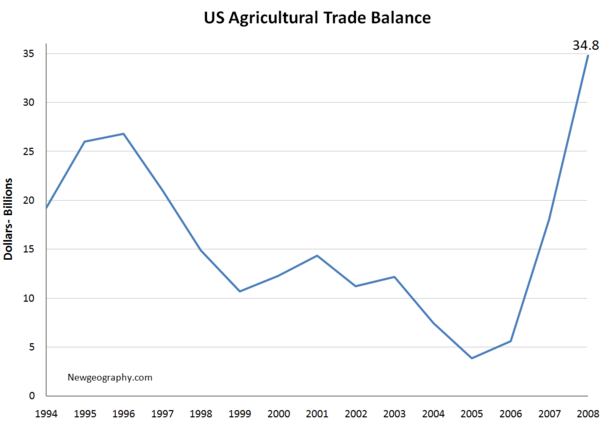
    These increasing levels of productivity have allowed American agriculture to become a powerful player in world agricultural trade. As the nation has seen overall trade deficits mount to record levels in recent years, the agricultural sector has proven a notable exception. American farms, able to “produce far beyond domestic demand for many crops,” have looked to the world market to absorb their output. In 2008, the United States exported over $115 billion worth of agricultural products, a record high.

    For the year, agricultural products made up ten percent of overall American exports, and the nation enjoyed an agricultural trade surplus of 35 billion dollars. While high commodity prices played their part in driving 2008’s export values higher, the agricultural sector has consistently shown export surpluses over the past 15 years, with the nation’s “share of the global market for agricultural goods,” averaging slightly over 20%.

    On the domestic front, production agriculture – and the wider world of agribusiness – provides not only food, fuel, and fiber for Americans, but also a source of employment. Roughly 4.1 million people are directly employed in production agriculture as farmers, ranchers, and laborers; but up to 21 million Americans work in jobs that are tied in some way to agriculture –approximately one out of six participants in the U.S. workforce.

    According to the USDA, the agricultural export industry supported as many as “841,000 full-time civilian jobs,” including “482,000 jobs in the nonfarm sector,” as of 2006. Production of food, fuel, and fiber involves support industries to supply the necessary inputs, and handle the product output, spurring economic activity in associated industries, including the “manufacturing, trade, and transportation sectors.”

    The continual adoption of advanced technologies and methodologies by American farmers and ranchers also creates demand for advanced research and development activity, from both the public and private sectors.These, in turn, spawn educational and entrepreneurial opportunities in a multitude of scientific and engineering fields. USDA research suggests that “each dollar spent on agricultural research returned about $10 worth of benefits to the economy.”

    Scaling Up Sustainable Agriculture

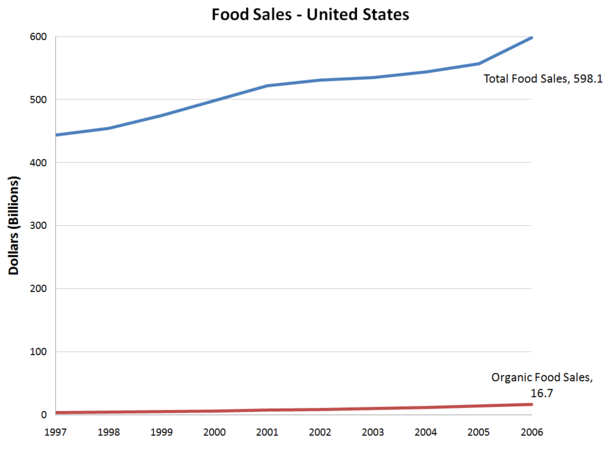
    None of this suggests that there is not room as well for what is known as sustainable, usually smaller scale, agriculture. Organic agriculture, where farmers minimize external inputs and are not permitted to use artificial fertilizers, pesticides or herbicides, is the most widely recognized segment of the sustainable farming industry. U.S. sales of organic food and beverages have grown from $1 billion in 1990 to an estimated $20 billion in 2007, and are projected to reach nearly $23 billion in 2008.

    This is clearly a growing industry, with organic food sales anticipated to increase an average of 18 percent each year from 2007 to 2010, according to an Organic Trade Association Manufacturing Survey. Yet organic foods and beverages account for less than 3 percent of all food sales in the United States – hardly enough supply or demand to feed a nation, much less a growing, hungry planet.

    The same technology that drives commercial, large scale agriculture – and is largely paid for by its profits – could expand the role of this specialized sector. This includes a greater role for what is commonly called precision agriculture. With the aid of technologies such as global positioning (GPS), sensors, satellites or aerial images, and geographic information management tools (GIS), every input can be applied optimally to meet the exact needs of the crop, and can be tracked and tailored with precision. Precision agriculture can be used to reduce energy usage and environmental effects of production agriculture.

    Precision agriculture builds on the strengths of America’s fundamental edge in innovation on the farm and in the factory. In the past, technology has been a major force in driving the shift of agricultural activities of the farm into the agribusiness input industries. Precision agriculture creates new and higher-value opportunities for agribusiness but also enables the farmer to apply the technology right in the field, thereby increasing the competitiveness and viability of farm operations of any size or ownership structure.

    This suggests that there is, in many cases, a false dichotomy between industrial and sustainable agriculture. American agriculture now competes in a truly global marketplace with a cornucopia of opportunities that extend to both systems. Technology and a focus on productivity can help sustainable farming expand, but this should not be at the expense of the larger, commercial sector that not only funds most new research but will continue to play a dominant role in both feeding the world and sustaining that most endangered of species – the American economy.

    Delore Zimmerman is the President of the Praxis Strategy Group an economic research and development strategy consulting company. Matthew Leiphon is a Research Associate with Praxis Strategy Group. Delore grew up in a small farming community in North Dakota, hauling bales and picking rocks for local farmers and ranchers. Matthew is from a North Dakota farm family and spends his fall weekends harvesting small grains and canola.

  • On Cities, GHG Emissions, Apples & Oranges

    Every day or so a new greenhouse gas emission report crosses my desk. Often these reports are very useful, other times they add little of value to the subject. The problem is separating the “wheat” from the “chaff.”

    This dilemma is well illustrated by a paper called “Greenhouse Gas Emissions from Global Cities,” authored by 10 academics. I had received notification of the paper from Science Daily, a useful website that provides notification of new research on a wide range of scientific subjects.

    The Science Daily article indicated that Denver produces the most greenhouse gases per capita annually, while Barcelona produces the least. I am always interested in reports that compare the performance of “cities,” both out of general interest and because of the gross errors that often are the result of invalid comparisons. So, immediately I ran down the report, and to my surprise the report dealt with only 10 “cities.” This seems rather a small number, since the smallest in the sample, Geneva, is not even among the top 700 urban areas in the world. This seems to be a rather incomplete sample: 10 out of more than 700.

    That was just the beginning. There were serious problems of comparison between the 10 “cities.” Whenever someone starts talking about “cities,” it is best to ask what they mean. The word “cities” has so many meanings and is subject to such confusion that I generally avoid using it.

    “Cities” might be municipalities, such as the city of New York or the ville de Paris.

    Cities could be urban areas (urbanized areas or urban agglomerations), which are the urban footprints one observes from an airplane on a clear night.

    “Cities” could be metropolitan areas, which are labor markets and are generally larger than urban areas, because people commute from rural areas (outside the urban footprint) to work in the urban area.

    In nearly the entire world, with the exception of China, urban areas and metropolitan areas are larger than municipalities.

    Or, “cities” could be used in the sense of Chinese prefectural, sub-provincial or provincial level cities, which tend to be far larger than any reasonable definition of a metropolitan area. Nearly all of China is divided into cities, in the same way that most of the United States is divided into counties.

    These Chinese “cities” themselves often contain county level “cities” that are separate from the principal urban areas.

    These differing definitions of municipalities make any international comparison of these entities difficult and often misleading. The ville de Paris represents barely 20 percent of the Paris region. The “city” of Atlanta represents barely 10 percent of its metropolitan area. The “city” of Melbourne represents only 5 percent of its metropolitan area. Yet, other “cities” are larger than their metropolitan areas, such as Chongqing, China, which has at least five times the population of its genuine metropolitan area (the “city” covers an area the size of Austria or Indiana). The city of San Antonio, with its vast stretches of suburbanization is surely not comparable to the city of Hartford, which is dominated by an urban core.

    Any genuine comparison of “cities” must be at the metropolitan area or urban area level. These definitions both represent the city as the organism it is, rather than simply the happenstance of municipal boundaries. Of course, comparisons must be either between metropolitan areas or urban areas to be valid. It will not do to compare metropolitan areas with urban areas; they are as apples and oranges. Moreover, there are no international standards for delineation of metropolitan areas, which makes metropolitan comparisons more complex.

    All of this raises the principal problem with the “Global Cities” paper. There is no consistency to the city definitions the paper uses and its results are thus meaningless (though “headline grabbing”). For example, “Global Cities” uses the geographic areas of the following barely comparable “cities”:

    The municipality of Barcelona, which represents less than one half of the urban area and excludes the expansive suburbs that stretch in every direction but the Mediterranean.

    The municipalities of Bangkok, Denver and New York, which are only parts of their respective metropolitan or urban areas.

    The municipality of Cape Town, which could be considered a metropolitan area because of the large expanse of rural area under its jurisdiction.

    The canton (province) of Geneva might probably qualify as a metropolitan area, except that it excludes the suburbs in France, from which virtually free movement of labor is permitted.

    The Greater London Authority which is nearly co-existent with the London urban area, while Prague as the report defines it is somewhat larger than its urban area.

    The Greater Toronto Area which meets none of the “city” definitions above and is larger than both the metropolitan area and the urban area as defined by Statistics Canada.

    Los Angeles County, which meets none of the “city” definitions and is part of the larger Los Angeles-Orange County metropolitan area.

    All in all, as charitably as it can be put, the “Global City” compares four municipalities, three metropolitan areas, two urban areas, one area larger than a metropolitan area and one that is part of a metropolitan area. Put another way, it tries to make comparisons between four apples, three oranges, two peaches, one banana and one sweet potato.

    Granted, the paper indicates the geographical definitions it uses. That, does not, however, change the fact that treating apples and oranges as comparable is simply invalid.

    There are other problems with the “Global Cities” paper, but one more is enough. In the obligatory fashion, the authors stress how important it is to adopt “smart growth” policies in North America. They cite a US Department of Transportation study to indicate that a doubling of density reduces vehicle miles traveled by 40 percent.

    A bit closer reading would have indicated that the study says doubling density would reduce new vehicle miles by 40 percent, where population densities are already 6,000 to 7,000 per square mile. Only two large urban areas in the United States have densities that high, San Francisco and Los Angeles (which the authors characterize as having urban densities at least 40 percent below the US Bureau of the Census number for the Los Angeles urban area). A 40 percent reduction in “new” vehicle miles means that overall vehicle miles traveled increase 60 percent when the population is doubled, rather than 100 percent. Thus, even with the high density qualification in the US Department of Transportation study, vehicle miles would increase 60 percent as population densities double.

    Maybe tomorrow will bring a better report. One can always hope.

    Photograph: The “city” of Chongqing (part of its vast rural countryside)

    Wendell Cox is a Visiting Professor, Conservatoire National des Arts et Metiers, Paris. He was born in Los Angeles and was appointed to three terms on the Los Angeles County Transportation Commission by Mayor Tom Bradley. He is the author of “War on the Dream: How Anti-Sprawl Policy Threatens the Quality of Life.

  • Germany’s Role in the Green Energy Economy

    Germany likes to brag about its green credentials. It is a source of pride and it is justified to a certain extent. The country, which is located on the same latitude as Canada, had the largest number of installed solar panels as of 2007.

    The key to growth clearly has not been abundant sunshine, but massive subsidies. Germany sponsors its solar industry with generous tax credits that take the form of feed-in tariffs, i.e. payment above the going market rate for energy from renewable sources like solar panels, it can run anywhere from twice to three times the market rate for a conventionally produced kilowatt. These tariffs can run high. They are being lowered slowly but perhaps a bit too slowly. As we have recently seen with the disasters impacting Spain’s renewable energy industry, dependence on subsidies can create a potential catastrophic downturn once the spigot is turned off.

    Would a similar model be appropriate for sponsoring renewable energy in the US? Probably not, in large part the technology is already developed. The Germans and now the Chinese have already subsidized their industries. The legwork has been done and anti-greenhouse legislation will sustain the market without massive subsidization.

    The first factor is that most of the investment in research and development has created the pre-conditions for grid parity within the next few years for southern countries. Even Germany will achieve it by 2012 according to the German business newspaper Handelsblatt. The economies of scale are sinking unit costs dramatically and production technologies like thin film are allowing solar cell manufacturers to produce ever more efficient panels with less and less silicon. Several silicon production plants are set to come on line in China soon.

    The US, whose fiscal situation is parlous compared to China and even Germany, wants to waste years developing already available technologies from scratch. It could try the European approach but would probably be much better off to follow the same path that it followed with the automobile or the motion picture: allow other countries to get the basic technology in place and concentrate its exceptional energy on marketing and scaling up the technologies from abroad.

    China’s entry into the market seems destined to create a dramatic collapse in the price of what was until a few years ago essentially a cost plus industry. China has low labor costs and inflation busting economies of scale. China’s entry into the silicon wafer market already has depressed prices for the once dear raw material. They are also working on a massive power plant with First Solar of the United States.

    Some are predicting that China’s entry into the renewable energy market will have the same effect as its entry into the consumer electronics market, i.e. it will make the expensive affordable and then cheap. German solar cell production companies have suffered much like its chip producers but to the general benefit of the economy. China will drive production costs further down. Germany is still coming to terms with this.

    A recent article in Die Zeit illustrates the growing discrepancy between renewable energy policy and the market potential. The feed-in tariffs have the perverse effect of making solar energy far more expensive than it actually needs to be. The government subsidies are essentially shielding domestic producers from China making the consumers pay the higher rates. Germany needs to focus on its traditional strengths in producing industrial machinery and carve a niche for itself. The US would be better off to maintain trade relations with China and let Adam Smith’s invisible hand work its magic. It would be far cheaper than trying to use protectionist measures to protect domestic manufacturers.

    All this is predicated on the assumption that the price of oil will only increase in price in the coming decades as China and India motorize their masses. This in turn will drive up conventional power costs. Even at its current price of around $70 a barrel, oil is still 7 times more expensive than it was just a decade ago. Some are predicting that that last year’s prices of almost a $150 a barrel represent a taste of what will confront the world when the economy begins to grow again

    This, however, will be a gradual process, based on undulating prices. The hysterical claims of Peak Oil have been delayed again and again by technological improvements. The latest finds off of Brazil and the Gulf of Mexico represent dramatic examples. Massive new gas reserves in North America represent another countervailing force. In the end, fossil fuels will be more expensive, but they will make renewable energy more competitive only at reasonable price points.

    Politics will also play a role. Climate change and the perceived need to combat it has gained enormous currency among world leaders including German Chancellor Angela Merkel. Regardless of what one thinks of the arguments calling for action, we will probably see some sort of carbon tax in the future, whether it be cap and trade or some other means of increasing the costs of carbon emissions. Conventional fuels like coal, oil, and natural gas are only going to get more expensive for political if not economic reasons. The growing consensus, regardless of its veracity, is set to create huge costs for non-renewable sources of energy.

    Over time, this will make renewable energy more attractive and unit costs will shrink as economies of scale start to kick in. The European cheerleaders of climate legislation are not doing it out of the goodness of their heart. They want to see a return on the billions spent on developing renewable technology. The US would be ill-advised to simply try to create technologies that are already up and running. Take the technology, commercialize it and thank the Europeans for footing the bill.

    The US would be well advised to keep their renewable energy markets open. The Europeans will come and are coming. The solar energy trade fairs in Germany focus on the immense potential available in the US market. Several large German producers are expanding aggressively on the American market bringing with them the technologies that they have created. China will also start to flood the market with cheap silicon wafers and further reduce solar panel costs. The US does not need to subsidize this technology lavishly. It simply needs to allow the companies that have it to sell it on their market. The initial support provided by countries like Germany was more than enough to get the technology to the point where it is ready to survive on the free market.

    Kirk Rogers resides in Bubenreuth on the outer edges of Nuremberg and teaches languages and Amercan culture at the University of Erlangen-Nuremberg’s Institut für Fremdsprachen und Auslandskunde. He has been living in Germany for about ten years now due to an inexplicable fascination with German culture.

  • Play It Cool at the G-20, Mr. President

    Barack Obama goes to this week’s Pittsburgh G-20 with what seems the weakest hand of any American president since Gerald Ford. In reality, he has a far stronger set of cards to play — he just needs to recognize it.

    Our adversaries may like our new president, but they don’t fear him. And, on the surface, why should they? The national debt is rising faster than the vig for a compulsive, debt-ridden gambler. And our primary rivals, the Chinese, continue to put the squeeze on American producers by devaluing their currency, subsidizing exports and penalizing imports.

    When the Chinese threaten to call in their debts, they can count on Timmy Geithner to kowtow like an obedient vassal. Some of Obama’s most important supporters — like Warren Buffett and The New York Times‘ Thomas Friedman — have discovered what Friedman calls “the great advantages” of autocracy over our cockamamie, boisterous democracy.

    From Virgil, Maecenas and the court of August to Hitler-admirers Henry Ford and George Bernard Shaw, as well as Stalin-fan Max Eastman, imperial scribes and money lenders have long demonstrated a weakness for even the worst autocrats. But our bedraggled democracy may have a lot more aces to play than many recognize.

    Just look at the other players around the table. French President Nicolas Sarkozy, when not worrying about his (lack of) height, tells his countrymen to stop worrying about gross domestic product. Productivity, one presumes, doesn’t mean as much as a good baguette, long vacation or wet kiss from a former model.

    Across the channel, Prime Minister Gordon Brown seems determined to take the Good Ship Brittania further underwater. According to Tony Travers of the London School of Economics, Britain, with the exception of London, is already well on its way to becoming “a second- or third-tier country.” And as my colleague Ryan Streeter points out, New Labour’s response to the economic crisis — basically raising taxes and doubling down on regulation — doesn’t seem a formula for a vibrant economy.

    Germany, Italy, Spain and the rest of E.U. face equally daunting problems. These “progressive” role models suffer from unsustainably low birthrates, and many face a future more Islamic than European. Their “green” rhetoric may thrill some fans in the U.S., but these economies still run largely on oil and natural gas, which makes them ever more dependent on the autocrat of all — Russia.

    And Japan, once considered the mega-tiger of the future by American policy wonks, is transforming itself into something of a post-modern pussycat. It won’t take immigrants even as its population begins to shrink. Largely dependent on exports, its new government does not like globalization and wants to expand its welfare state. Moreover, Japan seems to be wobbling toward a future as a quiescent vassal for the Greater Chinese East Asian sphere.

    So how does America compare? Let’s start with the basics. The U.S. is the only major advanced country that enjoys a steady population increase. Yes, immigrants are driving much of that growth, but our newcomers are generally very different from the largely alienated and isolated Muslim communities now nesting in Europe. America’s Mexicans, Chinese, Indians, Armenians, Caribbeans and Africans — and more pointedly Arabs and Iranians — do not constitute a hostile “them.” Instead they are the ones redefining us by adding new dimensions to what Nathan Glazer once described as “a permanently unfinished country.”

    Of course, it helps to be the only serious global military presence in the world. A strong military represents an invaluable asset in a world dominated by autocrats and lunatics. That doesn’t mean Obama should swagger like a Viagra-enhanced neo-con. He just needs to follow Teddy Roosevelt’s dictum: Speak softly, but keep a hold on that big stick.

    A powerful military and better demographics represent just part of America’s strong hand. Compared with the E.U., Japan, China or even India, the U.S. remains phenomenally rich in resources.

    Take our most basic need: food. The U.S. has the most arable land in the world and is its largest food exporter. Our $1.4 trillion food sector accounts for 12% of our economy, and prospects for expansion are enormous. By 2050, the population of the planet will be around 9 billion people — up from 6 billion today. More than 85% of the world’s population will reside in developing countries, most in cities, and they will constitute a gigantic future market.

    Equally important, the U.S. is sitting on huge energy resources. Of course, renewable fuels should become a major, even dominant, factor, but in the short- and maybe mid-term, oil, gas and even coal will continue driving the economy. The Great Plains and even the Northeast, particularly Pennsylvania, have enough natural gas to become a junior Abu Dhabi.

    Furthermore, despite its many weak links, our industrial base remains the most advanced in the world. If mindless “green” policies don’t force us to dismantle it, we could produce, through the use of new technology and a better-trained workforce, virtually everything we buy from the Chinese and the Europeans.

    This is not to argue for strict protectionism. But right now we buy almost $4.50 from the China for every $1 we sell there. China’s trade with us is worth 13 times to its economy what our trade with them is worth to us.

    Fundamentally, this means that the Chinese are more exposed to a potential trade war than we are. Without rising exports to the U.S., China’s leaders could face massive unemployment and internal unrest. For us, reducing Chinese imports means somewhat higher prices at Wal-Mart — and perhaps more vigorous business with better partners such as Mexico, whose future prosperity is directly tied to ours.

    All this suggests that Obama has more leverage to demand better trade terms than some might think. There’s nothing in the Constitution that mandates that Americans be the world’s trade chumps. So you want trade war, President Hu? Give him a little Clint Eastwood. Make. My. Day. Then give them a wink or a chance to think about it.

    How about the $1.5 trillion that the Chinese are holding? Well, they could call in their $1.5 trillion for yen or euros, ruining those economies by inflating their currencies. Polish zlotys? Iranian rials?

    Of course, losing Chinese investors and cheap products would hurt in the short term, but it could prove beneficial in the long run. After all, during World War II, we learned to thrive without German machinery or Southeast Asian rubber. Best of all, a Chinese withdrawal could force Washington to live on a budget, just like the rest of us.

    None of this suggests that Obama should discard his charm and morph into a svelte Dick Cheney. America’s preeminence rests on far more than missiles, resources, land or machines. The U.S. is more than a geographic place, or the home of a race, but, as Lincoln noted, the great human experiment about self-government and individual aspirations.

    Whatever his faults — and there are plenty — Obama epitomizes this ideal with his very being. When he arrives in Pittsburgh, our president should play the American hand like the guy who knows he holds aces in the hole.

    This article originally appeared at Forbes.

    Joel Kotkin is executive editor of NewGeography.com and is a distinguished presidential fellow in urban futures at Chapman University. He is author of The City: A Global History. His next book, The Next Hundred Million: America in 2050, will be published by Penguin Press early next year.

    Photo: White House Photo/Pete Souza

  • Vertical Urban Farming? Pull Your Head from the Clouds

    Dickson D. Desposmmier, in a recent op-ed in the New York Times, argues that the world, faced with increasing billions of mouths to feed, will soon run out of land. According to Mr. Despommier, “the traditional soil-based farming model developed over the last 12,000 years will no longer be a sustainable option.”

    Despommier’s answer to this ‘problem’: “move most farming into cities, and grow crops in tall, specially constructed buildings.” Such vertical farms, argues Despommier, would “revolutionize and improve urban life,” while also addressing issues such as agricultural runoff, air pollution, and carbon emissions.

    To sophisticated urbanites with little or no exposure to agriculture, vertical farming may seem to present a sort of utopian panacea. But first one must look at the underlying problem Mr. Despommier claims to address: land shortages.

    In this case, Despommier fails to show that land shortages will be a debilitating issue, rather than a manageable challenge. Desposmmier presents figures from the UN showing that the amount of arable land per person has dropped from one acre per person in 1970 to about half an acre in 2000, and may drop toward a third of an acre per person by 2050. This simply means that future generations will have less land available per person. But, does this necessarily translate into impending, persistent, worldwide food shortages?

    Even prior to the time of Thomas Malthus, there have been voices warning of disaster lying just around the bend with regards to food production and consumption. Yet, over the past two centuries, those tilling the soil (full disclosure: the author comes from a long line of family farmers, and has, from time to time, taken part in some ‘soil tilling’ of his own) have continued to keep pace with ever-increasing demands for food. True, the equitable distribution of this increased productivity sometimes leaves something to be desired (often for reasons of politics, not of production), but one cannot dispute the fact that farmers worldwide have made massive leaps and bounds in productivity.

    In the face of less acreage per human, the UN’s Food and Agriculture Organization continues to track increasing output per capita, and projections for the future show production levels able to meet increasing demand. One notable Dutch study showed the world’s farmers, using existing land resources, capable of feeding up to 10 billion people at least a “moderate diet,” if not an affluent one. Such projections have been supported by a “sizable literature,” some of which argues that future production of food will not be an overwhelming challenge, even at populations up to 12 billion. Between 1960 and 2000, the world’s farmers were able to increase food produced per capita, while the world’s population nearly doubled. We have now reached a point where Americans throw away around 14% of the food they buy.

    Making better use of the food we already produce, including gleaning of wasted food, and shifting land away from production of non-food crops, would be common-sense steps towards combating current and future food insecurity. Making better, more efficient use of our existing arable land makes more sense, both now, and in the future.

    High-rise urban farming, however, is not the solution. Even if we assume that the world will, as Despommier fears, face potential shortages of arable land in the future, the solution he proposes is far from the most feasible initial solution. In his piece, Mr. Despommier states that a prototype farm, covering one eighth of a city block and consisting of 5 stories, would cost around 20 to 30 million dollars to construct. A vertical farm of such size might mean around five acres of indoor production space (city blocks vary in size from place to place). Despommier states that one indoor acre might be able to replace 20 acres of outdoor farmland. So, giving the benefit of the doubt on cost to Despommier, for 20 million dollars his vertical farm might be able to match 100 acres of outdoor production: a cost per acre of around 200,000 dollars.

    For that same 20 million dollars, Despommier could purchase nearly 7,500 acres of productive, existing farmland in a state such as Minnesota or North Dakota, (the national average cost for an acre of farmland is about $2,600) and farm it with the latest in sustainable, organic, and/or low or no-till methods, already being implemented by many American farmers. Such practices can minimize or eliminate chemical use, reduce fossil fuel use, and help prevent erosion of valuable soil. In order to match his indoor production, financed at massive cost, Despommier would only need to find a way to increase the outdoor output by very small percentages, using land that is far less costly and readily available. As an added benefit, he’d have the opportunity to protect and preserve the very land he sees as under threat.

    Potentially more valuable still would be aiding farmers worldwide in the use of the most modern, sustainable, and environmentally-friendly practices in areas facing severe underutilization and degradation of valuable arable land resources. Since 1961 farmers in Asia have been able to increase their output by nearly threefold, while yields per acre in Africa have remained stagnant. Investing more resources in agricultural extension services to educate and empower local farmers in soil conservation, land stewardship and sustainable production techniques would be a common sense step towards addressing such challenges that would not require the construction of expensive towers, and would allow farmers to protect and preserve the world’s existing arable land while battling local food insecurity. In fact, according to one prominent soil scientist, protecting and restoring soil, the “most basic of resources,” offers “the chance not only to fight hunger but also to attack problems like water scarcity and even global warming.”

    Unfortunately, investing resources in such plans, using existing, tenable resources, might preclude Mr. Despommier from building a shiny new building in New York City, where “everyone” could see it. The more cynical observer might also point out that it could cut off a potential revenue stream for his new vertical farm business, which he envisions being financed by “venture-capital funds.”

    While vertical farms might be an interesting topic for light-hearted discussion, there is a reason we don’t farm intensively in urban areas: the land is too expensive, with costs that rise even higher building towering structures. That said, encouraging use of local agricultural products, even adjacent to or within urban areas, is a laudable goal. This supports the sort of family farmers that serve as good stewards of the land Despommier sees as under threat. Mr. Despommier need look no farther than his employer’s own Columbia University Greenmarket to find a farmer’s market supplying the very sort of agricultural product he extols and desires. Encouraging urban gardening is also a great idea, allowing people to take an active role in providing some of their own food, while making use of potentially underutilized spaces, at much less cost than “building up.”

    There are, to be sure, challenges to be faced moving forward: recent commodity price spikes (which have since abated) inflicted increased food insecurity on the world’s poor. However, such populations are the least likely to be able to afford the gleaming towers of Despommier’s dreams. Despommier and those interested in sustainable agriculture, including many farmers, will be better off trying to protect our existing farmland from urban sprawl, and supporting the use of the latest in sustainable agricultural practices worldwide, to better use and protect the farmland we already possess.

    On the other hand, promoting wildly expensive, Buckminster Fulleresque “leaps of faith”, while neglecting existing resources, is not the path towards long-term agricultural sustainability. Instead of pouring limited financial resources into building fields in the sky to serve as playthings for the urban elite and venture capitalists, farmers, governments and investors worldwide would be better served by plowing resources into making better, more sustainable use of the land that already exists, for the benefit of all.

    Matthew is a Research and Development Analyst for Praxis Strategy Group, and a native of Crary, ND.

  • The Costs of Climate Change Strategies, Who Will Tell People?

    Not for the first time, reality and politics may be on a collision course. This time it’s in respect to the costs of strategies intended to reduce greenhouse gas emissions. The Waxman-Markey “cap and trade” bill still awaits consideration by the US Senate, interest groups – mainly rapid transit, green groups and urban land owners – epitomized by the “Moving Cooler” coalition but they are already “low-balling” the costs of implementation.

    But this approach belies a bigger consideration: Americans seem to have limits to how much they will pay for radical greenhouse emissions reduction schemes. According to a recent poll by Rasmussen, slightly more than one-third of respondents (who provided an answer) are willing to spend $100 or more per year to reduce greenhouse gas emissions. About 2 percent would spend more than $1,000. Those may sound like big numbers, but they are a pittance compared to what is likely to be required to meet the more than 80 percent reduction in greenhouse gas emissions that the Waxman-Markey bill would require. Even more worryingly for politicians relying on voters to return them to office, nearly two-thirds of the respondents would pay nothing to reduce greenhouse gas emissions.

    If we do a rough, weighted average of the Rasmussen numbers, it appears that Americans are willing to spend about $100 per household per year (Note 1). This includes everyone, from the great majority, who would spend zero to the small percentage who would spend more than $1,000. At $100 per household, it appears that Americans are willing to spend on the order of $12 billion annually. This may look like a big number. But it is peanuts compared to market prices for greenhouse gas emissions. This is illustrated by the fact that the social engineers whose articles of faith requires building high speed rail to reduce greenhouse gas emissions would spend $12 billion to construct just 150 miles of California’s proposed 800 mile system.

    Comparing Consumer Tolerance to Expected Costs: At $100 per household, Americans are prepared to pay just $2 per greenhouse gas ton removed. All of this is in a policy context in which the United Nations Intergovernmental Panel on Climate Change suggests that $20-$50 per greenhouse gas ton is the maximum that should be spent per ton. The often quoted McKinsey/Conference Board study says that huge reductions in greenhouse gas emissions can be achieved at $50 or less, with an average cost per ton of $17. International markets now value a ton of greenhouse gas emissions at around $20. At $2 per ton, American households are simply not on the same “planet” with the radical climate change lobby as to how much they wish to spend on reducing greenhouse gases.

    International Comrades in Arms? This is not simply about Americans and their perceived differences from others who are so often considered more environmentally sensitive. France’s President Sarkozy has encountered serious opposition in proposing a carbon tax on consumers to discourage fossil fuel use. He is running into problems not only among members of the opposition, but concerns have also been expressed by members of his own party. It appears that many French consumers (like their American comrades) are more concerned about the economy than climate change at the moment.

    China, India and Beyond: If only a bit more than one-third of American households are willing to pay much of anything to reduce greenhouse gas emissions, it seems fair to ask what percentage of households in China, India and other developing nations are prepared to pay anything? A possible answer was provided recently by India’s environment minister, Jairam Ramesh, who released a report predicting that India’s greenhouse gas emissions would rise from the present 1.2 billion tons to between 4 and 7 billion tons in 2030. The minister said the “world should not worry about the threat posed by India’s carbon emissions, since its per-capita emissions would never exceed that of developed countries.” . At the higher end of the predicted range, India would add more greenhouse gas emissions than the United States would cut under even the proposed 80 percent reduction scheme. Suffice it to say that heroic actions to reduce greenhouse gas emissions seem unlikely in developing countries so long as their citizens live below the comfort levels of Americans and Europeans.

    Lower Standard of Living not an Option: I have been giving presentations on this and similar subjects for some years. I have yet to discern any seething undercurrent of desire on the part of Americans (or the vast majority anywhere else) to return to the living standards of 1980, much less 1950 or 1750. Neither Washington’s politicians nor those in Paris or any other high income world capital are going to tell the people that they must accept a lower standard of living. Nor is there any movement in Washington to let the people know that their tolerance for higher prices could well be insufficient to the task.

    For Washington, the dilemma is that every penny of the higher costs will hit consumers (read voters), whether directly or indirectly. There could be trouble when the higher utility bills begin to arrive and it could mean difficulty in delivering on the primary policy objective of virtually all governments, which is to remain in power. This is not to mention the unintended consequences of higher prices on many key industries, notably agriculture, manufacturing, and transportation.

    There is an even larger concern, however, and that is the stability of society. Harvard economist Benjamin Friedman, in The Moral Consequences of Economic Growth suggested from an economic review of history that economies that fail to grow lapse into instability.

    A Public Policy Collision Course? A potential collision between economic reality and public policy initiatives could be in the offing. Many “green” proposals are insufficiently sensitive – even disdainful – towards the concerns of everyday citizens. This suggests that politically there should be an emphasis only on the most cost effective strategies. In a democracy, you must confront to the reality that people are for the most part more concerned about the economy than about strategies meant to slow climate change.

    The imperative then is not to ignore the problem, but to focus on the most rational, low-cost and effective greenhouse gas emission reduction strategies. Regrettably, it does not appear that Washington is there yet. The special interests whose agendas are to cultivate and reap a bounteous harvest of “green” profits or to convert the “heathen” to behaviors – such as riding transit and living in densely packed neighborhoods – that they have been advocating long before the climate change issue emerged.

    Those concerned about the future of the environment also have to pay attention to reality. Reducing greenhouse gases is not a one-dimensional issue. Environmental sustainability cannot be achieved without both political and economic sustainability.


    Note 1: The Rasmussen question was asked of individuals. It is assumed here, however, that the answers related to households. One doubts, for example, that a queried mother answered with an assumption that she would pay $100, her husband would pay $100 and each of the kids would pay $100, but rather meant $100 for the household, since, to put it facetiously, few households devolve their budgeting to the individual members.


    Wendell Cox is a Visiting Professor, Conservatoire National des Arts et Metiers, Paris. He was born in Los Angeles and was appointed to three terms on the Los Angeles County Transportation Commission by Mayor Tom Bradley. He is the author of “War on the Dream: How Anti-Sprawl Policy Threatens the Quality of Life.