Tag: Energy

  • Alaska To Stimulus Funds: Yup, We’ll Take ‘Em

    Earlier this month the Alaska state legislature, in a special session, voted 44-14 to accept $28.6 million in stimulus funds that Sarah Palin had rejected in May. Sean Parnell, Alaska’s governor since Palin’s resignation, says the money will be used primarily for energy efficiency improvements in public buildings.

    The tale of the showdown between Palin, the state legislature, and the federal Department of Energy may ultimately reveal as much about state sovereignty under the current administration in Washington as it does about Alaska’s internal politics.

    Palin has more than once made her case for rejecting the stimulus money — or at least a portion of it — clear: her objection is that the American Recovery and Reinvestment Act calls for the adoption of the International Energy Conservation Code in exchange for the funds, which would set new standards for things like window fenestration and lighting equipment in new and remodeled commercial and residential buildings. Such codes, however, could be a logistical nightmare for some communities to adopt and for the state to enforce.

    Alaskan buildings are architecturally diverse, each constructed for a particular climate and geography. Homeowners in Ketchikan, for example, where it rains nearly every day of the year, have different concerns than those in Valdez, where the average yearly snowfall is 325 inches. Many communities in the state are only accessible by boat or plane, so the shipping of supplies is costly and inefficient. Economic hardship and subsistence are also the normal standard of living in many of the remote, rugged Alaskan towns and villages.

    Because of these circumstances, the state has always permitted local governments to set their own building codes. Most of the villages choose not to have building codes at all. All things considered, monitoring energy code compliance in perpetuity would easily cost the state more than $28.6 million. Palin also has noted that the state has hundreds of millions of dollars already budgeted for energy efficiency and renewable energy projects, so the less than $30 million in stimulus funds really aren’t a substantial addition to the state’s effort.

    Her rejection of the funds sparked a debate that was carried out in press releases, official letters, and Anchorage Daily News editorials. A legislator from Anchorage claimed in an op-ed piece that Palin was “denying” Alaskans much needed funds, and that rejecting money from the stimulus package brings to mind the old saying, “two wrongs don’t make a right.” The co-chairs of the state senate resources committee wrote a letter urging Palin to consider Missouri’s proposal (accepted by the Department of Energy) which would fulfill the mandate with a 90% compliance rate on the local level, exempting communities with populations under 2,500 and structures without plumbing and electricity. There are enough major Alaska communities that have already adopted energy codes, they said, that the state either already meets or could easily meet the federal requirements in the necessary time frame.

    Palin responded to these opponents with her own editorial and press releases, and an Anchorage architect agreed with her in another op-ed, suggesting that while Alaska has long built energy efficient buildings out of cold weather necessity, the two senators’ numbers for 90 percent compliance didn’t add up. The primary result of taking the money, he claimed, would be “a new regulatory requirement to verify compliance.”

    The disagreement hinged on everyone’s interpretation of the DOE’s language. The initial mandate required “assurances” from the governor that local communities with the authority to do so “will implement” the codes. Because there is no statewide energy code in Alaska and the state constitution supports local self-government, Palin took the stance that this requirement would put her outside of her jurisdiction as governor. She and her staff exchanged letters with the DOE in attempt to clarify the possibility of the Missouri option, and the degree to which the state would be required to oversee code implementation and compliance.

    The DOE admitted that the code mandate wasn’t appropriate for all states, but said the Missouri option was part of the Missouri governor’s “broader commitment” to “work proactively” with communities and the legislature to improve energy efficiency, implying, perhaps, that despite Alaska’s success in these areas, the governor’s personal involvement was non-negotiable. Revisions were offered, but Palin was still dissatisfied with the DOE’s language. Proponents of taking the money suggested that the DOE’s revisions required the governor to work “within the extent of her authority” to promote the building codes, not to actively enforce them. Palin didn’t agree with this interpretation, saying she didn’t want the role of dictating or influencing local policies.

    As a state with a cold climate and an economy vulnerable to volatile fuel prices, Alaska has indeed taken its own steps to improve energy efficiency in recent years. In addition to independently adopted energy codes in most of the major cities and hundreds of millions budgeted for state energy projects, there has been an admirable home energy rebate program in place for several years; homeowners can have their houses audited for energy efficiency and be reimbursed up to $10,000 for making recommended improvements.

    It’s hard to imagine, though, that the legislature’s motives in opposing Palin’s decision were entirely pure. Palin and the legislature had a combative relationship over budget issues for most of her tenure as governor, and this was an opportunity for them to demonstrate their clout. It’s telling, too, that the legislature rejected Parnell’s proposal to extend their special session (which was held primarily to overturn Palin’s veto) by one day in order to extend a year-long suspension of the state’s 8-cent gas tax, which will now be reinstated September 1. The legislature may choose to suspend the gas tax again when the regular session begins in January, but their lack of urgency to act on the issue undermines their claim that the stimulus funds are urgently necessary to help keep Alaskans’ energy costs down.

    Of course, Palin’s own stance has been calculated as well. She initially wanted to decline roughly half of Alaska’s $930 million allotment, and her vocal anti-stimulus statements garnered national attention, which helped establish her as a critic of the Obama administration in her own right, independent of her role in McCain’s presidential campaign. By the time the smoke cleared, however, she was rejecting only this $28.6 million. Critics have said that it looks like a token amount, chosen to make a strategic political statement.

    In her op-ed piece, she noted that during her time as a Wasilla city council member and then mayor, the city experienced a boom in growth that made building codes an issue of great contention. Wasilla is notably missing on the list of major communities that have independently adopted energy codes, which would suggest that it would be one of the key cities that would have problems with a statewide energy code.

    After the legislature’s vote, Sean Parnell wrote to the DOE accepting the funds, noting his own disapproval of the mandates. He quoted an August DOE statement that the state legislature “does not need to adopt, impose and enforce a statewide building code in order to qualify,” making clear that he was accepting the funds on the basis of that statement. He also provided the DOE with “assurances”, not that state or local codes would be adopted, but that the Regulatory Commission of Alaska “will seek to implement general policies to promote energy efficiency and maintain just and reasonable rates while protecting the public.”

    Ultimately, if Alaska holds its ground and does not adopt the IECC, Palin and the legislature may have unwittingly conspired to successfully challenge the federal government’s encroaching influence on the state’s affairs. Perhaps not coincidentally, the legislature unanimously passed a 10th amendment state sovereignty resolution while they were hashing out the stimulus funds controversy, and Palin signed it weeks before resigning as governor. It will be interesting to see how the DOE handles Alaska’s obstinance…and how the Alaska legislature responds if the DOE calls their bluff down the road and asks how the codes are coming along.

    Andrea Gregovich is a writer and translator living in Anchorage.

  • Do Home Energy Credits Need A Remodel?

    With the home building industry in peril, you would think that legislators would come up with immediate solutions to help foster new home construction. And there are now two well known Federal programs regarding housing: one is the $8,000 tax credit for first time home buyers, and the other is the 30% energy tax credit for a select few components of home remodeling.

    The $8,000 credit for first time home buyers is a good idea, and seems to have helped at least a few buyers purchase homes. Of course, it’ s not clear how many purchased bargains on previously owned homes and how many actually purchased new homes.

    The 30% energy tax credits are a different matter. I’m against the current incarnation of the program for a host of reasons:

    Problem No. 1: The 30% tax credit applies to only a few select items that somehow qualified, and there’s no (simple) way to get on the approved list. In addition, Energy Star certification assures that the “product” has gone through some scrutiny on performance and reliability. But what of the equally important installers?

    Problem No. 2: New construction gets very limited tax credits. When retrofitting existing houses, tax credits apply to the installation of efficient windows and insulation. But new construction (along with remodels) is not eligible unless it includes Geothermal, Solar Hot Water, or Solar Electricity. These benefits are meaningful only to those with enough income to make a credit of this size enticing. The middle and upper class homeowners who are willing to finance these upgrades hope that the after-tax benefits will make the investment worthwhile.

    In theory, of course, the ticky-tacky downtrodden neighborhoods built after World War II can also be upgraded…to become energy efficient ticky-tacky downtrodden neighborhoods. But the energy credit will not benefit those that need it the most: those in the lower income strata that find it difficult to survive from pay check to pay check. A 30% tax credit does them no good at all. Even if the tax credit made sense for downtrodden neighborhoods, none of the older homes would ever become nearly as energy efficient as new construction.

    As an example, let’s say 50 homes in a low income neighborhood did take advantage of the tax credits and upgraded their windows and insulation, and added geothermal design because that was the only option approved for the benefits. This would easily add up to well over $50,000 per home – at least $2,500,000 – of which almost a million dollars is funded by you, the tax payer.

    As an alternative, the 50 houses could be leveled, and excess streets abandoned to create a large developable contiguous tract of land. New home builders on the verge of bankruptcy, and even corporate national builders, could easily reinvent their business to build new urban neighborhoods using more efficient development patterns. To upgrade a new affordable home with more energy efficient windows would cost $2,000, an inch of foam insulation added to exterior walls would be another $2,000, and a high efficiency heating and cooling design just another $2,000. This highly efficient new home would use a fraction of the energy of an upgraded old home, and would add only $300,000 for all 50 homes. New neighborhoods could also have a fraction of the environmental impact of older ones, if planned using newer techniques. Low income families can live in new green neighborhoods, and the home building industry can find a new market while curbing sprawl at the same time…

    Any politicians reading this? (see study).

    Problem No. 3: The current tax credits promote overkill. Almost all the recent Green Certified Homes sold in the Minneapolis area had geothermal design as part of their package. Certainly a home builder increases profits by including a complex geothermal system instead of a simple, highly efficient and low cost conventional heating and cooling system. Building a new, well insulated home results in a significant reduction of heating and cooling energy needs, and the upgrade to a highly efficient system on a new home costs as little as $3,000 extra. But if the home design is not geothermal it will not get tax credits. A passive solar designed home gets free heat on sunny days — also not eligible for tax credits — but a $50,000 geothermal system is.

    Problem No. 4: The current tax credits are creating a false economy for the very few businesses that manufacture approved items. Without the tax credits, these suppliers and manufacturers would need to come in at a reasonable price point/payback ratio to generate the volume of sales necessary to be profitable. In other words, they would have to invent, innovate, and deliver systems that make sense or fail in the marketplace. As soon as the tax credit ends many will not survive. An article on energy tax programs of the 1980s and the “tin men” that sold under-performing systems shows how 95% of the manufacturers of that era went out of business when the Carter era tax benefits ended. What happens to the warranty and guarantees when the company is no longer around?

    So what’s the solution to the problems? Either fix the tax credit program, or do away with it.

    Make the program flexible enough so that new innovations can be accommodated, and make the system itself easy to access. This would encourage companies to be competitive, and give hope to start-ups that cannot right now get financing. The current application system favors well-funded, big corporations, and is far too restrictive in its scope. Have the tax credit apply to window and insulation upgrades above the “standard for code”, and include all heating and cooling systems that are above the 90% efficiency typically included in new construction. Even a tax credit limited to the price difference created by the upgrade would jump start both the green industry and new home construction.

    And while we’re jumpstarting…let’s not forget a little history. During the dot-com crash earlier this decade, unscrupulous promoters bilked investors out of billions of dollars on false promises. These promoters did not disappear, they simply moved to the next opportunity: mortgage and real estate. Quick profits from flipping real estate created an economy that was un-policed and unsustainable. Let’s not permit energy upgrades supported with a 30% tax credit to become the next unsustainable wave.

    Rick Harrison is President of Rick Harrison Site Design Studio and author of Prefurbia: Reinventing The Suburbs From Disdainable To Sustainable. His website is rhsdplanning.com.

  • Vetting the Volt: Toward Meaningful Electric Car Fuel Consumption Ratings

    The 230 Miles per Gallon Claim: The General Motors (GM) announcement last week that the Chevrolet Volt would achieve 230 miles per gallon in city driving and a rating of more than 100 miles per gallon with combined city and highway driving sadly contains more hype than reality. The Chevrolet Volt is a plug-in hybrid vehicle that GM intends to begin marketing in 2010. GM has indicated that the car will be able without gasoline for 40 miles, on its rechargeable battery. After the battery is depleted, the car would begin to use gasoline. The 230 mile per gallon figure, according to GM, was calculated using a proposed but yet not revealed Environmental Protection Agency fuel economy testing procedure. Similarly, the details of the GM calculation were not revealed.

    Criticisms: Rather than the expected praise, the GM claim was met by a barrage of questions and criticism. Consumer Reports said that the 230 miles per gallon claim might be the exaggeration of the century. Automaker Nissan, facetiously responded with a claim that its forthcoming all electric (not hybrid) “Leaf,” would achieve 367 miles per gallon in a Twitter post. Nissan, unlike GM can be excused for not providing the details of its calculation, since it was “making fun.” EPA distanced itself from the GM announcement, indicating that it had not yet tested the Volt.

    The criticisms and questions revolved around a single issue: How had General Motors calculated the 230 miles per gallon figure. Regrettably, General Motors has yet to provide a complete answer.

    From the sketchy details released, it appears that the 230 mile per gallon rating was based upon the assumption that a driver would travel less than 40 miles each day and recharge the battery at night. Using this methodology, there would never be a reason for the car to use gasoline, so long as the daily mileage is less than the battery capacity.

    A New EPA Rating System: Reportedly, the EPA’s fuel economy testing procedure for plug-in electric vehicles (whether hybrid or not) will report kilowatt hours (KWH) of electricity consumed per 100 miles. Presumably, this rating will be placed on the fuel economy window sticker on new cars, perhaps alongside some miles per gallon conversion. GM indicates that the Volt will consume 25 kilowatt hours per 100 miles in city driving.

    Policy Imperative for Improving Fuel Efficiency: The impetus for improving automobile fuel economy is being driven by public policy objectives to reduce greenhouse gas emissions, especially carbon dioxide (Note 1), and away from the consumption of petroleum .

    Even though the Volt will produce no greenhouse gas emissions from its tailpipe when operating in the electric mode, the electricity that drives its battery would come from power plants, many of them relying on fuels like coal, which produce high amounts of greenhouse gas emissions. In fact, coal accounts for roughly 30 percent of all electricity production in the country; other fossil fuels another 35 percent.

    A Flawed EPA Fuel Economy Rating System? Neither the GM calculation nor apparently the proposed EPA rating system include greenhouse gas emissions from electricity generation. A greenhouse gas gram emitted from an electric power plant smokestack has the same impact as one from an auto tailpipe. Any EPA fuel efficiency rating system that does not take into consideration power generation emissions would be shockingly incomplete and misleading. Consumers would not be given reliable information on the greenhouse gas emissions from cars they might purchase. One would expect that a government committed to greenhouse gas emission reduction would task its implementing agency with ensuring the availability of relevant and reliable information.

    Power Generation and Plug-In Cars: On average in the United States, the generation of each KWH produces 610 grams of carbon dioxide (1.35 pounds). By comparison, combustion of a gallon of gasoline emits nearly 8,900 grams of carbon dioxide. Thus, nearly one gallon of gasoline is the equivalent of approximately 15 KWH of electric power in its greenhouse gas emissions (Note 2).

    Thus, if the Volt uses 25 KWH to travel 100 miles in an urban area, then the greenhouse gas emissions from generating its power will be somewhat over 15,000 grams (Note 2), or the same as 1.7 gallons of gasoline (Note 3). Under these average operating conditions, the Volt would achieve approximately 60 miles per gallon (Note 4).

    Exaggeration Doesn’t Help: Now there is nothing to be ashamed about 60 miles per gallon, unless, that is, you have claimed 230 miles per gallon. Regrettably, General Motors, which could have claimed a great environmental advance, has diminished it by failing to “level” with the public. This kind of public relations will not help a company whose performance has cost it market share for well over a generation. .

    The Volt (and the Leaf) Will Get Better: Of course the equivalent miles per gallon would be much higher if US power generation were more efficient. And, it will be. For example, it has been proposed that electric power generation needs to become at least 80 percent less greenhouse gas intensive by 2050. If this is accomplished, the Chevrolet Volt could indeed achieve 230 equivalent miles per gallon and perhaps the Leaf 367. But neither car will reach these plateaus in the short term.

    A Better Fuel Economy Rating System: Since the EPA fuel economy rating system has not been finalized, its potential defects can be corrected. Any EPA fuel economy rating system should include a greenhouse gas emissions indicator. This should be provided for city driving, for highway driving and a combined overall figure. Moreover, such a rating must include the very real emissions that occur at the power plant. It would be appropriate for EPA to continue reporting miles per gallon and adding KWH per 100 miles, so that the cost impacts are clear to purchasers.

    Regional Variations: There is another complicating factor – regions. For example, in North Dakota fuel economy would be approximately 35 miles per gallon equivalent with full electric operation, well below the average 60 equivalent miles per gallon. On the other hand, in the state of Washington, the Volt would achieve its 230 miles per gallon equivalent, nearly 7 times the North Dakota fuel efficiency. This is not because people in Washington are more environmentally sensitive than North Dakotans. The difference is in type of power generation. Nearly 80 percent of Washington’s power is generated by hydro-electric and nuclear plants, which produce virtually no carbon dioxide emissions. On the other hand, nearly 80 percent of North Dakota’s electric power is produced with fossil fuels. These differences will be moderated as electric power production becomes less greenhouse gas intensive.

    The Bottom Line: Despite the exaggeration and misleading information, this story is far more positive than negative. Congratulations to General Motors (and Nissan) on the strong advances they have apparently made in vehicle technology. This is just further evidence of the potential of human ingenuity. From the 150 mile per gallon cars to which President Obama is committed to the zero emission petroleum car system demonstrated by a Georgia Tech team, the good news is that people can continue to live as they like, while admirably reducing their greenhouse gas emissions to meet whatever objectives are ultimately adopted.


    Notes
    1: Carbon dioxide accounts for the overwhelming share of greenhouse gas emissions from motor vehicles.
    2: Calculation: 8,900 (divided by) 610
    3: Calculation: 25 KWH (times) 610
    4: Calculation: 15,000 grams (divided by) 8,900 grams
    5: Calculation: 100 (divided by) 1.7
    6: A grams per mile rating system should include “upstream” activities, such as the greenhouse gas emissions required to produce and distribute petroleum, which by various estimates increases the emissions by 20 to 25 percent. Similarly, upstream electric power production emissions should be included.


    Wendell Cox is a Visiting Professor, Conservatoire National des Arts et Metiers, Paris. He was born in Los Angeles and was appointed to three terms on the Los Angeles County Transportation Commission by Mayor Tom Bradley. He is the author of “War on the Dream: How Anti-Sprawl Policy Threatens the Quality of Life.

  • One Step for Short-term Economic Stimulus, and One Giant Leap (backward) for U.S. Energy Sustainability

    The “cash for clunkers” (or CARS) program that was widely predicted to be extended by the Congress has been, if nothing else, a clear public relations win for the Obama Administration. It may also be, at least for the short-term, a shot in the arm for the beleaguered American auto industry (including domestic dealerships of foreign car companies, like Honda and Toyota). But the program’s extension may also be bad news for anyone who was hoping that candidate Obama’s campaign promises to fix our domestic energy policy would translate into something resembling a robust make-over.

    Don’t get me wrong; I am a huge fan of President Obama. And I am generally very supportive about what the Administration is trying to do. The President’s agenda is nothing if not ambitious, or may be better described as audacious. In no particular order, President Obama is seeking to fix the environment, reform the healthcare system, overhaul banking and financial services regulations, reverse a downwardly spiraling national and global economy, repair race relations in America, and get drivers to cease texting and talking on their cell phones while driving.

    And yet, one of President Obama’s greatest strengths may also be his greatest weakness: The willingness and ability to compromise, as it is the fundamental nature of compromise that the outcome will inevitably be less than ideal. This consequence of compromise can be seen clearly in the President’s efforts to secure Congressional approval of an additional $2 billion in funding for the CARS program.

    The initial concept behind CARS was elegant in its simplicity: give owners of “gas-guzzlers” (i.e. automobiles with highly inefficient internal combustion engines) a monetary incentive to trade their fuel inefficient vehicles for highly fuel-efficient replacements. The auto industry – albeit more centered in Tokyo than Detroit on this point – clearly is producing numerous passenger vehicles capable of achieving a combined city/highway rating of 30 miles-per-gallon (mpg) or more. Yet there remain a number of registered motor vehicles in the U.S. with substantially less than 18 mpg ratings under the program (any vehicle with a mpg rating above that is not worthy of the “clunker” moniker).

    If this was the Administration’s original goal for the CARS program, the $1 billion authorization could have had a considerable impact on fuel consumption. Assuming the maximum rebate of $4,500 on every trade-in, almost a quarter of a million (222,222 to be exact) fuel-inefficient vehicles would have been voluntarily taken off America’s roads. Great idea! Triple that program funding amount to $3 billion, coupled with the same lofty goal, and two-thirds of a million fuel inefficient cars would have been swapped out for highly fuel efficient cars. If the average driver puts 12,000 miles per year on a car, and the average improvement in fuel efficiency is 12 mpg (i.e. from 18 mpg to 30 mpg) the program would save 1,000 gallons of gas per car, per year, or 666,666,000 gallons of gas annually.

    If only this purpose – to incentivize drivers to purchase only the most fuel efficient vehicles – had remained the thrust of the CARS program. However, it seems that the elegant simplicity behind the CARS concept became intertwined in the “since the government now owns GM and Chrysler don’t you think we should do something to spur domestic car sales” debate. All of a sudden, light trucks (the product type on which the Big Three hung their hats and, subsequently, on which they were hung by their collective petard) became eligible provided they are more fuel-efficient than the millions of light trucks already registered and on domestic highways. So, instead of a rising fleet of truly efficient cars we now see sales of new SUVs of all sizes and dimensions, and not just the recently introduced hybrid versions, being allowed a “cash-for-clunkers” rebate. All that is necessary is for the trade-in vehicle to qualify under CARS and the newly purchased SUV achieve a paltry 18 combined mpg.

    In other words, the concept behind the initial legislation appears to have quickly devolved from “let’s incentivize the best consumer behavior possible when it comes to fuel efficiency” to “let’s get people to buy passenger cars, SUVs, and light trucks.” The Hummer H3, for example, with an MSRP of less than $45,000 (the maximum MSRP allowed under CARS), and a combined city/highway mpg of 18, could qualify for the rebate program (hoping the irony is not lost on anyone that a vehicle, the Humvee, that was the exclusive product of a publicly owned entity, the Defense Department, ended up being the product of another publicly owned entity, GM).

    There’s no doubt that CARS was wildly successful in its public debut, so much so that the $1 billion in federal rebate funds were projected to run out within the first 30 days of the program’s roll-out. Car dealerships and automakers were as ecstatic in their praise for the program as they were vociferous in their clamor to seek the additional $2 billion in Congressional funding. However, the pace at which the CARS rebates were utilized strongly suggests that the cash-for-clunkers program would have been equally successful even if Congress had stuck to the original premise of the program: To get car owners to trade in the worst mpg offenders for the exemplars of fuel efficiency. Instead, Congress and the Administration have botched the chance to make a real, lasting difference, while spending $3 billion in the process.

    So here are the “outcomes” of CARS thus far: According to cars.com, the top ten fuel-efficient cars sold in the U.S. range from the Honda Fit (32 combined mpg) to the Toyota Prius (46 combined mpg). However, based on statistics tracked by jalopnik.com, of the top ten new vehicles purchased using CARS rebates only two, the Toyota Prius (#1 in fuel efficiency and #4 in most-purchased) and the Honda Fit (#10 in fuel efficiency and #9 in most-purchased), are on both lists (see the table below). In fact the list of the most-purchased vehicles using CARS rebates appears to be comprised of more lower-priced cars (e.g. the Chevy Cobalt and Hyundai Elantra) and cars that were already very high-volume sellers before the economic downturn (e.g. Toyota Camry and Corolla).

    Ten Most-Purchased Vehicles Using CARS Rebate*

    Ten Most Fuel-Efficient Vehicles Sold in the U.S.**

    1

    Toyota Corolla

    1

    Toyota Prius 48/45/46 mpg

    2

    Ford Focus FWD

    2

    Honda Civic Hybrid 40/45/42 mpg

    3

    Honda Civic

    3

    Smart Fortwo 33/42/36 mpg

    4

    Toyota Prius

    4

    Nissan Altima Hybrid 35/33/34 mpg

    5

    Toyota Camry

    5

    Toyota Camry Hybrid 33/34/34 mpg

    6

    Hyundai Elantra

    6

    Volkswagen Jetta TDI 30/41/34 mpg

    7

    Ford Escape FWD

    7

    Ford Escape Hybrid*** 34/31/32 mpg         

    8

    Dodge Caliber

    8

    Toyota Yaris 29/36/32 mpg

    9

    Honda Fit

    9

    MINI Cooper/Clubman 28/37/32 mpg

    10

    Chevrolet Cobalt

    10

    Honda Fit 28/35/31 mpg

    *as posted on jalopnik.com Aug. 7th

    **as posted on cars.com Aug. 7th, city/hwy/combined mpg                             

    *** also includes Mercury Mariner/Mazda Tribute Hybrid

    Inasmuch as Congress has already approved the additional $2 billion for the CARS program – without improving the fuel efficiency goals the program incentivizes – then why don’t we at least be honest about it and just add the $3 billion CARS price tag to the federal auto industry bailout. Sadly, as it stacks up now, claiming that this program is all about fuel efficiency or domestic energy policy is a sham.

    Peter Smirniotopoulos, Vice President – Development of UniDev, LLC, is based in the company’s headquarters in Bethesda, Maryland, and works throughout the U.S. He is on the faculty of the Masters in Science in Real Estate program at Johns Hopkins University. The views expressed herein are solely his own.

  • Reducing Vehicle Miles Traveled Produces Meager Greenhouse Gas Emission Reduction Returns

    Senators Jay Rockefeller (D-West Virginia) and Frank Lautenberg (D-New Jersey) have introduced legislation that would require annual per capita reductions in driving each year. Another bill, the National Transportation Objectives Act, introduced by Representative Rush Holt (D-Indiana), Representative Russ Carnahan (D-Missouri) and Representative Jay Inslee (D-Washington.) would require a 16 percent reduction in driving in 20 years.

    Last week, a highly publicized report by the Urban Land Institute (Moving Cooler) also called for policies that would reduce the vehicle miles traveled (VMT) by people in their cars. This report was analyzed here by Alan Pisarski). The reductions in driving would be achieved by highly intrusive land use policies that would make it impossible for most Americans to live where they want, allow for only minor expansion of roadway capacity and force almost all new development to be within existing urban footprints. It would employ such radical strategies as forcing people to pay $400 per year to park their cars in front of their own homes.

    The assumption behind these initiatives is that reducing driving will produce substantial reductions in greenhouse gas emissions. It sounds like a simple enough proposition, since cars emit greenhouse gases in direct proportion to the gasoline they consume. It would seem logical that reducing their use would lower their emissions by a similar percentage. Moving Cooler assumes that for every 10 percent reduction in driving miles, there will be a 9 percent reduction in greenhouse gas emissions.

    Meager GHG Emission Reductions from Reducing Driving: But things are not nearly so simple. It appears that reducing vehicle miles would not produce a similar reduction in greenhouse gases from cars.

    It is well known that at the slower speeds of vehicle operation in cities, fuel economy tends to decline with speed. Further, as congestion increases, so does fuel consumption, due to longer idling periods (such as at signals or in stopped traffic), more acceleration and more deceleration. Thus, not only does fuel economy drop when average speeds drop, but it drops even further when traffic congestion intensifies. The extent to which any reduction in urban driving would reduce greenhouse gas emissions is not at all well known, simply because there has been insufficient research on the subject.

    Perhaps the best indication is a comparison of Environmental Protection Agency (EPA) “driving cycles,” which are tests used to estimate some emissions (although not greenhouse gases) and fuel economy. There is considerable data for the normal urban cycle, which replicates driving conditions in most of the nation’s urban areas. There is much less information available for the “New York City Cycle,” which replicates the congested traffic conditions in New York City, which is far more congested than any of the nation’s urban areas (Note).

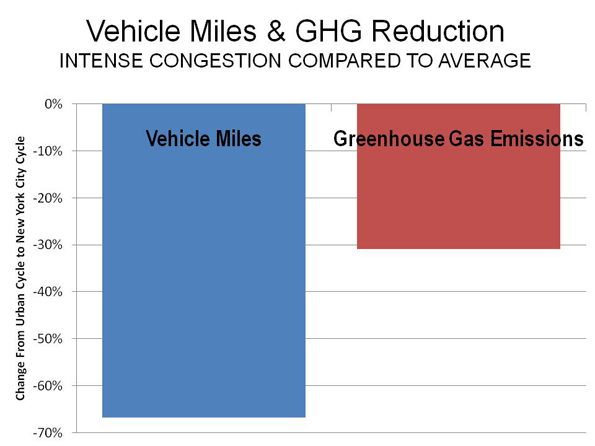
    Under the New York City Cycle average speeds are two-thirds less than under the average urban cycle. This reduction in speed and increase in congestion results in a 50 percent loss in fuel economy, according to an Argonne National Laboratory Study. Thus, between New York City and the average urban area, fuel efficiency drops at a rate 80 percent of the lower driving rate in New York City.

    On average, vehicle travel in New York City is approximately 8 miles per capita daily. In the average large urban area outside New York City (such as the Phoenix urban area, or for that matter the suburbs of New York City), vehicle travel is approximately 24 miles per day per capita. Thus, per capita driving in New York City is 67 percent less than in Phoenix. However, because of the loss in fuel consumption, the greenhouse gas emissions from cars per capita is only 31 percent less (Figure 1). Thus, the limited data indicates that nearly one-half of the greenhouse gas emissions difference between New York City driving rates and Phoenix driving rates are cancelled out by the impacts of slower speeds and increased congestion.

    Shortcomings of Policies to Reduce Driving: UCLA’s Lewis Center for Regional Policy Studies Program on Local Government Climate Action Policies raised concerns about relying on VMT reduction policies in a submittal to the California Air Resources Board:

    Especially in congested areas of California, VMT is an inadequate proxy for vehicle greenhouse gas emissions.

    Yet it is precisely more intense traffic congestion that we can expect if federal laws and policies should force most development into present urban footprints. Between 2010 and 2030, nearly 70,000,000 residents will be added to US urban areas, an increase of more than 25 percent. This increase would mean that the legislation introduced by Congressmen Hold, Carnahan and Inslee would require a one-third reduction in per capita driving to achieve its overall 16 percent reduction. Per capita driving declines such as those envisioned by the Congressmen or Moving Cooler have never occurred before in any American (or international) urban area. By comparison, charging people $400 to park their cars in front of their houses seems utterly reasonable.

    Further, higher population densities are associated with more intense traffic, both at the national and international level. Policies such as recommended by Moving Cooler would produce little additional highway capacity to handle the far higher levels of driving produced by a larger population. We could expect traffic congestion to increase markedly. It would take longer to get to work and local air pollution would be more intense (a health impact largely ignored by proponents of higher densities).

    The Economic Cost: A serious economic toll would be produced by more grid-locked urban areas, because of the positive relationship between personal mobility and economic performance. Remy Prud’homme and Chang-Woon Lee of the University of Paris have shown that greater economic mobility is associated with greater economic growth. Greater personal mobility also alleviates poverty, according to a Progressive Policy Institute study):

    In most cases, the shortest distance between a poor person and a job is along a line driven in a car. Prosperity in America has always been strongly related to mobility and poor people work hard for access to opportunities. For both the rural and inner-city poor, access means being able to reach the prosperous suburbs of our booming metropolitan economies, and mobility means having the private automobile necessary for the trip. The most important response to the policy challenge of job access for those leaving welfare is the continued and expanded use of cars by low-income workers.

    The UCLA submission further notes that policies aimed at reducing driving could damage the economy:

    … policies which seek to reduce VMT may hinder economic growth without reducing emissions.

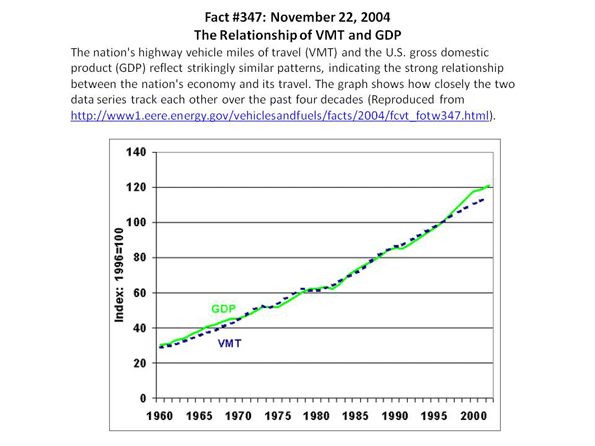
    The relationship between greater mobility and economic prosperity is also demonstrated at the national level. This is vividly illustrated in the chart from the United States Department of Energy (Figure 2).

    The significant improvements in fuel economy from higher mileage cars and less carbon intensive fuels will do far more to reduce greenhouse gas emissions from cars than the meager results that can be achieved by heavy handed policies to “coerce” people out of their cars (as Secretary of Transportation Ray LaHood put it). And, critically, it would do so with far less impact on both economic and physical mobility.

    Both the Economy and Greenhouse Gas Emissions at Stake: With the economic challenges facing the nation, policy makers need to steer clear of strategies that hobble the economy, like forcing people to drive less (or pay $400 to park in front of their houses) and make only minor improvements in reducing emissions. Indeed, a society with less money will have less to spend on reducing emissions through the adoption of new technologies that offer greater hope for creating a more prosperous as well as more environmentally sustainable society.


    Note: The New York City refers to the City of New York, not the metropolitan area or the urban area.


    Wendell Cox is a Visiting Professor, Conservatoire National des Arts et Metiers, Paris. He was born in Los Angeles and was appointed to three terms on the Los Angeles County Transportation Commission by Mayor Tom Bradley. He is the author of “War on the Dream: How Anti-Sprawl Policy Threatens the Quality of Life.

  • Green Jobs Can’t Save The Economy

    Nothing is perhaps more pathetic than the exertions of economic developers and politicians grasping at straws, particularly during hard times. Over the past decade, we have turned from one panacea to another, from the onset of the information age to the creative class to the boom in biotech, nanotech and now the “green economy.”

    This latest economic fad is supported by an enormous industry comprising nonprofits, investment banks, venture capitalists and their cheerleaders in the media. Their song: that “green” jobs will rescue our still weak economy while saving the planet. Ironically, what they all fail to recognize is that the thing that would spur green jobs most is economic growth.

    All told, green jobs constitute barely 700,000 positions across the country – less than 0.5% of total employment. That’s about how many jobs the economy lost in January this year. Indeed a recent study by Sam Sherraden at the center-left New America Foundation finds that, for the most part, green jobs constitute a negligible factor in employment – and will continue to do so for the foreseeable future. Policymakers, he warns, should avoid “overpromising about the jobs and investment we can expect from government spending to support the green economy.”

    This is true even in California, where green-job hype has become something of a fetish among self-styled “progressives.” One recent study found that the state was creating some 10,000 green jobs annually before recession. To put this into context, the total state economy has lost over 700,000 jobs over the past year (more than 200,000 in Los Angeles County alone). Any net growth in green jobs has barely made a dent in any economic category; only education and health services have shown job gains over this period.

    More worrisome, in terms of national competitiveness, the green sector seems to be going in the wrong direction. The U.S.’s overall “green” trade balance has moved from a $14.4 billion surplus in 1997 to a nearly $9 billion deficit last year. As the country has pushed green energy, ostensibly to free itself from foreign energy, it has become ever more dependent on countries such as China, Japan and Germany for critical technology. Some of this is directly attributable to the often massive subsidies these countries offer to green-tech companies. But as New America’s Sherraden puts it, this “does not augur well for the future of the green trade balance.”

    Nor are we making it any easier for American workers to gain from green-related manufacturing. Some of America’s “greenest” regions are inhospitable for placing environmentally oriented manufacturing facilities. For example, high taxes and regulatory climate have succeeded in intimidating solar cell makers from coming to green-friendly California; a manufacturer from China told the Milken Institute’s Ross DeVol that the state’s “green” laws precluded making green products there.

    Attempts to put windmills in Nantucket, Mass., the Catskills and Jones Beach in New York and other scenic areas have also been blocked by environmentalist groups. Transmission lines, necessary to take “renewable” energy from distant locales to energy-hungry cities, often face similar hurdles. Solar farms in the Mojave desert might help meet renewable energy quotas but, as wildlife groups have noted, may not be so good for local fauna.

    And then there is the impact of green policies on the overall economy. Green power is expensive and depends on massive subsidization, with government support levels at roughly 20 times or more per megawatt hour than relatively clean and abundant natural gas. Lavishing breaks for Wall Street investors and favored green companies also may be harmful to the rest of the economy. A recent study on renewable energy subsidies on the Spanish economy found that for every “green” job created more than two were lost in the non-subsidized economy.

    So how do we build a green economy that is sustainable without massive subsidies? First, governments need to learn how to say no to some environmentalists. Green jobs and renewable energy can not be fully developed without affecting somebody’s backyard. Windmills will have to be built in some scenic places; transmission lines may mar somebody’s “view-shed.”

    Arguably, the thing that would spur green jobs and domestic industries most would be economic growth. Environmentalists long have been cool to growth, since they link it to carbon production and other noxious human infestations. As an official at the Natural Resources Defense Council put it, the recession has “a moment of breathing room.” Disaster may be still looming, but bad times add a few more moments to our carbon clock.

    Long term, though, I would argue hard times may prove harmful for the environmental cause. Even with subsidies, many renewable energy projects are now on hold or being canceled across the country. Slackening energy demand, brought on by a weak economy, has undermined the case for new sources of energy generation; what looked attractive with oil prices at $140 a barrel and headed higher looks at $70 less so.

    Similarly, hard-pressed homeowners and businesses don’t constitute the best market for new, often expensive “green” products. A growing economy, which would drive up energy prices, could spur a more sustainable interest in alternative energy from firms that now only do so for public relations concerns. At the same time, cash-rich consumers could more afford to install energy-saving home insulation or rooftop solar panels. A strong economy would also spur sales of new energy-efficient appliances and cars.

    This process would go more quickly if government relied less on mandates, which tend to scare serious investors, and turned toward incentives. With the right tax advantages, energy efficiency could become a positive imperative for companies.

    There’s also an unappreciated political calculus at work. A persistently weak economy undermines support for the green agenda. For the first time in 25 years, according to a Gallup poll, more people place higher priority on economic growth than on the environment.

    Furthermore, more people now feel claims about global warming are “exaggerated.” Early this year, Pew reported that global warming ranked last among the top 20 priorities of Americans.

    Ultimately, environmentalists need to realize that the road to a green economy does not lie in promoting hysteria, guilt and self-abnegation while ignoring prohibitive costs and grim economic realities. Green enthusiasts should focus on promoting a growing economy capable of generating both the demand and the ability to pay for more planet-friendly products. After all, the economy needs green jobs less than green jobs need a thriving economy.

    This article originally appeared at Forbes.

    Joel Kotkin is executive editor of NewGeography.com and is a presidential fellow in urban futures at Chapman University. He is author of The City: A Global History. His next book, The Next Hundred Million: America in 2050, will be published by Penguin early next year.

  • “Cash For Clunkers” Doesn’t Utilize Junkyard Efficiency

    My father owned and operated a junkyard in Tucson for a number of years, and I learned a lot about the auto recycling industry helping around the office and as a delivery driver. So as a junkyard enthusiast, the “Cash For Clunkers” program naturally caught my interest lately. Though it looks to be the product of good intentions, I don’t think the legislation understands that junkyards already comprise an efficient, well developed recycling system for salvaging vehicles, with a beneficial result for the environment overall. I’m skeptical that quickly scrapping so many government-defined “clunkers” and replacing them with new, fuel-efficient models will have a substantial environmental benefit, because the plan has the potential to waste many useful materials in these cars.

    A junkyard may appear to be little more than a landfill for old cars if you’re just driving by, but in fact, to succeed, it must function as a highly efficient recycling operation. Junkyards sell parts to other junkyards, mechanics, and directly to consumers, and attempt to make as much of a profit as possible from each part on every car in their inventories.

    There is also a network of scavengers who travel around to junkyards gathering large core items, like alternators and starters, and a number of precious metals in small amounts that most don’t even recognize as in our cars. (Catalytic converters, for example, contain platinum and palladium, which are quite valuable when salvaged.) But a car needs to sit on the lot for a considerable period of time for this recycling process to work itself through. Parts from a car are usually sold one at a time over a period of months or even years; scavengers work on their own schedules. A scavenger may only come by a junkyard a few times a year to core out a particular metal or gather the useful components. Meanwhile, the junkyard needs to be selling parts off the car for it to be financially worth keeping in the inventory. A car is only sent off to be crushed for scrap metal when it no longer retains enough value to justify filling the space on the lot.

    If the Cash For Clunkers program is successful, it has the potential to throw a wrench into the system. The program’s rules require that the engine of a trade-in car be destroyed with an injection of sodium silicate so that the car won’t be resold and put back on the road. The rules seem to encourage the immediate crushing and shredding of the trade-in cars, but should they remain on junkyard lots, their inventory value would take an immediate hit with a non-functioning engine (the most valuable part of the car). To what degree the value decreases depends on the extent of the engine damage, the demand for the particular engine, and the age of the engine.

    A genuine old clunker would be likely to have a well used, and therefore less valuable engine, but then, the “clunker” program nickname (its official title is the “Car Allowance Rebate System”) is something of a misnomer. To be eligible for the program, cars must fall into certain categories of fuel inefficiency, be less than 25 years old, and worth less than $4500. This includes a number of models from the nineties. A working engine in many of the models targeted for the program is likely to have fewer miles on it, and therefore a higher inventory value, than a more traditionally defined clunker.

    But engine issues aside, if the program succeeds in taking a large number of particular models off the road, it could have an even more drastic effect on the junkyard value of those models, simply by lowering the demand for their parts. If there are only a few of a given model on the road, few consumers will buy parts for them from junkyards. Many junkyards are picky about which models they purchase for inventory, and won’t even bother with a model if there is little or no demand for its parts. So if Cash For Clunkers leaves some car models without junkyard value, those models would start going directly to the crusher, taking many of their valuable components with them. The scrap metal from crushed cars is used to make things like rebar and fence posts, so it isn’t as though the scrap winds up in the landfill. But it’s still a waste for precious metals and other valuable components to be crushed down with the low-end materials for low-end product.

    And even beyond the metals, something mundane like a plastic glove box has its own environmental impact. The overall junkyard process, where cars without “street” value become parts donors for cars still in use, prevents a great deal of after-market manufacturing of glove boxes and all the other parts that wear out or get damaged in cars on the road. If entire models are abruptly taken off the road, devalued at the junkyard, and crushed, it means that many new glove boxes must be manufactured – both for the new cars replacing the model, and for any other models and even makes still on the road for which that model of glove box, or stereo, or steering column fits (and many parts are surprisingly versatile this way). That could mean a boost in manufacturing, sure – but it also means an environmental impact that offsets some of the gains from the new fuel-efficient car that replaces the clunker.

    Cash For Clunkers is scheduled to end November 1, so it’s unlikely to have a long-term effect on the auto recycling industry beyond burdening it with a glut of devalued inventory. But so far the program is popular, and may be expanded or set a precedent for future programs. If this happens it could take a toll on the junkyards and their ability to recycle effectively. If there are suddenly millions of brand new car models on the road, there would be a period of hardship for the auto recycling industry, as the new cars would be running well, with any repairs done mostly under warranty at the dealerships with new parts. This whole scenario could also, by extension, tax the junkyard consumer base of low income, self-sufficient individuals whose cars are older, skillfully maintained, and perhaps most importantly, paid off.

    It’s beyond my pay rate to comprehensively evaluate the net difference in environmental impact between manufacturing and selling new, fuel-efficient cars for these quick “clunker” trade-ins and letting the older models stay on the road. But a legitimate evaluation would clearly involve more complex factors than a simple comparison of fuel efficiencies. Yet it’s clear that the program doesn’t appear to insert any innovative solutions into an already dynamic and effective recycling system. Even if it has some positive outcomes, it doesn’t look like Cash For Clunkers will utilize the industry’s full potential for environmental benefit.

    Perhaps its primary motive lies elsewhere, in its attempt to jump-start the auto industry with a “green” marketing gimmick. But in the process we may have reaped some unintended damage on a sometimes unsightly but remarkably environmentally resourceful industry.

    Andrea Gregovich lives in Anchorage, Alaska. She has written a novel about a junkyard called Martyred Cars and is looking for a publisher.

  • Koyaanisqatsi Redux

    I went to Hollywood one night last week to watch my favorite film of all time, Koyaanisqatsi (released in 1983). It was being shown on a big screen at the Hollywood Bowl, accompanied by orchestra playing the original score, conducted by its composer, Philip Glass. Oh, I didn’t go to the Bowl; I watched it at my daughter’s apartment about half a mile away (hi def DVD and digital sound system turned way up, thank you). It was much more enjoyable than going to the Bowl; after all, I didn’t want to share the experience with an audience that undoubtedly would have, shall we say, a different appreciation of the art.

    You see, the message and meaning most of the Hollywood crowd take from Koyannisqatsi (Hopi Indian for “life out of balance” or “crazy life”) is that man has despoiled and separated himself from his natural environment. Frankly, it has always had the exact opposite effect on me. Even after what must be 100 viewings, I am continually overwhelmed, impressed and delighted by the images of what man has been able to create, invent and build to control his environment, increase his wealth, provide him his food and energy, raise his standard of living, and transport him around the planet (or across the city).

    I am sure most of the Hollywood Bowl crowd has a different response, and finds the images disturbing and disgusting. This is the reactionary impulse, born of an anti-industrial, anti-development mindset. I would wager the majority of that audience has bought completely into the scaremongering of catastrophic man-made global warming, which to the properly skeptical and scientifically literate remains unproven (oh hell, it’s ludicrous on its face). This is deliciously ironic, as many sequences in Koyaanisqatsi were filmed in the 1970s, when most of the same crowd were hectoring us about global cooling (doubly ironic, as a cooling may now actually be upon us).

    My first review of the film, published some 25 years ago, needs only minor updating.

    This truly remarkable film by Godrey Reggio has no plot, no characters, no dialogue. The images of the film are awe-inspiring: first, huge expanses of pristine nature: deserts, rivers, mountains, mesas, lakes, waterfalls, clouds. Then grand-scale technology: huge earth-moving machines, power plants (nuclear and otherwise), oil refineries, food-processing plants, space shuttles, rockets, jets, freeways, subways, skyscrapers, shopping malls, train stations (and of course the obligatory atomic bomb explosions and mushroom clouds) – all shot in fascinating slow-motion and/or time-lapse format by cinematographer Ron Fricke. The accompanying music by Philip Glass is eerie, haunting and perfect.

    The film is a visual, aural and emotional feast. If it bores you, you don’t understand you are looking at, in juxtaposition, the majestic indifference of nature; the supreme accomplishments of physical engineering; and some of the most awful consequences of attempts at social engineering. Some of the images that make indelible impressions, all set to a majestic, driving score:

    • desert rock formations unchanged through thousands, if not millions of years
    • huge power transmission lines stretching forever across barren desolation
    • the implausible flying behemoth that is a 747
    • the flow of vehicles on a freeway, at night, from 50 stories up, that in time-lapse photography really does look just like the flow of blood through vessels, arteries and capillaries as seen through a microscope
    • row upon row of huge, empty, abandoned south Bronx tenements
    • the razing of the Pruitt-Igoe housing project in St. Louis (the most graphic depiction of public policy failure ever committed to film, I should think)
    • the rush of commuters who in time-lapse photography look like ants swarming an anthill
    • various mass production activities: mail-sorting machines, industrial assembly lines, escalators, elevators, revolving doors, conveyor belts, money counting machines, huge bowling alleys, movie theaters
    • finally, the high resolution satellite photograph of a massive city grid (Los Angeles, of course) overlaid, first, on a printed circuit microchip board, and secondly, on an intricate Hopi Indian woven blanket. The matches are nearly perfect.

    A very noticeable detail of the ’70s-era footage from Los Angeles is the blanket of smog that covers the city; I can tell you, having lived here all of these years, that the situation is dramatically improved. (I now see far-off mountain ranges daily; in the ’70s that was rare.) Environmental quality has been improving over the decades (read The Skeptical Environmentalist by Bjorn Lomborg for the statistical evidence). The solutions to the problems that technology causes often end up being more technology, sensibly and carefully applied.

    The single greatest contributor to the amelioration of LA smog, for example, is the catalytic converter. Instigated and required by government, you say? Developed and produced by industry in response to marketplace demand, says I.

    I find the movie very relevant today. It seems some of our new political overlords seem to think they can have a productive economy without production, without what the film depicts: heavy industry; mass processing of food, clothes, consumer and industrial goods; massive residential and commercial development; huge efforts devoted to energy extraction, production and transmission; untrammeled mobility for goods, people and vehicles. Now I’m a “new economy” guy myself, but I realize that our wealth, standard of living and quality of life – the current and future prospects for hundreds of millions of us – are dependent upon these activities, and that the health of the industries that make them possible are far more important than any particular small sub-species of bird, fish, ant or rat (the threats to which are always exaggerated anyway).

    We are really talking about the role of government here, not only in protecting nature. What the film shows me is that it is in fact government’s job to protect the “other” environment: the environment that encourages, promotes and allows incentives for production. Part of this environment is the need for massive infrastructure: energy systems, water systems, waste systems, transport systems, roads, dams, etc., etc., in adequate capacity and in good repair. Mass production and economies of scale bring good quality cheap to millions, and provide opportunities to generate incomes, grow wealth and lead productive, modern lives. More efficiency can also create more nature; for example, the millions of acres of non-redundant farmland turned into forest or open space.

    We used to know and understand this as a society. Our political elites were devoted to it. Now, not so much. We need to relearn the basic lessons and regain that consensus again.

    Dr. Roger Selbert is a trend analyst, researcher, writer and speaker. Growth Strategies is his newsletter on economic, social and demographic trends; IntegratedRetailing.com is his web site on retail trends. Roger is US economic analyst for the Institute for Business Cycle Analysis and its US Consumer Demand Index, a monthly survey of American households’ buying intentions.

  • ULI Moving Cooler Report: Greenhouse Gases, Exaggerations and Misdirections

    Yesterday a group of environmental advocacy groups, foundations and other organizations released a report, Moving Cooler, amid much fanfare, seeking to have us believe that it is a serious study of GHG reduction options in the transportation sector. It is immensely disappointing. The world could use a dispassionate, objective and broad-based assessment of petroleum reduction options as well as their positive and negative consequences. This is not it.

    As one reads one can’t help but feel that you are being hit with a sales pitch, or a legal brief from advocacy groups and those who would benefit financially from the derived policy options. The main point, amidst all the array of statistics, confirms the dogma of the already convinced that the only solution to greenhouse gases is major re-structuring of society.

    These notions, critically, were already on the front burner of these same groups long before the climate change issue came to prominence. “Progressive” foundations, new urbanists, planners and urban landowners long have advocated the re-assembly of urban living into high density transit-oriented bikeable/walkable communities. Even though their numbers as reported in the text don’t bear it out, the rhetoric is all focused towards that end and the pricing out of existence the automobile and all the evils it represents: suburban living and long trips.

    This is a report meant to be waved rather than read as the Congress goes about its fulminations in the coming months. It understates the prospect of gaining the full potential of greater energy efficiency from the vehicle fleet – the only way to justify the wholesale reorganization of society. In fact, if the vehicle/fuel assumptions had been as comparably optimistic as the land use assumptions, with a robust and honest assessment of fuel and vehicle technological development opportunities, one wonders whether this report would be worth doing at all.

    We have been here before. In the struggle to improve air quality, it turned out that the solution was not so much changing people’s behavior as it was technological – largely the improvement of fuel and vehicle technology. In the 1970s we were told we could not have cleaner air and automobiles; yet in fact that’s exactly what happened, without having to heed a sermon about our need to repent and change our suburban, car-driving ways. Some people just have a penchant for telling others how to live.

    Maybe the saddest part of it all, the authors appear not to take global warming or energy security very seriously at all. Rather these public concerns are just a convenient hook, the cause du jour, on which to hang their favorite solutions. If global warming matters – and it does; if energy security matters – and it does; then early action is clearly called for, particularly given the cumulative nature of GHG gases. But somehow the things easily done and carrying with them little in the way of disruption or public costs – carpooling, telecommuting, dispersed work – are largely written off. Such immediate, low-cost actions as highway operations strategies including better traffic signalization, improved traveler information and accident response systems receive little emphasis.

    Overall, the treatment of costs and benefits will leave readers gasping:

    • Travel times don’t get counted – so shifting from a 15 minute car trip to an hour on transit or walking has no penalty.
    • Transit subsidies don’t get counted – so doubling subsidies to increase ridership has only benefits.
    • Every possible pricing strategy is invoked – congestion pricing, cordon pricing, on-street parking fees, extreme fuel prices – in order to get people out of cars, and then the loss of their cars is counted as a benefit.

    At the same time the benefits and the costs involved are so corrupted to be meaningless. It will take weeks for analysts to tease out what really was done in the way of assumptions to create winners and losers. And there is no effort to tally all the costs exacted on the average household, or the typical business or even governments for that matter. The costs would add up to a permanent recession.

    I am sure the millions affected by these policies, particularly the middle and working class people who can now just barely afford a car, who would be priced out of the system by these policies, will say thank you for this “benefit”.

    As we work our way through the recession, workers will be willing to travel farther and farther to find the right job – or any job. With continuing increased specialization in our society larger and larger market sheds for jobs and for workers, quality transportation will be critical to our national productivity. This is the work that transportation does and it is totally dismissed by this report. It can not be addressed adequately by rail or transit even with a complete radical reorganization of work and society.

    In order to further bolster their ineffective case the proponents use a tool called “bundles” in which packages of actions are assembled for their “synergistic” qualities and either given a boost or cut based on the assertion that some things work well together. How this was done is not explained. So land use plans, which will take 30 years to come to fruition, are coupled with carbon pricing policies in a sort of horse and rabbit stew, that help make density solutions seem effective.

    Those who see the solution of so many of our present ills by cramming people into ever higher densities miss the point. Residential density is one of the most fundamental choices households make. Changing residential densities to make transit work better is the smallest tail wagging the biggest dog I can think of. It puts planning dogma ahead of the most basic human needs and rights.

    It is clear that most people, excepting a small but often very loud minority, opt for lower density living when income permits. As the society changes and choice patterns evolve, the marketplace must be ready to respond with development that is both responsive to household choices and to the demands of environmental needs. Any public policies that inhibit a market trend toward higher densities must be addressed. But the market place must be the final arbiter in a free society. People do not live “efficiently” in order to optimize some imposed societal goal, certainly not commuting.

    The serious work that needs to be done in this area still awaits an independent and credible group to undertake this work. It can’t come soon enough.

    For almost 40 years Alan E. Pisarski has been involved in the national transportation policy scene, from vantage points at the original Tri-State Transportation Commission in New York, the Metropolitan Washington COG, the Office of the Secretary, U.S. DOT, or in a personal consulting capacity. In his work he has measured the transportation activities of our nation from the metropolitan, state, national and international levels. In the U.S. DOT he organized the major travel surveys of the nation and designed and managed the U.S. transportation statistical system under the Assistant Secretary for Policy, establishing programs that are still the basis of much of the U.S. transportation statistical system today.

  • UK Green Path leads to Deindustrialization and Worsening Housing Shortage

    The First Secretary of State, Secretary of State for Business, Innovation and Skills, and Lord President of the Council, Peter Mandelson, together with Ed Miliband, the Secretary of State for Energy and Climate Change, have published The UK Low Carbon Industrial Strategy. They are claiming it promises an “economic revolution” but is in fact an environmentalist retreat from industrial production It is a disastrous strategy that will result in further de-industrialisation, supposedly with the aim of addressing a rather vague threat of climate change.

    Mandelson and Miliband insist The UK Low Carbon Industrial Strategy “can ensure that our economy emerges from the global downturn at the forefront of the technological and social shift that will define the next century.” Yet this is typical establishment “greenwash”, which many institutional and corporate leaders of the construction industry will sadly rush to endorse. It will shift us towards the laborious construction of new eco-homes, and the laborious refurbishment of the stock of mostly draughty, poorly insulated, and badly serviced housing. All this is aimed to achieve, at least on paper, a contribution to a national carbon reduction target by 2020.

    Government thinks that it will be building 240,000 “zero carbon” homes every year by 2106. In fact at least 500,000 homes are needed every year to meet household growth and replace the oldest of the stock at a rate of 1% a year. Yet in reality this year new house building is down to 100,000 a year, and there is no reason why that level of production will increase even when, as is starting to happen, house price inflation returns. Instead of promoting mass production, most house builders are quite likely to follow The UK Low Carbon Industrial Strategy to become luxury eco-home builders. They will be content to build around 100,000 “green” homes a year to get through the planning system. They will build homes that show their environmental credentials by the thickness of walls and roofs – full of sheep’s wool or hemp, packed with straw bales, or made from low-fired clay blocks.

    This, of course, is the approach to new house building promoted by Prince Charles and the other would be green gentry. He advocates “the use of local materials to create local identity which, when combined with cutting-edge developments in building technology, can enhance a sense of place and real community.” Just as Mandelson and Miliband claim theirs is an industrial strategy, Charles promotes green building technology.

    Charles talks of building walls and roofs thickly in “volume”, but what does his royal greenness know of the market? Government also imagines it can use renewable insulation materials to produce “affordable” housing. Walls and roofs will get thicker, but housing will not be built in sufficient quantity for a growing population, and will not be affordable on most British household incomes.

    The green tendency will be to use greater thicknesses of less processed, more laborious-to-install insulation materials, cut-to-fit on site. This will make the walls and roofs on new eco-homes around half a metre thick, but that might be fashionable. Having more material in the walls and roof will show how little energy is used in the new and expensive eco-home.

    Thick insulation is an immediate problem in the refurbishment of the stock of 26 million existing houses and flats. It is not always possible to cover the outside with great thicknesses of natural materials that, contrary to the Prince’s claim, have a low capacity to insulate. Even industrially produced fibres and foams, which green purists think are too processed, must be used thickly. It is less possible to apply thicknesses of insulation inside the existing home, when most British homes are so small. A lot of filling of masonry cavity walls has been carried out under energy efficiency schemes, with little regard for why the drained air cavity was there in the first place. But no existing housing has walls with cavities of up to the 300mm that would be required for insulants that satisfy greens.

    The architectural fact is that only made-to-fit insulation, prefabricated as an industrially processed product, can achieve the thermal performance being discussed with a minimal thickness.

    Sheep’s wool and hemp, straw bales, and low-fired clay blocks are positioned increasingly off the scale to the right on thickness. Foam glass as an industrial product is poor as an insulant, as is cellulose fibre. The sorts of glass and mineral fibre insulation that can be bought in any builder’s merchant require substantial thicknesses. Foams have better performance, and are familiar as cut-to-fit insulation. However only the use of processed vacuum insulation, as a made-to-fit industrial product reduces insulation thicknesses to the architectural dimensions required.

    On behalf of New Labour Miliband boasts that Britain has produced a carbon reduction plan to 2020 that should inspire other industrial and industrialising nations. “Having been the first country in the world to set legally binding carbon budgets, we are now the first country in the world to assign every department a carbon budget alongside its financial budget,” he told the House of Commons. We seem to be the first country in the world to ignore the space- and time-saving potential of construction technologies that require energy in their production processes, but save energy in the long term operation of well serviced buildings.

    Britain is retreating from industry and makes an environmental fetish out of bulky “natural” materials that don’t work well. Why favour materials that are lightly processed as agricultural crops, or are low-fired but need rendering? Why not accept processing, as all timber is processed, and welcome the durability of fully fired bricks? This carbon obsessed idiocy in construction works against other great materials like concrete, glass, steel and aluminium.

    For their part government is insisting that insulation must be renewable and crop-based rather than an industrially processed product. This means that small British houses and flats will be thickly walled and roofed and will be built in too few numbers to accommodate British household growth. Every existing home must be refurbished indefinitely. That is truly pitiful for an old industrial democracy like Britain.

    Government abuses the words Industrial and Strategy, sharing the Prince’s low aspirations for twenty-first century construction and architecture. An industrial strategy worthy of the name would promote the development of highly processed vacuum insulation, and would expect skills in design, manufacture, installation, and maintenance.

    An attempt to make “green jobs” rather than raise productivity and wages, The UK Low Carbon Industrial Strategy should be seen and criticised as an environmentalist strategy of de-industrialisation, because that is precisely what it is.

    Ian Abley, Project Manager for audacity, an experienced site Architect, and a Research Engineer at the Centre for Innovative and Collaborative Engineering, Loughborough University. He is co-author of Why is construction so backward? (2004) and co-editor of Manmade Modular Megastructures. (2006) He is planning 250 new British towns.