Tag: Energy

  • The Changing Landscape of America: The Fate of Detroit

    INTRODUCTION

    During the first ten days of October 2008, the Dow Jones dropped 2399.47 points, losing 22.11% of its value and trillions of investor equity. The Federal Government pushed a $700 billion bail-out through Congress to rescue the beleaguered financial institutions. The collapse of the financial system in the fall of 2008 was likened to an earthquake. In reality, what happened was more like a shift of tectonic plates.

    In 1912 a German scientist, Alfred Wegener, proposed that the continents were once joined together as one giant land mass called Pangea.

    About 200 million years ago the continents began to drift apart as the globe separated into eight distinct tectonic plates. History will record that the financial tectonic plates of our world began to drift apart in the fall of 2008. They have not stopped moving and the outcome of where they will end up remains uncertain.

    PART ONE – THE AUTOMOBILE INDUSTRY

    Edsel, Packer, Studebaker, Hudson, Nash, AMC – the demise of these brands may have seemed tragic at the time, but were actually a sign of industrial health. In contrast, for the last fifty years the American automobile industry has been static. Despite the proliferation of Japanese, Korean and German imports, General Motors, Ford and Chrysler managed to hold on to a majority of the domestic market, with a dizzying stable of makes and models that grew to near 17 million new car sales in 2007. That epoch is now over. The tectonic plates have shifted under the automotive business and a year from now, the industry will bear little resemblance to the static structure of the last fifty years.
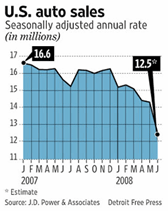
    Fifty years ago General Motors owned more than 50% of the American market and automobile jobs made up one seventh of the US workforce. It was said that when GM sneezed the US economy caught a cold. GM shares now sell for less than a cup of coffee at Starbucks. Now GM is about to enter bankruptcy.

    The brands are dissolving, Oldsmobile was the first casualty. Pontiac and Hummer have been discontinued. When they reorganize, eleven hundred dealers will be terminated. General Motors will close all its plants for three months this summer. Many will never reopen. The New GM, to be known as Government Motors, will be owned by the UAW (20%) and the Federal Government (70%). Twenty billion of tax-payer loans will be converted to ownership to make the UAW pensions liquid. The debt holders will see their senior $27 billion investment converted into just 10% of stock. The shareholders will be wiped out.

    The New GM will become the platform for small fuel efficient cars, hybrids, electric vehicles and experimental technologies mandated by an ever demanding government. Its shareholders vanquished, The New GM will bear no resemblance to the car company that we have known for the last 50 years. Can the Chevy Volt rescue GM? The answer is no.

    GM will continue to shrink as their SAAB and Saturn franchises are sold off to the Chinese. China’s automobile sales are up 10% this year versus declines of 23% in the US and 15% in Europe. Chinese automobile manufacturers are grabbing market share, 30% this year versus 26% in 2008, while their competitors are distracted. Chinese companies unknown to Americans like Geely Motors, Chery Automobiles or BYD Co. will buy SAAB or Saturn for their dealer network. Warren Buffett invested $230 million into BYD, a firm that has been manufacturing cars for just six years. They already provide batteries to Ford and GM and soon will be building the world’s least expensive mass produced hybrid and electric vehicles. Geely plans to triple its domestic sales to 700,000 by 2015 and Chery plans to introduce 36 new models over the next two years.

    Chrysler is in far worse shape and will likely never recover. The Federal Government already forced it into bankruptcy. Seven hundred and eighty nine dealers have been told that their franchises are terminated. Its shotgun marriage to Fiat will look more like a surgical amputation of unnecessary body parts than a marriage. If Fiat remains in the game, they will do so for the Jeep brand and a portion of the dealer network. Like Oldsmobile and Pontiac, Plymouth and Dodge brands are doomed as well as most of the Chrysler line. No one will mourn the demise of the Crossfire, Pacifica, Sebring, or the PT Cruiser. Fiat should keep the new Chrysler 300, a beautiful design that deserves to be built. Chrysler has not produced many stars in the last few decades. The trail blazing design of the 300 brought the full size sedan back from the dead.

    Chrysler will jettison the weakest of its dealers in bankruptcy. Fiat will retain the big dealers in the network. They will bring the stunning and iconic Fiat 500 to America, a fuel efficient small car that will enjoy the same success as Volkswagen’s retro Beetle. Fiat will also use the dealer network to bring the Alfa-Romeo back to America. The Fiat-Jeep-Alfa dealer of the future will bear no resemblance to the staid Chrysler-Dodge-Plymouth dealer of today.

    The surprising winner among the American troika of manufacturers is the Ford Motor Company. Ford and Lincoln will survive because they took no government bail-out money. Mercury may not survive but Ford and Lincoln should make it through the transition. The new Ford-Lincoln will be the refuge for auto enthusiasts who want attractive fast and powerful cars. Ford will become the Apple of the auto business, doing its own thing and flaunting political correctness and conventional wisdom. Ford’s namesake CEO has been an environmentalist for many years so Ford was well into fuel economy and hybrids before the tectonic plates began to move last fall. At just $5.00 per share, Ford is a tantalizing buy for the long term.

    One can no longer call Mercedes, BMW, Toyota and Honda imports as many of their cars are made entirely in the U.S. The Japanese system is different than the American counterpart although we are drifting toward their model. The Japanese government plays a heavy hand in their industry, subsidizing the encroachment into new markets until the brands have stabilized market share. But they are not immune. Toyota lost $7.7 billion in the last quarter – even more than GM.

    True imports like Volkswagen will weather the storm because they were well positioned with small fuel efficient cars long before the tectonic plates began to shift. VW is making a huge bet that oil will top $100/barrel again soon and their fuel efficient and clean diesels will be accepted by American drivers.

    The biggest winner is obviously the UAW and their pensions which have been bailed out with tax payer money by an administration beholden to its labor supporters. Who will be the biggest loser? Clearly, it will be America’s small towns. Our small towns will lose their local dealer and their choice in automobiles. They will be forced to buy the brand that remains in town or drive scores of miles to the next closest dealer for service. Most small town auto dealers were also the most generous members of the community. Charitable giving and support will wither as will local sales tax revenues when the big ticket automobile sales tax revenues disappear. Ironically, as the plates continue to shift, America’s small towns could be decimated by the changes in the automobile industry as they were one hundred years ago when the automobile shifted millions from rural communities to the cities.

    A year from now the landscape of America will be forever changed but the plates will continue to shift. Five years from now, will American ingenuity bring about a renaissance of the American automobile industry? Or, will what is left of this industry be gobbled up by the Chinese and the Korean manufacturers as the Japanese did in the 70s and 80s? The key issue may be what role the government will play. Will Americans buy cars designed by government bureaucrats and built by the unions that own the factories? Will an administration devoted to “coercing” Americans out of their cars be able to simultaneously save the auto industry?

    ***********************************

    This is the first in a series on the Changing Landscape of America. Future articles will discuss real estate, politics, healthcare and other aspects of our economy and our society. Robert J. Cristiano PhD is a successful real estate developer and the Real Estate Professional in Residence at Chapman University in Orange, CA.

  • Smart Growth? Or Not So Bright Idea?

    Smart Growth and New Urbanism have increasingly merged into a loosely aligned set of ideas. The benefits of this high-density housing viewpoint are fast becoming a ‘given’ to planners and city governments, but studies that promote the advantages often omit the obvious disadvantages. Here are some downsides that show a much different story:

    Smart Growth or Dumb Idea?

    One goal of Smart Growth is to move our society away from dependence on cars, and many Smart Growth plans intentionally make it difficult to drive through the neighborhood, making walking more inviting. Smart Growth planners advocate short blocks in a grid pattern to distribute traffic (vehicular and pedestrian) evenly within a development. These short blocks produce a multitude of 4-way intersections, and add a multitude of those trendy “turnabouts,” to make a bland site plan look more interesting.

    But all of this together destroys “flow”. On the other hand, in a grid planned neighborhood you might drive a straight line with an occasional turn, giving the impression of a much shorter drive than a curved subdivision. But with short blocks, a driver must stop completely, pause, then when safe accelerate through the intersection onto the next intersection, then repeat… multiple times. This scenario uses a tremendous amount of energy; the car eats gas.

    To understand this point clearly, go out and try to push a modern car. All the safety and convenience features, even in the most basic car sold today, add weight. Even a Toyota Prius is just under 3,000 lbs. While a given model may get great mileage the bulk of energy consumed is in getting the thing moving from a full stop. Should a vehicle maintain a constant flow (at any speed), the energy usage plummets, compared to stop-and-go traffic patterns that intentionally force conflicts.

    To make matters worse, the majority of vehicular vs. pedestrian accidents occur at intersections. Smart Growth designs have many more intersections than conventional suburban plans . Even more dangerous, Smart Growth walkways are placed close to the where the cars turns. Check out Traffic by Vanderbilt for an understanding of the psychology of driving.

    One may argue that cars will become more efficient. So what? This stop and go scenario also consumes time.

    Rooting Out Tree Issues

    Nobody can argue against the character of a tree-lined street… no one, that is, except the city Public Works department that must maintain structures being destroyed by trees growing in close confines to concrete walks and curbs. Smart Growth/New Urbanist compact front yard spaces are typically 10 feet or less. This simply cannot provide for enough room for tree growth when there is a 4’ wide walk typically a few feet away from the curb, the area where street trees grow. Without trees to define the street, these solutions have very little organic life to offset the vast volume of paving in front of each porch.

    Now and in the near future there will be a new era of solar heat and power, most of which will be mounted on the roofs of homes. Guess what blocks the sun’s energy? Yep – street trees! High density means that the proximity of trees to roofs will deter the sun’s energy from reaching those solar panels.

    Get Real About Presentations, Porches and People

    Typically, when a high-density development is proposed, the renderings show large green common areas bounded by homes with grand porches. The presentations usually show only a few cars parked along the street, and plenty of residents enjoying the spaces lined by mature trees that have had about 20 years of growth. This misrepresentation helps to win over councils, planning commissions and concerned neighbors. What is not shown in the presentations for approvals are claustrophobic, intense areas, such as the typical street most residents will live on, or perhaps the views down the alleys.

    There may be some neighborhoods that are built as represented, but architectural and land planning consultants are likely to stretch the truth more than a wee bit to gain approvals. Where can we see the original presentation images compared to what actually gets built?

    Those inviting large porches where neighbors sit and gossip in the presentation: Do they ultimately end up as stoops hardly large enough to fit a standing person? Those large mature trees: Are they actually just seedlings? Does the real streetscape have people walking on the typically narrow 4 foot wide walkways? How many people are walking along the roadway instead? Are the streets lined with just a few cars, as the renderings show, or are they packed with unsightly vehicles, while the nice cars are likely stored in the rear garage?

    The Evolution of Pavement

    Suburbs have changed during the last few decades. For example, in Minnesota thirty years ago an average suburban lot would have been 15,000 square feet and 90 to 100 feet wide. Today, 8,000 square feet and 70 feet wide would be more typical. In a conventional suburban plan, there weren’t any alleys, and the front loaded driveways were appropriately tapered. There were few side streets. The lots might have been 20% larger than in a Smart Growth high density plan, but the street layout might have had about 30% less linear feet of street compared to a Smart Growth grid layout. In the south, where the typical suburban lot is about the same size as that high density lot, the numbers favor the conventional layout even more; the total paved surface area could be 50% or more lower. So, the Smart Growth/New Urban plans place a greater burden on the tax payers to municipally maintain (more) paved surfaces.

    A Final Consolation…

    In reality, fire and police departments, as well as traffic engineers, review suburban development plans. And often the original high-density narrow street proposal doesn’t make it all the way to approvals. With or without the popularity of Smart Growth and New Urbanism, a much wider paved section or a compromised width is often the ultimate result.

    Rick Harrison is President of Rick Harrison Site Design Studio and author of Prefurbia: Reinventing The Suburbs From Disdainable To Sustainable. His websites are rhsdplanning and prefurbia.com.

  • Can Wind Power be a Reliable Long Term Source of British Power?

    The wind of change is blowing, but for once, that change might be affecting the wind.

    Wind, often championed as a viable alternative-energy source in the United Kingdom, might not be as energy efficient as it was once thought to be. Independent reports of the wind-energy efforts in the UK “have consistently revealed an industry plagued by high construction and maintenance costs, highly volatile reliability and a voracious appetite for taxpayer subsidies.”

    The cost for the energy alternative is sizable. Over the course of fiscal year 2007-2008, UK electricity customers paid a total of over $1 billion to the owners of wind turbines. That number is only expected to rise by 2020 to $6 billion a year as the government builds a national infrastructure of 25 gigawatts of wind capacity.

    Currently, wind produces only 1.3 percent of the U.K.’s energy needs while a 2008 report from Cambridge Energy Research Associates warns that over-reliance on offshore wind farms would only further create supply problems and drive up investor costs.

    Additionally, the average load factor for wind turbines in the UK was about 27.4 percent, meaning a typical 2-megawatt turbine only produced 0.54 megawatt of power on average. Dismissing the fact that low wind days would produce even less, all figures seem to point to poor return on investment.

    Some have suggested the building of cheaper wind farms, but ultimately higher maintenance costs and spare gas turbines to replace broken ones would cancel out any perceived benefits, as gas for the turbines would only add to carbon dioxide emissions.

    At this point, the outlook for wind to be a major source of UK electricity seems grim. Much like the wind itself, the problem just might be uncontrollable.

  • Obama’s Energy Triangulation

    With the possible exception of health care reform, no major issue presents more political opportunities and potential pitfalls for President Barack Obama than energy. A misstep over energy policy could cause serious economic, social and political consequences that could continue over the next decade.

    To succeed in revising American energy policy, the president will need to try to triangulate three different priorities: energy security, environmental protection and the need for economic growth. Right now, the administration would like to think it could have all three, but these concerns often collide more than they align.

    A president should have no higher priority than to ensure that America becomes more independent from foreign producers, particularly those outside North America. This represents a great opportunity to diverge from the failure of the Bush administration to reduce this dependence and encourage conservation.

    Instead, the best course could be called an “all of the above” strategy. This would embrace not only conservation and investment in renewable fuels but also aggressive expansion of the electric grid, the domestic fossil fuel industry and nuclear power. In particular, the country should focus on exploiting our vast reserves of relatively clean natural gas and drive technologies that could also clean up emission from coal, our other large resource.

    Instead of promoting fossil fuel development, environmental lobbyists — and Obama — like to talk about “green jobs.” Although green elements need to be integrated into all walks of economic life, the notion that green jobs can provide economic salvation seems more like a marketing strategy than one based on reality.

    Given current energy prices, large-scale numbers of green jobs can be created only through huge subsidization, the costs of which would, of course, be born by other parts of the economy. At the same time, jobs lost in fossil fuel production and manufacturing because of the high costs associated with renewables would most likely far outweigh any imaginable surge of green jobs.

    A recent study conducted in Spain, another country with a history of strong subsidies for renewable fuels, found that the money invested in green jobs actually cost so much that the overall employment effects were negative. Increasingly, the “green jobs” mantra seems like a story we tell our children to get them to sleep.

    The mantra also obscures the critical fact that the true goal of the environmental lobby is, above all, to shrink the much detested “carbon footprint” of people and communities. People like Obama’s science adviser, John Holdren, do not place much priority on maintaining much of the present American way of life. An acolyte of the many-times-wrong neo-Malthusian Paul Ehrlich, Holdren has promoted the “de-development” of Western societies as a way to lower carbon emissions and redistribute the world’s wealth.

    Such an approach might be popular at academic soirees or even among some investment bankers who see their future in Shanghai as opposed to Saginaw or Sacramento. It may prove a bit less popular among those, particularly in the middle and working class, who might not welcome seeing their families and communities de-developed.

    This should be obvious to the president and the clever political tacticians around him. Recent polls reveal that voters now rate global warming among their 20 least-critical concerns. Not surprisingly, the economy and jobs ranked as the top two.

    There are also serious regional issues to consider. Areas with economies tied to fossil fuels — mainly in Texas, the Great Plains, the Southeast and Appalachia — view the issue differently than do places like Manhattan, San Francisco or Chicago’s Gold Coast, whose residents can afford much higher energy prices and have few ties to traditional productive industries.

    As leader of both the country and his party, the president will have to consider these regional and class divides. The Republicans may be irrelevant, but the swelling ranks of more-pragmatic Democrats from Western, Southern and exurban districts cannot be so easily dismissed.

    In this sense, the possibility of the election next year of Houston Mayor Bill White, a Democrat, to the Senate represents more of a threat to the green lobby than a Republican victory does. White, like many Texas Democrats, has close ties to the energy industry and has already expressed grave misgivings about the administration’s renewables-obsessed carbon emissions policies.

    Given growing opposition in Congress, green groups and their allies in legal circles now argue that the administration can transcend the messy political process by imposing a strict anti-greenhouse-gas policy through the Environmental Protection Agency apparat. This has the virtue of allowing the president to avoid direct confrontation with many congressional Democrats but leaves power firmly in the hands of zealots for whom both energy independence and economic growth are less-than-compelling priorities.

    Ultimately, energy policy is too important to the economy and security to be left in the hands of bureaucratic zealots and their allies. It is up to the president to forge an energy program that, while looking toward renewables in the long run, does not sacrifice the livelihoods of millions of American workers today or leave our country ever more susceptible to the machinations of hostile foreign powers.

    This article originally appeared at Politico.

    Joel Kotkin is executive editor of NewGeography.com and is a presidential fellow in urban futures at Chapman University. He is author of The City: A Global History and is finishing a book on the American future.

  • Cap and Trade: Who Wins, Who Loses

    President Obama recently announced his plan for environmental protection and Congress took up the debate. Called “Cap and Trade” Obama explained it simply in several public appearances. The government puts a limit on the total amount of carbon emissions that are acceptable in the United States. Carbon emissions come, basically, from burning carbon-based fuels – natural gas, petroleum and coal – in the production and use of energy. Users and producers of energy emit carbon dioxide (and other pollutants) into the atmosphere.

    As Richard Ebeling writes at the Mises Institute, under cap and trade “the government will formally nationalize the atmosphere above the United States.” The program bypasses fundamental questions like what is pollution, how much does it take to cause harm, who is harmed by it and linking the causation between pollution and harm. Fear of lawsuits, torts and injunctions (which could provide the answers) keeps the Administration from addressing these questions head-on. Reliance on the same, tired old source for solutions – Wall Street – ensures that those being harmed aren’t necessarily the ones who will benefit.

    Under Cap and Trade, each carbon-emitting entity – cars, power plants, factories, etc. – is allotted some share of that total limit, or Cap, permitted for carbon spewed into the air in the United States. For example, a power plant producing electricity for 50,000 homes and businesses might be allowed to emit 2 tons of carbon per year. That’s their “cap,” the maximum amount of carbon they are allowed to put in the air.

    Now for the “trade”: if that plant finds a cleaner way to produce the electricity needed for 50,000 homes and businesses, say only 1 tons of carbon per year, they can sell the right to emit 1 ton of carbon to a power plant that puts 3 tons of carbon into the air while generating electricity for 50,000 homes and businesses. The plant that buys the right to emit an extra 1 ton of carbon per year is not required to limit their emissions to 2 tons – they bought the right for the extra ton.

    It all sounds very lovely as long as the caps will control the total amount of carbon added to the air from the United States. The money gained by selling the rights for “unused” emissions will provide financial incentives to the makers and users of cars, power plants and factories to pay for the technology to be cleaner. Since the money spent to pay for the more efficient technology can be recovered in the Cap and Trade marketplace, the cost of the cleaner energy shouldn’t require higher costs to consumers of the now cleaner air.

    This is great if you live near a power plant that manages to reduce the carbon emissions into the air you breathe below the maximum cap level. Here’s the problem: what if you live next to the power plant that paid for the right to put an extra ton of carbon into the air? Two things happen. First, you will be paying for the extra carbon because the power company will have to charge more to pay the cleaner power company for the right to produce the extra ton of carbon. That leads to the second problem: the extra ton of carbon is being emitted into the air around your home. That means that you could end up paying more for your electricity, while also breathing more polluted air.

    Cap and Trade is not a solution, it is another money-making scheme cooked up by the “dangerous dreamers” of Wall Street. In the EU they at least have the good grace to call it a “Trading Scheme.” A global carbon trading market already exists. “Pollution rights” have been traded since the 1990s when the Environmental Protection Agency held the first auction of air emission allowances, or pollution rights, at the Chicago Board of Trade. Starting with sulfur dioxide allowances, other pollutants were added in the next ten years to eventually create a complete trading market on the Chicago Climate Exchange. “The right to use water or air is more valuable than food, and we can use the price system to allocate that right,” said Richard Sandor at the 2005 Milken Institute Global Conference (yes, that Milken). The Chicago Mercantile Exchange and the New York Stock Exchange are now prepared to expand the environmental markets for industrial pollution, also known as the carbon markets, into “futures and options on more than 40 U.S. and international indexes [for pollution rights].”

    But, really, do we want the same bunch of guys that gave us junk bonds, mortgage-backed securities and credit default swaps allocating air and water? Globally? Into the future?

    Like sending subprime mortgages throughout the global economy, this scheme will allow pollution rights to be bought and sold by anyone. So, it isn’t just the factory next door to the power generator in Detroit that will be emitting the extra tons of carbon – factories in other countries will be able to sell their carbon emitting rights to power companies in Detroit. It’s a great money-making scheme for a solar powered producer in Costa Rica – but a very bad deal for those breathing the air and paying for power in Detroit.

    The Cap and Trade scheme is being supported by President Obama’s main economic advisor, Larry Summers – who once said we should export pollution to Africa because their per capita figures are too low. “I think the economic logic behind dumping a load of toxic waste in the lowest wage country is impeccable and we should face up to that.”

    Cap and Trade gets the polluters mixed up with the victims of pollution. Shouldn’t the money generated from the sale of pollution rights accumulate to the persons harmed by the pollution? The idea that you can structure economic incentives to produce socially beneficial results really ends up being about creating paper profits for the money-traders at the expense of the people living with the pollution. This does not seem like a fair trade to me.

    Susanne Trimbath, Ph.D. is CEO and Chief Economist of STP Advisory Services. Her training in finance and economics began with editing briefing documents for the Economic Research Department of the Federal Reserve Bank of San Francisco. She worked in operations at depository trust and clearing corporations in San Francisco and New York, including Depository Trust Company, a subsidiary of DTCC; formerly, she was a Senior Research Economist studying capital markets at the Milken Institute. Her PhD in economics is from New York University. In addition to teaching economics and finance at New York University and University of Southern California (Marshall School of Business), Trimbath is co-author of Beyond Junk Bonds: Expanding High Yield Markets.

  • Unintended Consequences

    Consider the tax credits for alternative fuels such as ethanol and biomass that were rolled into the 2005 Transportation Law to encourage energy independence. At the same time, re-consider the law of unintended consequences, enshrined in Adam Smith’s notion that the unregulated behavior of capitalists gives rise to an invisible hand “to promote an end which was no part of their intention.”

    The tax law included a fifty-cent-a-gallon credit for the use of fuel mixtures that combined “alternative fuel” with a “taxable fuel” such as diesel or gasoline.

    This ill-conceived legislation is now producing an $8 billion windfall for the nation’s paper companies that, in order to qualify for the subsides, began adding diesel fuel to a paper-making process that required none.

    Paper has been produced in basically the same way since the 1930s, when scientists learned how to leach cellulose from wood chemically. The chemical reaction produces a sludge containing lignin, which is so rich in carbon that the paper makers use it as fuel in the process that transforms the pulp into paper. It’s wonderfully efficient, and allows the nation’s paper companies to operate largely without foreign oil. But not, however, with subsides. That’s why the companies added diesel fuel to the lignin, effectively replacing a green technology with one that is dependent on foreign oil.

    The road to hell, as Adam Smith’s contemporary Samuel Johnson ironically observed, is paved with good intentions. But one can arrive there just as easily with bad intentions and bad faith.

  • Lessons from Chrysler and the Nationalized Economy

    Economists and accountants could very likely have told us six months ago that Chrysler was doomed as a business and that the likely best course of action would be Chapter 11 bankruptcy and restructuring. Doing this in a timely manner would have saved the taxpayers billions of dollars.

    But the politics were not right to permit this to happen at that time. So instead we invested billions of tax dollars to save it, only to find ourselves right back were we started. Except now the clock is striking twelve and it is the right time to reorganize the automaker – politically speaking.

    The politics has worked to “force” Daimler, Cerberus, Banks, UAW and the U.S. taxpayer to forgive nearly $17 billion in debt, and to transfer ownership to a consortium that includes Fiat, U.A.W., and the U.S. and Canadian governments. The same fate may soon await General Motors given the current political atmosphere.

    Government action is not driven so much by economics or accounting as it is by shifts and changes in public opinion and the political winds on Capitol Hill. Regardless of the problem and the consequences of delay, no issue will be dealt with until opinion has been properly shaped around it. This is inefficient by its nature, but government is not a business and cannot fail, so the consequences are never felt by government.

    This means government will often invest in what’s next and ignore what is needed in the present. Why? Because the public likes the new and the novel and grows weary of the old and tried and true. Transportation infrastructure is a great example. It is an accepted fact that our road and bridge infrastructure is failing and will require billions of additional dollars to rebuild and reform into a 21st century, integrated mobility network. Yet there is no political will to address an issue which could seriously undermine our economic competitiveness costing us countless jobs and businesses.

    Politicians know that a solution will require new revenues and very likely a new user fee to augment the current gas tax. Raising taxes is not good for the long term political health of our elected “leaders” because the public does not want to pay for things. So rather than solve a pressing need, government proposes borrowing $8 billion to spend on high speed rail projects like the one to connect Disneyland and Las Vegas. This project works politically because it is filled with perceived benefits and no one really has to pay for them – we can pass it all on to the next generation.

    As we move toward increasing the politicization of our economy where politicians replace CEOs, government becomes a major shareholder in corporations, and the metrics of elections replace standard accounting practices, we should remember the inherent and unintended consequences.

    Businesses succeed or fail based on markets. The government’s attempt to create a false housing market with its affordable housing initiative is arguably one of the major contributing factors to our current recession. They will likely assert their new power in the automobile industry to create “green” cars that may or may not sell. What if consumers choose to buy Japanese, Korean or German label cars made in Mississippi or Alabama, instead of UAW-built cars from Michigan?

    Markets work, and yet they are being ignored. The second most profound economic event of the past year (the collapse of the financial markets being the first) was when the price of gasoline moved above $4.00 a gallon in April of 2008. People drove less. Demand for SUVs plummeted. Ridership of public transportation increased dramatically. Many valued components of American way of life changed almost overnight.

    What is often missed is the fact that government was powerless to do anything about gas prices. Elected leaders looked for scapegoats in speculators and commanded the heads of the Big Oil companies pay homage at their feet. They attacked profits, demanded more drilling, put their environmental agenda on the back burner. The crisis showed them to be feckless on the horns of a dilemma. When prices retreated swiftly in August 2008 and public opinion cooled on the issue, drilling for new energy disappeared from the radar and everything was “green” again. The problem has not disappeared of course, but only public support for a solution. Is this any way to run an economy?

    Businesses concentrate on profit. Elected leaders focus on votes. Bad business decisions are unsustainable in a free market which metes out consequences with failure. Bad political decisions make an elected official unelectable, so it is always better to avoid conflict by putting off the really tough decisions for another day. This is not the way most Americans run their households, but it’s how politicians would run our economy – responding to opinion, not market conditions.

    There are some very difficult decisions as we move through this economic downturn. Do we want more and more of the political processes to be incorporated into our economy on a permanent basis? Banks and financial institutions have already seen first hand the consequences of getting into bed with government. Our automobile industry is next in line. Let’s hope it is the end of the line, but it probably won’t be.

    Dennis M. Powell is president and CEO of Massey Powell an issues management consulting company located in Plymouth Meeting, PA.

  • Germany’s Green Energy Goals Are Potentially Unrealistic

    The world looks to Germany to be a leader in Green Energy. There’s been a great deal of hype surrounding Chancellor Angela Merkel’s very ambitious goals of dramatically reducing the county’s emissions by 2020.

    Yet the German experience should also provide some pause to President Obama and others proposing such changes in the United States. It turns out that goals are potentially unrealistic, perhaps even dangerous, for numerous reasons. One reason that makes them so unrealistic is that they are seriously hamstrung by effectively cutting off the single largest source of CO2-free energy available anywhere in the world right now: Nuclear Power.

    This reflects how much Germany has been influenced by green politics. In the years of the Socialist-Green government stretching from 1998 – 2005, nuclear power was considered an anathema. The Green party has its roots in the anti-nuclear power movement of the seventies. One of the most important items on their agenda when they came into power was to completely eliminate Germany’s use of nuclear power in the now infamous Atomaustieg or Nuclear exit which mandated that Germany no longer use nuclear power by the year 2020.

    When Chancellor Merkel took power under the Grand Coalition of Christian Democrats and Social Democrats, this policy remained in place even as the government pledged it would dramatically lower Greenhouse Gases by 2020 as well. Although the Christian Democratic Union (CDU) has been arguing for a repeal of the ban on nuclear power, the coalition continued to eliminate this most effective means of GHG reduction, placing its bets on conservation and renewable energy.

    Ironically Germany remains one of the leading countries when it comes to nuclear technology. Areva, France’s nuclear leviathan has a large R&D facility here in Germany, where I myself once worked as an English language trainer. The German engineers working here in Erlangen are regularly sent abroad to help with the building and maintenance of nuclear plants throughout Europe and the rest of the world. German engineering is being used in Finland, Bulgaria, and Sweden. Some of the engineers have even helped build a high-pressure reactor in Lynchburg, Virginia. I have worked with these people and they include some of the best minds in the field.

    Germany’s desire to reduce greenhouse gases and live without nuclear power has taken some almost absurd turns over the years. For one thing, Germany appears to be turning to its single cheap and abundant supply of energy, albeit a very dirty one, coal. Germany has both some cleaner anthracite and a lot of very dirty bitumen mines. These mines provide an enormous portion of Germany’s electricity and are also one of the reasons why Germany’s lights won’t go off even if all the nuclear plants are turned off. Coal power plants are being built across the country – even the Greens in the Hamburg government have allowed massive plant to be built in the city with some very strict regulations.

    The single most absurd aspect of the Green’s desire to eliminate Germany’s reliance of nuclear power are massive subsidies that it has provided for both solar and wind power generation. Germany, while not the gloomiest country in Europe, is not exactly sunny. It has huge annual amounts of precipitation and dark, grey winters. Subsidies, as well as its renowned industrial prowess, have turned the country into one of the leading producers of solar power.

    Yet this is not an unalloyed advantage – despite the constant claims made about “green jobs“ here in Europe as well as North America. Solar power is enormously expensive and inefficient here, most notably lacking the reliability needed by all major power suppliers. It only produces power when the sun shines, and it is very tricky to store the energy created, especially with photovoltaic sources making it enormously expensive. Some forms of solar power have been able to store off-peak power production; the parabolic-trough plants in Andalusia or the Mojave deserts use molten salts stored en masse to assure 24-hour supply, but these technologies, though provided by German companies, cannot be implemented in Germany itself due to the lack of intense sunshine about 6 months out of the year.

    And then there’s wind. Wind has all of the drawbacks of solar but the advantage that Germany is at least fairly windy. Wind power has taken off here and the Baltic and North Sea coasts are dotted with enormous wind parks. The costs are still enormous and wind or solar power are still far more expensive than standard sources of power. A May 12, 2008 editorial in the Wall Street Journal stated: “For electricity generation, the EIA concludes that solar energy is subsidized to the tune of $24.34 per megawatt hour, wind $23.37 and ‘clean coal’ $29.81. By contrast, normal coal receives 44 cents, natural gas a mere quarter, hydroelectric about 67 cents and nuclear power $1.59.”

    Costs have come down recently due to the explosive growth in the sector over the last few years. The U.S. Energy Information Administration estimates that wind costs $55.80 per MWh, coal at $53.10/MWh and natural gas at $52.50, and the costs for wind fail to take into consideration the costs of owning and operating a conventional power plant to provide energy when the wind is not blowing. Explosive growth over the last few years has allowed companies to exploit the economies of scale created by large-scale production. German wind-turbine producers have been able to maintain a fairly large presence on the market but have been muscled out recently by American and Indian manufacturers. Wind-power will never be able to provide more than 20% of the power mix by most projections. As with solar, there is insufficient storage technology affecting solar; the appropriate areas have been built out. There have been murmurs about the possibility offered by off-sea wind parks but these are also enormously expensive to build and maintain.

    Germany has shunned nuclear and coal in an attempt to use wind and solar. Renewable sources are not only much more expensive but also cannot begin to provide the amount of energy at economical rates. Germans are also big fans of natural gas but the problem is Germany has very little of it. Germany has had to import its natural gas, some from fairly reliable partners like the Netherlands and the United Kingdom but mostly from an increasingly assertive and authoritarian Russia.

    So rather than promote independence in energy, Germany’s green policies are making it ever more dependent on an autocracy. Even under the Soviets, Germany’s wet winters were made more commodious with the pleasant warmth provided by Russian gas. Schroeder and Putin were the best of friends, aided by the fact that Putin spoke fluent German from his time running the KGB station in Dresden, Germany. When Schroeder was fired by the German people he quickly found employment as a lobbyist for Gazprom, the Russian energy titan.

    This leaves Germany with a series of problems with no pleasant solution. It can either lift the ban on nuclear power or extend the lives of its plants as Sweden has already done. It can build a lot more coal-fired power plants, which Vattenfall is now trying to do in Hamburg, or it can opt for conservation, renewable energy and economic stagnation. The latter seems to be the path that Germany has chosen. Economic stagnation or even moderate economic growth or slight contraction might not be so bad for Germany. It has none of the demographic pressures driving dynamism and growth in America. The green ideologues driving German policy argue that renewable and conservation of energy are Germany’s only hope. To them, green principles are well worth the price in demographic and economic stagnation.

    Kirk Rogers resides in Bubenreuth on the outer edges of Nuremberg and teaches languages and Amercan culture at the University of Erlangen-Nuremberg’s Institut für Fremdsprachen und Auslandskunde. He has been living in Germany for about ten years now due to an inexplicable fascination with German culture.

  • Playing With Trains

    The Obama administration appears to have established the development of high speed rail (HSR) as the most important plank of its transportation strategy. The effort may be popular with the media and planners, but it’s being promoted largely on the basis of overstatement and even misinformation.

    I have had considerable experience evaluating high speed rail projects. Most recently, Joe Vranich (a former colleague on the Amtrak Reform Council) and I teamed to produce an extensive report on the subject, California High Speed Rail: A Due Diligence Report. The findings, based on information provided by the HSR promoters reveal the claims of the Administration to be highly questionable.

    Financing: It begins with understanding transportation financing in the United States. The Administration notes that far more money has been spent on highways and airports than on intercity rail. This is not in question. However, virtually all of the money spent to build the nation’s highway system and its major airports has been paid for by users of the system. Highway users have paid for intercity highways with their state and federal fuel taxes. Airport users have paid for the airports and the air traffic control system with taxes on their tickets. Put directly, if you don’t use the highway or airport system, you don’t pay. Indeed, not only do highway users pay for highways, but at the federal level, their funds provide 8 times as much revenue to transit per passenger mile as to highways.

    Passenger rail finance is another matter. Generally, users pay less than one-half the total costs of passenger rail. The rest comes from taxpayers. If passenger rail were financed the same way as highways and airports, it would be largely paid for – both capital and operating costs – by fares and by taxes on tickets. Of course that would not work, because passenger rail is far more costly than the highway and airport competition. Today, Amtrak fares per passenger mile are more than double that of the airlines per passenger mile, and that is before the heavy subsidies received by Amtrak.

    Indeed, the most recent data provided by the Department of Transportation indicates that the federal government made a profit of $1.00 per 1,000 passenger miles on the highway program while subsidizing passenger rail $210 and transit $159 per 1,000 passenger miles.

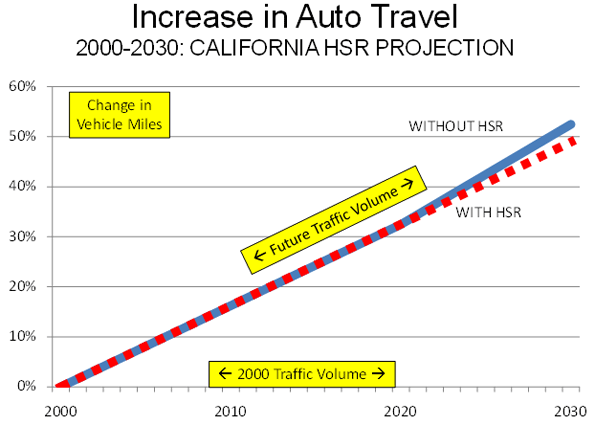
    Ridership and Relieving Congestion: High Speed Rail is also promoted by the Administration, which claims it will reduce traffic congestion. This claim is fraught with difficulty. First, highway traffic congestion is almost exclusively within urban areas, not between the urban areas that HSR would serve. Data from the California promoters indicates that traffic levels would rise nearly as much with HSR as without it. HSR is projected to reduce traffic by less than 3 percent once the system is complete. Without high speed rail, traffic volumes would increase 52 percent and without high speed rail, traffic volumes would increase 49 percent above 2000 levels (See Figure). In either case, things would be far worse in the future than they are today. And if HSR can make so little difference in congested California, it will surely do less in other parts of the country.

    Similarly, HSR will have little or no impact on the need to expand airports. For example, the Bay Area’s regional airport plan noted that high speed rail “would not divert enough passengers to make up for the shortfall in runway capacity.”

    In France and Japan, where travel is far more concentrated due to the linear location of major urban areas and the smaller number of large metropolitan centers, markets that are well served by HSR still have significant airline traffic (Tokyo to Osaka and Paris to Marseille). Also worth noting, both nations boasted pre-existing rail ridership levels that account for much of the HSR volumes. There is no such foundation in the United States. The ridership issue is particularly important, because of the miserable record of transportation ridership projections both in the United States and around the world. A most recent example is the Taiwan high speed rail system, which according to the early projections of promoters was to carry 180,000 passengers per day in its early operations. Yet in its second year of operation (2008), the average daily ridership was less than one-half that projection (84,000, calculated from Taiwan government data). This is telling in a country with notoriously congested traffic and very few major urban centers,

    This strategy of exaggerating ridership claims (and grossly under-estimating costs) is widespread in rail projects and has been extensively documented in Megaprojects and Risks: An Analysis of Ambition, by international scholars Bent Flyvbjerg, Nils Bruzelius and Werner Rothengatter (available from booksellers). The Taiwan and other international experiences suggest a major HSR investment would cost the taxpayers many additional billions and could bankrupt any private investors.

    Greenhouse Gas Emissions: But perhaps the most misleading claims are related to greenhouse gas (GHG) emissions. It starts with the marketing. The Administration’s press release indicates that building all of its routes would reduce GHG emissions by “six billion pounds” annually. This sounds like a big number. It is akin to my characterizing my weight as nearly 100,000 grams, instead of the pounds (200 in my case) that is customary in talking about weight. In GHG emissions, we do not talk about pounds, we talk about metric tons. Six billion pounds is only 2.7 million metric tons (2,205 pounds), which is an infinitesimal share of the GHG emissions from the nation’s passenger transportation. Indeed, given the propensity of the consultants to produce ridership projections less accurate than “Vietnam body counts,” the figure is probably less.

    The Administration falls into the usual trap of assuming that theoretical differences in GHG emissions can be turned into radical changes in travel patterns and behavior. The GHG emissions per passenger mile may be less (at least before the coming improvements in vehicle technology) but that does not mean that enough passenger miles can be moved from cars (and planes) to make a material difference. Our experience in high cost urban rail projects should have taught us this.

    Moreover, a mere reduction in GHG emissions is not sufficient to justify adoption of a strategy. Strategies must be prioritized based upon their effectiveness, and that is measured by cost. On this score, the California HSR system fails to a degree that is incomprehensible. The Intergovernmental Panel on Climate Change (IPCC) has indicated that the cost of GHG emission reduction should be no more than from $20 to $50 per ton. Even that may be too high. For example, Al Gore, Governor Schwarzenegger and Speaker of the House of Representatives Nancy Pelosi studiously buy carbon offsets for the tons of GHG that they produce flying around the country. The current market rate for such offsets is under $15.

    The California High Speed Rail Authority, whose leadership touts its GHG emissions reduction potential constantly, did not even bother to look at the cost of GHG emission removal in its thousands of pages of expensive, taxpayer financed reports. We looked at the issue, using California High Speed Rail Authority and California Air Resources Board assumptions and found that the cost per ton of GHG emission removal would be nearly $2,000, or 40 times the maximum figure used by the IPCC. To illustrate how extravagant a figure that is, if the nation were to reduce its GHG emissions by 80 percent (as proposed by the Administration) at the same rate, the annual cost would be more than 75 percent of the gross domestic product.

    But that assumes all of the rosy cost and ridership projections. The figure could be as high as $10,000 per GHG ton, if the consultants have exaggerated as much in California as elsewhere.

    Conclusion: It is likely that the same arguments can be made even more strongly in other proposed high speed rail markets. Yet, as costly as it is, HSR would be no more objectionable than building a new hardware store if it were paid for by its users. However, when taxpayers are asked to foot the bill, objective analysis of the claims, costs and benefits should at least have some priority. These are issues that an Administration committed to reducing GHG emissions by 80 percent has an interest in addressing. Relying on folklore rather than reality, as seems to be the present case, reflect an abject naivety at the least and incredible foolhardiness at the worst.

    Wendell Cox is a Visiting Professor, Conservatoire National des Arts et Metiers, Paris. He was born in Los Angeles and was appointed to three terms on the Los Angeles County Transportation Commission by Mayor Tom Bradley. He is the author of “War on the Dream: How Anti-Sprawl Policy Threatens the Quality of Life.

  • We Must Remember Manufacturing

    General Motors‘ reorganization and contemplated bankruptcy represents one possible – and dismal – future trajectory for American manufacturing.

    Unlike highly favored Wall Street, which now employs fancy financial footwork to report a return to profitability, the nation’s industrial core is increasingly marginalized by an administration that appears anxious to embrace a decidedly post-industrial future.

    Indeed, a recent survey of manufacturers found that most see the stimulus as only “slightly effective” for them. This is no surprise, since the lion’s share of the $800 billion is going to bolster the banks, with scraps spread out to green projects, health care and education.

    The administration’s priorities reflect a new political consciousness that, if not openly anti-industrial, seems to minimize manufacturing’s role in the nation’s long-term future.

    Just examine the demands placed upon General Motors and Chrysler. Their workers are being asked to make huge sacrifices – 1,600 new layoffs announced just this weekwhile their executives are largely shunned and demeaned compared with the generally more gentle treatment Wall Street malefactors get.

    This disparity reflects the close ties between Treasury Secretary Timothy Geithner, chief economic adviser Larry Summers and other top administration officials with the increasingly Democratic financial elite.

    Perhaps most revealing has been the somewhat bizarre choice to make mega-contributor and investment banker Steve Rattner as the “car czar” overlooking Detroit’s fate. Rattner, after all, has limited experience with the auto industry. (His expertise is largely in media.) “About all he knows about cars,” joked one person who has worked with him, “is that his chauffeur drives one.”

    Rattner may yet lose his post because of his involvement in New York’s latest pension fund scandal – but his appointment speaks volumes about the disdain with which the administration views the industrial economy.

    It also reflects an attitude – common among the academics, financiers and high-tech executives closest to the administration – that “smart” people can solve any problem better than someone with more hands-on experience but perhaps a less lofty IQ or a less tony advanced degree.

    To be sure, we should be wary of an approach like the Bush administration’s well-demonstrated embrace of mediocrity. But it is also dangerous to embrace a mindset that disdains all practical skill and areas of business not dominated by the cognitive elite.

    These days this mentality appears alongside an overall contempt for the tangible economy. Very few Obama appointees have ties to the country’s core productive sectors: manufacturing, agriculture, energy. Veterans of investment banking, academia or the public sector, they seem to see the economy more in terms of making media, images and trades – as opposed to actually making things.

    Such an approach also reinforces the administration’s surprising radicalism on the environmental front. Most industrial firms understand that precipitous moves to limit greenhouse gases and decimate domestic fossil fuels threaten America’s international competitiveness. Apparently, patience with and sympathetic understanding for Wall Street’s foibles is one thing; figuring out sustainable economic and energy policies that are friendly to industry is another.

    Unless something is done soon, the Obama policy could end up eroding more than just the nation’s industrial base. The president’s much-ballyhooed expansion of “green jobs” to make up for massive manufacturing layoffs worked well on the stump – but in reality it’s largely a fantasy.

    Certainly windmills and solar panels won’t rescue many of the communities at the bottom of our recent list of best cities for job growth. Industrial towns like Lansing and Flint, Mich., as well as Janesville, Wisc. may only see more devastation.

    Since 2007, these areas have lost somewhere between 15% and 25% of their industrial jobs. In Flint, nearly half have disappeared since 2003. These are the places where the American dream is dying most rapidly; Big Three bastions Michigan and Ohio have seen the quickest declines in per-capita incomes for most of this decade.

    The situation may be getting worse. Industrial decline could even be spreading to areas – like Houston, Texas, Fargo, N.D., Tulsa, Okla., or Anchorage, Alaska – that have actually been gaining industrial jobs. One culprit here may prove to be the administration’s anti-fossil fuels agenda, which could undermine even healthy firms and healthy regions. Even if Congress refuses to approve draconian rules for cap and trade or new taxes on greenhouse gas emissions, the “green” agenda could be imposed by the federal apparat anyway, through bureaucratic fiat. One harbinger could be the EPA’s recent actions to regulate carbon dioxide as a pollutant.

    All this doesn’t bode well for the country’s prosperity and for the prospects of millions of Americans. As demographer Richard Morrill has pointed out, traditionally, regions with industrial economies have been more egalitarian than the finance-driven areas. If this anti-manufacturing trend continues, more of America will resemble New York, Los Angeles or Chicago, places sharply divided between a growing class of low-wage workers and a relative few hegemons in finance, academia and media.

    Perhaps even worse, by stimulating everything but industry, the administration risks accelerating the very imbalance between production and consumption that is one key reason for the nation’s economic woes. Padding incomes by handing out money without increasing production may indeed prove a great way to stimulate economies – that is, those of industrial exporters like Germany, Japan and, most critically, China.

    Over time, Republicans may try to make these points. But economic conservatives have tended, if anything, to be at least equally clueless about the importance of industry. As far back as 1984 – the peak of the Reagan era – the New York Stock Exchange issued a report stating that “a strong manufacturing economy is not a requisite for a prosperous economy.”

    Disdain for industry has since grown as industrial employment has ebbed and the finance, service and media industries – and other non-tangible fields – have gained workers. Yet few understand how a swelling manufacturing trade deficit, which has grown ten-fold since 1984 to over $800 billion in 2007, has undermined the nation’s financial position. It has shifted so much wealth to countries focused on productive industry and energy.

    In the long run, too, it’s not just forlorn factory towns that get hurt. A strong manufacturing sector also boosts science and technology; the industrial workforce is increasingly dominated by engineers and highly trained technicians, many of whom are in increasingly short supply. Marketers, media firms, advertising agencies and software companies all benefit when industry expands.

    Fortunately, the situation isn’t hopeless. Despite commonly held assumptions, American can still compete industrially – and could do even better with the right investments in both human and physical infrastructure. In fact, despite unfavorable trade policies and growing regulatory burdens, American factories have remained among the most productive in the world; output has doubled over the past 25 years, and productivity has grown at a rate twice that of the rest of the economy.

    Clearly, not all American factories are run by the kind of boobs who governed General Motors and other failed enterprises. A 2008 McKinsey study noted American factories actually were, on average, considered the best-managed in the world – ahead, albeit slightly, of competitors based in advanced nations like Germany, Sweden and Japan, and considerably better than their counterparts in key emerging competitors China and India.

    To take advantage of these assets, American industry needs government to recognize their importance. We need incentives for improved productivity and investment, including ones for those companies employing “green” technologies. Another step would be to include accurate “carbon accounting” of goods produced elsewhere – particularly in places like China, whose production tends to generate more pollutants than those in more regulated countries like the U.S. Greening may be good, but it should not become another excuse for American de-industrialization.

    Finally, President Obama should recognize that expanding industry presents some of our best chances for future growth. Once the world recovers from the current financial crisis, there will be another surge in demand, particularly from developing countries, for the basic products that the U.S. can produce at prodigious levels, such as foodstuffs and airplanes, as well as farm, energy and construction equipment. The strategic opening for American firms may indeed be greater than any other time since the years after World War II.

    “We’re in the midst of 2 to 4 billion people around the world rising out of abject poverty and demanding a better living standard,” notes Daniel R. DiMicco, head of Nucor, the nation’s largest steelmaker. “That means we have a 20- to 30-year bull market in basic stuff.”

    Hopefully the Obama administration will overcome its preoccupation with post-industrial and green industries and allow American firms and workers to take advantage of this historic opportunity. If they fail to do so, the Great Lakes, Appalachia, parts of the Southeast and other regions can expect ever more economic devastation. Rather than delivering much-anticipated “hope” to the most beleaguered parts of the country, the administration could instead leave a legacy of wasted potential and economic misery that will haunt communities, and the entire country, for generations.

    This article originally appeared at Forbes.

    Joel Kotkin is executive editor of NewGeography.com and is a presidential fellow in urban futures at Chapman University. He is author of The City: A Global History and is finishing a book on the American future.