Tag: Energy

  • Why Today’s Green Era May Fail

    Much of the debate about ways to create a landscape of green homes today has focused on the new tax credits for residential energy efficient windows, solar panels and geothermal options. Passive solar and other design methods which make more sense have yet to qualify for tax credits. If history is any guide, this is an error that may take us down the wrong path.

    Yesterday And Today

    To best understand the direction of today’s green movement, let’s remember the first green era, when the Carter Administration offered a 50% tax credit to solve our energy consumption and pollution problems. The most prolific of the tax financed energy saving devices were unsightly rooftop solar water heaters that marred the suburban landscape. Those solar units cost $5,000 or more installed (1983 dollars). So you, the tax payer, financed $2,500 per home. Unfortunately the heaters had a short life span. Over a decade most wore out and disappeared. The good news was the developed landscape looked better without those things … the bad news was the tax payers likely paid billions for systems that quickly failed.

    Back then, I too was a participant in this green era. I built a 1980’s state-of-the-art home: Passive solar, earth bermed, with a 10kW Bergey Wind Generator, of which the tax payers reimbursed me $13,000.

    With “passive” solar, the sun heats up a dark brick floor in the home, which in turn heats the home on a sunny winter day. In the picture here, you can see the south-facing windows, which allow the sun through to heat the dark tile floors. The bricks were built upon a thick concrete base which stored heat over-night; this is known as the “battery”. No complex systems are needed as the home itself is the collector. It proved to work well.

    The City of Maple Grove, Minnesota, where the home was located, had passed a Wind Generator Ordinance allowing a 100 foot tall wind system to be built on a small city lot with just a permit. Perhaps it was the first city in the country with such a ruling.

    So we constructed a 100’ tall tower with a 10kW Bergey Wind System with its 23 foot diameter blades. A quarter century before today’s Green movement, we had a “Net-Zero” home (it produced more energy than it used).

    The neighbors however, were not enthused, and waged a war against the city, resulting in Maple Grove being the nations first city to repeal a Wind Generator ordinance. Years after the construction, the City made a large offer and bought the generator from me. There was no recovery from the tax laws, so I got to keep the $13,000 credit.

    In 1983 this home cost about $121,000. Twelve years later it was appraised at $186,000. It’s architectural oddity severely limited it’s resale potential. In those years of good home appreciation, had it been a conventionally built, the nearly 4,000 sq.ft. lake front home should have been worth a minimum of $350,000. I had lost nearly $200,000 by going green. In fairness the loss was due to the underground construction and lack of curb appeal, and had nothing to do with its passive solar design, which is why we used passive solar again on our new home.

    Late in 2008, I found myself building Green again, this time as a requirement of a land purchase I made from the City of St. Louis Park, Minnesota. I had to agree to build to MNGreenStar certification, a derivative of LEED modified for severe cold climates.

    This time, in a similar situation to the ‘80s, the housing market downturn coincides with an increase in energy awareness and we have a government controlled by the Democratic Party. We have not found any new Green solutions that simultaneously reduce both initial housing costs and energy consumption. It seems that higher an EnergyStar rating on an item, the more expensive it becomes. The option today still remains to pay more now, for the promise of reduced costs later.

    With most Green ratings there is a list of requirements (with MNGreenstar the “list” is 36 pages long in tiny sized fonts) the builder must contend with to earn “points”. MNGreenstar is modeled after LEED which also contains many “social engineering” requirements.

    I also had my builder, Creek Hill Custom Homes, apply for National Association of Home Builders “Green” certification. My Certification comes with a HERS Rating of 59. I have no idea what that means but I’m told it’s pretty good. It’s on an EnergyStar sticker for the entire house.

    Why Passive Solar instead of Geothermal?

    Since Passive Solar is a very low cost design method and our home has a large unobstructed southern exposure, it simply made sense. This first winter the passive solar was inoperable because we discovered Anderson delivered the wrong glass, reflecting the suns energy out, not letting it in. Regardless, our first gas bill for the January 2009 winter (most days the high was below zero) heating period bill was only $200 at a nice and toasty 72 degrees . We used a conventional 95% Bryant HVAC system with a 3 phase air exchanger, plus a separate gas heater for the garage, a 14,000 BTU Fireplace, and three separate gas cooktops – and 3,600 sq.ft. to heat.

    Considering that the average home sells every 6 years, a home buyer is not likely to recover the initial investment on a $20,000 to $60,000 geothermal system, leaving the cost benefit a future home buyer. There is likely to be a significant long term mortgage on the home, so the interest on a $40,000 geothermal system might eventually add up to over $100,000.

    According to a December 2008 study and report by Oak Ridge Laboratory for the US Energy Department, Geothermal Systems should reduce energy consumption 30% to 35% compared to typical conventional systems (not specifying what “typical” means). On our home savings in January, the coldest month in a decade, would have been only $66. At best we would save $500 annually with Geothermal. If we spent an extra $40,000 for geothermal payback ( even after factoring in the new 30% tax credit) it would take almost half a century ( without factoring interest). I’d be 108 years old by then.

    Had Anderson delivered the correct glass, our heating bill would have been much less than an active complex system (geothermal); there are no moving parts to passive solar.

    Sustainable Green

    We need efficient housing for the mass market home buyer at attainable pricing to make the largest difference. We desperately need many more newer and better technologies and methods than we have today. This will take the same type of research and development effort that the automotive industry maintains to be competitive. Twenty five years ago our government spent enormous amounts of tax payer dollars on grants for programs that no longer exist. We are entering a new era where government will likely make huge funds available for energy related technologies.

    How did the housing industry respond when consumers stopped buying? Why didn’t builders respond by going back to the drawing board to develop innovative and efficient affordable home construction? Where has that good old American innovation gone? We need real solutions that work this time around and we need them to be at prices the average home buyer can afford.

    Those applying for grants should show proof of concept of ideas in working prototypes before any money is released to reimburse their efforts. Even then, green still won’t take off unless this next problem is solved.

    Appraising the Situation… Or Not.

    This may come as a shock, but the home appraisal business does not factor in green at all. Not even those items that actually can clearly demonstrate a quick payback. Certainly a soy derived counter top (with questionable service life) won’t win over the bank, but there are sustainable green solutions. So, what good does winning Silver, Gold or Platinum Green Certification mean if the home is not worth a cent more for financing? To the average consumer what’s most important is valuation for financing. Because the appraisals give no extra value for highly energy efficient homes, lenders see no advantage to green certification. Fix the appraisal and mortgage side of green and there is hope.

    Are we Headed In The Wrong Direction?

    In some ways these difficult to comply with “go for the Gold” certification programs create roadblocks to success by adding unnecessary complexity and costs. The new tax credits for energy efficient windows, solar panels, geothermal, and wind energy ignore passive solar and other design methods which make more sense, yet earn no tax credits. New home construction is much easier than retrofitting an old home to be efficient, yet there are few tax benefits if building new. The middle class is unlikely to finance home improvements even with a 30% tax credit. Most likely only the wealthy can access funds to retrofit a home today, and take advantage of the tax credits. If we continue on the current path, this green era will fail, and in another quarter century the next generation will try again.

    Rick Harrison is President of Rick Harrison Site Design Studio and Author of Prefurbia: Reinventing The Suburbs From Disdainable To Sustainable. His websites are rhsdplanning.com and April 19, 2009
  • Beyond the Stimulus: Time to Get Real

    In remarks on Friday following a meeting with Fed Chairman Ben Bernanke and Sheila Bair, Chair of the Federal Deposit Insurance Corporation, President Obama pointed to some “glimmers of hope” in the economy, and indeed a few green shoots – rising mortgage refinancings and a slight uptick in durable goods orders – have appeared in recent weeks.

    But the economy is still in trouble. Don’t bet what remains of your 401K on the White House’s optimistic growth forecasts of the economy rebounding to 3.2 percent to 2010 and then improving to more than 4 percent on average for the next three years. Given the damage the housing and credit bubbles have done to the economy and the inadequacies of the administration’s economic recovery program, these growth assumptions are unrealistic. If anything, we will eventually need another better directed stimulus package before we see the kind of sustained economic growth the White House is predicting for the years beyond 2010.

    With its growth forecasts, the President’s economic team is betting on a sustainable V-shaped recovery typical of a normal business-cycle downturn. But as his team knows, this was not a normal business-cycle recession. For one thing, consumer spending is unlikely to return to its bubble-year levels given high household debt levels, slumping home prices, and constraints on credit expansion. In addition, unemployment is not expected to peak well in double digits until later in 2010, and thus it will put downward pressure on wages and incomes for some time to come. There are also serious impediments to increased business investment, not least of which is the fact that businesses have little incentive to invest given weak demand and excess capacity in many sectors.

    To be sure, Obama’s economic recovery program will help soften the economy’s fall as households and the financial system deleverage and rebuild their balance sheets. But it fails tragically to put the economy on a new more sustainable growth path. First, the $787 economic recovery program passed by Congress in February is too unfocused, too scattered over many areas, and too concerned with social spending to create a big new source of economic growth given likely lower levels of consumption in the future.
    The administration’s much-hyped green investment agenda comes to about $17 billion a year, far short of what is needed to create a new driver of investment and job creation.

    Indeed, on balance, the White House’s green energy agenda could actually become a drag on any economic recovery. The administration’s proposals for doubling the contribution of renewable energy by 2012 will make at best a modest contribution to energy supply. (Together, wind and solar sources produce only 1.1 percent of America’s electricity consumption and a far smaller percentage of all energy use.)

    Meanwhile, the cut-back in the domestic exploration of oil and gas, caused by falling prices and by Obama’s withdrawal of incentives for exploration, seems likely to reduce the domestic supply of energy by as much or even more. This a prescription for a new spike in energy prices that could snuff out any recovery just as it gets going. In the short term the administration’s green investment agenda may actually cost the economy jobs in the energy sector and lead to higher imports of foreign oil.

    Second, the economic recovery program is too concerned with short-term consumption as opposed to long-term investments in our public infrastructure that can create jobs and improve U.S. productivity. The White House estimates that the economic recovery program will create or save at most 3.5 million jobs over two years. Private forecasters are less optimistic and put the number at less than three million. But given the scale of job losses (now running at more than 600,000 per month) created by this recession, the economy will need to create 9 million more jobs to return the economy to something approaching full employment. Wages therefore are not likely to show any significant improvement any time soon, thereby eliminating the possibility of wage and income-led growth in the short-term. At the same time, weak private and public investment will undercut future gains in productivity, eroding the foundation for long-term income gains.

    Third, a sustainable economic recovery depends upon a strengthened tradable goods sector and a sustainable improvement in our trade balance. In order to work our way out of the debt accumulated during this crisis and, at the same time, improve American living standards, we will need to export more and import less. But the Obama economic recovery program will at best provide only a modest boost to America’s manufacturing sector. The most important help will come from the increased infrastructure spending included in the economic recovery program and the 2010 budget. Good basic infrastructure is critical to the success of American-based manufacturing companies, and the program will create some improvements in this area and relieve some bottlenecks that are now preventing increased investment.

    There are, however, other aspects of the Obama program that are much less favorable to the strengthening of manufacturing. As suggested earlier, the Obama green energy strategy will raise the cost of energy to American producers, and thus create new disincentives to business investment. In recent days, the White House has backed away from the president’s ambitious proposals for cap-and-trade, but some Congressional members of the President’s party are determined to push forward with this misguided policy.

    An improved trade balance also depends upon stronger global demand, critical if the exports are to increase in the months ahead. The president understands the importance of rebalancing the global economy with the large current account surplus economies consuming more and saving less. But even though the president received high marks for his recent European trip, he gave up more than he received in this area. Large current-account economies like China and Germany need to increase their fiscal stimulus to encourage more consumption. But in face of resistance from Germany and France, the administration quietly dropped its call for G-20 countries to commit to a modest 2 percent of GDP target for fiscal expansion. At the same time, the administration pledged to resist Buy America provisions and other measures that would ensure that the US stimulus does not leak out of the economy and help economies free-riding off world demand. As a result, once again the U.S. economy will bear a disproportionate burden in pulling the world economy out of a deep recession.

    The basic point here: The administration’s program is not properly structured to create a bridge to a new healthy pattern of economic growth. It is too reliant on the Federal Reserve and its program of quantative easing. At best, this will create a pale version of the debt-financed consumption-led economic growth that we experienced over the last five years – with a new bubble forming in commodities and energy that will act as a drag on a sustained economic recovery. The economy may experience a short recovery that will peter out into a prolonged slow-growth recession with high unemployment as stimulus dries up and energy prices begin to rise

    So how do we avoid this prospect? We need a second economic recovery program, one that focuses on the economic basics of encouraging real investment and demand creation. This economic recovery program would be more strategically focused on creating jobs with more emphasis on investment in America’s tradable goods sector. It would include the following features:

    • A temporary payroll tax cut to help restore the purchasing power of working families and to reduce the cost to employers of retaining or hiring new workers.
    • A greatly expanded long-term public infrastructure investment program that would commit the country to spend 1 percent of GDP beyond current spending to build the infrastructure needed for the 21st century
    • A crash oil and gas exploration energy program, combined with a program to convert part of our transportation fleet to natural gas by 2012, to complement Obama’s renewable energy initiative.
    • A cut in the corporate income tax to draw capital back to the United States and help spur onshoring of investment and jobs.
    • A jobs training program that would provide paid apprenticeships in fields and industries reporting shortages before the economic recession.

    This economic recovery plan should be accompanied by a new global diplomatic initiative that would push for new rules of trade and investment that would force chronic current account surplus economies to expand domestic demand and increase support for international development. If successful, such a global rebalancing plan would increase demand for U.S. good and services. This together with the domestic measures above would enable us to reduce America’s trade deficit and to stimulate private investment and job creation in our tradable goods sector.

    This program would represent a real sustainable economic stimulus for the country because it would create a new pattern of economic growth – one that no longer relies on debt-financed consumption but focuses instead on raising real wages and incomes through investment and job creation in America’s productive economy.

    Sherle Schwenninger directs the New America Foundation’s Economic Growth Program and the Global Middle Class Initiative. He is also the former director of the Bernard L. Schwartz Fellows Program.

  • Greenhouse Gas Emissions and Reality: Residential Emissions

    In the quest to sufficiently reduce greenhouse gas (GHG) emissions, it is crucial to “get the numbers right.” Failure to do so would, in all probability, mean that the desired reductions will not be achieved. Regrettably, much of what is being proposed is not based upon any comprehensive quantitative analysis, but is rather rooted in anti-suburban dogma.

    Further, ideologically based approaches carry the risk of severe economic and social disruption, which could make it even more difficult, in a political world, to reach GHG emission reduction objectives. Unconsidered attacks on suburbs could also backfire, setting back more reasonable attempts to reduce emissions over time.

    For example, a recent New York Times blog entitled “The Only Solution is to Move” presumed it a necessity to (1) move from the suburbs to the city, where (2) “you are near everything you need” and to (3) abandon cars, which the author contends “cannot be reformed.” This screed provides an ideal point of reference. We start with the comparative GHG emissions efficiency of suburbs and deal with the other issues in future articles.

    The Need for Comprehensiveness: Any plausible attempt to reduce GHG emissions must start with a comprehensive understanding of the issue, including the comparative GHG intensity of various types of living and mobility patterns.

    This requires a “top down” analysis of GHG emissions by mode and locality. Such an analysis must start with the gross GHG emissions in a nation and allocate each gram to a consuming household. A household allocation is necessary, because businesses emit GHGs only to satisfy the immediate or eventual demand of consumers. “Top down” is required because that is the only way to make sure the analysis includes everything. The typical “bottom up” analysis runs the risk of missing large amounts of emissions as analysts highlight their own “hobby horse” sources, while excluding the inconvenient. This is why we have “double entry” bookkeeping – to make sure that the sums balance.

    “Top down” comprehensiveness has been best developed by the Australian Conservation Foundation (ACF) Consumption Atlas, which is the only study I have found that allocates every gram of GHG emissions in a nation to households. That is a minimum requirement.

    Residential GHG Emissions

    Having reviewed the need for comprehensiveness, the balance of this article will deal with residential GHG emissions. Despite all the airtime – and trees – sacrificed for lengthy columns on GHG emissions, it is clear that the state of the research in the United States remains abysmal.

    GHG Emissions: A Function of House Size: Research has been published that suggests the dominant suburban housing form (the detached single-family dwelling) is more GHG intensive than more urban, multi-unit and high-rise apartment and condominium housing forms. However, the entire supposed city versus suburbs advantage relates to house size. The Department of Energy’s Residential Energy Conservation Survey (RECS) data shows that the energy consumption per square foot is 70 percent higher in residential buildings with five or more units (the largest building size reported upon) than in detached houses. Full disclosure on the part of the anti-suburban crowd would require telling people that their conclusions would mean much smaller house sizes.

    Common Area GHG Emissions: There is, however, a far more fundamental problem. The databases usually relied upon (The Bureau of the Census’s PUMS and the Energy Department’s RCES), as cited in the USDOE 2008 Buildings Energy Data Book, do not provide sufficient information to demonstrate any high-density GHG emissions advantage.

    None of these data sources include the GHG emissions from “common” energy consumption in multi-unit residential buildings. Their information is limited to energy consumption as directly billed to consumers. Thus, in a high-rise building, common energy consumption sources such as elevators, common area lighting, parking lot lighting, swimming pool heating, common heating, common water heating, common air conditioning, etc. are not included. Detached housing generally does not have common energy consumption.

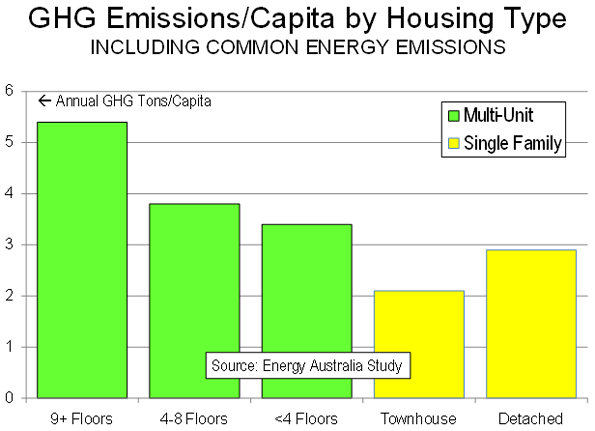
    The “common” consumption omission is serious. Other Australian research indicates how inaccurate consumer based inventories can be. Energy Australia has showed that, in the Sydney area, GHG emissions per capita, including common consumption, in high-rise residential buildings are 85 percent greater than in single family detached dwellings. Other multiple unit buildings are also more GHG intensive, while townhouses (row houses) are the best (see Figure).

    The inclusion of common consumption may be a principal reason why the ACF data associates lower GHG emissions with single family detached housing.

    Construction Materials: There is a further complicating factor. The materials that must be used to construct high-rise residential buildings, chiefly concrete and steel, are far more GHG intensive than the wood used in most single family dwelling construction. A 1997 Netherlands study indicates that the GHG emissions per square foot of high rise construction may be as much as five times that of a detached dwelling. In the newest energy efficient housing, the same study finds that the GHG emissions, over a building’s lifetime, can be greater than the emissions from day to day operation. The report notes that construction materials will become more important in residential GHG emissions, because improvements in routine energy consumption are likely to be more significant than those in building materials production.

    Then there is the issue of the GHG emissions in the construction process. It would not be surprising, for example, if heavy cranes could also tip the balance against high-rise towers.

    Dynamic Rather Than Static Analysis: Anyone who has studied economics understands the importance of “dynamic” versus “static” analysis. Dynamic analysis takes account of likely changes, while static analysis assumes that everything will continue to be as it is today. Much of the research on residential GHG emissions is based upon a static analysis. Yet, the housing stock (like the automobile stock) was largely produced during a time when there was little policy incentive to reduce GHG emissions. We are entering what may well be a very different policy environment. The comparatively recent emphasis on GHG emissions is producing a plethora of ideas, research and solutions. A recent Chicago Tribune article noted a surge in university graduates interested in research to reduce the GHG intensity of energy. The zero emission suburban house is on the horizon, which could take housing form “off the table” as a GHG emission issue and render static research to the internet equivalent of rarely accessed library stacks. Dynamic analysis asks “what can be,” not just “what is.”

    Cost per GHG Ton Reduced: All of this raises a question about how to identify policy strategies. The answer is to compare costs. The Intergovernmental Panel on Climate Change suggests that the maximum costs should be on the order of $20 to $50 per ton. McKinsey has published research indicating that steep reductions can be produced in the United States at less than $50 per ton.

    Yet, the costs of GHG emissions reduction are as absent from much of the present literature as the GHG emissions from elevators in high-rise towers. But costs are important. Economic and social disruption is likely to be greater to the extent that people are forced to change their lives. There is a big difference between requiring people to reduce their emissions where they live versus trying to uproot them – as well as their families and business – to urban cores. The former offers the hope of achieving sufficient GHG emission reductions, while the latter promises to incite a bitter fight between the bulk of the middle class and the regulatory apparatus. All this with a high probability that GHG emissions will not be sufficiently reduced.

    The Bottom Line: Outside some in the urban planning community, there is no lobby for reducing people’s standard of living. At least with respect to residential development and housing form, this does not appear to be necessary. The common area and construction GHG impacts of high-rise condominium buildings could well be greater both per capita and per square foot than those of detached housing. There is no need to force a move into a futuristic Corbusian landscape of skyscrapers. Indeed, it could even make things worse – for households, communities and even the environment.


    Previous posts on this subject:
    Regulating People or Regulating Greenhouse Gases?
    Greenhouse Gas Reduction Policy: From Rhetoric to Reason
    Enough “Cowboy” Greenhouse Gas Reduction Policies

  • Baby Boomers: The Generation That Lost America

    Tom Brokaw named our parents The Greatest Generation. They came of age during The Great Depression and defeated Fascism, Nazism and Communism. They built the Interstate Highway System and landed a man on the moon. They built the great American middle class with safe communities and public schools that were the envy of the world. They deserve the title of The Greatest Generation. One of their few criticisms is that they spoiled us boomers, adhering to the teaching of Dr. Benjamin Spock.

    I am 59 years old and a child of perhaps the most indulged and impatient generation in history. I fear we may also become known as the generation that lost the American Dream. The Baby Boomers have rejected personal responsibility and exhibited a lack of mental discipline that could have enormous implications for the future.

    The United States House of Representatives, now overwhelmingly controlled by the Boomers, signed a $787 billion legislative “stimulus” package comprised of 1,071 pages and a hefty 8 pounds. Not one legislator read the bill before signing it. Months later, the same House members publicly screamed at the corrupt executives of AIG who received bonuses in 2008 – bonuses specifically allowed in the very legislation they passed without reading.

    This abandonment of personal responsibilities by the Lost Generation took on historic significance on January 20, 1993. That’s when the first President Bush, a member of the Greatest Generation, was replaced with President William Jefferson Clinton, the first Baby-Boomer to reach the Presidency. The Clinton presidency was notorious for its personal indulgence – and not just by introducing oral sex to the Oval Office. During Clinton’s watch, 100,000 Islamic terrorists were trained in camps in Afghanistan while terrorist strikes against American interests went unanswered. Clinton failed to respond to the attack on the USS Cole that killed 17 servicemen. Our enemies grew emboldened believing that America did not take their deadly threats seriously. On September 11th 2,996 American civilians died in part because the government did not see its first priority to be protecting them.

    Also under President Clinton, the Federal Government in 1999 relaxed Fannie Mae and Freddie Mac’s requirements of home mortgages. The decades old formula of 20% down and a 30 year fixed mortgage that allowed the Greatest Generation to lift home ownership to more than 60% was replaced with an array of instruments including sub-prime loans, “no-doc” applications where income was not verified, and teaser rates of 1%. Such tinkering led to unqualified purchasers with 100% financing pushing home values up at 20% per year. The bubble burst in 2007 with disastrous consequences. The heads of Fannie Mae and Freddie Mac made tens of millions in annual salary. Despite the calamitous consequences of their stewardship, no one was fired.

    Another Boomer, George W. Bush followed Clinton and continued the Lost Generation’s abdication of personal responsibility. He also failed to comprehend the extremist Islamic threat. Again, no one was fired. On December 12, 2002, George Tenet, fellow Baby-Boomer and Director of the CIA assured President Bush the case that Saddam Hussein had weapons of mass destruction was a “slam dunk”. President Bush authorized the invasion of a sovereign nation based on that intelligence. No weapons of mass destruction were found. America’s soldiers inherited a broken country and hundreds of billions of responsibilities. No one, including George Tenet, lost their job. In fact, on December 14, 2004, President Bush awarded Tenet the Presidential Medal of Freedom.

    On August 29, 2005, Hurricane Katrina slammed into Louisiana and Mississippi as a Category 3 hurricane. The result was catastrophic. The levees were breached and 1,836 Americans lost their lives. Americans watched in horror as police abandoned their positions, and the National Guard struggled to protect the trapped citizens who could not evacuate. Dead bodies lay uncollected in the streets. No one will forget the scene of 60,000 American refugees at the Louisiana Superdome without food, water or medical care for days. On national television, President Bush proclaimed, “Brownie, you’re doing a heck of a job.” Although three days later, FEMA Director, Michael D. Brown was forced to resign, no one else at FEMA was fired.

    In July 2008, gasoline prices hit a national average of more than $4.00 per gallon as demand outstripped supply pushing oil to $147 barrel. The Lost Generation howled in protest at the oil companies who were profiting from the pain of American citizens. This came as no surprise. The environmental movement had stopped production on both nuclear power plants and gasoline refineries. Congress banned oil exploration off America’s coastline. Congress decided that ANWAR, a barren strip of coastal Alaska the size of Logan Airport in Boston, was off-limits to oil exploration. At $147 barrel, the Western economies were shipping more than $1 trillion dollars per year to the Persian Gulf to nations whose interests were simply not aligned with ours. Once again, our elected officials, dominated by boomers, abdicated their responsibility to keep America safe. Their inaction allowed our nation to become even more vulnerable to the oil weapon.

    In 1973, under President Carter, when the OPEC nations first used oil as a political weapon, America imported 30% of its daily oil quota. Yet not a word is mentioned by the Lost Generation expanding American production of oil to reduce this dependency. Yes, they talk of wind and solar energy – which collectively generate less than one percent of our energy – but no one has yet figured out how to power a car with wind or solar energy. After falling to $30 a barrel, oil has slowly crept back up over $50 a barrel – in a deep recession. When the recovery arrives, does anyone believe oil will not return to $100 barrel? Yet the Lost Generation sleeps with no energy policy in place and once again abdicates its responsibilities to a future generation.

    The same is true of Social Security. The Baby-Boomers are retiring now. The system is broken and there are not enough workers to make the transfers to the retirees. Do you hear anyone in Washington raising the red flag of warning? Once again, the Lost Generation has abdicated its responsibilities and kicked the can down the road.

    In the waning months of the Bush Administration, Treasury Secretary Paulson informed Congress that a $700 billion bail-out of the financial sector was needed to avoid a melt-down of our banking system. TARP, the Troubled Asset Relief Program was passed by the Congress in a matter of days. Only $350 billion was committed, banks were forced to accept TARP funds, and little of those funds made their way to acquire troubled assets. GM and Chrysler received $17 billion even though they had no “troubled assets.” Another $8 billion went to Sheik Mohammed in Dubai. He had no troubled assets either, and $1.6 billion was paid out in bank bonuses. AIG received $165 billion of TARP money and paid out $286 million in bonuses. No one in Congress anticipated the AIG bonuses when they signed the legislation that specifically allowed the payments. It does not end there.

    Franklin Raines, chief executive of Fannie Mae received $91.1 million in compensation from 1998 to 2004. In 1998, Fannie Mae stock was $75 per share. Today, Fannie Mae shares are worth 67 cents. Mr. Raines was not fired – he was simply hired as an economic advisor to President Elect Obama. Raines recently settled a civil lawsuit alleging fraud and stock manipulation for $31.4 million.

    Postmaster General John Potter received compensation of $800,000 in 2008 while the United States Post Office lost $2.8 billion. It is possible his $135,000 bonus was based on future performance. The USPS is projected to loss $6 billion in 2009. Postmaster Potter did not lose his job either.

    Our congressional representatives earn $174,000 per year for this fiscal oversight. Their congressional staff earns another $1.3 million per year plus too many perks to mention like free cars, airfare, and postage stamps.

    The very things that we took for granted as children of the Greatest Generation are now challenged. Home values have fallen dramatically. Our retirement accounts have been decimated. Our public schools are not working. Traditional allies no longer stand with America. Not surprisingly, most Americans fear their children will not be better off. The approval numbers for Congress are at an all-time low. Despite the vast number of problems facing our country in 2009, when Congress passed a Continuing Resolution in March 2009, it contained 8,500 earmarks of pork barrel spending confirming that this Congress is going to maintain business as usual.

    Dr. Spock wrote that our parents should not spank us and they should always bolster our self-esteem. That misguided advice led to the today’s climate of political correctness where the ideal of self-esteem outweighs the importance of performance, success or accomplishment.

    Consequently, the Lost Generation measures itself by its good intentions rather than by its accomplishments. Its good intentions led to policies that prohibited oil exploration off the coastlines. The result was $4.00 gasoline. Its good intentions of teaching all children in their native tongue was a good idea but the cost to do so weakened the overall education system in America. Its good intentions of helping poor families buy homes led to the sub-prime mess that has cost American families trillions in lost equity. In the last twelve months, under the dominant control of the Baby-Boom generation, America has witnessed $11 trillion of home and stock equities disappear.

    The Baby-Boomer’s move into retirement comes none too soon. Let the boomers in Congress retire at 65. We’ll even let them retire on the fat retirement plans they voted for themselves. But let’s get rid of them. The next generation can’t do much worse.

    Robert J. Cristiano Ph.D. has more than 25 years experience in real estate development in Southern California. He is a resident of Newport Beach, CA.

  • Enough “Cowboy” Greenhouse Gas Reduction Policies

    The world has embarked upon a campaign to reduce greenhouse gas (GHG) emissions. This is a serious challenge that will require focused policies rooted in reality. Regrettably, the political process sometimes falls far short of that objective. This is particularly so in the states of California and Washington, where ideology has crowded out rational analysis and the adoption of what can only be seen as reckless “cowboy” policies.

    Last year, California enacted Senate Bill 375, which seeks to reduce future GHG emissions by encouraging higher urban population densities and forcing more development to be near transit stations. Yet there is no objective analysis to suggest that such an approach will work. Of course, there are the usual slogans about people giving up their cars for transit and walking to work, but this occurs only in the minds of the ideologues. The forecasting models have been unable to predict any substantial reduction in automobile use, and, more importantly, such policies have never produced such a result.

    In fact, higher densities are likely to worsen the quality of life in California, while doing little, if anything to reduce GHG emissions. California already has the densest urban areas (which includes core cities and surrounding suburbs) in the United States. The Los Angeles urban area is 30 percent more dense than the New York urban area. The San Francisco and San Jose urban areas are also denser than the New York urban area. Sacramento stands as the 10th most dense among the 38 urban areas over 1,000,000 population, while Riverside-San Bernardino ranks 12th and San Diego ranks 13th.

    This high density creates the worst traffic congestion in the nation. The slower stop and go operation of cars in traffic congestion materially intensifies local air pollution and increases health hazards. It also consumes more gasoline, which increases GHG emissions. Finally, California’s prescriptive land use regulations have destroyed housing affordability. By the early 1990s, land use regulation had driven prices up well beyond national levels relative to incomes, according to Dartmouth’s William Fischell. Over the next decade the rationing effect of California’s excessive land use restrictions tripled house prices relative to incomes, setting up the mortgage meltdown and all that has followed in its wake.

    The implementation of Senate Bill 375’s provisions seems likely to make things worse. California’s urban areas already have plenty of dense “luxury” housing, much of which is now empty or is now converted from condos to rentals. Wherever they are clustered, particularly outside traditional urban centers like San Francisco, such areas experience intense traffic congestion, with all the resultant negative impact on both people and the environment.

    Yet despite the problems seen in California, the ideological plague has spread to Washington state. Last year the Washington legislature enacted a measure (House Bill 2815) that requires reductions in driving per capita, for the purpose of GHG emission reduction. By 2050, driving per capita is supposed to be halved. This year there was a legislative proposal, House Bill 1490, that would have mandated planning for 50 housing units to the acre within one-half mile of light rail stations. This would have amounted to a density of nearly 50,000 per square mile, 3 times the city of San Francisco, 7 times the density of the city of Seattle and more than that of any of more than 700 census tracts (small districts) in the three-county Seattle area. Areas around stations would be two-thirds as dense as Hong Kong, the world’s most dense urban area.
    The density requirement has since been amended out of the bill, but the fact that it made it so far in the legislature indicates how far the density mania has gone. The bill appears unlikely to pass this year.

    Extending the density planning regime is not likely to help the people on the ground, much less reduce GHGs. Seattle already has a housing affordability problem, which is not surprising given its prescriptive planning policies (called growth management or smart growth). Theo Eicher of the University of Washington has documented the close connection between Seattle’s regulatory structures and its house price increases.

    As in California, Seattle house prices rose dramatically during the housing bubble, nearly doubling relative to incomes. At the same time, much of the debate on House Bill 1490 has been over affordable housing. Yet there has been virtually no recognition of connection between Seattle’s low level of housing affordability and its destructive land use regulations. House Bill 1490 would have only made things worse, and still could. Proponents have indicated that they have not given up.

    The theory behind House Bill 1490 parallels that of California’s SB 375. It assumes high densities would significantly reduce driving and attract people to transit. As in California, however, this is based upon wishful thinking, and has no basis in reality. No urban area in the developed world has produced a material decline in automobile use through such policies.

    Regrettably, the special interest groups behind the California and Washington initiatives appear more interested in forcing people to change their lifestyles than in reducing GHG emissions. This is demonstrated by the Washington driving reduction requirement.

    A good faith attempt to reduce GHG emissions from cars would have targeted GHG emissions from cars, not the use of cars. The issue is GHG emission reduction, not behavior modification, and the more the special interests target people’s behavior, the clearer it becomes how facetious they are about reducing GHG emissions.

    Technology offers the most promise. Already the technology is available to substantially reduce GHG emissions by cars, without requiring people to change their lifestyles. Hybrids currently being sold obtain nearly three times the miles per gallon of the average personal vehicle (cars, personal trucks and sport utility vehicles) fleet. And that is before the promising developments in decades to come in alternative fuels and improved vehicle technology. In addition, the rapid increase in people working at home – a number on track to pass that of transit users by 2015 – would also represent a clear way to reduce GHG emissions.

    Finally it is not certain that suburban housing produces higher GHG emissions per capita than high rise urban development. The only comprehensive research on the subject was conducted in Australia and found that, generally, when all GHG emissions are considered, suburban areas emitted less per capita than higher density areas. This is partially because dense urbanites tend to live a high consumption lifestyle, by eating out at restaurants serving exotic foods, having summer homes and extensive travel. It is also because high density living requires energy consumption that does not occur in lower density suburbs, such as electricity for elevators, common area lighting, and highly consumptive central air conditioning, heating, water heating and ventilation, as Energy Australia research indicates.

    Further, tomorrow’s housing will be more carbon friendly than today’s. Japan has already developed a prototype 2,150 square foot, single story suburban carbon neutral house.

    Much of the anti-suburban and anti-car sloganeering ignores these developments and generally assumes a static world. If the world were static, we would still be living in caves.

    The California and Washington initiatives were not based upon any comprehensive research. There were no reports estimating the tons of GHG emissions that were to be reduced. There was no cost analysis of how much each ton removed would cost. United Nations Intergovernmental Panel on Climate Change (IPCC) has said that the maximum amount necessary to accomplish deep reversal of GHG concentrations is between $20 and $50 per ton. Responsible policy making would have evaluated these issues. (It seems highly improbable that Seattle’s currently under-construction University light rail extension remotely matches this standard, with is capital and operating costs per annual patron of more than $10,000.)

    The price that society can afford to pay for GHG emission reduction is considerably less today than it was just six months ago. The history of the now departed communist world demonstrates that poorer societies simply do not place a high priority on environmental protection. That is not surprising, since people address their basic human needs before broader objectives, such as a better environment. That may not comport with the doctrines of political correctness, but it is reality.

    In such times, communities should be careful not to undertake policies based on assumptions or the preferences of those planners, architects and ideologues who seem to hold suburbs and personal mobility in such contempt that they would not be satisfied even if they emitted no GHGs. These radical motives are inappropriate. “Cowboy” policies enacted ad hoc at the bequest of ideologues openly disdainful of our basic lifestyles threaten not only the future prosperity of a society but our most reasonable path to long-term environmental improvement including reducing GHG emissions.

    Wendell Cox is a Visiting Professor, Conservatoire National des Arts et Metiers, Paris. He was born in Los Angeles and was appointed to three terms on the Los Angeles County Transportation Commission by Mayor Tom Bradley. He is the author of “War on the Dream: How Anti-Sprawl Policy Threatens the Quality of Life.

  • Proposed Obama Cuts Will Impair Maintenance and Expansion of Nuclear Energy

    The days of the nu-cu-ler presidency may be over, but nuclear energy continues to be a hot-button issue, even if pronunciation isn’t the problem.

    As it stands, President Obama plans to “slash the budgets of the U.S. Nuclear Regulatory Commission and the national nuclear waste facility at Yucca Mountain, Nevada,” reports eco-watcher Paul Taylor.

    The 104 nuclear power plants spread across the United State currently supply around 20% of the nation’s power and have eliminated 8.7 trillion tons of carbon dioxide released into the atmosphere.

    Technological improvements in nuclear facilities have also led to a typical power plant operating at 90% annual efficiency – whereas wind and solar power generally operate at 25% efficiency.

    The U.S. may operate about a quarter of the 430 nuclear power plants worldwide, but “nuclear energy” continues to be a polarizing subject – safety may have improved, but Chernobyl and Three Mile Island continue to be associated with the energy’s potential hazards.

    Despite the memories of Karen Silkwood, Americans appear to be increasing their approval of nuclear power. The number of American citizens in favor of expanding nuclear power is up to 50% in 2007 from a 44% approval rating in 2001.

    The energy harvested from one pound of uranium fuel is equivalent to 1.3 millions pounds of coal energy. The decisions Obama will make about the nuclear program will undoubtedly be closely watched by those concerned with stable, domestic energy supplies as well as GHG emissions.

  • Obama: Only Implement Green Policies that Make Sense in a Time of Crisis

    With the exception of African-Americans, the group perhaps most energized by the Barack Obama presidency has been the environmentalists. Yet if most Americans can celebrate along with their black fellow citizens the tremendous achievement of Obama’s accession, the rise of green power may have consequences less widely appreciated.

    The new power of the green lobby — including a growing number of investment and venture capital firms — introduces something new to national politics, although already familiar in places such as California and Oregon. Even if you welcome the departure of the Bush team, with its slavish fealty to Big Oil and the Saudis, the new power waged by environmental ideologues could impede the president’s primary goal of restarting our battered economy.

    This danger grows out of the environmental agenda widening beyond such things as conservation and preserving public health into a far more obtrusive program that could affect every aspect of economic life. As Teddy Roosevelt, our first great environmentalist president, once remarked, “Every reform movement has a lunatic fringe.”

    Today, the “green” fringe sometimes seems to have become the mainstream, as well. While conservationists such as Roosevelt battled to preserve wilderness and clean up the environment, they also cared deeply about boosting productivity as well as living standards for the middle and working classes.

    In contrast, the modern environmental movement often seems to take on a different cast, adopting a largely misanthropic view of humans as a “cancer” that needs to be contained. Our “addiction” to economic growth, noted Friends of the Earth founder David Brower, “will destroy us.” Other activists regard population growth as an unalloyed evil, gobbling up resources and increasing planet-heating greenhouse gases.

    For such people, the crusade against global warming trumps such things as saving the nation’s industrial heartland, which is largely fueled by coal, oil and natural gas, even if it means the inevitable transfer of additional goods making it to far dirtier places such as India and China. Of course, the current concern over global warming could still prove to be as exaggerated as vintage 1970s predictions of impending global starvation or imminent resource depletion.

    Certainly experience suggests we should not be afraid to question policies advocated by the true believers — particularly amid what threatens to be the worst economic downturn in generations. Actions taken now in the name of climate change could have powerful long-term economic implications.

    We don’t have to imagine this in the abstract; just look at the economies of two of the greenest states — Oregon and California — whose land use, energy and other environmental policies have helped contribute to higher housing and business costs as well as an exodus of entrepreneurs.

    Bill Watkins, head of the forecasting project at the University of California, Santa Barbara, notes that these two environmentally oriented states now have among the nation’s highest unemployment rates, pushing toward 10 percent — ahead of only the Rust Belt disaster areas farther east. In some places, such as central Oregon, it could hit close to 15 percent next year.

    Many green activists, along with “smart growth” advocates and new urbanists, laud Oregon’s long-standing strict land use controls as a national role model. Recently imposed land use legislation in California, concocted largely to meet the state’s restrictions on greenhouse gas, has been greeted by them with almost universal hosannas.

    Of course, there is nothing wrong at all with trying to curb excessive sprawl or energy use. Promoting a dense urban lifestyle is also commendable, but it is an option that appeals to no more than 10 percent to 20 percent of the population. This is even truer of middle-class people with children, few of whom can hope to live the urban lifestyles of the Kennedys, Gores and other elites — much less also afford one or two country homes to boot.

    Tough land use policies are not only hard on middle-class aspirations, but they appear to have played a role in inflating the extreme bubble that affected the California and Oregon real estate markets. Limiting options for where people and business can locate, notes UCSB’s Watkins, tends to drive up the prices of desirable real estate beyond what it would otherwise cost.

    Perhaps worst of all, it is not at all certain that a forced march back to the cities would necessarily produce a better, more energy-efficient country. Sprawling and multipolar, with jobs scattered largely on the periphery, most American cities do not lend themselves easily to traditional mass transit; in many cases, this proves no more energy efficient than driving a low-mileage car, using flexible jitney services or, especially, working at home. Big cities also have a potential for generating a “heat island” effect that can result in higher temperatures.

    Energy policy represents another field where hewing too close to the green party line could prove problematic. Obama already has endorsed California’s approach as exemplary. And indeed, some things — like imposing tougher mileage standards, stronger conservation measures and more research into cleaner forms of energy — could indeed bring about both short-term and long-term economic benefits.

    However, there are also downsides to adopting a California-style single-minded focus on renewable fuels such as solar and wind. Right now, these sources account for far less than 1 percent of our nation’s energy production. Even if doubled or tripled in the next few years, they seem unlikely to reduce our future dependence on foreign oil or boost our overall energy supplies in the short, or even medium, term.

    Looking at the experience of these two states, bold claims about vast numbers of green jobs created by legislative fiat seem more about offloading costs to consumers, business and taxpayers than anything else, particularly at today’s current low energy prices. In contrast, new environmentally friendly investments in natural gas, hydro, biomass and nuclear are more likely to find private financing and may work sooner both to reduce dependence on foreign fuels and to keep energy prices down.

    The Obama administration certainly should listen to the arguments of environmentalists. But given the clear priority among voters to deal first with the economy, the president should implement only those green policies that make sense at this time of crisis. A sharp break from the Bush approach is certainly welcome, but not in ways that promise more pain to ordinary Americans and our faltering economy.

    This article originally appeared at Politico.

    Joel Kotkin is executive editor of NewGeography.com and is a presidential fellow in urban futures at Chapman University. He is author of The City: A Global History and is finishing a book on the American future.

  • Obama, Fight The Green Agenda

    In his remarkable rise to power, President Barack Obama has overcome some of the country’s most formidable politicians – from the Bushes and the Clintons to John McCain. But he may have more trouble coping with a colleague he professes to admire: former Vice President Al Gore.

    To date, motivations from sweet reason to hard-headed accommodation have defined Obama’s Cabinet choices, most notably in such areas as defense and finance. Oddly enough, though, his choices on the environmental front are almost entirely Gore-ite in nature. Obama’s green team, for example, includes longtime Gore acolyte Carol Browner as climate and energy czar, physicist Steven Chu as energy secretary and, perhaps most alarmingly, John Holdren as science adviser.

    These individuals are not old-style conservationists focused on cleaning up the air and water or protecting and expanding natural areas. They represent a more authoritarian and apocalyptic strain of true believers who see in environmental issues – mainly, global warming – a license to push a radical agenda irrespective of its effects on our economy, our society or even our dependence on foreign energy.

    We should not underestimate the power of these extreme greens. They can count on the media to cover climate and other green issues with all the impartiality of the Soviet-era Pravda. Stories that buttress the notion of man-made global warming – like reports of long-term warming in Antarctica – receive lavish attention in The New York Times and on Yahoo!.

    Meanwhile, other reports, such as new NASA studies indicating cooling sea temperatures since 2003, or the implications of two unusually cool winters, are relegated to the mostly conservative blogosphere.

    I am no scientist. For all I know, both sides are lying or exaggerating. However, we do need to take history into account. Scientists have not been and are not immune to hysteria or groupthink, particularly when taking the “correct” view means a lush supply of cash from foundations and governmental labs. Nor is “consensus,” however constructed, always right.

    In fact, lockstep “official” science is often very wrong – from the pre-Copernican view of the solar system, to the decades spent ridiculing the now undisputed reality that continents drift over time, to eugenics or even, back in the 1970s, concern over “global cooling.”

    The past also suggests we should be particularly leery of purveyors of impending natural apocalypse. Holdren, the new science czar, for example, is a longtime disciple of the largely discredited neo-Malthusian Paul Ehrlich, who in the early ’80s bluntly predicted that global mass starvation was imminent and that critical metals would suffer severe shortages. Neither calamity has occurred – even as both global population and economic activity have surged dramatically.

    Obama may also want to consider the consequences of following the catastrophists. Supporting green causes might have been useful for bludgeoning George Bush and for raising cash over the Internet from affluent urban professionals. But now these environmentalists could obstruct his program for creating broad economic recovery and meeting the nation’s energy challenges – and they could even slow his party’s quest to secure a permanent electoral majority.

    For one thing, the economic crisis has shifted the public’s attention away from environmental issues. Recessions may reduce greenhouse gases and halt development, but they terrify voters and shift their priorities. A recent Pew survey of 20 top priorities for 2009 shows the public places a growing emphasis on strengthening the economy and particularly creating jobs, each cited by over 80% of respondents.

    In contrast, concern over the environment has dropped to 41% – down from 57% in 2007. Global warming ranked dead last; 30% of respondents named it a priority, a figure down from 38% just two years ago.

    Green activists might force the administration to eschew some of the tools that could best restore the economy. For example, they often oppose expenditures that drive industrial and agricultural growth – investments in ports, roads, bridges and even freight rail – which some see as greenhouse gas boosters. With the likes of Browner, Chu and Holdren in charge – no matter what Congress’s intentions are – an emboldened regulatory apparatus could use their power to slow, and even stop, many infrastructure improvements.

    At the same time, greens can be expected to line up with the information-age lobby, whose notion of stimulus focuses largely on universities, health care, arts, culture and media. This “post-industrial strategy,” notes author Michael Lind, may be fine for Manhattan and San Francisco, but it’s not so appealing in Michigan, Ohio, Appalachia or the Great Plains.

    All this green-blessed employment would likely produce precious few well-paying, long-term, private-sector jobs for middle- or working-class Americans. Obama should understand, as much as anyone, that the votes that won him the presidency came largely from suburban voters who are concerned about their economic futures.

    Of course, suburbanites care about the environment too, but they would rather see practical steps to clean up air and water quality and expand public open space. In contrast, the greenocrats are generally hostile to cars and single-family homes – the suburbs themselves. In other words, they largely detest many of the very things middle-class voters cherish.

    Perhaps nowhere will this green agenda create more potential problems than in the energy arena. I have long held that conservation should be encouraged in every reasonable way possible. However, it is clearly fanciful to believe that solar, wind and other renewables can supply the bulk of the new power we need now to, as President Obama put it, “fuel our cars and run our factories” – much less meet the needs of the 100 million or more American who will be online by 2050.

    Just look at the numbers. According to the latest (2007) figures from the Energy Information Agency, renewable energy accounts for less than 7% of U.S. consumption – and almost all of that is derived from burning wood and waste and hydroelectric power. Nuclear generation accounts for over 8%, while fossil fuels meet nearly 85% of America’s energy needs. On the other hand, wind and solar power, which the new president has promised to “harness,” account for just 0.39% of total American energy.

    Even doubling renewables in the next few years – itself an expensive and difficult goal – would do relatively little to meet the nation’s demand for energy. In this light, the incoming energy secretary’s strong antipathy to fossil fuels – particularly coal, which he once described as his “worst nightmare” – coupled with his lack of enthusiasm for nuclear power, which is collectively the source of over 93% of U.S. energy, seems a bit problematic.

    We can only solve America’s energy needs by blending a variety of alternative solutions – renewables, conservation, nuclear – with fossil fuel-based energy. This approach, which would vary by region, would also help revive manufacturing, agriculture and other productive industries. A renewables-only approach, in contrast, would impose very high prices and require massive subsidization, leading to greater dependence on overseas energy and also, perhaps, to a permanently shrunken economy.

    These challenges, along with recent shifts in the public’s priorities, suggest that the president may need to distance himself from his extreme green advisers – or, somehow, get them to toe a more sensible line.

    In his new job, President Obama must confront many dangerous ideologues from organizations like Hamas and al-Qaida. His political future, however, may ultimately hinge on how he handles the dogmatic ideologues he has now lifted to the highest levels of our government.

    This article originally appeared at Forbes.

    Joel Kotkin is executive editor of NewGeography.com and is a presidential fellow in urban futures at Chapman University. He is author of The City: A Global History and is finishing a book on the American future.

  • How Detroit Lost the Millennials, and Maybe the Rest of Us, Too

    The current debate over whether to save our domestic auto industry has revealed some starkly different views about the future of manufacturing in America among economists, elected officials, and corporate executives. There are many disagreements about solutions to the Big Three’s current financial difficulties, but the more fundamental debate lies in whether the industry should be bent to the will of the government’s environmental priorities or if it should serve only the needs of the companies’ customers and their shareholders.

    But there’s something more at stake: the long-term credibility of Detroit among the rising generation of Millennials. These young people, after all, are the future consumers for the auto industry and winning them – or at least a significant portion of them – over is critical to the industry’s long-term prospects in the marketplace and in the halls of Congress.

    The enormous investments the federal government has been making in private enterprises, including the auto industry, will test the ability of private sector executives to meet the expectations of this very civically minded generation. Sadly, so far, it’s a test many business leaders seem likely to fail.

    In the case of the American auto industry, this failure has deep roots. Over the past few decades the leaders of the Big Three repeatedly have failed to move their industry in new directions, even when the opportunity to do so has plainly been put before them.

    Attempts to nudge Detroit into producing more fuel-efficient vehicles have been going on since the 1973-4 Arab Oil embargo, which led Congress to establish Corporate Average Fuel Efficiency (CAFÉ) standards for cars and light trucks. The target was for cars to meet an average of 27.5 miles per gallon (mpg) by 1985. On Earth Day, 1992, Bill Clinton proposed to raise that standard even further to 45 mpg after he was elected President.

    When Al Gore was asked to join the ticket, auto industry executives, terrified at the prospect that the man who had called for the abolition of the internal combustion engine might become Vice President, implored the leadership of the United Automobile Workers (UAW) to meet with the candidates and bring them to their senses. The lobbying effort worked. Under pressure from Owen Beiber, then UAW president, and Steve Yokich, who was his designated successor, and the powerful Democratic Congressman from Dearborn, Michigan, John Dingell, Clinton agreed to delay the adoption of higher CAFÉ standards until it could be proven that such goals were attainable.

    This formulation opened the door for what came to be known as the Partnership for a New Generation of Vehicles or PNGV. Reluctantly supported by the Big Three, PNGV provided approximately a quarter of a billion dollars in government research funds to demonstrate the feasibility of producing a midsize sedan that could get 80 mpg. Often called “the moon shot of the 90s,” each car company was to make a prototype of such a vehicle by the politically convenient year of 2000 and begin mass production by 2004, another presidential election year.

    After a few years of technological research, reviewed by the independent National Research Council (NRC), the partnership settled on the combination of a hybrid gasoline and electric powered propulsion system as the most promising approach. But by 1997, the car companies were resisting development of even a prototype for such a vehicle.

    Vice President Gore, who had been in charge of the PNGV program since its inception, decided to meet with the Big Three CEOs to make sure they did not forget their past commitments. The answer from Detroit was emphatic: profits were coming from SUVs and heavy-duty trucks, not cars. Gore suggested they deploy a 60 mpg hybrid passenger sedan in 2002 rather than waiting for an 80 mpg version in 2004. Ford’s Peter Pestillo and his UAW ally, Steve Yokich, quickly replied, “no way.” Pestillo maintained, “we need much more time than that to make them cost competitive.” Gore could have, but didn’t, embarrass his host by pointing out that Toyota’s Prius was already delivering 55 mpg.

    Not all executives were blind to the challenge. General Motors’ Vice-Chairman, Harry Pearce had been the driving force behind GM’s ill-fated EV1 electric car experiment. Despite a bout with leukemia that took him out of consideration for CEO of the company, he and his allies within GM exerted powerful influence on the company’s CEO, Jack Smith. He also won over an influential ally at Ford, the Chairman of its Board of Directors, William Clay “Bill” Ford, Jr., great grandson of the company’s founder.

    At the Detroit Auto Show in January, 1999 Bill Ford personally introduced a new line of electric cars, under the brand name, THINK. Even though Honda and GM had abandoned the concept of an all electric vehicle by then, Ford said he thought there was still a niche market for such a car. Tellingly, Jac Nasser, Ford’s newly installed CEO, demonstrated his attitude toward these ideas by treating the visiting Secretary of Transportation, Rodney Slater, to a personal trip in a new Jaguar Roadster with the highest horsepower and worst gasoline mileage of any car at the show.

    Right after that display of internal differences at Ford, Harry Pearce personally presided over the public introduction of General Motors’ PNGV hybrid prototype car, which delivered 80 mpg fuel efficiency, while seating a family of five comfortably. He then surprised everyone by revealing GM’s real vision of the future – a hydrogen fuel cell powered car called the “Precept” that got 108 mpg in its initial EPA tests. He grandly predicted that such cars would be on the road by 2010.

    Clearly the industry was at a critical fork in the road. At a 2000 meeting at the Detroit airport, almost exactly one year to the day since their last meeting, Vice President Gore suggested to auto company executives that developing these products could enhance both the industry’s image and each company’s individual brands. Gore reminded his listeners, “It’s not just the substance of the issue you need to consider. You also need to think about the symbolism of the decision. Putting SUVs into the PNGV project would change the public’s perception of where you are going in the future.”

    Jac Nasser wanted to know if such a commitment would change the dialogue between the industry and government. Gore suggested he would put his personal reputation behind such an agreement, which would garner the auto industry a great deal of positive press and appeal to the growing ranks of environmentally minded consumers.

    But when it came time to put their reputation on the line, the auto executives blinked. The CEOs were not ready to commit to any specific production goals. This less-than-clarion call for a green automotive industry future made it only to page B4 of the Wall Street Journal the next day and was otherwise ignored by the rest of the public that the participants were hoping to impress.

    Today, only Ford, the one American auto company not to ask for a bailout in 2008, is ready to offer a car that meets the original Clinton target. In showrooms in 2009, its Fusion Hybrid five-passenger sedan uses the hybrid technologies first explored in the PNGV to get 45 mpg in city driving, more on the highway, and costs about $30,000. As a result, Ford is in a much better position today to weather the whirlwind of change in consumer tastes and financial markets, even without the support of the federal government.

    Unfortunately for America, General Motors, the largest of the Big Three, went in almost the opposite direction. Rick Wagoner, who became General Motors’ CEO in June 2000, chose to pursue an SUV-centered strategy that won big profits for a brief period. Since then, however, GM stock has plunged 95%, from $60 per share to roughly $3 in late 2008. General Motors, which lost $70 billion since 2005, has seen its market share cut in half. Having failed to embrace a public partnership with a sympathetic government, Wagoner was forced to beg for a federal bailout with onerous conditions. Seven years after the fateful auto summit with Al Gore, when asked what decision he most regretted, Wagoner told Motor Trend magazine, “ending the EV1 electric car program and not putting the right resources into PNGV. It didn’t affect profitability but it did affect image.” [emphasis added]

    Had the auto industry taken Gore’s lead a decade ago and built a positive image among the very environmentally conscious Millennial Generation, it might have built a constituency to support the government’s bailout. Instead, the companies’ brands, particularly GM’s, have taken such a beating that the President-elect recently reminded the car companies that “the American people’s patience is wearing thin.” In contrast to young Baby Boomers buying songs by the Beach Boys celebrating the Motor City’s products, the country seems ready to drive their “Chevy to the levee” and tell the company “the levee is dry.”

    But that is not the right answer. Millennials bring not only an acute environmental consciousness to the country’s political debate, but a desire for pragmatic solutions to the nation’s problems that promote economic equality and opportunity. To secure Millenials’ support, however, the domestic automobile industry needs to be seen as a contributor in ending America’s dependence on foreign oil and improving our environment. Not only would such an approach assure the industry’s future profitability, it would also remake its image in a way that will appeal to both their future customers and the politicians they support.

    Morley Winograd, co-author with Michael D. Hais of Millennial Makeover: MySpace, YouTube, and the Future of American Politics (Rutgers University Press: 2008), served as Senior Policy Advisor to Vice President Gore where he witnessed the events described in this article. He and Mike Hais are also fellows of NDN and the New Policy Institute.

  • The Importance of Productivity in National Transportation Policy

    For years, transit funding advocates have claimed that national policy favors highways over transit. Consistent with that view, Congressman James Oberstar, chairman of the powerful House Transportation and Infrastructure Committee, wants to change the funding mix. He is looking for 40 percent of the transportation funding from the proposed stimulus package to be spent on transit, which is a substantial increase from present levels.

    This raises two important questions: The first question is that of “equity” – “what would be the appropriate level to spend on transit?” The second question relates to “productivity” – “what would be the effect of spending more on transit?”

    Equity: Equity consists of spending an amount that is proportionate to need or use. Thus, an equitable distribution would have the federal transportation spending reflect the shares that highways and transit carry of surface travel (highways plus transit). The most commonly used metric is passenger miles. Even with the recent, well publicized increases in transit ridership, transit’s share of surface travel is less than 1 percent. Non-transit highway modes, principally the automobile, account for 99 percent of travel.

    So if equity were a principal objective, transit would justify less than 1 percent of federal surface transportation expenditures. Right now, transit does much better than that, accounting for 21 percent of federal surface transportation funded expenditures in 2006. This is what passes for equity in Washington – spending more than 20 percent of the money on something that represents less than one percent of the output. Transit receives 27 times as much funding per passenger mile as highways. It is no wonder that the nation’s urban areas have experienced huge increases in traffic congestion, or that there’s increasing concern about the state of the nation’s highway bridges, the most recent of which occurred in Minneapolis, not far from Congressman Oberstar’s district.

    In addition, a substantial amount of federal highway user fees (principally the federal gasoline tax) are used to support transit. These revenues, which are only a part of the federal transit funding program, amounted to nearly $5 billion in 2006. Perhaps most amazingly, the federal government spends 15 times as much in highway user fees per transit passenger mile than it does on highways. Relationships such as these do not even vaguely resemble equity.

    Moreover, truckers would rightly argue against using passenger miles as the only measure of equity. Trucks, which also pay federal user fees, account for moving nearly 30 percent of the nation’s freight. Transit moves none. Taking money that would be used to expand and maintain the nation’s highways will lead to more traffic congestion and slower truck operations – which also boosts pollution and energy use. This also means higher product prices.

    Productivity: For a quarter of a century, federal funding has favored transit. A principal justification was the assumption that more money for transit would get people out of their cars. It hasn’t happened. Transit’s share of urban travel has declined more than 35 percent in the quarter century since highway user fee funding began. State and local governments have added even more money. Overall spending on transit has doubled (inflation adjusted) since 1982. Ridership is up only one third. This means that the nation’s riders and taxpayers have received just $0.33 in new value for each $1.00 they have paid. This is in stark contrast to the performance of commercial passenger and freight modes, which have generally improved their financial performance over the same period.

    It’s clear spending more on transit does not attract material numbers of people out of cars. Major metropolitan area plans are biased toward transit but to little overall effect. At least seven metropolitan areas are spending more than 100 times more on transit per passenger mile than highways and none is spending less than 25 times.

    The net effect of all this bias has barely influenced travel trends at all. Since 1982, per capita driving has increased 40 percent in the United States. Moreover, the increases in transit ridership (related to history’s highest gasoline prices) have been modest relative to overall travel demand. Transit captured little (3 percent) of the decline in automobile use, even in urban areas. Most of the decline appears to be a result of other factors like people working at home or simply choosing to drive less. It is notable that none of the transit-favoring metropolitan area plans even projects substantial longer term reductions in the share of travel by car.

    The reason for this is simple. Transit is about downtown. The nation’s largest downtown areas, such as New York, Chicago, San Francisco, Boston, Philadelphia, Boston and Washington, contain huge concentrations of employment that can be well served by rapid transit modes. Yet relatively few Americans either live or work downtown. More than 90 percent of trips are to other areas where transit takes, on average, twice as long to make a trip – if there is even service available. Few people are in the market for longer trip times.

    These policy distortions are not merely “anti-highway.” They are rather anti-productivity. This means they encourage greater poverty, because whatever retards productivity tends to increase levels of poverty. It would not be in the national interest for people to choose to take twice as much of their time traveling. By definition, wasting time retards productivity and international competitiveness. These are hardly the kinds of objectives appropriate for a nation facing perhaps its greatest financial challenges since the Great Depression.

    For years, national transportation policy has been grounded in hopeless fantasy about refashioning our metropolitan areas back to late 19th Century misconceptions. It’s time to turn the corner and start fashioning a transportation strategy – including more flexible forms of transit – that make sense in our contemporary metropolis.

    Resources:

    Urban Transport Statistics: United States: A Compendium
    http://www.publicpurpose.com/ut-usa2007ann.pdf

    Regional Plan Spending on Highways and Transit
    http://www.publicpurpose.com/ut-rplantransit.pdf

    Wendell Cox is a Visiting Professor, Conservatoire National des Arts et Metiers, Paris. He was born in Los Angeles and was appointed to three terms on the Los Angeles County Transportation Commission by Mayor Tom Bradley. He is the author of “War on the Dream: How Anti-Sprawl Policy Threatens the Quality of Life.