Tag: Energy

  • Latino Politicians Putting Climate Change Ahead of Constituents

    Racial and economic inequality may be key issues facing America today, but the steps often pushed by progressives, including minority politicians, seem more likely to exacerbate these divisions than repair them. In a broad arc of policies affecting everything from housing to employment, the agenda being adopted serves to stunt upward mobility, self-sufficiency and property ownership.

    This great betrayal has many causes, but perhaps the largest one has been the abandonment of broad-based economic growth traditionally embraced by Democrats. Instead, they have opted for a policy agenda that stresses environmental puritanism and notions of racial redress, financed in large part by the windfall profits of Silicon Valley and California’s highly taxed upper-middle class.

    Nowhere in California is this agenda more clearly manifested than with state Senate President pro Tem Kevin de León, who represents impoverished East Los Angeles. De León has proclaimed addressing “climate change” as the Senate’s “top priority” and is calling for, among other things, disinvestment from fossil fuel companies. Rarely considered seem to be the actual impacts of these policies on the daily lives of millions of working- and middle-class Californians.

    War on Blue Collar Jobs

    Despite vastly exaggerated claims about the prospects for so-called green jobs since the passage of Assembly Bill 32, the landmark 2006 climate change law, California is adopting policies detrimental to growing the higher-wage blue-collar sector. Green policies favoring expensive alternative energy have fostered energy prices that, for industrial users, are an estimated 57 percent higher than the national average. No surprise, then, that California has produced barely half the rate of new manufacturing jobs as the rest of the nation.

    Read the entire piece at the Orange County Register.

    Joel Kotkin is executive editor of NewGeography.com and Roger Hobbs Distinguished Fellow in Urban Studies at Chapman University, and a member of the editorial board of the Orange County Register. He is also executive director of the Houston-based Center for Opportunity Urbanism. His newest book, The New Class Conflict is now available at Amazon and Telos Press. He is also author of The City: A Global History and The Next Hundred Million: America in 2050. He lives in Orange County, CA.

    By Neon Tommy (Senator Kevin De Leon) [CC BY-SA 2.0], via Wikimedia Commons

  • Building a New California

    The Golden State has historically led the United States and the world in technology, quality of life, social innovation, entertainment, and public policy. But in recent decades its lead has ebbed. The reasons for this are various. But there is one area of decay whose story is a parable for California’s other plights—that area is infrastructure.

    California’s infrastructure, like California, has had a golden past full of larger-than-life personalities and heroic deeds. But in recent decades the state has lost its innovative edge, resting on the laurels of its past successes without adequately preparing for any such bold endeavors in the future. California’s infrastructure imperative, then, is this: to accomplish bold, ambitious projects that promise a transformed and vibrant future for California, yet are still practical and sensible, and have proven viability.

    Should California manage to get its act together and embark upon a course of infrastructure renewal, it will be taking one of several steps necessary to transform itself into an opportunity society again. Systemic reforms beyond infrastructure will be necessary to renew Californian society and lower the cost of living, raise the quality of life, and create opportunities for entrepreneurs and middle-class families. But infrastructure is a fantastic place to start.

    Aside from basic infrastructure renewal like fixing up roads and bridges, expanding our water storage capacity, and reforming public policy and internet regulation to provide a world-class infostructure, there are three main physical infrastructure projects California should be focusing on to bring the state forward into the 21st Century. These are driverless car networks, a new nuclear energy grid, and an archipelago of desalination plants.

    The current strategy for the future of California’s transportation system is wildly unrealistic. Passenger rail is simply too ineffective to justify building an expensive new High Speed Rail system that wouldn’t even be able to pay for itself. Commuter rail usage rates have been on the decline. A better way forward would be to embrace the power of computerization in the transport sector, and put our population on a path towards using self-driving cars.

    The benefits of a driverless car network are numerous. They include greater safety, optimized traffic flow, reduced congestion, higher productivity, and cheaper, more effective travel for those unable to afford a car. The possibilities are endless. Already a test range at the University of Michigan is exploring what a driverless car system would look like. One could expect such a system to seriously reduce traffic congestion, improve transport speeds, conserve energy, nearly eliminate accidents, increase worker productivity, and generally revolutionize driving.

    So how could California go about transitioning to a driverless car system? In the short run, there wouldn’t be much in the way of new construction to worry about. It’s mostly a question of technological investment and regulatory reform.

    First, the state of California should partner with major universities and tech firms currently working on driverless car systems, and fund research and innovation projects geared towards enhancing the vehicles.

    Once driverless cars are tested, California should work to lower the barriers to their deployment. This might include reforming insurance and licensing laws, to make it easier for people to purchase one. It would also help to offer incentives for middle-class individuals to purchase these new vehicles, too, such as tax deductions.

    As with all public goods and services, government policy towards transportation ought to be designed with providing the widest array of convenient options for consumers, rather than forcing people into a single system or expecting them to use costly, uneconomical, heavily subsidized services. The call for a driverless car system is not to rid the roads of traditional vehicles. Nor is this a call to abandon rail or buses or cease investing in bike paths and walkways. This plan, rather, would seek to make one particularly middle-class-convenient option more available.

    The next area California should focus on is its energy generation system, through a new nuclear generator fleet. Currently California generates energy with a combination of coal, oil, natural gas, and renewable power. Governor Brown has launched ambitious initiatives to have as much as 50% of the state’s electricity generated by renewables within a few decades (which doesn’t do anything to make energy cheaper for working and middle-class citizens and families, much less businesses.) Meanwhile the state’s use of fossil fuels for energy generation for backup continues to grow as unstable renewable energy sources go online.

    We need an ambitious energy infrastructure plan if we are to both provide cheap, readily-available energy to the masses of California’s citizens (and thus provide them with a lower cost of living and higher quality of life) and to continue the state’s commitment to combatting climate change. Incidentally, there is a way to achieve both of these goals, while growing the state’s economy at the same time. California should open its fossil fuel fields to exploitation, levy a carbon tax on the profits, and use that revenue from the carbon tax to fund an ambitious nuclear program that could generate a majority of the state’s electricity within a few decades.

    California’s antipathy toward fossil fuels has led it to impose onerous regulations that hurt growth and provide little environmental reward; the deposits of oil and gas off the coast and in the interior have been made even more accessible by the fracking revolution, and if it wanted to, California could become an energy giant. So California could open its fields for drilling, fighting off regulations and lawsuits by various anti-oil interest groups, and begin reaping huge revenues through the imposition of a light carbon tax.

    This light carbon tax would go towards funding research in advanced nuclear energy, and towards a fund for establishing a fleet of a dozen or so advanced nuclear plants across the state. This would signify California’s continued commitment to reducing carbon emissions and adopting advanced energy.

    These new nuclear reactors are not the hulking behemoths of Three Mile Island. Some new reactors have been designed to be as small as a car and power a small city. They are extremely safe. And, far more importantly, nuclear energy is the gift that keeps on giving. In civilizational terms, nuclear energy can power our society forever. And it provides far more bang for the buck than solar or wind, the current green fetish power sources.

    Finally, California seriously needs to confront the water scarcity challenge that has perennially afflicted it throughout its history, and seek a permanent solution for providing cheap and plentiful water to the residents of this parched coastal strip. Desalination is the best way to secure that.

    We are currently in the midst of what appears to be the worst drought California has faced in its entire history as a state, and this does not bode well for the future growth of California. Adequate water is one of those resources that every civilization has depended on. Although California is not literally “down to one year of water” as a recent LA Times article misleadingly claims, we are in a shortage that is economically catastrophic, environmentally devastating, and entirely unnecessary- for it is man-made. Better water policy in past years, allowing Californians to use more of their river water, could have staved it off, as could better storage infrastructure construction. But these projects and policies were never put in place to the degree necessary to stop this drought from happening.

    Rationing and conservation may indeed be the short-term solution, but we need to look to a longer-term solution- and buying more water from other states doesn’t solve the problem.

    Many arid coastal countries – including Australia, Israel, and some of the Persian Gulf states – use desalination plants to water their burgeoning populations, and it is something of a miracle that Southern California has gotten by without such systems. We have a long coastline on which we could build numerous desalination plants, powered by the aforementioned fleet of nuclear reactors. This system could more than satisfy the needs of California residents, farmers, and industries, while simultaneously reducing the pressure on our streams, rivers, and reservoirs.  It would be incredibly capital-intensive and costly, and would perhaps lead to some unforeseen environmental consequences. But it is a better water policy than what we are doing now.

    This infrastructure program would likely require budget, tax and regulatory reform, as well as the broad support of the majority of Californians. It would represent a reasonable response to the now excessive power of the environmental lobby.

    But more than fiscal reform and public support, it would require a newfound political moxie in both the private sector and the public sector. We need a new generation of visionary William Mullhollands, Henry Huntingtons,  and Pat Browns to pursue these and other reforms to turn our Golden State golden again.

    Can it be done? With some political maneuvering and engineering ingenuity, sure. Will it be done? That’s a choice that our next generation of political leaders will have to make for themselves.

    Luke Phillips is a student studying International Relations at the University of Southern California. He is an editorial intern for the magazine The American Interest and a research associate at the Center for Opportunity Urbanism.

  • Behind the Driving Increase

    The Federal Highway Administration reported that driving increased 1.7 percent between 2013 and 2014 in the United States. This compares to virtually no increase over the period from 2004 to 2013. The 2014 increase will come as a disappointment to those who have perceived that the flat driving volumes of recent years signaled a shift in preferences away from driving. It had even been suggested that America had reached "peak car."

    Despite the congruity of such sentiments with urban planning orthodoxy, it’s somewhat risky to divine future economic trends from the perspective of a weak economy. It is rather like predicting future employment trends from realities of the late 1930s, when the world had still not climbed out of the Great Depression

    The problem for those who seek to replace the car is that the current form of cities, from Phoenix to Paris, requires cars to support the millions with middle-class standard of living. Of course, with a sufficient decline in the standard of living, cars could become less essential. After all, you don’t need a car to not go to work when you are unemployed.

    Nor is “peak oil” coming to rescue; we now live in something more like an oil glut. Even when prices were soaring, the amount of driving barely changed. People may have shifted to more efficient cars, they didn’t give up their cars, they just drove a little bit less.  

    The latest driving data may indicate that even the somewhat tepid recovery is speeding up in the United States. This combined with falling gasoline prices is likely to be why driving is increasing again.

    Employment Exceeds 2008 Level

    Employment is probably the most important factor in the recent recovery of car use

    According to data at the St. Louis Federal Reserve Bank "FRED" website, national employment peaked at 138.3 million in January 2008. By early 2010, employment had dropped to under 130 million. It took until April 2014 to restore the employment level that had been previously achieved more than six years earlier. This was the longest employment trough since before World War I, except for the period of 1929 to 1936, during the Great Depression.

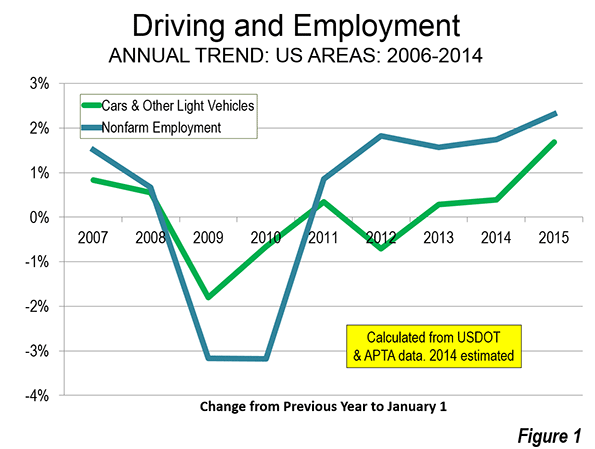
    As more people return to employment and incomes rise, driving can be expected to increase. During 2014, the nation’s nonfarm employment rose to the highest level in history. As the year progressed and employment increased, so did driving (Figure 1).

    But there is still a long way to go for the economy. The civilian labor force participation rate continues depressed. If early 2008 levels of labor participation were restored, there would be at least 10 million additional jobs.

    Falling Gasoline Prices

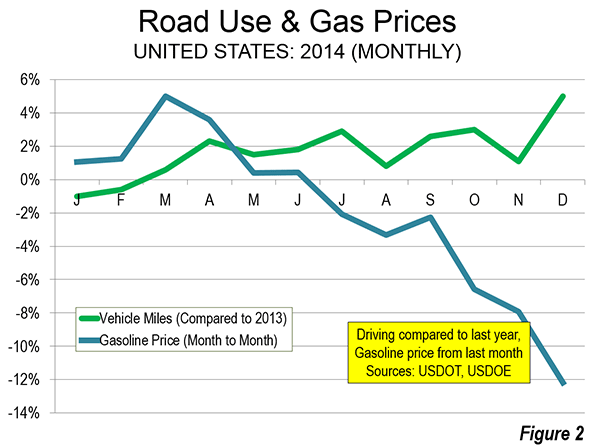
    US Department of Energy data indicates that the average price per gallon of gasoline rose by more than one half between 2005 and 2011. Until the middle for 2014, gasoline prices fluctuated around this level until early summer of 2014. Then the gas price reductions began. By the end of 2014, gasoline prices had dropped to near 2005 levels, which they actually reached in early 2015. Much of the 2014 increase in driving was concentrated since the decline in gasoline prices started in the last half of the year (Figure 2).

    Driving and Transit

    Ridership and road travel data also shows that there has been little relationship between the annual changes in driving and transit use over the period of the gas price increases and the subsequent decrease. Advocates of greater transit funding have claimed for decades that transit can be effective in attracting drivers from their cars. This was transit’s time.

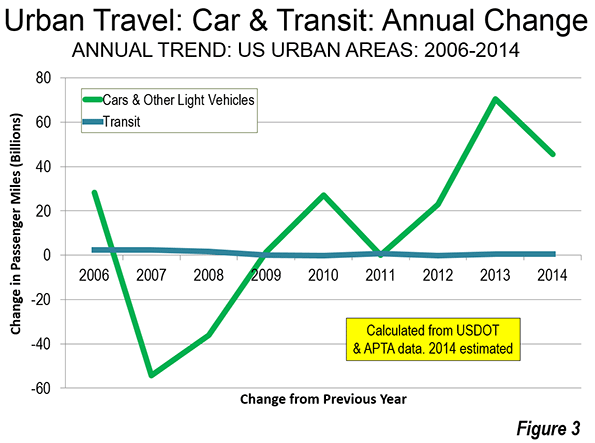
    However, the highly publicized transit ridership increases have been small in context and have shown virtually no relationship to the changes in automobile use in urban areas. This is illustrated in Figure 3. Driving volumes have risen and fallen, with little response in transit ridership. If there were a significant relationship between transit ridership and travel by car, the two lines on the chart would nearly follow one another. However, the lines show virtually no relationship. In relation to the actual changes in travel by car and light vehicle, the changes in transit are imperceivable. Transit ridership remains relatively small, at approximately two percent of all trips and five percent of work trips. An American Public Transportation Association (APTA) press release confirms the weak nexus between driving trends and transit for the most recent period. APTA notes that transit ridership late in the year increased despite the significant reduction in gasoline prices.

    Transit does not provide rapid mobility for most urban trips, which is why it has so little potential to attract people from cars. As higher prices force people to cut back on driving, they simply travel less, rather than getting on transit that cannot take them where they need to go in a reasonable time. That would be different if transit provided mobility competitive throughout the metropolitan area. Indeed, transit’s percentage of urban travel would be far above its current two percent. But to build out a system that reaches most jobs, of course, that would be financially prohibitive.

    Transit’s strength is downtown (the central business district, or CBD). The largest CBDs have employment densities are 100 times the urban average, and are well served by rapid, radial transit routes. In four of the nation’s largest CBDs — New York, Chicago, Boston and San Francisco — transit carries more than half of workers to their job, 77 percent in Manhattan alone. Americans use transit where it is competitive or superior to travel by car, which should dispel any notion that there is a national aversion to transit.

    But the city is much more than downtown. According to research by Lee and Gordon only eight percent of employment in the 48 largest metropolitan areas was in CBDs. This is despite the presence of impressive office towers that convey a sense of CBD dominance.

    Lee and Gordon also show that about 13 percent of jobs are in employment centers centers outside the CBDs, which are often called "edge cities." Because these centers do not have the radial networks of direct transit, even their high densities produce little in transit ridership.  My analysis of more than 80 post-World War II form suburban employment centers (mainly edge cities) indicated a transit work trip percentage of only 4.9 percent, which is approximately the national average for all areas. Transit’s share to the remaining nearly 80 percent of jobs dispersed throughout the metropolitan areas is just 4.6 percent.

    The basic problem is access. Outside of downtowns, few jobs can be conveniently reached by transit. This means transit takes about twice as long as driving alone and often is either not within walking distance of home or does not drop the passenger off within walking distance of work. This is illustrated by research at the University of Minnesota Accessibility Laboratory, which has shown that in 45 large metropolitan areas, only 10 percent of jobs can be reached by the average employee in 60 minutes by transit. By comparison, American Community Survey data indicates that nearly 65 percent of employees who drive alone in the same metropolitan areas actually reach work — and in half the time (30 minutes).

    Even low income workers, whose constrained budgets should make transit more attractive largely use cars to get to work.

    Driving and a Middle-Income Lifestyles

    I have referred before to the research that equates better economic performance with better mobility for people throughout the labor market (metropolitan area).

    Driving is not based on the shallow, arbitrary preference expressed in the threadbare cliché of a "love affair with the automobile." Cars are essential to realizing the aspirations of a majority of people, not only in the United States but in Europe and beyond.

    Wendell Cox is an international public policy consultant. He was appointed to three terms on the Los Angeles County Transportation Commission and chaired two American Public Transit Association (APTA) national committees (Policy & Planning and Governing Boards). Full biography is here.

  • Governments’ Oil Windfall

    We are reading a lot about the windfall coming to consumers due to falling gas prices now that oil is under $50/barrel. But cheap energy also represents a windfall for governments, including governments who are hard pressed for cash.

    The US uses nearly 20% of the world’s energy consumption every year. That spending includes households, businesses, industries and governments. Households in the US spend nearly $450 billion on gasoline alone to fuel their 2.28 vehicles. Energy for transportation represents about 50% of US consumer spending on average and climbs to nearly 70% in the summer when there is more driving. Governments spend money on gasoline, too.

    Not just the federal government, but government at every level – federal, state, county, city – all of which have fleets of cars and trucks that use gasoline.  We could not locate data on fuel spending by state governments for either gasoline or heating/cooling. The Bureau of Economic Analysis tables lump spending at gas stations in with “Other retail” which includes furniture and appliance stores and places like home depot. We did locate the numbers of cars owned by governments and police. Governments in the United States own about 1.5% of all vehicles on the road. That includes military vehicles, cars and trucks owned by the federal, state, county and local government plus police vehicles.


    Data is from www.rita.dot.gov, sourced as www.automotive-fleet.com as of Nov 26, 2013.

    Whether we extrapolate from the number of vehicles and use the “per car” savings estimates or estimate the savings based on the governments’ share of vehicle ownership, we guess that governments across the US will be sharing in at least $1 billion this year. And that is just on gasoline alone.

    They could also be saving on heating bills for real property. The Federal government alone owns almost 400,000 buildings located throughout the country. According to the Consortium for Science, Policy and Outcomes at Arizona State University, the US Federal government spends up to $610 billion annually on energy consumption. Every 1% drop in the prices could mean a $6 billion windfall for Uncle Sam.

    Don’t be surprised if he expands spending instead of using the savings to reduce the national debt or to balance a budget.

  • Peak Oil, Yes and No

    I have an Australian friend who works on an oil drilling platform off the coast of Tasmania. He sent these photos from his phone. Pretty cool, huh? These photos got me thinking about the Peak Oil meme. For the uninitiated there are two camps on the subject.

    One camp says there’s an unlimited amount of oil, natural gas, and coal in the ground and new technology will always be able to bring it to market. Since global demand is insatiable there will always be money on the table to incentivize new supply. This camp tends to shrug off environmental concerns and puts people and economic growth first.

    unnamed-8

    The other camp says there’s a fixed amount of fossil fuel in the earth’s crust and at some point the cost and complexity of wrestling the last sour crumbs to the surface will hit a wall the market can’t bear. Concerns about environmental degradation and social justice loom large in this camp.

    When oil reached $147 a barrel in 2007 the Peak Oil folks felt victorious. They also insisted that record high fuel prices, not merely financial chicanery, precipitated the economic crash of 2008. Today fracking, shale oil, and new deep water discoveries have created a glut of supply with significantly lower energy prices. There’s currently a lot of, “We told you so” from the other side.

    My view on the subject is colored by my experiences growing up during the oil shocks of the 1970’s and the resulting economic repercussions. Those shocks were caused by geopolitics in the Middle East during the Yom Kippur War of 1973 and the Iranian Revolution of 1979. They had nothing to do with any physical lack of oil in the world – just supply chain disruptions. But those disruptions were devastating to my family in ways that many people don’t necessarily remember clearly today.

    Screen Shot 2014-12-14 at 12.14.06 AM

    My parents had just purchased their first home in suburban New Jersey the year before the oil crunch hit. I was seven years old. Like many young couples my parents had put every bit of their savings into the down payment and were stretched very thin in terms of the monthly payments. Everyone in our extended family was working class with middle class aspirations so home ownership was at the top of the must-have list. New York City was falling apart back then so they drove an hour and a half south until they found a four bedroom fixer-upper on a quarter acre lot in a good school district that they could afford. The house wasn’t perfect, but my folks were convinced that it could be improved over time with sweat equity. Their mortgage was $203 a month. At the time that was a heavy burden relative to their modest income. (Adjusted for inflation that would be the equivalent of $1,153 today.)

    Economy

    We had oil heat like most people in New Jersey back then. A 300 gallon tank in the back yard would keep the house warm for about a month. From early fall until late spring we burned up six tanks on average per year. When we first moved in heating oil sold for 24¢ a gallon. 24¢ x 300 gallons was $72 (or $409 today). That was the number that my parents used when they put together their household budget before buying the house. At the worst point in the oil crisis heating oil sold for $1.20 a gallon. That’s $360 a tank compared to the mortgage payment of $203 (or $2,045 vs. $1,153 in today’s dollars). Think for a moment about your own mortgage or rent. Now think about what would happen to your personal finances if your utility bill unexpectedly became almost double that sum for half the year.

    At exactly the same time that our household budget collapsed under the weight of that heating bill, the cost of nearly everything else also rose significantly. Oil is used in the manufacture and transport of just about everything from beef and milk to lawn mowers and toilet paper. As fuel prices rose that additional cost rippled through the entire economy at the precise moment people had the least ability to absorb the increases. Consumer demand for many discretionary items collapsed, people lost their jobs, and the overall result was a considerably lower standard of living. That process played out over an entire decade and did serious damage to my family.

    Today most heat in New Jersey comes from natural gas which is cheaper, cleaner, and produced domestically. Problem solved, right? Well… I’m not so sure.

    Screen Shot 2014-12-14 at 3.48.07 PM Google

    1l-image

    The US still imports large amounts of natural gas and oil from other parts of the world – primarily Canada and Mexico along with Venezuela, Columbia, Nigeria, and the Arab nations. These things are priced in a global market so in spite of the “America is the new Saudi Arabia” talk prices can become volatile based on events in other parts of the world. The Bakken shale oil coming out of North Dakota is priced right along with the oil coming out of that oil rig off the coast of Tasmania. If even a small amount of the global oil supply were to be choked off for any reason (the Strait of Hormuz gets shut down due to war, or the Ras Tanura oil terminal is disabled by terrorists) the price of oil would skyrocket worldwide. Natural gas is harder to transport across the seas so that market might appear to be more insulated than the oil market, but if the price of oil jumped it could cause more of those economic ripples that were so troublesome in the ’70s. If you’re unemployed due to an oil shock and you lose your home to foreclosure it may not help that domestic natural gas remains relatively affordable. Peak Oil doesn’t have to be real for me to be concerned about energy and my household security.

    I never ever want to find myself in a similar position as my parents so I organize my affairs as if Peak Oil is a legitimate possibility, regardless of the particulars. Listed below are some of my personal rules. Notice, this isn’t a conservative or a liberal list. There’s no mention of bomb shelters or gas masks or firearms to defend against zombies. Nothing on this list will make anyone poorer or less happy. If life continues to be endlessly prosperous and bountiful no one will be missing out on anything. And by the way, these are all things that our great-grandparents did as a matter of course.

    image

    Keep debt to an absolute minimum. Live below your means in a smaller less expensive place than you can actually afford. Get that mortgage paid off entirely as soon as possible. Unless you have six kids you don’t really need a 2,600 square foot house with a three car garage and a bonus room. Think about the debt you will take on for a fancy kitchen remodel so you can keep up with the Joneses – and then think about how nice it would be to not have a monthly payment of any kind instead. The fancy kitchen is fine if you can pay cash, but that old Formica might look a whole lot better in a mortgage free home. If the economy gets funky and you lose the house to foreclosure the bank could end up enjoying those granite counter tops while you pack your bags and move in with your crazy brother-in-law.

    Screen Shot 2014-12-14 at 4.03.26 PM Screen Shot 2014-12-14 at 4.04.35 PMIMG_3282 (800x600)

    Live in a place where you can actually walk or ride a bicycle to all of your daily needs including work, school, the doctor’s office, the post office… This doesn’t mean you have to give up your car or stop driving. It just means you’ll have options and flexibility. And this doesn’t have to be Manhattan. Lots of small rural towns and some older suburban areas still have these qualities. Don’t let the grand double height entry foyer out in the McMansion subdivision off the side of the highway distract you from what’s really important in life. It ain’t chandeliers. 

    Screen Shot 2014-12-14 at 2.27.04 PM Screen Shot 2014-12-14 at 2.26.13 PM


    unnamed-8


    Figure out how to keep the house heated and cooled with the minimum amount of fuel of any kind. Start with the low hanging fruit by adding lots of insulation. Then think about adding modest extra sources of heat such as a small south-facing greenhouse addition or a back up wood stove. If you have the money you could spring for some technological bells and whistles like solar panels, but that’s very last on the to-do list after the cheaper more effective conservation stuff is done. Remember, Denmark is the most energy efficient, most “green” nation on earth with 20% of it’s power coming from windmills, but the other 80% of their energy still comes from dirty old fossil fuels like coal. They just use it very sparingly. First get your household consumption way, way down. Then think about green power to supply what little you do use.

    unnamed-7 unnamed-13

    Find cost-effective ways to secure a plentiful supply of water that isn’t dependent on mechanical pumps or distant supplies that you have no control over. Rainwater catchment off your roof is one such option. Water security is especially important for people who live in a desert or a region that suffers from long periods of drought.

    51a9c926fb04d664dc00177e._s.fit_h.640_w.640_
    IMG_4847
    IMG_4850
    Pantry storage room


    Keep a really well stocked pantry to help ride out future difficulties. Mine can make a Mormon grandma blush. Maintaining a well stocked pantry is a sensible form of insurance and a hedge against future inflation, unemployment, or temporary shortages.

    Sebastopol with MaAntonia 046 (640x480) Screen Shot 2014-12-14 at 4.32.18 PMjjyfcxytr IMG_5381 (480x640) (2)
    IMG_5386 (480x640)
    Sebastopol with MaAntonia 039 (640x480) Sebastopol with MaAntonia 008 (640x480)

    Produce useful things. Plant a big veggie garden and some fruit trees.  Keep chickens. Keep honey bees. Keep meat rabbits. If you have enough space for a dog, then you have enough space for a couple of small dairy goats. If you’re a vegan pacifist you can adjust by ramping up the garden even more. If you’re a skilled hunter you can fill the freezer with venison.

    unnamed-9 unnamed-11 unnamed-12 unnamed-10

    Cook. (Nuking a tray of Lean Cuisine doesn’t count.) Learn to bake a loaf of bread from scratch. A pot of bean soup is ridiculously inexpensive and dead easy. If your kids will only eat pizza then learn how to make it at home. In fact, teach your kids how to make it themselves as a family project. This stuff isn’t rocket science. While you’re at it learn to sew or knit or do woodworking. These skills can be rewarding unto themselves as hobbies, and you never know when they might actually become necessary. 

    Screen Shot 2014-10-08 at 1.19.32 AM Screen Shot 2014-10-08 at 1.21.00 AM Screen Shot 2014-10-08 at 1.16.59 AM

    Get to know your neighbors and build relationships of trust with like-minded people in your community. These associations can be extremely helpful in a crisis. If Peak Oil never occurs you’ve lived a comfortable, affordable, secure life surrounded by good people. How cool is that?

    John Sanphillippo lives in San Francisco and blogs about urbanism, adaptation, and resilience at granolashotgun.com. He’s a member of the Congress for New Urbanism, films videos for faircompanies.com, and is a regular contributor to Strongtowns.org. He earns his living by buying, renovating, and renting undervalued properties in places that have good long term prospects. He is a graduate of Rutgers University.

  • The Inevitability of Tradeoffs, or Understanding New England’s Sky High Energy Costs

    People advance two main sorts of arguments in favor of things for which they advocate: the moral argument (it’s the right thing to do) and the utilitarian one (it will make us better off). As it happens, in practice most people tend to implicitly suggest there’s a 100% overlap between the two categories. That is, if we do what’s right, it will always make us better off too with no down sides at all.

    But is that true?

    For most of us, our life experience suggests that there are always tradeoffs and there’s no such thing as a free lunch. Urbanists tend to argue in way that suggests this isn’t the case. The types of policies advocated by urbanists tend to be presented not only as right in a certain moral sense, but also ones that make society better off in every way. When things go awry in some respect, as they always seem to do, this is always seen as an avoidable defect in policy implementation, not as a problem inherent to the policy itself. Urbanists aren’t alone in this of course. It affects most of the world. But since I cover the urban beat, I’ll focus on us for a minute.

    Today the New York Times opens a window into the type of trade-offs that are studiously avoided in most writings on the subject of climate change. Called “Even Before Long Winter Begins, Energy Bills Send Shivers in New England,” it talks about how a lack of natural gas pipeline capacity is sending electricity and gas costs through the roof as the temperature turns cold.

    John York, who owns a small printing business here, nearly fell out of his chair the other day when he opened his electric bill. For October, he had paid $376. For November, with virtually no change in his volume of work and without having turned up the thermostat in his two-room shop, his bill came to $788, a staggering increase of 110 percent. “This is insane,” he said, shaking his head. “We can’t go on like this.”

    For months, utility companies across New England have been warning customers to expect sharp price increases, for which the companies blame the continuing shortage of pipeline capacity to bring natural gas to the region. Now that the higher bills are starting to arrive, many stunned customers are finding the sticker shock much worse than they imagined.

    I’ve written about this before re:Rhode Island, which is among the most expensive states in America for electricity (most of which is generated by gas). But all of New England is high, with Connecticut ranked as having the country’s most expensive electricity. Gas prices spike every winter to levels far above the rest of the country, as the graph below that I found via City Lab shows:


    This would appear to be a simple problem to solve: just build more pipelines. I included on mylist of starter ideas for improving economic competitiveness in the state.

    Unfortunately, planned pipelines haven’t been built due to environmental opposition:

    The region has five pipeline systems now. Seven new projects have been proposed. But several of them — including a major gas pipeline through western Massachusetts and southern New Hampshire, and a transmission line in New Hampshire carrying hydropower from Quebec — have stalled because of ferocious opposition.

    The concerns go beyond fears about blighting the countryside and losing property to eminent domain. Environmentalists say it makes no sense to perpetuate the region’s dependence on fossil fuels while it is trying to mitigate the effects of climate change, and many do not want to support the gas-extraction process known as hydraulic fracturing, or fracking, that has made the cheap gas from Pennsylvania available.
    ….
    A year ago, the governors of the six New England states agreed to pursue a coordinated regional strategy, including more pipelines and at least one major transmission line for hydropower. The plan called for electricity customers in all six states to subsidize the projects, on the theory that they would make up that money in lower utility bills.

    But in August, the Massachusetts Legislature rejected the plan, saying in part that cheap energy would flood the market and thwart attempts to advance wind and solar projects. That halted the whole effort.

    Here we see the clear tradeoff in action. Reducing carbon emissions has a clear human and economic cost. High electricity costs wallop household budgets in a region with many communities that are struggling or even outright impoverished (as recently as last year, for example, a third of the residents of Woonsocket, RI were on food stamps). This particularly harms poor and minority residents. What’s more, it helps contribute to the region’s low ranking as a place to do business and its anemic job creation.

    Given that gas itself is dirt cheap and will be for the foreseeable future thanks to fracking, hurting residents through high electricity prices designed to drive energy transition is clearly a deliberate policy choice.

    Fair enough if you believe reducing carbon requires subordinating other public goals like more money in poor people’s pockets. But how often is this forthrightly stated by advocates? Almost never.

    Instead we’re treated to article after article in various urbanist publications talking about some awesome green project that’s being implemented somewhere, and how other places ought to do the same thing. There’s lots of doom and gloom about the increased potential for future disasters if the policies aren’t followed. But there’s seldom much about the immediate negative consequences that almost certainly will follow if they are.

    I like energy efficiency. I’m glad we have more fuel efficient cars. I’m very glad I don’t own a car anymore. I’m not so excited about light bulb mandates and other “feel bad” policies that don’t materially affect emissions. But there’s definitely a lot we can do on the energy front.

    But I also care about things like poor people’s electricity bills and economic growth. And I’m not willing to make unlimited sacrifices (including imposing sacrifices on other people) in the name of conservation. I can appreciate that others might make different tradeoffs and want more conservation than I do. But at least they ought to be honest about the costs and harm they are imposing on people in the name of their preferred policy matrix.

    Instead there’s disingenuous talk about the “green economy” powering local economies when there’s no such thing as green industry. Or claiming, as many did in response to my article earlier this year, that Rhode Island’s government is actually conservative, so its problems can’t be laid at the foot of excessively progressive policies imported from places with vastly more economic leverage than most of New England. I guess I did not know that killing gas pipelines in the name of promoting renewable energy via high prices was a Tea Party idea.

    Actually, not even the places that do have huge economic leverage are behaving like this. New York City has more economic leverage than just about anybody. But it also, as the chart above shows, has cheaper gas. One reason is that, as City Lab reported, NYC recently just opened a new gas pipeline into the city:

    A really important thing happened last month to New York City and the rest of the mid-Atlantic. This event will change the daily lives of millions of people, especially during the coldest months of winter. And, despite some protesters, it all went down with less fanfare than Jay Z and Beyonce going vegan for a month.

    An $856-million pipeline expansion began ramping up service, allowing more natural gas to get to New York City consumers. The New York-New Jersey expansion project moves more gas the last few miles from Jersey, which is the terminus for much of the Marcellus Shale gas flowing out of Pennsylvania, into Manhattan. The Energy Information Administration called it “one of the biggest… expansions in the Northeast during the past two decades.” It will bring an additional 800 billion British thermal units (BTU) of gas to the area per day.

    Maybe New England wants to out do New York City when it comes to driving a green energy transition. (NYC seems to be focusing more on climate change adaptation, aka “resiliency,” these days). That’s a valid policy choice to make. But it’s one with consequences.

    Unfortunately, the consequences of these policy choices are seldom presented by their advocates. People only discover them when the costs show up in a way that can be tangible traced back to those policies. Maybe in the case of New England and energy costs, people are starting to wake up to the matter, possibly in a way similar to how sky high housing costs in so many cities woke people up to the actual trade-offs being made in housing policy.

    Advocates are there to advocate of course. So perhaps it’s unrealistic to expect advocates of any stripe to give you the full story. But that’s why we should always pay attention to what the critics of particularly policies have to say. That will give us a more complete picture of the tradeoffs any particular policy set will require.

    Aaron M. Renn is an independent writer on urban affairs and the founder of Telestrian, a data analysis and mapping tool. He writes at The Urbanophile, where this piece originally appeared.

    Photo: Pawtucket Power Plant

    .

  • Time to Bring Back the Truman Democrats

    Once giants walked this earth, and some of them were Democrats. In sharp contrast to the thin gruel that passes for leadership today, the old party of the people, with all its flaws, shaped much of the modern world, and usually for the better. Think of Franklin Roosevelt or Harry Truman, John Kennedy, or California’s Pat Brown, politicians who believed in American greatness, economic growth, and upward mobility.

    For more than 40 years, the Democratic Party has drifted far from this tradition, its policies increasingly a blend of racial and gender politics combined with a fashionable brand of environmental fanaticism. No longer does it constitute a reliable, middle class-based alternative to the corporatist mindset of the Republicans. “Today’s Democrats have no more in common with Franklin Roosevelt, Harry Truman, John F. Kennedy and Lyndon Johnson ,” notes author Michael Lind, “than today’s Republicans have in common with Abraham Lincoln or Dwight Eisenhower. “

    To regain their relevancy, Democrats need to go back to their evolutionary roots. Their clear priorities: faster economic growth and promoting upward mobility for the middle and working classes. All other issues—racial, feminine, even environmental—need to fit around this central objective. In survey after survey, economic issues such as unemployment, the economy, and the federal budget top the list of concerns while affirmative action, gay rights, and climate change barely register.

    From Obama Back to Jackson

    Democrats do not need to become Republican lite, as was true among some New Democrats (I was a fellow with the Progressive Policy Institute, the New Democrats think tank). Democrats need to respond aggressively to the crony capitalism practiced by many Republicans, particularly regarding Wall Street. But they can’t do that if all they offer in its place are policies that service instead their own cronies not only in finance, but technology and media as well.

    Right now it’s hard to make the case that the Democrats have a strategy to improve the economic prospects of the middle class. The New York Times’s Tom Edsall notes notes that after six years of Obama, voters stubbornly hold unto pessimistic views about the future. Of course, declining or stagnant wage growth started well before this president took office. Nevetheless, Democratic rule has not only failed to halt the trend, but appears to have accelerated it.

    Not surprisingly, many middle and working class voters, particularly whites, have deserted the Democrats in increasing numbers. This November, notes Gallup, support for Obama among white college graduates dropped to 41 percent while his support among those without degrees fell to a pathetic 27 percent.

    Critically, in 2014 this erosion began to extend to millennials; white millennials, particularly those without BAs (the vast majority), went Republican. This is a generation that, according to the Census, is both somewhat more educated than previous ones but far more likely to live in poverty.

    Although likely to reject Republican views on social issues, such as gay marriage, millennials may not become “permanently blue,” as imagined by some boomer progressives. Faced with the consequences of slow, and poorly distributed growth, they are already less likely to see themselves as environmentalists than the national average and particularly the generally better off boomers.

    Some progressives suggest that working class voters, particularly whites, can be lured back to the party by expanding the welfare state even further. But such an approach works against the traditional pride in self-sufficiency espoused by many in the American middle class. The old Jacksonians challenged financial power—then the Bank of the United States—but also worked to expand the economy, opening new lands to settlement, and encouraging home ownership and grassroots entrepreneurship.

    The Key Issue: Energy and Climate Change

    It would be difficult to find an issue with less resonance with the vast majority of voters than climate change. Concern over the environment has dropped since the Recession, notes Gallup, with climate change ranking near the bottom in voter concerns. In this sense, the emergence of Tom Steyer and other gentry yokes the party to a message with limited appeal once you get a few miles inland from either coast.

    This does not reflect lack of interest in a better environment. Instead, it is a rejection of the Clerisy’s “solutions” to environmental challenges—such as banning suburbs, hiking electricity rates, and opposing new pipelines. These policies don’t hurt the super-rich; they hurt middle and working class voters. Lower oil prices, a product of fracking and other new drilling technologies, represents a boon to the dispersed, largely suburban electorate. But at the same time cheap gas offends progressive writers like the New Yorker’s Michael Specter, who argues that lower oil prices simply reinforces our addiction to an “industrial form of crack.”

    In the next decade, the Obama administration’s bizarrely naïve “agreement” with China threatens to further weaken middle class interests. The South China Morning Post suggests westerners should be skeptical about prospects that China will sacrifice economic growth and, even more important, political stability in favor of planetary salvation. As one Canadian commentator put it, the Chinese deal constituted “a promise in a rented tuxedo” by a country that will cross “its coal fired heart” while the U.S. and the E.U. essentially disarm their economies with ever more draconian regulation.

    Sadly, this choice between growth and climate change may not be necessary. The development of new drilling techniques has sparked a shift from coal fired power to natural gas that has allowed the U.S. to reduce its emissions faster than any major country, far more, indeed, than the self-righteous Europeans whose expensive and inefficient green policies have left them burning more coal.

    Expanding, Not Constraining Geography

    The rapid shrinking of the party’s geographic base is one clear legacy of the Obama years. Energy policy has been key here. Democratic losses have been heavy in those parts of the country that either produce fossil fuels, such as Louisiana, Texas, Colorado, Utah, and Montana, or those, notably in the upper Midwest, that depend on cheap fossil fuels to drive their still critical manufacturing sectors.

    The losses of Democrats in states like Ohio, Michigan, and Wisconsin are arguably the most critical since these are traditionally swing states. The Steyer strategy of wiping out fossil fuels and raising energy costs might appeal to the denizens of climatically mild and highly affluent San Francisco. But people in a hardscrabble factory town in less temperate central Ohio or in greater Detroit , or even interior California, are less well-positioned to indulge green purity.

    And how about the South? As recently as 2008, Democrats held one-third of the South’s Senate seats. Now it’s down to three, two in Virginia and the other in Florida. Convinced the region is lost permanently, some suggest suggest that Democrats “dump Dixie” so as not to have to appeal to voters in what one progressive writer denounced as a “fetid place.”

    But the South accounts for almost 40 percent of the nation’s population, an impossibly large region to simply write off. But even progressives who want to take back the South, such as the New Republic’s Michael Cooper seek to build a coalition of poor whites and minorities in alliance with the growing numbers of graduate-educated professionals. This does not really address the aspirational reasons why so many Americans have been migrating to this region.

    In many ways these attitudes reflect the increasingly urban-centric focus of the party. It diverges dramatically from the approach of traditional Democrats, from Roosevelt and Truman to Clinton, himself the former governor of a poor Southern state, who looked favorably on dispersing growth, particularly to the traditionally poor South, intermountain West and Great Plains, as well to the suburban interior.

    Hostility to the non-urban regions includes a detestation of suburbia. Progressive theorists, like Salon’s Benjamin Ross, like to pin the detested “suburban sprawl” on Ronald Reagan, ignoring the basic fact that suburban growth was fostered for a half century by a Democratic controlled Congress, and was also favored by Democrats from Truman through Clinton. No surprise then that aside from wealthy coastal suburbs, the Democratic base has shrunk to the urban cores and college towns.

    Infrastructure for Growth

    Senator Charles Schumer’s retro perspective about the folly of enacting Obamacare in 2009 revealed much. Schumer rightly pointed out that Obamacare, for all the positives associated with expanding health care coverage, helped a relatively small part of the electorate, as well as the insurance companies.

    A far better move in the early years of Obama’s first term would have been to implement a updated version of the New Deal’s Works Progress Administration. A new WPA would have helped create jobs and provided some training to underemployed or unemployed youth. It could have left a legacy of improved roads, bridges, expanding port facilities, and affordable (usually bus) mass transit options that would appeal to many Americans.

    In contrast to Obamacare, a neo-WPA would have been a difficult target for the GOP. It likely would have appealed to many business people on Main Street, few of whom are free-market fundamentalists. But moves to push such a program elicited opposition from critical parts of the party base, including feminists, who feared that public works would disproportionately help “burly men.”

    Greens also were less than enthusiastic about new massive public works. Environmentalists today generally prefer to limit roads and block new water projects, even in parched California. So the Obama stimulus will be forever linked to insider deals with green energy epitomized by the Solyndra fiasco and massive loans to politically allied venture capitalists.

    Class Not Race

    The growing opposition towards Hillary Clinton’s ascension has one thing right: Democrats should not be seen as the second party of Wall Street. Obama’s recovery and Fed policy have, as Democrats like Elizabeth Warren like to point out, often favored the financial oligarchs, although their support for Democrats makes them far less keen on taking on the Silicon Valley Venture Capitalists, who have also profited under Obama. High valuations—even absurd ones—enrich the insiders who found companies, underwriters, and merger mavens, but those valuations have done precious little for the vast majority of Americans.

    Faced with the loss of middle class voters, the administration seems determined to double down on its current coalition. So to whom do they turn to determine their future political direction? Not to a successful elected official from a swing district or a Main Street businessperson but to Google’s Eric Schmidt, an oligopolist of the first order from the party’s new heartland around the San Francisco Bay Area.

    Given their cozy ties to Wall Street and oligarchs like Schmidt, the Democrats have failed to push class warfare as an issue, preferring instead to play the racial trump card. They allow issues to be dominated by such flawed emissaries as the detestable Al Sharpton, whose job seems to be the stoking of African-American ire. Similarly, the president’s executive order on undocumented residents follows this approach, by trying to appeal to Latino racial interests.

    Yet race politics has limited appeal to whites, and ultimately may not guarantee keeping many minority voters in check. After all, minorities have fared poorly under Obama: a recent Pew study found minority incomes dropped 9 percent between 2010 and 2013, while only 1 percent among whites. Hispanics, notes a recent Pew survey economic issues easily trump immigration. Texas Republicans, for example, got close to half the vote among Latinos in that state, and similar results were found in Kansas. Even in places as blue-leaning as Colorado, Latino support for pro-growth Republicans has been growing. And Asians also showed a shift toward the GOP in the mid-terms.

    Embrace Exceptionalism

    Historically Democrats, like Republicans, believed in American Exceptionalism. This sometimes spills over into messianic overkill—for example, under Woodrow Wilson and George W. Bush—but overall the ideal of a uniquely American national profile has been embraced by Democrats from Jefferson and Jackson to Roosevelt, Truman and, arguably the last of the breed, Bill Clinton.

    President Obama, in contrast, has openly rejected this notion, perhaps reflecting the world view of academics and much of the financial world that sees American Exceptionalism as some sort of patriotic nonsense. In the past the old Democrats saw the country’s broad resources and continental scale as primary sources of national greatness. Early conservationists did not oppose the expansion of industry, mining, or growth as inimical to progressive ideals; instead, they sought to restrain the abuses of the capitalist classes in order to prevent gouging as well as to preserve resources and open space for future generations.

    In sharp contrast to their modern “heirs,” both Progressives and New Dealers were builders of dams, roads, and electrical power systems. They embraced the notion of a growing America, whose economy could be expanded for the benefit of the majority.

    Is There a Messenger For Dino-Democrats?

    Hillary of the many houses, $200,000 speaking gigs, Wall Street linkages, and her aging, wealthy glitterati backers does not exactly appear the ideal messenger for a neo-Jacksonian revival. Rather than the “shot and a beer” Hillary who came back to almost save her 2008 effort, she now reflects gentry views on both economics and climate change in ways that do not significantly diverge from President Obama.

    With dissatisfaction with the economic status quo strong among many traditional Democrats, it’s likely populist candidates could emerge. Some imagine Senator Elizabeth Warren as the charismatic leader of a progressive version of the “tea party.” She has been a strong and vocal critic of Wall Street, which is to her credit, but her base lies not in middle class voters but among academia and wealthy Boston suburbs. On environmental issues, she seeks to out-green Hillary, something that might not appeal to voters in Ohio, Indiana, and a host of other key states.

    Bernie Sanders, the self-described socialist, represents an emotionally appealing alternative to the endlessly grifting Clintons and the law professor Warren. But Sanders, a representative of the Northeastern vacation state of Vermont, also opposes fossil fuel development. This approach would greatly limit his appeal beyond the Northeast and the west coast. It’s hard to envision him campaigning for votes at Great Lakes factories that depend on coal power, or appealing to construction workers who would love to see the Keystone and other pipelines built.

    Right now, former Virginia Senator James Webb may prove the best vehicle for dino-Democratic ideas. A self-conscious inheritor of the Jacksonian tradition, Webb epitomizes the individualist and populist values of his Scotch-Irish forebears. With a strong military background, he also appeals to nationalists who inhabit the South, Appalachia, and the non-coastal parts of the West. Whether his candidacy takes off is still an open question, but the ideas and spirit he embodies could revive a Democratic tradition that, although now submerged, might provide the party with a way out of its current morass. 

    This piece first appeared at The Daily Beast.

    Joel Kotkin is executive editor of NewGeography.com and Roger Hobbs Distinguished Fellow in Urban Studies at Chapman University, and a member of the editorial board of the Orange County Register. His newest book, The New Class Conflict is now available at Amazon and Telos Press. He is author of The City: A Global History and The Next Hundred Million: America in 2050. His most recent study, The Rise of Postfamilialism, has been widely discussed and distributed internationally. He lives in Los Angeles, CA.
  • Germany Also Having Big Problems Building Infrastructure

    Der Spiegel had an interesting article recently called “Angry Germans: Big Projects Face Growing Resistance.” The article (linked version is English) talks about how it is increasingly difficult to get infrastructure projects built in Germany.

    Wherever ambitious construction ventures loom on the horizon in Germany — from the cities to the countryside, from the coastlines in the north to the Black Forest in the south — opponents are taking to the streets…. As the public’s enthusiasm for constant innovation has lessened, so has the appeal of these sorts of projects, and, as a result, they now inevitably come accompanied by picketers. Germany’s graying society, it seems, is so cozy and settled that it resists anything threatening to upset the status quo. In the process, it has lost sight of the bigger picture.

    There are a lot of key points in this article that immediately raised parallels to the United States, where infrastructure projects are also under increasing siege. In fact, some of this reminded me of elements of the Tea Party movement. The protestors are uninterested in compromise. They are devoted, full time activists who are unrelentingly opposed to the projects in question:

    [Hartmut] Binner’s form of protest has a radical undercurrent: Well-informed, confrontational and devoid of respect for authority, he is typical of the new grassroots activism spreading across Germany.
    ….
    Binner’s entire life revolves around the campaign. He monitors the routes of departing and landing planes. He plays his self-designed noise simulator on market squares. He kicks off his court appearances by singing the Bavarian national anthem. “If you want to be heard as a member of the public, you need to push the envelope,” he shrugs.

    These days, he sees grassroots protests, activism and political responsibility from a different perspective. “The typical protesters are gray-haired, know-it-alls and very networked,” [Freiburg Mayor Dieter Salomon] says. “But they’re not remotely interested in consensus-building, political processes and pluralism.”

    Grassroots groups have become so livid, intransigent and single-minded that even the most respected politician in the country, Angela Merkel, is feeling their sting. In early May, hundreds of furious residents had gathered in central Ingolstadt to protest against the construction of a power line from Bad Lauchstädt in Sachsen-Anhalt to Meitingen in Bavaria.

    This certainly reminds me of the no-compromises view of the Tea Party. Also, a number of early American Tea Party activists were unemployed, and thus able to basically be full time activists. Even the singing of national anthem has echoes of the Tea Party and their tricorn hats. I don’t want to claim there’s a philosophical or other link between the Tea Partiers and Germany, however.

    Not everything lines up with the Tea Party, however. In Germany it seems to be disproportionately retirees who are the most engaged and militant:

    Germany’s graying society, it seems, is so cozy and settled that it resists anything threatening to upset the status quo. In the process, it has lost sight of the bigger picture.

    Many of the protestors are pensioners with no vested interest in Germany’s future. “It’s striking that the leader of the protests against the Munich runway is a 75-year-old and not someone in the middle of his working life,” [Munich Airport CEO Michael Kerkloh] points out.

    Salomon’s nemesis is Gerlinde Schrempp, a determined and argumentative 67-year-old retired teacher with attitude to spare. She’s the leader of the Freiburg Lebenswert movement, which translates roughly to “make Freiburg worth living in. The movement just got elected on to the district council and is first and foremost opposed to any new building in the city.

    There’s a stereotype out there of the average Republican voter as an old white guy. But the average Tea Party activist I’ve seen tends to be working age. I look at this one a bit differently. We need to see these types of controversies against the substrate of an aging population. Aging populations are not noted for dynamism, and older people’s self-interest is better served by starving investment for the future in order to save money and avoid uncomfortable change in the present. As a country whose population is projected to decline into the future thanks to this demographic inversion, we are seeing in Germany what’s likely a preview of coming attractions elsewhere around the world.

    Indeed, I’m reminded of what one analyst friend of mine in Indiana has said about the property tax caps there. He sees the push to cap property taxes as driven by an aging population in a stagnant state. Old people generally aren’t earning a lot of taxable income nor are they buying huge amounts of stuff, so they are disproportionately less affected by income and sales tax hikes, whereas they often own homes and are hit hard by property taxes. Thus property tax caps serve as another income transfer mechanism from young to old, holding revenue constant. They are in part an artifact of an aging society. Disinvestment in infrastructure can be seen in the same light.

    But there’s another part of this that shines a light on yet another group of opponents, namely the intelligentsia.

    The term “Wutbürger” (“enraged citizen”) was coined during the Stuttgart 21 fiasco to describe people like Hartmut Binner, and much has been written about them since. They often aren’t the “common man.” According to the Göttingen Institute for Democracy Studies, they tend to be highly educated people with steady incomes and white collar jobs. And while protests movements of the past were often steered by sociologists, today their leaders are more likely to stem from the technical professions, the researchers found.

    When we look at opposition to infrastructure in the United States, at least certain types of infrastructure, we see a similar profile of people (though not necessarily technical) behind it. It’s the leftist intelligentsia that oppose the Keystone Pipeline, suburban highway projects, fracking, and many other types of things, often with a militant unwillingness to compromise similar to the Tea Party.

    As with Germany, this opposition is enabled by environmental reviews and public participation laws that, while they serve important public purposes, make it easy to delay projects for years through repeated objections and scorched earth litigation. Traditionally environmental lawsuits were associated with the left, but conservatives have started saying, why not us too? Hence litigation against San Francisco’s regional plan. The Hollywood densification plan was recently overturned by lawsuits, and lawsuits have plagued California’s proposed high speed rail line as well.

    Whatever the project, it’s sure that somebody on the left and/or the right hates it, and thus will do everything in their power to kill it, which probably means years of delays and untold millions in increased costs.

    Also as with the United States, German governments have shot themselves in the foot with a series of financial debacles:

    Political and bureaucratic bodies are partly to blame for their own diminished authority. Every major venture seems to entail spiraling costs. Berlin’s new airport was supposed to cost €1.7 billion, a price tag that has shot up to well over €5 billion. Meanwhile, the €187 million earmarked for the Elbphilharmonie concert hall under construction in Hamburg is expected to exceed €865 million by the time the project is completed. Albig is well aware how bad this looks. “People see us as financially incompetent,” he says.

    Until politicians can convince the public they have a handle on this, the taxpayer will remain rightly skeptical of many major megaprojects. This is doubly true since it’s very clear, as has been documented by folks like Oxford professor Bent Flyvbjerg, that in many of these cases the politicians were simply lying all along about the real costs.

    I’m not sure what all the takeaways are, but there are clearly many forces operating on a global basis to inhibit the development of infrastructure in the West.

    Aaron M. Renn is an independent writer on urban affairs and the founder of Telestrian, a data analysis and mapping tool. He writes at The Urbanophile, where this piece originally appeared.

    MittlererSchlossgartenKundgebung 2010-10-01” by MussklprozzOwn work. Licensed under CC BY-SA 3.0 via Wikimedia Commons.

  • America Down But Not Out

    America, seen either from here or from abroad, doesn’t look so good these days. The country that maintained world peace for decades now “leads by behind,” or not at all. You don’t have to have nostalgia for George W. Bush’s foreign policy to wish for someone in the White House who at least belongs in the same room with the likes of Vladimir Putin. Some wags now suggest that President Barack Obama has exceeded Jimmy Carter in foreign policy incompetence – Carter certainly was more effective in the Middle East.

    What about space? Remember, we won the space race but now have to depend on Russian launch vehicles to do much of anything in orbit. President Obama thought we could rely on the Russians to provide us with cheap rides into orbit, but Putin squashed that notion after we objected to his actions in Ukraine. John Kennedy must be turning over in his grave.

    And as for our domestic economy, the best you can say is “It could be worse,” particularly if you look at what’s happening in torpid Europe. It’s a sign of our utter lack of confidence that the current administration, and much of the punditry, still thinks we should follow the Continent’s economic and social policies.

    Yet, despite all these challenges – and two presidencies the public ranks among the worst in history – it’s far too early to write off the United States. After all, no one else is doing very well. Even the widely touted BRICS countries – Brazil, Russia, India, China and South Africa – face slowing growth and mounting social problems.

    There are several factors that help explain why the USA’s long-term prospects are better than many Americans may assume.

    Entrepreneurial edge

    The essential strength of the U.S. economy has rested on having two things that rarely occur together – an innovative culture combined with massive natural resources. Whole industries, notably technology, years ago thought to be lost to Japanese and other Asian competitors, have recentralized in the United States. In 1990, six of the world’s top 10 semiconductor companies were Japanese; by 2011, five U.S. chip companies dominated the top 10, which included only two Japanese companies, Toshiba and Renesas. And their combined revenue in 2012 was less than half that of world leader Intel’s $49.7 billion.

    As of now, there’s not a key technology sector where the U.S. is not in the lead. We dominate social media, software and biotechnology. In fact, about the biggest technical threat we face is from the administration’s bizarre desire to surrender control of the Internet to foreign countries, many of whom, the president may acknowledge, do not share our values or relish our current predominance. Over time, to be sure, there will be challengers, notably China, South Korea and India, but none are likely to gain predominance in the near future. The same can be said in media; Hollywood still reigns supreme and U.S. dominance in fashion, lifestyle and music remains mostly in place.

    The advantage of size

    Other important countries are geographically large, but none – apart from Australia or Canada – is particularly rich. Russia is an oil plutocracy but beyond energy and weapons doesn’t export much else. China has a large land mass, but less resources, and its ability to feed itself will be increasingly constrained by pollution and diminishing water supplies. The country, by some estimates, has lost 28,000 rivers.

    In contrast, America has a huge agricultural base, spread across a vast continent. If California goes dry for a spell, for instance, there’s lots of water and fertile soil in the northern Plains, the Southeast, the Midwest and parts of the Northwest. Size is a form of arbitrage that allows production to move from one place to another. Others are investing heavily in farm land and other real estate, evidence not of American decline, but, instead, of the patterns of investment that led to the country’s great expansion in the 19th century.

    The energy revolution

    The United States could be on the cusp of another period of broad-based industrial expansion, spurred, in part, by its rapidly growing natural gas and oil production. The current energy and industrial boom, notes Joe Kaeser, president of the German multinational conglomerate Siemens, “is a once-in-a-lifetime moment.” Cheap and abundant natural gas is luring investment from manufacturers in Europe and Asia, who now must depend on often-insecure and more expensive sources of energy.

    The energy revolution has helped spark an industrial boom. There is already a shortfall, notes a recent Boston Consulting Group study, of some 100,000 skilled manufacturing positions in the U.S. By 2020, according to BCG and the government’s Bureau of Labor Statistics, the nation could face a shortfall of around 875,000 machinists, welders, industrial-machinery operators and other highly skilled manufacturing professionals.

    New capitalist revolution needed

    America’s capacity for perpetual renewal – what one Japanese scholar Fuji Kamiya calledsokojikara, a latent power to overcome seemingly insurmountable obstacles – persists but is limited by our political leadership in both parties as well as misguided economic policies. We need to alter contemporary capitalism’s tendency to favor and encourage transactions among investors and asset inflation, rather than fostering broad-based growth that rewards people adequately for their labor.

    Fortunately, the capitalist system, particularly one under democratic control, allows for the possibility of reform, as occurred in 19th century Britain and early 20th century America. What is needed now is structural reform that can shift priorities away from rent-seeking and towards true wealth creation.

    One clear priority is to reduce “financialization” of the economy. Over the past three decades, financial-services firms have doubled their share of the economy. The Obama recovery, with its bailouts of large banks and free-money policies for investors, has accelerated this trend, as companies have tended to be slow to reinvest profits in new products and innovations, preferring, instead, to engage in mergers or stock buybacks that raise share prices and reward investors, but do little for the overall economy.

    In contrast, financial institutions often regard productive industries – notably manufacturing – as hampering short-term financial gains. This has repeatedly pushed companies to strip their industrial assets, typically moving them overseas.

    Reforming capitalism toward a broader and more inclusive focus may not appeal to some – Wall Street investors, speculators in high-end real estate and tech oligarchs – who have done just fine the past five years. But, when asked what mattered more to them, most Americans preferred economic growth to redistribution, noted a 2014 studyconducted by the Global Strategy group, a Democratic consulting firm.

    Polls of popular opinion in the United States and the United Kingdom find key ecological concerns, such as climate change, well down the list, behind such issues as the economy, immigration, crime, unemployment and even the state of morality. What Americans want most, notes political commentator Mike Barone, is “an economic boom.”

    Such a broad-based economic boom is necessary if we are to restore America’s promise for this generation and, more importantly, the next. The country still has all the requisite advantages to lead in the next century and restore the middle class – if only the political leaders either rise to the occasion, or get thrown out.

    This article first appeared in the Orange County Register.

    Joel Kotkin is executive editor of NewGeography.com and Distinguished Presidential Fellow in Urban Futures at Chapman University, and a member of the editorial board of the Orange County Register. He is author of The City: A Global History and The Next Hundred Million: America in 2050. His most recent study, The Rise of Postfamilialism, has been widely discussed and distributed internationally. He lives in Los Angeles, CA.
    USA map image by BigStockPhoto.

  • Energy Preferences to Play Big Role in November

    The November election will be played out along all the usual social memes – from gay marriage, racism and immigration to the “war against women.” But what may determine the outcome revolves around one key economic issue: energy. This has all come to a boil now as President Obama has backed an Environmental Protection Agency effort to accelerate tougher emissions standards, something that could shutter hundreds of coal-fired power plants and slow fossil fuel development across the country.

    The energy issue has become in our era what tariffs were in the 19th century: an increasingly insurmountable partition that separates Americans by region and class and which, ultimately, touches on the long-term economic trajectory of the country.

    Of course, we have always had politics over energy – given regional variations in sources and kinds of supplies – but, until recently, both parties generally favored developing more oil and natural gas, largely because of the associated high-wage employment growth and potential for reducing the nation’s trade deficit. Now, energy increasingly has become a deeply partisan issue, with Democrats largely in opposition to fossil-fuel development and Republicans, fairly predictably, in support.

    Reflecting this trend has been the rise of opposing sets of contributors whose primary concerns are wrapped around energy. On the Republican side, energy industry contributors, including the billionaire industrialist Koch brothers, have become increasingly dominant. More than 90 percent of campaign donations from the oil and gas industries in 2012 went to Republicans.

    At the same time, environmentally focused Democratic contributors, led by hedge-fund manager Tom Steyer, have made being anti-fossil-fuel de rigueur for most candidates in the party. Steyer and his allies have become the favorite place to go for cash for Senate Majority Leader Harry Reid of Nevada and other top Democrats.

    The Geography of Energy

    The most-evident division – and most politically relevant – is geographic. A huge swath of the country, mainly along the Gulf Coast, Texas and the Great Plains, where shale-oil production has grown fourfold since 2007, is enjoying an energy boom that has created a surge in other high-wage, blue-collar fields such as manufacturing and construction. With the delays in approving the Keystone XL oil pipeline and looming new EPA emissions standards, Democratic senators and candidates from these states are, understandably, trying to distance themselves from their party’s increasingly anti-fossil-fuel policies.

    More significant, over time, may be how energy plays out in the country’s major political battleground, the rust-belt states. Most of these states are highly dependent on coal for electricity, and some, such as Pennsylvania, Ohio and West Virginia, are seeking to develop new oil and gas finds. Policies that limit fossil-fuel development, may prove a tough sell in some districts and could cost the Democrats several additional Senate seats.

    In contrast, the most fervent support for strict climate-change legislation comes mostly from states – notably, the Northeast – that produce little in the way of energy and use relatively little carbon to power their economies. These states need less power than other areas as they already have deindustrialized and have very little population growth.

    Two other ultrablue bastions, California and the Pacific Northwest, also advocate a green energy position. The Northwest relies largely on hydro power for its robust industrial sector, lessening dependence on carbon-based energy for electricity. California, itself rich in fossil fuels, largely disdains its resources, and its leaders prefer, for ideological reasons, to subsidize expensive renewable energy. Roughly one-fourth of all energy used in California comes from out of state, much of it from coal. But since this “dirty” power comes from elsewhere, the progressives in places like Hollywood and Silicon Valley can still feel good about our state’s “enlightened” policies, whatever their real effect.

    The Class Divide

    Historically, Democrats have been big supporters of expanding the energy sector, which includes such things as dams, nuclear power plants and pipelines. But the growing influence of the green movement has reversed that. Green policies are widely embraced by largely Democratic crony capitalists in places like Silicon Valley. They also enjoy almost universal support in academia, where boycotts of fossil-fuel companies are increasingly common. The media, too, is an ally, as is the predictably progressive entertainment industry.

    Rest assured, we will never see an HBO series that celebrates George Mitchell, the entrepreneur most responsible for developing fracking. But campus-climate scientists who diverge in any way from the party line on global warming are routinely excoriated as“deniers” of “settled” science, even in the face of 15 years of relatively stable global temperatures. The media has also become a fierce defender of climate orthodoxy. TheLos Angeles Times, as well as the website Reddit, have chosen to exclude contributions from skeptics.

    Of course, many traditional Democrats, notably in the construction trades and manufacturing, oppose this drift. Construction unions are apoplectic about the president’s endless delays on Keystone XL, which has two-thirds support from the public. The United Mineworkers, not surprisingly, oppose the new EPA emissions limits, claiming they will cost upward of 75,000 mining jobs.

    Some Ohio construction unions, incensed by green opposition to both Keystone and fracking, have shifted support to prodevelopment GOP Gov. John Kasich, despite his conflict with public employee groups. The only prominent national Democrat to identify as pro-fossil-fuel is former Montana governor Brian Schweitzer whose possible run for the presidential nomination seems a bit quixotic in a party increasing dominated by environmental activists and their gentry allies.

    What Kind of America do we want?

    Ultimately, the energy debate reflects a larger discussion about the future of the country and the economy. This is not merely about emissions and climate change, per se. California’s Draconian laws, even supporters admit, will have no appreciable effect on a global basis, particularly given the state’s already relatively low carbon footprint (largely a factor of the mild climate and the slow growth in its interior in recent years). Indeed, virtually all the world’s significant increases in CO2 are coming from developing countries; since 1990, China has increased its emissions almost threefold, while America’s have dropped. China now emits roughly twice as much greenhouse gas as the U.S.

    Some of the steps taken by environmental and renewable-energy interests against natural gas development can even be seen as counterproductive. The U.S.’s better recordon reducing emissions reflects overwhelmingly the shift from coal to natural gas for generating electricity, which has helped the U.S. reduce its carbon emissions more than either Asia or Europe.

    Fracking, like any energy technology – including wind and solar – clearly creates environmental problems. There should be strong rules to regulate fracking to make it safer, as Colorado’s Democratic Gov. John Hickenlooper has worked to pass in his state. In addition, major reductions can be achieved through a shift away from oil and coal and toward natural gas, as well as conservation efforts.

    Progressives, in particular, need to focus far more on what effects an ultrahigh-cost energy economy would have on the middle and working class. More attention should be paid in accelerating the current spike in job-creating foreign investment into the country, attracted in large part by the development of low-cost, clean natural gas. In contrast, policies hostile to fossil fuels will drive industry to less-environmentally conscious countries, particularly in the developing world.

    Sadly, none of this is necessary. America’s economic future is best guaranteed by marrying the successes of Silicon Valley and Hollywood with a robust blue-collar sector that includes fossil fuels, manufacturing, logistics and construction. Emissions can be cut, for the time being, by such steps as replacing coal for generating electricity, improving efficiencies, promoting telework and boosting the use of natural gas for transportation.

    Dividing the country, and the electorate, into totally polarized camps over energy may benefit the consultants in both camps who feed off contentious and expensive election campaigns, but will do little to help the futures of most Americans.

    This article first appeared in the Orange County Register.

    Joel Kotkin is executive editor of NewGeography.com and Distinguished Presidential Fellow in Urban Futures at Chapman University, and a member of the editorial board of the Orange County Register. He is author of The City: A Global History and The Next Hundred Million: America in 2050. His most recent study, The Rise of Postfamilialism, has been widely discussed and distributed internationally. He lives in Los Angeles, CA.
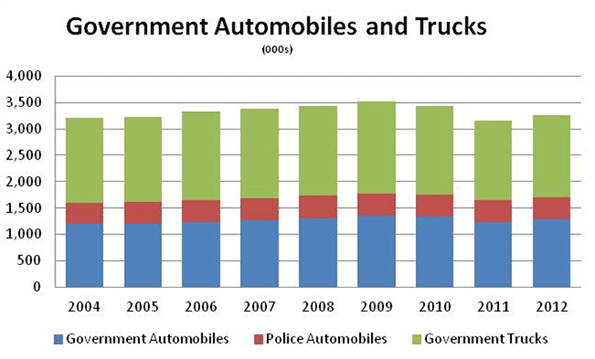
    Photo by gfpeck