Tag: Energy

  • Fracking, Youngstown and The Right to the City

    What happens when the Chamber of Commerce, labor leaders, and government officials, most of whom live outside the city, are pitted against a small yet influential group of community and university activists? That’s what’s going on right now in a debate over a ballot initiative that would prevent gas extraction by hydraulic fracturing — fracking — in Youngstown, Ohio. The proposed ordinance, Community Bill of Rights (CBR), is modeled on similar anti-drilling legislation in other Ohio communities that would largely block drilling, as well as shale gas extraction and injection wells, especially in urban areas.

    This is the third attempt during the last two years to pass such legislation in Youngstown, and the vote has become closer each time. In the most recent try, 45 per cent supported the ordinance and 55 per cent opposed it. Supporters hope to shift the balance this time.

    The underlying legal issue is whether local community restrictions can preempt Ohio’s legal framework for gas and oil drilling. Ohio is a home rule state where municipalities have authority “to exercise all powers of local self-government and to adopt and enforce within their limits such local police, sanitary and other similar regulations, as are not in conflict with general laws”. As proponents of the Youngstown ordinance point out, there is no exception in the Constitution for the oil and gas industry.

    The Constitution would seem to give Youngstown the right to regulate fracking on the local level, but in 2004, the Ohio legislature passed a bill HB 278 explicitly denying that right. The bill was largely written by the oil and gas industry, which recruited support for it by flooding both Republicans and Democrats with campaign contributions, according to former Ohio Attorney General Marc Dann. This happened before the industry expanded drilling in the Marcellus and Utica Shale regions of Eastern Ohio, suggesting that the industry knew it would encounter local resistance.

    Resistance to fracking reflects concerns about the well-documented relationship between fracking and earthquakes, both nationally and in Youngstown, and related health concerns. But what makes the Youngstown fight so remarkable is the setting: a community with a long history of economic struggle.

    Youngstown has been the poster child for deindustrialization and disinvestment since 1977. The city has lost over 30 per cent of its population in the last quarter century, and it has demolished over 3000 properties in the last five years. The average sale price for a home is $21,327. Other challenges include a median household income of $24,880 and a 36 per cent poverty rate. It’s also home to several prisons; one of every 20 residents is a prisoner. Alan Mallach, an urbanist and senior fellow of the National Housing Institute, notes that economic development efforts have not sufficiently addressed these problems, pointing out that “… factories or warehouses that the city has attracted usually move to the nearby suburbs, and four out of five jobs in the city are filled by people who commute from out of town.”

    Those opposing the Community Bill of Rights capitalize on these difficulties. They have spent large sums to set up phone banks in black urban churches, promoting the idea that fracking will create jobs. Yet there is very little evidence that African Americans have benefited from the fracking industry, except as precarious laborers.

    Many of those who are pushing for fracking don’t live in the city, and won’t have to live with its problems. These include Chamber members, labor unionists (especially the skilled trades), and city government employees who are exempted from local city residency requirements – a policy that contributed to the flight of middle-class white residents and the hollowing out of the city.

    The difference between the influence of these non-residents and the less well-financed voices of those who live in the city has not been lost on Community Bill of Rights supporters. CBR leaders Ray and Susie Beiersdorfer, city residents and Youngstown State University geologists, recognize that the blitz of advertising by the oil and natural gas industry, promising future jobs, appeals to the largely working-class, mostly black residents who are most affected by the city’s high levels of poverty and unemployment. But as a group of YSU academics noted in a letter to a Youngstown newspaper, “The same can be said for the manufacturing of cigarettes, alcohol, drones, high-range missiles, and nuclear warheads.”

    Youngstown, of course, is especially susceptible to the promise of jobs, even at the expense of the environment and health, and that has led some on the political left to either stay out of the fight or to oppose the CBR. Younger, environmentally-conscious city residents, including proponents of urban farming and sustainability, support the CBR. Other community groups think that the ban is too localized, and want to work on statewide fights. They argue that, because of the 2004 legislation, the local CBR is unenforceable and largely symbolic. Many local Democratic Party leaders also are visibly and vocally opposing the CBR. Democratic voters see their local leadership standing arm and arm with the many of same people who have attempted to undermine unionism and voting rights in Ohio.

    The proponents of the ban have been particularly troubled by the role of the city’s largest institution, Youngstown State University, and the resources it has accepted from the oil and gas industry. The impact of the university’s support of fracking has been powerful. YSU has downsized or abolished Humanities and Arts programs, while expanding its STEM (science, tech, engineering and math) college and trumpeting its training programs for promised oil and gas industry jobs that have yet to materialize in any significant degree. Some educators, like Deborah Mower, have argued that this should not be the role of the University: “Instead of merely responding to the industry need and ignoring the problems of fracking that have plagued the industry for decades, the university could create an epicenter for redressing their problems…. Perhaps lost in this discussion is the nature of education.”

    CBR proponents agree with that sentiment, but they might also point out that what is really at stake is, as the organizers of an upcoming international conference phrase it, the “right to the city” versus the influence of non-residents (disclosure: I’ll be speaking in May on so-called “smart shrinkage” at The Right to the City in an Era of Austerity (1973-2014) .

    The oil and gas industry has spent over $100,000 to defeat the CBR, and proponents have been sued to keep it off the ballot. Meanwhile, the Beiersdofers and other CBR organizers increasingly believe that public health, science and the ballot box are being overpowered by money. But they won’t let that happen in Youngstown without a fight.

    John Russo is a visiting research fellow at the Metropolitan Institute of Virginia Tech, and former co-director of the Center for Working-Class Studies / professor (emeritus) in the Williamson College of Business Administration at Youngstown State University. He is a board member of the Mahoning Valley Organizing Collaborative (MVOC) (Youngstown-Warren), and the co-author, with Sherry Linkon, of Steeltown U.S.A.: Work and Memory in Youngstown.

    Flickr photo by Don O’Brien, Red, White and Blue: In Ohio, 100-barrel tanks used to contain crude oil from gas wells.
  • Deutschland on the Pacific?

    California and Germany may not immediately come to mind as a doppelganger, but they do share several characteristics, particularly when it comes to their attitudes toward energy production and consumption.

    Both “States” have large populations which seem to agree that the world will be a better place if renewable sources of energy are given precedence over hydrocarbon based options in powering their economies.

    For both, this translates into an emphasis on preferentially using wind and photovoltaic sources. Initiatives include 1) the use of state and federal financial support for building and operating renewable generation and 2) preferential access to the grid for exporting the net power produced.

    On the “regulation” side the two “States” differ substantially.     

    California is relatively tough on coal based generation – long a major source of power to Los Angeles through Utah – while encouraging additional load following natural gas powered generation. Despite the shutdown of the nuclear plant at San Onofre, California is also viewed as being relatively tolerant of nuclear generation which does provide copious quantities of “base load” electric power without measurable amounts of air pollution. Of course California also likes hydropower when – during wet years – they can get it.

    Germany also likes wind, solar and hydro generation, but nuclear power units? Not so much. The draconian nuclear shutdown is a reaction Japan’s Fukushima disaster. However, the unrelated shutdown of natural gas plants in favor of coal based generation is a big surprise. By comparison, Japan, which really has a nuclear generation problem, is running their gas plants hard while trying to restart at least some of their existing nuclear units.

    The German natural gas plant cutbacks stem from the relatively high price of Russian sourced natural gas under long term contract. Such gas is simply unaffordable given the mandated subsidies charged to utilities. Ironically, Germany’s political and regulatory priorities have had the unintended consequence of encouraging the use of older coal based generation. Germany does have access to affordable coal as well as to existing power infrastructure that can use it. Due to the lack of politically viable alternatives, Germany is relying on their least attractive option.

    Power supply and demand is not created equal

    Residential power consumption varies significantly over the typical 24 hour day as people wake up, take showers, eat breakfast, go to work, return home, watch TV or play with their computers, and then go to bed. This is overlaid by seasonal needs for electrically powered air conditioning or heating units as well as by demand from industrial consumers. Output needs to vary directly with consumption.

    They do this by dispatching power from two different classes of equipment, “base load” and “load following”. (Think fixed and variable output). The time of daily peaks and troughs vary for each utility, but peaks generally occur in the late afternoon with troughs are observed in the late evening or early morning hours. The difference between the peak and trough can vary by a factor of three. Because electric power can’t be stored, utilities need the capability to follow the demand load by using generators capable of changing output quickly, hence “load following generation”. Gas turbines and hydropower are both good examples of load following generators. The other category “base load” is typically provided by nuclear and coal fired units. These power plants run 24/7 and cannot alter their output in the short term. They are capital intensive but can produce power at relatively low unit costs as long as they maintain full output. Because of pollution issues, coal powered generation is least welcome in California.

    Industrial power clients tend to be major consumers of base load power as their manufacturing plants run “24/7” and their need for variable power is much lower than that of the residential sector. Adding together industrial, residential, and commercial minimum demand defines the capacity need for base load generation. Adding together the maximum needs for all categories of load following capacity provides the utility’s total capacity requirement. The difference between the maximum and the minimum defines the need for load following capacity.

    California Dreaming

    There is at least one other category of power generation. We call it “intermittent”. By that, we mean a power source whose output cannot be predicted, such as wind and solar. Adding socially desirable, but intermittent, renewable power generation to a utility’s supply mix requires that the utility also acquire more predictable supplies, as the utility now needs to react to uncertainty of supply as well as to uncertainty of demand. As a state, California has been able to add new renewable sources, albeit with the result of higher residential rates.

    Germany has also added significant amounts of intermittent power to the supply mix, with wind turbines in the North and solar panels in the South. However, the economic impact of these additions has been much more severe for residential rate payers. Germany’s “Energiewende” policy has resulted in multiyear, double digit increases in power prices as the residential sector as well as the “non-energy intensive” industrial sector bear the cost of the experiment.

    Because Germany is, uber alles an export led economy, with exports representing 24% of GDP, the planners of the renewables initiative initially exempted large, energy intensive industry from paying the higher rates. Logically enough, they concluded that high power prices would compromise Germany’s ability to compete internationally. More recently, a new coalition government has proposed that, in the interest of “political peace in the family”, these previously exempt energy intensive industrial consumers must now bear part of the high costs of the energy transition. The industrial reaction has been to vote with their feet. BASF announced a multiyear investment program that assume the majority of new capital spending will occur outside of Germany, indeed outside of Europe.

    Physician, Heal Thyself

    Some economists have argued that Germany should simply purchase additional load following power from better-endowed neighbors. In fact, to some extent, that has occurred with Germany purchasing spot power from France and other neighboring countries. However, Germany’s attempts to sell surplus renewable power back to these same neighbors has been less than successful. This is because intermittent renewables are only available when the wind blows or when sunlight is available, not when the neighbors actually need the power. Germany’s neighbors, who have not yet bought in entirely to the new religion, do not have the ability to rapidly reduce their own domestic production in order to accommodate unpredictable foreign (German) surpluses. As a result, the Germans are exporting grid instability to their neighbors.

    With no other options, German utilities have resorted to using coal in order to create power to compensate for the variability in renewable output. American hands are not exactly “clean” as we have become a major supplier of steam coal to Germany, coal we no longer need to burn in US based power plants.

    Bipolar personalities and orphan power

    “Energiewende”, a national policy intended to accelerate the use of renewables and to reduce both CO2 emissions and particulate air pollution, has instead produced the unintended consequence of multiyear increases in pollution levels. It has caused higher prices to be paid for power in order to accomplish this dubious result. At the same time the policy has irritated Germany’s partners on the European Grid by producing intermittent power when it isn’t needed. I have to believe that Germany’s engineering class foretold this result…Too bad the politicians weren’t listening.

    Power to the People

    Back in California, the state government has been figuratively wringing its hands over the potential for the development of shale gas. Californians like to use natural gas, most of it imported from other western states and Canada. Ordinarily they would love to have a new local source of supply. However, the problem for California is that much of the state is dry during the best of times and, from a water standpoint, this is not the best of times.

    Low snow and rain levels are producing a “double whammy” for the state’s economy. While the legislature passed laws that legalize fracking, the implementation of enabling regulations has run afoul of the incremental need for water, either surface or subterranean, to support the fracking process. In a state renowned for its water wars between urban and rural interests, a new incremental need for water, even with the benefit of additional gas supply, is not good news.  

    For Germany, the solution is a bit more intractable. The energy intensive manufacturers in Germany   are now being threatened by a political compromise that has them also paying for the higher costs of renewable penetration of the German power market. The government has now recognized that the residential polity can no longer bare the “unsustainable” higher costs of Energiewende without help from heavy industry.

    The result is that their export oriented manufacturing economy is about to export itself to areas with a more welcoming attitude to affordable and sustainable energy supply.  Here on the US Gulf Coast the response is “Y’all come on down!”

    German companies as diverse as BASF and Volkswagen have announced new and expanded production facilities along the US Gulf Coast (also known as “The American Ruhr”). As long as German political authorities continue to pander to their fantasies, they will have no choice. Of course we will continue to ship them all the coal they can buy. The Germans have a word for political fantasy that grounds on economic reality. They call it “Realpolitik”.

    Eric Smith is a Professor of Practice at the A.B. Freeman School of Business at Tulane University. He serves as the Associate Director of the Tulane Energy Institute. He is a Chemical Engineer and has an MBA from the A. B. Freeman School at Tulane University. 

    Renewable energy photo from BigStockPhoto.com

  • Energy Running Out of California

    The recent decision by Occidental Petroleum to move its headquarters to Houston from Los Angeles, where it was founded over a half-century ago, confirms the futility and delusion embodied in California’s ultragreen energy policies. By embracing solar and wind as preferred sources of generating power, the state promotes an ever-widening gap between its declining middle- and working-class populations and a smaller, self-satisfied group of environmental campaigners and their corporate backers.

    Talk to people who work in the fossil-fuel industry, and they tell you they feel ostracized and even hated; to be an oil firm in California is like being a pork producer in an ultra-Orthodox section of Jerusalem. One top industry executive told me that many of his colleagues in California cringe at the prospect of being attacked by politicians and activists as something akin to war criminals. “I wouldn’t subject my kids to that environment,” the Gulf Coast-based oilman suggested.

    What matters here is not the hurt feelings of energy executives, but a massive lost opportunity to create loads of desperately needed jobs, particularly for blue-collar workers. The nation may be undergoing a massive “energy revolution,” based largely on new supplies of oil and, particularly, cleaner natural gas, but California so far has decided not to play.

    In all but forcing out fossil-fuel firms, California is shedding one of its historic core industries. Not long ago, California was home to a host of top 10 energy firms – ARCO, Getty Oil, Union Oil, Oxy and Chevron; in 1970, oil firms constituted the five largest industrial companies in the state. Now, only Chevron, which has been reducing its headcount in Northern California and is clearly shifting its emphasis to Texas, will remain.

    These are losses that California can not easily absorb. Despite all the hype about the ill-defined “green jobs” sector, the real growth engine remains fossil fuels, which have added a half-million jobs in the past five years. If you don’t believe it, just take a trip to Houston, where Occidental is moving. Houston now has more new office construction, some 9 million square feet, than any region in the country outside New York; Los Angeles barely has 1 million. Indeed, most of the office markets that have performed best in reducing vacancies since 2009 – Pittsburgh, Denver, Houston and Dallas – are all, to some degree, driven by energy.

    Everywhere you drive in Houston, now leading the nation in corporate expansions, one sees new office buildings. Last time I checked, I didn’t see much in the way of a Solyndra, Fisker or other green-business headquarters being constructed anywhere in our Golden State. Energy is driving Houston’s surge of some 50 new office buildings, led by ExxonMobil’s campus, the second-largest office complex under construction in the U.S. (after New York’s Freedom Tower).

    Chevron, once Standard Oil of California, has announced plans to construct a second tower for its downtown Houston campus, yet another signal of how that company is shifting emphasis from its roots in the Golden State to the Lone Star State. Relocating employees will have many people with whom to reminisce about old times; both Fluor and Calpine, major energy-related firms, have already made the Texas two-step.

    California clearly is squandering an opportunity to restart a large part of its economy. Texas energy has created some 200,000 new jobs over the past decade, while California has barely mustered 20,000. These energy jobs pay well, roughly $20,000 a year more than those in the information sector, according to EMSI. In 2011, this sector accounted for nearly 10 percent of all new jobs created in the nation. This has transformed much of the vast energy zone, from the Gulf to North Dakota. Houston, despite strong in-migration, now boasts an unemployment rate of 5.5 percent, almost four points below the jobless rate in Los Angeles.

    What about “green jobs”? Overall, California leads in green jobs, simply by dint of size; but on a per-capita basis, notes a recent Brookings study, California is about average. In wind energy, in fact, California is not even in first place; that honor goes to, of all places, Texas, which boasts twice California’s level of production.

    Ironically, one reason for this mediocre performance lies in environmental regulationsthat make California a tough place even for renewables. Even the New York Times has described Gov. Jerry Brown’s promise about creating a half-million new jobs as something of a “pipe dream.” Even though surviving solar firms are busy, in part to meet the state’s strict renewable mandates, solar firms acknowledge that they won’t be doing much of the manufacturing here, anyway.

    The would-be visionaries who manage the state are selling Californians a lot of pixie dust. Barely 700,000 Americans work in green energy, including building retrofits, compared with 9 million in fossil fuels. Nationwide employment in solar and wind, meanwhile, is well under 200,000. Overall, officials with fossil-fuel-related companies predict 1.4 million jobs in the sector by 2030.

    This predicament can’t be blamed on California running out of oil and gas; some estimates of the state’s oil and gas reserves as considerably larger than those of Texas. The Monterey Shale, located under the state’s economically struggling midsection, holds, according to federal Energy Department estimates, almost two-thirds of the nation’s total supply of shale oil. Tapping this source, notes a recent USC study, could bring as many as 500,000 new jobs to the state over the balance of this decade.

    Despite a bounty of fossil fuels, including along the coast, California’s oil production has continued to drop, and now ranks third among the states, behind No. 1 Texas, which has doubled its oil output in less than three years, and once-insignificant North Dakota. Californians have made a decision, based on green theology, that we don’t want to produce much of the stuff.

    Ordinary Californians bear the brunt of these policies, paying almost 40 percent above the national average for electricity. Rather than produce energy here, we appear set to import much of the oil and gas that, according to the state, still feeds well over 90 percent of California’s energy consumption.

    Particularly hard-hit has been California’s once-vibrant manufacturing sector, which has not mounted anything like the recovery being experienced in other parts of the country. From 2010-13, the country added 510,000 jobs, while California produced fewer than 8,000. Electricity prices are particularly uncompetitive, roughly twice as high in California, as those in prime competitors such Texas, Nevada, Arizona – as well as the hydro-powered Pacific Northwest.

    This has – discouraged manufacturers, such as Intel, from locating or expanding in the state. No surprise, then, that, just last week, it was revealed that the Lone Star State had also surpassed California in exports of high-tech goods.

    The worst impact of this deindustrialization is felt by blue-collar California. Even San Jose, the Central Valley’s traditional manufacturing hub, looks, as analyst Jim Russell suggests, more and more like a “rust-belt town.” Worse off still are the venerable agricultural and manufacturing regions, from the Central Valley to Los Angeles, where one person in five now lives in poverty. California’s green energy fixations, notes economist John Husing, are widening an ever-growing chasm based on “geography, class and race.”

    Despite these conditions, it’s hard to imagine a reversal of our current energy costs. The grip of green interests and their corporate allies in places like Silicon Valley suggests Californians will continue to endure ever-higher energy prices, lagging construction and manufacturing as a regular feature of the economy. This may make the green clerisy in the state happy, but is likely to have the opposite effect on the rest of us and on our economy as it becomes ever more narrowly based and fragile.

    This story originally appeared at The Orange County Register.

    Joel Kotkin is executive editor of NewGeography.com and Distinguished Presidential Fellow in Urban Futures at Chapman University, and a member of the editorial board of the Orange County Register. He is author of The City: A Global History and The Next Hundred Million: America in 2050. His most recent study, The Rise of Postfamilialism, has been widely discussed and distributed internationally. He lives in Los Angeles, CA.

    Oil well photo by BigStockPhoto.com.

  • Sustaining Prosperity: A Long Term Vision for the New Orleans Region

    This is the executive summary from a new report Sustaining Prosperity: A Long Term Vision for the New Orleans Region, authored by Joel Kotkin for Greater New Orleans, Inc. Download the full report from GNO, Inc. here: gnoinc.org/sustainingprosperity

    The recovery of greater New Orleans represents one of the great urban achievements of our era. After decades of slow economic, political and social decline, hurricane Katrina seemed a kind of coup de grâce, smothering the last embers of the region’s vitality. In the fall of 2005 it was entirely logical to see New Orleans as just a potential exemplar of failed urbanization, much as we might see in Detroit1, Cleveland, and a host of other once great cities – for example Naples, Lisbon, Antwerp and Osaka – that have tumbled from their once great importance.2

    Yet in New Orleans’ case, disaster engendered not continued decline, but the revival of the en­tire region, its economy, and social and political institutions. Like Chicago after the great fire of 1871, San Francisco in the wake of the 1906 earthquake and fire, or New York following 9-ll, New Orleans has rebounded in ways that have defied expectations.

    Critical to making New Orleans a resilient city has been the transformation of the civic culture. This has much to do with the commitment of New Orleanians to their city – like Chicagoans, New Yorkers and San Franciscans in the past. “A city,” notes urban historian Kevin Lynch,” is hard to kill if it possesses unique cultural appeal, geographic assets and people who are determined to save the city they love.”3

    New Orleans resiliency since Katrina constitutes much more than improved levees or better evacuation procedures; more than new brick and mortar applied to what had been an aging, deterio­rating region. New Orleans has made enormous progress in cleaning up its famously corrupt political system, and also made huge strides in improving its educational infrastructure. Once considered one of the worst places to do business, the region, and the state of Louisiana, has undergone a marked improvement to its reputation. It has emerged as a good place for commerce – something of a “Cin­derella” in economic development terms.4 Allison Plyer of the Greater New Orleans Community Data Center put it, “Greater New Orleans is in some ways rebuilding better than before”.5

    Our analysis shows this progress in a host of indicators. Once a below-average job producer, the region has expanded its employment since the 2007 recession far faster than the national average. It recovered all the jobs lost in the recession by 2012 – and then some – while the nation remained three percent below its pre-recession level. Entrepreneurial activity also has grown faster than the national average by a wide margin.6

    More important still, the region finally began to reverse a demographic decline that, for a gen­eration or more, saw young, educated people and families depart for other locales to seek out a better life. The concentration of 25 to 35 year olds has increased far more quickly in the region than it has in the nation as a whole. Indeed since 2007, New Orleans region has experienced the fastest growth in educated population in the nation.7

    Many economic trends favor the region’s continued ascendency. These include the still nascent US energy boom, which represents arguably the greatest shift in global economic power since the end of the Cold War and the rise of China; the massive flow of investment, domestic and foreign, into lower-cost locales and most particularly into the Third Coast, the burgeoning region around the Gulf of Mexico; and finally the expansion of US trade with Latin America and the Caribbean basin.

    To these powerful forces we can also add demographic and social factors that work to the region’s advantage. One key is a relatively low cost of living, which, in effect, gives area residents and businesses a leg up on their East and West coast rivals. This is critical in attracting net migration from those regions, with their storehouse of educated residents and skilled workers.8 Another force is the breadth of skills that can be easily found in the region, including higher paid skilled professionals ex­perienced in transportation and material moving, installation, maintenance and repair, construction, manufacturing and energy.

    A future scenario can be constructed where greater New Orleans emerges as one of the bright­est spots in the North American economy. Not only does the region have natural advantages in terms of energy resources and transportation, it can claim primary sources of higher-wage employment. It also possesses a cultural cachet that attracts educated workers, but in a cost and regulatory environ­ment that appeals to business investors.

    This is most notable in the growth of the region’s rapidly evolving information industry, in­cluding software, videogames and an expanding film/television industry. Over the past five years, New Orleans has come to enjoy a locational concentration equal to that of New York, and has emerged as a major player in this sector.

    Challenges Ahead: Economic, Social and Environmental

    As the region moves further from the immediate post-Katrina crisis, the great momentum of the last five years is clearly slowing down. Job creation remains positive, but has gradually fallen towards national norms. Indeed, since 2010, after years of running ahead, the region’s job growth rate actually trailed the national average. This could be simply a sign that, after recovering more slowly, the rest of the country is now catching up. But the slowdown relative to other cities should be taken seriously, as it could represent a loss of critical momentum.

    “Concert Of Economic Forces” That Can Make Recovery Permanent

    To overcome its legacy of poverty and inequality, the New Orleans region needs to focus not on just one sector but on five critical ones. In a highly competitive national and global economy, re­gions need to work on their unique strengths, establishing advantages that can lead to more, and bet­ter, job creation. Most particularly, the region needs to develop a broad, but still highly selective, base of industries that can create the higher-wage jobs necessary for the uplift not of a few New Orleani­ans, but for the many.

    1. The first, and most evident, is the region’s cultural legacy, which serves as a major source of jobs for local people as well as a lure for talented people from elsewhere. This, of course, includes the still very important tourism industry, but also encompasses generally higher-wage professions in film, television, video game software and even medical research.

    The growth in information sector employment, something relatively new to the region, rep­resents a clear breakthrough. It allows the region to take advantage of its essential cultural assets, by attracting companies and highly skilled workers. Although it is unlikely that the New Orleans region will ever become as tech-dependent as, say, Silicon Valley — which may prove a good thing, given that industry’s volatility — New Orleans can look forward to a sustained increase in high-paying, and high-visibility, employment. Perhaps most critically, it has an excellent opportunity to make itself the cultural capital of the Third Coast, the burgeoning region around the Gulf, something the region desperately needs and a role that New Orleans is uniquely positioned to fulfill.

    Yet although these industries are important, they alone cannot sustain a long-term, broad recovery. Wages in the tourism industry and the arts tend to be low – one reason for the city’s per­sistently poor income distribution in the past – and higher-wage jobs, except in engineering services and entertainment, remain below national norms in total jobs and will take many years to reach true critical mass. Perhaps most critically, these industries alone cannot produce enough high-wage skilled jobs for the region’s working class population.9

    2. The river system. Its location at the shipping terminus of the Mississippi River, across the regions the region’s ports – New Orleans, South Louisiana, St. Bernard, Manchac, Plaquemines and Grand Isle Port – is the historic reason for the region’s existence and one of the key factors in its future success. The region needs to work to compete successfully with its Third Coast rivals, notably Houston, as well as Mobile and Tampa. Growing trade with the Caribbean and the completion of the Panama Canal expansion project increase the opportunities for expanded logistics and cargo han­dling. In addition, the river provides an ideal spur to new industrial production, such as the Nucor Steel plant in St. James Parish, which some see as the precursor of a new zone, akin to Germany’s Ruhr Valley, that could emerge between New Orleans and Baton Rouge.

    Given the devastation of the region’s unique ecological environment, the river presents unique challenges to be addressed. At the same time, the river offers the region new opportunities to develop yet another nascent sector: environmental remediation. The RESTORE Act funds will bring billions to the Gulf help alleviate the region’s own environmental issues, but could also support the unique expertise and skills related to the profound challenges of maintaining coastal regions. This can be seen already in the over $210 million that has flowed to expert Louisiana companies as a result of Hurricane Sandy.10

    3. The energy revolution. Perhaps no sector has more potential to generate higher wage jobs across the region, particularly for working class residents, than the current energy revolution. This is rapidly shifting economic power to North America, and it’s a shift for which the region has a front row seat. Louisiana and the greater New Orleans area boast enormous oil and gas reserves, but the region has not kept up with Houston or even smaller cities in terms of energy-related jobs. Yet there has been continued growth in many upstream services, such as petro-industrial development and exploration, even if headquarters employment has dropped. With the resolution of the BP disaster, it is hoped that the region will recover more employment in this high-wage sector.

    4. Environmental remediation. This is both a major challenge and an opportunity for economic development. Simply put, there is no long-term future for the region if the environment that sup­ports it collapses. Katrina, after all, was not the first ecological disaster to hit the region, and it won’t be the last. Finding ways to restore coastal wetlands and manage the river and other water resources in a sustainable manner not only preserves the environment that New Orleanians cherish, but could also create significant business opportunities down the road; More than 4% of Dutch GDP is related to water management, and more than 50% of that is related to international projects and the export of water expertise and services.11

    The region has already received $1.3 billion from various BP criminal settlements that will be applied to river diversion and barrier island restoration projects. Over $600 million is already budget­ed for projects being let in 2014 alone, signifying great potential to expand the region’s expertise and capacity in this sector.12

    5. The construction of infrastructure. New industries require new or improved roads, better freight and harbor access, reliable, inexpensive electricity, and improved air service. The region is moving ahead on many of these fronts, from the expansion of the airport to major port improvements and the development of a new biomedical district along the Canal Street corridor. A region that has historically lagged in forward-looking improvements is showing clear signs of determination to catch up with competitors in the country and around the world.13

    Yet all these efforts must be done in conjunction with a long-term commitment to preserve the very environment that New Orleanians treasure. This is the ultimate challenge to sustaining and expanding regional prosperity in the era ahead.

    This concert of economic forces is critical to driving down poverty rates and raising incomes across class and racial lines. This can only be realized if there is a conscious effort to promote broad-based, sustainable growth in a diversity of industries. This requires placing a greater emphasis, among other things, on higher education, particularly on engineering and the biosciences, and, per­haps even more, on community colleges, technical schools and certificate training. The area may now be attracting more college-educated workers, but it still lags behind the national average, reflecting a legacy of out-migration of skilled workers over the past few decades.14

    This is the executive summary from a new report Sustaining Prosperity: A Long Term Vision for the New Orleans Region, authored by Joel Kotkin for Greater New Orleans, Inc. Download the full report from GNO, Inc. here: gnoinc.org/sustainingprosperity

    Joel Kotkin is executive editor of NewGeography.com and Distinguished Presidential Fellow in Urban Futures at Chapman University, and a member of the editorial board of the Orange County Register. He is author of The City: A Global History and The Next Hundred Million: America in 2050. His most recent study, The Rise of Postfamilialism, has been widely discussed and distributed internationally. He lives in Los Angeles, CA.

    Endnotes
    1 http://www.newgeography.com/content/003897-root-causes-detroit-s-decline-should-not-go-ignored
    2 http://www.theatlantic.com/business/archive/2012/01/the-10-fastest-growing-and-fastest-declining-cities-in-the-world/251602/#slide16
    3 Lawrence J. Vale and Thomas J. Campanella, “Conclusion: Axioms of Resilience”, in The Resilient City, editors, Lawrence J. Vale and Thomas J. Campanella, Oxford University Press, (New York: 2005), pp.335-353
    4 http://chiefexecutive.net/best-worst-states-for-business-2012
    5 The New Orleans Index, by Allison Player, 2013
    6 Allison Plyer, Elaine Ortiz, Ben Horwitz and George Hobor, The New Orleans Index at Eight: Measuring Greater New Orleans Progress Towards Prosperity, Greater New Orleans Community Data Center August 13, 2013, p.6-7
    7 newgeography.com/content/002044-americas-biggest-brain-magnets
    8 http://www.newgeography.com/content/002950-the-cities-where-a-paycheck-stretches-the-furthest
    9 Author’s analysis of data from EMSI, Inc.
    10 http://www.bp.com/en/global/corporate/sustainability/environment/managing-our-impact-on-the-environ­ment/complying-with-regulations/clean-water-act-provision.html; http://www.restorethegulf.gov/council/about-gulf-coast-ecosystem-restoration-council
    11 Dale Morris, Senior Economist, Royal Netherlands Embassy
    12 http://www.nfwf.org/gulf/Pages/home.aspx;
    13 http://biodistrictneworleans.org/
    14 Plyer, etal, op. cit., p.12

  • America’s Glass Half-empty, or Half-full?

    The stock market is high, real estate prices have resurged, even the unemployment rate is dropping, yet Americans still feel pretty down about the future. A survey released in January by the AP-NORC Center for Public Affairs Research had 54 percent of respondents expecting American life to go downhill over the coming decades. In a December survey, 23 percent of respondents said things will improve over time.

    Yet, in reality, there are several huge trends – economic, environmental, demographic – working in favor of the United States. Despite 13 straight years of underwhelming leadership, the U.S. can emerge extraordinarily blessed from the Great Recession and lackluster recovery, if Americans take advantage of our current situation.

    Why, then, so glum? One explanation clearly is the shape of the economic recovery, which, due in part to Federal Reserve monetary policy, has favored the rich by primarily promoting stock market and other asset growth. “Qualitative easing,” notes one former high-level Fed official, essentially constituted a “too big to fail” windfall for the largest Wall Street firms. Executives at these same firms set new compensation records in 2011, just three years after the financial “wizards” left the world economy on the brink of economic catastrophe.

    As people on Wall Street, and their hipper counterparts in Silicon Valley, celebrate their good fortune, most people are not doing well, and they know it. Unemployment may have dropped officially, but the percentage of Americans in the workforce is now at the lowest level since December 1977. Huge parts of our society now face long-term unemployment or, at best, a marginal existence at the low end of the job market.

    This trend is most disturbing because it has been going on for a long time and, generally, has been getting worse. Since 1973, for example, the rate of growth of the “typical family’s income” in the United States has slowed dramatically; for males, it has actually gone backward when adjusted for inflation, at least until the early 1980s. In contrast, in 2012, the top 1 percent of earners accounted for one-quarter of all American income, the highest percentage in the past century.

    So, given these problems, why should anyone be optimistic? After all, by 2020, the CIA suggested in 2005, the U.S. world position will have eroded because of the rise, most notably, of India and China; many business leaders share this assessment.

    Nevertheless, here are five reasons for optimism.

    Everyone else is in worse shape

    Looking for a global hot spot that’s doing better? Look again. Virtually all America’s much-vaunted competitors of yesterday – notably, Japan and the European Union – have suffered slow economic and demographic growth. The much-ballyhooed winner of tomorrow, China, also appears to be slowing. Political corruption, soaring local debt and massive levels of pollution are creating a crisis of confidence, reflected by the growing exodus of the educated and affluent from China and Hong Kong , with many ending up in the United States.

    The other members of the so-called BRIC countries – a term coined by one of the geniuses at Goldman Sachs – also are stagnating. Brazil’s successful bids to host the 2016 Summer Olympics and this summer’s soccer World Cup have made ever more obvious the country’s massive poverty and political incompetence, made all the worse by a slowing economy. India, too, is experiencing weak growth and increased political instability. Russia’s uncrowned czar, Vladimir Putin, may be outmaneuvering our gullible, indecisive president but the country Putin controls is going nowhere, with the population stagnating and its weakening economy utterly dependent on extractive resources. Turkey, another favorite of the investment banks, is also showing signs of distress and instability.

    Energy revolution

    Barack Obama has tried to take credit for America’s huge shift toward self-sufficiency in oil and gas, a movement driven largely by wildcatters and independents. Of course, it would have never happened if he had his druthers; under his administration, energy production on federal lands has dropped steadily. Nevertheless, the president seems smart enough not to shut off this amazing development on private and state lands, despite incessant pressure from his environmentalist supporters.

    The energy revolution, notably in natural gas, changes everything. It allows us to tell many of the world’s leading malefactors – Russia, Venezuela, Iran and Saudi Arabia – to keep their oil. It also is driving continued improvement in air quality and reduced levels of greenhouse gases. American natural gas, rapidly replacing coal as an energy source, has turned this country into what one green think tank, the Breakthrough Institute, called “the global climate leader.” We are lowering our emissions far more rapidly than are the Europeans, people widely praised by some U.S. greens for having superior policies.

    Manufacturing resurgence

    For all the concern expressed about the “end of the car era,” the U.S. auto industry is doing pretty well, in fact, selling vehicles at about the levels experienced before the Great Recession. General Motors, nearly dead five years ago, is now investing $1.3 billion to upgrade five Midwest factories. New auto plants, particularly those of European and Asian carmakers, are being erected across the South. But the resurgence of U.S. manufacturing is about more than cars; there also is huge investment in other industries, notably in pharmaceuticals and refining, notably tied to the energy revolution.

    Critically, the vast supplies of oil and, most importantly, natural gas, are pushing down manufacturing costs well below those imposed on Asian and European firms. This is where industrial jobs have been growing the fastest, and are likely to expand in years ahead. In fact, U.S. industrial and energy production has driven U.S. exports to a record level, one clear sign that the nation’s competitiveness is beginning to move beyond our traditional strengths in entertainment, services and agriculture.

    Demographic advantages

    As in other countries, The U.S. birth rate fell during the recession, but this decline has now stopped as the economy has crawled back. Over the past decade, the U.S., through somewhat high birth rates and immigration, has avoided the kind of demographic implosions that afflict most of our key competitors. In the next few decades, the working population of Americans is expected to grow substantially, while those in Japan, Korea, Europe and China all taper off.

    America’s relative youth helps not only fiscally – with more young people to carry the burden of a swelling retiree population – but also culturally. Despite the rise of entertainment and media in other countries (for example, Bollywood films or Korean pop music), the domination of new culture remains overwhelmingly American. Critically, this applies not only to Hollywood but even more so to digital media, where U.S. domination is both overwhelming and terrifying our competitors, particularly the autocrats in Moscow and Beijing.

    Blessings of federalism

    Perhaps America’s greatest strength lies in its constitutional order. Unlike other countries, the U.S. was defined by a separation of powers that accommodates regional differences. The calls from Washington by both Left and Right for more national solutions is misplaced; whether used to promote conservative or liberal policies, one size does not fit nearly all in a country as diverse and differentiated as the United States.

    Instead, we need to let our states and regions seek out the approaches that work best for them. If Ohio and Pennsylvania allow fracking, and it creates significantly better results than those in anti-fossil-fuel states like New York and California, that would send a message to other states, but does not have to reflect a national policy.

    America’s regions have enormous assets and advantages in the global economy. If we allow them to exploit what they have, there may be more hope for the future than many now believe.

    This story originally appeared at The Orange County Register.

    Joel Kotkin is executive editor of NewGeography.com and Distinguished Presidential Fellow in Urban Futures at Chapman University, and a member of the editorial board of the Orange County Register. He is author of The City: A Global History and The Next Hundred Million: America in 2050. His most recent study, The Rise of Postfamilialism, has been widely discussed and distributed internationally. He lives in Los Angeles, CA.

    USA map image by BigStockPhoto.

  • How Houston’s Missing Media Gene Hobbles Its Global City Ambitions

    In an upcoming study I am working on with Chapman University’s Center for Demographics and Policy, we show that San Francisco and Houston are North America’s “emerging” global cities. They are also rival representative champions and exemplars of two models of civic development. San Francisco is the world’s technology capital; focused on the highest levels of the economic food chain; paragon of the new, intangible economy; and promoter environmental values and compact development.  Houston is the closest thing to American laissez-faire; unabashed embracer of the old economy of tangible stuff, including unfashionable, but highly profitable, industries like oil, chemicals, and shipping.

    San Francisco embraces development restrictions that it sees as environmentally sustainable — and not coincidentally produced the highest housing costs compared to income in the nation, rendering the region unaffordable to all but the elite — whereas Houston has risen as an “opportunity city” for the non-elite; and the land of no-zoning and unrestricted development.  Somewhat unexpectedly, both cities are remarkably socially tolerant. Houston has an openly lesbian Democratic mayor and is extremely diverse, and while San Francisco may be a bit more free wheeling with its Folsom Street Fair and such, it’s also more strictly enforces its intellectual and political orthodoxy.

    Yet to date the competition between these two emerging models has been non-existent, at least from Houston’s perspective. Simply put, the Bay Area has played its hand brilliantly, and is lavished with praise in the media. In contrast Houston seems to be missing the self-promotion gene, at least outside what it has to pay for with advertising. The Bay Area has built its own image, often with the avid support of journalists who grant tech moguls demi-god status, and understandably prefer San Francisco’s spectacular scenery, mild weather and world-class restaurants to flat, steamy Houston, whose exciting food scene is typically housed in nondescript strip malls.

    In conventional (that is New York or London) terms it’s easy to see San Francisco as a global capital. It has long been established as an elite national center, the financial capital of the West Coast, as well as the traditional center, along with parts of New York, of the American counter-culture. With the comparative decline of Los Angeles, the Bay Area reigns supreme on the west coast. Its technology industry strides the globe like a colossus, its tech titans have managed, at least to date, to play simultaneously the roles of both modern day robber barons and populist heroes.

    Houston is less obvious. Though the energy capital of the world, Houston is still emerging as a prominent national and global city. It’s less mature, and was a small, obscure city when San Francisco was already emerging as the uncontested capital of the west coast.  And unlike San Francisco, whose only real rival is much smaller Seattle, Houston competes with an equally large, and in many ways also rising rival in Dallas-Ft. Worth.

    Unlike tech, energy has produced few rockstars, but many who are castigated as demons. Although there are 5,000 energy companies and 26 Fortune 500 headquarters in Houston, few of its leaders have achieved public prominence apart from Dick Cheney and Enron’s Jeff Skilling and Ken Lay — not exactly folk heroes.

    This is not to say some energy people don’t deserve celebration. For example, few Americans noticed the recent death of George Mitchell, the father of the fracking revolution that has driven America’s greenhouse gas emissions down at the fastest rate in the world, and one of America’s premier developers of master planned developments in the form of The Woodlands near Houston. The Economist said of this son of poor Greek immigrants, “Few businesspeople have done as much to change the world as George Mitchell.”  (Most people hearing the name would probably think of former Maine Senator George Mitchell).

    The maturity curve alone isn’t enough to account for the difference. Two additional factors are at work. First, the Bay Area self-consciously sees itself as a leader and moral exemplar. It wants to world to follow where it leads. Houston it seems, perhaps in line with its laissez-faire approach, wants to leave others alone, and be left to its own.  It may boast of having a great model, but whether others adopt has been of no particularly great local concern.

    The second big divergence relates to media. After all, the media, understood broadly, is how we come to have knowledge about or opinions of many things. Simply put, San Francisco and the tech industry get the power of media, while Houston doesn’t.

    The content creators may still prefer a New York, LA, or DC but the tech moguls are circling the last redoubts of entertainment and information.   Apple now has a dominant position in content distribution for music and is expanding in other areas.  Google generates huge advertising revenues that are greater than the entire newspaper and magazine industry.  Despite its many troubles, Yahoo remains one of the most-visited news sites. Meanwhile in just last year or two, Facebook co-founder Chris Hughes has bought the venerable New Republic while Seattle’s Jeff Bezos  recently bought the Washington Post. Pierre Omidyar, founder of Ebay, recently announced a $250 million new media venture featuring Glenn Greenwald and other well-known leftist media types.

    This isn’t just hubris, it’s good business. With Silicon Valley magnates starting to come under the same scrutiny as their 1% peers in other industries, it pays to have the means to control the narrative. Glenn Greenwald helped break the story on NSA snooping, but now that he’s on Silicon Valley’s payroll, how likely is it that he’ll take a similarly tough line on tech company privacy matters?  Give the Bay Area/tech crowd their due – they know what they are doing.

    Houston, by contrast, has close to zero media influence or impact and seems not to care. It’s much less an influencer of media than one whose reputation has been shaped by it, and often not in a good way. Though there are many sprawl dominated metropolises in America, it’s Houston that has become the bête noire of urbanists.

    It’s easy to understand historically why Houston has so little media influence, but harder to understand why the city is so blasé about it.  Tory Gattis, a former McKinsey consultant and local Houston blogger, suggests that it has to do with the DNA of the energy industry.  Most energy companies in Houston are B2B operations, so have little need for mass media. Energy has always been a political game and the industry’s approach has been a fairly direct one: employ a phalanx of lobbyists and former politicians around the world to help secure deals.  Also, unlike with the latest smart phone or social media app, you don’t need to convince anybody to fill up his gas tank or turn on his furnace in the winter.  The product is already completely understood by the end customer and literally sells itself.

    This mindset explains why the city has a blind spot, a missing gene if you will, that keeps it from understanding the necessity of having a robust media presence as part of its ambition to become a true global city. The Bay Area tech community may have been slow to the party when it comes to lobbying, but they are spending big to catch up fast and many of their executives have political as well as media aspirations. But despite its incredible wealth and surfeit of billionaires, Houston is absolute nowhere when it comes to media or thought leadership, and seems indifferent to the fact.

    Beyond merely asserting a role on the stage, getting in the media game is critical to the survival of Houston and its model.  The Bay Area sees itself as a model for a future America and world. It is spending big, lobbying big, and invading politics to create the kind of future it wants to see. Its mindset is to dominate.

    Houston may be content to let San Francisco go its own way but the reverse does not hold.  Silicon Valley has its sights set on overturning the fossil fuel industry through big investments (and good ol’ government pork) in green tech companies. Legal mandates that favor their investments are popular. It should be no surprise that folks like Bay Area billionaire Thomas Steyer have been vocal opponents of the KeystoneXL pipeline. (Such opposition is not uniform. Mark Zuckerberg’s Fwd.us organization supports KeystoneXL. But there’s clearly a lot of Silicon Valley support for policies that aren’t great for the Houston model).

    Houston can brag all its wants about its legitimate accomplishments in important areas like job and population growth and in providing middle-class opportunity. But if it wants to claim the mantle of global city, or even just head off threats to its way of doing business, it needs, like the Bay Area, to self-consciously stake out the role of leader.  For starters, that means putting its bigtime financial and intellectual muscle behind getting its message out. That means, like it or not, investing not only in oil wells, but inkwells.

    Aaron M. Renn is an independent writer on urban affairs and the founder of Telestrian, a data analysis and mapping tool. He writes at The Urbanophile.

    Photo by telwink.

  • Urban Planning For People

    The recent publication of the United States Department of Energy, Energy Information Administration’s (EIA) 2014 Annual Energy Outlook provides a good backdrop for examining the importance of current information in transportation and land-use planning. I have written about two recent cases in which urban plans were fatally flawed due to their reliance on outdated information. In one case, San Francisco’s Plan Bay Area, the planners are ignoring reality, and a court challenge is underway. In the other, a court invalidated the city of Los Angeles Hollywood Plan.

    Progress In Automobile CO2 Emissions

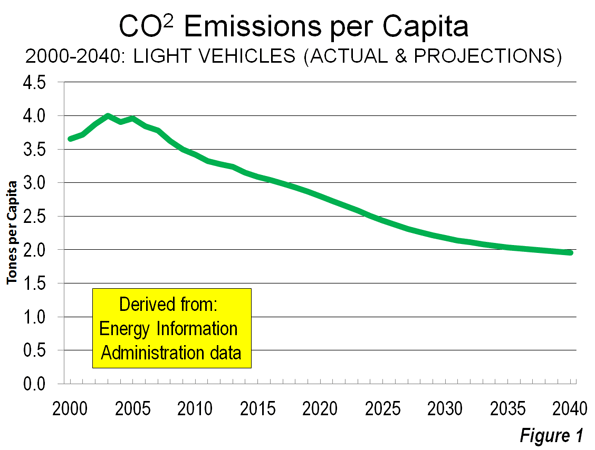
    The new Annual Energy Outlook forecasts continuing and material progress in improving energy efficiency, reducing fossil fuel consumption and reducing carbon dioxide emissions from cars and light trucks (light vehicles). Per capita carbon dioxide emissions from light vehicles are projected by EIA to fall to 51 percent below the peak year of 2003 (Figure 1).

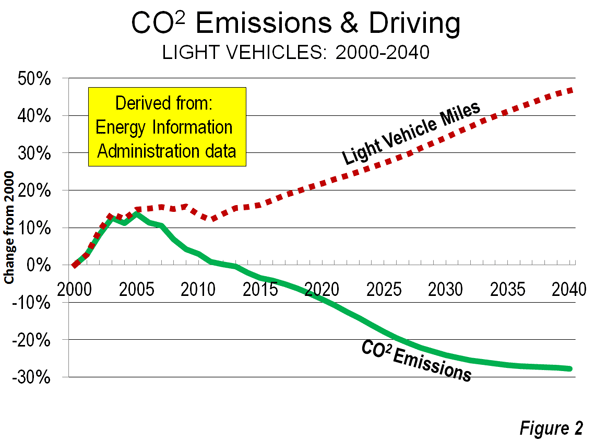
    The gross (not per capita) 2040 carbon dioxide reduction from light vehicles is projected to decline 28 percent in 2040 from 2003. Most significantly, the reduction is to occur as gross driving miles increases 29 percent (Figure 2). The actual 2040 emissions are likely to be even lower, because the 2014 Annual Energy Outlook assumes no vehicle fuel economy improvements after 2025. Improvements in vehicle technologies and cars using alternative fuels, and under government incentives, seem likely.

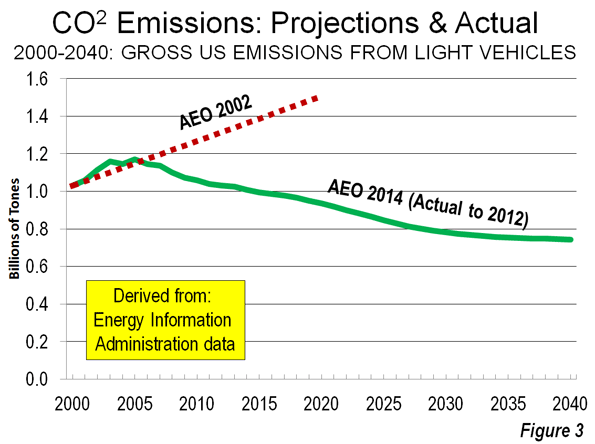
    The emissions forecast improvements have been stunning, to say the least. The 2002 Annual Energy Outlook had expected a 46 percent increase in carbon dioxide emissions from light vehicles between 2000 and 2020. The revised forecast – which takes into account what actually has occurred – says there will be a 9 percent decrease.

    This is the result of multiple factors. In 2002, EIA predicted a 55 percent increase in driving between 2000 and 2020. The 2014 Annual Energy Outlook revises that figure to 22 percent (Figure 3). Fuel economy is improving, which is being driven by stronger regulations as well as technological advances.  

    Driving is Down

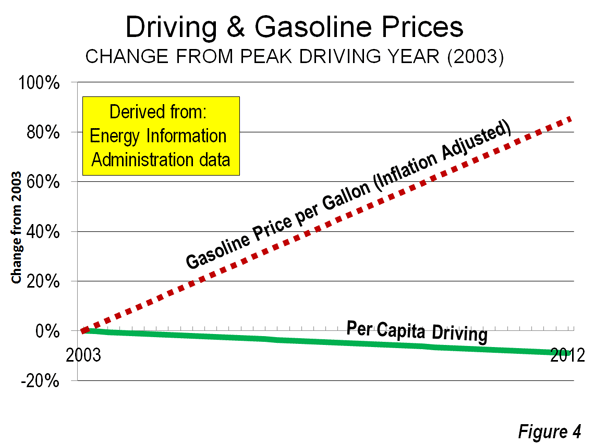
    Driving per capita fell nine percent from the peak year of 2003 to 2012. This decline is not surprising given the sorry state of the economy and high unemployment. Gas prices have risen 85 percent (inflation adjusted) over the same period. The decline in driving is modest compared to the increase in gas prices – a 0.9 percent reduction in driving per capita for each 10 percent increase in gasoline (Figure 4), inflation adjusted. This is half or less the reduction in transit ridership that would be expected if fares were raised by the same percentage.  

    Meanwhile, little of this reduction in driving has been transferred to transit. The increase in transit per passenger miles per capita captured less than one percent of the driving decline. Indeed, the daily increase in per capita transit use is less than the perimeter of a 20-to-the-acre townhouse lot.

    With fewer jobs, higher gas prices and the new reliance on social media, as well as a rise in people working at home, people may have become more efficient and selective in their driving patterns (such as by consolidating shopping trips). Certainly those with jobs use their cars for those trips above as much as before.

    Meanwhile, the EIA forecasts that driving per capita will rise gain, once the economy is released from intensive care. However, with the near universality of automobile ownership, the potential for substantial increases is very limited.

    Hiding Success?

    It might be thought that the planning community, with its emphasis on reducing greenhouse gas emissions, would be rushing to incorporate these into their plans and even to herald the improvements.

    Yet, this is not the case. San Francisco Bay Area planners hid behind over-reaching state directives to "pretend-it-was yesterday" and employed out of date forecasts for vehicle emissions. Data in Plan Bay Area documentation shows that 95 percent of the projected improvement in greenhouse gas emissions would be from energy efficiency improvements. These have nothing whatever to do with its intrusive land use and transport strategies. The additional five percent requires social engineering residents into "pack and stack" high density developments, virtually outlaw detached housing on plentiful urban fringe land and will likely cause even more intense traffic congestion.

    California’s high speed rail planners have made the same kind of mistake, using out-dated fuel economy data in their excessively optimistic greenhouse gas emissions reductions.

    The Illusion of Transit Mobility

    Part of the problem is an illusion that people in the modern metropolitan area can be forced out of their cars into transit, walking, and biking, without serious economic impacts (such as a lower standard of living and greater poverty).

    Transit is structurally incapable of providing automobile competitive mobility throughout the metropolitan area without consuming much or all of its personal income (of course, a practical impossibility). But there is no doubt of transit effectiveness and importance in providing mobility to the largest central business districts (downtowns) with their astronomic employment densities (Note 1). Yet, outside the relatively small dense cores, automobile use is dominant, whether in the United States, Canada, Australia, or Western Europe. The transit legacy cities (municipalities) of New York, Chicago, Philadelphia, San Francisco, Boston, and Washington, with the six largest downtown areas account for 55 percent of all transit commuting in the United States.

    The Delusion of Walking and Cycling as Substitutes for Driving

    Illusion becomes delusion when it comes to cycling and walking. Walking and cycling work well for some people for short single purpose trips, especially in agreeable weather. However, walking and cycling are inherently unable to provide the geographical mobility on which large metropolitan areas rely to produce economic growth. True, cycling does approximate transit commute shares in smaller metropolitan areas, like Amsterdam, Rotterdam, and Bremen, but still accounts for barely a third of commuting by car according to Eurostat data. Prud’homme and Lee at the University of Paris and others have shown in their research that the economic performance of metropolitan areas is better where more of an area’s employment can be reached within a specific period of time (such as 30 minutes). That leaves only a limited role for walking and cycling.

    Toward an A Non-Existent Nirvana?

    The "Nirvana" of a transit-, walking-, and cycling-oriented metropolitan area proves to be no Nirvana at all. We don’t need theory to prove this point. Take Hong Kong, for example, with its urban population density six times that of Paris, nine times that of Toronto, 10 times Los Angeles, 12 times New York nearly 20 times Portland, and nearly 40 times that of Atlanta.

    This vibrant, exciting metropolitan area cannot deliver on a standard of living that competes with Western Europe, much less the United States. Despite the high density, the overwhelming dominance of transit, walking, and cycling, Hong Kongers spend much longer traveling to and from work each day than their counterparts in all large US metropolitan areas, including New York and in most cases the difference is from more than 50 percent (as in Los Angeles) to nearly 100 percent.

    The problem goes beyond the time that could be used for more productive for rewarding activities. Housing costs are the highest among the major metropolitan areas in the eight nations covered by the Demographia International Housing Affordability Survey. Hong Kong’s housing costs relative to incomes are more than 1.5 times as high as in the San Francisco metropolitan area and almost five times as high as Dallas-Fort Worth. Meanwhile, the average new house in Hong Kong is less approximately 485 square feet (45 square meters), less than one-fifth the size of a new single family US American house (2,500 square feet or 230 square meters), though Hong Kong households, are larger (Note 2).

    When households are required to spend more of their income for housing, they have less discretionary income and necessarily a lower standard of living. This loss of discretionary income trickles down to people in poverty, whose numbers are swelled by higher than necessary housing costs.

    Planning is for People

    Contrary to the current conventional wisdom, the prime goal of planning should not be to achieve any particular urban form. What should matter most is the extent to which a metropolitan area facilitates a higher standard of living and less poverty.

    ——————

    Note 1: In 2000, employment densities in the nation’s six largest downtown areas (New York, Chicago, Washington, Boston, San Francisco and Philadelphia) was three times that of the downtowns in the balance of the 50 largest urban areas, and 14 times as dense as outside the downtown areas.

    Note 2: According to the 2011 census, the average household size in Hong Kong was 2.9 persons. This is more than 10 percent larger than the US figure of 2.6 from the 2010 census.

    ——-

    Wendell Cox is a Visiting Professor, Conservatoire National des Arts et Metiers, Paris and the author of “War on the Dream: How Anti-Sprawl Policy Threatens the Quality of Life.

    Photo: Prius photo by Bigstock.

  • Fixing California: The Green Gentry’s Class Warfare

    Historically, progressives were seen as partisans for the people, eager to help the working and middle classes achieve upward mobility even at expense of the ultrarich. But in California, and much of the country, progressivism has morphed into a political movement that, more often than not, effectively squelches the aspirations of the majority, in large part to serve the interests of the wealthiest.

    Primarily, this modern-day program of class warfare is carried out under the banner of green politics. The environmental movement has always been primarily dominated by the wealthy, and overwhelmingly white, donors and activists. But in the past, early progressives focused on such useful things as public parks and open space that enhance the lives of the middle and working classes. Today, green politics seem to be focused primarily on making life worse for these same people.

    In this sense, today’s green progressives, notes historian Fred Siegel, are most akin to late 19th century Tory radicals such as William Wordsworth, William Morris and John Ruskin, who objected to the ecological devastation of modern capitalism, and sought to preserve the glories of the British countryside. In the process, they also opposed the “leveling” effects of a market economy that sometimes allowed the less-educated, less well-bred to supplant the old aristocracies with their supposedly more enlightened tastes.

    The green gentry today often refer not to sentiment but science — notably climate change — to advance their agenda. But their effect on the lower orders is much the same. Particularly damaging are steps to impose mandates for renewable energy that have made electricity prices in California among the highest in the nation and others that make building the single-family housing preferred by most Californians either impossible or, anywhere remotely close to the coast, absurdly expensive.

    The gentry, of course, care little about artificially inflated housing prices in large part because they already own theirs — often the very large type they wish to curtail. But the story is less sanguine for minorities and the poor, who now must compete for space with middle-class families traditionally able to buy homes. Renters are particularly hard hit; according to one recent study, 39 percent of working households in the Los Angeles metropolitan area spend more than half their income on housing, as do 35 percent in the San Francisco metro area — well above the national rate of 24 percent.

    Similarly, high energy prices may not be much of a problem for the affluent gentry most heavily concentrated along the coast, where a temperate climate reduces the need for air-conditioning. In contrast, most working- and middle-class Californians who live further inland, where summers can often be extremely hot, and often dread their monthly energy bills.

    The gentry are also spared the consequences of policies that hit activities — manufacturing, logistics, agriculture, oil and gas — most directly impacted by higher energy prices. People with inherited money or Stanford degrees have not suffered much because since 2001 the state has created roughly half the number of mid-skilled jobs — those that generally require two years of training after high-school — as quickly as the national average and one-tenth as fast as similar jobs in archrival Texas.

    In the past, greens and industry battled over such matters, which led often to reasonable compromises preserving our valuable natural resources while allowing for broad-based economic expansion. During good economic times, the regulatory vise tended to tighten, as people worried more about the quality of their environment and less about jobs. But when things got tough — as in the early 1990s — efforts were made to loosen up in order to produce desperately needed economic growth.

    But in today’s gentry-dominated era, traditional industries are increasingly outspent and out maneuvered by the gentry and their allies. Even amid tough times in much of the state since the 2007 recession — we are still down nearly a half-million jobs — the gentry, and their allies, have been able to tighten regulations. Attempts even by Gov. Jerry Brown to reform the California Environmental Quality Act have floundered due in part to fierce gentry and green opposition.

    The green gentry’s power has been enhanced by changes in the state’s legendary tech sector. Traditional tech firms — manufacturers such as Intel and Hewlett-Packard — shared common concerns about infrastructure and energy costs with other industries. But today tech manufacturing has shrunk, and much of the action in the tech world has shifted away from building things, dependent on energy, to software-dominated social media, whose primary profits increasingly stem from selling off the private information of users. Servers critical to these operations — the one potential energy drain — can easily be placed in Utah, Oregon or Washington where energy costs are far lower.

    Even more critical, billionaires such as Google’s Eric Schmidt, hedge fund manager Thomas Steyer and venture firms like Kleiner Perkins have developed an economic stake in “green” energy policies. These interests have sought out cozy deals on renewable energy ventures dependent on regulations mandating their use and guaranteeing their prices.

    Most of these gentry no doubt think what they are doing is noble. Few concern themselves with the impact these policies have on more traditional industries, and the large numbers of working- and middle-class people dependent on them. Like their Tory predecessors, they are blithely unconcerned about the role these policies are playing in accelerating California’s devolution into an ever more feudal society, divided between the ultrarich and a rapidly shrinking middle class.

    Ironically, the biggest losers in this shift are the very ethnic minorities who also constitute a reliable voter block for Democratic greens. Even amid the current Silicon Valley boom, incomes for local Hispanics and African-Americans, who together account for one-third of the population, have actually declined — 18 percent for blacks and 5 percent for Latinos between 2009 and 2011, prompting one local booster to admit that “Silicon Valley is two valleys. There is a valley of haves, and a valley of have-nots.”

    Sadly, the opposition to these policies is very weak. The California Chamber of Commerce is a fading force and the state Republican Party has degenerated into a political rump. Business Democrats, tied to the traditional industrial and agricultural base, have become nearly extinct, as the social media oligarchs and other parts of the green gentry, along with the public employee lobby, increasingly dominate the party of the people. Some recent efforts to tighten the regulatory knot in Sacramento have been resisted, helped by the governor and assisted by the GOP, but the basic rule-making structure remains, and the government apparat remains highly committed to an ever more expansive planning regime.

    Due to the rise of the green gentry, California is becoming divided between a largely white and Asian affluent coast, and a rapidly proletarianized, heavily Hispanic and African-American interior. Palo Alto and Malibu may thrive under the current green regime, and feel good about themselves in the process, but south Los Angeles, Oakland, Fresno and the Inland Empire are threatened with becoming vast favelas.

    This may constitute an ideal green future — with lower emissions, population growth and family formation — for whose wealth and privilege allow them to place a bigger priority on nature than humanity. But it also means the effective end of the California dream that brought multitudes to our state, but who now may have to choose between permanent serfdom or leaving for less ideal, but more promising, pastures.

    Joel Kotkin is executive editor of NewGeography.com and Distinguished Presidential Fellow in Urban Futures at Chapman University, and a member of the editorial board of the Orange County Register. He is author of The City: A Global History and The Next Hundred Million: America in 2050. His most recent study, The Rise of Postfamilialism, has been widely discussed and distributed internationally. He lives in Los Angeles, CA.

    This piece originally appeared at U-T San Diego.


  • Middle-Wage Jobs That Have Survived, and the States That Are Fostering Them

    Middle-skill jobs are in the same camp as green jobs, STEM jobs, and other groups of occupations that garner lots of attention: They can be defined many ways, by many rubrics. Regardless of the definition, however, it’s clear that middle-skill, or middle-wage, jobs have been in decline for years.

    New research from the Federal Reserve indicates the share of middle-skill jobs in the workforce has dropped from 25% in 1985 to just above 15% today, part of the hollowing-out effect that David Autor of MIT has documented. And as our chart above shows, middle-wage jobs — those that pay between $13.84 and $21.13 per hour, as defined by the National Employment Law Project — sustained much deeper cuts during the 2008-2009 recession than high- and low-wage jobs.

    But not every middle-skill, middle-wage job is now extinct because of automation and offshoring. A subset of mid-wage manufacturing jobs (along with jobs in energy, health care, and other sectors) are among the healthiest post-recession occupations in the U.S. Furthermore, in a handful of states (Wyoming, Iowa, North Dakota, Michigan), mid-wage fields account for more than or close to 40% of all new jobs since 2010.

    Mid-Skill or Mid-Wage?

    For our analysis, we used middle-wage jobs instead of middle-skill jobs (i.e., those that require less than a bachelor’s degree but more than a high school degree). This is because some occupations that the BLS has assigned a mid level of education (e.g., registered nurses) often require a higher level of education by employers.

    This methodology is similar to the one used by Autor is his 2010 study. For a brief synopsis of why Autor used wage to approximate skill, see here.

    Share of New Jobs in Mid-Wage Category

    In the U.S., a quarter of all new jobs since 2010 fall in the mid-wage range. That’s a slightly smaller share than high-wage jobs (29%), while almost half (46%) of new jobs have been low-wage.

    ShareNewJobsbyWage

    No state has stood out more than Wyoming, where 45% of new jobs since 2010 have been mid-wage — well ahead of Iowa (37%), North Dakota (36%), and Michigan (35%). Texas (25%) and California (23%) have created the most total new middle-wage jobs in the nation, but they’re in the middle of the pack in terms of the share of all new jobs.

    State-MidWage-ShareAt the bottom, Rhode Island is the only state that’s lost middle-wage jobs the last few years. Coincidentally, it’s also seen a decline in high-wage jobs, meaning all of its job growth has been in occupations that pay $13.83 or lower.

    Meanwhile, Mississippi (10%) and New York (13%) have the lowest share of new mid-wage jobs among states that have seen job increases.

    Generally, states with higher cost of living are at the bottom in mid-wage job growth, with the exception of Mississippi. (It’s worth noting 80% of new jobs in Mississippi have been low-wage).

    State Name 2013 Jobs New Jobs Since 2010 (Total) New Jobs Since 2010 (Mid-Wage) Share of New Jobs Since 2010 (Mid-Wage)
    Source: QCEW Employees, Non-QCEW Employees & Self-Employed – EMSI 2013.3 Class of Worker
    Wyoming 319,672 7,607 3,411 45%
    Iowa 1,689,811 58,987 21,902 37%
    North Dakota 492,918 71,607 25,970 36%
    Michigan 4,391,882 214,075 74,536 35%
    Arizona 2,805,158 155,430 53,115 34%
    Alaska 388,436 9,790 3,296 34%
    New Mexico 913,612 13,215 4,315 33%
    Oklahoma 1,786,664 66,837 21,153 32%
    Minnesota 3,007,618 128,418 39,433 31%
    Pennsylvania 6,215,891 123,999 37,616 30%
    Vermont 356,643 10,494 3,158 30%
    Hawaii 742,002 27,637 8,262 30%
    Kentucky 2,038,143 72,485 21,562 30%
    South Carolina 2,085,991 83,597 24,601 29%
    Wisconsin 2,989,657 60,737 17,661 29%
    Louisiana 2,143,399 64,696 18,736 29%
    Ohio 5,585,543 159,403 44,960 28%
    Indiana 3,160,881 146,127 40,050 27%
    Kansas 1,530,232 35,131 9,471 27%
    Colorado 2,668,013 153,362 40,122 26%
    Nebraska 1,059,262 28,648 7,430 26%
    Texas 12,485,450 904,317 226,927 25%
    Tennessee 3,061,383 144,846 34,657 24%
    Utah 1,408,139 112,919 26,974 24%
    California 17,523,783 913,413 208,707 23%
    Massachusetts 3,679,152 149,301 33,836 23%
    Oregon 1,908,085 66,034 14,817 22%
    North Carolina 4,564,124 202,606 45,008 22%
    Georgia 4,449,841 182,068 40,297 22%
    Montana 511,880 18,730 4,122 22%
    Maryland 2,881,471 103,598 22,439 22%
    Nevada 1,260,218 47,951 10,160 21%
    Idaho 724,549 26,236 5,250 20%
    South Dakota 472,376 12,811 2,476 19%
    District of Columbia 775,185 23,111 4,378 19%
    Washington 3,379,817 140,985 26,352 19%
    West Virginia 789,978 22,278 4,134 19%
    Arkansas 1,302,641 15,044 2,652 18%
    Illinois 6,243,694 178,096 30,999 17%
    Missouri 2,988,014 62,799 10,803 17%
    Maine 672,708 2,998 508 17%
    Delaware 453,952 12,810 2,133 17%
    Florida 8,370,099 373,274 61,868 17%
    Alabama 2,084,701 22,075 3,605 16%
    Connecticut 1,831,478 44,701 7,161 16%
    Virginia 4,175,545 133,765 19,079 14%
    New Jersey 4,211,361 104,096 14,478 14%
    New Hampshire 702,271 13,694 1,877 14%
    New York 9,602,939 325,490 43,591 13%
    Mississippi 1,255,654 22,961 2,236 10%
    Rhode Island 503,723 5,140 -46
    Total 150,645,641 6,080,429 1,502,652 25%

    Mid-Skill, Mid-Wage Occupations on the Rise

    The list of still-vibrant middle-wage jobs is long, and most typically require on-the-job training, work experience, or short-term certificates and degrees that community colleges specialize in. This includes customer service representatives (up 6%) and heavy/tractor-trailer truck drivers (up 7%), two occupations that have each added more than 118,000 estimated jobs since the start of 2010. Both offer solid, mid-tier earnings ($14.91 and $18.14 median hourly earnings, respectively).

    Other examples of strong mid-wage occupations:

    • Machinists have the best combination of total jobs added from 2010 to 2013 (nearly 50,000) and percentage job growth (14%). This occupation is just one of several on-the-rebound production fields: computer controlled machine tool operators (17% growth since 2010), welders (11%), and inspectors, testers, sorters, samplers, and weighers (8%) have also performed well post-recession.
    • The fastest-growing mid-wage jobs are clustered in energy fields, specifically oil and gas: roustabouts (38% growth since 2010), oil, gas, and mining service unit operators (38%), helpers of extraction workers (28%), and extraction workers, all other (22%). Next in percentage growth since 2010 are computer controlled machine tool operators (17%).

    These occupations are the cream of the crop in terms of recent job growth, and there are dozens of other viable mid-wage professions.

    Joshua Wright is an editor at EMSI, an Idaho-based economics firm that provides data and analysis to workforce boards, economic development agencies, higher education institutions, and the private sector. He manages the EMSI blog and is a freelance journalist. Contact him here.

  • Twitter And The Real Economy Of Jobs

    With Twitter’s high-profile IPO, the media and much of the pundit class are revisiting one of their favorite themes: the superiority of the brash, young urban tech elite, who don’t need to produce much in the way of profits to be showered with investor cash.  Libertarians will celebrate the triumph of fast-paced greed and dismiss concerns over equity; progressives may dislike the easy money but will be comforted when much of it ends up supporting their candidates and causes.

    Lost amid this discussion is any sense of reality about the economy for the rest of us. To be sure, in large part due to the Fed, the Bay Area and Manhattan are awash in money. But these places are barely typical of their regions, much less the nation, and are not attuned to creating a prosperity that will benefit more than a slight percentage of our population.

    The focus on digital uber alles is endorsed by a new school of American economics that essentially cedes the future to information-based industries and considers tangible activities like fossil fuel production, manufacturing and construction passé. In the mind of its devotees, such as UC Berkeley’s Enrico Moretti, author of The New Georgaphy of Jobs, information industries, clustered in ultra-expensive, overwhelmingly white (and Asian) enclaves, are the lodestones of our economic future.

    But what about those lacking degrees from elite colleges? The economist Tyler Cowen suggests that the 85% of the population without the proper cognitive pedigree will need to adopt the survival strategies of the poor in Latin America, including a diet heavy in beans.

    Another suggestion is that they can cut hair, walk dogs, and work on the houses of the digerati; given the extraordinary housing prices in the places where the anointed live, how they will afford to live anywhere near them is a bit of mystery. Yet most now putative middle-class Americans are not likely to walk easily to go into that dark night of limited opportunity. There remain economies anchored to more mundane industries, such as energy, construction, manufacturing and logistics, that still offer paths of upward mobility to people who didn’t go to Harvard, MIT or Stanford. These industries also employ more engineers and scientists than the IT sector, and in the case of energy produce more economic benefit to local economies, according to a 2007 study by the Bureau of Economic Analysis.

    In contrast celebrated social media firms, overwhelmingly concentrated close to the venture capital spigot, are both geographically constrained and and employ shockingly  few workers. The darlings of the bubblicious tech boom — Twitter, Facebook, Zynga, LindedIn and Google — employ roughly 58,000 people combined; in contrast the old-line tech firm Intel employ 85,000 people, half in the U.S., while ExxonMobil provides livelihoods to 80,000.

    In term of profits, the supposed holy grail of business, it’s not even close. In Exxon’s disappointing last quarter it racked up $6.9 billion. By contrast Google earned $3.1 billion, while Facebook made $333 million and LinkedIn $3.7 million. Yet what the new tech oligarchs lack on the balance sheet, they seem to make up for with a combination of presumed potential and PR panache.

    The money that has flowed to tech companies in San Francisco has and the much more important Silicon V alley has transformed these geographies,  peninsula  into something resembling glorified gated communities, populated by those lucky enough to have bought earlier and, increasingly, by techno-coolies shipped in from abroad.

    With the cost of housing soaring, the Bay Area has lost domestic migrants until very recently. Meanwhile,  the strongest household growth is taking place in less glitzy metro areas like Houston and other Texas cities, Atlanta, Raleigh and Jacksonville. With the worst of the recession over, most new jobs, once again, according to Moody Analytics, are likely to be  created largely in Sun Belt locations such as Texas, Arizona, Georgia and even Nevada as well as the Great Plains and Intermountain West.

    The people who settle in these places are not, as often asserted dummies stuck at the low rung of the meritocracy; the cities with the fastest-growing college-educated populations are primarily in the Sun Belt and Intermountain West, such as Houston, Austin, San Antonio and Nashville.

    Although many of the new economists believe these areas are generating mainly “crummy” jobs, employment is expanding in higher-wage areas such as energy and manufacturing as well as services and even high-tech. What these unfashionable regions offer are good business conditions, reasonable housing prices and usually lower taxes. Increasingly these seem like the remaining future bastions of middle-class jobs and lifestyles while the coasts mint the most billionaires, many in tech and finance.

    Ideally America’s economy should benefit from both Twitter and wildcatters. But increasingly Silicon Valley, led by Google, has chosen to wage an economic war on competing sectors, notably the fossil fuel industry,  including producers of relatively clean, abundant and cheap natural gas. By doing this they also threaten America’s nascent industrial renaissance, and particularly the country’s heartland. These jobs may not replace all those lost in past decades, but they tend to be higher paying and offer communities, particularly in the Midwest and Southeast, opportunities that few previously thought possible.

    Tech boosters like Moretti tend to claim that jobs created by social media and software firms are more solid, and permanent, than those in more traditional sectors. This is absurd. Tech employment has become, if anything, more unstable than energy. Indeed between 2000 and 2008, Valley tech companies lost well over 100,000 jobs; even with the current bubble, Silicon Valley’s STEM employment, according to estimates by Economic Modeling Specialists Inc., has only now started to make up for what was lost in the last recession.

    Of course, energy, as well as manufacturing, suffer through cycles, although the opening of the developing world economies has created a vast, and likely permanent, long-term market. New technologies, including fracking and horizontal drilling, also suggest that resources may not erode as quickly as in the past.

    Rather than celebrate or at least coexist with the tangible economy’s power, the tech oligarchs , along with their allies on Wall Street and within the political-media class, seem intent on stamping them out. One manifestation of this alliance could be seen in the recent pronunciamento against the Keystone Pipeline signed by three prominent oligarchs: Bay Area hedge fund manager Tom Steyer, retiring New York Mayor Michael Bloomberg and former Treasury Secretary Hank Paulson, the designer of the TARP bailouts and first rescuer of Wall Street’s worst miscreants.

    But for some, like the politically connected billionaire Steyer, there’s more to this more than just misguided idealism. Steyer and his allies, such as Google and associated venture firms, have sought to profit mightily by backing renewable energy ventures dependent on regulations mandating their use and guaranteeing high prices.

    The price of this enlightened progressive profit-taking largely falls on working class Californians, and traditional industries, which get stuck with exorbitant energy prices. We can see similar phenomena in New York State, where grandees now finance  much of the anti-fracking movement, joined by academics,  Manhattan glitterati and gentry landowners. In contrast to Pennsylvania and Ohio, where new energy development is sparking manufacturing and opportunities in formerly destitute communities, the anti-fracking band seems destined to keep upstaters the economic equivalent of fat, dumb and pregnant.

    Perhaps we should call the new concert of tech, media and finance “Billionaires for Poverty.” Their approach — backed by the new economists –  leaves most Americans only the prospect of a dim future envisioned, with people huddled together, like our grandparents in small apartments, working at low wages with little hope of advancement. Perhaps some will be satisfied with a higher minimum wage, more digital gadgetry, and an expanded welfare state in lieu of a middle-class existence.

    Instead of waging a senseless economic war that is sure to expand class divisions perhaps the best economic model would be to encourage growth of both the tangible and digital economies.  According to my colleague Mark Schill of the Praxis Strategy Group, the tech and energy sectors employ roughly the same number of people, 2.4 million, and pay around the same average wages, slightly above $100,000.

    Texas has benefited by going after both sectors, something  California as well as New York have disdained to do. Indeed even in tech, Texas is gaining ground, since 2001 adding tech jobs at a much faster pace than than California. The Lone Star state could, at the current rate, equal the Golden State in this critical field within a decade or two.

    But there’s no real competition in the energy sweepstakes. Since 2001 Texas has added some 208,000 jobs in this field, and now employs over 580,000. In contrast California, whose fossil fuel resources may match or even exceed Texas’, has created barely 20,000, for a total of 185,000. Critically, IT work generally employs only college graduates, while the energy industry employs, often at high wages, not only geologists and other highly trained workers but blue-collar workers on rigs, driving trucks, or monitoring equipment.

    Providing broad opportunities for the mass of Americans — not enriching the few, even if they happen to be hip and cool — should be the primary objective in an economy in a democracy. The supremacy of the emerging digital economy may be OK for people at Twitter or Facebook, but how many of the rest of us want our children to grow up with little chance of reaping much from the economy except an updated app that allows them to stay in touch with their largely unemployed or underemployed “friends.”

    This story originally appeared at Forbes.

    Joel Kotkin is executive editor of NewGeography.com and Distinguished Presidential Fellow in Urban Futures at Chapman University, and a member of the editorial board of the Orange County Register. He is author of The City: A Global History and The Next Hundred Million: America in 2050. His most recent study, The Rise of Postfamilialism, has been widely discussed and distributed internationally. He lives in Los Angeles, CA.

    Midwest drilling rig photo by Bigstock.