Tag: Energy

  • What Conservatives Can Teach Liberals About Global Warming Policy

    Over the last decade, progressives have successfully painted conservative climate skepticism as the major stumbling block to reducing greenhouse gas emissions. Exxon and the Koch brothers, the story goes, fund conservative think tanks to sow doubt about climate change and block legislative action. As evidence mounts that anthropogenic global warming is underway, conservatives’ flight from reason is putting us all at risk.

    This week’s release of a new United Nations Intergovernmental Panel on Climate Change report opens another front in the climate wars. But beneath the bellowing, name-calling, and cherry-picking of data that have become the hallmark of contemporary climate politics lies a paradox: the energy technologies favored by the climate-skeptical Right are doing far more to reduce greenhouse gas emissions than the ones favored by the climate-apocalyptic Left.

    How much more? Max Luke of Breakthrough Institute ran the numbers and found that, since 1950, natural gas and nuclear prevented 36 times more carbon emissions than wind, solar, and geothermal. Nuclear avoided the creation of 28 billion tons of carbon dioxide, natural gas 26 billion, and geothermal, wind, and solar just 1.5 billion.

    Environmental leaders who blame “global warming deniers” for preventing emissions reductions point to Germany’s move away from nuclear and to renewables. “Germany is the one big country that’s taken this crisis seriously,” wrote Bill McKibben. Other progressive and green leaders, including Al Gore, Bill Clinton, and Bobby Kennedy, Jr., have held up Germany’s “energy turn,” theEnergiewende, as a model for the world. 

    But for the second year in a row, Germany has seen its coal use and carbon emissions rise — a fact that climate skeptical conservatives have been quick to point out, and liberal environmental advocates have attempted to obfuscate. “Last year, Germany’s solar panels produced about 18 terawatt-hours (that’s 18 trillion watt-hours) of electricity,” noted Robert Bryce from the conservative Manhattan Institute. “And yet, [utility] RWE’s new coal plant, which has less than a 10th as much capacity as Germany’s solar sector, will, by itself, produce about 16 terawatt-hours of electricity.

    Reagan historian Steven Hayward, formerly of the American Enterprise Institute, noted in the conservative Weekly Standard earlier this week, “Coal consumption wentup 3.9 percent in Germany last year. Likewise, German greenhouse gas emissions — the chief object of Energiewende — rose in Germany last year, while they fell in the United States.”

    Emissions fell in the United States thanks largely to a technology loathed by the Left:fracking. From 2007 to 2012, electricity from natural gas increased from 21.6 to 30.4 percent, while electricity from coal declined from 50 to 38 percent — that’s light speed in a notoriously slow-changing sector. And yet the Natural Resources Defense Council, Sierra Club, and most other green groups are working to oppose the expansion of natural gas.

    Hayward and Bryce are two of the most respected writers on energy and the environment on the Right. Both are highly skeptical that global warming poses a major threat. Both regularly criticize climate scientists and climate models. Both men are regularly attacked by liberal organizations like Media Matters for working for organizations, the American Enterprise Institute and Manhattan Institute, respectively, that have taken money from both Exxon and the Koch brothers. And yet both men are full-throated advocates for what Bryce calls “N2N” — accelerating the transition from coal to natural gas and then to nuclear.

    Arguably, the climate-energy paradox is a bigger problem for the Left than the Right. One cannot logically claim that carbon emissions pose a catastrophic threat to human civilization and then oppose the only two technologies capable of immediately and significantly reducing them. And yet this is precisely the position of Al Gore, Bill McKibben, the Sierra Club, NRDC, and the bulk of the environmental movement.

    By contrast, there are plenty of good reasons for climate skeptics to support N2N. A diverse portfolio of energy sources that are cheap, abundant, reliable, and increasingly clean is good for the economy and strengthens national security – all the more so in a world where energy demand will likely quadruple by the end of the century.

    Why then is there so much climate skepticism on the Right? One obvious reason is that climate science has long been deployed by liberals and environmentalists to argue not only for their preferred energy technologies but also for sweeping new regulatory powers for the federal government and the United Nations.

    But here as well, the green agenda hasn’t fared well. Those nations that most rapidly reduced the carbon intensity of their economies over the last 40 years did so neither through regulations nor international agreements. Nations like France and Sweden, which President Obama rightly singled out for praise earlier this month, did so by directly deploying nuclear and hydroelectric power. Now the United States is the global climate leader, despite having neither a carbon price nor emissions trading, thanks to 35 years of public-private investment leading to the shale gas revolution. Meanwhile, there is little evidence that caps and carbon taxes have had much impact on emissions anywhere.

    In the end, both Left and Right reject a more pragmatic approach to the climate issue out of fear that doing so might conflict with their idealized visions for the future. Conservatives embrace N2N as a laissez-faire outcome of the free market in the face of overwhelming evidence that neither nuclear nor gas would be viable today had it not been for substantial taxpayer support. Progressives seized on global warming as an existential threat to human civilization because they believed it justified a transition to the energy technologies – decentralized renewables – that they have wanted since the sixties.

    The Left, in these ways, has been every bit as guilty as the Right of engaging in “post-truth” climate politics. Consider New Yorker writer Ryan Lizza’s glowing profile of Tom Steyer, the billionaire bankrolling the anti-Keystone campaign. After Lizza suggested that Steyer and his brother Tom might be the Koch brothers of environmentalism, Steyer objects.  The difference, he insists, is that while the Koch brothers are after profit, he is trying to save the world.

    It is telling that neither Lizza nor his editors felt it necessary to point out that Steyer is a major investor in renewables and stands to profit from his political advocacy as well. Clearly, Steyer is also motivated by green ideology. But it is hard to argue that the Koch brothers haven’t been equally motivated by their libertarian ideology. The two have funded libertarian causes since the 1970s and, notably, were among the minority of major energy interests who opposed cap and trade. Fossil energy interests concerned about protecting their profits, including the country’s two largest coal utilities, mostly chose to game the proposed emissions trading system rather than oppose it as the Koch brothers did.

    As Kathleen Higgins argues in a new essay for Breakthrough Journal, it’s high time for progressives to get back in touch with the liberal tradition of tolerance, and pluralism. “Progressives seeking to govern and change society,” she writes, should attempt to “see the world from the standpoint of their fiercest opponents. Taking multiple perspectives into account might alert us to more sites of possible intervention and prime us for creative formulations of alternative possibilities for concerted responses to our problems.”

    As Left and Right spend the next week slugging it out over what the climate science does or does not tell us, we would do well to remember that science cannot tell us what to do. Making decisions in a democracy requires understanding and tolerating, not attacking and demonizing, values and viewpoints different from our own.

    Conservatives have important things to say when it comes to energy, whether or not they think of it as climate policy. Liberals would do well to start listening. 

  • Fast-Growing Mining and Oil & Gas Industries, and the Huge Number of Supply-Chain Jobs They Create

    The fastest-growing industry in the U.S since 2010 isn’t large or well-known. In fact, nearly half of the estimated 5,100 jobs in support activities for metal mining are located in one state: Nevada. Nonetheless, employment in this niche mining industry has ballooned 53% since 2010, and it creates a huge number of supply-chain jobs in other parts of the economy.

    Four of the five fastest-growing industries from 2010-2013, based on EMSI’s 2013.2 employment dataset, are related in some form to mining and oil & gas. These industries (e.g., oil & gas pipeline construction and support activities for oil & gas operations) have been carried by the boom in oil and natural gas production in pockets of the U.S., from North Dakota to Pennsylvania to Texas. And their growth has sparked new jobs in other sectors.

    This is especially the case for support activities for metal mining. For every job in this industry, another 6.1 supply-chain jobs are created elsewhere. That means the tiny industry accounts for a much more significant 36,180 jobs in all. (Note: This does not count the induced effects that come when employees and other income claimants spend what they make on food, clothes, and other goods and services.)

    NAICS Code Description 2013 Jobs % Change Since 2010 Supply-Chain Jobs Multiplier Total Supply-Chain Jobs
    Source: EMSI Wage-and-Salary and Self-Employed Workers (2013.2) and EMSI Input-Output Model
    213114 Support Activities for Metal Mining 5,103 53% 7.09 36,180
    212322 Industrial Sand Mining 5,241 49% 1.75 9,172
    237120 Oil and Gas Pipeline and Related Structures Construction 145,870 49% 1.68 245,062
    213112 Support Activities for Oil and Gas Operations 302,077 43% 2.15 649,466
    212234 Copper Ore and Nickel Ore Mining 15,109 37% 2.7 40,794
    532412 Construction, Mining, and Forestry Machinery and Equipment Rental and Leasing 70,151 36% 2.74 192,214
    333132 Oil and Gas Field Machinery and Equipment Manufacturing 78,502 32% 2.12 166,424
    212221 Gold Ore Mining 15,738 32% 1.86 29,273
    211112 Natural Gas Liquid Extraction 6,374 28% 1.85 11,792
    TOTAL 644,165 1,380,376

    Mining and similar extraction-based industries take a lot of equipment and materials to operate, so their growth is felt by a wide variety of suppliers. Altogether, the nine mining and oil & gas industries highlighted above — all of which have grown at least 28% since 2010 — account for 644,165 estimated jobs. And when you consider the spin-off jobs in their supply chain, the employment number more than doubles to 1,380,376. (As reader Gene Hayward calculated, when you add the direct and supply-chain jobs created since 2010, these nine industries account for nearly 600,000 total jobs created in three-plus years. Keep in mind EMSI’s 2013 job numbers are estimates and are based on historic and projected data).

    To understand what we mean by “supply-chain jobs,” it’s helpful to look at the different components of EMSI’s job multiplier:

    • Initial: Jobs in the focus industry (e.g., support activities for metal mining).
    • Direct: Jobs in the supplying industries.
    • Indirect: The subsequent ripple effect in further supply chains. These are the suppliers of the suppliers.
    • Induced: This change is due to the impact of the new earnings created by the initial, direct, and indirect changes (otherwise known as the income effect). These earnings enter the economy as employees spend their paychecks in the region on food, clothing, and other goods and services.

    As we mentioned earlier, we’ve only included the first three components in this analysis. These are the jobs directly related to these industries’ supply chains, and the indirect suppliers of their supply chain. So these industries, especially support activities for metal mining, have deep roots in the economy — the more they grow, the more the economy as a whole grows. But how do the supply-chain job multipliers in these mining and oil & gas industries compare to other export-based industries?

    Comparing Supply-Chain Multipliers

    Support activities for metal mining packs serious job-creation punch, and its 7.1 supply-chain job multiplier compares favorably with other industries with hefty multipliers. The largest supply-chain multiplier in the mainstream manufacturing sector belongs to light truck and utility vehicle manufacturing (a whopping 15.0), while cyclic crude and intermediate manufacturing and cheese manufacturing are both at 10.2. This means that every job in these these heavyweight sectors leads to between nine to 14 new jobs in the U.S.

    supplychainmultipliers

    Impressive. But various processing and refining industries have even larger supply-chain multipliers. The largest supply-chain multiplier in the U.S. is petroleum refineries (20.8), followed by soybean processing (19.1). What makes an industry’s multiplier so large (or so small)? Here’s an explanation from EMSI co-founder and chief economist Hank Robison:

    The size of supply-chain employment multipliers generally reflects a mix of three things: 1) the number and complexity of steps involved in producing the good, 2) capital requirements, and 3) the vertical integration of the production process (in a vertically integrated industry most of the production steps occur within the industry itself). Producing a quart of common motor oil provides a good example of a process resulting in a large employment multiplier. Producing refined oil products entails a complex many-stepped process – starting with exploration, and then drilling, oil field to refinery transportation, testing, treating and refining, and finally packaging of the end product. Oil refining is as capital intensive as it gets; refineries represent enormous capital investments, with sophisticated cracking towers, gauges, piping and more. And finally the production of refined oil products reflects a very disintegrated production process: the bulk of the labor embodied in the final product is added in the earlier production steps, e.g., in exploration, drilling, transport, etc. It is little wonder then that at 20.83, the supply-chain employment multiplier for the petroleum refining (NAICS 324110) sector is the largest of all employment multipliers in the US IO Model.

    Consider now an industry at the other end of the supply-chain employment multiplier spectrum, soil preparation, planting, and cultivating (NAICS 115112). Operating under contract from farmers, firms in this sector conduct a variety of basic farm support activities. Their capital investment in tractors, tillers and such is relatively modest, and they often use the equipment of the contracting farmer. Compared to manufacturing, and most other sectors, their production process entails few steps: buy some fuel, maybe some seed, and go to work. There is little room for vertical integration as they add all but the smallest sliver of the labor entailed in delivering their end product – season-ready land. It is little wonder that their supply-chain employment multiplier is a mere 1.02, one of the lowest of all supply-chain employment multipliers in the US IO Model.

    SupplyChainMultipliers_Low

    Joshua Wright is an editor at EMSI, an Idaho-based economics firm that provides data and analysis to workforce boards, economic development agencies, higher education institutions, and the private sector. He manages the EMSI blog and is a freelance journalist. Contact him here.

  • America’s True Power In The NAFTA Century

    OK, I get it. Between George W. Bush and Barack Obama we have made complete fools of ourselves on the international stage, outmaneuvered by petty lunatics and crafty kleptocrats like Russia’sVladimir Putin. Some even claim we are witnessing “an erosion of world influence” equal to such failed states as the Soviet Union and the French Third Republic. “Has anyone noticed how diminished, how very Lilliputian, America has become?” my friend Tunku Varadajaran recently asked.

    In reality, it’s our politicians who have gotten small, not America. In our embarrassment, we tend not to notice that our rivals are also shrinking. Take the Middle East — please. Increasingly, we don’t need it because of North America’s unparalleled resources and economic vitality.

    Welcome then to the NAFTA century, in which our power is fundamentally based on developing a common economic region with our two large neighbors. Since its origins in 1994, NAFTA has emerged as the world’s largest trading bloc, linking 450 million people that produce $17 trillion in output. Foreign policy elites in both parties may focus on Europe, Asia and the Middle East, but our long-term fate lies more with Canada, Mexico and the rest of the Americas.

    Nowhere is this shift in power more obvious than in the critical energy arena, the wellspring of our deep involvement in the lunatic Middle East. Massive finds have given us a new energy lifeline in places like the Gulf coast, the Alberta tar sands, the Great Plains, the Inland West, Ohio, Pennsylvania and potentially California.

    And if Mexico successfully reforms its state-owned energy monopoly, PEMEX, the world energy — and economic — balance of power will likely shift more decisively to North America. Mexican President Pena Nieto’s plan, which would allow increased foreign investment in the energy sector, is projected by at least one analyst to boost Mexico’s oil output by 20% to 50% in the coming decades.

    Taken together, the NAFTA countries now boast larger reserves of oil, gas (and if we want it, coal) than any other part of the world. More important, given our concerns with greenhouse gases, NAFTA countries now possess, by some estimates, more clean-burning natural gas than Russia, Iran and Qatar put together. All this at a time when U.S. energy use is declining, further eroding the leverage of these troublesome countries.

    This particularly undermines the position of Putin, who has had his way with Obama but faces long-term political decline. Russia, which relies on hydrocarbons for two-thirds of its export revenues and half its budget, is being forced to cut gas prices in Europe due to a forthcoming gusher of LNG exports from the U.S. and other countries. In the end, Russia is an economic one-horse show with declining demography and a discredited political system.

    In terms of the Middle East, the NAFTA century means we can disengage, when it threatens our actual strategic interests. Afraid of a shut off of oil from the Persian Gulf? Our response should be: Make my day. Energy prices will rise, but this will hurt Europe and China more than us, and also will stimulate more jobs and economic growth in much of the country, particularly the energy belts of the Gulf Coast and the Great Plains.

    China and India have boosted energy imports as we decrease ours; China is expected to surpass the United States as the world’s largest oil importer this year. At the same time, in the EU, bans on fracking and over-reliance on unreliable, expensive “green” energy has driven up prices for both gas  and electricity.

    These high prices have not only eroded depleted consumer spending but is leading some manufacturers, including in Germany, to look at relocating production , notably to energy-rich regions of the United States. This shift in industrial production is still nascent, but is evidenced by growing U.S. manufacturing at a time when Europe and Asia, particularly China, are facing stagnation or even declines. Europe’s industry minister recently warned of “anindustrial massacre” brought on in large part by unsustainably high energy prices.

    The key beneficiaries of NAFTA’s energy surge will be energy-intensive industries such as petrochemicals — major new investments are being made in this sector along the Gulf Coast by both foreign and domestic companies. But it also can be seen in the resurgence in North American manufacturing in automobiles, steel and other key sectors. Particularly critical is Mexico’s recharged industrial boom. In 2011 roughly half of the nearly $20 billion invested in the country was for manufacturing. Increasingly companies from around the world see our southern neighbor as an ideal locale for new manufacturing plants; General Motors GM -0.96%Audi , Honda, Perelli, Alcoa and the Swedish appliance giant Electrolux have all announced major investments.

    Critically this is not so much Ross Perot’s old “sucking sound” of American jobs draining away, but about the shift in the economic balance of power away from China and East Asia. Rather than rivals, the U.S., Mexican and Canadian economies are becoming increasingly integrated, with raw materials, manufacturing goods and services traded across the borders. This integration has proceeded rapidly since NAFTA, with U.S. merchandise exports to Mexico growing from $41.6 billion in 1993 to $216.3 billion in 2012, an increase of 420%,while service exports doubled. MeanwhileU.S. imports from Mexico increased from $39.9 billion in 1993 to $277.7 billion in 2012, an increase of 596%.

    At the same time, U.S. exports to Canada increased from $100.2 billion in 1993 to $291.8 billion in 2012.

    Investment flows mirror this integration. As of 2011, the United States accounted for 44% of all foreign investment in Mexico, more than twice that of second-place Spain; Canada, ranking fourth, accounts for another 10%. Canada, which, according to a recent AT Kearney report, now ranks as the No. 4 destination for foreign direct investment, with the U.S. accounting for more than half the total in the country. Over 70% of Canada’s outbound investment goes to the U.S.

    Our human ties to these neighbors may be even more important. (Disclaimer: my wife is a native of Quebec). Mexico, for example, accounts for nearly 30% of our foreign-born population, by far the largest group. Canada, surprisingly, is the largest source of foreign-born Americans of any country outside Asia or Latin America.

    We also visit each other on a regular basis, with Canada by far the biggest sender of tourists to the U.S., more than the next nine countries combined; Mexico ranks second. The U.S., for its part, accounts for two-thirds of all visitors to Canada and the U.S. remains by far largest source of travelers to Mexico.

    These interactions reflect an intimacy Americans simply do not share with such places as the Middle East (outside Israel), Russia, and China. There’s the little matter of democracy, as well as a common sharing of a continent, with rivers, lakes and mountain ranges that often don’t respect national borders. Policy-maker may prefer to look further afield but North America is our home, Mexico and Canada our natural allies for the future. Adios, Middle East and Europe; bonjour, North America.

    This story originally appeared at Forbes.

    Joel Kotkin is executive editor of NewGeography.com and Distinguished Presidential Fellow in Urban Futures at Chapman University, and a member of the editorial board of the Orange County Register. He is author of The City: A Global History and The Next Hundred Million: America in 2050. His most recent study, The Rise of Postfamilialism, has been widely discussed and distributed internationally. He lives in Los Angeles, CA.

    NAFTA logo by AlexCovarrubias.

  • A Map Of America’s Future: Where Growth Will Be Over The Next Decade

    The world’s biggest and most dynamic economy derives its strength and resilience from its geographic diversity. Economically, at least, America is not a single country. It is a collection of seven nations and three quasi-independent city-states, each with its own tastes, proclivities, resources and problems. These nations compete with one another – the Great Lakes loses factories to the Southeast, and talent flees the brutal winters and high taxes of the city-state New York for gentler climes – but, more important, they develop synergies, albeit unintentionally. Wealth generated in the humid South or icy northern plains benefits the rest of the country; energy flows from the Dakotas and the Third Coast of Texas and Louisiana; and even as people leave the Northeast, the brightest American children, as well as those of other nations, continue to migrate to this great education mecca.

    The idea isn’t a new one – the author Joel Garreau first proposed a North America of “nine nations” 32 years ago – but it’s never been more relevant than it is today, as America’s semi-autonomous economic states continue to compete, cooperate … and thrive. Click on the thumbnail of our map to see our predictions for the job, population and GDP growth of these 10 regional blocks over the next decade, and read on below for more context.

    View the map graphic at Forbes.com.


    INLAND WEST

    The Inland West extends from the foothills of the Rockies to the coastal ranges that shelter the Pacific Coast. This is the West as we understand it historically, a land of spectacular scenery: icecaps and dry lands, sagebrush, high deserts and Alpine forests. From 2003 to 2013, it enjoyed the most rapid population growth in the nation: 21%. It is expected to continue to outgrow the rest of the country over the next decade, as the area boasts the highest percentage of young people under 20 in the U.S.

    Much of this growth was driven by a combination of quality of life factors — access to the outdoors and relatively low housing prices — as well as strong economic fundamentals. Over the past decade the area has enjoyed nearly 8% job growth, the strongest in the country, with the highest rate of STEM growth in the nation over the past decade.  Boise, Denver and Salt Lake City have posted stellar employment growth due to the energy boom and growth in technology. The western reaches of the region — the inland parts of Washington, Oregon and California — have not done as well. These areas suffer from being “red” resource- and manufacturing-oriented economies within highly regulated, high-tax “blue states.”

    THE LEFT COAST

    The Northeast may still see itself as the nation’s intellectual and cultural center, but it is steadily losing that title to the Left Coast. This region sports a unique coastal terroir, with moderate temperatures, though it may be a bit rainy in the north. The climate requires less power than elsewhere in the country for heating and air-conditioning, making its residents’ predilection for green energy more feasible.

    Over the past 20 years, the Left Coast — the least populous nation with some 18 million people — has rocketed ahead of the Northeast as a high-tech center. It has by far the highest percentage of workers in STEM professions — more than 50% above the national average — and the largest share of engineers in its workforce as well. No place on the planet can boast so many top-line tech firms: Amazon and Microsoft in the Seattle area, and in the Bay Area, Intel, Apple, Facebook and Google, among others.

    Over the next decade, the Left Coast should maintain its momentum, but ultimately it faces a Northeast-like future, with a slowing rate of population growth. High housing prices, particularly in the Bay Area, are transforming it into something of a gated community, largely out of reach to new middle-class families. The density-centric land use policies that have helped drive up Bay Area prices are also increasingly evident in places like Portland and Seattle. The Left Coast has the smallest percentage of residents under 5 outside the Great Lakes and the Northeast, suggesting that a “demographic winter” may arrive there sooner than some might suspect.

    CITY-STATE LOS ANGELES

    Once called “an island on the land,” southern California remains distinct from everywhere else in the country. Long a lure for migrants, it has slipped in recent decades, losing not only population to other areas but whole industries and major corporations. The once-youthful area is also experiencing among the most rapid declines in its under-15 population in the nation. Yet it retains America’s top port, the lion’s share of the entertainment business, the largest garment district–and the best climate in North America.

    THE GREAT PLAINS

    The vast region from Texas to Montana has often been written off as “flyover country.” But in the past decade, no nation in America has displayed greater economic dynamism. Since the recession, it has posted the second-fastest job growth rate in the U.S., after the Inland West, and last year it led the country in employment growth. The Dakotas, Nebraska, Oklahoma and Kansas all regularly register among the lowest unemployment rates in the country.

    The good times on the Plains are largely due to the new energy boom, which has been driven by a series of major shale finds: the Bakken formation in North Dakota, as well as the Barnett and Permian in Texas. The region’s agricultural sector has also benefited from soaring demand in developing countries.

    Most remarkable of all has been the Plains’ demographic revival. The region enjoyed a 14% increase in population over the past 10 years, a rate 40% above the national average, and is expected to expand a further 6% by 2023, more than twice the projected growth rate in the Northeast. This is partly due to its attractiveness to families — the low-cost region has a higher percentage of residents under 5 than any other beside the Inland West.

    But outside of the oil boom towns, don’t expect a revival of the small communities that dot much of the region. The new Great Plains is increasingly urbanized, with an archipelago of vibrant, growing cities from Dallas and Oklahoma City to Omaha, Sioux Falls and Fargo.

    Its major challenges: accommodating an increasingly diverse population and maintaining adequate water supplies, particularly for the Southern Plains. The strong pro-growth spirit in the region, its wealth in natural resources and a high level of education, particularly in the northern tier, suggest that the Plains will play a far more important role in the future than anyone might have thought a decade ago.

    THE THIRD COAST

    Once a sleepy, semitropical backwater, the Third Coast, which stretches along the Gulf of Mexico from south Texas to western Florida, has come out of the recession stronger than virtually any other region. Since 2001, its job base has expanded 7%, and it is projected to grow another 18% the coming decade.

    The energy industry and burgeoning trade with Latin America are powering the Third Coast, combined with a relatively low cost, business-friendly climate. By 2023 its capital–Houston–will be widely acknowledged as America’s next great global city. Many other cities across the Gulf, including New Orleans and Corpus Christi, are also major energy hubs. The Third Coast has a concentration of energy jobs five times the national rate, and those jobs have an average annual salary of $100,000, according to EMSI.

    As the area gets wealthier, The Third Coast’s economy will continue to diversify. Houston, which is now the country’s most racially and ethnically diverse metro area, according to a recent Rice study, is home to the world’s largest medical center and has dethroned New York City as the nation’s leading exporter. Mobile, Ala., seems poised to become an industrial center and locus for trade with Latin America, and New Orleans has made a dramatic comeback as a cultural and business destination since Katrina.

    THE GREAT LAKES

    The nation’s industrial heartland hemorrhaged roughly a million manufacturing jobs over the past 10 years, making it the only one of our seven nations to lose jobs overall during that period. But the prognosis is not as bleak as some believe.

    Employment is growing again thanks to a mild renaissance in manufacturing, paced by an improving auto industry and a shale boom in parts of Ohio. The region has many underappreciated assets, such as the largest number of engineers in the nation, ample supplies of fresh water and some of the nation’s best public universities. With fifty-eight million people, it boasts an economy on a par with that of France.

    Yet we cannot expect much future population growth in the Great Lakes, the second most populous American nation. Its population is aging rapidly, and the percentage under 5 is almost as low as the Northeast.

    THE GREAT NORTHEAST

    The Northeast–which excludes the city-state of New York–has been the country’s brain center since before the American Revolution. This region is home to some 41 million people, and leads the nation in the percentage of workers engaged in business services, as well as in jobs that require a college education. With average wages of $76,000, $19,000 above the national average, the area boasts a GDP of $2.2 trillion, about equal to that of Brazil.

    The Northeast is one of the country’s whitest regions — Anglos account for over 70% of the population — and one of the wealthiest. In many ways, it resembles aging Western Europe in its demographic profile. The Northeast is the most child-free region outside the retirement hub of south Florida. Coupled with sustained domestic out-migration, its population growth is likely to be among the slowest in the nation in the decade ahead.

    Good thing its residents are highly educated — diminishing numbers and the consequent decline in political power suggest that the Northeast may need to depend more on its wits in decade ahead.

    CITY-STATE NEW YORK

    The Big Apple’s much heralded comeback has assured its place as one of the world’s great global cities. But the city faces challenges in terms of soaring indebtedness, rapid aging, a weak technical workforce, expensive housing and high taxes. It also will struggle with competition from rising cities of the other nations such as San Francisco, Seattle, Washington, D.C., and Houston, each of which threatens New York’s traditional role in key sectors of the economy.

    THE SOUTHEAST MANUFACTURING BELT

    At the time of the Civil War the southeastern United States was both outpeopled and outmanufactured. Today the Southeast, is the largest region in terms of population (60 million) and is establishing itself as the country’s second industrial hub, after the Great Lakes.

    It is attracting large-scale investment from manufacturers from Germany, Japan, and South Korea. Although most of the region still lags in educational attainment, the education gap with the Northeast and Great Lakes is slowly shrinking. The population holding college degrees has been expanding strongly in Nashville, Raleigh, Birmingham, Richmond and Charlotte.

    More babies and the migration of families, including immigrants, to this low-cost region suggest an even larger political footprint for the Southeast in the decades ahead. Population growth has been more than twice as fast since 2001 as in the Northeast, a trend that is projected continue in the next decade. The region looks set to become smarter, more urban and cosmopolitan, and perhaps a bit less conservative.

    CITY-STATE MIAMI

    Greater Miami often seems more the capital of Latin America than it does an American region. Its population is heavily Hispanic, and trade, finance, construction and tourism tend to focus southward. But Miami faces the constraints of an aging, and largely childless, population–which means it will continue to rely on newcomers both from abroad and from the colder regions of the U.S.

    This story appears in the September 23, 2013 issue of Forbes.

    Joel Kotkin is executive editor of NewGeography.com and Distinguished Presidential Fellow in Urban Futures at Chapman University, and a member of the editorial board of the Orange County Register. He is author of The City: A Global History and The Next Hundred Million: America in 2050. His most recent study, The Rise of Postfamilialism, has been widely discussed and distributed internationally. He lives in Los Angeles, CA.

    Mark Schill is Vice President of Research at Praxis Strategy Group, an economic development and research firm working with communities and states to improve their economies.

  • Cities Don’t Consume Resources, People Do

    Urban form or urban consumers? If we want to reduce the environmental impacts of modern society let’s prioritize consumption, not city form.  The evidence suggests that large cities (and especially city centres) are associated with a bigger environmental footprint than modest cities or suburbs. 

    This post looks at incomes and consumption, especially the consumption of housing and transport services, asking how far can local regulation really influence environmental impacts?

    What can local governments do about the environment?
    Local governments have two core roles.  One is to ensure that the infrastructure and services necessary to sustain everyday life and commerce are in place and working well.  In fulfilling this role they should aim to enhance the quality of the urban environment and limit any environmental impacts of infrastructure. 

    The other role is to plan and manage development in a way that reduces conflict among land uses. In doing that they should aim to contain or control adverse spill-over impacts. 

    However, for councils to use their investment in infrastructure and land use regulation to determine in detail how and where people should live and consume pushes the boundaries of these roles, particularly when they try indirectly to reshape household behavior by reshaping the city.

    The key to understanding the environmental impacts of urbanized society is not urban form but household consumption, a function of income, not city plans.

    Urbanization and environmental impacts
    In a recent piece I showed how policies to increase residential densities around city and town centres assume a relationship between urban form and environmental impacts that is not supported by the evidence. In Australia, for example, residents of the New South Wales state capital, Sydney, particularly central Sydney, have by far the largest environmental impact per head.  Much lower levels are recorded in suburbs, smaller cities, and towns. (The same pattern is evident in all Australian states: have a look using the Australian Consumption Atlas).

    The environmental impacts of intensive urban living outweigh any advantages of increasing scale and density. This means that policies that push agglomeration and intensification will increase rather than lower the impacts of urban living.

    Household spending is the issue
    The Australian study confirms that a city’s environmental impacts simply comprise the collective impacts of its residents.  Income is the driver of their consumption and thereby their demands on the environment. 

    If we really believe city form can in some way over-ride income- and consumption-driven environmental impacts, then we should heed the evidence and plan for modest, small scale, dispersed urban settlement. 

    Spending on housing and transport in New Zealand
    Household Expenditure Survey data for New Zealand (and elsewhere) provide an opportunity to explore the role of income in consumption generally. 

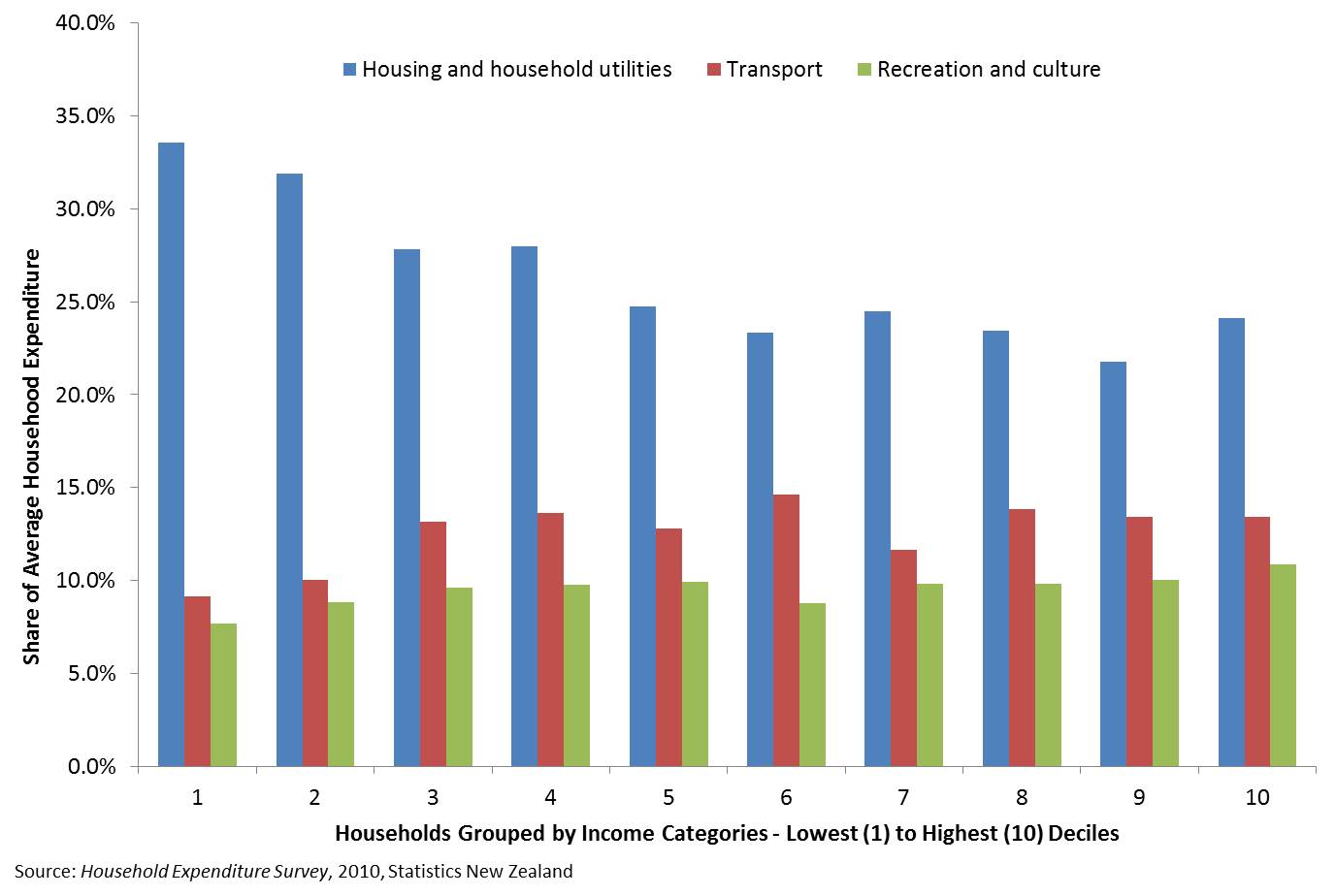
    First, take a look at the distribution of spending on housing, transport, and discretionary goods (recreation and cultural services is used to represent the latter category) according to household incomes in 2010. Average spending levels have been organized by income decile for this purpose, each group containing 10% of households. Average incomes increase from decile 1 (the lowest earning 10% of households) to decile 10 (the highest earning 10%).

    The pattern is pretty predictable.  Housing dominates the spending of low decile households.  It accounts for 34% in the lowest decile, falling to 22% in the ninth.  It rises again (to 24%) in the highest earning decile (10). This lift between decile 9 and 10 households no doubt reflects higher discretionary spending in the latter group by way of additional space, the quality of fit-outs, and second homes. 

    Shares of Household Spending to Selected Categories, by Income Band
    http://3.bp.blogspot.com/-9RfoZrWOqJk/UdklonCl_xI/AAAAAAAAAY0/AX1r49MtdJE/s640/Share+of+hhold+spend+by+category.jpg

    Do lower housing costs lead to higher transport spending?
    Rent theory suggests that lower household spending is offset by higher transport spending.  This is because low income households can only afford cheaper, less accessible properties and so end up commuting further at a higher cost than high income households. 

    It turns out that it’s not that simple.  Contrary to the theory, higher income households actually spend more of their income on transport.  That makes sense when we realize that commuting accounts for only around 25% of time spent travelling by New Zealanders.  The capacity to take discretionary trips is a bigger determinant of transport consumption than non-discretionary commuting and work-based trips.

    The Relationship Between Spending on Housing and Transport

    http://4.bp.blogspot.com/-8sGLN4_gTfo/UdyUskoSpgI/AAAAAAAAAZk/WEqMSQNRZM4/s640/Transport+Housing+Relationship.jpg


    Lower incomes leave a lot less to spend on discretionary goods and services once housing and essential transport spending are covered. [1] Higher income households can and do travel more and consume more.  Their behavior is unlikely to be significantly influenced by changing city form. 

    Who spends how much?
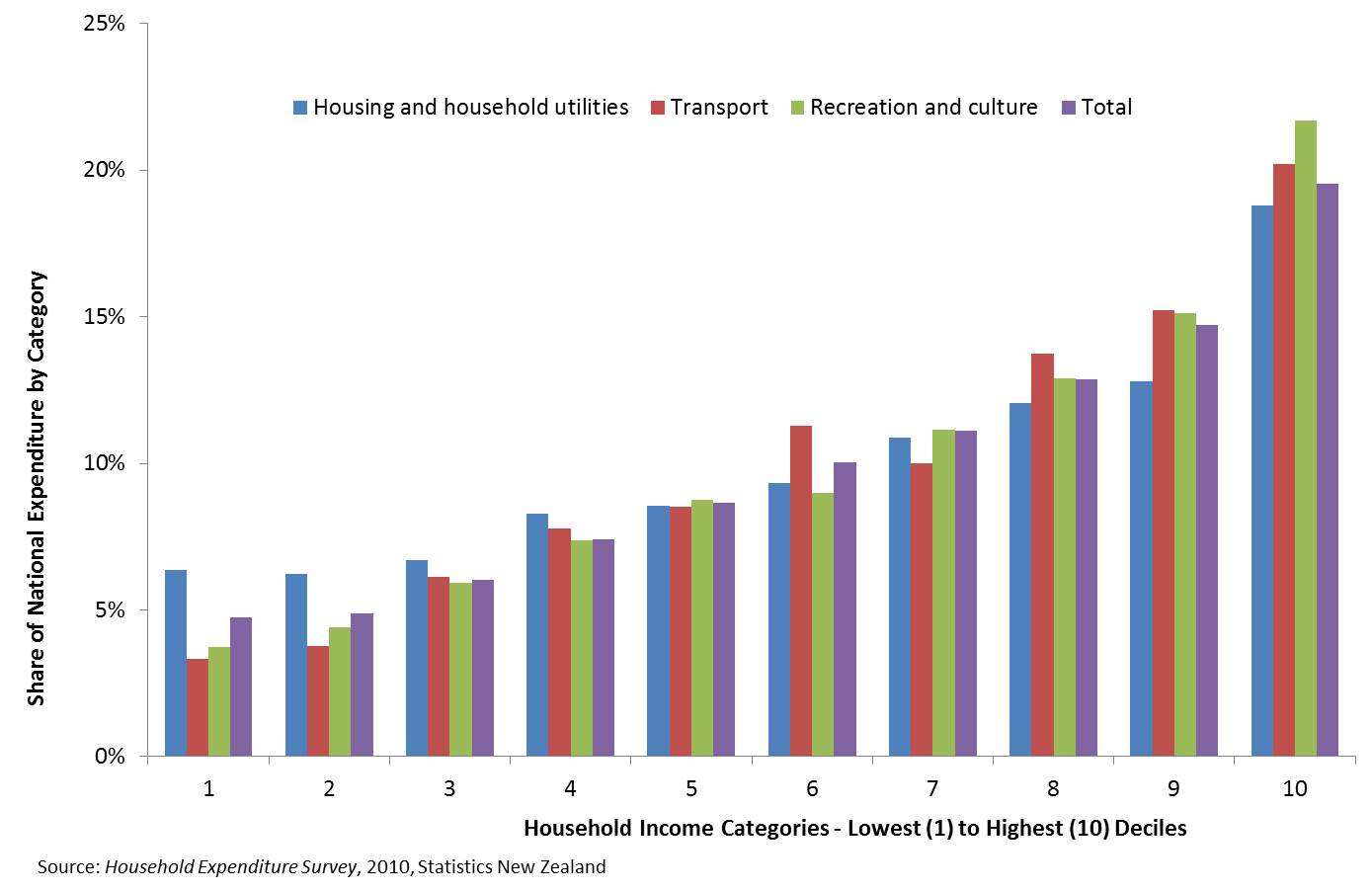
    Not surprisingly total consumption in New Zealand is dominated by higher income households: the 20% highest earning households (deciles 9 and 10) account for 35% of total spending on goods and services, while the lowest earning 20% (deciles 1 and 2) account for just 20%.

    And decile 10 households account for 7 times more spending on transport than decile 1 households.  They spend 5.5 times more on recreation and cultural services, and 3.5 times as much on food.


    The Contribution of Household Total Expenditure by Income Band, Selected Categories
    http://2.bp.blogspot.com/-OXL5hMRRw-Q/UdklqCO8CjI/AAAAAAAAAZA/o2GweAb3nTc/s640/Contributinm+to+totalmspoend+by+decile.jpg

     
    The highest income households spend three times more on housing than low income households, an average of $476 per week compared with $161.
    If refurbished housing in high amenity inner city living is expensive, guess which income groups will be living there?  The high consumers, obviously.  And in Auckland, at least, it seems that city planners and policy-makers are keen to deliver them the high order consumer services that will promote ever-more discretionary spending around the CBD(although much of central city resident travel may be taken up with recreational and social trip-making away from there).  

    A high social cost for little environmental benefit?
    The conclusion is straightforward: higher incomes mean more expenditure on additional housing, transport, and discretionary goods and services with correspondingly high environmental impacts.  If incomes are higher in cities, then their collective impacts will be high too.

    Planning policies won’t change that much – except to the extent that they erode consumption by inflating the basic costs of living, something that impacts most heavily on lower income households.  

    Fiddling with city form is unlikely to significantly reduce the impact of higher incomes and associated spending on the environment.  Increasing dwelling and living costs by promoting larger cities, higher residential densities, and uneconomic transit systems simply penalizes low income households already committing substantial shares of their spending to housing and transport.  And this is the group that, by dint of constrained consumption, has the lowest impact on the environment. 

    Better to address environment issues directly
    From a policy perspective, environmental issues are better tackled directly.  This may mean promoting environmentally friendly goods and services, promoting low impact technologies (including low impact housing, fuel efficient vehicles, and the like), and encouraging responsible consumption. If we are really serious about environmental threats, we need to examine the efficiency of current pricing practices and even taxation measures, rather than leaning so heavily on clumsy, indirect, and ultimately spurious urban planning policies. 

    Phil McDermott is a Director of CityScope Consultants in Auckland, New Zealand, and Adjunct Professor of Regional and Urban Development at Auckland University of Technology.  He works in urban, economic and transport development throughout New Zealand and in Australia, Asia, and the Pacific. He was formerly Head of the School of Resource and Environmental Planning at Massey University and General Manager of the Centre for Asia Pacific Aviation in Sydney. This piece originally appeared at is blog: Cities Matter.

    Photo by Pat Scullion

  • America Hanging in There Better Than Rivals

    To paraphrase the great polemicist Thomas Paine, these are times that try the souls of optimists. The country is shuffling through a very weak recovery, and public opinion remains distinctly negative, with nearly half of Americans saying China has already leapfrogged us and nearly 60 percent convinced the country is headed in the wrong direction. Belief in the political leadership of both parties stands at record lows, not surprisingly, since we are experiencing what may be remembered as the worst period of presidential leadership, under both parties, since the pre-Civil War days of Franklin Pierce and James Buchanan.

    Yet, despite the many challenges facing the United States, this country remains, by far, the best-favored part of the world, and is likely to become more so in the decade ahead. The reasons lie in the fundamentals: natural resources, technological excellence, a budding manufacturing recovery and, most important, healthier demographics. The rest of the world is not likely to cheer us on, since they now have a generally lower opinion of us than in 2009; apparently the "bounce" we got from electing our articulate, handsome, biracial Nobel laureate president is clearly, as Pew suggests, "a thing of the past."

    But as the Romans used to say, don’t let the bastards get you down. After all, it’s not like our competitors are stealing the march on us. Start with Europe. Just a few years ago, writers like Jeremy Rifkin and Steven Hill were telling us that Europe was the "model" for the world. Expand the welfare state, curtail capitalist excess, provide a comfortable partner to the rising nations of the world, and, well, enjoy a long and comfortable early retirement.

    Now, that early retirement is quickly turning into a kind of senility. Not only is Europe continuing to age – particularly along its Southern rim – but the fiscal pressures of ultrahigh unemployment, approaching 30 percent or above, among the young and the costs of maintaining a strong welfare state could create what urban analyst Aaron Renn has labeled "a demographic Lehman Brothers."

    At the same time the near-collapse of the Southern-rim countries threatens the viability of Europe’s banks, including those in Germany. Increasingly, Germany lives largely so the rest of Europe can die more quickly. Like a prototypical science-fiction villain, Germany – with fewer children than it had in 1900 – relies increasingly on the blood taken from the decaying Southern rim countries. By 2025, Germany’s economy will need 6 million additional workers, likely from such countries as Spain, Italy, Greece and Portugal, to keep its economic engine humming, according to government estimates.

    Asian anemia

    What about our prime Asian competitors? Japan has been the sick man of Asia for more than two decades. It’s now desperate enough to unleash Bernanke-like money-printing policies to supply some desperately needed economic Viagra. With a weaker currency, and more money from the Tokyo exchange, there could be a temporary recovery, but Japan’s long term prognosis is not good.

    What Japan really needs is more animal spirits – particularly the kind that produce offspring. By 2050, according to UN estimates, Japan will have 3.7 times as many people at least age 65 than 15 and younger. By then, there will be 10 percent more Japanese over 80 than under 15. Without an unlikely embrace of immigration, Japan is destined to become the nation in wheelchairs.

    China poses a more serious challenge, but the Middle Kingdom appears headed toward what one analyst calls "the end" of its amazing and profound economic miracle. Growth, once projecting Chinese global preeminence, is slowing precipitously. The country now faces a growing rank of competitors from lower-wage countries poised to take market share from the Middle Kingdom.

    China faces growing political instability at the grass-roots level, a mountain of state-issued bad debt and a festering environmental crisis, which threatens long-term food supplies and could create massive health problems. China is rapidly aging. It will have 60 million fewer people under age 15 by 2050, while gaining nearly 190 million people at least 65, approximately the population of Pakistan, the world’s fourth-most populous country.

    The so-called BRICS (Brazil, Russia, India, China and South Africa), once the darlings of the investment banking set, all are facing slowing growth and rising political instability. It doesn’t help that most are either total or partial kleptocracies, dependent on commodity exports or cheap labor. This is not a solid foundation for ascendency as newer emerging nations – Myanmar, Indonesia, Vietnam – ramp up.

    ENERGY SHIFT

    On all these accounts, North America, including our Canadian and Mexican neighbors, looks best-positioned. The first, and, arguably, most important game-changer is the energy revolution that could realign the economic stars for decades to come. The shale oil and natural gas boom, as the Economist recently noted, is as illustrative of America’s future, and genius at reinvention, "as the algorithms being generated in Silicon Valley."

    The energy boom’s best aspect, besides the emergence of relatively cleaner natural gas, is making global tyrants, such as those ruling Saudi Arabia and Russia, nervous about their future place in the world. These worries alone should send a three-word message to our leaders: Go for it.

    But North America is not, like Russia, a one-trick pony. The U.S. remains the world’s leading food producer and exporter, sending out more of such critical commodities as soybeans, corn and wheat than any other country. After decades of decline, the U.S. industrial base is growing again, and, although job growth is likely to be limited, our manufacturing sector is already the most productive in the world. With the advantages of a decent legal order, a huge domestic market and available workforce, the U.S. has remained the largest recipient of foreign investment on the planet, roughly five times that so far accumulated in China.

    Technology can be a fickle industry, but at this point of the game, it’s fair to say the U.S. is winning that race. As potentially dangerous as the tech giants may become over time, the U.S. dominance in everything from software code (Microsoft) and design (Apple), search (Google), e-retailing (Amazon), and social networking (Facebook) is nothing short of astounding. We even lead in the coffee business (Starbucks) that keeps all those nerds typing code late into the night.

    Cultural influence

    Then there’s the matter of culture. For years, Asian, Third World and European cultural warriors have plotted to knock the U.S. off its pre-eminent perch. But the European film industry is a shadow of its once-glorious efflorescence; much the same can be said about the once-splendid Japanese cinema. To be sure, Chinese films, Korean pop stars and Bollywood are rising forces, but U.S. exports more than $14 billion annually in film and television. On a global level, no one can compete with Hollywood as a packager of images and dreams – and Silicon Valley’s control of new distribution technology could further boost this advantage.

    Finally, there’s the matter of demographics. The United States, like its competitors, is aging, but not as quickly as our prime rivals. The birth rate has slowed with the recession, but it’s likely to come back toward replacement levels in the years ahead as millennials enter their thirties en masse, and immigrants continue coming to the country. America should be the only one of the top five economies with a growing workforce over the next few decades.

    So, if things are so good, why do they seem so bad? Sixteen years of lackluster leadership has not helped – a succession of two spendthrift presidents, one a too-happy warrior with a weak sense of the limits of even an imperial power, and the other, a posturing and arrogant academic oddly disconnected from the fundamental grass-roots drive that moves his country’s economy. Yet I prefer to see it in a more positive light: If we can do better than our major competitors under such leadership, how great a country is this?

    Joel Kotkin is executive editor of NewGeography.com and Distinguished Presidential Fellow in Urban Futures at Chapman University, and a member of the editorial board of the Orange County Register. He is author of The City: A Global History and The Next Hundred Million: America in 2050. His most recent study, The Rise of Postfamilialism, has been widely discussed and distributed internationally. He lives in Los Angeles, CA.

    This piece originally appeared at The Orange County Register.

    USA map image by BigStockPhoto.

  • How the Left Came to Reject Cheap Energy for the Poor

    Eighty years ago, the Tennessee Valley region was like many poor rural communities in tropical regions today. The best forests had been cut down to use as fuel for wood stoves. Soils were being rapidly depleted of nutrients, resulting in falling yields and a desperate search for new croplands. Poor farmers were plagued by malaria and had inadequate medical care. Few had indoor plumbing and even fewer had electricity.

    Hope came in the form of World War I. Congress authorized the construction of the Wilson dam on the Tennessee River to power an ammunition factory. But the war ended shortly after the project was completed.

    Henry Ford declared he would invest millions of dollars, employ one million men, and build a city 75 miles long in the region if the government would only give him the whole complex for $5 million. Though taxpayers had already sunk more than $40 million into the project, President Harding and Congress, believing the government should not be in the business of economic development, were inclined to accept.

    George Norris, a progressive senator, attacked the deal and proposed instead that it become a public power utility. Though he was from Nebraska, he was on the agriculture committee and regularly visited the Tennessee Valley. Staying in the unlit shacks of its poor residents, he became sympathetic to their situation. Knowing that Ford was looking to produce electricity and fertilizer that were profitable, not cheap, Norris believed Ford would behave as a monopolist. If approved, Norris warned, the project would be the worst real estate deal “since Adam and Eve lost title to the Garden of Eden.” Three years later Norris had defeated Ford in the realms of public opinion and in Congress.

    Over the next 10 years, Norris mobilized the progressive movement to support his sweeping vision of agricultural modernization by the federal government. In 1933 Congress and President Roosevelt authorized the creation of the Tennessee Valley Authority. It mobilized thousands of unemployed men to build hydroelectric dams, produce fertilizer, and lay down irrigation systems. Sensitive to local knowledge, government workers acted as community organizers, empowering local farmers to lead the efforts to improve agricultural techniques and plant trees.

    The TVA produced cheap energy and restored the natural environment. Electricity from the dams allowed poor residents to stop burning wood for fuel. It facilitated the cheap production of fertilizer and powered the water pumps for irrigation, allowing farmers to grow more food on less land. These changes lifted incomes and allowed forests to grow back. Although dams displaced thousands of people, they provided electricity for millions.

    By the 50s, the TVA was the crown jewel of the New Deal and one of the greatest triumphs of centralized planning in the West. It was viewed around the world as a model for how governments could use modern energy, infrastructure and agricultural assistance to lift up small farmers, grow the economy, and save the environment. Recent research suggests that the TVA accelerated economic development in the region much more than in surrounding and similar regions and proved a boon to the national economy as well.

    Perhaps most important, the TVA established the progressive principle that cheap energy for all was a public good, not a private enterprise. When an effort was made in the mid-’50s to privatize part of the TVA, it was beaten back by Senator Al Gore Sr. The TVA implicitly established modern energy as a fundamental human right that should not be denied out of deference to private property and free markets.

    The Rejection of the State and Cheap Energy

    Just a decade later, as Vietnam descended into quagmire, left-leaning intellectuals started denouncing TVA-type projects as part of the American neocolonial war machine. The TVA’s fertilizer factories had previously produced ammunition; its nuclear power stations came from bomb making. The TVA wasn’t ploughshares from swords, it was a sword in a new scabbard. In her 1962 book Silent Spring, Rachel Carson described modern agriculture as a war on nature. The World Bank, USAID, and even the Peace Corps with its TVA-type efforts were, in the writings of Noam Chomsky, mere fig leaves for an imperialistic resource grab. 

    Where Marx and Marxists had long viewed industrial capitalism, however terrible, as an improvement over agrarian feudalism, the New Left embraced a more romantic view. Before the arrival of “progress” and “development,” they argued, small farmers lived in harmony with their surroundings. In his 1973 book, Small is Beautiful, economist E.F. Schumacher dismissed the soil erosion caused by peasant farmers as “trifling in comparison with the devastations caused by gigantic groups motivated by greed, envy, and the lust for power.” Anthropologists like Yale University’s James Scott narrated irrigation, road-building, and electrification efforts as sinister, Foucauldian impositions of modernity on local innocents. 

    With most rivers in the West already dammed, US and European environmental groups like Friends of the Earth and the International Rivers Network tried to stop, with some success, the expansion of hydroelectricity in India, Brazil and elsewhere. It wasn’t long before environmental groups came to oppose nearly all forms of grid electricity in poor countries, whether from dams, coal or nuclear. “Giving society cheap, abundant energy,” Paul Ehrlich wrote in 1975, “would be the equivalent of giving an idiot child a machine gun.” 

    Elaborate justifications were offered as to why poor people in other countries wouldn’t benefit from cheap electricity, fertilizer and roads in the same way the good people of the Tennessee Valley had. Biomass (eg, wood burning), solar and efficiency “do not carry with them inappropriate cultural patterns or values.” In a 1977 interview, Amory Lovins added: “The whole point of thinking along soft path lines is to do whatever it is you want to do using as little energy — and other resources — as possible.” 

    By the time of the United Nations Rio environment conference in 1992, the model for “sustainable development” was of small co-ops in the Amazon forest where peasant farmers and Indians would pick nuts and berries to sell to Ben and Jerry’s for their “Rainforest Crunch” flavor. A year later, in Earth in the Balance, Al Gore wrote, “Power grids themselves are no longer necessarily desirable.” Citing Schumacher, he suggested they might even be “inappropriate” for the Third World.

    Over the next 20 years environmental groups constructed economic analyses and models purporting to show that expensive intermittent renewables like solar panels and biomass-burners were in fact cheaper than grid electricity. The catch, of course, was that they were cheaper because they didn’t actually deliver much electricity. Greenpeace and WWF hired educated and upper-middle class professionals in Rio de Janeiro and Johannesburg to explain why their countrymen did not need new power plants but could just be more efficient instead.

    When challenged as to why poor nations should not have what we have, green leaders respond that we should become more like poor nations. In The End of Nature, Bill McKibben argued that developed economies should adopt “appropriate technology” like those used in poor countries and return to small-scale agriculture. One “bonus” that comes with climate change, Naomi Klein says, is that it will require in the rich world a “type of farming [that] is much more labor intensive than industrial agriculture.” 

    And so the Left went from viewing cheap energy as a fundamental human right and key to environmental restoration to a threat to the planet and harmful to the poor. In the name of “appropriate technology” the revamped Left rejected cheap fertilizers and energy. In the name of democracy it now offers the global poor not what they want — cheap electricity — but more of what they don’t want, namely intermittent and expensive power. 

    From Anti-Statism to Neo-Liberalism

    At the heart of this reversal was the Left’s growing suspicion of both centralized energy and centralized government. Libertarian conservatives have long concocted elaborate counterfactuals to suggest that the TVA and other public electrification efforts actually slowed the expansion of access to electricity. By the early 1980s, progressives were making the same claim. In 1984, William Chandler of the WorldWatch Institute would publish the “The Myth of the TVA,” which claimed that 50 years of public investment had never provided any development benefit whatsoever. In fact, a new analysis by economists at Stanford and Berkeley, Patrick Klein and Enrico Moretti, find that the “TVA boosted national manufacturing productivity by roughly 0.3 percent and that the dollar value of these productivity gains exceeded the program’s cost.”

    Even so, today’s progressives signal their sophistication by dismissing statist solutions. Environmentalists demand that we make carbon-based energy more expensive, in order to “harness market forces” to cut greenhouse gas emissions. Global development agencies increasingly reject state-sponsored projects to build dams and large power plants in favor of offering financing to private firms promising to bring solar panels and low-power “microgrids” to the global poor — solutions that might help run a few light bulbs and power cell phones but offer the poor no path to the kinds of high-energy lifestyles Western environmentalists take for granted.

    Where senators Norris and Gore Sr. understood that only the government could guarantee cheap energy and fertilizers for poor farmers, environmental leaders today seek policy solutions that give an outsized role to investment banks and private utilities. If the great leap backward was from statist progressivism to anarcho-primitivism, it was but a short step sideways to green neoliberalism.

    But if developed-world progressives, comfortably ensconced in their own modernity, today reject the old progressive vision of cheap, abundant, grid electricity for everyone, progressive modernizers in the developing world are under no such illusion. Whether socialists, state capitalists, or, mostly, some combination of the two, developing world leaders like Brazil’s Lula da Silva understand that cheap grid electricity is good for people and good for the environment. That modern energy and fertilizers increase crop yields and allow forests to grow back. That energy poverty causes more harm to the poor than global warming. They view cheap energy as a public good and a human right, and they are well on their way to providing electricity to every one of their citizens. 

    The TVA and all modernization efforts bring side effects along with progress. Building dams requires evicting people from their land and putting ecosystems underwater. Burning coal saves trees but causes air pollution and global warming. Fracking for gas prevents coal burning but it can pollute the water. Nuclear energy produces not emissions but toxic waste and can result in major industrial accidents. Nevertheless, these are problems that must be dealt with through more modernization and progress, not less.

    Viewed through this lens, climate change is a reason to accelerate rather than slow energy transitions. The 1.3 billion who lack electricity should get it. It will dramatically improve their lives, reduce deforestation, and make them more resilient to climate impacts. The rest of us should move to cleaner sources of energy — from coal to natural gas, from natural gas to nuclear and renewables, and from gasoline to electric cars — as quickly as we can. This is not a low-energy program, it is a high-energy one. Any effort worthy of being called progressive, liberal, or environmental, must embrace a high-energy planet.

    Shellenberger and Nordhaus are co-founders of the Breakthrough Institute, a leading environmental think tank in the United States. They are authors of Break Through: From the Death of Environmentalism to the Politics of Possibility.

    This piece originally appeared at TheBreakthrough.org.

  • No Solar Way Around It: Why Nuclear Is Essential to Combating Climate Change

    Nobody who has paid attention to what’s happened to solar panels over the last several decades can help but be impressed. Prices declined an astonishing 75 percent from 2008 to 2012. In the United States, solar capacity has quintupled since 2008, and grown by more than 50 times since 2000, according to US Energy Information Administration data. In 1977, solar panels cost $77 per watt. Today, they are less than a dollar per watt.

    So it came as a shock to many and an offense to some to learn that new nuclear plants still cost substantially less than solar. Solar advocates have challenged our recent analysis finding that the electricity from Finland’s beleaguered Olkiluoto plant is still four times cheaper than electricity from Germany’s solar program, claiming that we cherry-picked cases to make nuclear look good and solar look bad.

    It is an odd objection, given that we selected perhaps the most expensive nuclear power plant ever built for our comparison. The complaint is odder still because many of the same critics who accused us of cherry-picking then turned around and, without any apparent irony, cherry-picked small, one-off solar projects as evidence that our analysis is slanted toward nuclear. 

    The reason we compared the Finnish plant to the German solar program is not just because renewables advocates have long claimed that the two examples prove that solar is cheap and nuclear is expensive. We also compared the two because both projects exist in the real world at significant scale, which helps avoid the cherry-picking problem of overgeneralizing from particular cases. Thanks to generous subsidies, Germany generated 5 percent of its electricity from solar last year — a huge amount compared to other nations. By contrast, last year the United States produced just 0.18 percent of its electricity from solar, according to the EIA.

    Some have reasonably asked if there aren’t broader surveys of the costs of new solar and new nuclear. There are. Both the International Energy Agency and the EIA have done them, and both find that solar costs substantially more than new nuclear construction.

    While those figures represent the cost of the average solar installation today, they don’t tell us what it costs for a major industrial economy to scale up solar rapidly, such that it gets a significant percentage of its electricity from solar. To date, Germany is the only major economy in the world that has done so. The costs of Germany’s solar feed-in tariff represent the only real world figure we have. 

    As solar has scaled up in Germany, the costs have declined. But the dynamics are not dissimilar with nuclear. France saw significant cost declines as it scaled up standardized plant designs in the 70s and 80s. The new plant in Finland is a first-of-kind design. Subsequent builds are already showing significantly lower costs. The EPR under construction in France, initiated around the same time as the one in Finland, is expected to cost slightly less. The third and fourth versions of the EPR, currently under construction in China, will be a third the cost of the Finnish plant.

    Had we chosen to use the two new Chinese plants, solar would have cost twelve times more than nuclear, rather than just four times more. Of course this comparison would almost certainly have raised further objections that we had compared German apples to Chinese oranges. Yet it turns out that the German solar program has benefited enormously from the scaling up of Chinese solar manufacturing — or in the eyes of the US Solar Energy Association, the US Trade Commission, and the European Union, the outright dumping of solar panels by Chinese firms. Indeed the flood of Chinese solar panels, which take up as much as 80 percent of market share in Europe, has depressed the cost of solar panels by as much as 88 percent according to EU officials.

    Surely, if it is appropriate to tout solar cost reductions that have been driven by Chinese mercantilism and industrial policy it is also appropriate to consider the cost benefits that Chinese manufacturing and construction costs are bringing to nuclear ­— even more so given that the vast majority of future carbon emissions will come from places like China, not Finland or Germany.   

    Our analysis was further biased toward solar over nuclear by not accounting for the high costs of backing up and integrating intermittent solar electricity. Leading anti-nuclear greens, including Bill McKibben and Robert F. Kennedy Jr., note that for a few hours during a sunny weekend day, solar provided 50 percent of Germany’s electricity; at the same time, as we pointed out, only five percent of the country’s total electricity came from solar in 2012. What that means is that if Germany doubled the amount of solar, as it intends to do, there might be a few hours or even days every year where the country gets 100 percent of its electricity from solar, even though solar only provides 10 percent of its annual electricity needs.

    What happens beyond that is anyone’s guess. Some say Germany could sell its power to other countries, but this would mean other countries couldn’t move to solar since Germany would provide electricity at the same hours it would seek to unload it on their neighbors. Solar advocates say cheap utility-scale storage is just around the corner; in fact, choices are extremely limited and expensive. As a result, analysis by the Clean Air Task Force suggest that integration costs for solar and wind are likely to surge dramatically should renewables rise much above 20 or 30 percent of total electrical generation (see graph below).


    Costs of adding intermittent generation are likely to scale super-linearly with penetration, creating a deployment barrier.  Some examples (various bases) in the figure: “Wind A” is the marginal cost per MWh of wind in ERCOT relative to the same index at 0% wind penetration. “Wind B” is the reciprocal of total system wind capacity factor in CAISO relative to 0% wind penetration (an indicator relative total system construction cost).“Wind C” is the number of annual CCGT start-ups in Ireland relative to 0% wind penetration (a proxy for system-wide O&M costs and emissions due to cycling).“PV” is the marginal cost per MWh of PV in ERCOT relative to the same index at 0% PV penetration. “RE Bundle” is the relative size of the US bulk transmission system (million MW-miles) due to bundled renewables (roughly ½ wind+solar) relative to 0% penetration.

    Sources: CATF from Denholm & Hand, 2011 (Wind A); Hart et al, 2012 (Wind B); Troy et al, 2010 (Wind C); Denholm & Margolis, 2006 (PV); NREL, 2012 (RE Bundle). 

    We do not present this evidence to advocate against solar subsidies or Germany’s program. We have long advocated that governments spend significantly more on energy innovation, including the deployment of solar panels. But it’s one thing to endorse Germany’s big investment in solar in the name of accelerating solar innovation, and it’s quite another to claim — as McKibben, Kennedy, and environmental groups do — that Germany’s solar program and increasingly cheap solar panels demonstrate that solar energy is ready to scale, capable of substantially displacing fossil energy, and a viable alternative to nuclear.

    In reality, there’s little evidence that renewables have supplanted — rather than supplemented — fossil fuel production anywhere in the world. Whatever their merits as innovation policy, Germany’s enormous solar investments have had little discernible impact on carbon emissions. Germany’s move away from baseload zero-carbon nuclear has resulted in higher coal consumption since 2009. In 2012, Germany’s carbon emissions rose 2 percent.

    Nuclear, by contrast, replaces fossil energy. A recent analysis by the Business Spectator’s Geoff Russell finds that big nuclear programs around the world have shown the ability to scale up three to seven times faster than Germany’s vaunted Energiewende (see below). In 1970, fossil fuels supplied roughly two-thirds of France’s electricity, with the balance mostly coming from hydro. By 1990, fossil’s share of the electricity supply had dropped to 10 percent, according to EIA data, while nuclear supplied 80 percent, an energy mix that still holds today. As a result, France’s electricity sector emits 80 grams of CO2 per kWh, compared to Germany’s 450 grams CO2 per kWh. Sweden and Ontario, which also have large shares of nuclear in their electricity supply, augmented by large hydro projects, are even lower. 

    In the United States, nuclear power grew from supplying zero percent of US electricity in 1965 to 20 percent in 1990. Over that same period, coal generation remained flat, rising from 54 percent of generation in 1965 to 60 percent in 1990, during a period when total electricity demand roughly tripled. Since the early 1990’s, when the US nuclear build-out stalled, the vast majority of new US electricity demand has been met by coal and gas.

    Even so, nuclear still needs to get better and cheaper if it is going to displace fossil energy at any scale that will make much difference in terms of climate change. Next generation plants that are safer, cheaper, and more reliable will be necessary if nuclear is to be more than a hedge against fossil energy in the developing world and to see significant new deployment at all in the developed world. Solar, wind, and energy storage technologies will need substantial further advances if they are going to even begin to achieve the scale possible with present day nuclear.

    Our analysis serves a broader point: we must reject technology tribalism if we are to meet rising energy demand and combat global warming. This entails paying close attention to the substantial challenges emergent technologies face, not ignoring them, and discerning how far different technologies are from being capable of replacing fossil energy. The question is not whether solar is the solution, or nuclear. The question is what technologies will deliver clean, reliable, and cheap energy to a growing population, and what it will take to get those technologies to scale. Any movement serious about addressing climate change will thus be characterized by a broad commitment to innovation and a willingness to take a hard, non-ideological look at present day zero-carbon technologies.

    Shellenberger and Nordhaus are co-founders of the Breakthrough Institute, a leading environmental think tank in the United States. They are authors of Break Through: From the Death of Environmentalism to the Politics of Possibility.

    This piece originally appeared at TheBreakthrough.org.

    Photo Credit: SonomaPortal.com.

  • Driving Trends in Context

    There are grains of reality, misreporting and exaggeration in the press treatment of a report on driving trends by USPIRG. The report generated the usual press reports suggesting that the millennial generation (ages 16 to 35) is driving less, moving to urban cores, and that with a decline in driving per capita, people are switching to transit. These included the usual, but not representative anecdotes about people whose lifestyles and mobility needs are sufficiently served by the severe geographical and travel time limitations of transit.

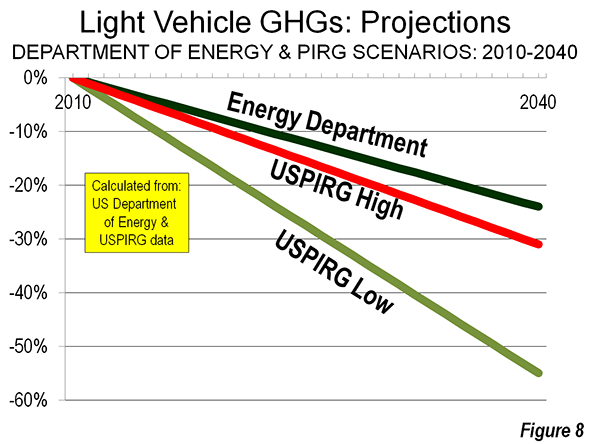
    Further, in an important contribution, the USPIRG report provides driving trend forecasts that are lower than other projections. If accurate, these would result in materially greater greenhouse gas emissions reductions to 2040 than projected by the Department of Energy, further undermining the justification for anti-mobility policies as well as urban containment.

    Millennials and More Urban and Walkable Living

    It is again reported that millennials "like to live in the city center." Last year, a report by USPIRG cited a poll indicating that 77 percent of millennials plan to live in urban cores. Their actual choices have been radically different.

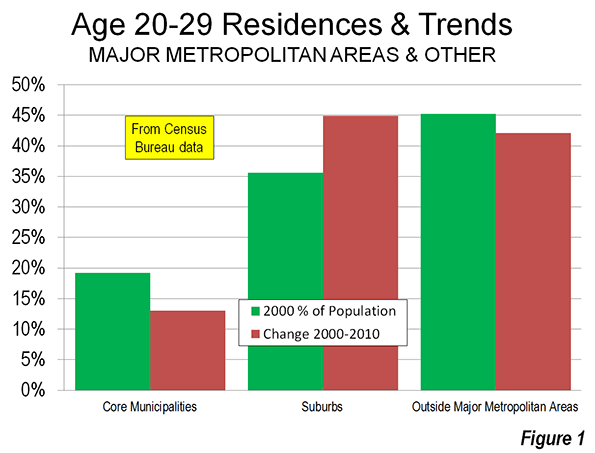
    In fact, 2010 census data indicates that people between 20 and 29 years old were less inclined to live in more urban and walkable neighborhoods than their predecessors. In 2000, 19 percent of people aged 20 to 29 lived in the core municipalities of major metropolitan areas, where transit service and walkable neighborhoods are concentrated. Only 13 percent of the increase in 20 to 29-year-old population between 2000 and 2010 was in the core municipalities. By contrast, the share of the age 20 to 29 living  in the suburbs of major metropolitan areas was 45 percent, higher than the 36 percent living there in 2000 (Figure 1).

    The Decline in Driving

    Driving per capita in urban areas peaked in 2005. Between 2005 and 2011, driving declined seven percent. In the context of rising gasoline prices, and economic trends, the real news is not how much driving has fallen, but rather how little. A seven percent reduction is slight compared to the one and one-half times increase in gas prices over the past decade (Figure 2). Per capita travel by car and light truck has fallen back only to 2002 levels, which remained above the driving rates of previous years.

    Drivers: Not Switching to Transit

    The USPIRG report gives the impression that instead of driving, Americans are switching to other modes of transport, principally transit. In discussing the report, Nick Turner, of the Rockefeller Foundation said: "Americans are making very different transportation choices than they did in years past."

    Actually not. The data shows that as people drove less, they did not switch to transit. The driving reduction was approximately 900 miles per capita from 2005 to 2011. At the same time, transit ridership per capita was up approximately 15 miles – a small change compared to the reduction in driving (Figure 3). People just traveled a less (perhaps fewer trips to the store or to the beach, not to mention the fewer work trips in a depressed economy).

    Work trip travel trends are little changed over the past decade. Driving alone and transit were up marginally between 2000 and 2011. Working at home increased the most, while car pooling declined the most (Figure 4).

    This raises the issue of context. While driving was declining about seven percent per capita from 2005 to 2011, transit use was increasing about seven percent. The percentages were similar, but the amount of travel was radically different, because of transit’s much smaller base. Transit usage would need to increase nearly 400 percent to equal the mileage of a seven percent loss in travel by car. For all of the impressive transit ridership increase claims, transit’s share of urban travel has changed little (Figure 5).

    Transit’s failure to capture much of the decline in driving simply reflects the limitation of its effectiveness in taking people where they need to go. Transit is very effective in providing mobility to the nation’s largest downtown areas, where it provides half to three quarters of the trips. Approximately 55 percent of all US transit commuting is to six transit legacy cities (municipalities), including New York, Chicago, Philadelphia, Boston, San Francisco, and Washington. Most of this commuting is to the compact and dense downtown areas.

    Outside the transit legacy cities, transit’s impact is slight, because of the "last mile" problem.  Transit service is not close enough (or fast enough) to be practical for most trips in metropolitan areas. For example, Brookings Institution data indicates that the average worker can reach fewer than 10 percent of of jobs in major metropolitan areas within 45 minutes. By contrast, the average solo driver reaches work in approximately 25 minutes. There is no solving this problem, because the infrastructure that would be required is far from affordable, as Professor Jean-Claude Ziv and I showed in a WCTRS paper (See: Megacities and Affluence).

    Millennial Driving in Context

    Survey data does indicate a decline in driving among millennials, but those with jobs are not flocking to transit. Single occupant commuting in this age group increased between 2000 and 2011, from 66.9 percent to 69.7 percent. Transit use and working at home also increased (5.4 percent to 5.8 percent and 1.4 percent to 2.6 percent respectively. There was, however, a substantial decline in car pool use among millennials, from 17.4 percent to 12.6 percent (Figure 6).

    Younger workers have suffered disproportionately from the economic decline. There has been a substantial reduction in the percentage of people aged 16 to 24 who have jobs (Figure 7). These lost work trips have contributed more than any perceived preference for urban living to the decline in driving. Transportation expert Alan Pisarski has attributed much of the decline in demand in this age group to such economic factors.

    At the same time, and as USPIRG indicates, the increase in social media use may well have contributed to the declining demand for discretionary travel.

    Driving Less in the Future and the GHG Emissions Implications

    The decline in per capita driving is not surprising. Back in 1999, Pisarski predicted that per capita driving would soon peak ("Cars, Women and Minorities: The Democratization of Mobility in America"), because automobile availability had now spread to most all segments of society.

    USPIRG forecasts driving volumes below US Department of Energy predictions. According to USPIRG:  "Coupled with improvements in fuel efficiency, reduced driving means Americans will use about half as much gasoline and other fuels in 2040 than they use today." This means an even greater reduction in GHG emissions than currently forecast. Department of Energy forecasts a 21 percent decline in total (not per mile) GHG emissions from light vehicles between 2010 and 2040, despite a 40 percent increase in driving. The more modest driving levels in USPIRG scenarios would result in GHG emissions reductions of between 31 percent and 55 percent between 2010 and 2040 (Figure 8). These projections provide further evidence that of the "greening" of the automobile and the needlessness of urban containment policies.

    Reality

    Regardless, however, of the future trend, it is important to minimize the time that people spend traveling in metropolitan areas, because of the strong association between effective mobility, job access, and economic growth. Modern metropolitan areas require the quickest possible access between all origins and destinations to facilitate greater household affluence (measured in discretionary income) and lower levels of poverty. The objective should be the greatest reduction in travel delay per dollar spent on transportation.

    Dug Begley accurately characterized the situation in the Houston Chronicle:

    "We spend a lot of transportation money in the Houston region on roads, and for good reason: That’s how most people travel. Houston is a growing place, and there aren’t two or three job centers, there are about eight. Getting people between them … is going to take roads."

    Outside the municipal boundaries of the six legacy cities and especially their downtown enclaves, Houston (despite its reputation) is little different than the rest of metropolitan America. From the suburbs of New York, to the entire Portland and Phoenix metropolitan areas, the automobile carries the overwhelming share of travel (see Table 1, here). It cannot be any other way, since no planning agency in the New World or Western Europe has a plan, much less the resources, to construct a transit system that would duplicate the mobility of the automobile throughout its metropolitan area.

    Wendell Cox is a Visiting Professor, Conservatoire National des Arts et Metiers, Paris and the author of “War on the Dream: How Anti-Sprawl Policy Threatens the Quality of Life.

    —–

    Methodology: This article is based on data from the Federal Highway Administration, the Federal Transit Administration, Census Bureau, Department of Energy and USPIRG.

    Photo: Roadways, Fort Lauderdale (Miami metropolitan area)

  • The Myth of Green Australia

    Having collected the Nobel peace prize in 2007, Al Gore’s fortunes as a climate crusader slid into the doldrums.  But 8th November 2011 arrived as a ray of sunshine. On that day Australia’s parliament passed into law the world’s first economy-wide carbon tax. Rushing to his blog, Gore posted a short but rapturous statement, cross-posted in The Huffington Post. His fervent language echoed in progressive circles across the globe. Australians have been held-up as pioneering environmentalists ever since, putting Americans to shame.

    “This is a historic moment”, thundered Gore. “With this vote”, he blogged, “the world … turned a pivotal corner in the collective effort to solve the climate crisis”. He proclaimed it “the result of tireless work of an unprecedented coalition that came together to support the legislation”; he praised the “leadership of Prime Minister [Julia] Gillard and the courage of legislators”; and he declared “the voice of the people of Australia has rung loud and clear”.

    But maybe Gore’s enthusiasm was a bit misplaced. In September, less than two years later,   Australians seem likely, according to the polls, to hand the Gillard Labor government a stinging landslide defeat.     

    “A pivotal corner in the collective effort”

    As it turns out, and not for the first time, Gore’s analysis was wrong. For one thing, calling the carbon tax “pivotal” is pure hyperbole. Although a relatively large land mass, Australia is populated by just 23 million people who collectively emit a minuscule 1.5 per cent of the world’s greenhouse gases. Nor is the country influential in a broader political union or association beyond its borders.  Since climate change alarmists suggest that global emissions must fall by 25 to 40 per cent in 2020 compared to 1990 levels, Australia’s efforts must be seen as more symbolic than effective.    Currently, the tax and its post-2015 form as an emissions trading scheme (ETS) are adjusted for a trivial 5 per cent cut from 2000 levels in 2020; 5 percent of 1.5 percent of the world’s emissions barely registers against a few days increase in countries like China.   

    Environmentalists maintain that the important thing is not results, but setting a moral example of climate action. They argue Australia’s emissions may be tiny in absolute terms, but amongst the highest in per capita terms. Major emitters like the US, China, India and the EU, they argue, can be shamed into action by Australia’s noble sacrifice. Unfortunately for them, this argument, not very strong to being with, deflated like a punctured balloon since the shambles at Copenhagen.

    We’ve been here before. In December 2009 Australia’s newly minted Labor Prime Minister, Kevin Rudd, with a bulging entourage of 114 officials, descended on the Copenhagen conference to negotiate a successor to the Kyoto Protocol. He was awarded the task of preparing a draft negotiating text. Rudd played an active role in the lead up, having signed Kyoto and undertaken to legislate for an ETS in his first term, a serious step given Australia’s status as the world’s leading coal exporter. Before flying out to Denmark, he introduced the necessary bills into parliament for a second time.

    Copenhagen was a test of the ‘noble sacrifice’ argument driving Rudd’s activism but resulted in an epic fail. Rudd’s draft text was tossed aside and the conference collapsed into bickering between delegations from the developed and developing worlds. There was no successor to Kyoto, just a flimsy, non-binding accord the delegates “took note of” but didn’t adopt. Greenpeace called Copenhagen “a crime scene”.    

    The UN’s Framework Convention on Climate Change has stayed off the rails ever since. Later Conferences of the Parties (COPs) at Cancun and Durban did little more than kick the can down the road. Durban opened twenty days after the “historic moment” of Australia’s carbon tax, but delegates deferred all talk of a binding agreement to 2015, anticipating a possible start in 2020. Canada pulled the plug on Kyoto altogether, later followed by Japan and Russia. “This empty shell of a plan leaves the planet hurtling towards catastrophic climate change”, huffed Friends of the Earth.

    Under the non-binding Copenhagen Accord, parties were invited to submit emission reduction “pledges”, and most have done so. Even if achieved, though, they get the world nowhere near 25 to 40 per cent reductions on 1990 levels in 2020. Writing in Nature, analysts from the Potsdam Institute of Climate Impacts dismiss them as “paltry”. Amid rising emissions, Australia’s “pivotal” carbon tax is but a straw in the wind.

    “An unprecedented coalition that came together”

    At the end of 2009, Rudd’s ETS was rejected by parliament a second time, due in part from rising doubts about the climate agenda. As 2010 progressed, his popularity waned, battered by his inept handling of the contentious mining tax. Labor colleagues bristled at his secretive and high-handed manner, while powerful union bosses resented his indifference to their concerns. Taking advantage of drooping opinion polls, Rudd was sacked and replaced with Deputy Prime Minister Julia Gillard.

    This sent shockwaves through the country, which had never seen a sitting prime minister dumped in his first term. Fearing a backlash, Gillard hastily called an election for 21st August, hoping to exploit positive feelings around serving as Australia’s first female leader. She proved a poor campaigner, however, and a series of damaging leaks scuttled her efforts. Labor’s support faded and on election night Gillard was left with 72 seats, four short of a majority in the 150 seat House of Representatives. The Liberal-National opposition ended up with 73 seats, also short of a majority. The balance of power was in the hands of one Greens Party member and four independents.

    After weeks of negotiations, the Greens and three of the independents pledged support for a Labor Government under Gillard, the first minority government since the 1940s.  But it became increasingly clear that a fresh election would produce a solid Liberal-National Party majority. Returning to the people for a new mandate was never in Gillard’s interests. As for the Greens and independents, fortune delivered them more power than they ever had or would ever have again. Making the most of their time in the sun, they opted for Gillard, who wasn’t about to call another election. Gillard’s coalition may be “unprecedented”, in Al Gore’s words, but it’s untrue that they “came together to support” high principle. They were thrown together by electoral chance and stuck together out of grim self-interest.

    “Leadership of Prime Minister Gillard and the courage of legislators”

    After the second rejection of his ETS, Rudd shelved the policy indefinitely, to the dismay of the world’s environmentalists. The inner circle which advised him to take this course, according to later revelations, included Julia Gillard. On becoming prime minister she showed little enthusiasm for the climate cause, ruling out a price on carbon unless there was “a deep and abiding community consensus”. Her tokenistic policy at the 2010 election was “citizen’s assembly” to canvass options. The opposition also ruled out a price on carbon. Twice in the lead up to polling day, Gillard explicitly denied rumours of a hidden agenda, uttering the now infamous words “there will be no carbon tax under the government I lead”.

    Gillard entered the post-election negotiations desperately hoping to save her prime ministership.  The radical Greens would never have backed the conservative opposition. But when they demanded a carbon tax as the price of their support, she caved in a fit of panic, displaying little of the courage praised by Gore. The independents signed on to keep the minority government in business.

    Labor’s Clean Energy Future package includes a carbon tax, but also billions of dollars of compensation and credits to cushion the blow. In a massive money churn, around $5 billion of the revenue is disbursed to households in higher benefits and tax breaks, and $9.2 billion goes to industry assistance, including free permits for high emitting industries, $300 million to the steel industry, $1.26 billion to the coal sector, and $1.2 billion to manufacturing. Unhappy about these handouts, the Greens were bought off with a $10 billion Clean Energy Finance Corporation. Australians are left wondering how all of this encourages shifts to “cleaner” energy sources. The handouts muffle some damaging impacts of the tax, but they are hardly “courageous” from the perspective of Al Gore.

    “The voice of the people of Australia has rung loud and clear”

    Gillard made her plans for a carbon tax public on 25th February 2011. Her residual popularity sank like a stone. The Newspoll of 18-20 February 2011 recorded 50 per cent satisfied and 39 per cent dissatisfied with her performance. In the next survey of 4-6 March 2011, those figures were reversed: 39 per cent satisfied, 51 per cent dissatisfied. Labor’s support (first preference) plunged to 30 per cent in the March survey, from 38 per cent at the election. These results were consistent with a general fall in support for climate action. From a high of 68 per cent in 2006, reported the Lowy Institute Poll, it dropped to 41 per cent in 2011. Only 32 per cent of Australians supported the carbon tax when Gore wrote his rapturous blog post.    

    Gillard’s frantic attempts to recover have come to nothing, and calling an election for 14th September hasn’t helped. The latest Newspoll of 5-7 April 2013 had her satisfaction rating at a dismal 28 per cent, with 62 per cent dissatisfied. Labor’s support is still in the basement at 32 per cent, with the Liberal-Nationals at 48 per cent. Likely, the government faces a devastating loss of around 20 seats.  

    The opposition’s implacable campaign against the carbon tax has rocked Gillard’s time in office. They promise to repeal it, dismantle much of the Clean Energy Future package and even abolish the Department of Climate Change. Since the 2010 election Labor has suffered a succession of defeats at the state level, losing power in New South Wales, Victoria, Queensland and the Northern Territory, while the Liberal-National Coalition improved their majority in Western Australia. These elections were fought on state issues, but in every case the conservatives echoed Opposition Leader Tony Abbott’s anti-carbon tax message. Closer to home, Gillard was forced to stare down moves against her by colleagues to restore Kevin Rudd, once in February 2012 and again in March this year. Four senior cabinet ministers were sacked or resigned after the second episode. Labor limps forward in the worst possible shape.

    A Liberal-National victory would probably mean the end of climate change as a major political priority in Australian politics. Al Gore was mistaken. He didn’t hear “the voice of the people of Australia” on 8th November 2011; but if he’s listening he’ll hear it “loud and clear” on 14th September 2013.

    John Muscat is a co-editor of The New City Journal.