Tag: Energy

  • Fracking Offers Jerry Brown a Watershed Moment

    The recent announcement that Jerry Brown is studying "fracking" in California, suggests that our governor may be waking up to the long-term reality facing our state. It demonstrates that, despite the almost embarrassing praise from East Coast media about his energy and green policies, Brown likely knows full well that the state’s current course, to use the most overused term, is simply not politically and economically sustainable.

    Although largely a prisoner of basic green dogma, Brown also is a former Jesuit, with that order’s sense of rationality, order and, well, philosophical flexibility. Unlike many of his progressive idolaters and legislative allies, Brown may well be intelligent enough to look past the rhetoric of the environmental movement and consider its often unexpected ill-effects.

    Brown needs to balance "California comeback" stories – including one that gushingly describes "California beaming" – with the actual realities. Good times, and the current technology bubble, may be blessing Silicon Valley, but as Walter Russell Mead points out, this comeback is being pushed "over the heads of the poor and the jobless." This, he adds, "is not how progressives used to think."

    The chasm between the effects of "noble" green politics and the interests of most Californians is becoming evident, if not widely recognized in the mainstream media. Editorial writers at the New York Times may believe we are losing our need for oil and gas, but this transition should be more difficult than they suggest and, if achieved through often-thoughtless Draconian measures, could have profound impacts on the overall economy.

    Let’s start with the supposed "up" side of the purist renewable policies hitherto embraced by Brown. The governor’s 2010 election promise about creating 500,000 "green jobs" – his economic rationale for his energy and other environmental policies – increasingly looks far-fetched. With electric car maker Fisker, backed by well-connected Democratic venture capitalists and Al Gore, now perhaps ready to follow solar-panel maker Solyndra into bankruptcy, the pitch about a green economy seems unlikely, even bizarre.

    The state-driven "green" policies have also created huge losses for the giant state-employee retirement fund CalPERS, one of whose managers at a recent conference confided that renewable–energy investments have negative returns approaching 10 percent.

    Certainly, neither green energy nor even the current Silicon Valley bubble are creating enough jobs to make up for the enormous shortfall in employment since the recession. This is particularly evident in urban areas like Los Angeles and Oakland – where Brown was mayor from 1999-2006 – as well as most of the state’s interior. Overall, the state vies for last-place honors with the likes of Rhode Island, Nevada and Mississippi for the nation’s highest unemployment rate. The damage is greatest in the state’s more blue-collar interior. Working-class Stockton just was allowed to enter bankruptcy and other municipalities seem likely to join the queue.

    Progressive journalists, eager to pronounce the state’s comeback to justify their ideology, seem utterly unaware of the seriousness of the overall situation in the state. One wonders what they would say if Pete Wilson or Meg Whitman were governor. Compare Texas, which is 550,000 jobs ahead of its 2007 number, to California, which, despite recent gains, remains down 560,000 jobs from its peak. Perhaps unemployment is not a big issue in the progressive reserve of Palo Alto, where the jobless rate is about the same as in North Dakota, but it is a constant in much of Los Angeles, San Jose and Santa Ana, as well as the Central Valley. If this suggests a "comeback" to New York Times columnist Paul Krugman, perhaps we need a new definition for that word.

    These comparisons seem particularly relevant to the discussion of fracking – oil and gas extraction using a technique called hydraulic fracturing. In the environmental scheme of things, oil and even natural gas, once widely favored by progressives, now constitute an utter evil. This is true even though gas has been the primary reason for the country’s reduced carbon emissions by replacing coal as a source for generating electricity. Some of the state’s well-heeled greens would like to ban the process entirely.

    Brown must be aware he is not just governor of the public sector or of his admirers among the coastal rich. He has to consider the unimaginable: removing mandates that force the state to rely on expensive, often-unreliable renewables, notably, solar. These have helped push California electricity prices well above the national average, and much higher than in prime economic competitors such as Washington state, Utah, Texas, Arizona and Nevada. Economist John Husing suggests this is one reason why California not only completely missed the recent national revival in manufacturing jobs – 500,000 the past two years – but actually lost 10,000 more such jobs.

    We are clearly missing the party here. California’s energy policies reflect what is already happening in Europe, where anti-fracking ideology, sometimes supported by the no-doubt-disinterested Russians, have largely won the day. But the costs of green policies have already convinced hard-pressed Spain to abandon its widely praised renewable program.

    Far more economically healthy Germany also is rethinking its renewables mandates. One reason: German companies like Bayer and BASF consider moving to cheaper locales, such as along the U.S. Gulf Coast, where electricity is one-third the price. Texas, Utah and Arizona are to California’s hard-pressed manufacturers what the Gulf Coast is to Germany’s.

    And, then, there are the effects of the budget. Unlike his East Coast admirers, Brown must know that the budget situation is hardly rosy over the longer term. The state auditor recently released a report showing the state’s net worth to be negative by some $127 billion, in large part due to often out-of-control pension costs. There are already indications that the return from last year’s hike in income taxes may not be as large as expected and that what was, during the election, promised to schools will likely end up, as widely predicted, covering rising pension obligations.

    Companies and individuals may not leave California in droves, as some have suggested, but investors certainly can put their money someplace more fiscally responsible. A longer-term problem may be that the higher-income earners, who generate the vast majority of income-tax revenue, are also those most likely to change behavior or find effective income-hiding strategies; remember, Facebook paid no income taxes last year.

    Given these prospects, reviving California’s fossil-fuel industry could prove a critical boost to the budget. A deal to raise some energy taxes while allowing more exploration and development would go a long way to filling the state’s coffers.

    Energy taxes play a big role in financing higher education in many states, including North Dakota, Louisiana and Texas. Oil money, ironically, has allowed Texas to fund universities, particularly the main University of Texas campus in Austin, as a competitor to the perennially hard-pressed University of California system. An energy boom in California, whose energy resources may exceed those of all these states, might offend most academics, but, my hunch is, they might take the money.

    Perhaps more important, a pragmatic shift on energy would also help, as columnist Tim Rutten puts it, "jump start" the state’s economy, particularly in central California. In the past decade, Texas has created almost 200,000 energy-related jobs, while California has generated barely 20,000. These jobs provide good wages to many blue-collar workers, the very people losing out the most in our progressive-minded state.

    There are other signs of pragmatism from the governor. Brown has announced support for a peripheral canal that would provide more-reliable water supplies to the state’s huge agribusiness industry. Although some state regulators threaten farmers with ever-tougher regulations, some observers, such as three-term Salinas Mayor Dennis Donahue, now a full-time farmer, say the governor is trying to "walk the line between labor, greens and agriculture."

    Many Republicans and conservatives find the notion of Brown getting on the road to reality itself fundamentally unrealistic. But the past could be prologue. Brown also started off his first term, in 1975, as something of a dreamer, proclaiming a "small is beautiful" agenda. This was, in many ways, ahead of its time, and skeptical of government spending, but Brown’s environmental views, particularly, also offended some business interests. Far worse, he signed off on legislation freeing up public-sector unions, which has turned into something of a disaster.

    But by the time he started running for a second term, Brown readjusted to a new reality. He could claim that, as someone opposed to the growth of institutionalized government, he could live with Proposition 13. Brown had opposed the measure, but, once it passed, in 1978, he chose, unlike many progressives, to embrace it.

    Brown then ran as a centrist, pro-growth governor. He particularly embraced the then-ascendant technology industry, gaining new donors and allies, although the shift toward realpolitick horrified some of his green backers. But the politics worked brilliantly.

    Today’s circumstances, of course, are different. For one thing, Brown faces little pressure from the right, as the Republican Party, at least for now, has deteriorated into near irrelevancy. The once-potent California business community also has lost much influence, with every lobby, basically, trying to make its own deal with the overweening state apparat.

    So, if Brown is to move to the center, he will have to do it largely on his own, and put up with the incessant hectoring of his allies. Yet, Brown’s occasional genius has demonstrated a Machiavellian quality, knowing when to embrace opponents in order to divide or weaken them, or to allow allies to stew. He also, at this stage of life – today, April 7, is his 75th birthday – must wonder if he wants to leave a legacy of fiscal weakness, a fading competitive edge and an ever-expanding class chasm. In the long run, whether on fracking or a host of other issues, Brown’s success will not derive from pleasing progressive writers, but by promoting a better future for the vast majority who live in, and love, this state.

    Joel Kotkin is executive editor of NewGeography.com and a distinguished presidential fellow in urban futures at Chapman University, and a member of the editorial board of the Orange County Register. He is author of The City: A Global History and The Next Hundred Million: America in 2050. His most recent study, The Rise of Postfamilialism, has been widely discussed and distributed internationally. He lives in Los Angeles, CA.

    This piece originally appeared in the Orange County Register.

    Photo: Troy Holden

  • U.S. Could be Courting Trouble in Europe

    One of the most fascinating aspects of Barack Obama’s presidency stems not so much from his racial background, but his status as America’s first clearly post-European, anti-colonialist leader. Yet, after announcing his historic "pivot" to vibrant Asia, the president, the son of an anti-British Kenyan activist, recently announced as his latest foreign policy initiative an economic alliance with, of all places, a declining, and increasingly decadent, Europe.

    Some analysts, such as Walter Russell Mead, suggest the possible "ratting out" of the new Asia focus could constitute "a mistake of historic proportions." In East Asia, leaders, from Vietnam and Singapore to Japan, have been counting on a strong U.S. presence to ward off Chinese hegemony in the region. The idea of a reduced naval presence and a weakening commitment to allies would undermine our influence in this increasingly critical economic region.

    At the same time, the president’s desire to integrate our economies more closely to that of Europe reflects a longtime prejudice within the Democratic Party favorable to the old Continent. The notion of a new trade tie to the European Union set longtime Eastern policy types, such as former Bill Clinton aide and onetime Woodrow Wilson School head Anne-Marie Slaughter into rhapsodies about an emerging new "Atlantic Century." Vice President Joe Biden, for his part, told a recent Munich security conference that Europe represents "the cornerstone of our engagement with the rest of the world."

    This is delusional, to say the least. Republicans have their faults, but at least they know how to tell historic time. In contrast, largely Democratic Europhiles simply want to relive the glorious past, and consume a legacy of affluence. And to be sure, generally it’s more pleasant to attend – as long as someone is paying the bill – a conference in London, Paris or Zurich than Beijing, Mumbai or Mexico City. Europe, as we know from the debates over compensation of EU bureaucrats, knows how to treat functionaries with the comfort to which they easily can become accustomed.

    Pumping for greater Euro-ties seems almost insane under current conditions. The Continent’s unemployment rate, nearly 12 percent among the 17 EU member countries, is already at record levels, and its younger generation suffers unemployment approaching 30 percent or higher in at least five EU countries, including Greece, Spain and France. In Portugal, 2 percent of the population has migrated just in the past two years, not only to Northern Europe but, amazingly, also to Portugal’s booming former African colonies.

    This does not seem to be setting up the prime conditions for Ms. Slaughter’s imagined new "Atlantic Century." Although North America retains the resources, demographics and innovative culture to compete with Asia and other rising powers, Europe is in a notably downward trajectory. Its share of the world economy has plummeted from nearly 40 percent in 1900 to 27 percent today and continues to shrink rapidly. By 2050, not only the United States, but China and the rest of the developing world, according to the European Commission, will have surpassed the total of the 27 countries in the EU.

    One has to be a cockeyed optimist not to see that the long-term prognosis, even without the current euro crisis, is not good. Manufacturing, long a Continental bastion, is weak and falling behind that of the U.S. as well as Asia. German engineering may still be first-class, but much of the production and design will be moving to Mexico, the U.S., Latin America and Asia.

    Energy may prove a particular vulnerability. Although the region has shale and other energy resources, greens are far more powerful in Europe than in America and hostile to the hydraulic fracking that has created the current U.S. boom in oil and gas. The combination of radical green policies favoring expensive, often unreliable renewables, as well the shuttering of the Continent’s once-strong nuclear industries, are creating both high prices and wobbly reliability of electricity supplies. (Ironically, the reluctance to maintain nuclear power and oppose fracking for natural gas has led to a rise in greenhouse gas emissions and even some increased use of coal.) Tulane’s Eric Smith suggests many of Germany’s manufacturing powers are intensifying efforts to shift operations, notably to the southern United States, for cheap electricity and lower overall costs.

    Demographics, however, may be Europe’s weakest suit. Although East Asia is now experiencing low fertility, Europe has been demographically stagnant for at least a generation longer. By 2050, Europe’s workforce is expected to decline by 25 percent from 2000 levels; the U.S. is expected to see expansion of upward of 40 percent.

    This phenomenon threatens Europe’s lone serious economic power, Germany. The country now produces fewer children than in 1900. Given the expansive welfare state, the fiscal burdens being faced in Germany and other EU countries will dwarf those of the United States; by 2050 Germany will have nearly twice as many retirees per active worker as America.

    Yet remarkably, for all its manifest failings, Europe remains a Mecca and role model for many American progressives, like Ms. Slaughter. The past decade has seen the publication of a spate of books, such as Jeremy Rifkin’s "The European Dream" and Steven Hill’s "Europe’s Promise," that see Europe’s regulation state and "soft power" an alluring alternative to America. Some hail the EU as the prototype of a benign "new kind of empire" based on culture and pacifism.

    If so, it’s an empire rapidly hurtling into its dotage. The great European historian Walter Lacquer has pointed out that such optimism about the Continent becoming "united and prosperous" is likely "misplaced." In policy terms, for the U.S. to follow Europe’s model is an almost sure recipe for our own decline. Even the usually pro-free-trade Wall Street Journal is concerned that any attempt to "harmonize" American policies with those of the "European model" will simply expand government power and bureaucratic hegemony.

    To be sure, there remain parts of Europe, particularly in the Northern rim, that are doing better. These countries – the Netherlands, Scandinavia and Germany – have enacted significant labor market reforms, retain some strong industries and have tried to be responsible fiscally. If they broke off from the EU and set up a modern-day Hanseatic League, it may make sense for us to embrace stronger ties with them. But that can’t be said of an alliance with the weak sisters of the EU’s southern and eastern fringes, or even dirigiste state-dominated France.

    In reality, the EU will never become a giant Sweden. Scandinavia possesses a unique history, shaped by massive outmigration in the past century and a largely homogeneous population; many of these countries possess great natural resources, such as oil, iron ore or hydroelectricity. In contrast, the eastern edge of the zone contains some of the most depopulating parts of the planet, as people seek opportunities in the more economically viable North. The comic political economy of Italy, the political violence of Greece and the mass disenchantment of Spain presage a European future that contrasts greatly with the relative prosperity and order of the North.

    None of this suggests that, if the political strings are not wound too tight, that a free-trading arrangement with Europe may prove useful. But if an agreement becomes a wedge for accelerating the adoption of Euro-style policies, it could allow us to squander an opportunity to maintain our pre-eminence in the post-colonial, and post-European-centered, world.

    Joel Kotkin is executive editor of NewGeography.com and a distinguished presidential fellow in urban futures at Chapman University, and a member of the editorial board of the Orange County Register. He is author of The City: A Global History and The Next Hundred Million: America in 2050. His most recent study, The Rise of Postfamilialism, has been widely discussed and distributed internationally. He lives in Los Angeles, CA.

    This piece originally appeared in the Orange County Register.

  • Fracktivists for Global Warming: How Celebrity NIMBYism Turned Environmentalism Against Natural Gas

    Over the last year, celebrities such as Yoko Ono, Sean Lennon, Robert Redford, Mark Ruffalo, Mario Batali, Scarlett Johansson, Alec Baldwin, and Matt Damon have spoken out against the expansion of natural gas drilling. “Fracking kills,” says Ono, who has a country home in New York. “It threatens the air we breathe,” says Redford. 

    In fact, “gas provides a very substantial health benefit in reducing air pollution,” according to Daniel Schrag, director of Harvard University’s Center for the Environment. There have been “tremendous health gains” from the coal-to-gas switch, MIT economist Michael Greenstone told The Associated Press. Indeed, air pollution in Pennsylvania has plummeted in recent years thanks to the coal-to-gas switch. "Honestly," added Greenstone, "the environmentalists need to hear it."

    Fracktivism might be dismissed as so much celebrity self-involvement had it not reversed the national environmental movement’s longstanding support of natural gas as a bridge to zero-carbon energy — and kept shale drilling out of New York state. Last week, Governor Andrew Cuomo was set to green-light 40 demonstration gas wells in a depressed part of New York until Natural Resources Defense Council attorney Bobby Kennedy Jr. called him and asked him not to.

    Bill McKibben and his organization 350.org have made common cause with the anti-fracking movement, as has the Sierra Club. NRDC went from being supportive of a coal-to-gas switch to opposing the expansion of gas production. Even the Environmental Defense Fund’s chief, Fred Krupp, said in a debate last month that he opposes the expansion of natural gas.

    All of this comes at a time when carbon emissions are declining in the US more than in any other country in the world. The USA is the global climate leader, while Europe and Germany are returning to coal. The main reason is gas, which increased last year by almost the exact same amount that coal declined

    Just a few years ago, environmental leaders were saying that we faced a climate emergency, that emissions must start declining rapidly, and that enemy number one was coal. Now the same leaders are saying we have to stop shale fracking even though it is crushing coal and driving down American carbon emissions.

    Of course, the fractivism isn’t really about the fracking. Matt Damon’s anti-natural gas movie was originally an attack on wind farms. In 2005, Bobby Kennedy Jr. helped lead a campaign to stop the Cape Wind farm from being built because it will be visible from the Kennedy compound. Meanwhile, he was championing the construction of a massive solar farm in the Mojave Desert, 3,000 miles away — itself opposed by local environmentalists.

    Fracktivists like Mark Ruffalo protest that his NIMBYism isn’t pro-coal. He told AP that we don’t need natural gas; we can easily switch from coal directly to solar panels, like the ones Ruffalo installed on his Catskills house. 

    But when the sun isn’t shining on Ruffalo’s roof, he’s mostly getting his electricity from natural gas. In order to accommodate the intermittent nature of solar and wind, utilities rely on natural gas plants, which can be quickly ramped up and down to keep the lights on. Contra Gasland’s Josh Fox’s claims about using "compressed air" in a recent debate with Ted at Salon.com — cheap, utility-scale energy storage simply doesn’t exist.

    Privately, scientists and analysts within national environmental organizations are appalled that celebrity fractivism could get in the way of the coal-to-gas shift. They say the fracktivists undermine green credibility, and are disturbed by the failure of their movement’s leadership. 

    But there’s little reason to expect national green leaders will become, well, leaders. They will likely continue to follow donors who demonstrate time and again that what matters most to them — whether in the case of a nuclear plant in Long Island, a wind farm in Cape Cod, or a gas well in the Catskills — is the view from their solar-plated eco-compounds, not the potentially catastrophic impact of global warming on the planet.

    This post first appeared at TheBreakthrough.org.

  • The Real Winners Of The Global Economy: The Material Boys

    Something strange happened on the road to our much-celebrated post-industrial utopia. The real winners of the global economy have turned out to be not the creative types or the data junkies, but the material boys: countries, states and companies that have perfected the art of physical production in agriculture, energy and, remarkably, manufacturing.

    The strongest economies of the high-income world (Norway, Canada, Australia, some Persian Gulf countries) produce oil and gas, coal, industrial minerals or food for the expanding global marketplace. The greatest success story, China, has based its rise largely on manufacturing. Brazil has been powered by a trifecta of higher energy production, a strong industrial sector and the highest volume of agricultural exports after the United States.

    Things are really looking up for the material boys here in North America. Over the past decade, the strongest regional economies (as measured by GDP, job and wage growth) have overwhelmingly been those that produces material goods. This includes large swaths of the Great Plains, the Gulf Coast and the Intermountain West, three regions that, as I point out in a recent Manhattan Institute study, have withstood the great recession far better than the rest of the country.

    Today virtually all the “material boy” states now boast unemployment well below the national average; the lowest are the Dakotas, Wyoming and Nebraska. Texas, the biggest of the U.S. material boys, boasts an unemployment rate around 6%, well below California (nearly 10%) and New York (8%). One key reason: While Texas has created over 180,000 generally well-paid energy jobs over the past decade, California, with abundant energy reserves, has generated barely one-tenth as many. New York, despite ample potential in impoverished upstate areas, largely has disdained developing its energy sector.

    These realities contrast greatly with the conventional wisdom that with the rise of the information age, the application of “brains” to abstract concepts, images and media would come to trump the “brawn” of producers, a thesis advanced influentially in 1973 by Daniel Bell in The Coming of Post Industrial Society. More recently Thomas Friedman has cited the East Asian countries such as Taiwan and Japan as suggesting that a lack of natural resources actually sparks innovation and economic health, while too great a concentration generally hinders progress.

    So how is it that the rubes, with their grease-stained hands, reeking of the smell of manure or chemical fertilizers, have outperformed the darlings of the information age? The answer lies largely in the forces that are reshaping the world. This includes, most portentously, rising demand for fuel, food and fiber in developing countries, notably in East Asia and Latin America.

    In the past commodity-based economies suffered frequent cyclical recessions whenever a handful of wealthy consuming countries — the EU, Japan and North America — experienced a recession or slow growth. Now a set of new consumers are fuelling strong demand even when high-income countries tank; this is keeping prices up far more reliably than in the past. Of course, a major global economic catastrophe, or some new breakthrough in energy or agricultural technology, could bring prices down precipitously, but for the most part demographic trends seem likely to favor commodity producers over the coming decade or two.

    Arguably the biggest surprise has been the United States’ strong advantages in the resource race. America has a far richer endowment of raw materials than its primary competitors, including the European Union, India, China and Japan. Only the Russian Federation is equally well-endowed: The Siberian periphery that was first conquered in the great period of Russian expansion between the 16th and mid-19th centuries remains one of the greatest resource regions on the planet and the base of that country’s economy.

    Agriculture is perhaps the least appreciated of the new drivers of the U.S. economy. Farm exports have been surging; in 2011 the U.S. exported a record $135 billion worth of agricultural goods, with a net favorable balance of $47 billion, the highest in nominal dollars since the 1980s.What accounts for this boom? One key driver is China, which consumes almost 60% of the world’s soybean exports and 40% of its cotton.

    Perhaps even more transformative has been the energy boom, largely sparked by new technologies such as fracking and deepwater drilling. This has transformed the Great Plains alone into the world’s 14th largest oil producer, roughly on a par with Nigeria and Norway. Unless stopped by regulatory constraints, this expansion may only be in its infancy. We can expect large increases in production not only in North Dakota; Texas’ Eagle Ford shale oil is expected to quintuple its daily production by 2014 . New finds in the Wattenberg Field north of Denver alone could contain more than a billion barrels of recoverable oil and natural gas, essentially matching the huge Eagle Ford or the Bakken Field in western North Dakota. Another find, the Green River formation in Wyoming, could contain an astounding 1.4 trillion barrels of oil shale.

    The energy revolution already has been transformative in the material states. Between 2010 and 2011, according to an analysis by EMSI, all six of the fastest-growing job classifications were related to energy development. Since 2009 the industry, according to EMSI, has added some 430,000 jobs, with the largest share going to Texas, Oklahoma, and Pennsylvania.

    Perhaps even more important, the expansion of the energy sector is galvanizing manufacturing, hitherto the weakest link in the material boy economy. The energy boom could create more than a million industrial jobs nationwide over the decade both to supply the industry and as a result of lower energy costs, according to a recent PricewaterhouseCoopers study.This new industrial economy is already evident in those parts of the country embracing the energy revolution, notably Texas, Oklahoma, Louisiana, Pennsylvania, and Ohio.

    Some see the rise of the material boys as just another “bubble” soon to collapse. Derek Thompson at the Atlantic suggests that the North Dakota boom may have already crested. And to be sure, labor and infrastructure limits may slow the rate of growth compared to past years, but projections by JPMorgan Chase suggest that North Dakota will continue to enjoy GDP growth two to three times the national average for the next few years. And as for the labor shortages, help is also on the way; North Dakota now boasts the highest rate of domestic in-migration in the country.

    To be sure, the material boys will face real challenges in the years ahead. The need to train skilled blue-collar workers — something the country has neglected for generations — presents a major challenge in places like Louisiana and Texas, where education levels remain below the national average, as well as the more literate but less populous Dakotas. Infrastructure needs like pipelines and electrical transmission lines will become more evident as production increases.

    But even the most effete coastal denizens should appreciate what the rise of the “material boys” means for America’s future. The growth of basic industries also creates demand for high-end business services — everything from architects and investment bankers to data-miners, advertising, and public relations firms — concentrated in such places as San Francisco, Seattle, New York, and Boston.

    But clearly the biggest beneficiaries will be the cities of the commodity belt, starting with Houston, the epicenter of the energy industry, as well as Oklahoma City, Dallas-Ft. Worth, Omaha, Salt Lake City and Denver. Rapid growth is even evident in smaller places in the Dakotas such as Sioux Falls, Bismarck, and Fargo.

    Most importantly, the rise of the material boys expands the nation’s geography of opportunity in ways rarely imagined just a decade ago. It is a process that all Americans should appreciate and encourage.

    Joel Kotkin is executive editor of NewGeography.com and a distinguished presidential fellow in urban futures at Chapman University, and a member of the editorial board of the Orange County Register. He is author of The City: A Global History and The Next Hundred Million: America in 2050. His most recent study, The Rise of Postfamilialism, has been widely discussed and distributed internationally. He lives in Los Angeles, CA.

    This piece originally appeared in Forbes.

    Welder photo by Bigstock.

  • Gas Crushes Coal

    Coal electricity declined by 12.5 percent in 2012, mostly driven by the switch to natural gas, which increased by almost the exact same amount (217 terrawatt-hours) as coal declined (216 TWh), according to new annual numbers released by the US Energy Information Administration.

    Wind electricity increased as well — by about one-tenth (20.5 TWh) as much as gas. Solar increased a little more than one-hundredth as much as gas (2.5 TWh).

    The figures come at a time when renewable energy advocates have claimed that wind and solar have been responsible for the big declines in coal — claims that do not stand up to scrutiny, according to a new Breakthrough Institute analysis.

    Indeed, the new numbers highlight the key difference between gas and solar and wind. Where taxpayers subsidized unconventional gas exploration from 1980 to 2002 to the tune of $10 billion, natural gas in recent years has been replacing coal without subsidies.

    Wind and solar, by contrast, remain almost wholly dependent on public support. Uncertainty last year over whether Congress would renew the key wind subsidy meant that less than half as much new wind will be installed in 2013 as was installed in 2012.

    Where the problem for wind has been its high cost, the problem for gas is that it has become too cheap. Natural gas production slowed last year in the face of unprofitably low prices caused by overproduction.

    This does not mean that subsidies for solar and wind should be cut, only that they should be reformed. Instead of subsidizing the production of electricity from the same old technologies, we need the kind of innovation that allowed natural gas to become cheaper than coal.

    This piece first appeared at The Breakthrough.

  • Natural Gas Boom: The “Janus” Effect

    The last five years have seen a revolution in terms of the amount of inexpensive U.S. natural gas made available for consumption in power plants, road fuels, and as a feedstock for new and expanded petrochemical plants. We are now even debating the advisability of large volume natural gas exports in the form of liquid natural gas (LNG).  

    This bonanza has created euphoria in the fossil energy and industrial communities, but has also created something of a “Janus effect” within the Environmental community.  To the Romans, Janus (the two faced god) provided a cohesive view of the present as well as an uncertain view of the future. In Rome, the temple to Janus was opened only when Rome was at war. During peace time, presumably because the future was more certain, the doors of the temple remained closed. They were last opened in AD 531 immediately prior to an invasion by the Goths. We all know how well that turned out.

    Environmentalists are reacting to the natural gas bonanza in three ways. The first group, which we may define as “pragmatists”, see a hopeful face based on solid evidence that natural gas helps with achieving multiple environmental goals by reducing particulate emissions, sulfur emissions, NOX levels and CO2 emissions.  They acknowledge natural gas fueled generators emit approximately 40% less CO2 per kilowatt hour than the older coal-fired units they are largely replacing. Although the aftermath of the recession has reduced the use of most other fuels, natural gas now rivals coal as the major fuel source for power generation in the US.

    A second group, the “environmental fatalists” are less impressed with the displacement effects on coal but appreciate that natural gas plants provide crucial support when mandated, for intermittent renewable power options, such as solar and wind. Once renewables represent approximately 10% of aggregate capacity, negative side effects of these “intermittent” sources become problematic; too much dependence on them can cause grid “instability” or, in a worse case, cascading power failures and massive blackouts. 

    Then there’s the third group, we’ll call the “ideologues.” Often the loudest, this group views natural gas as an implacable enemy for undermining the economic viability of renewable energy projects. They oppose the use of natural gas on principle and call for ever more restrictive regulations and production constraints on natural gas fueled power production. In their view, increasing the costs of generating electric power from natural gas will allow renewable generation finally to achieve cost parity. This “logic” explains at least some of the objections to fracking, an essential requirement for shale gas production, which, if restricted, would seriously undermine production and consumption of additional natural gas in the U.S.  

    The ideologues believe in “leveling the playing field” so that renewables such as solar and wind can be made economically viable. They see themselves fostering a new economy based on renewable energy. The rest of society’s role is to “shut up” and allow them unimpeded access to scarce and valuable assets (e.g. subsidized prices and preferential access to the grid) in order to wipe fossil fuels off the grid. 

    Natural gas based power generation represents the ideologue’s worst nightmare.  They know that increasing the use of natural gas for a generation undermines the economic value of renewable-based generating companies. It’s not hard to imagine that for those individuals and businesses profiting from renewable subsidies and mandates, natural gas represents a great threat. The argument therefore does make a certain amount of sense if you accept the initial premise.    

    Renewable mandates generally represent a commandment that “Thou shalt generate e.g. 10% of a given utility’s power output using approved renewable resources”, regardless of the costs to ultimate consumers.  Requiring utilities to purchase high priced renewable power under so called feed in tariffs results in those higher prices simply being “rolled in” to the aggregate cost of power delivered to all consumers and duly covered by an aggregate rate requirement.

    Such initiatives to support an artificial market for renewable power generation are politically vulnerable, since the public tends to reject mandates forcing investors in renewable energy projects to face bankruptcy as a distinctly possible outcome. Government-guaranteed loans supporting construction of the plants manufacturing new PV solar cells or wind turbines have already outraged a public forced to pay for their bankruptcies.  

    What is the future of America if the renewable mandate regime expands under state or federal programs? That future is now on display in Germany, a trailblazer in applying subsidies and preferential access to the grid to support the adoption of solar and wind power. The country has not only restricted the construction of new coal and nuclear power units, but also limited the operations of natural gas fueled generation by providing preferential prices and access to the grid for renewables. To be fair, the Germans are also groaning under the cost of imported natural gas supplies, primarily from Russia.

    Unfortunately, as a result Germany does not have adequate load following capacity to absorb the ups and downs of renewable power generation. The result is grid instability. These policies are creating potential dangers for an economy heavily dependent on power intensive manufactured exports.  Already German petrochemical manufacturers, such as BASF and Bayer, have warned that the country faces grave threats to its manufacturing base due to lower cost competition in the natural gas-rich US. Volkswagen has been equally blunt about their need to manufacture car parts outside of Germany. Remember that Germany’s job pool has roughly 24% of the work force engaged in export focused activity.

    The Germans avoid discussing their lack of enthusiasm for searching out low cost coal gas and shale gas deposits in the fatherland. The country now endures an aggregate price of 32 cents/kilowatt hour vs. a US price of about 10 cents/kwh. The bad news is that this already elevated German rate is slated to increase further in the next year, by another 50%, to a level of 48 cents/kwh.  

    To make it through Germany presumes the good will of neighboring countries which face their own energy challenges. Germany’s current power generation profile has approximately 20% of its power being provided by renewable sources, primarily wind and solar. Germany’s neighbors complain that the country is exporting the grid instability associated with its “green” policies. It’s gotten so bad that the country, which loathes nuclear power, is actually expanding the use of coal fired generation. In essence, coal fired generation is growing in Germany at the expense of higher cost natural gas generation. (The silver lining is that the U.S. is supplying the extra low cost coal required). Naturally, Germany’s CO2 and particulate targets are not being met, while the equivalent US targets are being met ahead of schedule.   

    Not surprisingly, the German government is now back tracking because their economy cannot support, from a technical or economic perspective, the current level of installed renewables. Angela Merkel has recently called for a more balanced approach to power generation. That will probably mean a policy of diverting subsidies and preferential treatment from solar and wind to natural gas and hydro.

    The Current Status in the US

    Back here in the US, we’ve managed to spend $97 billion or so on government funded wind and solar projects that certainly will not survive without operating subsidies, feed in tariffs, preferential access to the grid and production mandates.

    Fortunately, the US is upgrading our power generation fleet by building new, unsubsidized, gas-fired generation plants throughout the country. We are also seeing new pipeline and grid infrastructure coming to market along with significant expansions of our refining and petrochemical manufacturing facilities, exploiting nonconventional hydrocarbon resources. The bulk of this expenditure is being managed with minimal federal financial support.

    However, adverse government regulation of fracking could bring the shale gas band wagon to a sudden halt. (Beyond that, a measurable, multi-year slowdown in permits for new gas pipelines is also having a deleterious effect.)

    Recognizing the risks, shale gas proponents are taking another approach. Having apparently convinced the pragmatists and the fatalists of the benefits of natural gas, they are now beginning to spend significant sums in an effort to educate the general electorate and thereby isolate the diehard   ideologues.  

    Fortunately, the majority of the environmental community is not made up of latter day luddites bent on destroying western civilization, just as the majority of the oil and gas industry is not made up of barbarians seeking to plunder the environment. The majority of the population consistently supports measured progress on both the environmental and economic fronts.

    The challenge now is to grow support for  environmental compromises that produce favorable results for everyone. We still live in a democracy where everyone gets to vote and to have his or her say. However, we do not live in an “Alice and Wonderland” world where everyone can create his own reality. Germany is already facing the downside of listening to their ideological enthusiasts. Let’s take the German lesson to heart, and embrace a more pragmatic approach. It is after all, the American way.

    Eric Smith is a Professor of Practice at the A.B. Freeman School of Business at Tulane University. He serves as the Associate Director of the Tulane Energy Institute. He is a Chemical Engineer and has an MBA from the A. B. Freeman School at Tulane University. 

  • Uniting a Fractured Republic: Innovation, Pragmatism, and the Natural Gas Revolution

    Over the last four years, emissions in the United States declined more than in any other country in the world. Coal plants and coal mines are being shuttered. That’s not from increased use of solar panels and wind turbines, as laudable as those technologies are. Rather it’s due, in large measure, to the technological revolution allowing for the cheap extraction of natural gas from shale. By contrast, Europe, with its cap and trade program, and price on carbon, is returning to coal-burning.

    Could President Obama, during his second term in office, turn this homegrown success story into paradigm-shifting climate strategy? In a speech we gave to the Colorado Oil and Gas Association yesterday, we argue that, after a season of ugly ideological polarization, politicians, environmentalists, and the gas industry have a chance to hit the reset button on energy politics. 

    This will require the natural gas industry to clean up its act, accepting better regulations, cracking down on bad actors, and preventing the leakage of methane, a potent greenhouse gas. It will require environmentalists to consider whether there might be a different path to significant emissions reductions from the one they have pursued over the last 20 years. And it will require Left and Right to put a halt to the tribalism that has characterized the national debate over climate and energy. 

    — Michael and Ted

    Uniting a Fractured Republic

    Innovation, Pragmatism, and the Natural Gas Revolution

    by Ted Nordhaus and Michael Shellenberger

    In 1981, George Mitchell, an independent Texas natural gas entrepreneur, realized that his shallow gas wells in the Barnett were running dry. He had millions of sunk investment in equipment and was looking for a way to generate more return on it. Mitchell was then a relatively small player in an industry that by its own reckoning was in decline. Conventional gas reserves were limited and were getting increasingly played out.

    As he considered how he might save his operation, Mitchell turned his attention to shale. Drillers had been drilling shale since the early 19th Century, but mostly they drilled right through it to get to limestone and other formations. Dan Jarvey, a consultant to Mitchell at the time, told us, "When you look at a [gas drilling] log from the 1930s or 1950s or 1970s it is noted as a ‘gas kick’ or ‘shale gas kick.’ Most categorized it as ‘It’s just a shale gas kick’ – as in, ‘to be expected, but to be ignored.’"

    As Mitchell embarked on his 20-year quest to crack the shale gas code, most of his colleagues in the gas industry thought he was crazy. But Mitchell persisted and his efforts would ultimately culminate in today’s natural gas revolution.

    In doing so, Mitchell upended longstanding assumptions about the future of energy. Just a few years ago, the convention wisdom was that no source of electricity could be cheaper than coal. Today, in the U.S., natural gas is cheaper. As a result, coal’s share as a percentage of electricity generated went from over 50 percent in 2005 to 36 percent in 2012. While global coal use continues to rise, the U.S. is at present leaving much of it in the ground. Meanwhile, estimates of recoverable natural gas results in the United States have nearly doubled, growing from 200 trillion cubic feet in 2005 to 350 trillion cubic feet today.

    The implications for those of us concerned about climate change are also significant. Leaving coal in the ground has been the longstanding goal of those of us concerned about global warming. Natural gas releases emits 45 percent fewer carbon emissions. In large part due to the glut of natural gas, U.S. carbon dioxide emissions will have declined more in the United States than in any other country in the world between 2008 and 2012 — an astonishing 500 million metric tons out of 6 billion, according to the Energy Information Administration.

    While we don’t imagine that any of this is news to most of you in this audience, there is another part of the story that might be. That is the story of the ways in which both the gas industry and the federal government helped Mitchell along the way. In these intensely polarized times, when it seems that almost everyone imagines that either government or corporations are the enemy, and it seems impossible to imagine that the two might actually work together to further the public interest, there are important lessons here too.

    1.
    As Mitchell considered trying his hand at shale, he cast about to see what was known at the time about how to get gas out of shale. A geophysicist who worked with Mitchell recalled telling him that, "It looks similar to the Devonian [shale back east], and the government’s done all this work on the Devonian."

    The work Mitchell’s geophysicist was referring to was the Eastern Gas Shales Project, which was started in 1976 by President Ford. The Shales Project was just one of several aggressive government-led efforts to accelerate technology innovation to increase oil and gas production. Already in 1974 the Bureau of Mines was funding the study of underground fracture formations, enhanced recovery of oil through fluid injection, and the recovery of oil from tar sands. One year later, the government funded the first massive hydofracking at test sites in California, Wyoming and West Virginia, as well as "directionally deviated well-drilling techniques" for both oil and gas drilling.

    The mandate from Congress was for government scientists and engineers to hire private contractors rather than do the work in-house. This was consistent with the tradition of the Bureau of Mines, which would set up trailers around the country to support oil, coal and gas entrepreneurs. This strategy contrasted with the government’s nuclear energy R&D work, which had been hierarchical since its birth in the military’s Manhattan project. This decentralization proved wise, as it ensured that the information would rapidly reach entrepreneurs in the field and not gather dust inside of a federal bureaucracy.

    From early on, Mitchell and his team relied heavily on information coming out of the Eastern Gas Shales project. "We were all reading the DOE papers trying to figure out what the DOE had found in the Eastern Gas Shales," Mitchell geologist Dan Steward told us, "and it wasn’t until 1986 that we concluded that we don’t have open fractures, and that we were making production out of tight shales."

    Through the 1980s, Mitchell didn’t want to ask the government – or the Gas Research Institute, which was funded by a fee on gas pipeline shipments to coordinate government research with experiments being conducted by entrepreneurs in the field – for help because he worried that he wouldn’t be able to take full advantage of the investment he was making in innovation.

    But by the early 1990s Mitchell had concluded that he needed the government’s help, and turned to DOE and the publicly-funded Gas Research Institute for technical assistance. The Gas Research Institute, which had worked with other industry partners to demonstrate the first horizontal fracks, subsidized Mitchell’s first horizontal well. Sandia National Labs provided high-tech underground mapping and supercomputers and a team to help Mitchell interpret the results. Mitchell’s twenty-year quest was also made possible by a $10 billion, 20-year tax credit provided by Congress to subsidize unconventional gas, which was too expensive and risky for most private firms to experiment with otherwise.

    By 2000, the combination of technologies to cheaply frack shale were firmly in place. The final piece of the puzzle was the sale of Mitchell Energy to Devon Energy, which scaled up the use of horizontal wells. Over the next ten years the use of this combination of technologies would spread across the country, resulting in today’s natural gas glut.

    Though the collaboration between Mitchell and the government was one of the most fruitful public-private partnerships in American history, it was mostly unknown until we started interviewing the key players involved around this time last year.

    After our findings were verified by other researches and reporters, including the New York Times and the Associated Press, some in the oil and gas industry, like T. Boone Pickens, have tried to downplay the government’s role.

    But the pioneers of this technology have been forthright. "I’m conservative as hell," Mitchell’s former Vice President Dan Steward told us, but DOE "did a hell of a lot of work and I can’t give them enough credit… You cannot diminish DOE’s involvement." Fred Julander said, “The Department of Energy was there with research funding when no one else was interested and today we are all reaping the benefits." 

    2.
    Today marks the end of one of the most divisive chapters in American political history. There is more partisan polarization in Congress than at any time since Reconstruction. There are vanishingly few swing voters. And the ideological divide between liberals and conservatives at times appears unbridgeable.

    One of the most insidious aspects of today’s political polarization is the way gross exaggerations turn into ossified caricatures. Left and Right view the other as ignorant, insane, or immoral.
    From the Right we have heard that President Obama is taking the country to socialism, and that Big Government is destroying the American dream. From the Left we have heard that Governor Romney would have exported all our jobs to China, and turn Congress over to Big Business. Where this downward spiral takes us is to the conclusion that America is fundamentally broken. The two great institutions of American life — business and government — are viewed by one side or the other as corrupt and nefarious.

    Few issues have become more polarizing than energy. Both sides have taken ever more extreme positions. Prominent conservatives have exaggerated both the size of Obama’s clean energy investments and the number of bankruptcies. They have described global warming and other environmental problems as either not happening or not worth worrying about. Some environmentalists have taken the opposite tack, exaggerating the negative impacts of gas drilling, downplaying the benefits, and accusing anyone who disagrees with them of being on the take.

    As we say in California — everyone needs to chill out. There is too much at stake for America, our environment, and our economy, for such hyper-partisanship to continue.

    In our rush to point fingers and interpret everything in catastrophic terms, we have lost sight of the fact that we are the richest nation on earth, and one with improving environmental quality, precisely because the private sector and the government have worked so well together. The failures of Big Business and Big Government should be put in their appropriate historical context.

    When the Colorado Oil and Gas Association asked us to give this speech at its conference the day after the election, we agreed on two conditions: that we pay our own way and that COGA invite local environmental and elected leaders to attend. We are glad to see them in the audience, because we need a common dialogue.

    As two individuals who came out of the environmental movement, where we spent most of our careers, we are best known for our writings calling for reform and renovation of green politics. In particular, we have advocated that environmentalists drop their apocalyptic rhetoric, which is self-defeating and obscures the very real environmental problems we face.

    And we have argued that environmentalists have been overly focused on regulations, when our focus should also be on revolutionary technological innovation, which is needed to make clean energy and other environmental technologies much cheaper, so that all seven going on 10 billion humans can live modern, prosperous lives on an ecologically vibrant planet.

    But our work has also focused on reminding private investors and corporate executives of the critical role played by the government in creating our national wealth. While economists have long recognized that innovation is responsible for most of our economic growth, few realize that many of our world-changing innovations would have been unlikely to occur without government support. A short list of recognizable technological innovations includes interchangeable parts, computers, the Internet, jet engines, nuclear power and every other major energy technology.

    Consider the information revolution. The government funded the R&D and bought 80 percent of the first microchips. The Internet started out as a federally funded program to connect networks of computers of government. Every major technology in the iPhone can be traced to some connection with government funding. The driver-less robot car that Google has invented relies on technologies that come out of government innovation programs.

    While high tech executives who are our age or younger are unaware of the government roots of the IT revolution, the old-timers of Silicon Valley do, and frequently expresses their gratitude for it.

    While interviewing the participants of the shale gas revolution, we were struck by how much respect and deference each side gave to the other. In many cases the government scientists and engineers acted as consultants to private firms like Mitchell’s — "We never forgot who the customer was," said Alex Crawley, who ran the DOE’s fossil innovation program for many years.

    As environmentalists, we were taught to be suspicious of such cozy relationships between industry and government workers, that government could not simultaneously promote industry while also attempting to regulate it. But when it comes to technology innovation, those cozy relationships, and the revolving door between government agencies, whether DoD or DoE, and private companies like Mitchell Energy, are absolutely essential to allowing knowledge to rapidly spillover and flow throughout the sector.

    And yet, there is also an important role for regulation, not only to protect the public from accidents and environmental degradation, but also to improve technologies and promote better practices throughout the industry. Wise regulation in the long run promotes, rather than hinders, the spread of new technologies and new industries, and this has never been more true than in the case of fracking. While US gas production has taken off, many European nations banned fracking for fear of the local environmental impacts and have started to return to burning coal.

    Last August, George Mitchell and New York Mayor Michael Bloomberg announced they would fund a large effort by the states to establish better fracking practices. They called for stronger control of methane leaks and other air pollution, the disclosure of chemicals used in fracking, optimizing rules for well construction, minimizing water use and properly disposing of waste water, and reducing the impact of gas on communities, roads, and the environment.

    You would be hard pressed to find very many Americans who would call those reforms unreasonable. They are the kinds of things that die-hard anti-fracking activists and much of the natural gas industry could agree to. And indeed, states like Colorado, and environmental groups like the Environmental Defense Fund, deserve credit for bringing regulators and the gas industry together to improve practices. By squarely addressing the methane leakage problem, and reducing the local environmental impacts, the government and the industry can make natural gas an even more obviously better alternative to coal.

    And the good news is that reducing methane leakage is something the industry already knows how to do. Little innovation is required to make sure that old pipelines are not leaking, and that new cement jobs are done properly. Similarly, responsible disposal of fracking fluids is not rocket science, it is something that the oil and gas industry does routinely in other contexts. Promising efforts are also underway to develop more environmentally sound fracking fluids and to further minimize water usage.

    There are costs, of course, associated with all of these efforts. But if the history of fracking proves anything, it is that costs will come down quickly. Indeed, if history is any guide, we will see great improvements to fracking technologies and techniques over the next 30 years that will be mutually beneficial to the industry, the public, and the environment, for the history of the shale gas revolution has been a history of incremental improvements to the technology. The water intensity of fracking, for instance, was originally not an environmental problem for drillers but an economic one. Only once Mitchell and others developed methods that required vastly less water to crack the shale did fracking become economically viable.

    For all of these reasons, we should both regulate fracking fairly and effectively, and also continue to support innovation to improve unconventional gas technologies. Doing so will help assure a future for gas beyond the precincts in which it is already well established. We also need to support innovation in new gas technologies well beyond fracking practices to include carbon capture and storage, which is more viable economically and technologically for gas than for coal, because gas plants are more efficient, and the emissions stream much purer. In a world in which there may remain significant obstacles to moving entirely away from fossil fuels, gas CCS looks much more viable than coal CCS. As such, we need government and the gas industry to work together to demonstrate carbon capture technologies at sites around the country, similar to how we conducted the Eastern Gas Shales Project.

    And the gas industry should support innovation beyond natural gas to include support for innovation in renewables, nuclear and other environmentally important technologies. Championing energy innovation more broadly would do more for the industry than the millions it is currently spending on slick 30-second TV ads and will remind Americans that supporting gas as well as renewables is not a zero sum proposition. Getting our energy from a diversity of sources is in the national interest and gas will thrive for a long time regardless of the energy mix. Moreover, until we have cheap utility scale storage, renewables need cheap gas for backup.

    For all of this to happen, the gas industry and environmentalists alike must change their posture toward regulation. While it is the goal of a small number of us to rid the world of particular practices, whether shale-fracking or atom-splitting, most of the rest of us want to improve them.

    Over the last 10 years, our message to the environmental movement has been that it must change its attitude toward technological innovation. Technologies are not essentially good or bad but rather in a process of continuous improvement. But there is another side to that story that industry must remember. Regulations that are often bitterly opposed sometimes end up being a boon for industry, paving the way for the broad acceptance of new technologies and pushing firms to improve those technologies in ways that make them more economical as well as more environmental.

    In closing we’d like to invoke the title essay of our last e-book, “Love Your Monsters,” which was written by one of our Senior Fellows, a well-known French anthropologist named Bruno Latour. In the essay, Latour monkey-wrenches the Frankenstein fable. The sin of Dr. Frankenstein, according to Latour, was not creating the monster, but rather abandoning him when he turned out to be flawed. We must learn to love our technologies as we do our children, he concluded, constantly helping and improving them. In so doing, we too become all the wiser.

    As we consider the implications of the gas revolution for the future of both our energy economy and our environment, we should commit ourselves to the larger effort of improving our technological creations. In so doing, the gas industry and the environmental movement might together update the concept of sustainability for the 21st Century. We should seek not to put limits on the aspirations of 1.5 billion people who still lack access to electricity, nor on the billions more yearning for enough to power washing machines and refrigerators. Nor should we want to sustain today’s energy technologies to be used in perpetuity. Rather, we should embrace technological innovation as the key to creating cleaner and better substitutes to today’s energy and non-energy resources alike so that we might sustain human civilization far into the future.

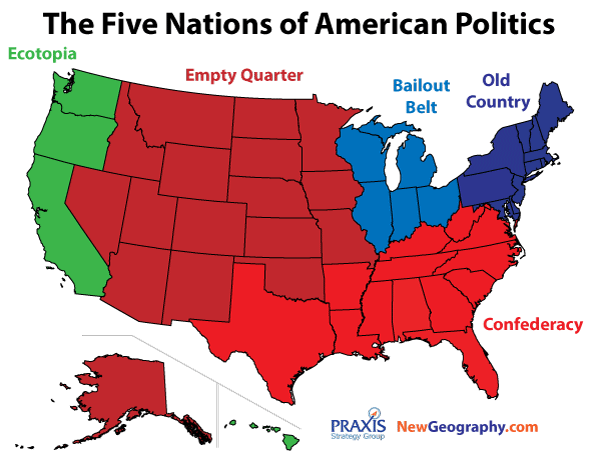
  • Why it’s All About Ohio: The Five Nations of American Politics

    Looking at Tuesday’s election results, it’s clear the United States has morphed into five distinct political nations. This marks a sharp consolidation of the nine cultural and economic regions that sociologist Joel Garreau laid out 30 years ago in his landmark book “The Nine Nations of North America.”

    In political terms there are two solid blue nations, perched on opposite coasts, that have formed a large and powerful bloc. Opposing them are two almost equally red countries, which include the historic Confederacy as well as the vast open reaches between the Texas panhandle and the Canadian border.

    Between these two largely immovable blocs stands the fifth nation – essentially the Great Lakes industrial heartland. By winning this territory – which could be called “Bailout Nation” – President Barack Obama built a winning coalition. Though this part of the country has suffered economic decline and demographic stagnation for decades, it is now emerging, as former President George W. Bush would put it, as “the decider” of America’s political fate.

    It’s no surprise that the coastal nations voted totally blue, reelecting the president, usually by margins of 10 points or more. The first of these nations can be dubbed “the Old Country,” the most European part of America.

    It stretches along the coast, from Maine to Maryland, and is essentially the Democratic Party’s base. It’s where the intellectual heirs to the traditions of Progressivism, the New Deal and New Frontier are most entrenched.

    Republican presidential nominee Mitt Romney lost by five percentage points or more in every state from this nation. In New York and Massachusetts, Obama won with 60 percent; in Washington, D.C., he received an astronomical 91 percent. Talk about home court advantage.

    This area is heavily urbanized and its economy – except for parts of western Pennsylvania – has become largely de-industrialized. Good jobs here are in the professions and financial services. Unemployment is high in some states, particularly New York and Rhode Island, but low – below 7 percent – in Maryland and Massachusetts.

    In the Old Country, natural resource extraction industries represent a small part of the economy and populations are concentrated in large metropolitan areas, with strong minority communities. It’s ideal territory for today’s Democratic Party, which is devotedly multicultural, strongly supportive of green energy and hostile to fossil fuels, large-scale agriculture and suburban sprawl.

    The region is essentially solid blue – as even the appealing Senator Scott Brown (R-Mass.) found out Tuesday. In the Old Country, things remain more of the same. The election numbers were nearly identical to 2008. States like Rhode Island, for example, didn’t even shift a point, despite lower national polling for Obama and the Dems.

    The Old Country’s coalition partner is Ecotopia, named after the science-fiction best-seller by Ernest Callenbach. “Ecotopia” tells the story of a successful breakaway “green” republic, which embraced most of the totems of West Coast progressivism, everything from renewable energy to militant feminism. This nation includes the states of California, Washington and Oregon. To these you can add Obama’s green-oriented, multicultural home state of Hawaii.

    In political terms, coastal Ecotopians share their states with less progressive regions on the other side of the mountains. Eastern Washington, Oregon and California all tend to be conservative – but are usually outnumbered, as they were this year, by the more densely populated coastal areas.

    Together, these two nations represent 186 electoral votes, almost equal to Romney’s total. They overwhelmingly send Democrats to Congress. And they have outsized influence. Ecotopia is home to Silicon Valley, while the Old Country, along with Hollywood, has turned the culture industry into an adjunct of the Democratic Party.

    For their part, the Republicans increasingly control two nations. One is the former Confederacy, which supported the former Massachusetts governor – only Virginia and possibly Florida slipped over to the Obama. This region has some of the nation’s strongest population growth and a strong allegiance to the military, one key GOP voting bloc.

    Energy defines much of the southern rim of the Confederacy. Texas and Louisiana have seen strong growth from oil and gas. Even the remaining Democrats in this region fear federal energy regulation under Obama will slow their economic growth. President Bill Clinton won Louisiana in 1996; this year the state went for Romney by an astounding 20 points.

    The other nation in the GOP camp is the Empty Quarter, the vast region stretching from the Great Plains and the Inter-mountain West to Alaska. This is where much of America’s food is grown and minerals extracted. Like the Gulf Coast, many in these states feel they have much to lose from a Democratic victory.

    Despite losing Nevada and Colorado and possibly Florida to Obama on Tuesday, these regions have seen expanding shares of Republican vote. Across these two nations, Romney’s margin was considerably better than Senator John McCain’s in 2008. In some states, his margins expanded by 10 points or more. From 2008 to 2012, Obama lost by 10 percentage points in Utah; 7 points in North Dakota and 5 points in Montana, South Dakota, Wyoming and Idaho.

    Yet these Republican nations may not be as stable as their Democratic counterparts. Conservative politics is almost extinct in places like California and New York. But Great Plains voters, however unhappy with Obama, still send some Democrats to the Senate, particularly when the GOP nominates extreme-right candidates.

    Ultimately, the decision comes down to the Great Lakes industrial region – which we can call the Bailout Belt. For these areas, which have high concentrations of manufacturing, the auto bailout was a godsend. And the region is now even more prosperous by the discovery of vast amounts of oil and gas.

    The benefits of the bailouts in this election – communities revived, families uplifted – outweighed those from fossil fuel producers, which now operate under threat of a possible Environmental Protection Agency-ordered shutdown. These states, outside of Indiana, stayed with Obama – by a handsome seven-point margin in Michigan. In virtually all these states, however, Romney did better than McCain.

    The president was quiet about fracking during the election. Now eyes turn to the EPA, since the House of Representatives would likely oppose a ban of any kind. The Bailout Belt may have to decide its energy future before it sides with either party.

    And where this region decides to go, so goes the nation – the entire nation.

    Joel Kotkin is executive editor of NewGeography.com and is a distinguished presidential fellow in urban futures at Chapman University, and contributing editor to the City Journal in New York. He is author of The City: A Global History. His newest book is The Next Hundred Million: America in 2050, released in February, 2010.

    This piece originally appeared at Reuters.

    Barack Obama photo by Bigstock.

  • Prairie Populism Goes Bust As Obama’s Democrats Lose The Empty Quarter

    Along Phillips Avenue, the main street of Sioux Falls, South Dakota, the local theater’s marquee is a tribute to the late Senator and 1972 presidential candidate George McGovern, who was buried last month, and is still regarded as a hero by many here. But with McGovern gone, it seems that the Democratic tradition of decent populism he epitomized was being interred along with him.

    In his landmark 1981 book, The Nine Nations of North America, Joel Garreau deemed the vast region stretching from the southern Plains well past the Canadian border The Empty Quarter. Along with the western strip of the neighboring Bread Basket that stretches up from central Texas through the Dakotas, the Quarter—covering much of the nation’s land and home to many of its vital natural resources—is in open revolt against the Democratic Party, threatening the last remnants of prairie populism.

    Although long conservative and GOP leaning, the Empty Quarter—containing Nevada, Utah, Wyoming, Idaho, Montana, and most of Alaska, along with inland California and Washington and parts of Colorado, New Mexico, and Oregon—has a proud progressive tradition as well. Over the past half-century, many of the Democratic Party’s most respected leaders —McGovern, Senator Majority Leaders Mike Mansfield of Montana and Tom Daschle of South Dakota, and powerful figures like North Dakota’s Byron Dorgan and Kent Conrad—have represented the Plains.

    The tradition is still revered there, but today’s Democrats are becoming an endangered species    as the party has become ever more distinctly urban, culturally secular and minority dominated.

    While Obama lost most of the Quarter in 2008, this year polls show that he’s likely to be crushed there, despite the booming economy in many of the states. Obama’s popularity has dropped more in North Dakota, which has the nation’s lowest unemployment rate, than any other state.

    Amidst the growing anti-Obama tide, progressive Democrats in most of the Quarter have been increasingly marginalized, both by their own party and by voters.  In the past two years, Republicans picked up a Senate and House seat in North Dakota, and look likely to pick up another this year,  along with a Senate seat in Nebraska,  and quite possibly another in Montana.  They are also poised to claim the only remaining Democratic House seat in Utah, if Mia Love’s lead over Rep. Jim Matheson holds up.

    By the end of this election, it’s possible that only two classic Prairie Democrats—South Dakota’s Tim Johnson and Montana’s Max Baucus—will remain in the Senate, where they once formed a powerful caucus. The Plains states, plus Alaska, account for 50 Congressional seats and an equal number of electoral votes—more than Florida, North Carolina and New Hampshire combined.

    Why has this occurred? One problem, notes former Daschle top economic aide Paul Batcheller, lies with the “nationalization” of the Democratic Party—and its transformation from an alliance of geographic diverse regions to a compendium of narrow special-interest groups, so that under Obama, the Democratic Party has essentially become the expression of urban-dwellers, greens and minorities, along with public employees.

    This, says Batcheller, has “made it easier for Republicans to paint Democrats as in cahoots with the likes of Ted Kennedy, Nancy Pelosi, etcetera.  And because politics has always been fairly civil here, having those coastal boogeymen to use has made it easier to paint Prairie Dems as having gotten Potomac Fever.”

    He also points to “changes in the media”—especially cable TV—that have made it more difficult for grassroots Democrats to make their case for their own interests, outside of the increasingly polarized national debate.  At the same time, Obama’s policies—focused largely on constituents in dense coastal cities—have widened the gap between the Plains and the Democrats.  It is increasingly difficult to be a successful Prairie progressive when that means striking out consistently against the very industries, from large-scale agriculture to fossil fuels, at the center of these economies.

    At the same time, the failings of Democratic big states, most notably California and Illinois, are not exactly advertisements for the virtues of modern progressivism. Particularly galling, notes Mike Huether, the mayor of Sioux Falls, have been the huge deficits and expanded welfare spending associated with the Obama Administration.

    “This is a fiscally conservative place, we don’t like deficits,” notes Huether, a lifelong Democrat whose city of 156,000 operates with a fiscal surplus. “People here want self-sufficiency. They are happy to give a hand up but they see that as short term and that’s it.”

    And the region’s self-sufficiency is an increasingly important part of our national debate, especially about energy independence. Although often dismissed as a land of rubes and low-end jobs, a study of the Plains  I conducted with the Praxis Strategy Group and Texas Tech University found that, overall, it has outperformed the rest of the country in virtually every critical economic measurement from job creation and wage growth to expansion of GDP.

    The area has also thrived demographically, with population growth well above the national average. Most of this has taken place in the region’s flourishing urban centers, from Ft. Worth and Midland, Texas to Sioux Falls, Bismarck, Fargo, Oklahoma City and Omaha. This growth includes migration from still de-populating smaller towns in the region, but increasingly includes migrants from the coastal areas as well as immigrants.

    More people now arrive in Oklahoma City from Los Angeles than the other way around.   And these arrivals are hardly poor Okies pushed back unwillingly; the Plains cities have become magnets for educated people. Over the past decade, the number of people with BAs in Sioux Falls has grown by almost 60 percent; Bismarck and Fargo saw growth of over 50 percent, while Oklahoma City, Omaha and Lubbock enjoyed forty percent increases. In contrast, the educated population of San Francisco grew at 20 percent and that of New York by 24 percent.

    Any coastal denizen who spends time in these cities may be surprised by the tolerance and lack of bible-thumping one encounters there. Social issues, notes Mayor Huether, have never been drivers in the Plains as they have been in parts of the Deep South. A quiet Nordic spirituality prevails here, rather than evangelical enthusiasm; people and politicians generally do not wear their faith on their sleeves. The real issue in the Plains centers around the future of the economy, and how best to bolster family and community; the Obama program, with its interest-group agendas, simply does not translate well in this environment.

    Ultimately, the red tide sweeping over the Plains is bad news, not simply for Democrats but for the country, part of the trend noted by Batcheller in which moderating regional forces within both parties—New England Republicans and Blue Dog Democrats—are losing ground.

    Prairie Democrats are crucial for ensuring that producers tangible staples—food, fiber and energy—have a space within their party’s tent, along with the big-city coastal consumers of those resources. Never mind the conservative cliché: If Democrats lose their remaining hold on the Plains, the nation’s parties will truly be split between makers and takers.

    This region is likely to become more important over the coming decades, providing much of the food needed for world markets as well as significant share of our new domestic energy. Its manufacturing, technology and service industries are also growing rapidly, integrating the area more into the national and global economies.

    Batcheller, among others, believe that the Plains Democrats may not become extinct, but their future will be limited in the increasingly polarized, and nationalized, political order. On the local level, particularly on key infrastructure projects like Lewis and Clark water project  that is being built to meet the needs of Sioux Falls and its environs, Republicans and Democrats are largely in agreement. Neither tea-party extremists nor greens can block progress towards widely accepted local infrastructure goals.

    One can only hope that the Prairie Democrats manage to survive. They have  contributed a unique brand of civically minded, decent social democracy that added much to the national debate. Egalitarian in intent, their brand of aspirational liberalism, fully content and compatible with notions of individual achievement and hard work, offers an alternative to the “know nothing” extremism increasingly dominant in both parties. This tradition of progressive decency could be sorely missed in the years ahead.

    Joel Kotkin is executive editor of NewGeography.com and is a distinguished presidential fellow in urban futures at Chapman University, and contributing editor to the City Journal in New York. He is author of The City: A Global History. His newest book is The Next Hundred Million: America in 2050, released in February, 2010.

    This piece originally appeared at The Daily Beast.

    Sioux Falls photo by Jon Platek..

  • The Rise of the Great Plains: Regional Opportunity in the 21st Century

    This is the introduction to a new report on the future of the American Great Plains released today by Texas Tech University (TTU). The report was authored by Joel Kotkin; Delore Zimmerman, Mark Schill, and Matthew Leiphon of Praxis Strategy Group; and Kevin Mulligan of TTU. Visit TTU’s page to download the full report, read the online version, or to check out the interactive online atlas of the region containing economic, demographic, and geographic data.

    For much of the past century, the vast expanse known as the Great Plains has been largely written off as a bit player on the American stage. As the nation has urbanized, and turned increasingly into a service and technology-based economy, the semi-arid area between the Mississippi Valley and the Rockies has been described as little more than a mistaken misadventure best left undone.

    Much of the media portray the Great Plains as a desiccated, lost world of emptying towns, meth labs, and Native Americans about to reclaim a place best left to the forces of nature. “Much of North Dakota has a ghostly feel to it," wrote Tim Egan in the New York Times in 2006. This picture of the region has been a consistent theme in media coverage for much of the past few decades.

    In a call for a reversal of national policy that had for two centuries promoted growth, two New Jersey academics, Frank J. Popper and Deborah Popper, proposed that Washington accelerate the depopulation of the Plains and create “the ultimate national park.” They suggested the government return the land and communities to a “buffalo commons,” claiming that development of The Plains constitutes, “the largest, longest-running agricultural and environmental miscalculation in American history.” They predicted the region will “become almost totally depopulated.”

    Our research shows that the Great Plains, far from dying, is in the midst of a historic recovery. While the area we have studied encompasses portions of thirteen states, our focus here is on ten core locations: North Dakota, South Dakota, Nebraska, Kansas, Oklahoma, Texas, New Mexico, Colorado, Wyoming, and Montana.

    Rather than decline, over the past decade the area has surpassed the national norms in everything from population increase to income and job growth. After generations of net out-migration, the entire region now enjoys a net in-migration from other states, as well as increased immigration from around the world. Remarkably, for an area long suffering from aging, the bulk of this new migration consists largely of younger families and their offspring.

    No less striking has been a rapid improvement in the region’s economy. Paced by strong growth in agriculture, manufacturing and energy — as well as a growing tech sector — the Great Plains now boasts the lowest unemployment rate of any region. North Dakota, South Dakota and Nebraska are the only states with a jobless rate of around 4 percent; Kansas, Montana, Oklahoma and Texas all have unemployment rates below the national average.

    A map of areas with the most rapid job growth over the past decade and through the Great Recession would show a swath of prosperity extending across the high plains of Texas to the Canada/North Dakota border. Rises in wage income during the past ten years follow a similar pattern. The Plains now boasts some of the healthiest economies in terms of job growth and unemployment on the North American continent.

    Of course, this tide of prosperity has not lifted all boats. Large areas have been left behind — rural small towns, deserted mining settlements, Native American reservations — and continue to suffer widespread poverty, low wages and, in many cases, demographic decline.

    In addition, the region faces formidable environmental and infrastructural challenges. Most prominent is the continuing issue of adequate water supplies, particularly in the southern plains. The large-scale increase in both farming and fossil fuel production, particularly the use of hydraulic fracking, could, if not approached carefully, exacerbate this situation in the not so distant future.

    Inadequate infrastructure, particularly air connections, still leaves much of the area distressingly cut off from the larger urban economy. The area’s industrial economy and rich resources are subject to a lack of sufficient road, rail and port connections to markets around the world. Yet despite these challenges, we believe that three critical factors will propel the region’s future.

    First, with its vast resources, the Great Plains is in an excellent position to take advantage of worldwide increases in demand for food, fiber and fuel. This growth is driven primarily by markets overseas, particularly in the developing countries of east and south Asia, and Latin America.

    As these countries have added hundreds of millions of middle class consumers, the price and value of commodities has continued to rise and seem likely to remain strong, with some short-term market corrections, over time.

    Second, the rapid evolution and adoption of new technologies has enhanced the development of resources, notably oil and gas previously considered impractical to tap. At the same time, the internet and advanced communications have reduced many of the traditional barriers — economic, cultural and social — that have cut off rural regions from the rest of country and the world.

    Third, and perhaps most important, are demographic changes. The late Soichiro Honda once noted that “more important than gold or diamonds are people.” The reversal of outmigration in the region suggests that it is once again becoming attractive to people with ambition and talent. This is particularly true of the region’s leading cities — Omaha, Oklahoma City, Tulsa, Kansas City, Sioux Falls, Greeley, Wichita, Lubbock, and Dallas-Fort Worth — many of which now enjoy positive net migration not only from their own hinterlands, but from leading metropolitan areas such as Los Angeles, the San Francisco Bay Area, New York and Chicago. Of the 40 metropolitan areas in the region, 32 show positive average net domestic migration since 2008.

    Together these factors — resources, information technology and changing demographics — augur well for the future of the Great Plains. Once forlorn and seemingly soon-to-be abandoned, the Great Plains enters the 21st century with a prairie wind at its back.

    Visit TTU’s page to download the full report, read the online version, or to check out the interactive online atlas of the region containing economic, demographic, and geographic data.

    Praxis Strategy Group is an economic research, analysis, and strategic planning firm. Joel Kotkin is executive editor of NewGeography.com and author of The Next Hundred Million: America in 2050. Kevin Mulligan is Associate Professor of Geography at Texas Tech University and Director of TTU’s Center for Geospatial Technology.