Tag: Energy

  • USA: A Net Exporter of Natural Gas?

    Less than a decade ago, major American energy companies were investing billions in constructing new terminals for importing liquefied natural gas — the cooled, dense state of methane that makes it economical for it to be transported by ship. Today, some of those same companies are contemplating spending billions to retrofit those facilities in order to export LNG.

    What happened in the interim? Natural gas boomed in the U.S., thanks to major discoveries of unconventional gas deposits in shale rock and new extraction techniques. In 2011, the U.S. Energy Information Administration raised its estimate for “technically recoverable” natural gas reserves in the U.S. from 353,000 billion cubic feet to 827,000 billion cubic feet. At $4 for every million BTU, natural gas isn’t that much more expensive than coal, which trades at a little over $2 per million BTU but produces twice as much greenhouse gas and significantly more air pollution.

    A “gas glut”

    Despite increased demand and a push to replace coal-fired power with natural gas, the U.S. is suffering what experts call a “gas glut.”

    “The real problem for shale gas is demand — they don’t know where to put all of it,” says Ben Schlesinger, an independent consultant to the natural gas industry. Meanwhile, Europe is paying two to three times the prices in the U.S., and countries that are entirely dependent on LNG, including Japan, Taiwan and South Korea, are paying even more — between $20 and $30 per million BTU.

    Europe also has security and political reasons for wanting access to U.S. gas. Its current primary source, Russia, has shown a willingness to use Europe’s dependence as a bargaining chip. In three of the past five winters, Russia has cut off the supply of gas to some part of Europe in a dispute over prices and other issues.

    Currently there are plans for up to three LNG export terminals on the U.S. gulf coast, and one on the Pacific coast of Canada, in Kitimat. Historically, the only LNG export facility in the U.S. was in Kenai, Alaska. LNG ships bound for Japan have departed from the terminal since the 1960s, but it’s slated to be shut down in the near future. If the first two export plants in the U.S., both converted import facilities, come online by 2015 as projected, they would be the first constructed in the U.S. in 40 years.

    The next Qatar?

    Whether or not the U.S. will become “the next Qatar,” which is the largest exporter of natural gas in the world, will depend on a number of factors. Together, these variables will determine whether investors think LNG export terminals are worth the risk, and whether or not the U.S. will even be capable of sending its bounty overseas.

    First, U.S. gas consumption must remain low. That means no “Pickens Plan” for using our natural gas reserves to fuel our trucking fleet, and no quick changeover from coal to natural gas for energy production. Second, we have to continue to drill at the rapid pace set over the past few years. More than half the natural gas consumed in the U.S. today comes from wells drilled in the last three years, and unconventional wells deplete rapidly, unlike conventional gas fields.

    Economics and more responsible drilling practices suggest that the drilling bonanza will continue, however. Pennsylvania, for example, could turn into the a state literally covered with wells. One engineer at Cornell speculated the state could eventually be home to as many as 100,000.

    “The increase [in unconventional natural gas production] has been so dramatic it’s amazing,” says Schlesinger. Ten years ago, production was a tenth what it is today, and fracking technology is evolving rapidly. If current trends in the U.S. continue — slow turnover of old power plants, reduced demand due to efficiency — it’s likely that much of that gas will be sent overseas as LNG.

    Christopher Mims is a contributor to Good, Technology Review and The Huffington Post, and is a former editor at Scientific American and Grist.org. He tweets @mims.

    Photo by jermlac
  • Wind Energy is Not Just Hot Air

    Anaheim Convention Center, Southern California, last week was a hot bed of one of the ultimate forms of renewable energy. The “fuel” used by wind turbines (really the wind) is free for the 30 year life span of the windmill installation, is considered inflation proof, and is 100 % domestically available.

    Just a brief walk through the trade exhibition convinces any visitor of European as well as Chinese commitment to wind energy. One guest speaker, Ted Turner put it: “Just do not look at the next 30 years, look for at least a few hundred years of human energy needs.”

    Conventional energy lobbyists claim that wind is unreliable and will harm operation of the grids. However, grid operators have observed that wind power is more reliable and predictable.

    There are rumors that sound of operating wind will cause a variety of dangerous health effects, including headaches and disturbed sleep. The studies have shown that wind turbines at a distance of 2,000 feet (normal building codes for Wind Mills) have a dB rating close to 45 (comparing that to 55 in an average home in the USA). Normally, two people can carry on a conversation on any wind mill farm. Please remember: this energy source has no side effects such as air or water polluting emissions, no hazardous waste, and has a direct impact on reducing the public health impact of any other energy generation.

    Are birds get affected by wind energy? A very legitimate question by the American Bird Conservancy needs to be addressed with honesty. The bird loss caused by buildings is about 550 million, by power lines 130 million, vehicles 80 million, poisoning by pesticide 67 million, and radio and TV towers close to 4 million. The tabulated loss by wind is under 150,000. Special attention is being paid to bats: The bats and wind energy coalition was formed in 2003 by Bat Conservation International, the U.S. Fish and wild life Service, and the National Renewable Energy Laboratory.
    The view of a wind energy facility or the distance of a home from a wind mill farm had no consistent, measurable or significant impact on home values.

    The current worldwide installed capacity gives a snap shot of Wind energy penetration in a given region. By 2010, the European Union was leading the world with 84,000 MW, China with 42,000 MW and the USA was at 40,000 MW. However, Denmark leads the world as percentage of total power needs fulfilled by Wind Energy: close to 20 % in 2010.

    The potential of up to 20 % electricity generation that can be derived from Wind Energy is feasible, both technically as well as financially by 2030. Most land used to construct wind farms can be used for its original purpose of harvesting, grazing and farming. The actual foot print of turbine farms, roads and generating and transmitting facilities is under 3 percent of total land taken out of commission.

    Wind Energy should be debated in the public forum with both energy independence and long term sustainability for our planet beyond the next election cycle.

  • Natural Gas Vehicles Floor It in Long Beach

    The Alternate Clean Transportation Expo held in Long Beach earlier this month was a spectacular display of engineering ingenuity by Natural Gas Vehicle providers. The event’s theme was that America’s self sufficiency in natural gas has decoupled our energy resources from petroleum prices. But the consensus among the gathered engineers and scientists was to look beyond the current prices of petroleum alone, and consider that domestic self sufficiency includes keeping jobs at home.

    The NGVs (Natural Gas Vehicles, which include Compressed Natural Gas—CNG, as well Liquefied Natural Gas—LNG) reduce greenhouse gas emissions almost 20 percent on medium and heavy duty models, and 30 percent on light duty vehicles.

    All fuels, including natural gas, release energy by burning. But cleanliness and renewability are probably the single most talked-about aspect of NGVs. From energy field to vehicle engine, natural gas needs very little processing to make it usable, compared to crude oil, which is processed into gasoline by complex and expensive refining techniques. A naturally occurring fuel, its chemical formulation is about 90% methane, with smaller amounts of ethane, propane, butane and carbon dioxide, a high octane rating of about 120 – 130, and clean burning characteristics.

    Biomethane gas is extracted from biomass, and is therefore renewable, and it can be produced economically in large quantities. Current estimates are that the US has proven reserves of over 1500 TCFs (trillion cubic feet) of natural gas which, by some estimates, should last for the next 100 years.

    Potentially, natural gas will create jobs not only through vehicle manufacturing, but through the construction of new CNG stations. A landfill processing plant near Dallas, Texas, owned by a pioneering company in CNG station installation, Clean Energy™, creates up to 9,000,000 GGEs (gasoline gallon equivalents)of biomethane gas for fueling stations. It has agreements with airports in Tampa, New York City, New Orleans and Philadelphia to build CNG filling stations that will support ground transport vehicles and off-airport parking shuttles.

    Of course, legitimate concerns have been expressed about the safety of natural gas vehicles. Notably, in a tragic 1998 accident a stopped bi-fueled Honda (a vehicle that can run on CNG or gasoline) was impacted by another vehicle moving at almost 100 mph. A fire started by the gasoline engine broke out.

    NGV supporters counter that the 50 liter CNG tank was intact and remained secure in its support bracket, that NGVs are subject to same federal standards as regular vehicles, and that natural gas cylinders are thicker and stronger than conventional gas tanks.

    The NVG safety record also includes a survey of more than 8,000 natural gas utility, school, municipal and business fleet vehicles that have traveled 178 million miles, in which the vehicle injury rate was 37% lower than in a gasoline fleet. Under federal and state regulations, fueling stations, indoor parking structures, repair garages and car dealerships must all meet high safety standards. Leaking gasoline forms puddles and creates a fire hazard; if the CNG engine leaks at all, the fuel will normally rise to the ceiling and disappear. Insurance companies nationwide have looked at the safety of natural gas buses and fleets and have no reservations about insuring them.

    Hybrids were also on display at the Expo, including a notable innovation by Parker Hannifin Company. Says Tom Decoster, business development manager of the Cleveland-based firm, “We are going to let California know there are alternatives to electric and CNG.” Parker’s alternative is the hydraulic hybrid, with regenerative braking energy stored as a pressurized gas in a vessel. These vessels are known to be accumulators, which Parker compares to batteries. While stored electricity from a battery drives a motor, energy from an accumulator powers a pump-motor to drive wheels. This assistance increases fuel efficiency and sometimes permits a smaller engine.

    Average fuel consumption for a conventional Class 8 vehicle is about 9,800 gallons per year. RunWise™, Parker’s vehicle, reduces the fuel consumption by 30 to 50 percent, depending on route density and operating conditions. “The more stops a vehicle makes during the day, the more efficient the system becomes relative to a conventional drive train,” Decoster says, adding that the NGV also reduces CO2 emissions, compared to a conventional vehicle, by 38 tons per year, the equivalent of about six midsize cars or planting 1,500 trees. It has reduced brake replacement cycles from every few months to almost 2 years. Parker’s technology is intended for refuse trucks and for fleets that need frequent stops, such as those run by FedEx and UPS.

    This highly technical conference and engineering-driven trade show was innovative in one other way, too. Expo organizer GNA designed events to reach out beyond the technorati to ordinary consumers who — it hopes — will one day be its loyal customers.

    Shashi Parulekar is a Los Angeles-based engineer. He holds an MBA, and served as Asia Pacific M.D. with Parker Hannifin Co in Michigan for over ten years.

  • The Deconstruction of Barack Obama

    The first two years of the Obama Administration have been historic and eventful. The first openly liberal president in a generation has dramatically increased government spending and intervention in the nation’s economy. The federal deficit soared to $1.65 trillion dollars and 35% of Americans now receive some type of government assistance.

    The President seems to view the American economy through the prism of an academician. His vision of America held that his New Economy would be supported by the troika of plentiful Green jobs, new federal employment, and a revitalized and robust union based economy.

    Give him credit. President Obama has held true to his vision even if the economy, and the American people, did not.

    The “Green Jobs” of Mr. Obama’s new economy have not materialized despite huge government incentives. The president’s New Energy for America plan called for a federal investment of $150 billion over the next decade to catalyze the private sector to build a clean energy future.

    Obama’s plan is to:

    • Provide short-term relief to American families facing pain at the pump
    • Help create five million new jobs by strategically investing $150 billion over the next ten years to catalyze private efforts to build a clean energy future.          
    • Within 10 years save more oil than we currently import from the Middle East and Venezuela combined    
    • Put 1 million Plug-In Hybrid cars – cars that can get up to 150 miles per gallon – on the road by 2015, cars that we will work to make sure are built here in America
    • Ensure 10 percent of our electricity comes from renewable sources by 2012, and 25 percent by 2025
    • Implement an economy-wide cap‐and‐trade program to reduce greenhouse gas emissions 80 percent by 2050

    The President’s plan called for renewable energy to supply 10% of the nation’s electricity by 2012, rising to 25% by 2025. The problem with his vision was that America was already generating 11.4% of its electricity from renewable sources when he delivered his speech. Ironically, most renewable energy comes from hydro-power, a source disdained by many greens. (US Energy Information Administration, Electric Power Monthly, June 2010.). T. Boone Pickens’s plan to build wind farms across the Great Plains was the most publicized private response to Obama’s vision never materialized. The U.S. Chamber of Commerce reported on March 10th that 351 “shovel ready” energy projects were stalled nationally due to “a tangle of state and local regulations”. These 351 projects were to create 1.9 million jobs and infuse the economy with “a $1.1 trillion short-term shot in the arm”. William Kovacs, senior vice-president of the chamber said, “In fact, there weren’t any shovel ready projects.”

    In the end, the outpouring of new technologies and jobs in the new “green” economy simply never materialized. 

    Indeed, despite the grand vision of a Green economy, America remains deeply dependent on others for its energy.

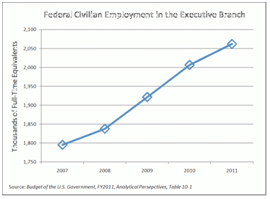
    The second leg of Obama’s troika was new government employment. He was successful in signing his health care reform into law but delayed implementation to 2014. The 2010 election that changed 63 House seats to the Republicans, has acted to unwind much of this legislation. If not repealed outright, Obamacare will likely face starvation from Republican cuts in funding necessary to implement the 2,900 page law with its hundreds of new federal regulations. Federal civilian employment in the president’s 2012 budget, will be 15 percent higher in 2011 than it was in 2007. This effort is also likely to be stymied.

    Union workers, the third leg of Obama’s troika, were well served in the first two years of the Obama Administration. The United Auto Workers inherited ownership in General Motors and Chrysler, and obtained federal protection of their relatively high wages and Cadillac health care benefits.  Had GM and Chrysler been allowed to enter Chapter 11 bankruptcy, it’s likely both would have been drastically reduced. Under the health reform act, union workers received exemptions from taxation for their Cadillac health care plans – unlike those of private companies.

    According to the most recent Employer Costs for Employee Compensation survey from the U.S. Bureau of Labor Statistics, as of December 2009, state and local government employees earned total compensation of $39.60 an hour, compared to $27.42 an hour for private industry workers – a difference of over 44 percent. This includes 35 percent higher wages and nearly 69 percent greater benefits. (Adam Summers Reason Foundation – Comparing Private Sector and Government Worker Salaries May 10, 2010).

    Will union members be able to hold their ground or be forced into major concessions during the coming deconstruction? State governors like Christie (NJ), Daniels (IN), Kasich (OH), and now Governor Walker of Wisconsin are taking on the unions head-on for the first time in generations. New conservative majorities in state house around the country are deconstructing collective bargaining agreements, above market wage gains, and Cadillac fringe benefits. Labor’s gains, and political clout, may have peaked in 2008. 

    Will President Obama adhere to his academician’s vision of the New Economy or will he be forced to succumb to the realities of the coming Great Deconstruction? Congress is arguing whether it can afford $4 billion in cuts to a $3 trillion budget in order to avoid an imminent government shutdown.

    Overlooked and more momentous is that for the first time since World War II, both houses of Congress – and some in both parties – are debating how to enact massive cuts in government spending. This is the beginning of the Great Deconstruction. Like the proverbial snowball rolling downhill, the $4 billion cuts of March 2011 could eventually canonball into hundreds of billions of actual spending reductions as the federal government deconstructs.

    The Government Accounting Office released a report on March 1st entitled ‘Opportunities to Reduce Potential Duplication in Government Programs, Save Tax Dollars, and Enhance Revenue.’ The report identified $200 billion in annual waste from duplicative federal programs. The agency found 82 federal programs to improve teacher quality; 80 to help disadvantaged people with transportation; 47 for job training and employment; and 56 to help people understand finances. Finding ways to cut billions in federal spending is not be the problem. Finding politicians with the political will to withstand the barrage of criticism from impacted constituents is another matter.

    The Great Deconstruction has already begun. Will President Obama, clearly a savvy politician, recognize this inexorable reality of this gathering force, leap in front of it, and claim ownership? Or will he stick to his academician’s vision and allow the snowball of deconstruction to roll over him? 

    Robert J Cristiano PhD is the Real Estate Professional in Residence at Chapman University in Orange, CA and Head of Real Estate for the international investment firm, L88 Investments LLC. He has been a successful real estate developer in Newport Beach California for thirty years.

    Other works in The Great Deconstruction series for New Geography
    Deconstruction: The Fate of America? – March 2010
    The Great Deconstruction – First in a New Series – April 11, 2010
    An Awakening: The Beginning of the Great Deconstruction – June 12, 2010
    The Great Deconstruction :An American History Post 2010 – June 1, 2010
    A Tsunami Approaches – Beginning of the Great Deconstruction – August 2010
    The Tea Party and the Great Deconstruction – September 2010
    The Great Deconstruction – Competing Visions of the Future – October 2010
    The Post Election Deconstructors – Mid-term Election Accelerates Federal Deconstruction – November 2010
    The State Government Deconstructors – November 2010

  • Energy Policy Reset: Forget Nuclear Reactors and Mideast Oil

    The two largest crises today — the Japanese nuclear disaster and the widening unrest in the Middle East — prove it’s time to de-fetishize energy policy. These serious problems also demonstrate why we must expand the nation’s ample oil and gas supplies — urgently.

    The worsening Japanese nuclear crisis means, for all intents and purposes, that atomic power is, if not dead, certainly on a respirator.

    Some experts may still make the case that nuclear power remains relatively safe. Some green advocates still tout its virtues for emitting virtually no greenhouse gases.

    But the strongest case against nuclear power is now rooted in grave public fears about radiation. Imagine trying to site or revamp a nuclear plant today anywhere remotely close to an earthquake fault or a major city.

    Germany has already begun shutting down some reactors. Opposition throughout Europe and in the United States is likely to grow exponentially as Japan’s tragedy unfolds.

    At the best of times, nukes were a hard sell. Even with support from Energy Secretary Steven Chu, a Nobel Prize-winning physicist who talks tough about fossil fuels, the obstacles to new nuclear construction were steep. Now, no amount of Obama administration green or corporate lobbying can overcome images of horrific fires and the terror, even if exaggerated, of radiation leaks.

    The other shoe dropping relates to the growing chaos in the Middle East, from North Africa to the Gulf. The price of oil is likely to continue climbing, unless the world economy slides back into recession — and perhaps even then. The governments that emerge from the current Mideast upheavals are likely to be far less pliable to Western interests than the authoritarian potentates that Washington long supported. Disruptions in supply, higher energy taxes and emergent environmental movements could constrain markets for months, even years, to come.

    These realities upset all the “best” obsessions of our rival political classes. Much of the progressive community, for example, had embraced nuclear fuel as key to ultimately replacing fossil fuels as a source of electricity — including the long-awaited electric cars. Green advocates often overestimated the readiness of renewable fuels — still far more expensive than fossil fuels and highly dependent on subsidies.

    Wind power, for example, produces, at best, some 2.3 percent of the nation’s electricity. But in addition to wiping out whole flocks of birds, it receives subsidies many times higher per megawatt hour than fossil fuels. In contrast, the dirtiest fuel, coal, still produces close to 50 percent of the nation’s electricity.

    Meanwhile, solar panel production, touted as a wellspring of job creation, seems to be shifting inexorably to China. Algae-based biofuels and other types look promising — but could take decades to become practical.

    Many conservatives, on the other hand, have espoused the nuclear option — in part, because the industry has powerful corporate backing, which is always an influential factor to Republicans. But even red-state denizens are probably looking at the scenes of Fukushima with understandable horror.

    So if the “best” agendas of both parties are flawed, it may be time to look at the “good.” The pragmatic way out of this emerging energy mess means focusing on our increasingly abundant supplies of oil and gas.

    “Peak oil” enthusiasts may not have noticed, but recent discoveries and improvements in technology have greatly expanded the scope of U.S. energy resources. New finds are occurring around the world, but some of the biggest are in the United States.

    Shale oil deposits in the northern Great Plains, Texas, California and Colorado could yield more oil annually by 2015 than the Gulf of Mexico. Within 10 years, these finds have the potential to reduce U.S. oil imports by more than half.

    Even more promising, from the environmental standpoint, are huge natural gas finds. Discoveries in Texas, Arkansas and Pennsylvania could satisfy 100 years of use at current demand levels.

    Natural gas is already muscling out coal as the primary source for new power plants. It can also be converted into transportation fuel, particularly for buses, trucks and taxis. In terms of pollutants and greenhouse gases, natural gas is much cleaner to burn than oil and significantly more so than coal.

    Exploring these resources is, of course, still likely to pose considerable environmental risks. But compared with the existential threat of nuclear radiation, even potential oil spills and damage to water supplies from fracking shale might be regarded as tolerable risks for which we have considerable experience and technology managing with enhanced regulation.

    In contrast, a nuclear meltdown, such as could be happening in Japan, poses a far more immediate threat than the scenarios proposed about climate change. Similarly, ceding even more power to an increasingly unstable Middle East represents a clear threat to both our economic and military security.

    Focusing on near- and medium-term fossil fuel development also has the virtue of fitting into the here-and-now realities of global economic conditions — largely the growing demand for energy in developing countries — and all but guarantees long-term high prices that encourage private investors to assume the risk. The likely demise of “clean” nuclear energy, sadly, makes such bets even more appealing.

    Producing domestic energy also creates the potential for hundreds of thousands of new U.S. jobs — everything from engineering to high-paying blue-collar work in the fields.

    A new gas-led energy boom would also spark increases in demand for manufactured goods like oil rig equipment, tractors, pipelines and refineries. And those are sectors that the United States still dominates.

    Would we rather this economic growth take place in Iran, Saudi Arabia or, for that matter, Vladimir Putin’s Russia?

    The time has come for both political parties to give up their “best” energy options for the good. A green economy that produces millions of new jobs is a laudable goal. But the renewable sector cannot develop rapidly without massive expenditures of scarce public dollars. To fully develop these technologies, we need lots of money and time.

    Republicans, too, need to give up their “bests” — including the notion that no policy is always the best, usually a convenient cover for the narrow interests of large energy corporations. Allowing private corporations to unilaterally determine our energy policy makes little sense. After all, most of our key competitors — China, Brazil and India — approach energy not as an ideological hobby horse but as a national priority.

    This new energy policy can be accomplished at far lower cost than either increasing dependence or waiting for the green Godot. It could also be far less expensive in terms of our soldiers’ lives — which would otherwise be spent protecting oil rights of corrupt Middle East regimes.

    It’s time to demand that our deluded, and self-interested, political class develops an energy policy based not ideology but on how to best guarantee prosperity for future generations of Americans.

    This piece originally appeared in Politico.

    Joel Kotkin is executive editor of NewGeography.com and is a distinguished presidential fellow in urban futures at Chapman University, and an adjunct fellow of the Legatum Institute in London. He is author of The City: A Global History. His newest book is The Next Hundred Million: America in 2050, released in February, 2010.

    Photo by gfpeck

  • Dallas Charges Up for the Electric Chevy

    If they build it, will we come? Planners, utilities, auto industry execs, and retailers are hopeful that we will, as they get themselves ready for electric vehicles in the Dallas/Fort Worth Metroplex. This isn’t a pie-in-the-sky vision for the future. The reality is unfolding right now. In 2011, NRG Energy will install upwards of 70 car-charging stations across Dallas and Forth Worth. As the Nissan Leaf and the Chevy Volt begin to penetrate the D/FW market, NRG aims to capture the revenue stream from charging car batteries here, just it is doing in Houston. NRG’s news comes on the heels of electric utility TXU Energy’s announcement of its own installation of twelve public charging stations being allocated across Dallas and Fort Worth.

    I’ve been watching the wave for several years as part of my work with emerging companies. At numerous conferences on electric vehicles, I’ve observed stakeholders – many of them in competition with each other – come together to swap ideas, network, and hammer out standards. It’s been an education in the necessity of collaboration to foster sustainable development.

    Cooperation hasn’t been guided by idealism so much as by the urge to survive in a market that, until recently, was practically non-existent. Start-ups that have failed to collaborate have fallen by the wayside. As one conference speaker joked, “We’ve got to build up the market before we tear each other down.”

    Profit-making may be the motivation of electric-vehicle manufacturers, but others at the table have their own agendas for EV readiness. The city of Dallas, for example, is in Serious Nonattainment status for ozone pollution. The region risks losing funding if it doesn’t clean up its air. “Seventy percent of air pollution in Dallas comes from on-road/off-road vehicles, so EVs can play a substantial role in resolving this,” said Jennifer Cohen, Executive Director for the North Texas Clean Air Coalition. Cohen was an organizer of the Electric Vehicle North Texas Electric Vehicle Showcase last September at the State Fair of Texas.

    At the Electric Vehicle Showcase. Betsy del Monte, Director of Sustainability for Dallas-based construction giant BECK told a panel, “Mass transit alone cannot solve our problem. We also need to look at the broader picture in terms of development. Of the palette of materials that we have available, EVs are one of the tools we must come to rely on.”

    Tom Reddoch, Director of Energy Efficiency for Electric Power Research Institute, agreed: “This is a success story. EPRI is connecting two giants, the electric industry with the auto industry.” To assist stakeholders with the information they need to build communities that can sustain a transition to electric vehicles, EPRI sees three keys: regionally-driven consumer attitudes, the installation of charging infrastructure in order to ensure a positive response for the drivers’ first experiences, and utility readiness. “We have plenty of capacity to go around, especially if people charge at night,” said Reddoch, “but there could be localized effects where cars cluster. The construction community, developers, and architects need to address this together.”

    At a technical level, tools are emerging that can help integrate electric vehicles into the transportation landscape. “We’ve arrived at an interesting nexus between the power industry and the auto industry,” said Brad Gammons of IBM. “There is not going to be a dominant leader so we need standards across the value chain… Collaboration ensures that things happen efficiently.”

    Not all collaboration requires complex software. Some of it is happening on the ground, person to person. The installation of electric vehicle charging infrastructure in D/FW is giving two cities with a long (if friendly) rivalry a chance to mutually benefit by working together. “To get the mayor of Fort Worth to travel to Dallas to talk about EVs is huge,” said Jim Greer of Oncor electricity.

    Range anxiety continues to be a barrier to electric vehicle adoption, even though three-fourths of Americans commute less than 40 miles per day. “To handle range anxiety, we need to provide home-based charging capability,” said del Monte from BECK.

    At the same time, Half Price Books unveiled Dallas’ first public charging station. Granted, there’s not a line around the block for the EV charger yet. But just having it at one of Dallas’ most popular bookstores sends a tangible signal to drivers that the future is here and now.

    As the infrastructure falls into place, the question remains: Will drivers buy the cars? We’ll find out very soon. The Chevy Volt is scheduled to arrive on car dealers’ lots in Dallas-Fort Worth in March.

    Photo of the Chevy Volt, a plug-in electric vehicle by IFCAR

    Anna Clark is the author of Green, American Style and the president of EarthPeople. She lives in one of Dallas’ first residences to earn a Platinum-LEED certification from the U.S. Green Building Council.

  • The Urban Energy Efficiency Retrofit Challenge

    I was welcomed home to Chicago from visiting family on Christmas Day by a cold house and a gas furnace that wasn’t working. The next day a repair tech gave me the bad news about a blown circuit board that would cost over $500 to replace. But I heard that were was a $1500 tax credit for energy efficient upgrades that was expiring at year end. With $2000 in “free money” to spend, I thought maybe furnace replacement might be a better option. At eight years old, the furnace might have more years of life. But it was a “developer special” – that is, a basic workhorse model that was not particularly energy efficient – only 80% Annual Fuel Utilization Efficiency (AFUE) rated – or with other features I might like. My hot water heater dated to the same time and was probably closer to needing to be replaced, so why not do them both at the same time? Maybe I would even go super-enviro friendly with a tankless model water heater.

    This is exactly what the stimulus was supposed to be stimulating. Unfortunately, the reality didn’t work out like I thought it would, and in a way that shows the challenge of doing energy efficiency retrofits in urban areas.

    I had my heating company come out to give me an estimate on replacement for my furnace and hot water heater. Immediately, I learned that there were problems. Chief among them is that newer, energy efficient systems recycle heat that previously went up the chimney. This makes their exhaust much cooler, and requires special chimney pipes that are plastic, not metal. My old chimney wouldn’t work, nor could a new pipe be inserted through it, since my water heater and furnace shared a chimney and there wasn’t room to install all the piping needed. They’d have to punch new holes in my roof. I’m on the top floor of my 14 unit building, which means this is actually doable, but it would cost money and require getting permission from my association. It’s also not something I’d want to take on in the winter unless absolutely required. And, as it turns out, I might not have a big enough gas line required to feed regardless tankless water heater. Tankless units consume less energy overall, but they do burst at higher output, requiring heftier gas supplies.

    I decided to just fix the circuit board.

    According to the heating company, if I lived in a single family home, this would probably have all been a non-issue. First, no permission would be needed from anyone, and generally furnaces and such are located where you can just punch an exhaust line directly out the side of the house. This makes upgrading a snap. But since I’m in an urban multi-unit building, things aren’t so easy. What’s more, even though I and the other person who live on the top floor might be able to make an upgrade happen, the other 12 units below us will never be able to upgrade to energy efficient heating because it is impossible for them to run new chimney pipes to the roof. That is, unless a new generation of technology vents through older metal chimney pipes. In essence, then, my building is permanently precluded from installing high efficiency heating – although the structure is less than a decade old.

    Gas forced air is the standard heating solution for new construction in Chicago and much of the Midwest. This may not apply to the largest buildings, but certainly to single family homes and most of the new construction condos in Chicago. Being able to upgrade building systems is key to energy efficiency, because buildings are the number one source of carbon emissions. In the city of Chicago, about 70% of all carbon emissions come from buildings. And while multi-unit buildings may be inherently more efficient in some regards, they create huge challenges for upgrades because of all the shared infrastructure and lack of access to the roof, exterior walls, and utility feeds. This might not apply in some cases where there is, for example, a shared boiler where one upgrade takes care of all units. But for most new construction condos outside of high rises, I strongly suspect they were built without energy efficient furnaces and in a way that effectively precludes upgrading to current technology.

    This shows the need for infrastructure and buildings that are designed to physically evolve over time. With rapidly changing technology, a “build once for the ages” approach is no longer appropriate. Even if codes were changed to require energy efficient heating at the time of construction or the installation of provisions for gas supply and venting, it would only deal with the here and now. We’d be fools to believe we are never going to want to upgrade things again in the future.

    The things we buy become obsolete more rapidly than ever. Consumer electronics companies have solved this with a short product cycles and rapidly declining costs that assumes the things you buy will be disposable. We should think about this principle as applied to buildings, but we’re probably a long way off from that.

    This is a difficult challenge and one that requires significant thought and trial and error as technology doesn’t always evolve like we think it will. I was very proud of myself for being forward looking enough to run network cabling to every room when I renovated an 1898 house back in the 1990s. A few years later wireless rendered that investment in wires itself obsolete.

    But it’s worth the effort to try to find a solution. From our highways and transit systems, to water and sewer lines, to our buildings, we are facing a huge overhang of required replacements and upgrades, much of the cost driven by a need to bring designs up to new, modern design requirements and the state of the art. We could spend an enormous amount of money doing this only to find ourselves right back in the same boat a few decades down the road when things are old again, and society’s desires and technology have moved on to the next generation. In an era of ever greater technology change, finding a way to ride the upgrade curve effectively is an imperative.

    Aaron M. Renn is an independent writer on urban affairs based in the Midwest. His writings appear at The Urbanophile.

    Photo by Ron Zack

  • The Heartland Rises

    The change in congressional power this week is more than an ideological shift. It ushers in a revival in the political influence of the nation’s heartland, as well as the South.

    This contrasts dramatically with the last Congress. Virtually its entire leadership — from former House Speaker Nancy Pelosi (D-Calif.) on down — represented either the urban core or affluent, close-in suburbs of large metropolitan areas. Powerful old lions like Reps. Charles Rangel (D-N.Y.) of Harlem, Henry Waxman (D-Calif.) of Los Angeles and Barney Frank (D-Mass.) of Newton, an affluent, close-in Boston suburb, roamed. The Senate was led by Sen. Harry Reid (D-Nev.), who loyally services Las Vegas casino interests while his lieutenant, Sen. Chuck Schumer (D-N.Y.), is now the top Democratic satrap of Wall Street.

    The old Senate tandem remains in place — but with greatly reduced influence. Many remaining Democrats, particularly those from the heartland, now live in justifiable fear for their political lives. But the most radical shifts in political geography are in the House.

    The new House leaders are, for the most part, from small towns, suburbs and interior cities. Most GOP pickups came from precisely these regions — particularly in the South and Midwest.

    The new speaker, Rep. John Boehner (R-Ohio), for example, represents a southern Ohio district that includes some Cincinnati suburbs. Rep. Eric Cantor (R-Va.), the majority leader, comes from suburbs west of Richmond. Rep. Paul Ryan (R-Wis.), chairman of the Budget Committee, hails from Janesville (population: 63,000).

    Power is moving within state delegations. Before the elections, California’s most influential House members hailed from coastal districts. In contrast, Rep. Kevin McCarthy, the new majority whip, represents Bakersfield, an oil-rich, largely agricultural area known as “Little Texas” — a far cry from the urbanity of Pelosi’s San Francisco.

    This change in geography also suggests a shift in the economic balance of power. The old Congress owed its allegiance largely to the “social-industrial” complex around Washington, Wall Street, public-sector unions, large universities and the emergent, highly subsidized alternative-energy industry. In contrast, the new House leaders largely represent districts tied to more traditional energy development, manufacturing and agriculture.

    The urban-centered environmental movement’s much-hyped talk of “green jobs,” so popular in Obama-dominated Washington, is now likely to be supplanted by a concern with the more than 700,000 jobs directly related to fossil fuel production. Greater emphasis may be placed on ensuring that electric power rates are low enough to keep U.S. industry competitive.

    The Obama administration’s land-use policies will also be forced to shift. Sums lavished on “smart growth” grants to regions, high-speed rail and new light-rail transit are likely to face tough obstacles in this Congress.

    Ken Orski, a former senior Transportation Department official and longtime observer of Washington land-use and transportation policy, said that no member of the GOP majority on the House Transportation and Infrastructure Committee comes from a big-city, transit-oriented district. The new committee, dominated by members from rural, suburban and interior smaller cities, represents areas that rely little on mass transit. These members are expected to steer money back to the roads and bridges their constituents rely on.

    Even more important are pending changes in energy policy. Many conservatives disdain what they consider “green pork” — subsidies for renewable fuels like solar and wind as well as the electric car and battery industry. Many firms involved in renewable fuels, already struggling to compete with cheap natural gas, could be driven out of business without continued federal nurturing.

    Another top priority for GOP leaders — and perhaps some energy-state Democrats — may be to choke off funding for the Environmental Protection Agency’s announced new regulations for greenhouse gases. Three out of four jobs in the oil and gas extraction industry are in GOP-dominated Texas, Oklahoma and Louisiana. California’s still-large oil industry includes many who work in the state’s increasingly Republican-leaning interior.

    Similarly, more than two-thirds of the nation’s coal mines, a prime EPA target, are in just three, increasingly red-leaning states — Kentucky, Pennsylvania and West Virginia, according to the Energy Information Administration.

    Yet urban areas can expect some benefits from this Congress. The recent extension of the Bush tax cuts largely benefits wealthy professionals, who cluster in a handful of expensive, liberal-oriented cities and their leafy, affluent suburbs. San Francisco, Boston and Manhattan liberals may groan about “breaks” for the rich, but many may be cursing the GOP all the way to the bank.

    Over time, the new emphasis on fiscal austerity could also play to Wall Street’s advantage — probably the last intention of most tea party activists. Reductions in public borrowing should drive more money into the private economy. This approach, adopted by Conservative British Prime Minister David Cameron, has helped create a smart recovery for London — even as the rest of Britain suffers from government cutbacks.

    The drive for austerity could also threaten traditional heartland staples like agricultural price supports and military spending. Major defense budget reductions, a necessity for any credible cut, could prove painful for military-oriented, red states like Virginia, Arizona, Alabama and Texas.

    This new regional balance of power poses a profound existential question for Democrats in states like California, New York and Illinois. The unlikely possibility of any future bailout for states or cities should help concentrate their minds on things like cutting spending and restoring their ability to create new jobs.

    Overall, it may be better for all regions to have a divided government. With President Barack Obama still in charge of the executive branch, we are not likely to see a repeat of the Bush-era excesses that favored traditional energy companies, suburban housing speculation and agribusiness.

    Optimistically, we may now see a canceling out of both parties’ regional tilts, spurring greater competition among localities for both investment and human talent. This could ultimately benefit the entire economy — taxpayers and communities — shedding an enlightened pragmatism on the current dreary landscape that is U.S. politics.

    This article first appeared at Politico.

    Joel Kotkin is executive editor of NewGeography.com and is a distinguished presidential fellow in urban futures at Chapman University, and an adjunct fellow of the Legatum Institute in London. He is author of The City: A Global History. His newest book is The Next Hundred Million: America in 2050, released in February, 2010.

    Photo by Smaku

  • How Liberalism Self-destructed

    Democrats are still looking for explanations for their stunning rejection in the midterms — citing everything from voting rights violations and Middle America’s racist orientation to Americans’ inability to perceive the underlying genius of President Barack Obama’s economic policy.

    What they have failed to consider is the albatross of contemporary liberalism.

    Liberalism once embraced the mission of fostering upward mobility and a stronger economy. But liberalism’s appeal has diminished, particularly among middle-class voters, as it has become increasingly control-oriented and economically cumbersome.

    Today, according to most recent polling, no more than one in five voters call themselves liberal.

    This contrasts with the far broader support for the familiar form of liberalism forged from the 1930s to the 1990s. Democratic presidents from Franklin D. Roosevelt to Bill Clinton focused largely on basic middle-class concerns — such as expanding economic opportunity, property ownership and growth.

    Modern-day liberalism, however, is often ambivalent about expanding the economy — preferring a mix of redistribution with redirection along green lines. Its base of political shock troops, public-employee unions, appears only tangentially interested in the health of the overall economy.

    In the short run, the diminishment of middle-of-the-road Democrats at the state and national level will probably only worsen these tendencies, leaving a rump party tied to the coastal regions, big cities and college towns. There, many voters are dependents of government, subsidized students or public employees, or wealthy creative people, college professors and business service providers.

    This process — driven in large part by the liberal attachment to economically regressive policies such as cap and trade — cost the Democrats mightily throughout the American heartland. Politicians who survived the tsunami, such as Sen. Joe Manchin in West Virginia, did so by denouncing proposals in states where green policies are regarded as hostile to productive local industries that are major employers.

    Populism, a traditional support of liberalism, has been undermined by a deep suspicion that President Barack Obama’s economic policy favors Wall Street investment bankers over those who work on Main Street. This allowed the GOP, a party long beholden to monied interests, to win virtually every income segment earning more than $50,000.

    Obama also emphasized an urban agenda that promoted nationally directed smart growth, inefficient light rail and almost ludicrous plans for a national high-speed rail network. These proposals appealed to the new urbanist cadre but had little appeal for the vast majority of Americans who live in outer-ring neighborhoods, suburbs and small towns.

    The failure of Obama-style liberalism has less to do with government activism than with how the administration defined its activism. Rather than deal with basic concerns, it appeared to endorse the notion of bringing the federal government into aspects of life — from health care to zoning — traditionally controlled at the local level.

    This approach is unpopular even among “millennials,” who, with minorities, represent the best hope for the Democratic left. As the generational chroniclers Morley Winograd and Michael Hais point out, millennials favor government action — but generally at the local level, which is seen as more effective and collaborative. Top-down solutions from “experts,” Winograd and Hais write in a forthcoming book, are as offensive to millennials as the right’s penchant for dictating lifestyles.

    Often eager to micromanage people’s lives, contemporary liberalism tends to obsess on the ephemeral while missing the substantial. Measures such as San Francisco’s recent ban on Happy Meals follow efforts to control the minutiae of daily life. This approach trivializes the serious things government should do to boost economic growth and opportunity.

    Perhaps worst of all, the new liberals suffer from what British author Austin Williams has labeled a “poverty of ambition.” FDR offered a New Deal for the middle class, President Harry S. Truman offered a Fair Deal and President John F. Kennedy pushed us to reach the moon.

    In contrast, contemporary liberals seem more concerned about controlling soda consumption and choo-chooing back to 19th-century urbanism. This poverty of ambition hurts Democrats outside the urban centers. For example, when I met with mayors from small, traditionally Democratic cities in Kentucky and asked what the stimulus had done for them, almost uniformly they said it accomplished little or nothing.

    A more traditional liberal approach might have focused on improvements that could leave tangible markers of progress across the nation. The New Deal’s major infrastructure projects — ports, airports, hydroelectric systems, road networks — transformed large parts of the country, notably in the West and South, from backwaters to thriving modern economies.

    When FDR commissioned projects such as the Tennessee Valley Authority, he literally brought light to darkened regions. The loyalty created by FDR and Truman built a base of support for liberalism that lasted for nearly a half-century.

    Today’s liberals don’t show enthusiasm for airports or dams — or anything that may kick up some dirt. Deputy Assistant Secretary of the Interior Deanna Archuleta, for example, promised a Las Vegas audience: “You will never see another federal dam.”

    Harold Ickes, FDR’s enterprising interior secretary, must be turning over in his grave.

    The administration would have done well to revive programs like the New Deal Works Progress Administration and Civilian Conservation Corps. These addressed unemployment by providing jobs that also made the country stronger and more competitive. They employed more than 3 million people building thousands of roads, educational buildings and water, sewer and other infrastructure projects.

    Why was this approach never seriously proposed for this economic crisis? Green resistance to turning dirt may have been part of it. But undoubtedly more critical was opposition from public- sector unions, which seem to fear any program that threatens their economic privileges.

    In retrospect, it’s easy to see why many great liberals — like FDR and New York City Mayor Fiorello LaGuardia — detested the idea of public-sector unions.

    Of course, green, public-sector-dominated politics can work — as it has in fiscally challenged blue havens such as California and New York. But then, a net 3 million more people — many from the middle class — have left these two states in the past 10 years.

    If this defines success, you have to wonder what constitutes failure.

    This article originally appeared in Politico.

    Joel Kotkin is executive editor of NewGeography.com and is a distinguished presidential fellow in urban futures at Chapman University and an adjunct fellow with the Legatum Institute in London. He is author of The City: A Global History. His newest book is The Next Hundred Million: America in 2050, released in February, 2010.

    Photo: Tony the Misfit

  • California Suggests Suicide; Texas Asks: Can I Lend You a Knife?

    In the future, historians may likely mark the 2010 midterm elections as the end of the California era and the beginning of the Texas one. In one stunning stroke, amid a national conservative tide, California voters essentially ratified a political and regulatory regime that has left much of the state unemployed and many others looking for the exits.

    California has drifted far away from the place that John Gunther described in 1946 as “the most spectacular and most diversified American state … so ripe, golden.”  Instead of a role model, California  has become a cautionary tale of mismanagement of what by all rights should be the country’s most prosperous big state. Its poverty rate is at least two points above the national average; its unemployment rate nearly three points above the national average.  On Friday Gov. Arnold Schwarzenegger was forced yet again to call an emergency session in order to deal with the state’s enormous budget problems.

    This state of crisis is likely to become the norm for the Golden State. In contrast to other hard-hit states like Pennsylvania, Ohio and Nevada, which all opted for pro-business, fiscally responsible candidates, California voters decisively handed virtually total power to a motley coalition of Democratic-machine politicians, public employee unions, green activists and rent-seeking special interests.

    In the new year, the once and again Gov. Jerry Brown, who has some conservative fiscal instincts, will be hard-pressed to convince Democratic legislators who get much of their funding from public-sector unions to trim spending. Perhaps more troubling, Brown’s own extremism on climate change policy–backed by rent-seeking Silicon Valley investors with big bets on renewable fuels–virtually assures a further tightening of a regulatory regime that will slow an economic recovery in every industry from manufacturing and agriculture to home-building.

    Texas’ trajectory, however, looks quite the opposite. California was recently ranked by Chief Executive magazine as having the worst business climate in the nation, while Texas’ was considered the best. Both Democrats and Republicans in the Lone State State generally embrace the gospel of economic growth and limited public sector expenditure. The defeated Democratic candidate for governor, the brainy former Houston Mayor Bill White, enjoyed robust business support and was widely considered more competent than the easily re-elected incumbent Rick Perry, who sometimes sounds more like a neo-Confederate crank than a serious leader.

    To be sure, Texas has its problems: a growing budget deficit, the need to expand infrastructure to service its rapid population growth and the presence of a large contingent of undereducated and uninsured poor people. But even conceding these problems, the growing chasm between the two megastates is evident in the economic and demographic numbers. Over the past decade nearly 1.5 million more people left California than stayed; only New York State lost more. In contrast, Texas gained over 800,000 new migrants. In California, foreign immigration–the one bright spot in its demography–has slowed, while that to Texas has increased markedly over the decade.

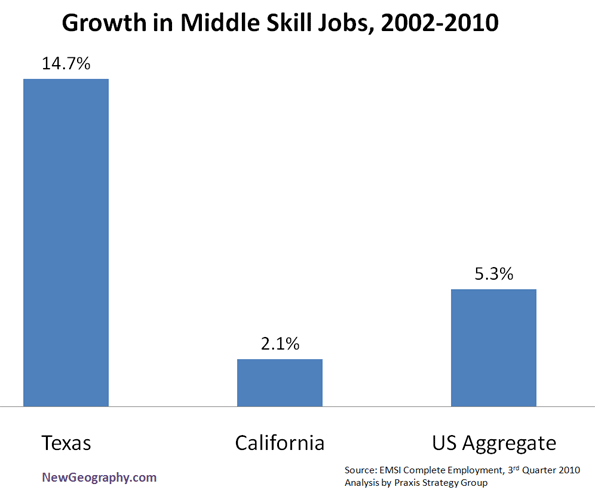
    A vast difference in economic performance is driving the demographic shifts. Since 1998, California’s economy has not produced a single new net job, notes economist John Husing. Public employment has swelled, but private jobs have declined.  Critically, as Texas grew its middle-income jobs by 16%, one of the highest rates in the nation, California, at 2.1% growth, ranked near the bottom. In the year ending September, Texas accounted for roughly half of all the new jobs created in the country.

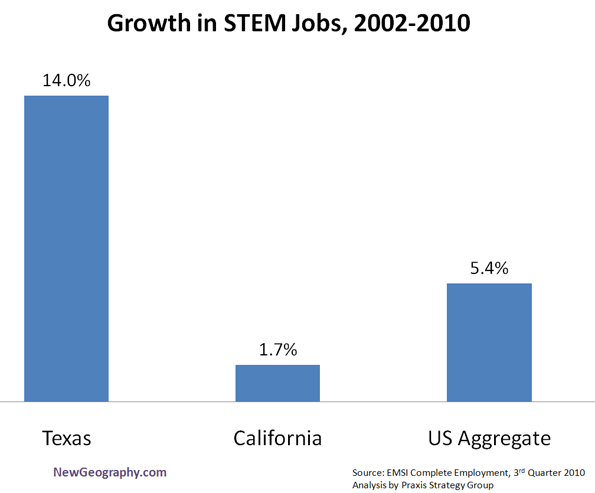
    Even more revealing is California’s diminishing preeminence in high-tech and science-based (or STEM–Science, Technology, Engineering and Mathematics) jobs. Over the past decade California’s supposed bulwark grew a mere 2%–less than half the national rate. In contrast, Texas’ tech-related employment surged 14%. Since 2002 the Lone Star state added 80,000 STEM jobs; California, a mere 17,000.

    Of course, California still possesses the nation’s largest concentrations of tech (Silicon Valley), entertainment (Hollywood) and trade (Port of Los Angeles-Long Beach). But these are all now declining. Silicon Valley’s Google era has produced lots of opportunities for investors and software mavens concentrated in affluent areas around Palo Alto, but virtually no new net jobs overall. Empty buildings and abandoned factories dot the Valley’s onetime industrial heartland around San Jose. Many of the Valley’s tech companies are expanding outside the state, largely to more business-friendly and affordable places like Salt Lake City, the Research Triangle region of North Carolina and Austin.

    Hollywood too is shifting frames, with more and more film production going to Michigan, New Mexico, New York and other states. In 2002, 82% of all film production took place in California–now it’s down to roughly 30%. And plans by Los Angeles County, the epicenter of the film industry, to double permit fees for film, television and commercial productions certainly won’t help.

    International trade, the third linchpin of the California economy, is also under assault. Tough environmental regulations and the anticipated widening in 2014 of the Panama Canal are emboldening competitors, particularly across the entire southern tier of the country, most notably in Houston. Mobile, Ala., Charleston, S.C., and Savannah, Ga., also have big plans to lure high-paid blue collar jobs away from California’s ports.

    Most worrisome of all, these telltale signs  palpable economic decline seem to escape most of the state’s top leaders. The newly minted Lieutenant Governor, San Francisco Mayor Gavin Newsom, insists “there’s nothing wrong with California” and claims other states “would love to have the problems of California.”

    But it’s not only the flaky Newsom who is out of sync with reality. Jerry Brown, a far savvier politician, maintains “green jobs,” up to 500,000 of them, will turn the state around. Theoretically, these jobs might make up for losses created by ever stronger controls on traditional productive businesses like agriculture, warehousing and manufacturing. But its highly unlikely.

    Construction will be particularly hard hit, since Brown also aims to force Californians, four-fifths of whom prefer single-family houses, into dense urban apartment districts. Over time, this approach will send home prices soaring and drive even more middle-class Californians to the exits.

    Ultimately the “green jobs” strategy, effective as a campaign plank, represents a cruel delusion. Given the likely direction of the new GOP-dominated House of Representatives in Washington, massive federal subsidies for the solar and wind industries, as well as such boondoggles as high-speed rail, are likely to be scaled back significantly.  Without subsidies, federal loans or draconian national regulations, many green-related ventures will cut as oppose to add jobs, as is already beginning to occur. The survivors, increasingly forced to compete on a market basis, will likely move to China, Arizona or even Texas, already the nation’s leader in wind energy production.

    Tom Hayden, a ’60s radical turned environmental zealot, admits that given the current national climate the only way California can maintain Brown’s “green vision” will be to impose “some combination of rate heights and tax revenues.”  Such an approach may help bail out green investors, but seems likely to drive even more businesses out of the state.

    California’s decline is particularly tragic, as it is unnecessary and largely unforced. The state still possesses the basic assets–energy, fertile land, remarkable entrepreneurial talent–to restore its luster. But given its current political trajectory, you can count on Texans, and others, to keep picking up both the state’s jobs and skilled workers. If California wishes to commit economic suicide, Texas and other competitors will gladly lend them a knife.


    This article originally appeared at Forbes.com.

    Joel Kotkin is executive editor of NewGeography.com and is a distinguished presidential fellow in urban futures at Chapman University. He is author of The City: A Global History. His newest book is The Next Hundred Million: America in 2050, released in February, 2010.

    Employment data from EMSI.

    Photo by {Guerrilla Futures | Jason Tester}