Tag: Energy

  • Corn Crop 2010: Food, Fuel, Feed and Folk Art

    The harvest of this year’s U.S. corn crop is about 90 percent complete, and it is going to be a bin-buster. If it surpasses 2009’s astonishing 13.1 billion bushels, it could become the largest in U.S. history. American farmers are growing more corn today than at any time in the past, and the trend is accelerating. The last five years have brought us five of the largest corn crops ever. Where to store the stuff is becoming an issue: When the bins and elevators are full, the corn is simply piled on the ground. Bankers are saying that we are experiencing the best farming environment in decades.

    Genetically modified seed, powerful fertilizer, and the rich soil of the Central Plains have turned field corn into the most prolific and versatile commodity on earth. It’s used in biofuel, animal feed, fabrics, biodegradable plastics, makeup, fireworks, crayons, shoe polish, batteries, and thousands of other products we consume every day.

    The U.S. Department of Agriculture reports that of the 13 billion bushels of field corn produced last year, 36 percent was used as feed for domestic livestock (beef, pork, poultry), 31 percent was used for ethanol (also resulting in 1.5 billion bushels of distiller grains, a byproduct of ethanol production that is used as livestock feed), 14 percent was exported to other countries (Japan, Mexico, South Korea, Taiwan and Egypt are the top recipients), 9 percent was used for human food, seed and industrial use, and 11 percent was carried over as a surplus.

    According to Nathan Fields, Director of Biotechnology and Economic Analysis for the National Corn Growers Association (yes, that is his real name), today’s farmers are good at growing corn—very good. No other county in the world even comes close.

    Corn was domesticated more than 7,000 years ago, when the early agronomists of the Americas instigated the upward trajectory of what might be described as the world’s first and most successful designer crop. In 1621, Squanto taught the pilgrims how to cultivate corn — maize —that sported only eight rows of kernels and was about one quarter of the length that it is today.

    In 2009, farmers in the Corn Belt — usually defined as Iowa, Illinois, Indiana, Minnesota, South Dakota, North Dakota, Nebraska, Kansas, Missouri, Ohio, Oklahoma, northern Texas, and Colorado— averaged a record yield of 165 bushels per acre. In 1927, when the first official records were kept, yield was only 26 bushels per acre. Fields asserts that the genesis of modern agriculture was in the 1880s, when ingenious farmers began to cross pollinate corn, creating hybrid seeds that produced hardier plants with the ability to outperform their parents. In the 1920s, geneticists developed inbred corn; after that, each decade brought and growth spurt after spurt. In the 1990s, biotech hybrids were developed that better tolerated drought, variances in temperature, and insects. But farmers still battle the weather every year. Indeed, it’s not unheard of for farmers to be fighting snow drifts during the last few weeks of harvest, and no amount of technology can stop a late summer hailstorm from destroying an entire crop in ten minutes or less.


    The winner of the National Corn Yield Contest last year grew 307 bushels per acre. A bushel of corn is 56 pounds and the size of a small laundry basket. A bold prediction is the expectation of 300 bushels per acre as a national average by 2030. It would be an 80 percent increase in just 20 years.

    Nathan Fields emphasizes that developments have led to higher US corn yields, grown on fewer acres with less water, chemicals, fertilizers, and fuel. Dramatic reductions in inputs per acre mean a smaller environmental footprint. There are 316,000 corn farmers in the U.S., and 95 percent of them are family farmers, the vast majority multigenerational. “For family farmers,” Fields asserts, “success is not measured by a single season. Family farmers are determined to leave the land in good shape for the next generation.”

    Enormous combines harvest biotech hybrid crops with the use of sophisticated GPS navigation systems—it’s no longer your grandfather’s farm, a fact reinforced to me recently by my 94-year-old grandpa, Ben Radcliffe. Radcliffe was a South Dakota farmer in the 1940s before he became the president of South Dakota Farmers Union and one of the country’s most revered farm activists. When Radcliffe’s father (my great-grandfather) was farming in the early 1900s, less than 1 percent of planted corn was hybrid; early farmers saved their seed from year to year. By the early 1940s, 78 percent of the corn planted was hybrid.

    Radcliffe notes,“Today, farmers use a weed control chemical so they don’t have to cultivate [plow between the rows]. We had to cultivate twice a year just to get the weeds out of the row. Today, the rows can be closer and the number of plants automatically doubles.”

    Today’s farmers also plant earlier. In the 1940s there was a farmer tradition that planting corn ideally began May 10th and was completed before June 1. Because today’s seed is more resistant to frost, farmers now begin planting in April. Today, most if not all of the corn harvest is sent to grain elevators. In Radcliffe’s day, most of it was fed to livestock right on the same farm. “Almost every farm, including mine,” he says, “had hogs and cows.”

    A new market for corn has recently opened up in China. According to CHS market analyst Kent Beadle, “China has undergone dramatic changes over the last decade. As incomes and lifestyles are changing, there is a demand for better food—specifically, more protein.” Pork, beef, and chicken consumption have caused demand to exceed supply, putting the world’s most populous country in a position to begin to buy U.S. corn.

    The U.S. supplies 62 percent of the world’s corn. Last year, America’s farmers exported $9 billion worth of it, an export surplus that most U.S. industries would envy… all from the ability of a genetically modified kernel of corn that weighs one-hundredth of an ounce to produce a 10 foot tall plant. A”maize”ing.

    Photo by Deborah Dragseth: The World’s Only Corn Palace, located in eastern South Dakota, twelve miles from where the author grew up in the heart of corn country. A folk art wonder, it is redecorated each year with 275,000 ears of corn. The 13 different colors and shades of corn include yellow, red, brown, blue, black, white, orange, calico and (this year for the first time via genetic engineering), green.

    Debora Dragseth, Ph.D. is an associate professor of business at Dickinson State University in Dickinson, North Dakota. She trains and develops leadership curriculum for CHS, Inc. a diversified energy, grains and foods company. The Fortune 100 company is the largest cooperative in the United States. Dragseth’s family owns a farm 8 miles east of the World’s Only Corn Palace.

  • A Price on Carbon: the New Greenmail

    Hidden from view during the Australian election, a carbon price is back on the political agenda. This comes as no surprise. Anyone following the debate, however, will see that it has nothing to do with the environment. For some time we have been urged to “act now”, but the grounds keep shifting and changing. Early on it was the drought. Then the Great Barrier Reef. After that the Bali Conference. Then the election of Barack Obama. Next came the Copenhagen Conference. Then being “left behind” in clean technology. Now, apparently, “inaction will cost more in the end”. All have come and gone – including the drought which was supposed to be with us forever.

    Even so, we are assured that a price on carbon is “inevitable”.

    The frantic search for a rationale is driven by the plain fact that there is no environmental reason for Australia to have a carbon price. In tandem with efforts to manufacture urgency, there has been an equally devious campaign to misrepresent the process of climate change, or at least the IPCC’s “consensus” version. Crucial has been the cynical manipulation of words like “pollution” and “clean”. “Carbon pollution” is a scientifically absurd term designed to distort the basic issue. If the “consensus” science is right, the problem is with the concentrations of carbon dioxide, not the natural, clean, life-giving gas itself. Most of the public associate “pollution” with “dirty” emissions such as exhaust fumes and particulate matter. By definition, reducing such pollution is good. Many, if not most, still believe this is what climate action is about, thanks to obscurantist Greens and others. In the same way, “clean” energy is seen as the antidote to “dirty” or “polluting” gases. Who can be against cleanliness? Derivative terms like “the big polluters” are also deceptive.

    Greens, activists and others with a stake in climate action live in mortal dread of the public grasping the truth. Since the concentrations are the issue, rather than carbon dioxide as such, Australia can do nothing about climate change. Our share of global emissions is too small. Nor do the world’s highest emitters show any sign of caring about what we do.

    No Australian Prime Minister did, or could have done, more to push climate onto the world’s agenda than Kevin Rudd. Asked about the Copenhagen fiasco in the dying days of his prime ministership, Rudd delivered this famous outburst: “There was no government in the world like the Australian Government which threw its every energy at bringing about a deal, a global deal, on climate change. Penny Wong and I sat up for three days and three nights with 20 leaders from around the world to try and frame a global agreement.” The UN assigned Rudd a special role drafting the text of the prospective protocol. Ultimately, he was rebuffed by large and small emitters alike. The face-saving accord was cobbled together without him.

    Australia can’t combat climate change directly by reducing its own emissions, or indirectly by encouraging larger emitters to reduce theirs. If we lack the power to prevent adverse climate effects, should they eventuate, we can’t avoid any higher costs of delayed action. Forget the constant bleating about China “doing its part.” Now the world’s largest emitter, China’s official policy is to reduce the “carbon intensity” of its economy (the carbon emitted per unit of GDP), not to cut emissions. This means emissions will continue to rise, although (possibly) at a diminishing rate. The point is this “action” is way short of what the IPCC considers necessary to make a difference. Greens keep asking the wrong question. It’s not whether China does “something” that matters, but whether that something is relevant. India does even less. As for the second largest emitter, opinion polls suggest a carbon price will remain dead in the United States after the November mid-term elections.

    So why must Australia have a carbon price? One thing is for sure: it has nothing to do with climate. In his early interviews as Minister for Climate Change, Greg Combet referred to it, repeatedly, as “a very important economic reform”. Calling it an environmental measure would raise too many awkward questions. Certainly, a carbon price has serious economic impacts, but gracing it with the label “economic reform” is disingenuous. The word “reform” connotes improvement. Economic reform is designed to spur growth by improving productivity and efficiency. In contrast, a carbon price damages productivity, by raising cost inputs, and hampers efficient resource allocation. It isn’t economic reform. It’s an environmental measure, but utterly futile.

    Climate activists were elated when Marius Kloppers, the boss of BHP Billiton, recently declared that a global carbon price is inevitable, so Australia should get in early. His grounds for this belief are a mystery. All the evidence suggests that a global price on carbon will be as elusive as world peace. He would have been on firmer ground to restrict his prediction to Australia. Still, environmental factors were far from Kloppers’s mind. As the arguments for a carbon price fall in succession, one lingers on. Endless speculation is undermining investor confidence, so the argument runs, and producing uncertainty in industries with long investment lead times, like the capital-intensive energy industry. This can only be ended with the swift introduction of a carbon price. Of course the argument is entirely circular. The activists, politicians and journalists who push this line are themselves instrumental in generating the speculation, uncertainty and paralysis, and for obvious reasons.

    Back in the 1980s, “greenmail”, an amalgam of blackmail and greenback, referred to the practice of buying enough shares in a company to threaten a takeover, thereby forcing the company to buy the shares back at a premium. As the practise and word have since faded away, perhaps it’s time to revive the term “greenmail” and invest it with new meaning. Greenmail occurs when officials and activists with media power disrupt stability and certainty in a particular industry, maintaining pressure and an air of crisis, to intimidate business leaders holding out against some senseless green measure.

    If Australia does end up with a carbon price, it will be due to greenmail rather than any rational consideration.

    This article first appeared at The New City Journal.

    Photo by Amit (Sydney)

  • Environmental Consequences of Low Fertility Rates

    But isn’t it great news for the environment that we are having fewer children?”

    We should always stress the positive in life. Were it not for the dramatic slowdown in birthrates that began the late 1960s and 70s, the apocalyptic warnings of overpopulation then voiced Paul Ehrlich, the Club of Rome, and many others could well have come true in short order. We are lucky that they did not. But it is not clear the “the planet” is any better off as a consequence.

    Consider, for example, that when Japan, South Korea, Singapore, and the other Asian Tiger countries first began to experience sharp declines in fertility in the 1970s, their economies simultaneously took off, leading to far higher levels of per capita and total consumption. More recently, China, and to a lesser extent India, have followed the same pattern. Viewed through the lens of demography this does not look like a coincidence.

    The first order effect of fertility decline is that there are proportionately fewer children to raise and educate. This both frees up female labor to join the formal economy, and allows for greater investment in the education of each remaining child. All else being equal, both factors stimulate economic development, and by extension pollution and resource depletion.

    Low fertility societies can put extra burdens on the environment in other ways as well. For example, they have a higher proportion of singles and childless couples, who generally have more money and opportunity to engage in new forms of consumption, such as world travel or eating out regularly, than do people bearing the responsibilities of family life. (Think of Japan’s so-called “parasite singles”—childless, young adults notorious for their high living).

    A rising proportion of childless households also affects the pattern of living arrangements in ways that can be harmful to environment. Five childless singles living in separate housing units, each with its own washer and dryer, stove, refrigerator, etc., will tend to have a bigger environment footprint than a five-person family that lives under one roof, as will be confirmed by any “carbon footprint” calculator. Such factors help to explain why even in places like Japan and Germany where population is already deceasing in absolute size, increases in per capita consumption result in increasing total carbon emissions.

    Of course, over time, low birthrates lead not to just fewer children, but to fewer working age people as well, even as the percentage of dependent elders explodes. This means that as population aging runs it course, it may depress economic activity for a variety of reasons. Yet even if these and other factors related to population aging ultimately cause a Great Recession and thereby tamp down use of natural resources, is still not clear the consequences for the environment are necessarily positive.

    For example, a society that is paying more and more for pensions and health care also has fewer financial resources available for environmental remediation and investment in “green technology” Also, a society facing dwindling numbers of workers available to support each retiree may respond by adopting patterns of production and consumption that save labor but are far more energy intensive and thereby create lots of environmental damage. (Modern industrialized agriculture, with its high inputs of fossil energy, synthetic chemicals, and water, for example, becomes closer to a necessity if there are dwindling numbers of people available to work the land).

    An aging society may also come to believe that there is no other way to preserve an eroding tax base or to pay for old age entitlement than by stimulating economic growth by whatever means. These could include subsiding suburban sprawl, bailing out auto makers, and other measures that are particularly hard on the planet. Finally, once the point of absolute population decline sets in, this may work against the feasibility of mass transit, high speed rail, and other forms of infrastructure that require a high population density to be economically feasible.

    Was Malthus wrong?
    Malthus and his many present day followers could still be right that we face a future of scarcity. Particularly alarming is the declining growth in agricultural productivity. The so-called Green Revolution, which involved the intensive use of petroleum-based fertilizers, synthetic chemical pesticides herbicides, irrigation, genetic engineering of crops and animals, mechanization, and economies of scale, appears to be approaching its limits. Already, the rate of productivity growth on American and European agriculture has dropped substantially in this decade compared to the 1990s, due to such factors as soil and water depletion, the increasing resistance of pests to chemical treatment, and the simple fact that there is only so much fertilizer one can add to soils and still have it benefit crops. World food production no longer produces a surplus, and in recent years has fallen below the rate of population growth. Decreasing genetic diversity in the crops on which humans depend also makes world agricultural production increasingly vulnerable to climate change, which is always occurring regardless of cause. Feeding the next one billion could be a lot harder than feeding the last one billion, even if most are seniors.

    Yet here again, emerging scarcities of food and other natural resources argue against any reversal in the current downward trend in fertility. If a huge and growing portion of mankind already finds the cost of children prohibitive under modern conditions how will they respond in their family planning when the cost of food and energy (to say nothing of health care and pension contributions) rises further?

    Key to understanding here is that phrase “modern conditions,” or more specifically the institutional arrangement that affect the economics of family life far more than the simple “cost of living.” If rising food and energy prices cause a reversal of the global trend toward urbanism and a renewal of small-scale, local production and rural life, this could be begin to restore the economic basis of the family. In that process, children would regain stranding as productive assets and fertility rates could be expected to rise as a result.

    The ongoing rollback of social security and other intergenerational transfer programs around the world pushes in the same direction. But until globalism and the welfare state are damaged to the extent that they lose even their short-term viability, increasing scarcity will push down fertility rates by increasing the cost of children and thereby accelerate global aging with all its attendant challenges.

    Phillip Longman, a senior fellow at the New America Foundation and the Washington Monthly, is the author of The Empty Cradle and many other writings on demographics and social change.

    Photo by Ethan Prater

  • Green Jobs for Janitors: How Neoliberals and Green Keynesians Wrecked Obama’s Promise of a Clean Energy Economy

    In August 2008, then-candidate Barack Obama traveled to Lansing, Michigan, to lay out an ambitious ten-year plan for revitalizing, and fundamentally altering, the American economy. His administration, he vowed, would midwife new clean-energy industries, reduce dependence on foreign oil, and create five million green jobs. “Will America watch as the clean-energy jobs and industries of the future flourish in countries like Spain, Japan, or Germany?” Obama asked. “Or will we create them here, in the greatest country on earth, with the most talented, productive workers in the world?”

    Two years later, the answer to that second question appears to be no. Obama’s environmental agenda is in tatters. His green jobs plan has done little to make a dent in unemployment, which persists at close to 10 percent. Obama’s signature environmental initiative, cap-and-trade, died in the Senate in July. And, during the first year of Obama’s tenure, China massively outspent the United States on clean-energy technology.

    The story of how Obama’s green agenda came up empty is more complicated than the one conventionally told by Democrats and greens, who imagine that cap-and-trade would have been transformational had Republicans and global-warming deniers not gotten in the way. In truth, the president’s strategy was flawed from the start. Cap-and-trade would not have birthed a domestic clean-energy economy — indeed, it wasn’t designed to. Meanwhile, the administration’s green stimulus spending was split between short-term, if worthy, investments in green technology, to which far too little money was allocated, and over-hyped public-works projects that would never have delivered the new industrial economy Obama promised as a candidate.

    Voodoo Economics

    Shortly before the House passed its version of cap-and-trade legislation last year, the Center for American Progress (CAP), headed by Obama transition director John Podesta, released a study claiming that the cap-and-trade bill and the stimulus combined would create 1.7 million new jobs. Democrats repeatedly pointed to the CAP report to support their jobs claims. Extrapolating from the report’s analysis, it seems that over half of the new jobs, almost 900,000, were supposed to come from building retrofits. The study’s authors apparently believed that a mere $5 billion in stimulus funding for weatherization, plus a price on carbon, would leverage $80 billion annually in private investment and lead to the retrofitting of every single commercial and residential building in America in just ten years.

    Alongside the CAP report, the Natural Resources Defense Council and the leading green jobs group, Green For All, released another study written by two of the same authors, claiming that roughly half of the jobs would benefit low-wage workers and would offer “decent opportunities for promotions and rising wages over time.” Indeed, environmentalists such as Van Jones — who had come to prominence calling upon young people to “put down those handguns and pick up some caulking guns” and briefly served as Obama’s green jobs czar — claimed that building retrofits and cap-and-trade legislation could save both the planet and the inner city.

    In reality, the stimulus’s $5 billion weatherization program, according to the Department of Energy, created or saved just 13,000 jobs during the last reported quarter. But, even if more of these jobs had been created, the idea that inner-city youth should see what are essentially janitorial jobs as a pathway out of poverty was always far-fetched. America’s black middle class emerged from the steel, ship, and automobile factories of the postwar industrial heyday. Those jobs were high-skill, high-wage, and long-term. They manufactured products that could be sold on domestic and foreign markets, and they provided the economic basis for a dramatic improvement in black America’s standard of living. Jobs retrofitting buildings and weatherizing homes are, by contrast, low-skill and short-term.

    To be fair, Democrats in Congress and White House officials always believed that while the stimulus expenditures represented a down payment on the clean energy economy, the real action would ultimately be driven by private investments in response to cap and trade, not sustained public investments in innovation and manufacturing.

    In this way the green Keynesianism that characterized the stimulus comfortably accommodated itself to the neoliberal policy predilections that have, over the last 20 years, become Democratic Party orthodoxy. Born of fashionable neoclassical economic theory and political expediency after the Reagan revolution, Democratic neoliberalism embraces the notion that private firms are better and more efficient at “picking winners,” technological and otherwise, than government. This cliche was never based on the real-world history of technological innovation or economic growth but rather upon the neoclassical assumption that governments must do a worse job than private actors since they are not motivated by profit and cannot act rationally.

    Even Jones, who spent recent years railing against neoliberal economic policies, accepts this neoliberal conceit. “The real solution to this whole thing is to put a price on carbon,” Jones told Pacifica’s Democracy Now in the fall of 2008. “The biggest economic stimulus I can imagine would be a carbon tax or a cap and trade… so that suddenly there is a market signal for private capital to start moving aggressively in a clean energy, low carbon direction.”

    But cap and trade could never deliver the millions of new jobs that Obama, Congressional Democrats, and greens promised. The primary obstacle to private sector investment in clean energy technologies is not the absence of modest carbon price signals such as those in the Congress’ cap and trade proposals and currently in place in Europe. Rather, it is the vast price gap between fossil fuels and clean energy technologies. While fossil fuels are energy dense, widely available, easy to consume, and supported by a well-developed infrastructure, the alternatives are costly, cumbersome, intermittent, or all of the above.

    Yet cap and trade enjoyed mainstream credibility for as long as it did in spite of these hard technological realities because economic models seemed to show that a rising carbon price would cause technological innovation and hence emissions reductions. Cap and traders used these models to argue that once we have a carbon price, the market would magically deliver technology innovation because private firms would have an incentive to invest to make those technologies better and cheaper.

    But the magic wasn’t in the market, it was in the models constructed by neoclassical economists, which simply assume substantial rates of technological change. Innovation — non-linear, unpredictable, and ephemeral — is understandably difficult to model. Perhaps more significantly, important innovations have as often as not been the result of public investments in technology which economists, following neoclassical doctrine, are loathe to acknowledge, much less include in their models.

    The real world gives us ample reason to be skeptical of carbon pricing claims. The European Union has had a cap-and-trade system in place since 2005, and Norway and Sweden have had carbon taxes since the early ’90s. None have spurred much innovation. On the contrary, much of Europe has been on a coal-plant-building binge over the last decade. Where European nations have advanced clean-energy technologies–whether wind in Denmark, nuclear in France, or solar in Germany–they did so through direct investments in those technologies that dwarfed the economic incentive provided by carbon pricing.

    The Ideology of Decline

    In late May, President Obama told employees at a solar panel factory in California, “I’m not prepared to cede American leadership” in clean energy. But that is in effect what his policies have done. While U.S. policymakers have fetishized carbon pricing and energy efficiency retrofitting, America’s competitors have been investing heavily to deepen their domination of solar, wind, nuclear, electric car, and high-speed rail technology and manufacturing.

    China, Japan and Korea have moved forward with aggressive plans to out-manufacture, out-innovate, and out-compete the United States in clean tech. China alone plans to spend more than $740 billion (5 trillion yuan) over the next 10 years. While neoclassical economists and their disciples in Washington have presided over the deindustrialization and financialization of the American economy, our economic competitors have used long-term investments to establish dominant positions in advanced, high value manufacturing sectors such as automobiles, electronics, information technology, and now clean tech.

    Obama too could have focused on winning a similarly long-term commitment to public investment in green innovation and manufacturing. Instead, he threw his political capital behind cap-and-trade. Despite the fact that the rising domination of key clean energy technologies by our economic rivals could in no way be attributed to a price on carbon — China, Japan, and Korea don’t even have one — Obama, his Congressional allies, and their cheerleaders in the media such as New York Times columnist Thomas Friedman, have continued to insist that cap and trade legislation was the key to reestablishing U.S. competitiveness in clean tech.

    In truth, cap and trade was conceived as a strategy to minimize the cost of reducing emissions, not to create domestic industries or jobs. Indeed, economists typically argue that government should not even concern itself with such issues. To the neoclassical mind, making microchips is no better than making potato chips, as innovation expert Rob Atkinson wryly observes. If China is better at making solar panels and we are better at making foam insulation, then we should just buy our solar panels from China. From this point of view, creating low-skill construction jobs installing compact fluorescent light bulbs in old buildings has the same economic utility as creating high-skill jobs manufacturing solar panels and nuclear reactors for export.

    Apply these assumptions to climate and energy policy, and what you get is the failed Democratic agenda. Governments should cap carbon emissions and auction the right to pollute. Doing so would establish a price on carbon pollution that will make fossil fuels increasingly expensive and thus drive private investment and consumption to efficiency and renewables. If all those solar panels and windmills get made in China — so be it. America will still lead the world in potato chips or something else.

    This is not a recipe for American economic competitiveness in clean energy technology and manufacturing. America’s nascent clean energy industries need sustained public investments to survive and prosper. While neoliberal greens and their allies were hyperventilating over the death of cap and trade, the stimulus investments in technology and manufacturing were hard at work laying the foundations for a competitive clean economy. Though overshadowed by the public works-style efficiency programs, stimulus-funded investments in clean technology arguably saved the American renewables industry, which was in free-fall after the 2008 financial crisis.

    In contrast to the green public works projects, stimulus investments in manufacturing and innovation have largely done what they were intended to do — support an embryonic domestic industry and help improve clean energy technologies so that they can become competitive with fossil fuels. Those investments helped put American clean energy manufacturing back on a competitive footing globally, and, ironically, created more jobs at less cost than the green public works investments that were supposed to put millions of Americans back to work. Already, Deutsche Bank estimates that the stimulus grew U.S. battery manufacturers production capacity from two percent of the global market to 20 percent by 2012, and the story is similar for other technologies.

    Those technologies still have a long way to go before they will be good enough and cheap enough to become the basis for a sustained American economic renewal. But the road map for getting there looks a lot more like what America began through the stimulus investments in technology and manufacturing than through the green public works programs and carbon market making that have distracted the Administration and Congress for the better part of the last two years.

    This should not particularly surprise us as the history of industrialization and technology innovation in America is the history of government investment in technology. In the postwar era, the federal government made investments in the development and commercialization of new technologies such as nuclear power, computers, the Internet, biomedical research, jet turbines, solar power, wind power and countless other technologies at a scale that private firms simply could not have replicated. Those investments “crowded in” rather than crowded out private investment and the result was high growth and prosperity that benefited virtually every American.

    Unfortunately, neither Obama nor his fellow Democrats still seem to get it. While White House officials, in the wake of the collapse of cap and trade, tout the impressive short-term accomplishments of the stimulus investments in technology and manufacturing, they have done little to date to prevent them from expiring next year.

    Change We Can Believe In

    Obama appears genuinely moved by the vision of a clean-energy economy. He seems to have convinced himself, however, that America’s energy economy can be transformed through carbon markets and efficiency retrofits.

    The president’s proposal to “make clean energy the profitable kind of energy” — which was always code for making fossil fuels more expensive — today needs to be replaced by a focused effort to make clean energy cheap through innovation. Doing so will require large, direct, and sustained federal investments in new energy technologies. This focus on innovation may seem like an indirect way to create jobs, but history shows it is also the one with the strongest record of producing whole new industries — industries that have driven America’s long-term economic expansion.

    There is a growing consensus in favor of such an effort, which includes some conservatives and Republicans who opposed cap-and-trade. Support for greater investment in energy innovation includes corporate chieftains, such as Bill Gates, GE’s Jeff Immelt, and Intel founder Andy Grove, as well as dozens of Nobel laureate scientists and energy policy experts across the ideological spectrum.

    The failure of cap-and-trade to make it through the Senate may thus turn out to be a blessing in disguise. It spares the country a program that would have done little to help either the economy or the environment. And it gives Obama and the Democrats an opportunity to reconsider how they might build the clean-energy economy they were elected to deliver. With the right policies, the answer to the question Obama posed two years ago in Lansing — will the United States lead the way in creating clean-energy jobs? — can still be yes.

    This piece originally appeared at Breakthrough Blog.

    Michael Shellenberger and Ted Nordhaus are co-founders of the Breakthrough Institute and authors of Break Through.

    Image by heatingoil

  • The Great Deconstruction: Competing Visions of the Future

    During the Great Recession, America’s wealth has diminished while indebtedness has increased. This is simply a matter of fact. How the United States will marshal its resources and deploy its wealth in the future is a matter of great public debate. Previous installments of the Great Deconstruction series have explored the debate over the growing size of government and the impact the Tea Party movement may have on a possible smaller role for future government.

    The current administration has its own vision of how to address the coming period of deconstruction. John P. Holdren, Director of the White House Office of Science and Technology, shied away from using the term “de-development” that he endorsed in past writing. When asked by CNSNews how he would “de-develop” the United States, Holdren said he would use the “free market economy” to implement “stopping the kinds of activities that are destroying the environment and replacing them with activities that would produce both prosperity and environmental equality”.

    But this stated new appreciation for market forces likely does not mean he has shifted from his belief that resources “must be diverted” from advanced countries to the underdeveloped countries. An example of how Holdren’s vision of the future may be implemented as policy in the United States can be found in this administration’s actions towards energy and in particular, oil drilling. The BP oil well, Deep Horizon, has been officially capped yet the federal ban on all drilling in the Gulf remains in place. The administration estimates the ban cost just 8,000 – 12,000 jobs but Baton Rouge-based Louisiana Mid-Continent Oil and Gas Association believes that the moratorium may put as many as 46,000 rig workers out of work. If all workers on deep water rigs were laid off during the suspension, the moratorium would lead to the loss of 23,247 jobs.

    In contrast, the same Administration approved $2 billion in loan guarantees from the US Import Export Bank to Brazil’s state owned oil giant, Petrobas, to open the giant Tupi oilfields in the Santos Basin fields near Rio de Janeiro. The oil recovered from the Tupi fields will not go to the US and US taxpayers, but it will make Brazil richer and energy independent

    Critically much of what the Administration has proposed follows the contours of “de-development”. This can be seen in a host of initiatives that would hit Americans economically from the “cap and trade” scheme, support for solar and wind energy, as well the attempt to regulate greenhouse emissions through the EPA.

    Oddly the Administration has not put much priority on nuclear power, which is arguably the most effective way to reduce greenhouse gases. Despite announcing an $8 billion loan program for nuclear power plant construction, there is only one nuclear power plant under construction in the US, compared to 50 worldwide. Jeff Immelt, CEO of General Electric, joked that the nuclear industry’s most important output these days is press releases. Nuclear power remains banned in many states. Just 6 states are able to generate more than 40% of their electricity from nuclear power.

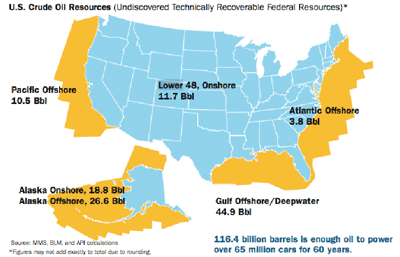
    The drive to de-develop America begins with control of energy. This includes actions to restrict access to our natural resources. The United States has 31 billion barrels of oil reserves on-shore in the lower 48 and Alaska. Off-shore oil reserves include 60 billion barrels along the coastal US and 26 billion barrels in off shore Alaska. Yet almost all of these reserves remain untouchable. Drilling in ANWAR is still banned and due to the BP oil leak in the Gulf, a drilling ban remains in place on the only coastal resource previously open for drilling.

    The US oil reserves are a pittance compared to our reserves of oil shale deposits. Estimates put oil shale reserves at 1.5 – 2.0 trillion barrels or five times that of Saudi Arabia. “The technical groundwork may be in place for a fundamental shift in oil shale economics,” the Rand Corporation recently declared. “Advances in thermally conductive in-situ conversion may enable shale-derived oil to be competitive with crude oil at prices below $40 per barrel. If this becomes the case, oil shale development may soon occupy a very prominent position in the national energy agenda.” Shell utilized a process called “in situ” mining, which heats the shale while it’s still in the ground, to the point where the oil leaches from the rock. The process eliminates the need to mine the shale to get to the oil. The Administration has shown little sign of encouraging the development of these resources, particularly in the areas controlled by the federal government.

    US policy towards the coal industry is no more favorable. U.S. coal production decreased in 2009, dropping by 8.5 percent to a level of 1,072.8 million short tons. The decline in coal production in 2009 was the largest percent decline since 1958 and the largest tonnage decline since 1949.

    In sharp contrast, the administration openly promotes green technologies like wind and solar. Unfortunately, these sources provide just 1% of our energy requirements.

    De-development, the Obama Administration’s version of deconstruction, is very different from a growing political movement aimed at reducing the nation’s debt and current spending. The Great Deconstruction will not come from a government policy of reducing energy consumption to bring America into a more correct distribution and use of the world’s resources. Rather, it will come from the people demanding a smaller bureaucracy, more efficient government and government employees actually willing to do the job they are paid to do.

    The election in November offers the most profound choice for the future of America that we have seen in decades. One choice espouses government control of our natural resources, motivated by the strategy of “de-development” and expensive, rationed energy. The other choice seeks deconstruction of unsustainable and dysfunctional bureaucracies and intends to choke off the money supply from Congress and defund these programs.

    **************************

    Robert J Cristiano PhD is the Real Estate Professional in Residence at Chapman University in Orange, CA and Head of Real Estate for the international investment firm, L88 Investments LLC. He has been a successful real estate developer in Newport Beach California for twenty-nine years.

    Other works in The Great Deconstruction series for New Geography
    Deconstruction: The Fate of America? – March 2010
    The Great Deconstruction – First in a New Series – April 11, 2010
    An Awakening: The Beginning of the Great Deconstruction – June 12, 2010
    The Great Deconstruction :An American History Post 2010 – June 1, 2010
    A Tsunami Approaches – Beginning of the Great Deconstruction – August 2010
    The Tea Party and the Great Deconstruction – September 2010

  • Political Decisions Matter in State Economic Performance

    California has pending legislation, AB 2529, to require an economic impact analysis of proposed new regulation. Its opponents correctly point out that AB 2529 will delay and increase the cost of new regulation. There will be lawsuits and arguments over the proper methodology and over assumptions. It is not easy to complete a thorough and unbiased economic impact analysis.

    Should California incur the costs and delays of economic impact studies?

    California should, because political decisions matter and too many California politicians don’t believe it. I’ve had a State Legislator, sitting in her office in the Capital, tell me in essence that decisions made in this building won’t impact California’s economy.

    She’s not alone. It is common to hear politicians or their advisors claim that “California will come back” or something similar. They believe that California’s climate and abundant amenities are enough to guarantee prosperity. They are wrong.

    Consider North Dakota, and its booming economy. As of July 2010, North Dakota’s unemployment rate was 3.6 percent, and in 2008, the most recent year for which we have data, its economy grew at a 7.3 percent rate. California’s unemployment rate was 12.3 percent in July 2010, and its 2008 economic growth rate was an anemic 0.4 percent.

    That’s a very big difference. If California had North Dakota’s unemployment rate, it would have over 1.3 million jobs than it has today. That is almost the entire population of Sacramento County and 30 percent more than the entire population of Northern California’s Contra Costa County.

    Why the big difference? Why is North Dakota booming, as the United States suffers its most devastating economic decline in over 70 years? Why is California’s economy, with almost 30 percent higher unemployment than the United States, performing so poorly?

    Does North Dakota have some naturally endowed advantage over California? If so, nobody has noticed it before. It is not climate. California has a friendly Mediterranean climate, while North Dakota has a Northern Continental climate. North Dakota’s mean minimum temperature is below freezing six months of the year, and it gets as low as -60F! Many Californians, living on the coast, can go decades without witnessing a freezing temperature. I remember when we had a multi-day freeze in my hometown of Ventura, sometime in the 1980s. I was freezing; a North Dakotan would be walking around in a t-shirt.

    California has oil and gas. North Dakota has oil and gas. California has over 2,000 miles of beaches. North Dakota doesn’t have beaches. California has magnificent mountains. North Dakota doesn’t have any mountains and only a few hilly areas. Over 20 species of trees reach their largest size in California. Most of North Dakota doesn’t naturally grow many trees.

    Let’s face it. Most Californian’s consider North Dakota to be a cold, windy, God-forsaken piece of dirt best left to the bison. North Dakota’s natural endowment doesn’t explain why it has been growing with vigor while California has been stagnating.

    Maybe North Dakota has been lucky while California has been unlucky? Luck can play a part in economic performance, and North Dakota has almost surely been luckier than California over the past few years, but that can’t be the only explanation.

    It’s hard to point to a single source of North Dakota’s prosperity. Its taxes aren’t particularly low. It has a reasonable safety net for the unfortunate. It does have a booming oil and gas business. Its agriculture sector is doing well. It has a small, but dynamic, tech sector. Its universities remain well funded since the state is actually running surpluses. It has a hardworking, well educated, Midwestern population. Governments and politicians in both parties tend to be business friendly, willing to support business and enter into occasional partnerships. North Dakotans have done lots of things right, and they’ve probably also been a bit lucky.

    It’s just as hard to point to a single source of California’s dismal performance. California hasn’t maximized the economic potential of its oil and gas resources, but its economy is large, and oil and gas alone can’t explain the differences between California and North Dakota. California hasn’t updated its ports to accommodate the most recent and planned ships, but those ports see lots of activity. Many California communities are not business friendly, but some are, particularly some smaller ones inland. California has lost some military bases, but many remain. California is a relatively expensive place to do business, because of taxes and regulation, but California’s workers are more productive, even after adjustment for industrial composition and capital, and California’s consumers still constitute a huge market.

    California’s economy is dying the death of a thousand cuts: a tax here, a regulation there, an unfriendly city council in Coastal California, a lack of infrastructure investment everywhere. These things add up to a significant net negative for California, its businesses, and its workers.

    Californians have done lots of things wrong, and they’ve been a bit unlucky.

    That’s why AB 2529 is a good idea for California, why it’s worth the costs and delays. The analysis will require regulators to consider the economic costs of regulation, something many green activists and Sacramento politicians simply ignore. Perhaps if this regulation had been in place over the past few years, some of California’s 2.2 million unemployed workers would have jobs and once Golden State would not be on the verge of becoming, as historian Kevin Starr has noted, “a failed state”.

    Bill Watkins is a professor at California Lutheran University and runs the Center for Economic Research and Forecasting, which can be found at clucerf.org.

    Photo by Willem van Bergen

  • Cars, People & Carbon Neutrality: A Symbiosis

    The potential for a symbiotic relationship between the environment, cars and people may be about to take a giant leap forward. London’s Daily Telegraph reports that a group of engineers from Genco have developed a bio-bug (Volkswagen bug) that runs on human waste. The car is powered for 10,000 miles from the excrement from 70 households (annually). The human waste bio-bug would be carbon neutral because it would not add any greenhouse gas to that already produced. The fuel would be produced at sewage plants, which already produce the necessary methane fuel from waste. While the technology, fully implemented, would not produce sufficient methane to power the entire fleet of cars, it would be a significant step forward and is further indication of the potential for technology to make substantial greenhouse gas emission reductions.

    Bio-Bug Photo

  • Alaska: Caribou Commons Or America’s Lost Ace?

    The most serious collateral damage from the BP spill disaster could very likely be in the far north, along the Alaskan coast. The problem is not a current spill but the Obama administration’s ban on offshore drilling and what many fear may be a broader attempt to close the state from further resource-related development.

    Such an approach could harm both the local and national economies for decades to come.

    Locking up of this vast northern state–which is home to some 700,000 people and has more coastline than the rest of “lower 48″combined–would be tantamount to the U.S. throwing away a strategic ace in the hole. Alaska contains many of the strategic assets–oil, zinc, lead, gold and, perhaps most critically, rare earth metals–critical in the increasingly multipolar battle for global prosperity.

    The move by some in the administration and green activists to freeze the last frontier recalls Frank and Mary Popper’s proposal to turn the Great Plains into a “buffalo commons” for wildlife, Native Americans and grasslands. In this case, this new Alaska could be labeled “the caribou commons.”

    By now it’s clear that the Great Plains region has value well beyond accommodating vast herds of bison, which have indeed been expanding. According to a recent Portfolio.com survey, four states either completely or partially in the Plains–North Dakota, Texas, South Dakota and Nebraska–rank among the top six states in economic performance.

    Alaska–buoyed in large part by energy production and its spinoffs–ranked second on the list, its residents doing far better than those in what the locals call “the outside.” Yet for all its wealth, Alaska has a peculiar challenge that stems from the fact that the vast majority of its land is owned by the federal government.

    Right now oil drilling represents the most important and contentious issue. Sixteen billion barrels of the black tea have come out of the North Slope alone since the 1980s, more than originally expected. An estimated 56 billion additional barrels exist, much of it in coastal waters.

    For decades, oil has driven Alaska’s prosperity. Before the discovery of the Prudhoe Bay field in 1967, Alaska suffered a per-capita income some 20% below the national average. Today it ranks eighth.

    Roughly 100,000 Alaskans work for energy companies, either directly or indirectly. Jobs in the oilfields, as well as the mines, pay an average of between $70,000 and $100,000 a year. These industries have helped it rise as one of the national leaders in producing good middle-class, blue-collar jobs.

    University of Alaska economist Scott Goldsmith estimates that oil accounts for two-thirds of the state’s growth since it became a state in 1959. Just eliminating the vast fields on Prudhoe Bay tomorrow, he estimates, would wipe out roughly one-third of all the state’s jobs. Oil-related taxes account for roughly 84% of the state’s total revenues.

    Alaska has other industries, such as tourism and fishing, but these pay far lower average wages than energy. “Without oil, we are essentially a third-world country,” notes Dan Sullivan, mayor of Anchorage, home to nearly half the state’s population.

    Not surprisingly, many Alaskans believe a ban on new energy and mining projects would end their relative prosperity. Goldsmith, for one, envisions the state turning into something akin to Maine (ranked 30th in per-capita income), a tourism-dominated playground for the visiting rich scarred by grinding poverty.

    Already oil-fueled revenues that fund government employment have fallen dramatically. Since its peak in 1988 oil flowing through the Alaska pipeline has dwindled from 2 million barrels a day to barely 700,000. This total could fall to under 600,000 by 2018.

    Without the development of new fields, Alaska, which now enjoys the country’s largest rainy day fund, could face a huge fiscal crisis. According to recent University of Alaska estimates, the state could confront California-style insolvency within a decade or two.

    Of course, most Alaskans do not want to see energy–or mining–expanded without strenuous controls. Many of them live in this isolated, often brutally cold place in order to enjoy its natural splendor and bounty. Climate change–irrespective to this summer’s chilly weather–also is a wide concern among people who live adjacent to retreating glaciers and worry about depleting arctic fisheries.

    Yet if Alaskans passionately want to preserve their staggeringly beautiful environment, they also are unlikely to embrace a vision of pristine poverty. Having suffered the depredations of international energy, mining or fishery companies, they also are not anxious to leave their fate to the Environmental Protection Agency or litigation-happy, trust-fund groups such as the Center for Biological Diversity.

    “A lot of people in the lower 48 [states] want us to pay for their sins,” suggests Alaska Sen. Con Bunde, reflecting a widely felt sentiment. “They may never come to Alaska, but knowing it’s there keeps them warm inside at night.”

    To protect their economy, Alaskans will need to learn new skills. For a generation they relied on powerful, now retired longtime Sen. Ted Stevens to protect their industries and make them the largest per-capita beneficiaries of federal largesse.

    Best suited for this role are the powerful Alaska-based, native-owned corporations. Unlike the oil companies run from Dallas, Houston or London, these companies are locally rooted. Together the top 13 native-owned firms possess some $4 billion in assets, a billion-dollar payroll and 12% of the state’s land.

    Taking control of their destiny may also mean changing attitudes common in a society that combines the most rugged individualism with what many call “an entitlement mentality.” After all, this is a place where big oil pays most of the bills and every individual receives an $1,300 annual check from the energy-funded Personal Dividend Fund. “The typical Alaskan doesn’t give a damn about what happens as long as they get their PDF check,” observes Dan Robinson, an economist with the McDowell Group, a local consulting firm.

    To maintain its long-term prosperity, Alaska needs to shift from petro-welfare to investing its energy wealth in the growth and diversification of its key industries. The state, for example, has huge potential for wind, geothermal and tidal production and should be a hub for both new fossil fuel technology as well. It also can use its locale on a key Pacific trade route as a center for advanced logistics (Anchorage Airport carries the world’s fifth-largest cargo tonnage).

    The rest of the country also has a big stake in the fate of America’s Far North. Lost production of energy and mineral resources would make us more dependent on other, often unfriendly countries. With exploration shifting to far less environmentally sensitive places like Mongolia or Africa, you also can count on greater net ecological damage as well.

    Alaska’s concerns may seem remote those in the “lower 48.” But how the 49th state fares may determine whether the rest of America can build a more sustainable and prosperous economy in the decades ahead.

    This article originally appeared at Forbes.com.

    Joel Kotkin is executive editor of NewGeography.com and is a distinguished presidential fellow in urban futures at Chapman University. He is author of The City: A Global History. His newest book is The Next Hundred Million: America in 2050, released in February, 2010.

    Photo: Unhindered by Talent

  • Deepwater Dreams: Drilling The Psych of Oil Execs

    For more than fifteen years, I spent a considerable amount of my professional time in the company of oil men. For years I ate lunch with them, traveled with them to places like Scotland and Russia, listened to their war stories over drinks, watched them unfurl seismic charts on board tables, read their budgets, and marveled at their forecasts — all of which predicted finding the next Prudhoe Bay, North Sea, Bass Strait, or Caspian Sea, no matter where they looked. In one meeting, I heard of a vast store of gas under, alas, the walls of old Jerusalem.

    The oil men of my acquaintance had names like Swede, Red, Junior, Clint, and Roge. To a man they believed that oil could be found through satellite images, wildcat drilling, 3-D seismic surveys, or, in one case, a careful reading of select Biblical passages.

    All they ever needed to realize their dreams was about $25 million, a few drilling rigs, a handful of outside experts (all of whom charged $2000 a day to pour cement, decode seismic, or spud wells), and then to be left alone until the crude came bubbling to the surface, as it does in the opening scenes of “The Beverly Hillbillies”.

    The stories of British Petroleum’s Deepwater Horizon have reminded me that the industry runs on the fumes of dreams, what Sigmund Freud called “the future of an illusion.”

    According to the mainstream media accounts, which read like a Frank Norris novel, the petroleum industry is an octopus that has wrapped its stranglehold around all aspects of America’s economic and political life. It’s methodical, logical, all-encompassing, and evil.

    In practice, most oil companies are lotteries with gas stations.

    Yes, the Gulf oil spill is a cautionary tale of what happens when wily corporations strong-arm regulators, scoff at environmental impact statements, and ignore safety regulations to bleed the world of its precious energy reserves, all for extortionate profits.

    That said, the Deepwater Horizon sounds like every oil deal I ever heard described, with the exception that the shareholders and management of BP were willing to fund the diving rods with millions in actual front money. In most cases, petroleum deals do not get past the sketches drawn on restaurant napkins.

    The only way to go into the oil business, at least on the upstream (exploration) side, is to think big. Downstream (refining, gas stations, Jiffy Lube and the like) is closer to banking or life insurance, a narrow-margin turnover business. Upstream is the stuff of wildcat dreams, where the right drilling rig (which can cost $100,000 a day) and the right well (some as deep as several miles) will unlock a gusher.

    Large oil companies, however, rarely go it alone when developing a new field. In places like the North Sea and the Caspian, they syndicate participations to other oil companies in order to reduce capital requirements and spread around the risk.

    With the Deepwater Horizon, apparently BP thought they had a sure thing and held on to a majority. If you’re tapping into Paradise, why bring in outside angels?

    Doubt is not an emotion that I associate with oil men; think of BP’s chief executive, Tony Hayward, who said, “I think the environmental impact of this disaster is likely to have been very, very modest,” and then rode out the media storms on his yacht. I am sure BP’s executives who planned the Gulf drilling are no different from those that I met who preached the gospel of untapped petroleum wealth in Sudan, Mongolia, the Democratic Republic of Congo, and Albania.

    Whenever I would ask about the risks or costs of a venture, the oil men at the table would look at me as if I were shoe salesman who was trying to understand the finer points of neuroscience. My job as a banker was to find the money to sink the drills. Beyond that, I was on a “need not to know” basis.

    How often do oil men hit oil? Obviously, many wells hit pay dirt. Nonetheless, I spent fifteen years following drilling adventures and no one I came across ever shouted “Eureka!”. Instead, I was introduced to the concept of the “dry hole,” a noble but unsuccessful effort to tap into the riches of the earthen core, which costs about eight million dollars a whack.

    When a hole comes back empty, oil men generally agree that failure is key to the industry, that the faults were not their own, and that next time, with another eight or eighty million to sink into the ground, they will do things differently, such as actually study the geological formations, consult earlier drillers, prepare a budget, or call some top notch oilman who has retired to Wyoming. Many oil meetings end with someone saying, “Let’s get Swede over here.”

    As best I could tell, drilling is done on a wing and a prayer. I am sure this was the case for BP as much as it was for my biblical geologists, despite all of the “beyond petroleum” spin, Maybe the company did not consult the Bible after it anchored the Deepwater Horizon, but otherwise it might well have followed the script from the Book of Revelation (‘The sea is turning into blood and everything is dying’).

    Another central belief of the petroleum industry is that losses measure an oil man as much as does success. Bankers hate bad loans, and retailers loathe getting undercut. Oil men, however, take a fair amount of pleasure in losing huge sums of money. It’s part of the culture to have lost $100 million in the Caspian or $300 million in the Black Sea. It shows the world that their pockets are as deep as their drill bits.

    I am not saying that BP wanted its well to blow out or its crude to pollute the Gulf of Mexico, although failure does have its rewards. I am sure that many oil men, including a number inside BP, are having what might be called “a good spill.” It has been as munificent as holy water to all the consultants earning $4000 a day for their opinions on caps, relief wells and blowout preventers.

    If properly maintained, wells produce oil and gas for years. That does not take away the go-for-broke, extreme risk element that is critical to the industry’s emotional DNA, and probably it’s success.

    I remember one wildcat deal in the former Soviet republic of Georgia. In meeting after meeting, specialists from Texas, Aberdeen or Egypt poured over budget projections showing billion dollar profits, the largest gas field in Central Asia, the next East Texas in Tbilisi.

    It was a liquid gold mine, and for “$2 million, $5 million, okay, $15 million” it could be reached with a few rigs shipped in from Israel. (As John the Geologist wrote in Revelations: “I will give unto him that is athirst of the fountain of the water of life freely.”)

    In the end, the investors put up $45 million for three dry holes. The reasons for failure were endless: the seismic was old, the Soviets had ruined the wells, the reservoirs were fractured, water had diluted the oil, the Georgians were siphoning the oil into their cars, you name it. After that, the drillers blamed the owners for “failing to support the project” and walked away.

    Who was right? I have no idea, although I was impressed by the insight of one executive who had gone to many planning meetings. Earlier in his career, he might even have worked for BP. “Well,” he said, “they didn’t find any oil or gas, but they certainly got their $40 million worth of fun.”

    U.S. Coast Guard photo by Petty Officer 3rd Class Patrick Kelley of Deepwater Horizon Flaring Operation, posted by DVIDSHUB

    Matthew Stevenson is the author of Remembering the Twentieth Century Limited,winner of Foreword’s bronze award for best travel essays at this year’s BEA. He is also editor of Rules of the Game: The Best Sports Writing from Harper’s Magazine. He lives in Switzerland.

  • The Need to Expand Personal Mobility

    Few books in recent memory have started from as optimistic or solid a foundation as Reinventing the Automobile: Personal Urban Mobility for the 21st Century. Reinventing the Automobile conveys a strong message that improved personal mobility is necessary and desirable:

    “Have we reached the point where we now must seriously consider trading off the personal mobility and economic prosperity enabled by automobile transportation to mitigate its negative side effects? Or, can we take advantage of converging 21st century technologies and fresh design approaches to diminish those side effects sufficiently while preserving and enhancing our freedom to move about and interact? This book concludes the latter.”

    The authors include William J. Mitchell, Professor of Architecture, and Media Arts and Sciences at the Massachusetts Institute of Technology directs the Smart Cities research group at the MIT Media Lab, Christopher Boroni-Bird, Director of Advance technology Vehicle Concepts at General Motors and Lawrence D. Burns, who consults on transportation, energy and communications systems and technology. The book is published by the MIT Press.

    Getting Urban Economics Right

    The authors start with getting the urban economics right. They recognize that the “freedom and prosperity benefits” of the automobile “have been substantial.” They note that the automobile industry “set the stage for the growth of the middle class,” something that has been labeled the “democratization of prosperity.” The authors say that the car “enabled modern suburbia” and “powered a century of economic prosperity.” This refreshing treatment is consistent with the overwhelming economic evidence that links personal mobility with prosperity, such as by Remy Prud’homme and Chang-Wong Lee, David Hartgen and M. Gregory Fields and others. It is also at considerable odds with the widely accepted, somewhat nostalgic planning orthodoxy that rejects private automotive transport as “unsustainable”, unaesthetic and anti-social. This ideology embraces the illusion that forcing people to travel longer, with less personal flexibility somehow will improve the economy and raise the standard of living.

    The Future of the Automobile?

    The authors envision a automobile characterized by a new “DNA.” It starts with smaller cars, fueled by electricity and hydrogen (fuel cell technology). It also begins with an understanding that the cars used in many mundane urban operations today – for example getting to the market or pick up the kids at school – are over-engineered. They are far larger than is needed for most trips, their capacity for speed exceeds urban requirements and their range between refueling is also more than needed.

    The authors would re-engineer urban vehicle to the needs of metropolitan dwellers, an “ultra-small vehicle” (USV). The designs proposed include far lighter cars that can be easily “folded” up to minimize parking space requirements. Cars would be connected to one another by wireless technology, all but eliminating the possibility of collisions. The cars would be small enough that they could be assigned special dedicated lanes on current freeways and streets. Travel would be less congested because the dedicated lanes would have a far higher vehicle capacity, while the interconnectedness would allow cars to safely operate closer to one another.

    The combination of electricity, hydrogen, wireless technology and the USV would bring additional benefits. This would permit improved vehicle routing, as drivers would be advised take alternate less congested routes. This would also, in time, lead to self-drive cars, about which Randal O’Toole has recently written, made possible by the use of wireless technology and that dedicated lanes would make possible.

    Empowering Transit Riders through Car Sharing

    Car sharing is an important part of this future, for dwellers of dense urban cores, according to Reinventing the Automobile. The author’s note that car sharing can solve the “first mile-last mile” problem making it possible for transit users to speed up their trips by not having to walk long distances to and from transit stops. Indeed, car sharing programs are set to be adopted in urban cores with some of the world’s best transit systems, such as Paris, and London. Privately operated car sharing systems have been established in a number of US metropolitan areas, such as Atlanta, Denver and San Francisco.

    Progress with Conventional Strategies

    The longer term vision of the MIT Press authors may take a while to unfold, but we can already see potential for progress. Just this week, “super-car” developer Gordon Murray announced development of an urban car (the T25), smaller than the “Smart,” which would achieve nearly 60 miles per gallon, with plans for marketing within two years. Volkswagen has developed a “1-litre” car, which would achieve 235 miles per gallon on diesel fuel. All of this makes the 51 mile per gallon Toyota Prius seem gluttonous by comparison

    These developments and the Reinventing the Automobile vision show that it is unnecessary to tell people in America (or Europe or the developiung world) that they must give up their automobiles. That is good news. The social engineering approaches requiring people to move from the suburbs to dense urban cores and travel by slower, less frequent transit are incapable of achieving serious environmental gains (see below) and can not seriously be considered progress or desirable by most people in advanced countries.

    The Superiority of Technology

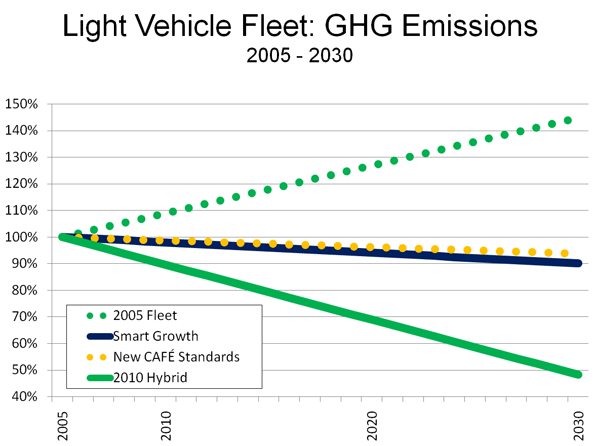
    This is illustrated by recent developments in automobile technology and research (Figure).

    • Before the adoption of the new 2020 and 2016 new car fuel economy standards, the US light vehicle fleet was on track to increase its greenhouse gas (GHG) emissions nearly 50% from 2005 to 2030 (the green dotted line in the figure).
    • As a result of the new fuel economy standards, Department of Energy projections indicate that greenhouse gas emissions from light vehicles will be one-third less by 2030 compared to the 2005 fleet (the yellow dotted line), and this is at the standard projected driving increase rates that could well be high.
    • The smart growth strategies of land rationing, densification and discouraging driving would produce, at best, a marginal reduction in GHG emissions, using the mid-point of the recent proponent research (Moving Cooler), indicated by the solid blue line. Actually, this overstates the impact of smart growth, since it discounts the substantial GHG emissions gains that result from higher fuel consumption in more congested traffic produced by densification.
    • The potential for technological advance is illustrated by the green solid line, which estimates the GHG emissions from light vehicles in 2030 if the average fuel economy were equal to today’s best hybrid technology.

    Overall auto-centered technology-based strategies – such as the improved fuel economy standards and the hybrid fuel economy – would each produce about 15 times as much benefit as the smart growth strategies proposed by such studies as Moving Cooler. This approach would not only be far more productive in terms of environmental improvement but would not require interfering with people’s lives in ways that would require longer trips times, less convenience, seriously retarded job access and, inevitably, fewer jobs and lower levels of economic growth.

    Technology: The Only Way

    It would be a mistake – and likely political folly – to force a re-engineering our way of life in order to enact strategies with dubious environmental benefits. In the final analysis, personal mobility must be retained and expanded, because there is no alternative that is acceptable to people, whatever system of government they happen to live under. Reinventing the Automobile paints the most optimistic picture to date and, if given due serious treatment, could prove a debate changer.

    Photograph: Manila suburbs

    Wendell Cox is a Visiting Professor, Conservatoire National des Arts et Metiers, Paris. He was born in Los Angeles and was appointed to three terms on the Los Angeles County Transportation Commission by Mayor Tom Bradley. He is the author of “War on the Dream: How Anti-Sprawl Policy Threatens the Quality of Life.