Tag: Environment

  • Protecting Cities in Fire-Prone Regions

    If you live in a fire-prone area, which includes most of California, it is not a good idea to allow ivy and other plants to cover the sides of your building, as this winery and this church did near Santa Rosa. Both were lost to last week’s wildfires.

    Similarly, if you are a legislator in a fire-prone state, it is not a good idea to outlaw fire-resistant developments. As now-retired Forest Service researcher Jack Cohen relates in the above video, one requirement for making your home fire-safe is to have no large flammable structures within 100 feet of the home. That pretty much means people should build on one-acre or larger lots.

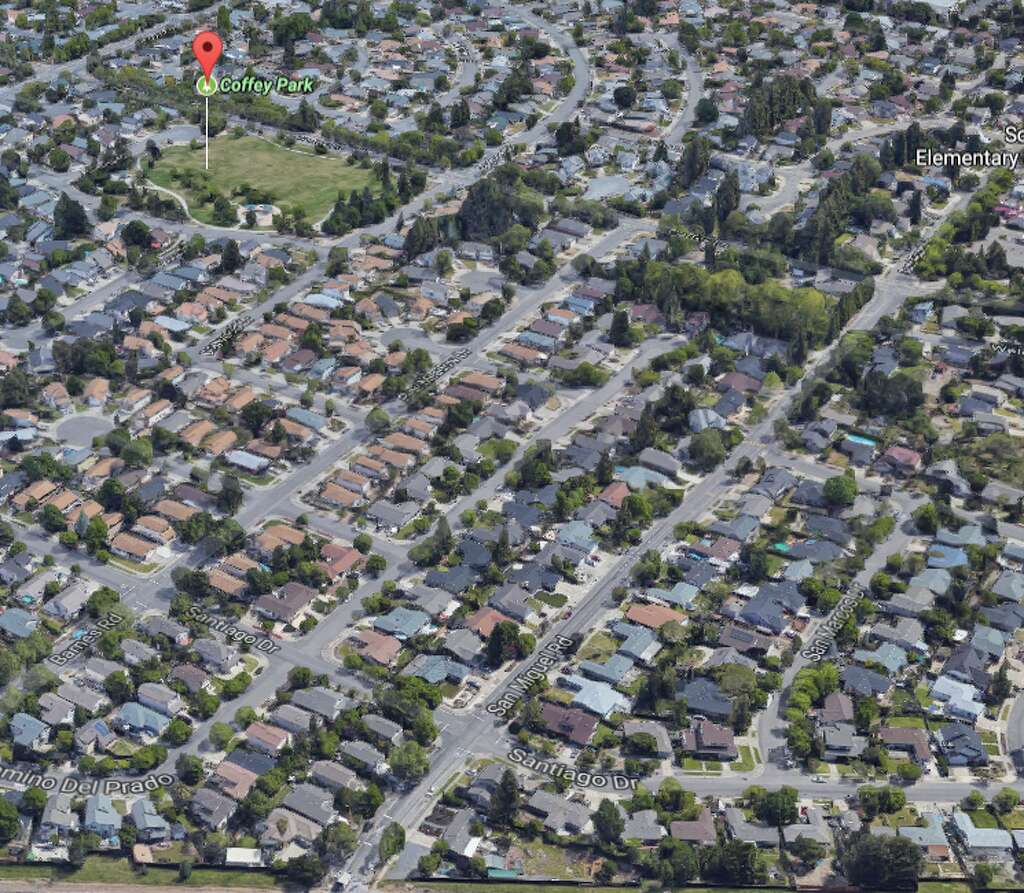
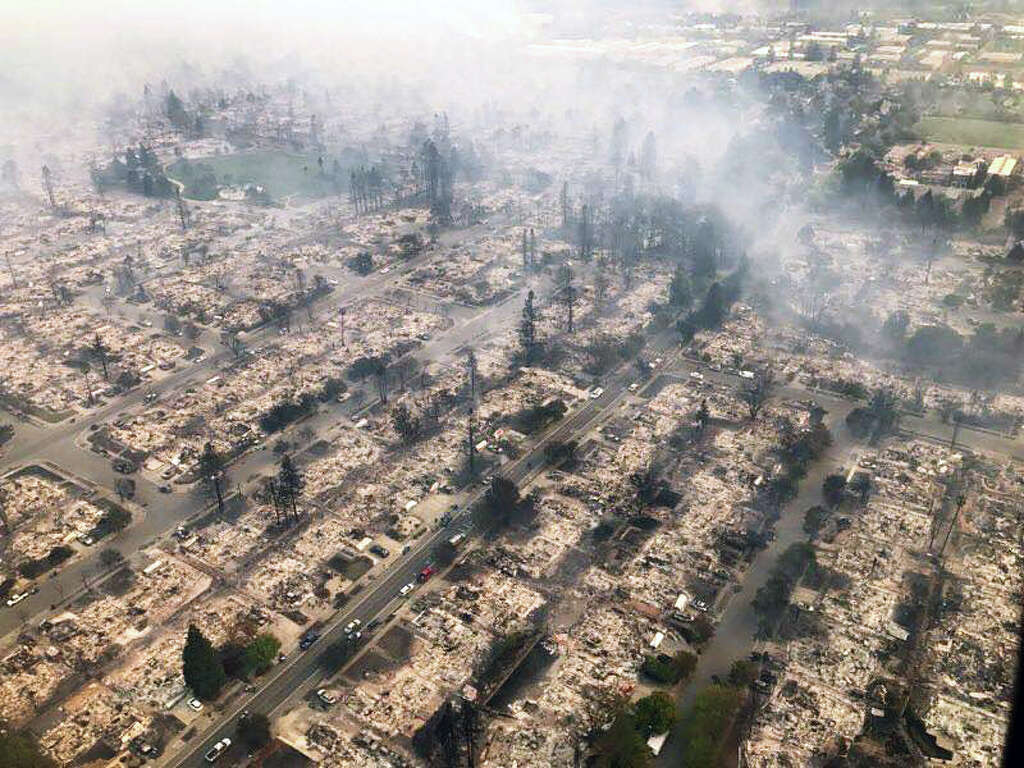
    But in California, the nation’s most fire-prone state, urban planners’ mania for density has led the legislature to effectively outlaw such low-density development. Santa Rosa’s Coffey Park neighborhood consisted of conventionally sized suburban homes on 50-by-100-foot lots–small for a modern suburb–resulting in many houses being only a few feet apart from one another. If one house caught fire during a dry spell, the intense radiant heat would be sure to set off the next home. As a result, the neighborhood is now a smoking ruin.

    As the Antiplanner noted a decade ago, California developers have built shelter-in-place neighborhoods that are so fire-resistant that it is safer for residents to stay in their homes than to evacuate. Wildfires have swept by these neighborhoods and not harmed a single home.

    Sadly, this technique has been criticized by even the California Department of Forestry, which argues that making homes fire-safe will just encourage people to live in fire-prone areas (meaning almost all of California). They suggested that people build their homes closer together to make them “easier to protect.” That didn’t work very well in Santa Rosa.

    If California had allowed urban areas to grow in the modern way, with density at the center and increasingly low densities at the edges, then a ring of low-density, shelter-in-place neighborhoods around Santa Rosa and other cities could have provided a fire break protecting the denser developments. But this is practically forbidden in California. So, we will get more disasters like the one in Santa Rosa and the 1991 Oakland Hills firestorm.

    This piece first appeared on The Antiplanner.

    Randal O’Toole is a senior fellow with the Cato Institute specializing in land use and transportation policy. He has written several books demonstrating the futility of government planning. Prior to working for Cato, he taught environmental economics at Yale, UC Berkeley, and Utah State University.

    Photo: Homes burned by a wildfire are seen, Oct. 11, 2017, in Santa Rosa, California via VOA News.

  • Oh, for those good days without fossil fuels!

    Maybe it’s time to start scaling back on our leisurely lifestyle to lower our greenhouse gas emissions and start reverting back to the pre-1900 horse and buggy days for our transportation systems, and the “snake oil” pitchmen for our healthcare system, and no medications, no cosmetics, no fertilizers, no computers nor IPhones, and shorter life spans. Our leisurely lifestyle has been driven by those “chemical ingredients” that are derived from the fossil fuels of oil, coal and natural gas that make all the “stuff” associated with our lifestyles, as they are NOT derived from nuclear electrical power, nor from intermittent electricity from solar panels and wind turbines.

    Looking back, the development of the internal combustion engine at the beginning of the 20th century, combined with the introduction of mass-produced affordable vehicles, got people moving on an unprecedented scale — and we haven’t looked back. Yes, it’s crude oil from which we have produced transportation fuels, but more importantly for civilization, it’s the related chemicals and by-products that have revolutionized our infrastructures and dramatically improved our quality of life and especially our leisurely lifestyle.

    The good news is that the chemicals and energy from fossil fuels have enabled us to cheaply build and run wondrous machines that give us the mobility to choose any particular climate and the ability to increase the livability of the climate, has made us safer and masters of climate from natural and man-made threats.

    The international aviation industry has been booming, with aviation fuel consumption more than double what it was 30 years ago in 1986. Worldwide, the consumption of jet fuels is astoundingly in excess of 225 MILLION gallons PER DAY to fly those huge aircrafts.

    Those huge cruise ships are consuming on average, 140-150 tons of fuel per day, which works out to roughly 30 to 50 gallons of fuel PER MILE !

    And by the way, it’s those two industries, the airlines and cruise ships, that were the catalyst to the hotel and theme park leisure industries that were not accessible in the horse and buggy times of our society.

    Complimentary to the international aviation and cruise industry are the billions of gallons of transportation fuels being consumed to get passengers back and forth from airports and the various ports, all in an effort to travel and see the beautiful cities and sites around the world, i.e., the tourism industry.

    The good news is that the fossil fuel industry has been the major contributor to industrialization, economic growth and the creation of jobs in all the infrastructure sectors and all the industries that are the basis of our lifestyle and economy, and technology continues to get ever better at minimizing and neutralizing the risks. The bad news is that we’re all getting older and sicker.

    Interestingly, a few side benefits associated with shorter life spans associated with those pre-1900 horse and buggy days would solve a few of our current financial problems:

    •   The unfunded liabilities of every city and state for those growing defined benefit retirement entitlement plans would be instantly solved by eliminating decades of retirement benefits per person.

    •   The single payer health care program to provide free health care for everyone may work be eliminating the exponential medical expenses associated with older folks.

    •   Social Security would never run out of funds by eliminating decades of payments per person.

    •   World population growth would be stagnated and relieve pressure on the world’s food supplies.

    Rather than reverting back to those good-old emission free days without fossil fuels when lives were dirty, smelly, difficult – and short, we should continue to efficiently utilize the elements from crude oil, coal, and natural gas that have provided all the “stuff” in our lifestyle, to improve the lifestyles of all those on this planet! In addition, we should also be augmenting electricity from intermittent renewables to operate all of our ”stuff” and gradually reduce the burning of our crude oil and coal.

    Ronald Stein is founder of PTS Staffing Solutions, a technical staffing agency headquartered in Irvine.

    Photo: Aero Icarus from Zürich, Switzerland (570dc) [CC BY-SA 2.0], via Wikimedia Commons

  • A Layman’s Guide To Houston After Harvey: Don’t Throw The Opportunity Baby Out With The Stormwater

    In the aftermath of Hurricane Harvey, and the disastrous flooding, Houston has come under extreme scrutiny. Some in the global, national as well as local media assaulted the area’s flood control system and its development model, criticisms that were echoed by some in the local area.

    Much of the current debate starts from a firm misunderstanding of the region’s realities. This could lead to policies that ultimately undermine the keys that have propelled the region’s success. Below is a primer to inform future discussions of Houston’s future trajectory.

    Click here to read more or download the full paper.

    Photo: Michael Coppens, via Flickr, using CC License.

  • How To Deal With An Age of Disasters

    When Hurricane Harvey flooded Houston, followed by a strong hurricane in Florida, much of the media response indicated that the severe weather was a sign of catastrophic climate change, payback for mass suburbanization — and even a backlash by Mother Nature against the election of President Donald Trump.

    Yet, these assumptions are often exaggerated. Although climate change could well worsen these incidents, this recent surge of hurricanes followed a decade of relative quiescence. Hurricanes, like droughts and heavy rains, are part of the reality along the Gulf Coast and the South Atlantic, just as droughts and earthquakes plague those of us who live in Southern California.

    The best response to disasters is not to advance hysterical claims about impending doom, but rather resilience. This means placing primary attention on bolstering our defenses against catastrophic events, whether in protecting against floods, ice storms, earthquakes or droughts.

    The limits of original sin

    Days after Hurricane Harvey hit, Quartz opined that “Houston’s flooding shows what happens when you ignore science and let developers run rampant.” The Guardian’s climate columnist, George Monbiot, even portrayed the event as a kind of payback for being the world capital of planet-destroying climate change.

    In ascribing every disaster — even the Syrian civil war — to human-caused warming, we may be venturing into something more akin to the religious notion of original sin than to rational science. We should want to reduce greenhouse gases, but, as both rational skeptics like Bjorn Lomborg and true believers like NASA’s James Hansen agree, such things as the Paris climate accord are unlikely to make much of an impact on the actual climate in the near term — or even in the medium term.

    In the short run, then, who sits in the White House is pretty irrelevant. Having Barack Obama, or even Bill Nye, the “Science Guy,” in the White House would not make an appreciable difference in addressing nature’s fury.

    Read the entire piece at The Orange County Register.

    Joel Kotkin is executive editor of NewGeography.com. He is the Roger Hobbs Distinguished Fellow in Urban Studies at Chapman University and executive director of the Houston-based Center for Opportunity Urbanism. His newest book is The Human City: Urbanism for the rest of us. He is also author of The New Class ConflictThe City: A Global History, and The Next Hundred Million: America in 2050. He lives in Orange County, CA.

    Photo: Jill Carlson (jillcarlson.org) from Roman Forest, Texas, USA (Hurricane Harvey Flooding and Damage) [CC BY 2.0], via Wikimedia Commons

  • What’s the Future of Beleaguered Fossil Fuels Industry?

    Perhaps no economic issue — even trade — is as divisive as the energy industry. Once a standard driver of economic progress, the conventional energy industry has become increasingly vilified by the national media, sued by blue state attorneys general and denounced throughout academia. Some suggest that the industry should be demonized and hounded much as occurred in the case of tobacco.

    Yet, is this attack entirely justified? Unlike tobacco, energy is a huge economic driver, and conventional fossil fuel industries employ roughly 2 million people nationally, while hosts of industries — notably agriculture, manufacturing and warehousing — depend on reasonable energy prices and consistent delivery. Overall, fossil fuels last year accounted for 81 percent of all U.S. energy consumption.

    The one great exception is California, long a major oil-producing state, where fossil fuels are about as popular as herpes. In order to enhance its obsession with promoting climate “leadership” — likely to reduce emissions globally by a mere 0.4 percent by 2030 — the state has declared war on this industry, even though most Californians still depend on the gooey stuff, particularly for transportation. Once, we produced a lot of fossil fuel, but now we import a majority of it from abroad, taking an economic asset and turning it into a permanent deficit.

    Doom or future boom?

    In the past, advocates for “green energy” tied their agenda to concerns over “peak oil,” suggesting that renewables will save us from dependence on an increasingly scarce resource. More recently, given the huge increase in U.S. energy production, the argument has shifted to the notion that there’s too much oil, and that prices will not support the industry.

    Others suggest that the industry be undermined for environmental reasons. Yet, the reality is that most advanced countries — and developing countries even more so — depend heavily on coal, oil and gas. Some of these countries, like China, talk a good game, but continue to construct ever more coal plants, seek to buy more oil, including from the United States, and nurture an expanding automobile sector.

    Seeing the demand, frackers and offshore drillers have reason to stay in the game. Indeed, according to some projections, an improving global economy and a decline in production from the energy bust will drive prices up, perhaps to well over $100 a barrel, within the next three years.

    Prospects for energy-related development have been improved by the ascendency of the Trump administration, which has a strong fossil fuel constituency. Energy Secretary and former Texas Gov. Rick Perry wants to make the U.S. “dominant” in the global energy market. Increasing U.S. energy production also plays an important geopolitical role in challenging the power of global menaces such as Russia, Saudi Arabia, Iran and Venezuela.

    Read the entire piece at The Orange County Register.

    Joel Kotkin is executive editor of NewGeography.com. He is the Roger Hobbs Distinguished Fellow in Urban Studies at Chapman University and executive director of the Houston-based Center for Opportunity Urbanism. His newest book is The Human City: Urbanism for the rest of us. He is also author of The New Class ConflictThe City: A Global History, and The Next Hundred Million: America in 2050. He lives in Orange County, CA.

    Photo by Downtowngal (Own work) [CC BY-SA 3.0], via Wikimedia Commons

  • Why the Greens Lost, and Trump Won

    When President Trump pulled out of the Paris climate accords, embraced coal, and stacked his administration from people from fossil-fuel producing states, the environmental movement reacted with near-apocalyptic fear and fury. They would have been better off beginning to understand precisely why the country has become so indifferent to their cause, as evidenced by the victory not only of Trump but of unsympathetic Republicans at every level of government.

    Yet there’s been little soul-searching among green activists and donors, or in the generally pliant media since November about how decades of exaggerated concerns—about peak oil, the “population bomb,” and even, a few decades back, global cooling—and demands for economic, social, and political sacrifices from the masses have damaged their movement.

    The New Religion and the Next Autocracy

    Not long ago, many greens still embraced pragmatic solutions—for example substituting abundant natural gas for coal—that have generated large reductions in greenhouse gas emissions. Rather than celebrate those demonstrable successes, many environmentalists began pushing for a total ban on the development of fossil fuels, including natural gas, irrespective of the costs or the impact on ordinary people.

    James Lovelock, who coined the term “Gaia,” notes that the green movement has morphed into “a religion” sometimes marginally tethered to reality. Rather than engage in vigorous debate, they insist that the “science is settled” meaning not only what the challenges are but also the only acceptable solutions to them. There’s about as much openness about goals and methods within the green lobby today as there was questioning the existence of God in Medieval Europe. With the Judeo-Christian and Asian belief systems in decline, particularly among the young, environmentalism offers “science” as the basis of a new theology.

    The believers at times seem more concerned in demonstrating their faith than in passing laws, winning elections or demonstrating results. So with Republicans controlling the federal government, greens are cheering Democratic state attorney generals’ long-shot legal cases against oil companies. The New York TimesThomas Friedman has talked about dismissing the disorder of democracy as not suited to meeting the environmental challenges we face, and replacing it with rulers like the “reasonably enlightened group of people” who run the Chinese dictatorship.

    After Trump pulled the U.S. out of the Paris climate accord, China was praised, bizarrely, as the great green hope. The Middle Kingdom, though, is the world’s biggest and fastest grower emitter, generating coal energy at record levels. It won’t, under Paris, need to cut its emissions till 2030. Largely ignored is the fact that America, due largely to natural gas replacing coal, has been leading the world in GHG reductions.

    Among many greens, and their supports, performance seems to mean less than proper genuflecting; the Paris accords, so beloved by the green establishment, will make little impact on the actual climate, as both rational skeptics like Bjorn Lomborg and true believers like NASA’s James Hanson agree. In this context, support for Paris represents the ultimate in “virtue signaling.” Ave Maria, Gaia.

    The California Model

    The cutting edge for green soft authoritarianism, and likely model after the inevitable collapse of the Trump regime, lies in California. On his recent trip with China, Brown fervently kowtowed to President Xi Jinping. Brown’s environmental obsessions also seems to have let loose his own inner authoritarian, as when he recently touted “the coercive power of the state.”

    Coercion has its consequences. California has imposed, largely in the name of climate change, severe land use controls that have helped make the state among the most unaffordable in the nation, driving homeownership rates to the lowest levels since the 1940s, and leaving the Golden State with the nation’s highest poverty rate.

    The biggest losers from Brown’s policies have been traditional blue collar, energy-intensive industries such as home building, manufacturing, and energy. Brown’s climate policies have boosted energy prices and made gas in oil-rich California about the most expensive in the nation. That doesn’t mean much to the affluent Tesla-driving living in the state’s more temperate coast, but it’s forced many poor and middle-class people in the state’s less temperate interior into “energy poverty,” according to one recent study.

    That, too, fits the climatista’s agenda, which revolves around social engineering designed to shift people from predominately suburban environments to dense, urban and transit dependent ones. The state’s crowded freeway are not be expanded due to a mandated “road diet,” while local officials repeatedly seek to reduce lanes and “calm traffic” on what are already agonizing congested streets. In this shift, market forces and consumer preferences are rarely considered, one reason these policies have stimulated much local opposition—and not only from the state’s few remaining conservatives.

    California’s greens ambitions even extend to eating habits. Brown has already assaulted the beef producers for their cattle’s flatulence. Regulators in the Bay Area and local environmental activists are proposing people shift to meatless meals. Green lobbyists have already convinced some Oakland school districts to take meat off the menu. OK with me, if I get the hamburger or taco-truck franchise next to school when the kids get out.

    Sadly, many of these often socially harmful policies may do very little to address the problem associated with climate change. California’s draconian policies fail to actually do anything for the actual climate, given the state’s already low carbon footprint and the impact of people and firms moving to places where generally they expand their carbon footprint. Much of this has taken on the character of a passion play that shows how California is leading us to the green millennium.

    Goodbye to the Family

    An even bigger ambition of the green movement—reflecting concerns from its earliest days—has been to reduce the number of children, particularly in developed countries. Grist’s Lisa Hymas has suggested that it’s better to have babies in Bangladesh than America because they don’t end up creating as many emissions as their more fortunate counterparts. Hymas’ ideal is to have people become GINKs—green inclinations, no kids.

    Many green activists argue that birth rates need to be driven down so warming will not “fry” the planet. Genial Bill Nye, science guy, has raised the idea of enforced limits on producing children in high-income countries. This seems odd since the U.S. already is experiencing record-low fertility rates, a phenomenon in almost all advanced economies, with some falling to as little as half the “replacement rate” needed to maintain the current population. In these countries, aging populations and shrinking workforces may mean government defaults over the coming decades.

    The demographic shift, hailed and promoted by greens, is also creating a kind of post-familial politics. Like Jerry Brown himself, many European leaders—in France, Germany, Sweden, the United Kingdom, and the Netherlands—are themselves childless. Their attitude, enshrined in a EU document as “no kids, no problem” represents a breathtaking shift in human affairs; it’s one thing to talk a good game about protecting the “next generation” in the collective abstract, another to experience being personally responsible for the future of another, initially helpless, human being.

    Do As We Say, Not How We Live

    The pressing need to change people’s lives seems intrinsic now to green theology. Without penance and penalties, after all, there is no redemption from original sin. In the process, it seems to matter little if we undermine the great achievements of our bourgeois economy—expanded homeownership, greater personal mobility, the ability to rise to a higher class—if it signals our commitment to achieve a more earth-friendly existence.

    The left-wing theorist Jedidiah Purdy has noted that “mainstream environmentalism overemphasizes elite advocacy” at the expense of issues of economic equity, a weakness that both Trump and the GOP have exploited successfully, particularly in the Midwest, the South, and Intermountain West. Some greens object even to the idea of GDP growth at a time when most Americans are seeing their standard of living drop. No surprise then that the green agenda has yet to emerge from the basement of public priorities, which remain focused on such mundanities as better jobs, public safety, and decent housing.

    To further alienate voters, many green scolds live far more lavishly than the people they are urging to cut back. Greens have won over a good portion of the corporate elite, many of whom see profit in the transformation as they reap subsidies for “green” energy, expensive and often ineffective transit and exorbitant high-density housing. Most notable are the tech oligarchs, clustered in ultra-green Seattle and the Bay Area, who depend on massive amounts of electricity to run their devices, but have reaped huge subsidies for green energy.

    The tech oligarchs have little interest in family friendly suburbs, preferring the model of prolonged adolescence in largely childless places like college campuses and San Francisco. Oligarchs such as Mark Zuckerberg live in spacious and numerous houses, even while pressing policies that would push everyone without such a fortune to downsize. Richard Branson, another prominent green supporter, may not like working people’s SUVs, but he’s more than willing to sponsor climate change events on a remote Caribbean island reachable only by private plane. One does not even need to plumb the hypocrisy of Al Gore’s jet-setting luxurious lifestyle.

    In the manner of Medieval indulgences these mega emissions-generators claim to pay for their carbon sins by activism, buying rain forests and other noble gestures. Hollywood, as usual, is particularly absurd, with people like Leonardo di Caprio flying in his private jet across country on a weekly basis. Living in Malibu, Avatar director James Cameron sees skeptics as “boneheads” who will have “to be answerable” for their dissidence, suggesting perhaps a shootout at high noon.

    In the end, the greens and their wealthy bankrollers may find it difficult to prevail as long as their agenda makes people poorer, more subservient, and more miserable; this disconnect is, in part, why the awful Donald Trump is now in the White House. Making progress on climate change, and other environmental concerns, remains a critical priority, but it needs to explore ways humans, through ingenuity and innovation, can meet these challenges without undermining what’s left of our middle class and faded democratic virtue.

    This piece originally appeared on the Daily Beast.

    Joel Kotkin is executive editor of NewGeography.com. He is the Roger Hobbs Distinguished Fellow in Urban Studies at Chapman University and executive director of the Houston-based Center for Opportunity Urbanism. His newest book is The Human City: Urbanism for the rest of us. He is also author of The New Class ConflictThe City: A Global History, and The Next Hundred Million: America in 2050. He lives in Orange County, CA.

    Photo by Joe Flood, via Flickr, using CC License.

  • High-Flying California Charts Its Own Path — Is A Cliff Ahead?

    As its economy bounced back from the Great Recession, California emerged as a progressive role model, with New York Times columnist Paul Krugman arguing that the state’s “success” was proof of the superiority of a high tax, high regulation economy. Some have even embraced the notion that California should secede to form its own more perfect union.

    Pumped up by all the love, California’s leaders have taken it upon themselves to act essentially as if they were running their own nation. In reaction to President Trump’s abandonment of the Paris accords, Gov. Jerry Brown trekked to Beijing to show climate solidarity with President Xi, whose country is by far the world’s largest greenhouse gas emitter and still burns coal at record rates, but mouths all the right climate rhetoric.

    At the same time California’s Attorney General is spending millions to protect undocumented workers and there’s legislation being proposed to transform the entire place into a “sanctuary state.” Sacramento also recently banned travel by government workers to Texas and seven other states that fail to follow the California line on gay and transgender rights.

    Past performance and future trajectory

    When progressive journalists, including those in Texas, speak about the California model, they usually refer to the state’s economic performance since 2010, which has been well above the national average. Yet this may have been only an aberrant phenomenon. Since 2010, Texas’ job count has grown by 20.6 percent compared to 18.6 percent for California. If you pull the curtain even further, to 2000, however, the gap is even bigger, with employment growing 32.7 percent in Texas compared to 18 percent in California.

    The main problem is that California’s once remarkably varied and vital economy has become dangerously dependent on the Bay Area tech boom. Since 2010, the Silicon Valley-San Jose economy and San Francisco have been on a tear, growing their employment base by 25 percent. Job growth in the rest of the state has been a more modest 15 percent. “It’s not a California miracle, but really should be called a Silicon Valley miracle,” notes Chapman University forecaster Jim Doti. “The rest of the state really isn’t doing well.”

    Tech starts to slow

    Such dependency poses dangers. The tech economy is very volatile, and now seems overdue for a major correction. People tend to forget the depth of the tech bust at the turn of the century. If you go back to 2000, San Jose’s job growth rate is among the lowest in the state, less than half the state average.

    Now tech is clearly slowing – job growth in the information sector has slowed over the past year from almost 10 percent to under 2 percent. Particularly hard-hit is high-tech startup formation, down almost half in the first quarter from two years ago; the National Venture Capital Association reported that the number of deals in the quarter was the lowest since the third quarter of 2010.

    The growing hegemony of a few very large firms – chiefly Apple, Google and Facebook — has created a very difficult environment for upstarts. As one recent paper demonstrates, these “super platforms” depress competition, squeeze suppliers and reduce opportunities for potential rivals, much as the monopolists of the late 19th century did.

    And as we found in our recent survey of the hot spots for high wage professional business services jobs, last year’s growth rates for this critical middle class sector in Silicon Valley and San Francisco lagged considerably behind those of boomtowns such as Nashville, Dallas, Austin, Orlando, San Antonio, Salt Lake City and Charlotte. Most other California metro areas, including Los Angeles, have languished in the bottom half of the rankings. These trends suggest that the state’s job performance will at least drop to the national average over the next two years and perhaps below, says California Lutheran University forecaster Matthew Fienup.

    Rising inequality

    California is home to a large chunk of the world’s richest people and particularly dominates the list of billionaires under 40. Yet, by one new measure introduced by the Census Bureau last year, the state also suffers the nation’s highest poverty rate; while a 2015 United Way study found that close to one in three Californians were barely able to pay their bills. No surprise then that as of 2015, the state was the most unequal in the nation, according to the Social Science Research Council.

    As of 2011, nearly half of the 16 counties with the highest percentages of people earning over $190,000 annually were located in California but denizens of the state’s interior have done far worse. A 2015 report found California was home to a remarkable 77 of the country’s 297 most “economically challenged,” cities based on levels of poverty and employment. Altogether these cities had a population of more than 12 million in 2010, roughly one third of the state at the time. Six of the ten metropolitan areas in the country with the highest percentage of jobless are located in the central and eastern parts of the state.

    What is disappearing faster than any state, according to a survey last year, is California’s middle class, a pattern also seen in a recent Pew study. One clear sign of middle class decline: California’s homeownership rates now rank among the lowest in the nation and Los Angeles-Orange County, the state’s largest metropolitan area, suffers the lowest level of homeownership of any major region.

    Jerry’s Jihad and its consequences

    State policies tied to Jerry Brown’s climate jihad have widened these divides. Inland Empire economist John Husing asserts that Brown has placed California “at war“ with blue-collar industries like home building, energy, agriculture and manufacturing. These jobs are critical for regions where almost half the workforce has a high school education or less.

    Richard Chapman, President and CEO of the economic development arm of Kern County, an area dependent on these industries, complains that most polices promulgated in Sacramento — from water and energy regulations to the embrace of sanctuary status and a $15 an hour minimum wage — give little consideration given to the needs of the interior. “We don’t have seats at the table,” he laments. “We are a flyover state within a state.”

    The recent legislation to raise the minimum wage to $15 an hour will have more severe ramifications for less affluent areas than San Francisco. As for climate policies, the state no longer even assesses the economic implications. Yet the state’s costly renewable energy mandates make a lot of difference in the less temperate interior when energy prices are 50 percent rise above neighboring states. A recent study found that the average summer electric bill in rich, liberal and temperate Marin County was $250 a month, while in the impoverished, hotter Central Valley communities, where air conditioners are a necessity, the average bill was twice as high. Some one million Californians, many in the state’s hotter interior, were driven into “energy poverty,” a 2012 Manhattan Institute study stated.

    Housing has arguably emerged as the biggest force accentuating inequality. Environmental restrictions that have cramped home production of all kinds, particularly the building of affordable single-family homes on the periphery. The ever increasing restrictions have made the state among the most unaffordable in the nation, driving homeownership rates to the lowest levels since the 1940s. New “zero emissions” housing policies alone are likely to boost the already bloated cost of new construction by tens of thousands of dollars per home.

    Demographic crisis looms

    In much of California, particularly along the south coast, the number of children has dropped sharply. Since 2000, there has been a precipitous 13.6 percent drop in the number of residents under 17 in Los Angeles, while that number has remained flat in the Bay Area. In contrast, there has been 20 percent growth or better in the under 17 population in more affordable metropolitan areas such as Dallas-Fort Worth, Atlanta, Charlotte, Raleigh, Phoenix and San Antonio.

    Housing prices, in part driven by state and regional regulation, are gradually sending the seed corn — younger workers — to more affordable places. Despite claims that people leaving California are old and poor, the two most recent year’s data from the IRS shows larger net losses of people in the 35 to 54 age group. Losses were particularly marked among those making between $100,000 and $200,000 annually.

    Young people particularly are on the way out. California boomers, as we discussed in a recent Chapman University report, have a homeownership rate around the national average but the state has the third lowest home ownership rate in the nation for people 25 to 34, behind just New York and Washington. The drop among this demographic in San Jose and the Los Angeles areas since 1990 are roughly twice the national average and a recent San Jose Mercury News poll found nearly half of all Bay Area millennials planning to move, mostly motivated by housing and costs. The one population on the upswing in the state are seniors, particularly in the coastal countries, who bought their homes when they were much less expensive.

    As long as home prices stay high, and opportunities for high-wage employment highly limited, the state will continue to suffer net domestic migration outflows, as it has for the last 22 of the past 25 years. Given that the state’s birthrate is also at a historic low and immigration from abroad has slowed, there’s a looming shortage of new workers. Between 2013 and 2025 the number of California high school graduates is expected to drop by 5 percent compared to a 19 percent increase in Texas, 10 percent growth in Florida and a 9 percent increase in North Carolina.

    And for what?

    Of course, many environmental activists generally prefer smaller families to cut greenhouse gas emissions; smaller families also serve the needs of developers of high-density housing, who might prefer that younger people remain long-term adolescents.

    Sadly, many of these climate policies, which cause so much damage, won’t have much of an impact on the actual climate unless the rest of the country adopts similar measures. This stems from the state’s already low carbon footprint and the impact of people as well as firms moving elsewhere, where they usually expand their carbon footprint. Nor does densification make sense as a climate antidote, given the rising temperatures associated with “urban heat islands.”

    The tech boom has been used to justify Sacramento’s crushing regulatory and tax regime. It has also made it possible for apologists to ignore some 10,000 businesses that have left or expanded outside the state, many of them employing middle and working class people.

    Ultimately California’s growing class bifurcation will demand solutions. Hedge fund billionaire-turned green patriarch Tom Steyer now insists that, to reverse our worsening inequality, we should double down on environmental and land use regulation but make up for it by boosting subsidies for the struggling poor and middle class. Certainly the welfare state in California — home to over 30 percent of United States’ on public assistance as of 2012 — will have to expand if the state stays on its present course.

    In the coming years the state’s business leaders fear an ever more leftist, and fiscally damaging, regime after the departure of the somewhat frugal Brown. There are increased calls in Sacramento for new subsidized housing, a single payer healthcare system as well as a big boost to the minimum wage already enacted.

    Ultimately California will pay — demographically, economically and socially — from its current surfeit of good intentions. Those who already own houses will not suffer immediately, but the new generation, immigrants and minorities will face an increasingly impossible burden. With its unparalleled natural assets, and economic legacy, California may be able to survive this toxic policy mix better than most places, but even in the Golden State reality has a way of showing its ugly face.

    This piece originally appeared on Forbes.

    Joel Kotkin is executive editor of NewGeography.com. He is the Roger Hobbs Distinguished Fellow in Urban Studies at Chapman University and executive director of the Houston-based Center for Opportunity Urbanism. His newest book is The Human City: Urbanism for the rest of us. He is also author of The New Class ConflictThe City: A Global History, and The Next Hundred Million: America in 2050. He lives in Orange County, CA.

    Photo by Neon Tommy, via Flickr, using CC License.
  • Want to be Green? Forget Mass Transit. Work at Home.

    Expanding mass-transit systems is a pillar of green and “new urbanist” thinking, but with few exceptions, the idea of ever-larger numbers of people commuting into an urban core ignores a major shift in the labor economy: More people are working from home.

    True, in a handful of large metropolitan regions — what we might call “legacy cities” — trains and buses remain essential. This is particularly true of New York, which accounts for a remarkable 43% of the nation’s mass-transit commuters, and of other venerable cities, such as San Francisco, Washington, Boston, Philadelphia and Chicago. Together, these metros account for 56% of all mass-transit commuting. But for most of the rest of the country, transit use — despite often-massive infrastructure investment — has either stagnated or declined. Among the 21 metropolitan areas that have opened substantially new urban-rail systems since 1970, mass transit’s share of work trips has declined, on average, from 5.3% to 5%. During the same period, the drive-alone share of work trips, notes demographer Wendell Cox, has gone up from 71.9% to 76.1%.

    Meantime, the proportion of the labor force working from home continues to grow. In 1980, 2.3% of workers performed their duties primarily at home; by 2015, this figure had doubled to 4.6%, only slightly behind the proportion of people who commute via mass transit. In legacy core-metropolitan statistical areas (MSAs), the number of people working from home is not quite half that of those commuting by transit. In the 47 MSAs without legacy cores, according to the American Community Survey, the number of people working from home was nearly 250% higher than people going to work on trains or buses.

    In the greater Los Angeles area, roughly 1.5% of people worked from home in 1980; today about 5% do. Meanwhile, despite significant expenditures, the share of people using mass transit went from slightly over 5% to slightly less than 5%.

    The areas with the thickest presence of telecommuters — including cities such as Austin, Raleigh-Durham, San Diego, Denver, and Seattle — tend to have the greatest concentration of tech-related industries, which function well with off-site workers. In San Jose, the epicenter of the nation’s tech industry, 4.6% of people work from home, exceeding the 3.4% who take mass transit. Other telecommuting hot spots include college towns like Boulder, where over 11.6% of workers work from home, and Berkeley, where the share is 10.6%.

    Leading telecommuting centers tend to be home to many well-educated, older and wealthy residents. Communities such as San Clemente, Newport Beach and Encinitas in Southern California, as well as Boca Raton in Florida, all have telecommuting shares over 10%. Perhaps older, well-connected people are more inclined to avoid miserable commutes, given the chance to do so. As the American population skews older, the economy will likely see more workers making such choices.

    Another important demographic force contributing to the work-from-home inclination is Americans’ continuing move to lower-density cities, which usually lack effective transit, and to the suburbs and exurbs — where 81% of job growth occurred between 2010 and 2014. While most metropolitan regions can be called “polycentric,” they are actually better described as “dispersed,” with central business districts (CBDs) and suburban centers (subcenters) now accounting for only a minority of employment. By 2000, more than three-quarters of all employment in metropolitan areas with populations higher than 1 million was outside CBDs and subcenters.

    Home-based work could be the logical extension of this dispersal — and modern technologies, from ride-sharing services to automated cars, will probably accelerate the trend. A recent report by the global consulting firm Bain suggested that greater decentralization is likely in the coming decades. A 2015 National League of Cities report observes that traditional nine-to-five jobs are on the decline and that many white-collar jobs will involve office-sharing and telecommuting in the future. The report also predicts that more workers will act as “contractors,” taking on multiple positions at once.

    Some see these developments as ominous, but greens and urbanists shouldn’t: Telecommuting will, among other things, reduce pollution. It may be that the shift to home-based work will prove the ultimate in mixed use — albeit for workers in their pajamas.

    This piece originally appeared on the Los Angeles Times.

    Joel Kotkin is executive editor of NewGeography.com. He is the Roger Hobbs Distinguished Fellow in Urban Studies at Chapman University and executive director of the Houston-based Center for Opportunity Urbanism. His newest book is The Human City: Urbanism for the rest of us. He is also author of The New Class ConflictThe City: A Global History, and The Next Hundred Million: America in 2050. He lives in Orange County, CA.

    Photo from Picjumbo.

  • California’s Descent to Socialism

    California is widely celebrated as the fount of technical, cultural and political innovation. Now we seem primed to outdo even ourselves, creating a new kind of socialism that, in the end, more resembles feudalism than social democracy.

    The new consensus is being pushed by, among others, hedge-fund-billionaire-turned-green-patriarch Tom Steyer. The financier now insists that, to reverse our worsening inequality, we must double down on environmental and land-use regulation, and make up for it by boosting subsidies for the struggling poor and middle class. This new progressive synthesis promises not upward mobility and independence, but rather the prospect of turning most Californians into either tax slaves or dependent serfs.

    California’s progressive regime of severe land-use controls has helped to make the state among the most unaffordable in the nation, driving homeownership rates to the lowest levels since the 1940s. It has also spurred a steady hegira of middle-aged, middle-class families — the kind of tax-burdened people Gov. Jerry Brown now denounces as “freeloaders” — from the state. They may have access to smartphones and virtual reality, but the increasingly propertyless masses seem destined to live in the kind of cramped conditions that their parents and grandparents had escaped decades earlier.

    A green people’s republic?

    There is some irony in a new kind of socialism blessed by some of the world’s richest people. The new policy framework is driven, in large part, by a desire to assume world leadership on climate-related issues. The biggest losers will be manufacturing, energy and homebuilding workers, who will see their jobs headed to other states and countries.

    Under the new socialism, expect more controls over the agribusiness sector, notably the cattle industry, California’s original boom industry, which will be punished for its cows’ flatulence. Limits on building in the periphery of cities also threaten future growth in construction employment, once the new regulations are fully in place.

    Sadly, these steps don’t actually do anything for the climate, given the state’s already low carbon footprint and the fact that the people and firms driven out of the state tend to simply expand their carbon footprints elsewhere in their new homes. But effectiveness is not the motivation here. Instead, “combating climate change” has become an opportunity for Brown, Steyer and the Sacramento bureaucracy to perform a passion play, where they preen as saviors of the planet, with the unlikable President Donald Trump playing his role as the devil incarnate. In following with this line of reasoning, Bay Area officials and environmental activists are even proposing a campaign to promote meatless meals. It’s Gaia meets Lent.

    Read the entire piece at The Orange County Register.

    Joel Kotkin is executive editor of NewGeography.com. He is the Roger Hobbs Distinguished Fellow in Urban Studies at Chapman University and executive director of the Houston-based Center for Opportunity Urbanism. His newest book is The Human City: Urbanism for the rest of us. He is also author of The New Class ConflictThe City: A Global History, and The Next Hundred Million: America in 2050. He lives in Orange County, CA.

    Photo by Fortune Live Media, via Flickr, using CC License.

  • Driving Alone Hits High, Transit Hits Low in “Post-Car” City of Los Angeles

    According to The New York Times, the car used to be “king” in the city (municipality) of Los Angeles. “’A Different Los Angeles’, The City Moves to Alter its Sprawling Image,” was another story that seeks to portray the nation’s second largest municipality as having fundamentally changed. Following this now popular meme, a Slate story in 2016 referred to Los Angeles becoming “America’s next great transit city.” Los Angeles has surely become America’s greatest transit tax city, with Los Angeles County voters in 2016 approving a fourth half-cent sales tax increase principally for transit since 1980. Yet transit’s market share has fallen, not only in the nation’s largest county but even in the city of Los Angeles.

    The Ascent of Transit: A False Narrative

    The Los Angeles political establishment and media is virtually unanimous in its praise for the now quarter century old rail system. Yet, despite more than $15 billion being spent on rail transit the already meager levels of transit commuting in the city have fallen further, while solo driving has risen to an all time high. Unless platitudes are more important than results, rail’s success is a false narrative. People are driving more and using transit less according to the American Community Survey for 2015.

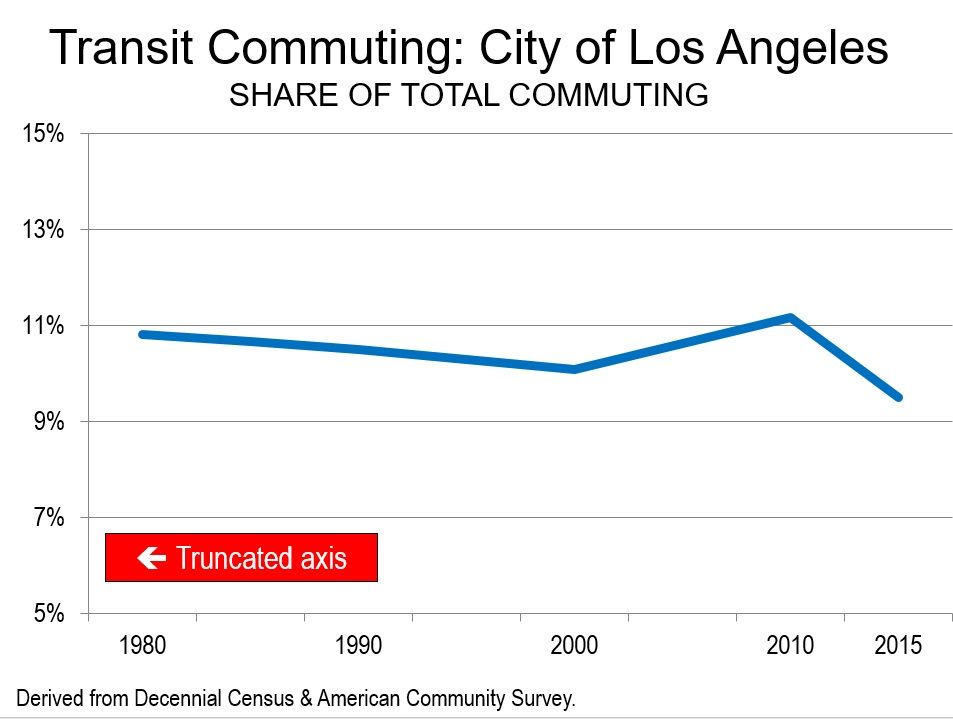
    The share of city of Los Angeles residents commuting by transit fell from 11.2 percent in 2010 to 9.5 percent in 2015 (Figure 1, note truncated axis). The 2010 figure was the highest decennial census year transit figure in the period starting in 1980. Just five years later, in 2015, however, the city of Los Angeles transit commuting share had fallen below 1980 levels.

    In 1980, 10.8 percent of the city’s commuters used transit, a figure that fell to 10.5 percent just before the initial Long Beach “Blue Line” opened in 1990. While new light rail lines and the Metro (subway) line opened after 1990, transit’s market share fell further, to 10.1 percent by 2010. During the 2000s, transit commuting rose 1.1 percentage points to the 11.2 percent figure, propelled by unprecedented gasoline price increases. But progress was short-lived as the share dropped to 9.5 percent in 2015.

    City of Los Angeles Surge in Driving Alone

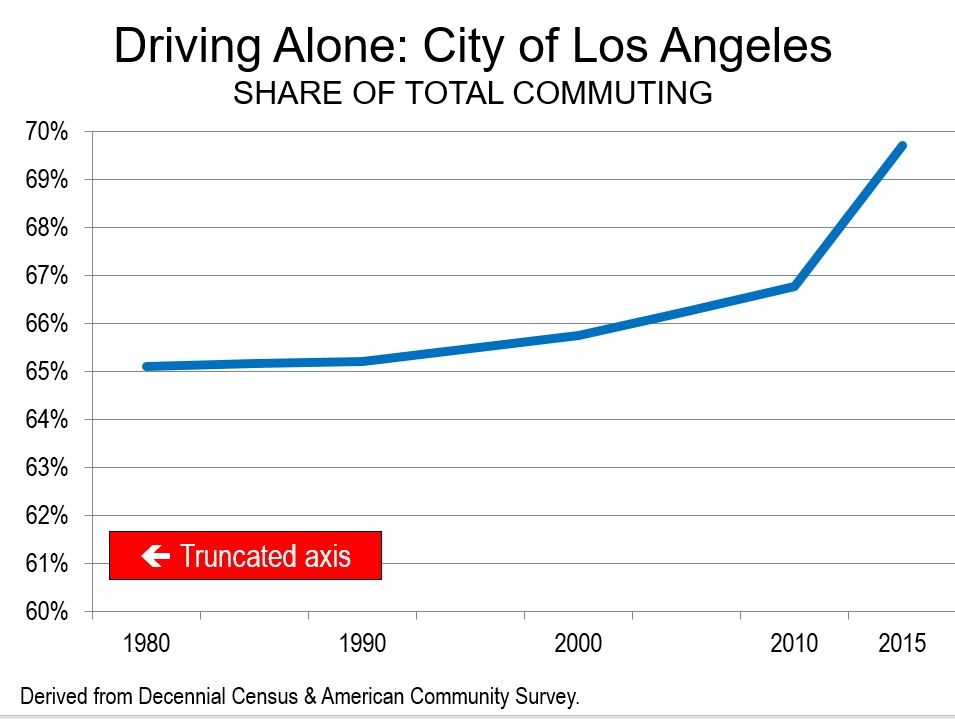
    At the same time, commuters were turning even more to driving alone. In 2015, 69.8 percent of work trip access was by solo drivers. This represents a substantial increase from the 66.8 percent drive alone share in 2010. From 1980 to 2010, driving alone edged up slightly, much less than the increase in the last five years. In 1980, 65.1 percent of commuters drove alone. In 1990, a nearly identical 65.2 percent drove alone. In the last five years, driving alone has risen more than the entire previous 30-year increase in the city of Los Angeles.

    The news could get worse. According to new American Public Transportation (APTA) data, total ridership on all Los Angeles County MTA services dropped more than five percent from 2016. The APTA reported decline is astounding, since the highly touted extension of the Expo light rail line to downtown Santa Monica opened in 2016. Even more astounding is that the expensive, at least seven line (counted at radial line ends plus the transverse Green Line) system has added not a soul to transit ridership on the Los Angeles MTA bus and rail system since 1985. Not all MTA service is in the city of Los Angeles, however, the APTA data could presage a further transit market share decline in the city with the American Community Survey data due in the Autumn.

    All of this is consistent with the larger trend in the Los Angeles metropolitan area (which includes Los Angeles and Orange Counties). Overall, the transit work trip market share in the metropolitan area fell from 6.1 percent in 2010 to 5.1 percent in 2015. The MTA 2016 decline is likely to push this figure lower.

    The Illusion of a “Different Los Angeles”

    Yet to read the press and media accounts in Los Angeles, one might be inclined to believe an alternate reality that LA transit is ascendant.

    Christopher Hawthorne, who teaches urban and environment policy at Occidental College told The New York Times that the recent defeat of a development moratorium, along with approval of the transit tax and an affordable housing measure is “a very clear statement from the voters that they want a different Los Angeles.”

    The voters may want a different Los Angeles, but apparently commuters are sufficiently happy with driving and have been for the more than a quarter century since rail transit was restored to Los Angeles. This is not surprising, since the average commuter can reach 60 times as many jobs by car in 30 minutes in the Los Angeles metropolitan area as by transit. (30 minutes is the average one-way commute time in the metropolitan area). Data is not available for the city of Los Angeles (see: “Access in the City”).

    However, it is a generally hopeless task for transit to be an alternative to the automobile, except for trips to and from the urban core (downtown and nearby). The reality is that it could take as much as the total income, every year, of a metropolitan area to provide transit that could effectively compete with the car throughout a metropolitan area for work and other trips.

    Platitudes do not ride, people do. At least with respect to the implied transit ridership increases and forsaken cars, the “different” Los Angeles is an illusion, completely inconsistent with reality.

    Wendell Cox is principal of Demographia, an international public policy and demographics firm. He is a Senior Fellow of the Center for Opportunity Urbanism (US), Senior Fellow for Housing Affordability and Municipal Policy for the Frontier Centre for Public Policy (Canada), and a member of the Board of Advisors of the Center for Demographics and Policy at Chapman University (California). He is co-author of the “Demographia International Housing Affordability Survey” and author of “Demographia World Urban Areas” and “War on the Dream: How Anti-Sprawl Policy Threatens the Quality of Life.” He was appointed to three terms on the Los Angeles County Transportation Commission, where he served with the leading city and county leadership as the only non-elected member. He served as a visiting professor at the Conservatoire National des Arts et Metiers, a national university in Paris.

    Photo: Los Angeles City Hall (by author)