Tag: Environment

  • Australia’s Carbon Tax Battle: Where it Fits into the Global War

    Next week Australia’s Parliament is set to pass a carbon tax that has proven so divisive it may bring down the Labor-Green government. By setting a low price on carbon, returning the money raised to industry and consumers, and relying so heavily on offsets, the legislation is further proof of the iron law of climate policy. A better way forward would be for Australia to impose a modest fee on coal mining and use the money to support its advanced manufacturing industries and innovation to make clean energy cheap. Below is our take on the legislation in Australia’s news magazine, Crikey.

    As two Americans watching from the sidelines as Australia tears itself apart over a carbon tax, it is impossible not to be reminded of our own country’s self-destructive battle over cap and trade in 2009 and 2010. And little wonder why: the Left and Right parties in Australia have adopted virtually wholesale the positions taken by Left and Right parties in America.

    The Labor Party has borrowed from American Democrats the strategy of giving out money to win over consumers, powerful industries, and unions. The Liberal Party has borrowed from American Republicans the strategy of attacking climate scientists and mobilising a populist backlash.

    Of course, the great difference is that while Democrats did not get their cap and trade law, it now seems that the Australian Labor-Green coalition will get its carbon tax. But Australia’s populist backlash against the legislation will, at minimum, slow its implementation and, at most, result in a change of government and its ultimate repeal.

    Not that its rapid implementation would have any effect on emissions. The carbon tax will be far too small to make clean energy cost-competitive with coal. And the government has announced it will give back to consumers more than it collects through redistributive tax policies. As in Europe, Australia can meet its emissions targets only by purchasing dubious carbon offsets.

    While the Liberal Party has, like the Republican Party, behaved badly and rejected good science in reaction to bad policy, the real blame for the inevitable policy failure lies with the green movement. In Europe, the US and Australia, environmental NGOs and the center-left generally has grossly oversold the impact of pricing carbon, the readiness of renewable energy, and the political sustainability of their schemes.

    Though some greens try to fudge the numbers, no climate or energy analyst today can credibly claim that renewables are cheap enough to compete broadly with fossil fuels. Solar is three to five times more expensive than coal, and that’s not counting the high cost of storage and transmission. No nation — not Australia, not Germany, not China — will raise carbon prices significantly enough to make solar and wind competitive with coal, much less natural gas.

    For this reason, every framework to mandate emissions reductions — whether Europe’s Emissions Trading Scheme (ETS), cap and trade, or Labor’s carbon tax — contains numerous loopholes designed to rebate or otherwise blunt higher energy costs to industry and consumers, greatly lowering the effective carbon price.

    The right-wing everywhere blusters that efforts to price carbon will destroy the economy. This is nonsense. Everywhere the carbon prices have been too low to have any discernible impact. Australia’s carbon price would cost households less than $5 per week more in groceries. Many households will get back in assistance more than the carbon tax costs. If the plan applied to petrol, it would raise the cost per litre by a few cents. In any case, in recent years the price of most fossil fuels has already increased by much more than any proposed carbon tax, and we still see economic growth coupled with increasing use of those fuels.

    Climate analyst Roger Pielke, Jr. calls this “the iron law of climate policy.” Governments might impose a carbon tax, but never high enough to actually send the “market signals” the Labor-Green alliance has come to believe it will. That would be political suicide.

    Europe has convinced Labor and the Greens that it has reduced its emissions, but it can only make this claim because it arranged for Kyoto to count reductions beginning in 1990, not in 2000, when the treaty was implemented. This allowed Britain to count as part of its reductions its move to natural gas and Germany to count the closure of inefficient Eastern Bloc coal plants — both of which happened for reasons that had nothing to do with global warming.

    To avoid the economic pinch, the carbon tax legislation will allow half of emissions reductions to come from offsets. But it is hard, after more than three years of investigative reporting and reports by independent auditors, to conclude that carbon offsetting is little more than an elaborate scam — some companies and landowners get paid for doing what they would have done anyway, and others game the system.

    Advocates for the carbon tax defensively insist that, though Australia’s contribution to global emissions is, for all practical purposes, nil, it is important to join up with the international community.

    But the international community is more divided than ever, with China, the world’s largest emitter and energy user, insisting that only rich countries should be required to reduce its emissions, so it supports extending the Kyoto protocol, which exempts China from making any reductions. Europe mostly sides with China on extending Kyoto, but Japan and Canada side with the United States on the need for any agreement to include China.

    These differences will not be resolved in Durban, later this year. The idea that the United Nations will oversee shared economic sacrifice through higher energy prices — the idea that captivated greens in the developed world over the last decade — is dead.

    While the carbon tax allows the Labor-Green coalition to show Australia’s cosmopolitan face to the world, the loopholes and carve-outs reveal the reality of Australia’s mining economy. Australia exports more emissions every year in the form of coal sent to Japan, China and elsewhere than it generates domestically. Given the importance of coal to the Australian economy, it’s little wonder that Labor will allow coal exports to double over the next 10 years.

    But Labor need not worry that Europe will make note of its hypocrisy. The German environment minister famously boasted that the great thing about carbon offsets is that they allowed Germany to keep building coal plants. Over the last decade Germany has brought 11 gigawatts of coal-fired generation online, about six times the electricity it gets from its much-vaunted solar panels. Today, having shut down its nuclear plants in a reaction to Fukushima, Germany’s dependence on fossil fuels will only deepen.

    There is a better way. Instead of trying to make fossil energy more expensive, Australia should work to make clean energy cheap. This can be done through a concerted R&D and innovation push funded by the government. A much smaller fee levied on coal production could generate $10 to $20 billion a year for Australia to spend on research labs, prizes, and procurement contracts with private firms, all aimed at getting the technological breakthroughs needed for renewables to be in a position where they can compete with fossil fuels. Such a strategy might also help Australia reduce its dependence on mining and start to engage in more advanced technology manufacturing and innovation.

    The climate war between greens and skeptics will rage on, but there is no reason a reasonable bloc of centrist thinkers inside and outside of the Labor and Liberal parties cannot put forward a new, more pragmatic approach. Perhaps Australia can be the first to move the international focus away from unrealistic dreams and economic sacrifice and toward technological innovation and economic opportunity.

    Shellenberger and Nordhaus are co-founders of the Breakthrough Institute, a leading environmental think tank in the United States. They are authors of Break Through: From the Death of Environmentalism to the Politics of Possibility, and will be appearing at the Adelaide Festival of Ideas, which runs Oct 7 – 9. Check out the full festival program here, most sessions are free.

    Photo by Jarrod Carruthers
  • Los Angeles Downtown Stadium Cloaked in ‘Green’ Snake Oil

    AEG’s downtown stadium in Los Angeles isn’t just a playground for really big guys or just another site for really rich guys to consume conspicuously in luxury boxes. If you believe the chorus of hype, Farmers Field also grows good jobs, solves the city’s debt crisis, transforms downtown Los Angeles into a nicer version of Manhattan, and builds strong bodies eight ways. It may even cure cancer.

    But the downtown stadium – if it’s built – isn’t going to be particularly “green” in ways that matter.

    According to a report by David Futch in the L.A. Weekly:

    AEG has promised to build a “carbon-neutral” Farmers Field football stadium that will add no extra emissions to the current load in polluted downtown Los Angeles. But there’s no way to accomplish that, according to environmental lawyers, climate researchers and traffic engineers who’ve seen it all before.

    Claiming “carbon neutrality” for a massive construction project that will have a usable life measured in decades is beyond the ability of good science (and common sense), but it sounds good in press briefings. “Most labels are nonsense, dreamed up by marketing departments,” Konstantin Vinnikov, a University of Maryland climatologist and atmospheric scientist, told Futch.

    In defense of green nonsense, the state Legislature has put on Governor Brown’s desk SB 292, a special bill that would permit the city of Los Angeles and AEG to declare Farmers Field a model of environmental sensitivity while shutting out critics of the project, whose ability to force a real review of the stadium’s environmental impact would be severely limited.

    Under SB 292, legal challenges would have to go directly to the state Court of Appeals, where bringing suit is much more expensive.

    In exchange for giving AEG a fast track to judicial review in a favorable setting, the downtown stadium would have to show zero net emissions of new greenhouse gases from automobile trips and achieve a ratio of automobile trips to attendance that is at least ten percent lower than other NFL stadiums.

    Since nearly all NFL stadiums are not in downtowns but at the suburban fringe, where tailgaters gather in massive parking lots, this last criterion is essentially meaningless.

    But AEG has another out. If cutting more automobile trips isn’t “feasible” (a very slippery term), AEG can buy carbon credits to reduce emissions somewhere else – even in another state – rather than cut the stadium’s emissions downtown.

    Certifying that AEG’s trip reduction measures have met the goal of greenhouse gas emissions (to the extent “feasible”) is the responsibility of the city – not the state agencies that currently oversee air quality. In fact, all of the mitigation measures promised by AEG are equally squishy, hedged with qualifiers that permit AEG and the city to quietly waive costly mitigations and allow others to be achieved without measurable improvements. That’s just standard operating procedure at city hall, which explains why state regulators are cut out of the process.

    Santa Monica environmental attorney Doug Carstens reminded Futch, “When developers (like AEG) start shedding mitigation like crazy, then instead of revoking approval, public agencies tend to forgive and forget.”

    SB 292 is almost certain to be signed into law. And it’s so perfect a model of environmental duplicity that other developers demanded and a got a companion bill – SB 900 – that gives every big project in California generally the same benefits. SB 900 is sure to be signed into law, too.

    Farmers Field won’t be environmentally neutral in the context of downtown’s crowded streets and neighborhoods and, say many experts, can’t possibly be “carbon neutral” overall. As one traffic engineer asked, “Do they include the carbon dioxide emitted by all of the additional motor vehicles, buses and trains serving fans going to and from the games? Do they count the carbon dioxide emitted by the power plants supplying the electricity for the billboards?”

    Actually, AEG doesn’t have to count anything, except the profits it intends to make. And the only green that will wrap Farmers Field will shine from its gigantic LED billboards.

    This piece originally appeared at KCET.org.

    D. J. Waldie is a contributing editor at the Los Angeles Times and a contributing writer for Los Angeles magazine. He is the author most recently of California Romantica with Diane Keaton. He blogs for KCET TV at http://www.kcet.org/user/profile/djwaldie.

    Photo by Pete Prodoehl

  • Smart Growth (Livability), Air Pollution and Public Health

    In response to the outcry by job creators about proposed new Nitrogen Oxides emission regulations, the Obama Administration has suspended a planned expansion of these rules.

    The Public Health Risks of Densification

    The purpose of local air pollution regulation is to improve public health. For years, regional transportation plans, public officials, and urban planners have been seeking to densify urban areas, using strategies referred to as “smart growth” or “livability.” They have claimed that densifying urban areas would lead to lower levels of air pollution, principally because it is believed to reduce travel by car. In fact, however, EPA data show that higher population densities are strongly associated with higher levels of automobile travel and more intense air pollution emissions from cars and other highway vehicles. In short, higher emissions cause people to breathe more in air pollution, which can be unhealthful. To use a graphic example, a person is likely to encounter a greater chance of health risk by breathing intense smoke from a fire than if they are far enough from the fire to dilute the intensity of the smoke.

    Overall, more intense air pollution detracts from public health. To put in the economic terms that appear so often in planning literature on "urban sprawl," more intense traffic congestion and the consequent higher air pollution emissions are negative externalities of smart growth and densification.

    This is illustrated by county-level data for nitrogen oxides (NOx) emissions, which is an important contributor to ozone formation. This analysis includes the more than 420 counties in the nation’s major metropolitan areas (those with more than 1 million in population).

    Seven of the 10 counties with the highest NOx emissions concentration (annual tons per square mile) in major metropolitan areas are also among the top 10 in population density (2008). The densest, New York County (Manhattan), has by far the most intense NOx emissions. Manhattan also has the highest concentration of emissions for the other criteria air pollutants, such as carbon monoxide, particulates, and volatile organic compounds (2002 data). New York City’s other three most urban counties (Bronx, Kings, and Queens) are more dense than any county in the nation outside Manhattan, and all land among the top 10 in NOx emission density (Table 1).

    Table 1
    Intensity of Nox Emissions (per Square Mile)
    NOx Emissions
    Rank County Compared to Average
    1 New York Co, NY           23.8
    2 San Francisco Co, CA           14.7
    3 Bronx Co, NY           13.7
    4 Washington city, DC           13.1
    5 St. Louis city, MO           12.4
    6 Arlington Co, VA           11.3
    7 Cook Co, IL           10.0
    8 Suffolk Co, MA             9.5
    9 Kings Co, NY             8.7
    10 Queens Co, NY             8.7
    Calculated from 2008 EPA Data


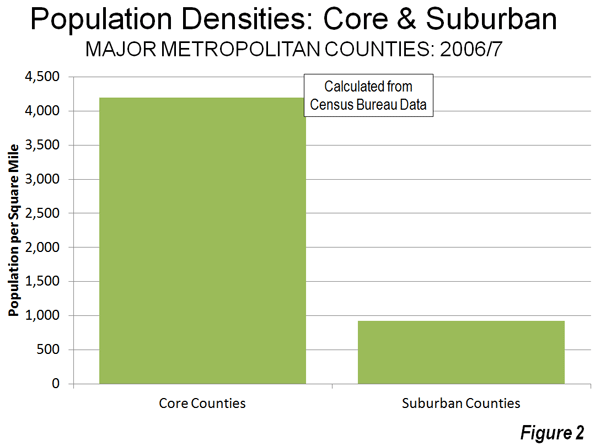
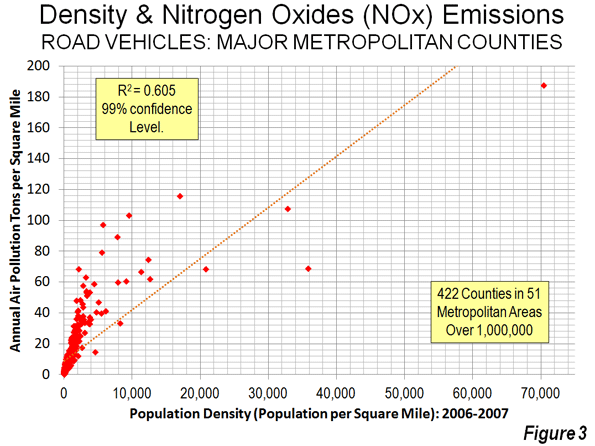
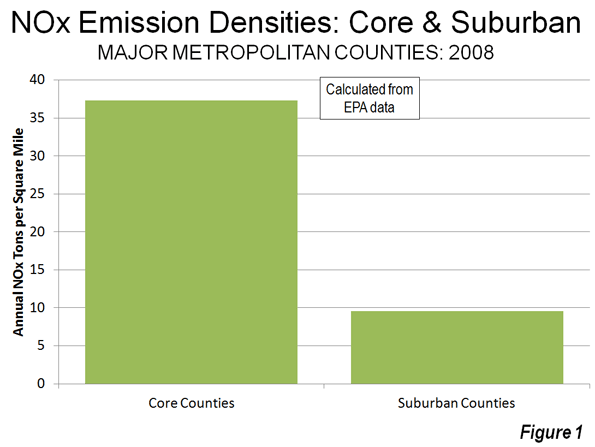
    NOx emission density data by county is provided in the document below, Annual Density of Highway Vehicle NOx Emissions by County: 2008. Overall, this data indicates that the average core county had a NOx density 3.9 times that of the average suburban county (Figure 1). By contrast, the average core county density is 4.5 times that of the average suburban county (Figure 2), indicating a strong relationship that is also shown in Figure 3.

    For example, in the New York metropolitan area, core New York County has NOx emissions that are nearly 15 times as intense in a given volume of air as suburban Morris County. In the Cleveland metropolitan area, core Cuyahoga County has a NOx emissions intensity 12 times that of suburban Geauga County. Charlotte’s core Mecklenberg County has a NOx emissions intensity more than five times that of suburban Union County.

    Traffic and Air Pollution

    More concentrated traffic also leads to greater traffic congestion and more intense air pollution, according to data available from EPA. The data for traffic concentration is similar to population density. Manhattan – despite its huge transit complex – has by far the greatest miles of road travel per square mile of any county, while seven of the densest counties are among the top ten in traffic intensity. As in the case of NOx emissions, the four highly urbanized New York City counties are also among the top 10 in the density of motor vehicle travel (Table 1).

    Table 2
    Intensity of Traffic (per Square Mile)
    Motor Vehicle Travel
    Rank County Compared to Average
    1 New York Co, NY 37.8
    2 Bronx Co, NY 22.3
    3 Fredericksburg city, VA 19.9
    4 Alexandria city, VA 15.8
    5 San Francisco Co, CA 15.6
    6 Arlington Co, VA 15.1
    7 Suffolk Co, MA 14.4
    8 Queens Co, NY 14.3
    9 Kings Co, NY 13.8
    10 Washington city, DC 13.1
    Calculated from 2005 EPA Data


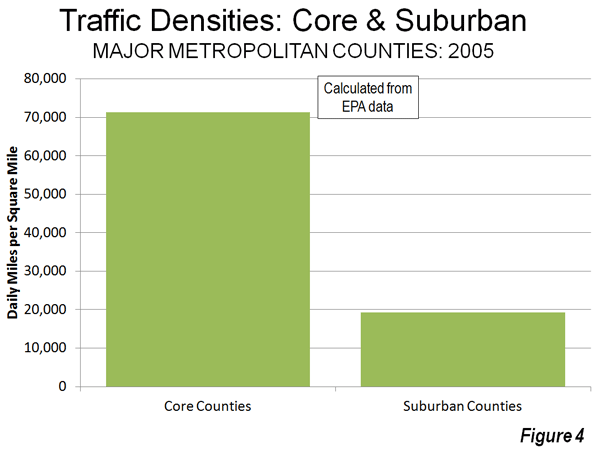
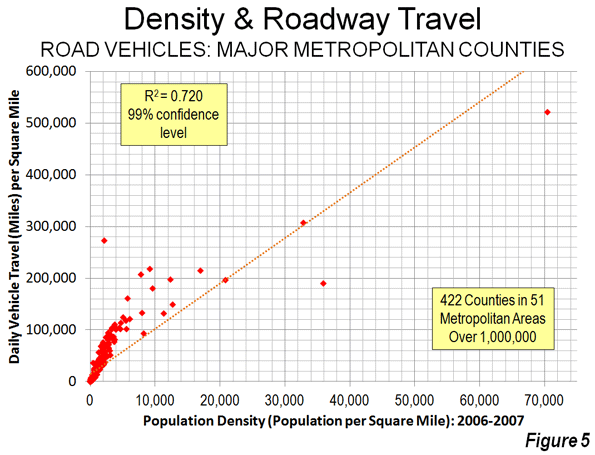
    Traffic density data by county is provided in the second document below, Daily Density of Road Vehicle Miles by County: 2005. Overall, this data indicates that the average core county had a traffic density 3.7 times that of the average suburban county (Figure 4), again a difference similar to the difference in density (Figure 5).

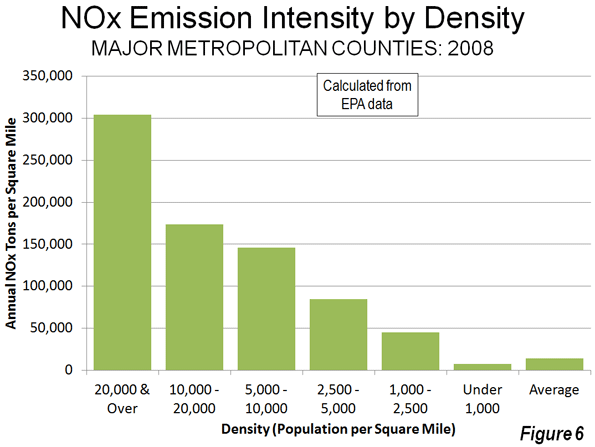
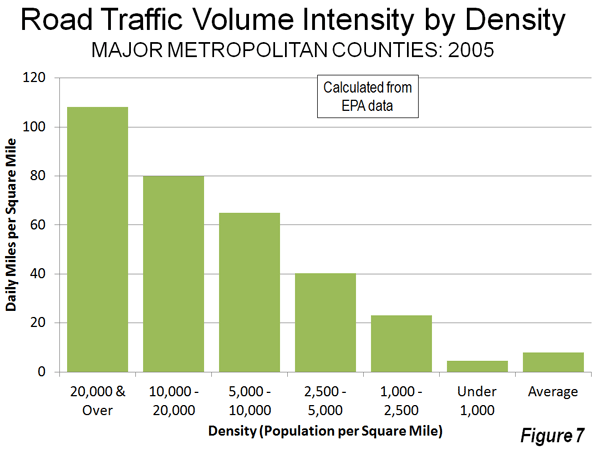
    The overall relationship between higher population densities and both NOx concentration and motor vehicle traffic intensity is illustrated in Figure 6 and Figure 7. There is a significant increase in the concentration of both NOx emissions and motor vehicle travel in each higher category of population density. For example, the counties with more than 20,000 people per square mile have NOx emission concentrations 14 times those of the average county in these metropolitan areas, and motor vehicle travel is 22 times the average. A smaller sample of the most urbanized counties (those with 90 percent or more of the land urbanized) showed a stronger association. This findings are consistent with research by the Sierra Club and a model derived from that research by ICLEI–Local Governments for Sustainability, both strong supporters of the livability and smart growth strategies of densification.

    A Caution: The air pollution data contained in this report is for emissions, not for air quality. Air quality is related to emissions and if there were no other intervening variables, it could be expected that emissions alone would predict air quality. However there are a number of intervening variables, from climate, wind, topography and other factors. Again, Los Angeles County makes the point. As the highest density large urban area in the nation   Los Angeles under any circumstances would have among the highest density of air pollution emissions. However, the situation in Los Angeles is exacerbated by the fact that the urban area is surrounded by mountains which tend to trap the air pollution that is blown eastward by the prevailing westerly winds.

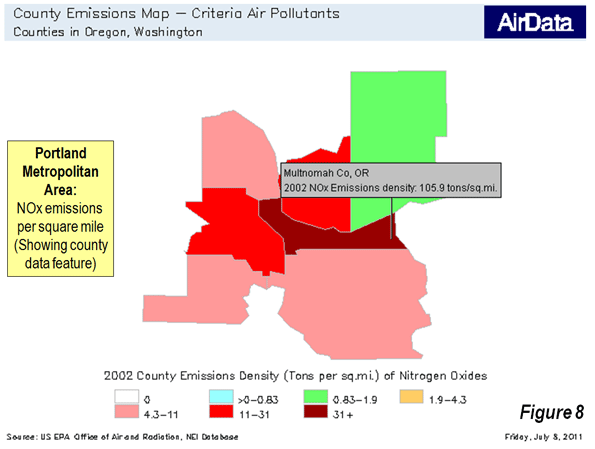
    The EPA data for 2002 can be used to create maps indicating criteria pollutant densities within metropolitan areas. An example is shown of  the Portland (OR-WA) metropolitan area (Figure 8), with the latter indicating the data illustration feature using Multnomah County (the central county of the metropolitan area), which is the most dense county and has the greatest intensity of NOx emissions and traffic congestion.

    The Goal: Improving Public Health

    These data strongly indicate that the densification strategies associated with smart growth and livability are likely to worsen the intensity of both NOx emissions and congestion of motor vehicle travel.

    But there is a more important impact. A principal reason for regulating air pollution from highway vehicles is to minimize public health risks. Any public policy that tends to increase air pollution intensities will work against the very purpose of air pollution regulation: public health. The American Heart Association found that air pollution levels vary significantly in urban areas and that people who live close to highly congested roadways are exposed to greater health risks. The EPA also notes that NOx emissions are higher near busy roadways. The bottom line is that all – things being equal – higher population density, more intense traffic congestion, and higher concentrations of air pollution go together.

    All of this could have serious consequences as the EPA seeks to expand its misguided regulations. For example, officials in the Tampa-St. Petersburg area have expressed concern that the metropolitan area will not meet the new standards, and they have proposed densification as a solution, consistent with the misleading conventional wisdom. The reality is that this is likely to make things worse, not better.  

    Less Livable

    There are myriad difficulties with smart growth and livability policies, not least their association with higher housing prices, a higher cost of living, muted economic growth, and decreased mobility and access to jobs in metropolitan areas. As the EPA data show, the densification policies of smart growth and livability also make air pollution worse for people at risk.

    Virtually all urban areas of Western Europe, North America and Oceania principally rely on cars for their mobility and there is no indicate that this will change. The air is less healthful for residents where traffic intensity is greater. As the air pollution intensity data shows, cars need space.

    Wendell Cox is a Visiting Professor, Conservatoire National des Arts et Metiers, Paris and the author of “War on the Dream: How Anti-Sprawl Policy Threatens the Quality of Life

    —–

    Note 1: The city (county level jurisdiction) of Fredericksburg, Virginia surprisingly ranks third in its concentration of motor vehicle travel yet ranks eighth much lower in population density. This reflects the high volumes of traffic through the  small municipality (and county-equivalent jurisdiction) carried on two of the East’s busiest roadways, Interstate 95 and US-1.

    Note 2: Additional analysis and information is available at Air Pollution, NOx Emissions, Traffic Congestion and Higher Population Density: The Association in Major Metropolitan Areas of the United States.

    Adapted from an article published by the Heritage Foundation.

    Photo of Manhattan traffic by carthesian.

  • Permeable Pavement: Looking Below The Surface

    How can we prevent situations where environmental ‘solutions’ end up in failure? The tale of problems encountered with the misuse of pervious pavers (also known as porous or permeable pavers), used as an eco- friendly option, provides some answers.

    Low impact sidewalk and street installations can become economic problems. Why? Because failed environmental solutions placed on public property are then replaced with conventional construction, using tax dollars. The EPA Section 438 mandating all owned and leased Federal Facilities be converted into low impact development promotes permeable pavement, that is, paving that allows rainwater to pour through it, instead of running off at high speed to an inlet and overloading the storm sewer system, taking pollutants downstream with the water, and eventually infecting our streams and oceans. To understand more about it, read reporter Dave Peterson’s exposés in the Minneapolis Star Tribune.

    On the surface, permeable pavers seems logical: pavement that allows rain to fall through. But what happens after the rain falls through the pavement – where does the floodwater go? A sub-base is needed to support the pavement. The rainfall must fall not only through the pavers, but also through the ground below. If you were to place permeable pavers on your back yard patio, supporting the weight of people and furniture would require very little sub-structure. If your lot was made of sandy soil that allows rain to quickly filter through, better yet. But if the ground underneath is clay or rock, the water must be retained or piped off with a sub-drainage system. If this is starting to sound expensive, as we say in Minnesota, you betcha!

    This sub-surface material must be sponge-like, and allow a conduit for water to either pass through to a piped system to be transported elsewhere, or have enough small void areas to retain the water until it can slowly be filtered through its lowest layer seeping back to the earth. To create a ‘base’ with properties that has ‘void spaces’, plenty of rock and large stone is used.

    Of course this means digging a very deep channel under the proposed pavement, moving (removing) the old soil and hauling in this sub-base material. A 100 foot long 30 foot wide road would require a five foot deep excavation with 555 cubic yards of soil to be removed, and almost the same in sub-base to be hauled in. Since a large dump truck holds up to 20 cubic yards (typically less), that small section of street would require at least 27 trips to and from the destination with 27 truckloads of rock, no doubt consuming massive amounts of petroleum.

    Anybody who has been in Minnesota in the winter knows that during, those seven months of freezing weather, cold is redefined. Water expands about nine percent as it freezes, so 555 cubic yards of water would increase about 50 cubic yards. Where does the water go? Up! Water pressure can lift pavers and cause havoc in the winter, so before cold weather sets in it is recommended that the liquid be vacuumed out of the sub-surface and hauled away. Now how much energy does that take?

    People and patio furniture are not that heavy, certainly not as heavy as a bus, which weighs somewhere between 26 and 40 thousand pounds transferred to the tires, depending upon the size and how many it is carrying. This weight is then transferred to the pavement, which is on top of rocks and stone that are intentionally ‘loose,’ to hold water.

    There is another problem with permeable pavement in some applications: water settles to a level surface. A few years ago we designed a low-impact, clustered neighborhood in Minnesota. At the ‘consultants’ meeting with the developer, the young engineer pushed the permeable paver idea. We had designed the neighborhood by harnessing the natural grade, embracing the heavily wooded site’s natural drainage to save most of the existing trees on the steep slopes. In other words, we planned to use what nature provided, eliminating much of the grading, costs and environmental impacts. On this site there were some fairly steep grades, in many cases exceeding a five foot drop in its length along private drives.

    The engineer aggressively insisted on permeable pavers. His idea was to create a five foot deep sub-base under the private drives (26’ wide) and run the gutters of the roofs underground to the sub-surface drainage system. In such meetings it is not polite to scream, “Are you out of your mind?” Instead, after the meeting I told the developer to kill the idea for being far too expensive. The developer did not heed my advice, and when the economics of the engineering was done, the cost escalated out of control. Several months of the engineer trying to (unsuccessfully) convince the city that the permeable pavers was a great solution caused the project to be delayed. By the time it was approved (with the natural drainage solution), the recession was in full swing and the development went dormant.

    From a personal experience, when I built my Green Certified home in 2008, MNGreenstar provided points for permeable pavement but only if the underlying base held the storm water underneath. The soil of my lot is sandy, and could have quickly absorbed the rainwater, allowing a fairly cheap sub-base, but the ‘green’ certification did not allow for compromise. The green certification ‘all or nothing’ approach meant that my sub-surface would have added $5,000 to the construction to get a few green ‘points’ encouraging the ‘nothing’ side of the equation. So, instead of designing the driveway with permeable pavement, we used sculpted landscaped strips (like the driveways of yesterday) to reduce the paved surface area and the overall costs. It is not unusual to see people taking pictures of my ‘low impact’ driveway, which adds curb appeal and value, however, we gained no green points for this logical solution.

    Why the motivation to push permeable pavement? In many cases it might indeed make sense. One reason is profitability, not by those selling the pavement alternatives, but by the consulting industry that specifies materials charging fees based upon a percentage of the construction cost. Permeable pavers and other ‘green’ alternatives can add a considerable amount to costs, and to the profitability of a consulting firm. If all bids were based upon rewarding solutions that cost less, with a penalty for solutions that cost more, consultants would truly deliver on the promise of sustainability; development costs and future maintenance burdens would plummet, while the environment would benefit. If we rewarded engineers employed by government agencies by allowing them to share a percentage of the money they saved by introducing green solutions that are cost effective, it would bring about change overnight.

    Can this be done? Absolutely. The technology and educational materials have been developed for this overhaul, but it would take effort and investment, since we’re currently in an economy where up to 65% of the architectural and land consultants are unemployed, and those remaining are not exactly overloaded with work.

    The EPA Section 438 is the Federal agenda to rebuild existing facilities and have all new construction (including all military bases) comply with low impact standards. On some new construction and redevelopment, permeable pavement could be effective, but it is unlikely to be cost effective where heavy loads, bad soils, and/or frigid weather occur.

    The decreased pavement width of New Urbanism is a start in the right direction, as long as safety and functionality are maintained. Combined with the reduced ‘length’ of infrastructure in plans like Prefurbia, it is entirely possible to reduce the environmental impact of newly paved development by about 30%, and of re-developed areas (i.e. EPA Section 438) by more than 50%, while increasing function and value. Now that we have the knowledge to do so, isn’t it time to start reaping the benefits of design techniques that reduce pavement without harming function?

    Photo by Mockney Rebel; “Pavement Archeology”

    Rick Harrison is President of Rick Harrison Site Design Studio and Neighborhood Innovations, LLC. He is author of Prefurbia: Reinventing The Suburbs From Disdainable To Sustainable and creator of Performance Planning System. His websites are rhsdplanning.com and performanceplanningsystem.com.

  • Australians Are Getting A Carbon Tax They Don’t Want

    Within weeks, the Australian government is expected to announce a package of measures including a carbon tax to stimulate renewable energy sources and abate carbon emissions. Officials, activists and journalists around the world will hail Australia as a courageous and forward-looking country, ready to take its responsibilities seriously. Some will rebuke their own governments for being less bold. Yet they will ignore an inconvenient detail. According to opinion surveys, at least 60 per cent of Australians strongly oppose the tax. Since it was flagged in February, support for the ruling Labor Party has fallen to its lowest level in 40 years. Only 27 per cent of Australians now nominate Labor as their first preference. Nor did they vote for it. In the lead up to last August’s federal election, both major parties ruled out a carbon tax. Prime Minister Julia Gillard declared, just hours before polling day, that “there will be no carbon tax under the government I lead”. Her job approval rating is 31 per cent.

    So why is this happening? The current malaise can be traced to a combination of long and short term causes. Like other western countries, Australia was profoundly changed by the 1960s social movements. In the decades after World War II, as Britain lost its empire and turned to Europe for an economic future, Australia shifted its agricultural and mineral commodity trade to Asia, admitted growing numbers of immigrants from outside the British Isles, and came to rely on the United States for security. Elites in the professions, judiciary, churches, universities and bureaucracies conceiving Australia as an outpost of British civilisation, found the ground moving under them.

    Radicalised by Australia’s participation in the Vietnam war, baby boomers poured out of an expanded university system to spearhead a range of movements, over time supplanting the old elites. By the 1980s, universities, schools, many professions, the media, and most of the public sector were dominated by left-progressives. Their “long march through the institutions” was perhaps more thorough-going than in the United States, since anti-leftists had yet to find a substitute for British imperialism.

    One of the social movements was environmentalism. Australia is an isolated, sparsely populated continent with hauntingly beautiful landscapes and unique natural species. Late-coming westerners found a pristine wilderness, populated by aboriginals with close spiritual ties to the land. Since European settlement, these features have, in various forms, injected a romantic strain into the country’s transplanted British culture. That strain was mostly confined to the arts and radical fringe movements. In large part, the colonies, federated in 1901, evolved a practical outlook shaped by nineteenth-century liberalism and the blessings of trade, industry and commerce.

    The 1960s saw a fusion of the romantic strain with ideologies shaped by streams of Marxism, left-wing anarchism and revivals of Counter-Enlightenment Romanticism. Sharing a preference for ecological protection over economic growth, inner-city-based activists, including many socialists, current or former communists, Trotskyites and others from counter-culture circles, like hippies, together with aboriginal peoples, campaigned to lock up remnant bushland, native forests, wetlands and traditional aboriginal sites in “green-belts” or national parks. They targeted urban expansion and industries like logging, cattle-grazing and mining, which boomed in a mineral-rich arc across northern Queensland and Western Australia. Conflicts over mining projects were routine in the 1970s and 1980s. Uranium was particularly contentious.

    But it was in Tasmania that the new environmentalism came of age. State government plans for a hydro-electric dam on the Franklin River became a cause celebre, attracting strong opposition from environmentalists, and wide public interest. Many leading-lights of the movement, including the current Greens Party leader, made their name in that struggle. Ultimately, the activists came out on top, winning support from federal Labor just before the 1983 election, at which they returned to power.

    The Franklin tussle cast a long shadow over Australian politics. Many analysts thought it contributed to Labor’s victory. Nature conservation crept onto the mainstream agenda. In 1984, various green lobby groups, including some of the more hard line activists, came together to form Greens parties in New South Wales and Queensland, modeled on the German Greens. Other states followed, and in 1992 a national Greens Party emerged. Over time, Greens gained a presence in state and federal parliaments. Some were ideological refugees from defunct communism. Before joining the Greens, for instance, one serving Greens senator was a member of the Socialist Party of Australia, a successor organisation to the Communist Party.

    While open to compromise on environmental concerns, Labor never embraced green ideology. A moderate party in the British tradition, built on craft trade unionism rather than socialism, Australian Labor was essentially pragmatic. Its environment agenda was adapted to job security, rising living standards and the interests of mining, forestry and transportation workers. For most Australians, the environment was still a marginal issue.

    Then came the climate panic. Australia is a land of climate extremes, where severe drought alternates with devastating floods. By 2006 the continent had been in the grip of drought for virtually a decade. Water restrictions even hit the major cities, as morale began to sag under fears of interminable dryness. That year also saw some unseasonably hot days. From their posts on the “commanding heights” of academia, politics and media, green ideologues sensed a chance to ramp up their rhetoric on global warming, claiming the drought would persist until carbon emissions were cut. Now they hoped to impose their anti-growth philosophy on the whole economy, not just individual projects.

    This time their message fell on fertile ground. Surveys began to show majority support for strong action on climate change. Conservative Prime Minister John Howard, who was lukewarm on the issue, and had refused to sign the Kyoto Protocol, was caught off guard. Looking to the election due in 2007, Labor succumbed to opportunism. They took to spouting green rhetoric, promising ratification of Kyoto, an emissions trading scheme (ETS) and a renewable energy target. Come 2007, the sense of exhaustion around Howard’s eleven year government was enough to tip Labor into office. But the party’s green chickens eventually came home to roost. Having hyped global warming as a great moral cause, Prime Minister Kevin Rudd suffered the indignity of returning empty-handed from the failed Copenhagen Conference. By this time the drought had broken, and the Liberal-National opposition changed course, defeating Rudd’s ETS in the senate.

    Public support for climate action began to slide. According to the authoritative Lowy Institute Poll, it is now down to 41 per cent, from 68 per cent in 2006. Workers grew nervous about the implications for trade-exposed or energy intensive industries like mining, steel production and power generation. They shifted back to former attitudes on the environment, leaving the government stranded. Following advice from his inner-circle, including then Deputy Prime Minister Gillard, Rudd deferred the ETS until after the election scheduled for late 2010, but he suffered a crushing loss of credibility. His colleagues dumped him for Gillard.

    For city-based progressives, especially in the publicly-funded sector, climate action became a vehicle to burnish their moral authority and claim a larger share of the nation’s wealth, reversing two decades of market-oriented reform. Prompted by Labor’s turmoil, more of them defected to the Greens. At the election hastily called for 21 August 2010, neither major party won a majority in the House of Representatives. The balance of power was held by the Greens and four other independents. In the senate, the balance went exclusively to the Greens. Desperate to survive, Gillard signed up to a formal alliance with them. After weeks of negotiation, the Greens and enough independents sided with Labor to form a minority government. Their price was the carbon tax she ruled out just hours before election day.

    When the dust settled, Australians found that, by pure chance, their country was in the hands of a climate junta, euphemistically called the Multi-Party Climate Change Committee, consisting of Gillard, the Treasurer, the Minister for Climate Change, the Greens leader and his deputy, and two independents. Posing as an open-minded enquiry into Australia’s climate options, the Committee is driven by an inescapable political logic. None of them can break ranks without bringing down the government, ending the most power any of them will ever have. This logic overrides everything, even rising public anger. The opposition’s line, that “Labor may be in government but the Greens are in power”, resonates widely. Few think Gillard really believes in the tax. Moreover, it comes at a time when consumer confidence is weak, and cost-of-living pressures dominate surveys of public concerns.

    Never has such a gulf opened up between elite and popular opinion. Nothing has turned around opposition to the Committee’s tax, not Gillard’s promise of compensation for low to middle income earners, not favourable media coverage, not reports by scientific experts, not declarations signed by eminent citizens, not even an advertising campaign fronted by Oscar-winning actress Cate Blanchett. Urging Australians to “say yes”, the ad unleashed a wave of resentment towards the globe-trotting star, who owns a $10 million “eco-mansion” in one of Sydney’s exclusive suburbs. Tabloid newspapers dubbed her “Carbon Cate”.

    Most opinion-leaders will applaud Gillard’s carbon tax package. They will ignore the real story: Australians are being made to walk the climate plank, with a cutlass at their back.

    John Muscat is a co-editor of The New City.

    Photo by MystifyMe Concert Photography

  • Can Florida Escape the Horse Latitudes?

    When it comes to the winds of change, Florida remains in the horse latitudes.  This zone of the Atlantic around 30 degrees latitude was so named by ship captains because their ships, becalmed in the water, seemed to move faster when they lightened their load by throwing off a few horses.  Florida’s governor Rick Scott, who campaigned on a promise to create 700,000 jobs in this state, appears to have adopted the same tactic by throwing overboard the Department of Community Affairs, the state agency that regulated real estate development.  Other bureaucracies may be next in line if the state doesn’t show signs of improvement soon.

    Billy Buzzett, appointed head of this bureaucracy, was in Orlando last week to discuss the new future of Florida growth management.  Growth will now be lightly monitored by the Department of Economic Opportunity , which is in charge of reviewing development plans, and will handle unemployment benefits as well.  Mr. Buzzett stated that the department’s mission will also include items such as weatherization of structures for hurricanes. All of this is good, but it’s a puzzling mix to throw into a single bureaucracy.  Obviously, real estate regulation is not the focus of this governor, who saw regulation as one of the chief obstacles to creating jobs in this state.

    The Department of Community Affairs was created in 1985 to set some standards for quality of life as well as for environmental protection.  Failing at both tasks, the DCA came under fire during the last election cycle as a statewide referendum (Amendment 4) on growth gained support from people tired of seeing forests converted into strip malls.  The referendum, narrowly defeated, would have people vote in Cailfornia-style ballots for such changes.  This may have been a bad idea, based on how California’s growth controls have stifled its once vibrant economy.

    In this era of minimal new building, the reinvention of growth management may be seen as a way to pass the time while we wait for the economy to recover.  In reality, however, there are some very large implications in the future.

    Governor Scott wants the state to be more like Texas, which regulates with a far lighter hand and seems to be navigating through this particularly horrid recession better than other big states.  Texas has growth and does not have an onerous, time-consuming process which weeds out all but the deepest pocketed investors.  Unlike Texas, however, Florida has few natural resources like oil and mineral wealth to fall back on for revenue, and therefore deregulates itself without any diversification of income stream.

    What this means to the local economy will be hard to predict.  Certainly, the DCA was able to negotiate with private developers, and helped to shield cities and counties from a lot of the pressure from out-of-state interests.  Without the DCA, it will be interesting to watch which of Florida’s regions stand up to this pressure and which regions, starved for cash, cave in to the pressures of growth.

    Although defeated, Amendment 4 clearly scared the real estate interests to death.  Legislation now prevents anything like that from happening again.  While real estate development clearly needs to be left in the hands of professionals, it also seems to have risen to the top of citizens’ awareness.  Whether it stays there or not is up to the state’s citizens, most of whom immigrated from elsewhere in search of the good life.  Growth benefitted the lowest economic class by creating cheap housing, construction jobs and access to consumer goods.  Florida, however, by grabbing the bottom tranche of workers, has missed a chance to build a more vertically integrated middle class with higher skilled workers.

    Orlando in particular is in an unfortunate situation, as it has no natural hard boundaries like the sea.  Like Atlanta, Central Florida’s metropolitan area can grow in concentric rings forever and ever, gobbling up more agriculture, wetlands, and forests.  Such a development pattern puts value on the rim, rather than in the center, leaving the older parts of the city devoid of investment, energy, and hope.  With private interests, whose mission is to grab the low hanging fruit, in chargethere will be little redevelopment of these interior districts, despite the sunk costs of infrastructure that could give them an edge. 

    Making more stuff is the business of growth.  Making stuff better is the business of development.  And development is what older neighborhood areas like this sorely need.  Successful in-fill redevelopment, in both suburban and urban locations, can still happen if employment can be added to the mix.

    It is up to our region’s leadership to turn this pattern around, and start valuing our real estate a little differently than in the past.  For example, debasing our wetlands to their mere economic value overlooks their larger value in terms of biodiversity.  Bringing wetlands and agriculture into our growth management policy would be a good first step towards creating a sustainable future for Central Florida.  Florida’s environmental movement need not turn into a shrill anti-growth machine as has happened elsewhere, but should be a partner with the real estate interests to protect the more long-term natural assets that bring so many to the Sunshine State in the first place.

    Recycling also need not be just the job of the utility department.   Recycling land through the EPA’s brownfield program is already underway by many municipalities, and provides a vehicle to reinvent neighborhoods that have failed. 

    As always, clean water will be the limiting factor to growth.  Already a concern of Florida, the state is divided into various water management districts, who regulate how clean water can be removed from the aquifer, and what kind of dirty water can be put into it.  No doubt this regulation will be under assault next.

    Without Secretary Buzzett’s new department, Florida is already showing signs of new employment opportunities and diversity.  Military spending in Florida is up, thanks to the National Center for Simulation, and medical research spending is continuing at a steady pace.  These were added to the mix of growth, tourism, and agriculture upon which Florida has traditionally relied. More jobs that revolve around these two industries will include support technology, computer science, manufacturing, and services. 

    These industries grew despite the regulatory burden of the state.  What is dangerous about Secretary Buzzett’s new department is its blasé treatment of the public’s genuine desire for better environmental management and a better quality of life.  Like many places, Florida has its share of “not in my backyard” sentiment reacting against more development.  The anger voiced in 2010 through Amendment 4, however, represented something new and deeper:  a collective sense that enough is enough.  Speculative development, built during the boom and remaining unoccupied to this day, is in every community, urban and rural.  Few believe that the empty condos, ghost town subdivisions, empty strip shopping centers, and vacant office parks are improvements over what was there before, and fewer still want this kind of insanity to return.

    So the death of the DCA, which allowed speculative development to the point of embarrassment, may have been a good thing.  Employment-based growth, which so far has eluded Florida’s regions, may now have a chance to take place.  With the new industries arriving, job creation is already a reality – no horses had to be thrown overboard to make that happen. What Florida needs now is some leadership at the local level to promote more employment-based growth that is slow, but sure, and that is sustainable for the long haul.   

     Richard Reep is an Architect and artist living in Winter Park, Florida. His practice has centered around hospitality-driven mixed use, and has contributed in various capacities to urban mixed-use projects, both nationally and internationally, for the last 25 years.

    Photo: Desiree N. Williams

  • California’s Green Jihad

    Ideas matter, particularly when colored by religious fanaticism, wreaking havoc even in the most favored of places. Take, for instance, Iran, a country blessed with a rich heritage and enormous physical and human resources, but which, thanks to its theocratic regime, is largely an economic basket case and rogue state.

    Then there’s California, rich in everything from oil and food to international trade and technology, but still skimming along the bottom of the national economy. The state’s unemployment rate is now worse than Michigan’s and ahead only of neighboring Nevada.  Among the nation’s 20 largest metropolitan regions, four of the six with the highest unemployment numbers are located in the Golden State: Riverside, Los Angeles, San Diego and San Francisco. In a recent Forbes survey, California was home to six of the ten regions where the economy is poised to get worse.

    One would think, given these gory details, California officials would be focused on reversing the state’s performance. But here, as in Iran, officialdom focuses more on theology than on actuality.   Of course, California’s religion rests not on conventional divinity but on a secular environmental faith that nevertheless exhibits the intrusive and unbending character of radical religion.

    As with its Iranian counterpart, California’s green theology often leads to illogical economic and political decisions. California has decided, for example,  to impose a rigid regime of state-directed planning related to global warming, making a difficult approval process for new development even more onerous.  It has doubled-down on climate change as other surrounding western states — such as Nevada, Utah and Arizona — have opted out of regional greenhouse gas agreements.

    The notion that a state economy — particularly one that has lost over 1.15 million jobs in the past decade — can impose draconian regulations beyond those of their more affluent neighbors, or the country, would seem almost absurd.

    Californians are learning what ideological extremism can do to an economy. In the Islamic Republic, crazy theology leads to misallocating resources to support repression at home and terrorism abroad. In California green zealots compel companies to shift their operations to states that are still interested in growing their economy — like Texas. The green regime is one reason why CEO Magazine has ranked California the worst business climate in the nation.

    Some of these green policies often offer dubious benefits for the environment. For one thing, forcing California businesses to move to less energy-efficient states, or to developing countries like China, could have a negative impact overall since shifting production to Texas or China might lead to higher greenhouse gas production given California’s generally milder climate.   A depressed economy also threatens many worthy environmental programs, delaying necessary purchases of open space and forcing the closure of parks. These programs enhance life for the middle and working classes without damaging the overall econmy.

    But people involved in the tangible, directly carbon-consuming parts of the economy — manufacturing, warehousing, energy and, most important, agriculture — are those who bear   the brunt of the green jihad. Farming has long been a field dominated by California, yet environmentalist pressures for cutbacks in agricultural water supplies have turned a quarter million acres of prime Central Valley farmland fallow, creating mass unemployment in many communities.

    “California cannot have it both ways, a desire for economic growth yet still overregulating in the areas of labor, water, environment,” notes Dennis Donahue, a Democrat and mayor of Salinas, a large agricultural community south of San Jose. Himself a grower, Donahue sees agricultural in California being undermined by ever-tightening regulations, which have led some to expand their operations to other sections of the country, Mexico and even further afield.

    Other key blue collar industries are also threatened, from international trade to manufacturing. Since before the recession California manufacturing has been on a decline.  Los Angeles, still the nation’s largest industrial area, has lost a remarkable one-fifth of its manufacturing employment since 2005.

    California’s ultra-aggressive greenhouse gas laws will further the industrial exodus out of the state and further impoverish Californians.  Grandiose plans to increase the percentage of renewable energy in the state from the current unworkable 20% to 33% by 2020 will boost the state’s electricity costs, already among the highest in the nation, and could push the average Californian’s bill up a additional 20%.

    Ironically California, still the nation’s third largest oil producer, should be riding the rise in commodity prices, but the state’s green politicians seem determined to drive this sector out of the state.. In Richmond, east of San Francisco, onerous regulations pushed by a new Green-led city administration may drive a huge Chevron refinery, a major employer for blue collar workers, out of the city entirely. Roughly a thousand jobs are at stake, according to Chevron’s CEO, who also questioned whether the company would continue to make other investments inside the state.

    Being essentially a religion, the green regime answers its critics with a well-developed mythology about how these policies can be implemented without economic distress.  One common delusion in Sacramento holds that the state’s vaunted “creative” economy — evidenced by the current bubble over   surrounding social media firms — will make up for any green-generated job losses.

    In reality the creative economy simply cannot  make up for losses in more tangible industries. Over the past decade, as the world digitized, the San Jose area experienced one of the stiffest drops in employment of any of the 50 largest regions of the country; its 18% decline was second only to Detroit.  Much of the decline was in manufacturing and services, but tech employment has generally suffered. Over the past decade California’s number of workers in science, technology, engineering and math-related fields actually shrank. In contrast, the country’s ranks of such workers expanded 2.3% and prime competitors such as Texas , Washington and Virginia enjoyed double-digit growth.

    So who really benefits from the green jihad? To date,  the primary winners have been crony capitalists, like President Obama’s newly proposed commerce secretary, John Bryson, who built a fantastically lucrative  career (he was once named Forbes’  “worst valued chief executive”) while  running the regulated utility Edison International. A lawyer by training, Bryson helped found the green powerhouse National Resources Defense Council. He’s been keen to promote strict  renewable energy  standards  that also happen to benefit solar power and electric car companies in which he holds large financial stakes.

    Other putative winners would be large international companies, like Siemens, that hope to build California’s proposed high-speed rail line, the one big state construction project favored by the green-crony capitalist alliance. Fortunately , the states dismal fiscal situation and  rising cost estimates for the project, from $42 to as high as $67 billion, as well as cuts in federal subsidies, are undermining support for this project even among some liberal Democrats.  Even in a theocracy, reality does, at times, intrude.

    Finally, there are the lawyers — lots of them. A hyper-regulatory state requires legal services just like a theocracy needs mobs of mullahs and bare knuckled religious enforcers. No surprise the number of lawyers in California increased by almost a quarter last decade, notes Sara Randazzo of the Daily Journal. That’s two and a half times the rate of population growth.

    The legal boom has been most exuberant along the affluent coast.  Over the past decade, the epicenter of the green jihad, San Francisco, the number of practicing attorneys increased by 17%, five times the rate of the city’s population increase. In the Silicon Valley, Santa Clara and San Mateo counties boosted their number of lawyers at a similar rate. In contrast, lawyer growth rate in interior counties has generally been far slower, often a small fraction of their overall population growth.

    If California is to work again for those outside the yammering classes, some sort of realignment with economic reality needs to take place.  Unlike Iran, California does not need a regime change, just a shift in mindset that would jibe with the realities of global competition and the needs of the middle class. But at least with California we won’t have to worry too much about national security: Given the greens anti-nuke proclivities, it’s unlucky the state will be developing a bomb in the near future.

    This piece originally appeared at Forbes.com.

    Joel Kotkin is executive editor of NewGeography.com and is a distinguished presidential fellow in urban futures at Chapman University, and an adjunct fellow of the Legatum Institute in London. He is author of The City: A Global History. His newest book is The Next Hundred Million: America in 2050, released in February, 2010.

    Photo by msun523

  • Wind Energy is Not Just Hot Air

    Anaheim Convention Center, Southern California, last week was a hot bed of one of the ultimate forms of renewable energy. The “fuel” used by wind turbines (really the wind) is free for the 30 year life span of the windmill installation, is considered inflation proof, and is 100 % domestically available.

    Just a brief walk through the trade exhibition convinces any visitor of European as well as Chinese commitment to wind energy. One guest speaker, Ted Turner put it: “Just do not look at the next 30 years, look for at least a few hundred years of human energy needs.”

    Conventional energy lobbyists claim that wind is unreliable and will harm operation of the grids. However, grid operators have observed that wind power is more reliable and predictable.

    There are rumors that sound of operating wind will cause a variety of dangerous health effects, including headaches and disturbed sleep. The studies have shown that wind turbines at a distance of 2,000 feet (normal building codes for Wind Mills) have a dB rating close to 45 (comparing that to 55 in an average home in the USA). Normally, two people can carry on a conversation on any wind mill farm. Please remember: this energy source has no side effects such as air or water polluting emissions, no hazardous waste, and has a direct impact on reducing the public health impact of any other energy generation.

    Are birds get affected by wind energy? A very legitimate question by the American Bird Conservancy needs to be addressed with honesty. The bird loss caused by buildings is about 550 million, by power lines 130 million, vehicles 80 million, poisoning by pesticide 67 million, and radio and TV towers close to 4 million. The tabulated loss by wind is under 150,000. Special attention is being paid to bats: The bats and wind energy coalition was formed in 2003 by Bat Conservation International, the U.S. Fish and wild life Service, and the National Renewable Energy Laboratory.
    The view of a wind energy facility or the distance of a home from a wind mill farm had no consistent, measurable or significant impact on home values.

    The current worldwide installed capacity gives a snap shot of Wind energy penetration in a given region. By 2010, the European Union was leading the world with 84,000 MW, China with 42,000 MW and the USA was at 40,000 MW. However, Denmark leads the world as percentage of total power needs fulfilled by Wind Energy: close to 20 % in 2010.

    The potential of up to 20 % electricity generation that can be derived from Wind Energy is feasible, both technically as well as financially by 2030. Most land used to construct wind farms can be used for its original purpose of harvesting, grazing and farming. The actual foot print of turbine farms, roads and generating and transmitting facilities is under 3 percent of total land taken out of commission.

    Wind Energy should be debated in the public forum with both energy independence and long term sustainability for our planet beyond the next election cycle.

  • Natural Gas Vehicles Floor It in Long Beach

    The Alternate Clean Transportation Expo held in Long Beach earlier this month was a spectacular display of engineering ingenuity by Natural Gas Vehicle providers. The event’s theme was that America’s self sufficiency in natural gas has decoupled our energy resources from petroleum prices. But the consensus among the gathered engineers and scientists was to look beyond the current prices of petroleum alone, and consider that domestic self sufficiency includes keeping jobs at home.

    The NGVs (Natural Gas Vehicles, which include Compressed Natural Gas—CNG, as well Liquefied Natural Gas—LNG) reduce greenhouse gas emissions almost 20 percent on medium and heavy duty models, and 30 percent on light duty vehicles.

    All fuels, including natural gas, release energy by burning. But cleanliness and renewability are probably the single most talked-about aspect of NGVs. From energy field to vehicle engine, natural gas needs very little processing to make it usable, compared to crude oil, which is processed into gasoline by complex and expensive refining techniques. A naturally occurring fuel, its chemical formulation is about 90% methane, with smaller amounts of ethane, propane, butane and carbon dioxide, a high octane rating of about 120 – 130, and clean burning characteristics.

    Biomethane gas is extracted from biomass, and is therefore renewable, and it can be produced economically in large quantities. Current estimates are that the US has proven reserves of over 1500 TCFs (trillion cubic feet) of natural gas which, by some estimates, should last for the next 100 years.

    Potentially, natural gas will create jobs not only through vehicle manufacturing, but through the construction of new CNG stations. A landfill processing plant near Dallas, Texas, owned by a pioneering company in CNG station installation, Clean Energy™, creates up to 9,000,000 GGEs (gasoline gallon equivalents)of biomethane gas for fueling stations. It has agreements with airports in Tampa, New York City, New Orleans and Philadelphia to build CNG filling stations that will support ground transport vehicles and off-airport parking shuttles.

    Of course, legitimate concerns have been expressed about the safety of natural gas vehicles. Notably, in a tragic 1998 accident a stopped bi-fueled Honda (a vehicle that can run on CNG or gasoline) was impacted by another vehicle moving at almost 100 mph. A fire started by the gasoline engine broke out.

    NGV supporters counter that the 50 liter CNG tank was intact and remained secure in its support bracket, that NGVs are subject to same federal standards as regular vehicles, and that natural gas cylinders are thicker and stronger than conventional gas tanks.

    The NVG safety record also includes a survey of more than 8,000 natural gas utility, school, municipal and business fleet vehicles that have traveled 178 million miles, in which the vehicle injury rate was 37% lower than in a gasoline fleet. Under federal and state regulations, fueling stations, indoor parking structures, repair garages and car dealerships must all meet high safety standards. Leaking gasoline forms puddles and creates a fire hazard; if the CNG engine leaks at all, the fuel will normally rise to the ceiling and disappear. Insurance companies nationwide have looked at the safety of natural gas buses and fleets and have no reservations about insuring them.

    Hybrids were also on display at the Expo, including a notable innovation by Parker Hannifin Company. Says Tom Decoster, business development manager of the Cleveland-based firm, “We are going to let California know there are alternatives to electric and CNG.” Parker’s alternative is the hydraulic hybrid, with regenerative braking energy stored as a pressurized gas in a vessel. These vessels are known to be accumulators, which Parker compares to batteries. While stored electricity from a battery drives a motor, energy from an accumulator powers a pump-motor to drive wheels. This assistance increases fuel efficiency and sometimes permits a smaller engine.

    Average fuel consumption for a conventional Class 8 vehicle is about 9,800 gallons per year. RunWise™, Parker’s vehicle, reduces the fuel consumption by 30 to 50 percent, depending on route density and operating conditions. “The more stops a vehicle makes during the day, the more efficient the system becomes relative to a conventional drive train,” Decoster says, adding that the NGV also reduces CO2 emissions, compared to a conventional vehicle, by 38 tons per year, the equivalent of about six midsize cars or planting 1,500 trees. It has reduced brake replacement cycles from every few months to almost 2 years. Parker’s technology is intended for refuse trucks and for fleets that need frequent stops, such as those run by FedEx and UPS.

    This highly technical conference and engineering-driven trade show was innovative in one other way, too. Expo organizer GNA designed events to reach out beyond the technorati to ordinary consumers who — it hopes — will one day be its loyal customers.

    Shashi Parulekar is a Los Angeles-based engineer. He holds an MBA, and served as Asia Pacific M.D. with Parker Hannifin Co in Michigan for over ten years.

  • Pollution: An Off – Road Guide to Environmental Hot Spots

    Not all pollutants are created equal, nor do they necessarily hang out in the same hot spots. Rankings of the most polluted cities — you know who you are — have become depressingly familiar. But those standings almost always represent a statistical stew of assorted toxins in the air and water, averaged together. The list that follows may surprise you: A quick look at a handful of cities, each with the unfortunate distinction of being the worst in the U.S. for a specific environmental health hazard.

    Bakersfield, California
    While the Los Angeles metro area is synonymous with dangerous smog – and LA is, in fact, the leader in ozone pollution – it is actually Bakersfield, California that has the nation’s worst overall air quality, according to the American Lung Association’s State of the Air report. An inland city between LA and Fresno, this “gateway to the Central Valley” defies the stereotype of dirty, urban air; rural Bakersfield is a major agricultural center.

    A combination of factors pushed Bakersfield into the #1 spot. Like LA, it, too, suffers from ozone pollution. Ozone is a necessary component of the Earth’s upper atmosphere, where it shields the planet from the sun’s more harmful rays. However, when ozone collects at ground level, it can interrupt photosynthesis in plants and cause detrimental health effects in humans. When breathed in, ozone and other components of smog irritate the respiratory system, and can cause asthma, bronchitis, heart attacks, and other cardiopulmonary problems that may result in premature death.

    Air pollution has long been a problem in California because of geographical and weather conditions that allow the pollution to hang over the regions, rather than dispersing. The Golden State’s much-renowned sunshine actually exacerbates the problem, reacting with car exhaust and other pollutants to create ozone molecules, helping to make California home to the six worst U.S. cities for ozone pollution.

    Of course, ozone is not the only environmental problem Bakersfield faces. It also ranks second in year-round particle pollution and first in periodic short-term spikes of particle pollution.

    Libby, Montana
    Another pollution frontrunner that is not located in a large city. Libby, Montana, a town of 3,000 residents, is home to the nation’s deadliest environmental dangers and the most expensive Superfund clean-up site monitored by the Environmental Protection Agency. The dangers stem from a nearby vermiculite mine which provided employment for many of the residents. Vermiculite, a component in some types of insulation, is not hazardous in itself, but it is often found in ore deposits along with another mineral – asbestos. Miners who extracted and broke up the rocks containing vermiculite also released tiny asbestos fibers into the air and breathed them into their lungs. Over time, these fibers caused lung scarring, asbestosis, and symptoms of mesothelioma, a deadly cancer that affects the lining of the chest or abdomen.

    More than 400 Libby-area residents have died of asbestos-related illnesses, and another 1,500 show lung scarring, which can be a precursor to other serious diseases. The miners were not the only ones at risk. Those who unwittingly brought fibers home on their clothes exposed their families. Some children even played in the soft piles of mining waste, breathing in asbestos dust as they did. Despite the fact that the mine’s owners, the W.R. Grace corporation, knew of the dangers as early as 1964, the mine remained open until 1990. Because mesothelioma symptoms can take between 20 and 50 years after exposure to surface, the residents of Libby may have yet to see the full impact of the mine on the town. Mesothelioma life expectancy is tragically low, with most patients surviving only 9 to 12 months after diagnosis, making asbestos a serious environmental health threat.

    Pensacola, Florida
    America’s worst drinking water, according to a compilation of results from a five-year Environmental Working Group report. The EWG looked at percentage of chemicals in the water, the total number of contaminants, and the most dangerous average level of a single pollutant. Topping their list was this panhandle city. Analysts found 45 of the 101 chemicals the study tested for in Pensacola’s water, and 21 of those chemicals exceeded health standards. For comparison, the city with the second worst drinking water – Riverside, California – contained 30 chemicals, 15 of them at unhealthy levels.

    Among the worst contaminants in Pensacola’s water were radium-228, trichloroethylene, tetrachloroethylene, alpha particles, benzene, and lead. Radium-228 and alpha particles are both dangerous because of their radioactivity. Trichloroethylene is used as an industrial solvent, and tetrachloroethylene is more commonly known as dry cleaning fluid. In addition to these contaminants, the Pensacola drinking water also contained cyanide and chloroform — obvious health hazards — and lead, which can be a natural contaminant, but more often works its way into drinking water through old pipes. Also problematic for Pensacola: benzene, once a gasoline additive, is now used in the making of plastics, rubber, and dyes, and linked to the development of certain types of leukemia.

    Jeorse Park Beach, Indiana
    The most polluted beach in America in 2010. Few would think of Indiana as a beach state, but where its borders meet Lake Michigan there are several beachfronts that locals take advantage of in the summer. One of these, Jeorse Park Beach I near East Chicago, ranked as #1. Of 78 water quality tests conducted by the National Resource Defense Council, this beach exceeded pollution standards for human and animal waste 76 percent of the time, more often than any other beach. Not surprisingly, it had to be closed several times in 2010 due to bacterial contamination.

    Lake Michigan has long been plagued with pollution problems. Nearby steel mills from several states dump waste in the lake, and a BP oil refinery in Whiting, Indiana, reportedly discharges raw sludge into the lake on a regular basis. Though protesters in 2007 managed to extract a promise from BP that it would not expand and hence dump more waste, as of 2010, expansion was proceeding as originally planned. Though the company still insists it will keep its promise, the pledge is unenforceable, since BP has a permit to increase waste production and get rid of it in the lake.

    Photo of the highly toxic Berkeley Pit, Butte, Montana by grabadonut

    Krista Peterson is a recent graduate of the University of Central Florida and an aspiring writer. As a health and safety advocate, she shares her passion for the wellness of our communities.