Tag: Environment

  • The High Speed Rail Battle of Britain

    A high speed rail battle is brewing in Great Britain, not unlike the controversies that have lit up the political switchboard in the United States over the past six months.

    The Department for Transport has announced a plan to build a "Y" shaped high speed rail route that would connect Leeds and Manchester, to Birmingham, with a shared line on to London and London’s Heathrow Airport.

    The government places the construction cost at £32 billion and makes familiar claims that the economic benefits would be 2.6 times the cost.

    These apparently impressive benefits relative to costs are not convincing to George Monbiot, the well-known environmental columnist for The Guardian. He points out that much of the purported benefit is a mere conversion of time savings into currency, which hardly produces "investment grade" projections.

    Monbiot further observes that these monetized time savings benefits largely will not be returned to the taxpayers who pay for the system. This raises a fundamental question. If the time savings benefits are so great to the users, why shouldn’t they pay for the whole system instead of the projected (and perhaps unreliable) 60 percent? Why should taxpayers be required to pay 40 percent (or probably more)?

    As in the United States, the critics get little respect. The Financial Times refers to the Taxpayers Alliance, which opposes the high speed rail program as an "anti-public spending group." In fact, like taxpayers organizations around the world, the Taxpayers Alliance does not oppose public spending but rather opposes wasteful public spending. The Transport Secretary himself, Philip Hammond employs a form of populist character assassination, calling opponents of the high speed rail line "truck importers and climate change deniers," echoing similar sentiments from this side of the Atlantic where promoters would have you believe that anyone who questions high speed rail is best described as an enemy of the people. Demonization should not be used as a substitute for debate.

    In the above referenced article, the Financial Times notes that 69 business people signed a letter favoring the project. FT refers specifically to executives of three companies, including Seimens, without mentioning that the firm is among the world’s biggest builders and promoters of high speed trains.

    Meanwhile, as in the United States, the government and much of the British media have accepted cost, ridership and revenue projections as produced by the consultants as if they were holy writ. Given the experience of Britain on this very corridor, this makes "child-like faith" look like ultimate truth.

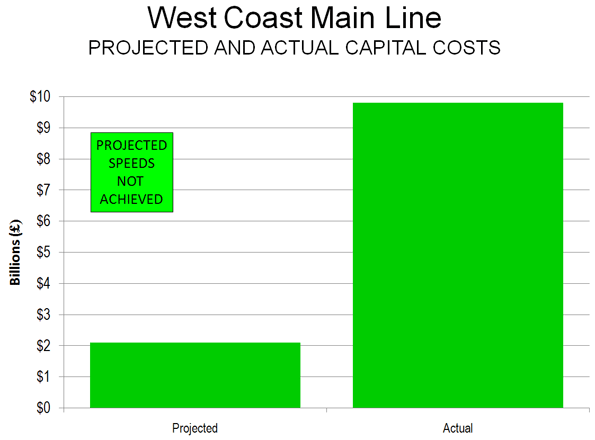
    Much of the proposed high speed rail line would be built parallel to the West Coast Main Line (which runs from London, through Birmingham and Manchester to Glasgow). Nothing short of a dog’s breakfast has been made of West Coast Main Line projects. In the 1980s, the tilting Advanced Passenger Train was developed to increase speeds to 155 miles per hour along the West Coast Main Line. The project was scrapped and all of the expenditure lost. Then there was the West Coast Main Line upgrade in the late 1990s and 2000s, to increase speeds to 140 miles per hour, which was to have cost £2 billion. The trains never exceeded 125 miles per hour, but the costs exceeded projections approached £10 billion instead, a world record cost blowout of Big Dig proportions (Figure).
    This should not be a surprise. The international record of high-speed rail projections is nothing short of horrific.Not only have costs proven far higher, but ridership and revenue have been less than projected. All of this means that taxpayers end up paying more.

    Again, Britain is a prime example. The Eurostar London to Brussels and Paris continues to attract at least 50 percent less ridership originally projected. High speed rail systems in Taiwan and Korea have had similar ridership shortfalls.

    As in Britain, costs have been higher as well. In Korea, the high speed rail line costs rose three times projections. Costs in California have increased 50 percent in two years and doubled over a decade even before the first shovel has been turned (inflation adjusted).  The cost escalation has already equaled the high end of the range predicted by Joe Vranich and me in our Reason Foundation Due Diligence Report on the California system in 2008.  

    If the proposed high speed rail project were simply to miss its cost and revenue targets by the international average (which is far better than the British experience), the benefits to users would fall below £1.00 for each £1.00 of cost. Both the strategic case and the business case for high speed rail would be blown apart. The spectre of cost overruns was a major factor in Governor Scott’s cancellation of the Florida high speed rail project.

    Not surprisingly, there is rising concern about high speed rail in Britain.A group of 21 officials, including former Chancellor of the Exchequer (minister of the treasury, finance and economics) Nigel Lawson, signed a letter to the Daily Telegraph calling the project "an extremely expensive white elephant isn’t what the economy needs. If the government wants to encourage growth there are better ways to get Britain growing and make us more competitive than getting each family to pay over £1,000 for a vanity project we cannot afford." The signatories also included Mark J. Littlewood, Director-General of the Institute of Economic Affairs, one of Great Britain’s leading free-market think tanks.

    Further, as in the United States there is also strong opposition from neighborhood groups concerned about the impact of trains operating at more than 200 miles per hour or faster through their neighborhoods. Eventually, up to 18 trains per hour are projected in each direction. This means that a 1,300 foot long train will pass houses and other adjacent development every one minute and forty seconds.

    There are the usual claims that the high speed rail line will reduce greenhouse gas emissions. However, as in California, the reality dissipates quickly, like steam into the air. Areport prepared for the Department for Transport by Booz Allen Hamilton concluded that the busiest section of the line, from London to Manchester would result in a net increase in greenhouse gas emissions when construction emissions are included (over a 60 year time analysis). Perhaps the intention is to begin reducing greenhouse gas emissions sometime after 2075?

    Monbiot further dismantles the environmental case, looking into the government reports to find that 92% of the passengers would switch to high-speed rail from alternatives that produce lower levels of greenhouse gas emissions (including conventional train, new travel and air).

    In Britain, as opposed to the United States, the proposed high speed rail system would relieve congestion on a passenger rail line. In contrast, US high speed rail lines would be built in corridors where there are few, if any rail passengers, much less passenger rail congestion.

    Even so, there are disagreements in Britain over whether high speed rail is the least costly way to address the problem, or indeed, whether there is a "problem" of sufficient magnitude to justify the public expenditure.

    The huge ridership increases projected may well be "over the top" given Britain’s less than population replacement fertility rate. As in the United States, some question the wisdom of high speed rail subsidies at a time that the government is (or in the case of the United States, should be) committed to an unprecedented austerity program that is falling heavily on middle income people who will not be the principal beneficiaries of high speed rail.

    In the final analysis, the questions will come down to who rides, how far and how fast. Will riders, in this third iteration, ride as fast as promised?  More likely it’s Britain’s beleaguered taxpayers who will be taken for a ride, with costs low-balled and ridership exaggerated as before.

    Revised on 3/22/2011. The original version had inappropritately refered to George Monbiot in the sentence about Transport Secretary Hammond. This was due to an editing error.

    Wendell Cox is a Visiting Professor, Conservatoire National des Arts et Metiers, Paris and the author of “War on the Dream: How Anti-Sprawl Policy Threatens the Quality of Life

    Photo by Jon Curnow

  • Energy Policy Reset: Forget Nuclear Reactors and Mideast Oil

    The two largest crises today — the Japanese nuclear disaster and the widening unrest in the Middle East — prove it’s time to de-fetishize energy policy. These serious problems also demonstrate why we must expand the nation’s ample oil and gas supplies — urgently.

    The worsening Japanese nuclear crisis means, for all intents and purposes, that atomic power is, if not dead, certainly on a respirator.

    Some experts may still make the case that nuclear power remains relatively safe. Some green advocates still tout its virtues for emitting virtually no greenhouse gases.

    But the strongest case against nuclear power is now rooted in grave public fears about radiation. Imagine trying to site or revamp a nuclear plant today anywhere remotely close to an earthquake fault or a major city.

    Germany has already begun shutting down some reactors. Opposition throughout Europe and in the United States is likely to grow exponentially as Japan’s tragedy unfolds.

    At the best of times, nukes were a hard sell. Even with support from Energy Secretary Steven Chu, a Nobel Prize-winning physicist who talks tough about fossil fuels, the obstacles to new nuclear construction were steep. Now, no amount of Obama administration green or corporate lobbying can overcome images of horrific fires and the terror, even if exaggerated, of radiation leaks.

    The other shoe dropping relates to the growing chaos in the Middle East, from North Africa to the Gulf. The price of oil is likely to continue climbing, unless the world economy slides back into recession — and perhaps even then. The governments that emerge from the current Mideast upheavals are likely to be far less pliable to Western interests than the authoritarian potentates that Washington long supported. Disruptions in supply, higher energy taxes and emergent environmental movements could constrain markets for months, even years, to come.

    These realities upset all the “best” obsessions of our rival political classes. Much of the progressive community, for example, had embraced nuclear fuel as key to ultimately replacing fossil fuels as a source of electricity — including the long-awaited electric cars. Green advocates often overestimated the readiness of renewable fuels — still far more expensive than fossil fuels and highly dependent on subsidies.

    Wind power, for example, produces, at best, some 2.3 percent of the nation’s electricity. But in addition to wiping out whole flocks of birds, it receives subsidies many times higher per megawatt hour than fossil fuels. In contrast, the dirtiest fuel, coal, still produces close to 50 percent of the nation’s electricity.

    Meanwhile, solar panel production, touted as a wellspring of job creation, seems to be shifting inexorably to China. Algae-based biofuels and other types look promising — but could take decades to become practical.

    Many conservatives, on the other hand, have espoused the nuclear option — in part, because the industry has powerful corporate backing, which is always an influential factor to Republicans. But even red-state denizens are probably looking at the scenes of Fukushima with understandable horror.

    So if the “best” agendas of both parties are flawed, it may be time to look at the “good.” The pragmatic way out of this emerging energy mess means focusing on our increasingly abundant supplies of oil and gas.

    “Peak oil” enthusiasts may not have noticed, but recent discoveries and improvements in technology have greatly expanded the scope of U.S. energy resources. New finds are occurring around the world, but some of the biggest are in the United States.

    Shale oil deposits in the northern Great Plains, Texas, California and Colorado could yield more oil annually by 2015 than the Gulf of Mexico. Within 10 years, these finds have the potential to reduce U.S. oil imports by more than half.

    Even more promising, from the environmental standpoint, are huge natural gas finds. Discoveries in Texas, Arkansas and Pennsylvania could satisfy 100 years of use at current demand levels.

    Natural gas is already muscling out coal as the primary source for new power plants. It can also be converted into transportation fuel, particularly for buses, trucks and taxis. In terms of pollutants and greenhouse gases, natural gas is much cleaner to burn than oil and significantly more so than coal.

    Exploring these resources is, of course, still likely to pose considerable environmental risks. But compared with the existential threat of nuclear radiation, even potential oil spills and damage to water supplies from fracking shale might be regarded as tolerable risks for which we have considerable experience and technology managing with enhanced regulation.

    In contrast, a nuclear meltdown, such as could be happening in Japan, poses a far more immediate threat than the scenarios proposed about climate change. Similarly, ceding even more power to an increasingly unstable Middle East represents a clear threat to both our economic and military security.

    Focusing on near- and medium-term fossil fuel development also has the virtue of fitting into the here-and-now realities of global economic conditions — largely the growing demand for energy in developing countries — and all but guarantees long-term high prices that encourage private investors to assume the risk. The likely demise of “clean” nuclear energy, sadly, makes such bets even more appealing.

    Producing domestic energy also creates the potential for hundreds of thousands of new U.S. jobs — everything from engineering to high-paying blue-collar work in the fields.

    A new gas-led energy boom would also spark increases in demand for manufactured goods like oil rig equipment, tractors, pipelines and refineries. And those are sectors that the United States still dominates.

    Would we rather this economic growth take place in Iran, Saudi Arabia or, for that matter, Vladimir Putin’s Russia?

    The time has come for both political parties to give up their “best” energy options for the good. A green economy that produces millions of new jobs is a laudable goal. But the renewable sector cannot develop rapidly without massive expenditures of scarce public dollars. To fully develop these technologies, we need lots of money and time.

    Republicans, too, need to give up their “bests” — including the notion that no policy is always the best, usually a convenient cover for the narrow interests of large energy corporations. Allowing private corporations to unilaterally determine our energy policy makes little sense. After all, most of our key competitors — China, Brazil and India — approach energy not as an ideological hobby horse but as a national priority.

    This new energy policy can be accomplished at far lower cost than either increasing dependence or waiting for the green Godot. It could also be far less expensive in terms of our soldiers’ lives — which would otherwise be spent protecting oil rights of corrupt Middle East regimes.

    It’s time to demand that our deluded, and self-interested, political class develops an energy policy based not ideology but on how to best guarantee prosperity for future generations of Americans.

    This piece originally appeared in Politico.

    Joel Kotkin is executive editor of NewGeography.com and is a distinguished presidential fellow in urban futures at Chapman University, and an adjunct fellow of the Legatum Institute in London. He is author of The City: A Global History. His newest book is The Next Hundred Million: America in 2050, released in February, 2010.

    Photo by gfpeck

  • Asthma: The Geography of Wheezing

    Are you familiar with the Hygiene Hypothesis? The HH — or, as some of us call it, the “pound of dirt theory” — is grabbing attention again. A minor medical press feeding frenzy followed the publication in the New England Journal of Medicine of a study based on data from Europe. The summary?

    “Children living on farms were exposed to a wider range of microbes than were children in the reference group, and this exposure explains a substantial fraction of the inverse relation between asthma and growing up on a farm.”

    This is the Hygiene Hypothesis incarnate. The HH posits that part of our immune system produces an antigen called IgE, which evolved to fight parasites in unhygienic conditions that have prevailed for most of human history, and since we are now cleaner, these antigens attack otherwise harmless proteins in some of us, making us sick, in the form of allergies. Instead of attacking, say, hookworms, the antigen goes after that just-chomped peanut butter sandwich.

    Proponents of the HH compare the prevalence of allergies in East and West Germany before and after unification. East Germany had more children growing up on farms and in larger families than West Germany, and much lower rates of allergies and asthma. Now, with its more westernized culture, East German rates of allergies and asthma have nearly caught up with West Germany.

    It makes a great story. The whole farm-city thing resonates deep in the American mind. It evokes the mythic hold that farm life has over our national psyche. Farms good; cities bad. Wholesome Jeffersonian America is good for our children not only morally, but physically. The implication is that if we all grew up on farms, asthma wouldn’t be at the epidemic levels we now have. The trouble is that in medical science there are too many variables to draw sweeping conclusions from one set of data, and anyone who would do so is not a serious scientist, or is driven by an agenda (or both).

    A case in point is a Forbes blogger who took a pot shot at mold-inspired litigation against landlords, interpreting the study to mean that mold is good for us. The Forbes blogger mentioned the case of Bianca Jagger, who sued her landlord about mold growing in her Park Avenue apartment. Erin Brockovich, Michael Jordan, and Ed McMahon are other celebrities who have coped with mold contamination, along with countless sufferers whose names are not familiar to us.

    Some mold is, undoubtedly, good. Without it, we wouldn’t have penicillin or blue cheese. But some mold can kill, particularly stachybotrys chartarum – a toxic black mold – which is often found in buildings with water damage. Other molds, while not immediately life threatening, are still potent allergens, including the ones you find in the woods behind the back 40, in Central Park, and in virtually any basement anywhere. In fairness, it’s not as easy for landlords to decide which molds to allow in their properties as it is, say, to choose between Stilton or Roquefort. As for that wet laundry you left in the washing machine for two days, it may not make you sneeze, let alone kill you, but it does stink.

    As objectionable as I find enlisting a specious inference in service of an ideological argument against the American tort bar, there are medical considerations to look at before we let the kids run barefoot through the barnyard as immunotherapy against asthma.

    First, these were European farms under study. The European farm population may or may not be a fairly homogeneous group compared to city dwellers, and genetics make a large difference in who develops asthma. It stands to reason that generations of working the family farm may have bred a hearty cohort of kids who can breathe the local air without wheezing.

    Second, there may be something about European farming practices that makes their farm/city dynamic different from ours. European farms are regulated very differently from our own, in part because of the health fears of the European commissioners. For example, genetically modified food is much more tightly restricted in Europe, if it is legal at all. This means that Europeans use different fertilizers and pesticides than the ones we use here, which undoubtedly affects the rural health picture.

    And European farm asthma may just be lagging behind ours. Typical farms are rampant with chemicals. Add to that the effects of weather on the pollen count and the aromatic plumes from manure lagoons, and no wonder rural America is suffering from an asthma epidemic that rivals the one we’re seeing in urban America.

    CDC researcher Dr. Teresa Morrison, medical epidemiologist in the Air Pollution and Respiratory Health Branch, was lead author of an article in the Journal of Asthma which concluded that “Asthma prevalence is as high in rural as in urban areas.” The goal of their research is “… to document patterns of asthma symptoms among rural residents in Midwestern states, and learn more about possible environmental exposures that potentially lead to asthma attacks.”

    David Van Sickle, who has worked with Morrison, holds a doctorate from the University of Wisconsin, and is founder of a Madison-based company called Reciprocal Sciences. In a guest editorial for www.asthmaallergieschildren.com in November, he wrote that studies of farm workers in California showed that exposures to agricultural dusts were associated with the development of persistent wheeze, exposure to pesticides was associated with the development of asthma in women, and that community exposures to airborne waste from large scale animal agriculture might also be associated with exacerbations of asthma. As he also pointed out, this may have remained hidden because it’s hard to study, but that is changing, in no small part because Van Sickle has developed an iPhone app called Asthmopolis, which can transmit information to doctors every time the patient—say a farmer—toots on his inhaler.

    No one who has studied immunology, as I have, can ignore the contribution farms have made to the treatment of the human immune system. As every biology student should know, vaccination began because Edward Jenner noticed that milk maids exposed to cow pox gained immunity from small pox. I have my doubts that a similar benefit can be derived with asthma.

    The country — where the air is full of all kinds of pollen and chemicals — is probably not the ideal choice for a Fresh Air Fund-style migration of wheezing children. But who knows? Maybe some of those farm microbes do have a salutary effect on kids’ immune systems. I wouldn’t recommend sending the kids to the city, either (check out some of the reasons a Bronx neighborhood has the nation’s highest asthma rates). If I sound equivocal, it’s because I am. Maybe sneezing, wheezing, and itching are the price we — that’s an urban and rural “us” — pay for “progress.”

    Dr. Paul Ehrlich is co-author with Dr. Larry Chiaramonte and Henry Ehrlich of Asthma Allergies Children: A Parent’s Guide (Third Avenue Books), available only from Amazon.com and from Barnes & Noble. He is co-founder of asthmaallergieschildren. He is a fellow of the American Academy of Pediatrics, the American Academy of Allergy, Asthma & Immunology, and the American College of Allergy, Asthma & Immunology, as well as a clinical assistant professor of pediatrics at New York University School of Medicine, and an attending physician at Beth Israel Medical Center and at the New York Eye & Ear Infirmary. He has been featured as one of the top pediatric allergy and immunology specialists in New York Magazine for the last 10 years and counting.

    Photo by Nathan T. Baker: “I might have to get a cooler style for this asthma inhaler.”

  • Dallas Charges Up for the Electric Chevy

    If they build it, will we come? Planners, utilities, auto industry execs, and retailers are hopeful that we will, as they get themselves ready for electric vehicles in the Dallas/Fort Worth Metroplex. This isn’t a pie-in-the-sky vision for the future. The reality is unfolding right now. In 2011, NRG Energy will install upwards of 70 car-charging stations across Dallas and Forth Worth. As the Nissan Leaf and the Chevy Volt begin to penetrate the D/FW market, NRG aims to capture the revenue stream from charging car batteries here, just it is doing in Houston. NRG’s news comes on the heels of electric utility TXU Energy’s announcement of its own installation of twelve public charging stations being allocated across Dallas and Fort Worth.

    I’ve been watching the wave for several years as part of my work with emerging companies. At numerous conferences on electric vehicles, I’ve observed stakeholders – many of them in competition with each other – come together to swap ideas, network, and hammer out standards. It’s been an education in the necessity of collaboration to foster sustainable development.

    Cooperation hasn’t been guided by idealism so much as by the urge to survive in a market that, until recently, was practically non-existent. Start-ups that have failed to collaborate have fallen by the wayside. As one conference speaker joked, “We’ve got to build up the market before we tear each other down.”

    Profit-making may be the motivation of electric-vehicle manufacturers, but others at the table have their own agendas for EV readiness. The city of Dallas, for example, is in Serious Nonattainment status for ozone pollution. The region risks losing funding if it doesn’t clean up its air. “Seventy percent of air pollution in Dallas comes from on-road/off-road vehicles, so EVs can play a substantial role in resolving this,” said Jennifer Cohen, Executive Director for the North Texas Clean Air Coalition. Cohen was an organizer of the Electric Vehicle North Texas Electric Vehicle Showcase last September at the State Fair of Texas.

    At the Electric Vehicle Showcase. Betsy del Monte, Director of Sustainability for Dallas-based construction giant BECK told a panel, “Mass transit alone cannot solve our problem. We also need to look at the broader picture in terms of development. Of the palette of materials that we have available, EVs are one of the tools we must come to rely on.”

    Tom Reddoch, Director of Energy Efficiency for Electric Power Research Institute, agreed: “This is a success story. EPRI is connecting two giants, the electric industry with the auto industry.” To assist stakeholders with the information they need to build communities that can sustain a transition to electric vehicles, EPRI sees three keys: regionally-driven consumer attitudes, the installation of charging infrastructure in order to ensure a positive response for the drivers’ first experiences, and utility readiness. “We have plenty of capacity to go around, especially if people charge at night,” said Reddoch, “but there could be localized effects where cars cluster. The construction community, developers, and architects need to address this together.”

    At a technical level, tools are emerging that can help integrate electric vehicles into the transportation landscape. “We’ve arrived at an interesting nexus between the power industry and the auto industry,” said Brad Gammons of IBM. “There is not going to be a dominant leader so we need standards across the value chain… Collaboration ensures that things happen efficiently.”

    Not all collaboration requires complex software. Some of it is happening on the ground, person to person. The installation of electric vehicle charging infrastructure in D/FW is giving two cities with a long (if friendly) rivalry a chance to mutually benefit by working together. “To get the mayor of Fort Worth to travel to Dallas to talk about EVs is huge,” said Jim Greer of Oncor electricity.

    Range anxiety continues to be a barrier to electric vehicle adoption, even though three-fourths of Americans commute less than 40 miles per day. “To handle range anxiety, we need to provide home-based charging capability,” said del Monte from BECK.

    At the same time, Half Price Books unveiled Dallas’ first public charging station. Granted, there’s not a line around the block for the EV charger yet. But just having it at one of Dallas’ most popular bookstores sends a tangible signal to drivers that the future is here and now.

    As the infrastructure falls into place, the question remains: Will drivers buy the cars? We’ll find out very soon. The Chevy Volt is scheduled to arrive on car dealers’ lots in Dallas-Fort Worth in March.

    Photo of the Chevy Volt, a plug-in electric vehicle by IFCAR

    Anna Clark is the author of Green, American Style and the president of EarthPeople. She lives in one of Dallas’ first residences to earn a Platinum-LEED certification from the U.S. Green Building Council.

  • Petrol a Green Fuel? The Volkswagen 261 Mile per Gallon Car

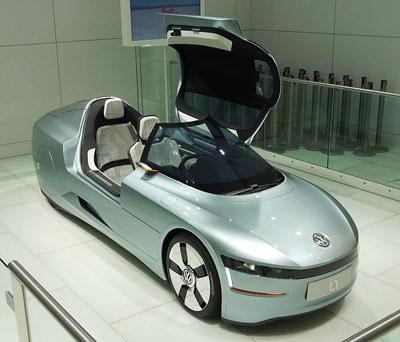
    There have been reports for some years about the Volkswagen 1-litre car, so called because it would travel 100 kilometers on one litre of fuel. That is the equivalent of 235 miles per gallon. Earlier reports were that the car would be marketed by now.

    Now Volkswagen indicates that the car will be produced "within the next few years." The car will be called the XL1. However, rather than being a 1 L car it will be a 0.9 L car, achieving 261 miles per gallon. The improvement is the result of adding an electric motor that will make the car a plug-in hybrid.

    This is just further indication of reality that technological improvements can materially reduce greenhouse gas emissions. Indeed, if the entire automobile fleet could obtain this fuel efficiency by 2050, greenhouse gas emissions from cars would be reduced more than 80 percent, despite substantial increases in driving. This development may mean that petroleum itself could emerge as a "green fuel."

    Moreover, this advance is consistent with finding by McKinsey & Company and the Conference Board, in a report sponsored by the Environmental Defense Fund, the Natural Resources Defense Council (NRDC), Shell, National Grid, DTE Energy and Honeywell that "….no change in thermostat settings or appliance use, no downsizing of vehicles, home or commercial space and traveling the same mileage” and no “shift to denser urban housing" would be necessary to achieve substantial greenhouse gas emission reductions in the United States.

    Volkswagen L1 (2009) photo by RudolfSimon

  • More Cap and Trade Delays in California

    The California Air Resources Board had good intentions when it developed a cap-and-trade plan to meet greenhouse gas standards, but according to a San Francisco Superior Court Judge, the Board made a few mistakes that will delay their efforts. The Air Resources Board is acting in response to AB32, California’s Global Warming Solutions Act of 2006, which calls for the reduction of carbon emissions to 1990 levels by 2020.

    They are being sued by a team of environmental groups, represented by the San Francisco’s Center on Race, Poverty and the Environment, who disapprove of the Board’s inadequate analysis of alternatives to cap and trade. Not only that, but Judge Ernest Goldsmith found that the Board’s “analysis provides no evidence to support its chosen approach.” These issues are becoming commonplace in California these days, as they echo the criticisms of California’s High Speed Rail Authority’s quick decisions in building new rail lines.

    The California Air Resources Board will not be able to move forward until it complies with the California Environmental Quality Act of 1970, which Governor Reagan enacted to make sure agencies in California both determined and prevented the environmental consequences of their projects. The environmental groups who raised this lawsuit, who would be disappointed if AB32 were to be delayed or abolished, want to assure that any environmental legislation would not hurt disadvantage communities in the state. Therefore, they are willing to wait for the Air Resources Board to comply with the California Environmental Quality Act and explore the possibilities beyond cap-and-trade.

    Acting too quickly without fully exploring all options has become a theme in California politics, mainly because the state is in such a rush to meet deadlines outlined in the legislation or that dictate the disbursement of federal funds. This haste to develop may ultimately hinder new projects since the public will be extra vigilant in making sure agencies find solutions that support their well-being.

  • Agglomeration Vs. Isolation for Science Based Economic Development

    Earlier this month President Obama signed the reauthorization of the COMPETES Act, which provides federal funding for science initiatives aimed at enhancing economic competitiveness. In addition to shoring up agencies like the National Science Foundation, the bill called on the Department of Commerce to create a new program charged with supporting the development of research parks and regional innovation clusters. Unheard of before World War II, these entities today represent the cutting edge in what insiders call TBED: technology-based economic development. By leveraging existing strengths and promoting cooperation between universities and private industry, TBED-minded regions seek to attract outside investment and carve out a niche in the global economy.

    Research parks and innovation clusters both draw on the logic of agglomeration: when smart people (or up-and-coming firms) gather in a concentrated area, the story goes, they bounce ideas off each other and push each other to innovate and eventually outperform other people or firms who are more widely dispersed. This is the logic at the heart of Geoffrey West’s grand unified theory of urbanism featured in the New York Times back in December. It’s the logic of Silicon Valley. But is agglomeration always good for science? What assumptions do clusters and science parks make about how research gets carried out? That is, does science cluster of its own accord? Or can the political and economic arguments for clustering come into conflict with strains of science that are best kept at arm’s length?

    An instructive case to consider is that of the National Bio- and Agro-Defense Facility (NBAF), an animal disease research facility set to be built in Manhattan, Kansas. After the anthrax attacks of 2001, bioterrorism experts convinced the Bush administration that biological agents and, specifically, diseases affecting American livestock could constitute a threat to the nation’s security. American agriculture was, in the words of one presidential directive, “an extensive, open, interconnected, diverse and complex structure providing potential targets for terrorist attacks.” So the Department of Homeland Security (DHS) dreamed up a new, state-of-the-art laboratory for animal disease research, and after a long, involved site selection process, Kansas was selected to host the new lab in December 2008. As the Daily Yonder recently reported, concerns persist about whether it’s a good idea to conduct research on deadly livestock diseases smack in the middle of cattle country.

    Then what brought NBAF to Kansas, if DHS acknowledged that a mainland location was riskier than a lab located offshore? The answer, as far as I can tell, is agglomeration. NBAF’s predecessor, the Plum Island Animal Disease Center, was located in the middle of Long Island Sound to minimize the risk of an accidental pathogen release. Scientists took a ferryboat to work in the morning, and in the early years nothing could leave the island, not even library books. NBAF, on the other hand, was always envisioned as part of a constantly circulating network. DHS’s request for proposals explicitly mentioned “proximity to other related scientific programs and research infrastructure” as one of the selection criteria. Others included proximity to vaccine manufacturers and access to an international airport. If the geographical logic of animal disease research after World War II was one of isolation, then the new logic of post-9/11 science was one of hyperconnection.

    The sites that were well connected—literally—were the ones that moved forward in the NBAF site selection process. Georgia and North Carolina offered access to nearby veterinary schools, while Mississippi vowed to work with contract research giant Battelle to drum up the necessary workforce. Backers in San Antonio proposed locating the lab in, you guessed it, the Texas Research Park. But it was the Kansas bid that best exemplified the new logic of agglomeration, by envisioning NBAF as the anchor for an emerging Kansas City Animal Health Corridor. Kansas State University, where the lab would be located, offered DHS “surge capacity” in its new Biosecurity Research Institute if a crisis were to ensue. And as for the half-million cattle in nearby counties? Those, too, became part of the cluster, with the Kansas Livestock Association issuing a letter of support arguing that “having this facility in close proximity to the nation’s geographic concentration of meat production is extremely logical.” The proximity that a previous generation of researchers understood as a vector of contagion was now being repackaged as a source of reassurance and a boon to scientific discovery.

    You can’t fault Kansas, of course, for wanting to secure its slice of the knowledge economy. In a report for the Chicago Council on Global Affairs, Mark Drabenstott argues that Midwestern states need to be looking beyond silos and smokestacks, and the Kansas Bioscience Authority estimates that NBAF will have a positive economic impact of $3.5 billion over the next two decades. That’s pretty good. Except, according to a 2009 report from the Government Accountability Office, the cost of a large-scale outbreak of foot-and-mouth disease would be even greater. There are no easy answers here. The point is that science-driven development carries risks, and concentrating brainpower in one place can also mean concentrating the harmful substances that those knowledge workers handle each day. Without being hobbled by irresponsible fearmongering, states and regions pursuing an innovation agenda need to be honest about the associated risks—and to ensure that the people who bear those risks also stand to reap the rewards.

    After all, confining science to uninhabited islands means asking scientists to live like monastics, and risks isolating them in an echo chamber of their own assumptions. That’s neither desirable nor practical. So, if the science cluster is here to stay, then the question becomes how to build a research infrastructure that maximizes the benefits of clustering and minimizes the drawbacks.
    Brazil’s Ministry of Science and Technology just put forward a promising template, which calls for decentralizing scientific research from the southern cities of São Paulo and Rio de Janeiro to other parts of the country. Too much concentration in the south, the ministry concluded, could actually quash innovation and exacerbate existing inequalities. But a growing research economy in the north could ease the strain on the region’s natural resources and help incoming president Dilma Rousseff to make good on her pledge to combat poverty in the South American nation.

    Let’s be clear: there’s no neatly replicable way of manufacturing scientific breakthroughs, and people around the world will continue to have good ideas without ever setting foot in an innovation cluster. Still, modern science thrives on linkages, and managing those linkages has become an increasingly central part of modern statecraft. As policymakers use the new tools at their disposal to promote cooperation between universities, companies, and local economies, they would do well to think of agglomeration, not as an inherent good, but as a means of securing real, sustainable prosperity.

    Marcel LaFlamme is a graduate student in the Department of Anthropology at Rice University. His research focuses on science-driven development on the American Great Plains.

    Photo: NBAF draft rendering, K-State.edu

  • The Urban Energy Efficiency Retrofit Challenge

    I was welcomed home to Chicago from visiting family on Christmas Day by a cold house and a gas furnace that wasn’t working. The next day a repair tech gave me the bad news about a blown circuit board that would cost over $500 to replace. But I heard that were was a $1500 tax credit for energy efficient upgrades that was expiring at year end. With $2000 in “free money” to spend, I thought maybe furnace replacement might be a better option. At eight years old, the furnace might have more years of life. But it was a “developer special” – that is, a basic workhorse model that was not particularly energy efficient – only 80% Annual Fuel Utilization Efficiency (AFUE) rated – or with other features I might like. My hot water heater dated to the same time and was probably closer to needing to be replaced, so why not do them both at the same time? Maybe I would even go super-enviro friendly with a tankless model water heater.

    This is exactly what the stimulus was supposed to be stimulating. Unfortunately, the reality didn’t work out like I thought it would, and in a way that shows the challenge of doing energy efficiency retrofits in urban areas.

    I had my heating company come out to give me an estimate on replacement for my furnace and hot water heater. Immediately, I learned that there were problems. Chief among them is that newer, energy efficient systems recycle heat that previously went up the chimney. This makes their exhaust much cooler, and requires special chimney pipes that are plastic, not metal. My old chimney wouldn’t work, nor could a new pipe be inserted through it, since my water heater and furnace shared a chimney and there wasn’t room to install all the piping needed. They’d have to punch new holes in my roof. I’m on the top floor of my 14 unit building, which means this is actually doable, but it would cost money and require getting permission from my association. It’s also not something I’d want to take on in the winter unless absolutely required. And, as it turns out, I might not have a big enough gas line required to feed regardless tankless water heater. Tankless units consume less energy overall, but they do burst at higher output, requiring heftier gas supplies.

    I decided to just fix the circuit board.

    According to the heating company, if I lived in a single family home, this would probably have all been a non-issue. First, no permission would be needed from anyone, and generally furnaces and such are located where you can just punch an exhaust line directly out the side of the house. This makes upgrading a snap. But since I’m in an urban multi-unit building, things aren’t so easy. What’s more, even though I and the other person who live on the top floor might be able to make an upgrade happen, the other 12 units below us will never be able to upgrade to energy efficient heating because it is impossible for them to run new chimney pipes to the roof. That is, unless a new generation of technology vents through older metal chimney pipes. In essence, then, my building is permanently precluded from installing high efficiency heating – although the structure is less than a decade old.

    Gas forced air is the standard heating solution for new construction in Chicago and much of the Midwest. This may not apply to the largest buildings, but certainly to single family homes and most of the new construction condos in Chicago. Being able to upgrade building systems is key to energy efficiency, because buildings are the number one source of carbon emissions. In the city of Chicago, about 70% of all carbon emissions come from buildings. And while multi-unit buildings may be inherently more efficient in some regards, they create huge challenges for upgrades because of all the shared infrastructure and lack of access to the roof, exterior walls, and utility feeds. This might not apply in some cases where there is, for example, a shared boiler where one upgrade takes care of all units. But for most new construction condos outside of high rises, I strongly suspect they were built without energy efficient furnaces and in a way that effectively precludes upgrading to current technology.

    This shows the need for infrastructure and buildings that are designed to physically evolve over time. With rapidly changing technology, a “build once for the ages” approach is no longer appropriate. Even if codes were changed to require energy efficient heating at the time of construction or the installation of provisions for gas supply and venting, it would only deal with the here and now. We’d be fools to believe we are never going to want to upgrade things again in the future.

    The things we buy become obsolete more rapidly than ever. Consumer electronics companies have solved this with a short product cycles and rapidly declining costs that assumes the things you buy will be disposable. We should think about this principle as applied to buildings, but we’re probably a long way off from that.

    This is a difficult challenge and one that requires significant thought and trial and error as technology doesn’t always evolve like we think it will. I was very proud of myself for being forward looking enough to run network cabling to every room when I renovated an 1898 house back in the 1990s. A few years later wireless rendered that investment in wires itself obsolete.

    But it’s worth the effort to try to find a solution. From our highways and transit systems, to water and sewer lines, to our buildings, we are facing a huge overhang of required replacements and upgrades, much of the cost driven by a need to bring designs up to new, modern design requirements and the state of the art. We could spend an enormous amount of money doing this only to find ourselves right back in the same boat a few decades down the road when things are old again, and society’s desires and technology have moved on to the next generation. In an era of ever greater technology change, finding a way to ride the upgrade curve effectively is an imperative.

    Aaron M. Renn is an independent writer on urban affairs based in the Midwest. His writings appear at The Urbanophile.

    Photo by Ron Zack

  • Here Comes Barack Cameron?

    President Bill Clinton and British Prime Minister Tony Blair were so “like-minded,” according to one Los Angeles Times writer, that they brought new meaning to the U.S. and England’s “special relationship.” Blair’s later embrace of George W. Bush, however, was less satisfying, leading to widespread ridicule that the PM was the Texan’s favorite “lap dog.”

    President Barack Obama shares little of his predecessors’ Anglophilia; he even unceremoniously returned Blair’s gift of a Winston Churchill bust loaned to Bush after 9-11. Yet however much Obama may detest the old Tory imperialist, he might find in Blair’s successor David Cameron a role model for his troubled administration.

    On the surface, the aristocratic, well-heeled Cameron, the son of a wealthy stockbroker and husband to an heiress (he is now estimated to be worth 30 million pounds), might seem a poor match for the self-made community organizer from Chicago. But Cameron’s philosophy — which melds liberal social and environmental concerns with fiscal conservatism — could prove useful to the U.S. president, particularly since Obama’s initial plan (massive expansion of the federal welfare state) has been made moot by the recent election. Cameron’s “One Nation” Toryism offers a model of governmental activism while accommodating anti-deficit sentiment that has grown in both countries.

    But Cameron’s politics share more with Obama’s than meets the eye.  Like the Obama, he is articulate, attractive and young — at 44 he is five years younger than the U.S. president. And he is determined to reshape his party’s image. Cameron represents a break from what we might consider rightist conservatism. Unlike Margaret Thatcher, Cameron reflects gentry, not middle-class, conservative values; much like Obama he appeals more to the well-educated segments of society. Enterprise, the breaking down of class structures and expanding opportunity and ownership do not rank among Cameron’s priorities. The Telegraph’s Simon Heffer suggests that Cameron shares some similarities with Harold MacMillan, who sought to put a more human face of Britain’s notoriously rigid class system rather than upending it entirely.

    Cameron’s Conservatives, locked in a governing alliance with the Liberal Democrats, also eschew the unattractive views, common on the continental right, about immigrants or minorities. These enlightened social attitudes reflect the class consensus of the upper echelons of post-industrial Britain — much as Obama’s social views resonate with the U.S.’ academic, media and financial sectors.

    The big banks represent the most important gentry constituency on both sides of the Atlantic. In Washington the new Chief of Staff, crony capitalist extraordinaire Bill Daley, will strongly reflect their interests. In both countries, the financial services industry has benefited more from government largesse and monetary policy than any other sector. Less than three years from helping sink the world economy, firms in the City in London and Wall Street in New York are minting money and handing out lush bonuses. In London, developers are considering building new office complexes. The restaurants and fancy shops, from the City and Mayfair to the West End, like their counterparts in swank parts of Manhattan, are thriving.

    This prosperity, of course, contrasts dramatically with conditions outside the financial sector. Like the American industrial heartland, areas outside the largely prosperous southeastern U.K. are struggling. Some of these areas, notes Conservative MP Mark Field, resemble “Stalinist Russia” in their near total dependence on government spending. Any significant cutbacks in government expenditures will hit these areas hardest.

    These areas would benefit most from expansive, pro-growth policies that encourage building new plants, research facilities and business services outside London’s swanky precincts. But Cameron, like Obama, seems more interested in promoting “hip” urbanism focused on high-end services, media and cultural exports than in rebuilding Britain’s declining middle-class job base.

    Cameron’s political “green act,” as Heffer calls it, reflects aristocratic attitudes and a keen reading of “focus groups.” Unlike the current crop of conservatives in Washington, Cameron’s Conservatives embrace the global warming agenda about as fully as their Labour predecessors. They embrace all the policies — high-speed rail, pro-density planning policies, massive subsidization of renewable fuel — that remain critical Obama policies.

    Cameron’s Conservatives have even sought to limit the construction of new runways at Heathrow, the country’s main airport, in order to stop what the government has called “binge flying.” Of course, this usually refers to middle-class people taking cheap vacations on low-cost airlines. After all, much higher airfares won’t much affect the financial sector, which can easily absorb them.

    Green land-use policy is also useful to the City, notes the pro-development group Audacity, since it serves to constrict supply and bolster the value of  mortgages by keeping prices artificially high. The U.K. suffers a perennial shortage of homes that already has reached 1 million, a number likely to double in the following decade. No surprise then that British property prices, compared to incomes, are among the highest in the world, particularly in and around London.

    The City, like Wall Street and Silicon Valley, hopes to make a killing on “cap and trade” as well as a host of renewable energy schemes. For Obama, who is anxious to repair relations with big business, green politics represents a potential windfall, bringing him accolades from both the financial hegemons and parts of his enviro-focused “progressive” base.

    Yet a combined policy of fiscal austerity and green regulations could also suppress growth across the broader economy outside the high-end financial and service sector. Opposition to new fossil fuel plants, opting instead for expensive and highly subsidized wind-energy could double U.K. energy by 2030. Faced with competition from developing countries willing to burn coal, oil and perhaps anything flammable, and lacking the hydro-resources of Scandinavia or the nuclear industry of France, British the U.K. will face ever great obstacles in the global marketplace

    Overall Cameron’s policies, notes author James Heartfield, will likely intensify class barriers in Britain. Over this cold, snowy winter as many as 25,000 people have died from exposure, in large part because they cannot afford higher energy bills. Millions of homes, schools and hospitals face winter fuel-rationing.

    Similarly, the Tory resistance to building new suburban housing will not only deprive people of the option of a decent, low-density lifestyle, but it will also strip jobs from the historically well-paying blue-collar construction trades. Under current policies, notes one recent study, prospective homeowners will face “mortgage misery” for the rest of the decade.

    Of course, these policies present political risks.  Conservative poll ratings are up slightly, but Cameron’s coalition partners, the Liberal Democrats, who appeal more to centrist voters, are fading rapidly. A year after its resounding defeat, Labour has surged to a slight lead in the polls.

    Yet given the current reality, a Cameron-like embrace of austerity coupled with green policies represents a positive strategy for the Obama Administration. Just as Cameron has sought to redefine conservativism with a humane face, Obama could concoct a modern progressivism that is both green and fiscally responsible.  By 2012, the radical community organizer could well morph into an entirely new persona: Barack Cameron.

    This piece originally appeared in Forbes.

    Joel Kotkin is executive editor of NewGeography.com and is a distinguished presidential fellow in urban futures at Chapman University, and an adjunct fellow of the Legatum Institute in London. He is author of The City: A Global History. His newest book is The Next Hundred Million: America in 2050, released in February, 2010.

    Photo Wikipedia Commons

  • California’s Third Brown Era

    Jerry Brown’s no-frills inauguration today as California governor will make headlines, but the meager celebration also marks the restoration of one of the country’s most illustrious political families. Save the Kennedys of Massachusetts no clan has dominated the political life of a major state in modern times than the Browns of California. A member of this old California Irish clan has been in statewide office for most of the past half century; by the end of Jerry Brown’s new term, his third, the family will have inhabited the California chief executive office for a remarkable two full decades since 1958.

    Brown, at 72 the oldest governor in state history, may well determine the final legacy of this remarkable family. His biggest challenge will be to reverse the state’s long-term secular decline — a stark contrast to the heady days of the first Brown era, presided over by paterfamilias Edmund “Pat” Brown.

    Pat Brown was a committed progressive who actually believed in both social and economic progress. He did not focus on re-distributing wealth or expanding bureaucratic controls; his priority was to use government to help generate greater opportunities for Californians.

    Under Pat roughly 20% of the state budget was devoted to capital outlays. He expanded wealth creating infrastructure such as freeways and the State Water Project, which created vast expanses of new, highly fertile farmland. He also increased the state’s parklands so that middle-class Californians could enjoy the state’s unmatched natural beauty.

    Pat, as historian Kevin Starr notes, also transformed California into “a mecca for education.” Inexpensive and quality training — from the elite university to the extensive network of community colleges — fostered high-tech industries across the state. Under Pat Brown, California’s share of the nation’s employment rose from some 8% to 10% as its GDP swelled by a similar percent.

    Pat, not surprisingly, remains an iconic figure for many older Californians. What ended his career was not so much his embrace of big government — although its growing scope and cost concerned many voters  – but backlash against the 1964 “free speech” riots at Berkeley and the far deadlier civil unrest in Watts the following year.  Running as the candidate of law and order, as well as fiscal conservatism, Ronald Reagan in 1966 defeated Brown’s bid for a third term.

    Yet so great was the reservoir of affection for the Pat Brown that in 1974 the voters elected his 36-year-old son as Reagan’s successor. As the late Joe Cerrell, a key operative for both Browns, put it: “If he had run as Edmund G. Green, he wouldn’t have bet on his running in the top 14.”

    Jerry Brown turned out to be of a very different political hue than his father. Sometimes he sounded more anti-government even than Reagan. He disdained his father’s traditional focus on   infrastructure spending and instead preached about amore environmentally friendly “era of limits.”  Brown cut the percentage of spending on such capital improvements from roughly 10% of state spending under Reagan to barely 5%, where it remains mired today.

    Arguably Brown’s biggest mistake was signing legislation in 1978 that allowed collective bargaining for public employee unions. This opened the door for a power grab that eventually drove the state toward semi-permanent penury. Brown’s early embrace of environmentalism also set a pattern of state green engineering that, although clearly avant garde , also tipped the state’s competitive edge.

    Brown, however, also showed a pragmatic side.   Although initially opposed to Howard Jarvis’ 1978 Proposition 13 limits on property taxes, he later embraced it  so enthusiastically that the casual voter might have mistaken him for its author. In his second term Brown also evolved into an avid cheerleader for the state’s burgeoning high-tech industry.

    He also had good fortune to govern California at a time when surging Japanese investment, the high tech boom and, perhaps most important of all, the military buildup accelerated by the 1979 Soviet invasion of Afghanistan generated a remarkable economic boom. Between 1976 and 1980 aerospace and electronics-related employment jumped by a third. California’s share of the nation’s GDP, population and jobs rose steadily, while job growth surpassed the national average.

    The third Brown era, sadly, starts with far less favorable prospects. The state’s share of the nation’s economy and employment has been shrinking for at least a decade. Per capita income has fallen in comparison with the national average by nearly 20%. Once the nation’s high tech wunderkind, California’s share of new high-tech jobs has fallen to a fraction of the national average, while other states, notably Texas, Virginia, Utah and Washington have surged ahead.

    Things have been toughest on the state’s working class. Despite an ever-expanding welfare state, California’s 36 million people suffer a rate of poverty at least one-third higher than the national average when adjusted for cost of living.  Unemployment now is higher than any major state outside Michigan.

    Meanwhile, even as state social spending has surged, reminders of the heroic period — from the state system of higher education to the power, water and freeway systems — have fallen into disrepair. The state’s finances are in even worse shape. Under the feckless Arnold Schwarzenegger, state debt jumped from $34 billion to $88 billion. California now spends twice as much on servicing its interest (more than $6 billion annually) than on the University of California.

    Brown himself recently conceded that the state budget deficit may widen to $28 billion over the next 18 months while the state’s Legislative Analyst’s Office predicts that $20 billion deficits are likely to persist at least through 2016. Not surprisingly, once golden California suffers consistently near the worst debt rating of any state. And things are not likely to turn around quickly: State and local tax revenues in the third quarter of last year rose a paltry 0.6% compared with a 5.2 % gain nationwide.

    Brown’s proven taste for austerity could make him far more effective at addressing the state fiscal crisis than the clueless Terminator. His biggest problem on fiscal matters, one close advisor confided, may lie with his own Democrats in the legislature, many of whom are little more than satraps of the public employee interests.

    Brown’s support for the state’s increasingly draconian green polices may prove more problematic.  As Attorney General, Brown played the bully in enforcing radical green measures that seek to limit developments — industrial and residential — suspected of creating greenhouses gases. Brown suggested during the campaign that such policies would help create an estimated 500,000 green jobs, but few outside the environmental lobby take this seriously. Brownsupporter Tom Hayden points out that these jobs can only be created by higher energy prices and considerable tax increases — not exactly the elixir for an already weak economy.

    More troubling still, Brown, the Democratic leadership and their media supporters continue to deny that “progressive” policies have created  ”a hostile business climate.” Until they wake up to the reality of the state’s dire economic situation, little in the way of serious reform can be expected.

    To succeed, Brown must move beyond delusions and rediscover the pro-business pragmatism that characterized his second gubernatorial term. If not, we can expect the final obliteration of Pat Brown’s great  legacy of pro-growth progressivism, in no small part due to the misjudgments of his son and heir.

    Joel Kotkin is executive editor of NewGeography.com and is a distinguished presidential fellow in urban futures at Chapman University, and an adjunct fellow of the Legatum Institute in London. He is author of The City: A Global History. His newest book is The Next Hundred Million: America in 2050, released in February, 2010.

    Photo by Thomas Hawk