Tag: Environment

  • Progressives Against Progress

    For the first two-thirds of the twentieth century, American liberals distinguished themselves from conservatives by what Lionel Trilling called “a spiritual orthodoxy of belief in progress.” Liberalism placed its hopes in human perfectibility. Regarding human nature as essentially both beneficent and malleable, liberals, like their socialist cousins, argued that with the aid of science and given the proper social and economic conditions, humanity could free itself from its cramped carapace of greed and distrust and enter a realm of true freedom and happiness. Conservatives, by contrast, clung to a tragic sense of man’s inherent limitations. While acknowledging the benefits of science, they argued that it could never fundamentally reform, let alone transcend, the human condition. Most problems don’t have a solution, the conservatives maintained; rather than attempting Promethean feats, man would do best to find a balanced place in the world.

    In the late 1960s, liberals appeared to have the better of the argument. Something approaching the realm of freedom seemed to have arrived. American workers, white and black, achieved hitherto unimagined levels of prosperity. In the nineteenth century, only utopian socialists had imagined that ordinary workers could achieve a degree of leisure; in the 1930s, radicals had insisted that prosperity was unattainable under American capitalism; yet these seemingly unreachable goals were achieved in the two decades after World War II.

    Why, then, did American liberalism, starting in the early 1970s, undergo a historic metanoia, dismissing the idea of progress just as progress was being won? Multiple political and economic forces paved liberalism’s path away from its mid-century optimism and toward an aristocratic outlook reminiscent of the Tory Radicalism of nineteenth-century Britain; but one of the most powerful was the rise of the modern environmental movement and its recurrent hysterias.

    If one were to pick a point at which liberalism’s extraordinary reversal began, it might be the celebration of the first Earth Day, in April 1970. Some 20 million Americans at 2,000 college campuses and 10,000 elementary and secondary schools took part in what was the largest nationwide demonstration ever held in the United States. The event brought together disparate conservationist, antinuclear, and back-to-the-land groups into what became the church of environmentalism, complete with warnings of hellfire and damnation. Senator Gaylord Nelson of Wisconsin, the founder of Earth Day, invoked “responsible scientists” to warn that “accelerating rates of air pollution could become so serious by the 1980s that many people may be forced on the worst days to wear breathing helmets to survive outdoors. It has also been predicted that in 20 years man will live in domed cities.”

    Thanks in part to Earth Day’s minions, progress, as liberals had once understood the term, started to be reviled as reactionary. In its place, Nature was totemized as the basis of the authenticity that technology and affluence had bleached out of existence. It was only by rolling in the mud of primitive practices that modern man could remove the stain of sinful science and materialism. In the words of Joni Mitchell’s celebrated song “Woodstock”: “We are stardust / We are golden / And we got to get ourselves back to the garden.”

    In his 1973 book The Death of Progress, Bernard James laid out an argument already popularized in such bestsellers as Charles Reich’s The Greening of America and William Irwin Thompson’s At the Edge of History. “Progress seems to have become a lethal idée fixe, irreversibly destroying the very planet it depends upon to survive,” wrote James. Like Reich, James criticized both the “George Babbitt” and “John Dewey” versions of “progress culture”—that is, visions of progress based on rising material attainment or on educational opportunities and upward mobility. “Progress ideology,” he insisted, “whether preached by New Deal Liberals, conservative Western industrialists or Soviet Zealots,” always led in the same direction: environmental apocalypse. Liberalism, which had once viewed men and women as capable of shaping their own destinies, now saw humanity in the grip of vast ecological forces that could be tamed only by extreme measures to reverse the damages that industrial capitalism had inflicted on Mother Earth. It had become progressive to reject progress.

    Rejected as well was the science that led to progress. In 1970, the Franco-American environmentalist René Dubos described what was quickly becoming a liberal consensus: “Most would agree that science and technology are responsible for some of our worst nightmares and have made our societies so complex as to be almost unmanageable.” The same distrust of science was one reason that British author Francis Wheen can describe the 1970s as “the golden age of paranoia.” Where American consumers had once felt confidence in food and drug laws that protected them from dirt and germs, a series of food scares involving additives made many view science, not nature, as the real threat to public health. Similarly, the sensational impact of the feminist book Our Bodies, Ourselves—which depicted doctors as a danger to women’s well-being, while arguing, without qualifications, for natural childbirth—obscured the extraordinary safety gains that had made death during childbirth a rarity in developed nations.

    Crankery, in short, became respectable. In 1972, Sir John Maddox, editor of the British journal Nature, noted that though it had once been usual to see maniacs wearing sandwich boards that proclaimed the imminent end of the Earth, they had been replaced by a growing number of frenzied activists and politicized scientists making precisely the same claim. In the years since then, liberalism has seen recurring waves of such end-of-days hysteria. These waves have shared not only a common pattern but often the same cast of characters. Strangely, the promised despoliations are most likely to be presented as imminent when Republicans are in the White House. In each case, liberals have argued that the threat of catastrophe can be averted only through drastic actions in which the ordinary political mechanisms of democracy are suspended and power is turned over to a body of experts and supermen.

    Back in the early 1970s, it was overpopulation that was about to destroy the Earth. In his 1968 book The Population Bomb, Paul Ehrlich, who has been involved in all three waves, warned that “the battle to feed all of humanity is over” on our crowded planet. He predicted mass starvation and called for compulsory sterilization to curb population growth, even comparing unplanned births with cancer: “A cancer is an uncontrolled multiplication of cells; the population explosion is an uncontrolled multiplication of people.” An advocate of abortion on demand, Ehrlich wanted to ban photos of large, happy families from newspapers and magazines, and he called for new, heavy taxes on baby carriages and the like. He proposed a federal Department of Population and Environment that would regulate both procreation and the economy. But the population bomb, fear of which peaked during Richard Nixon’s presidency, never detonated. Population in much of the world actually declined in the 1970s, and the green revolution, based on biologically modified foods, produced a sharp increase in crop productivity.

    In the 1980s, the prophets of doom found another theme: the imminent danger of nuclear winter, the potential end of life on Earth resulting from a Soviet-American nuclear war. Even a limited nuclear exchange, argued politicized scientists like Ehrlich and Carl Sagan, would release enough soot and dust into the atmosphere to block the sun’s warming rays, producing drastic drops in temperature. Skeptics, such as Russell Seitz, acknowledged that even with the new, smaller warheads, a nuclear exchange would have fearsome consequences, but argued effectively that the dangers were dramatically exaggerated. The nuke scare nevertheless received major backing from the liberal press. Nuclear-winter doomsayers placed their hopes, variously, in an unverifiable nuclear-weapons “freeze,” American unilateral disarmament, or assigning control of nuclear weapons to international bodies. Back in the real world, nuclear fears eventually faded with Ronald Reagan’s Cold War successes.

    The third wave, which has been building for decades, is the campaign against global warming. The global-warming argument relied on the claim, effectively promoted by former vice president Al Gore, that the rapid growth of carbon dioxide in the atmosphere was producing an unprecedented rise in temperatures. This rise was summarized in the now-notorious “hockey stick” graph, which supposedly showed that temperatures had been steady from roughly ad 1000 to 1900 but had sharply increased from 1900 on, thanks to industrialization. Brandishing the graph, the UN’s Intergovernmental Panel on Climate Change predicted that the first decade of the twenty-first century would be even warmer. As it turned out, temperatures were essentially flat, and the entire global-warming argument came under increasing scrutiny. Skeptics pointed out that temperatures had repeatedly risen and fallen since ad 1000, describing, for instance, a “little ice age” between 1500 and 1850. The global-warming panic cooled further after a series of e-mails from East Anglia University’s Climatic Research Unit, showing apparent collusion among scientists to exaggerate warming data and repress contradictory information, was leaked.

    As with the previous waves, politicized science played on liberal fears of progress: for Gore and his allies at the UN, only a global command-and-control economy that kept growth in check could stave off imminent catastrophe. The anti-progress mind-set was by then familiar ground for liberals. Back in the 1970s, environmentalist E. J. Mishan had proposed dramatic solutions to the growth dilemma. He suggested banning all international air travel so that only those with the time and money could get to the choice spots—thus reintroducing, in effect, the class system. Should this prove too radical, Mishan proposed banning air travel “to a wide variety of mountain, lake and coastal resorts, and to a selection of some islands from the many scattered about the globe; and within such areas also to abolish all motorised traffic.” Echoing John Stuart Mill’s mid-nineteenth-century call for a “stationary state” without economic growth, Mishan argued that “regions may be set aside for the true nature lover who is willing to make his pilgrimage by boat and willing leisurely to explore islands, valleys, bays, woodlands, on foot or on horseback.”

    As such proposals indicate, American liberalism has remarkably come to resemble nineteenth-century British Tory Radicalism, an aristocratic sensibility that combined strong support for centralized monarchical power with a paternalistic concern for the poor. Its enemies were the middle classes and the aesthetic ugliness it associated with an industrial economy powered by bourgeois energies. For instance, John Ruskin, a leading nineteenth-century Tory Radical and a proponent of handicrafts, declaimed against “ilth,” a negative version of wealth produced by manufacturing.

    Like the Tory Radicals, today’s liberal gentry see the untamed middle classes as the true enemy. “Environmentalism offered the extraordinary opportunity to combine the qualities of virtue and selfishness,” wrote William Tucker in a groundbreaking 1977 Harper’s article on the opposition to construction of the Storm King power plant along New York’s Hudson River. Tucker described the extraordinary sight of a fleet of yachts—including one piloted by the old Stalinist singer Pete Seeger—sailing up and down the Hudson in protest. What Tucker tellingly described as the environmentalists’ “aristocratic” vision called for a stratified, terraced society in which the knowing ones would order society for the rest of us. Touring American campuses in the mid-1970s, Norman Macrae of The Economist was shocked “to hear so many supposedly left-wing young Americans who still thought they were expressing an entirely new and progressive philosophy as they mouthed the same prejudices as Trollope’s 19th century Tory squires: attacking any further expansion of industry and commerce as impossibly vulgar, because ecologically unfair to their pheasants and wild ducks.”

    Neither the failure of the environmental apocalypse to arrive nor the steady improvement in environmental conditions over the last 40 years has dampened the ardor of those eager to make hair shirts for others to wear. The call for political coercion as a path back to Ruskin’s and Mishan’s small-is-beautiful world is still with us. Radical environmentalists’ Tory disdain for democracy and for the habits of their inferiors remains undiminished. True to its late-1960s origins, political environmentalism in America gravitates toward both bureaucrats and hippies: toward a global, big-brother government that will keep the middle classes in line and toward a back-to-the-earth, peasantlike localism, imposed on others but presenting no threat to the elites’ comfortable lives. How ironic that these gentry liberals—progressives against progress—turn out to resemble nothing so much as nineteenth-century conservatives.

    This essay originally appeared in City Journal.

    Fred Siegel is a contributing editor of City Journal, a senior fellow at the Manhattan Institute, and a scholar in residence at St. Francis College in Brooklyn.

    Photo: CarbonNYC
  • What’s Behind China’s Big Traffic Jam

    The world press has been fixated on the “Beijing” traffic jam that lasted for nearly two weeks. There is a potential lesson here for the United States, which is that if traffic is allowed to far exceed roadway capacity, unprecedented traffic jams can occur.

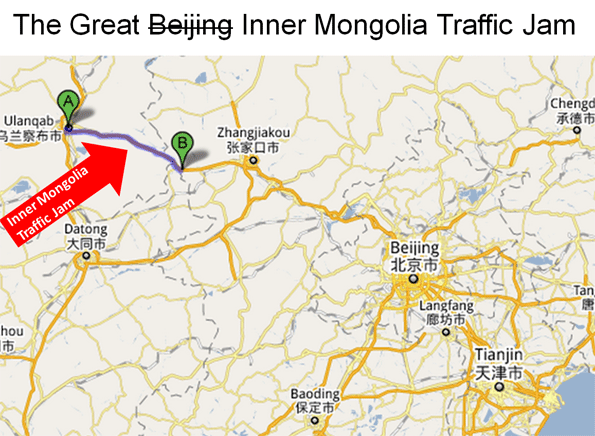
    The Inner Mongolia Traffic Jam: First we need to understand that this was not a “Beijing” traffic jam at all,or even on the outskirts of Beijing. The traffic jam came no closer to Beijing than 150 miles (250 kilometers) away, beyond the border of the city/province of Beijing, through the province of Hebei and nearly to the border of Inner Mongolia. The traffic jam then extended for more than 60 miles (100 kilometers) from near the Inner Mongolia border to Jingxi, in the region/city of Ulanqab. In reality this would be like calling a New York City traffic jam something that originated from Springfield, Massachusetts to Boston’s I-495 beltway (Figure 1).

    However, even the New York City example understates the complexity of the Chinese traffic jam. Beijing, China’s national capital, is one of the world’s largest urban areas (with a population of nearly 14 million). The city is situated at the northwestern limit of the densely populated part of China (which is called “China Proper”) that runs from Manchuria in the north to Yunnan in the south.

    Beijing’s urbanization ends at the mountains less than 30 miles from the Forbidden City, Beijing’s core. The area beyond the mountains, through which the Great Wall runs, possesses only intermittent and generally minor urbanization. The area is dominated by grassland, and some rice farming. In this environment, it is not surprising that there were few alternatives for traffic to the G-110 Expressway (freeway), just as there would be few alternatives for traveling between Casper and Cheyenne, Wyoming on Interstate 25.

    Continuing the I-25 comparison, the Inner Mongolian traffic jam more closely resembled traffic destined for Denver, with the congestion stretching from north of Cheyenne for another 60 miles, not far from the south end of the Powder River Basin, America’s largest coal producing region. This is a particularly appropriate comparison, because the type of traffic that caused the Inner Mongolian jam, coal trucks, would similarly jam I-25, were it not for the high-capacity freight rail system that moves most of the coal from the Powder River Basin to the nation’s electricity generation plants in the Midwest, East and South.

    Like Interstate 25, the G-110 Expressway is a high quality divided and grade separated four lane road. As with Wyoming’s I-25, Inner Mongolia has an old 2-lane road (National Route 110) that parallels the G-110 for much of the way. This is not a viable alternative for the truck traffic volumes that are needed to supply the megacity of Beijing with its electric power.

    Beijing’s First World Traffic: The Beijing city commission has announced that traffic flows continue to slow in Beijing. In the first half of 2010, the average speed dropped to 14 miles per hour (24 kilometers per hour). This is despite the fact that the urban area has a world class expressway system, with a fifth ring expressway (beltway) mostly completed (Note 1) and radial expressways feeding the inner areas. The surface arterial system in the inner area consists of a dense network of wide streets, providing capacity that certainly exceeds that of the city of Chicago or the four highly urbanized boroughs of New York, Manhattan, Brooklyn, the Bronx, and Queens (Note 2).

    Beijing’s inner area traffic congestion is like that of New York City. The population density is 30,000 people per square mile (the approximate density also of the four New York boroughs), too high to move the volume of traffic over a freeway and expressway system. Higher population densities are associated with greater traffic congestion, slower speeds, stop and go traffic and more intense pollution. Beijing and New York share all of these conditions.

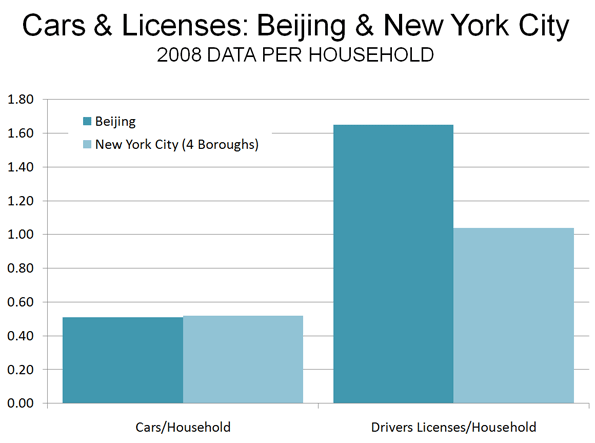
    There is a perception that the traffic situation could become substantially worse in Beijing, and that could well be the case. However, it is surprising that the Bejing (the city/province) is already well along in private vehicle ownership and use. Beijing has achieved a car ownership rate almost equal to that of New York City’s dense boroughs. In 2008, the dense boroughs of New York City had 0.52 cars per household, while Beijing had achieved a 0.51 rate. One report now places Beijing’s car ownership one third higher than in 2008, which would place Beijing’s car ownership rate 20% above that of New York City.

    By 2008, Beijing already had 1.5 times as many drivers per household as New York City’s dense boroughs (Figure 2). The difference appears to be in commercial drivers licenses, which account for nearly one-half of Beijing’s 9.4 million driver’s licenses. With the coal truck traffic and heavy truck traffic to the port of Tianjin, little more than 100 miles (160 kilometers) away, it is possible that trucks comprise a higher share of the traffic volume in Beijing than in New York City (Note 3).

    Local authorities are seeking to reduce the traffic congestion problem by building one of the world’s largest Metro (subway) systems. By the middle of the decade, nearly 350 miles (561 kilometers) should be open. Some lines will extend to outside of the fifth ring road, where much of the population growth is occurring. The Beijing Metro, like that of Mexico City, has been designed to better serve the contemporary urban area. Both are characterized by a concentration of grid routes and less by radial routes. Beijing also has ring routes. This design is especially appropriate for Beijing, which as is typical for many large Asian urban areas and unlike New York, Chicago or Hong Kong, has a decentralized core. Large office buildings in the center are more sparsely spread around a larger area, larger than these concentrated central business districts. Yet, even with this appropriate route design, the decentralization of retail and office activity necessitates time-consuming transfers that can make cars faster, even in Beijing’s traffic.

    China is also encouraging the use of electric cars, subsidizing buyers willing to switch from cars powered by fossil fuels. This will not ease traffic congestion, but it will reduce air pollution.

    At the same time, a period review of traffic conditions on the Internet will show Beijing’s worst traffic congestion to be concentrated in the high density core while in the much less dense expanding suburbs, traffic conditions are considerably better. Additionally, there is discussion of a seventh ring road and Beijing officials continue to improve their roadway network. As in US urban areas, Beijing’s continued decentralization could allow traffic to eventually be managed. Economists Peter Gordon and Harry W. Richardson have found that “suburbanization has been the dominant and successful mechanism for reducing congestion.”

    Clearing the Traffic: Meanwhile, there are reports that authorities have eased the traffic jam in Inner Mongolia. A longer term solution might be to add a couple of additional lanes in each direction. This should not be too difficult in a nation that by the end of the year will have nearly as many miles of freeway (43,000 or 70,000 kilometers) as the original US interstate system and will probably lead the world early in the next decade. This is a key to improving the competitiveness of Chinese urban areas. Sufficient roadway investment to handle growing travel demand will be just as important to maintain the competitiveness of US urban areas.

    —-

    Note 1: Beijing has six ring roads, however the first is the arterial road surrounding the Forbidden City, which is not an expressway.

    Note 2: Staten Island is excluded because its urban form is principally that of a post-war suburb, with a much lower population density.

    Note 3: This assumes comparability of data, which may not be fully reliable due to incomplete information.

    —-

    Wendell Cox is a Visiting Professor, Conservatoire National des Arts et Metiers, Paris and the author of “War on the Dream: How Anti-Sprawl Policy Threatens the Quality of Life

    Photo of Beijing Fourth Ring Road by archlife

  • Australia 2010: Unstable Politics in a Prosperous Country

    2010 has been something of an annus mirabilis in Australian politics. On 24 June a prime minister was dumped before facing the voters a second time. This was the first time ever for such an early exit. Then the election on 22 August produced a “hung parliament”, an outcome not seen since the 1940s. Having fallen short of enough seats to form government, the major parties are scrambling for the support of four independents and one Green in the House of Representatives.

    If this looks like the politics of a nation mired in economic upheaval, the reality is far different. Australia was one of a handful of advanced countries to avoid recession during the financial crisis. The unemployment rate never rose much above 5 per cent. For some economists, Australia is “the wonder from down under”.

    So why did the Labor government, elected in 2007, fall apart? There was certainly a lack of governing experience after eleven years in opposition. But in a broader sense, the political class is struggling to cope with Australia’s increasingly regionalised economy, and the divergent sources of its new-found prosperity.

    Like many industrialised countries, Australia passed through a seemingly intractable malaise in the 1970s. The country’s predicament appeared worse than that of more diverse and innovative economies like the United States. Relying on agricultural and mineral exports, legacies of a colonial past, Australia’s manufacturing base was inward-looking, outmoded and sclerotic. Disparaging assessments like that of former Singapore Prime Minister Lee Kwan Yew – Australians were destined to be “the poor white trash of Asia” – were common. Some fretted about “the Argentine route”, a country failing to diversify its economy and sliding down world rankings of GDP per capita. As transformed manufactures and high-tech products gobbled up an increasing share of world trade, Australia seemed stuck in the slow lane of commodity exports.

    And then came the 1980s. Protective barriers were slashed, the currency was floated, the financial system was opened up to foreign banks and state-owned agencies were sold off or treated to radical micro-economic reform. By the mid-2000s, the contours of the economy had changed. Activities such as business and property services rose from 10 to almost 15 per cent of GDP over the decade to 2006. Meanwhile manufacturing declined from 15 to 12 per cent. The new economy was dominated by services, now accounting for 68 per cent of GDP. Rather than drag down the economy, however, mining enjoyed parallel growth, from 4.5 to 8 per cent in the same period. China’s explosive arrival on the world scene shifted commodity exports into a very fast lane. These developments set Australia on a growth path that few could have foreseen in the 1970s. A small economy in relative terms to countries like China and the United States, it has evolved into a series of distinct geographic regions.

    The booming commodities export sector, dominated by mining, is concentrated in the northern and western states of Queensland and Western Australia, which account for 74 per cent of onshore mining production. Business and property services are concentrated in the south-eastern states of New South Wales and Victoria, specifically the inner precincts of Sydney and Melbourne, the nation’s emerging global cities. Together, these cities host around 50 per cent of Australia’s finance industry jobs. Public sector services, mostly in health and education, figure prominently in the populous south-east, again skewed towards long-established inner-city localities, where the most prestigious institutions are found. Construction, consumer services, including retail, and light manufacturing, fuelled by demand for household goods and building supplies, thrive in the larger metropolitan regions with high rates of immigration and population growth, like outer Sydney and Melbourne, and increasingly south-east Queensland.

    At the end the true driver of the economy lies with commodities. Today mineral resources make up just under 80 per cent of Australia’s commodity trade and around half of all exports (including services). Australia is the world’s leading exporter of coal and iron ore and ranks high other minerals like zinc and aluminium.

    Reaping the China bounty, former Prime Minister John Howard kept the federal budget in surplus and reduced government debt to zero, while handing out tax cuts and family income supplements. This winning combination delivered Howard eleven years in power. Towards the end of his rule, however, strains in the boom economy began to manifest themselves. Skilled labour shortages and the heated property market began to put pressure on inflation and interest rates, contributing to a sense of policy exhaustion in Howard’s later years.

    By 2007, there was a widespread view that the benefits of the resources boom were not being distributed fairly. The service sector professionals of the south-east, especially in the public sector who dominate the national media, began to shift to Labor as did outer suburban workers, who saw the dream of home ownership slipping beyond their reach. Forced to compete for investment in the open economy, south-eastern state governments, controlled by Labor, were constrained to keep taxes low. An ever larger proportion of their budgets was channelled into health and education services, partly due to close links with powerful public sector unions. There was little left to pay for urban infrastructure on the booming fringes.

    In response, infrastructure costs were shifted onto developers and local government, along with a new set of regulations, and urban consolidation (“smart growth”) was enforced as planning policy, ostensibly to reduce the need for extra resources. These choices reflected the green ideology taking hold in the planning profession, as well as among the professional classes.

    The impact of these measures on housing affordability were disastrous. When the low interest rates of the Howard years began to creep up, the problem turned into a crisis, as the Demographia survey has shown. The property market slowed down, depriving the south-eastern states of even more funds, since property taxes are a significant share of their revenues. This contrasted with conditions in the mining states, prompting the Federal Treasury Secretary to declare Australia a “two speed economy”.

    At the 2007 election, Labor leader Kevin Rudd claimed to have the solutions. Paying lip service to Howard’s fiscal conservatism, he signalled plans to divert mining boom proceeds towards infrastructure and services, including a new deal on health funding and an “education revolution“. Much of this was wrapped up in the rhetoric of climate change, talked up by Rudd as “the greatest moral challenge of our time”. His environmental centrepiece was an Emissions Trading Scheme (cap and trade), a massive revenue raising device for the federal government. In essence it was a mechanism for transferring wealth from the mining states, and their fossil-fuelled economies, to the populous south-east.

    Rudd’s electoral success, and apparent public support for climate action, drove the agenda forward until the crash at Copenhagen. This precipitated a revolt in the opposition Coalition, which replaced ETS supporter Malcolm Turnbull with climate-sceptic Tony Abbott. When Abbott labelled the ETS “a great big new tax on everything“, and blocked its passage in the Senate, public interest in the scheme melted away, particularly in the mining regions. Rudd lost his nerve and shelved it until 2012. For many Australians, he was exposed as a weak leader without the courage of his convictions.

    Rudd refused to give up his dream of redistribution though, turning to Plan B. Having commissioned a review of Australia’s taxation system, he announced a Resource Super Profits Tax, a complex device confiscating up to 40 per cent of mining profits above a threshold. Adopted without consulting the resources industry, it attracted furious opposition from the global mining companies, which launched a powerful advertising campaign against it. Opposition leader Abbott labelled the measure ”a great big new tax on mining”. Opinion polls showed strong opposition to the tax in mining states, and mild support in the south-east. Rudd’s poll ratings fell through the floor. He was soon deposed by his Labor Party colleagues.

    Julia Gillard, the new prime minister, substantially modified the proposal after negotiations with the large miners, but smaller operators remained opposed, along with most of Queensland and Western Australia. Gillard quickly called an election to capitalise on her status as the country’s first female leader. But the legacy of Rudd’s undelivered promises shaped the outcome. Australia’s regional divisions were clearly evident in the voting patterns. Western Australia and Queensland swung to the Coalition, and Queensland proved to be a killing ground, depriving Labor of nine seats. New South Wales also swung to the Coalition, reflecting dissatisfaction with the long-serving state Labor government’s failure to address the infrastructure and housing needs of suburban western Sydney. In contrast, the southern states of Victoria, Tasmania and South Australia swung towards Labor.

    Well over half of Labor’s lost votes moved left to the Greens, who more than doubled their share of the vote, rather than right to the Coalition. Increasing numbers of south-eastern professionals consider the Greens their preferred agent of redistribution. Handing the Greens the balance of power in the Senate, and possibly the House of Representatives (only one seat this time), may prove a better strategy than sticking with a fractured Labor Party. Inevitably though, regional and outer-suburban voters, with their divergent priorities, will react to a green-dominated agenda, which tends to dismiss suburban interests. Over time, and perhaps after the next election, this may mean a shift back to the right and a clear Coalition victory.

    John Muscat is a Sydney lawyer and co-editor of The New City (www.thenewcityjournal.net), a web journal of urban and political affairs.

    Photo by webmink

  • In California Cool is the Rule, but Sometimes, Bad is Bad

    Californians value cool. I’m not sure how this came to be. It might be the weather. It might be the entertainment industry. Whatever the reason, Californians don’t get excited. Better to go with flow than to get excited. Things will be ok. Concerned about the economy? Stay cool Dude. It’ll come back. Always has. Always will. Relax.

    It’s not cool to get excited, or heaven forbid, panic. Californians are not quick to react to problems, so confident that eventually the problem will just go away. This was forcefully brought home to me when a member of California’s legislature told me that “It doesn’t matter what we do in this building. California will always rebound.”

    California’s governance is seemingly designed to enforce cool in the government. Term limits, two-thirds requirements, and bipartisan gerrymandering combine to insure that change is not legislated. So you see absurdities, such as the legislature’s worrying about the asbestos content of the State Rock while the budget-less State goes down the path of bankruptcy and economy collapse.

    Institutionalized stasis is why I don’t think it matters who wins the upcoming gubernatorial election. Neither Mercurial Meg Whitman nor Moonbeam Jerry Brown will cause Sacramento to actually do anything to change California’s trajectory.

    Veteran capital-watcher Dan Walters likes to say that when legislators do agree and actually do something important, it’s usually bad. He cites California’s failed “electricity deregulation” back in 2000 as a case in point. The state does have a release valve, the initiative, which is much hated by the political class. But it is their fault. Legislative inaction is probably one reason for the increase we’ve seen in ballot initiatives. Of course, initiatives are seldom the optimal way to create change.

    Proposition 13 is an excellent example. Sacramento was aware of the property-tax problem, but was unable to deal with it. That created a vacuum, and the radical tax reformers stepped in. The result was a far more draconian and less flexible law than necessary or desirable. That’s the way initiatives work. The legislature fails to legislate. Inaction creates a vacuum. The vacuum is filled by more extreme interests. The resulting law is almost always flawed.

    California cool may be legendary, but as the Huey Lewis song says, sometimes bad is bad, and California’s economy is bad, very bad, and it’s not going to get better soon without real change. Plenty of lawmakers, especially the governor, are counting on renewable energy and green industry to provide California with an economic rebirth. It won’t happen. Read why here and here.

    I’m thinking that now would be a good time for Californians to lose their cool.

    Recently, Boeing announced that it is moving two programs from Long Beach California to Oklahoma. The move will cost California about 800 mostly well-paid engineering jobs. This is a relatively small event in an economy the size of California’s, but it is part of a steady drumbeat of businesses leaving California. Northrop Grumman has already decamped. General Dynamics’ San Diego shipbuilding subsidiary, Nassco, is shrinking its workforce by 300 workers, most of them highly skilled. Even the entertainment industry is slowly reducing its footprint in California. The list goes on and on.

    The main reason: California is an expensive place to do business, and the expense is made more onerous by uncertainty about future taxes and regulation. Consequently, those businesses that can increasingly are departing for more reliable, friendlier climes.

    Policy makers may find excuses for each of these events, but the persistence and size of the differences between California’s economic performance and those of better-managed states indicate something few in Sacramento understand: many of California’s economic problems are self inflicted. How big is the difference between California’s economy and other states? The unemployment rate provides one answer: California’s unemployment rate is about 30 percent higher than that of the rest of the country. That’s big, far larger than can be explained by demographic factors.

    High and persistent unemployment is not the only result of California’s job-killing environment. Income inequality is increasing, a legacy of declining opportunity for skilled blue collar workers and a failed educational system. Home prices and sales will not recover for years. Commercial real estate is in freefall, and we may not see anything approaching full occupancy for a decade. Real-per-capita retail sales may never recover, a result of joblessness, high taxes, and increased internet competition. Perhaps the most telling trend is that domestic migration has been negative for most of the past 15 years, as people vote with their feet and seek opportunity in other states.

    About the only source of hope, in a perverse way, is that government revenues are down. By now, it should be clear, even to those who thought their income was independent of economic activity, that a prosperous private sector is a necessary precondition for general prosperity. Professors, non-profit-sector workers, and government employees are learning the hard way their dependence on the private sector. We can hope that personal interest will drive them to more enlightened policy.

    That hope is tempered, though, by the political class’s willingness to embrace the mirage of a free lunch. The AB 32 climate change and SB 375 anti-sprawl bills were the result of a well-meaning search for the Holy Grail of costless environmental and economic virtue.

    Environmental and economic interests are not inherently incompatible, but environmental quality is not costless. In fact, it is a luxury good. Wealthier societies invest far more in environmental protection and rehabilitation than do subsistence societies whose primary concern is finding the next meal. In short, environmental protection requires investment, and wealthier societies are better able to pay the price.

    California’s leadership’s embrace of AB32/SB375 is unlikely to achieve any of its goals. It will be a drag on economic activity. Its impact on global greenhouse gasses will be negligible. Worse, it is very inefficient. Economic research is not ambiguous. Subsidies and command-and-control regulation are far from the cheapest way of improving the environment. The best way to reduce greenhouse gas emissions is through a rebated tax. This would be a carbon tax, where the tax revenue would be rebated to offset a more distortionary tax, say a labor or capital tax. This simultaneously discourages the bad, pollution, while encouraging the good, work or investment.

    AB32/SB375 is certainly not the source of all of California’s problems. The state has lots of them, and it’s time we took a serious approach of addressing them. Maybe, we should lose our cool and demand real leadership from Sacramento.

    Bill Watkins is a professor at California Lutheran University and runs the Center for Economic Research and Forecasting, which can be found at clucerf.org.

    Photo by Duncan H

  • Cars, People & Carbon Neutrality: A Symbiosis

    The potential for a symbiotic relationship between the environment, cars and people may be about to take a giant leap forward. London’s Daily Telegraph reports that a group of engineers from Genco have developed a bio-bug (Volkswagen bug) that runs on human waste. The car is powered for 10,000 miles from the excrement from 70 households (annually). The human waste bio-bug would be carbon neutral because it would not add any greenhouse gas to that already produced. The fuel would be produced at sewage plants, which already produce the necessary methane fuel from waste. While the technology, fully implemented, would not produce sufficient methane to power the entire fleet of cars, it would be a significant step forward and is further indication of the potential for technology to make substantial greenhouse gas emission reductions.

    Bio-Bug Photo

  • Alaska: Caribou Commons Or America’s Lost Ace?

    The most serious collateral damage from the BP spill disaster could very likely be in the far north, along the Alaskan coast. The problem is not a current spill but the Obama administration’s ban on offshore drilling and what many fear may be a broader attempt to close the state from further resource-related development.

    Such an approach could harm both the local and national economies for decades to come.

    Locking up of this vast northern state–which is home to some 700,000 people and has more coastline than the rest of “lower 48″combined–would be tantamount to the U.S. throwing away a strategic ace in the hole. Alaska contains many of the strategic assets–oil, zinc, lead, gold and, perhaps most critically, rare earth metals–critical in the increasingly multipolar battle for global prosperity.

    The move by some in the administration and green activists to freeze the last frontier recalls Frank and Mary Popper’s proposal to turn the Great Plains into a “buffalo commons” for wildlife, Native Americans and grasslands. In this case, this new Alaska could be labeled “the caribou commons.”

    By now it’s clear that the Great Plains region has value well beyond accommodating vast herds of bison, which have indeed been expanding. According to a recent Portfolio.com survey, four states either completely or partially in the Plains–North Dakota, Texas, South Dakota and Nebraska–rank among the top six states in economic performance.

    Alaska–buoyed in large part by energy production and its spinoffs–ranked second on the list, its residents doing far better than those in what the locals call “the outside.” Yet for all its wealth, Alaska has a peculiar challenge that stems from the fact that the vast majority of its land is owned by the federal government.

    Right now oil drilling represents the most important and contentious issue. Sixteen billion barrels of the black tea have come out of the North Slope alone since the 1980s, more than originally expected. An estimated 56 billion additional barrels exist, much of it in coastal waters.

    For decades, oil has driven Alaska’s prosperity. Before the discovery of the Prudhoe Bay field in 1967, Alaska suffered a per-capita income some 20% below the national average. Today it ranks eighth.

    Roughly 100,000 Alaskans work for energy companies, either directly or indirectly. Jobs in the oilfields, as well as the mines, pay an average of between $70,000 and $100,000 a year. These industries have helped it rise as one of the national leaders in producing good middle-class, blue-collar jobs.

    University of Alaska economist Scott Goldsmith estimates that oil accounts for two-thirds of the state’s growth since it became a state in 1959. Just eliminating the vast fields on Prudhoe Bay tomorrow, he estimates, would wipe out roughly one-third of all the state’s jobs. Oil-related taxes account for roughly 84% of the state’s total revenues.

    Alaska has other industries, such as tourism and fishing, but these pay far lower average wages than energy. “Without oil, we are essentially a third-world country,” notes Dan Sullivan, mayor of Anchorage, home to nearly half the state’s population.

    Not surprisingly, many Alaskans believe a ban on new energy and mining projects would end their relative prosperity. Goldsmith, for one, envisions the state turning into something akin to Maine (ranked 30th in per-capita income), a tourism-dominated playground for the visiting rich scarred by grinding poverty.

    Already oil-fueled revenues that fund government employment have fallen dramatically. Since its peak in 1988 oil flowing through the Alaska pipeline has dwindled from 2 million barrels a day to barely 700,000. This total could fall to under 600,000 by 2018.

    Without the development of new fields, Alaska, which now enjoys the country’s largest rainy day fund, could face a huge fiscal crisis. According to recent University of Alaska estimates, the state could confront California-style insolvency within a decade or two.

    Of course, most Alaskans do not want to see energy–or mining–expanded without strenuous controls. Many of them live in this isolated, often brutally cold place in order to enjoy its natural splendor and bounty. Climate change–irrespective to this summer’s chilly weather–also is a wide concern among people who live adjacent to retreating glaciers and worry about depleting arctic fisheries.

    Yet if Alaskans passionately want to preserve their staggeringly beautiful environment, they also are unlikely to embrace a vision of pristine poverty. Having suffered the depredations of international energy, mining or fishery companies, they also are not anxious to leave their fate to the Environmental Protection Agency or litigation-happy, trust-fund groups such as the Center for Biological Diversity.

    “A lot of people in the lower 48 [states] want us to pay for their sins,” suggests Alaska Sen. Con Bunde, reflecting a widely felt sentiment. “They may never come to Alaska, but knowing it’s there keeps them warm inside at night.”

    To protect their economy, Alaskans will need to learn new skills. For a generation they relied on powerful, now retired longtime Sen. Ted Stevens to protect their industries and make them the largest per-capita beneficiaries of federal largesse.

    Best suited for this role are the powerful Alaska-based, native-owned corporations. Unlike the oil companies run from Dallas, Houston or London, these companies are locally rooted. Together the top 13 native-owned firms possess some $4 billion in assets, a billion-dollar payroll and 12% of the state’s land.

    Taking control of their destiny may also mean changing attitudes common in a society that combines the most rugged individualism with what many call “an entitlement mentality.” After all, this is a place where big oil pays most of the bills and every individual receives an $1,300 annual check from the energy-funded Personal Dividend Fund. “The typical Alaskan doesn’t give a damn about what happens as long as they get their PDF check,” observes Dan Robinson, an economist with the McDowell Group, a local consulting firm.

    To maintain its long-term prosperity, Alaska needs to shift from petro-welfare to investing its energy wealth in the growth and diversification of its key industries. The state, for example, has huge potential for wind, geothermal and tidal production and should be a hub for both new fossil fuel technology as well. It also can use its locale on a key Pacific trade route as a center for advanced logistics (Anchorage Airport carries the world’s fifth-largest cargo tonnage).

    The rest of the country also has a big stake in the fate of America’s Far North. Lost production of energy and mineral resources would make us more dependent on other, often unfriendly countries. With exploration shifting to far less environmentally sensitive places like Mongolia or Africa, you also can count on greater net ecological damage as well.

    Alaska’s concerns may seem remote those in the “lower 48.” But how the 49th state fares may determine whether the rest of America can build a more sustainable and prosperous economy in the decades ahead.

    This article originally appeared at Forbes.com.

    Joel Kotkin is executive editor of NewGeography.com and is a distinguished presidential fellow in urban futures at Chapman University. He is author of The City: A Global History. His newest book is The Next Hundred Million: America in 2050, released in February, 2010.

    Photo: Unhindered by Talent

  • US Leads World in Greenhouse Gas Reduction

    For years, the United States has been portrayed by both international and domestic interests as an environmental outlaw, because of its high rate of greenhouse gas (GHG) emissions. The United States, Canada and Australia have the highest GHG emissions per capita in the world. Further, the United States has historically had the highest overall GHG emissions, until having recently been passed by China.

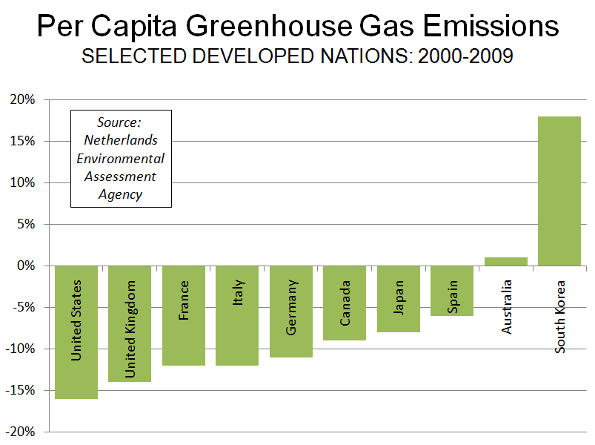
    It is likely to come as a surprise that the US has become a model for its reduction in GHG emissions over the last decade. According to a report by the Netherlands Environmental Assessment Agency, GHG emissions per capita fell more in the United States from 2000 to 2009 than in any other area reviewed. The Agency also reported that there had been no growth in global GHG emissions in 2009.

    Per capita GHG emissions fell 16% in the United States from 2000 to 2009. This is half again as large as the 11% reduction in the highest income portion of the European Union (EU-15). Among EU-15 nations for which data was provided, per capita GHG emissions were down 14% in the United Kingdom, 12% in France and Italy, and 11% in Germany. Spain, where economic reality is forcing a reduction in support for its highly touted “green” energy program, reduced per capita GHG emissions by little more than one-third the US rate, at 6%. The Netherlands achieved a 3% reduction (Figure).

    In both the United States and Europe, the deep recession contributed to a reduction between 2008 and 2009. Between 2000 and 2008 (pre-recession), US GHG emissions per capita declined 9%, while EU-15 emissions declined 7%.

    Canada’s GHG emissions declined 9% from 2009 to 2009, while Japan’s per capita GHG emissions declined at one-half the US rate (8%). Australia’s emissions rose 1%, while emissions per capita rose 18% in South Korea.

    GHG emissions per capita increased in all of the developing nations surveyed except for the Ukraine (-12%) and Brazil (-1%). Such increases are not surprising, as people in developing nations move from the countryside to urban areas and as they seek greater affluence.
    There was more good news for the United States. Biofuel use in road freight transport was more than double that of the European Union (EU-27). This is significant because road transport volumes in the EU-27 are nearly the same as in the United States.

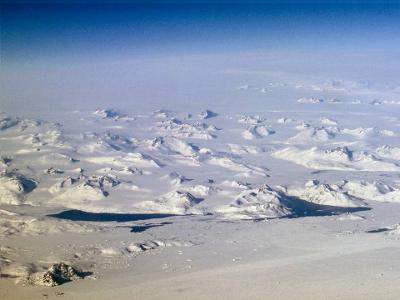
    Photograph: Southern Greenland (by the author)

  • The Need to Expand Personal Mobility

    Few books in recent memory have started from as optimistic or solid a foundation as Reinventing the Automobile: Personal Urban Mobility for the 21st Century. Reinventing the Automobile conveys a strong message that improved personal mobility is necessary and desirable:

    “Have we reached the point where we now must seriously consider trading off the personal mobility and economic prosperity enabled by automobile transportation to mitigate its negative side effects? Or, can we take advantage of converging 21st century technologies and fresh design approaches to diminish those side effects sufficiently while preserving and enhancing our freedom to move about and interact? This book concludes the latter.”

    The authors include William J. Mitchell, Professor of Architecture, and Media Arts and Sciences at the Massachusetts Institute of Technology directs the Smart Cities research group at the MIT Media Lab, Christopher Boroni-Bird, Director of Advance technology Vehicle Concepts at General Motors and Lawrence D. Burns, who consults on transportation, energy and communications systems and technology. The book is published by the MIT Press.

    Getting Urban Economics Right

    The authors start with getting the urban economics right. They recognize that the “freedom and prosperity benefits” of the automobile “have been substantial.” They note that the automobile industry “set the stage for the growth of the middle class,” something that has been labeled the “democratization of prosperity.” The authors say that the car “enabled modern suburbia” and “powered a century of economic prosperity.” This refreshing treatment is consistent with the overwhelming economic evidence that links personal mobility with prosperity, such as by Remy Prud’homme and Chang-Wong Lee, David Hartgen and M. Gregory Fields and others. It is also at considerable odds with the widely accepted, somewhat nostalgic planning orthodoxy that rejects private automotive transport as “unsustainable”, unaesthetic and anti-social. This ideology embraces the illusion that forcing people to travel longer, with less personal flexibility somehow will improve the economy and raise the standard of living.

    The Future of the Automobile?

    The authors envision a automobile characterized by a new “DNA.” It starts with smaller cars, fueled by electricity and hydrogen (fuel cell technology). It also begins with an understanding that the cars used in many mundane urban operations today – for example getting to the market or pick up the kids at school – are over-engineered. They are far larger than is needed for most trips, their capacity for speed exceeds urban requirements and their range between refueling is also more than needed.

    The authors would re-engineer urban vehicle to the needs of metropolitan dwellers, an “ultra-small vehicle” (USV). The designs proposed include far lighter cars that can be easily “folded” up to minimize parking space requirements. Cars would be connected to one another by wireless technology, all but eliminating the possibility of collisions. The cars would be small enough that they could be assigned special dedicated lanes on current freeways and streets. Travel would be less congested because the dedicated lanes would have a far higher vehicle capacity, while the interconnectedness would allow cars to safely operate closer to one another.

    The combination of electricity, hydrogen, wireless technology and the USV would bring additional benefits. This would permit improved vehicle routing, as drivers would be advised take alternate less congested routes. This would also, in time, lead to self-drive cars, about which Randal O’Toole has recently written, made possible by the use of wireless technology and that dedicated lanes would make possible.

    Empowering Transit Riders through Car Sharing

    Car sharing is an important part of this future, for dwellers of dense urban cores, according to Reinventing the Automobile. The author’s note that car sharing can solve the “first mile-last mile” problem making it possible for transit users to speed up their trips by not having to walk long distances to and from transit stops. Indeed, car sharing programs are set to be adopted in urban cores with some of the world’s best transit systems, such as Paris, and London. Privately operated car sharing systems have been established in a number of US metropolitan areas, such as Atlanta, Denver and San Francisco.

    Progress with Conventional Strategies

    The longer term vision of the MIT Press authors may take a while to unfold, but we can already see potential for progress. Just this week, “super-car” developer Gordon Murray announced development of an urban car (the T25), smaller than the “Smart,” which would achieve nearly 60 miles per gallon, with plans for marketing within two years. Volkswagen has developed a “1-litre” car, which would achieve 235 miles per gallon on diesel fuel. All of this makes the 51 mile per gallon Toyota Prius seem gluttonous by comparison

    These developments and the Reinventing the Automobile vision show that it is unnecessary to tell people in America (or Europe or the developiung world) that they must give up their automobiles. That is good news. The social engineering approaches requiring people to move from the suburbs to dense urban cores and travel by slower, less frequent transit are incapable of achieving serious environmental gains (see below) and can not seriously be considered progress or desirable by most people in advanced countries.

    The Superiority of Technology

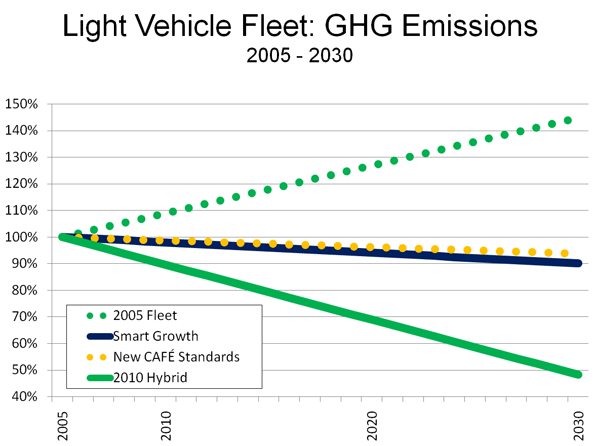
    This is illustrated by recent developments in automobile technology and research (Figure).

    • Before the adoption of the new 2020 and 2016 new car fuel economy standards, the US light vehicle fleet was on track to increase its greenhouse gas (GHG) emissions nearly 50% from 2005 to 2030 (the green dotted line in the figure).
    • As a result of the new fuel economy standards, Department of Energy projections indicate that greenhouse gas emissions from light vehicles will be one-third less by 2030 compared to the 2005 fleet (the yellow dotted line), and this is at the standard projected driving increase rates that could well be high.
    • The smart growth strategies of land rationing, densification and discouraging driving would produce, at best, a marginal reduction in GHG emissions, using the mid-point of the recent proponent research (Moving Cooler), indicated by the solid blue line. Actually, this overstates the impact of smart growth, since it discounts the substantial GHG emissions gains that result from higher fuel consumption in more congested traffic produced by densification.
    • The potential for technological advance is illustrated by the green solid line, which estimates the GHG emissions from light vehicles in 2030 if the average fuel economy were equal to today’s best hybrid technology.

    Overall auto-centered technology-based strategies – such as the improved fuel economy standards and the hybrid fuel economy – would each produce about 15 times as much benefit as the smart growth strategies proposed by such studies as Moving Cooler. This approach would not only be far more productive in terms of environmental improvement but would not require interfering with people’s lives in ways that would require longer trips times, less convenience, seriously retarded job access and, inevitably, fewer jobs and lower levels of economic growth.

    Technology: The Only Way

    It would be a mistake – and likely political folly – to force a re-engineering our way of life in order to enact strategies with dubious environmental benefits. In the final analysis, personal mobility must be retained and expanded, because there is no alternative that is acceptable to people, whatever system of government they happen to live under. Reinventing the Automobile paints the most optimistic picture to date and, if given due serious treatment, could prove a debate changer.

    Photograph: Manila suburbs

    Wendell Cox is a Visiting Professor, Conservatoire National des Arts et Metiers, Paris. He was born in Los Angeles and was appointed to three terms on the Los Angeles County Transportation Commission by Mayor Tom Bradley. He is the author of “War on the Dream: How Anti-Sprawl Policy Threatens the Quality of Life.

  • “Little Monsters”? Children and the Environment

    The idea has bubbled around the edges of the environmental pond for a while: choosing to be childfree expressly for the purpose of reducing one’s carbon footprint. An environmental correspondent at Mother Jones, for example, has pointed out that “…Nothing else you can do — driving a more fuel efficient car, driving less, installing energy-efficient windows, replacing light bulbs, replacing refrigerators, recycling — comes even close to simply not having that child… Why are we pretending that because they’re cute they’re harmless? Little monsters.”

    A Planet Green channel segment on the Voluntary Human Extinction Movement, the organization that offers voluntary human extinction as “a solution to involuntary human extinction” (slogan: “May we live long and die out”), cites the group’s 4000 Facebook friends.

    As absurd as it may seem, the concept has picked up supporters, and is actually inching into mainstream environmental thinking. It’s a trend that poses dangers, most of all to the green movement’s own sustainability.

    Attention a couple of years back focused on Australia, where the issue of a tax on (greenhouse gas emitting) newborns was raised. This month, a Princeton bioethicist, in a New York Times opinion blog headlined, Should This Be The Last Generation? eventually concluded, “In my judgment, for most people, life is worth living,” but then tamped down this irrational exuberance by questioning whether “the continuance of our species” really is justifiable.

    Earlier, a blog at the Nature Conservancy — the deservedly well-respected environmental group — made the case that it’s pointless to blame Bangladesh for its high birth rate when our own reproductive decisions have far greater environmental impact. The mixed reader response to author Peter Kareiva ranged from enthused zero population growth supporters — “..ninety percent of us could die without affecting our genetic diversity,” — to the head-scratching “…wonder if it’s perhaps a little short-sighted,” and “..Removing ourselves from the gene pool isn’t necessarily the best idea, no?”

    Notably absent from the commentary is the potential cost to the credibility of the environmental movement. Should we accept childlessness as the ultimate pathway to carbon neutrality? Or that eco-brownie points for sidestepping the egotism and self-indulgence of procreation accrue to future generations (in absentia)? That children are yet another impulse “buy”, thrown into the shopping cart of degenerate conspicuous consumption?

    The resurgence of support for zero population growth — or even negative population growth — as a means of preserving the earth represents a twist on our nation’s spiritual — and very green — heritage. Thoreau, other transcendentalists, and essayists both before and after him recognized America’s wilderness as a spiritual sanctuary. Reverence for our natural bounty and, more broadly, the planet, is now shared by countless Americans.

    But anti-natalism takes the religion of conservation well beyond respect for the natural world, to view the very existence of humans as defilement. It rejects the notion — powerful since the 19th Century — that children are the essence of purity. Now they’re unwitting agents of the sinful pollution of nature. An earlier era’s worry over Youth’s loss of innocence through exposure to the wild world is being replaced by the opposite concern: Youth is now seen as the destroyer of the world by its mere existence.

    We’ve come full circle from the early twentieth century national hysteria over Margaret Sanger, the great birth control pioneer who was condemned by members of the old Anglo-Saxon elite for hastening the extinction of America’s “native stock”. In that era, the impulse of families to restrict their size was seen as a selfish quest for mere personal fulfillment, harmful to the growth of the nation. Today, we see the opposite: An impulse to cast procreation as a personal indulgence at the expense of the larger society.

    The reasoning is, of course, that the choice to be child-free is not merely a personal decision, but rather a laudable contribution to a more sustainable world. But as a response to global population trends — widespread fertility declines, particularly in the West, combined with record high overall global population — it’s very different than offering birth control options to those who want them.

    This particular manifestation of environmentalism — the concept of solving humanity’s problems by eliminating, as much as possible, human beings — while positioning itself as both future-focused and statistically supported, is remarkably oblivious to the worldwide drop in birthrates and its economic implications. The demographic transition, which in Europe began before the mid-1800s, is bringing us both an aging population and more widespread participation, particularly among women, in the wealth of the modern economy.

    Today’s environmental movement has always included strands of Luddites. But, like other ultra-ascetic religions, and as even the anti-natalists themselves ruefully admit, the idea is not about to conquer the world.

    The demon-seed statistical projections on the carbon output of a single infant born today are based on the premise that the world’s energy use and methods will change not one iota during its lifetime. And the calculations usually include a reproductive chain over the next century or two. The assumption that the grandkids of today’s infants will be tucking AAA batteries into their toys or gassing up their Grand Cherokees isn’t — despite the impressive spreadsheets — objective or scientific.

    Of course, religion, guilt, and the quest for purity have a long, shared history, with holiness as the garlic that wards off Armageddon. The urge to condemn anything short of perfection reeks of fundamentalism. The witch-hunt for hypocrisy has been relentless by critics of environmentalism who believe that dangers to the ecosystem have been exaggerated: Does anyone in America not now know that Al Gore has a big house with a lot of light bulbs, and that he flies around on (gasp) planes?

    Now the annoying Puritanical fervor has been taken up those who think environmental dangers have been minimized. With fundamentalist zeal, they’ve one-upped their fellow environmentalists with a soul-purifying — and seemingly bulletproof — sacrifice of the urge to reproduce. This particular fast-track to holiness doesn’t require chastity; sex is allowed for everything except procreation. And, when considering a society where reproduction is denigrated, please imagine the mental health of children raised with the philosophy that the world would be a whole lot better off without them.

    Why has this issue gained such traction right now? The Age of Anxiety morphed into a Prozac Nation, but maybe the depression lingered on, marked by an inability to project positive outcomes, including the potential benefits of today’s infants over the coming years. The phenomenon’s growth can also be at least partly attributed to the unprecedented internet-age ability to connect with masses of like-minded individuals for group reinforcement.

    The choice to have a child or not is a purely personal decision. “Breeders,” as their critics sometimes describe them, shouldn’t need to justify their offspring with cost-benefit analysis’ showing that we need children to balance the national books (with social security payments) or to renew our civilization. Childless men and women still — even in our more-open-than-ever-society — encounter prejudice. To respond by claiming a ‘sacred’ justification as a guardian of the earth might appeal in a moment of self-righteousness. But it stands to reason that the custodian of a precious resource shouldn’t begrudge the very existence of its future inheritors.

    Photo derived from Face_0110

    Zina Klapper is a Los Angeles-based journalist, and Deputy Editor of newgeography.com.

  • Follow The Money On Development Deals

    “Follow the money” became a household phrase after the 1976 movie that told the story of Watergate, All the Presidents Men. Personal experiences over four decades in the consulting industry, working to create sustainable developments, often bring the phrase to mind.

    In a meeting a few weeks ago concerning a potential collaboration between our planning company and large engineering consulting firm, I was coached to tone down the fact that the design methods we invented and utilize reduce infrastructure. You might ask, why would reduced infrastructure (one key to a more sustainable world) be a negative condition for an engineering firm whose main purpose is to design the infrastructure that society must rely upon?

    Follow the money… Large engineering projects, as well as many architectural structures, are often quoted as a percentage of construction costs. The incentive is to increase, not decrease construction costs. We have the ability today to reduce the world’s infrastructure possibly up to 30%, which would be a major step towards reducing initial costs of commercial building and residential housing. It would have massive environmental benefits, and reduce the continual maintenance costs to the governmental authorities (forever) up to 30%.

    Follow the money… If the income of consulting firms is based upon construction costs, the consultants’ gross dollar billings would also be reduced by 30%. Firms that supply concrete, steel, pipes, etc would also have their gross income slashed by 30%. Does our world have a chance of becoming sustainable? Dream on!

    Follow the money… A decade ago I met with the president of one of the largest engineering firms in Minnesota. He wanted to know how our firm can produce so much work with so few people (I personally design all of the developments and had a drafting staff of two people). In ten minutes I designed a development of about 15 lots that showed homes, driveways, and all the final geometry, using the commercially available technology we had developed. “Oh my,” he said, and paused. I thought he would say, “We could reduce our staff by half,” but instead said , “You must put the plans on the shelf a few weeks, to justify the billing hours”. Then the enlightenment came to me. I had developed a software technology used in my own consulting business to produce engineering-accurate layouts in a fraction of the time of a CAD (Computer Aided Drafting)-based technology, but started to understand that this might be a hard sell.

    Follow the money… Large consultants often look at the floor of employees as a multiplier, meaning that each workstation will bring some multiple of profit. Suppose a technician costs $50,000 a year, and the multiplier is 3.5. After overhead, that technician represents $100,000 in potential profit. At a 150 person company, replacing one third of the staff by using more efficient technology and methods in the above example reduces the potential consulting income by five million dollars!

    Follow the money… Liability is another roadblock to sustainability. Why try something new when the old tried and true has worked for decades or centuries? In the consulting industry, licensed professionals risk their careers if a new concept causes a major failure, so they’re more likely to discourage anything without a proven history. The loss of a license to certify plans would have a devastating effect on a consultant’s personal finances. It is far safer to claim that the new method cannot work and talk the developer or municipality out of the idea.

    Follow the money… Today, few consultants are making any. Most are either hanging on (barely) or have shut their doors. The unemployment rate among architects, engineers, draftsmen, technicians, planners, and related occupations is very high. The exceptions are those lucky few that have won lucrative government contracts and are holding their own, or even thriving.

    Follow the money… The market reacts to design, innovation and value. The first Toyota Prius was an ugly miniscule car based upon the Echo, but it was highly efficient. Gas was cheap when it was first introduced, and sales were dismal. The first generation Prius had innovation, but lacked design. The next generation Prius came out as gas prices soared. When an attractive interior and exterior design was combined with innovation, it quickly became a symbol for a new era of green thinkers. Rising fuel prices turned the hybrid technology into an increasing value which fueled — so to speak — its success. Before the I-Pod there were many digital music players that were innovative. When players were combined with an attractive package design and the ability to download from the same vendor, the overall value created its success. Like the Prius and the I-Pod, land development itself is a “product”.

    Follow the money… The housing market crashed and many believe the commercial real estate crash to come will also be devastating. Funding for infrastructure keeps many consultants employed when the private development and building industry flounder.

    Those of us in the consulting industry must make some significant foundational changes if we are going to have a sustainable future, and claiming “Sustainability!” on the corporate web site is not enough. Unlike building construction, where being “green” typically increases costs, in land development, environmentally sound design and construction can cost significantly less if done right. That said, it does require more design effort with a greater attention to detail. It is possible to decrease both construction costs and environmental impacts say, 30%, but it could mean the consultant doubling his or her design efforts to do so. Not only does the firm lose 30% of its gross income if billing is based upon a percentage of construction costs, it must make a huge increase in effort to do so.

    Follow the money… In this new age of engineering and designing sustainable development, it is no longer possible to get the best result by simply using an off-the-shelf software to calculate the hydrology of the site (the drainage) within sewer pipes. Using surface flow along with natural materials that can filter pollutants from the run-off before drainage leaves the site requires a botanical engineering solution that blends knowledge of natural and manmade engineering. This requires a specialist, and the complexity that’s required to successfully design these systems with fail-safe methods goes far beyond pressing a software button. Small errors could have devastating results, and the consultant will be liable.

    For example, I installed a no-mow – low watering – fescue lawn, instead of sod, when my home was built last year. This landscaping worked great during the first year, giving us the look of a lawn look without having to mow it. We were told to water twice daily to get it established by the landscaping firm that claimed to be experts on this exciting new low impact landscaping. Well, watering fescue twice daily, it turns out, is the worst thing you can do, according to the prairie restoration consultants. We inadvertently turned our lawn into a fast growing prairie that needs more mowing than sod! But this is just one example of what can go wrong in this new era of sustainability. I was willing to invest, and I believe mistakes can be corrected and documented to reduce future errors. My landscape contractor installed something quite new in the industry, and took on a risk compared to suggesting safe sod. After the bugs are worked out the company will have a market edge and an example to show (but maybe not this year).

    So how can we force an industry to change?

    Lead with Money… Cities and developers hire firms assuming that they are going to use the latest techniques available to get the most efficient design possible. If the bidding process changed from seeking the lowest bidder to looking for the most advanced and efficient bidder, the industry would be rewarding innovation, competition, great design, and risk. Give priority to solutions that exceed the specifications. Contractors and consultants could be rewarded for coming up with revolutionary solutions.

    Lead with Money… The reward could be in the form of a bonus for innovation: For example if a plan saves 100 million in right-of-way purchasing, give half of the savings to the winning contractor and consultant. If the consultant is being paid a percentage of the construction costs (lets use 5% as an example) on a 100 million dollar project, then he or she would gross five million dollars. If they could win the consulting (engineering) contract by demonstrating the most efficient design instead of being the lowest bidder (or the most politically connected), and be paid a percentage of the demonstrated benefit, they would be making more for providing a higher degree of effort and perhaps taking on more risk. In the above example, if 30 million dollars is demonstrated to be a savings or increase in functionality, and 20% of the savings is rewarded back to the consultant, then the consultant would make 5% on the 70 million dollars (3.5 million dollars) and 20% on the 30 million in savings (6 million dollars). The gross revenue to the consultant would almost double.

    Lead with Money… Our military often awards bids for those projects that exceed the specifications. Vendors should compete not just on price, but to demonstrate how they exceeded the specifications. Governments as well as private developers could pick and choose based upon innovation, design, and value. Those taking the extra effort would flourish, and eventually the new higher standards would become the norm.

    How about forcing change through regulations? Regulations can only control minimum standards, pretty much guaranteeing monotony and stagnation. Instead, follow the money: To create a sustainable world, we need to exceed minimums, and foster innovation by rewarding risk, effort, and investment.

    Flickr photo, “George Is Keeping An Eye On You,” by We Love Costa Rica

    Rick Harrison is President of Rick Harrison Site Design Studio and Neighborhood Innovations, LLC. He is author of Prefurbia: Reinventing The Suburbs From Disdainable To Sustainable and creator of Performance Planning System. His websites are rhsdplanning.com and performanceplanningsystem.com.