Tag: Environment

  • Copenhagen: the Fall of Green Statism

    Now we have the Copenhagen deniers. These are people who won’t accept that the UN’s climate change process has been derailed. The highest emitting nations refuse to be bound by an enforceable treaty. Instead of bedding down a replacement for the near-defunct Kyoto Protocol, they asked for a rain check.

    If the grandly named Copenhagen Accord is “a first step”, as President Obama put it, what were Rio (1992), Geneva (1996), Kyoto (1997), Buenos Aires (1998), Lyon (2000), The Hague (2000), Marrakech (2001), New Delhi (2002), Milan (2003), Buenos Aires (2004), Montreal (2005), Nairobi (2006), Vienna (2007), Bali (2007), Bangkok (2008), Ghana (2008), Poznan (2008), Bangkok (2009) and Barcelona (2009)?

    Apparently these earlier meetings of the UN Framework Convention on Climate Change were just for cocktails. And the list doesn’t include the eleven or so gatherings since 1998 of the Convention’s “subsidiary bodies”, all held in Bonn.

    Copenhagen wasn’t meant to be just another UNFCCC meeting. It was the Conference of Participants (the Convention’s supreme body) where member nations were to sign off on a successor to Kyoto, which only covers the period to 2012. Their failure to do so means the process is in disarray. Consisting of twelve short clauses, the Accord is little more than a face-saving device full of vague and unenforceable aspirations. The final clause calls “for an assessment of the implementation of this Accord to be completed by 2015”, so the world won’t have a binding operational treaty for some time, if ever.

    Copenhagen wasn’t a first step; it was the last step. It marked the end point in a long cycle of top-down, bureaucratic, multilateralism launched at the 1992 Rio Earth Summit. This all came unstuck in the very different world of 2009.

    The geo-political rifts on display at Copenhagen can’t be papered over with the diplomatic equivalent of a Hallmark greeting card. Essentially, the UN process is hostage to a standoff between the two largest emitters and their respective camps. On the one hand there’s China (for which read the Communist Party, whose grip on power depends on high rates of carbon-spewing growth) and so-called rapidly industrialising countries like India, Brazil, South Africa and Indonesia. On the other there’s the United States (for which read representatives of energy-producing regions in Congress, which must ratify any treaty negotiated by the President) and most of the developed world.

    Negotiations are rarely successful when both parties can only lose. Climate talks are about the apportionment of pain and blame, with benefits flowing to a third category of poorer countries, so the prospect of a workable compromise between the major camps is remote. Expect emissions to go on rising.

    Australia counts for little in all of this and was rebuffed at Copenhagen. Our 1.4 per cent contribution to global emissions has zero impact on the climate.

    Despite all the guff about Copenhagen being “a first step” or “a good beginning”, the collapse of the UNFCCC process changes everything. Absent a binding multilateral instrument, or the realistic prospect of such an instrument, the rationale for government-level, legislative and tax-funded initiatives disappears. The contention that we must enact a framework complementing the Kyoto Protocol and succeeding protocols, and demonstrate a credible intention to achieve prescribed emission targets, has been swept away.

    Bizarrely, our government persists with the argument that early action is essential to avoid the higher costs of delay. This claim rests on the assumption that acting now will prevent adverse climate effects. But that assumption was demolished at Copenhagen. Assuming the IPCC is right, only action by the major emitters, not Australia, can avoid such effects and they aren’t playing ball.

    If this is really about climate change, the government should call a moratorium on climate-related legislation and spending until the international position is clearer.

    Of course, individuals, firms and organizations in the private sector are always entitled to act on their own initiative, should they feel strongly about the issue. There just isn’t a rationale, or moral justification, for coercive state action.

    As John Humphreys of the Centre for Independent Studies points out, “it is an indication of the sorry state of community groups that when faced with a problem, they spend millions of dollars whingeing and asking other people to do something“. He proposes that “instead of whinging and waiting for politicians to become benevolent, people who are worried about anthropogenic global warming can take immediate action”. Climate activists and concerned citizens should put their money where their mouths are.

    On a practical level, Humphreys estimates that if activists were to organise a system of voluntary “workplace giving”, whereby people could opt to allow 0.5 per cent (or more) of their income to go directly into a “climate fighting fund“, more that $1 billion would be raised if only one third of Australians participated. These funds could be used to buy low-emission energy from alternative energy producers for sale to into the power grid at the going market price. For one thing, this would spur investment in alternative energy technologies without inefficient meddling from government.

    This is one of many courses open to those who profess to be alarmed about the coming cataclysm. We’re often told they’re in the majority. Since the future of the planet is at stake, why should higher contributions matter?

    If green activists and entrepreneurs can generate demand for expensive but clean energy sources, the government should facilitate this market by removing barriers to entry, not by mandating or subsidising particular energy options. If property developers can generate demand for high-density “green” housing, planning officials shouldn’t regulate against this, just as they shouldn’t regulate against low-density housing. The same applies to transport and cars. Let consumers choose. This is the real “market solution” to climate change (assuming a solution is needed), not the fake market represented by a cap-and-trade ETS.

    Surveys and electoral returns show that the affluent tend to be more concerned about green issues, so this approach has an added advantage. It relieves wealthy greens of the moral hypocrisy inherent in demanding state interventions which produce glittering opportunities for them, while shifting the pain disproportionately to the most vulnerable in the community.

    This article first apeared at The New City Journal

    Photo:

  • Housing: Density & Desire

    Density — the number of units per acre on a proposed site plan — is at the heart of the developer’s mantra: More density, more profit. Meanwhile, environmentalists and many planners preach high density as the promise for a better future. The compression of families is an attempt to curb sprawl and reduce transportation energy consumption. For these reasons, many Green programs demand a minimum density to qualify for certification. Those who sit on suburban city councils and planning commissions fear over-densification, and typical suburban ordinances are written to oppose density.

    Who’s right? Nobody. There is no ideal density number in planning or development. Forget the search for a numerical value. Instead, concentrate on livability.

    Ordinances throughout the world state minimal dimension requirements. Some suburban ordinances, but not most, specify density maximums. But density alone cannot determine the most important issue in any development: Is it a great place to live? If both environmental impact and affordability were added to the mix, then you could equate livability with sustainability.

    Suburban Settings: The term ‘sprawl’ is recklessly used to describe all new suburban development, as if every new suburb was composed of massive lots with McMansions. Want proof that it’s not so? Take a tour of a suburb near a major city that was developed this past decade. In most, you will find smaller lots with homes compressed close together, often with less open space than older, large lot developments. Many of the new suburban developments that are close to major cities approach New Urbanism in density. There are some large lot developments for large residential estates, which are frowned upon as if achievement has become evil.

    The opponents of suburbia often don’t factor in the changes that have come about in environmental regulations. When urban areas of the past were built, wetlands (previously known as “swamps”) were simply filled in for development. Wooded areas were clear cut for the new city to be built. Today, we cannot fill in wetlands that in some places constitute vast areas within suburban communities. Many suburban cities have tree preservation and slope restrictions that also result in large open spaces. Because land that developers in the past simply built over is now set aside for preservation, today’s suburbs are going to naturally appear much less “dense” than existing suburban areas. Should a new “urban” city sprout today, as a result of these same protections it too may appear far less dense.

    Higher density can drive up raw land value. Developers who can place four homes on each acre are willing to pay much more than they would have a decade ago for the same land, when each acre could yield only two homes or less. The consumer ultimately pays the same (or more) for a much smaller lot, so density does not deliver affordability.

    Ordinances typically do not deliver livability. When we provide amenities that are not required in ordinances such as an architectural theme, or parks, walks, trails, destination places, and then add sustainability elements such as low impact storm drainage, green building, engineering, and landscaping…what keeps all of this affordable? Increased density helps when the original plan is for large lots. But we can only push density increases to a limit that preserves the sense of space that suburban home buyers expect. Cities that have already reduced minimum lots from, say, 10,000 square feet to 5,000 gave up all of their spare space long ago. Reducing lot size on an already small space can destroy livability. When lots were larger, there was negotiating power: Want smaller lots and more density? Then we’ll build a sustainable neighborhood, not a subdivision. With a small lot that negotiating power vanishes.

    Livability results from a balance of the hundreds of elements that must be taken into consideration when planning, engineering and constructing a neighborhood. A density goal can easily tip that balance in the wrong direction.

    I was trained on how to abuse the regulatory system. In the early 1970s, I was on top of the planning game as a master at manipulating regulations. I was able to find holes in the regulations to legally justify cramming units together. I felt victorious when I gained density. After driving through many of the neighborhoods that were eventually built, pride turned into shame. They were nothing special. I created developments that would do nothing to enhance the living standards of the residents; instead, they made the developer (who was now long gone) more profit. I vowed to never again use increased density as a goal, but rather to use balanced design practices as the driving force of all my neighborhood plans.

    Urban Settings: It is expected that density will be higher in urban areas. We recently did a proposal on a four acre infill site in Minneapolis. We pushed the density on one proposal to 111 units. Our goal was to produce an affordable (i.e. low income), environmentally sound development that would provide a sense of space and accomplishment (pride) for the residents. In low income neighborhoods it is important to hide parked cars as they can be an eyesore that can have a negative visual impact. All parked cars were to be hidden in underground parking areas or in the rear of a home.
    Utilizing new architectural design practice, we provided panoramic views of landscaped spaces using the kitchen as the focal spot for every unit. In this new era, which we call Prefurbia, one goal is to make the interior floor plan an integral component of the overall neighborhood design; we break up the architecture to create that all important curb appeal and eliminate the monotony so common in urban settings, especially lower-income ones. Density was also limited because we wanted to keep each unit at a minimum of 900 square feet. Every home was tied to a meandering walk system leading to a central aquatic garden in a 0.7 acre park. A truly wonderful place to live, at any income level.

    Yet when we presented the development plan we were told that the density goal was 120 units. When we asked where that number came from, we were told it was the minimum that was needed for LEED-ND standards. Jamming another 10% of density would bring the proposal out of balance – something would need to be sacrificed. We could eliminate the central park focus, or perhaps throw the parked cars in the open, or make the small units even smaller. We could eliminate the tie between the floor plans and the neighborhood. Going up another floor would just make the parking situation worse, as we would then have no room to hide the cars underneath the apartments. Demanding a minimum density does nothing to assure good development. If anything, it provides another target that detracts from creating a well balanced neighborhood that is a pleasure to live within.

    Density Instead of Profitability: When I began to plan developments for a nationally recognized firm, we achieved the density goals, but had no clue as to the actual costs of constructing a neighborhood. We would cross a creek to reach isolated corners of a site and gain a few lots, never realizing that a bridge costs much more than the profits gained in those few units. Using geometry instead of smart design practices, we stretched the length of streets, never realizing that streets cost about $300 (today’s dollars) for each extra foot. In the end we did get to the desired density ratio, but at what cost? Smarter design would have been to balance the infrastructure needs against the density goals. That was 40 years ago. Unfortunately those regulating and planning many of today’s new developments and redevelopments still look only to density, not to other costs.

    Density And The Environment: Planners assume that if we increase density in one place then we will not need to build somewhere else, and the end result will be that we will be left with vast, natural open spaces. This fantasy can only become a reality if the additional density achieved on a site corresponds with the dedication of a permanent preserve of open space elsewhere in the same city.

    Want to make this a better world to live in? Forget trying to justify a particular number of units per acre. I was guilty of this approach at one time. There is actually a term for the attitude: it’s defined as “difficult to understand or follow because of being closely packed with ideas or complexities of style”…and that word is “Dense”!

    Rick Harrison is President of Rick Harrison Site Design Studio and author of Prefurbia: Reinventing The Suburbs From Disdainable To Sustainable. His website is rhsdplanning.com.

  • Will Anyone Stand Up for American Industry?

    “Esau for one morsel of meat sold his birthright. For ye know how that afterward, when he would have inherited the blessing, he was rejected: for he found no place of repentance, though he sought it carefully with tears.” – Hebrews 12:16-17

    Built from 1933-1936, the Bay Bridge linking San Francisco to Oakland was an engineering marvel of its day. A complex series of multiple spans, when it opened – six months ahead of the more famous Golden Gate Bridge – it was both the longest suspended bridge deck in the world and the longest cantilever bridge in the world. The western suspension bridge section, technically two bridges in one, had to settle for being only the second and third longest suspension bridges in the world.

    The 1989 Loma Prieta earthquake badly damaged the Bay Bridge. The iconic western suspension span was seismically reinforced, but the eastern steel truss section required replacement. San Francisco wanted another iconic span, not just a functional one. A striking self-anchored suspension structure was selected and is under construction.

    The dubious part of this new span isn’t the usual matter of being way late and massively over budget – though it is – but where it’s being made. The steel for the bridge is not being built in America but in China.

    Why is this bridge being fabricated in China? The troubling answer, according to a lengthy article in the SF Public Press, is that no American company can do the job. America, a country that once pulled off the most audacious of engineering projects with panache, one that put a man on the moon in the 1960s, now can’t even build a bridge to replace one it constructed with ease in the 1930s.

    What’s more disturbing, is that China can’t really build it either – but we are teaching them, and paying for them to learn how.

    When you drive across that new Bay Bridge, your tolls will literally be helping to finance the advancement of China’s industrial base and the evisceration of America’s.

    I believe in free trade, strongly. I believe America can compete in a free market. But the United States is a country curiously uncommitted to industry. Other countries build, promote and protect industrial champions. They blockade their markets against American competitors. India freely sells us software and BPO, but passes laws to hamper Wal-Mart and other American firms. China demands many foreign companies do business there only through joint ventures, and transfer technology to local partners. It also intervenes to keep its currency artificially low. Many countries outright ban foreign involvement in many sectors such as energy. They view even their privately owned firms, many of which have close and corrupt ties to the state, as instruments of national and foreign policy.

    These places see Japan as a model to follow, a country that used its closed market to build industrial champions, even in high technology markets. Perhaps in time the same problems that hobbled Japan – asset bubbles, debt, demographic collapse, or an inflexible economy – will similarly afflict these emerging markets. But by that time it might be too late for American industry. And those problems are just as likely to affect us as them.

    This raises difficult questions about the future of America. Can we thrive as a purely post-industrial economy? Can we have a long term prosperous society built on little more than selling each other ever more exotic pieces of financial paper, creative consultancies, typing away at computers, serving up caffe lattes, and the like? Can we have a just social order as a two-tier society of only highly-paid elite knowledge workers and a low end service class, but not the robust middle class a manufacturing economy – along with agriculture and energy – supported?

    Can America even retain its military industrial strength under such conditions? In the past, military technologies launched spin-offs to the commercial world. Today, the reverse is as likely to happen. Already the only major ship builders left in America are captive suppliers to the US Navy. Only the anomalous Jones Act has kept a tradition of small and medium sized commercial shipbuilding alive.

    There’s a positive reinforcement cycle at work. The less we manufacture, the less we can manufacture. We slowly lose the skills, the facilities, the institutions, and the culture that enable a robust manufacturing economy to thrive. Eventually, we won’t be able to recover.

    Maybe we won’t even want to. The less we make, the less we want to make. As we become unmoored from our agro-industrial roots, we fail to see them as central to our national identity and frequently treat them with hostility. As Douglas and Wildavsky put it in Risk and Culture (1982):

    A larger proportion of the population of working age was disengaged from the production process than had been before. The economic boom and educational boom together produced a cohort of articulate, critical people with no commitment to commerce and industry.

    Increasingly, Americans have no personal experience with industry, and even no family experience with it. What was once common is just another niche, much like military service has become. This means most people have little familiarity or affection for industry, agriculture, or energy production. Many, especially urban dwellers, view most productive industry as a negative, as a source of blight where once others saw jobs and a strong tax base.

    Portland provides the perfect example. It views its waterfront as prime territory for residences and recreation, but not for industry. As the Oregonian reports:

    The question makes Jay Zidell uncomfortable. When will he stop building barges on the waterfront and start building high-rises? The room goes silent….Oregon power brokers have nudged the Zidell family for decades to do more with their prime Portland real estate…In the 1970s, Gov. Tom McCall called Jay Zidell’s late father, Emery, to suggest he stop adding industrial buildings. As Jay Zidell has told the story, McCall said: “We have big plans for the waterfront.”

    Those big plans don’t include manufacturing. Portland is the perfect example of where America is heading. It’s a place where thousands of highly educated but often underemployed young people sip lattes by the light rail while on the waiting list for a job at Starbucks. Meanwhile people in third world countries, hungry for more, hustle to build an ambitious future for themselves and their nation. Americans increasingly view manufacturing as an undesirable activity, particularly in an urban context, when in fact we should be looking to build new industrial cities – updated, re-imagined, and re-designed for a 21st century economy.

    Also, too often industry is viewed only as a source of pollution. Many industrial expansions are opposed on environmental grounds. But from a global, not local perspective, an ever stricter regime of regulation is sending firms offshore where pollution standards are usually far laxer. Corporations put a green gloss on their branding campaigns while building their products in China, where they get electricity from one of the new coal fired power plants that open at a rate of more than one per week. They also escape independent unions, anything like the Environment Impact Statement process in the US, and operate in a regime of weak property rights, questionable worker health and safety conditions, and a limited ability for the public to dissent. It’s not just cheap labor, it’s regulatory arbitrage. It’s like inverse colonialism, only this time the joke’s on the West. And the end result is a global environment that ends up worse, not better.

    To really protect the environment, we should be doing more manufacturing at home, where we can keep an eye on it and prevent the worst abuses. It’s like the Steak ‘n Shake boast about their open kitchens: “In sight, it must be right”.

    The sometimes exception to this negative take on manufacturing is, of course, “green” industry, notwithstanding that the concept does not exist except as a transitory state. In a decade there will just be “manufacturing”, and virtually all will adhere to green standards. But if America can’t succeed at traditional manufacturing, why would anyone think it will be different with green manufacturing? Even if so, by then there might not be many major American producers left to succeed.

    American firms and labor have made many mistakes over the years, but more often today they are adopting the new approaches needed to compete in tomorrow’s world. American labor can compete, even against cheap foreign workers, since it is the best and most productive workforce in the world. But not when public policy implicitly favors shipping manufacturing overseas.

    The answer is not protectionism, it’s freeing American labor to compete and developing policies designed to advance American manufacturing interests. Alexis de Tocqueville talked about Americans knowing the difference between raw, naked self interest, and “self-interest well-understood”. Likewise, we need to find a new approach to create “free trade, well understood”, a modern day trade equivalent of speaking softly, but carrying a big stick. Billions for American infrastructure, but not one $4 Bay Bridge toll to finance China’s technology ambitions.

    Alas, this seems unlikely. American industry is trapped between a political right that can’t see beyond instinctive anti-federalism and an overly ideological vision of free trade, and a political left that, while paying lip service to labor interests, no longer embraces industry. Almost alone among nations, America today lacks political champions for its industry. That, more than anything, is why it is being left to wither. Will anyone stand up and be counted before it’s too late?

    Aaron M. Renn is an independent writer on urban affairs based in the Midwest. His writings appear at The Urbanophile.

  • The Limits Of Politics

    Reversing the general course of history, economics or demography is never easy, despite even the most dogged efforts of the best-connected political operatives working today.

    Since the 2006 elections – and even more so after 2008 – blue-state politicians have enjoyed a monopoly of power unprecedented in recent history. Hardcore blue staters control virtually every major Congressional committee, as well as the House Speakership and the White House. Yet they still have proved incapable of reversing the demographic and economic decline in the nation’s most “progressive” cities and states.

    Obama and his congressional allies have worked overtime in favor of urban blue-state constituencies in everything from transportation funding and energy policies to the Wall Street bailouts and massive transfers of private wealth to powerful public-employee unions. Yet these areas continue suffering from net outmigration and stubbornly high job losses – as well as from some of the most severe fiscal imbalances in the nation.

    Nowhere is this more evident than in the president’s hometown of Chicago. The Windy City has suffered a very bad recession and may have fallen to its worst relative position since the Daley reconquista in 1989. As Chicago blogger Steve Bartin points out, even the presence of a Daley operative in the White House has failed to prevent the city from falling “in a funk.” He writes that even a reliable booster, columnist Mary Schmich of the Chicago Tribune, has lately described the city “as edgy, a little sullen and scared, verging on depressed.”

    There’s plenty reason for feeling low, well beyond the humiliating loss of the Obama-backed Olympics bid last year. For example, Oprah Winfrey, the city’s one bona fide A-list celebrity, is retiring her talk show in 2011. She is also reportedly shifting much of her media empire to Southern California, which, for all its admitted problems, has gads of celebrities and much better weather.

    Chicago’s most serious concern, however, revolves around the economy. In June, its unemployment rate peaked at 11.3%, far outpacing the national unemployment rate of 10%. Since 2007, the region has lost more jobs than Detroit, and more than twice as many as New York. Chicago’s total loss over the entire decade is greater than any region outside Detroit: about 250,000 positions, which is about the amount its emerging mid-American rival Houston has gained. In hard times businesses tend to look for places with a friendly environment for their enterprise. They avoid high taxes, political payoffs and inflated public employee salaries – all well-known Chicago specialties. These costs are undermining the city’s competitive position in, for example, the convention business, among others.

    Other key sectors are also flailing. Political influence in Washington will not stem the flow of high-wage trading jobs away from the Mercantile Exchange to decentralized electronic exchanges. Nor can it reverse the deteriorating state fiscal crisis caused by weak economies and exacerbated by insanely high pensions and out of control spending policies. Late last month Moody’s and S&P downgraded the debt ranking for the State of Illinois. Of course, such fiscal malaise is not limited to Chicago or Illinois. True blue California has an even worse debt rating. New York, another blue bastion, is also just about out of cash.

    To be sure, the recession has not hurt New York as much as Chicago, but the Big Apple has lost heavily , including 50,000 financial sector jobs since 2007. The outrageous bonuses to a few well-placed financial types will cushion but not deflect the influence of declining high-wage jobs. This can be seen in the striking weakness in the once seemingly unstoppable high-end condominium market. Particularly hard hit have been recent gentrified neighborhoods like Williamsburg in Brooklyn, N.Y., much like the hard-hit, newly developed areas along the Chicago lakefront.

    Other blue bastions have been shedding jobs as well, both during the recession and over the whole decade. Beyond Chicago and Detroit, the biggest losses among the mega-regions have taken place in the San Francisco Bay Area, Los Angeles-Long Beach and Boston. Big money can still be made in Silicon Valley, Hollywood or around the academic economy of Boston, but in terms of overall jobs, the past decade has been dismal for these regions. Meanwhile, the consistent big gainers have been – besides Houston – Dallas and Washington, D.C., the one place money really does seem to grow on trees. Even Miami, Phoenix and San Bernardino-Riverside, in California, boast more jobs today than in 2000, despite significant setbacks in the recent recession.

    These trends coincide with continuing shifts in demographics. The recession may have slowed the pace of net migration, but the essential pattern has remained in place. People continue to leave places like New York, Chicago, San Francisco and Los Angeles for more affordable, economically viable regions like Houston, Dallas, Austin and San Antonio. Overall, the big winners in net migration have been predominately conservative states like Texas – with over 800,000 net new migrants – notes demographer Wendell Cox. In what Cox calls “the decade of the South,” 90% of all net migration went to southern states.

    Utah, Colorado and the Pacific Northwest have also experienced positive flows – but perhaps most striking have been the migration gains, albeit modest, in Great Plains states such as Oklahoma and South Dakota as well as Appalachian Kentucky and West Virginia. Historically these places shipped many of their people to cities of the industrial Midwest, the eastern seaboard and California; that is no longer the case.

    Ultimately these shifts could undermine the true blue political strategy, perhaps as early as the 2010 congressional and state elections, and certainly after reapportionment. By 2012, the census will likely take seats from New York, Michigan, Pennsylvania and Ohio, handing them over to Texas, North Carolina, Georgia and Utah. Perhaps nothing will epitomize the new reality more than the fact that California, now among the most extreme blue states in terms of governance, will not gain a Congressional seat for the first time since the 1860s.

    These trends suggest that the current administration and the majority party in Congress must adjust their strategy. Further attempts to push a radical “progressive” agenda – expansive public employee bailouts, higher taxes and radical measures to combat “climate change” and suburban development – might please their current core constituencies, but they have the perverse effect of driving even more people and jobs out of these regions.

    All these underlying trends appear a boon to Republicans. But Democrats could counter the emerging GOP edge by appealing to the needs of these ascendant regions. By their very nature, growth states have the most urgent need for government investments in basic infrastructure, something traditional Democrats long have espoused. Moreover, such areas tend to become more tolerant as they welcome outsiders, and could be turned off to excessive Republican social conservatism.

    For any of this to work, however, Democrats must first abandon their current narrow, urban-centric blue-state strategy. They must learn to adjust their appeal to regions on the upswing, or things could turn out very badly for them very soon.

    This article originally appeared at Forbes.com.

    Joel Kotkin is executive editor of NewGeography.com and is a distinguished presidential fellow in urban futures at Chapman University. He is author of The City: A Global History. His next book, The Next Hundred Million: America in 2050, will be published by Penguin Press early next year.
  • How California Went From Top of the Class to the Bottom

    California was once the world’s leading economy. People came here even during the depression and in the recession after World War II. In bad times, California’s economy provided a safe haven, hope, more opportunity than anywhere else. In good times, California was spectacular. Its economy was vibrant and growing. Opportunity was abundant. Housing was affordable. The state’s schools, K through Ph.D., were the envy of the world. A family could thrive for generations.

    Californians did big things back then. The Golden State built the world’s most productive agricultural sector. It built unprecedented highway systems. It built universities that nurtured technologies that have changed the way people interact and created entire new industries. It built a water system on a scale never before attempted. It built magnificent cities. California had the audacity to build a subway under San Francisco Bay, one of the world’s most active earthquake zones. The Golden State was a fount of opportunities.

    Things are different today.

    Today, California’s economy is not vibrant and growing. Housing is not affordable. There is little opportunity. Inequality is increasing. The state’s schools, including the once-mighty University of California, are declining. The agricultural sector is threatened by water shortages and regulation. Its aging, cracking, highways are unable to handle today’s demands. California’s power system is archaic and expensive. The entire state infrastructure is out of date, in decline, and unable to meet the demands of a 21st century economy.

    Indications of California’s decline are everywhere. California’s share of United States jobs peaked at 11.4 percent in 1990. Today, it is down to 10.9 percent. In this recession, California has been losing jobs at a faster pace than most of the United States. Domestic migration has been negative in 10 of the past 15 years. People are leaving California for places like Texas, places with opportunity and affordable family housing.

    California’s economy is declining. Those of us who live here can all see it. Yet, Californians don’t have the will to make the necessary changes. Like a punch-drunk fighter, sitting helpless in the corner, California is unable to answer the bell for a new round.

    Pat Brown’s California – between 1958 and 1966 – crafted the Master Plan for Higher Education, guaranteeing every Californian the right to a college education, a plan that has served the state very well. That system is threatened by today’s budget crisis and may be on the verge of a long-term secular decline. California was a state where people said yes, a state where businesses could be created, grow, and prosper. Some of these businesses were run by Democrats, others Republicans but all celebrated a culture of growth and achievement.

    Today’s California is a state where building a home requires charrettes with the neighbors, years in the planning department, architects, engineers, and environmental impact studies – we built the transcontinental railroad in three years, faster than a builder can get a building permit in many California communities. People here dream of a green future but plan and build nothing. There’s big talk about the future, but California now turns more and more of our children away from college, and too many of our least advantaged children don’t even make it through high school.

    Once, California was a political model of enlightened government. Now it’s a chaotic place where everyone has a veto on everything; a state where people say no; a state where business is wrapped up in bureaucracy and red tape; a state our children leave, searching for opportunity; a state with more of a past than a future.

    Some things have not changed. California’s physical endowment is still wonderful. The state is blessed with broad oak-studded valleys, incredible deserts, magnificent mountains, hundreds of miles of seashore, and an optimal climate. California’s location on the Pacific Rim situates the state to profit from growing international trade with the dynamic Asian economies. California didn’t change, Californians changed. Californians have forgotten basics that Pat Brown knew instinctively.

    How did California get to this point? How did it move from Pat Brown’s aspirational California to today’s sad-sack version? What did Pat Brown know in 1960 that Californians now forget?

    First thing: Pat Brown knew that quality of life begins with a job, opportunity, and an affordable home. Other Californians in Pat Brown’s time knew that too. His achievements weren’t his alone. They were California’s achievements.

    It seems that California has forgotten the fundamentals of quality of life. Instead, the state has embraced a cynical philosophy of consumption and denial. The state’s affluent citizens celebrate their enjoyment of California’s pleasures while denying access to those less fortunate, denying not only the ticket, but the opportunity to earn the ticket. At best California offers elaborate social services in place of opportunity.

    Today, too many Californians don’t rely on the local economy for their income. For them, quality of life has nothing to do with jobs, opportunity, or affordable homes. Many see the creation of new jobs as bad, something to be avoided. They see no virtue in opportunity. They have theirs, after all. It is their attitude that if someone else needs a job, let them go to Texas; if people are leaving California, so much the better.

    They see someone else’s opportunity as a threat to them. Perhaps the upstarts will want a house, which might obstruct their view. They see economic growth as a zero sum game. Someone wins. Someone loses.

    This type of thinking is unsustainable. Opportunity is not a zero sum game. It may be a cliché, but it is true, that if something is not growing it is dying. Many of the things that make California the place it is are not part of our natural endowment. The Yosemite Valley is part of the state’s natural endowment, but the Ahwahnee Hotel is not. Monterey, Santa Barbara, San Francisco, the wine countries, and California’s many other destinations were made possible and built because of economic growth. Will California add to this impressive list in the 21st century?

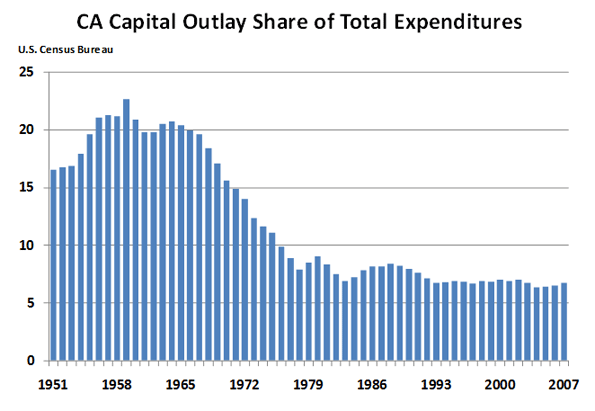
    Not likely. Today, we are not even maintaining our infrastructure. Infrastructure investment’s share of California’s budget has declined for decades. In Pat Brown’s day California often spent over 20 percent of its budget on capital items. Today, that number is less than seven percent. It shows.

    Pat Brown also knew that with California’s natural endowment, all he had to do was build the public infrastructure and welcome business, business will come. Too many today act as if they believe that business will come, even without the infrastructure or a welcoming business climate. Indeed, many Californians – particularly in the leadership in Sacramento – seem to think that business will come no matter how difficult or expensive the state makes doing business in California. This is just not true.

    California needs to embrace opportunity and economic growth. It is necessary if California is to achieve its potential. It is necessary if California is to avoid a stagnant future characterized by a bi-modal population of consuming haves and an underclass with little hope or opportunity and few choices, except to leave.

    Bill Watkins is a professor at California Lutheran University and runs the Center for Economic Research and Forecasting, which can be found at clucerf.org.

  • World Small Area Map of GHG Emissions

    The European Commission has just made a Google Earth overlay available showing annual greenhouse gas (GHG) emissions by 10 square kilometer quadrants. The overlay can be manipulated to show estimates from every year beginning in 1970. One of the most fascinating features is the GHG emissions on the oceans, from shipping lanes. All are green (fewer GHG tons), but one route stands out as by far the busiest, from Hong Kong and Japan through the Straits of Malacca and the Suez Canal to northern Europe.

    The application is useful for broad reviews of GHG emissions by same-sized areas, though the zoom feature does not provide high resolution enough photography to discern differences at the smallest area level.

  • The Suburbs are Sexy

    The Administration’s Anti-Suburban Agenda: Nearly since inauguration, the Administration has embarked upon a campaign against suburban development, seeking to force most future urban development into far more dense areas. The President set the stage early, telling a Florida town hall meeting that the days of building “sprawl” (pejorative for “suburbanization”) forever were over. Further, a number of bills have been introduced in the Congress that would attempt to discourage suburban development, some under the moniker of “livability,” which promises to improve people’s lives by enforcing planner-preferred density. The war against the suburbs is by no means new, but the Administration and some members of Congress have proposed their own “surge” in hopes of suppressing them permanently.

    The Mythical “Demise” of the Suburbs: Nearly since the pace of suburbanization increased, following World War II, critics have been foretelling the demise of the suburbs. During the 1950s and 1960s, some planning “visionaries” such as Peter Blake were predicting widespread municipal bankruptcies in the suburbs and for residents. This was occurring even as other urban planners were tearing up cities with urban renewal projects and freeways, setting the stage for “block-busting” and an ever-widening racial divide. The early criticisms have been repeated through the years, justifying a paraphrase of the old saw about Brazil (“Brazil is the country of the future and always will be”): “The suburbs are the wasteland of tomorrow and always will be.”
    The Real Decline of the Cities: In fact, it has more generally been the central cities that nearly went bankrupt, not the suburbs. Examples include New York, Philadelphia, Pittsburgh, Cleveland and that jewel of municipal consolidation, Indianapolis, rescued last year by $1 billion in state taxpayer funds. There are hopeful signs of a renaissance in most central cities, however their financial difficulties remain intractable and large swaths of their land area remain desolate. Meanwhile, the lawns were mowed in the suburbs, the houses painted and a strong sense of community developed among residents that was far too subtle for the prophets of suburban doom to perceive.

    Greenhouse Gas Emissions: More recently, the effort to reduce greenhouse gas (GHG) emissions has given suburban critics new ammunition. A simple mantra was dictated by “planning common sense.” Cars produce greenhouse gases, therefore people must get out of cars and live in more dense conditions, where they will not need to drive as much. Further, they will live in smaller, multi-family dwellings, which planning common sense teaches are more GHG friendly than the despised – except by those who choose to live in them – detached housing in the suburbs.

    But a funny thing happened on the way toward GHG inspired desurburbanization. Some academics actually began looking at data. The reality of the suburbs turned out to be rather different from that portrayed by the conventional wisdom of the planners. The most comprehensive research comes from Australia, some of which has been previously covered here.

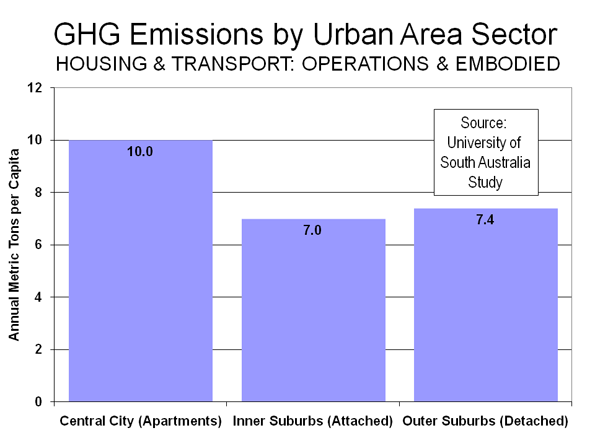
    University of South Australia: The most recent (and new) offering comes from a University of South Australia report thatallocates transportation and residential energy produced GHGs by location and housing type in the Adelaide area. The researchers found that the most GHG friendly sector of the urban area was the inner suburbs, which are dominated by single-family attached housing. GHG emissions per capita from housing and transportation were estimated at 7.0 metric tons of GHG emissions per capita annually.

    However, the outer suburbs, principally with detached housing, were not far behind at 7.4 tons GHG emissions per capita. The highest GHG emissions per capita, by far, were in the central area, with its predominance of multi-unit housing. There the annual GHG emissions were estimated at 10.0 tons per capita (See Figure). The University of South Australia study includes an element missing from virtually all other examinations of transportation and residential GHG emissions: “embodied emissions.” Embodied emissions are the GHGs from construction or manufacturing materials, and from building cars, transit vehicles and buildings. Embodied GHG emissions are ignored by much research, but are a significant factor in GHG emissions. For example, multi-unit housing, with higher use of concrete and more complex construction methods, tends to be substantially more GHG intensive than building detached housing or townhouses.

    GHGs from Common Energy: Previous work by Sydney researchers reached similar results – townhouse development was the most GHG friendly, followed closely by detached housing. Both were substantially less GHG intensive than high-rise condominium development. A principal reason for this conclusion stems in part from the fact that this research included GHGs from common energy, such as the electricity used to power elevators, parking lot and common area lighting, building-provided heating, air conditioning and water heating. American and Canadian research attempting to quantify GHG emissions by residential building type generally has not accounted for common energy and its GHG emission. Yet a gram of GHG from a residential elevator has the same impact as one produced by driving to the local Target store.

    GHG Friendly Suburbs: The most comprehensive research was conducted by the Australian Conservation Foundation. This was not the typical, incomplete or theoretical study of greenhouse gas emissions. The study included virtually every gram of greenhouse gas emissions in Australia and allocated them to consuming households in small residential zones within urban areas and around the nation. Suburban locations, with their greater use of cars and higher percentage of low density detached housing, had lower GHG emissions per capita than the core areas, with their greater use of transit and walking and their high-rise multi-unit housing.

    Compact Development: These findings provided the impetus to review the potential impact of compact development policies. Compact development policies (also called “smart growth” or “growth management”) generally seek to densify urban areas, by drawing urban growth boundaries, outside of which development is prohibited, and by trying to force people to drive less and to use transit more. Again, “planning common sense” clearly indicated to planners that compact development would yield substantial benefits in GHG emissions, principally because people would drive less.

    Yet the more recent research on compact development finds something much different. Densification scenarios from two recent reports, the congressionally mandated Driving and the Built Environment and a smart growth coalition’s Moving Cooler, showed that by 2050, compact development could reduce GHG emissions from driving by only 1% to 9%. At the high end of the range, the most new development would be directed to only a small part of present urban footprints, a policy outcome less believable than a balanced federal budget next year.

    Moreover, these projections have to be considered overly optimistic, because they make no allowance for the higher GHG emissions that occur as traffic slows and stops more in higher density conditions.

    The President Discovers the Suburbs? Meanwhile, on December 15, President Obama took the opportunity to visit a suburban Washington Home Depot, a chain that is a very symbol of American suburbanization. The President could have taken the opportunity to orate further against the suburbs in the insulation aisle, urging households to abandon the suburbs and move to high rise condominiums in the city.

    That was not to be. The President instead proposed providing incentives to people to make their houses more energy efficient, which would reduce greenhouse gas emissions and save money on consumer energy bills. In particular, he cited insulation, saying that “insulation is sexy”. It is worth noting that the Home Depot’s insulation is principally sold to suburban homeowners who can readily arrange for its installation. Residents of high-rise condominiums must rely on their building managers, who tend to purchase their insulation from wholesalers, rather than retailers like Home Depot and Lowes.

    The President explained why insulation was sexy, noting that saving money is sexy. Indeed, saving money is what the suburbs are about. The economic research is clear that housing costs are far less where suburban development is not limited by the compact development strategies that artificially create land scarcity. That’s why places like Dallas-Fort Worth, Atlanta and Houston, without compact development, had little, if any housing bubble, while housing bubbles of economy-wrecking proportions occurred in California and Florida, with their compact development.

    Yes, Mr. President, insulation is sexy. Saving money is sexy. And, the suburbs are sexy.

    Wendell Cox is a Visiting Professor, Conservatoire National des Arts et Metiers, Paris. He was born in Los Angeles and was appointed to three terms on the Los Angeles County Transportation Commission by Mayor Tom Bradley. He is the author of “War on the Dream: How Anti-Sprawl Policy Threatens the Quality of Life.

  • The Green Movement’s People Problem

    The once unstoppable green machine lost its mojo at the Climate Change Conference in Copenhagen. After all its laboring and cajoling, the movement at the end resembled not a powerful juggernaut but a forlorn lover wondering why his date never showed up.

    One problem is that the people of earth and their representatives don’t much fancy the notion of a centrally dictated, slow-growth world. They proved unwilling to abandon either national interest or material aspirations for promises of a greener world.

    The other problem is that divisions are now developing within the green camp. There are members, like Michael Shellenger and Ted Nordhaus, who recognize the serious fall out from the “Climategate” scandal, while others, including large parts of the media claque, dismiss any such possibility. There are the corporatists aligned with big business–who will live with any agreement that allows them to exact monopoly profits–and the zealots–like Greenpeace, Friends of the Earth and Bill McKibben–who see Copenhagen as an affront to themselves and to our endangered planet.

    But the main, fundamental problem facing the movement after Copenhagen–which none of the green factions have yet addressed–is its people problem. The movement needs to break with the deep-seated misanthropy that dominates green politics and has brought it to this woeful state. Its leaders have defined our species as everything from a “cancer” to the “AIDs of the earth.” They wail in horror at the thought that by the year 2050 there will likely be another 2 or 3 billion of these inconvenient bipeds. Leading green figures such as Britain’s Jonathan Porritt, Richard Attenborough and Lester Brown even consider baby-making a grievous carbon crime–especially, notes Australian activist Robert Short, in those “highly consumptive, greenhouse-producing nations.”

    Yet a slower population growth–while beneficial for poor, developing countries–can lead to a dismal, geriatric future in already low-birthrate nations like Germany, Italy, Spain, Japan, South Korea and Russia. And although birth rates are dropping in most developing countries, particularly those experiencing rapid economic growth, it will likely be decades before population stops increasing in most of the developing world.

    Besides, people in developing countries have much more important things to worry about–such as earning a living and getting ahead. Fighting climate change ranks low on the list of Third World priorities. The sprawling slums of Mumbai need more energy, not less; they want better roads, not fewer. More economic development would produce the money to help clean the now foul water and air, but also provide access to better education, one of the best ways to assure more manageable birth rates.

    Instead of looking to make developing countries even more dependent on Western largesse, greens should focus on ways to help improve the day-to-day lives of their people. Rather than prattle on about the coming apocalypse, they could work to replace treeless, dense slums with shaded low-lying clean houses that are easier to heat or cool. Those interested in nature might purchase land and rebuild natural areas. The children of cities like Mumbai should have the opportunity to experience wildlife other than crows, pigeons and rats.

    The environmental movement also might as well forget fighting the aspirations of the burgeoning middle class in India, or other developing countries. No developing world politician, whether from democratic India or Brazil or authoritarian China will embrace an agenda that stifles such aspirations.

    Post-Copenhagen greens need to reassess their relations with people in the developed countries as well. The popular call to transfer hundreds of billions of dollars from the so-called “rich” countries to combat the potential effects of climate change will not be very popular with the vast majority of the middle or working classes in these places.

    Much of the problem revolves around the loaded term “rich.” To be sure, many top climate-change scolds–Richard Branson, Al Gore, Arnold Schwarzenegger, Michael Bloomberg and, of course, his royal highness, Prince Charles–qualify easily. After all, no sweat off their well-massaged backs. The rock stars of the green millennium can buy their environmental indulgences so they can gorge good conscience on their carbon-rich world of private jets and lush estates.

    For them, going green means minimal sacrifice.

    Instead, the “rich” who will suffer the most will be the middle and working class of the developed countries. For them, carbon “sacrifice” may mean more than giving up needless luxuries like gas-guzzlers or monster plasma televisions. A green regime of enforced slow growth and ever greater regulation over carbon could threaten whole industries while environmental-planning policies will make purchasing a decent suburban house even more difficult.

    Such calls for sacrifice seem particularly ill-timed when 4 in 10 U.S. residents fear they could lose their jobs, with many rightly worried about holding onto their homes. With unemployment at 10%, few may be willing to wait around until the promised “green jobs” miraculously appear to save both them and the planet.

    But there’s an obvious way out of this dilemma: Start shifting away from fear-mongering and look to ways to achieve green goals without catastrophic economic losses. One clear way to start this process is through land-use policy. Right now many activists and their allies in the climate-industrial complex–which includes urban land interests–want to force suburban home dwellers into dense urban areas. They also want to coerce people to give up their individual mobility for trains, even if this means longer commutes and less convenience.

    Proposing a radical re-engineering of society does not constitute a winning political program. Environmentalists would do better to embrace a vision of “greenurbia,” allowing for dispersed living but in a environmentally responsible way. This could be done with practical steps–increased telecommuting, more tree-planting and flexible work arrangements–that would enhance not only the environment but also day-to-day life for hundreds of millions of people.

    Similarly, environmentalists should redouble their efforts to provide more access to open space for millions of people through expanded purchases of land throughout the country. America’s highly productive agricultural sector has jettisoned millions of acres of land from cultivation, providing an excellent opportunity for purchases for public use. In some areas, abandoned industrial or mining properties could be rehabilitated as natural areas.

    Such changes, however, require a re-evaluation of the values that now drive the green movement. Whether in California or Calcutta, it boils down to the existential question: Do humans matter?

    Frederick Law Olmsted explained his plan for New York’s Central as an attempt “to supply to the hundreds of thousands of tired workers … a specimen of God’s handiwork.” This represents the kind of sensibility that could transform the green movement from an obstacle to people’s aspiration to a force for greater human happiness.

    This article originally appeared at Forbes.com.

    Joel Kotkin is executive editor of NewGeography.com and is a distinguished presidential fellow in urban futures at Chapman University. He is author of The City: A Global History. His next book, The Next Hundred Million: America in 2050, will be published by Penguin Press early next year.

  • Personal Rapid Transit: Twenty-First Century Transport?

    Recently I had the chance to visit Taxi 2000. This Personal Rapid Transit (PRT) company is based just minutes from my office in Minneapolis. I’m no expert on rail systems, but I’ve always believed that an elevated system that can run freely over existing right-of-ways makes more sense than an antiquated system based on nearly 200 hundred year old technology.

    Since we plan new neighborhoods and cities, I saw a great opportunity to design a new town with an elevated PRT system as a major design influence, not as an afterthought. A perfect combination: a new age city based upon the latest methods, with a convenient way to access most of the region, based on a 21st century design, not an 18th century one.

    I typically investigate the products and companies that I’m about to meet. I’d heard about PRT solutions for well over a decade and assumed there were many examples of installations. After searching the internet I found not a single installed PRT system serving a city.

    I’ve never been a fan of light rail for a variety of reasons. Human beings are smart enough to explore space, extend life spans for decades, and remodel genetics. Yet all we can come up with is a slow (and often unsightly) train that runs on tracks conceived in the 1800s that now cost billions of dollars to implement? We are told that building a light rail line spurs economic growth. Even if true, typically only a minor portion of a town benefits because the system is linear. Most are designed to be functional, not beautiful, and most light rail trains are not inspiring.

    I used to drive in Minneapolis, but now train tracks intermix with the driving lanes in some areas of town. I avoid those sections, and now do my spending in the suburbs. I’m sure I’m not the only one. This brings me to my final opposition to light rail: Because it’s typically ground-based, it’s obstructive to implement, and often requires the demolition of buildings and the acquisition of right-of-ways. All of this costs plenty.

    On top of this, many businesses suffer during the construction of light rail, while it interferes with their access. Sure, they might ultimately get additional business, but first they must survive a period with reduced access.

    Mike Lester, CEO of Taxi 2000 demonstrated the prototype of SkyWeb Express along with its technologies to us. Over a period of three hours, Mike proudly showed us what they have accomplished.

    First, this is an on-call system. This means that you do not have to wait for the next train. Cars located only a minute or so away await your command. No more missed connections while waiting an hour for the next ride.

    It is elevated far above ground — 5 meters — using existing right-of-way on posts spread far apart. In an urban area such as Minneapolis which already has a skyway system, this could coincide with existing access points on the second or third floors. It’s non-linear, and able to easily turn corners and access much of a city, not just points along a single route.

    It maintains a constant rate of speed; no stops needed until you reach the destination. About 30+ miles per hour might not seem fast, but a mile every two minutes in an urban environment is indeed impressive. It’s limited to 3 persons per vehicle with plenty of extra space for luggage, boxes, or even a bicycle. No more crowding. It goes where you want, not only on a preset route. In theory it’s safer because you can access it alone, not with strangers. And one car needing maintenance does not shut down the system.

    The big issue that all transit needs to address is the cost. The light rail transit in Minneapolis costs somewhere around a billion dollars. PRT cost studies show a savings of 60 to 70 percent could have been realized along the same line. Even if the estimates are wrong by double, that’s over $200 million that could have been spent elsewhere, or to make a quite comprehensive PRT system for the same dollars.

    I’m not easily convinced when someone tries to “sell” me on new technologies, but that common sense meter in my brain was at 100% as I learned about the PRT possibilities. I was not sold that this will get everyone out of their cars, but it’s a solution that would be more effective than a rail system.

    So why no installations?

    PRT companies have been around for a while, continually upgrading and perfecting their systems. While I’m not sure how they get funded, I can tell you that cities have a hard time spending hundreds of million dollars on systems developed by small firms. As a software developer of Geographic Information Systems in the 1990’s we constantly lost sales to larger companies, even though our product was superior. It appeared that cities were more comfortable buying from companies with hundreds of employees working in tall impressive buildings than from smaller firms. It was natural to think a firm that appeared quite large had staying power compared to small companies with a handful of employees. But in the dot-com bust we learned that size does not guarantee longevity.

    I’ve written this before, but it bears repeating: On August 1st, 2009 President Obama addressed the nation with: “Future economic prosperity depends on building a new, stronger foundation and recapturing the spirit of innovation …. Innovation has been essential to our prosperity in the past, and it will be essential to our prosperity in the future”.

    Small PRT firms have risked everything, adhering to a belief that it is a viable solution for urban transportation problems today and in the future. How have we rewarded these innovators who certainly have the spirit? We continually invest in the most non-innovative, obtrusive, and expensive solution: Light Rail. We reward large corporations who take no risk… What happened to us? Let’s see if this new Administration can stand by the President’s words and invest in the pioneers who can create that strong American foundation.

    Rick Harrison is President of Rick Harrison Site Design Studio and author of Prefurbia: Reinventing The Suburbs From Disdainable To Sustainable. His website is rhsdplanning.com.

  • Nurturing Employment Recovery

    President Obama’s quick exit from Oslo and late arrival in Copenhagen suggest he’s finally ready to shift focus from Nordic adulation and fighting climate change and diplomacy to fixing the American economy. About time. As former Clinton adviser Bill Galston observed recently, the president needs “to pivot and make 2010 the year of jobs.”

    White House operatives, as well as the Democrats in Congress, know high unemployment could bring big political trouble next year. But in their rush to create new jobs, policy makers would do well to focus on the quality of jobs created over the next year and beyond.

    On this score, the slight improvements in the job picture are far from sufficient. The most recent analysis of employment over the past year by the Web site JobBait shows that almost all the growth has occurred in three fields–government, education and health care.

    The problem: All these fields are financed by taxpayers or through transfer payments. They do little to expand our exports, and they employ few of the blue- collar male workers who have been hardest hit by the “hecession.”

    Unemployment for men is over 2.5% higher than for women, the largest gap in history. In all but a handful of states, male-dominated fields such as transportation, mining and logging, manufacturing and warehousing have declined rapidly over the past year. The only states to experience gains were North Dakota, Montana and West Virginia.

    This reflects the critical weakness in the stimulus package. The stimulus focused on government bailouts and transfers of research funds to universities, while less than 5% went to basic infrastructure. But a greater emphasis on infrastructure would not only have created large numbers of construction jobs, it would have boosted our industrial competitiveness by eliminating bottlenecks in our transportation system.

    The only big regional beneficiary of expanding government employment has been, unsurprisingly, the Washington Beltway. Indeed, the number of federal bureaucrats making $100,000 or more jumped from 14% to 19% since the recession–and that’s $100,000 before overtime and bonuses.

    Elsewhere, the surge of government employment is petering out, particularly on the state and municipal levels. These jurisdictions are running out of money, since they are unable to print their own. Over the past year government jobs contracted in financially strapped states like California, Oregon, Michigan and Florida, as well as throughout the Northeast and New England. There’s little hope for much improvement in 2010.

    The other two sectors to enjoy significant growth have been education and health. Yet these fields do not seem to generate the broad-based economic growth needed to boost the overall economy. The region most often favorably linked with the “eds and meds” economy, Pittsburgh, has produced only modest, below-average job growth over the past generation. In fact, Pittsburgh has looked successful largely because the region has continued to hemorrhage its population to other regions, and it attracts few foreign immigrants.

    Yet the fiscal damage from dependence on public and nonprofit employment has been enormous. The city suffers a billion-dollar unfunded pension liability, among the highest in the nation on a per-capita basis. Due to the heavy local presence of institutions of higher education, nonprofits and hospitals, who keep about 40% of Pittsburgh’s property remains tax-exempt. In a sign of desperation Mayor Luke Ravenstahl recently proposed taxing tuition at local colleges and universities, eliciting outrage from the academic world.

    More important, the Pittsburgh “eds and meds” model can’t really be applied to a country whose workforce will expand by roughly 1 million annually over the next decade. The country now has fewer jobs than it had in March 2000, even though the labor force has grown by 12.1 million workers. There is no way we can produce enough growth depending on sectors that feed off taxpayers and private enterprise.

    This shortfall will be particularly tough on millenials as they enter their 20s and 30s. Already those 18 to 24 now have an unemployment rate over 18%. Not surprisingly, as Morley Winograd and Mike Hais observe, lack of jobs now stands as the No. 1 concern for those under 30.

    Another problem: We are now producing many more educated workers than we can gainfully employ. Information jobs may not be disappearing at the rate of industrial ones, but they have lost nearly 3 million positions since 1999. One likely result has been that returns to education–hyped by academics and “progressive” economists–have been dropping, particularly for younger workers. The unemployment rate for recent college grads is currently 10.6%, a record high.

    So, how to create opportunities that pay well? Some place their hopes in either the “green” or “creative” economies. But the green sector has been notably ineffective in sparking growth across other parts of the economy. A much-hyped report issued by California green-boosters bragged “green jobs”–which included everything from public relations representatives to marketing managers, accountants and brick-layers–account for something like 1% of employment. Even with heavy subsidies by taxpayers, the “green” sector seems unlikely to rescue an economy with 12.5% unemployment.

    Many politicians, particularly California’s increasingly delusional governor, also fail to recognize the cost that the “green agenda” exacts on a struggling economy. A draft report by a state advisory committee estimates California’s new draconian greenhouse gas laws could cost the state economy over $143 billion over the next decade. Efforts to spread this kind of regulation–either through federal legislation or EPA directives–would inflict similar pain to economies beyond the Sierra Nevada.

    As for the much ballyhooed “creative” sector, video producers, financial analysts, architects and other workers in the non-tangible economy are less susceptible to green pressures than factory workers, truckers or farmers. Yet as the JobBait report shows, information, business and professional services haven’t fared well over the past year. So far the only winners in professional and business services are in small states: New Mexico, Utah, South Carolina and, once again, West Virginia.

    Perhaps it’s time to abandon the notion that the U.S. can rely on preferred sectors–“green”, creative or “eds or meds”–to turn around our vast economy. Theorists often forget the essential ties that exist between tangible and intangible sectors. The strongest growth in high-end services are usually propelled by growth in tangible industries, such as energy, agriculture or manufacturing. When those industries tank, as in much of the upper Midwest, high-end services decline with them.

    Green jobs, too, require a strong economy. It is not by mistake that the big cities with the largest numbers of new “green” construction projects are not in Portland, San Francisco or other eco-capitals, but in more robust, if less organically obsessed places like Dallas and Houston. To create green jobs, you need to have growth, particularly in “hard” industries like construction and manufacturing.

    Instead of favoring certain sectors, the administration’s job “pivot” needs to focus across all economic sectors. This can be done in a pragmatic non-ideological manner. It could combine the increase in infrastructure and scientific research spending favored by many on the left with more market-friendly approaches–industrial tax credits and streamlining some regulatory standards–associated with conservatives.

    In the end the goal of policy should not be just to create more jobs, but to nurture employment that will make our economy stronger and more competitive over time. Until that happens, the recovery will create an economy fundamentally unable to sustain itself in an ever more competitive global environment.

    This article originally appeared at Forbes.com.

    Joel Kotkin is executive editor of NewGeography.com and is a distinguished presidential fellow in urban futures at Chapman University. He is author of The City: A Global History. His next book, The Next Hundred Million: America in 2050, will be published by Penguin Press early next year.