Tag: Environment

  • There is no “Free Market” Housing Solution

    The common line used by advocates of housing affordability has been that the solution lies in “free markets”. Yet this “free market” solution does not address the fundamental problem which is really a political one.

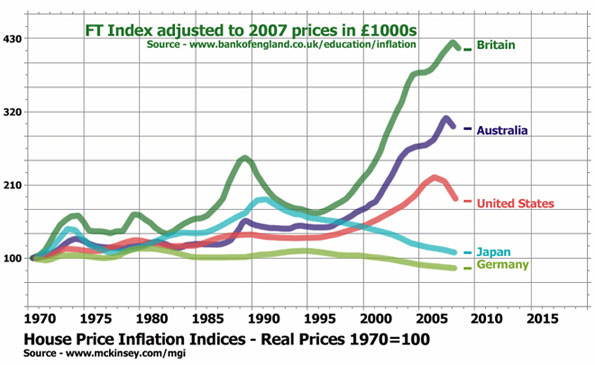
    This true fundamental problem is particularly evident here in Britain, the leader in house price inflation and housing financial bubbles since the 1970s. In their recent report Global capital markets, the McKinsey Global Institute has confirmed what has been shown in recent Demographia surveys.

    The root of this problem lies with an elite agenda that is highly ideological. The ideology at work is environmentalism, making a moral virtue of the retreat of political and commercial elites from the industrial production of housing.
    The preference is for interest payments on a fund of mortgage debt rather than the effort of turning a profit from development, let alone construction. Professionals like estate agents, planners, architects, and bankers are certainly in collusion with that elite ideology.

    That is not to say there is a conspiracy to plan a housing bubble. That is too crude. There is clearly regulation and legislation. On 24 November 2009 the Housing Minister John Healey confirmed that Britain will be the first country in the world to require zero carbon homes as a matter of law from 2016. Britain is the world leader in green ideology.

    John Healey
    All of the newly built British housing will have much better insulated walls, windows, roofs and floors. The clear aim of the government is to keep reducing the energy consumption of all new homes to be measured in kilowatt-hours per square metre of floor area per year. New Labour hope to make it law that total energy consumption is no more than 46 kWh/m2/year for semi-detached and detached homes, and then no more than 39 kWh/m2/year for all other homes. The energy efficiency standards will be applied from 2016, subject to yet another consultation on the Code for Sustainable Homes, announced at the end of 2006, and technically published for use on a voluntary basis in 2007. The building regulations get revised in 2010, 2013, and 2016 leading to this legal requirement for maximum energy consumption in all new homes.
    Healey says that “zero carbon” is a concept that will apply to a new home at the “point of build”. ‘We are not going to regulate through this policy how occupants live in them,’ he says. However the Code for Sustainable Homes assumes patterns of behaviour. Environmentalists within and without government will argue that behaviour needs to change. They will be suggesting all sorts of intrusions into daily life.

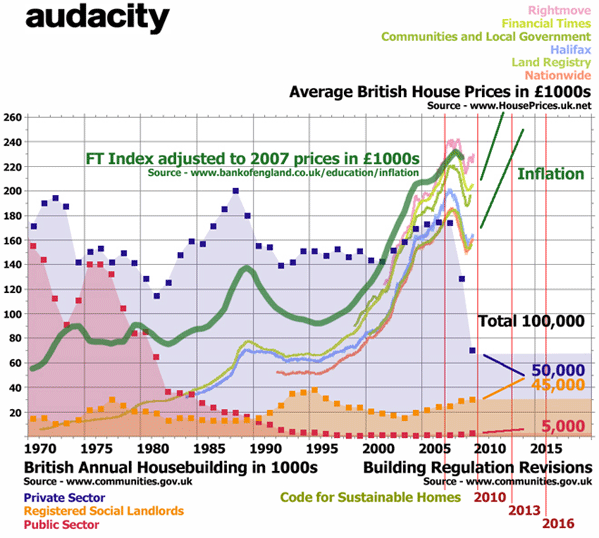
    British environmentalism couldn’t be more ideological, and more of a barrier to the production of affordable housing. The planning system has been “greened”. The mood is against development, and planning approvals for new land for new housing are hard to obtain. The zero carbon requirement will only apply to around the 100,000 new homes that will be built annually, while the existing stock is around 26 million homes. Healey is also going to regulate existing housing, and is not just looking at the residential sector.

    I am sure politicians like Healey don’t want their pursuit of “zero carbon” buildings to mean that fewer buildings are built. I am sure there are some environmentalists who will be pleased that building activity is in decline. The logic of green thinking entails that the most energy efficient thing to do is not to build more buildings at all.

    It is green not to build new homes to meet demographic demand. Let people modify their behaviour, say the environmentalists, and live together in as much of the existing stock as can be refurbished. It also happens that the existing stock is highly mortgaged, and the vast majority doesn’t want their homes to fall in value. An indefinite policy of green refurbishment of the homes that already exist and a future of house price inflation are highly compatible. That suits the mortgage lenders and the government. The commitment to “zero carbon” allows government to appear virtuous in its legislation for the new build sector.

    This suits the financial markets as well, since it guarantees house price inflation by making it difficult to meet the demographic demand for homes. Environmentalism offers more and more reasons not to build. Green thinking ensures that house price inflation can be sustained through a bubble, and projected beyond the bursting of that period of financialisation into the next.

    As capitalism ”greens” itself, capitalists continue to profit, while not meeting the fundamental demands of the people for housing. But simply restoring “the free market” will not solve the problem. In an old industrial country like Britain, there are ever more people who don’t earn enough to buy a home even at the “affordable” price of two and a half times their gross annual household income, which is the Demographia measure of affordability.

    This reality has a great appeal to what Robert Bruegmann refers to as “the incumbents club” – established homeowners, increasingly older, and those with inherited money. That majority want homes to be an appreciating asset, not a depreciating utility, like a pair of trousers, or a car. They want their home to appreciate in value, and they want to be green. Most people want to be greener and better off.

    Being anti-development for green reasons allows the incumbents to preserve their wealth, while making mundane opposition to new house building, or the attempt to constrain “sprawl”, seem virtuous. People don’t wake up thinking that they will inflate the value of their home by resisting sprawl in principle. Instead they oppose new development in the mistaken belief that Climate Change is caused by sprawling development. It is common for people to think that sprawl is bad for the planet, even while living, mostly with a mistaken sense of guilt, in the sprawl.

    By hoping for a “free market” solution to the problem of unaffordability, Hugh Pavletich of Demographia assumes that it is politicians, businessmen, and professionals who have distorted the market for reasons of narrow and immediate self-interest. Yet that is not how people think: they believe their environmentalism is morally above self-interest. They are saving the planet in their minds by blocking new building, and by their opposition to sprawl. The incumbents’ club members can feel virtuous at little cost to themselves and don’t worry too much about house price inflation. Of course there is no actual Club. There is no conspiracy. Homeowners simply share a self-interest in raising the value of their home, and tend to also want to show how selflessly green they are.

    This all has had the effect of making the lending of mortgages on inflated land values a much larger business than the construction of homes. No-one planned to cause a sequence of bubbles, but Britain’s desperate social dependence on sustained house price inflation can’t be brought to an end easily.

    The only way to stop national or regional housing bubbles recurring is the establishment of the freedom for everyone to build a home on cheap agricultural land without any government or professional hindrance except in matters of technical building regulations. Fire should not spread, and buildings should not fall down. But even building regulations can become ideological rather than technical. The British building regulations, as Healey has made clear, will also push energy efficiency standards to illogical extremes of peak performance in an attempt to address Climate Change. Even while the supply of new homes reduces

    The political freedom to build wouldn’t be a “free market” because not everyone is able to raise the finance to buy cheap land and pay for construction. The idea of a “free market” is a long running ideological myth. But the universal freedom to build would mean people are free to attempt to raise the finance to buy land and build.

    More importantly, the freedom to build would undermine the financialisation of the housing market. If everyone was free to build on cheap land the incumbents’ club would have to compare the value of their existing home to the cost of building a new one. Mortgage lenders would not be able to lend over the cost of construction unless they felt secure in doing so. The security of the 1947 Town and Country Planning Act would be removed for financiers. Government, the finance system, planners, or the incumbents’ club will be ideologically opposed to that for a host of environmental reasons. Britains mostly want to be greener but with renewed house price inflation, while no-one wants to make an argument explicitly for un-affordability. This may be confused and deluded, but it is an ideology promoted by the British government.

    However, ideas can be challenged and changed. One step is to understand that there is no “free market” housing solution. Getting rid of the 1947 denial of the freedom to build doesn’t mean an end to planning. Homes will still need to be planned, just as they were before 1947. But planners will not have the power to stop people from building. There is a need to politically end the environmentalist denial of the freedom to build in an industrial democracy. With a population free to build the finance system would be more interested in cheapening new construction on lower cost land, and not preoccupied with securing the financialisation of periodic but persistent house price inflation. A freedom to build is very much not a right to a home. It is a freedom from the obstructions of planners, with the weight of government legislation behind them. A freedom that is denied to protect the environment, a denial that sustains house price inflation.

    The market is not capable of being a “free market”. Capitalism is a system of control by political and commercial elites, and their professional employees. British capitalists tend to be less interested in industry, which is held to have caused Climate Change, and more interested in finance these days. What is precisely missing in the face of the morally selfless capitalist ideology of environmentalism is an ideology in favour of raising the productive capacity of the construction industry based on a universal sense of immediate and material self-interest. Getting rid of the 1947 planning legislation is a limited attempt to reconnect house building with the cost of construction and household incomes by removing the means by which house price inflation is sustained. Homes would be more of a utility than an investment in Britain, and we would cease to be world leaders in housing based financial bubbles.

    To do that requires us to oppose those who would be world leaders in the environmental ideology that industrial production is a problem for the planet. In Britain we need to set people free to build housing to the best of their abilities within a capitalist planning system stripped of the legal powers it gained in 1947. Innovative in their day, British planning now only sustains housing bubbles and restricts people’s opportunity for decent housing.

    Ian Abley, Project Manager for audacity, an experienced site Architect, and a Research Engineer at the Centre for Innovative and Collaborative Engineering, Loughborough University. He is co-author of Why is construction so backward? (2004) and co-editor of Manmade Modular Megastructures. (2006) He is planning 250 new British towns.

  • Is Obama Separating from His Scandinavian Muse?

    Barack Obama may be our first African-American president, but he’s first got to stop finding his muse in Scandinavia. With his speech for the Nobel, perhaps he’s showing some sign of losing his northern obsession.

    On the campaign trail, Obama showed a poet’s sensitivity about both America’s exceptionalism and our desire to improve our country. His mantra about having “a father from Kenya and a mother from Kansas” resonated deeply with tens of millions of Americans.

    Obama’s more recent recasting as a politically correct Nordic seemed out of sync. His speech in Oslo – a surprising defense of American values and role in the world – must have shocked an audience that all but the most passionate courtiers suspect he does not deserve.

    But the bigger challenge will come when he rushes off to Copenhagen to push for his politically dubious climate change agenda. This will take a more serious break from his unfortunate tendency to identify first with the global cognitive elite.

    This is a particularly European, and particularly Scandinavian, affliction. In these countries professors, high-level bureaucrats, and corporate chieftains usually dominate the media, policy making and public perceptions. This constitutes an essential part of what is often called the “Scandinavian consensus” model.

    It works pretty well there. Historically homogeneous, affluent and well-educated Scandinavians generally accept working hard and giving up much for people for the poorer members of societies. These admirable attitudes reflect noble Nordic virtues of thrift, study and social trust.

    These values also work reasonably well in Nordic parts of America, such as in North Dakota. When a local economist told Milton Friedman “In Scandinavia we have no poverty”, he replied: “That’s interesting because in America among Scandinavians, we have no poverty, either.”

    As Obama may finally be learning, America is not Scandinavia, outside a handful of places. It is a big, amazingly diverse country with an expanding population. In a country made up of so many crunched together cultures an expansive welfare state faces many problems. (This is one reason northern Europe is having such a difficult time with its immigrants.)

    In a diverse society, you cannot assume that everyone will play by the rules. Coexisting with very different kinds of people, Americans tend to be less than enthusiastic about paying high taxes to support them.

    Demographics are also a major factor. Our relatively youthful and socially diverse population includes a large component of people, particularly males, with limited skills and education. Yet, at least until they were blindsided by falling poll numbers and stubbornly high unemployment, Obama’s administration treated the recession as if it could be cured Euro-style by simply adding more employment in government, education and medical care.

    Similarly the president’s to date dogmatic embrace of an extreme climate change agenda seems one more saleable to Danes or Swedes than people in the Dakotas or South Carolina. After all, they are well-positioned to absorb the costs. Norway and Sweden enjoy huge reserves of hydropower, the largest sources of renewable fuels. Norway also has lots of oil to boot and fellow traveler Netherlands still boasts strong reserves of natural gas.

    The dense land use policies associated with the climate change agenda fit better into small compact cities like Amsterdam, Copenhagen, Stockholm and Oslo than their sprawling American counterparts. In America, the vast majority lives in sprawling suburbs and small towns. With the exception of the Northwest few parts of the U.S. rely on hydropower, with most of the country reliant on coal, oil and natural gas.

    Then there are political risks to Obama’s dogged embrace of the alarmist “climate change” agenda. Recent Gallup, Pew, and Rasmussen surveys show weakening interest in global warming and increasing levels of skepticism. Today we even have considerable disputes over whether the temperature is even warming. Certainly a series of cold winters and mild summers might make some casual citizens a bit skeptical.

    Even one of the scientists whose email was hacked recently at the UK’s University of East Anglia Climate Research Unit wondered, “Where the heck is global warming?” The revelations, now widely known as Climategate, make clear that some of the science – and the scientists – behind the most apocalyptic predictions are suspect, a view now held by a majority of Americans, according to a recent Rasmussen survey.

    Yet so far, Obama appears blissfully unaffected by the swirling controversy. But the man has a full capacity to surprise. Perhaps he will understand that just because the media and his climate advisors have circled the wagons, this may be a case where the “crowds” may be onto something that the self-proclaimed experts would rather ignore.

    Perhaps if President Obama had studied history, rather than law, he might realize that “smart” (i.e. highly credentialed) types often get things terribly wrong. After all, a century ago eugenics – that some races were intrinsically superior to others – stood as the reigning ideology of the scientific community. Back in the 1970s, the scientific consensus embraced by his science advisor, John Holdren, predicted imminent mass starvation, a catastrophic decline in resource availability, and a bleak future for all developing countries, including China and India. This assessment proved widely off the mark.

    Of course, having committed himself to today’s climate orthodoxy, Obama may find it difficult to reverse course. Not only does he seem ill-disposed to challenging the cognitive elites but he also gains support from the well-funded warming lobby – rent-seeking utilities, “green” venture capitalists, investment bankers and urban land speculators – who hope to wrest huge fortunes from a strict carbon regime.

    If he wants to regain his effectiveness, however, the president needs to realize that these groups and the science establishment are just a small fraction of the country that elected him. His speech in Oslo may be the first sign he may be waking up from his Scandinavian slumber to become the assertive, independent American leader that we need.

    Joel Kotkin is executive editor of NewGeography.com and is a distinguished presidential fellow in urban futures at Chapman University. He is author of The City: A Global History. His next book, The Next Hundred Million: America in 2050, will be published by Penguin Press early next year.

  • Capping Emissions, Trading On The Future

    Whatever the results of the Copenhagen conference on climate change, one thing is for sure: Draconian reductions on carbon emissions will be tacitly accepted by the most developed economies and sloughed off by many developing ones. In essence, emerging economies get to cut their “carbon” intensity–a natural product of their economic evolution–while we get to cut our throats.

    The logic behind this prediction goes something like this. Since the West created the industrial revolution and the greenhouse gases that supposedly caused this “crisis,” it’s our obligation to take much of the burden for cleaning them up.

    Plagued by self-doubt and even self-loathing, many in the West will no doubt consider this an appropriate mea culpa. Our leaders will dutifully accept cuts in our carbon emissions–up to 80% by 2050–while developing countries increase theirs, albeit at a lower rate. Oh, we also pledge to send billions in aid to help them achieve this goal.

    The media shills, scientists, bureaucrats and corporate rent-seekers gathered at Copenhagen won’t give much thought to what this means to the industrialized world’s middle and working class. For many of them the new carbon regime means a gradual decline in living standards. Huge increases in energy costs, taxes and a spate of regulatory mandates will restrict their access to everything from single-family housing and personal mobility to employment in carbon-intensive industries like construction, manufacturing, warehousing and agriculture.

    You can get a glimpse of this future in high-unemployment California. Here a burgeoning regulatory regime tied to global warming threatens to turn the state into a total “no go” economic development zone. Not only do companies have to deal with high taxes, cascading energy prices and regulations, they now face audits of their impact on global warming. Far easier to move your project to Texas–or if necessary, China.

    The notion that the hoi polloi must be sacrificed to save the earth is not a new one. Paul Ehrlich, who was the mentor of President Obama’s science advisor, John Holdren, laid out the defining logic in his 1968 best-seller, The Population Bomb. In this influential work, Ehrlich predicted mass starvation by the 1970s and “an age of scarcity” in key metals by the mid-1980s. Similar views were echoed by a 1972 “Limits to Growth” report issued by the Club of Rome, a global confab that enjoyed a cache similar to that of the United Nations’ Intergovernmental Panel on Climate Change.

    To deal with this looming crisis, Holdren in the 1977 book Ecoscience (co-authored with Anne and Paul Ehrlich) developed the notion of “de-development.” According to Holdren, poorer countries like India and China could not be expected to work their way out of poverty since they were “foredoomed by enormous if not insurmountable economic and environmental obstacles.” The only way to close “the prosperity gap” was to lower the living standards of what he labeled “over-developed” nations.

    These predictions were less than accurate. World-wide systemic mass starvation did not take place as population escalated. Rather those many millions wallowing in poverty in the developing world, particularly in Asia, lifted themselves into the global middle class. Far more efficient ways to use energy have been developed, and unexpected caches of new resources continue to be discovered all over the planet.

    Yet however wrong-headed, Holdren’s world view now has jumped from the dustbin of history into the craniums of presidents and prime ministers. President Obama’s pledge to “restore science to its rightful place” has morphed into state-sponsored scientific ideology.

    The blind acceptance of this agenda threatens the credibility of Obama and other Western leaders. For one, if the crisis is by its nature global why should we allow massive increases in carbon emissions in developing countries–China will soon surpass us in greenhouse gas emissions, if it hasn’t already–while we draconically cut ours? Does the planet really care if it’s turned to toast by American- vs. Chinese-made gas?

    Then there’s the specious historical narrative that insists we pay for creating the industrial revolution since it brought on global warming. Should the West pay for the sins of the British who brought electricity and railroads to India? Does America owe carbon penance for making the technology transfers critical to East Asia’s remarkable rise? Maybe we should start by making Wal-Mart cancel its China orders. That might help de-carbonize the planet a bit.

    There’s also growing skepticism about the whole warmist narrative. Climate change now ranks last among 20 top issues in a recent Pew report. There’s been a similar rise in skepticism in the U.K., once a hot bed of warmist sentiment.

    The reasons for the shift may vary. First, there’s a controversy over the temperatures of the past decade, with even some concerned about climate change admitting that there has not been the expected warming. Or perhaps a deep recession has made many “rich” countries feel a trifle less “overdeveloped.”

    And now we have Climate-gate–where leading warmist pedagogues are trying to suppress unsuitably conformist scientists and perhaps even cook the numbers a bit. Although you won’t see too much tough coverage in the mainstream press, the tawdry details have poured out over the Internet and diminished the aura of scientific objectivity of some leading global warming researchers. One recent poll shows that a large majority of Americans believe scientists may have indeed falsified their research data. By well over 4 to 1, they also believe stimulating the economy is a bigger priority than stopping global warming.

    Clearly the political risks of giving first priority to the carbon agenda are on the rise. Australia’s Senate just voted down that country’s proposed cap and trade scheme. The Western center-right, once intimidated by the well-financed greens and their media claque, has become bolder in challenging climate change alarmism.

    There’s also something of a rebellion brewing, at least toward emissions trading schemes, among some liberals from the South and Midwest, notably Wisconsin’s Russ Feingold and North Dakota’s Byron Dorgan. As analyst Aaron Renn has pointed out, these areas are most likely to be negatively affected by the current climate change legislation. Feingold recently stated that he was “not signing onto any bill that rips off Wisconsin.”

    So why do leaders like Barack Obama and British Prime Minister Gordon Brown continue identifying themselves with the climate change agenda and policies like cap and trade? Perhaps it’s best to see this as a clash of classes. Today’s environmental movement reflects the values of a large portion of the post-industrial upper class. The big money behind the warming industry includes many powerful corporate interests that would benefit from a super-regulated environment that would all but eliminate potential upstarts.

    These people generally also do not fear the loss of millions of factory, truck, construction and agriculture-related jobs slated to be “de-developed.” These tasks can shift to China, India or Vietnam–where the net emissions would no doubt be higher–at little immediate cost to tenured professors, nonprofit executives or investment bankers. The endowments and the investment funds can just as happily mint their profits in Chongqing as in Chicago.

    Global warming-driven land-use legislation possesses a similarly pro-gentry slant. Suburban single family homes need to be sacrificed in the name of climate change, but this will not threaten the large Park Avenue apartments and private retreats of media superstars, financial tycoons and the scions of former carbon-spewing fortunes. After all, you can always pay for your pleasure with “carbon offsets.”

    So who benefits from this collective ritual seppuku? Hegemony-seeking communist capitalists in China might fancy seeing America and the West decline to the point that they can no longer compete or fund their militaries. A weakened European Union or U.S. also won’t be able provide a model of a more democratic version of capitalism to counter China’s ultra-authoritarian version.

    The Chinese may win a victory in Copenhagen greater than anything accomplished so far in the marketplace–and our leaders will likely thank them for it. Forget bowing to the emperor in Tokyo; like vassal states at the height of the old Middle Kingdom, the new requisite diplomatic skill for Westerners will be kow-towing to Beijing.

    Yet most people in the developing world will not benefit from the suicide of the West. The warmists’ vision is not one of growing prosperity, but of capping wealth at a comparatively low level. De-industrialization means the West falls back while emerging economies grow a bit. The “prosperity gap” may close, but ultimately everyone is left with less prosperity.

    In the long run developing countries gain less from harvesting guilt than enjoying a bounty of customers, capital and expertise. The West’s experience and technology can assist developing nations in improving their far more greatly threatened environment. Turning the West into a spent force will leave the world poorer, dirtier and ultimately less hopeful.

    This article originally appeared at Forbes.com.

    Joel Kotkin is executive editor of NewGeography.com and is a distinguished presidential fellow in urban futures at Chapman University. He is author of The City: A Global History. His next book, The Next Hundred Million: America in 2050, will be published by Penguin Press early next year.

  • Growing Today’s Green Jobs Requires Solid Economic Development Policy

    I was hired for my first Green Job, thirty-four years ago, shoveling horse stalls for a barn full of Tennessee Walking Horses. The droppings and bedding that was removed from the stables was then composted and applied to my employer’s crops in lieu of chemical fertilizers. You don’t get much greener than that!

    Now don’t get me wrong, I am not bragging about holding such a lucrative job because the 75 cents an hour they paid me made this Ozark, Missouri boy feel rich. Actually, I am bragging that I learned the value of environmental stewardship and the interdependence of our economy at an early age. For our community, no horses meant no corn.

    My employer, a local auto dealer who owned the farm, created these value-added “green jobs” without any subsidy from the government or without a governmental policy forcing his customers to pay him a subsidy. But I guess that is the good old days. So much for market forces and producing a product that customers will pay for.

    I have spent more than 25 years in the profession of economic development serving at the community and state levels. I have worked with hundreds of companies to create tens of thousands of jobs. In that time, I have seen more “silver bullets” than the Lone Ranger ever gave away. These have included the following “you must have” edicts: four lanes/interstate highway; a new airport terminal; micro chips; nanotechnology; aqua culture; speculative buildings; a Super Bowl; a bohemian bastion; or a biotech cluster. Now, it’s environmentally friendly “green” businesses like wind farms and solar fields that are calling for precious public resources.

    Yet in reality, these silver bullets usually work only for a few places and certainly do not constitute a national strategy for job creation. Some places may benefit from the rush to wind and solar energy, although the benefits may well diminish if the panels or turbines are made elsewhere. There are not too many industries that have such a large profit margin that they can afford to pay double or triple their existing electric rates.

    In fact, the answer to job creation is definitely not financially supported and government-mandated green energy policy that focuses its efforts on wind and sun. The reasons why that policy won’t work include:

    1. A quick review of a recent issue of a national economic development trade publication featured ads by 32 states that claim to be the next green energy place, although they only focus on wind and solar. Maybe it is because the public is being coerced into subsidizing these industries. But at the end of the day there will NOT be 32 places nationwide that are green energy centers of excellence, but more likely a dozen or so globally.
    2. Most of these green initiatives rely on nature. Nature is not constant – that is what makes it “natural.” Wind may be a suitable form of power off the ocean on Monday, Tuesday and Wednesday evenings but what happens when it quits blowing? Not only are the resources stranded and not providing a return on investment but no power is being generated.
      Now don’t get me wrong, wind power has worked for years. Farmers have been using it to fill up water tanks for their animals for hundreds of years. But as all farmers know, if the wind quits for long enough, the animals die. Are we to bet our economies and our lives on the hope that maybe someone can develop a storage tank for electricity generated by the wind even if it quits?

    3. Solar power is great. But let’s be realistic. How are we ever going to get solar panels on the roof of every home – at a cost of $60,000 or more – in America when some people don’t even have cable television or broadband access yet? And what about the heat radiated from the panels themselves? And, solar power still has the same storage and reliability issues that come with wind power.

    Let’s be clear that here are two very clear outcomes we, as a nation, must strive to achieve: low cost, environmentally sensitive energy independence and job creation. These are not mutually exclusive goals.

    Energy independence will never come from wind and solar power; neither is dependable or manageable enough to meet our needs. Compound this with artificially mandated requirements and the hidden taxes that go with them and we are facing higher energy prices which will cripple the economy.

    When it comes to jobs, we must embrace the age-old adage: Be yourself but be great. We call this model Community Capitalism. In short, Community Capitalism is focused and organized philanthropy and business investment occurring simultaneously in five strategic areas based upon historical and geographical advantages in order to create jobs and wealth.

    I am blessed to live in a place, Kalamazoo, Michigan, that has embraced the fundamentals of Community Capitalism for more than 100 years. Kalamazoo is the place where the friable pill, a pill easily dissolved when ingested, was invented; where Dr. Homer Stryker invented the oscillating device that cuts casts off; where the yellow-checkered cab was invented; where most of the nation’s corsets and paper were once produced, and home of the Kalamazoo sled, the direct-to-you-from Kalamazoo Stove, Shakespeare Rod & Reel and Gibson Guitars.

    So what are we great at? We are one of only a few places globally where a drug can move from concept through trials to market. We are centrally located, a short drive to the logistical hub of Chicago. We can staff a call center or customer care center with the speed of light. We will leave the micro chips to Boise, the film industry to Hollywood, the Country music business to Nashville, the financial district to Manhattan; and telecommunications to Dallas. Not to say we won’t welcome a few of their companies. But they are great at those things; we will be good at best.

    So how do we create jobs using the five precepts of Community Capitalism: place, capital, infrastructure, talent and education? The same way communities have grown for hundreds of years.

    First is the concept of place. Great economic regions know who they are and that sense of identity ensures people are not only comfortable within the environment but can nurture their personal and professional growth. Think about places that do this really well and where place has become their brand – like Boise, Idaho; Austin, Texas; Melbourne, Australia and Gorongosa in Africa.

    Capital is critical to spur innovation and entrepreneurship. In the case of Kalamazoo, we established in 2005 a limited partnership venture fund to invest in early-stage life science companies. The $100 million Southwest Michigan First Life Science Fund is believed to be the largest sum of community-based private capital ever to be raised and managed by an economic development organization. Other communities have focused on angel networks, revolving loan funds or even micro lending. But whatever the source, we know that companies cannot grow without the capital to grow a business.

    Great communities understand that great minds need the right place to make things happen and are committed to providing the necessary infrastructure. For example, when we saw the need to create a place for local talent to incubate biotech concepts, we created a 69,000-square-foot accelerator to do just that. This same catalyst served the Palm Beach, Florida region’s desire to grow life science research when Scripps Research Institute decided to locate there and mix its DNA with the local biotech economy. It also worked for Corpus Christi, Texas when the Harte Research Institute was built to chart the future of the Gulf of Mexico.

    Communities cannot be great if they lack a long-term, funded commitment to education and academic excellence. Our legacy in life science and manufacturing prominence has resulted in an indigenous cluster of highly educated people. And we realize that educated people seek out strong education for their families which in turn produces a high-performance workforce.

    We are home to the world-renowned Kalamazoo Promise college scholarship program which provides free scholarships to every child that graduates from the Kalamazoo Public school system. In fact, Southwest Michigan’s diversified workforce is highly educated and boasts one of the nation’s highest concentrations of Ph.D.’s (1.84%), more than two times the national average per capita (0.81 %).

    Other economic regions have used “education” to make a difference. For example, the African Children’s Choir uses its funds to build schools, provide medical care and fund community development projects in the villages from which its young members come from. Oprah Winfrey’s Leadership Academy for Girls in South Africa looks to instill change for young girls in a place where almost a third of all pregnant women are afflicted with HIV.

    Finally, we recognize that a community needs to embrace talent. Kalamazoo is home to the Stryker Corporation, which is the only publicly traded company to achieve double-digit growth every year over a twenty-year period due to its commitment to putting the right people in the right place at the right time.

    I understand that none of these five things is as easy as the Lone Ranger’s silver bullet. It is much harder to raise capital to grow companies than it is to get your congressman to earmark dollars for highways or build a speculative building in a corn field. But if we are to truly build a sustainable economy that grows jobs and wealth, we must invest in Community Capitalism while limiting artificial governmental manipulations of the economy.

    Ron Kitchens serves as the Chief Executive Officer of Southwest Michigan First, as well as the General Partner of the Southwest Michigan First Life Science Fund. Ron has worked with more than 200 Fortune 500 corporations as a Certified Economic Developer in addition to starting multiple privately held companies and serving as a city administrator, elected official and staff member to United States Senator John Danforth.

  • Think Globally, Regulate Locally

    It was during a recent tour of a sun-baked Los Angeles schoolyard that theories on state regulations developed by the latest Nobel Prize-winning economist came into focus. The Da Vinci Design Charter School is an oasis in an asphalt desert. Opened this year by the appropriately named Matt Wunder, the school draws 9th and 10th graders from some of the most difficult and dangerous learning environments in the country, and introduces them to a demanding, creative atmosphere.

    The school is located just south of Los Angeles Airport. Wunder is taking advantage of the area’s proliferation of aerospace companies, and is building relationships with the likes of Boeing and Northrop Grumman, which offer financial and educational assistance. This is not the standard thinking one finds in the mammoth Los Angeles Unified School District.

    As we walked the playground we came upon two dirt-spewing holes in the blacktop, spaced about 50-feet apart. We discovered an actual human being with a shovel digging what looked like the beginnings of a mine shaft. The reason?

    California State regulations, as established by the California Architects Board, require all basketball hoops on public school campuses to be cemented into 50-inch deep holes. That’s four-feet-two inches for a basketball hoop!

    Now I am sure some scientifically sound earthquake testing at a California university found that such precautions are necessary if we are ever struck with a 9.9-Richter scale disaster. Of course, if such a thing happened we would have bigger problems than basketball rims keeling over. But a larger point became clear: In a school where creative leadership is making life-long impacts on the lives of children, the “long arm” of Sacramento has reached into the very soil, regulating how deep to dig ditches for recreational equipment. In so doing the State not only increases “construction” costs, but also incurs our disenchantment, as we consider a government that “trusts” local decision-making on curriculum, but not on hole digging.

    The theories of Elinor Ostrom, one of this year’s two Nobel Prize-winners in economics, tie in here with stunning irony. Ostrom, a political scientist at Indiana University, won the prize for her historical and economic analysis concerning the “tragedy of the commons”: the theory that, without some form of regulation, when people fish or farm “common” (non-private) property they will tend to abuse the privilege and hurt all interests in the end.

    A major underpinning of this theory is how these rule sets are most effectively developed. Ostrom found, in studies dating back centuries, that local parties –- sometimes non-governmental ones — almost always determine the best regulations, based on deliberated self-interest as opposed to centralized (and, often, distant) institutions.

    As Vernon Smith, a past economics Nobel laureate himself, recently commented on Ostrom’s work, “A fatal source of disintegration is the inappropriate application of uninformed external authority, including intervention to prevent application of efficacious rules to political favorites.” As rule-making becomes more removed from the actual location of execution, there’s a loss of “local knowledge” regarding conditions. And “interests” that tend to gather around centralized institutions have a disproportionate influence on legislation.

    At a recent conference on sustainable planning at Pepperdine University, I sat in on a discussion of “natural resource management” and heard a relevant story of competing, predominantly left-leaning interests. In one corner were the “green” energy folks who had attempted to build a massive solar “farm” in the Mojave Desert. In the same, uh, other corner, were the defenders of the desert tortoise. Not wanting to get anyone in trouble, I will just say that officials from several State and Federal departments were present to talk about how, once again, centralized decision-making had sunk an impressive project.

    Apparently, when alerted to the possibility of frying turtles under the heat of these huge solar mirrors, local park authorities provided a proposal to mitigate the loss of these reptiles through a variety of measures from fencing along the highways to moving the turtles to non-developed areas. This was not good enough for State decision-makers who, from the exalted heights of Sacramento, determined that the only legitimate course of conservation would be to land-swap the entire 8,000+-acre land parcel for another similar and suitable section for these animals. As one local official recounted, “If the goal of the policy is to save tortoises, we had that plan, which also kept the solar project alive. But the goal of the policy was to do a land exchange, which is stopping the project, and not doing all that much better for the tortoises.”

    My point in raising these two of what could be thousands of examples of overreach by the administrative state is not to dismiss government’s central and important role in advising, and, at points, regulating the actions of citizens in areas ranging from public safety to sustainable planning. Rather, it’s to demonstrate what happens when policy goals are subsumed by prescriptive policy created at levels (such as Sacramento in a state the size of California) which cannot possibly allow for unique local conditions. The goal is not just child safety, or saving tortoises, but to accomplish these in a certain way that may, in fact, prevent these greater benefits to the public good.

    This style of governance exasperates the well-intentioned in both the private and public sector, as it prevents the liberty necessary for creative and customized policy-making. This common sense approach to policy-making is, apparently, what they give out Nobel Prizes for these days.

    It was Alexis De Tocqueville who most famously realized that the genius in American governance was decentralized administration , an aspect directly contrary to the European bureaucratic experience. In words that could have appeared in Professor Ostrom’s classic, Governing the Commons, De Tocqueville wrote over 150 years ago, “When the central administration claims to replace completely the free cooperation of those primarily interested, it deceives itself or wants to deceive you. A central power, however enlightened… cannot gather to itself alone all the details of the life of a great people.”

    Let us not be so deceived.

    Pete Peterson is Executive Director of Common Sense California, a multi-partisan non-profit organization that supports civic engagement in local/regional decision-making. His views here are not meant to represent CSC. Pete also teaches a course on civic participation at Pepperdine University’s School of Public Policy.

  • Boomer Economy Stunting Growth in Northern California

    The road north across the Golden Gate leads to some of the prettiest counties in North America. Yet behind the lovely rolling hills, wineries, ranches and picturesque once-rural towns lies a demographic time bomb that neither political party is ready to address.

    Paradise is having a problem with the evolving economy. A generational conflict is brewing, pitting the interests and predilections of well-heeled boomers against a growing, predominately Latino working class. And neither the emerging “progressive” politics nor laissez-faire conservatism is offering much in the way of a solution.

    These northern California counties–which include Sonoma, Napa, Solano and Marin–have become beacons for middle- and upper-class residents from the Bay Area. These generally liberal people came in part to enjoy the lifestyle of this mild, bucolic region, and many have little interest in changing it.

    “The yuppies have insulated themselves here for the long term,” notes Robert Eyler, a director at the Center for Regional Economic Analysis at Sonoma State University. “The boomers have blocked everyone else different in age and skill from rising up and making their place.”

    Nowhere is this more evident than in the “green,” anti-growth movement so prevalent in these places. Strong restrictions of business growth, bolstered by California’s draconian land-use regulations, have turned these areas into business no-go zones. This has become increasingly clear after the collapse of the real estate boom, which created thousands of jobs for agents, mortgage brokers and construction workers.

    Hard times have come to paradise. Unemployment in Sonoma now tops 10%, up from barely 3% two years ago, notes Eyler. The rate is slightly higher in neighboring Solano County but a bit lower in wealthy Marin and Napa. Across the region, vacancy rates for offices and other commercial buildings have reached as high as 30%. Overall, by some estimates, the vacancy rate is higher in Sonoma than in Detroit.

    These conditions, local business leaders suggest, seem to have no effect on the region’s well-organized and well-financed greenies, who often see any growth as a threat to their quality of life

    Of course, economic reversal can sometimes hurt the balance sheets of wealthy yuppies and early retirees, but Eyler suggests the change could prove most devastating to the next generation of residents. In 2000 these counties were almost 70% white; Eyler projects that by 2030 they will be majority minority, with the Latino percentage more than doubling to almost one-third the population.

    At the same time, the predominant white population will be getting older and even less supportive of economic growth. The boomers who moved to paradise may not have “put up a parking lot” as much as rooted themselves firmly into the ground. Already Marin, the wealthiest county, is among the oldest in California, vying with other high-end places like San Francisco and Orange and Ventura Counties.

    Today in Marin, there are still more people aged 40 to 55 than over 65. But by 2025 the over-65 crowd will be as large as the prime working-age population (which comprises those in their 30s and 40s) and should be larger than the under-25 population. The old and young also will diverge greatly in their ethnicities. In virtually all North Bay areas, the bulk of the codgers will be white, while most young people will be Hispanic or other minorities.

    In the past, besides construction, these young workers might have found employment in the area’s once-burgeoning electronics and telecommunications industry. But many of these companies have moved operations to more business-friendly regions or overseas. “When these kids who are in school now grow up, we are going to have a huge job crisis here,” Eyler warns. “But when the boomers are gone, what happens when all the jobs have moved to Des Moines?”

    Of course, the widely accepted solution to this dilemma comes in the color green–that environment jobs will provide the new employment. Indeed by some accounts, most embarrassingly in a recent Time magazine cover, the shift to green technologies has already created a “thriving” economy.

    This would be news to a state that suffers 12% unemployment, massive outmigration and among the worst business climates in the country. Time extols Google, Apple, Facebook, Twitter and the other Silicon Valley companies as exemplars leading to a glorious prosperity; somehow the article missed the empty factories, vacant offices and abandoned farms across the state.

    Not surprisingly, California’s middle class is getting hammered, and has for years. Since 1999, according to research at the California Lutheran University forecast project, the state has experienced a far more dramatic drop in households earning between $35,000 and $75,000, than the national average. At the same time California’s poverty rate has grown at a more rapid pace than the national average, with a huge spike since 2006.

    This reflects a strange disjunction between the optimism of the top-tier boomers–venture capitalists, academics and the self-described progressives–and the realities facing most Californians. For Apple’s Steve Jobs, Google’s Eric Schmidt and venture capitalists connected to Al Gore, these could well be the best of times. Fed policy prints money for investment bankers to speculate; stock prices rise as people have nowhere else to invest. And for the much celebrated venture community, there’s also an Energy Department that pours hundreds of millions into “green” start-ups that build things like expensive electric cars.

    California’s high-tech greens may talk a liberal streak in terms of diversity and social justice, but their prescriptions offer little for those who would like to build a career and raise a family in 21st century California. Their policies in terms of land use regulation and greenhouse gas emissions will make it even harder for existing factories, warehouses, homebuilders and other traditional employers of the middle- or working class. “In effect,” Eyler notes, “the progressives have become regressives.”

    In the real world hype and enthusiasm are not sufficient to create a sustainable economic model. In order to grow a “green” economy, you first have to have an economy. To be sure, there are potential opportunities in the development and implementation of energy-saving technologies in the next decade, including wind and solar energy, but it’s doubtful that many jobs can be generated without a major shift in the economic climate here.

    One key problem, as suggested in a recent analysis by Rob Sentz at Economic Modeling Specialists, is that green is not really about “what” you make but about “how” you make it. Green jobs, for the most part, will come from growth in construction, manufacturing and warehousing industries.

    Yet the “greenest” parts of the country–places like the northern end of the Bay Area–are among the toughest places to build or manufacture anything, without huge public-sector subsidies. Indeed, California’s new green requirements, compared with places like Texas or China where manufacturing has other advantages, would further undermine an already struggling sector. Few businesspeople see much growth in the near future in office or residential construction.

    This leaves “green” industries reduced to largely improving the energy footprint of existing structures, an effort that will no doubt be further undermined by the deteriorating picture for many commercial mortgages. At best, Eyler notes, this may create a small temporary surge in jobs, but the long-term effects will likely be limited.

    Ultimately, the only way out of this looming crisis lies with the boomer gentry doing something totally out of character: getting past their self-interest and self-love for the good of the next generation. In the process, they do not have to give up preserving paradise, but focus as well on creating economic opportunity for the emerging working and middle class majority. If not, their Eden will end up as a green version of a gated community.

    This article originally appeared at Forbes.com.

    Joel Kotkin is executive editor of NewGeography.com and is a distinguished presidential fellow in urban futures at Chapman University. He is author of The City: A Global History. His next book, The Next Hundred Million: America in 2050, will be published by Penguin Press early next year.

  • Hyper-Partisans on the Green Politics Battlefield

    America is more polarized today than at any time since Reconstruction. A major quantitative analysis by social scientists Nolan McCarty, Keith Poole and Howard Rosenthal found today to be the most polarized period in 130 years.

    If you want to understand how it is that the debate over — for example — global warming policies became so shrill, consider the recent pattern of behavior by the country’s second-most read climate blogger, Joe Romm. We will argue – against those who pooh-pooh his influence – that Joe Romm is, in fact, far more influential today than Joe McCarthy was in the 1950s, a fact that, unfortunately, has proven poisonous to creating the consensus needed for serious action on climate.

    Today’s fractured and polarized media environment has allowed Joe Romm to become the most influential liberal climate activist in the country, largely because he has convinced liberals and Democrats that he is an energy and climate science expert. This explains why Nobel Prize Winner and New York Times columnist Paul Krugman says “I trust Joe Romm,” Thomas Friedman calls ClimateProgress.org “the indispensable blog,” Al Gore relies on him for technical analysis, and the Center for American Progress makes him the organization’s chief spokesperson on climate and energy issues.

    Partisan Identity as a Mental Short-Cut
    It’s no coincidence that America’s Climate McCarthyite-in-chief is a blogger at the largest liberal think tank and not a U.S. Senator. Busy fundraising and campaigning, members of Congress have largely outsourced the deliberative process of legislating to partisan interest groups and think tanks.

    Much has been written about the ideological echo chamber conservatives like Sen. James Inhofe, Rush Limbaugh, and Glen Beck have created to enforce anti-environmental orthodoxy on the Right. Less remarked upon has been the creation of its analog on the Left – an accomplishment in which Romm has taken a leading role. Romm has mastered the echo chamber in its liberal expression and creates a reassuring green womb for his growing cadre of loyal readers.

    Most importantly Romm functions to inform his readers of the partisan identity of any given thing, whether it be a new technology, policy, or analysis. Thus, when it came time for Romm to criticize a rather technical piece on the rising carbon intensity of the global economy that appeared in the journal Nature he attacked it not as inaccurate or incorrect, but rather as Republican:

    It will be no surprise to learn the central point of their essay, ironically titled “Dangerous Assumptions” is “Enormous advances in energy technology will be needed to stabilize atmospheric carbon dioxide concentrations at acceptable levels,” which is otherwise known as the technology trap or the standard “Technology, technology, blah, blah, blah” delayer message developed by Frank Luntz and perfected by Bush/Lomborg/Gingrich.

    In other words, the Nature article was not what it claimed to be. It wasn’t an analysis suggesting that the United Nations Intergovernmental Panel on Climate Change should revisit its assumptions about decarbonization. It wasn’t an argument for stronger technology policies. No, it was a devious Republican message – one designed by Republican pollster Frank Luntz during the Bush years – to delay action.

    How then did Romm become convinced that, rather than being genuine, the “Dangerous Assumptions” analysis was, in fact, Republican propaganda? Because Romm’s Climate McCarthyism is, in large measure, the product of his Hyper-Partisan mind, one which sees everything through the gaze of Republican or Democratic, “climate denier” or “climate science advocate,” and “climate destroyer” or climate savior.

    Elsewhere Romm attacked Robert Mendelsohn, another leading environmental economist:

    When the global warming deniers and delayers at right wing think tanks like the Hoover Institute agree with your analysis, you should start to ask yourself whether you really know what you’re talking about.

    Get it? The economists in question should rethink their work not because their assumptions are wrong, or their findings invalid, but rather because a conservative think tank agrees with them.

    If You Do Not Agree Then You Must Be A Republican
    Romm does not simply enforce the existing Democratic discourse, he also seeks to narrow it, effectively reducing its appeal by making it more hysterical, shrill, and apocalyptic. Little surprise, then, that Romm felt the need to attack the views of environment writer Gregg Easterbrook for writing a critical review of Friedman’s book, which relied heavily on Romm’s apocalyptic interpretation of the climate science.

    Here’s Easterbrook:

    Why does the cocktail-party circuit embrace claims about a pending climate doomsday? Partly owing to our nation’s shaky grasp of science–many Americans lack basic understanding of chemicals, biology, and natural systems. Another reason is the belief that only exaggerated cries of crisis engage the public’s attention; but this makes greenhouse concern seem like just another wolf cry.

    Romm responded by calling Easterbrook – wait for it – Republican:

    Thanks to the Gregg Easterbrooks of the country — otherwise known as Reagan, Gingrich, Bush and McCain – the United States became only a bit player in a global industry it helped create and once dominated, a bit player in what will certainly be one of the largest job-creating industries in the world.

    Reading Romm, one would be hard pressed to conclude that Easterbrook was anything other than an opponent of action to reduce carbon emissions. In fact, Easterbrook is an advocate of the dominant Democratic and environmental approach to climate change, cap and trade. “Government should regulate greenhouse emissions,” he wrote in his review, “then let the free market sort out the details, including by funding the research.”

    Easterbrook’s policy agenda turns out to be closer to most national environmental groups than to Bush’s, Gingrich’s, or Luntz’s. If Easterbrook is recycling partisan talking points, they are mostly Democratic, not Republican ones, save for his view that global warming’s threat is real but not apocalyptic.

    McCarthyism in a Hyperpartisan Era
    Some readers have complained to us that Joe Romm is no Joe McCarthy. They are right. Joe Romm is far more influential. Others wonder why we criticize Romm, who believes passionately that global warming is occurring and that we must take action to address it, rather than Limbaugh or Inhofe, who reject climate science and oppose action.

    And yes, to be fair, McCarthy had the ability to get people fired and put on blacklists. In this way he was more powerful. But Romm shapes how a whole generation of Democratic leaders, liberals, and greens think about the most serious environmental problem in the world, climate change, and about the master resource, energy, in the most powerful economy humankind has ever created. In this way Romm is more influential. Those who wave away Romm’s influence are disconnected from our new hyper-partisan and fractured media reality.

    “The nation grows more politically segregated,” Nicholas Kristof quoted Bill Bishop, the author of the Big Sort, saying, “and the benefit that ought to come with having a variety of opinions is lost to the righteousness that is the special entitlement of homogeneous groups.”

    Joe Romm has the trust of liberals and Democrats, but not on the force of his arguments, the weight of his evidence, or the success of his agenda, for all are spectacular failures. As terrible as it may turn out to be, global warming is not “apocalypse now.” No, Joe Romm has won the trust of partisans because he tells them the story they want to hear better than anyone else. Unfortunately, hyper-partisans like Joe Romm are part of the problem, not the solution. Effective solutions to global warming cannot be enacted in our extremely divided political environment.

    Democratic partisans, liberals and greens have spent much of the last eight years tearing out our hair about all the ways the hyper-partisan it’s-all-a-hoax! Republicans have blocked action on climate. These complaints may have been cathartic, but they have not been productive. We have not had and cannot have any impact on Republicans, and our partisan apocalypse talk and our sacrifice-now agenda are obviously alienating the vast, moderate middle.

    The work of holding Republican obstructionists, anti-government extremists, and right-wing conspiracy mongers to task is work for principled conservatives, not liberals. The work of greens and liberals is to challenge the Democratic demagogues, the left-wing bullies, and the Climate McCarthyites who narrow and polarize the debate in ways that make effective policy action all but impossible. If we can hold our own hyper-partisans to account then fair-minded conservatives might do the same. For until the establishment and the grassroots on both left and right learn to say no to Joe Romm and to Glenn Beck, hyper-partisanship is here to stay.

    An earlier version of this article appeared at The Breakthrough Institute blog.

    Michael Shellenberger and Ted Nordhaus are co-founders of the Breakthrough Institute and authors of the seminal essay The Death of Environmentalism in 2004 and the controversial and critically acclaimed Break Through: Why We Can’t Leave Saving the Planet to Environmentalists in 2007. They are widely recognized experts on climate and energy policy and their work has deeply influenced a new generation of clean energy advocates.

  • Predicting the Future of British House Building

    People are expecting British house building to pick up. Sadly they will be disappointed, even as the housing market inflates into another bubble.

    There have been declines and recoveries in British house building before the 2007 collapse in construction activity. Data is in abundance. The total number of homes built annually has more than halved since the late 1960s, as successive governments withdrew from publicly funding the post-war welfare programme of council house building. There have been ups and downs in the volume of private housing built. After building 175,000 private homes in 2007 many expected that the market for new private housing would eventually recover from the financial crisis. The pent up demographic demand for new private housing would surely lead to a recovery of building if financing were made available. It seems irrational to suggest that the supply of housing will not recover to meet demand.

    In July 2008 audacity argued that British house builders would be collectively reduced in the planning regulated market to building 100,000 homes in 2009. They would shift from aspiring to build in “volume” to making their money from planning approved “eco-homes” for a luxury market. This has already occurred and there will be no necessary recovery of volume in a few years. Production may even decline from that level of inactivity.

    There seems little demand for new housing from the Public. Instead, we seem to be most concerned that housing continues to inflate in value as an asset. Most see obvious advantages in housing asset inflation, while complaining of the unaffordability of better housing. Britain is experiencing house price inflation again, but home owners know that the worsening gap between household income and the cost of buying a home, even on very low rates of interest, is frustrating new buyers, and the young in particular.

    Gordon Brown knows that playing the housing market is a mainstream activity for the electoral majority. New Labour is doing what is necessary to revive housing asset inflation. Some had hoped that the bursting of the bubble in 2007 would reconnect house prices with household income. Young people were understandably most hopeful of that prospect. Now prices are drifting upwards again to unaffordable highs. This is happening nationally, but is particularly true in greater London, where average house prices have recovered to nearly £270,000, which is where they were before the collapse of Lehman Brothers in September 2008. This makes an average house “affordable” to those earning more than £90,000 a year. That is a very small percentage of the region’s home buying public.

    Here’s what the restoration of higher prices means nationally, and in London in particular. There will be greater social immobility, expressed in more commuting, an extension of families, and several households living in the same home. Overcrowding will be more likely. Homelessness may slightly increase, but most housing difficulty will be accommodated within the existing stock.

    The mainstream majority of the electorate – those already owning homes – is likely to be grateful that the burst bubble did not turn into a crash. New Labour will try to take the credit for averting any further financial disaster. What will be ignored is that house price inflation suits Britain’s politicians, and the lending institutions in The City. The British economy is too weak to pay higher wages, and the mainstream majority are too politically weak to challenge that predicament. What other future is there for Britain except another asset inflation bubble?

    The problem then with restoring the Brown bubble is it solves none of our fundamental problems: notably a weak economy, low wages and lack of decent housing. David Cameron’s Conservative opposition will not make any difference to that predicament. They want to get rid of regional tiers of planners and to return control to local authorities, as was the intention of the 1947 Town and Country Planning Act. That is the legislation that stops the British public from building housing on cheap farmland.

    But it’s doubtful they will try to break the back of housing inflation and our country’s dependence on it. The British economy depends greatly on The City, which needs to expand the £1.2 trillion of mortgage lending in a secure way for lenders in the global financial system. This only happens when existing house prices are maintained well above the cost of constructing new ones, and best in a period of asset inflation. The trickle of new homes onto the market could reduce, and while any demographic demands of a growing population for the utility of housing would not be met, the political and economic demand for asset inflation and loan security will be satisfied.

    The way in which existing homes are made more expensive than the cost of building new ones is to inflate the price of land and keep it inflated. It is the high price of land approved for development within the 1947 legislation that is unaffordable. That is why government and house builders recognise there is “planning gain” to be negotiated over, as the uplift in land value that follows an approval to develop.

    Yet this stands in the way of a clear public interest. Government housing experts argue we need at least 240,000 new homes a year to meet demographic demand. Our inability, or even unwillingness, to tackle this issue would have shocked either the Conservatives or the Socialists of the last Century.

    What matters is to make materialist sense of the future. Society can’t live off asset inflation and debt. We must build new housing.

    We face a serious predicament today. Small quantities of highly subsidised and high density “eco-homes” are to be built by socially motivated architects, some working with the former “volume” house builders. How can building an insufficient number of homes be called “sustainable”? Instead of building new replacement homes Britain is also looking to finance a greener and endlessly refurbished housing stock, while producing too few “eco-homes” even to accommodate yearly household growth.

    The finance obsessed Green Capitalists of today are worse than their counterparts from a century ago. At least the Capitalists of the past were materialists, who believed in building more, and developing a construction industry based on materials manufacture and the skills of the workers they exploited. Those Capitalists were progressive materialists.

    The new capitalists in housing are not even interested in meeting the needs of the working and middle classes, but in pleasing environmentalists. Unsurprisingly, they also will not have to hire too many workers to build their meagre product. Today Capitalists are abandoning industrial production in favour of finance, and this is nowhere more evident than in housing. Hiding behind the moral claims of environmentalism the Capitalists of twenty-first century Britain have clearly abandoned any idea of social progress, when once they could claim to be materialists. What is noticeable is that they have so many moralistic Greens cheering them on.

    Sadly, there is no political association today to oppose Green Capitalists operating a nationalised planning system, in their effort to realise asset inflation in the form of a housing market. New Labour under Gordon Brown will not change this – indeed he clearly favours housing inflation and the City over the needs of aspiring families. So do the Conservatives under David Cameron. At the same time, they can play to a green constituency, which now dominates the media.

    Given the current planning regime and the moral imperative for building “eco-homes”, British house builders will be reduced to building around 100,000 homes for a very long time. They will aspire not to build in “volume” but instead take pride that their homes are “sustainable”.

    Only a political challenge will improve the situation. Gordon Brown faces no political challenge from David Cameron. He never will. Under New Labour or the Conservatives the only future for house builders will be to offer highly differentiated luxury “eco-homes” for the equity rich, or the top quintile of earners, supported with high subsidies in some form to build affordable “eco-homes”. Architects will particularly benefit from this shift in the market.

    New Labour will build a few council homes more as a publicity stunt to keep their middle class Old Labour supporters amused. Conservatives will not bother about such nonsense. They will both insist on “zero carbon” new housing by 2016. Both will focus on refurbishment of the existing stock, not replacement. Both will exclude more land from the planning system.

    The only people who will challenge this predicament, this retreat of Capitalism from population growth and industrial productivity, will be the working mainstream middle. Brown thinks he has bought off the majority of home owners with asset inflation, and temporarily he might have relieved many. Cameron thinks he can further mobilise established local residents attempting to extract more “gain” from the planning system. He imagines local opposition to development aggregating to a general protection of house price inflation nationally.

    These Red/Green and Blue/Green political leaders might be proved wrong. The construction industry matters, and with argumentative organisation materialists might push for house building against the greens of Britain. Most of all there is the new generation of British people – those entering their 20s and 30s – who will demand something other than over-priced, undersized and often miserably maintained housing for themselves and their families.

    A longer version of this article originally appeared at www.audacity.org/IA-07-11-09.htm

    Ian Abley, Project Manager for audacity, an experienced site Architect, and a Research Engineer at the Centre for Innovative and Collaborative Engineering, Loughborough University. He is co-author of Why is construction so backward? (2004) and co-editor of Manmade Modular Megastructures. (2006) He is planning 250 new British towns.

  • Reducing Carbon Should Not Distort Regional Economies

    A pending bill in Congress to reduce carbon emissions via a “cap and trade” regime would have significant distorting effects on America’s regional economies. This is because the cost of compliance varies widely from region to region and metro to metro. This is all the more important since such legislation may do very little to reduce overall carbon emission according to two of the EPA’s own San Francisco lawyers.

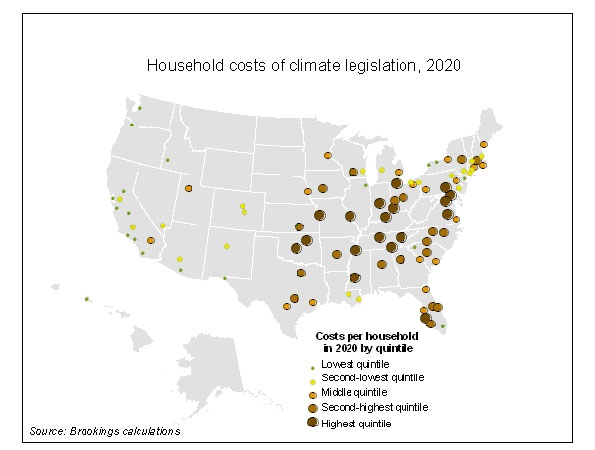
    The Brookings Institution recently calculated the projected cost of compliance under the cap and trade plan on a metro by metro basis and produced the map below for The New Republic:

    The costs of compliance are highest in the lower Midwest through to the Mid-Atlantic and in the South. New England, the Upper Midwest, and the West are the winners from a cost standpoint.

    The actual costs vary from a high of $277 per household per year in 2020 in Lexington, KY to a low of $96 in Los Angeles among the 100 largest metros. Other hard hit metros include Washington, DC ($250), Indianapolis ($246) and Kansas City ($228). Among the winners are Portland ($107), San Francisco-Oakland-Fremont ($119) and Chicago ($135).

    In aggregate, this adds up to a significant amount of money. The Cincinnati metro had 815,000 households in 2008. Brookings did not include their household estimates for 2020, but even with no population growth at all, at $244 per household that still adds up to about $200 million per year in compliance costs. To put that in perspective, Cincinnati is proposing to construct a new downtown streetcar system for that same amount of money. It could conceivably build a new streetcar line every single year in perpetuity for the cost of compliance. Portland has 835,000 households, for an annual compliance cost of $90 million. Though they are about the same size regions, Cincinnati will be paying over $100 million more per year compliance costs. This creates a $100 million disincentive to live or locate a business in Cincinnati vs. Portland.

    In short, cap and trade creates disparities between metros. As the New Republic put it, “place matters” on cap and trade. And because the effects are geographically clustered, these disparities aren’t just local, they are regional. This is enough to immediately prompt the question as to whether or not this was an implicit design goal of the system.

    Among the biggest beneficiaries of cap and trade is California. Its large metros are clustered together at the bottom of the list. I noted previously how California is placing a huge bet on the green economy as its engine of economy renewal. In fact, beyond legacy industries such as high tech, agriculture, and entertainment, California’s political leaders are betting their entire future on green. With so much on the line for California, it should come as no surprise that the state would seek to federalize its policies and institutionalize the advantages it has in this arena through its state level climate regulations. One might even better name this bill “The California Economic Recovery and Competitor Hobbling Act of 2009”.

    This reality isn’t lost on Indiana Governor Mitch Daniels. With Indianapolis the fifth hardest hit metro in the country, it is no surprise he denounced the plan in a Wall Street Journal editorial, saying, “Quite simply, it looks like imperialism. This bill would impose enormous taxes and restrictions on free commerce by wealthy but faltering powers – California, Massachusetts and New York – seeking to exploit politically weaker colonies in order to prop up their own decaying economies.”

    It is clear that getting a bill out of Washington is not just a matter of cost, but of states and regions jockeying for position. The significant regional disparities in impact grind the legislative gears and might ultimately imperil getting legislation passed. Reducing regional disparities could help improve the chances of action on carbon.

    But shouldn’t places that implemented what is considered good policy be rewarded? To some extent, yes. Many places actually voted to cause economic pain for themselves for the sake of a better environment. Other places have fought environmental regulation every step of the way. Clearly, we do want to provide incentives for good behavior, and certainly not reward bad.

    On the other hand, not all the differences in current carbon emissions or abilities to reduce them are the result of good policy. Quite a bit of them are the result of simple good luck. Some places have climates that reduce the need for heating and air conditioning. Other places face more extreme weather.

    Plentiful clean energy sources are unequally spread throughout the country. Not every place has access to large amounts of solar, wind, or hydro power sources. Much of the Midwest and South built coal fired power plants due to plentiful coal supplies in the region. Technology and transportation costs made other sources cost prohibitive. Carbon emissions were not on anyone’s radar then. Some places like Chicago were fortunate to build nuclear plants, which were bitterly opposed by environmentalists at the time, but now are praised by some as a source of low carbon power.

    In short, much of the inequality in carbon emissions results from accidents of geography or history, not deliberate bad choices. People shouldn’t be punished for practices that were rational at the times. As Saul Alinksy put it, “Judgment must be made in the context of the times in which the action occurred and not from any other chronological vantage point.” And while one could say perhaps regions whose climates require excessive heating and cooling shouldn’t be favored places to live, one could say the same about much of the West, including California, whose existence depends on a vast edifice of what many consider environmentally destructive water works.

    To actually get action on carbon – the true imperative – we should adopt the following policy guiding principles:

    1. The goal is carbon reduction, full stop. Encumbering it with additional regional economic gamesmanship, or becoming overly enamored with particular means to that end should be avoided.
    2. Reducing carbon emissions will come with an economic cost. It isn’t realistic to expect that we will get away with pain free reductions. Obviously we should seek to get the best blend of costs and benefits, but let’s not pretend we can have our cake and eat it too, holding carbon action hostage to a standard that can never be met.
    3. The carbon reduction regime should not create significant regional cost disparities. As a purely practical matter, this helps ease passage and should be embraced. Complete equality is never realistic, but when some regions will pay twice as much as others, that by itself creates oppositional voting blocs. If a cap and trade scheme is the preferred approach, then perhaps assistance to high compliance cost areas should partially fund the transition away from coal and towards less polluting sources.
    4. The carbon reduction regime should not encourage business to migrate offshore. We should also not take action that reduces the attractiveness of America as a place to do business and especially to manufacture. Regulatory arbitrage already provides an incentive to move to China, where you can largely escape environmental rules, health and safety regulations, and avoid the presence of independent, vigorous unions. An ill chosen carbon regime could simply enhance China’s allure as a “carbon haven”. Again, this skews manufacturing regions and labor interests against action on carbon, while shifting production to areas with only minimal regulatory restraints.

    In short, action on carbon reduction may well be a good policy goal. But we shouldn’t embrace any means to that end uncritically if it creates huge distortions in regional economic advantage or further damages America’s industrial competitiveness.

    Aaron M. Renn is an independent writer on urban affairs based in the Midwest. His writings appear at The Urbanophile.

  • Obama Still Can Save His Presidency

    A good friend of mine, a Democratic mayor here in California, describes the Obama administration as “Moveon.org run by the Chicago machine.” This combination may have been good enough to beat John McCain in 2008, but it is proving a damned poor way to run a country or build a strong, effective political majority. And while the president’s charismatic talent – and the lack of such among his opposition – may keep him in office, it will be largely as a kind of permanent lame duck unable to make any of the transformative changes he promised as a candidate.

    If Obama wants to succeed as president he must grow into something more than movement icon, become more of a national leader. In effect, he needs to hit the reset button. Here are five key changes that Obama can implement to re-energize and save his presidency.

    1. Forget the “Chicago way.” The Windy City is a one-party town with a shrinking middle class and a fully co-opted business elite. The focused democratic centralism of the machine – as the University of Illinois’ Richard Simpson has noted – worked brilliantly in the primaries and even the general election campaign. But it is hardly suited to running a nation that is more culturally and politically diverse.

    The key rule of Chicago politics is delivering the spoils to supporters, and Obama’s stimulus program essentially fills this prescription. The stimulus’s biggest winners are such core backers as public employees, universities and rent-seeking businesses who leverage their access to government largesse, mostly by investing in nominally “green” industries. Roughly half the jobs saved form the ranks of teachers, a highly organized core constituency for the president and a mainstay of the political machine that supports the Democratic Party.

    The other winners: big investment banks and private investment funds. People forget that Obama, even running against a sitting New York senator, emerged as an early favorite among the hedge fund grandees. As The New York Times’ Andrew Sorkin put it back in April, “Mr. Obama might be struggling with the blue-collar vote in Pennsylvania, but he has nailed the hedge fund vote.”

    At best, the president’s policy seems like Karl Rove in reverse, essentially smooching the core and ignoring the rest. This is a formula for more divisiveness, not the advertised “hope” Americans expected last November.

    2. Focus on Real Jobs, Not Favored Constituencies . The Chicago approach works better in a closed political system controlled by a few powerbrokers than in a massive continental economy like the U.S. Health care and education, which depend on government largesse, are surviving. But the critical production side of the economy that generates good blue-collar jobs – like agriculture, manufacturing and construction – is getting the least from the stimulus.

    These industries need more large-scale infrastructure spending, as well as more focused skills training and initiatives to free capital for politically unconnected entrepreneurial businesses. Instead, productive industries face the prospect of more regulation while capital for small businesses continues to dry up.

    Those in post-industrial bastions tied to speculative capital – think Manhattan and the Hamptons – are the ones most benefiting from Obamanomics. College towns like Cambridge, Mass., Madison, Wis., Berkeley, Calif., and Palo Alto, Calif., will also prosper, becoming even richer and more self-important. It seems, then, that Obama has done best for elite graduates of Harvard and Stanford and other members of the “creative class.”

    The rest of America, however, is still waiting for a real sustained recovery. Industrial and office properties remain widely abandoned not only in Detroit but Silicon Valley. The future sustainability of our economy depends mostly on what happens to those who previously staffed these facilities – those who produced actual goods and services – not just on a relative handful of people working at Google or the national laboratories. In other words, we need jobs for machinists, welders and marketers as well as scientists with Ph.D’s.

    3. Step on the Gas. Providence has handed America – and Obama – an enormous gift in the now recoverable deposits of natural gas found across the continent. Proven levels have been soaring and now amount to 90 years’ supply at current demand. More will be found, and across a wide section of the country.

    Natural gas may be a fossil fuel, but it is relatively clean and thus the perfect intermediate solution to our energy problems. The problem: The president’s green advisers will seek to prevent developing these resources.

    Although Obama should support strong environmental controls on gas extraction, the greens should not be allowed to block this unique and historic opportunity to shift economic power back to North America. Along with modest increases in domestic and Canadian oil, natural gas could end our dependence on fossil fuels from outside North America. This would relieve our military from the onerous task of defending other people’s oil supplies. But most important, the new energy sources could expand our industrial and agricultural economies so they can capitalize on the huge potential growth from markets at home and in the developing world.

    The natural gas era could then finance continued research and deployment of renewable fuels. Let’s give it the 10 or 20 years that great transformations require. Quick fixes will lead us to subsidize the purchase of rapidly dated technology from China or Europe; we should aim at the energy equivalent of the moon shot, helping forge a huge technological advantage.

    4. Rediscover America. As a candidate, Obama spoke movingly about his Kansas roots, but lately he seems to have become all big city all the time. This administration offers very little to people who live in places like Kansas, as many of my heartland Democrat friends complain.

    Urbanites often forget that this is an enormous country. Crowded into dense cities themselves, they fail to look down from the window when crossing the country by plane. The vast majority of America is, well, vast – sparsely settled, if settled at all.

    Moreover, Obama’s people need to understand that 80% of America live in suburbs or small towns. They do not want to live in dense cities or realize a move there would mean living in less than idyllic conditions. If Obama wants to shape a green America, he must find ways that work with the majority’s preferences.

    But so far the president’s housing, transport and planning advisers seem to be pushing the death of suburbia and promoting ever more densification. It’s hardly surprising, then, that suburbs and small towns feel left out. After finally starting to inch toward the Democrats, they are now turning again to the right. If Democrats want to retain their majority, they need the strong support of these constituencies – without it the Congressional majority will be gone by the end of the second term, if not the first.

    5. Chuck the Nobel; Embrace Exceptionalism. Many progressives love Obama because they see him as one of them in the struggle with what the immortal Bill Maher calls “a stupid country.” But the president should remind himself that the country may not be quite as dumb as it sometimes looks from Oslo – or from Dupont Circle, Cambridge or Soho.

    Being smart was part of the reason the Republicans lost the majority. The voters understood the country was wasting resources – and young people – on internecine conflicts for energy that we could produce at home. The Bush years also undermined any GOP claim to fiscal responsibility.

    Initially Obama allowed us to redefine American exceptionalism as something more than monomaniacal use of force and overconsumption. He spoke to our traditions of inclusiveness, adaptability and idealism. He offered the perfect vehicle because he and his story are so exceptional. Yet Obama sometimes seems more interested in serving as the apologizer rather than as commander in chief. His vision appears less American than pseudo-European.

    This is not the path to success for American presidents. Whether Ronald Reagan or Franklin Roosevelt, Harry Truman or even Bill Clinton, a president has to be a spokesman for his country. Right now, on the world stage, Obama is looking more and more like Jimmy Carter.

    I suggest these things because, for all his missteps over the past year, Barack Obama is my president and I want him to succeed. But to do so, first he needs to hit his own reset button – and the sooner the better. Unlike some, I do not believe the Obama presidency is already doomed. Presidents often grow in office: Despite his exceptionalism in other areas, let’s hope that Obama proves the norm here.

    This article originally appeared at Forbes.com.

    Joel Kotkin is executive editor of NewGeography.com and is a distinguished presidential fellow in urban futures at Chapman University. He is author of The City: A Global History. His next book, The Next Hundred Million: America in 2050, will be published by Penguin Press early next year.

    Official White House Photo by Pete Souza