Tag: Environment

  • Prince Charles is Britain’s Master-eco-fraudster

    Thomas Paine was born in Thetford, Norfolk, in 1737. He understood that history is made. Aged 39, writing his Common Sense, he noted that Britain is constituted of ‘…the base remains of two ancient tyrannies, compounded with some new republican materials.’ These were:

    ‘First. – The remains of monarchical tyranny in the person of the king

    Secondly. – The remains of aristocratical tyranny in the persons of the peers.

    Thirdly. – The new republican materials, in the persons of the commons, on whose virtue depends the freedom of England.’ (1)

    Since Britain’s reformist politicians in the House of Commons have shown no republican virtue, in 2009 we now also suffer the “aristocratical tyranny” of the House of Lords being augmented with life peers. These political appointees must give their allegiance to the monarchy, even if they imagine they serve the majority. In contrast to reformists today, the revolutionary republican Paine had the “common sense” to ask:

    ‘How came the king by a power which the people are afraid to trust, and always obliged to check? Such a power could not be a gift of a wise people, neither can any power, which needs checking, be from God.’ (2)

    The king in waiting, Prince Charles, certainly believes in God, and entertains the myths of many Gods, but his claim to the throne in 2009 is that he understands and represents “the natural order”. He has been arguing like this for 30 years. He reiterated his claim in the 2009 Richard Dimbleby Lecture. His is the 33rd lecture held in honour of the veteran broadcaster who died in 1965. Charles had warned in March 2009 that there were only 100 months in which to avoid disaster. (3) He reminded the BBC audience on 8 July that there were 96 months left. The imagined catastrophe he hopes to avoid is otherwise due in July 2017. (4)

    The full lecture is available to see on BBC iPlayer.

    It does not matter if Charles Windsor is “well meaning”. As Paine understood in the Rights of Man, ‘…a casual discontinuance of the practice of despotism, is not a discontinuance of its principles; the former depends on the virtue of the individual who is immediate possession of the power; the latter, on the virtue and fortitude of the nation.’ (5) Prince Charles conveniently imagines himself to be the “steward” of “natural capital”. He has an urgent “duty” in his mind to use his monarchical authority to sustain not only Britain, but the entire planet, in some undefined “natural balance and harmony”. This is his eco-myth, and no matter how benign, how little he uses his power, along with the military command that entails, he cannot be tolerated by a self-interested people.

    We are weak if we allow his eco-mysticism to go unchecked, and to reinvigorate the monarchy in Britain. Those promoting Charles as the spokesman for “natural capitalism” are worse than weak.

    Charles talks of not taking too much “income” from the Earth, which makes him sound modest in his monarchy. He does not seem like a feudal monarch. Yet Paine could see through this in 1792:

    ‘As time obliterated the history of their beginning, their successors assumed new appearances, to cut off the entail of their disgrace, but the principles and objects remained the same. What at first was plunder, assumed the softer name of revenue; the power originally usurped they affected to inherit.’ (6)

    The Windsors have been adept at assuming new appearances since the Second World War. Where his grandmother walked through Blitzed streets, and his mother managed to appear “ordinary”, the now 60 year old Charles makes an effort to appear “green”. He is an environmentalist promoting the stasis of sustainability, and the political deception works to the point where in drawing his revenue from “natural capital” he seems to be doing not only the British people but the whole of humanity a favour. ‘If we fail the Earth, we fail humanity,’ he says. (7)

    Even if he lived as a monarch as poorly as the majority of the world does, he would still be a focus for every anti-democratic interest in twenty-first century capitalism. Of course, even before he inherits the British throne from his aging mother, he does not live poorly.

    With a Parliament of worse than weak representatives checked by a house of new gentry and old aristocrats, all in deference to a feudal monarchy in charge of an interventionist military, Britain is a mostly low paid industrial democracy of debt-laden professional and amateur residential property speculators using a planning system that makes a political and economic nonsense of freehold land ownership. We must find a way to break free of this social containment, (8) focused in Britain on the impending coronation of a “green” king.

    ‘Hereditary succession is a burlesque upon monarchy. It puts it in the most ridiculous light, by presenting it as an office which any child or idiot may fill. It requires some talents to be a common mechanic; but, to be a king, requires only the animal figure of man – a sort of breathing automation. This sort of superstition may last a few years more, but it cannot long resist the awakened reason and interest of man.’ (9)

    In the second part of Rights of Man, Paine was over-optimistic. He thought that kings would make themselves sufficiently ridiculous. While Charles is worthy of ridicule on many occasions, he still commands loyalty from “greens”, even when they are embarrassed by his fantasy of the Earth as “Gaia”, as a conscious entity.

    It is not enough to point out his self-deceptive eco-hypocrisy, or its popularity. The pervasive idea that capitalism is in any way “natural” must be broken. That requires the promotion of industrial production based on an appreciation of the social division of labour. It is necessary to see that in moaning about the effect of “mechanisation” on the environment, for which the contemporary capitalist will even accept moral and legal responsibility, they will abandon industry and make a virtue out of a life of laborious effort, sustained as a “duty”.

    In 2009, 200 years after Thomas Paine died, ‘…environmentalism is the ideology of capitalism in retreat from production.’ (10) That is what we understand at audacity. What people lack is social control of the vast industrial surplus that is produced by all of us. At present the aggregated value of our social production is taken as privately owned capital, partially taxed and redistributed through government, while mystified and made acceptable by the likes of the Prince of Wales as “natural capital”.

    Charles says:

    ‘It seems to me a self-evident truth that we cannot have any form of capitalism without capital. But we must remember that the ultimate source of all economic capital is Nature’s capital.’ (4)

    Wrong. Nature just exists. Only human labour turns nature into product, using machines to enable less labour to produce more. Capitalism has succeeded so far in developing industry so that sufficient surplus is produced beyond the needs of subsistence. That has allowed employers to live off their employees. Paine did not understand the parasitical relationship of the employer on employees. The workforce is paid less than the value it produces. However Paine could see institutionalised fraud that we tend to ignore:

    ‘Monarchy would not have continued so many ages in the world, had it not been for the abuses it protects. It is the master-fraud, which shelters all others. By admitting a participation of the spoil, it makes itself friends.’ (11)

    Democratic society depends on raising the productivity of labour. He may fool himself, and some of his fellow “greens”, but we must not let Charles fool us. He and his backward, stasis-loving supporters must be denied the appearance of being “natural” leaders, as they attempt to promote an anti-machine age of capitalist “sustainable development”:

    ‘Our current model of progress was not designed, of course, to create all this destruction. It made good sense to the politicians and economists who set it in train because the whole point was to improve the well-being of as many people as possible. However, given the overwhelming evidence from so many quarters, we have to ask ourselves if it any longer makes sense – or whether it is actually fit for purpose under the circumstances in which we now find ourselves?’ (4)

    What “model of progress” and what “destruction” is he talking about? In his pre-recorded Richard Dimbleby Lecture, broadcast on BBC One on 8 July 2009, Charles insisted that Facing The Future meant a new system that is more ‘…balanced and integrated with nature’s complexity.’ (7)

    This is complete nonsense, but popular “sustainababble”. The majority needs complete control of industrial advance. That requires a plan to rescue society from “greens”. Prince Charles knows much “…depends on how you define both ‘growth’ and ‘prosperity’.” (4) Much certainly depends on whether most people accept his redefinitions, anticipating his imagined “catastrophe”, or whether we are no longer willing to be subject to his retreat from industrial production. We don’t need to accept his prediction for 2017. We need not be his duped “commoners”.

    “As to the word ‘Commons,’ applied as it is in England, it is a term of degradation and reproach, and ought to be abolished. It is a term unknown in free countries.” (12)

    There is much to abolish in Britain, fraudulent monarchy included, and much to build with “republican materials” in pursuit of democracy.

    Ian Abley, Project Manager for audacity, an experienced site Architect, and a Research Engineer at the Centre for Innovative and Collaborative Engineering, Loughborough University. He is co-author of Why is construction so backward? (2004) and co-editor of Manmade Modular Megastructures. (2006) He is planning 250 new British towns.

    References:

    1. Thomas Paine, Common Sense: Addressed to the Inhabitants of America, 14 February 1776, Philadelphia, reprinted in Mark Philp, editor, Thomas Paine: Rights of Man, Common Sense, and Other Political Writings, Oxford, Oxford University Press, 1998, p 8

    2. Ibid, p 9

    3. ‘Prince Charles: ‘We have less than 100 months to stop climate change disaster” ‘, 8 March 2009, posted on www.dailymail.co.uk

    4. Prince Charles, ‘Facing the Future’, The Richard Dimbleby Lecture as delivered by HRH The Prince of Wales, St James’s Palace State Apartments, London, 8 July 2009. For transcript see here as directed on the Press Release, ‘Richard Dimbleby Lecture 2009: The Prince of Wales’, 9 July 2009, BBC, posted on www.bbc.co.uk

    5. Thomas Paine, Rights of Man: Being an Answer to Mr Burke’s Attack on the French Revolution, to George Washington, President of the United States of America, 1791, reprinted in Mark Philp, editor, Thomas Paine: Rights of Man, Common Sense, and Other Political Writings, Oxford, Oxford University Press, 1998, p 98

    6. Thomas Paine, Rights of Man: Part the Second, Combining Principle and Practice, 9 February 1792, London, reprinted in Mark Philp, editor, Thomas Paine: Rights of Man, Common Sense, and Other Political Writings, Oxford, Oxford University Press, 1998, p 221

    7. ‘Prince fears Earth “catastrophe” ‘, 8 July 2009, posted on http://news.bbc.co.uk

    8. Ian Abley, We are witnessing a British built “housing crisis” that Government is powerless to resolve, 23 July 2008, posted on this website here

    9. Ibid, p 226

    10. James Heartfield, Green Capitalism – Manufacturing scarcity in an age of abundance, www.heartfield.org, 2008, p 91, with details of how to buy posted here

    11. Ibid, p 257

    12. Ibid, p 351
  • Enviro-wimps: L.A.’s Big Green Groups Get Comfy, Leaving the Street Fighting to the Little Guys

    So far, 2009 has not been a banner year for greens in Los Angeles. As the area’s mainstream enviros buddy up with self-described green politicians and deep-pocketed land speculators and unions who have seemingly joined the “sustainability” cause, an odd thing is happening: Environmentalists are turning into servants for more powerful, politically-connected masters.

    On March 3, voters shot down Measure B, a controversial solar energy initiative pushed by Mayor Antonio Villaraigosa and endorsed heartily by many prominent environmentalists. The stunning defeat in this liberal city came after critics accused the mayor and his friends of secret deals that rushed the measure onto the ballot as a favor to a city union whose workers be guaranteed almost all of the resulting solar jobs.

    Then, on April 29, U.S. District Judge Christina Snyder placed a temporary injunction on part of the “clean trucks” program at the Port of Los Angeles, whose air pollution is so foul that the EPA warns its emissions cause cancer in suburbs like Cerritos, miles upwind of the port. Judge Snyder rejected efforts by Villaraigosa and the Teamsters to force port truckers to give up their independence and work for companies – spun as a green rule, but ridiculed as a move to pressure the truckers to become Teamsters.

    Today, labor unions, big businesses, and politicians are embracing a green economy to solve their own political and financial woes. And the green agenda – repairing a damaged planet and protecting the local environment in which we live – is at risk of ending up an after-thought.

    “I don’t think the traditional environmental organizations are up to speed,” says Miguel Luna of Urban Semillas, a grassroots environmental group. Alberto B. Mendoza, president of the Coalition for Clean Air, concurs: “If we don’t become more modern in our approach, we’ll become obsolete.”

    In Los Angeles, developers now market, or “green wash,” big new buildings as “sustainable” – meaning healthy for the planet over the long term. The city of Los Angeles requires large buildings to follow “LEED” rules – low flush toilets, on-site renewable energy and the like. But do these projects cause more congested streets filled with idling cars, for example, than the energy they claim to save? In truth, nobody knows. “If you have a project that would normally be four stories high and now it has 20 stories,” says Hollywood activist Bob Blue, there’s a “net increase in power, water, sewer, traffic, pollution – and impact.”

    Yet among many greens, LEED is a closed debate – and represents a profound shift. In the 1990s, greens like Marcia Hanscom, Rex Frankel, Bruce Robertson, Cathy Knight, Sabrina Venskus, and Patricia McPherson took on Los Angeles City Hall, preventing it from wiping out the Ballona Wetlands to erect a vast housing development, Playa Vista. Those greens publicly trounced the pols and their speculator friends over absurd “sustainability” claims — including an effort to count the grassy median strips as “open space.”

    Nowadays, though, Los Angeles enviros are sliding toward the argument that big development is good for the air, land and water – and small bits of green are enough. Environmentalists rarely engage in the city’s intense development hearings. “Maybe one time an environmentalist showed up,” Blue says, “but it was on the behalf of the developer.”

    Within the green movement, Andy Lipkis, the founder of Tree People, and Mark Gold, executive director of Heal the Bay, have reputations as heavyweights with access to Villaraigosa and other politicians. Neither of them, though, wants to jump into rough-and-tumble politics. Lipkis, a likeable and dedicated activist, proudly says he is politically “naive.” Gold, a smart and equally dedicated environmentalist, says he is not “even a little” worried that politicians, labor unions or speculators are hijacking the greens’ issues.

    But today, developers regularly peddle their proposed apartments near L.A. freeways as “sustainable” – claiming they bring workers closer to jobs. The developments are backed by Villaraigosa and the L.A. City Council – to the horror of health experts. Researchers now know, for certain, that children living in these projects are burdened with often lifelong lung disease. “They are putting individuals at risk,” says USC professor Jim Gauderman, whose 2007 study confirmed it.

    Heavily focused on lowering emissions region-wide to fight global warming, greens now praise freeway-adjacent housing projects, utterly forgetting about the young humans involved. Incredibly, city Planning Commissioner Michael Woo, a Villaraigosa-appointee, hasn’t heard a word of opposition from them. Two years after USC’s study, he says, “I’m not sure there’s a political will to stop housing projects at these locations.”

    Grassroots activist Marcia Hanscom, who has never gotten anything by staying quiet, worked for years with other environmentalists to save the Ballona Wetlands. In 2003, that relentless effort paid off – the state bought more than 600 acres to protect and restore. But now, she says, the environmental movement in L.A. has lost its way. It’s time to talk openly about a “mid-course correction.”

    L.A. politicians “sometimes call me as if I’m one of their staff members,” she notes, “and I’m supposed to do what they say. They have their roles mixed up. I’m here to advocate for the environment, not to advocate for them.”

    Pro-green politicians control the office of mayor, almost every Los Angeles City Council seat, every Los Angeles Unified School Board seat, and, for years, have controlled the legislature. Yet the greens seem oddly incapable of asserting power. Mark Gold of Heal the Bay, for example, went out of his way to endorse solar power Measure B, even though Villaraigosa clearly dissed him by dreaming it up utterly without Gold’s input. What L.A. union boss would stand for that?

    Stefanie Taylor, interim managing director interim of the Green L.A. Coalition, a group of over 100 organizations, says, “We have to make sure we’re at the table when these decisions are made about the new green economy.” But right now, says enviro-lobbyist John White, environmentalists are “more like the menu.”

    The stark difference between the daily work of Hanscom, the grassroots environmentalist, and Jonathan Parfrey, the political insider and mainstream environmentalist, is instructive. When the Weekly talked with Hanscom, she was in the middle of an almost surreal battle to keep glaring, Vegas-style digital billboards, made up of 480,000 piercingly bright LED light bulbs, from being allowed adjacent to the blue herons and wildflowers of the Ballona Wetlands.

    Says Hanscom, “The city has the Ballona Wetlands as a part of a billboard ‘sign district?’ It’s outrageous! I even had [developer] lobbyists and lawyers ask me what they were thinking.”

    As Hanscom aimed her firepower at City Hall, environmentalist Parfrey, one of Antonio Villaraigosa’s newest political appointees, was getting ready to visit a Department of Water and Power wind farm way out of town, with the idea of creating “educational tours” for environmentalists. Nothing wrong with that, but it sounded like a public relations campaign for the big utility.

    It’s hard to escape the fact that Los Angeles power brokers regard the environmental movement not as a passionate force they can tap to improve the quality of life and to clean the air, water, and open spaces, but, increasingly, as just another jobs program. And some of the greenest greens have begun to wonder if their own leaders are taking part in the movement’s demise.

    Patrick Range McDonald is a staff writer at L.A. Weekly, and this piece appears in full at www.laweekly.com. Contact Patrick Range McDonald at pmcdonald@laweekly.com.

  • Why Rapid Transit Needs To Get Personal

    Innovation in urban transportation is the only long-term correction for expensive environmental losses and energy waste. Why, then, isn’t there a US plan for more vigorous exploration and demonstration of new systems using advanced technologies, particularly automation? Where is the Personal Rapid Transit — PRT — in US transportation policy?

    PRT utilizes automated, energy efficient, very lightweight four seat vehicles that operate on narrow, electrified, dedicated guideways. PRT vehicles reduce pollution and conserve land use. The system preserves the benefits that have made automobiles our current dominant transportation mode: personal, on-demand, fast travel directly to arbitrary destinations. For non-drivers, it’s a form of public transportation that upgrades travel to the personal level now available with the automobile. It allows travelers to avoid the slow, stop and go, repetitive service schedule which has prevented meaningful acceptance of conventional mass transit in all but a few very dense cities.

    PRT works like this: At an off line station, a rider goes to a waiting group of personal cars, inserts a card, punches in a destination and joins the main line for the automatically controlled trip directly to his or her destination.

    By direct use of electric energy to power very efficient drive motors, the limitations and inconvenience of batteries are primarily avoided. In some cases, when complete area coverage for the guideway net is not completed, dual mode cars with minimum battery use can deliver the “last mile” to destinations. Of course, current programs for significant automobile improvement should continue until PRT operations are ready to supplant them.

    There is a safety bonus, since these very light weight, energy efficient cars are segregated from the mixed flow of heavy cars and trucks.

    The simpler, lighter PRT vehicles would use significantly less energy than hybrids or battery powered cars. PRT offers the most potential for deep cuts in greenhouse gases in a few decades, without restricting the mobility necessary for regional productivity.

    Community-useful PRT coverage is not possible “overnight”. But PRT and other emerging technologies can stimulate whole new job producing industries while reducing dependence on both fossil fuels and conventional autos for personal transportation.

    Billions are being spent on mass transit installations that few travelers want. Meanwhile, urban congestion increases. Urban “streamlined” mass transit is seldom faster than 100-year-old trolleys. No really new concepts have appeared, since government has not prioritized new systems. Instead, it supports minor changes in existing models. Look at the military’s successful history of taking advantage of risky new technologies. Imagine if it overlooked a comparable potential; it’s equally difficult to fathom telecommunications companies still offering “Ma Bell” style dial phones.

    There is some limited evidence that the concept and hardware are being adopted. Heathrow airport near London is about to open on-demand personal ground travel between parking and terminals. Masdar is a United Arab Emirates new city which will replace automobiles with PRT. In the US, completely automatic on-demand travel on a small, funds-limited basis has been operating successfully at the University of West Virginia for thirty years.

    Some investigators hope that private funding — perhaps an office park, or a campus — can give PRT its initial boost. Maybe a city would be willing to start such a system in a congested area.. Certainly, the automobile revolution started in piecemeal ways. The commitments that are needed today are larger, however. Today’s climate of regulation and progressive income tax discourage risk capital at the needed levels.

    There are signs that the Federal government realizes that transportation policy has lost direction. A recent National Transportation Policy Project report proposes performance-based investment decisions for economic productivity. Compared to other vital infrastructure and private enterprise accomplishments, truly new concepts in transportation have been missing for many decades. With an opportunity to stimulate the economy, and create new job producing industries of global significance, hopefully this new form of vital personal transportation can be the win-win basis for national economic health and efficient urban transportation.

    For more on PRT vehicles, see the Liberator Car by MonoMobile or the British/Swedish/Korean Vectusport-Vectur Transport.

    Walter Brewer is a retired Vice President of a concepts and management center supporting military missile and space programs.

  • America’s Energy Future: The Changing Landscape of America

    During the first ten days of October 2008, the Dow Jones dropped 2,399.47 points, losing 22.11% of its value and trillions of investor equity. The Federal Government pushed a $700 billion bail-out through Congress to rescue the beleaguered financial institutions. The collapse of the financial system in the fall of 2008 was likened to an earthquake. In reality, what happened was more like a shift of tectonic plates.

    History will record that the tectonic plates of our financial world began to drift apart in the fall of 2008. The scale of this change may be most visible in who controls the energy that powers our world.
    ***********************************

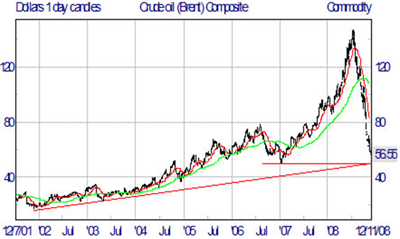
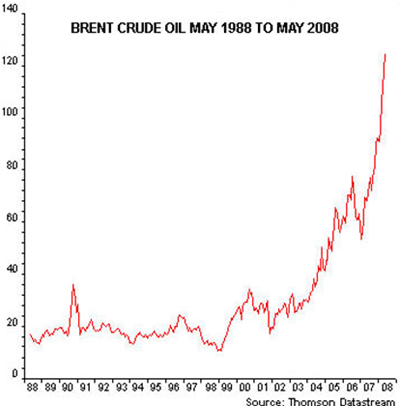
    May 2008 brought with it the highest price on record for Brent Crude Oil – $148 per barrel. At the pump that translated into prices in excess of $4.00 per gallon. A sixteen gallon fill-up of a Toyota Prius in Los Angeles cost its owner $72.00 and a fill-up of a twenty-five gallon Cadillac Escalade set its owner back more than $100.00. The largest transfer of wealth in the history of mankind was underway and consumers were feeling the pinch.

    The countries that border the Persian Gulf produce and export 20,000,000 barrels of oil per day. At its peak in May of 2008, the Persian Gulf producers (Saudi Arabia, Iran, Iraq, Kuwait, Qatar and the U.A.E) were receiving $3 billion per day, $90 billion per month and $1 trillion per year in revenues from the industrialized nations of the world, including the EU, North America and, most importantly, the rising powers of India and China.

    These Persian Gulf nations are mostly monarchies controlled by individuals, royal families or at best a few power brokers. American consumers abandoned their love affair with the SUV and Detroit’s assembly lines began to grind to a halt. New car sales which peaked at 17 million units in 2007 plummeted to a rate of 9.2 million within six months. The inventory of unsold vehicles built up and led inexorably to the bankruptcies of Chrysler and General Motors.

    At the same time, the airlines began charging for checked bags and discontinued the ubiquitous bag of peanuts as they reeled under the cost of jet fuel. Bellicose despots in oil rich lands outside the Middle East used their new found wealth to rattle their sabers. Russia, the world’s second largest oil producer after Saudi Arabia, began flying their venerable Backfire bombers to the American coast. Hugo Chavez of Venezuela, the world’s ninth largest oil producer, used his oil wealth to turn himself into an icon of the anti-gringo sentiment always beneath the surface throughout Latin America.

    Politicians, who placed America’s coastline off limits for drilling, were forced to recant their precious moratorium under the growing chorus of “Drill here and drill now”. Environmentalists, who destroyed the nuclear power industry with fearmongering over its safety, were increasingly on the defensive. T. Boone Pickens invested millions of his own money to promote wind farms – and more importantly natural gas – across America’s heartland. Sales of little known Jatropha seeds, a plant indigenous to India that produces an oil clean enough to run a diesel engine, skyrocketed. By the fall of 2008, the financial markets were buckling under the strain.

    As the economies of the world contracted, demand for oil plummeted and the price of crude collapsed. Terrified by the apparent mismanagement of the economy by the Republicans, Americans elected an untested junior Senator to the most powerful position in the world. Predictably, plans for alternative energy withered as prices plummeted and gas dropped to $1.50 per gallon. Russia, whose cost to develop crude is $50 per barrel, lost its swagger as its currency and stock market collapsed with the price of crude. The collapse of oil to $35 per barrel even silenced Hugo Chavez, at least for a moment.

    Sadly, the America public lost interest in energy as they were distracted by a 40% loss in their 401ks, corporate bankruptcies and the growing numbers of lay-offs. Politicians quickly shifted their focus from drilling, nuclear energy and independence from imported oil and began espousing the Obama administration mantra of “green energy” and “green collar jobs”. Unfortunately, these words are just a chimera since they are likely, even with massive subsidy, to produce only a small fraction of the nation’s energy for at least decade or two.

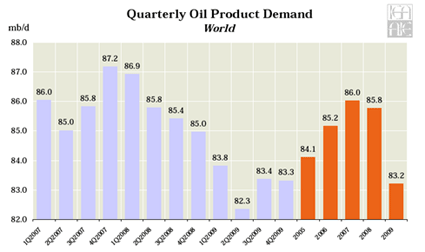
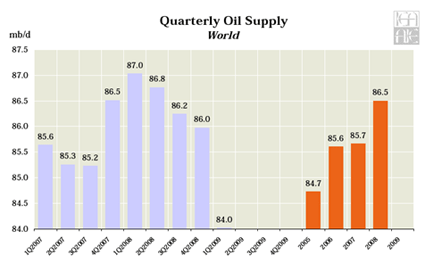
    These ephemeral goals only mask the real problem: America’s dependence on imported oil. The world demand for oil averages 85 mbd (million barrels per day). In the darkest days of the global financial crisis during the spring, when we stood at the abyss of The Great Depression, demand dropped to just 82.3 mbd. Conversely, world oil supply peaked at 87 mbd in 2007. This relative parity between supply and demand eliminates the elasticity that puts some control on prices. With literally no elasticity, speculators know that buyers will purchase every barrel of oil and prices rise. The proof of this market force is visible at the pump where gasoline has crested $3.00 per gallon in California and more than $2.66 per gallon nationwide. The United States consumes 20,000,000 barrels of oil per day or 24% of the world’s supply. In previous decades this was not a problem because the United States was a major producer of oil. But our peak production was reached in the 1970s when the US imported just 35% of its oil. Today we import more than 66% and no longer can influence the price of black gold. That price is now determined by despots in the Persian Gulf, Russia and Venezuela.

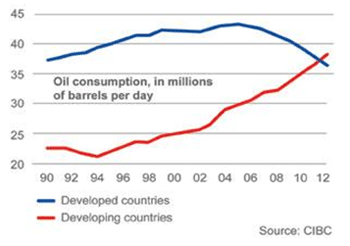
    This problem is not going away soon. According to the Energy Information Agency of the U.S. Government, the world demand for oil will require an additional 44 million barrels of oil every day to meet projected demand. The increase of demand is not going to come from the American or European markets. The developed nations through conservation, fuel standards, a reinvigorated nuclear power industry and, over time, the push for alternative fuels will actually reduce their consumption over the next twenty years. The push will come from India, Russia, Brazil, and of course China.

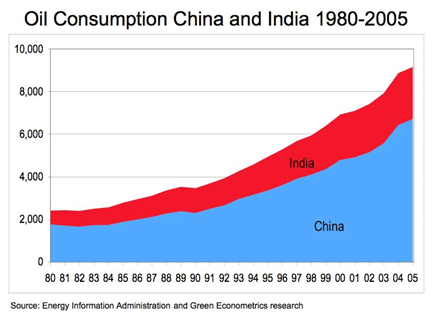
    India, with a population over one billion, has announced its version of the Interstate Highway System that opened America to its great Middle Class. After the acquisition of Jaguar and Land Rover, Tata Industries has begun production of the Nano, a car that sells for $2,000 in India. The demand for oil to power the cars for an educated and increasingly affluent Indian society will keep pressure on oil prices for years to come. India uses just 2.7 mbd today but expects that demand to grow to 4.5 mbd by 2030.

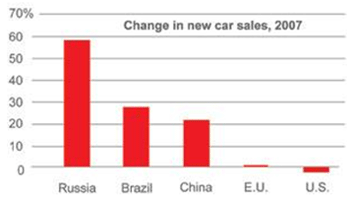
    There are now more than a billion Chinese. China consumed just 2 mbd of oil in 1990. Oil consumption jumped to 7.6 mbd in 2007 and is projected to grow to 15 mbd in 2030. The Chinese automobile industry grew at 21% last year while the US auto industry contracted by 40%. China displaced Germany as the third largest auto producer and will soon eclipse the damaged US auto industry which is contracting to a mere shadow of its former self. Chinese brands such as Chery and Geely, unknown to American consumers, may soon become as well known in America as Nissan or Hyundai.

    Demand will push oil over $100 barrels again. Vast capital will pour into the Persian Gulf, Russia and Venezuela once again. Into this tempest comes America with a thirst for 20,000,000 barrels each day. The major oil producers in the Middle East, Russia and Venezuela are not America’s friends. Russia will use its oil wealth to thwart the US and veto in the United Nations any effort to subdue the North Koreas and Irans of the world. China, with its surplus of US dollars, will continue to harvest natural resources around the world, and forge strategic alliances with the likes of Iran as it secures the flow of oil and natural resources to its industries for years to come.

    Meanwhile our politicians ignore our growing dependence on unfriendly nations and our weakening credit rating in the world to chase the chimera of green collar jobs and a green economy. Wind and solar will never power more than a minuscule fraction of America’s engines. America needs the equivalent of the Apollo moon project, a national challenge to move America off its dependence on foreign oil. We need simultaneous development of domestic oil and natural gas drilling, nuclear power, development of hydrogen fuel cells and clean coal technologies along with wind and solar power plants.

    A year from now the landscape of America will be forever changed. Five years from now, will American find the fortitude to grasp its energy independence? Or will our weak politicians in both parties keep their heads buried in the sand until China and India emerge to deny us what we are no longer in a financial position to demand?

    ***********************************

    This is the third in a series on The Changing Landscape of America. Future articles will discuss real estate, politics, healthcare and other aspects of our economy and our society. Robert J. Cristiano PhD is a successful real estate developer and the Real Estate Professional in Residence at Chapman University in Orange, CA.

    PART ONE – THE AUTOMOBILE INDUSTRY (May 2009)

    PART TWO – THE HOMEBUILDING INDUSTRY (June 2009)

  • Europe: No Longer A Role Model For America

    For decades many in the American political and policy establishment–including close supporters of President Obama–have looked enviously at the bureaucratic powerhouse of the European Union. In everything from climate change to civil liberties to land use regulation, Europe long has charmed those visionaries, particularly on the left, who wish to remake America in its image.

    “There is much to be said for being a Denmark or Sweden, even a Great Britain, France or Italy,” wrote political scientist Andrew Hacker in his 1971 book The End of the American Era .This refrain has been picked up again more recently by the likes of Washington Post reporter T.R. Reid and economist Jeremy Rifkin. Just last year, international relations scholar Parag Khanna shared his vision of a “shrunken” America lucky to eke out a meager existence between a “triumphant China” and a “retooled Europe.”

    But the tendency to borrow from the European toolbox may be somewhat questionable, particularly given that a growing number of Europeans are either uninterested–barely 40% bothered to vote in E.U. Parliament elections last week–or in open revolt against their own system of government. In the elections, for example, parties generally opposed to expanding E.U. power gained ground in countries as diverse as Hungary, Slovakia and the Netherlands. In Britain, the relatively small U.K. Independence Party, which even opposed membership in the U.N., out-polled the Labour Party and trailed only the Conservatives, who announced their own shift toward a more euro-skeptic point of view.

    Although the E.U.’s current top-down bureaucratic approach is clearly losing support, these recent events don’t necessarily mean the E.U. is doomed. It’s just that people who might be happy to accept a customs union and perhaps even a common currency are simply proving loath to hand over land use controls and environmental standards, much less foreign policy, to Brussels-based bureaucrats. At its root this move represents both a cry against control and a cry for greater autonomy.

    For the Obama administration, there may be some significant lessons here. Compared with Europeans, Americans are disposed to dislike too much central control. Turning Washington into a new Brussels, with regulations to cover virtually any human activity, could backfire both on the president and his party.

    But it’s also critical not to see Europe’s new tilt as affirming Reaganite cowboy capitalism. Many European countries, particularly the northern ones, are justly proud of the “social” models of capitalism they embrace. There are many policies–such as Danish incentives for industrial firms to greenify themselves, efficient universal health care and tough fuel economy standards for cars–that should be discussed and perhaps even adopted in some form in the U.S.

    In one sense, we should understand that Europeans are trying to protect their preferred standards when it comes to culture, social structure and lifestyle. They remain, if you will, fundamentally conservative in their efforts to preserve their well-established welfare states.

    But overall the anti-E.U. vote should make it clear that Europe’s overall economic system makes for a poor role model for our country. When the current economic crisis first hit, many European leaders–and their American fans, like Harvard economist Ken Rogoff–saw vindication for the E.U.’s economic policy and a much tougher road for the U.S. over the next year or two. Yet in reality, Europe already has suffered as much as we have from the downturn, and recovery there may also be even slower to emerge. In some countries, such as Greece and France, social unrest has been far more evident than here in the U.S.

    Simply put, European models do not necessarily work better–and when they do, they have occurred in part due to shifts away from strict welfare-state policies. As Sweden’s Nima Sanandaji and Robert Gindehag have argued the recent return to growth in places like Sweden came only after some modest reforms in both taxes and social benefits.

    Yet at the same time, even successful European countries–as well as the whole E.U.–generally experience slower growth than the U.S. with respect to measures like gross domestic product and job growth. This makes it an example of limited utility for America, a country that needs strong economic growth in order to maintain both its quality of life and overall social sustainability.

    The biggest source of divergence between the U.S. and the E.U. lies in demographic trends. For the most part, Europe is aging far more rapidly, and its workforce is shrinking. As demographer Ali Modarres notes, America’s population over the second half of the 20th century grew by 130 million, essentially doubling, while the populations of France, Germany and Britain together increased by 40 million, or 25%.

    As a result, there is virtually no European equivalent for cities like Houston, Phoenix, Las Vegas or Atlanta. American cities sprawl–and will likely continue to do so–because they are newer and because they are growing much faster in a country that is much vaster. Even with 100 million more people, the country will still be one-sixth as crowded as Germany.

    These differences will only become more stark. Opposition to immigration–from both Muslim countries and the E.U.’s own eastern periphery–is growing even in historically tolerant places like Great Britain, Denmark and Holland. Over time, migration into Europe is destined to slow. In Barack Obama’s wildly multicultural America, strong restrictionist sentiments have not gained much political ground, and, at most, efforts are directed not at reducing legal immigration but rather shifting it toward a more meritocratic model.

    So we can expect America’s population to continue growing at close to the highest rate in the advanced industrial world while Europe remains among the most rapidly aging places on earth. America’s fertility rate is 50% higher than Russia’s, Germany’s and Italy’s. By 2040, for example, the U.S. could have a greater population than the first 15 member nations of the European Union. Compare that prediction to 1950, when America had only half the population of Western Europe.

    These numbers point toward separate destinies for the U.S. and the E.U. Throughout history, low fertility and societal and economic decline have been inextricably linked, affecting such once-vibrant civilizations as ancient Rome, 17th-century Venice and, now, contemporary Europe.The desire to have children also reflects a fundamental affirmation of faith in the future and in values that transcend the individual. This is particularly true in affluent societies, where it is socially acceptable to remain childless and technology has made the decision not to have children easier to enforce.

    The U.S.’ demographic vitality will allow it to emerge from the current economic doldrums with more rapid growth than Europe–continuing a trend that has generally held for most of the past two decades. Innovation, largely a product of youthful indiscretion, also will continue to emerge more quickly stateside. Indeed, according to one recent European Commission survey, at the current rate of innovation, it would take 50 years for the E.U. to catch up to the U.S.

    Largely thanks to these demographic pressures, we could see an American economy twice the size of the E.U.’s by 2050. Unlike Europe, we have better prospects for growth, since there’s really no sustainable alternative for our society. In contrast, 40 years from now Europe’s economic growth rate is expected to fall 40%, due directly to the shrinking size of both its labor force and its internal market.

    We can ultimately expect two very different courses to develop. In America, the emphasis needs to be on sustained growth to prevent a massive decline in living standards. In contrast, Europe may be able to maintain a steady level of prosperity–even with lower growth, since its population will be either stagnant or declining–at least until the looming costs of maintaining a welfare state impose onerous economic burdens.

    Environmentally, Europe will become a “green” hero–because lower economic growth means a natural reduction in energy consumption and dreaded greenhouse gas emissions. Americans, on the other hand, will need to depend more on technological fixes–some of them from Europe–and embrace less economically damaging paths to growth. (These include promoting such things as working close to or at home and developing more fuel-efficient cars.)

    Neither Europe nor America–particularly given a much-reduced E.U. bureaucracy–has a better or worse model. We just have to recognize that these are, in the end, increasingly different societies: The former is focused on preservation of its hard-won peace and prosperity; the latter is challenged more by constant, major and sometimes even frightening change.

    Some may still hold out the hope that wise men in the old continent will present us with a road map to the future. But given the revolt going on against this mega-European ideal, we should understand that even many across the pond are having second thoughts about a future controlled by Brussels. Perhaps it’s better to recognize that most solutions to America’s problems–now and in the future–will be concocted not in Brussels, Berlin or Paris, but at home.

    This article originally appeared at Forbes.

    Joel Kotkin is executive editor of NewGeography.com and is a presidential fellow in urban futures at Chapman University. He is author of The City: A Global History. His next book, The Next Hundred Million: America in 2050, will be published by Penguin early next year.
  • Painting the Town White: Technology and Greenhouse Gas Emissions

    “Paint the world white to fight global warming” was the astonishing headline from The Times of London. The paper was referring to a presentation made by United States Secretary of Energy, Dr. Stephen Chu at the St. James Palace Nobel Laureate Symposium last week. Chu was reported as saying that that this approach could have a vast impact. By lightening paved surfaces and roofs to the color of cement, it would be possible to cut carbon emissions by as much as taking all the world’s cars off the roads for 11 years. That would be no small accomplishment.

    Chu makes considerable sense and his underlying approach is wise: emphasizing inexpensive, simple and unobtrusive ways to reduce greenhouse gas (GHG) emissions. This is at the same time that Secretary of Transportation Ray LaHood has suggested “coercing” people out of cars and a bill by Senators Jay Rockefeller and Frank Lautenberg would require annual reductions in per capita driving. Strategies such as these are not inexpensive, they are not simple and they are not unobtrusive. Indeed, given the close association between personal mobility, employment and economic growth, such policies could have serious negative effects.

    The biggest problem with coercive strategies is that they are simply unnecessary. As Secretary Chu has indicated, huge reductions can be achieved in GHG emissions, without interfering in people’s lives or threatening the economy. There’s more to this story than paint.

    The Cascade of Technology

    There is a virtual cascade of technological advances that have been spurred by the widely accepted public policy imperative to reduce GHG emissions. Here are just a few.

    Vehicle Technology

    Some of the most impressive advances are in vehicle technology. GHG emissions from cars are directly related to fuel consumption. Thus, as cars require less fuel, GHG emissions go down at the same rate.

    By now, everyone is aware that the Administration has advanced the 2020 vehicle fuel efficiency (CAFE) standards to 2016, matching the California requirements. These requirements apply to the overall fleet, both cars and light trucks (which are predominantly sport-utility vehicles). Recently published research by Robert Puentes of the Brookings Institution finds that per capita automobile use had fallen off even before gasoline prices exploded, so it seems reasonable to suggest that future vehicle travel will rise at approximately the population growth rate, rather than the robust growth rates previously forecast. At the new 35.5 miles per gallon, the nation could be on a course to reduce GHG emissions from cars and light trucks by more than 20 percent by 2030, despite the increase in driving as population increases.

    This is just the beginning. There are advances well beyond the 35.5 mile per gallon standard. The most efficient hybrid cars now achieve 50 miles per gallon. The European parliament has adopted a nearly 70 mile per gallon standard for 2020. The President has often spoke of his commitment for the nation to develop 150 mile per gallon cars, while Volkswagen has already developed a 235 mile per gallon car.

    A French company plans to market a car powered by compressed air at city traffic speeds, producing almost no GHG emissions, while at higher speeds it uses gasoline to get more than 100 miles per gallon.

    Fuel Technology

    Progress is also being made on alternative fuels and on making present fuels cleaner.

    Technologies are being developed to produce gasoline from carbon dioxide.

    There are even substantial advances in air travel emissions. Air New Zealand has announced tests that show the feasibility of using biofuels based upon the jatropha plant. The airline reports that, gallon for gallon, the biofuel reduced GHG emissions 60 to 65 percent relative to jet fuel. Jatropha is a non-food crop, and therefore its use would have little or no impact on food prices.

    Carbon Neutral Housing

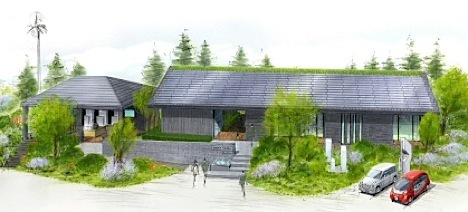
    We have previously reported on the development of a carbon neutral, single story 2,150 square foot suburban house in Japan. The resulting 100 percent reduction in GHG emissions means that there is no reason that such housing cannot continue to be available to those who prefer it.

    Electricity Generation

    One of the most intractable challenges will be producing sufficient supplies of electricity while considerably reducing GHG emissions. Obviously, one approach with great potential is nuclear power, which the environmentally conscious French have successfully used to produce approximately three-quarters of their demand.

    Further, substantial advances are coming in solar power. For example a Massachusetts Institute of Technology team has developed a solar concentrator system that increases power production “by a factor of 40.” The process is now under commercial development.

    Even Buck Rogers seems to be getting into the game. California’s Pacific Gas and Electric Company is partnering with a startup firm to produce solar energy in space and to beam it to earth by microwaves. This process could produce as much as 10 times the energy as ground based solar connectors.

    Further, international efforts continue toward developing nuclear fusion power generation. This non-polluting technology, still largely theoretical, could revolutionize power production in decades to come.

    The Color of Paint

    Some of the technological advances above may not in fact make a substantial contribution to reducing GHG emissions in the longer run. However, these developments and others likely to come underscore the fact that technology, that is human ingenuity, can materially reduce GHG emissions, while permitting people and the economy to go about their business. Serious attempts to force behavior modification backwards to the past seem likely to fail.

    So, there is no reason to retreat to an idealized yesterday to meet the thinly disguised social engineering goals of the few while leaving the many worse off. Secretary Chu has caught the spirit of the right approach. We should be painting the town white with innovation and should reject the coercion that has been embraced by those who naively (or perhaps even purposefully) would paint the future a more somber color. As in the past, human ingenuity appears up to the challenge, if we give it the chance.

    Wendell Cox is a Visiting Professor, Conservatoire National des Arts et Metiers, Paris. He was born in Los Angeles and was appointed to three terms on the Los Angeles County Transportation Commission by Mayor Tom Bradley. He is the author of “War on the Dream: How Anti-Sprawl Policy Threatens the Quality of Life.

  • Project Development: Regulation and Roulette

    The site plan logically should be the key to approval of a development project. Yet in reality, the plan is secondary to the presentation. My conclusions are based upon experience with well over a thousand developments over four decades, most in the mainland USA. And what I’ve observed is that the best site plan is only as good as the presentation that will convince the council or planning commission to vote “Yes” on it. No “yes” vote, no deal, no development.

    Each presenter deals with the dog-and-pony show in his own way. There’s an endless variety of styles (or lack of styles). All of these public meetings have one thing in common: The neighbors (if there are any) will be there to oppose the new development.

    Not Too Long Ago…
    In the old days there were three factions: The developer presenting the plan, the neighbors opposing the plan, and the council listening to both sides. If the development was high profile, someone from the local press might also show up. The planning commission and council are fully aware that all plans will be met with neighborhood opposition, and they will have to listen to lengthy complaints along the route to approving (possibly) the plan.

    In the past, the citizens sitting on these boards would most likely dismiss Elwood and Betsy Smith’s complaint about how a development in their back yard would invade their privacy, and would vote in favor of the new master planned community instead.

    How It’s Different Today
    Today there is often an additional audience. Televised meetings provide an entire region of neighbors. The on-screen council listens to the neighbor’s objections, no matter how absurd they may be, then answers directly to the camera, showing the general community watching at home that they really care about every citizen’s opinion. The council member must never appear too much in favor of the developer, as that could be misconstrued as not caring about the citizens he or she represents. A televised Council member hears the Smith’s complaint with a very concerned on-camera look, explains how maybe we have too many new homes in this town, and proceeds to tell viewers that the developer might want to consider a buffer and a drop in density. Concerns have changed from developing economically sensible neighborhoods to “please elect me Mayor when I’m on the ballot”.

    Planning Outside The USA
    Our first large site plan done outside the States was in Freeport, Bahamas. In 2000, when we were first contacted to design Heritage Village, we asked about doing presentations to the city council and planning commission to help move the approval process along. We were told that the development company and the regulating entity were the same, and if they liked the plan it would be built! That is exactly what had happened.

    Our next attempt outside the USA was not so easy. In Mexico City when we asked to sit down with government officials to change policy to create better neighborhoods, the developer said… No. At the time, we did not understand why it was so critical that we were not to suggest changes.

    We Discover A Superior Foreign System
    We wrongly assumed that all planning outside the USA could have similar problems, with restrictions that were absurdly prohibitive for designing great neighborhoods. It was only when we worked in Bogota, Columbia last year that we had the opportunity to work within a system that may not be so backwards after all. Our request to meet with the authorities to show them new ways to design neighborhoods was met, as it had been in Mexico City, with an absolute… No.

    We then asked for an opportunity to present the plan, and were told that was not necessary. Being that it was Columbia you can imagine our first thoughts. Cartels? Maybe corruption? The reality was much simpler. Since our plans met the minimums (they actually exceeded them), they were automatically considered approved. Imagine that – no neighbors to complain! If everything conforms, it should be approved … right? Just plain common sense.

    Zoning-Compliant Projects Should Be Exempt From Public Meetings
    When you think about it, why wouldn’t this work in the USA? if the development plan being submitted meets or exceeds the zoning and the subdivision regulation minimums, why does it need to go through any public approvals at all? The American developer often faces months or years of delays, enormous interest payments, and tens or perhaps hundreds of thousands of dollars spent on consultants and legal help to re-create plans that conform. Those massive sums could go towards making better neighborhoods, better architecture, better landscaping, less environmental impacts, and more affordable housing.

    We’d Still Need Public Meetings
    The public would still have plenty of input on regulation and zoning exemptions, where public citizen input is valuable. If a developer is proposing something that goes below minimums or does not conform to zoning regulations, then it is reasonable to go through the more time consuming process that we currently have. This brings up the question of how the developer would introduce something different to the written law. This could be a problem under typical PUD (Planned Unit Development) regulations, which typically allow blanket changes to the minimums when alternative designs are not covered by typical zoning.

    This PUD Pandora’s box, once opened, can have devastating results if the regulators and the neighbors both agree that the plan is simply not good enough. The developer thinks the plan is just dandy as is, but in reality most PUD proposals are simply too vague to be functional. A battle of wills that can last years often ensues.
    In the end , these expensive delays increase lot costs, and the home buyer ultimately pays. If a special ordinance such as PUD, Cluster Conservation, or Coving was specifically spelled out in a rewards-based — instead of a minimums-based — system, developers could get benefits for great plans complete with open space and connectivity, typically density and setback relaxations.

    While writing Prefurbia, we began to ask ourselves, how did we take something so simple and let it get so out of control? The third world countries are progressive enough to actually allow developers who comply with the rules to quickly build their neighborhood. Maybe they are not so far behind us after all.

    Perhaps our regulations and planning approach is intended to keep the system “busy” with billable hours. Imagine if we could get a conforming plan stamped, and the next day construction could begin. How many billable hours would be eliminated, how much construction cost and land holding interest saved? That would be very hard to calculate, but it’s likely significant.

    “It is difficult to get a man to understand something when his salary depends upon his not understanding it…” Al Gore, An Inconvenient Truth

    The inconvenient truth won’t win us many friends in the consulting industry whose incomes depend upon generating billing time in meetings. But can we afford to continue down the path we are presently on? We need to take a hard look at the regulations. Are they written solely to provide the highest living standards? Or do they generate the highest billable hours for the consultants who propose them?

    Rick Harrison is President of Rick Harrison Site Design Studio and author of Prefurbia: Reinventing The Suburbs From Disdainable To Sustainable. His websites are rhsdplanning and prefurbia.com.

  • Can Wind Power be a Reliable Long Term Source of British Power?

    The wind of change is blowing, but for once, that change might be affecting the wind.

    Wind, often championed as a viable alternative-energy source in the United Kingdom, might not be as energy efficient as it was once thought to be. Independent reports of the wind-energy efforts in the UK “have consistently revealed an industry plagued by high construction and maintenance costs, highly volatile reliability and a voracious appetite for taxpayer subsidies.”

    The cost for the energy alternative is sizable. Over the course of fiscal year 2007-2008, UK electricity customers paid a total of over $1 billion to the owners of wind turbines. That number is only expected to rise by 2020 to $6 billion a year as the government builds a national infrastructure of 25 gigawatts of wind capacity.

    Currently, wind produces only 1.3 percent of the U.K.’s energy needs while a 2008 report from Cambridge Energy Research Associates warns that over-reliance on offshore wind farms would only further create supply problems and drive up investor costs.

    Additionally, the average load factor for wind turbines in the UK was about 27.4 percent, meaning a typical 2-megawatt turbine only produced 0.54 megawatt of power on average. Dismissing the fact that low wind days would produce even less, all figures seem to point to poor return on investment.

    Some have suggested the building of cheaper wind farms, but ultimately higher maintenance costs and spare gas turbines to replace broken ones would cancel out any perceived benefits, as gas for the turbines would only add to carbon dioxide emissions.

    At this point, the outlook for wind to be a major source of UK electricity seems grim. Much like the wind itself, the problem just might be uncontrollable.

  • Cap and Trade: Who Wins, Who Loses

    President Obama recently announced his plan for environmental protection and Congress took up the debate. Called “Cap and Trade” Obama explained it simply in several public appearances. The government puts a limit on the total amount of carbon emissions that are acceptable in the United States. Carbon emissions come, basically, from burning carbon-based fuels – natural gas, petroleum and coal – in the production and use of energy. Users and producers of energy emit carbon dioxide (and other pollutants) into the atmosphere.

    As Richard Ebeling writes at the Mises Institute, under cap and trade “the government will formally nationalize the atmosphere above the United States.” The program bypasses fundamental questions like what is pollution, how much does it take to cause harm, who is harmed by it and linking the causation between pollution and harm. Fear of lawsuits, torts and injunctions (which could provide the answers) keeps the Administration from addressing these questions head-on. Reliance on the same, tired old source for solutions – Wall Street – ensures that those being harmed aren’t necessarily the ones who will benefit.

    Under Cap and Trade, each carbon-emitting entity – cars, power plants, factories, etc. – is allotted some share of that total limit, or Cap, permitted for carbon spewed into the air in the United States. For example, a power plant producing electricity for 50,000 homes and businesses might be allowed to emit 2 tons of carbon per year. That’s their “cap,” the maximum amount of carbon they are allowed to put in the air.

    Now for the “trade”: if that plant finds a cleaner way to produce the electricity needed for 50,000 homes and businesses, say only 1 tons of carbon per year, they can sell the right to emit 1 ton of carbon to a power plant that puts 3 tons of carbon into the air while generating electricity for 50,000 homes and businesses. The plant that buys the right to emit an extra 1 ton of carbon per year is not required to limit their emissions to 2 tons – they bought the right for the extra ton.

    It all sounds very lovely as long as the caps will control the total amount of carbon added to the air from the United States. The money gained by selling the rights for “unused” emissions will provide financial incentives to the makers and users of cars, power plants and factories to pay for the technology to be cleaner. Since the money spent to pay for the more efficient technology can be recovered in the Cap and Trade marketplace, the cost of the cleaner energy shouldn’t require higher costs to consumers of the now cleaner air.

    This is great if you live near a power plant that manages to reduce the carbon emissions into the air you breathe below the maximum cap level. Here’s the problem: what if you live next to the power plant that paid for the right to put an extra ton of carbon into the air? Two things happen. First, you will be paying for the extra carbon because the power company will have to charge more to pay the cleaner power company for the right to produce the extra ton of carbon. That leads to the second problem: the extra ton of carbon is being emitted into the air around your home. That means that you could end up paying more for your electricity, while also breathing more polluted air.

    Cap and Trade is not a solution, it is another money-making scheme cooked up by the “dangerous dreamers” of Wall Street. In the EU they at least have the good grace to call it a “Trading Scheme.” A global carbon trading market already exists. “Pollution rights” have been traded since the 1990s when the Environmental Protection Agency held the first auction of air emission allowances, or pollution rights, at the Chicago Board of Trade. Starting with sulfur dioxide allowances, other pollutants were added in the next ten years to eventually create a complete trading market on the Chicago Climate Exchange. “The right to use water or air is more valuable than food, and we can use the price system to allocate that right,” said Richard Sandor at the 2005 Milken Institute Global Conference (yes, that Milken). The Chicago Mercantile Exchange and the New York Stock Exchange are now prepared to expand the environmental markets for industrial pollution, also known as the carbon markets, into “futures and options on more than 40 U.S. and international indexes [for pollution rights].”

    But, really, do we want the same bunch of guys that gave us junk bonds, mortgage-backed securities and credit default swaps allocating air and water? Globally? Into the future?

    Like sending subprime mortgages throughout the global economy, this scheme will allow pollution rights to be bought and sold by anyone. So, it isn’t just the factory next door to the power generator in Detroit that will be emitting the extra tons of carbon – factories in other countries will be able to sell their carbon emitting rights to power companies in Detroit. It’s a great money-making scheme for a solar powered producer in Costa Rica – but a very bad deal for those breathing the air and paying for power in Detroit.

    The Cap and Trade scheme is being supported by President Obama’s main economic advisor, Larry Summers – who once said we should export pollution to Africa because their per capita figures are too low. “I think the economic logic behind dumping a load of toxic waste in the lowest wage country is impeccable and we should face up to that.”

    Cap and Trade gets the polluters mixed up with the victims of pollution. Shouldn’t the money generated from the sale of pollution rights accumulate to the persons harmed by the pollution? The idea that you can structure economic incentives to produce socially beneficial results really ends up being about creating paper profits for the money-traders at the expense of the people living with the pollution. This does not seem like a fair trade to me.

    Susanne Trimbath, Ph.D. is CEO and Chief Economist of STP Advisory Services. Her training in finance and economics began with editing briefing documents for the Economic Research Department of the Federal Reserve Bank of San Francisco. She worked in operations at depository trust and clearing corporations in San Francisco and New York, including Depository Trust Company, a subsidiary of DTCC; formerly, she was a Senior Research Economist studying capital markets at the Milken Institute. Her PhD in economics is from New York University. In addition to teaching economics and finance at New York University and University of Southern California (Marshall School of Business), Trimbath is co-author of Beyond Junk Bonds: Expanding High Yield Markets.

  • Unintended Consequences

    Consider the tax credits for alternative fuels such as ethanol and biomass that were rolled into the 2005 Transportation Law to encourage energy independence. At the same time, re-consider the law of unintended consequences, enshrined in Adam Smith’s notion that the unregulated behavior of capitalists gives rise to an invisible hand “to promote an end which was no part of their intention.”

    The tax law included a fifty-cent-a-gallon credit for the use of fuel mixtures that combined “alternative fuel” with a “taxable fuel” such as diesel or gasoline.

    This ill-conceived legislation is now producing an $8 billion windfall for the nation’s paper companies that, in order to qualify for the subsides, began adding diesel fuel to a paper-making process that required none.

    Paper has been produced in basically the same way since the 1930s, when scientists learned how to leach cellulose from wood chemically. The chemical reaction produces a sludge containing lignin, which is so rich in carbon that the paper makers use it as fuel in the process that transforms the pulp into paper. It’s wonderfully efficient, and allows the nation’s paper companies to operate largely without foreign oil. But not, however, with subsides. That’s why the companies added diesel fuel to the lignin, effectively replacing a green technology with one that is dependent on foreign oil.

    The road to hell, as Adam Smith’s contemporary Samuel Johnson ironically observed, is paved with good intentions. But one can arrive there just as easily with bad intentions and bad faith.