Tag: Environment

  • Lessons from Chrysler and the Nationalized Economy

    Economists and accountants could very likely have told us six months ago that Chrysler was doomed as a business and that the likely best course of action would be Chapter 11 bankruptcy and restructuring. Doing this in a timely manner would have saved the taxpayers billions of dollars.

    But the politics were not right to permit this to happen at that time. So instead we invested billions of tax dollars to save it, only to find ourselves right back were we started. Except now the clock is striking twelve and it is the right time to reorganize the automaker – politically speaking.

    The politics has worked to “force” Daimler, Cerberus, Banks, UAW and the U.S. taxpayer to forgive nearly $17 billion in debt, and to transfer ownership to a consortium that includes Fiat, U.A.W., and the U.S. and Canadian governments. The same fate may soon await General Motors given the current political atmosphere.

    Government action is not driven so much by economics or accounting as it is by shifts and changes in public opinion and the political winds on Capitol Hill. Regardless of the problem and the consequences of delay, no issue will be dealt with until opinion has been properly shaped around it. This is inefficient by its nature, but government is not a business and cannot fail, so the consequences are never felt by government.

    This means government will often invest in what’s next and ignore what is needed in the present. Why? Because the public likes the new and the novel and grows weary of the old and tried and true. Transportation infrastructure is a great example. It is an accepted fact that our road and bridge infrastructure is failing and will require billions of additional dollars to rebuild and reform into a 21st century, integrated mobility network. Yet there is no political will to address an issue which could seriously undermine our economic competitiveness costing us countless jobs and businesses.

    Politicians know that a solution will require new revenues and very likely a new user fee to augment the current gas tax. Raising taxes is not good for the long term political health of our elected “leaders” because the public does not want to pay for things. So rather than solve a pressing need, government proposes borrowing $8 billion to spend on high speed rail projects like the one to connect Disneyland and Las Vegas. This project works politically because it is filled with perceived benefits and no one really has to pay for them – we can pass it all on to the next generation.

    As we move toward increasing the politicization of our economy where politicians replace CEOs, government becomes a major shareholder in corporations, and the metrics of elections replace standard accounting practices, we should remember the inherent and unintended consequences.

    Businesses succeed or fail based on markets. The government’s attempt to create a false housing market with its affordable housing initiative is arguably one of the major contributing factors to our current recession. They will likely assert their new power in the automobile industry to create “green” cars that may or may not sell. What if consumers choose to buy Japanese, Korean or German label cars made in Mississippi or Alabama, instead of UAW-built cars from Michigan?

    Markets work, and yet they are being ignored. The second most profound economic event of the past year (the collapse of the financial markets being the first) was when the price of gasoline moved above $4.00 a gallon in April of 2008. People drove less. Demand for SUVs plummeted. Ridership of public transportation increased dramatically. Many valued components of American way of life changed almost overnight.

    What is often missed is the fact that government was powerless to do anything about gas prices. Elected leaders looked for scapegoats in speculators and commanded the heads of the Big Oil companies pay homage at their feet. They attacked profits, demanded more drilling, put their environmental agenda on the back burner. The crisis showed them to be feckless on the horns of a dilemma. When prices retreated swiftly in August 2008 and public opinion cooled on the issue, drilling for new energy disappeared from the radar and everything was “green” again. The problem has not disappeared of course, but only public support for a solution. Is this any way to run an economy?

    Businesses concentrate on profit. Elected leaders focus on votes. Bad business decisions are unsustainable in a free market which metes out consequences with failure. Bad political decisions make an elected official unelectable, so it is always better to avoid conflict by putting off the really tough decisions for another day. This is not the way most Americans run their households, but it’s how politicians would run our economy – responding to opinion, not market conditions.

    There are some very difficult decisions as we move through this economic downturn. Do we want more and more of the political processes to be incorporated into our economy on a permanent basis? Banks and financial institutions have already seen first hand the consequences of getting into bed with government. Our automobile industry is next in line. Let’s hope it is the end of the line, but it probably won’t be.

    Dennis M. Powell is president and CEO of Massey Powell an issues management consulting company located in Plymouth Meeting, PA.
  • Germany’s Green Energy Goals Are Potentially Unrealistic

    The world looks to Germany to be a leader in Green Energy. There’s been a great deal of hype surrounding Chancellor Angela Merkel’s very ambitious goals of dramatically reducing the county’s emissions by 2020.

    Yet the German experience should also provide some pause to President Obama and others proposing such changes in the United States. It turns out that goals are potentially unrealistic, perhaps even dangerous, for numerous reasons. One reason that makes them so unrealistic is that they are seriously hamstrung by effectively cutting off the single largest source of CO2-free energy available anywhere in the world right now: Nuclear Power.

    This reflects how much Germany has been influenced by green politics. In the years of the Socialist-Green government stretching from 1998 – 2005, nuclear power was considered an anathema. The Green party has its roots in the anti-nuclear power movement of the seventies. One of the most important items on their agenda when they came into power was to completely eliminate Germany’s use of nuclear power in the now infamous Atomaustieg or Nuclear exit which mandated that Germany no longer use nuclear power by the year 2020.

    When Chancellor Merkel took power under the Grand Coalition of Christian Democrats and Social Democrats, this policy remained in place even as the government pledged it would dramatically lower Greenhouse Gases by 2020 as well. Although the Christian Democratic Union (CDU) has been arguing for a repeal of the ban on nuclear power, the coalition continued to eliminate this most effective means of GHG reduction, placing its bets on conservation and renewable energy.

    Ironically Germany remains one of the leading countries when it comes to nuclear technology. Areva, France’s nuclear leviathan has a large R&D facility here in Germany, where I myself once worked as an English language trainer. The German engineers working here in Erlangen are regularly sent abroad to help with the building and maintenance of nuclear plants throughout Europe and the rest of the world. German engineering is being used in Finland, Bulgaria, and Sweden. Some of the engineers have even helped build a high-pressure reactor in Lynchburg, Virginia. I have worked with these people and they include some of the best minds in the field.

    Germany’s desire to reduce greenhouse gases and live without nuclear power has taken some almost absurd turns over the years. For one thing, Germany appears to be turning to its single cheap and abundant supply of energy, albeit a very dirty one, coal. Germany has both some cleaner anthracite and a lot of very dirty bitumen mines. These mines provide an enormous portion of Germany’s electricity and are also one of the reasons why Germany’s lights won’t go off even if all the nuclear plants are turned off. Coal power plants are being built across the country – even the Greens in the Hamburg government have allowed massive plant to be built in the city with some very strict regulations.

    The single most absurd aspect of the Green’s desire to eliminate Germany’s reliance of nuclear power are massive subsidies that it has provided for both solar and wind power generation. Germany, while not the gloomiest country in Europe, is not exactly sunny. It has huge annual amounts of precipitation and dark, grey winters. Subsidies, as well as its renowned industrial prowess, have turned the country into one of the leading producers of solar power.

    Yet this is not an unalloyed advantage – despite the constant claims made about “green jobs“ here in Europe as well as North America. Solar power is enormously expensive and inefficient here, most notably lacking the reliability needed by all major power suppliers. It only produces power when the sun shines, and it is very tricky to store the energy created, especially with photovoltaic sources making it enormously expensive. Some forms of solar power have been able to store off-peak power production; the parabolic-trough plants in Andalusia or the Mojave deserts use molten salts stored en masse to assure 24-hour supply, but these technologies, though provided by German companies, cannot be implemented in Germany itself due to the lack of intense sunshine about 6 months out of the year.

    And then there’s wind. Wind has all of the drawbacks of solar but the advantage that Germany is at least fairly windy. Wind power has taken off here and the Baltic and North Sea coasts are dotted with enormous wind parks. The costs are still enormous and wind or solar power are still far more expensive than standard sources of power. A May 12, 2008 editorial in the Wall Street Journal stated: “For electricity generation, the EIA concludes that solar energy is subsidized to the tune of $24.34 per megawatt hour, wind $23.37 and ‘clean coal’ $29.81. By contrast, normal coal receives 44 cents, natural gas a mere quarter, hydroelectric about 67 cents and nuclear power $1.59.”

    Costs have come down recently due to the explosive growth in the sector over the last few years. The U.S. Energy Information Administration estimates that wind costs $55.80 per MWh, coal at $53.10/MWh and natural gas at $52.50, and the costs for wind fail to take into consideration the costs of owning and operating a conventional power plant to provide energy when the wind is not blowing. Explosive growth over the last few years has allowed companies to exploit the economies of scale created by large-scale production. German wind-turbine producers have been able to maintain a fairly large presence on the market but have been muscled out recently by American and Indian manufacturers. Wind-power will never be able to provide more than 20% of the power mix by most projections. As with solar, there is insufficient storage technology affecting solar; the appropriate areas have been built out. There have been murmurs about the possibility offered by off-sea wind parks but these are also enormously expensive to build and maintain.

    Germany has shunned nuclear and coal in an attempt to use wind and solar. Renewable sources are not only much more expensive but also cannot begin to provide the amount of energy at economical rates. Germans are also big fans of natural gas but the problem is Germany has very little of it. Germany has had to import its natural gas, some from fairly reliable partners like the Netherlands and the United Kingdom but mostly from an increasingly assertive and authoritarian Russia.

    So rather than promote independence in energy, Germany’s green policies are making it ever more dependent on an autocracy. Even under the Soviets, Germany’s wet winters were made more commodious with the pleasant warmth provided by Russian gas. Schroeder and Putin were the best of friends, aided by the fact that Putin spoke fluent German from his time running the KGB station in Dresden, Germany. When Schroeder was fired by the German people he quickly found employment as a lobbyist for Gazprom, the Russian energy titan.

    This leaves Germany with a series of problems with no pleasant solution. It can either lift the ban on nuclear power or extend the lives of its plants as Sweden has already done. It can build a lot more coal-fired power plants, which Vattenfall is now trying to do in Hamburg, or it can opt for conservation, renewable energy and economic stagnation. The latter seems to be the path that Germany has chosen. Economic stagnation or even moderate economic growth or slight contraction might not be so bad for Germany. It has none of the demographic pressures driving dynamism and growth in America. The green ideologues driving German policy argue that renewable and conservation of energy are Germany’s only hope. To them, green principles are well worth the price in demographic and economic stagnation.

    Kirk Rogers resides in Bubenreuth on the outer edges of Nuremberg and teaches languages and Amercan culture at the University of Erlangen-Nuremberg’s Institut für Fremdsprachen und Auslandskunde. He has been living in Germany for about ten years now due to an inexplicable fascination with German culture.

  • Playing With Trains

    The Obama administration appears to have established the development of high speed rail (HSR) as the most important plank of its transportation strategy. The effort may be popular with the media and planners, but it’s being promoted largely on the basis of overstatement and even misinformation.

    I have had considerable experience evaluating high speed rail projects. Most recently, Joe Vranich (a former colleague on the Amtrak Reform Council) and I teamed to produce an extensive report on the subject, California High Speed Rail: A Due Diligence Report. The findings, based on information provided by the HSR promoters reveal the claims of the Administration to be highly questionable.

    Financing: It begins with understanding transportation financing in the United States. The Administration notes that far more money has been spent on highways and airports than on intercity rail. This is not in question. However, virtually all of the money spent to build the nation’s highway system and its major airports has been paid for by users of the system. Highway users have paid for intercity highways with their state and federal fuel taxes. Airport users have paid for the airports and the air traffic control system with taxes on their tickets. Put directly, if you don’t use the highway or airport system, you don’t pay. Indeed, not only do highway users pay for highways, but at the federal level, their funds provide 8 times as much revenue to transit per passenger mile as to highways.

    Passenger rail finance is another matter. Generally, users pay less than one-half the total costs of passenger rail. The rest comes from taxpayers. If passenger rail were financed the same way as highways and airports, it would be largely paid for – both capital and operating costs – by fares and by taxes on tickets. Of course that would not work, because passenger rail is far more costly than the highway and airport competition. Today, Amtrak fares per passenger mile are more than double that of the airlines per passenger mile, and that is before the heavy subsidies received by Amtrak.

    Indeed, the most recent data provided by the Department of Transportation indicates that the federal government made a profit of $1.00 per 1,000 passenger miles on the highway program while subsidizing passenger rail $210 and transit $159 per 1,000 passenger miles.

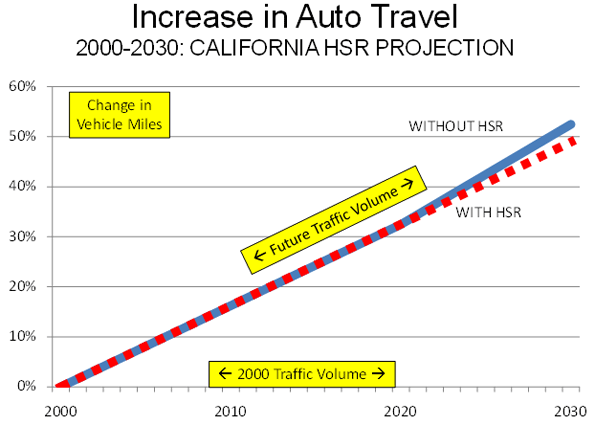
    Ridership and Relieving Congestion: High Speed Rail is also promoted by the Administration, which claims it will reduce traffic congestion. This claim is fraught with difficulty. First, highway traffic congestion is almost exclusively within urban areas, not between the urban areas that HSR would serve. Data from the California promoters indicates that traffic levels would rise nearly as much with HSR as without it. HSR is projected to reduce traffic by less than 3 percent once the system is complete. Without high speed rail, traffic volumes would increase 52 percent and without high speed rail, traffic volumes would increase 49 percent above 2000 levels (See Figure). In either case, things would be far worse in the future than they are today. And if HSR can make so little difference in congested California, it will surely do less in other parts of the country.

    Similarly, HSR will have little or no impact on the need to expand airports. For example, the Bay Area’s regional airport plan noted that high speed rail “would not divert enough passengers to make up for the shortfall in runway capacity.”

    In France and Japan, where travel is far more concentrated due to the linear location of major urban areas and the smaller number of large metropolitan centers, markets that are well served by HSR still have significant airline traffic (Tokyo to Osaka and Paris to Marseille). Also worth noting, both nations boasted pre-existing rail ridership levels that account for much of the HSR volumes. There is no such foundation in the United States. The ridership issue is particularly important, because of the miserable record of transportation ridership projections both in the United States and around the world. A most recent example is the Taiwan high speed rail system, which according to the early projections of promoters was to carry 180,000 passengers per day in its early operations. Yet in its second year of operation (2008), the average daily ridership was less than one-half that projection (84,000, calculated from Taiwan government data). This is telling in a country with notoriously congested traffic and very few major urban centers,

    This strategy of exaggerating ridership claims (and grossly under-estimating costs) is widespread in rail projects and has been extensively documented in Megaprojects and Risks: An Analysis of Ambition, by international scholars Bent Flyvbjerg, Nils Bruzelius and Werner Rothengatter (available from booksellers). The Taiwan and other international experiences suggest a major HSR investment would cost the taxpayers many additional billions and could bankrupt any private investors.

    Greenhouse Gas Emissions: But perhaps the most misleading claims are related to greenhouse gas (GHG) emissions. It starts with the marketing. The Administration’s press release indicates that building all of its routes would reduce GHG emissions by “six billion pounds” annually. This sounds like a big number. It is akin to my characterizing my weight as nearly 100,000 grams, instead of the pounds (200 in my case) that is customary in talking about weight. In GHG emissions, we do not talk about pounds, we talk about metric tons. Six billion pounds is only 2.7 million metric tons (2,205 pounds), which is an infinitesimal share of the GHG emissions from the nation’s passenger transportation. Indeed, given the propensity of the consultants to produce ridership projections less accurate than “Vietnam body counts,” the figure is probably less.

    The Administration falls into the usual trap of assuming that theoretical differences in GHG emissions can be turned into radical changes in travel patterns and behavior. The GHG emissions per passenger mile may be less (at least before the coming improvements in vehicle technology) but that does not mean that enough passenger miles can be moved from cars (and planes) to make a material difference. Our experience in high cost urban rail projects should have taught us this.

    Moreover, a mere reduction in GHG emissions is not sufficient to justify adoption of a strategy. Strategies must be prioritized based upon their effectiveness, and that is measured by cost. On this score, the California HSR system fails to a degree that is incomprehensible. The Intergovernmental Panel on Climate Change (IPCC) has indicated that the cost of GHG emission reduction should be no more than from $20 to $50 per ton. Even that may be too high. For example, Al Gore, Governor Schwarzenegger and Speaker of the House of Representatives Nancy Pelosi studiously buy carbon offsets for the tons of GHG that they produce flying around the country. The current market rate for such offsets is under $15.

    The California High Speed Rail Authority, whose leadership touts its GHG emissions reduction potential constantly, did not even bother to look at the cost of GHG emission removal in its thousands of pages of expensive, taxpayer financed reports. We looked at the issue, using California High Speed Rail Authority and California Air Resources Board assumptions and found that the cost per ton of GHG emission removal would be nearly $2,000, or 40 times the maximum figure used by the IPCC. To illustrate how extravagant a figure that is, if the nation were to reduce its GHG emissions by 80 percent (as proposed by the Administration) at the same rate, the annual cost would be more than 75 percent of the gross domestic product.

    But that assumes all of the rosy cost and ridership projections. The figure could be as high as $10,000 per GHG ton, if the consultants have exaggerated as much in California as elsewhere.

    Conclusion: It is likely that the same arguments can be made even more strongly in other proposed high speed rail markets. Yet, as costly as it is, HSR would be no more objectionable than building a new hardware store if it were paid for by its users. However, when taxpayers are asked to foot the bill, objective analysis of the claims, costs and benefits should at least have some priority. These are issues that an Administration committed to reducing GHG emissions by 80 percent has an interest in addressing. Relying on folklore rather than reality, as seems to be the present case, reflect an abject naivety at the least and incredible foolhardiness at the worst.

    Wendell Cox is a Visiting Professor, Conservatoire National des Arts et Metiers, Paris. He was born in Los Angeles and was appointed to three terms on the Los Angeles County Transportation Commission by Mayor Tom Bradley. He is the author of “War on the Dream: How Anti-Sprawl Policy Threatens the Quality of Life.

  • Greenhouse Gas Emissions and Reality: Residential Emissions

    In the quest to sufficiently reduce greenhouse gas (GHG) emissions, it is crucial to “get the numbers right.” Failure to do so would, in all probability, mean that the desired reductions will not be achieved. Regrettably, much of what is being proposed is not based upon any comprehensive quantitative analysis, but is rather rooted in anti-suburban dogma.

    Further, ideologically based approaches carry the risk of severe economic and social disruption, which could make it even more difficult, in a political world, to reach GHG emission reduction objectives. Unconsidered attacks on suburbs could also backfire, setting back more reasonable attempts to reduce emissions over time.

    For example, a recent New York Times blog entitled “The Only Solution is to Move” presumed it a necessity to (1) move from the suburbs to the city, where (2) “you are near everything you need” and to (3) abandon cars, which the author contends “cannot be reformed.” This screed provides an ideal point of reference. We start with the comparative GHG emissions efficiency of suburbs and deal with the other issues in future articles.

    The Need for Comprehensiveness: Any plausible attempt to reduce GHG emissions must start with a comprehensive understanding of the issue, including the comparative GHG intensity of various types of living and mobility patterns.

    This requires a “top down” analysis of GHG emissions by mode and locality. Such an analysis must start with the gross GHG emissions in a nation and allocate each gram to a consuming household. A household allocation is necessary, because businesses emit GHGs only to satisfy the immediate or eventual demand of consumers. “Top down” is required because that is the only way to make sure the analysis includes everything. The typical “bottom up” analysis runs the risk of missing large amounts of emissions as analysts highlight their own “hobby horse” sources, while excluding the inconvenient. This is why we have “double entry” bookkeeping – to make sure that the sums balance.

    “Top down” comprehensiveness has been best developed by the Australian Conservation Foundation (ACF) Consumption Atlas, which is the only study I have found that allocates every gram of GHG emissions in a nation to households. That is a minimum requirement.

    Residential GHG Emissions

    Having reviewed the need for comprehensiveness, the balance of this article will deal with residential GHG emissions. Despite all the airtime – and trees – sacrificed for lengthy columns on GHG emissions, it is clear that the state of the research in the United States remains abysmal.

    GHG Emissions: A Function of House Size: Research has been published that suggests the dominant suburban housing form (the detached single-family dwelling) is more GHG intensive than more urban, multi-unit and high-rise apartment and condominium housing forms. However, the entire supposed city versus suburbs advantage relates to house size. The Department of Energy’s Residential Energy Conservation Survey (RECS) data shows that the energy consumption per square foot is 70 percent higher in residential buildings with five or more units (the largest building size reported upon) than in detached houses. Full disclosure on the part of the anti-suburban crowd would require telling people that their conclusions would mean much smaller house sizes.

    Common Area GHG Emissions: There is, however, a far more fundamental problem. The databases usually relied upon (The Bureau of the Census’s PUMS and the Energy Department’s RCES), as cited in the USDOE 2008 Buildings Energy Data Book, do not provide sufficient information to demonstrate any high-density GHG emissions advantage.

    None of these data sources include the GHG emissions from “common” energy consumption in multi-unit residential buildings. Their information is limited to energy consumption as directly billed to consumers. Thus, in a high-rise building, common energy consumption sources such as elevators, common area lighting, parking lot lighting, swimming pool heating, common heating, common water heating, common air conditioning, etc. are not included. Detached housing generally does not have common energy consumption.

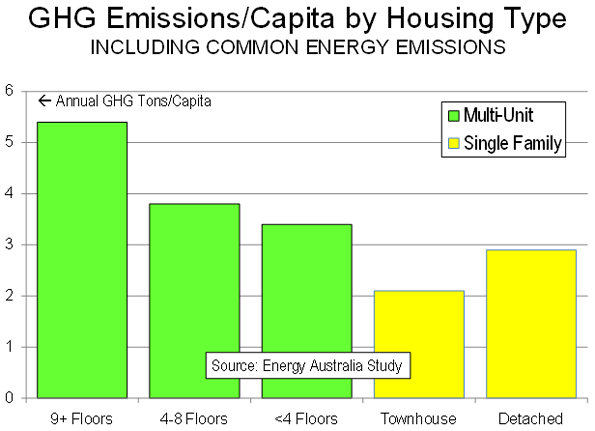
    The “common” consumption omission is serious. Other Australian research indicates how inaccurate consumer based inventories can be. Energy Australia has showed that, in the Sydney area, GHG emissions per capita, including common consumption, in high-rise residential buildings are 85 percent greater than in single family detached dwellings. Other multiple unit buildings are also more GHG intensive, while townhouses (row houses) are the best (see Figure).

    The inclusion of common consumption may be a principal reason why the ACF data associates lower GHG emissions with single family detached housing.

    Construction Materials: There is a further complicating factor. The materials that must be used to construct high-rise residential buildings, chiefly concrete and steel, are far more GHG intensive than the wood used in most single family dwelling construction. A 1997 Netherlands study indicates that the GHG emissions per square foot of high rise construction may be as much as five times that of a detached dwelling. In the newest energy efficient housing, the same study finds that the GHG emissions, over a building’s lifetime, can be greater than the emissions from day to day operation. The report notes that construction materials will become more important in residential GHG emissions, because improvements in routine energy consumption are likely to be more significant than those in building materials production.

    Then there is the issue of the GHG emissions in the construction process. It would not be surprising, for example, if heavy cranes could also tip the balance against high-rise towers.

    Dynamic Rather Than Static Analysis: Anyone who has studied economics understands the importance of “dynamic” versus “static” analysis. Dynamic analysis takes account of likely changes, while static analysis assumes that everything will continue to be as it is today. Much of the research on residential GHG emissions is based upon a static analysis. Yet, the housing stock (like the automobile stock) was largely produced during a time when there was little policy incentive to reduce GHG emissions. We are entering what may well be a very different policy environment. The comparatively recent emphasis on GHG emissions is producing a plethora of ideas, research and solutions. A recent Chicago Tribune article noted a surge in university graduates interested in research to reduce the GHG intensity of energy. The zero emission suburban house is on the horizon, which could take housing form “off the table” as a GHG emission issue and render static research to the internet equivalent of rarely accessed library stacks. Dynamic analysis asks “what can be,” not just “what is.”

    Cost per GHG Ton Reduced: All of this raises a question about how to identify policy strategies. The answer is to compare costs. The Intergovernmental Panel on Climate Change suggests that the maximum costs should be on the order of $20 to $50 per ton. McKinsey has published research indicating that steep reductions can be produced in the United States at less than $50 per ton.

    Yet, the costs of GHG emissions reduction are as absent from much of the present literature as the GHG emissions from elevators in high-rise towers. But costs are important. Economic and social disruption is likely to be greater to the extent that people are forced to change their lives. There is a big difference between requiring people to reduce their emissions where they live versus trying to uproot them – as well as their families and business – to urban cores. The former offers the hope of achieving sufficient GHG emission reductions, while the latter promises to incite a bitter fight between the bulk of the middle class and the regulatory apparatus. All this with a high probability that GHG emissions will not be sufficiently reduced.

    The Bottom Line: Outside some in the urban planning community, there is no lobby for reducing people’s standard of living. At least with respect to residential development and housing form, this does not appear to be necessary. The common area and construction GHG impacts of high-rise condominium buildings could well be greater both per capita and per square foot than those of detached housing. There is no need to force a move into a futuristic Corbusian landscape of skyscrapers. Indeed, it could even make things worse – for households, communities and even the environment.


    Previous posts on this subject:
    Regulating People or Regulating Greenhouse Gases?
    Greenhouse Gas Reduction Policy: From Rhetoric to Reason
    Enough “Cowboy” Greenhouse Gas Reduction Policies

  • GHG Emissions by Type of Geography

    The suburbs, generally a haven for luxury SUVs, regimented lawn sprinkling, and keep-up-with-the-Jones purchases, are not often considered the front-runner in environmentally friendly living.

    However, the Australian Conservation Foundation’s 2007 Consumption Atlas published controversial research that suggested that “dense inner-city zones unleash more greenhouse emissions than car-loving fringe suburbs.” Suddenly, car use is not the prime factor in measuring efficient living, nor can incomes tell the whole story. ()

    While it has been generally accepted that high human consumption is worse for the planet than lower consumption, the study’s main controversy is the fact that the ACF gave the problem a specific geography.

    The quote:

    Rural and regional areas tend to have noticeably lower levels of consumption . . . Higher incomes in the inner cities are associated with higher levels of consumption across the board.

    The ACF has not only pointed their finger at their main supporters (inner-city professionals) but have also invited comments from a variety of sources. The Australian study questions the data used in the past to measure where the worst violators are located.

    American consultant Wendell Cox—long an advocate of suburban development—found that the data suggested that “lower GHG emissions were associated with long distance from the (urban) core, detached housing, more automobile use and lower population density.”

    A team from Queensland’s Griffith University Urban Research Program drew an altogether different conclusion that put simply is, “correlation does not establish causality.”

    GHG emissions are a function of overall consumption and consumption based on low-density housing “doesn’t figure prominently in the composition of aggregate consumption.”

    Urban sprawl cannot be used as an argument or attempt to point fingers at the Hummer drivers. Lowering greenhouse gas emissions will require a commitment by city dwellers and suburbanites alike if we are to alter our future carbon footprint.

    While the study itself has prompted much discussion and debate, if the object is to cut down on greenhouse gas emissions, singling out suburbia might not be the first order of business. Spurious data and indeterminate causality make for an argument destined to fail for the lack of a supportable conclusion – unless we wish to overturn logic entirely, which some seem determined to do in furtherance of their long-held anti-suburban agenda.

  • Enough “Cowboy” Greenhouse Gas Reduction Policies

    The world has embarked upon a campaign to reduce greenhouse gas (GHG) emissions. This is a serious challenge that will require focused policies rooted in reality. Regrettably, the political process sometimes falls far short of that objective. This is particularly so in the states of California and Washington, where ideology has crowded out rational analysis and the adoption of what can only be seen as reckless “cowboy” policies.

    Last year, California enacted Senate Bill 375, which seeks to reduce future GHG emissions by encouraging higher urban population densities and forcing more development to be near transit stations. Yet there is no objective analysis to suggest that such an approach will work. Of course, there are the usual slogans about people giving up their cars for transit and walking to work, but this occurs only in the minds of the ideologues. The forecasting models have been unable to predict any substantial reduction in automobile use, and, more importantly, such policies have never produced such a result.

    In fact, higher densities are likely to worsen the quality of life in California, while doing little, if anything to reduce GHG emissions. California already has the densest urban areas (which includes core cities and surrounding suburbs) in the United States. The Los Angeles urban area is 30 percent more dense than the New York urban area. The San Francisco and San Jose urban areas are also denser than the New York urban area. Sacramento stands as the 10th most dense among the 38 urban areas over 1,000,000 population, while Riverside-San Bernardino ranks 12th and San Diego ranks 13th.

    This high density creates the worst traffic congestion in the nation. The slower stop and go operation of cars in traffic congestion materially intensifies local air pollution and increases health hazards. It also consumes more gasoline, which increases GHG emissions. Finally, California’s prescriptive land use regulations have destroyed housing affordability. By the early 1990s, land use regulation had driven prices up well beyond national levels relative to incomes, according to Dartmouth’s William Fischell. Over the next decade the rationing effect of California’s excessive land use restrictions tripled house prices relative to incomes, setting up the mortgage meltdown and all that has followed in its wake.

    The implementation of Senate Bill 375’s provisions seems likely to make things worse. California’s urban areas already have plenty of dense “luxury” housing, much of which is now empty or is now converted from condos to rentals. Wherever they are clustered, particularly outside traditional urban centers like San Francisco, such areas experience intense traffic congestion, with all the resultant negative impact on both people and the environment.

    Yet despite the problems seen in California, the ideological plague has spread to Washington state. Last year the Washington legislature enacted a measure (House Bill 2815) that requires reductions in driving per capita, for the purpose of GHG emission reduction. By 2050, driving per capita is supposed to be halved. This year there was a legislative proposal, House Bill 1490, that would have mandated planning for 50 housing units to the acre within one-half mile of light rail stations. This would have amounted to a density of nearly 50,000 per square mile, 3 times the city of San Francisco, 7 times the density of the city of Seattle and more than that of any of more than 700 census tracts (small districts) in the three-county Seattle area. Areas around stations would be two-thirds as dense as Hong Kong, the world’s most dense urban area.
    The density requirement has since been amended out of the bill, but the fact that it made it so far in the legislature indicates how far the density mania has gone. The bill appears unlikely to pass this year.

    Extending the density planning regime is not likely to help the people on the ground, much less reduce GHGs. Seattle already has a housing affordability problem, which is not surprising given its prescriptive planning policies (called growth management or smart growth). Theo Eicher of the University of Washington has documented the close connection between Seattle’s regulatory structures and its house price increases.

    As in California, Seattle house prices rose dramatically during the housing bubble, nearly doubling relative to incomes. At the same time, much of the debate on House Bill 1490 has been over affordable housing. Yet there has been virtually no recognition of connection between Seattle’s low level of housing affordability and its destructive land use regulations. House Bill 1490 would have only made things worse, and still could. Proponents have indicated that they have not given up.

    The theory behind House Bill 1490 parallels that of California’s SB 375. It assumes high densities would significantly reduce driving and attract people to transit. As in California, however, this is based upon wishful thinking, and has no basis in reality. No urban area in the developed world has produced a material decline in automobile use through such policies.

    Regrettably, the special interest groups behind the California and Washington initiatives appear more interested in forcing people to change their lifestyles than in reducing GHG emissions. This is demonstrated by the Washington driving reduction requirement.

    A good faith attempt to reduce GHG emissions from cars would have targeted GHG emissions from cars, not the use of cars. The issue is GHG emission reduction, not behavior modification, and the more the special interests target people’s behavior, the clearer it becomes how facetious they are about reducing GHG emissions.

    Technology offers the most promise. Already the technology is available to substantially reduce GHG emissions by cars, without requiring people to change their lifestyles. Hybrids currently being sold obtain nearly three times the miles per gallon of the average personal vehicle (cars, personal trucks and sport utility vehicles) fleet. And that is before the promising developments in decades to come in alternative fuels and improved vehicle technology. In addition, the rapid increase in people working at home – a number on track to pass that of transit users by 2015 – would also represent a clear way to reduce GHG emissions.

    Finally it is not certain that suburban housing produces higher GHG emissions per capita than high rise urban development. The only comprehensive research on the subject was conducted in Australia and found that, generally, when all GHG emissions are considered, suburban areas emitted less per capita than higher density areas. This is partially because dense urbanites tend to live a high consumption lifestyle, by eating out at restaurants serving exotic foods, having summer homes and extensive travel. It is also because high density living requires energy consumption that does not occur in lower density suburbs, such as electricity for elevators, common area lighting, and highly consumptive central air conditioning, heating, water heating and ventilation, as Energy Australia research indicates.

    Further, tomorrow’s housing will be more carbon friendly than today’s. Japan has already developed a prototype 2,150 square foot, single story suburban carbon neutral house.

    Much of the anti-suburban and anti-car sloganeering ignores these developments and generally assumes a static world. If the world were static, we would still be living in caves.

    The California and Washington initiatives were not based upon any comprehensive research. There were no reports estimating the tons of GHG emissions that were to be reduced. There was no cost analysis of how much each ton removed would cost. United Nations Intergovernmental Panel on Climate Change (IPCC) has said that the maximum amount necessary to accomplish deep reversal of GHG concentrations is between $20 and $50 per ton. Responsible policy making would have evaluated these issues. (It seems highly improbable that Seattle’s currently under-construction University light rail extension remotely matches this standard, with is capital and operating costs per annual patron of more than $10,000.)

    The price that society can afford to pay for GHG emission reduction is considerably less today than it was just six months ago. The history of the now departed communist world demonstrates that poorer societies simply do not place a high priority on environmental protection. That is not surprising, since people address their basic human needs before broader objectives, such as a better environment. That may not comport with the doctrines of political correctness, but it is reality.

    In such times, communities should be careful not to undertake policies based on assumptions or the preferences of those planners, architects and ideologues who seem to hold suburbs and personal mobility in such contempt that they would not be satisfied even if they emitted no GHGs. These radical motives are inappropriate. “Cowboy” policies enacted ad hoc at the bequest of ideologues openly disdainful of our basic lifestyles threaten not only the future prosperity of a society but our most reasonable path to long-term environmental improvement including reducing GHG emissions.

    Wendell Cox is a Visiting Professor, Conservatoire National des Arts et Metiers, Paris. He was born in Los Angeles and was appointed to three terms on the Los Angeles County Transportation Commission by Mayor Tom Bradley. He is the author of “War on the Dream: How Anti-Sprawl Policy Threatens the Quality of Life.

  • How Elite Environmentalists Impoverish Blue-Collar Americans

    The great Central Valley of California has never been an easy place. Dry and almost uninhabitable by nature, the state’s engineering marvels brought water down from the north and the high Sierra, turning semi-desert into some of the richest farmland in the world.

    Yet today, amid drought conditions, large parcels of the valley – particularly on its west side – are returning to desert; and in the process, an entire economy based on large-scale, high-tech agriculture is being brought to its knees. You can see this reality in the increasingly impoverished rural towns scattered along this region, places like Mendota and Avenal, Coalinga and Lost Hills.

    In some towns, unemployment is now running close to 40%. Overall, the water-related farming cutbacks could affect up to 300,000 acres and could cost up to 80,000 jobs.

    However, the depression conditions in the great valley reflect more than a mere water shortage. They are the direct result of conscious actions by environmental activists to usher in a new era of scarcity.

    To some extent, such efforts reflect some real limits imposed by the growth of population. Constructive long-term changes in the conservation and utilization of all basic resources – energy, water and land – are not only necessary, but also inevitable.

    Yet the new scarcity does not simply advocate humane ways to deal with shortages, but seeks to exacerbate them intentionally. This reflects a doomsday streak in the contemporary environmental ethos – greatly enhanced by the concern over climate change – that believes greater scarcity of all basic commodities, from land and water to energy, might help reduce the much detested “footprint” of our species.

    One key element of this agenda has to do with reducing access to critical resources like water beyond those required to support existing uses. To be sure, two years of below-average precipitation helped create central California’s current water shortage. Planting crops such as cotton, which needs lots of water, may also have contributed to the problem.

    However, this only explains part of the problem, which increasingly has to do not with vicissitudes of nature but conscious political action. In prior dry periods, the state has managed its water resources to supply farmers and other users as effectively as possible. Today, in response to seemingly endless litigation to protect certain fish in the Delta region west of Sacramento or to “revitalize” valley streams, enormous amounts of water have been allowed to flow untapped into San Francisco Bay.

    This distinction was entirely missing in national coverage of the drought. A recent New York Times article, for example, barely acknowledged the role played by environmentalists whose move to block additional water supplies from the Delta have turned a below-average year – moisture content in the Sierra is about 90% of normal – into something of an epochal agricultural and human disaster.

    “This is still a pretty decent drought but nothing unusual,” suggests Tim Quinn, executive director of the Association of California Water Agencies, which represents both urban and agricultural interests. “We were prepared, as usual, for the drought, but they have taken all the tools away from us.”

    Many environmentalists justify their efforts to curtail water availability for California’s farmers and towns by citing various doomsday global warming projections. Energy Secretary Steven Chu, for example, recently opined that as the state’s climate inevitably shifts to a hot-weather, low-precipitation pattern, water scarcity will create “a scenario where there is no more agriculture in California.” If agriculture is doomed anyway, why not kill the industry now and use the water for fish or other pet “green” projects?

    This represents a remarkable reversal in the spirit that only a few decades ago drove the development of California. Anyone who has lived for any period in the state knows that aridity represents our greatest natural challenge. California seems always either at the edge of drought, coming out of one, or about to enter a dry spell. Since 1920, the state has experienced crippling six-year droughts during 1929 to 1934 and 1987 to 1994, as well as severe shortfalls of a lesser span on several occasions.

    Recognizing the need for a reliable water supply despite the certainty of significant dry years, Californians responded by building one of the most highly advanced water delivery systems in the world. The result was a network of federal and state dams, pumps and aqueducts emblematic of the “can-do” spirit motivating old Progressives, like Edmund Brown in Sacramento and New Dealers in the nation’s capitol.

    The state’s water conveyance facilities opened vast new tracts of land to agriculture. Some of the world’s largest expanses of almonds, pistachios, pomegranates, grapes and cotton covered once-arid land. This expansion created steady demand for advanced farming technologies as well as low-paid labor, much of it undocumented. Reflecting this dichotomy, wealth and poverty grew hand in hand throughout the Central Valley.

    Today, environmentalists cite – as yet another reason to dehydrate California farmlands – the prevalence of immigrant labor in the Central Valley. Lloyd Carter, a major state environmental activist, recently suggested that cutting farm production would actually be beneficial since most farm workers are “not even American citizens for starters” and raise children that “turn to lives of crime,” “go on welfare” and “get into drug trafficking and … join gangs.” These comments cost Carter his association with certain environmental groups, but not his day job – deputy attorney general under former governor and supreme green jihadi Jerry Brown.

    Unfortunately, Carter’s comments reflect what many environmentalists will tell you in private. As a Valley resident himself, Carter may have great empathy for his region’s poor and working class, but it’s hardly a priority among the core of the green movement, which is based in places like San Francisco or Santa Monica. This reflects not so much racism as a disconnect with the productive industries – agriculture, energy and manufacturing – that tend to cluster on the other side of the coastal range.

    The growing economic problems in Central Valley cities like Fresno, where unemployment is near 15%, represents little more than an abstraction to a new cadre of wealthy “progressives” who merely pass through the area on their way to Yosemite and other Sierra resorts.

    “We are getting the sense some people want us to die,” notes native son Tim Stearns, a professor of entrepreneurship at California State University at Fresno. “It’s kind of like they like the status quo and what happens in the Central Valley doesn’t matter. These are just a bunch of crummy towns to them.”

    This split has engendered what is likely a quixotic secession campaign led by farmers in the interior counties, but such drives to divide the Golden State have risen and failed many times before. Yet clearly, there exists a growing divide between producer and consumer economies, and this is coming to the fore not only in California, and on issues well beyond water.

    It is critical to understand that anti-growth politics diverges from the old conservationist ethos in radical ways. No longer is it enough to talk about growing intelligently or using technology to meet long-term problems. Instead, scarcity politics seeks to slow and even reverse material progress through what President Obama’s science adviser, John Holdren, calls “de-development.”

    “De-development” – that is, the retreat from economic growth – includes some sensible notions about conservation but takes them to unreasonable, socially devastating and politically unpalatable extremes. The agenda, for example, includes an opposition to population growth, limits on material consumption and a radical redistribution of wealth both nationally and to the developing world.

    In much the same way as seen in California’s water crisis, many of the administration’s “green” energy policies pose a direct threat to blue-collar workers employed in extracting and processing fossil fuels. The resultant high energy prices caused by the proposed “cap and trade” system – essentially a system for creating scarcity – also will cost middle-class consumers, blue-collar workers, truckers and manufacturers. These constituencies could well face the kind of water policy-related decline that is destroying farming communities throughout central California.

    Yet at the same time, such policies make the well-to-do and trustafarians in San Francisco and Malibu – for whom higher energy prices are barely a concern – feel better about themselves. In what passes for progressive politics today, narcissism usually takes priority over reality.

    In the new scarcity politics, access to land also may be sharply limited. New land regulation, ostensibly for climate-change reasons – already in place in California and being discussed as well in Washington state – could force almost all new development to follow a high-density, multi-family pattern. Over time, single-family homes – the preference of a vast majority of Americans – will become once again, as they were in the past, the privilege only of the upper classes in some metropolitan regions.

    By embracing the politics of scarcity, the Obama administration seems committed to imposing a regime that could slow any sustained recovery from the current recession. Although these ideas might appear plausible at a Harvard Law Review bull session, their real consequences for millions of Americans could prove very ugly indeed.

    This article originally appeared at Forbes.

    Joel Kotkin is executive editor of NewGeography.com and is a presidential fellow in urban futures at Chapman University. He is author of The City: A Global History and is finishing a book on the American future.

  • Different Shades of Green

    Last month marked the 15th anniversary of the settlement of Plotkin vs. General Electric, the landmark “greenwashing” lawsuit I filed in 1993. At the time, GE was misleading consumers by selling phony lookalike energy efficient light bulbs that were in fact just old fashioned incandescent wolves in green packaging.

    I took no money from the case. But I required G.E. to make labeling changes and to pony up $3.25 million dollars in consumer refunds and donations to environmental and public service groups. The labeling changes made it easier for the manufacturers of real energy efficient light bulbs, which were just then entering the marketplace, to distinguish their products on the shelves. Plotkin vs. GE also more firmly established the ability of environmental activists to turn to the courts when state and federal government agencies fail to punish greenwashing. The settlement we achieved created a powerful deterrent that continues to produce benefits to this day.

    In the meantime, though, greenwashing has become a virtual industry in the political and policy worlds. Take, for example, the growing push for economically regressive and environmentally problematic HOT (high occupancy toll) lanes. HOT lanes are toll lanes on public highways. Prices are set dynamically so that HOT lanes keep moving even if all the other lanes are stuck. Governor Schwarzenegger and many leading Democrats favor the idea and use it to paint themselves green. HOT lanes are also popular with many affluent motorists who love the idea of driving their SUVs in the carpool lane for what amounts to pocket change. It’s an odd alliance.

    Unfortunately, support for HOT lanes is also becoming a litmus test issue for some environmental groups when they evaluate political candidates, apparently without much thought about the economic consequences, particularly for the poor.

    HOT lane backers push their plan by claiming that only a limited number of lanes will be involved, typically just one to start. But in Europe, where many of these experiments began, “congestion management” programs have since morphed into systems that essentially allow rich drivers to hog public roads. Give the upper crust the fast lane and, it turns out, pretty soon they want the whole road.

    HOT lanes are an example of one of the worst forms of regressive taxation imaginable. Like all regressive taxes, they exact a higher percentage of income from the poor. But in this case, they also tax the very mobility of the poor, making it harder for them to commute, including to work and school, which can effectively lock people into low end jobs and poverty that they might otherwise escape.

    What little thought the proponents of HOT lanes have given to their impact on the poor appears to be in the category of “let them eat cake.” One widely-cited report recommending HOT lanes even dismissed concerns they were unfair to the poor by noting that service workers can use the lanes to get to their clients’ houses more quickly:

    “… studies of Orange County’s SR-91 show that the variable-priced toll lanes are not used exclusively by the wealthy. The ability to save time and reduce uncertainty confers substantial benefits to all drivers, including service professionals who can make more service calls…”

    In the San Francisco Bay Area, Caltrans and the Metropolitan Transportation Commission are fast-tracking a HOT lane implementation plan that could be devastating for students at area community colleges. At De Anza College in Cupertino, California, for example, more than 10,000 students commute to school each day. For many, this is the only reasonable path towards upward mobility. I know. Thirty years ago, I was one of those students, only to return more recently to serve on the college district’s board of trustees.

    A proposed fee of $5 a day per trip on Highway 85 during peak rush hour, as envisioned, would boost a typical De Anza College commuter student’s expenses by as much as $100 a month. That burden is sure to grow over time. Escaping poverty is often a game of inches. Our surveys indicate that thousands of our students live at or near the poverty level. Each additional expense imposed by our government makes a high quality college education less accessible.

    HOT lane proponents say that over the long run the impact on the poor will be positive because the tolls will be used to improve public transit, which will benefit less affluent citizens and increase use of public transportation.

    But this is out of touch with the realities of life in places like Silicon Valley, where the automobile is still the most practical way for many people to get to work. What may work for investment bankers taking transit to downtown San Francisco doesn’t work for a student who lives in Mountain View and needs to get to Cupertino and then to a job in Redwood City each day.

    What’s more, the promised transportation improvements may take decades to implement and may never meet the real world transit needs of working students, not to mention those who also have to stop to pick up their children, get groceries or complete errands on the same trip.

    But one thing is for sure. While we wait for those HOT lane financed transit improvements to kick in, a generation, maybe more, will find it harder to attend school or get to their jobs.

    Global warming is a very real problem. But it can and must be addressed in far better and more equitable ways. Those less regressive ideas include higher taxes on gas guzzlers, road electrification, remote sensing (“by wire”) vehicles, increased subsidies and public support infrastructure for carpools, home-based work and or possibly even a boost in industrial levies based on employee commute profiles. All of these advances will require government action and a communal effort. But each of these more significant steps are far less likely to occur if rich divers can easily get wherever they want to go quickly at the expense of everyone else. That’s the road the current elitist HOT lanes proposal takes us down.

    It also raises the question of what comes next. Will this same crowd of economic elitists also want to make public parks and beaches off limits to all but the affluent, too? After all, those are also getting pretty crowded. Or we will defend a more traditional American value: public spaces, including roads, are created, maintained, protected and improved by the public to benefit the public.

    When General Electric put phony energy efficient light bulbs on stores shelves two decades ago, taking the company to court was the smart way to fight back. Unfortunately, there is no court we can petition to ensure that regressive tax policies aren’t greenwashed in ways that trample the rights of the poor, community college students and working people. But there is at least one place we can fight for the smarter, more effective and more equitable environmental policies we need: the state legislature.

    Hal Plotkin is a veteran Silicon Valley journalist and commentator, a founding editor of Marketplace on public radio, and the founder of the Center for Media Change, Inc., a Palo Alto-based 501(c)3 non-profit that enables crowd-funding of high-quality journalism.

  • The New Business Ethos

    My only post-graduate employment lasted 3 months. I worked for a small political consulting firm drafting online strategy for a well-funded land-use initiative. After the success of the measure, the firm’s founder sat me down, told me he loved my work but that the firm was not interested in continuing its web-based consulting. He had to let me go. It was in that same meeting that I decided to start – and pitched to my boss – my own business.

    Without a business degree, experience, funding or family support I started WebRoots Campaigns. It seems insane in retrospect. But at the time, the process was so thrilling, so life-changing, that I would not trade those initial months for all the know-how in the world.

    Being in consulting, I’ve encountered entrepreneurs from a broad array of industries. Some were as expected: those who wanted money and would do anything for it. Less expected however was the number of business owners who worked to a different beat – running their companies for wildly different reasons – all less motivated by the bottom line.

    This group for the most part hailed from the ranks of new, young business owners. Some started their business fresh out of school, not even dipping into the employment pot for a taste of the promised land. Others, like myself, had a taste, spat it out, and went on to create our own soup.

    While the intrigue of entrepreneurship is nothing new, the current economic and cultural climate has fostered a wave of young, untraditional businessmen (and women) never seen before.

    The New Business
    The emerging business class recognizes various motivations for their work and builds their companies to reflect these motivations.

    This new business is in part a reaction to the shortfalls of traditional business epitomized by disregard for the environment, social equality and family. Once widely viewed as intelligent, lean and mobile, the corporation of the past century maneuvered unquestioned through our economic, cultural and political landscapes.

    The new business reaction to this is to view business not as an end unto itself, but as a means toward something greater. Such a model does not insist that profits are bad, or that one requires world-changing ambition to succeed.

    Profits are celebrated if the business creates value beyond the bottom line. A boutique furniture company which employs locals at good wages, buys from ethically sound foresters, and re-invests some capital back into the community is an exemplary model.

    The entrepreneur may have founded the store because of love for his craft, to be near his family, or because he wanted to support his community. In any of these motivations, the pursuit of profit is inherent and accepted, but is balanced against other factors. It is only when the pursuit of capital becomes exclusionary, when it becomes absolute, that business begins to degrade the quality of both our environment and our lives.

    The new model recognizes various practices, motivations and responsibilities throughout the business process. Such factors as the environment, social mobility, cooperation, community and family are not simply strewn aside in a dash for quick profits, but are strategically considered throughout the life of the business.

    An Emptying Promise
    An additional factor in the emergence of the young entrepreneur is the emptying promise of the traditional employment path, both economically and psychologically.

    Forty years ago, relative wages were higher, health insurance more accessible, and mobility more lubricated; it was not uncommon to stay with a company for one’s entire professional life. However, real wages have been stagnant since the 1970s, while average working hours have increased over the same period.

    Young Americans’ wages were already in retreat before the downturn. They appear to be suffering more since they lack seniority, contacts and, in part, because older Americans – their nest eggs now cracked – cannot retire and not make room for newer workers.

    The young American psyche has also become weary of the traditional path. We are accused of laziness, of unwillingness to pay our dues. But when our dues lead only to more hours in a cubicle in an insatiable rat race to increase corporate profits for an illusionary beneficiary…well, the repulsion becomes understandable.

    The emptiness of such a path has been understood by many over the years. Many have chosen to be musicians, artists, or activists. But as this realization spreads – not just to potential entrepreneurs but to consumers who are also increasingly weary of traditional business – the notion of “rebelling” against business through business itself is becoming a real option. A critical mass is being reached, both as a consumer base large enough to support this new business ethos, and as new entrepreneurs seeking to work with the “untraditional” businessmen.

    The New Business as a Response to the Recession
    The current economic crisis is obviously hurting traditional business and entrepreneurship. However, it will have a mixed effect on the emergence of new business.

    On the down side, business loans or other investments are more difficult to obtain, consumer spending has plummeted, and the majority of all industries have stripped to their bare necessities in an attempt to weather the storm.

    On the up side, the new business ethos provides a model that becomes a response to the roaring chaos. Many are losing their jobs after years of hard work for large enterprises. They are not only venturing out on their own out of economic necessity, but because of newfound realizations of the hollow promises of old business.

    In many ways, the new business ethos is better suited for tough times than the old inflated, dog-eat-dog system because it recognizes the value of cooperation and remains more flexible than older models. In the face of a recession, those who are starting new companies are finding supportive communities where expertise, connections and even business is shared.

    Consumers are also increasingly aware of the difficulties that smaller, local business are facing and are adjusting their behavior to help these local business stay afloat throughout the recession.

    The risks are higher than ever, but the recession may provide a wakeup call for many Americans, and a crucial shift in how business is started and run.

    Much praise has been given to new business models centered on community, philanthropy, environmental sustainability and cooperation. But we are only on the crest of the wave. Scan any business district and it becomes clear that old business still very much dominates the scene. MANY old companies are launching expensive PR campaigns to align themselves with the wave, but they still remain fundamentally flawed.

    As consumers become increasingly sophisticated in this respect, opportunities will arise for business to be built on this new model. More likely than not, these businesses will be built not by the businessmen of the past, but by a new generation, with new rules, and hopefully new results.

    Ilie Mitaru is the founder and director of WebRoots Campaigns, based in Portland, OR, the company offers web and New Media strategy solutions to non-profits, political campaigns and market-driven clients.

  • Generating Gasoline From CO2 Emissions

    For some time it has been assumed that reducing greenhouse gas (GHG) emissions will require a shift to cars that do not use petroleum and to power plants that do not use coal, because of the emissions from these sources. All of this may be a false alarm.

    Two recent articles indicate that there may be no need to reduce petroleum use in cars to reduce greenhouse gas emissions (GHG). The first story from USA Today describes a new process for producing gasoline from CO2. If implemented, this could materially reduce GHG emissions from coal fired electricity plants – a principal source of GHG emissions in the United States and in many other nations, including China and India. Another story in The New York Times, indicates the potential of technology that could capture CO2 emissions from cars, to be later refined into gasoline. All of this is further evidence that technology is the answer with respect to reducing GHG emissions.