Tag: Environment

  • Fixing California: The Green Gentry’s Class Warfare

    Historically, progressives were seen as partisans for the people, eager to help the working and middle classes achieve upward mobility even at expense of the ultrarich. But in California, and much of the country, progressivism has morphed into a political movement that, more often than not, effectively squelches the aspirations of the majority, in large part to serve the interests of the wealthiest.

    Primarily, this modern-day program of class warfare is carried out under the banner of green politics. The environmental movement has always been primarily dominated by the wealthy, and overwhelmingly white, donors and activists. But in the past, early progressives focused on such useful things as public parks and open space that enhance the lives of the middle and working classes. Today, green politics seem to be focused primarily on making life worse for these same people.

    In this sense, today’s green progressives, notes historian Fred Siegel, are most akin to late 19th century Tory radicals such as William Wordsworth, William Morris and John Ruskin, who objected to the ecological devastation of modern capitalism, and sought to preserve the glories of the British countryside. In the process, they also opposed the “leveling” effects of a market economy that sometimes allowed the less-educated, less well-bred to supplant the old aristocracies with their supposedly more enlightened tastes.

    The green gentry today often refer not to sentiment but science — notably climate change — to advance their agenda. But their effect on the lower orders is much the same. Particularly damaging are steps to impose mandates for renewable energy that have made electricity prices in California among the highest in the nation and others that make building the single-family housing preferred by most Californians either impossible or, anywhere remotely close to the coast, absurdly expensive.

    The gentry, of course, care little about artificially inflated housing prices in large part because they already own theirs — often the very large type they wish to curtail. But the story is less sanguine for minorities and the poor, who now must compete for space with middle-class families traditionally able to buy homes. Renters are particularly hard hit; according to one recent study, 39 percent of working households in the Los Angeles metropolitan area spend more than half their income on housing, as do 35 percent in the San Francisco metro area — well above the national rate of 24 percent.

    Similarly, high energy prices may not be much of a problem for the affluent gentry most heavily concentrated along the coast, where a temperate climate reduces the need for air-conditioning. In contrast, most working- and middle-class Californians who live further inland, where summers can often be extremely hot, and often dread their monthly energy bills.

    The gentry are also spared the consequences of policies that hit activities — manufacturing, logistics, agriculture, oil and gas — most directly impacted by higher energy prices. People with inherited money or Stanford degrees have not suffered much because since 2001 the state has created roughly half the number of mid-skilled jobs — those that generally require two years of training after high-school — as quickly as the national average and one-tenth as fast as similar jobs in archrival Texas.

    In the past, greens and industry battled over such matters, which led often to reasonable compromises preserving our valuable natural resources while allowing for broad-based economic expansion. During good economic times, the regulatory vise tended to tighten, as people worried more about the quality of their environment and less about jobs. But when things got tough — as in the early 1990s — efforts were made to loosen up in order to produce desperately needed economic growth.

    But in today’s gentry-dominated era, traditional industries are increasingly outspent and out maneuvered by the gentry and their allies. Even amid tough times in much of the state since the 2007 recession — we are still down nearly a half-million jobs — the gentry, and their allies, have been able to tighten regulations. Attempts even by Gov. Jerry Brown to reform the California Environmental Quality Act have floundered due in part to fierce gentry and green opposition.

    The green gentry’s power has been enhanced by changes in the state’s legendary tech sector. Traditional tech firms — manufacturers such as Intel and Hewlett-Packard — shared common concerns about infrastructure and energy costs with other industries. But today tech manufacturing has shrunk, and much of the action in the tech world has shifted away from building things, dependent on energy, to software-dominated social media, whose primary profits increasingly stem from selling off the private information of users. Servers critical to these operations — the one potential energy drain — can easily be placed in Utah, Oregon or Washington where energy costs are far lower.

    Even more critical, billionaires such as Google’s Eric Schmidt, hedge fund manager Thomas Steyer and venture firms like Kleiner Perkins have developed an economic stake in “green” energy policies. These interests have sought out cozy deals on renewable energy ventures dependent on regulations mandating their use and guaranteeing their prices.

    Most of these gentry no doubt think what they are doing is noble. Few concern themselves with the impact these policies have on more traditional industries, and the large numbers of working- and middle-class people dependent on them. Like their Tory predecessors, they are blithely unconcerned about the role these policies are playing in accelerating California’s devolution into an ever more feudal society, divided between the ultrarich and a rapidly shrinking middle class.

    Ironically, the biggest losers in this shift are the very ethnic minorities who also constitute a reliable voter block for Democratic greens. Even amid the current Silicon Valley boom, incomes for local Hispanics and African-Americans, who together account for one-third of the population, have actually declined — 18 percent for blacks and 5 percent for Latinos between 2009 and 2011, prompting one local booster to admit that “Silicon Valley is two valleys. There is a valley of haves, and a valley of have-nots.”

    Sadly, the opposition to these policies is very weak. The California Chamber of Commerce is a fading force and the state Republican Party has degenerated into a political rump. Business Democrats, tied to the traditional industrial and agricultural base, have become nearly extinct, as the social media oligarchs and other parts of the green gentry, along with the public employee lobby, increasingly dominate the party of the people. Some recent efforts to tighten the regulatory knot in Sacramento have been resisted, helped by the governor and assisted by the GOP, but the basic rule-making structure remains, and the government apparat remains highly committed to an ever more expansive planning regime.

    Due to the rise of the green gentry, California is becoming divided between a largely white and Asian affluent coast, and a rapidly proletarianized, heavily Hispanic and African-American interior. Palo Alto and Malibu may thrive under the current green regime, and feel good about themselves in the process, but south Los Angeles, Oakland, Fresno and the Inland Empire are threatened with becoming vast favelas.

    This may constitute an ideal green future — with lower emissions, population growth and family formation — for whose wealth and privilege allow them to place a bigger priority on nature than humanity. But it also means the effective end of the California dream that brought multitudes to our state, but who now may have to choose between permanent serfdom or leaving for less ideal, but more promising, pastures.

    Joel Kotkin is executive editor of NewGeography.com and Distinguished Presidential Fellow in Urban Futures at Chapman University, and a member of the editorial board of the Orange County Register. He is author of The City: A Global History and The Next Hundred Million: America in 2050. His most recent study, The Rise of Postfamilialism, has been widely discussed and distributed internationally. He lives in Los Angeles, CA.

    This piece originally appeared at U-T San Diego.


  • What Conservatives Can Teach Liberals About Global Warming Policy

    Over the last decade, progressives have successfully painted conservative climate skepticism as the major stumbling block to reducing greenhouse gas emissions. Exxon and the Koch brothers, the story goes, fund conservative think tanks to sow doubt about climate change and block legislative action. As evidence mounts that anthropogenic global warming is underway, conservatives’ flight from reason is putting us all at risk.

    This week’s release of a new United Nations Intergovernmental Panel on Climate Change report opens another front in the climate wars. But beneath the bellowing, name-calling, and cherry-picking of data that have become the hallmark of contemporary climate politics lies a paradox: the energy technologies favored by the climate-skeptical Right are doing far more to reduce greenhouse gas emissions than the ones favored by the climate-apocalyptic Left.

    How much more? Max Luke of Breakthrough Institute ran the numbers and found that, since 1950, natural gas and nuclear prevented 36 times more carbon emissions than wind, solar, and geothermal. Nuclear avoided the creation of 28 billion tons of carbon dioxide, natural gas 26 billion, and geothermal, wind, and solar just 1.5 billion.

    Environmental leaders who blame “global warming deniers” for preventing emissions reductions point to Germany’s move away from nuclear and to renewables. “Germany is the one big country that’s taken this crisis seriously,” wrote Bill McKibben. Other progressive and green leaders, including Al Gore, Bill Clinton, and Bobby Kennedy, Jr., have held up Germany’s “energy turn,” theEnergiewende, as a model for the world. 

    But for the second year in a row, Germany has seen its coal use and carbon emissions rise — a fact that climate skeptical conservatives have been quick to point out, and liberal environmental advocates have attempted to obfuscate. “Last year, Germany’s solar panels produced about 18 terawatt-hours (that’s 18 trillion watt-hours) of electricity,” noted Robert Bryce from the conservative Manhattan Institute. “And yet, [utility] RWE’s new coal plant, which has less than a 10th as much capacity as Germany’s solar sector, will, by itself, produce about 16 terawatt-hours of electricity.

    Reagan historian Steven Hayward, formerly of the American Enterprise Institute, noted in the conservative Weekly Standard earlier this week, “Coal consumption wentup 3.9 percent in Germany last year. Likewise, German greenhouse gas emissions — the chief object of Energiewende — rose in Germany last year, while they fell in the United States.”

    Emissions fell in the United States thanks largely to a technology loathed by the Left:fracking. From 2007 to 2012, electricity from natural gas increased from 21.6 to 30.4 percent, while electricity from coal declined from 50 to 38 percent — that’s light speed in a notoriously slow-changing sector. And yet the Natural Resources Defense Council, Sierra Club, and most other green groups are working to oppose the expansion of natural gas.

    Hayward and Bryce are two of the most respected writers on energy and the environment on the Right. Both are highly skeptical that global warming poses a major threat. Both regularly criticize climate scientists and climate models. Both men are regularly attacked by liberal organizations like Media Matters for working for organizations, the American Enterprise Institute and Manhattan Institute, respectively, that have taken money from both Exxon and the Koch brothers. And yet both men are full-throated advocates for what Bryce calls “N2N” — accelerating the transition from coal to natural gas and then to nuclear.

    Arguably, the climate-energy paradox is a bigger problem for the Left than the Right. One cannot logically claim that carbon emissions pose a catastrophic threat to human civilization and then oppose the only two technologies capable of immediately and significantly reducing them. And yet this is precisely the position of Al Gore, Bill McKibben, the Sierra Club, NRDC, and the bulk of the environmental movement.

    By contrast, there are plenty of good reasons for climate skeptics to support N2N. A diverse portfolio of energy sources that are cheap, abundant, reliable, and increasingly clean is good for the economy and strengthens national security – all the more so in a world where energy demand will likely quadruple by the end of the century.

    Why then is there so much climate skepticism on the Right? One obvious reason is that climate science has long been deployed by liberals and environmentalists to argue not only for their preferred energy technologies but also for sweeping new regulatory powers for the federal government and the United Nations.

    But here as well, the green agenda hasn’t fared well. Those nations that most rapidly reduced the carbon intensity of their economies over the last 40 years did so neither through regulations nor international agreements. Nations like France and Sweden, which President Obama rightly singled out for praise earlier this month, did so by directly deploying nuclear and hydroelectric power. Now the United States is the global climate leader, despite having neither a carbon price nor emissions trading, thanks to 35 years of public-private investment leading to the shale gas revolution. Meanwhile, there is little evidence that caps and carbon taxes have had much impact on emissions anywhere.

    In the end, both Left and Right reject a more pragmatic approach to the climate issue out of fear that doing so might conflict with their idealized visions for the future. Conservatives embrace N2N as a laissez-faire outcome of the free market in the face of overwhelming evidence that neither nuclear nor gas would be viable today had it not been for substantial taxpayer support. Progressives seized on global warming as an existential threat to human civilization because they believed it justified a transition to the energy technologies – decentralized renewables – that they have wanted since the sixties.

    The Left, in these ways, has been every bit as guilty as the Right of engaging in “post-truth” climate politics. Consider New Yorker writer Ryan Lizza’s glowing profile of Tom Steyer, the billionaire bankrolling the anti-Keystone campaign. After Lizza suggested that Steyer and his brother Tom might be the Koch brothers of environmentalism, Steyer objects.  The difference, he insists, is that while the Koch brothers are after profit, he is trying to save the world.

    It is telling that neither Lizza nor his editors felt it necessary to point out that Steyer is a major investor in renewables and stands to profit from his political advocacy as well. Clearly, Steyer is also motivated by green ideology. But it is hard to argue that the Koch brothers haven’t been equally motivated by their libertarian ideology. The two have funded libertarian causes since the 1970s and, notably, were among the minority of major energy interests who opposed cap and trade. Fossil energy interests concerned about protecting their profits, including the country’s two largest coal utilities, mostly chose to game the proposed emissions trading system rather than oppose it as the Koch brothers did.

    As Kathleen Higgins argues in a new essay for Breakthrough Journal, it’s high time for progressives to get back in touch with the liberal tradition of tolerance, and pluralism. “Progressives seeking to govern and change society,” she writes, should attempt to “see the world from the standpoint of their fiercest opponents. Taking multiple perspectives into account might alert us to more sites of possible intervention and prime us for creative formulations of alternative possibilities for concerted responses to our problems.”

    As Left and Right spend the next week slugging it out over what the climate science does or does not tell us, we would do well to remember that science cannot tell us what to do. Making decisions in a democracy requires understanding and tolerating, not attacking and demonizing, values and viewpoints different from our own.

    Conservatives have important things to say when it comes to energy, whether or not they think of it as climate policy. Liberals would do well to start listening. 

  • Cities Don’t Consume Resources, People Do

    Urban form or urban consumers? If we want to reduce the environmental impacts of modern society let’s prioritize consumption, not city form.  The evidence suggests that large cities (and especially city centres) are associated with a bigger environmental footprint than modest cities or suburbs. 

    This post looks at incomes and consumption, especially the consumption of housing and transport services, asking how far can local regulation really influence environmental impacts?

    What can local governments do about the environment?
    Local governments have two core roles.  One is to ensure that the infrastructure and services necessary to sustain everyday life and commerce are in place and working well.  In fulfilling this role they should aim to enhance the quality of the urban environment and limit any environmental impacts of infrastructure. 

    The other role is to plan and manage development in a way that reduces conflict among land uses. In doing that they should aim to contain or control adverse spill-over impacts. 

    However, for councils to use their investment in infrastructure and land use regulation to determine in detail how and where people should live and consume pushes the boundaries of these roles, particularly when they try indirectly to reshape household behavior by reshaping the city.

    The key to understanding the environmental impacts of urbanized society is not urban form but household consumption, a function of income, not city plans.

    Urbanization and environmental impacts
    In a recent piece I showed how policies to increase residential densities around city and town centres assume a relationship between urban form and environmental impacts that is not supported by the evidence. In Australia, for example, residents of the New South Wales state capital, Sydney, particularly central Sydney, have by far the largest environmental impact per head.  Much lower levels are recorded in suburbs, smaller cities, and towns. (The same pattern is evident in all Australian states: have a look using the Australian Consumption Atlas).

    The environmental impacts of intensive urban living outweigh any advantages of increasing scale and density. This means that policies that push agglomeration and intensification will increase rather than lower the impacts of urban living.

    Household spending is the issue
    The Australian study confirms that a city’s environmental impacts simply comprise the collective impacts of its residents.  Income is the driver of their consumption and thereby their demands on the environment. 

    If we really believe city form can in some way over-ride income- and consumption-driven environmental impacts, then we should heed the evidence and plan for modest, small scale, dispersed urban settlement. 

    Spending on housing and transport in New Zealand
    Household Expenditure Survey data for New Zealand (and elsewhere) provide an opportunity to explore the role of income in consumption generally. 

    First, take a look at the distribution of spending on housing, transport, and discretionary goods (recreation and cultural services is used to represent the latter category) according to household incomes in 2010. Average spending levels have been organized by income decile for this purpose, each group containing 10% of households. Average incomes increase from decile 1 (the lowest earning 10% of households) to decile 10 (the highest earning 10%).

    The pattern is pretty predictable.  Housing dominates the spending of low decile households.  It accounts for 34% in the lowest decile, falling to 22% in the ninth.  It rises again (to 24%) in the highest earning decile (10). This lift between decile 9 and 10 households no doubt reflects higher discretionary spending in the latter group by way of additional space, the quality of fit-outs, and second homes. 

    Shares of Household Spending to Selected Categories, by Income Band
    http://3.bp.blogspot.com/-9RfoZrWOqJk/UdklonCl_xI/AAAAAAAAAY0/AX1r49MtdJE/s640/Share+of+hhold+spend+by+category.jpg

    Do lower housing costs lead to higher transport spending?
    Rent theory suggests that lower household spending is offset by higher transport spending.  This is because low income households can only afford cheaper, less accessible properties and so end up commuting further at a higher cost than high income households. 

    It turns out that it’s not that simple.  Contrary to the theory, higher income households actually spend more of their income on transport.  That makes sense when we realize that commuting accounts for only around 25% of time spent travelling by New Zealanders.  The capacity to take discretionary trips is a bigger determinant of transport consumption than non-discretionary commuting and work-based trips.

    The Relationship Between Spending on Housing and Transport

    http://4.bp.blogspot.com/-8sGLN4_gTfo/UdyUskoSpgI/AAAAAAAAAZk/WEqMSQNRZM4/s640/Transport+Housing+Relationship.jpg


    Lower incomes leave a lot less to spend on discretionary goods and services once housing and essential transport spending are covered. [1] Higher income households can and do travel more and consume more.  Their behavior is unlikely to be significantly influenced by changing city form. 

    Who spends how much?
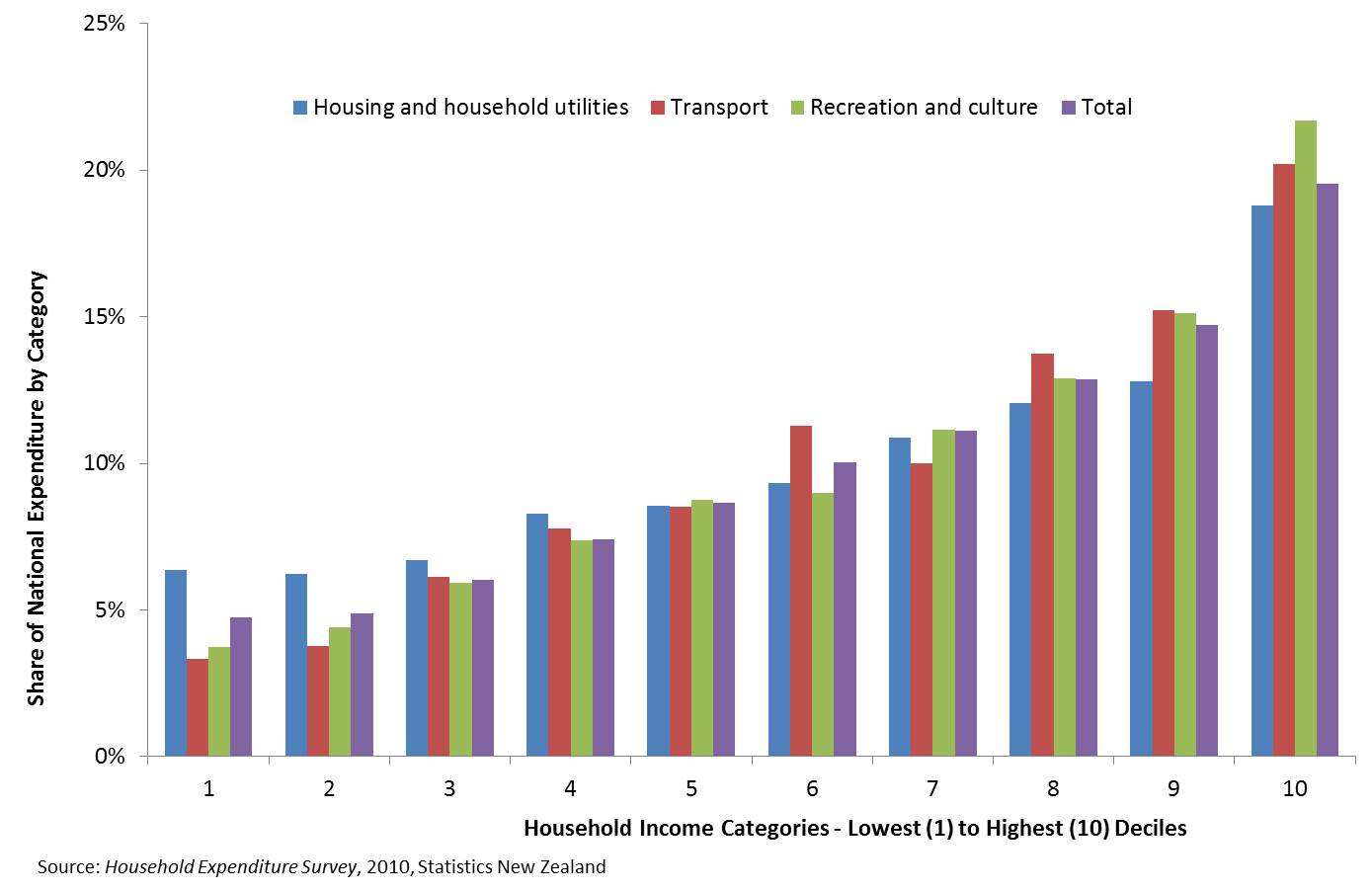
    Not surprisingly total consumption in New Zealand is dominated by higher income households: the 20% highest earning households (deciles 9 and 10) account for 35% of total spending on goods and services, while the lowest earning 20% (deciles 1 and 2) account for just 20%.

    And decile 10 households account for 7 times more spending on transport than decile 1 households.  They spend 5.5 times more on recreation and cultural services, and 3.5 times as much on food.


    The Contribution of Household Total Expenditure by Income Band, Selected Categories
    http://2.bp.blogspot.com/-OXL5hMRRw-Q/UdklqCO8CjI/AAAAAAAAAZA/o2GweAb3nTc/s640/Contributinm+to+totalmspoend+by+decile.jpg

     
    The highest income households spend three times more on housing than low income households, an average of $476 per week compared with $161.
    If refurbished housing in high amenity inner city living is expensive, guess which income groups will be living there?  The high consumers, obviously.  And in Auckland, at least, it seems that city planners and policy-makers are keen to deliver them the high order consumer services that will promote ever-more discretionary spending around the CBD(although much of central city resident travel may be taken up with recreational and social trip-making away from there).  

    A high social cost for little environmental benefit?
    The conclusion is straightforward: higher incomes mean more expenditure on additional housing, transport, and discretionary goods and services with correspondingly high environmental impacts.  If incomes are higher in cities, then their collective impacts will be high too.

    Planning policies won’t change that much – except to the extent that they erode consumption by inflating the basic costs of living, something that impacts most heavily on lower income households.  

    Fiddling with city form is unlikely to significantly reduce the impact of higher incomes and associated spending on the environment.  Increasing dwelling and living costs by promoting larger cities, higher residential densities, and uneconomic transit systems simply penalizes low income households already committing substantial shares of their spending to housing and transport.  And this is the group that, by dint of constrained consumption, has the lowest impact on the environment. 

    Better to address environment issues directly
    From a policy perspective, environmental issues are better tackled directly.  This may mean promoting environmentally friendly goods and services, promoting low impact technologies (including low impact housing, fuel efficient vehicles, and the like), and encouraging responsible consumption. If we are really serious about environmental threats, we need to examine the efficiency of current pricing practices and even taxation measures, rather than leaning so heavily on clumsy, indirect, and ultimately spurious urban planning policies. 

    Phil McDermott is a Director of CityScope Consultants in Auckland, New Zealand, and Adjunct Professor of Regional and Urban Development at Auckland University of Technology.  He works in urban, economic and transport development throughout New Zealand and in Australia, Asia, and the Pacific. He was formerly Head of the School of Resource and Environmental Planning at Massey University and General Manager of the Centre for Asia Pacific Aviation in Sydney. This piece originally appeared at is blog: Cities Matter.

    Photo by Pat Scullion

  • Can Kamaishi, Japan Recover From the Tsunami?

    KAMAISHI, Japan – Two years after the disastrous 2011 earthquake and tsunami, most of the debris from the deluge has been cleared away in this small city on the northern edge of Japan’s tsunami coast. The cars and vans once piled on top of each other like some kind of apocalyptic traffic jam have been sorted out or sold for scrap. My guide, a local teacher who lost three of her aunts in the deluge, drives us up to a lookout. Spread out below us is the coastal village of Unosumai, or, more accurately, what once was the village of Unosumai. The view reminds me of pictures taken of Hiroshima after the atomic bomb had flattened almost everything. The only exception there was one surviving building, the former Industrial Promotion Hall in Hiroshima’s Peace Garden.

    In Unosumai, the village hall is still standing, broken windows and all, with the huge clock over the main entrance still fixed forever on 3:25 p.m., the time on March 11 of 2011 when an enormous wall of water washed into the building, drowning many of the village workers. A small shrine with flowers is set in front. While we stopped there, several people arrive to pray and give obeisance.

    Kamaishi is a hilly city with little flat land. Rising directly behind the central business district are three steep hills, covered with a network of wooden ladders, stairways and pathways that have long provided a natural shelter against tsunami, a kind of local version of the storm shelters in Oklahoma. Tsunami is an historic threat here in the same way that deadly tornadoes are there.

    These routes upward were critical in saving many lives. The town is extremely proud that not one of the approximately 3,000 elementary through high school children was killed in the surge, even though their schools, located along the shore, were inundated. It is often called the “Kamaishi Miracle.” By all accounts, the teachers and students performed admirably in the thirty minutes or so between the earthquake and the tsunami. Teachers had the presence of mind to tell their charges to literally ‘take to the hills’. Don’t wait. Older students carried the younger elementary school children on their backs as they climbed to safety.

    Kamaishi was famous for its network of seawalls, built at considerable expense before the tsunami. The seawalls utterly failed to hold back the surging tide. Plans to rebuild or strengthen them, using money from the national reconstruction fund, have become a source of controversy. Why spend so much money on a system that demonstrably failed its ultimate test?

    Some argue that the sea walls gave the residents a false sense of security. “I do believe that, unconsciously, the breakwater’s presence did give people a false sense of security,” says Mayor Takenori Noda. Loud speakers all over the city had warned people to flee, with enough time to get to higher ground. Most of the town is within about two hundred yards of the nearest evacuation stairway.

    Today, there isn’t much evidence of new construction going on. The national government has appropriated billions of yen to facilitate rebuilding in the tsunami-devastated zone, but not much is being spent in this town. When the slate is wiped totally clean, it is not surprising that it takes time to decide what to write as a replacement.

    Kamaishi and other Japanese towns along the northeastern tsunami coast need something more basic than millions of yen in reconstruction aid sunk into greater seawalls, namely, a rationale for their existence. For more than a hundred years, the city’s reason for being was grounded on its famous Steel Works.

    The location of Japan’s first steel mill blast furnace, Kamaishi started to rise even before the Meiji Restoration began Japan’s transformation into a modern, industrial society. Built in 1857, the furnace was initially established to provide the steel needed for modern artillery to defend the country.

    The city’s heyday was probably in the 1950 and 1960s, when some 12,000 people were employed by the mill, and the town had a population or more than 90,000. Nippon Steel closed the works in 1988, putting thousands out of work. The town’s population has steadily declined, and is now around 40,000.

    Kamaishi Steel Works never found a niche to justify itself, unlike Japan Steel Works a little further north on the island of Hokkaido. It, too, supplied the steel needed to build the large guns for the Imperial Japanese Navy, but it then evolved into a lucrative niche business to forge reactor pressure vessels for nuclear power plants, which it developed into virtually a global monopoly.

    Kamaishi struggled to find a substitute for defense production. It recruited various metal-working enterprises. Some stayed, but others left because the location was too far from regular supply networks. The small harbor was thought to have container-ship potential, but it never developed into the kind of terminal that some of the city fathers had envisioned. The day I visited it was quiet and empty of ships.

    In 2010, Foreign Policy Magazine used Kamaishi as an exemplar of what it thought ailed Japan’s economy, especially the propensity to spend billions of yen on unneeded and ultimately useless public works projects, including Kamaishi’s famous city breakwater.

    Has Kamaishi’s story changed since then? One element of the town’s new reconstruction plan involves a request for funds to build a rugby stadium. With the once formidable Kamaishi Nippon Steel Rugby team long gone, one has to wonder who would play there.

    Todd Crowell is a Tokyo-based journalist.

    Flickr photo by Master Sgt. Jeremy Lock, 1st Combat Camera Squadron 1. Posted by DVIDSHUB: “Petzel, a search and rescue dog with the Fairfax County, Va., Task Force 1 Urban Search and Rescue team waits for his master before heading out to search structures and debris on March 17, 2011, in Unosumai, Japan. A 9.0 earthquake hit Japan on March 11 that caused a tsunami that destroyed anything in its path.” Related Photos: dvidshub.net/r/sojri7.

  • No Solar Way Around It: Why Nuclear Is Essential to Combating Climate Change

    Nobody who has paid attention to what’s happened to solar panels over the last several decades can help but be impressed. Prices declined an astonishing 75 percent from 2008 to 2012. In the United States, solar capacity has quintupled since 2008, and grown by more than 50 times since 2000, according to US Energy Information Administration data. In 1977, solar panels cost $77 per watt. Today, they are less than a dollar per watt.

    So it came as a shock to many and an offense to some to learn that new nuclear plants still cost substantially less than solar. Solar advocates have challenged our recent analysis finding that the electricity from Finland’s beleaguered Olkiluoto plant is still four times cheaper than electricity from Germany’s solar program, claiming that we cherry-picked cases to make nuclear look good and solar look bad.

    It is an odd objection, given that we selected perhaps the most expensive nuclear power plant ever built for our comparison. The complaint is odder still because many of the same critics who accused us of cherry-picking then turned around and, without any apparent irony, cherry-picked small, one-off solar projects as evidence that our analysis is slanted toward nuclear. 

    The reason we compared the Finnish plant to the German solar program is not just because renewables advocates have long claimed that the two examples prove that solar is cheap and nuclear is expensive. We also compared the two because both projects exist in the real world at significant scale, which helps avoid the cherry-picking problem of overgeneralizing from particular cases. Thanks to generous subsidies, Germany generated 5 percent of its electricity from solar last year — a huge amount compared to other nations. By contrast, last year the United States produced just 0.18 percent of its electricity from solar, according to the EIA.

    Some have reasonably asked if there aren’t broader surveys of the costs of new solar and new nuclear. There are. Both the International Energy Agency and the EIA have done them, and both find that solar costs substantially more than new nuclear construction.

    While those figures represent the cost of the average solar installation today, they don’t tell us what it costs for a major industrial economy to scale up solar rapidly, such that it gets a significant percentage of its electricity from solar. To date, Germany is the only major economy in the world that has done so. The costs of Germany’s solar feed-in tariff represent the only real world figure we have. 

    As solar has scaled up in Germany, the costs have declined. But the dynamics are not dissimilar with nuclear. France saw significant cost declines as it scaled up standardized plant designs in the 70s and 80s. The new plant in Finland is a first-of-kind design. Subsequent builds are already showing significantly lower costs. The EPR under construction in France, initiated around the same time as the one in Finland, is expected to cost slightly less. The third and fourth versions of the EPR, currently under construction in China, will be a third the cost of the Finnish plant.

    Had we chosen to use the two new Chinese plants, solar would have cost twelve times more than nuclear, rather than just four times more. Of course this comparison would almost certainly have raised further objections that we had compared German apples to Chinese oranges. Yet it turns out that the German solar program has benefited enormously from the scaling up of Chinese solar manufacturing — or in the eyes of the US Solar Energy Association, the US Trade Commission, and the European Union, the outright dumping of solar panels by Chinese firms. Indeed the flood of Chinese solar panels, which take up as much as 80 percent of market share in Europe, has depressed the cost of solar panels by as much as 88 percent according to EU officials.

    Surely, if it is appropriate to tout solar cost reductions that have been driven by Chinese mercantilism and industrial policy it is also appropriate to consider the cost benefits that Chinese manufacturing and construction costs are bringing to nuclear ­— even more so given that the vast majority of future carbon emissions will come from places like China, not Finland or Germany.   

    Our analysis was further biased toward solar over nuclear by not accounting for the high costs of backing up and integrating intermittent solar electricity. Leading anti-nuclear greens, including Bill McKibben and Robert F. Kennedy Jr., note that for a few hours during a sunny weekend day, solar provided 50 percent of Germany’s electricity; at the same time, as we pointed out, only five percent of the country’s total electricity came from solar in 2012. What that means is that if Germany doubled the amount of solar, as it intends to do, there might be a few hours or even days every year where the country gets 100 percent of its electricity from solar, even though solar only provides 10 percent of its annual electricity needs.

    What happens beyond that is anyone’s guess. Some say Germany could sell its power to other countries, but this would mean other countries couldn’t move to solar since Germany would provide electricity at the same hours it would seek to unload it on their neighbors. Solar advocates say cheap utility-scale storage is just around the corner; in fact, choices are extremely limited and expensive. As a result, analysis by the Clean Air Task Force suggest that integration costs for solar and wind are likely to surge dramatically should renewables rise much above 20 or 30 percent of total electrical generation (see graph below).


    Costs of adding intermittent generation are likely to scale super-linearly with penetration, creating a deployment barrier.  Some examples (various bases) in the figure: “Wind A” is the marginal cost per MWh of wind in ERCOT relative to the same index at 0% wind penetration. “Wind B” is the reciprocal of total system wind capacity factor in CAISO relative to 0% wind penetration (an indicator relative total system construction cost).“Wind C” is the number of annual CCGT start-ups in Ireland relative to 0% wind penetration (a proxy for system-wide O&M costs and emissions due to cycling).“PV” is the marginal cost per MWh of PV in ERCOT relative to the same index at 0% PV penetration. “RE Bundle” is the relative size of the US bulk transmission system (million MW-miles) due to bundled renewables (roughly ½ wind+solar) relative to 0% penetration.

    Sources: CATF from Denholm & Hand, 2011 (Wind A); Hart et al, 2012 (Wind B); Troy et al, 2010 (Wind C); Denholm & Margolis, 2006 (PV); NREL, 2012 (RE Bundle). 

    We do not present this evidence to advocate against solar subsidies or Germany’s program. We have long advocated that governments spend significantly more on energy innovation, including the deployment of solar panels. But it’s one thing to endorse Germany’s big investment in solar in the name of accelerating solar innovation, and it’s quite another to claim — as McKibben, Kennedy, and environmental groups do — that Germany’s solar program and increasingly cheap solar panels demonstrate that solar energy is ready to scale, capable of substantially displacing fossil energy, and a viable alternative to nuclear.

    In reality, there’s little evidence that renewables have supplanted — rather than supplemented — fossil fuel production anywhere in the world. Whatever their merits as innovation policy, Germany’s enormous solar investments have had little discernible impact on carbon emissions. Germany’s move away from baseload zero-carbon nuclear has resulted in higher coal consumption since 2009. In 2012, Germany’s carbon emissions rose 2 percent.

    Nuclear, by contrast, replaces fossil energy. A recent analysis by the Business Spectator’s Geoff Russell finds that big nuclear programs around the world have shown the ability to scale up three to seven times faster than Germany’s vaunted Energiewende (see below). In 1970, fossil fuels supplied roughly two-thirds of France’s electricity, with the balance mostly coming from hydro. By 1990, fossil’s share of the electricity supply had dropped to 10 percent, according to EIA data, while nuclear supplied 80 percent, an energy mix that still holds today. As a result, France’s electricity sector emits 80 grams of CO2 per kWh, compared to Germany’s 450 grams CO2 per kWh. Sweden and Ontario, which also have large shares of nuclear in their electricity supply, augmented by large hydro projects, are even lower. 

    In the United States, nuclear power grew from supplying zero percent of US electricity in 1965 to 20 percent in 1990. Over that same period, coal generation remained flat, rising from 54 percent of generation in 1965 to 60 percent in 1990, during a period when total electricity demand roughly tripled. Since the early 1990’s, when the US nuclear build-out stalled, the vast majority of new US electricity demand has been met by coal and gas.

    Even so, nuclear still needs to get better and cheaper if it is going to displace fossil energy at any scale that will make much difference in terms of climate change. Next generation plants that are safer, cheaper, and more reliable will be necessary if nuclear is to be more than a hedge against fossil energy in the developing world and to see significant new deployment at all in the developed world. Solar, wind, and energy storage technologies will need substantial further advances if they are going to even begin to achieve the scale possible with present day nuclear.

    Our analysis serves a broader point: we must reject technology tribalism if we are to meet rising energy demand and combat global warming. This entails paying close attention to the substantial challenges emergent technologies face, not ignoring them, and discerning how far different technologies are from being capable of replacing fossil energy. The question is not whether solar is the solution, or nuclear. The question is what technologies will deliver clean, reliable, and cheap energy to a growing population, and what it will take to get those technologies to scale. Any movement serious about addressing climate change will thus be characterized by a broad commitment to innovation and a willingness to take a hard, non-ideological look at present day zero-carbon technologies.

    Shellenberger and Nordhaus are co-founders of the Breakthrough Institute, a leading environmental think tank in the United States. They are authors of Break Through: From the Death of Environmentalism to the Politics of Possibility.

    This piece originally appeared at TheBreakthrough.org.

    Photo Credit: SonomaPortal.com.

  • The Myth of Green Australia

    Having collected the Nobel peace prize in 2007, Al Gore’s fortunes as a climate crusader slid into the doldrums.  But 8th November 2011 arrived as a ray of sunshine. On that day Australia’s parliament passed into law the world’s first economy-wide carbon tax. Rushing to his blog, Gore posted a short but rapturous statement, cross-posted in The Huffington Post. His fervent language echoed in progressive circles across the globe. Australians have been held-up as pioneering environmentalists ever since, putting Americans to shame.

    “This is a historic moment”, thundered Gore. “With this vote”, he blogged, “the world … turned a pivotal corner in the collective effort to solve the climate crisis”. He proclaimed it “the result of tireless work of an unprecedented coalition that came together to support the legislation”; he praised the “leadership of Prime Minister [Julia] Gillard and the courage of legislators”; and he declared “the voice of the people of Australia has rung loud and clear”.

    But maybe Gore’s enthusiasm was a bit misplaced. In September, less than two years later,   Australians seem likely, according to the polls, to hand the Gillard Labor government a stinging landslide defeat.     

    “A pivotal corner in the collective effort”

    As it turns out, and not for the first time, Gore’s analysis was wrong. For one thing, calling the carbon tax “pivotal” is pure hyperbole. Although a relatively large land mass, Australia is populated by just 23 million people who collectively emit a minuscule 1.5 per cent of the world’s greenhouse gases. Nor is the country influential in a broader political union or association beyond its borders.  Since climate change alarmists suggest that global emissions must fall by 25 to 40 per cent in 2020 compared to 1990 levels, Australia’s efforts must be seen as more symbolic than effective.    Currently, the tax and its post-2015 form as an emissions trading scheme (ETS) are adjusted for a trivial 5 per cent cut from 2000 levels in 2020; 5 percent of 1.5 percent of the world’s emissions barely registers against a few days increase in countries like China.   

    Environmentalists maintain that the important thing is not results, but setting a moral example of climate action. They argue Australia’s emissions may be tiny in absolute terms, but amongst the highest in per capita terms. Major emitters like the US, China, India and the EU, they argue, can be shamed into action by Australia’s noble sacrifice. Unfortunately for them, this argument, not very strong to being with, deflated like a punctured balloon since the shambles at Copenhagen.

    We’ve been here before. In December 2009 Australia’s newly minted Labor Prime Minister, Kevin Rudd, with a bulging entourage of 114 officials, descended on the Copenhagen conference to negotiate a successor to the Kyoto Protocol. He was awarded the task of preparing a draft negotiating text. Rudd played an active role in the lead up, having signed Kyoto and undertaken to legislate for an ETS in his first term, a serious step given Australia’s status as the world’s leading coal exporter. Before flying out to Denmark, he introduced the necessary bills into parliament for a second time.

    Copenhagen was a test of the ‘noble sacrifice’ argument driving Rudd’s activism but resulted in an epic fail. Rudd’s draft text was tossed aside and the conference collapsed into bickering between delegations from the developed and developing worlds. There was no successor to Kyoto, just a flimsy, non-binding accord the delegates “took note of” but didn’t adopt. Greenpeace called Copenhagen “a crime scene”.    

    The UN’s Framework Convention on Climate Change has stayed off the rails ever since. Later Conferences of the Parties (COPs) at Cancun and Durban did little more than kick the can down the road. Durban opened twenty days after the “historic moment” of Australia’s carbon tax, but delegates deferred all talk of a binding agreement to 2015, anticipating a possible start in 2020. Canada pulled the plug on Kyoto altogether, later followed by Japan and Russia. “This empty shell of a plan leaves the planet hurtling towards catastrophic climate change”, huffed Friends of the Earth.

    Under the non-binding Copenhagen Accord, parties were invited to submit emission reduction “pledges”, and most have done so. Even if achieved, though, they get the world nowhere near 25 to 40 per cent reductions on 1990 levels in 2020. Writing in Nature, analysts from the Potsdam Institute of Climate Impacts dismiss them as “paltry”. Amid rising emissions, Australia’s “pivotal” carbon tax is but a straw in the wind.

    “An unprecedented coalition that came together”

    At the end of 2009, Rudd’s ETS was rejected by parliament a second time, due in part from rising doubts about the climate agenda. As 2010 progressed, his popularity waned, battered by his inept handling of the contentious mining tax. Labor colleagues bristled at his secretive and high-handed manner, while powerful union bosses resented his indifference to their concerns. Taking advantage of drooping opinion polls, Rudd was sacked and replaced with Deputy Prime Minister Julia Gillard.

    This sent shockwaves through the country, which had never seen a sitting prime minister dumped in his first term. Fearing a backlash, Gillard hastily called an election for 21st August, hoping to exploit positive feelings around serving as Australia’s first female leader. She proved a poor campaigner, however, and a series of damaging leaks scuttled her efforts. Labor’s support faded and on election night Gillard was left with 72 seats, four short of a majority in the 150 seat House of Representatives. The Liberal-National opposition ended up with 73 seats, also short of a majority. The balance of power was in the hands of one Greens Party member and four independents.

    After weeks of negotiations, the Greens and three of the independents pledged support for a Labor Government under Gillard, the first minority government since the 1940s.  But it became increasingly clear that a fresh election would produce a solid Liberal-National Party majority. Returning to the people for a new mandate was never in Gillard’s interests. As for the Greens and independents, fortune delivered them more power than they ever had or would ever have again. Making the most of their time in the sun, they opted for Gillard, who wasn’t about to call another election. Gillard’s coalition may be “unprecedented”, in Al Gore’s words, but it’s untrue that they “came together to support” high principle. They were thrown together by electoral chance and stuck together out of grim self-interest.

    “Leadership of Prime Minister Gillard and the courage of legislators”

    After the second rejection of his ETS, Rudd shelved the policy indefinitely, to the dismay of the world’s environmentalists. The inner circle which advised him to take this course, according to later revelations, included Julia Gillard. On becoming prime minister she showed little enthusiasm for the climate cause, ruling out a price on carbon unless there was “a deep and abiding community consensus”. Her tokenistic policy at the 2010 election was “citizen’s assembly” to canvass options. The opposition also ruled out a price on carbon. Twice in the lead up to polling day, Gillard explicitly denied rumours of a hidden agenda, uttering the now infamous words “there will be no carbon tax under the government I lead”.

    Gillard entered the post-election negotiations desperately hoping to save her prime ministership.  The radical Greens would never have backed the conservative opposition. But when they demanded a carbon tax as the price of their support, she caved in a fit of panic, displaying little of the courage praised by Gore. The independents signed on to keep the minority government in business.

    Labor’s Clean Energy Future package includes a carbon tax, but also billions of dollars of compensation and credits to cushion the blow. In a massive money churn, around $5 billion of the revenue is disbursed to households in higher benefits and tax breaks, and $9.2 billion goes to industry assistance, including free permits for high emitting industries, $300 million to the steel industry, $1.26 billion to the coal sector, and $1.2 billion to manufacturing. Unhappy about these handouts, the Greens were bought off with a $10 billion Clean Energy Finance Corporation. Australians are left wondering how all of this encourages shifts to “cleaner” energy sources. The handouts muffle some damaging impacts of the tax, but they are hardly “courageous” from the perspective of Al Gore.

    “The voice of the people of Australia has rung loud and clear”

    Gillard made her plans for a carbon tax public on 25th February 2011. Her residual popularity sank like a stone. The Newspoll of 18-20 February 2011 recorded 50 per cent satisfied and 39 per cent dissatisfied with her performance. In the next survey of 4-6 March 2011, those figures were reversed: 39 per cent satisfied, 51 per cent dissatisfied. Labor’s support (first preference) plunged to 30 per cent in the March survey, from 38 per cent at the election. These results were consistent with a general fall in support for climate action. From a high of 68 per cent in 2006, reported the Lowy Institute Poll, it dropped to 41 per cent in 2011. Only 32 per cent of Australians supported the carbon tax when Gore wrote his rapturous blog post.    

    Gillard’s frantic attempts to recover have come to nothing, and calling an election for 14th September hasn’t helped. The latest Newspoll of 5-7 April 2013 had her satisfaction rating at a dismal 28 per cent, with 62 per cent dissatisfied. Labor’s support is still in the basement at 32 per cent, with the Liberal-Nationals at 48 per cent. Likely, the government faces a devastating loss of around 20 seats.  

    The opposition’s implacable campaign against the carbon tax has rocked Gillard’s time in office. They promise to repeal it, dismantle much of the Clean Energy Future package and even abolish the Department of Climate Change. Since the 2010 election Labor has suffered a succession of defeats at the state level, losing power in New South Wales, Victoria, Queensland and the Northern Territory, while the Liberal-National Coalition improved their majority in Western Australia. These elections were fought on state issues, but in every case the conservatives echoed Opposition Leader Tony Abbott’s anti-carbon tax message. Closer to home, Gillard was forced to stare down moves against her by colleagues to restore Kevin Rudd, once in February 2012 and again in March this year. Four senior cabinet ministers were sacked or resigned after the second episode. Labor limps forward in the worst possible shape.

    A Liberal-National victory would probably mean the end of climate change as a major political priority in Australian politics. Al Gore was mistaken. He didn’t hear “the voice of the people of Australia” on 8th November 2011; but if he’s listening he’ll hear it “loud and clear” on 14th September 2013.

    John Muscat is a co-editor of The New City Journal.

  • Fracking Offers Jerry Brown a Watershed Moment

    The recent announcement that Jerry Brown is studying "fracking" in California, suggests that our governor may be waking up to the long-term reality facing our state. It demonstrates that, despite the almost embarrassing praise from East Coast media about his energy and green policies, Brown likely knows full well that the state’s current course, to use the most overused term, is simply not politically and economically sustainable.

    Although largely a prisoner of basic green dogma, Brown also is a former Jesuit, with that order’s sense of rationality, order and, well, philosophical flexibility. Unlike many of his progressive idolaters and legislative allies, Brown may well be intelligent enough to look past the rhetoric of the environmental movement and consider its often unexpected ill-effects.

    Brown needs to balance "California comeback" stories – including one that gushingly describes "California beaming" – with the actual realities. Good times, and the current technology bubble, may be blessing Silicon Valley, but as Walter Russell Mead points out, this comeback is being pushed "over the heads of the poor and the jobless." This, he adds, "is not how progressives used to think."

    The chasm between the effects of "noble" green politics and the interests of most Californians is becoming evident, if not widely recognized in the mainstream media. Editorial writers at the New York Times may believe we are losing our need for oil and gas, but this transition should be more difficult than they suggest and, if achieved through often-thoughtless Draconian measures, could have profound impacts on the overall economy.

    Let’s start with the supposed "up" side of the purist renewable policies hitherto embraced by Brown. The governor’s 2010 election promise about creating 500,000 "green jobs" – his economic rationale for his energy and other environmental policies – increasingly looks far-fetched. With electric car maker Fisker, backed by well-connected Democratic venture capitalists and Al Gore, now perhaps ready to follow solar-panel maker Solyndra into bankruptcy, the pitch about a green economy seems unlikely, even bizarre.

    The state-driven "green" policies have also created huge losses for the giant state-employee retirement fund CalPERS, one of whose managers at a recent conference confided that renewable–energy investments have negative returns approaching 10 percent.

    Certainly, neither green energy nor even the current Silicon Valley bubble are creating enough jobs to make up for the enormous shortfall in employment since the recession. This is particularly evident in urban areas like Los Angeles and Oakland – where Brown was mayor from 1999-2006 – as well as most of the state’s interior. Overall, the state vies for last-place honors with the likes of Rhode Island, Nevada and Mississippi for the nation’s highest unemployment rate. The damage is greatest in the state’s more blue-collar interior. Working-class Stockton just was allowed to enter bankruptcy and other municipalities seem likely to join the queue.

    Progressive journalists, eager to pronounce the state’s comeback to justify their ideology, seem utterly unaware of the seriousness of the overall situation in the state. One wonders what they would say if Pete Wilson or Meg Whitman were governor. Compare Texas, which is 550,000 jobs ahead of its 2007 number, to California, which, despite recent gains, remains down 560,000 jobs from its peak. Perhaps unemployment is not a big issue in the progressive reserve of Palo Alto, where the jobless rate is about the same as in North Dakota, but it is a constant in much of Los Angeles, San Jose and Santa Ana, as well as the Central Valley. If this suggests a "comeback" to New York Times columnist Paul Krugman, perhaps we need a new definition for that word.

    These comparisons seem particularly relevant to the discussion of fracking – oil and gas extraction using a technique called hydraulic fracturing. In the environmental scheme of things, oil and even natural gas, once widely favored by progressives, now constitute an utter evil. This is true even though gas has been the primary reason for the country’s reduced carbon emissions by replacing coal as a source for generating electricity. Some of the state’s well-heeled greens would like to ban the process entirely.

    Brown must be aware he is not just governor of the public sector or of his admirers among the coastal rich. He has to consider the unimaginable: removing mandates that force the state to rely on expensive, often-unreliable renewables, notably, solar. These have helped push California electricity prices well above the national average, and much higher than in prime economic competitors such as Washington state, Utah, Texas, Arizona and Nevada. Economist John Husing suggests this is one reason why California not only completely missed the recent national revival in manufacturing jobs – 500,000 the past two years – but actually lost 10,000 more such jobs.

    We are clearly missing the party here. California’s energy policies reflect what is already happening in Europe, where anti-fracking ideology, sometimes supported by the no-doubt-disinterested Russians, have largely won the day. But the costs of green policies have already convinced hard-pressed Spain to abandon its widely praised renewable program.

    Far more economically healthy Germany also is rethinking its renewables mandates. One reason: German companies like Bayer and BASF consider moving to cheaper locales, such as along the U.S. Gulf Coast, where electricity is one-third the price. Texas, Utah and Arizona are to California’s hard-pressed manufacturers what the Gulf Coast is to Germany’s.

    And, then, there are the effects of the budget. Unlike his East Coast admirers, Brown must know that the budget situation is hardly rosy over the longer term. The state auditor recently released a report showing the state’s net worth to be negative by some $127 billion, in large part due to often out-of-control pension costs. There are already indications that the return from last year’s hike in income taxes may not be as large as expected and that what was, during the election, promised to schools will likely end up, as widely predicted, covering rising pension obligations.

    Companies and individuals may not leave California in droves, as some have suggested, but investors certainly can put their money someplace more fiscally responsible. A longer-term problem may be that the higher-income earners, who generate the vast majority of income-tax revenue, are also those most likely to change behavior or find effective income-hiding strategies; remember, Facebook paid no income taxes last year.

    Given these prospects, reviving California’s fossil-fuel industry could prove a critical boost to the budget. A deal to raise some energy taxes while allowing more exploration and development would go a long way to filling the state’s coffers.

    Energy taxes play a big role in financing higher education in many states, including North Dakota, Louisiana and Texas. Oil money, ironically, has allowed Texas to fund universities, particularly the main University of Texas campus in Austin, as a competitor to the perennially hard-pressed University of California system. An energy boom in California, whose energy resources may exceed those of all these states, might offend most academics, but, my hunch is, they might take the money.

    Perhaps more important, a pragmatic shift on energy would also help, as columnist Tim Rutten puts it, "jump start" the state’s economy, particularly in central California. In the past decade, Texas has created almost 200,000 energy-related jobs, while California has generated barely 20,000. These jobs provide good wages to many blue-collar workers, the very people losing out the most in our progressive-minded state.

    There are other signs of pragmatism from the governor. Brown has announced support for a peripheral canal that would provide more-reliable water supplies to the state’s huge agribusiness industry. Although some state regulators threaten farmers with ever-tougher regulations, some observers, such as three-term Salinas Mayor Dennis Donahue, now a full-time farmer, say the governor is trying to "walk the line between labor, greens and agriculture."

    Many Republicans and conservatives find the notion of Brown getting on the road to reality itself fundamentally unrealistic. But the past could be prologue. Brown also started off his first term, in 1975, as something of a dreamer, proclaiming a "small is beautiful" agenda. This was, in many ways, ahead of its time, and skeptical of government spending, but Brown’s environmental views, particularly, also offended some business interests. Far worse, he signed off on legislation freeing up public-sector unions, which has turned into something of a disaster.

    But by the time he started running for a second term, Brown readjusted to a new reality. He could claim that, as someone opposed to the growth of institutionalized government, he could live with Proposition 13. Brown had opposed the measure, but, once it passed, in 1978, he chose, unlike many progressives, to embrace it.

    Brown then ran as a centrist, pro-growth governor. He particularly embraced the then-ascendant technology industry, gaining new donors and allies, although the shift toward realpolitick horrified some of his green backers. But the politics worked brilliantly.

    Today’s circumstances, of course, are different. For one thing, Brown faces little pressure from the right, as the Republican Party, at least for now, has deteriorated into near irrelevancy. The once-potent California business community also has lost much influence, with every lobby, basically, trying to make its own deal with the overweening state apparat.

    So, if Brown is to move to the center, he will have to do it largely on his own, and put up with the incessant hectoring of his allies. Yet, Brown’s occasional genius has demonstrated a Machiavellian quality, knowing when to embrace opponents in order to divide or weaken them, or to allow allies to stew. He also, at this stage of life – today, April 7, is his 75th birthday – must wonder if he wants to leave a legacy of fiscal weakness, a fading competitive edge and an ever-expanding class chasm. In the long run, whether on fracking or a host of other issues, Brown’s success will not derive from pleasing progressive writers, but by promoting a better future for the vast majority who live in, and love, this state.

    Joel Kotkin is executive editor of NewGeography.com and a distinguished presidential fellow in urban futures at Chapman University, and a member of the editorial board of the Orange County Register. He is author of The City: A Global History and The Next Hundred Million: America in 2050. His most recent study, The Rise of Postfamilialism, has been widely discussed and distributed internationally. He lives in Los Angeles, CA.

    This piece originally appeared in the Orange County Register.

    Photo: Troy Holden

  • Progessives, Preservation & Prosperity

    Conservatives often fret that Barack Obama is leading the nation toward socialism. In my mind, that’s an insult to socialism, which, in theory, at least, seeks to uplift the lower classes through greater prosperity. In contrast, the current administration and its core of wealthy supporters are more reminiscent of British Tories, the longtime defenders of hereditary privilege, a hierarchical social order and slow-paced economic change.

    The notion that the "progressives" are, in fact, closeted Royalists has been trotted out by a handful of Obama admirers, such as Andrew Sullivan, who calls the president "the conservative reformist of my dreams." Essentially, Sullivan argues, Obama has been a "Tory president," with more in common with, say, an aristocratic toff like British Prime Minister David Cameron than a traditional left-liberal reformer.

    The fundamental conservativism underlying the modern "progressive" marks the central thesis of an upcoming book by historian Fred Siegel, appropriately titled "Revolt Against the Masses." Siegel traces the roots of the new-fashioned Toryism to the cultural wars of the 1960s, when the fury of the "Left," once centered on the corporate elites, shifted increasingly to the middle class, which was widely blamed for everything from a culture of conformity to racism and support for the Vietnam War.

    Tory progressivism’s most-unifying theme, Siegel notes, includes the preservation and conservation of the landed order enjoyed by the British ultrawealthy and upper-middle classes. In the 19th century, Siegel notes, Tory Radicals, like William Wordsworth, William Morris and John Ruskin, objected to the ecological devastation of modern capitalism and sought to preserve the glories of the British countryside.

    They also opposed the "leveling" effects of a market economy that sometimes allowed the less-educated, less well-bred to supplant the old aristocracies, with their supposedly more enlightened tastes. "Strong supporters of centralized monarchical power, this aristocratic sensibility also saw itself as the defender of the poor – in their place," writes Siegel. "Its enemies were the middle classes and the aesthetic ugliness they associated with the industrial economy borne of bourgeois energies."

    Today, this Tory tradition lives on in contemporary Britain, where industry remains widely disparaged and land use tightly controlled. There is no more strident defender of preserving the space of the landed gentry than the leading Tory mouthpiece, The Daily Telegraph. All efforts are made to restrict the expansion of suburbs and new towns, all the better to preserve the British countryside for the better enjoyment of the gentry.

    As a result, Britain now suffers some of the world’s highest housing prices – even in the economically devastated north of the country. Unable to afford decent accommodations, notes author James Heartfield, some British families have been forced to live in old restrooms, garden sheds, even abandoned double-decker buses.

    Until recent decades, such an "enlightened" conservatism has been rare in America, with its strong tradition of upward mobility and vast landscape for development. As early as the 1950s, however, intellectuals, architects, planners and aesthetes have railed against the banality of suburbanizing, and democratizing, America, but the real turn towards gentry progressivism took place with the rise of the environmental movement in the 1970s.

    Rightfully alarmed by the deterioration of the environment at that time, early green activists made contributions to a remarkable cleanup of the nation’s air and water, something that widely benefited millions of Americans. But the movement also fell ever more prone to all manner of hysterias; at the first Earth Day, in 1970, some scientists predicted that, by the 1980s, people would not be able to walk outside without a helmet. Then followed a series of jeremiads about "limits of growth" associated with the depletion of critical minerals, "peak oil" and, finally, the call for radical steps to address climate change.

    All these causes, sometimes based on fact or somewhat overheated extrapolation, gradually diverted American progressives from their historic interest in economic growth and social mobility to a primary focus on environmental purity, whatever the social or economic cost. Their Tory-like policies have helped stunt economic growth, particularly in the blue-collar industrial and construction sectors, promoting, albeit unintentionally, ever-narrowing opportunity for all but a few Americans.

    Despite its opportunistic use of populist rhetoric, the Obama administration has presided over widespread economic distress – with the average household now earning considerably less than it did four years ago. This trend has worsened during the current "recovery," even as the Federal Reserve’s policies have generated record profits for corporate and Wall Street grandees.

    It has been a particular boon time for a new rising class of oligarchs from Silicon Valley, which has embraced Obama with money and technical expertise. Not surprisingly, the ultra-affluent coastal areas have become primary supporters of the administration, which in November won eight of the nation’s 10 wealthiest counties, many of them handily.

    The growing gaps between the "1 percent" and everyone else have been particularly marked in those regions under the most complete progressive control. The Holy Places of urbanism, such as New York, San Francisco and Washington, D.C., also suffer some of the worst income inequality.

    In these regions, the so-called "creative class" is courted by politicians, developers and corporate big-wigs. Meanwhile their putative political allies, in places like Oakland and parts of New York’s the outer boroughs, experience seemingly irrepressible permanent unemployment and, increasingly, rising crime. Perhaps the most outrageous example of the dual nature of the new progressive economy, notes Walter Russell Mead, can be seen in Detroit, where a shrinking, debt-ridden and dysfunctional city that fails its largely poor residents has generated $474 million since 2005 for well-connected Wall Street bond issuers.

    Under the progressive Tory regime, the best that can be offered the middle class is an outbound ticket to less-Tory-dominated, albeit often less culturally "enlightened" places, such as Texas, the Southeast or Utah. There, manufacturing, energy and agricultural industries still anchor much of the economy. Despite their expressions of concern for the lower orders, gentry progressives don’t see much hope for the recovery of blue-collar manufacturing or construction jobs, at least not in their bailiwicks. Instead they suggest that the hoi polloi seek their future in what the British used to call "service," that is, as caregivers, haircutters, dog walkers, waiters and toenail painters for their more-highly educated betters.

    Such kindness, however, is no replacement for the kind of broad-based economic growth that historically has promoted self-sufficiency and upward mobility, both in California and elsewhere. Due in large part to the new progressive policies, this is now increasingly out of reach for many in the middle class, as well as the increasingly Latino working classes. Indeed, a recent report from the Public Policy Institute of California reveals that class stratification in the state has expanded far faster than the national average.

    "We have created a regulatory framework that is reducing employment prospects in the very sectors that huge shares of our population need if they are to reach the middle class," notes economist John Husing. A onetime Democratic activist, Husing laments how, in progressive California, green energy policies have driven up electricity costs to twice as high as those in competitor states, such as Utah, Texas and Washington, and considerably above those of neighboring Arizona and Nevada. These and other regulatory policies, he suggests, are largely responsible for the Golden State missing out on the country’s manufacturing rebound, losing jobs, while others, not only Texas but also in the Great Lakes, have expanded jobs in this sector.

    Similarly, Draconian land-use regulations have not only kept housing prices, particularly on the coasts, unnecessarily high, but slowed a potential rebound in the construction sector, traditionally a source of higher-wage employment for less-than-highly educated workers. So, while Google workers are pampered and celebrated by the progressive regime, California suffers high unemployment and a continued exodus of working-class and middle-class families.

    Sadly, there currently is no strong counterweight to the new Tory ascendency. Until traditional social democrats awake to realities, or the GOP acknowledges the painful reality of class, America will continue to lurch towards the very Tory model that our forefathers had the wisdom to reject throughout most of our history.

    Joel Kotkin is executive editor of NewGeography.com and a distinguished presidential fellow in urban futures at Chapman University, and a member of the editorial board of the Orange County Register. He is author of The City: A Global History and The Next Hundred Million: America in 2050. His most recent study, The Rise of Postfamilialism, has been widely discussed and distributed internationally. He lives in Los Angeles, CA.

    This piece originally appeared in the Orange County Register.

    Photo by: conservativeparty

  • Green Office Towers Cast Shadow Over Sydney

    Known for her spiky hair, studded-collar and heels, Sydney’s Lord Mayor is the epitome of progressive chic. For a green activist, though, Clover Moore attracts some surprising company. Landlords owning 58 per cent of the CBD’s office space have rushed to join her Better Buildings Partnership, an alliance “to improve the sustainability performance of existing commercial and public sector buildings”. At first glance, the property industry’s enthusiasm for ‘green building’ seems strange.  Shouldn’t they be insisting on less costly design and materials?  Or despite their hard-nosed reputation, are they out to save the planet after all?

    As it turns out, the lure of green building has more to do with cash than climate. By virtue of the soft economy and creeping “sustainability” measures, green-rated office towers are a gilt-edged opportunity for investors fleeing stocks and bonds. The wave of change rolling over central Sydney displays a certain logic. Meddling officials get to wrap themselves in virtue while big landlords – local and global investment trusts and fund managers – get a new premium grade rating for their properties. How better to protect asset values in an unsettled world? It’s a cosy, CBD-boosting deal, even if it distorts job and investment flows in outlying parts of the city.

    The floor-space revolution

    Even before the crash of 2008, banks, insurance companies and other financial services were under pressure to extract higher value out of every inch of floor-space. The global debt meltdown only accelerated the process. Aggressive cost-cutting saw Australian banks reduce their cost-to-income ratios from around 60 per cent in the late 1980s to around 45 per cent today. This priority is turning Sydney CBD’s office core inside-out, a trend reinforced by pay-offs from the green-rating of building stock.

    One recent headline summed it up neatly: “Martin Place exodus”. The article describes how major banks like Westpac, ANZ and Commonwealth are all vacating large office blocks in stately Martin Place, “the heart of Sydney’s financial centre”. Linking George Street, the CBD’s commercial “spine”, to the city’s government office sector along Macquarie Street, near state Parliament House, Martin Place has hosted the cream of Australia’s banking and insurance houses since the nineteenth century. The Reserve Bank is based there as well.   

    Sydney’s traditional office core enclosed Martin Place within Clarence, King and Macquarie Streets and the waterfront at Circular Quay. In line with conventional CBD morphology, this lies just north of the longstanding, but expanding, retail core bounded by York, Park, Elizabeth and King Streets, where large department stores are concentrated around the conjunction of George and Market Streets, the CBD’s peak land value intersection (PLVI).  

    Driven to economise on floor-space, larger financial and professional services firms are leaving the traditional office core for outer blocks, which until recently were, in the parlance of CBD theory, “zones in transition”, low-grade areas on the periphery of the office and retail cores with potential for higher value functions. Some “see the axis of the Sydney central business district changing.” Typically, landlords are now expected “to work with Sydney tenants to address their concerns around relocating or redesigning … and help minimise costs and increase efficiencies in their work environment.”  Lest this be dismissed as penny-pinching, a new “workplace philosophy” has been invented to sell the floor-space revolution, and, predictably, that old chestnut “sustainability” has been pressed into service.

    Spreading from banks to insurance companies to professional services and other large white-collar workplaces, “activity-based working” (ABW) has been treated to rapturous media coverage. “Gen Y shuts door on open-plan century”, is how one headline put it. In progressive outlets, ABW is depicted more as a reaction than an initiative, a revolution forced on employers – and indirectly on property developers – by green, socially aware, tech-savvy Gen Y office workers. As the narrative goes, they reject confinement in the “assigned desks” of open-plan workstations or offices. 

    At one prominent bank, staff are “free to roam and work where and how the mood takes them.” Usually, we are told, “they start the day at an ‘anchor point’ where their locker is and which they share with about 100 other workers … they might stay around that area for the day, with a choice of work situations ranging from quiet spaces to conversation areas, or they may set up somewhere else depending on who they need to see.” Equipped with laptops, i-pads, mobile phones and wi-fi, they “can move from space to space and hardware isn’t an inhibitor.” Some organisations “have been … expanding a whole range of tools from [their] internal social-media platform to crowd-sourcing …” Spaces come in all varieties, including meeting rooms, “hush” rooms, discussion pods, team tables, cafes, “floor hubs”, “touch-and-go area[s] for short stays”, even “funky kitchens”.

    And topping off the semblance of a white-collar wonderland, ABW adapted buildings often have glass lifts and “a central atrium allowing views to other floors”, so “you really do feel part of a bigger whole, you can see everybody.”

    Touted in near-utopian language, ABW unites the high-end circle of developers, architects, interior designers, building managers, real estate agents and progressive media. Most of all, we are assured, it’s about values, lifestyles and the coming generation, invariably presented as model progressives. According to a Colliers International report, Generation Y “prefer to work for an organisation with a commitment to social causes than one without … [i]n relation to the built environment, being green as an office occupier will become more of a ‘must have’ than a ‘nice to have’ in order to attract and retain staff.” Amongst other things, this means “creating less hierarchical workplaces, which facilitate collaboration, personal accountability and flexibility.”

    Such are the times, that if a business announced ABW-type reforms to improve its bottom line, raise productivity or increase returns to investors, it would be damned as a “slave to neo-liberal dogma”. But if the very same measures were dressed-up in the garb of “sustainability”, it would be showered with awards and accolades.

    Notwithstanding the pushy New Age rhetoric, ABW is more an economic-cum-technological opportunity for employers, than a revolt by the young and restless. Focus on costs is inevitable when economic conditions are so tight, and information and communications devices so ubiquitous and portable. A popular measure of office space efficiency is the workspace ratio, explains a researcher at Jones Lang Lasalle, or the number of square metres occupied by each office worker. The typical ratio is 15 square metres per person, but technology is freeing up workers to leave the office, so occupancy is typically now between 40 and 50 per cent, which translates, on average, to each worker occupying 37.5 square metres. “That’s expensive space”, he says.

    Other research found that in a traditional office, between 55 and 85 per cent of desks are not used at any given time. Yet other studies indicate that “trading off individual territory for shared areas” can reduce floor space requirements by 20 to 40 per cent. This all leads directly to the bottom line. By cutting the amounts paid for rent and outgoings, says a Colliers researcher, ABW could reduce a firm’s total cost by up to 30 per cent.

    That’s reason enough to drive large organisations out of their digs in Martin Place and the old office core, mostly for state-of-the-art towers designed to accommodate ABW floor-plans and facilities. “Macquarie Bank was an early mover (to Shelley Street), as was Westpac to its vertical campus in the western central business district”, report Jones Lang Lasalle on the major banks, and “[m]ore recently, the Commonwealth Bank has moved to Darling Quarter and ANZ will soon move to Pitt Street.” One way or another, the larger financial institutions, whose head-office functions were scattered throughout the CBD, have “implemented strategies to consolidate their space requirements and build in [ABW] flexibility.”

    This isn’t happening to satisfy worker demands for “sustainability”, but recourse to “green ethics” no doubt helped prise the sceptical from their desks.

    Green-star trek

    Nor have landlords failed to gain from the floor-space revolution. Large and institutional players like real estate investment trusts and fund managers profited from a wave of demand for innovative, capital-intensive building stock. More unexpectedly, they encountered a rising class of green-tinged activists, designers and architects, whose obsessions with energy-saving and natural power came in useful. As climate change crept up the political agenda, progressives across all tiers of government soon turned to the built environment, churning out laws and regulations that defined and mandated ‘green building’ standards. The property industry’s peak bodies embraced the concept.    

    This is somewhat paradoxical. Despite its obsession with all sorts of metrics, ratios and indices, the property sector doesn’t seem to care that the object of these standards is unmeasurable. Their effect on the global climate system can never be known (it was always fanciful to suggest that Australian building styles would affect the climate, but anyone who believes it after Copenhagen, Cancun, Durban and Rio is deluded).

    On the other hand, the financial benefits are rather more tangible. The key is NABERS, the National Australian Built Environment Rating System. Administered nationally by the New South Wales Office of Environment and Heritage, NABERS is a rating scale from a low of 1 to a high of 6 stars (the “Green Star”) applicable to buildings or tenancies, based on criteria like energy efficiency, water usage, waste management and indoor environment quality. The federal and some state governments have mandated at least a 4.5 star rating for public sector offices, and 4.5 has generally become the minimum for image-conscious corporates. A building or suite designed or refurbished for ABW will naturally score well.

    The Commonwealth Bank’s new campus-style headquarters at Darling Quarter is in the CBD’s “western corridor”, formerly a “zone in transition” near the disused docks and freight yards of Darling Harbour. It achieved a coveted 6 star rating. Coming up with two curved-roof buildings of six and eight stories, “the designers have emphasised the natural light, air quality and water recycling … with features including a full-height atrium, single-pass ventilation, blackwater recycling, trigeneration power and passive chill beam air-conditioning.” Westpac’s new campus further up the corridor at 275 Kent Street achieved 4 stars, and the three towers underway at Barangaroo, a futuristic, mixed-use precinct at the corridor’s northern end, meet 6 star specifications. ANZ’s new headquarters at 242 Pitt Street (161 Castlereagh), towering over the CBD’s “mid-town” south of the retail core, also aims for 6 stars.

    The most vaunted 6 star tower is the oval-shaped, “flagship” tower at 1 Bligh Street. Using 3D software called Building Information Modelling or BIM, the designers conceived an edifice with “gas and solar panels reduc[ing] electricity consumption by as much as 25 per cent, while water recycling reduces mains water by up to 90 per cent …” But its “principal sustainability feature is a fully glazed doubleskin façade made from clear glass panels … allow[ing] for automated sunshading that dramatically reduces the heat load on the building, which means [it needs] less airconditioning and can have … better natural light.” First-tier law firm Clayton Utz is the building’s anchor tenant.

    To the extent that creative designers, developers and landlords have combined to meet a demand in the market, these buildings are impressive enough. That’s how markets should work. But on the pretext of “sustainability”, activist politicians and officials have, effectively, codified the product and marketing strategies of the most powerful players. NABERS does that by granting official recognition to a system mirroring the star scale long used in the hotel industry. Overnight, hundreds of thousands of square metres of non-rated office space was downgraded. Rent-seeking opportunities for the owners of rated space proliferated, to the detriment of smaller, more marginal players, their tenants and peripheral regions. “While the NABERS rating of a building is not the sole factor for corporate tenants”, said a CBRE director, “it is playing a significant role in selecting suitable office space.”

    Clover Moore, whose jurisdiction covers capital-rich Sydney CBD and surrounds, has actively boosted the interests of large and institutional landlords with a grab-bag of lucrative benefits. There’s the CitySwitch Green Office program, which assists landlords leasing more than 2000 square metres of office space to achieve a mandatory NABERS rating; there are “green loans” for “sustainable retrofits” to be repaid as a levy on council rates; there’s a scheme under the Better Buildings Partnership that enables commercial property owners to enter Environmental Upgrade Agreements (EUAs) and share the cost of green building upgrades with tenants; and there are exemptions from a levy on new construction for green initiatives. 

    All in all, NABERS effects have proven a boon to the high-end property industry. Particularly for listed real estate investment trusts (REITs) and fund managers, but also many unlisted investors, which value stable capital growth as much as income, and continually trade or “recycle” assets to manage their portfolios. By allocating capital efficiently for market-oriented purposes, these investors can play a positive role in urban development, as long as green distortions (amongst others) don’t get in the way.

    An Australian Property Institute study at the end of 2011 found that office buildings with a 6 star NABERS rating enjoyed a premium in value of 12 per cent, those with a 5 star rating 9 per cent, those with 4.5 stars 3 per cent, and those with 3 stars 2 per cent. In May 2012, the IPD green property survey found that “prime office buildings with high NABERS ratings – from 4 stars to 6 stars – outperformed the broader prime office market over the past year … the greener buildings delivered an 11.3 per cent total return compared with the overall CBD office return of 10.8 per cent.” Further, buildings with a high NABERS rating “significantly outperformed assets as having a NABERS rating of 3.5 stars or less … better-rated assets delivered 11.8 per cent compared with 8.7 per cent for the lower-rated properties.”

    Capital growth conscious REITs and funds must have been pleased to hear, from a principal of the IPD Green Property Investment Index, that “owners who improve the sustainability attributes of their buildings are more likely to experience relatively stronger growth in capital values and will mitigate downside risk in asset values.” That’s a bonus for such local and global investors who have poured billions into the “safe haven” of Australian – especially Sydney – commercial real estate for other reasons, like the diminished standing of other asset classes, stock market volatility, a relatively sound economy, a reputable legal system and links to the booming Asia-Pacific region. Sydney was the world’s fourth most popular destination for cross-border property investment in the 18 months to June 2010, while the spreading use of NABERS culiminated in November 2011, when a rating became mandatory for space above 2000 square metres.   

    This is how a mayor can spend her life cultivating a progressive persona, only to end up the unwitting tool of some canny fund managers.

    Regressive recentralisation

    Green building is promising to be a goldmine for the well-placed, and a dead weight for almost everyone else. In an April 2012 Market Overview for Parramatta, a second-tier CBD servicing Sydney’s western region, Knight Frank explain that “the gap between economic rents and market rents remains a constraint on new [office] supply.” In other words the cost of land acquisition, planning and building processes, construction and fitting out, and a profit margin, on a square metre basis (economic rent) exceeds the rent obtainable from prospective tenants (market rent). Not all the gap between economic and market rents can be pinned on green standards, now essential for investor interest. But they are an undeniable factor. On one estimate, by consultants Davis Langdon, achievement of a 4 to 6 star NABERS rating can add between 3 and more than 11 per cent to construction costs.

    If supply constraints are serious in Parramatta, where the federal and NSW governments have relocated several agencies and departments, apparently they are acute in more suburban locations. According to a newspaper report in April 2011, “the trend across the Sydney metropolitan markets is falling [office] supply … this is evident across all key markets including North Sydney, St Leonards, Parramatta, North Ryde, Rhodes and Homebush … at present there is no speculative development across these suburbs, so the problem of reduced A-grade space will only increase during the next couple of years, putting pressure on rents and incentives.” The only speculative office block started at the time was at Norwest, says the report, a specialised business park in north-west Sydney. The building was designed for a 4.5 star NABERS rating.

    These weak conditions have various causes, but green standards shouldn’t be underestimated. Investors have lost interest in non-rated projects, and the economics of rated projects are trickier beyond high-rent centres like the CBD or business parks. According to a CBRE director, as of June 2011 there was “more capital looking to invest in the office sector than was evident before the global financial crisis … however, the majority of this capital is only chasing prime assets with very few groups willing to consider smaller secondary assets and non-central business locations.” For their part, more demanding tenants are also retreating to the green citadels and ABW theme-parks of Sydney CBD. Noting the CBD’s low office vacancy rate, Jones Lang Lasalle explain that “any downsizing that has occurred in the financial services sector has been offset by tenant centralisation … [a]s companies continue to look to improve the environment and amenity for staff as a means of attracting and retaining the best talent.” They detect a “trend to centralisation”.  Similarly, a Colliers director observed that “tenants were being driven out of metro markets by tight vacancy rates for quality space and are attracted by a greater ability to attract and retain staff if located in the CBD.”

    Phrases like “attract and retain staff”, of course, suggest NABERS rated buildings adapted for ABW. The portability of communications devices should be liberating workers from fixed locations, not just assigned desks. ABW advocates love phrases like “work is a thing you do not a place you go” and “work is becoming a process not a place”. But green imposts are having a countervailing effect.

    This withdrawal of capital and tenants is bound to choke-off a range of suburban and peripheral businesses, the small to medium sized service operators, start-ups, microbusinesses, consultants, franchisees and sole traders which rely on freely-available space and low rents.  

    To all but the greenest ideologues, it should be clear that the decentralisation of offices – as well as factories and warehouses – over recent decades has fuelled Sydney’s prosperity, enabling the city to absorb an extra 1.5 million people since the mid-1980s. Equally, it should be clear that decentralisation offers better outcomes on access to affordable housing, traffic congestion and employment dispersion. On average, peripheral Local Government Areas (LGAs) still experience higher unemployment rates than central LGAs. That’s why the centralising forces unleashed by green planning and building codes pose serious dangers to economic vitality across the greater metropolitan region. Plenty of attention has been lavished on the pampered few in their ABW playgrounds. Some should be spared for the vast majority who seek to make a life in Sydney.

    John Muscat is a co-editor of The New City, where this piece originally appeared. 

    Photo by Christopher Schoenbohm.
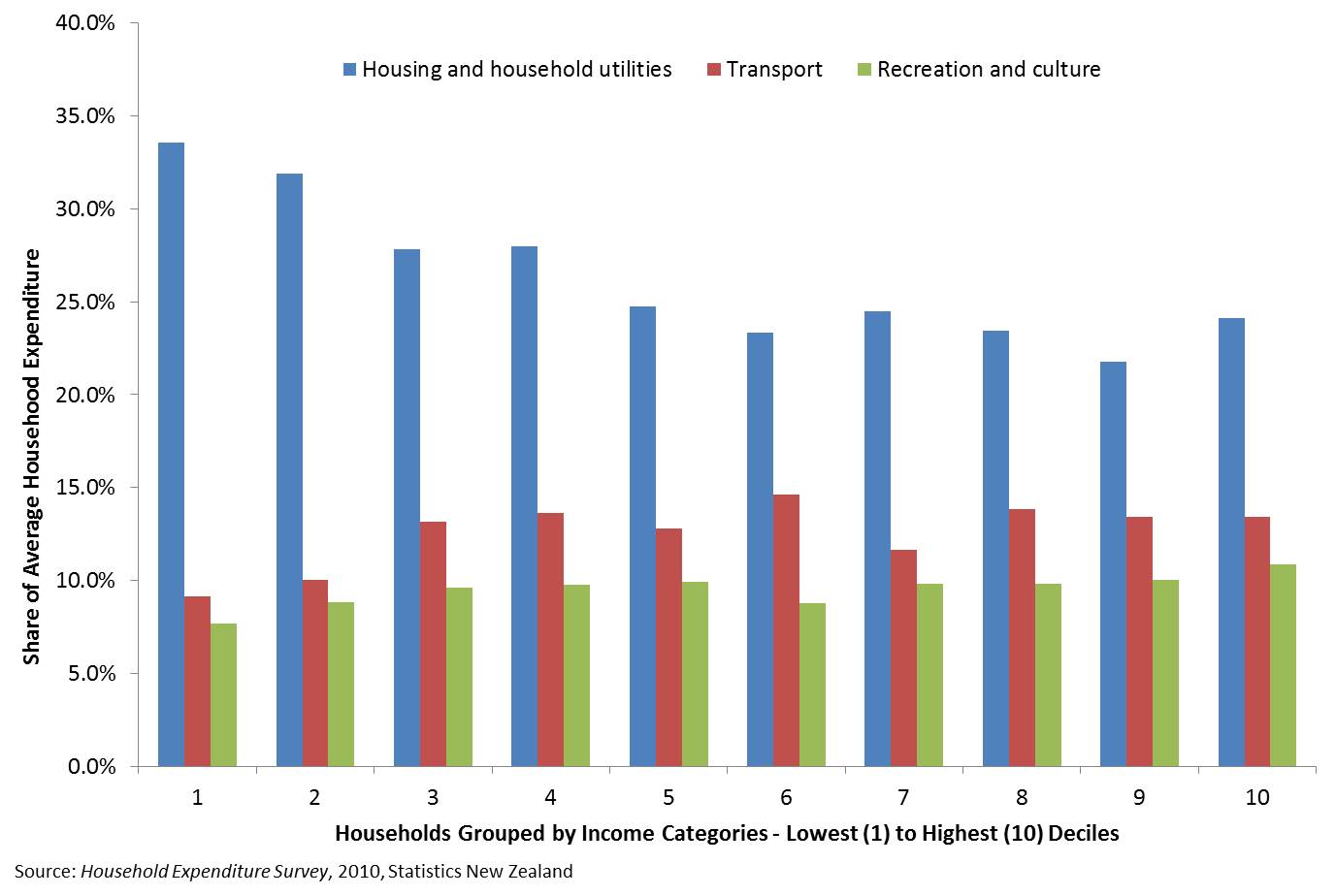
  • The Ecology of Obesity

    Starting in the mid-nineties, ecologically-minded Americans increasingly came to see farmers markets as a way to bring healthy foods to poor neighborhoods, support local organic agriculture, and even address global warming. During the Bush years, major health philanthropies joined these efforts, making new grocery stores their highest priority in combating obesity, which was disproportionately affecting the poor.

    Food justice advocates were thus taken aback last April when new public health research revealed that there were more grocery stores and supermarkets in poor communities than in middle- and upper-income ones. More importantly, the studies found no relationship whatsoever between childhood obesity and neighborhood food availability. In effect, children who have more access to grocery stores and supermarkets are no more likely to become obese than children who have less. The findings — independently arrived at by two large national studies published by RAND and Social Science and Medicine — landed on the front page of the New York Times.

    The reaction from some advocates was swift and harsh. "I’d love to take a couple of those researchers and drop them in several neighborhoods where I grew up," First Lady Michelle Obama told NPR. "Go get a head of lettuce — one that’s affordable, that’s fresh — and see what happens." Mrs. Obama went on to suggest that poor mothers on the south side of Chicago have to travel five miles to reach a grocery store.

    But Mrs. Obama need only visit the US Department of Agriculture’s online Food Desert Locator to discover that the vast majority of Chicago’s poor live well within walking distance of grocery stores. Just 0.4 percent of Cook County’s 5 million residents are low-income and live more than a mile away from a grocery store or supermarket. In Mrs. Obama’s old neighborhood, fewer than 7,000 poor people have to travel more than a mile.

    It is no exaggeration to say that most Americans, and especially the poorest among us, have greater access to healthy food than ever before. Why, then, the rush to attribute our growing waistlines to a supposed lack of fruits, vegetables, and other whole foods?

    In a major new essay for Breakthrough Journal, sociologist Helen Lee, who authored the Social Science and Medicine study challenging the neighborhood-obesity connection, explains how journalists, public health officials, and food justice advocates got the obesity epidemic so wrong.

    She begins in the late 1990s, when activist journalists and public health officials were less focused on food deserts than with how we had become a "fast food nation." The decision to blame food corporations for our burgeoning waistlines came in part from a misunderstanding of the successes of the tobacco-control movement. Some public health scholars believed that framing smoking as a consequence of corporate power had created a "public opinion environment conducive to public policy solutions that burden powerful groups." 

    Convinced that reducing obesity rates would require a similar effort, scholar-activists advocated targeting food corporations as the source of the obesity epidemic. The problem was that the major declines in smoking came not from the high-profile anti-Joe Camel campaigns of late nineties but rather from decades-long public education efforts about the harms of smoking. 

    Moreover, the relationship between fast food and obesity has always been conjectural. Consider that between 1952 and 1980 the number of McDonald’s franchises skyrocketed from 1 to 8,000, and yet obesity rates remained virtually flat. The rise in obesity rates starting in the nineties and its plateau in the mid-aughts remain as mysterious to public health researchers as the decline in violent crime is to criminologists.

    Moreover, where smoking can result in largely untreatable diseases like lung cancer, obesity is one risk factor among many for diseases that are, in fact, highly treatable. While national health philanthropies were pouring hundreds of millions into farmers markets and grocery stores, better medical care was reducing mortality rates for diabetic adults by an astonishing 25 percent and cardiovascular disease by 40 percent.

    Part of what makes obesity a wicked problem is how existing solutions — farmers markets, anti-corporate marketing — led advocates to frame the problem in particular ways. "The picture painted by advocates of grocery stores and gardens in the inner city was compelling to so many in no small part because it combined an established way of thinking about poor neighborhoods as materially deprived along with rising cultural support from middle-class Americans for eating healthier, locally grown foods," Lee writes.

    The new research has not exactly inspired food justice advocates to rethink their approach. "Obesity is declining in Philadelphia because of a network of people dedicated to helping vulnerable children and families," asserted the head of the Kellogg Foundation recently. And yet another journalist, Pulitzer-winning New York Times reporter Michael Moss, is out with a book (subtitle: How the Food Giants Hooked Us) reducing the obesity epidemic to food companies. 

    To be sure, food corporations have played a role in making the obesity epidemic. They must exercise greater responsibility. And farmers markets can be a way to both deliver fresh produce and build community.

    But in focusing so narrowly on food availability, many in the public health and philanthropic communities lose sight of the far more important determinants of health and well-being. "For the poor,” Lee writes, “the problem has less to do with food deserts and more to do with income deserts, college degree deserts, and quality health care deserts.” 

    Confronting the negative impacts of obesity on low-income Americans means confronting difficult social problems like inter-generational poverty, inadequate access to health care, under-performing schools, and myriad barriers to higher education. It requires a perseverance over decades, and a commitment to getting the science right.

    Easier to build more farmers markets.

    Shellenberger and Nordhaus are co-founders of the Breakthrough Institute, a leading environmental think tank in the United States. They are authors of Break Through: From the Death of Environmentalism to the Politics of Possibility.

    This piece originally appeared at TheBreakthrough.org.

    Photo Credit: Lance Cheung/USDA