Tag: Europe

  • Is America Now Second-Rate?

    President Donald Trump’s recent renunciation of the Paris climate change accords has spurred “the international community” to pronounce America’s sudden exit from global leadership. Now you read in the media aspirations to look instead to Europe, Canada, or even China, to dominate the world. Some American intellectuals, viewing Trump, even wish we had lost our struggle for independence.

    Yet, perhaps it’s time to unpack these claims, which turn out to be based largely on inaccurate assumptions or simply wishful thinking. In reality, these countries are hardly exemplars, as suggested by the American intellectual and pundit class, but rather are flawed places unlikely to displace America’s global leadership, even under the artless Trump.

    We’ll always have Paris, or is it Beijing?

    California Gov. Jerry Brown’s recent trip to China reflects the massive disconnect inherent in the progressive establishment worldview. The notion that the country that is the world’s largest emitter of carbon dioxide, emitting nearly twice as much as the United States, and is generating coal energy at record levels, should lead the climate jihad is so laughable as to make its critics, including Trump, seem reasonable. All this, despite the fact that the U.S., largely due to the shift from coal to natural gas, is clearly leading the world in greenhouse gas reductions.

    Paris is good for China in that it gets it off the hook for reducing its emissions until 2030, while the gullible West allows its economies to be buried by ever-cascading regulations. The accords could have cost U.S. manufacturers as many as 6.5 million industrial jobs, while China gets a basically free pass. President Xi Jinping also appeals to the increasingly popular notion among progressives that an autocracy like China is better suited to address climate change than our sometimes chaotic democratic system.

    Xi has played the gullible West with a skill that would have delighted his fellow autocrat, Joseph Stalin, who did much the same in the 1930s. (“Purges? What purges?”) Of course, Xi does not have to worry much about criticism from the media — or anywhere else. Trump may tweet insanely and seek needless fights with the media, but critics of the Chinese Communist Party end up in prison — or worse. To accuse Trump of loving dictators and then embrace Xi seems a trifle dishonest.

    Ultimately, the Paris accords are much ado about nothing. The goals will have such little impact, according to both rational skeptics like Bjorn Lomborg and true believers like NASA’s James Hanson, as to make no discernible difference in the climate catastrophe predicted by many greens. In reality, Paris is all about positioning and posturing, a game at which both Brown and Xi are far more adept than the ham-handed Trump.

    Read the entire piece at The Orange County Register.

    Joel Kotkin is executive editor of NewGeography.com. He is the Roger Hobbs Distinguished Fellow in Urban Studies at Chapman University and executive director of the Houston-based Center for Opportunity Urbanism. His newest book is The Human City: Urbanism for the rest of us. He is also author of The New Class ConflictThe City: A Global History, and The Next Hundred Million: America in 2050. He lives in Orange County, CA.

    Photo by Michael Temer via Flickr, using CC License.

  • The Evolving Urban Form: Prague

    Prague is the capital of Czechia, a nation most readers have probably never heard of. Last year, the Czech Republic adopted a new name that does not reveal its governance structure (republic). The new name has not enjoyed widespread acclaim. The union of Czechoslovakia, which dates from the end of World War I, split peacefully in 1993, resulting in the creation of Czech Republic and Slovakia.

    Prague, like its central and eastern European cousins, Warsaw, Budapest and Bucharest, has experienced substantial decentralization of its population following the collapse of communism. As economies improved and more housing choices opened up, many residents opted to move to outer parts of the core cities or even beyond to suburban and exurban areas.

    Today, the municipality of Prague has approximately 100,000 more residents than in 1980. Yet, the distribution of the population is quite different than before. Then, the central and inner districts of the city had a population of approximately 980,000, while the outer districts were home to 200,000. The latest Czech Statistical Office estimates (for January 1, 2017) show the center and inner districts have declined to approximately 785,000 residents. The city’s outer districts have experienced all of the population increase, more than doubling to above 460,000.

    Meanwhile, two-thirds of the growth (Graphic 1) has been in the suburbs of the Středočeský region (Central Bohemia), which surrounds Prague (Graphic 2).

    The Historic Inner District

    Prague’s central district (District 1) comprises the pre-transit walking core of the city. It stretches across the Vltava River (Smetana’s “The Moldau”) from Wenceslaus Square across the Charles Bridge to Prague Castle, the site of St. Vitus Cathedral. The district also includes the Old Town Square. The population of District 1 dropped from 53,000 in 1980 to 29,000 in 2017, a decline of 44 percent.

    The most recent historic events have virtually all taken place in District 1. The 1968 revolt against Soviet control occurred in Wenceslaus Square and was put down by Warsaw Pact military action and tanks, with a loss of 500 Czechoslovakian citizens.

    This was the end of Alexander Dubček’s “Prague Spring” attempt to liberalize communism. Dubček rose from head of the Slovak communist party to leader of the Czechoslovakian communist government. Dubček, however, was luckier than Imre Nagy of Hungary, the communist leader who paid for his liberalizing tendencies by being executed after the 1956 rebellion.

    Wenceslaus Square, named after St. Wenceslaus, Duke of Bohemia, was also the center of the “Velvet Revolution”. Led by Václav Havel, he became Czechoslovakia’s first president following the fall of communism. The communist parliament building (Graphic 3) played a major role, as described by prague-stay.com:

    “This Communist eyesore, loathed by many, loved by few was built after the old Exchange building was destroyed from 1966 – 1973. This glass monstrosity with its two giant pillars is still complete with nuclear shelters. The demands of the Velvet Revolution were accepted here in 1989 and the building was once home to Radio Free Europe who rented the location from former president Vaclav Havel for a very small fee per year (rumor has it that the fee was 1 CZK).”

    I watched Dubček, an unsurprising supporter of the Velvet Revolution, from the building’s gallery in his role as chairman of the national parliament in 1991. Soon after, the national parliament relocated from the building, which is now part of the National Museum. The main building is shown in the top photograph (my photo was not used because of the present scaffolding being used in its refurbishment).

    There is a memorial to victims of the 1968 Warsaw Pact action in front of the main building (Graphic 4), with a barbed wire wreath. Graphics 5 to 7 are also of Wenceslaus Square, which some travel guide books point out is more of a boulevard than a square.

    Old Town Square is shown in Graphics 8 to 12. Charles Bridge is illustrated in Graphics 13 to 16. This historic bridge was built between 1357 and 1402. The approach to Prague Castle and related views are in Graphics 17 to 21. Other views of the inner district are in Graphic 22 (the National Theatre) and Graphic 23.

    Inner and Outer Districts of Prague

    The inner districts (2 through 10) were mainly developed during the mass transit area. The outer districts, where all the city’s growth has occurred, have generally lower population densities. There are some detached houses in the outer districts. Besides the historical buildings, Prague, like other European cities, is in many ways spatially dominated by the automobile, with its narrow, crowded streets and parking on sidewalks. (Graphics 24 to 27).

    The Suburbs

    The Středočeský region surrounds Prague and contains both suburban and exurban development (Graphics 28 to 36), including new construction (Graphics 30 to 36). The Středočeský suburbs exhibit a high quality of suburban infrastructure for eastern Europe, including sidewalks in most cases and curbs. However, the quality of the visible suburban infrastructure falls considerably short of that enjoyed by suburban residents of the United States, Canada, Australia, and New Zealand, where for decades nearly all suburban development has included these features, as well as streets wide enough for parking and cars to pass one-another in opposite directions.

    The Prague Area: Dominating Czechia’s Population Growth

    As is occurring in Tokyo-Yokohama and Budapest, the Prague area is capturing nearly all the national growth, at 86 percent. This includes 58 percent in the suburbs and 28 percent in the outer districts. This is a far greater percentage than Prague’s 25 percent of the population in 1980. (Graphic 37).

    Prague’s Popularity

    For nearly three decades, Prague has been the capital of a nation free to set its own course, the longest period since the 1918 establishment of Czechoslovakia. Prague has become particularly popular among foreign tourists. Trip Advisor ranked Prague 5th among the cities of Europe last year, trailing London, Paris, Rome and Barcelona and ninth in the world. It is no minor accomplishment to edge out cities like Vienna, Amsterdam, and Budapest.

    Wendell Cox is principal of Demographia, an international public policy and demographics firm. He is a Senior Fellow of the Center for Opportunity Urbanism (US), Senior Fellow for Housing Affordability and Municipal Policy for the Frontier Centre for Public Policy (Canada), and a member of the Board of Advisors of the Center for Demographics and Policy at Chapman University (California). He is co-author of the “Demographia International Housing Affordability Survey” and author of “Demographia World Urban Areas” and “War on the Dream: How Anti-Sprawl Policy Threatens the Quality of Life.” He was appointed to three terms on the Los Angeles County Transportation Commission, where he served with the leading city and county leadership as the only non-elected member. He served as a visiting professor at the Conservatoire National des Arts et Metiers, a national university in Paris.

    Top photograph: National Museum. Main building. By Jorge Láscar [CC BY-SA 2.0], via Wikimedia Commons

  • The Evolving Urban Form: Budapest

    The Budapest area has lost population overall since 1980, having fallen from 3.03 million to 2.99 million in 2016, according to Hungarian Central Statistical Office data as reported by citypopulation.de (Graphic 1). This 1.3 percent loss is smaller than the national population loss over the same period of 8.2 percent. Moreover, during the last five years, the Budapest area is estimated to have gained 1.7 percent, even as Hungary lost 1.1 percent. In this regard, the trend in Budapest has been similar to that of Warsaw, with stronger population growth than in the nation as a whole, but at the same time greater population growth outside the urban core.

    The Budapest area described in this article includes two of Hungary’s county level jurisdictions (megyék), the core municipality of Budapest and Pest, which surrounds Budapest with inner and outer suburbs. Each of the county level jurisdictions is further divided into districts.

    Urban Core Districts

    Budapest’s center spans the Danube River and includes District I (former Pest) and District V (former Buda). These districts largely encompassed the “walking city” that existed before the coming of transit in the 18th century. Walking cities have especially high densities, and were subject to huge population losses when after transit and the automobile arrive. For example, from 1860 to 2010, core walking arrondissements (I through IV) of the ville de Paris have lost nearly 75 percent of their population (earlier comparisons are not readily available because new arrondissement boundaries were adopted in 1860).

    Similarly, since 1980, the former walking center of Budapest has lost 44 percent of its population. The largest loss occurred in the decade following the exit of Soviet influence, between 1990 and 2001. Over the past five years, these two districts have experienced a small population reversal, having increased approximately four percent.

    On the east side of the Danube, there are a number of high density districts adjacent to District V (Districts VI, VII, VIII, IX, X and XIII). These largely developed in the mass transit era and have suffered less serious losses. Since 1980, these districts have loss 29 percent of their population. Again, the greatest declines were between 1990 and 2001. However, modest losses continue and the most recent five year loss more than offset the gains noted above in the inner core districts.

    Budapest’s urban core is renowned for its magnificent buildings, largely from the 19th century. Its core is a feast of architecture rivaling such urban showpieces as Paris, Barcelona and Buenos Aires.

    The urban core of Budapest includes the Royal Palace (Graphic 2) on the west side of the river and Parliament on the east side. There is the notable ‘Chain Bridge,” which opened in 1848 and still handles pedestrian, transit and highway traffic (Graphic 3).

    Parliament was completed in 1904, when Budapest was one of the two capitals of the Austrian-Hungarian Empire, under the dual monarchy (top photograph and Graphics 4 and 5). It is, in my view, one of the most distinctive seats of government in the world, having features that resemble those of the Palace of Westminster in London and a dome resembling that of the U.S. Capitol. Its distinctive reddish roofs are seen in current river cruise PBS television commercials.

    The Parliament is in Kussuth Square (Graphics 6 and 7), which was at the heart of the 1956 rebellion against Soviet rule, which resulted in a death toll of 2,500, followed by the loss of 200,000 refugees. There is now a memorial to the event below Kussuth Square, with exhibits tied together by a lighted red line symbolizing the bloody event (Graphic 8).

    The urban core also includes the Opera House that reminds one of the Garnier Opera in Paris. There are many more examples of ornate architecture, principally from the 19th century (Graphics 9 to 17), extending to “Heroes Square,” where Imre Nagy, Chairman of the Council of Ministers of the Hungarian People’s Republic (the national leader) was reburied, after having been executed for leadership of the 1956 rebellion.

    Other City Districts

    The other 15 districts of Budapest have lost six percent of their population since 1980. These districts are newer, have lower population densities and are more automobile oriented (Graphic 18). However, since 2011, these districts experienced a three percent increase. The other districts have more than 70 percent of Budapest’s population, and this increase was enough to produce an overall two percent increase for Budapest county between 2011 and 2016. Even so, Budapest county has lost 15 percent of its population since 1980.

    The Suburbs (Pest County)

    The only part of the Budapest area that has grown since 1980 is Pest County, with its inner and outer suburbs (Graphics 19 and 20). Overall, Pest County has grown 27 percent. The eight inner suburban counties experienced the bulk of the growth, adding 50 percent, while the 10 outer suburban counties added four percent to their population.

    In the Soviet era, high rise apartment blocks were the rule, while there was little construction of detached housing. Following the Soviet exit, suburbanization developed rapidly, with considerable single family detached housing construction (Graphics 21 to 22). Houses continue to be under construction, both in existing suburban areas and in greenfield areas (Graphics 23 to 28), some in the Buda Hills, with stunning views of the city. This greenfield development appears to have stronger infrastructure regulations, illustrated by unusually wide (for Europe) suburban roadways and complete sidewalk development, even before house construction begins (Graphic 29).

    Progress in Budapest

    Hungary faces serious challenges, particularly due to its substantial population losses. Yet, as in the case of Tokyo-Yokohama, a national capital in a nation losing population can prosper by capturing nearly all of the nation’s growth. This is also the reality in the Budapest region, where recent modest population gains have been achieved, even as the nation continued to lose population. Over the last three decades, Budapest has moved quickly from the excessive political and economic controls to a new future of people-centered modernity that the more fortunate cities in North America, Europe and Oceania were able to embrace much earlier.

    Wendell Cox is principal of Demographia, an international public policy and demographics firm. He is a Senior Fellow of the Center for Opportunity Urbanism (US), Senior Fellow for Housing Affordability and Municipal Policy for the Frontier Centre for Public Policy (Canada), and a member of the Board of Advisors of the Center for Demographics and Policy at Chapman University (California). He is co-author of the “Demographia International Housing Affordability Survey” and author of “Demographia World Urban Areas” and “War on the Dream: How Anti-Sprawl Policy Threatens the Quality of Life.” He was appointed to three terms on the Los Angeles County Transportation Commission, where he served with the leading city and county leadership as the only non-elected member. He served as a visiting professor at the Conservatoire National des Arts et Metiers, a national university in Paris.

    Top photograph: Parliament from across the Danube (by author).

  • The globalization debate is just beginning

    The decisive victory of Emmanuel Macron for president of France over Marine Le Pen is being widely hailed as a victory of good over evil, and an affirmation of open migration flows and globalization. Certainly, the defeat of the odious National Front should be considered good news, but the global conflict over trade and immigration has barely begun.

    On both sides of the Atlantic, there are now two distinct, utterly hostile, opposing views about globalization and multiculturalism. The world-wise policies of the former investment banker Macron play well in the Paris “bubble” — and its doppelgangers in New York, San Francisco, Tokyo and London — but not so much in the struggling industrial and rural hinterlands.

    The trade dilemma

    For much of the past half-century, the capitalist powers, led by the United States, favored free trade, even with terms often vastly unbalanced. Now President Donald Trump has undermined this orthodoxy. But anti-globalism transcends conservatism. Besides the National Front, which won over a third of the vote, doubling its support from 2002, the other rising political force in the country, far-left socialist Jean-Luc Melenchon, is at least as hostile to free trade. Much the same can be said of the ascendant Bernie Sanders wing of the Democratic Party.

    Globalists argue that the free trade regime, primarily promoted by the United States, has been a boon to the world economy. Certainly, the last half-century has seen enormous progress in some countries, most notably in East Asia, and led to a general decline in global poverty. It has also produced lower prices for consumers in America and elsewhere.

    Yet, there has been a price to pay, perhaps not in Newport Beach or Beverly Hills, but definitely in areas such as Lille, France, or Rust Belt Ohio, where workers and communities suffered for free trade “principles.” The trade deficit with China alone, notes the labor backer Economic Policy Institute, has cost the country some 3.4 million jobs between 2001 and 2015.

    Read the entire piece at the Orange County Register.

    Joel Kotkin is executive editor of NewGeography.com. He is the Roger Hobbs Distinguished Fellow in Urban Studies at Chapman University and executive director of the Houston-based Center for Opportunity Urbanism. His newest book is The Human City: Urbanism for the rest of us. He is also author of The New Class ConflictThe City: A Global History, and The Next Hundred Million: America in 2050. He lives in Orange County, CA.

    Photo: By Lorie Shaull from Washington, United States (French Election: Celebrations at The Louvre, Paris) [CC BY-SA 2.0], via Wikimedia Commons

  • The 37 Megacities and Largest Cities: Demographia World Urban Areas: 2017

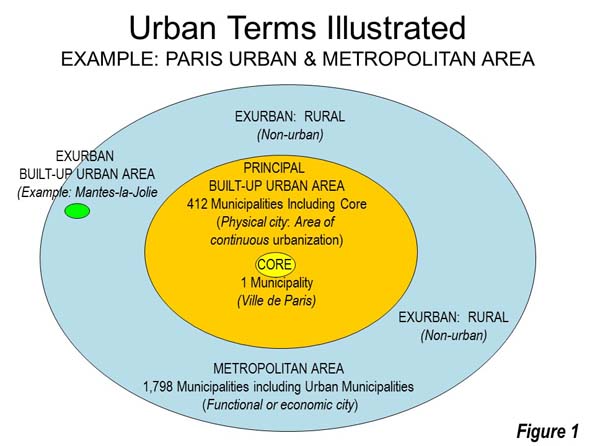
    Many of the world’s biggest cities are getting bigger still. In 2017, the number of megacities — urban areas with better than ten million people —   increased to 37 in 2017, as the Chennai urban area entered their ranks. Chennai becomes India’s fourth megacity, along with Delhi, Mumbai and Kolkota. These are among the major findings in the just released 13th annual edition of Demographia World Urban Areas, which provides population, land area and population density estimates for the 1,040 identified built-up urban areas (cities) in the world. Built-up urban areas are the physical form of the city, a definition which separates out the urban, or constructed form of the city from the rural and smaller town areas with which they form a metropolitan area or labor market (Figure 1).

    The World’s Largest Cities

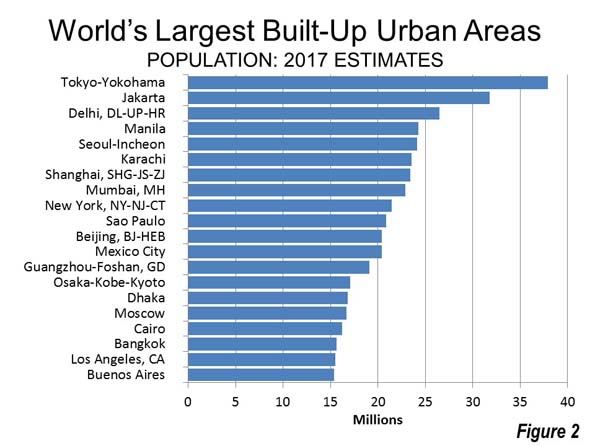
    Asia increasingly dominates the ranks of the world’s most populous cities. Tokyo-Yokohama continues to be the largest urban area in the world (Figure 2), a ranking it has held for more than six decades. It is estimated the Tokyo Yokohama house a population of 37.9 million, living in approximately 3300 square miles (8,500 square kilometers) with a population density of 11,500 per square mile (4,400 per square kilometer).

    Jakarta is the second largest urban area, with a population of 31.8 million 9,600 per square kilometer). Delhi, India’s capital held onto third position, with a population of 26.5 million. Delhi has now opened up a more than 3.5 million lead on 8th ranked Mumbai, which had been India’s largest urban area before and which some experts had considered likely to become the world’s largest city. This prediction, like a similar ones made with respect to Mexico City in the 1980s has not come to fruition and it seems unlikely that either urban area will ever be, the world’s largest.

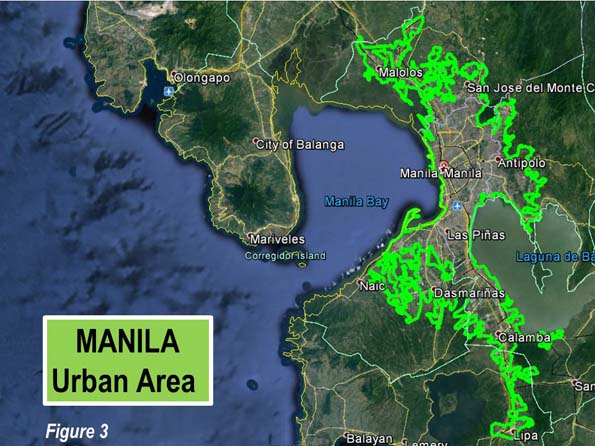
    Manila moved up from fifth position to fourth position, passing Seoul-Incheon (Figure 3). Manila’s population is estimated at 24.3 million, in an area of 690 square miles (1,790 square kilometers) in a population density of 35,100 per square mile (13,600 per square kilometer), the highest density among the top five built-up urban areas.

    Seoul-Incheon remains the only high income city, besides Tokyo,  in the top five. Seoul-Incheon is estimated to have a population of 24.1 million and an urban population density of 22,700 per square mile (8800 per square kilometer).

    The second five includes Karachi, Shanghai, Mumbai, New York and Sao Paulo, with only New York in the high income world. Thus, seven  of the largest 10 cities in the world are now outside the high income world. New York was the largest city in the world from the 1920s until the mid-1950s. London, which was the largest city in the world from the early 19th century to the 1920s is now ranked 34th, while Beijing, which preceded London as largest ranks 11th. Among the next ten largest urban areas, only two — Osaka-Kobe-Kyoto, at 14th and Los Angeles, at 19th are in the high-income world.  Formerly rapidly growing Los Angeles seems likely to drop out of the top 20 before long.

    Dhaka’s High Density

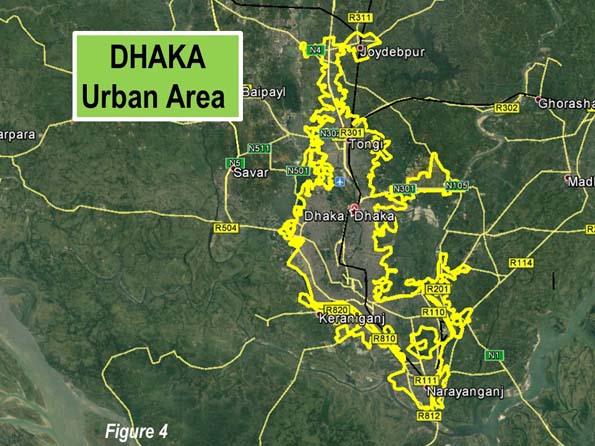
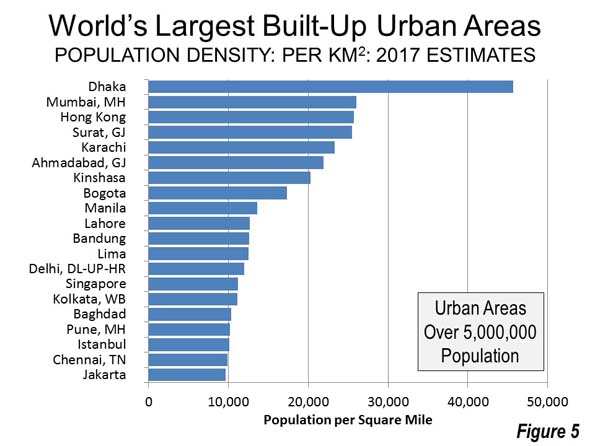
    Dhaka (Figure 4) remains far and away the highest density built-up urban area in the world (Figure 5), Dhaka has an urban density of 118,500 per square mile (45,700 per square kilometer). No other urban area exceeds 70,000 per square mile (27,000 per square kilometer). Yet, Dhaka is not dense enough for some critics, who perceive it to sprawl too much. Notably, Dhaka is about 50 percent denser than Mumbai or Hong Kong (the high income world’s densest city) and more than 30 times as dense as international densification model Portland, Oregon. Portland ranks 963rd in population density out of the 1040 built-up urban areas.

    A Half Urban World?

    In recent years, the population of the world has become majority urban for the first time. Yet, most people do not live in the largest urban areas. For example, only 15 percent of the urban population resides  in the 37 megacities. The middle of the urban population distribution is at a population of approximately 680,000. People who live in urban areas such as Shizuoka (Japan), Mangalore (India), not to be confused with Bangalore, Qitaihe (China) and Allentown (United States) are the average. The population of the urban areas that are larger have half of the urban population, while the smaller includes the other half.

    Distribution of the Population

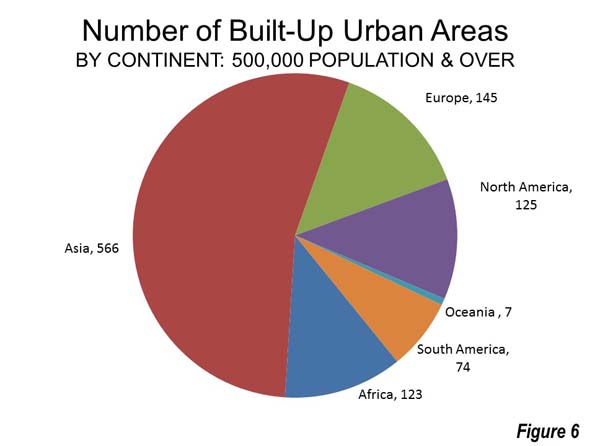
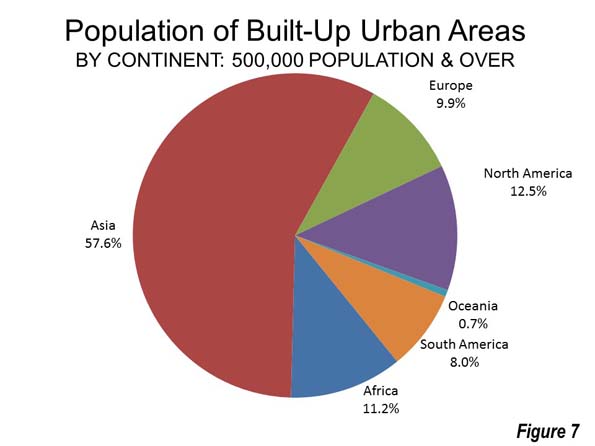
    World urbanization is dominated by Asia, which has a majority (54 percent) of the built-up urban areas with at least 500,000 population. Asia’s dominance is even greater in population, with 58 percent of the residents in urban areas of 500,000 or more. North America has the second largest share of urban area population, at 12.5 percent, followed by Africa (11.2 percent) and Europe (9.9 percent). By contrast, Europe has the second largest number of urban areas of 500,000 population or more, reflecting the generally smaller population of its cities (Figures 6 and 7).

    Concentration of Future Growth in Asia and Africa

    The latest data underscores the substantial changes that have occurred in urbanization in recent decades. In 1950, 11 of the 20 largest cities were in the high income world, according to the United Nations. On average these cities had 5 million population. Today, only five of the 20 largest cities are in the high income world and their average population is 21.5 million.

    In the decades to come, Asia  seems likely to continue its dominance, while Africa will capture an increasing share of urban population growth. By 2050, the United Nations projects that approximately 1.2 billion residents will be added to Asian urban areas, while nearly 900 million will be added to the urban areas of Africa. This would leave only about 125 million, or five percent of total urban growth for the rest of the world. Of course, projections can be wrong, but the strength of current trends make these forecasts all the more credible.

    Note: Demographia World Urban Areas uses base population figures, derived from official census and estimates data, to develop basic year population estimates within the confines of built-up urban areas. These figures are then adjusted to account for population change forecasts, principally from the United Nations or national statistics bureaus for a 2016 estimate.

    Built-up urban areas are continuously built-up development that excludes rural lands. Built-Up urban areas are the city in its physical form, as opposed to metropolitan areas, which are the city in its economic or functional form. Metropolitan areas include rural areas and secondary built-up urban areas that are outside the primary built-up urban area. These concepts are illustrated in Figure 1 (above), which uses the Paris built-up urban area (unité urbaine) and metropolitan area ("aire urbaine") as an example.

    Wendell Cox is principal of Demographia, an international public policy and demographics firm. He is a Senior Fellow of the Center for Opportunity Urbanism (US), Senior Fellow for Housing Affordability and Municipal Policy for the Frontier Centre for Public Policy (Canada), and a member of the Board of Advisors of the Center for Demographics and Policy at Chapman University (California). He is co-author of the “Demographia International Housing Affordability Survey” and author of “Demographia World Urban Areas” and “War on the Dream: How Anti-Sprawl Policy Threatens the Quality of Life.” He was appointed to three terms on the Los Angeles County Transportation Commission, where he served with the leading city and county leadership as the only non-elected member. He served as a visiting professor at the Conservatoire National des Arts et Metiers, a national university in Paris.

    Photo: Cover of Demographia World Urban Areas: 13th Annual Edition.

  • Death Spiral Demographics: The Countries Shrinking The Fastest

    For most of recent history, the world has worried about the curse of overpopulation. But in many countries, the problem may soon be too few people, and of those, too many old ones. In 1995 only one country, Italy, had more people over 65 than under 15; today there are 30 and by 2020 that number will hit 35. Demographers estimate that global population growth will end this century.

    Rapid aging is already reshaping the politics and economies of many of the most important high-income countries. The demands of older voters are shifting the political paradigm in many places, including the United States, at least temporarily to the right. More importantly, aging populations, with fewer young workers and families, threaten weaker economic growth, as both labor and consumption begin to decline.

    We took a look at the 56 countries with populations over 20 million people, nine of which are already in demographic decline. The impact of population decline will worsen over time, particularly as the present generation now in their 50s and 60s retires, begins drawing pensions and other government support.

    Europe: Homeland of Demographic Decline

    Heading up our list of slowly dissipating large countries is the Ukraine, a country chewed at its edges by its aggressive Russian neighbor. According to U.N. projections, Ukraine’s population will fall 22% by 2050. Eastern and Southern Europe are home to several important downsizing countries including Poland (off 14% by 2050), the Russian Federation (-10.4%), Italy (-5.5%) and Spain (-2.8%). The population of the EU is expected to peak by 2050 and then gradually decline, suggesting a dim future for that body even if it holds together.

    The most important EU country, Germany, has endured demographic decline for over a generation. Germany’s population is forecast to drop 7.7% by 2050, though this projection has not been adjusted to account for the recent immigration surge. The main problem is the very low fertility rate of the EU’s superpower, which according to United Nations data was 1.4 between 2010 and 2015. It takes a fertility rate of 2.1% to replace your own population so we can expect Germany to shrink as well as get very old.

    Nor can Europe expect much help from its smaller countries. Although too small to reach our 20 million person threshold, many of Europe’s tinier “frontier” countries have abysmal fertility rates. Among the 10 smaller countries with the greatest population declines, all are in Europe, and outside Western Europe, with Bulgaria’s population expected to shrink 27% by 2050 and Romania’s 22%. Each of these have below replacement rate fertility. Things are not that much better in Western Europe, where fertility rates are also below replacement rates, but not quite so low. Long-term, the only option for Europe may be to allow more immigration, particularly from Africa and the Middle East, although this may be impossible due to growing political resistance to immigration.

    Demographic Decline: The Asian Edition

    If this were just a European disease, it would not prove such a challenge to the economic future. Europe is gradually diminishing in global importance. The big story in demographic trends is in Asia, which has driven global economic growth for the past generation. The decline of Japan’s population is perhaps best known; the great island nation, still the world’s third largest economy, is expected to see its population fall 15% by 2050, the second steepest decline after Ukraine, and get much older. By 2030, according to the United Nations, Japan will have more people over 80 than under 15.

    But the biggest hit on the world economy from the new demographics will come from China, the planet’s second largest economy, and the most dynamic.

    Until a generation ago, overpopulation threatened China’s future, as it still does some developing countries. Today the estimates of the country’s fertility rate run from 1.2 to 1.6, both well below the 2.1 replacement rate. By 2050 China’s population will shrink 2.5%, a loss of 28 million people. By then China’s population will have a demographic look similar to ultra-old Japan’s today — but without the affluence of its Asian neighbor.

    Other Asian countries have similar problems. Thailand ranks as the fifth most demographically challenged, with a projected population loss of 8%. The population of Sri Lanka, just across Adam’s Bridge from still fast-growing India, is projected to increase only 0.6%.

    Also going into a demographic stall is South Korea, another country which a generation ago worried about its expanding population. With its fertility rate well below replacement (1.3), the country will essentially stagnate over the next 35 years, and will becoming one of the most elderly nations on earth.

    Full List: The Countries Shrinking The Fastest

    Smaller Singapore is an anomaly. The city-state has a rock-bottom fertility rate of 1.2, but projects a population increase of 20% by 2050 due to its liberal and vigorously debated immigration policies.

    Economic Consequences

    Most world leaders are fixated on the unpredictable new administration in Washington in the short term, but they might do better to look at the more certain long-term impacts of diminishing populations on the world’s most important economies. Economists, including John Maynard Keynes, have connected low birth rates to economic declines. On the “devil” of overpopulation, Keynes wrote, “I only wish to warn you that the chaining up of the one devil may, if we are careless, only serve to loose another still fiercer and more intractable.”

    It is already fairly clear that lower birthrates and increased percentages of aged people have begun to slow economic growth in much of the high-income world, and can be expected to do the same in long ascendant countries such as China and South Korea. Economists estimate that China’s elderly population will increase 60% by 2020, even as the working-age population decreases by nearly 35%. This demographic decline, stems from the one-child policy as well as the higher costs and smaller homes that accompany urbanization, notes the American Enterprise Institute’s Nicholas Eberstadt. China’s annual projected GDP growth rate will likely decline from an official 7.2% in 2013 to a maximum of 6% by 2020.

    There are several reasons these demographic shifts portend economic decline. First, a lack of young labor tends to drive up wages, sparking the movement of jobs to other places. This first happened in northern Europe and Japan will increasingly occur now in Korea, Taiwan, and even China. It also lowers the rate of innovation, notes economist Gary Becker, since change tends to come from younger workers and entrepreneurs. Japan’s long economic slowdown reflects, in part, the fact that its labor force has been declining since the 1990s and will be fully a third smaller by 2035.

    The second problem has to do with the percentage of retirees compared to active working people. In the past growing societies had many more people in the workforce than retirees. But now in societies such as Japan and Germany that ratio has declined. In 1990, there were 4.7 working age Germans per over 65 person. By 2050, this number is projected to decline to 1.7. In Japan the ratios are worse, dropping more than one-half, from 5.8 in 1990 to 2.3 today and 1.4 in 2050. China, Korea and other East Asian countries, many without well-developed retirement systems, face similar challenges.

    Finally, there is the issue of consumer markets. Aging populations tend to buy less than younger ones, particularly families. One reason countries like Japan and Germany can’t reignite economic growth is their slowing consumption of goods. This challenge will become all the more greater as China, the emerging economic superpower, also slows its consumption. The future of demand, critical to developing countries, could be deeply constrained.

    What about the USA?

    To a remarkable extent, the United States has avoided these pressing demographic issues. The U.N. has the U.S. tied with Canada for the fastest projected population growth rate of any developed country: a 21% expansion by 2050. Yet this forecast could prove inaccurate.

    One threat stems from millennials who, even with an improved economy, have not started families and had children at anything close to historical rates. Today the U.S. fertility rate has dropped to 1.9 from 2.0 before the Great Recession; population growth is now lower than at any time since the Depression. This places us below replacement level for the next generation. Projections for the next decade show a stagnant, and then falling number of high school graduates, something that should concern both employers and colleges. The United States’ high projected population growth rate, like that of Singapore, is entirely dependent upon maintaining high rates of immigration.

    But even before the election of Donald Trump, who is hell-bent on cracking down on at least undocumented immigration, total immigration to the United States has been slowing. At the same time the fertility rates of some immigrant groups, notably Latinos, have been dropping rapidly and approaching those of other Americans. This is despite the fact that as many as 40% of women would like to have more children; they simply lack the adequate housing, economic wherewithal and spousal support to make it happen.

    In the coming decades, the countries that can maintain an at least somewhat reasonable population growth rate, and enough younger people, will likely do best. To a large extent, it’s too late for that in much of Europe and East Asia. For countries like the United States, Canada and Australia, with among the most liberal immigration policies and large landmasses, the prospects may be far better. However, we also need native-born youngsters to launch, get married and start creating the next generation of Americans.

    This piece originally appeared at Forbes.

    Joel Kotkin is executive editor of NewGeography.com. He is the Roger Hobbs Distinguished Fellow in Urban Studies at Chapman University and executive director of the Houston-based Center for Opportunity Urbanism. His newest book, The Human City: Urbanism for the rest of us, was published in April by Agate. He is also author of The New Class ConflictThe City: A Global History, and The Next Hundred Million: America in 2050. He lives in Orange County, CA.

    Photo: Ahmet Demirel [Public domain], via Wikimedia Commons

  • The Futility of Annual Top 10 Predictions

    In every recent year, a black swan event has made top 10 lists appear quaintly naive and unimaginative. Our list is probably no better.

    This time of year, top 10 predictions are all the rage. These lists can be interesting and entertaining but how useful are they really?

    This question goes to the heart of forecasting. How futile or how useful is an attempt to forecast the economy, or technology, or world events for the next twelve months? There are three answers.

    First, not futile and somewhat useful. Projecting the trends of 2016 into 2017 is a useful exercise to identify their linear logical trajectories and end points. For example, the automation of many job functions will continue as long as robotics and artificial intelligence make progress. Or, North Korea’s ability to deliver a nuclear warhead on a long-range missile will continue to improve if unchecked.

    Second, futile and not that useful. When a desirable trend, say a decline in unemployment, is identified, policy makers will attempt to reinforce it. When an undesirable trend becomes obvious, they will work to counter it. However in both cases, the intervention can be either effective or counterproductive. It can either reinforce or roll back the trend. Human tinkering means that few trends are truly linear or logical beyond the near-term. There may be a slowdown in the spread of automation. There may be an agreement to stop North Korea’s nuclear ambitions.

    Third, neither futile nor useful but somewhat irrelevant. While forecasters are focusing their sights on the high probability of a, b and c, there are always bigger low-probability events brewing under the surface. In fact, the most important event in any given year, the one event that shakes things up and that has wide long-lasting ramifications, is usually one that few people foresaw at the beginning of that year.

         •  In 2016, Brexit and the victory of Donald Trump. A large majority of experts gave either event a low probability.

         •  In 2015, the massive refugee influx into Europe. The numbers were rising in previous years but no one saw the surge coming.

         •  In 2014, the sudden rise of ISIS after it conquered large territories in Syria and Iraq. President Obama had famously dismissed them as the JV team a few months earlier.

         •  In 2013, the Boston Marathon bombing and Edward Snowden’s revelations.

    And so on. If you look at it by decade, the most important events of the 1990s and 2000s were the collapse of the Soviet Union and the 9/11 terror attacks. Neither featured in top ten lists in any year but both had an enormous impact and repercussions that are still rippling around the world.

    So instead of a list of top 10 higher probability predictions, we should consider a list of lower probability events each of which, were it to occur, would have a very large impact on the future of politics, economics, science etc. As extensively argued by Nassim Taleb, black swan events often have a much greater impact on the future.

    Here is one attempt to compile such a list, with the caveat admission that it is only marginally better if at all than other lists and that the most important event of 2017 will likely be something else.

    Low Probability high impact events

    In no particular order:

         •  A major cyberattack that paralyzes the electric grid, payment exchanges, the stock market and/or other infrastructure. Until repaired, this would wreak havoc on daily life and the economy and would hit GDP for several quarters. It would also lead to new security measures and the attendant spending by corporations and governments.

         •  Putin removed from power. This has a low probability but it is not impossible. Referring to Putin, George Friedman recently wrote that “Russia must be led by a magician who can make small things appear large.” Through ways not always approved in the West, Putin has managed to spread Russia’s influence despite economic deterioration. But Russia has large demographic and economic challenges which could get worse after his departure.

         •  Another financial crisis starting in Europe or in emerging markets. Though regulation and oversight have increased since 2008, there was no deep overhaul of the cultural mindset at many leading financial institutions. The world is awash with credit and emerging markets are considerably weaker now than in 2008. If nothing else, moral hazard created by the bailouts means that the next crisis could be as severe as the last one, with little appetite in the public for saving the banks one more time.

         •  A joint Russia-NATO military operation against ISIS and a settlement of the Syrian war. ISIS has lost much territory in 2016 but is still effective at orchestrating terror attacks in other countries. During the campaign, Donald Trump vowed to hit them hard.

         •  A sharp economic slowdown in China. China has been a huge engine of growth for over two decades lifting its own economy and boosting commodity-based countries such as Brazil, Russia and the OPEC countries. Chinese demand also helped maintain strong demand for American and European goods at a time when growth in Western economies was sluggish or nonexistent. At the same time, China’s low-cost manufacturing and capital flows into the US lowered inflation and interest rates. A marked China slowdown could throw all of the above in reverse, lifting interest rates in the US and Europe and depressing demand for finished goods and commodities.

         •  Political turmoil in Saudi Arabia and/or Iran. Both countries have vast oil reserves and are the leading power brokers in the Middle East. Destabilization in either would have important near and long-term consequences.

         •  A coup d’état or populist revolt in an OECD country. OECD member Turkey experienced an aborted military takeover in 2016. Could it happen elsewhere? Highly improbable but not necessarily 100% out of the question, as far as black swans are concerned.

         •  The price of oil at $20 or $90 per barrel. Today oil is trading near $55 and a decline to $40 or a rise to $65 are neither here nor there in terms of their lasting impact. But a $30 to $40 rise or drop would certainly shake things up. It is not difficult to construct either scenario, improbable as it may be. For a drop, imagine China and/or the US economy weakening while production from Iran, Iraq, Libya and US shale producers surges back. For a rise, consider emerging markets recovering with a stronger India while turmoil in the Middle East threatens some production.

         •  A major terrorist attack with thousands of casualties. Unfortunately, this one will have to feature on the list every year for the foreseeable future. Though it has a low probability, its occurrence anywhere would shock and reshape the world for the several decades that follow.

         •  On the positive side, there will continue to be advances in science and medicine. Because positive developments tend to build on the previous years’ progress, they are by their nature incremental, and are therefore unlikely to generate surprise shock or awe headlines.

    These are all low probability but not zero probability events. And the impact of each would be far greater than that of any higher probability event featuring in many top 10 predictions for 2017.

    Sami Karam is the founder and editor of populyst.net and the creator of the populyst index™. populyst is about innovation, demography and society. Before populyst, he was the founder and manager of the Seven Global funds and a fund manager at leading asset managers in Boston and New York. In addition to a finance MBA from the Wharton School, he holds a Master’s in Civil Engineering from Cornell and a Bachelor of Architecture from UT Austin.

    Photo: Edvard Munch [Public domain or Public domain], via Wikimedia Commons

  • ‘Two Regimes’: A Visual Memory of Wartime Survival

    At the corner of Maitland Avenue and Maitland Boulevard, the Holocaust Memorial Center is squeezed between tennis courts and a small courtyard, part of the Jewish Community Center. Inside, the classrooms are nicely squared off. The exhibit “Two Regimes” takes up one classroom’s walls with about 40 paintings depicting life during the Stalin and Hitler regimes for Jews living in Mariupol, Ukraine. From this industrial port town on the shore of the Azov Sea to a ramshackle stilt house in north Florida, the exhibit is a strange tale, partly told.

    “The exhibit will be free and available for the public to view until January 2, 2017,” stated Terrance Hunter, Program Coordinator for the Holocaust Memorial Resource and Education Center of Florida. The Center is dedicated to building an inclusive community in the Orlando area through exhibits and educational programs centered around the events of the Holocaust. This is the very first show of these paintings by the artist, and the Holocaust Center, through a State of Florida Grant, is preparing classroom curriculum materials using the paintings to help children better understand this terrible period.

    Artist Nadia Werbitzky’s forty-odd paintings soulfully illuminate her mother’s memoirs of the times between the two world wars. After surviving several concentration camps, Werbitzky and her mother emigrated first to Germany, then to Canada, ending up in Baltimore. How her paintings came to rest under a Florida Cracker stilt house is still a bit of a mystery, confessed exhibit co-curator Kelly Bowen in a recent talk about the art.

    The work was discovered by Mimi Shaw, then an acting coach in Tallahassee in the late 1990s. A student advised her of an interesting garage sale, so she went, and discovered Teodora’s memoirs and much of Nadia’s paintings, slowly rotting in an old house about to be demolished. Foresight and determination helped Shaw and her friend Bowen rescue, and eventually restore, the artwork.

    Werbitzky studied at the Art Academy of Dusseldorf after the end of World War 2, developing her own style that references European masters like Van Gogh and Matisse. Haunted by her memories she carefully depicted real people in real events. When her work was subjected to authoritative Holocaust scholarship, the people she claimed to have painted were found to be real, and so are memorialized, as she put it, as “people who lived and breathed on this earth.”

    So much of our Holocaust education is about numbers: six million Jews; twenty-three main concentration camps, and so on. The suffering, however, cannot be abstracted into numbers and are brought to extraordinary life in Werbitzky’s beautiful paintings. “Hell’s Threshold” is a good example. It depicts the October 1941 Nazi roundup of 7,500 Jews in Mariupol. Standing in the back of the line, the woman in the pink dress was a friend of Teodora’s, and later verified by others. In a blue dress, a woman rushes around the corner to the back of the line with a young baby in her arms and pulling her daughter, who is clutching a large doll. Again, a specific memory of a specific person: this time, herself.

    The book “Two Regimes” puts the paintings and memoirs together, bringing old Russia to life, both good and bad. This touring exhibit evokes awe for its subjects and respect for the calm approach the curators have taken to restore and exhibit Verbitzky’s work. Two Regimes is worth seeing for both its artistic depth and its unique eye on this terrible time. If it happened then, it could happen again.

    This article first appeared in The Orlando Weekly.

    Richard Reep is an architect with VOA Associates, Inc. who has designed award-winning urban mixed-use and hospitality projects. His work has been featured domestically and internationally for the last thirty years. An Adjunct Professor for the Environmental and Growth Studies Department at Rollins College, he teaches urban design and sustainable development; he is also president of the Orlando Foundation for Architecture. Reep resides in Winter Park, Florida with his family.

    Image: Nadia Werbitzky

  • Erasing Anglo cultural heritage risks what makes our republic diverse

    It’s increasingly unfashionable to celebrate those who made this republic and established its core values. On college campuses, the media and, increasingly, in corporate circles, the embrace of “diversity” extends to demeaning the founding designers who arose from a white population that was 80 percent British.

    In this American version of Mao’s “Cultural Revolution,” which tried to eviscerate traces of China’s past, venerable buildings are being renamed, athletes refuse to stand for the national anthem and, on some campuses, waving the American flag is now considered a “microaggression,” while English students at Yale want to avoid reading the likes of Milton, Shakespeare and Chaucer.

    Of course, some changes are justified. Asking anyone, particularly African Americans, to revere the Confederate flag or attend schools named after the founder of the Ku Klux Klan is, indeed, offensive. But in our zeal to address old wrongs, we may also be sacrificing the very things that have made this republic so attractive to millions from distinctly different backgrounds for the last two centuries.

    Why we come here

    Just to clear the air, I have not a single drop of British blood in me. The closest ties I have to what I consider my cultural and political home country come from my great uncle Simon, who served in Gen. Allenby’s Jewish brigade in World War I, and that my wife, born in Montreal, came into the world a subject of Her Majesty, Queen Elizabeth. Career wise, I did work for a think tank in London for several years.

    But what ties most Americans to the founders is not race, but our embrace of a political and legal culture based on distinctly Anglo-Saxon ideas about due process, representative government, property rights and free speech. These proved infinitely superior to the divine right of czars, kaisers, emperors and other hereditary autocrats for generations of non-Anglo-Americans.

    This system, always capable of amendment, has allowed waves of traditional outsider groups — African Americans, Latinos, women, Mormons, Jews and Muslims — to join the economic, political and cultural mainstream. In some cases, as in the case of President Obama, they have also secured the highest reaches in the national firmament.

    Read the entire piece at the Orange County Register.

    Joel Kotkin is executive editor of NewGeography.com. He is the Roger Hobbs Distinguished Fellow in Urban Studies at Chapman University and executive director of the Houston-based Center for Opportunity Urbanism. His newest book, The Human City: Urbanism for the rest of us, will be published in April by Agate. He is also author of The New Class ConflictThe City: A Global History, and The Next Hundred Million: America in 2050. He lives in Orange County, CA.

    Photo: William Robert Shepherd [Public domain], via Wikimedia Commons

  • Solidarity, not Division: Understanding London’s East End

    The East End of London has a long history of working-class community. It has been a place of industry, where the river Thames and the river Lea have provided work for many people. The area attracted many immigrants, including workers from Africa since Tudor times, sailors from China, former slaves from America, French Protestants facing religious persecution in the 1600s and Irish weavers working in the textile industries. There have been Jewish communities in the East End for centuries, too. The twentieth century saw an increase in immigrants from the former British colonies, including South Asia, particularly Bangladesh. Not only has it been a place to seek a livelihood, but it has also been a place of refuge.

    One side of my family hails from the East End and North East London, so I have a strong personal connection to this part of London. My ancestors worked in the local industries and on the river. We might not technically be ‘Cockneys’ (in that we weren’t all born within earshot of Bow Bells), but we are Cockney by nature. Family gatherings would include a raucous ‘knees-up’ (dancing and singing) and traditional local fare of jellied eels. We’re a working-class family who have lived in East London for generations.

    So I was interested when I came across a recent short BBC documentary called Last Whites of the East End. I was disturbed by the title, which suggested that white people in the area are somehow endangered – an odd idea and potentially a racist one. This racism was confirmed when I watched the show. The documentary focused on residents of Newham, one of the poorest working-class boroughs in England. The filmmakers interviewed a number of working-class residents about their experiences of living in the East End and the decisions of some of them to leave the area. The majority of the subjects were white, though they also included one man of Bangladeshi background and one man of white and Afro-Caribbean heritage.

    The narration of the documentary presented a racist agenda, describing the neighbourhood as at ‘tipping point’ with the ‘lowest white population in the UK’. It also noted a ‘dwindling cockney community’ who were in danger of disappearing in the face of increased immigration. Some of those interviewed were moving outside of London, to places like Essex, so they could live in areas with larger white populations. Some described themselves as ‘traditional East Enders’ and lamented the loss of the old community. They spoke of local services being shut down and the closure of the local pub. The film presented the interviewees as embodying white racism and a fear of the other, highlighting their reluctance to build bridges due to perceived differences. As one young white woman explained, they wanted to ‘stay with their own’.

    But there were many contradictions in the documentary, too. It included an elderly white woman, who was preparing to leave her home and move out of London, not due to her fear of her Muslim neighbours (as implied by the narration, despite the fact that she was obviously upset to say goodbye to her Somali neighbour), but because she was elderly and alone and wanted to move closer to her daughter. Like many of her neighbours, she had once been a new arrival to the neighbourhood, moving there from the north of England. The two people of colour in the film both spoke of their connections to the local area and their identification as East Enders. Like their white neighbours, they pointed to the changing environment, but I’d suggest that the changes they were criticising were not tied to the latest influx of new immigrants.

    Instead, they are matters of class. Gentrification and austerity are disrupting the lives of the working-class residents of the East End, not immigration. Housing has become too expensive, and government funding cuts are squeezing local schools and health services. Interviewees complained about the closure of a club which wasn’t just a local pub but also a community centre that elderly residents relied on for social events and to reduce isolation. Some white people are leaving, but, as I’ve seen with some friends and family members, that’s for financial reasons. They can purchase bigger properties if they sell their London homes, or they can pay less rent by moving to areas outside of London with smaller populations and less pressure on local services. And of course, not all of those leaving London are white.

    The documentary downplays this part of the story. It also downplays the working-class solidarity that connects residents despite their differences. Residents of the East End share the experience of hardship and struggle, and this shared struggle has a very long history. The East End has a tradition of political radicalism and collective action. East Enders have looked after each other during tough times and shown a united front against hostile external forces. Famously, in 1936, the local community stood up against a group of anti-Semitic fascists who wanted to march through a Jewish area. The confrontation, known as the Battle of Cable Street, was won because the community put their bodies on the line to keep the fascists out. The same community rallied during the Second World War and looked after each other during the bombing raids of the Blitz. More recently, local people have been supporting each other and engaging in collective action in the face of forced evictions as local public housing is sold and redeveloped for private profit.

    If the ‘traditional East End’ is disappearing, that isn’t because some working-class white are moving out of London. Working-class communities are not made up of just white people, and I’ve certainly never known a London that was mono-cultural. Yes, there are racist white working-class people. But the East End of London is a diverse and dynamic place, and always has been. It has also been a place of solidarity and struggle. The filmmakers chose to emphasize division instead of showing how East Enders act collectively, and it cast immigrants as a threat, when the real threats facing this community are austerity and gentrification.

    This piece first appeared at Working-Class Perspectives.

    Photo Credit: Daryl Hutchison, @daryldactyl