Tag: Europe

  • Two Views of West’s Decline

    Summer is usually a time for light reading, and for the most part, I indulged the usual array of historical novels, science fiction as well as my passion for ancient history. But two compelling books out this year led me to more somber thoughts about the prospects for the decline and devolution of western society.

    One, “Submission” by the incendiary French writer Michel Houellebecq, traces the life of a rather dissolute French literature professor as he confronts a rapidly Islamifying France. The main character, Francois, drinks heavily, sleeps with his students and focuses on the writing of the now obscure French writer, J.K. Huysmans. Detached from politics, he watches as his native country divides between Muslims and the traditional French right led by the National Front’s Marine Le Pen.

    Ultimately, fear of Le Pen leads the French left into an alliance with the Muslim Brotherhood, handing power over to an attractive, clever Islamist politician. With all teaching posts requiring conversion to Islam, Francois in the end “submits” to Allah. Francois motives for conversion merge opportunism and attraction, including to the notion that, in an Islamic society, high prestige people like himself get to choose not only one wife, but several, including those barely past puberty.

    The other declinist novel, “The Family Mandible” by Lionel Shriver, is, if anything more dystopic. The author covers a once illustrious family through the projected dismal decades from 2029 to 2047. Like the Muslim tide that overwhelms Francois’ France, the Brooklyn-based Mandibles are overwhelmed in an increasingly Latino-dominated America; due to their higher birthrate and an essentially “open border” policy, “Lats” as they call them, now dominate the political system. The president, Dante Alvarado, is himself an immigrant from Mexico, due to a constitutional amendment — initially pushed to place Arnold Schwarzenegger in the White House — that allows non-natives to assume the White House.

    Collapse is from within

    Some critics have lambasted author Shriver as being something of a Fox style right-wing revisionist while others have labeled Houellebecq as an “Islamophobe.”

    But these books are far more nuanced than orthodox Muslims or progressives might assume. For one thing, neither book blames the newcomers for the crisis of their respective societies. The collapse, they suggest, is largely self-inflicted.

    Read the entire piece at The Orange County Register.

    Joel Kotkin is executive editor of NewGeography.com. He is the Roger Hobbs Distinguished Fellow in Urban Studies at Chapman University and executive director of the Houston-based Center for Opportunity Urbanism. His newest book, The Human City: Urbanism for the rest of us, will be published in April by Agate. He is also author of The New Class ConflictThe City: A Global History, and The Next Hundred Million: America in 2050. He lives in Orange County, CA.

  • Eastern Europe Heads For A Brave Old World

    Will a unified Europe survive Britain’s vote on Brexit? The referendum of last June pointed the country out of the European Union. Will France or Italy follow suit? If so, it could doom the structure that began in the 1950s as a customs union, if not an uneasy economic alliance to keep Germany from rearming and dominating central Europe. And will a consequence of Brexit be the re-emergence of Russia as the dominant power in Eastern Europe? Or will the European Union last long enough to bring prosperity to the forgotten countries of Eastern Europe?

    I thought about these questions when I recently boarded a night train in Zurich. Switzerland has never been a member of the European Union, but it coexists with the EU through a series of bilateral agreements, similar to those that Britain will now seek. I was heading east on a series of sleepers that took me through Austria, Slovakia, Hungary, Serbia, and Bulgaria, precisely those countries that a unified Europe had aimed to lift into prosperity.

    I expected to find an absence of trade barriers, and see lands benefiting from the common currency, the euro, which is used by nineteen of the twenty-eight EU members. Instead, I felt as thought I was descending into a Brave Old World, that of a Europe with guarded borders and separate currencies, a land best imagined as lying on the far side of an economic Iron Curtain rather than a political one. Here’s the view from the train window:

    Austria: Along with its capital city, Vienna, Austria has been an EU winner. Into the 1980s Vienna was a cul-du-sac of the Cold War; the dead end, final stop of Western European laissez-faire economic polices that nestled against the dragon teeth and barbed wire of the Soviet sphere of influence.

    After the wall fell, Vienna became a glittering capital of central Europe, the ideal city for both corporate headquarters and long weekends at the opera. Its banks and companies flourished, and much trade with the new countries of the East began and ended in the Austrian capital, which lies on the western edge of the great Hungarian plains.

    Without the EU, however, Austria would be at risk of becoming a more dynamic Slovenia.

    Slovakia: A stepchild of the Soviet dissolution, Slovakia is the rump state to the east of the Czech Republic, the other half of divided Czechoslovakia. Its capital is in Bratislava, which is something of a Viennese suburb. The rest of the country, surrounded by Poland, Hungary, and Ukraine, is best understood as a heavy machine shop of collectivization, where there is now more demand for imported jeans than for Comecon turbines.

    An EU member in the Eurozone — that is, a member that uses the euro as its currency — Slovakia is betting its economic future on the basis of its low-costs and proximity to Austria, which has attracted a number of Western car companies, including Jaguar. A nice hotel room is €45.

    Conversely, Western consumers are indifferent to Slovakian products, goods, and services, which has positioned Turkey as one of the country’s leading trade partners.

    I spent an evening with a Slovakian who is fixing up his house. His solution wasn’t to order British or French fixtures from within the EU, but to import a container full from Istanbul, complete — so he implied — with Turkish workers to hitch up the low-cost appliances and lighting.

    Hungary: In the go-go years of European expansion, Hungary was the France of Eastern Europe, a proud civilization that dates back more than a thousand years. Its capital city, Budapest, is a place of grace and sophistication.

    London bankers invested their bonuses in Pest apartment flats, and discount airlines flooded the Buda hills with wandering tourists.

    In the soon-to-be-reordered European Union, Hungary could become neither here nor there. Its nationalist, right wing parties (70 percent of the recent election) dream of a Hungarian greatness that was lost at Trianon after World War I and in Transylvania. But the Hungarians have no idea whether its salvation lies in turning east toward Russia, north toward Germany, or west toward a fragmented EU.

    Without a lodestone that inspires optimism, Hungary finds it easier to blame its problems on gays, immigrants, Viennese bankers, and the EU, not to mention the protocols of the elders of Zion.

    Serbia: My overnight train from Budapest to Belgrade was covered with graffiti, giving it the air of a wayward New York City subway train from the 1970s, although one with couchettes and without break dancers.

    NATO bombed Belgrade in spring 1999, in support of Kosovo’s independence. Legally, Kosovo is an autonomous region of Serbia, but in practicality it is a NATO protectorate, the love child of Madeline Albright’s and Richard Holbrooke’s air campaign.

    Among the casualties of that air war was Serbian enthusiasm for all things American and European. The isolated, rump republic of 11 million Serbs has become an orphanage of disaffected Europeans who remain locked away from Western prosperity with a stillborn economy.

    In theory, Serbia, the nearby republics of Macedonia and Montenegro, and perhaps even a new republic in Kosovo were to rise into the middle class through membership in the European Union. In reality, the EU has no more appetite for Serbia’s tottering banks or pig farms than it does for more Greek debentures.

    Bulgaria: Sofia, the capital, is 225 miles from Belgrade, the same distance as Boston is from New York City, but my meandering sleeper took twelve hours to make the overnight trip, which included several hours at dawn on the Serbian-Bulgarian border, the site of many Balkan wars.

    Carved from the Ottoman Empire at the 1878 Treaty of Berlin, Bulgaria could rightfully claim to be both the last piece on the European chess board and the best barometer of EU efficacy in the twenty-first century. Some polls say it is the most unhappy EU member. As a city, Sofia is a pleasant combination of socialist realism, Balkan impressionism, and a few modern glass towers.

    I first visited it in summer 1976, when Bulgaria was hewing the Marxist line with Stalinist devotion. Now, in summer 2016, the oppression comes from a hybrid form of capitalism that mixes Leninist sympathies with mafia business practices. No wonder the EU isn’t in any rush to bring the euro to Bulgaria, although the country is a member of the confederation.

    Bulgaria’s political dilemma is that its gas is a hostage to fortunes in Russia and Ukraine (where all the pipelines originate), while its subsidies and regulations come from Brussels.

    ***

    Sadly, I doubt the EU will last much longer. Brexit marks the ebb tide of European optimism, and part of the reason the British voted themselves out is a wish to send home Hungarian, Slovak, and Bulgarian immigrants who despair of making a living in their own countries.

    Brexit is also a diplomatic move in the increasing cold war between Western Europe and Islam, whose fault lines run precisely through Bosnia, Albania, Bulgaria, Macedonia, and Turkey.

    When the Brexit vote took place, Europe was in the midst of a terror spree that had Muslim fanatics opening fire on shoppers in a Munich mall and driving a truck through a Nice street fair on Bastille Day. Is it any wonder that Britain, staring at refugees camped out in Calais, would raise the draw bridge?

    Brexit is also a victory for Putin’s Russia and its gangster capitalism. Until the invasions of Crimea and Ukraine, Russia felt encircled by NATO in Turkey and by the EU in the Baltic States. Now, however, Europe has the look of what diplomatic histories used to call a “dead letter,” leaving much of Eastern Europe vulnerable to a modern Russian Risorgimento.

    In the EU, only Germany is earning any money, and it is only a matter of time before Angela Merkel is voted out of office. A new leader there — appealing to nationalist sentiments — will ask German voters, “Why are you working for 4.5 years, on average, to pay the subsidies that are handed out to lazy Spaniards, Greeks, and Italians?”

    As someone who admired the European Union, riding trains from Zurich to Sofia reminded me of the downside of old Europe. I hated changing money in train stations, and being woken up by border guards at forlorn crossings like Dimitrograd (Serbia) or Kalotina (Bulgaria). More disturbing was to see, in Belgrade parks or along rail lines, Syrian refugees living like cattle that is drifting north across an arid plain.

    The EU was created to embrace free trade and freedom of movement across a continent of 400 million that, in the past, has failed to compensate for overlapping national claims by adjusting borders.

    Brexit is one overt expression of dissatisfaction with Europe. But EU failures can also be seen across countries that have changed little since Bismarck, an early Pan-European, said the Balkans were not “worth the bones” of a single Prussian grenadier.

    Matthew Stevenson, a contributing editor of Harper’s Magazine, is the author of, among other books Remembering the Twentieth Century Limited, and Whistle-Stopping America. His next book, Reading the Rails, is due out in August. He lives in Switzerland.

    Flickr photo by sbrrmk: Rhodope Mountains, Bulgaria

  • Commie Skin Jobs

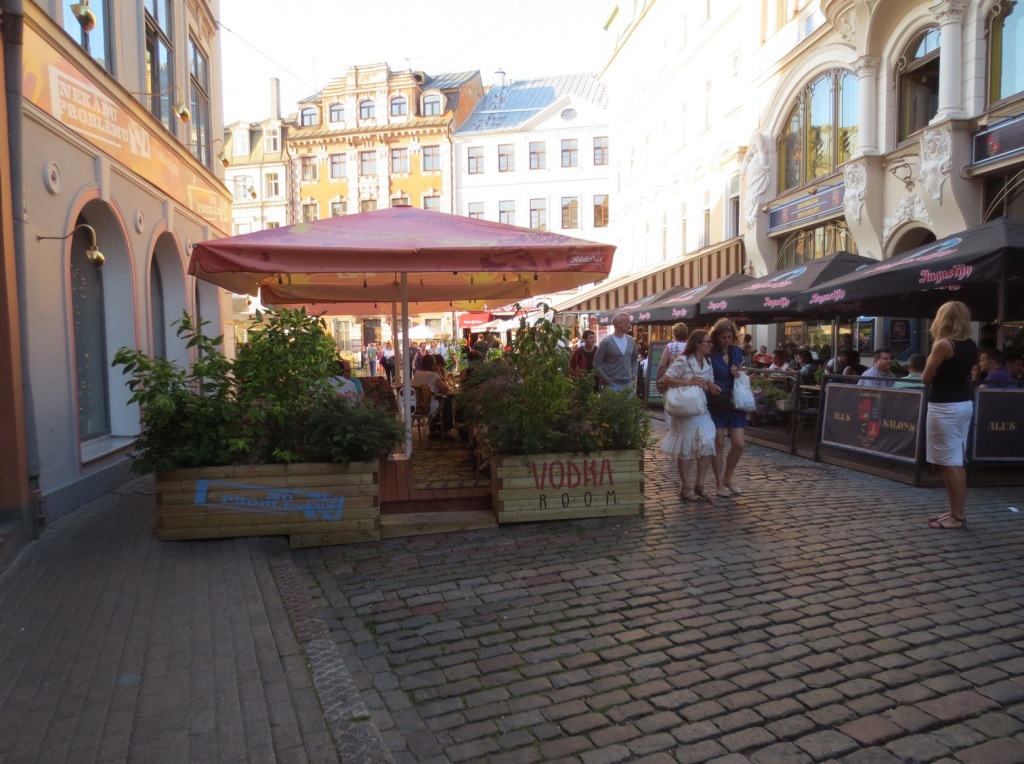
    This is Riga, Latvia. The Baltic Republics had a particularly difficult time during the twentieth century with Nazi Germany invading in 1941 and Soviet Russia occupying them until 1991. What had been a prosperous group of small Scandinavian style countries became relatively impoverished and isolated.


    Screen Shot 2016-04-15 at 1.23.01 PM

    Screen Shot 2016-04-15 at 12.43.07 PM

    Screen Shot 2016-04-15 at 12.38.34 PM

    Screen Shot 2016-07-25 at 12.20.40 PM

    This is Riga, Latvia. The Baltic Republics had a particularly difficult time during the twentieth century with Nazi Germany invading in 1941 and Soviet Russia occupying them until 1991. What had been a prosperous group of small Scandinavian style countries became relatively impoverished and isolated.

    Screen Shot 2016-07-26 at 1.52.14 AM

    Screen Shot 2016-07-26 at 1.45.59 AM

    Screen Shot 2016-07-25 at 8.57.20 PM

    Screen Shot 2016-07-25 at 10.38.32 AM

    Screen Shot 2016-07-25 at 10.37.13 AM

    Screen Shot 2016-07-25 at 8.52.43 PM

    This is nothing new. The Baltic has been repeatedly dominated by larger nations since the 1200’s. Riga is equidistant from both Berlin and Moscow. It’s a rough neighborhood and it seems likely there will be more such impositions in the future. The region is too important to left alone. But the people will adapt as they always have.

    Screen Shot 2016-04-15 at 12.43.47 PM

    Screen Shot 2016-07-25 at 8.57.48 PM

    Screen Shot 2016-07-25 at 8.58.01 PM

    Screen Shot 2016-04-15 at 12.44.00 PM

    Between the various wars and occupations when the country was allowed to flourish on its own Latvia proved to be industrious and highly cultured. The buildings that survived the tumults of history attest to the quality of the people, economy, and place.

    Screen Shot 2016-07-25 at 9.22.34 PM

    Screen Shot 2016-07-25 at 9.23.13 PM

    Screen Shot 2016-07-25 at 9.22.03 PM

    Screen Shot 2016-07-25 at 9.49.04 PM

    Screen Shot 2016-04-15 at 1.26.03 PM

    Screen Shot 2016-04-15 at 1.23.58 PM

    Screen Shot 2016-07-25 at 9.49.21 PM

    It was a matter of national pride for the Latvian people to completely restore the historic core of Riga after the Soviets left things in Havana style dishevelment. This is their homeland and the repository of their culture, language, music, and history. It was also an excellent business model. The city is a dynamic and highly profitable venue for foreign investment, trade, and tourism. Every inch of the old city is productive.

    Screen Shot 2016-04-15 at 1.06.58 PM

    Screen Shot 2016-07-25 at 10.33.44 AM

    Screen Shot 2016-07-26 at 12.44.15 AM

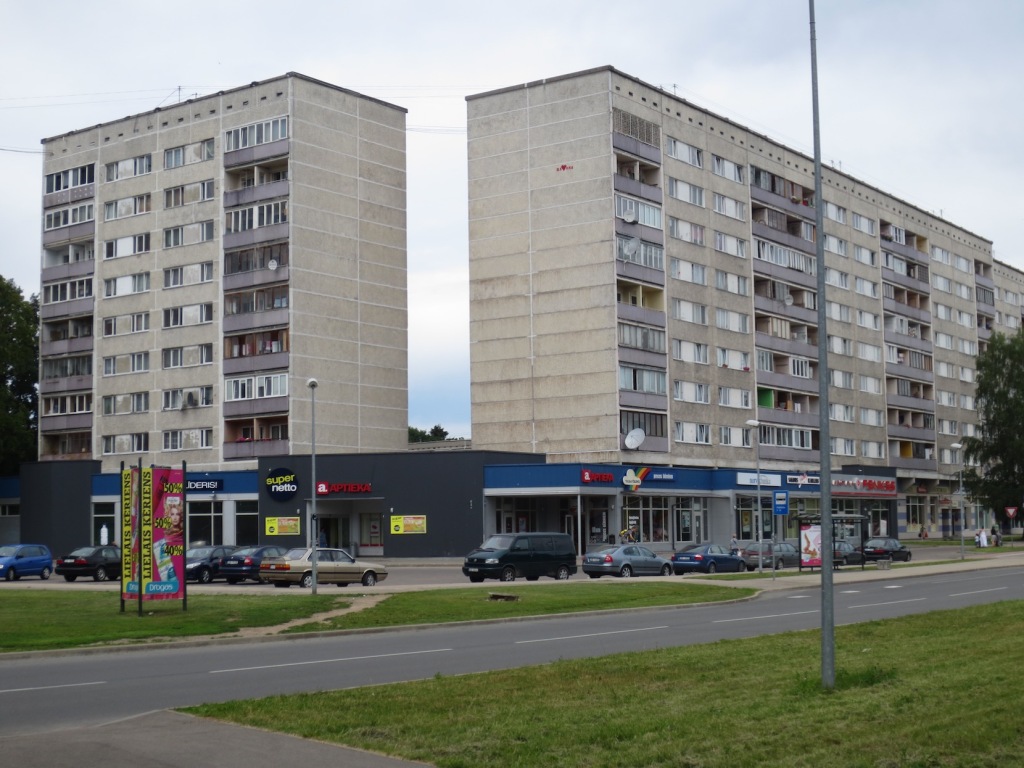
    But then there’s all that left over communist stuff ringing the city. What exactly do you do with it all? Pulling it down and replacing it is too expensive. And many of these buildings are occupied by ethnic Russians not Latvians. (Latvia is a quarter Russian as a result of the Soviet occupation, but the city of Riga is closer to half Russian.)

    Screen Shot 2016-07-26 at 1.38.49 AM

    Screen Shot 2016-07-26 at 1.39.50 AM

    Screen Shot 2016-07-26 at 1.33.09 AM

    Screen Shot 2016-07-26 at 12.44.29 AM

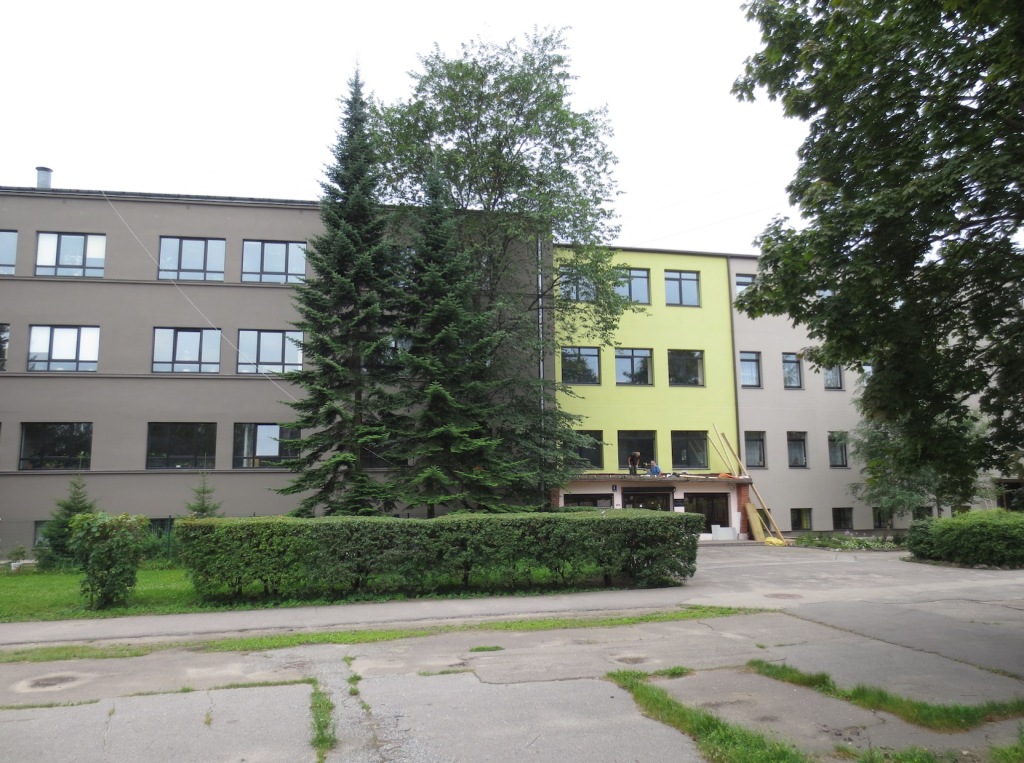
    This was top down bureaucratic central planning at its finest. Residential buildings were isolated from industry and from each other for health and safety. Operating a business of any kind in these apartment buildings was strictly forbidden. Tightly regulated shops were provided at convenient but segregated locations. Highly consolidated schools and isolated office and manufacturing parks were constructed in their own little pods at some distance.

    Screen Shot 2016-07-25 at 9.47.26 PM

    Screen Shot 2016-07-25 at 12.24.22 PM

    The preservation of green open space was a hallmark of Soviet design. Grass and trees were necessary for recreation, health, and social tranquility. There’s also a coincidental side effect of this kind of land use planning that worked in favor of central authority. Where exactly would people organize a protest rally in this environment? There is no prominent central square or iconic rallying point. What exactly would the rebel cry be here? Rise up and storm the shrubbery!

    Screen Shot 2016-07-25 at 12.25.50 PM

    Screen Shot 2016-07-26 at 1.37.09 AM

    Screen Shot 2016-07-26 at 1.42.37 AM

    Honestly it’s not that different from American suburbia. Communists just preferred concrete tower blocks to wood framed tract homes. If you’ve ever been inside an original 1947 Levittown house then you’ve essentially been inside one of these Soviet apartments. I spent a chunk of my childhood in a beige stucco apartment in Los Angeles that was nearly identical on the inside. The kitchens are small, there’s only one bath, the ceilings are low, there’s no craft or workmanship in the architecture. It’s utilitarian. It’s not terrible. People can and do live perfectly comfortable lives in these places. It’s just bland and there’s never anything to do in the neighborhood. It’s the precise opposite of the historic city center. No tourist ever ventures out to this part of town and you’ll never see photos of these neighborhoods in brochures.

    Screen Shot 2016-07-25 at 10.35.31 AM

    Screen Shot 2016-07-25 at 10.34.48 AM

    Screen Shot 2016-07-25 at 10.40.09 AM

    Screen Shot 2016-07-26 at 1.39.07 AM

    Screen Shot 2016-07-26 at 1.35.13 AM

    So here’s what the pragmatic Latvians are doing. First, these inherited communist buildings are given a quick skin job. They’re scrubbed clean, fitted with new cupboards and fixtures, painted, given new windows and doors, and generally made to feel fresh. If you squint these buildings look like the lesser offerings of 1960s Sweden or Germany. There are worse places to live in the world. A tidy apartment in a boring suburb of Riga is what some people genuinely prefer. There’s plenty on offer here for them. And there isn’t much else that can be done with these places.

    John Sanphillippo lives in San Francisco and blogs about urbanism, adaptation, and resilience at granolashotgun.com. He’s a member of the Congress for New Urbanism, films videos for faircompanies.com, and is a regular contributor to Strongtowns.org. He earns his living by buying, renovating, and renting undervalued properties in places that have good long term prospects. He is a graduate of Rutgers University.

  • Challenging Nordic Myths

    Hillary Clinton, Bernie Sanders and numerous other American politicians want to increase taxes, regulate businesses and create a society where government takes responsibility for many aspects of daily life. If you are sick, the public sector should pay for your treatment and give you sick leave benefits. If you quit your job, taxpayers should support you. If you have a low income, the government should transfer money from your neighbor who has a better job.

    The ideal is a society in which the state makes sure that those who work and those who don’t have a similar living standard. These are classical socialist ideas, or as Bernie Sanders himself would explain, the core ideas of social democracy.

    Social democracy is becoming increasingly popular among Leftists in the United States. An important reason is that positive role models exist. In fact, a number of countries with social democratic policies — namely, the Nordic nations — have seemingly become everything that the Left would like America to be: prosperous yet equal, and with good social outcomes. Bernie Sanders has said, “I think we should look to countries like Denmark, like Sweden and Norway and learn from what they have accomplished for their working people.”

    At first glance, it is not difficult to understand the Left’s admiration for Nordic-style democratic socialism. These countries combine relatively high living standards with low poverty, long life spans and equal income distribution — everything the Left would like America to have. The Left, however, is simply failing to understand the reasons why Nordic societies are so successful. The reason is not large welfare states, but rather a unique culture.

    Debunking Utopia – Exposing the myth of Nordic socialism, my new book, details the situation. Many people seem to forget that Nordic countries have not always had large welfare states. During the latter half of the nineteenth century and the first half of the twentieth century, these places were shining examples of small government systems that combined open trade policies with free labor markets and a dynamic market system.

    Today, Denmark, for example, stands out as having the highest tax rate among developed nations. But in 1960 the tax rate in the country was merely 25 per cent, lower than 27 percent in the US at the time. In Sweden, the rate was 29 percent, only slightly higher than the US.

    During this time, the Nordic countries had already developed equal income distributions, long life spans, low child mortality rates, and high levels of prosperity. The reason is simple. In order to survive the harsh Nordic climate, the people in this part of the world adapted a rigorous work ethic. The Protestant norms of hard work and individual responsibility combined with a system that emphasized protection of private property, limited government and openness to global markets. Income equality grew and poverty was pushed back, thanks to the wealth creating force of markets.

    In 1960, well before large welfare states had been created in Nordic countries, Swedes lived 3.2 years longer than Americans, while Norwegians lived 3.8 years longer. After the Nordic countries introduced universal health care, the difference shrunk: today, it is 2.9 years in Sweden and 2.6 years in Norway.

    This fact might surprise those who believe that large welfare states lead to longer life spans. Once we study the issue in depth, however, it becomes clear that the explanation is cultural. Nordic people eat healthy diets, run in forests, and avoid the unhealthy lifestyles of many Americans.

    In late 2015, a PBS story entitled “What Can The US Learn From Denmark?” stated, “Danes were excited this week to see their calm and prosperous country thrust into the spotlight of the U.S. presidential race when Democratic hopefuls Bernie Sanders and Hillary Clinton sparred over whether there’s something Americans can learn from Denmark’s social model.” The story continued, “Danes get free or heavily subsidized health care” and “compensation when they’re unemployed, out sick from work or on parental leave,” adding that they have longer life spans than Americans.

    Now, all these statements are certainly true. The only problem is that the story gives the impression that these facts are directly related. Danes have universal healthcare and government compensation when sick. Correspondingly, they live longer than Americans. So, for the US to raise its life expectancy rates, perhaps a Danish model should be adapted? After all, what kind of heartless monster would oppose policies that increase life spans?

    Well, as it turns out, Danes lived 2.4 years longer than Americans in 1960 — when Denmark had lower taxes than the US. Today, the difference has shrunk to 1.5 years. Denmark no longer ranks among the top ten countries in the world in terms of lifespan.

    Iceland, the Nordic country with the smallest welfare state, has far surpassed Denmark and the other Nordic countries in terms of life span. The explanation for this success is clearly not a large welfare state. Nor is it that the Icelandic people inhabit a pleasant country. Iceland is cold and dark. It has large, barren, volcanic fields which look much like the fictional Mordor of Lord of the Rings. But the Icelandic people enjoy going out in nature. Also, they eat a healthy diet based to a large extent on fish. The lesson is quite simple: Nordic culture, rather than Nordic-style social democracy, explain the social successes in this part of the world.

    The American Left has an idealized, and fully unrealistic, vision of social democracy; a belief that if the US adapts a large welfare state it will magically succeed in this way. There is little if any merit to this viewpoint. Today, Nordic-Americans actually outstrip their cousins in the Nordics both in prosperity and social outcomes.

    If we look at another broad measure of social success, child mortality, again we find that yes, Nordic countries indeed do have among the lowest levels in the world. But this too was already the case when these countries had small public sectors. As Sweden, Denmark and Norway introduced large welfare states, if anything they fell somewhat in global ranking. Iceland, on the other hand, climbed the ranking.

    The conclusion is clear: Nordic social success pre-dates the modern welfare state, and was if anything more pronounced during the small-government era. Perhaps equally interesting is that while Nordic-style democratic socialism is all the rage among Leftist ideologues in the US, the same policies are to a large degree rejected by the people of the Nordic countries themselves.

    After seeing his country held up as an example by in the Democratic presidential debate, the Danish prime minister, Lars Løkke, Rasmussen, objected to the skewed image of socialism in his country. In a speech at Harvard’s Kennedy School of Government, he told students, “I know that some people in the US associate the Nordic model with some sort of socialism. Therefore I would like to make one thing clear. Denmark is far from a socialist planned economy. Denmark is a market economy.”

    The remark comes as no surprise. While some US liberals believe that democratic socialism is a flattering label, in the Nordics many are distancing themselves from socialist ideas, pointing out that they, too, embrace the market. In many regards, the Danish government interferes less in the economy than the American government does.

    While Denmark does have high taxes and generous welfare policies, today even the Danish Social Democratic Party acknowledges that these policies are slowly eroding responsibility norms, trapping people in welfare dependency and reducing the level of prosperity.

    Out of the five Nordic countries, four currently have center-right governments. The only exception is Sweden, in which the Social Democratic Party – which holds the seat of power – has never in its modern history polled as weakly as it does today. Most Swedes vote either for the center-right coalition which wants to reduce the scope of government, or for the right-wing anti-immigration party.

    Perhaps these facts are worth pointing out to Bernie Sanders, Hillary Clinton, the journalists at PBS and numerous other Americans who believe that Nordic-style social democracy will transform America to Shangri-La.

    Nima Sanandaji is president of the European Centre for Policy Reform and Entrepreneurship. His latest book is Debunking Utopia – Exposing the myth of Nordic socialism.

    Copenhagen Harbor Water Bus by Jacob Surland

  • Urban Future: The Revolt Against Central Planning

    In Milton Keynes, perhaps the most radical of Britain’s post-Second World War “New Towns,” the battle over Brexit and the culture war that it represents is raging hard. There, the consequences of EU immigration policy, of planning instituted by national authority, and of the grassroots yearning to preserve local character have clashed together to shape a platform that may set a precedent for whether central planners or local residents will determine the urban future.

    Milton Keynes is unusual for planned cities. Founded in 1967 and having matured in the last few decades, it defies virtually every tenet of contemporary planning orthodoxy. In its day it was a product of Britain’s national planners; despite that, today Milton Keynes drives the country’s national planners crazy. Instead of a mixed-use, dense, transit-oriented bastion of urbanism – the predictable and commonly reiterated goals of many British town planning leaders today – Milton Keynes is exactly the opposite, intentionally.

    A modernist experiment, Milton Keynes was planned to be low-density. It was also planned to be auto-oriented, and suburban. Its houses are large, its buildings do not front streets, and its transportation modes are separated by grade: that is, they are at different heights, with different means of transport often moving at different speeds. This is the antithesis of the now-favored idea of “complete” streets. The town’s downtown shopping enclave is an inward-facing mall – the largest in Britain – with downtown as a whole designed as a business and commercial center rather than a mixed-use playground. Mixed-use development is clustered in the city’s low-density neighborhoods and villages, all on a grid, rather than scattered with the UK’s more favored randomness.

    Milton Keynes was designed to be livable and functional, family-friendly, job-friendly and conducive to convenient mobility. The daily grind, by design, was to bear a closer resemblance to a rural experience than to an urban one. Original advertisements promoted a healthy, carefree lifestyle sheathed in nature, away from the nuisances of the big city. Even the logic of its location, equidistant from Britain’s other large cities, sought convenience over traditional planning rationales.

    To those with a one-track view of what a city should be, Milton Keynes is unrecognizable. To these people, the city is bland, sterile, and without the day-to-day vibrancy that defines cities. In many planning texts it has been written off as a failure, and to many residents of Britain, Milton Keynes is not a preferred destination.

    But in many of the most important metrics that define urban success, Milton Keynes shines. It has virtually no traffic, it attracts lots of families, and it has the highest job growth in the country. Its population has swelled over 20 percent since 2001, over twice the national average, to 255,000 , and its residents ardently defend it. It has built out nearly identically to the original vision, with its millions of trees and lush, anti-urban character earning it the affectionate moniker “Urban Eden”.

    Today, however, Milton Keynes faces ever-mounting threats to the integrity of its original character. Thanks to the consequences of EU immigration policy, which spurred population growth in the UK to a level that exceeded housing construction to the tune of 70,000 units a year, or roughly 50 percent, cities like Milton Keynes are under fire to take up their “fair share” of the difference. Although Milton Keynes was originally developed independently through a long-range loan to the Milton Keynes Development Corporation, the nation’s housing issue led Britain’s deputy prime minister to effectively lift the city’s self-rule in 2004 in a sweeping authoritarian central takeover.

    That move transferred planning authority from local government to a national regeneration authority. The authority promptly set a housing quota for the city based on national targets, and began the task of systematically increasing density, narrowing roads, reducing unit sizes, instilling a transit-oriented ethos, discontinuing the grid, and concocting plans to build new development that directly fronted the street, all at odds with the city’s original masterplan.

    The new ideas reflect tenets frequently promoted by the Royal Town Planning Institute, Britain’s central planning body. The moves reflect what has become a familiar narrative of planner as a high-minded savior and opposition as selfish NIMBY (“not in my backyard”) residents, who lack regard for the broader picture. That Milton Keynes’ defenders are arguing on behalf of a thoughtful vision – one shaped decades ago and misaligned with contemporary planners’ aspirations – is a complicating wrinkle. In contrast to the narrative that the suburbs were an unfortunate accident that have destroyed communities, Milton Keynes’ defenders are trying to save a city that was planned to be suburban and that is successful today, and are defending it by citing affection for its character and sense of community.

    Because of Milton Keynes’ unusual design, traditional NIMBY dynamics have been inverted. In a rare twist on the oft-repeated Jane Jacobs narrative of residents against the planners, Milton Keynes’ defenders are fighting for the planned suburban character of their town: a primary complaint is that the central planners promoting density and mixed-use development lack creativity or an understanding of the bigger picture vision that shapes their sense of place, even though the tactics the planners are employing are often advocated using the same argument in reverse. Far from being ad-hoc selfish obstructionists, the Milton Keynes defenders are well-organized and thoughtful: a group called “Urban Eden” offers a well-composed six-point vision as the baseline for alternatives to the central plans.

    Milton Keynes belies the narrative of a lack of intentionality as a disqualifier for suburbia. More importantly, its future will tell us much about whether creativity and self-determination can continue to exist in Britain at the local scale, and whether the forces that induced Brexit can topple an internal bureaucracy, in addition to an external one.

    While local freedoms may ultimately help cities like Milton Keynes preserve their unique character, additional bureaucracy in the UK must be lifted to solve the larger national issue of housing affordability. In particular, Britain should free the private land development market, which has been effectively nationalized since 1947. Britain’s self-imposed shortage of developable land is the primary reason British housing production is well under half what it was when Milton Keyes was originally conceived. In an ironic twist, if it maintains such strict centralized planning strategies, Britain may continue to choke the character of its cities over the issue of housing production, wielding a national-scale bully pulpit to try to solve a crisis that could perhaps best be solved by eliminating the nationalization of property development altogether.

    Brexit offers a lesson to planners world-wide, with Milton Keynes a creative case study of an alternative to the hegemony of contemporary urban planning. While many planners loathe Milton Keynes, many residents like it, and its demonstrable successes suggest it should be a worthy case study. So many planning bodies are dominated by a singular ideology. Instead, a new era of open-mindedness to local creativity should be embraced… lest Britain and the world rise up to circumvent the planners behind a movement with a nickname as catchy as Brexit.

    Roger Weber is a city planner specializing in global urban and industrial strategy, urban design, zoning, and real estate. He holds a Master’s degree from the Harvard Graduate School of Design. Research interests include fiscal policy, demographics, architecture, housing, and land use.

    Flickr photo by Sarah Joy: Double Rainbow, Milton Keynes

  • European GDP: What Went Wrong

    First the two world wars, then a decline in the birth rate.

    Newspapers these days are full of stories on World War I which started 100 years ago. They are also full of stories on today’s anemic European economy, as for example with Italy’s negative growth rate in the second quarter and France’s struggle to reach 1% GDP growth this year. At first blush, these two sets of stories are unrelated. But on closer look, it is apparent that the economy today is a distant echo of the war a century ago. And it all comes down to Europe’s demographics.

    In my view, there are essentially three main catalysts of economic growth: innovation, demographics, and a favorable institutional framework. To illustrate this, imagine that a firm develops the best smartphone in the world but that there is only a potential market of 1 million buyers. Clearly, the wealth created by this innovation would be far smaller than if the potential market was 100 million buyers. Thus the importance of demographics.

    Now imagine that there is a market of 1 billion people but that there is no innovation of any kind. In this case, wealth creation would be greatly stunted and, with few new assets being created, wealth would become essentially a game of trading existing resources. Thus the importance of innovation. Finally, imagine a country where institutions are weak, where contract law is weak, where access to capital is difficult, where the government is corrupt and political risk is high. Here again there would not be much innovation because there would not be much capital or much incentive to innovate. Thus the importance of a favorable institutional framework.

    Too many deaths

    So going back to Europe, we could say that it has some innovation and that it has a favorable institutional framework, though in both cases to a lesser extent than the United States. What Europe lacks most is a strong demographic driver. It is enlightening in this regard to look at the sizes of European populations in the year 1900 vs. today:

     Population (millions)  1900 2014 Growth CAGR  TFR 
    France 38 66 74% 0.5%  1.98
    Germany 56 81 45% 0.3%  1.42
    Italy 32 61 91% 0.6%  1.48
    Russia 85 146 72% 0.5%  1.53
    Spain 20.7 46.6 125% 0.7%  1.50
    United Kingdom 38 64 68% 0.5%  1.88
    Brazil 17 203 1094% 2.2%  1.80
    China 415 1370 230% 1.1%  1.66
    Egypt 8 87 988% 2.1%  2.79
    India* 271 1653 510% 1.6%  2.50
    Indonesia 45.5 252 454% 1.5%  2.35
    Japan 42 127 202% 1.0%  1.41
    Mexico 12 120 900% 2.0%  2.20
    Nigeria 16 179 1019% 2.1%  6.00
    Philippines 8 100 1150% 2.2%  3.07
    United States 76 318 318% 1.3%  1.97

    * includes India, Pakistan, Bangladesh and Burma.

    Source: Various, United Nations. Data may include errors. Estimates vary due to shifting borders and uneven reporting.

    Two important points stand out:

    First, in 1900, European countries were not only the world’s economic and military powers. They were also among the most populous countries in the world. By contrast today, Russia is the only country in the top 10 most populous. Then Germany is 16th and France is 20th. More importantly, some of the new demographic powers, India, Nigeria, Egypt, Mexico, the Philippines and Indonesia, are growing at a healthy clip, as can be seen from their Total Fertility Ratios (TFR, see table) whereas European countries are growing very slowly at TFRs that will ensure stagnation or shrinkage in the sizes of their population. A ranking ten or twenty years from now may show no European countries in the top 20 most populous countries.

    Second, comparing European population sizes in 2014 vs. 1900 reveals a very slow annual increase in the 114 year period. And this is where the effects of the two World Wars, of the Spanish Influenza and of communism can be seen. Populations have grown with a CAGR of less than 1% per year for the last 114 years.

    The United States had fewer casualties in the two World Wars, more immigration and a strong post-war baby boom, resulting in a healthy 1.3% population CAGR and a near quadrupling of the population over the past 114 years. However, as I wrote previously, the US faces slower, sub 1% population growth in the next few decades.

    Here is the tally of deaths for some countries in the two World Wars:

     Millions of deaths  WW1 % of pop WW2 % of pop
     France    1.7 4.3%   0.6 1.4%
     Germany    2.8 4.3%   8.0 10.0%
     Italy    1.2 3.3%   0.5 1.0%
     Soviet Union    3.1 1.8% 22.0 14.0%
     UnitedKingdom    1.0 2.0%   0.5 0.9%
     United States    0.1 0.1%   0.4 0.3%

    Source: Various. Estimates vary widely and may include errors.

    Estimates of deaths from the Spanish Influenza of 1918-19 vary widely from 20 to 50 million people worldwide. And Stalin’s purges are estimated to have killed over 20 million. Tens of millions of people and a larger number of descendants would have been added to today’s European population had these events not occurred. I made the case last year that Europe’s economies and markets suffer from weak domestic demand and have for a long time been driven by events outside of Europe itself.

    Too few births

    In general, a large number of countries are facing a more challenging demographic period in the next fifty years compared to the last fifty. Since the 1970s, there had been a steady decline in the dependency ratios (the sum of people under 14 and over 65 divided by the number of people aged 15 to 64) of the US, Western Europe, China and others. This decline is explained by a lower birth rate and was accelerated by large numbers of women joining the work force in several countries. There were fewer dependents and more bread winners than in previous decades.

    In future years, dependency ratios are expected to rise due to the aging of the population in most countries and a decline in the number of workers per dependent. In the United States for example, baby boomers are swelling the number of dependents who rely on younger generations to support them in retirement (whether through taxes or through buoyant economy and stock market). But because boomers had fewer children than their parents, the burden on these children will be that much greater than it was on the boomers themselves.

    In effect, our demographics have pulled forward prosperity from future years. Had there been more children in the West in the 1970-2000 period, there would have been less overall prosperity during that time, but we would now look forward to stronger domestic demand and a stronger economy going forward.

    Note in the table below that the dependency ratio of Japan bottomed around 1990 which is the year when its stock market reached its all-time high; and that the dependency ratios in Europe and the US bottomed a few years ago around the time when stock markets reached their 2007 highs. The fact that several stock indices are now at higher peaks than in 2007 can be largely credited to America’s faster pace of innovation and to near-zero interest rates. Case in point: Apple’s market value has more than tripled since 2007.

    DependencyRatios

    India will soon be the most populous country in the world but because its dependency ratio is still declining, its growth profile may improve in future years. The same is true of Subsaharan Africa where the fertility rate is still high but declining steadily thanks to improved health care for women and declining infant mortality. As such both India and Subsaharan Africa could see faster economic growth than elsewhere, provided the institutional framework can be improved towards less corruption and more efficiency.

    Europe is in a bind in the sense that, even if it had the wherewithal to do so, it cannot now raise its birth rate without making its demographic situation worse in the near term (by raising its dependency ratio faster). For the foreseeable future, its economy will become even more dependent on exports towards the United States and emerging markets. The new frontier for European exports may well be in the old colonies of the Indian subcontinent and of Subsaharan Africa.

    Sami Karam is the founder and editor of populyst.net and the creator of the populyst index™. populyst is about innovation, demography and society. Before populyst, he was the founder and manager of the Seven Global funds and a fund manager at leading asset managers in Boston and New York. In addition to a finance MBA from the Wharton School, he holds a Master’s in Civil Engineering from Cornell and a Bachelor of Architecture from UT Austin.

    Lead photo 4 August 1914 (via Wikipedia)

  • Working Class British Voters Led the European Union Rejection

    On Thursday night the first results from Britain’s referendum on pulling out of the European Union came in.

    A small clue to the way things were going last night was the vote in the North East.

    People in Newcastle are known locally as ‘takems’ (said with a short a, like tack um); those in Sunderland are called ‘makems’. It means that people in Sunderland make things and people in Newcastle take them. Sunderland is solidly industrial, while Newcastle, also a big industrial centre, is a market town. Newcastle voted to remain, but by the tiniest of margins. Sunderland voted to leave, 60-40. That was when we began to think that – not for the first time – the polls had got it wrong.

    As the night wore on the results came in, defying the pollster’s determination that the people would reject the referendum question and stick with the European Union.

    Of London Boroughs, Barking voted to leave, too. It was historically a ‘white flight’ borough, but today it is thronging with Poles and Africans. It is very working class. Islington, by contrast, was overwhelmingly for stay. Islington has working class wards, though these are mostly demoralised, and the borough deserves its reputation for being dominated by a precociously radical middle class.

    Most of all the vote is a popular reaction against the elite. Their view that the European Union is not for them is right. I have taken students to the Brussels Parliament, which is a bit like visiting the offices of the IMF. The only people that you see hanging around outside and waiting to see someone, are themselves very haut bourgeois. By contrast, if you go to the Palace of Westminster, you will see large crowds of school children, nurses, veterans, and ethnic minorities. Parliament is often very bad in its decisions and its cliquishness, but the people do look to it in a way that they will never look on Brussels. That law making should have passed so silently and sneakily off to the European Commission is not something that ordinary British people approve of, and they are right.

    The British Labour movement protested against the Maastricht Treaty back in 1991 that created the EU, and had already been committed to a position of withdrawing from the preceding EEC. Labour’s heartlands were in agreement. Over time, though, the temptation of the ‘European Social Chapter’, and the trade union leaders’ resentment at the Tories opt-out of that did tempt some labour leaders (though not their members) to support the EU. That in itself is a symptom of the unions’ loss of influence in their own right; they hoped that their European friends would offer them what their own campaigning could not.

    As the Labour Party became more distant, metropolitan and elitist, it sought to re-write the party’s policy to mirror its own concerns, and also to diminish working people’s aspirations for social democratic reform in their favour. They got rid of the socialist clause in the party’s constitution, Clause 4, diminished union leaders’ say so in making party policy, and, symbolically, they changed the party’s position on Europe from withdrawal to positive support. For younger graduates in London who were the party’s activists, that all seemed to make sense, but a chasm was opening up between the party and its working class redoubts in the Midlands and the North of England.

    There are many facets to this disaffection. People are angry about the NHS. Some of the mood of hostility towards Blair’s government was attached to the Iraq War.

    Latterly, the question of immigration became one that the labour voters came to distrust the Labour leadership on. In private the Cabinet did indeed talk about encouraging wide scale immigration, with the ambition of making the Conservative Party unelectable, by creating a ‘multicultural’ country. In a telling moment in the 2010 election Gordon Brown was caught by a radio mike complaining about a voter whom he had been introduced to. ‘That bigoted woman’, he called her. Suddenly everyone could hear the snobbery in his prissy voice. ‘Bigoted’ here was code for common, uneducated, or perhaps even ‘unwashed’.

    The EU issue was initially raised by the United Kingdom Independence Party (UKIP), which is to say the grassroots of the Conservative Party, peeling away from David Cameron’s leadership. UKIP in that way are a mirror image of the disaffection of the Labour vote. In time, UKIP candidates got some support in Labour constituencies. That was a clue that the disaffection of the Labour vote was about to form itself up around the referendum.

    Asked by pollsters why they had voted to leave the EU, some said it was immigration. But more said that it was the question of democracy. This is a word that seems to mean very little to the academics, government officials, constitutional lawyers and politicians, and yet, strangely, means a great deal to those whose access to it is most limited – the greater mass of the British public.

    Depressingly, the sulking metropolitans and ‘opinion formers’ (Ha!) dismissed this revolt of the lower orders as nothing more than race prejudice. But that says more about those that say it than those that it is said of. To them almost every expression of popular sentiment feels like fascism. They see fascism in the support for the English football team, and lurking in the bad tempered rants of ‘white van man’ as he makes his deliveries. An old drunk on a bus says something mean about immigrants and he is pilloried on YouTube and Facebook as the latest sign of incipient fascism.

    What they usually mean is that the common people have spoken, and spoken clumsily, without the tortuous manners of the intersectional left. But by and large the exiters were not angry with migrants so much as they were angry with the established order.

    A tipping point was the publication of a letter on the front page of the Times, signed by leading businessmen demanding ‘remain’. This came hot on the heels of the claims that all economists (the same ones who had told us that there was no danger of an economic meltdown in 2008) were for remain. Before that the leaders of all the major parties lined up to say that remain was the only viable result.

    Elsewhere in Europe we have seen this kind of consensus form up. The last time was around the proposed EU Constitution in 2004/5. As every respectable voice made it plain that the Constitution effectively making the EU into a superstate was needed, the ordinary people revolted. In referenda in France and Denmark it was rejected. The project was in tatters. The very solidity of the establishment behind the EU Constitution was the thing that sunk it. If this shower are for it, thought the mass of the people, then it must be rubbish. So it was with the EU referendum in Britain on 23 June. The solidity of the establishment case for staying was probably what decided the majority to leave.

    The ‘out’ decision leaves many questions. The traders have attacked the pound – well, they had made it clear that they did not like exit, so we can expect them to try to punish the voters. We will weather it, and the economy’s underlying strength will make them come back for sterling later on.  Shame on them.

    It is by no means clear that the vote to leave will lead to an actual ‘exit’. The prolonged process of leaving set out in the EU Treaty is effectively a ‘cooling off’ period, and a confident political leader – perhaps Boris Johnson, the star of the exit campaign – might well be tempted by some reforms. The EU itself will be shaken by the vote, and there are already signs that its leaders are moving away from the Federal structure of the Union in favour of a looser, intergovernmental agreement, that would allow greater sovereignty for its member states. That much is just an obvious attempt to accommodate what is already a groundswell of opposition to the Union that is much wider than Britain, taking in France, Spain, Greece and Portugal.

    One thing is for sure:  the vote shows that very few of the experts, the academics, the media, lawyers and politicians have any insight into the will of the people, or even understand the meaning of the words sovereignty and democracy.

    James Heartfield is author of The European Union and the End of Politics and an historian and political scientist based in London.

    Photo by flickr user Diamond Geezer licensed under Creative Commons.

  • Brexit Will Be Britain’s Fourth of July

    The campaign to take the United Kingdom out of the European Union, widely known as “Brexit,” is potentially on the verge of a huge victory Thursday despite overwhelming opposition in the media and among the corporate and political establishment. The outcome matters not just as an expression of arcane British insularity, but as evidence of a growing rebellion against the ever greater consolidation and concentration of power now occurring across all of Europe, as well as here in the United States.

    In many ways, this rebellion’s antecedents include our own revolution, which sought to overturn a distant, and largely unaccountable, bureaucracy. Like Lord North, George III’s prime minister, today’s Eurocratic elites spoke of obligations and fealty to the wisdom of the central imperium. What shocked the centralizers then, and once again today, was the temerity of the governed to challenge the precepts of their betters.

    None of this suggests that Brexit will win this time around, given the massive odds of overcoming so much concentrated establishment power, and the reaction to the brutal slaying of a prominent, pro-EU Labor MP by a deranged neo-Nazi (is there any other kind?). But the fact that the anti-EU rebels have gotten this far (after the Brexiters had surged ahead, polls now show the country evenly split) suggests a growing desire to overturn hyper-centralization with a return to self-government and local control.

    Given the grisly history of internecine warfare on the old continent , the idea of European integration initially had a certain appealing logic. And indeed the early years of integration promised much: greater prosperity, adherence to democracy and even a guarantee that Europe would retain a powerful voice in the world economy and politics. That promise has faded, as Europe remains locked in what appears a more or less permanent cycle of secular decline and stagnation.

    Over the past decade, the EU has lagged in terms of both growth and innovation even by our mediocre standards. The EU’s poor performance is recognized well beyond Britain’s borders. Today more than 60 per cent of French voters now hold an unfavorable view of the Union while almost half the electorate in Germany, Spain and the Netherlands have also become Euroskeptic, notes a recent Pew study. In all, these countries’ rejection of the “European project” is even greater than in the UK’s.

    Rather than embrace a greater Europe bolstered by millions of newcomers, most Europeans now reject such demographic engineering. This sentiment has been rising, most portentously, among Europe’s diminished youth.

    These sentiments help explain the rise in support for Brexit. Much of Britain’s hard-pressed middle and working classes are disturbed by the current record immigration, much of it from other EU countries, which has occurred despite Prime Minister David Cameron’s repeated promises to reduce its growth.

    To this phenomena, one has to consider the recent EU sanctioned mass migration from the Middle East. This can be seen as not just an economic threat, but one that could undermine the hard-won rights achieved women and gays. The language spoken by the Eurocrats may seem liberal and progressive, but their effects on the ground seem profoundly both illiberal and authoritarian, as societies are forced to adapt to the quasi-medieval codes of the newcomers, notably in such matters as separating men and women in public pools.

    In terms of immigration, populist anger is most powerful in the poorer countries, such as in Eastern Europe, and among the already beleaguered working class in the more prosperous north. Despite Labour’s support for both large scale immigration and the EU, a recent YouGov poll finds the majority of working-class Brits favor leaving.

    This growing opposition also stems from growing resentment of an unaccountable, and often haughty, bureaucracy that seeks to impose regulation on everything from the borders to the schools, planning, environment policy, and, perhaps most insulting of all, laws that control the production and distribution of such critical European products as alcohol and cheese. Climate change regulations imposed from Brussels also threaten to further weaken the middle class, even making car ownership too expensive for most drivers.

    The European and British rebellions have clear parallels here in the United States. If there is any consistent theme to the current Administration, it has been implicit embrace of the European model. This includes the massive expansion both of executive branch regulatory power and a relentless, ever growing assault on the traditional rights of states and local communities to control their own fates.

    President Obama’s use of executive orders, much in the image of the EU bureaucracy, has enhanced federal power into many areas once was the purview of localities, such as public education and transportation, land use and, most absurdly, the regulation of bathroom access. Ultimately, every state, city or town may find—as is already the case in Europe—that their future lies in the hands of distant bureaucracies , in this case HUD, the EPA, and other federal agencies.

    As is increasingly true in Europe, the vaunting of the leviathan does not reflect popular will. According to numerous surveys, Americans now fear their own government more than they do than outside threats. In contrast, some 72 percent of Americans, according to Gallup, trust their local governments more than their state institutions. Even millennials, who maintain liberal positions on issues such as immigration and gay marriage, generally favor of community-based, local solutions to key problems. “Millennials are on a completely different page than most politicians in Washington, DC,” notes pollster John Della Volpe. “This is a more cynical generation when it comes to political institutions.”

    This rebellion against ever increasingly centralized power—what might be called “fashionable fascism”—is just beginning. It does not reside solely on the far right. Many on the left embrace the ideal of localism as a reaction against globalization and domination by large corporations. Grassroots progressives often embrace the idea of purchasing from local merchants and relying on locally produced agricultural products as an environmental win, and a form of resistance to ever-greater centralized big business control.

    Of course, prevailing progressive opinion on both sides of the Atlantic embraces central control, often in the form of favor of a “technocracy” determining energy, economic and land use policies. If the technocrats get their way, we can expect policies aimed at limiting the mundane pleasures of the middle class such as affordable electricity, cheap air travel, cars, and single-family housing.

    One might hope that progressives who favor the concentration of power when their side is in power might rethink matters if central power were invested in the likes of Ted Cruz, Donald Trump, or France’s Marine Le Pen. After all, Vladimir Putin is an elected leader who has shown how power can be in profoundly illiberal ways.

    So let’s hear it for Brexit, or at least the spirit that animates it: a desire to regain control of our lives, families and communities. What we need —- as the British increasingly demand —- is tolerance for diverse forms of expression and governance, allowing people, as much as is feasible, to choose how to live. As even the French, who invented modern centralization, increasingly recognize: vive la difference!

    This piece first appeared at The Daily Beast.

    Joel Kotkin is executive editor of NewGeography.com. He is the Roger Hobbs Distinguished Fellow in Urban Studies at Chapman University and executive director of the Houston-based Center for Opportunity Urbanism. His newest book, The Human City: Urbanism for the rest of us, will be published in April by Agate. He is also author of The New Class ConflictThe City: A Global History, and The Next Hundred Million: America in 2050. He lives in Orange County, CA.

    Photo by Xavier Häpe – http://www.flickr.com/photos/vier/192493917/CC BY 2.0

  • Brexit: Why the Brits Will Stay… Or Go

    On June 23, Britain votes on whether to remain in the European Union or to leave it. Either way, the point has been made and registered around the European continent that the British have more faith in the white rabbits of political fairy tales than they do in the sinkhole of Brussels and its economic policies.

    Even though the vote is mostly a creature of English party politics — Prime Minister David Cameron chose to have a showdown with the noisome “Eurosceptics” who make up half of his fox-hunting party — the negative consequences of the vote both for Europe and for Great Britain will exceed any advantages that he wrings from the party’s recalcitrant right wing.

    Punters, who in Britain predict outcomes more successfully than pundits do, have been giving a slight advantage at the polls to the so-called Leavers. But the senseless killing by a Neo-Nazi of the well-liked Labour Minister of Parliament Jo Cox, who was campaigning in Yorkshire for Britain to stay in Europe, casts a pall on the Leave position. With more than thirteen percent of the electorate undecided and unlikely to make up their minds before they vote, the referendum on Britain and Europe could still tilt in favor of the Union.

    Who wants Britain out of Europe? The main constituencies for leaving the EU are working class Labourites tired of losing their jobs to Slovenian immigrants, and right-wing nativists. Leave supporters include UKIP, the British Independence Party, which sees all good things British (David Beckham’s right foot. . . David Beckham’s left foot. . .) going up in the smoke of endless regulations from Brussels, or being overrun by a long line of immigrants who have ‘clogged up’ local social services.

    That the French city of Calais has become a Syrian refugee waiting room for those on their way to England is another reason some Britons would like to retreat to their “island fortress.” “We want our country back” is the typical refrain of Leavers.

    In economic terms, Britain sends the EU about $20 billion a year, and gets back (directly) about $7 billion. Thus the English contribute about $13 billion to the Union, which, depending on how you look at it, buys them either continent-wide peace and prosperity, or welfare payments to Greek civil servants retiring at age 52.

    But it would be naïve to assume that Britain gets nothing more from the European Union than some milk subsidies. For starters, even though the country kept the British pound instead of adapting the Euro, the financial center of Europe remains in London. Banks, brokerage firms, and other financial intermediaries trade more Euro-based investments in the city than in any other EU capital.

    Compared to London, Paris, where they still take long lunches, has the feel of a prosperous regional market, and Frankfurt has the air of twentieth century Cincinnati, a well-to-do merchant city on a river.

    As EU members, British companies — to a degree that is difficult to quantify — also enjoy a huge competitive advantage for their sales into Europe.

    Nevertheless, some British workers only see the negative influence of the EU on their job security and paychecks. Large ships are now more likely to be built in Gdansk than Glasgow, much the way Airbuses are pieced together around the continent rather than in United Kingdom hangars. Officially, Labour is opposing Brexit, but that party itself is fractured on the question.

    In voting to leave the European Union, the skeptics believe that Britain can maintain its positive trade relations with Europe and its global financial position, while still booting out Bulgarian émigrés living on the English dole. They also believe they would save $13 billion in subsidies to Italian vintners (et al.) who knock off for lunch not long after the their third morning coffee.

    But how forgiving would Europe be with bilateralism if it were trashed by Brexit isolationists?

    Politically, the historical arguments are lost on the iPhone generation. For them, the European militarism that has been a fixture since the Thirty Years War in the seventeenth century (if not before), and the Franco-Prussian wars of the nineteenth and twentieth century, are as distant as formal tea service on the job at 4 PM.

    If Britain does decide to exit the common market, chances are good that a Doomsday scenario in Europe could unfold as follows:

    —With Britain out of the European Union, the Scottish Nationalist Party — the most dominant party in Scotland — would likely call for another referendum on Scottish independence, which this time would pass, just before Scotland applied for membership in the EU.

    —Britain’s exit from the EU would also strengthen the far right in France’s next presidential election in spring 2017, as the French would see themselves as the only counterweight in Europe to German dominance, which is never a good idea.

    —Brexit would also be a huge victory for Russian President Vladimir Putin, who is no fan of David Cameron, Barack Obama, or NATO policies that have pushed the borders of the European community into the Baltic States and close to Ukraine.

    —Putin would be likely to view Britain’s exit from the community as clear evidence that the United States has little influence in Europe. He could use the moment to menace Latvia, Georgia, Ukraine or Moldova.

    —Finally, Brexit could hasten debt default not just in Greece, but in other Mediterranean countries that for the moment enjoy the full faith and credit of all major European countries. If the backstop is reduced to Angela Merkel’s Christian Democratic Union party, the chances are good that her government would fall to parties on the right, and her successor would probably be less keen on having Berlin backstop all the questionable loans in southern Europe.

    If you want to criticize the EU, do so because it did not spend much time, if any, on the question of dissolution when drafting the articles of incorporation. That’s made it easy for one country, in this case Britain, to have a simple yes or no vote on membership, almost sixty years into the experiment on common economic polices.

    In retrospect, the EU could have demanded a two-thirds voting majority or a confirmation vote in the European parliament. Or it could have mandated that the exit period take place over ten years or so.

    Instead, on June 23rd, Britain votes on the future of Europe, and those holding the keys are, among others, unemployed fisherman on the North Sea coast, where EU membership is a license for Dutch or German trawlers to fish in the local waters.

    Ironically, among those most supportive of the EU are London millennials, for whom Europe remains “cool.” The problem with this bloc of voters, according to press reports, is that few of them know when the vote will be held or have registered to cast a ballot (“…whatever. . .”).

    In many respects, Leavers are the spiritual heirs of appeasement, the belief by Prime Minister Neville Chamberlain and others that there was no reason for England to become entangled in European affairs. As he put it when Hitler wanted the Czechoslovak Sudetenland in 1938: “How horrible, fantastic, incredible it is that we should be digging trenches and trying on gas-masks here because of a quarrel in a far away country between people of whom we know nothing.”

    In response, Winston Churchill (never to be confused with the Leavers) scoffed that the British ruling class liked “…to take its weekends in the country while Hitler takes his countries in the weekends.” Alas, Brexit is this generation’s Munich, and with Europe in the midst of the wettest spring in 100 years, there are umbrellas in the air.

    Matthew Stevenson, a contributing editor of Harper’s Magazine, is the author, most recently, of Remembering the Twentieth Century Limited, a collection of historical travel essays, and Whistle-Stopping America. His next book, Reading the Rails, will be published in 2016. He lives in Switzerland.

    Flickr photo by Paul Loyd: Brexit

  • Scandinavian Women Do Well, Except at the Top

    In which part of the world should we expect most women to reach the top? The answer has to be the Nordic countries. According to The Global Gender Gap report, for example, Iceland is the most gender equal country in the world followed by Norway, Finland and Sweden. Yet as I will discuss below, this has not translated in women making it to “the top”, as one might expect. This a paradox that I will seek to address.

    Around the world, the Nordic countries are often idealized as the most gender equal places in the world. To a large degree, this admiration is warranted. But it is time to realize that the very same system is holding back women’s ability to reach the top.

    To begin with, the Nordics have a unusual gender equal history. The tradition of gender equality has roots in Viking culture. For example, Scandinavian folklore is primarily focused on men who ventured on longboats to trade, explore and pillage. Yet the folklore also includes shiledmaidens, women chosen to fight as warriors. Byzantine historian John Skylitzes records that women were indeed participating in Nordic armies during the 10th century. The fact that women were allowed to bear arms, and train as warriors, suggests that gender segmentation in early Norse societies was considerably more lax – or at least more flexible – than other parts of contemporary Europe. Evidence also suggests that women in early Nordic societies could inherit land and property, that they kept control over their dowry and controlled a third of the property they shared with their spouses. In addition, they could, under some circumstances at least, participate in the public sphere on the same level as men.

    Medieval law, which likely reflects earlier traditions, supports this notion. Medieval inheritance laws in Norway for example followed family relations through both male and female lines. Additionally, women could opt for a divorce. These rights might not seem impressive today, but they were rather unusual in a historical context. In many contemporary European and Asian societies, the view was that women simply belonged to their fathers or husbands, having little right to property, divorce or inclusion in the public sphere.

    Nordic gender egalitarianism continued after the Viking age, particularly in Sweden. In much of the world, women were excluded from participating, at least fully, in the rise of early capitalism during the 18th and 19th centuries. In essence, free markets and property rights were institutions that initially excluded women. Although Sweden and the other Nordic countries were far from completely egalitarian, they challenged contemporary gender norms by opening up early capitalism for women’s participation.

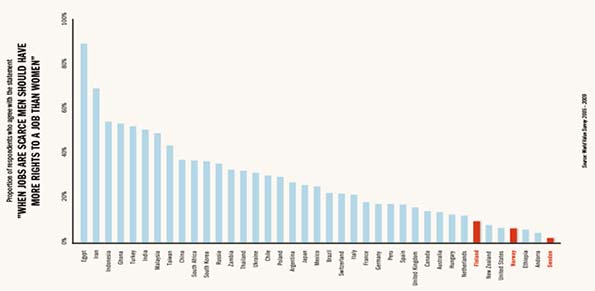
    As shown below, the World Value Survey has asked respondents around the world whether they believe that men should be prioritized over women if jobs are scares. In modern market economies, fewer agree with this notion. In Switzerland for example, 22 per cent believe that men should have more right to a job than women, compared to 16 per cent in the United Kingdom and 14 per cent in Canada and Australia. Sweden has the lowest share agreeing with this view, merely 2 per cent. Norway (6 per cent) and Finland (10 per cent) are also amongst the countries with egalitarian views.

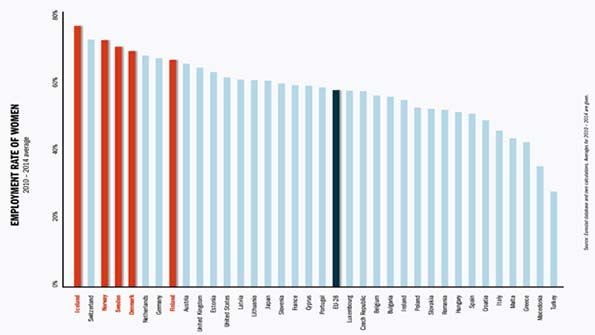
    In addition, the Nordic welfare states have encouraged women to enter the labor market early on. Still today Nordic countries are ahead of most of Europe in this regard. Child care cost and paid maternity, services provided largely by the public sector in the Nordic welfare states, can in part explain the high labor participation amongst both parents. Such systems are much more extensively funded by the public sector in the Nordics compared to other modern economies, and particularly so compared to the Anglo-Saxon nations. Although even here, the United States, still not a full welfare state, does surprisingly well.

    A long history of gender equality, gender equal norms, many women actively participating in the labor market and family friendly welfare policies – surely this should be seen as the recipe for many women reaching the top of the business world? In the new book The Nordic Gender Equality Paradox I show that this is not the case. In Nordic countries surprisingly few women have made to the top echelons.   

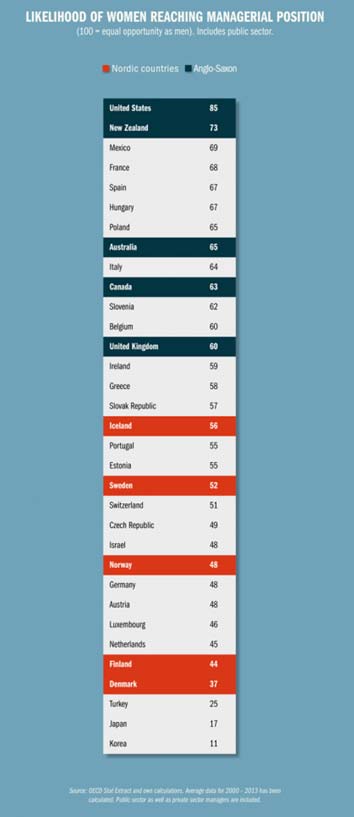
    The OECD gathers information about the proportion of employed persons which have managerial responsibilities in different developed economies. In the table below the share of women managers in different countries is shown as a percentage of the share of male managers. This calculation yields a measure of the likelihood of the average employed women to reach a managerial position compared to the average employed man. The likelihood of a women reaching a managerial position as compared to the same likelihood for a man in the United States is found to be 85 per cent. This is far higher than any other country in the study. As a comparison, the same share is 60 per cent in the United Kingdom and 52 in Sweden. Norway (48 per cent), Finland (44 per cent) and Denmark (37 per cent) score even lower.

    It should be emphasized that this measure includes public sector managers, which inflates the figures for Nordic countries compared to if private sector managers had been studied. The data paints a clear picture: The United States, where welfare state programs do not subsidize women’s parental leave has more women reaching managerial positions than any of the Nordic welfare states.

    Why is it that Nordic countries fail to reach their gender equal potential? Shouldn’t these countries be heads and shoulders above the US when it comes to the share of women climbing to the top? Progressive theorists would naturally assume this. But in reality there is a paradox here; the egalitarianism of the Nordics has clear limits.   At the end of 2014 for example, The Economist ran a story entitled A Nordic mystery

    “Visit a typical Nordic company headquarters and you will notice something striking among the standing desks and modernist furniture: the senior managers are still mostly men, and most of the women are [program administrators]. The egalitarian flame that burns so brightly at the bottom of society splutters at the top of business.”

    As I explain in The Nordic Gender Equality Paradox there is a logical answer to the apparent paradox: policy matters. Numerous studies support the conclusion that the large welfare states in the Nordics, although designed to aid in women’s progress, in fact are hindering the very same progress. Social democratic systems do provide a range of benefits for women, such as generous parental leave systems and publicly financed day care for children. The models however also have features that are detrimental to woman’s careers.

    To give an illustrative example, public sector monopolies in women-dominated areas such as health and education seem to substantially reduce the opportunities for business ownership and career success amongst women. Welfare state safety nets in particular discourage women from self-employment. Overly generous parental leave systems encourage women to stay home rather than work. Substantial tax wedges make it difficult to purchase services that substitute for household work, which reduces the ability of two parents to engage fully in the labor market.

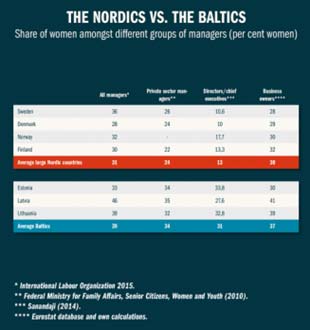
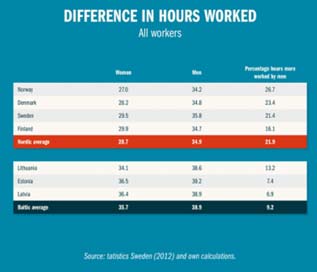
    The Nordic welfare model has, perhaps unintentionally, created a model where many women work but seldom in the private sector and seldom enough hours to be able to reach the top. For example, it might seem as a puzzle why the Baltic countries – which have much more conservative and family oriented cultures – have a higher share of women amongst managers, top executives and business owners than their Nordic neighbors. As shown below, a key factor is difference in working time. In the Nordic societies the average employed man works fully 22 per cent more hours than the average working women. In the Baltic model, where families have greater choice in organizing their lives compared to the Nordic welfare states, the gap is only 9 per cent. On top of this comparison, which looks at working individuals, many Nordic women also take long parental leaves, paid to do so by the welfare state, and thus fall behind in their careers. Of course Baltic mothers are also much concerned for the upbringing of their children. However, many of them solve the equation by getting help from family, perhaps grandmother, to watch the children or buy services to alleviate household work – something easier to do in low-tax countries.

    Thus, for all their gender equal progress, the Nordic countries in fact have relatively few women entrepreneurs, managers and executives. And there is really not a paradox why this situation has developed. It’s all about the policy choices made in the Nordics.

    As is clear, an expansive welfare state may be good for some things, but expanding the ranks of managers for women is not one of them. The feminist heritage that dates back to the age of the Vikings needs to be combined with a more free-market and small government approach if Nordic societies are to fulfill their gender equal potential. Perhaps this is also a lesson to the rest of the world, where progressive policies are often seen as the recipe for promoting women’s careers.

    Nima Sanandaji is the president of the European Centre for Policy Reform and Entrepreneurship (www.ecepr.org) and a research fellow at the Centre for Policy Studies and at the Centre for Market Reform of Education. His latest book, The Nordic Gender Equality Paradox, can be ordered here.