Tag: Europe

  • Paris: Are the Banlieues Still Burning?

    Press coverage of the recent European violence often draws a line from the Arab slums around Paris to the violence that has recently engulfed Brussels and Paris. According to this theory, Arab refugees from Morocco and Algeria, and, more recently, Syria, who have settled on the impoverished outskirts of Paris, are to blame for the terrorist attacks because France and Belgium have been reluctant to assimilate Arabs into their European cultures. And youth unemployment rates in the banlieues — suburbs — of Paris and Brussels are, indeed, more than fifty percent in some districts. Is it any wonder, the thinking goes, that disaffected Arabs have taken to fitting themselves with suicide vests, or spraying AK-47 bullets into crowded cafés?

    Living on the Swiss border with France, and spending many days each year in France, I have long heard these urban-decay theories of political violence. I decided to investigate the link between unassimilated Arabs in the banlieues and the violence that has shaken Europe.

    I made the trip in March with my bicycle, so that I could easily get around such notorious suburban ghettos as Clichy-sous-Bois and Le Blanc-Mesnil.

    I couldn’t see every street or every crumbling apartment complex in the banlieues, obviously, but I did cover a wide swath of the Paris exurbs. And I tracked a course that, at least during the 2005 riots, would have followed the smoke of burning tires.

    I include the above qualifier because many friends (most, I would say, have never explored the suburbs on a bike) don’t believe my conclusions, which are that the banlieues are not nearly as desperate on the ground as they are on television reports.

    Especially after a terrorist incident, local media will invariably show pictures of dilapidated high-rise apartment buildings on the edges of Paris, and action shots of the police dragging suspected terrorists from these underworlds. The causes and effects would seem clear. But my observations led to conclusions that question that French connection.

    Setting out from the Chelles train station, I had expected to come across 1970s-era South Bronx-like slums, only with an Arab motif. But as I rode through many Islamic neighborhoods, what surprised me is how different the banlieues are from the violent shadows on the evening news.

    In those dispatches, the suburbs might well be an Arabic Calcutta.

    Instead I found the these areas to be in the midst of urban renewal. Where ten years ago there were overturned cars and burning tires, I came across rows of working class houses (most well kept) and some new strip malls. On many corners there were the outlets of national franchises—as many McDonalds as mosques.

    Clearly, France has spent millions in the banlieues; think of the construction that went on in American cities after the urban riots of the 1960s. The French government has replaced some of the post-war, high-rise towers of despair with smaller scale apartment buildings, what American city planners call “scatter-site housing.” Clearly, the sociologists have come to have more sway than the civil engineers.

    Not every street I went down in places like Sevran or Aulnay-sous-Bois looked like a contemporary planner’s urban-renewal model. But more than I expected did.

    So why has the violence moved from the halal shops in Clichy-sous-Bois to the Boulevard Voltaire in Paris?

    Most articles about terrorist violence in France and Belgium make the point that Arab immigrants have yet to be integrated into local culture. Social isolation remains one of the possible causes of the new urban wars, and it is well documented in many descriptions of Arab culture in Europe.

    Left out of these explanations for the Paris or Brussels violence is the extent to which an existing criminal underclass has committed itself to Islam, and not the other way around.

    According to some candidates in the American presidential election, the European bombers and attackers are the kamikaze of a new religious order, taking their orders from the ISIS central command in Raqqa in the east Syrian desert.

    It is true that many of the attackers have had the support of military planners, such as those from Saddam’s Baathist officer caste, who were ostracized when the US invaded Iraq.

    But the aspect of the attackers that never gets on the evening news is the extent to which many of the bombers embraced Islam only after lives of petty crime, if not debauchery, in the same clubs they are now attacking.

    The killers failed at school, in after-school programs, and at various low-level jobs, only to find the warm embrace of a prison imam speaking of injustices done to co-religionists on the Syrian frontier.

    These rebels finally had a cause, however distant it was from their lives of street crimes. Their route to eternity, however, only passed through Raqqa by chance and convenience, not by providential design.

    While I was in Paris, I made it a point to bicycle over to all of the sites that were attacked on November 13, and to the site of the earlier shootings at the magazine Charlie Hebdo.

    I thought that by riding the stations of such a sad cross I might get some insight into what had motivated the killers.

    The editorial offices of Charlie Hebdo have moved from the location of the attack. But on the side of the old building, a portrait of the slain editor, Stéphane Charbonnier, has been drawn. Of earlier threats he said: “I would rather die standing than live kneeling.”

    The mournful side street near the center of the Paris gives no clue as to how the French rank the importance of press and religion in the hierarchy of its political freedoms. Would France feel the same about Charlie Hebdo if it had attacked Judaism as it did Islam?

    Around the corner is the Bataclan nightclub, where almost 100 young French concertgoers were shot down in cold blood. Some flowers were propped against the closed doors. Otherwise, the pagoda-shaped building had the look of a failed theater, down and out in the latest economic depression.

    Standing in front of the killing zone, I envisioned the Bataclan assassins less as holy warriors—jihadis on their way to martyrdom—and more as street thugs or contract hitmen.

    Looking at the bullet holes in the plate glass windows of the nightclub, plus at some nearby cafés, I saw the gunmen as absent of any ideas or ideals. I thought more about Baby Face Nelson and the Dillinger gang (sometimes called the Terror Gang), with their running boards and machine guns, than I did about what candidate Ted Cruz calls “radical Islamic terrorism.”

    I grant you that the killers were Muslim and that many had roots in the Paris suburbs, but I don’t think the poverty of the banlieues alone explains why anyone would attack a nightclub with automatic weapons, any more than crop failures in Sicily or Catholicism explain the violent rubouts committed by the mafia in the last 100 years.

    Matthew Stevenson, a contributing editor of Harper’s Magazine, is the author, most recently, of Remembering the Twentieth Century Limited, a collection of historical travel essays, and Whistle-Stopping America. His next book is Reading the Rails. He lives in Switzerland.

    Photo of the Bataclan nightclub in Paris by the author.
  • Class and the EU referendum

    On June 23rd, voters in the UK get a say on whether to remain in the European Union (EU). The UK first joined what was then called the European Economic Community (EEC) back in 1973, and in a 1975 vote, 67% voted to stay in the EEC. The issue was fairly settled until Conservative Prime Minister David Cameron, under pressure from the right wing of his party and anti EU sentiment, promised an in/out referendum in the Party’s manifesto for last year’s General election. The stakes here are high, and no one really knows what the result of a ‘Brexit’ (a neologism for British Exit) would be.

    In recent polls, opinion seems fairly evenly divided, with roughly 40% each for staying and going.  While a crucial 20% remain undecided, momentum seems to be with the ‘out’ side. Sentiment towards the EU cuts across party lines in the UK. Broadly speaking, the political establishment want to remain, though significant numbers of supporters, especially in the Tory Party, wish to go.  While initially hostile to the EEC, many on the left and in the trade union movement have come to embrace Europe because of its promotion of progressive labour law and working conditions directives, even though the UK has opted out of many of these.

    But what about the question of class in all of this? In many ways, class is a central factor, though it is rarely mentioned in debate or in the mainstream media. The UK Independence Party (UKIP), which has been a threat to both Conservative and Labour parties, has made immigration central to its campaigns. UKIP draws much of its support from the working-class, especially those who feel marginalised by the political mainstream, and one of the biggest reasons for this is immigration. According to a recent survey, 55% of voters see immigration as the most important issue in the upcoming referendum.  Of course, the issue is being mixed up with the ongoing refugee crisis and the desire of many non-EU economic migrants to come to Britain. This is a difficult and touchy subject for all political parties and for understandable reasons. But immigration was an issue even before refugees began streaming in from the Middle East, because one of the main planks of the EU is the free movement of goods and labour. Any citizen of the EU can choose to live and work in any other member state, and millions of people have chosen to do just that. Migration within the EU, which was seriously underestimated by the previous Labour government, has had very different outcomes in different labour markets. Many eastern and southern Europeans have been attracted to Britain by the promise of relatively high wages, job vacancies, and the fact that English is widely spoken across the continent.

    The biggest losers in this migration process have been the indigenous UK working class, who now have to compete with millions of semi-skilled and unskilled workers from across the EU. While there is plenty of anecdotal evidence that UK workers are being discriminated against by recruitment agencies, the best evidence of this practice comes from a high profile case in the English midlands where local people have been effectively excluded from the 3,000 jobs created at a distribution warehouse owned by sports clothing retailing firm Sports Direct.  The company apparently preferred to recruit directly from Poland. For working-class voters, the EU’s free market in labour appears to be more about big corporate profits than worker mobility.

    Immigration has an impact beyond access to employment. It also affects housing, schooling, and a host of other public services. All of these factors raise questions about the long term stability and sustainability of working-class communities. In many areas in the UK, from big cities to smaller towns, working-class people bear the brunt of all of these issues, and this has turned many towards UKIP and away from Labour as their natural home. Brexit begins to look attractive for those most marginalised by the effects of the free market, who also benefit least from the more positive aspects of EU membership. This situation has been confounded for many by the ways in which, after the recession of 2007/8, the EU has liberalised its markets and toned down its hitherto strong commitment to social legislation. Most notably, this has seen the EU in secret negotiations with the US over The Transatlantic Trade and Investment Partnership or TTIP.

    Nothing about the EU referendum is clear or straightforward. Whatever the result of the ballot, the motivations of voters in terms of class may not be clear. The EU had and still has the potential to improve the lives of millions of working-class citizens across Europe, but too often the interests of big business and social elites trump those of ordinary people.

    This piece first appeared in Working-Class Perspectives.

    Tim Strangleman, University of Kent

    Photo by Xavier Häpehttp://www.flickr.com/photos/vier/192493917/, CC BY 2.0

  • Discount Airlines: The Cheap Seats Challenge

    Market forces in the airline business are, for the moment, a battle between state-owned carriers like Alitalia and Aeroflot, and start-up discounters like Ryanair and AirAsia. The conflict between state monopolies and under-capitalized start-ups is a perfect metaphor for the economic debates over subsidies and competition that divide much of the industrial world in America, Europe, and Asia. When my dreams come true, carriers like these will encircle the globe with two-hour, $49 short-hop flights.

    With the Internet marketing sky-high seats in real time, travel pricing has become an endless bazaar. Airborne seats are one futures market that everyone understands. For the moment, there’s no clear winner in these fare/service battles, although many state airline companies are functionally bankrupt. The monopolists fly the latest jets and check bags without ransom payments, while the discounters, going nearly everywhere (Pristina, Erbil, Kochi, and Perth are among their many stops), find leg room, hungry passengers, and reclining seats annoying.

    For now, don’t expect the large airlines to cave in to the budget carriers. Competitive round-the-world tickets, using established airlines, can be found for about $1500-2000, although only for about $3000 can you visit all the places that may interest you and still move around the world.

    Is it possible to travel around the world using only one-way, discount airlines? To try, I would start by heading east — from my home in Switzerland — to Dubai or its suburb, Sharjah, a hub of low-cost carriers. Wizz Airlines, an Eastern European carrier, can get me there for less than $100, although it means a connection in Cluj-Napoca, the capital of Transylvania.

    For a little more money, I could trade my Romania stopover for Istanbul’s Sabiha Gökçen International Airport (way out of town), and get to the Persian Gulf on Pegasus, a Turkish low-cost airline that links Europe to the Middle East; use it to get to Baku, Tehran or Turkish Cyprus.

    From Dubai, the trick is to find a Middle Eastern budget airline — Air Arabia and flydubai are two of my preferred magic carpets — that overlaps with the vast network of Asian low-cost carriers, which include, among many others, Air Asia, Cebu Pacific, and Jetstar.

    India and Sri Lanka offer a few of the “crossover airports,” where I could change, say, from flydubai ($120 to Colombo) and enter Air Asia’s low-cost paradise ($80 to go on to Kuala Lumpur).

    Fortunately, nearly every Asian country — especially India, Malaysia, Singapore, Hong Kong, South Korea, Australia, and the Philippines — is a discount hub. For less than $300 it is easy to go from Delhi to Japan on lines such as Tiger, Vanilla, IndiGo, and Lion. You will have to change somewhere, but that provides a chance to stretch cramped legs or visit Chittagong.

    It is somewhere way east of Suez that my round-the-world discount dreams start to blur.

    The Pacific Ocean does not lend itself to puddle-jumping airlines. The only ‘local’ among the long-haul trans-Pacific flights is United Airlines #155, which in leisurely fashion connects Guam (get there on Cebu Pacific for pocket change) to Honolulu, with stops in Truk, Pohnpei, Kosrae, Kwajalein, and Majuro, atolls that the Marines liberated in World War II.

    Air Micronesia (affectionately “Air Mike”) used to fly this mail run across the central Pacific, but that carrier became Continental and now is part of United, which no one will ever confuse with a low-cost carrier. As best as I can determine, just to fly from Guam to Honolulu on the island hopper would cost about $1500, which is a lesson in monopoly pricing.

    Without a discount airline to get across the Pacific, the only option is to search for one-way tickets on established airlines, which sometimes offer fares for about $400 to $500.

    Technically, these airlines are not discounters and many of the cheap trans-Pacific fares involve cumbersome changes en route; low-fare-paying customers are routed on emptier flights. Some Pacific layovers are for about nineteen hours in places like Wuhan or Incheon.

    Once you are in Los Angeles or San Francisco (LAX is the cheaper option), it’s easy to embrace the discount networks of JetBlue ($159 in mid-January) or Southwest ($147) to hop across the United States.

    One-way trans-Atlantic plane tickets are expensive. Generally, on the big carriers they cost the same as a round-trip tickets, sometimes more. To get home to Europe on a budget, my two best choices involve Scandinavia and Iceland.

    Norwegian is a low-cost airline that has one-way flights for about $300 from New York to London Gatwick, Oslo and Copenhagen, and then connections into a wide European network.

    The cheaper option is WOW, an Icelandic discounter that flies from Boston to the continent with a stop in Reykjavik (okay, you purists, Keflavik).

    In mid-winter, WOW can take me across the Atlantic, although not back home to Geneva, for less than $200. To get home I would then be at the mercy of EasyJet, which is technically a low-cost airline but, to my mind, a full-cost baggage hauler, which charges crazy prices for checked luggage, with its rudeness toward paying customers thrown in for free.

    On a direct line north of the equator, this trip might have cost me $1500, and would have taken me, depending on a few choices, through Romania (Cluj-Napoca), Dubai, Colombo (Sri Lanka), Malaysia (Kuala Lumpur), Seoul, Wuhan (China), Los Angeles, New York, Boston, Reykjavik, and Copenhagen. The total time in the air would have been about fifty hours.

    For most of us it would be the trip of a lifetime, and it can be done for less than $1500, provided you are not checking a bag.

    What could go wrong? The exposed flank in my travel plans is the Pacific Ocean. Only by plugging and playing with a lot of combinations of cities and dates can I find those one-way $400-500 fares. They only show up briefly on carriers such as Evergreen, Korean, or Air China, and just as quickly vanish.

    Try as hard as I have, I cannot find a discount Russian airline, not even the alluring S7 or Yakutia, to make the land bridge from Siberia across the Bering Strait to Alaska. Even if I did get to Anchorage I would be out of luck finding a cheap airline to the lower forty-eight, except to Minnesota in mid-summer, on something called Sun Country.

    Nor have I been able to find local airlines to take me across the South Pacific on, say, the path Ahab took in Moby-Dick. Fiji Airlines has some promise, but gouges whenever the opportunity arises. Jetstar, owned by Qantas, does make it possible to fly for relatively low cost between Cambodia and New Zealand. So, for now, the trans-Pacific discount trail grows cold after Fiji. Although I can think of worse places, including Cluj-Napoca, to run out of gas.

    Matthew Stevenson, a contributing editor of Harper’s Magazine, is the author most recently of Remembering the Twentieth Century Limited, a collection of historical travel essays, and Whistle-Stopping America. His next book, Reading the Rails, will be published in 2016. He lives in Switzerland.

    Flickr Photo by dreamcatcher-68: Wizz Air HA-LWF Airbus Z320-232.

  • Traffic: Rome’s Not-So-Smart Car Squeeze

    Who would have thought that city planners in Oklahoma City would be more bike and pedestrian friendly, and better at taming car traffic, than those in Rome? In Oklahoma City, Mayor Mick Cornett has reordered the city’s transportation priorities away from cars, and toward exercise and fitness. Speaking of OKC’s car-centric era, the mayor said “We had built an incredible quality of life, if you happen to be a car. But if you have to be a person, you are combatting the car seemingly at every turn.” By contrast, Rome remains wedded to the automobile, to the point that it’s turning into the Eternal Parking Lot.

    Cornett has added sidewalks and bike lanes, and even put in some kayak parks downtown, leading OKC residents through a collective weight loss campaign that he estimates to have totaled one million pounds. Rome, meanwhile, must rank with Moscow, Dubai, and Lagos as one of the most automobile-dominated cities in the world.

    What madness possessed me to take a bicycle into Rome? I had biked from Florence to Siena, across the heart of Tuscan wine country, and was simply continuing on two wheels. The reason I know: I went there on a bike.

    Outside the classical city I could skirt cobblestones and ride in bus lanes (Rome has a few bike paths, but they begin and end nowhere, a bit like the country’s politics).

    Once inside the famed city gates, slick cobblestones made biking feel like a ride on a roller-coaster off the rails. As I headed into central Rome I knew the cobblestones and the taxi drivers might make it a rough journey, but I had forgotten the extent to which Rome is the world capital of lane-changing, that frantic need to get around every slow or parked car.

    Knowing Rome fairly well I switched to back alleys and one-way streets, where I discovered that not only does the city’s traffic have aspects of colliding atoms, but that the emergence of economical Smart Cars and small electric vehicles has made it possible for many more Romans to squeeze their motorized vehicles into the city’s historic corners.

    No matter which historic piazza I crossed or which road I took I came face-to-face with one of the motorized creatures — some the size of golf carts — that Romans drive literally everywhere.

    If Caesar’s assassins were now to stalk him near the Forum, I am sure they would do so in tiny Fiats and, while stabbing him, park on the sidewalk with their emergency lights flashing.

    Everywhere I went in Rome, cars were littered. There were cars all around the Vatican, in the small squares of Trastevere, around the Colosseum, and up against the Forum.

    Not only is Rome the empire of errant cars, its sidewalks — perhaps laid out to confuse invading Huns — have to be the worst in Europe. Walking two abreast is impossible. Instead, between the cars careening around medieval piazzas or parked against doorways, pedestrians must walk single-file, like a retreating army.

    The solution to Rome’s clogged arteries is to ban (during the waking hours) cars, trucks, motor scooters, tour buses, four-by-fours, and Harleys from the historic downtown, and to return the small cobblestoned streets to their rightful owners: classical architecture and pedestrians.

    For traveling through and outside the original city center, Rome has an underground metro, trams, and many buses which could stick to the main avenues. It might inconvenience some, but for the majority, and that includes the global heirs of the Roman republic, the city would again be a delight.

    Venice solved the problem of burdensome traffic by filling its streets with water. Other European cities — the old town of Dubrovnik, Orleans in France, and Copenhagen come to mind — have successfully put pedestrians and bicycles first.

    If its cars were evicted, Rome would become one of the world’s great open air museums, on a par with the old city of Jerusalem, parts of Marrakech, and with some sidewalk areas in Paris, although I doubt Rome will ever break with the automobile.

    Rome is sinking under the weight of its exhaust pipes not only because of its traffic. The city shares the nation’s political problems: one hundred and fifty years after its independence, Italy is still best understood as a fragmented state, the Yugoslavia of the European Union, with a dysfunctional judiciary, parliament, executive branch, and treasury, and the fear that the center will not hold.

    To understand the level of executive and parliamentary incompetence, consider that, since the Fascist government was toppled in World War II, about forty-three men have served as prime minister, and the parliament has had more than sixty changes to its governing coalition. Only one government in this period has served out its five-year term.

    The biggest reason for Italy’s political stalemate is that the country’s north-south divide has remained unresolved, some would say since Garibaldi marched on Rome in 1862.

    Northern Italy has a prosperous manufacturing base, a balanced budget, low debt to its GDP, dynamic cities (Milan, Turin, Venice, Bologna), and strong tourist and export revenue. The south, which includes Naples and Sicily, is a huge consumer of government subsidies, heavily reliant on inefficient agricultural systems, and has less manufacturing than the North. Rome is a nether world between the two blocs.

    Youth unemployment in Naples is said to be 50 percent, and GDP per capita is some $40,000 less in the south than in the north. Sicily today may have less to fear from the mafia, but greater danger from joblessness.

    The specter of Italy dividing along its north-south seam — as if after an earthquake in the Apennines — is, I believe, the reason that no one wants a strong federal government in Rome. Little government is thought to be less offensive to most than at even some degree of functional government would be.

    Rome is the symbol of this fragmented state, with its allure of past and future greatness, and its present vanishing under a layer of soot, corruption, and waste.

    David Gilmour ends his excellent history, The Pursuit of Italy, with, “Yet the millennia of [the Italians] past and the vulnerability of their placement have made it impossible for them to create a successful nation-state.”

    In Oklahoma City, my favorite mayor can expand the sidewalks and lay down more bike lanes, much as he can argue for a balanced budget. In Rome, however, no one can take on the car lobby because no one, politically, is out strolling arm-in-arm. For one thing, the sidewalks don’t allow it.

    Matthew Stevenson, a contributing editor of Harper’s Magazine, is the author most recently of Remembering the Twentieth Century Limited, a collection of historical travel essays, and Whistle-Stopping America. His next book, Reading the Rails, will be published in 2016. He lives in Switzerland.

    Flickr photo by Andrew Moore: Parking, Italian Style — A Fiat 500 in Rome

  • Too Many Places Will Have too Few People

    The adage “demographics are destiny” is increasingly being replaced by a notion that population trends should actually shape policy. As the power of projection grows, governments around the world find themselves looking to find ways to counteract elaborate and potentially threatening population models before they become reality.

    Nowhere is this clearer than in China’s recent announcement that it was suspending its “one child” policy. The country’s leaders are clearly concerned about what demographer Nicholas Eberstadt has labeled “this coming tsunami of senior citizens” with a smaller workforce, greater pension obligations and generally slower economic growth.

    A second example is Europe’s open migration policy. Despite widespread opposition by its own citizens, and cost estimates that run to a trillion euros over 30 years, Europe’s political and business leaders regard migration as critical to address the Continent’s aging demographics. Germany knows it may not be able to keep its economic engine running without a huge influx of workers.

    In defense of the migration policy, European Union economists project that refugees from the Middle East, Africa and Central Asia could boost Europe’s GDP by 0.2 percent to 0.3 percent by 2020.

    This all speaks to a kind of demographic arbitrage between countries with aging demographics and those with youth to spare. Half the world’s population already lives in countries with fertility rates below replacement level (2.1 per woman).

    Read the entire piece at The Orange County Register.

    Joel Kotkin is executive editor of NewGeography.com and Roger Hobbs Distinguished Fellow in Urban Studies at Chapman University, and a member of the editorial board of the Orange County Register. He is also executive director of the Houston-based Center for Opportunity Urbanism. His newest book, The New Class Conflict is now available at Amazon and Telos Press. He is also author of The City: A Global History and The Next Hundred Million: America in 2050. He lives in Orange County, CA.

    Photo “Nursery Cart” by flickr user Pieterjan Vandaele

  • Berlin: The Imperial Impulse in City Planning

    “He who controls Berlin, controls Germany, and who controls Germany, controls Europe.” V.I. Lenin (but also attributed to Karl Marx, and sometimes to Otto von Bismarck)

    About the time that Syrian refugees were on the march to Germany’s safe havens, I spent a few days in Berlin, which is not only the capital of reunified Germany, but the unofficial capital of the European Union, as well as being hipster ground zero.

    The Europe that united under the EU — the New Europe — was predicated on a weak, federal Germany surrounded by strong members such as France, Britain, and Italy. On paper, the EU has its headquarters in Brussels and, for one week a month, in Strasbourg (to placate the envious French). But the Union’s power emanates from Berlin, where Angela Merkel — the latest Iron Chancellor — has made most of the EU decisions concerning the Greek bailout and Syrian emigrants. The EU has become a ward of the Teutonic Knights, where solvency and peace come only from German diktats.

    Does the modern city of Berlin speak about a resurgent Germany (über alles, so to speak), or about the ability of the Union to tame the excesses of German nationalism?

    Since Germany united in 1989 the success of reunification has often been measured in the bright lights and new buildings that have spread across Berlin, from West to East. Once a Cold War no-man’s land, the Potsdamer Platz is now a crossroads on Architectural Digest walking-tour maps, while the worker housing in the East has been recycled into studios and sidewalk bistros for hi-tech executives and skateboarders.

    For the past twenty years, I have believed that a healthy and vibrant Berlin could only mean good things for the European Union. It meant that reunified Germany was working, that Russia was at bay, and that in the New Europe there were enough new jobs to service the debt on the leveraged buyout of Eastern Europe.

    On this trip to Berlin, however, I glimpsed the other side of the German coin, which is that as Germany succeeds — economically and politically — the European dream will become ever more distant.

    What did I see in Berlin that made me doubt the future of the European Union?

    On the surface, Berlin is a success story, with open-topped tourist buses crisscrossing the city and new restaurants. Old working-class neighborhoods such as Prenzlauer Berg and Kreuzberg have gotten facelifts, and the city’s infrastructure of railroad stations, banks, and conference centers glistens.

    In other, more subtle ways, however, the city seems to be fulfilling the dreams of Adolf Hitler and his architect, Albert Speer, to turn Berlin into a capital of the thousand year Reich, even if, for now, it is a dream of admirable intentions.

    Take the $600 million gilded palace of the Humboldt Forum that is being built on Museum Island, just off Unter den Linden, the imperial boulevard of Prussian dreams.

    Swathed in marble frontage, the reconstructed palace dwarfs much that is nearby, including several classical museums. The web site descriptions make it sound like an elaborate visitors’ center, however, with nebulous goals:

    The Humboldt Forum is a novel centre for exhibitions, events, and human encounter in the heart of Berlin. Museums, a library and a university will pool their competencies and create a lively place where knowledge about the cultures of the world can grow and be exchanged. In this, the Humboldt Forum distinguishes itself from the traditional idea of the ethnographic museum.

    It’s difficult not to recall that Hitler, when he spoke to Speer about the purpose of the nearby New Reich Chancellery on Voss Strasse, said, “On the long walk from the entrance to reception hall they’ll get a taste of the power and grandeur of the German Reich!”

    * * *

    On this trip, I had the use of a bicycle — until it was stolen — to ride around the city, including along Unter den Linden. Graffiti is still visible on the last fragments of the Wall; elsewhere, I came across some posters of the far-right National Democratic Party (NPD), with turbaned immigrants and the tag line: “Have a good flight home.”

    I first saw united Berlin in December 1989, a month after the Wall came down, when it was a city in liquidation. As if in the Berlin airlift, I flew on a Pan American jet from Frankfurt, and in a friend’s small Trabant toured West and East Berlin, which felt, respectively, like Manhattan and Brooklyn, in the days before gentrification. The Kurfürstendamm had the brand-name franchises of New York’s Fifth Avenue, while East Berlin felt like the far reaches of Bensonhurst.

    This time, on foot (post-bike theft), I saw a united Berlin, but one with many cracks in the sidewalks. I found a street on which the English writer Christopher Isherwood, whose fiction inspired the play and movie Cabaret, had lived. His building was destroyed in the war, and the replacement speaks of the temporary housing that became permanent. If writing now about the city’s decadence, he might describe its bureaucracies — Humboldt is run by the Prussian Cultural Heritage Foundation — rather than its cabarets.

    Another thing I did was go around to Berlin’s bookstores, and was surprised at how mediocre many were. Yes, they had book club novels and Hitler histories, but everything looked second-hand, not fresh off presses with any new ideas about the European Union, Mrs. Merkel, or Berlin. Has Germany discovered the end of history?

    * * *

    Before the bike vanished, I did take it up and down the Wilhelmstrasse to see what remains of Hitler’s and Bismarck’s Berlin. The city doesn’t have much from Bismarck’s era as the head of the German government. He wanted Berlin at the head of a unified Germany. When he got what he wanted in 1871, he realized (although it was too late for him to do much about it) he had the rest of Europe as his enemies.

    Likewise, the imperial masquerade of Speer’s Berlin went up in the smoke of the World War II. Hitler mandated him to draw boulevards wider than the Champs-Élysées, and reception halls vaster then the cathedral at Rheims. It was to have been Rome on steroids.

    In his memoirs, published in the 1970s, Speer describes a Hitler consumed with architectural ambitions, as if his military and political aggression was just to make the world safe for his city planning. The two spent countless hours discussing castles in the air, or an imperial way from the south Berlin station to a Great Hall near the Reichstag.

    There was to have been an oversized Arch of Triumph, and various Nazi ministries housed behind those faceless façades of National Socialism that spoke of government by diktat. Looking back on his dreams, however, Speer wrote of the Grunewald forest, “Of the whole vast project for the reshaping of Berlin, these deciduous trees are all that have remained.”

    Matthew Stevenson, a contributing editor of Harper’s Magazine, is the author most recently of Remembering the Twentieth Century Limited, a collection of historical travel essays, and Whistle-Stopping America. His next book, Reading the Rails, will be published in 2015. He lives in Switzerland.

    Flickr photo by Nigel Swales: Billboard announcing construction on the now-completed Schlossplatz – Berliner Schloss (Humboldt Forum); a modern building housing museums and offices, but with the façade of the original city palace.

  • Wave of Migrants Will Give Europe an Extreme Makeover

    The massive, ongoing surge of migrants and refugees into Europe has brought up horrendous scenes of deprivation, along with heartwarming instances of generosity. It has also engendered cruel remembrances of the continent’s darkest hours. But viewed over the long term, this crisis may well be the prelude to changes that could dissipate, and even overturn, some of the world’s most-storied and productive cultures.

    Some may prefer to ignore the long-term impacts of huge migration from the often-chaotic developing world – where 99 percent of the world’s population growth will be taking place – to the more orderly, prosperous and low-fertility richer countries. Separated from the daily drama, the human movement from Syria, the rest of the Middle East and Africa can be seen as potentially changing European society forever by breaking its already-weak Christian foundations and threatening the future of Europe’s elaborate welfare states. In many ways this invokes the vision laid out in the 1973 French novel “Le Camp des Saints,” which envisioned a Europe overwhelmed by a tide of poor refugees.

    These concerns, of course, are not simply European. The flow of generally lower-income people from Central and South America has emerged – largely courtesy of the demagogic Donald Trump – as a key political issue in the Republican presidential race. Claims, based on federal employment data, that immigrants have gained far more jobs in the recovery is the kind of thinking that keeps Trump in business. Concerns about other transfers from the Third World to the First World have also surfaced in a host of other countries, including Canada, Australia and even orderly Singapore.

    Read the entire piece at The Orange County Register.

    Joel Kotkin is executive editor of NewGeography.com and Roger Hobbs Distinguished Fellow in Urban Studies at Chapman University, and a member of the editorial board of the Orange County Register. He is also executive director of the Houston-based Center for Opportunity Urbanism. His newest book, The New Class Conflict is now available at Amazon and Telos Press. He is also author of The City: A Global History and The Next Hundred Million: America in 2050. He lives in Orange County, CA.

  • Rethinking the Scandinavian Model

    During a tour to Paris, Bruce Springsteen explained that his dream was for the US to adapt a Swedish style welfare state. The famous musician is far from alone in idealizing Nordic policies. The four Nordic nations (Denmark, Finland, Norway and Sweden) are often regarded as prime role-models the policies to be emulated by others. Internationally, advocates of left of centre policies view these countries as examples of how high tax social democratic systems are viable and successful. Paul Krugman, for example, has said: “Every time I read someone talking about the ‘collapsing welfare states of Europe’, I have this urge to take that person on a forced walking tour of Stockholm”.

    This admiration has a long history. In the mid-1970s Time Magazine described a country that sounded much like a utopia. “It is a country whose very name has become a synonym for a materialist paradise”, the international magazine wrote and continued to report about Sweden: “No slums disfigure their cities, their air and water are largely pollution free… Neither ill‑health, unemployment nor old age pose the terror of financial hardship.” Similarly, political scientist John Logue argued in 1979: “A simple visual comparison of Scandinavian towns with American equivalents provides strong evidence that reasonably efficient welfare measures can abolish poverty as it was known in the past; economic growth alone, as the American case indicates, does not”. Logue believed that the greatest threat to the Nordic welfare states was that they were too successful; eliminating social problems to such a degree that people forgot the importance of welfare policies.

    The high regard comes as no surprise. Nordic societies are uniquely successful. Not only are they characterised by high living standards, but also by other attractive features such as low crime rates, long life expectancy,  high degrees of social cohesion and even income distributions. Various international rankings conclude that they are amongst the best, if not the best, places in the world in which to live. One example is the “Better Life Index”, complied by the OECD. In the 2014 edition of the index Norway was ranked as the nation with the second highest level of well-being in the world, followed by Sweden and Denmark in third and fourth position. Finland ranked as the eighth best country.

    The OECD “Better Life Index”


    1. Australia

    2. Norway

    3. Sweden

    4. Denmark

    5. Canada

    6. Switzerland

    7. United States

    8. Finland

    9. Netherlands

    10. New Zealand


    If one disregards the importance of thinking carefully about causality, the argument for adopting a Nordic style economic policy in other nations seems obvious. The Nordic nations – in particular Sweden, which is most often used as an international role‑model – have large welfare states and are successful in a broad array of sectors. This is often seen as proof that a ”third way” policy between socialism and capitalism works well, and that other societies can reach the same favourable social outcomes simply by expanding the size of government. If one studies Nordic history and society in‑depth, however, it quickly becomes evident that the simplistic analysis is flawed.

    To understand the Nordic experience one must bear in mind that the large welfare state is not the only thing that sets these countries apart from the rest of the world. The countries also have homogenous populations with non-governmental social institutions that are uniquely adapted to the modern world. High levels of trust, strong work ethic, civic participation, social cohesion, individual responsibility and family values are long-standing features of Nordic society that pre-date the welfare state. These deeper social institutions explain why Sweden, Denmark and Norway could so quickly grow from impoverished nations to wealthy ones as industrialisation and the market economy were introduced in the late 19th century. They also play an important role in Finland’s growing prosperity after the Second World War.

    Take Sweden as an example. In 1870 free markets were introduced in this agrarian society. During the coming 100 years Sweden combined low taxes, liberal regulations and strong working ethics to experience an unrivalled growth rate in Europe. In 1870 Sweden’s GDP per capita was 57 per cent lower than in the UK. In 1970 it had risen to become 21 per cent higher. The shift towards high taxes and state involvement actually began   occurred around 1970, resulting in a long-lasting period of stagnation that was broken through ambitious market reforms during the 1990s and onward.

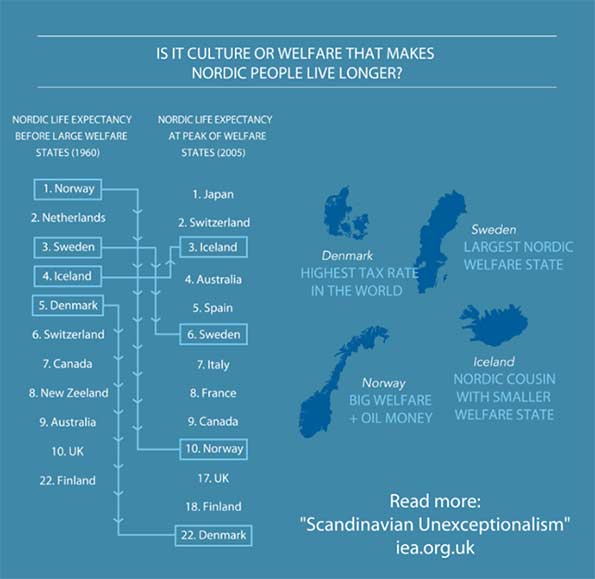
    Perhaps even more interestingly, even the social progress that Nordic countries are admired for developed during the latter part of the 19th century and the first half of the 20th century, developed not under socialism but at a time when Nordic countries combined free markets and low taxes with small (and efficient) welfare states. Researchers have for example shown that it was during this period that Sweden and Denmark developed a relatively equal income distribution. Long life expectancy is another example. In the picture below I show the life expectation at birth is shown for various OECD nations in 1960 – when Nordic nations had small welfare states – and 2005 – when Nordic welfare states were at their peak. In both periods Nordic countries were characterized by relatively long life expectancy, but if anything, this was more the case when the countries had small rather than large welfare states. The reason is simply that everything is not politics, cultural attributes such as a love for nature and healthy diets explains much of Nordic citizens good health.

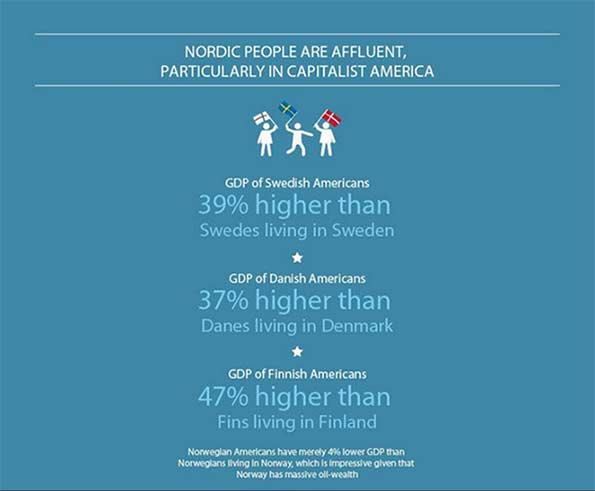
    Similarly, it comes as no surprise that descendants of the Nordics who migrated to the US in the 19th century are still characterised by favourable social outcomes, such as a low poverty rate and high incomes. In fact, as shown below, Nordic Americans have considerably higher living standard in capitalist America than their cousins in the Nordics. This is interesting, since those Nordic citizens who migrated to the United States in large groups during the 19th and 20th centuries were anything but an elite group. Rather, it was often the poor who left for the opportunities on the other side of the Atlantic.

    A key lesson from the success of Nordic society lies in what can broadly be defined as “culture matters”. We should not be surprised that it is these nations, with their historically strong work ethic and community-based social institutions, t  have had fewer adverse effects from their welfare states and are therefore used as the poster child for those wishing to extol the benefits of active welfare policies. On the other hand, Southern European countries with similar sized welfare states and size of government have had less favourable outcomes.

    Paul Krugman is right in noting that a forced walking tour of Stockholm disproves the idea of the collapsing welfare states of Europe. Nordic societies have not collapsed under the weight of welfare policies, particularly since they have lately adopted by introducing market reforms, reducing the generosity of welfare programs and cutting taxes. Such a tour may perhaps also be wise for Krugman himself, in teaching that Scandinavian countries have been rather unexceptional. The normal economic rules apply: incentives, economic freedom, a strong self-sufficient culture and a regime of good governance all matter when it comes to economic success. The question that remains is whether Scandinavian countries will continue their return to the free-market roots that have historically served them so well. If so, the Nordic culture of success can in combination with sound policies allow growth, innovation and entrepreneurship to flourish.

    Dr. Nima Sanandaji is a research fellow at CPS, and the author of “Scandinavian Unexceptionalism – Culture, Markets and the Failure of Third-Way Socialism”. The book, which was recently released is currently being translated to a number of different languages. The entire book is available through the Institute of Economic Affairs which has published it.

  • The French housing Bubble also has Roots in Excessive Land Use Regulations

    Despite the claim to uniqueness that is quintessentially French, the housing bubble shares the same root as we see in the Anglo-Saxon world. To be sure, some analysts blame it only on low interest rates: they made the households more solvent, and thus drove home prices up. This rise in purchasing power might have been enhanced by some specific subsidies to new rental units. Some also y point to normative constraints on new buildings have added to production costs.

    These facts are undisputed, but a demand-only driven bubble can’t happen in a really free market where price signals provide incentives to supply more units, moderating price escalation, and eventually revert the price curve. After all, there hasn’t been anything like a “car price bubble”. So there has to be a supply side factor constraining the building of new homes. And since building itself doesn’t require scarce skills, the constraint has to come from land. These analysts observe that in middle America booming cities like Texas’ Houston and Dallas, or others in Kansas, Georgia, Oklahoma, and elsewhere didn’t experience such a price bubble despite identical credit conditions, despite in some cases, as in Texas, an even greater surge in demand.

    Numbers

    Let’s take a look at official French statistics.

    Professor Joseph Comby (From Institut d’Urbanisme de Paris) summarizes essential data in an exhaustive article (not available online) published in the very specialized peer reviewed "Revue Foncière" (n°3, January 2015), dedicated to land and housing issues. His graphs can be accessed from data provided by our national institute of statistics (INSEE).

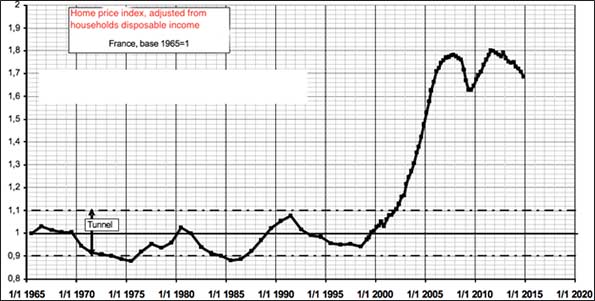
    The first graph shows that home prices surged between 1997 and 2007, and that the prices didn’t really slump then, despite worldwide economic crisis. Average home price rose by a whopping 150% in 11 years, and rose 86% faster than households’ disposable income.


    Fig 1. Home price Index, adjusted from households’ disposable income – Base 1, 1965.
    Source: French Ministry of Sustainable Development (
    doc format)

    In this period, the median multiple in France (Average Home price / Average Household disposable income) rose from a stunningly low 2.25 to 4.21, and these average figures hide numerous regional discrepancies.

    Home prices can be truncated between land costs and building costs, including the home and the infrastructure costs (road access, sewage, water and energy adduction, and so on). Had this price hike uniquely "credit and demand" driven, we should have seen a relatively parallel evolution between land and building components in home prices.

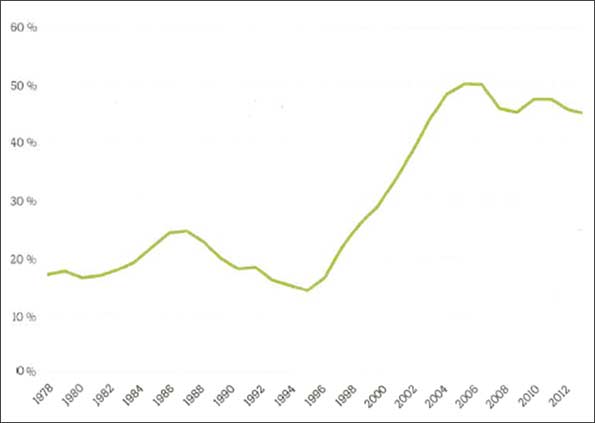
    Our national statistics institute conducts regular wealth inquiries on the total wealth of French households. These studies show that the  share of aggregate land value in  homes value rose from 15% in 1996, to 50% in 2007, and slowly decreased then to 45% in 2013.


    Fig 2. France – Share of land in aggregate real estate value
    Source: J. Comby, computed from
    INSEE Annual wealth surveys

    So, from these data, let’s compute how the prices of land and building components evolved between the 1996 low and 2007 peak, relatively to households revenue. The following table summarizes it all:


     1996

    2007

    Price Increase

    Existing homes, average price – (current prices, €) (INSEE)

    77 100

    192 800

    +150%

    Average disposable income per household (current values, €)

    34 149

    45 800

    • 33%

    Ratio Home price / disposable income

    2.25

    4.21

    +86 %

    Land, % of home value

    15

    50


    Land, average value in existing homes (€)

    11 565
    (15% of 77100)

    96 400
    (50% of 192800)

    + 733 %

    Land price appreciation, adjusted from household disposable income appreciation

    + 520 %

    Building, average value in existing homes (€)


    65 535

    96 400

    + 47 %

    As has been seen in the Anglo-Saxon regulated markets, land appreciation overwhelms construction costs appreciation. Figures show clearly that the 1996-2007 real estate bubble is driven by land prices appreciation.

    As a confirmation pattern, INSEE figures from its annual wealth studies show that the total value of built land plots went from 67% of GDP in 1998 (no figures for 1996) to 308% in 2007. So owning developable land in the end of the 90s provided returns that no other asset class could offer, despite creating absolutely no new added value for society. On the contrary, high home prices have been harmful to modest households, with 6% of people experiencing very bad housing conditions (obsolete and/or overcrowded units), 9% other having tough times financing their housing needs (1).  And according to INSEE, there were 112 000 homeless people in 2012, a 44% increase from 2001 (2).

    Since there is no physical shortage of land in France (most of the country is rather flat, and only 7% of land is developed), this suggests loudly to look at our land use regulations to understand how they fed the monster.

    Our regulation of land belongs to the “prescriptive” family, according to Wendell Cox and Hugh Pavletich classification (3). It means that land is, by default, limited for natural or agricultural usage, and turning it into developable land must endure a long and politically complex zoning process. Worst of all, not only each city is zoned, but every local zoning has to comply, since the new millennium, with “territorial coherence schemes” which tend to cap the maximal amount of land available for development through years. Prescriptive regulations can be opposed to “responsive” ones, which can be seen in central parts of America and Canada. In a responsive regulatory frame, default status of land is let to the free choice of the owner, and only limitations for some collective purpose have to pass through a political process, and open a right   for owners to be compensated for the loss of land value resulting of limitations. As Cox and Pavletich as well as the Brookings institution showed, places with prescriptive regulations experienced a much tougher bubble than responsive ones during the years of wild credit expansion. France is not different and the same phenomenon happened.

    The idea of a bubble driven by strong regulatory constraints put on land meets a lot of resistance among several groups familiar in other countries: Local politicians, who get power from a population prone to NIMBY attitudes, and feeling richer through home value appreciation, are the first of them; most farmers, 70% of whom are renters, have an interest in preserving legal interdiction to turn  plots at the fringe of cities into housing developments; and there are about 40,000 employees in public and private jobs who make a living from elaborating and implementing these regulations. 

    So we can see that in France, like other countries, the role of artificial restriction of land supply for new development can’t be dismissed. The costs and benefits of these regulations should be publicly questioned. Can their advocates still deny that that this price bubble is largely an unintended outcome of regulations. Nor can they acknowledge that this  results in increasing levels of “housing poverty” and drives so much resources from more productive investments. Is this  more desirable than “sprawl containment”, “farmland preservation” and other pretenses which provided justifications for these regulations in first place ?

    Vincent Benard is senior economic analyst for the Turgot Insitute (www.turgot.org), a french classical liberal think tank. His principal interests are housing, land use and infrastructure policies, and the study of the unintended consequences of regulations.  Since 2006, he authored one book and many articles about the French housing crisis. " 

    (FYI: The book : https://www.scribd.com/mobile/doc/80163334 – Free, PDF, in French) 

    ———

    Notes: (1) Figures from the annual report of the “Abbe Pierre” Foundation, dedicated to homelessness and poverty assistance  www.fondation-abbe-pierre.fr/
    (2) Source: “L’express”, November 2014 – http://www.lexpress.fr/actualite/societe/le-nombre-de-sdf-en-france-a-explose-en-dix-ans_1623371.html
    (3) See Annual Housing affordability report, by Cox and Pavletich, www.demographia.com

    Photo by Benh LIEU SONG (Own work) [GFDL or CC BY-SA 4.0-3.0-2.5-2.0-1.0], via Wikimedia Commons

  • Dispersion in Europe’s Cities

    For any who had been following demographic trends closely in Western Europe, it is long been obvious that suburbanization was following generally the same track as in Canada (more than 75 percent suburban), Australia and the United States (85 percent suburban). Nearly all growth in the major cities has been in the suburbs for the last four decades.

    The massive postwar automobile oriented suburbanization of Europe started a bit later than in the Western offshoots of the British Empire as the fabled economic historian Angus Maddison called them. It took a while for Western Europe to recover from World War II, but by 1970 much had been restored.

    This article reviews citywide population trends, divided into their core and suburban (or exurban) components from 1971 to 2011. This is a far more complicated exercise than reviewing the urban trends of Canada, Australia, and the United States. Ten years ago I published an examination of European trends relying principally on using data from the Ranally Metropolitan Areas, which had been established by my friend Richard Forstall, then at Rand McNally. Metropolitan areas are particularly difficult to compare across international lines because the few nations that designate them use different criteria and most nations do not designate them at all.

    Regretfully, the internet and perhaps other commercial considerations made the Ranally Metropolitan Areas a thing of the past.

    Data Difficulty in Western Europe

    The only source that approaches consistency is the United Nations Urban Agglomerations (urban areas) list. In its latest iteration the list includes data from 1950 through projections to 2030 in five year increments for approximately 1700 cities around the world. But, the United Nations must rely on member states to provide the information, which is often not urban agglomeration data at all.

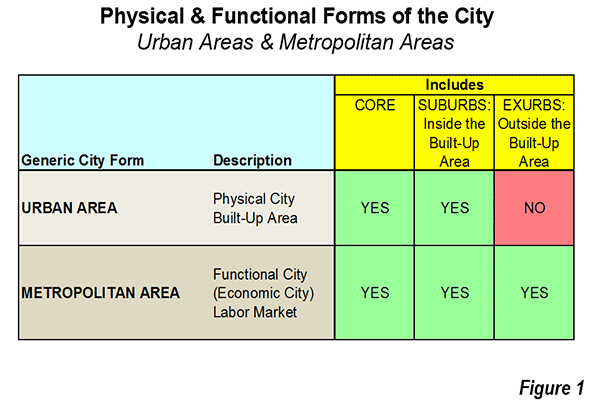
    Some nations report urban area data. Others report metropolitan area data. Urban areas and metropolitan areas are not the same thing. Urban areas are built up areas defined by the extent of the urban form, rather than by jurisdictional boundaries (see Demographia World Urban Areas). Metropolitan areas encompass both the urban area and the economically connected areas to the outside (exurbs). The difference is that urban areas do not include exurbs and metropolitan areas do (Figure 1).

    Some nations report only core municipality data, which is incomplete. Characterizing cities as only the core is rather like declaring a leg or a lung to be the same thing as a human body. These nations include Germany and Austria. Data for Valencia, Spain is also for the core municipality only.

    Perhaps the best source for citywide trends over the last 40 years in Western Europe is the United Nations data. The results are reported for urban areas and metropolitan areas, ignoring the irrelevant reported core data. Cities are included that had a population of 750,000 or more in any year from 1970 to 2010 on the UN World Agglomerations list. As of 2011, there are 24 urban areas and 16 metropolitan areas with comparable United Nations data (Table).

    How the Cities have Dispersed

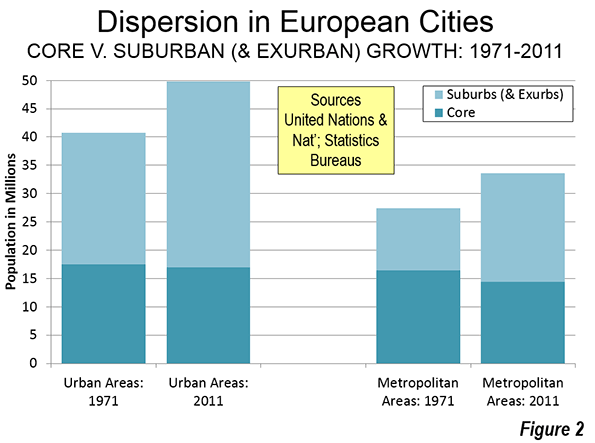
    Among the urban areas, the suburbs monopolized population growth over the period (1971 to 2011). Overall, the 24 urban areas increased their population by 9.1 million residents. This was the combination of a 9.7 million increase in the suburbs and a 600,000 loss in the cores. With the core losses, the suburbs accounted for 107% of the urban area growth.

    The monopolization of suburban and exurban growth was even greater in the 16 metropolitan areas. The overall citywide population increase was 6.2 million. This included 8.2 million in the suburbs and exurbs and the loss of 2.1 million in the cores.

    Combining these two different urban conceptions for statistical purposes shows how dominant suburban and exurban growth has been. In 1971, the cores and suburbs had about the same population. By 2011, the suburbs had grown to have 60% more residents than the cores (Figure 2).

    Some of the disparities were large. In Madrid, the suburbs grew 450 percent between 1971 and 2011, compared to only 5 percent in the core. In Toulouse, the suburbs grew 327 percent, while the core edged up only 20 percent, while in Zurich, the suburbs grew 186 percent compared to the core decline of 12 percent.

    Overall, core population performance exceeded that of the suburbs in only three of the 40 cases. The most significant is slow-growing Birmingham, which is closing in on its 1951 peak. Then there is Liverpool, which is managed to drop from the population peak of more than 850,000 in 1931 to under 475,000 in 2011. Liverpool’s loss over the 40 years was even less percentage wise than that of the suburbs. The core of Southampton also grew faster than the suburbs.

    Core Resurgence

    At the same time, it notable cores have reversed their previous loss patterns in recent years. Some resurgent cores remain well below their much earlier peaks. The ville de Paris has regained little more than 100,000 of its 800,000 loss since 1921. Inner London (Note) has regained much more (800,000), but still needs another 1.3 million to restore its 1901 peak (Outer London is so suburban that it provided much of the ammunition for the British anti-suburban movement). Others cores, like Stockholm and Madrid have risen above previous peaks.

    As in the United States, this urban resurgence should not lead to a perception that suburbanites are "flocking" to the urban cores. Domestic migration data continues to show net population movements from the cores to the suburbs and exurbs. Much of the resurgence has been propelled by international migration since enlargement of the European Union (such as from the growing London core), which has virtually eliminated westward barriers to immigration from the less affluent former Soviet satellites. Even the core of Stockholm, now at its population peak, has lost domestic migration to the suburbs in Stockholm County in each of the last five years according to Statistics Sweden data.

    Earlier Core Troughs

    The forty-year perspective masks some huge core population losses that occurred earlier. Perhaps the most spectacular is Copenhagen, which dropped from 768,000 in 1950 to 464,000 in 1992, for a percentage loss near that of Detroit from 1950 to 1990. Copenhagen’s population loss was 40 percent, compared to Detroit’s 44 percent (See: Shrinking Cities, Chapter 2). Since 1992, the core of Copenhagen has made up only a quarter of its loss since 1950.

    The core of Glasgow also suffered earlier losses. In 1931, the core municipality had a population nearing 1.1 million. By 1971, Glasgow became the first core municipality in the world to fall below 1,000,000 population after having achieved that status. Glasgow has since been followed by Naples, Turin and Detroit. Glasgow increased its population modestly after 2001, to just under 600,000.

    The Missing Cities

    What can be said about Germany and Austria, which do not provide data for either urban areas or metropolitan areas? If such data were available, it would likely show the same general trends. By the early 2000s, cores such as Berlin, Dresden, Frankfurt, Hamburg, Leipzig, Munich and Stuttgart had lost population from their peaks. Between 1987 and 2001, all growth in the Rhine-Ruhr, Western Europe’s third largest city, was in the suburbs and exurbs. This area, which defines the very term conurbation, may have been the first truly polycentric metropolitan area in the world, with its historic municipalities like Essen, Dusseldorf, Bochum, Gelsenkirchen, Oberhausen, Dortmund, Duisburg, Dusseldorf and Wuppertal.  Vienna reached its population peak in 1910,when  capital of the Austro-Hungarian under Emperor Franz Josef.

    Better Data Ahead

    Meanwhile, the state of urban statistics is improving significantly in Europe. It is to be expected that historical data would be non-comparable and cumbersome with Europe’s multiple nations. However, Eurostat now publishes its own, consistent metropolitan area data. Generally data is available back to the early or mid 2000s, which will make the lives of interested statisticians better in the future.

    The suburbanization of Europe may be surprising to New World tourists, who rarely venture beyond the historical cores. I called this the Louvre Syndrome, which describes New World tourists who jealousy wonder why their cites cannot look like attractive European cores, but never experience, predictably,  their extensive and   less historically appealing  suburbs. And why should they? Americans and Canadians go to Europe to see what’s different, not what’s similar.

    What is similar is that the cities of Europe, like those in Japan and the New World have dispersed as they have become more affluent, a dynamic pointed out by Robert Bruegmann in Sprawl: A Short History. There is also considerable dispersion going on in developing world cities. There is also an imperative to disperse the inhuman densities and living conditions in many parts of African, Asia and South America. These include shantytowns like Dharavi in Mumbai, Kibera in Nairobi, Rio’s notorious favelas and in Manila, with its all too frequent fires that destroy thousands of homes at once.

    Core & Suburban Growth in Cities
    Western Europe: 1971-2011
    Urban Areas (Urban Agglomerations) and Metropolitan Areas
    Population in 000s 1971 Population 2011 Population
      UA/MA Core Suburbs UA/MA Core Suburbs
    URBAN AREAS (URBAN AGGLOMERATIONS)      
    Amsterdam 938 820 118 1,064 780 284
    Athens 2,535 862 1,673 3,089 664 2,425
    Birmingham 2,369 1,013 1,356 2,446 1,086 1,360
    Bordeaux 590 254 336 853 239 614
    Dublin 783 569 214 1,114 528 586
    Glasgow 1,732 897 835 1,210 593 617
    Helsinki 522 529 -7 1,134 588 546
    Lille 912 233 679 1,020 228 792
    Liverpool 1,253 607 646 865 466 399
    London 7,787 2,959 4,828 10,297 3,232 7,065
    Lyon 1,128 507 621 1,563 491 1,072
    Manchester 2,391 542 1,849 2,559 503 2,056
    Marseille 1,197 894 303 1,569 851 718
    Newcastle 876 222 654 776 149 627
    Nice 649 328 321 947 344 603
    Oslo 643 488 155 916 599 317
    Paris 8,278 2,504 5,774 10,537 2,250 8,287
    Rotterdam 959 687 272 995 606 389
    Stockholm 1,031 747 284 1,385 847 538
    Southampton 740 213 527 857 254 603
    Thessaloniki 557 340 217 754 325 429
    Toulouse 476 372 104 891 447 444
    West Yorkshire 1,705 506 1,199 1,787 475 1,312
    Zurich 711 423 288 1,198 373 825
    Urban Areas 40,763 17,516 23,247 49,824 16,918 32,906
    METROPOLITAN AREAS (LABOR MARKETS)      
    Antwerp 858 227 631 976 185 791
    Barcelona 3,521 1,828 1,693 4,999 1,621 3,378
    Bergamo 561 126 435 799 115 684
    Bologna 746 488 258 766 371 395
    Brussels 1,576 143 1,433 1,975 170 1,805
    Copenhagen 1,338 626 712 1,207 540 667
    Florence 725 460 265 694 358 336
    Genoa 918 832 86 701 586 115
    Lisbon 1,874 782 1,092 2,826 553 2,273
    Madrid 3,595 3,121 474 5,870 3,265 2,605
    Milan 3,040 1,732 1,308 3,065 1,242 1,823
    Naples 2,019 1,267 752 2,213 962 1,251
    Palermo 757 653 104 855 658 197
    Porto 941 326 615 1,288 238 1,050
    Rome 3,168 2,656 512 3,617 2,617 1,000
    Turin 1,775 1,142 633 1,742 872 870
    Metropolitan Areas 27,413 16,409 11,004 33,594 14,353 19,241
    All 68,177 33,925 34,252 83,418 31,271 52,148
    Populaton Change 1971 Population 2011 Population
      UA/MA Core Suburbs UA/MA Core Suburbs
    URBAN AREAS (URBAN AGGLOMERATIONS)      
    Amsterdam 126 -40 166 13% -5% 141%
    Athens 553 -198 751 22% -23% 45%
    Birmingham 77 73 4 3% 7% 0%
    Bordeaux 263 -15 278 45% -6% 83%
    Dublin 331 -41 372 42% -7% 173%
    Glasgow -522 -304 -218 -30% -34% -26%
    Helsinki 611 59 552 117% 11%
    Lille 108 -5 113 12% -2% 17%
    Liverpool -389 -141 -248 -31% -23% -38%
    London 2,510 273 2,237 32% 9% 46%
    Lyon 435 -16 450 39% -3% 72%
    Manchester 169 -39 208 7% -7% 11%
    Marseille 372 -43 415 31% -5% 137%
    Newcastle -101 -73 -28 -11% -33% -4%
    Nice 298 16 282 46% 5% 88%
    Oslo 272 111 161 42% 23% 104%
    Paris 2,259 -254 2,513 27% -10% 44%
    Rotterdam 36 -81 117 4% -12% 43%
    Stockholm 354 100 254 34% 13% 90%
    Southampton 118 41 77 16% 19% 15%
    Thessaloniki 197 -15 212 35% -4% 97%
    Toulouse 415 75 340 87% 20% 327%
    West Yorkshire 82 -31 113 5% -6% 9%
    Zurich 487 -50 537 69% -12% 186%
    Urban Areas 9,061 -598 9,659 22% -3% 42%
    METROPOLITAN AREAS (LABOR MARKETS)      
    Antwerp 118 -42 160 14% -19% 25%
    Barcelona 1,477 -207 1,684 42% -11% 99%
    Bergamo 238 -11 249 43% -9% 57%
    Bologna 21 -117 138 3% -24% 54%
    Brussels 399 27 372 25% 19% 26%
    Copenhagen -131 -86 -45 -10% -14% -6%
    Florence -31 -102 71 -4% -22% 27%
    Genoa -217 -246 29 -24% -30% 34%
    Lisbon 952 -229 1,181 51% -29% 108%
    Madrid 2,275 144 2,131 63% 5% 450%
    Milan 24 -490 514 1% -28% 39%
    Naples 194 -305 499 10% -24% 66%
    Palermo 97 5 92 13% 1% 88%
    Porto 347 -88 435 37% -27% 71%
    Rome 449 -39 488 14% -1% 95%
    Turin -33 -270 237 -2% -24% 37%
    Metropolitan Areas 6,181 -2,056 8,237 23% -13% 75%
    All 15,242 -2,654 17,896 22% -8% 52%
    Population in 000s
    Sources:
       Urban Area/Metropolitan Area data estimated from UN
       Core data from national statistics bureaus
    Core: Core municipality or previous core municipality where data available
    Urban Areas/Metropolitan Areas over 750,000 in 1971 or 2001
    No data for Germany, Austria or Valencia (Spain)
       Do not report data in urban area or metropolitan area format
    Some cores may have added land area during the period


    Wendell Cox is principal of Demographia, an international public policy and demographics firm. He is co-author of the "Demographia International Housing Affordability Survey" and author of "Demographia World Urban Areas" and "War on the Dream: How Anti-Sprawl Policy Threatens the Quality of Life." He was appointed to three terms on the Los Angeles County Transportation Commission, where he served with the leading city and county leadership as the only non-elected member. He served as a visiting professor at the Conservatoire National des Arts et Metiers, a national university in Paris and is a Senior Fellow at the Center for Opportunity Urbanism.

    Photograph: Paris: Eifel Tower & La Defense from Tour Montparnasse (by author)