Tag: Europe

  • Europe Is Still a Second-Rate Power

    In the years after the Cold War, much was written about Europe’s emergence as the third great force in the global political economy, alongside Asia and the United States. Some, such as former French President Francois Mitterand’s eminence grise Jacques Attali, went even further: in his 1991 book Millenium Attali predicted that in the 21st century, “Japan and Europe may supplant the United States as the chief superpowers.”

    This notion of a fading America has been embraced among some here as well, by authors such as Jeremy Rifkin who has written extensively about a “European dream” supplanting the American one on a global scale. In 2008, CNN anchor Fareed Zakaria predicted the rise of what he called “the post-American world,” with the U.S. still preeminent but losing ground, particularly to emerging countries in Asia. This view is widely held in American elite circles, including many people in or close to the Obama administration.

    Yet something funny happened on the road to a post-American era: it didn’t happen. Even under two of the most incompetent administrations in our country’s long history, we are headed not to a “post-American” world, but more likely a “post-European” one.

    The Fading of the “European Dream”

    Fifty years ago, when Europe’s economy was growing faster than America’s on a consistent basis, and Asia was just emerging, the case for the continent’s ascendency seemed much stronger. But for the past 30 years Europe’s economy has been generally performing worse than that of the U.S. , not to mention rising Asian powers, including China and India.

    The Great Recession hit all economies, but recently American growth rates have consistently outperformed those on the continent. By 2013 Europe was still experiencing 12 percent unemployment—a rate that exceeds ours at the height of the U.S. recession. European household debt, notes analyst Morgan Housel, has been increasing while that of American households has dropped.

    The roots of Europe’s poor economy lies in large part in the very welfare state so admired by some progressives. To be sure, generous benefits have helped make Europe somewhat less unequal than the United States. But in the process Europe has become a very expensive place to do business. High taxes and welfare costs, tolerable in an efficient economy like Germany’s, have caught up with weaker, less productive countries such as Italy, Greece, and even France.

    This weakness is most evident in two critical sectors—energy and technology—critical to modern economies. Europe’s much ballyhooed attempt to go “green” has raised energy costs throughout the continent. Ultimately, the effects of high energy prices tend to fall on the middle and working classes, as well as on manufacturing industries, which are are now scouring the world, including the southern United States, for lower cost alternatives.

    Europe is also vastly underrepresented among the rising players in the tech world . The continent still possesses some influential industrial companies—Siemens, BMW, Volkswagen, Bayer, Royal Dutch Shell, Daimler—but it has created no European equivalent to Google, Facebook, Apple, Amazon, Microsoft, Intel, or even IBM. Not one of the world’s 14 largest tech companies by revenue is based in Europe. Five are in Asia, nine in the United States. European officials have tried to curb these often intrusive and arrogant companies, but the problem lies not in overstrong American competition but Europe’s inability to grow and nurture successful young companies.

    The Barrel of the Gun

    It’s understandable that a continent that almost destroyed itself twice with wars in the 20th century would shy away from the use of military force. This was reinforced by decades of reliance on U.S. military might for security. This situation in turn nurtured a strong anti-military, pacifistic streak that resulted in a region with a large economy but with little to offer on the battlefield. England is the only European country to possess one of the world’s top five military budgets. Besides the U.S., by far the largest military power, the top four include China, Russia, and Saudi Arabia. The three largest economies using the Euro—France, Germany, and Italy—spend one third less on defense combined than the U.S. Increasingly the only counterweight to U.S. power will be the emerging Sino-Russian alliance, which matches Russia’s still prodigious arms production with China’s almost limitless bankroll.

    Demilitarization has its perils. As Chairman Mao once noted, “political power grows out of the barrel of a gun.” Sure we should all prefer, like President Obama, to employ “soft power” rather than going in with guns blazing a la George Bush. Yet the world is still full of well-armed people who don’t play by such civilized rules. A hard-baller like Vladimir Putin knows a bluffer when he sees one and knows he can do what he wants, in the Ukraine or elsewhere, without fear of European intervention or even fear that the E.U. might help arm Kiev’s forces. Similarly, Jihadis have learned that you can do what you want to Europeans, knowing that some countries—notably France, Germany, Spain and Italy—will willingly pay ransoms to free their citizens. Kidnap a German and get rich; do it to an American, Brit or, god forbid, an Israeli, and there’s eventually hell to pay.

    The Demographic Disaster

    Europe’s biggest problem, however, happens inside the boudoir. Along with Japan, Europe has pioneered low fertility. European countries average a fertility rate of 1.5, well below the 2.1 children per family needed to replace their population.

    The problem is most acute in Italy, Spain, and, most important, Germany. The number of German babies born annually has dropped below the levels at the turn of the last century. Not surprisingly the U.N. expects Germany’s population to drop 9 percent by 2050. Germany may have fewer children than it did in 1900, but Spain’s total number of births has dropped well below the rates of 1858, and may match those of the 18th century.

    This reflects something of a hangover from the disasters inflicted by Europeans on themselves in the last century. After decades of war and conflict, notes historian Tony Judt, Europeans simply wanted peace and quiet. In post-war Europe, every subsequent generation has been a “me generation,” focusing less on family and religion and more on material goods and financial security. Today Europe is one of the most irreligious places on the planet; there are more atheists in Germany, by some counts, than in the entire United States, a country with nearly four times as many people.

    To maintain their workforces and create new consumers, European countries have by necessity made a priority of bringing in more immigrants. By 2025 Germany’s economy will need six million additional workers; this means 200,000 new migrants every year to keep its economic engine humming, according to government estimates . The situation gets worse from there, and by 2050 Germany’s overall workforce (PDF) is expected to drop 30 percent below 2010 levels, reducing it from 54 to 38 million. In the same time period the American workforce is expected grow by an additional 35 million workers.

    For years, Germany and other western European countries have depended on newcomers from Turkey and other Islamic countries to drive their economy. But Islamic migration is widely believed to have failed to deliver workers with enough skills, not to mention creating ever more dire cultural and social divisions. Concerned about Islamic immigration, Germans are now relying , as they did back in the ’60s, on the diminishing pool of skilled workers from rapidly aging states such as Spain and Italy, as well as from eastern Europe. These economically beleaguered countries have become a major source of new migrants to Germany, numbering roughly one million in 2011, a 20 percent increase from the previous year.

    In the process, much of southern and eastern Europe is gradually depopulating. By 2050, Bulgaria is expected to lose 27 percent of its population, while Latvia, Lithuania, and Romania are expected to lose more than 10 percent of theirs. By 2050 the populations of almost the all of Eastern Europe will fall, according to recent projections.

    Then there is Europe’s rapidly aging population, a natural product of low birth rates, which also imposes enormous burdens on the region’s economy. A proposal by German Chancellor Angela Merkel would impose a one percent income tax as a “demographic reserve” to make up for rising pension costs. “We have to consider the time after 2030, when the baby boomers of the ’50s and ’60s are retired and costing us more in health and care costs,” explained Gunter Krings, who drafted the new proposal for Germany’s ruling Christian Democrats.

    Ultimately the next generation will be the biggest losers in Europe’s decline. Even though birthrates are very low, those young people now entering the workforce face extraordinarily high levels of unemployment ranging 20 percent and higher in countries such as Spain, Greece and France. No surprise that Europe’s young are widely described as “the lost generation.”

    Political Chaos

    Europe’s current political crisis has spawned a new level of political uncertainty most clearly seen in the rise of radical new parties—such as Greece’s Syriza—on both right and left. Two forces driving this shift in political balance have been immigration and a growing grassroots rebellion, such as has emerged in Greece, over EU budget and regulatory policies. In Spain, for example, the fastest rising party, Podemos, borrows directly from Syriza’s brand of quasi-Marxist radicalism.

    But most of the thunder in other parts of Europe comes from the right. Many Europeans have come to see the EU not as a great unified superstate but instead as an oppressive, unelected, despotic power. The “common European home” dreamed of by Soviet President Mikhail Gorbachev is becoming a ramshackle collection of apartments, with neighbors who increasingly don’t get along and look elsewhere for succor.

    Another key driver of opposition from the right is the EU’s generally lenient view about immigration. Despite their growing dependence on immigrants, Europeans are increasingly resentful of the newcomers, particularly those from Africa and the Middle East. Some two thirds of Spaniards, Italians, and British citizens, according to an Ipsos poll, believe there are already “too many immigrants,” while majorities in Germany, Russia, and Turkey also hold negative views about newcomers in their midst.

    In France the long-standing fear of losing control of national destiny has combined with growing fear over immigration, stoked by the recent terrorist incidents there. This has allowed the far right National Front’s Marine Le Pen to emerge as an unlikely front runner in the next race for president. The rise of the United Kingdom’s Independence Party stems from a similar concern about threats to Britain’s sovereignty as well as angst over immigration, particularly among working and middle class voters. Even countries such as Denmark and the Netherlands, once considered paragons of liberalism, have seen the rise of similarly minded rightist movements.

    Back to Bipolarity

    Buffeted by a weak economy and a welter of social ills, the aforementioned visions of Jacques Attali and American Europhiles now seem like wishful thinking, if not delusional. In reality in everything from culture and high tech to military prowess, the continent is rapidly becoming a peripheral global power at best. Only Russia, the most powerful military power and the continent’s primary source of energy, seems to have seen the light. President Putin has made this clear as he develops closer ties to China, with whom he shares an authoritarian philosophy.

    Other countries on the fringe of the continent, such as Greece and Serbia, also are looking increasingly at Russia, and its emergent Chinese alliance, rather than the E.U. Chinese plans for new bullet trains to Central Asia and eastern Europe could further enhance the Middle Kingdom’s linkage to Eurasia and central Asia.

    “So what about us?” Anglo-Americans (culturally if not ethnically) may ask. In a globalized world that speaks and writes in English, the Anglosphere—comprising both the U.K. and its various colonial offspring, including the United States—retains some natural advantages. This is where the most elite colleges and universities are located, and where the top financial, technology, and key business service firms are concentrated. Equally important, the Anglosphere also controls much of what the developing countries will most need in the future—food—through the unsurpassed fecundity of the United States, Canada, Australia, and New Zealand.

    Demographics and a unique ability to absorb a wide range of immigrants make the Anglosphere economically and demographically more vibrant than Europe. By 2050, the Anglosphere will be home to upwards of 550 million people, the largest population grouping outside China and India. English-speakers may not straddle the world like the 19th century empire-makers, but they are likely to remain first among equals well into the current century.

    Ultimately, the various countries of the world will have to choose between the Anglosphere and the Chinese-led authoritarian alliance. This will become something of a new version of the Cold War (but with China not Russia in the lead position), with each bloc seeking to win influence across the world. Anglophone India and Japan, for example, may choose the Anglosphere due to democratic traditions and a feeling of foreboding about a future forged by Chinese economic and, increasingly, military power.

    On the other hand, Latin American nations like Brazil and Argentina may consider “yankee imperialism” a greater threat to their autonomy and choose instead to embrace the Middle Kingdom and its Russian ally. This may also hold true for much of Africa, where China is making deep inroads. The Chinese-led New Development Bank and its $40 billion “Marshall Plan” for infrastructure in developing countries represents a bold move to secure ever more influence in the emerging world order.

    In this bipolar world forged in the context of U.S. vs China competition, Europe will likely be a bit player, wooed by both but essential to neither. In the 21st century, the road to power will not run through Paris or Berlin but through Beijing and Washington. Like the great leaders of the post-war era, American politicians and statesmen need to acknowledge the new reality of the post-European world and begin to address its implications.

    This piece first appeared at The Daily Beast.

    Joel Kotkin is executive editor of NewGeography.com and Roger Hobbs Distinguished Fellow in Urban Studies at Chapman University, and a member of the editorial board of the Orange County Register. He is also executive director of the Houston-based Center for Opportunity Urbanism. His newest book, The New Class Conflict is now available at Amazon and Telos Press. He is also author of The City: A Global History and The Next Hundred Million: America in 2050.  He lives in Los Angeles, CA.
  • 10 Most Affluent Cities in the World: Macau and Hartford Top the List

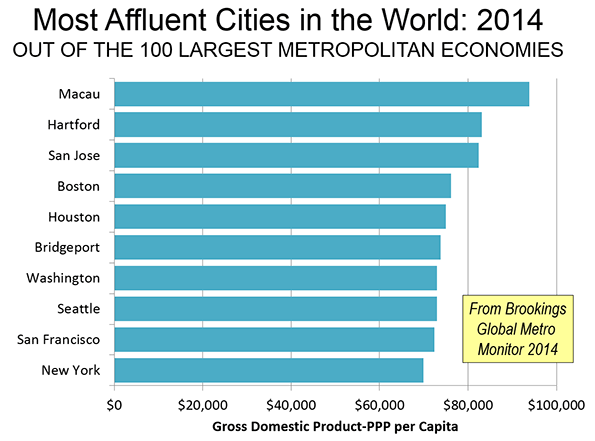
    The United States and Europe continue to dominate the list of strongest metropolitan areas (city) economies in the world, according to the Brookings Institution’s recently released Global Metro Monitor 2014. This is measured by gross domestic product per capita, adjusted for purchasing power parity (GDP-PPP). Brookings points out that this does not indicate personal income, but "proxies the average standard of living in an area."

    The Global Metro Monitor 2014 provides detailed ratings for the 300 largest metropolitan economies in the world, measured by gross domestic product adjusted for purchasing power parity. The list is defined by total size of the economy, with some cities with very high GDP-PPPs per capita, but small populations are excluded. For example, Midland, Texas, with the highest GDP-PPP per capita metropolitan area according to the United States by the Department of Commerce Bureau of Economic Analysis, is excluded.  Other cities, with large populations and low GDP-PPP s per capita were included, such as megacity Kolkata, with a GDP-PPP of $4,000, a fraction of the top 10 average of $77,000. Megacities such as Lagos, Dhaka and Kinshasa were excluded from the top 300, owing to their low GDP-PPPs per capita

    According to data in the Global Metro Monitor website and report, 90 of the top 100 cities were in the United States or Europe in 2014, 68 in the United States and 20 in Europe. The US figure matches that of the previous Global Metro Monitor (2012), while Europe has fallen from 22 to 20 cities.

    Macau: The Most Affluent City

    Last year’s most affluent city, Hartford, was replaced by Macau, which, with Hong Kong is one of China’s two special economic regions. Brookings estimates Macau’s GDP-PPP per capita at $93,849, opening a substantial lead on Hartford of more than $10,000.

    Macau’s economy has expanded rapidly the last decade, principally due to legalized gaming industry and related tourism. Macau displaced Las Vegas as the largest gaming center in 2006. According to the Las Vegas Review Journal, Macau’s gaming revenues had exploded to nearly seven times that of the Las Vegas Strip ($44.1 billion compared to $6.4 billion). Revenue declined, however, in 2014, partly due to China’s anti-corruption drive and competition from other growing East Asian centers, such as Singapore and the Philippines.

    Macau is the one of the smallest cities in the Brookings 300, with a population of only 575,000. Only three other richest cities have populations less than 600,000 including Durham, North Carolina the smallest, ranked 12th, Pennsylvania’s capital, Harrisburg (with a core city that filed for bankruptcy), ranked 25th and Scotland’s capital, Edinburgh, at ranked 37th.

    Balance of the Top 10 Cities

    As was the case last year, nine of the 10 largest GDP-PPP’s per capita were in the United States (Figure). Like Macau, the second and third ranking cities were also smaller than the average, a population of 4.7 million. Second ranked Hartford, with a GDP-PPP per capita of $83,100 has 1.1 million residents. Hartford’s economy strong in finance, especially insurance and benefits and is an important government center, as the capital of Connecticut.

    San Jose, with 1.9 million residents, ranked third, with a GDP-PPP per capita of $82,400. San Jose is home to the larger part of the world’s leading technology center, suburban Silicon Valley. Tech and University hub Boston ranked fourth.

    Leading energy hub Houston ranked as the fifth most affluent city, with a GDP-PPP per capita of nearly $75,000 (Note 1). With 6.4 million residents, Houston is the largest city among the top five. Among the top ten, only New York is larger.

    Bridgeport, Connecticut, a metropolitan area adjacent to New York that includes suburban business centers such as Stamford, Westport and Greenwich is ranked 6th.

    The balance of the top 10 also includes cities specializing in technology, finance and government. Number seven Washington has probably the world’s largest government complex   and has nurtured a huge technology center centered in the Virginia and Maryland suburbs. Seattle ranks eighth, continuing its historic leadership in the technology driven aerospace industry besides its emergence as one of leading information technology centers in the world.

    San Francisco which includes part of the Silicon Valley in its suburbs (sharing with San Jose) and has a strong social media industry in its urban core, ranks 9th. The top 10 was rounded out by New York, perennially ranked as one of the two top global cities, along with London (see: Size is not the Answer: The Changing Face of the Global City, referred to as the Global Cities Report, described further in Note 2)

    Additional Highlights

    Europe:Unlike the United States, which placed 37 of its most affluent cities in the top 50 and 31 in the second 50, Europe’s 20 most affluent economies were concentrated in the second 50, with only six in the top 50. Comparatively small Edinburgh, cited above, was the most affluent, at 37th. Paris was ranked 40th most affluent by Brookings and 3rd in the Global Cites report, just ahead of London at 42nd, the perennial global city co-leader (which was ranked number one in the Global Cities Report).

    Hong Kong:Along with Macau, China’s other special economic region, Hong Kong continued to be among the world’s most affluent, at 39th. The Global Cities Report ranked Hong Kong as the sixth Global City, with a GDP-PPP PPP higher than that of former its former imperial capital   London.

    China: Perhaps most significantly, mainland China has begun to enter the top 100. Suzhou, partly exurban to Shanghai (Kunshan), now ranks 68th. Suzhou has been the recipient of considerable business park investment, including cooperative ventures with Singapore. China’s economic prosperity may be shifting toward the Yangtze Delta (which extends from Ningbo and Hangzhou, through Shanghai to Nanjing). Along with Suzhou, Wuxi, Changzhou and Nanjing now have GDP-PPP’s per capita exceeding $30,000. By contrast, among the large manufacturing centers of the Pearl River Delta, only Shenzhen exceeds a GDP-PPP of $30,000, while Guangzhou, Dongguan and Foshan are below that level (Note 2). According to a new Economist Intelligence Unit report, Jiangsu (which includes the urban corridor from Suzhou to Nanjing) now accounts for more manufacturing employment than any other province.

    Surprisingly Low Rankings: Some cities that might have been expected to be among the world’s most affluent, ranked comparatively low. For example Tokyo, the world’s largest city, ranked fourth in the Global Cities Report, made it only to the third 50 in affluence. Seoul-Incheon, a burgeoning corporate and tech center, remained outside the top 100.

    Canada’s largest city, Toronto managed only a ranking of 100, well below the Prairie behemoths of Calgary (11th) and Edmonton (23rd). Australia’s largest city, Sydney also barely made the top 100, at 95th, far below energy and commodities capital Perth (17th).

    European cities with reputations for unusual prosperity also ranked lower than expected. Financial center Zurich was ranked 45th. Scandinavia’s most affluent city  was Stockholm (48th), followed by energy leader Oslo (62nd), Helsinki (87th) and Copenhagen, which failed to make the top 100 and ranked in the third 50. Singapore,which the Global Cities Report ranks fourth, is ranked 14th most affluent.  

    Evaluating City Performance

    Cities grow as migrants are attracted by hope for better lives. This is as true in Africa and India as it is in Europe or the United States. Cities achieve their primary purpose when they produce a higher standard of living for their residents. Some cities do very well at this, as the Brookings data indicates, and some do less well. The Global Metro Monitor provides crucial information that can be used by national, regional and local officials to measure how well their policies are performing in improving living conditions in relation to both their own past and other cities.

    Note 1: Purchasing power can vary greatly even within nations. Because of this, the United States Department of Commerce, Bureau of Economic Analysis has developed a regional price parities (RPP) program to adjust for metropolitan area costs of living. For example, in 2012, the unadjusted per capita income in San Jose was 30 percent above that of Houston. In the same year, the per capita income-RPP (or in international terms, the per capita income-PPP) in San Jose was just six percent above that of Houston, indicating cost of living at least 20 percent higher in San Jose. 

    Note 2:  Joel Kotkin was principal author of Size is not the Answer: The Changing Face of the Global City, which included contributing authors Ali Modarres, Aaron M. Renn and me. The report was jointly published by the Civil Service College of Singapore and Chapman University. The report is available here.

    Note 3: The 2012 Global Metro Monitor ranked some cities of China higher, though Note 19 expressed concerns about population data for some cities, which might have excluded migrant populations (the "floating population"). There are no such difficulties in the 2014 Global Metro Monitor.

    Wendell Cox is principal of Demographia, an international public policy and demographics firm. He is co-author of the "Demographia International Housing Affordability Survey" and author of "Demographia World Urban Areas" and "War on the Dream: How Anti-Sprawl Policy Threatens the Quality of Life." He was appointed to three terms on the Los Angeles County Transportation Commission, where he served with the leading city and county leadership as the only non-elected member. He was appointed to the Amtrak Reform Council to fill the unexpired term of Governor Christine Todd Whitman and has served as a visiting professor at the Conservatoire National des Arts et Metiers, a national university in Paris.

    Photo: St. Paul’s Church (Facade), Macau, photo by authors

  • Looking Back: The Ideal Communist City

    Over time, suburbs have had many enemies, but perhaps none were more able to impose their version than the Communist Party of the Soviet Union. In its bid to remake a Russia of backward villages and provincial towns, the Soviets favored big cities – the bigger the better – and policies that were at least vaguely reminiscent of the “pack and stack” policies so popular with developers and planners today.

    Some of this took the form of rapid urbanization of rural areas. Under Joseph Stalin’s rule in the Soviet Union from 1929 to 1953, scores of “socialist cities” were founded near new, expansive steel mills. These steels mills were built to speed up industrialization, in order to produce vast amounts of weaponry. These, notes historian Anne Applebaum, represented the Soviet communists “most comprehensive attempt to jump-start the creation of a truly totalitarian civilization”, by bringing the peasantry into the factories to grow Russia’s working class.   Built from the ground up, these factory complexes, notes Applebaum, “were intended to prove, definitively, that when unhindered by preexisting economic relationships, central planning could produce more rapid economic growth than capitalism”.

    As is sometimes asserted by urbanists today, the new socialist cities were about more than mere economic growth; they were widely posed as a means to develop a new kind of society, one that could make possible the spread of Homo sovieticus (the Soviet man). As one German historian writes, the socialist city was to be a place “free of historical burdens, where a new human being was to come into existence, the city and the factory were to be a laboratory of a future society, culture, and way of life”.

    Elements of High Stalinist culture was evident in these cities; the cult of heavy industry, shock worker movement, youth group activity, and the aesthetics of socialist realism. This approach had no room for what in Britain was called “a middle landscape” between countryside and city. Throughout Russia, and much of Eastern Europe, tall apartment blocks were chosen over leafy suburbs. Soviets had no interest in suburbs of any kind because the character of a city “is that people live an urban life. And on the edges of the city or outside the city, they live a rural life”. The rural life was exactly what communist leaders hoped their country would get away from, therefore Soviet planners housed residents near industrial sites so they could contribute to their country through state-sponsored work.

    With this assumption, Soviet planners made some logical steps to promote density. They built nurseries and preschools as well as theatre and sports halls within walking distance to worker’s homes.   Communal eating areas were arranged. Also, wide boulevards were crucial for marches and to have a clear path to and from the factory for the workers. The goals of the “socialist city” planners were to not just transform urban planning but human behavior, helping such spaces would breed the “urban human”.

    As is common with utopian approaches to cities, problems arose. Rapid development, the speed of construction, the use of night shifts, the long working days, and the inexperience of both workers and management all contributed to frequent technological failures. Contrary to the propaganda, there was a huge gap between the ideal of happy workers thriving in well-managed cities and the reality.  

    If today’s architects sometimes obsess over the quality of production and design, the Soviet campaign to expand dense urbanism was less aesthetically oriented. Less than a year after Stalin’s death, in December 1954, Nikita Khrushchev set a campaign to promote the “industrialization of architecture”. He spoke highly of prefabricated buildings, reinforced concrete, and standardized apartments. He did not care for appearances, instead focusing on just building housing because that is what the people need. Prefab tower blocks, called Plattenbau in German and panelaky in Czech and Slovak, were constructed all over the Soviet Union and their satellite states. Originally, these apartments were to house families working for the state.

    In 1957, a group of architecture academics from the University of Moscow published a book called the Novye Elementy Rasseleniia or “New Elements of Settlement”. This team of socialist architects and planners — Alexei Gutnov, A. Baburov, G. Djumenton, S. Kharitonova, I. Lezava, S. Sadovskij— became known as the “NER Group.”  In 1968, they were invited to the Milan Triennale by Giancarlo de Carlo to present their plans for an ideal communist city. In cooperation with a group of young urbanists, architects, and sociologists, they created an Italian edition of their book under the title Idee per la Citta Comunista.    

    Alexei Gutnov and his team set to create “a concrete spatial agenda for Marxism”. At the center of The Communist City lay the “The New Unit of Settlement” (NUS) described as “a blueprint for a truly socialist city“. Gutnov established four fundamental principles dictating their design plan. First, they wanted equal mobility for all residents with each sector being at equal walking distance from the center of the community and from the rural area surrounding them. Secondly, distances from a park area or to the center were planned on a pedestrian scale, ensuring the ability for everyone to be able to reasonably walk everywhere. Third, public transportation would operate on circuits outside the pedestrian area, but stay linked centrally with the NUS, so that residents can go from home to work and vice versa easily. Lastly, every sector would be surrounded by open land on at least two sides, creating a green belt.

    Gutnov did acknowledge the appeal of suburbia — “…ideal conditions for rest and privacy are offered by the individual house situated in the midst of nature…”, but rejected the suburban model common in America and other capitalist countries. Suburbs, he argued, are not feasible in a society that prioritizes equality, stating, “The attempt to make the villa available to the average consumer means building a mass of little houses, each on a tiny piece of land. . . . The mass construction of individual houses, however, destroys the basic character of this type of residence.”

    The planner’s main concern was ensuring social equality. This was seen in their preference of public transportation over privately owned vehicles, high-density apartment housing over detached private homes, and maximizing common areas. These criticisms of suburban sprawl have some resonance in the   writings by planners advocating “smart growth” today. Both see benefits to high density housing. For one, they argue it is more equitable so everyone, no matter what social class they belong too, can live in the same type of buildings. Some New Urbanists do also like the idea of mixed-income communities. In addition, they both see their ideal community utilizing mixed-use developments, with assuring people easy access to public services such as day care, restaurants, and parks, creating less of a need for private spaces. Similarly, New Urbanists also claim that their planned developments would foster a better sense of community.

    Source: Gutnov, Alexi, Baburov, A., Djumenton, G., Kharitonova, S., Lezava, I., Sadovskij, S. The Ideal Communist City. George Braziller: New York. 1971.

    Of course, it is easy to go too far with these analogies. Even at their most strident, new urbanists and smart growth advocates do not enjoy anything like monopoly of power than accrued to Communist leaders. And also, not all the ideas of new urbanists, and even the creators of the Ideal Communist City, are without merit. The ideas of walkability, close access to amenities and services, are adoptable even in privately planned, suburban developments. But the dangers of placing ideology before what people prefer are manifest, whether in 20th Century Russia or America today.

    Alicia Kurimska is a research associate at the Center for Opportunity Urbanism and Chapman University’s Center for Demographics and Policy. She is the co-author of “The Millennial Dilemma: A Generation Searches for Home… On Their Terms” and deputy editor of New Geography, a website focusing on economics, demographics, and policy.”

    Lead photo of Krushchev-era apartment buidlings in Estonia, “EU-EE-Tallinn-PT-Pelguranna-Lõime 31” by Dmitry GOwn work. Licensed under Public Domain via Wikimedia Commons.

  • Russian Rublette

    Is the demise of the ruble, together with falling crude oil prices, comeuppance for President Vladimir Putin’s expansionist dreams? That’s certainly the storyline of those holding faith in economic sanctions. In their eyes, he foolishly land grabbed eastern Ukraine and Crimea, and in exchange got back a cratered Russian economy, with a debased currency and little access to Western financial markets. Heck of a job, Vlad.

    The victors, presumably, are the sanction wizards of Washington and London who stared down the barrels of Putin’s tanks and fifth columnists. Under the theory that the Russian economy is a kleptocracy that sustains Putin in power, the sanctions were targeted at presidential cronies and their “sectoral” holdings, such as those in the oil business (the rallying cry should have been “Don’t fire until you see the whites of their proxy statements”).

    Amazingly, even the dysfunctional US Congress found time in its lame-duck session to vote additional sanctions against the Russian oil sector, although hidden in the fine print of the midnight legislation were goodie bags for Washington lobbyists, who are in line for a $60 million windfall to, as the New York Times reported, “promote democracy, independent news media, uncensored Internet access and anticorruption efforts in Russia.”

    For the moment, despite the free fall of his currency, President Putin remains defiant. Tired of getting finger-waggled for the benefit of western TV audiences, he ghosted from the G-20 summit in Brisbane. Heading early to the airport, Putin must have made a mental note to repay his Western confessors, someday, with the same currency that they fetched from Russian coffers.

    The irony of the allied attacks on the ruble, Russia, and President Putin is that the biggest losers may end up being the high-minded Western countries that would consign Russia and her Kremlin leadership to the dustbin of history.

    The Russian ruble—or should I say the new ruble—was reissued after the 1998 credit collapse in Russia. The previous currency was holdover Soviet bitcoin, issued on the full faith and credit of defunct tractor communes, and convertible, at best, into assets that the oligarchs had already claimed for themselves.

    In free fall as I write, the ruble is best understood as an oil junk bond, for which par is about $117 a barrel (the break-even point for Russia’s budget). Below that price, the ruble falls; above it, the currency strengthens. The reason it remains tied to oil is because the Russian economy has yet to stimulate a large enough middle class to free its markets from petroleum dependence.

    Sadly, Russia’s economy is like that of a Gulf state: it has oil revenues and anointed princes who share in the state’s wealth. Everyone else is a variation on guest workers from the Philippines.

    Despite the structural imbalance of Russia’s economy, the nation’s fundamentals are stronger than you might think. Its foreign currency reserves are $418 billion, placing it sixth in world rankings, way ahead of the US with $132 billion and even ahead of South Korea, which has $364 billion.

    Nor has Russia engaged in the same reckless deficit spending that defined the United States during the feel-good years. Despite the chimes of death, the projected budget deficit for Russia in 2014 is still only about 389 billion rubles (roughly $7 billion, depending on the ruble-dollar exchange rate), while the deficit for the US could reach $500 billion.

    Gross government debt, as a percentage of gross domestic product (GDP), in Russia remains a relatively healthy 10 percent, unlike that of the United States, which has maxed out its borrowings at more than 100 percent of GDP.

    Russia’s external or foreign debt is a manageable $715 billion compared to that of the U.S., which is on the hook for $17 trillion. It might not have a CVS drugstore on every corner or iPhones in every hand, but since emerging from communism in the early 1990s it has, reasonably, lived within its means.

    Even in the most solvent nations, circulating national currencies are best understood as company scrip; bonds drawn on faceless central banks that allow citizens to transact their daily business. As storehouses of wealth, national currencies make about as much sense as holding baseball cards or those Raleigh coupons that used to be included with packs of cigarettes.

    Not for a long time has any world currency been convertible to gold, silver, or any other commodity. At best they are unsecured loans undertaken by citizens in favor of their central banks. All that backs them is political confidence, something ebbing right now in Russia.

    Fortunately for the Russians, their economy is better able to withstand economic isolation than many others. The country can be self-sufficient in food and energy, and one of the few advantages learned in the hothouse years of Soviet communism is how to live apart from Western markets and malls.

    One reason the West decided to fight Russian expansion with sanctions as opposed to bayonets is that the encroachments into Ukraine came at a time of oversupply in Western energy markets.

    By turning down the taps of Russian oil companies — or by at least limiting their access to Western financial markets — the Obama administration was throwing a subsidy bone to domestic energy producers, which were already choking on glutted markets and depressed stocks.

    Nor do the Western allies fear much from Russian retaliation. Moscow laughably imposed travel bans on Obama administration and congressional figures, to keep them from vacationing in Omsk, but it has left open the pipelines that supply Western Europe with natural gas.

    In the same vein, while it may have been aggressive in protecting the rights of Russians living in Ukraine, it refrained from imposing its own sanctions when the US launched similar wars of national liberation in Afghanistan, Iraq, Libya, Serbia, and Somalia.

    The unspoken risk in the great game of economic sanctions and currency strangulation is that the United States has a lot more to lose should, say, China join Russia someday in playing pin-the-tail-on-the-dollar, or if Russia decides to lash back at the Americans by, for example, stirring the cauldron in the Middle East.

    Already Putin’s push-back in favor of Syria’s president Assad turned a civil uprising into a regional war. Russia might also decide to damn the $60 million in press-release torpedoes and take more, if not all, of Ukraine.

    Watching the takedown of another country’s currency — I am assuming that the West is gloating over Putin’s misfortunes — has the air of harmless fun. The assumption is that only a few banks, rogue states, or crony capitalists will suffer.

    Worth further consideration, however, is that currency collapses and hyperinflation have often ushered in civil war and continental instability. Rarely have the effects been contained to the country of origin and its discontents.

    The dissolution of its legal tender, Assignats, in part turned the French Revolution away from the rights of man and into a counting house for disembodied heads. Weimar’s wheelbarrow currencies had disastrous effects beyond Germany’s market squares.

    The last Russian tsar abdicated in 1917, at a moment when his currency had collapsed, and the West lived with the consequences of what followed for almost a century.

    Matthew Stevenson, a contributing editor of Harper’s Magazine, is the author, most recently, of Remembering the Twentieth Century Limited, a collection of historical travel essays, and Whistle-Stopping America. His next book, Reading the Rails, will be published in 2015. He lives in Switzerland.
    Flickr photo by James Malone. The “old” ruble: Russian note for 100 Rubles; 1993.

  • The Sick Man Of Europe Is Europe

    The recent near breakup of the United Kingdom — something inconceivable just a decade ago — reflects a deep, pervasive problem of identity throughout the EU. The once vaunted European sense of common destiny is decomposing. Other separatist movements are on the march, most notably in Catalonia, Flanders and northern Italy.

    Throughout the continent, public support for a united Europe fell sharply last year. Opposition to greater integration has emerged, with anti-EU parties gaining support in countries as diverse as the United Kingdom, Greece, Germany and France.

    The new reality is epitomized by France’s ascendant far-right political figure, Marine Le Pen, who is now leading in many polls to win the next presidential election. “The people have spoken loud and clear … they no longer want to be led by those outside our borders, by EU commissioners and technocrats who are unelected,” she declared recently. “They want to be protected from globalization and take back the reins of their destiny.”

    These attitudes suggest that the EU could be devolving from a nascent super-state to something that increasingly resembles the Holy Roman Empire, a fragmented landscape of small, unimportant states wrapped in a unitary, but ephemeral crepe. This challenges the view of some Americans, particularly but not only on the left, who see Europe as a role model for the U.S.

    Not long ago progressive authors like Jeremy Rifkin could project the European Union to be one of the world’s great and admirable powers. Today, Rifkin’s 2005 tome “The European Dream,” and a host of similar tracts, seem absurd amid growing political unrest and spreading economic stagnation.

    Economic Decline

    Some pundits, such as Paul Krugman, routinely describe Europe’s approach to economic, environment and social policy as more enlightened than America’s. Wherever possible, progressives push for European-style action in areas such as curbing carbon emissionsand rapidly converting to “green” energy.

    Yet these policies are not working. The one large relatively fast-growing economy in Europe (excluding Turkey) is Poland.

    Several years ago Germany and the Netherlands were exemplars as opposed to the much-disdained PIGS (Portugal, Italy, Greece and Spain). But German growth rates have plummeted, going negative in the last quarter, along with France and Italy. More stagnation is likely as energy costs surge and key export markets, notably in Russia and China, begin to contract. Today, the “sick man” of Europe is not any one country, or collection of countries; the “sick man of Europe” is Europe.

    Europe’s poor economy stems in large part from policy. The strong welfare state so admired by progressives here has also made Europe a very expensive place to do business. High taxes and welfare costs, long tolerable in an efficient economy like Germany, have a way of catching up with companies and countries. This has been particularly notable after the financial crisis; since 2008 the unemployment rate has shot up 5 percentage points while dropping steadily in the Untied States.

    The European-wide embrace of “green” energy policies has been tough particularly for manufacturers. Under Chancellor Merkel, Germany has embraced a massive shift to green energy that has helped raise electricity costs for companies by 60% over the past five years to double the rates in the United States.

    The Russians, Europe’s one relatively inexpensive energy source, may have calculated that, in the long run, China may prove a better customer than the Europeans. Ironically, some European countries, including Germany, have been forced to boost their use of coal, certainly not much of a climate change win, to make up for shortfalls created by shuttering nuclear plants and overreliance on often erratic green energy.

    Ultimately, high energy prices tend to fall most painfully on the middle and working classes in the form of higher electricity bills. Some may see their jobs threatened as European employers look forlower-cost alternatives, such as in the energy rich South and middle of the United States.

    Demographic Disasters

    The young are arguably the biggest losers in Europe’s decline. Even though birthrates are very low throughout much of Europe from Germany, Italy and Spain to the eastern countries, those now coming into the workforce face extraordinarily high levels of unemployment, topping 50% in some places. It’s no wonder that some are dubbing them a “lost generation.”

    The combination of low birth rates and declining prospects contribute to rising concerns about immigration. Immigration has always been a more contentious issue in Europe, where many countries are dominated by a single ethnic group and the residents prefer something closer to homogeneity. This nativism has been painfully evidenced in recent decades from everything from the violent breakup of Yugoslavia and the far more civilized dismantling of Czechoslovakia to assaults on the Roma in France, the Czech Republic, Greece and other countries.

    In Britain, the anti-immigrant and anti-EU U.K. Independence Party’s recent strong showing in the European Parliament elections reflected this concern. Diversity in London, which by some counts has the world’s largest concentration of immigrants, thrills London’s media and business communities but stirs great resentment, particularly among working and middle-class voters. The fact that by some estimates that most new jobs generated in the recovery have gone to immigrants has not warmed sentiments.

    A Region Without Meaning

    Chancellor Merkel has noted that “multi-culturalism” in Germany has “utterly failed.” Muslims in Europe drifting to ISIS is just one reflection of the continent’s weakness. The slow integration of immigrants into the economy, even in relatively prosperous, enlightened countries like Sweden, reflects also the inability of Europeans to integrate the newcomers who could help provide a workforce and consumer base in the future.

    Perhaps the greatest challenge to Europe is not demographics, economics or energy, but one of identity. In highly secularized Europe, Christianity, which bound the continent around some similar values, is increasingly rarely practiced or believed. More Czechs, for example, believe in UFOs than in God. Outside of some vaguely anti-American, neo-druid communitarianism among some, there’s not much holding Europeans together.

    All this suggests that Americans would do better than look to Europe for future solutions to our own problems. However attractive the European model may seem to our pundit class, the reality on the ground shows something more to be avoided than embraced.

    This piece originally appeared at Forbes.

    Joel Kotkin is executive editor of NewGeography.com and Distinguished Presidential Fellow in Urban Futures at Chapman University, and a member of the editorial board of the Orange County Register. His newest book, The New Class Conflict is now available at Amazon and Telos Press. He is author of The City: A Global History and The Next Hundred Million: America in 2050. His most recent study, The Rise of Postfamilialism, has been widely discussed and distributed internationally. He lives in Los Angeles, CA.

  • Will Lindsay Lohan Save Greece?

    It’s September, but island beaches from the Aegeans to Zante are still buzzing in Greece. Mykonos has been the summer’s Go-To spot for superstars and supermodels; the mainland and cities are also seeing the British and Europeans coming back.

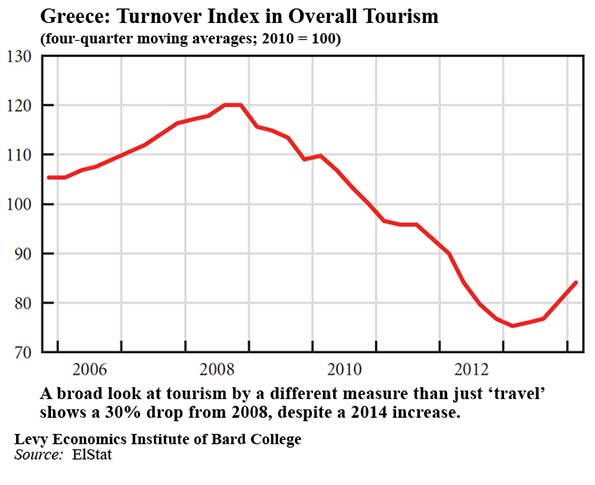
    Greece’s reemergence on the tourist circuit and the celebrity-watch sites has brought travel revenue, which accounted for 12 billion euros through April, actually above the previous peak in 2008. And, based on arrivals, the national tourism agency predicts that visitors will account for 13 billion euros this year.

    So did the appearance of Lindsay Lohan and friends in the Greek isles signify, as one newspaper put it, a template for Greece’s economic recovery?

    It didn’t. It’s even still possible that Greece’s economic troubles have yet to hit bottom — no one really knows. There is one definite, though. Even with a dramatic increase in its significant tourism industry, the dance floor under Greece’s summer parties has been resting on a breathtakingly shaky foundation.

    The debt-ridden economy has now endured 24 quarters of negative output. Young Greeks continue to flee, straining the country’s pension system.

    Extreme austerity regime policies — fiscal tightening — have resulted in the most extreme unemployment rate in Europe, 27 percent.

    Private investment remains in a free fall, with a decline of more than 10 percent over 2013. Financial institutions are barely lending. The gross total of doubtful and nonperforming loans by major banks is up from 5 percent to 25 percent since 2010.

    And, while tourists are crowing about Greece’s fantastic bargains, those low prices are partly a reflection of the salary squeeze on Greek workers. Wage deflation is at a pace never before experienced in a post-WWII era developed country, even as household taxes continue to rise.

    Those facts are just shorthand — an almost random selection from the reams of data we’ve compiled and analyzed at the Levy Economics Institute that document the continued precariousness of the economy.

    This isn’t the first time in recent months that a seemingly positive sign in Greece has been wrongly celebrated as the start of a recovery. The country’s return to the bond markets in April was cheered as the end of a four-year exile. But the exercise was a public relations play. Demand for the bonds reflected the state of excess global liquidity, not investor confidence in Greece as a good risk. (Not to mention that the bonds were implicitly guaranteed by the European Central Bank.)

    The improvement in tourism isn’t a sham like the bond market show. It’s real — but it’s such a small portion of the overall picture that it’s having only a minimal impact on the terrible employment problem, and on Greece’s balance of payments.

    Millions of tourists may keep landing at Greece’s airports. I hope they do. But don’t expect ordinary Greeks to be planning their own luxury vacations anytime soon.

    Dimitri Papadimitriou is president of the Levy Economics Institute of Bard College. The publications, conferences, workshops and congressional testimony of the institute have a wide international audience.

    Flickr photo by efilpera: Clouds over Mykonos, September 2014.

  • Welcome to the Billion-Man Slum

    When our urban pundit class speaks of the future of cities, we are offered glittering images of London, New York, Singapore, or Shanghai. In reality, the future for most of the world’s megacities—places with more than 10 million people—may look more like Dhaka, Mumbai, or Kinshasa: dirty, poverty- and disease-ridden, and environmentally disastrous.

    Harvard’s Ed Glaeser suggests that megacities grow because “globalization” and “technological change have increased the returns to being smart.” And to be sure, megacities such as Jakarta, Kolkata (in India), Mumbai, Manila, Karachi, and Lagos—all among the top 25 most populous cities in the world—present a great opportunity for large corporate development firms and thrilling treasure troves for both journalists and academic researchers. But surely there’s a better alternative to celebrating misery, as one prominent author did recently in aForeign Policy article bizarrely entitled “In Praise of Slums.”

    Bigger is no longer better.

    Let’s start with the idea that, in an urbanizing world, bigger is no longer necessarily better. In a recent study I conducted with Ali Modarres, Aaron Renn, and Wendell Cox for Singapore’s Civil Service College and Chapman University, we ranked cities by importance as global centers. Of the world’s estimated 29 megacities, only a handful made into the top 20. Most leading megacities were either long-established Western cities—Tokyo, New York, London, Los Angeles—or located in booming East Asia, including Beijing, Shanghai, and Seoul.

    Notably missing are fast-growing growing megacities such as Lagos, Karachi, and Dhaka, as well as the 16 additional megacities—mostly in developing countries in Africa and south Asia—that will pass the 10 million mark by 2030. Yet despite their girth, the majority of megacities are not particularly attractive for foreign investors or as locations for regional corporate offices. These firms tend to cluster instead in westernized cities such as Singapore, Hong Kong, or Dubai, and visit places like Jakarta, Manila, and Cairo only when necessary.

    History drives some of this. The great global cities rose as centers of industry and trade, while developing from there an excellence in related services. They created pockets of a more advanced economy to serve the predominately rural hinterland, or in some cases colonial possessions. This imperial relationship spurred the rise of London, Paris, and New York in the early 20th century, and also that of Tokyo, still the world’s biggest city.

    Some new megacities, some such as Guangzhou and Shenzhen (which in 1979 had roughly 30,000 people, compared to its 10.6 million today) have a real economic shot at becoming top global cities due to China’s emergence as the world’s workshop. But, as we explain in a recent paper from Chapman University, this is far less the case for most megacities in the developing world.

    Unlike their Chinese counterparts, these megacities’ expansion has not been driven by economic growth but more by bringing people from their own impoverished countryside into the city. Critically, in contrast to the peasants who came to Tokyo in the ’50s or Shanghai in the ’90s, there is no huge demand for an industrial workforce in cities in South Asia, Africa, or Latin America, where manufacturing is far less prevalent—manufacturing’s share of India’s GDP, for example, is half that of China.

    Here’s the difficult truth: Most emerging megacities, particularly outside of China, face bleak prospects. Emerging megacities like Kinshasa or Lima do not command important global niches. Their problems are often ignored or minimized by those who inhabit what commentator Rajiv Desai has described as “the VIP zone of cities,” where there is “reliable electric power, adequate water supply, and any sanitation at all.” Outside the zone, Desai notes, even much of the middle class have to “endure inhuman conditions” of congested, cratered roads, unreliable energy, and undrinkable water.

    The slums of Bangladesh’s capital, Dhaka, swell by as many as 400,000 new migrants each year. Some argue that these migrants are better off than previous slum dwellers since they ride motorcycles and have cellphones. Yet access to the wonders of transportation and “information technology” don’t compensate for physical conditions demonstrably worse than those endured even by Depression-era poor New Yorkers. My mother’s generation at least could drink water out of a tap and expect consistent electricity, if the bill was paid, something not taken for granted by their modern-day counterparts (PDF) in the developing world.

    More serious still, the slum dwellers face enormous risk from unsafely built environments. Traffic, as anyone who has spent time in these cities easily notices, poses particular threats to riders and pedestrian alike. According to researchers, developing countries now experience a “neglected epidemic” of road-related injuries accounting for 85 percent of the world’s traffic fatalities.

    And don’t drink the water, please. Nearly two-thirds of the sewage in the megacity of Dhaka, with 15 million people, is untreated. As Dr. Marc Reidl, a specialist in respiratory disease at UCLA, puts it, “Megacity life is an unprecedented insult to the immune system.”

    Cities of disappointment.

    Over these environmental problems loom arguably greater social ones. Many of the megacities—including the fastest growing, Dhaka—are essentially conurbations dominated by very-low-income people; roughly 70 percent of Dhaka households earn less than $170 (U.S.) a month, and many of them far less. “The megacity of the poor,” is how the urban geographer Nazrul Islam describes his hometown.

    Inequality is expanding in most of these places. A recent Euromonitor International study found that larger “city size remains the key explanatory factor for income inequalities across the world’s urban agglomerations.” Even megacities that we might refer to as “middle income,” such as Tehran and Istanbul, are becoming what geographer Ali Modarres calls “cities of disappointment.” In many cases, high housing prices and a lack of space have already reduced the birthrate to well below the replacement level. Increasingly, many women are choosing to remain single—heretofore something rare in these countries.

    One scholar, Jan Nijman, suggests that most gains in recent years have accrued to the upper echelons of the middle class in Indian cities while “the ranks of the lower middle income classes have shrunk, and the ranks of the poor have expanded rapidly.” Much of the growth in a perceived middle class, Nijman argues, is based not on income but on consumption driven by credit. The informal sector—drivers, stall-owners, repair-people, household industries—account for much of Mumbai’s employment growth.

    Housing costs are the key here. Researcher Vatsala Pant estimates a monthly total household “middle class income” in Mumbai at 40,000-50,000 rupees; equivalent to less than $1,000 U.S. dollars. Yet monthly salaries for teachers, police officers, and other mid-level jobs are often half that amount. Not surprisingly, even these workers often find themselves living in slum neighborhoods, which are also known as jhopad-patti, jhuggi-jhopadi or busties. “It’s the dream of an immigrant for a place in Mumbai … and ends up with a slum,” she notes.

    Is there a better alternative?

    Future urbanization does not need to pose a choice between rural hopelessness and urban despair. This is a critical issue, even for high-income countries. The rise of a mass of poor slum dwellers—estimated as high as 1 billion—threatens the social stability not only of the countries they inhabit, but the world, as they tend to generate high levels of both random violence and more organized forms ofthuggery, including terrorism.

    Fortunately, an alternative structure of urbanization is beginning to emerge that emphasizes a spreading diversity of cities as opposed to gigantic agglomerations. In the coming decade, McKinsey predicts megacities will underperform economically and demographically, as growth shifts to “fast growing middleweights,” many of them in China and India.

    There needs to be a far greater emphasis on these smaller cities, as well as working to develop a viable economy for the villages. In India, migration to large cities already is beginning to slow, as more potential migrants weigh the costs and opportunities of making such a move as opposed to staying closer to home. This phenomenon has been called “rurbanization” and was an important provision of the campaign of India’s new prime minister, Narendra Modi, who implemented such programs as chief minister of the state of Gujarat. Modi speaks of human settlements with the “heart of a village” and developing “the facilities of the city.”

    A growing array of critics understand the need to break with the megacity mantraAshok R. Datar, chairman of the Mumbai Environmental Social Network and a longtime adviser to the Ambani corporate group, says the emerging megacities of the developing world need to stop emulating the Western model of rapid, dense urbanization. “We are copying the Western experience in our own stupid and silly way,” Datar says.

    He suggests a policy focusing on more human-scale growth. One does not have to be a Gandhian idealist to suggest that Ebenezer Howard’s “garden city” concept—conceived as a response to miserable conditions in early 20th century urban Britain—may be a better guide to future urban growth than the current trend of relentless concentration.

    The “garden city” alternative could help ameliorate the downsides of  mass urbanization in China as well, where the government is seeking to move 250 million more people from the countryside to urban areas over the next decade. “There’s this feeling that we have to modernize, we have to urbanize, and this is our national-development strategy,” said Gao Yu, China country director for the Landesa Rural Development Institute, based in Seattle. Referring to the disastrous Maoist campaign to industrialize overnight, he added, “it’s almost like another Great Leap Forward.”

    As the world urbanizes, we need to start thinking about how to make cities better, not simply bigger. The primary goal of a city should not be to enrich already wealthy landlords and construction companies. It should not be to make politicians more powerful. And it certainly should not be mindless, pointless growth for its own sake. Urbanism should not be defined by the egos of planners, architects, politicians, or the über-rich but by what works best for the most people.

    This piece originally appeared at The Daily Beast.

    Joel Kotkin is executive editor of NewGeography.com and Distinguished Presidential Fellow in Urban Futures at Chapman University, and a member of the editorial board of the Orange County Register. His newest book, The New Class Conflict is now available for pre-order atAmazon and Telos Press. He is author of The City: A Global History and The Next Hundred Million: America in 2050. His most recent study, The Rise of Postfamilialism, has been widely discussed and distributed internationally. He lives in Los Angeles, CA.

    Dhaka photo by Wendell Cox.

  • Integrating Immigrants: Outcomes Not Attitudes Matter

    Many modern economies struggle with integrating foreign-born into their labor markets. In particular, low-skilled immigrants from poor countries experience high unemployment and a range of related social problems. Much has been written about the extent of the problem. In many Western European cities, entire communities of migrants are living in social and economic exclusion. The state of poverty is often persists among their children.

    But although the problem is widely acknowledged, the cause of it remains an issue of vivid debate. One line of reasoning is that modern job markets are increasingly knowledge-based. Technological changes have reduced the availability of simple jobs. The supply of the low‑skilled workforce often becomes higher than the demand for it. A limited number of jobs exist at the formal or informal minimum wage levels in various modern economies. Foreign‑born individuals, who often have weak social networks and language skills, find it particularly hard to obtain these jobs.

    Another related explanation is that welfare states hinder integration. High taxes and generous public benefit systems reduce the incentives for work. Families with children can experience a situation where their actual incomes are only slightly, if at all, increased when a parent transitions to work. In addition, rigid labor market regulations can make it difficult for outsiders to enter the labor market.

    A third view is that the problem is rooted mainly in discrimination and open racism. Immigrants are simply not given a chance to prove themselves since employers chose not to hire them. Direct and indirect racist structures hinder the success of immigrants and their children.

    It is difficult to conclusively say which explanations are more relevant than the others. But we can look at the relation between discriminatory viewpoints and the labor market success of migrants. This is made possible by the World Value Survey, an ambitious project to map the prevalence of different attitudes around the world.

    Recently the result of latest survey, conducted between the years 2010 and 2014, has been made available. One of the questions included in the survey was how many who would not like to have neighbors which were immigrants or foreign workers. Another was how many who thought that when jobs are scarce, employers should give priority to natives over immigrants.

    As shown below, the prevalence of these answers vary greatly between seven modern economies for which data have been released so far. In Germany and the Netherlands for example a fifth of the population express that they would not like to have foreign-born neighbors. The same view is shared by less than four percent of the Swedish population. Likewise, about half of the public in the US, Australia, New Zealand and Spain believed that employers should give priority to natives over foreign-born when jobs are scarce. In Germany and the Netherlands about four in ten hold the same view, compared to 14 percent in Sweden.

    Would not like foreign-born neighbors

    Employers should give priority to natives

    Unemployment difference low-educated foreign-born versus low-educated natives

    Unemployment difference high-educated foreign-born versus high-educated natives

    Germany

    21

    41

    2.6

    6.1

    Netherlands

    20

    36

    4.5

    3.3

    US

    14

    50

    -8.9

    1.4

    Australia

    11

    51

    -1.0

    2.5

    Spain

    7.5

    53

    11

    9.9

    New Zealand

    5.9

    50

    -0.96

    1.9

    Sweden

    3.5

    14

    10

    8.1

     Data from World Value Survey 2010-2014. Unemployment difference from OECD data over “Indicators of integration of immigrants and their children”, given for the years 2009-2010.  Rounded to two significant digits.


    However, there is no clear link between tolerance for foreign-born as either neighbors or in the labor market on one hand, and actual labor market success on the other. Sweden, where the public expresses the most tolerant viewpoints, could be expected to be characterized by good labor market outcomes for immigrants. However, Sweden is next  to spain is  characterized with the biggest gap in employment between foreign-born and natives. This relation holds regardless if we look at the difference between low-educated or high-educated people with foreign-born and native backgrounds respectively.

    The US on the other hand, has merely 1.4 percentage point higher unemployment amongst high-educated foreign-born compared to natives with similar educational background. Amongst the low-educated in the US the difference is 8.9 percentage points in favor of the foreign-born. At the same time, the share in the US who would not like to have foreign-born neighbors is almost twice as high as in Spain and fully four times as high as in Sweden.

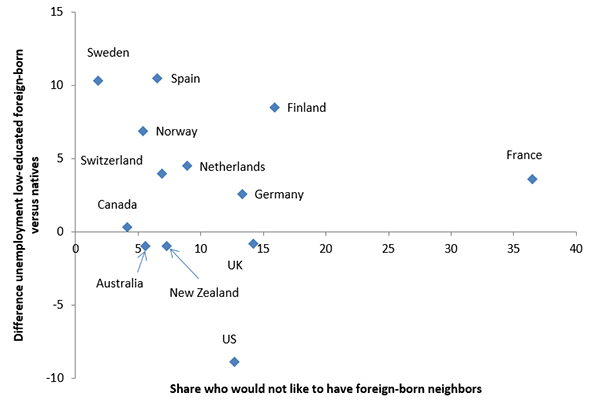
    Perhaps it is difficult to find a strong link since the number of countries included is so small. In order to broaden the sample, we can look at the 2005-2009 edition of the World Value Survey. In that survey the question relating to foreign-born neighbors, but not that of allocation of jobs, was asked. The graph below shows the relation between the share who would not like to have foreign-born neighbors on one hand, and the difference in unemployment on the other. 


    Source for attitudes towards foreign-born neighbors: World Value Survey 2005-2009. Source for difference in unemployment: OECD data over “Indicators of integration of immigrants and their children”, given for the years 2009-2010. 

    The relation between attitudes and employment prospects are not what one would expect. If anything, the countries in which fewest people do not want foreign-born neighbors are also those in which differences in unemployment are the highest. This does not necessarily mean that countries with the different attitude do better. Canada, Australia and New Zealand are nations where a relatively small share has anything against foreign-born neighbors. The same countries have good labor market outcomes for the foreign-born. In Australia and New Zealand, low-skilled individuals with a foreign-born background have slightly lower unemployment than similar natives. In Canada the difference is minute between the two groups.

    Given these outcomes it is difficult to conclusively say what factors that favor integration and what obstacles that stand in the way of integration. It could, for example, be argued that the people in countries such as Sweden are giving politically correct responses. These responses do not necessarily have to translate to the discrimination actually faced by immigrants on a daily basis. At the same time, it is clear that the Anglo-Saxon countries are succeeding in integration. This could be attributed to having English as their main language. It could also be attributed to market-based systems with strong incentives for work and relatively free labor markets. In short, attitudes, at least as reported by the World Value Survey, do not seem to explain the differences in integration. Although all enlightened countries should strive for the tolerant views expressed in countries such as Sweden, this does not guarantee well‑functioning integration.

    Dr. Nima sanandaji is a frequent writer for the New Geography. He is upcoming with the book "Renaissance for Reforms" for the Institute of Economic Affairs and Timbro, co-authored with Professor Stefan Fölster.

    Photo from BigStockPhoto.com.

  • European Style Going Out of Fashion at Ballot Box

    The recent political earthquake in Europe has great implications for the United States, both internationally and domestically. The unpopularity of European Union institutions produced record-breaking votes for a motley assortment of anti-establishment parties across the Continent, suggesting it’s time to stop looking across the Atlantic for role models as Europe’s dismal prospects have inspired the lowest levels of political support in several decades.

    Many of the parties that did best in the May 25 multinational balloting for the European Parliament – from Greece’s Far Left Syriza party to Britain’s oddball United Kingdom Independence Party and France’s historically racist National Front – are hardly ideal candidates for responsible governance. Yet, despite their many blemishes, these and other anti-EU parties fed on growing distaste for the 28-nation EU’s sprawling, largely unaccountable bureaucracy blamed for, in the words of one British group, “undermining” liberal democracy in these countries.

    This suggests that it’s time for Americans to stop looking across the Atlantic for role models. For decades, American gentry liberals have seen the EU as a superior mode of governance. Jeremy Rifkin’s 2005 book, “The European Dream” – and a host of similar tracts that all assert European superiority – now may seem absurd on their faces, but it’s doubtful many EU boosters, here and abroad, will let facts get in their way.

    The Urge to Merge

    The bigger loser in the May elections was the notion that more concentration of power leads to better results. Many American intellectuals and policy wonks favor handing ever-greater control to the “best and brightest” who run academia, much of the media and the bureaucracy. Figures, such as former Obama budget adviser Peter Orszag and New York Times columnist Thomas Friedman, argue that power should shift from naturally contentious elected bodies – subject to pressure from the lower orders – to credentialed “experts” operating in Washington, Brussels or the United Nations. This notion suggests the popular will is too lacking in scientific judgment and societal wisdom to be trusted with real authority.

    Yet, as the EU parliamentary elections suggest, people object to having details of their lives controlled from a great distance. Beyond the Right, many on the Left also nowoppose the Brussels-based EU for imposing austerity measures on several struggling economies. The British website Socialist Alternative saw the vote not just as a shift to the right but “a revolt against the capitalist establishment,” which remains, like the bureaucracy and media, devotedly pro-EU.

    In the United States, there is also mounting resistance to centralization. The 2010 congressional elections reflected a reaction to attempts by President Obama and his Democratic Party to put more of our lives under Washington’s control. Even now, less than two years after the president’s re-election, opposition to an extended federal role is, if anything, even stronger. Less than one in five Americans trust the federal government, and barely two in five see it as even capable of reversing the inequality. There may be a groundswell of support for the social democratic goals of the Great Depression’s New Deal, but likely not for the reimposing of its highly centralized policy prescriptions.

    Energy and Economy

    Pundits, such as the New York Times’ Paul Krugman, routinely describe Europe’s approach to economic, environmental and social policy as far more enlightened than that in the U.S. Wherever possible, progressives push European style in areas such as energy, with strong attempts to force a rapid conversion to “green” energy.

    Yet, there’s not much to cheer for in Europe’s energy policy. The attempt to turn the Continent into a renewable-energy superpower has been hampered by soaring prices. The policy has increased dependence on unreliable and expensive renewable power – as well as Russian natural gas – forcing some European countries, including Germany, to boost their use of coal, certainly not much of a victory against climate change.

    Ultimately, the consequences of high energy prices tend to fall, as they do here, on the middle and working classes, who see their electricity bills soar, along with the cost of gasoline. Some Europeans, in fact, may see their jobs threatened as employers look for lower-cost alternatives, including moving to energy-rich parts of the USA.

    Addressing Inequality

    In seeking out economic models that promote greater equality and upward mobility, many pundits look to Europe as a model. French economist Thomas Piketty’s influential book, “Capital in the Twenty-First Century,” argues that the only way to confront increasing income inequality and prevent deeper social fracturing is to expand the “social state” that forcibly redistributes wealth. In his mind, economic growth, traditionally a prime source of social uplift, is little more than a “illusory” solution.

    Like many American progressives, Piketty looks to governmental action as the sole force for greater equality. Financed by taxes on wealth, the “social state” would curb the rich, but would also empower the bureaucracy and other parts of the rising clerisy with unprecedented power.

    Yet recent European experience also provides little support for the benefits of redistribution, given the persistently high rates of unemployment across most of the EU. This is particularly true for much of the Continent’s youth, who are widely described as “the lost generation.”

    Just as in the United States, pervasive inequality and limited social mobility have been well documented in larger European countries, including France, which has among the world’s most evolved welfare states. This is true even in historically egalitarian Sweden, where, over the past 15 years, the gap between the wealthy and other classes has increased four times more rapidly than in the United States. As Europe’s population ages, and its economies stagnate, demands for redistribution may well increase, but the ability to pay will surely decline.

    Issue of Immigration

    Concern over immigration has been a key driver in mounting anti-EU sentiment. Immigration has always been a more contentious issue for Europeans, who generally belong to a single ethnic group and prefer something closer to homogeneity than to the kind of rolling ethnic evolution that characterizes the United States. This nativism has been painfully evidenced in recent decades in from everything from the violent breakup of Yugoslavia and the far more civilized dismantling of Czechoslovakia to France’s recent campaign against the Roma, Catalonia’s attempts to divorce from Spain, and even the upcoming vote on Scottish independence from the United Kingdom.

    During the boom times of the 1950s and ’60s, many European countries – France, Germany, Netherlands and the U.K. – invited hundreds of thousands of foreign workers, many from outside Europe. But with European labor markets far weaker, such an infusion seems to many middle- and working-class voters as a threat to their economic futures as well as to their identities.

    Immigration played a role in UKIP’s victory in Britain’s voting for European Parliament.Diversity in London, by some counts home to the world’s largest concentration of immigrants, thrills London’s media and business communities but stirs resentment, particularly among more working- and middle-class voters. The fact that as many as 87 percent of new jobs generated in the recovery go to immigrants has not warmed their sentiments.

    Future of the ‘nation-state’

    As we look to how to reform our own less-than-perfect union, adopting the European approach seems, at best, misguided. One does not have to share the Tea Party’s reflexively hostile view of government to see that attempts to expand control from Washington could, in the long run, create the very stagnation and often-ugly political reactions that we see in Europe today.

    More to the point, the drift toward an EU-like state works against the very structure of the American political community, designed to disperse power among various levels of government and varied constituencies. The tendency of administrations to rule through executive orders, or regulatory agencies, has been growing, particularly during the Obama years; a centralized state also could pose a threat to progressive Americans and their values under conservative rule.

    For America, this may be the biggest takeaway from Europe’s crisis. Our political culture, for all its problems, was designed to allow localities greater leeway in determining their own fates. There are many areas – water, air quality, arterial road infrastructure – that require cooperation along regional lines, but, for the most part, the best approach, whenever possible, is to allow localities to control their fates. It is a decentralized, bottom-up system that, for the most part, has performed far better over time than the dysfunctional blunderbuss that is the European Union.

    This article first appeared in the Orange County Register.

    Joel Kotkin is executive editor of NewGeography.com and Distinguished Presidential Fellow in Urban Futures at Chapman University, and a member of the editorial board of the Orange County Register. He is author of The City: A Global History and The Next Hundred Million: America in 2050. His most recent study, The Rise of Postfamilialism, has been widely discussed and distributed internationally. He lives in Los Angeles, CA.

  • Are America’s Rich More Generous?

    In 2009, the two richest men in America organized a confidential dinner meeting of billionaires in New York City, hosted by David Rockefeller. Guests included George Soros, Michael Bloomberg, Ted Turner, and Oprah Winfrey. The topic of discussion was philanthropy. Each billionaire was asked to describe his philosophy of giving. CNN-founder Ted Turner told the story tale of how he had made a spur-of-the-moment decision to donate $1 billion, most of his future, to the United Nations. During this dinner, Bill Gates and Warren Buffet started the biggest fundraising drive in history. Setting examples though their own charity, Gates and Buffet initiated “The Giving Pledge”, a campaign encouraging billionaires to commit the majority of their wealth to philanthropic causes. So far around 113 billionaires have agreed to the pledge.

    Billionaires are targeted because Gates and Buffet believe that only they have sufficient funds to make a dent into the world’s major problems. The United States was initially chosen in part because the nation has a stronger culture of donating. The social contract in the United States puts stronger emphasize on giving back something to society by those fortunate enough to have acquired wealth. Bill Gates has already donated close to $30 billion dollars of his own wealth. He has further pledged to donate his remaining wealth of about $60 billion (leaving his three children $10 million each). Omaha billionaire Warren Buffett was inspired by his friend Gates’ example and also pledged all of wealth to charity. Leaving only a small endowment to his children, Buffet stating “I want to give my kids just enough so that they would feel that they could do anything, but not so much that they would feel like doing nothing”.

    On average, the wealthy in the United States tend to donate a higher share of assets to charity than those in other countries. There also appears to exist an international correlation between charitable donations and billionaire entrepreneurship. The Johns Hopkins Comparative Nonprofit Sector Project cites data about cross-country differences in charitable donations. The 2004 book “Global Civil Society: Dimensions of the Nonprofit Sector” contains charitable donations as a share of GDP in 36 countries. According to this source Americans donated 1.9% of GDP to charity, compared to 0.3% of GDP in continental Europe.

    In the publication “SuperEntrepreneurs – and how your country can get them” we recently examined the circa 1000 self-made men and women who have earned at least $1 billion dollars and who have appeared in Forbes magazine’s list of the world’s richest people between 1996 and 2010. There is a very strong correlation between the per capita number of SuperEntreprenures in different countries and donations to charity as a share of GDP. This relationship holds also when controlling for per capita GDP and tax rates. Other than the United States, countries with a high count of SuperEntreprenures and high charity as a share of GDP includes Israel (1.3 percent of GDP), Canada (1.2 percent) and the United Kingdom (0.8 percent). Several British Superentreprenurs have joined the Gates and Buffet Giving Pledge to donate half their wealth to charity, including Michael Anthony and Richard Branson.

    It may be that the strong correlation between charity and the number of SuperEntreprenurs is not causal and reflects cultural differences, such as Anglo-Saxon countries donating more to charity and having more entrepreneurship. To some extent, there may be an interplay between Anglo-Saxon capitalist culture and Anglo-Saxon prescription for charity, especially for the fortunate. Tocqueville has argued that Protestant norms such as industry, frugality, charity and humility were important for American development. The Calvinist Puritan settlers brought with them strong norms of charity from England, which also influenced Canada and Australia. Interestingly, a similar norm towards expectations of charity from the wealthy exists in Jewish culture, which may in part account for the high rate of charity in Israel. The lower rates of charitable giving is found in poorer countries such as Mexico (0.04 percent of GDP) and India (0.09 percent) but also in Germany (0.13 percent) Austria (0.17 percent), Korea (0.18 percent) and Japan (0.22 percent).

    American capitalism differs from other societies in its historical focus on both the creation of wealth and the reconstitution of wealth through philanthropy. In 1957, Historician Merle Curti argued that “philanthropy has been one of the major aspects of and keys to American social and cultural development”. The implicit social contract allows rich Americans to retain most of their wealth from taxation. In return, they voluntarily give much of it back to society, in projects of their choosing. The notion exists that wealth beyond a certain point should be invested back in society to expand opportunity for future generations. In this way John D. Rockefeller, the richest man in American history, gave back 95 percent of his wealth before he died.

    The legitimacy of American capitalism has in part been upheld through voluntary donations from the rich. Social norms regulating donations differ markedly between Europe and the United States, not only for the rich. In the United States, around 2 percent of GDP is donated to charity each year; about ten times higher the ratio of European countries. Based on tax data, Fortune Magazine estimates that the 400 highest earning Americans donate $15 billion to charity each year, or around ten percent of their annual income. Compared to other donors, wealthy Americans are more likely to donate to education and the arts but less likely to donate to religion.

    Much of the new wealth created historically has thus been given back to society. This has had several feed-back effects on capitalism. For one, the practice has limited the rise of new dynasties. Another positive feed-back mechanism is that the donations to research and higher education in particular has allowed new generations to become wealthy. In his lifetime, Rockefeller alone established many important institutions, including the University of Chicago, Spelman College, The General Education Board, National Bureau of Economic Research, Brookings Institution, and the Rockefeller Foundation. The University of Chicago is not the only great private research universities created through individual philanthropy. The same is true for Stanford, MIT, Johns Hopkins, Carnegie-Mellon, and Duke.

    Lastly the practice of philanthropy creates legitimacy for capitalism among the public. Bill Gates, the richest man in America, accumulated his wealth using famously sharp elbows. Yet his is one of the most popular people in the country. In one public Pew poll, he was viewed favorably by 69 percent and unfavorably by only 15 percent of the public, the best numbers of any public person polled. Similarly according to Gallup Bill Gates in the most admired man in America who is not a current or former President.

    Scholars Asc and Phillips have disused the “entrepreneurship-philanthropy nexus” at length, arguing that “[m]uch of the new wealth created historically has been given back to the community, to build up the great social institutions that have a positive feedback on future economic growth.” Asc and Phillips describe the importance of these norms in American economic history: “For Carnegie, the question was not only, ‘How to gain wealth?’ but, importantly, ‘What to do with it?’ The Gospel of Wealth suggested that millionaires, instead of bequeathing vast fortunes to heirs or making benevolent grants by will, should administer their wealth as a public trust during life”. Charitable instincts amongst highly successful entrepreneurs is relevant for economic development, in a time where there is global concern that rich dynasties will dominate capital ownership by investing inherited wealth. The combination of opportunities to create new wealth and philanthropy has so far ensured that Anglo-Saxon societies are characterized by new wealth, compared to countries such as France where inherited wealth plays an increasingly important part in the economy.

    Dr. Nima sanandaji is a frequent writer for the New Geography. Dr. Tino Sanandaji is a full-time researcher at the Research Institute of Industrial Economics (IFN) in Stockholm. They have co-authored “SuperEntrepreneurs – and how your country can get them” (Center for Policy Studies) which has received considerable media impact during recent weeks.

    Bill Gates photo by PauloHenrique. 


    Acs, Z.J., and R.J. Phillips (2002). “Entrepreneurship and philanthropy in American capitalism”. Small Business Economics, 19;3:189-204.

    Curti, M. (1957). "The History of American Philantropy as a Field of Research", The American Historical Review, 62;2:352-363. De Tocqueville, A. (1966), reprint from original 1835 publication. “Democracy in America”, New York, NY: HarperCollings.

    Fortune Magazine and CNN Money (2010). "The $600 billion challenge", 2010-06-16. Blog post availiable on http://features.blogs.fortune.cnn.com/2010/06/16/gates-buffett-600-billion-dollar-philanthropy-challenge/ when last checked 2013-12-31.

    Lester, S., W. Sokolowski and Associates (2004). “Global Civil Society: Dimensions of the Nonprofit Sector, Volume Two”, Bloomfield, CT: Kumarian Press.