Tag: Europe

  • China’s Ascent in World Transport

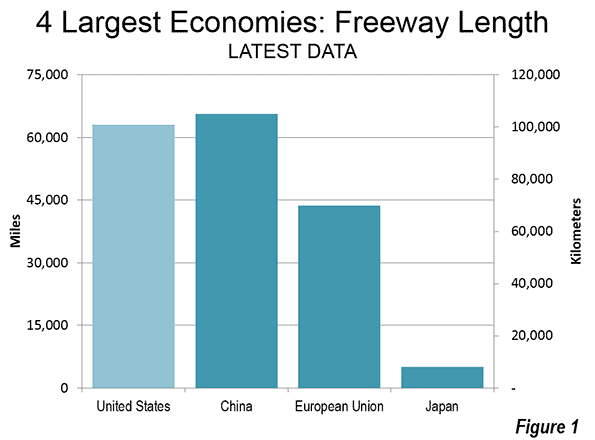
    After years of closing the gap with the United States, China built enough freeways in 2013 to amass the greatest length of freeways in the world. Between 2003 and 2013, China expanded its national expressway system, with interstate (motorway in Europe) standard roadways from 30,000 to 105,000 kilometers (18,000 to 65,000 miles). This compares to the 101,000 kilometers (63,000 miles) in the United States in 2012. China’s freeway system is also longer than that of the European Union, which was 70,000 kilometers in 2010 (43,000 miles) and Japan (8,000 kilometers or 5,000 miles) as is indicated in Figure 1 (Note 1). The ascent of China is evident across the spectrum of transport data, both passenger and freight.
    A review of transport statistics in the four largest world economies (nominal gross domestic product) shows considerable variation in both passenger and freight flows. It also reflects the rapid growth of China. Generally comparable and complete data is available for the European Union, the United States, China and Japan.

    Passenger Travel

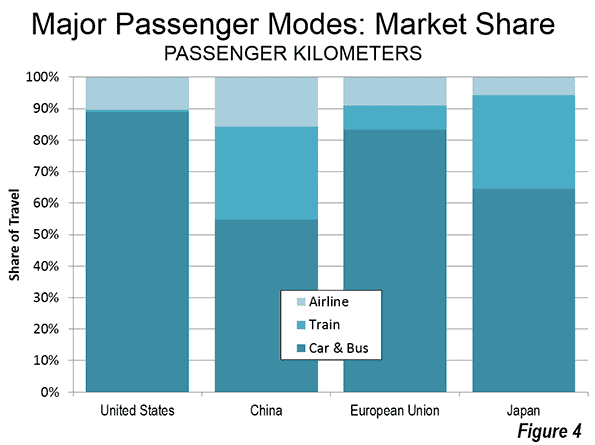
    All four of the world’s largest economies rely principally on roads for their passenger transport. The United States continues to lead in road volume (in passenger kilometers, see Note 2) by a substantial margin, followed by the European Union. In the United States, automobiles account for 83 percent of domestic passenger travel, which compares to 76 percent in the European Union and 58 percent in Japan. China’s combines automobile and bus data, which makes it impossible to obtain automobile comparisons with the other three economies.

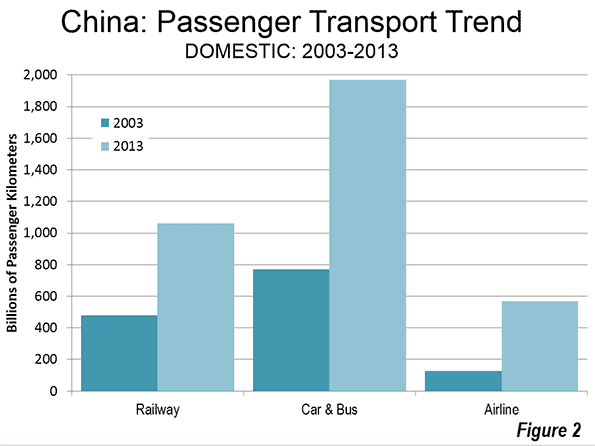
    Road travel increased more than 150 percent between 2003 and 2013 in China. Yet roads have barely held their market share as China has built new world-class airports, such as Capital City in Beijing, Baiyun in Guangzhou and many others. Over the same 10 years air travel has increased 350 percent. Meanwhile, China has built the world’s most extensive high-speed rail system and has experienced healthy rail travel growth. Yet, despite this, passenger rail’s market share has dropped from 35 percent to 29 percent over the period (Figure 2).
    China is dominant among the four economies in passenger rail volumes, with its 1.05 trillion annual passenger kilometers (0.65 trillion passenger miles) accounting for more than 2.5 times the rail travel in both the European Union and Japan. US rail travel is no more than 1/20th that of China (equal to the road travel volume in the state of Arkansas).

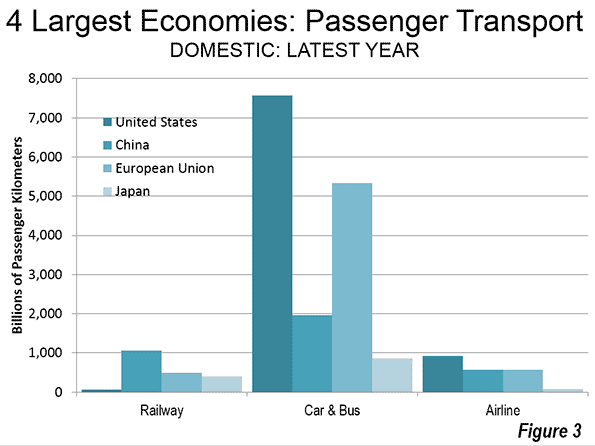
    The United States continues to lead in a domestic airline travel, with a volume approximately 60 percent greater than those of the European Union and China. China trails the European Union by only two percent and with its growth rate seems likely to assume the second position before long (Figure 3).

    Passenger travel market shares are indicated in Figure 4.
    Freight Transport

    After having led the world in rail freight volumes in recent decades, the United States has recently yielded the title to China. In 2013, China moved nearly 3 trillion tonne kilometers (Note 3) of freight by rail, compared to the US total of 2.5 trillion (2012). It may be surprising to find out that Europe, with its extensive passenger train system moves so little of its freight by rail. However, the European Union moved approximately 60 percent less of its freight by rail. However, much of the capacity of the EU’s rail system is consumed by passenger trains, leaving little for freight.  This is despite a policy commitment in the EU to substantially increase the rail freight market share relative to trucks. As a result, in Europe, the freight trains are "on the highway" (see Photo below). China has been uniquely successful among the world’s economies in developing both a world class freight rail system and a world class passenger rail system. One of China’s early objectives in developing its high speed rail program was to free space for its large freight train volumes.
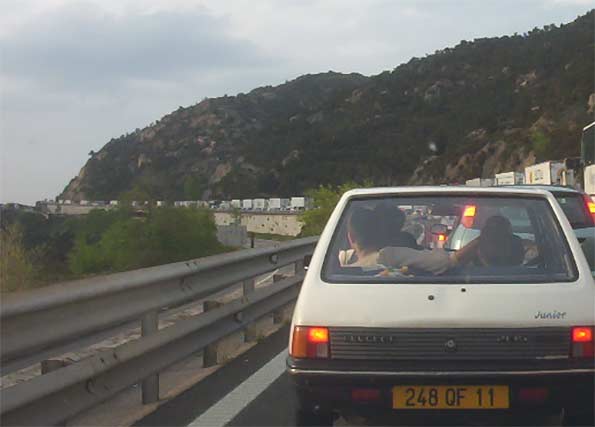

    Caption: Trucks on the A7, north of Barcelona (by author)

    Among other nations, only Russia can compete with China and the United States in rail freight, having moved approximately 2.2 trillion tonne kilometers in 2012.

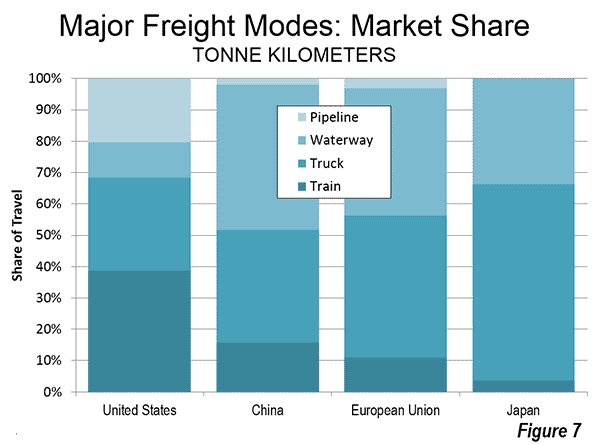
    Rail freight remains by far the most important in the United States compared to the other three largest economies. Rail freight continues to carry more tonne kilometers in the United States than trucks. The situation is much different in Europe, where trucks carried four times the volume of freight rail. Rail freight is even less significant in Japan, where trucks carry more than 15 times the volume of rail freight.

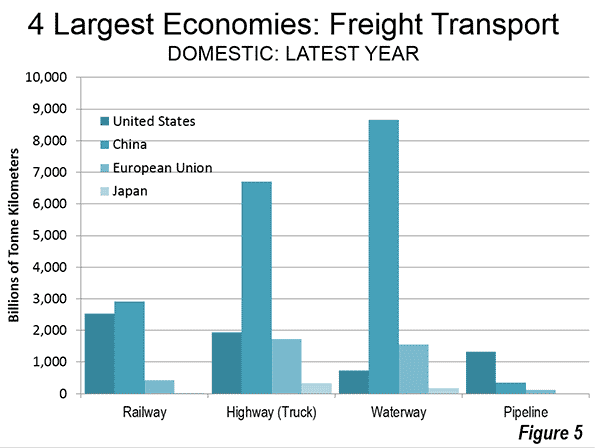
    One possibly surprising fact lies with the substantial increase in China’s truck volumes over the last decade. China now has a volume of truck traffic that is four times that of trucks in either the European Union or the United States.

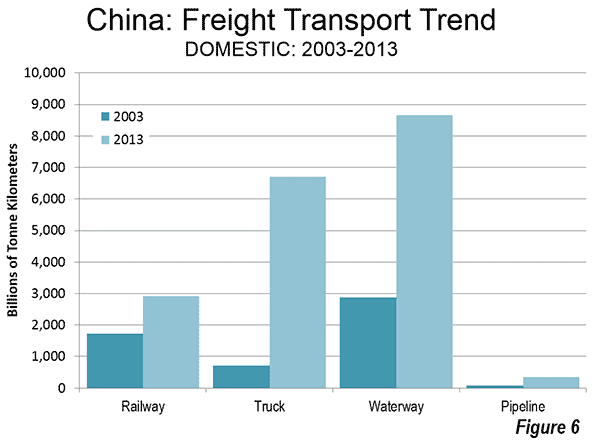
    In 2003, trucks carried 60 percent less of the nation’s metric tonne mileage than freight rail. By 2013, that had been reversed with tracks carrying 130 percent more volume than freight rail.

    However China’s dominance is even greater in water borne freight, at nearly 6 times the European Union volume and more than 10 times the volume of the United States (Figure 5). Even so, China’s largest freight volumes are carried on waterways, such as the Yangtze River. Over the past 10 years waterway volumes tripled. It is even expected that there will be a significant increase in shipping on the ancient Grand Canal (Figure 6).

    Freight market shares among the major modes are shown in Figure 7.
    India

    Another of the world’s largest economies, India, also relies heavily on roads. According to the World Bank 65 percent of the freight and nearly 90 percent of passengers are carried by roads in India, though late detailed data is not available. Yet India also has the largest passenger rail usage in the world. Only China is close, and the two nations have been near equal, at least over the last decade. In 2003, China trailed India by seven percent in passenger kilometers by train. Complete Indian Railway data for 2013 is not yet available. However, if the average trip length in 2013 was the same as in 2012, China will have moved to within two percent of India’s passenger rail volume. Both nations are far above Japan and the European Union, ranked third and fourth, and almost 90 percent above Russia, which has a reputation for high passenger rail volumes.

    The Future

    With economic growth in China slowing (though still at rates that would satisfy virtually any other nation) its transport growth of the past decade seems likely to moderate. On the other hand, the other large emerging economy, India, which has substantially trailed China, could assume a Chinese trajectory. The newly elected Bharatiya Janata Party (BJP) government is committed to economic advance and infrastructure development. Market facilitating policies like those that have propelled China (see the late Noble Laureate Ronald Coase and Ning Wang, How China Became Capitalist), could lead to a similar story about India in a decade or two.

    ——

    Note 1: The latest data on international transport varies by year, even within nations (such as the United States). This analysis compares the latest data, which is 2012 (Europe and Japan), 2013 (China) and the United States (2011, with some 2009). This latest years available permit comparing the general scale of differences and, particularly in the United States, changes from the earlier data are likely to have been modest, as a result of the Great Financial Crisis and the great economic malaise that has followed. The principal data sources are the Bureau of Transportation Statistics in the United States, the National Bureau of Statistics in China and Eurostat for the European Union and Japan.

    Note 2: A passenger kilometer (or passenger mile) is the distance traveled times the number of passengers. Thus, a car going 5 kilometers with one passenger produces 5 passenger kilometers. With two passengers, there are 10 passenger kilometers.

    Note 3: A tonne kilometer is a metric tonne (2.204 pounds or 1,000 kilograms) of freight times the number of kilometers traveled. The US ton (short ton) has 2,000 pounds or 907 kilograms.

    —-

    Wendell Cox is principal of Demographia, an international public policy and demographics firm. He is co-author of the "Demographia International Housing Affordability Survey" and author of "Demographia World Urban Areas" and "War on the Dream: How Anti-Sprawl Policy Threatens the Quality of Life." He was appointed to three terms on the Los Angeles County Transportation Commission, where he served with the leading city and county leadership as the only non-elected member. He was appointed to the Amtrak Reform Council to fill the unexpired term of Governor Christine Todd Whitman and has served as a visiting professor at the Conservatoire National des Arts et Metiers, a national university in Paris.

    Photograph: Grand Canal in Suzhou (by author)
  • Urban Core Jurisdictions: Similar in Label Only

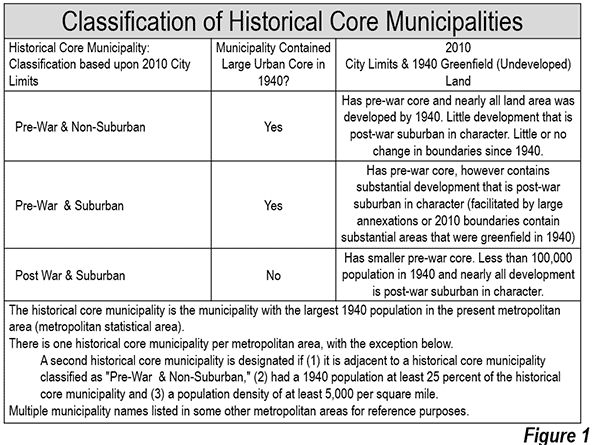
    The fortunes of U.S. core cities (municipalities) have varied greatly in the period of automobile domination that accelerated strongly at the end of World War II. This is illustrated by examining trends between the three categories of "historical core municipalities" (Figure 1). Since that time, nearly all metropolitan area (the functional or economic definition of the city) growth has been suburban, outside core municipality limits, or in the outer rings of existing, core municipalities.   

    Approximately 26 percent of major metropolitan area population is located in the core municipalities. Yet, many of these municipalities include large areas of automobile orientation that are anything but urban core in their urban form. Most housing is single-detached, as opposed to the much higher share of multi-family in the urban cores, and transit use is just a fraction of in the urban cores.

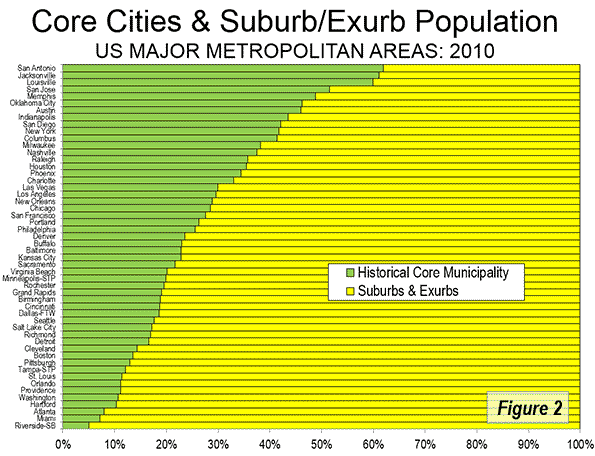
    Even counting their essentially suburban populations, today’s core municipalities represent, with a few exceptions, a minority of their metropolitan area population. The exceptions (San Antonio, Jacksonville, Louisville, and San Jose) are all highly suburbanized and have annexed land area at a substantially greater rate than they have increased their population.

    According to the 2010 census, using the 2013 geographic definitions, core cities accounted for from five percent of the metropolitan area population in Riverside-San Bernardino to 62 percent in San Antonio (Figure 2).

    International Parallels

    These kinds of differences are not limited to the United States. For example, the city (municipality) of Melbourne, Australia has little more than two percent of the Melbourne metropolitan area population. Indeed, the city of Melbourne is only the 23rd largest municipality in the Melbourne metropolitan area and has a population smaller than a single city council district in Columbus, Ohio.

    These virtually random variations in core city sizes lead to misleading characterizations. For example, locals sometimes point out that San Antonio is the 6th largest city in the United States. True, San Antonio is the 6th largest municipality in the United States, but the genuine, classically defined city – the broader metropolitan area that is the urban organism – ranked only 26th in size in 2010. The suburbs and exurbs, as defined by municipal jurisdictions, are smaller than average in San Antonio, but the city itself stretches in a suburban landscape up to more than 15 miles (24 kilometers) beyond its 1950 borders.

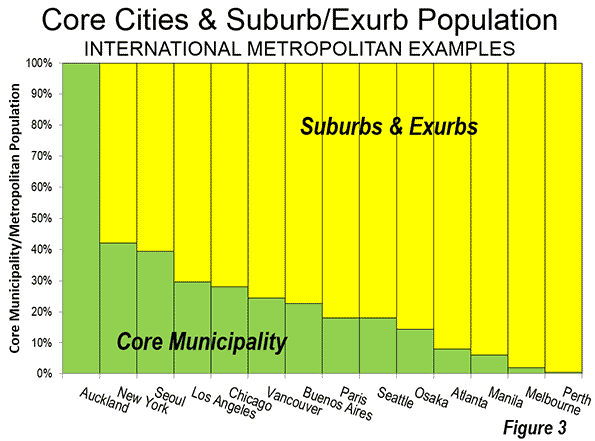
    Core municipality mayors have been known to travel around the as representatives of their metropolitan areas. In some cases core municipality mayors represent constituencies encompassing the entire metropolitan area (such as Auckland or soon to be major metropolitan Honolulu). Others have comparatively small constituencies. For example, the mayor of Paris presides over only 18 percent of the metropolitan area population, the mayor of Atlanta 8 percent, the mayor of Manila 6 percent, Melbourne 2 percent and Perth, Australia just 0.5 percent (Figure 3).

    Core Municipalities in the United States

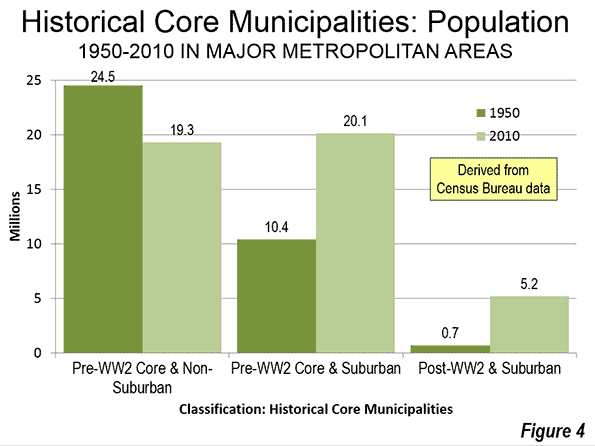
    A remnant of U.S. core urbanization is evident within the city limits of municipalities that were already largely developed in 1940 and have not materially expanded their boundaries. These are the Pre-World War II Core & Non Suburban category of core municipalities. Between 1950 and 2010 these core municipalities lost a quarter of their population, dropping from 24.5 million residents to 19.3 million (Figure 4). All but Miami lost population. Despite improved downtown population fortunes, the last decade saw a small further decline of 0.2 percent overall. Only two legacy cities, New York and San Francisco, now exceed their peak populations of the mid-20th Century.

    Again, this is the typical pattern internationally. Throughout the high-income world, the urban cores that have not expanded their boundaries and had little greenfield space for suburban development have had declining in population for years. My review of 74 high income world core municipalities that were fully developed in the 1950s and have not annexed materially showed that only one had increased in population by 2000 (Vancouver). Since that time, a few that had experienced more modest declines have recovered to record levels, such as Munich and Stockholm. Most others, such as London, Paris, Milan, Copenhagen and Zurich remain below their peak populations.

    In the United States, most of the strong growth has taken place in the "Pre-World War II & Suburban" classification, doubling from 10.1 million residents to 20.4 million since 1950. These include core cities with strong pre-war cores, but which have either annexed large areas or already contained large swaths of rural territory at that time (like Los Angeles, with its San Fernando Valley, which was largely agricultural) that later became heavily populated.

    Many of these core cities experienced population declines within their 1950 boundaries (such as Portland, Seattle and Nashville between 1950 and 1990). Los Angeles, however, has been the exception. The more highly developed central area (as defined by the city Planning Department) within the city limits has increased in population by one-third since 1950. The continuing suburbanization of the city of Los Angeles, however, is indicated by the fact that the central area’s share of city population has fallen from 68 percent to 47 percent.

    The "Post-World War II & Suburban" core cities are much smaller and their metropolitan areas are nearly all suburban. These include metropolitan areas like Phoenix and San Jose. The population of these metropolitan areas has increased more than seven fold, from 700,000 to 5.2 million.

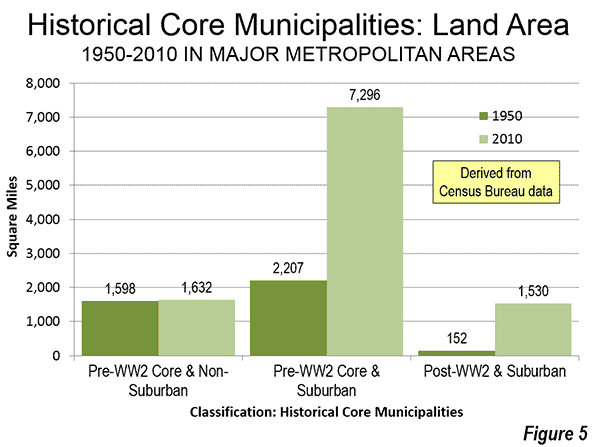
    Land Area: The differences between the three historical core municipality classifications are most evident in land area. Among the "Pre-World War II & Non-Suburban" cores, land areas were almost unchanged from 1950, with much of the difference reflected in Chicago’s O’Hare International Airport annexation. In contrast, the "Pre-World War II & Suburban" cores more than tripled in size, adding an area larger than Connecticut to their city limits. The percentage increase was even larger in the "Post-World War II & Suburban" cores which covered 10 times as much land in 2010 as in 1950 (Figure 5).

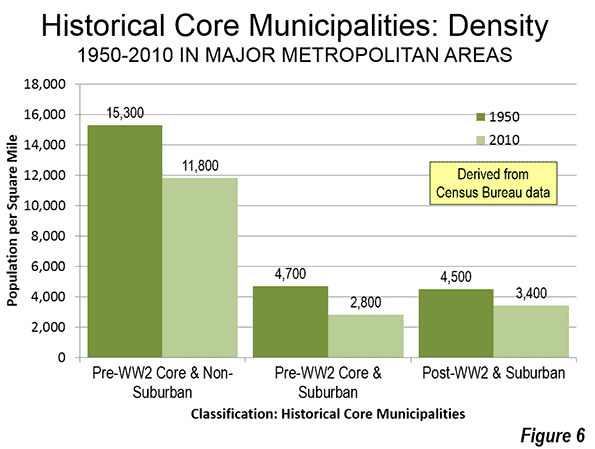
    Population Density: Over the 60 year period, the population density of the "Pre-World War II & Non-Suburban" cores dropped from 15,300 per square mile to 11,400 (5,900 per square kilometer to 4,400). The "Pre-World War II & Suburban" and "post-World War II & Suburban" cores started with much lower densities and then fell farther. The core city densities in these municipalities are approximately one-half the population densities of Los Angeles suburbs (Figure 6).

    The Need for Caution

    All of this indicates the importance of caution with respect to core versus suburban and exurban comparisons. For example, Atlanta, which represents only 8 percent of the urban organism (metropolitan area) in which it is located is not comparable to San Antonio, with its 62 percent of the metropolitan population. These distinctions are important when we talk about different regions.

    Wendell Cox is principal of Demographia, an international public policy and demographics firm. He is co-author of the "Demographia International Housing Affordability Survey" and author of "Demographia World Urban Areas" and "War on the Dream: How Anti-Sprawl Policy Threatens the Quality of Life." He was appointed to three terms on the Los Angeles County Transportation Commission, where he served with the leading city and county leadership as the only non-elected member. He was appointed to the Amtrak Reform Council to fill the unexpired term of Governor Christine Todd Whitman and has served as a visiting professor at the Conservatoire National des Arts et Metiers, a national university in Paris.

    Chicago photo by Bigstock.

  • Ukraine Watch: Kiev in the Media Center Spotlight

    This spring I traveled from St. Petersburg to Kiev, by way of southern Russian and eastern Ukraine. The newspapers were filled with reports of American policymakers gushing over how mobs in Kiev deserved the inalienable rights of freedom fighters and self-determination. Mobs of Russian mercenaries in Eastern Ukraine, who set up automobile tire and sandbag roadblocks, were condemned for threatening world peace.

    I took trains and mini-vans, and crossed the Russian-Ukrainian border between Belgorod (Russia) and Kharkiv (Ukraine), where, at least in the Western press, there are large concentrations of Russian forces getting ready to pounce on Ukrainian independence (I did not see any).

    As I travelled (with my 18-year-old son), I came to view the crisis less in geopolitical terms and more as opportunities for what the Soviets used to call agitprop, from “agitation and propaganda.” Like the agitprop theatricals of the 1920s, this war serves as the extension of public relations by other means.

    Ukraine is tailor-made for show business: it’s a folk opera, one of those performances in native dress you have to endure on package tours around Europe. The storyboards of an evil Vladimir Putin play well, even to an American electorate unsure if Donbas is a region or a dress designer.

    From any microphone in the world, President Obama can threaten “additional sanctions” against the Russian oligarchy. Vice President Biden can jet into Kiev with messages about how “the American people stand with the people of Ukraine, ” while Secretary of State John Kerry intones high moral dudgeon.

    For Putin, saber-rattling over Ukraine is a better media opportunity than even the winter games. It’s a chance to dominate the world stage and be taken seriously without having to put up another Olympic village for $51 billion.

    Day-to-day in the Kremlin, Putin presides over an empire in decline. For Russian men — awash in tobacco and vodka — the average life expectancy is about 64, and Potemkin’s village is now the glitter around Moscow, covering up the grim reality of the provincial cities.

    Economically, Russia’s trade zone with Belarus and Kazakhstan cannot compete with Europe, and China’s economic boom makes Russia, by comparison, look like a collective farm. For that reason, it’s doubtful that Putin needs to annex another coal region with high unemployment, although he’s happy to claim it if local militants drop it in his sphere of influence.

    As the avenger of the 1854 Crimean War, Putin can, at least, lay claim to Empress Catherine-like greatness, although the word on the Moscow street is that he took Yalta and Sebastopol so that Russian oligarchs can cash in on the bourgeois pursuits of gambling and casinos.

    Even the provisional government in Kiev has an interest in using the crisis to promote its competency. It came to power not through elections, but from street demonstrations, which were funded by sources as diverse as local oligarchs, nascent political parties, foreign intelligence agencies, the Catholic church, and neo-fascist elements. Each tent represents a marker in the great game.

    The freedom fighters still encamped around Kiev’s main city square, Maidan, look less like Jeffersonian democrats exchanging copies of Montesquieu’s treatises and more like those second-amendment militias in Montana, to whom all governments are evil.

    Dozens of tents are pitched in the square. The occupants, many dressed in thrift shop army fatigues, have the angry, down-and-out look of the 1890s Coxey’s Army of the unemployed, rather than of delegates to the Continental Congress.

    The Kiev protesters overthrew one government and are standing by—chopping wood, grilling sausages, listening to music, stacking bricks—to see what happens in the May 25 presidential election. To be clear, the February martyrs of the Maidan (about 110 were killed), whose pictures line makeshift altars around the square, were not paid to give their lives in political opposition.

    They took to the streets against the government of Viktor Yanukovych, which they saw as corrupt, dictatorial and ready to consign Ukraine to a Putin revival of the Warsaw Pact and Comecon. But in the chess culture of Ukraine, knights and bishops go forward with different goals than pawns.

    The Kiev government is struggling and divided. About 20 candidates have declared for the presidency, and at least eight parties are represented in the parliament. What could be more uplifting for them than solidarity phone calls from President Obama or pep talks from the US vice-president?

    The problem with the American embrace is that it validates the Russian belief that NATO, the EU, and the United States want Ukraine in their sphere of influence. Otherwise, why would the director of the CIA have come to Kiev during the recent crisis? Imagine the American reaction if an interim government in, say, Quebec welcomed the head of the Russian secret service, the FSB.

    The extent to which the crisis is being waged by the media can be seen in Kiev’s Hotel Ukraine, a dreary Intourist relic of the Soviet era overlooking the Maidan that, during the street demonstrations, allegedly rented out rooms to government snipers. Now that tourists rarely visit Kiev, the hotel is headquarters for something called Ukraine Crisis Media Center, a slick public relations operation where journalists can stop by for a quick coffee and a quote.

    On paper, the group is staffed with patriotic volunteers, there to keep alive the martyrdom of the Maidan and to warn about the evils of Russian aggression. In practice, the “media center” has the look of serious American front money.

    The day I was there it featured short, introductory remarks by the US ambassador to Ukraine and a press conference from the ranking minority member of the Senate Committee on Foreign Relations, Bob Corker (R-Tennessee).

    For these thirty minutes, Ukrainians, like homespun Tennessee constituents, were simple, hardworking folks who needed American support to throw off the Russian yoke. Yes, there was the local problem of corruption, but that was “a remnant of the Soviet-era,” much like the plumbing, I guess.

    Corker explained that he had come to Kiev to “show support for the people of Ukraine” and to applaud their courageous right to “self-determination”. For its aggression, he said, Russia and its president needed to “pay a price.”

    At no point was any mention made of other causes of the current crisis: NATO designs to push its military frontiers to Ukraine and Georgia, despite earlier assurances from President Bush (Sr.) not to advance NATO east of a reunited Germany; the US seeing Ukraine as a fertile market, not just for its intelligence services, but for its gas exports and energy companies; Ukraine’s kleptocracy that has left the post-Soviet economy stillborn since 1991; and elements of the non-elected government having spoken with the same reverence about fascism that earlier citizens accorded their Nazi liberators in 1941.

    In Washington’s press releases, the masked men in the East are Russian proxies in a renewed Cold War. To Moscow, the encampments around the Maidan are the spiritual heirs of the army of the Bay of Pigs.

    My own view is that that the liberators of Eastern and Western Ukraine, despite having different ideological mentors, are the homegrown dissidents of a failing state, one with high employment, cornered markets, governments with Italian-like instabilities, and few profits that have trickled down to ordinary citizens.

    Before leaving Kiev, we thought about visiting the vacated house of the former President Yanukovych, who departed in a hurry for his Russian exile, leaving behind his gilded furniture and private zoo. We were told the house is being transformed into a Museum of Corruption. Admission costs 20 Ukrainian hryvnia, although you can also get in by paying 10 hryvnia to one of the guards.

    Matthew Stevenson, a contributing editor of Harper’s Magazine, is the author of Remembering the Twentieth Century Limited, a collection of historical travel essays. His new book, Whistle-Stopping America, was recently published. He first traveled to the former Soviet Union in 1975, and over the years has been to many of its then-constituent parts.
    Photo by the author: Tents in the Maidan.

  • Crimea and Ukraine: What Putin Could Learn from Yugoslavia

    While American government officials respond to the Russian Anschluss in Crimea by mobilizing their Twitter feeds and making the rounds of the Sunday morning meetings of the press, the Moscow government of Vladimir Putin reinforced its occupation forces around Simferopol and Sebastopol, perhaps at some point passing out small Russian flags to local sympathizers, who can wave them gratefully when the symbolic gates between Russia and Crimea are thrown open.

    To paraphrase a quote that circulated in the 1930s: “The West likes to spend its weekends in the country, while the Russians prefer to take their countries in a weekend.”

    The reason the Russians have chosen this moment to move against Ukraine and its Western patrons is not difficult to reconstruct. Since the fall of the Soviet Union in the early 1990s, the United States, NATO, and most recently the European Union have treated Russia as little more than a Grand Duchy of Lithuania.

    The moment it could, when the Soviet Union was in liquidation and Russia was weak, NATO pushed its military frontiers into Poland, the Baltic States, Slovakia, and even Georgia. At international conferences such as the G7, it sat Russian presidents at the children’s tables. In the Middle East, the United States and its allies blew away Russia’s man in Baghdad — Saddam — and is now doing the same with Assad in Syria.

    In Libya, despite giving Russia assurances that the no-fly zone was there to protect citizens trudging to markets with their donkeys, it was expanded to justify killing Qaddafi and reserving the sweetheart oil contracts for western corporations. No wonder Russia had its doubts when the US and the EU started hinting that Ukraine’s president, Viktor Yushchenko, had stolen more than was necessary.

    More immediately, Putin felt humiliated when the Western press comically treated his Olympics as though he was Comrade Kane, staging a $51 billion snow opera for his girlfriend.

    Putin did not become president-for-life of Russia by giving fundraisers in Napa Valley or interviews to Esquire. By nature intensely competitive, he still smarts from the dissolution of the Soviet Union, especially the loss of Ukraine.

    Short of reviving the 1854 Crimean War coalition (Britain, France, and Turkey, with Austro-Hungary and Prussia neutral) and besieging Sebastopol, there isn’t much that the West can do, or will want to do, to evict Russian troops from Crimea. Will Russia now take up the fallen mantle of the Soviet empire? Will it work?

    By invading or partitioning the Ukraine, Russia sets itself up as the Yugoslavia of the 21st century—Russoslavia? Like Slobodan Milosevic before him, Putin is a former Communist war horse who champions the nationalist cause of disenfranchised Russians cut adrift after the dissolution of the Soviet Union — Yugoslavia on a grander scale, with the same hodgepodge ethnicity. Ukraine becomes the Bosnia of the 21st century.

    Yugoslavia was a 19th century political ideal, to pull together a number of smaller, vulnerable Balkan states from the encroachments of the Austro-Hungarian Empire to the north and the Ottomans to the south. It came into being at the end of World War I, although by that time neither the Austro-Hungarians nor the Turks were powers in southwest Europe.

    Almost immediately, without the common threats, the countries of the Yugoslav federation fell out, although the country lasted, officially anyway, until the 1990s. To be a Serb living in Bosnia or Croatia was fine until those republics went for the exits of Yugoslavia, when to be Serb became to be a symbol of a failed central government or, worse, a second-class citizen living in a new country.

    Russia’s role in the Soviet Union was not unlike the position of Serbia in Yugoslavia. It had the largest population, was the seat of the central government, and, later, had the most to lose when constituent states of the federation decided to secede and take with them large blocs of Russian citizens.

    With the Soviet devolution, Russians became a lost tribe of the Cold War, stranded with few rights and much contempt in places like Ukraine, Moldova, Kazakhstan, Uzbekistan, Belarus, and Latvia.

    When I have traveled in Russia or the ex-Soviet Union, I have met many who say, for example, “My father was from Moldova and my mother was Russian, but during the war we were moved to Uzbekistan, although later I went to school in Riga.”

    Putin is their archangel, much as the writer Aleksandr Solzhenitsyn was their philosopher-king, writing in 1995, “Russia has truly fallen into a torn state: 25 million have found themselves ‘abroad’ without moving anywhere, by staying on the lands of their fathers and grandfathers. Twenty-five million — the largest diaspora in the world by far; how dare we turn our back to it?? Especially since local nationalisms (which we have grown accustomed to view as quite understandable, forgivable, and ‘progressive’) are everywhere suppressing and maltreating our severed compatriots.”

    While there is a rationale for Putin speaking up for the lost rights of the Russian diaspora, the last thing he needs, in exchange for the liberation of Donetsk, is a Muslim Risorgimento in Tatarstan, Chechen agitation, a separatist movement in Siberia, or rebellion from the two million Ukrainians living inside Russia.

    Like Yugoslavia, Russia has a lot it can lose in playing the nationalist card, because it risks a series of border wars if it tries to impose Greater Russia not just on gleeful former citizens, but on less enthusiastic minorities, who want nothing to do with a Russian restoration.

    In its attempts to hang on to its cordon sanitaire in the past, Russia became the patron of bizarre breakaway republics, such as Transnistria (a Russian enclave between Ukraine and Moldova), Abkhazia and South Ossetia in Georgia, and Nagorno-Karabakh in Armenia. An Autonomous Republic of Crimea, run by shady commissars flitting around in SUVs, would fit well with these no-man’s lands, dressed up for the Kremlin masquerade.

    Most likely the Ukraine crisis will end with the same vagueness that has characterized so much of international diplomacy since the end of the Cold War. In most cases, Moscow has ended up as the guardian of a series of rump states, the latest of which might be Crimea.

    Matthew Stevenson, a contributing editor of Harper’s Magazine, is the author of Remembering the Twentieth Century Limited, a collection of historical travel essays. His new book, Whistle-Stopping America, was recently published. He first traveled to the former Soviet Union in 1975, and over the years has been to many of its then-constituent parts, usually by train.
    This post is a different version of a longer analysis at NYTimes eXaminer.

    Flickr photo by Alexxx Malev: Sevastopol 187

  • Freedom and its Fruits: Fertility Over Time in Estonia

    Estonians and Latvians are the only independent nations in Europe with fewer people now than at the beginning of the 20th century. It is written in The White Book, 2004, about losses inflicted on the Estonian nation by occupation regimes. During the whole period (1940-1991) nearly 90,000 citizens of the Republic of Estonia perished, and about the same number of people left their homeland forever. It happened in a nation with a population number of about one million. Another nation, through centuries, gradually perished and disappeared from this territory: the Livonians. Their leader, Caupo, in 1203 was received with honor by Roman Pope Innocent III. Interestingly, at least three regions in America are named after Livonians. They are Livonia in New York State, Livonia in Pennsylvania, and Livonia in the Michigan. Do the inhabitants of these Livonias have any connection to the Livonians at the Baltic Sea?!

    The growth of the number of Estonians in 45 postwar years till 1990 was about 100 thousand. This was caused by natural increase, decrease of mortality, return of ethnic Estonians from Russia. The fertility rate of Estonians was below the replacement level for 40 years, but from 1970 to 1990 was at or above the replacement level. At the same time, the foreign-born population experienced a rate of fertility beneath the replacement level: 1.64 – 1.72.

    The time between 1983 and 1988 was a positive period, with a crude birth rate (the number of births per 1000 people per year) of about 16.0. It is interesting that this situation arose during the so-called “stagnation era”. The stagnation period – life without radical changes – was probably fruitful for fertility growth. The same trend was noted for Russia. Perhaps this increase was caused by the decision of the Soviet government in 1981 to increase the birth rate “About Measures of Public Support to Families Having Children”. In 1989, the peak of fertility was over.

    The French demographer Adolphe Landry (1874-1956) defined genuine demographic revolution as the situation in which use of contraceptives and abortions by women becomes universal. This revolution detaches fertility from social control and transfers it to the interests of individuals. For Estonia, this period arrived at the beginning of nineties, when plenty of contraceptives became available, in addition to abortions continuing to be permitted.

    In 1991, the crude birth rate fell to 12.4, and the total fertility rate (number of children per woman during her lifetime, which characterize the necessary replacement level of 2.1) to 1.80. The year of 1991 was the first year of two decades of continuing decrease. Remarkably, fall of the birth rate at the beginning of nineties was much worse than it was during WW II. The population of about one million had 19.5 and 19.2 thousand births respectively in 1941 and 1942 during the war, but in 1993, when conditions were clearly better, only 15.3 thousand children were born to a population of one and a half million. The genuine demographic revolution had truly arrived!

    The reasons, in addition to the availability of contraceptives and abortions, were the decline of religion, economic uncertainty regarding the future, the opening of the world with a variety of lifestyle choices and career paths. Almost thirty decrees regarding the family benefits of the Soviet period that had been made by that government were cancelled in 1992. In the liberal market economy of the nineties, population policy was left largely to chance. Public attention to the issue was narrowly limited to family benefits and integration programs.

    The Parental Benefit Act passed in 2003 tried to attain the birth rate. According to the Act, persons have the right to receive parental benefits for 435 days from the day following the final day of maternity leave. The amount of the parental benefit received is calculated on the basis of the Social Tax paid during the previous year. If the parent didn’t work, the parental benefit is paid at the designated benefit base rate, which is 290 euros in 2013. The upper limit of the amount of the parental benefit is three times the average salary earned during the year before last, which – in 2013 – is 2,234 euros.

    If we take the birth rate of the years 2002 and 2003 – 13,000 births – as the plateau (base rate) and eliminate all other factors pertaining to reproductive behavior, then natality during the 2004-2012 period resulted in about 18 thousand additional births. This speaks to the effectiveness of the parental benefit. However, even this was insufficient for attaining positive natural increase. The total maximum fertility rate obtained was 1.65, but later, in 2011, it decreased to 1.52. In 28 countries of European Union the mean value of the total fertility rate was 1.58 in 2012, for euro area it was 1.56. However in France, which has perhaps the oldest experience in field of demography and demographic research, this indicator was 2.01. In contrast, Singapore’s total fertility rate steadily dropped from 1.6 in 2000 to a record low of 1.16 in 2010. It bounced back to 1.2 in 2011, and further to 1.29 in 2012, but last year slipped again to 1.19. 

    The government aims, by 2015, to achieve a birth rate that is higher than the death rate, meaning an increase of the total birth rate to 1.70. (Action Program of the Government of the Republic 2011-2015). This seems unattainable. Poverty and migration worsen the situation. The at-risk-of-poverty rate in Estonia in 2011 was 17.6% on the average. The parent benefit and family benefits together constituted 1,7% of GDP in 2011 ( the same figure in Sweden and Finland was 3%).  

    One key cause, ironically, is freedom to move that came with the fall of the Soviet Union. Handling the population decrease we described first of all the birth rate, but last years has been intensified external migration. Migration that took place in 2011 decreased the population of Estonia in 2012 by 6,600 inhabitants. The trend continued. In external migration, there was an increase in both immigration and emigration in 2012. Over 4,000 persons immigrated to and almost 11,000 persons emigrated from Estonia. The main destination countries for emigrants are Finland and the United Kingdom. Most of the immigrants are in fact returnees, mostly from Finland. The second place is held by Russia, but the immigrants from Russia are mainly new immigrants.

    Despite numerous attempts to boost birth rate, the years from 1991 to 2013 are characterized by a birth rate under the replacement level. The lowest point arrived in 1998, with a total fertility rate of 1.28. After that it began to rise, reaching 1.65 in the year of 2008, only to decrease again later. At the same time, the population figure decreased by 14%. Problems caused by decreasing population entail a threat to the survival of the Estonian national culture, issues with sustainable economic development and difficulties with the sustainability of the social infrastructure. 

    How to avoid the fate of Livonians? Is there a force majeure against the small nation? Or it is a problem of insufficient national steering without any specialized institution responsible on population?

    Jaak Uibu, a Phd. in human micro ecology, was former Deputy Minister of Health of Estonia and advisor to Minister of Population. 

    Oleviste photo by E. Kanash.

  • Switzerland: Why EU Immigrants Were Headed Off at the Pass

    The only time the Swiss make US headlines, other than with the occasional Olympic biathlon medal, is when a majority of the voters exercise their franchise by voting down minarets or, as happened this month, banning free immigration from the European Union.

    As the most democratic country on earth — major political questions are submitted to a popular vote — Switzerland allows what are called popular initiatives on any issue that can muster 100,000 signatures on a petition. It’s the only country in Europe that operates like “The Gong Show”.

    Popular initiatives on the ballot arise from signed petitions. Referendums, on the other hand, although voted on in the same manner, sometimes give citizens the right to approve or disapprove legislation that has already passed.

    In a country of almost eight million people, getting one percent of the population to sign off for a ballot initiative on the outrage of the day isn’t very challenging. Then, when the vote is scheduled, the Swiss, including me, say yes or no to all sorts of questions.

    My favorite initiative, a while back, was whether the animals in each canton (county is the closest English word) needed a lawyer to handle their days in court. A cat man, I voted yes. My neighbors, in the majority, said no, implying that the laws of the jungle were all the animals needed.

    In the case of European Union (EU) immigration, the Swiss People’s Party — called the UDC locally and dominated by right-wingers, Swiss Germans, and farmers in rural cantons — asked for a vote to restrict EU immigrants from entering Switzerland, and to restore an earlier edict that Swiss job applicants have precedent over foreigners.

    While Switzerland is not a member of the EU, during the last twelve years it has agreed to a number of bilateral treaties that give Europeans unfettered access to Swiss job markets and to establishing local residency here.

    With the European economy flat-lining since 2008, many in the EU have drifted across the border into Switzerland to work in a variety of skilled and unskilled jobs. With paychecks in Swiss francs, the work offers better returns than, say, looking to catch on as a hedge fund manager on the Greek island of Mykonos.

    Now that the Swiss have voted to put quota limits on EU immigrants, what exactly will happen?

    The way the initiative system works is this: just because a question is accepted by popular acclaim doesn’t make it law. It does, however, give the government — in this case the federal parliament in Bern — three years to draft and pass a law that complies with the spirit of the resolution.

    The way the law is written over the following three years, however, doesn’t necessarily conform exactly to what has been voted up or down in the popular initiative.

    In the case of the immigration vote, I would imagine that many caveats will be written into the deportation orders so that foreigners holding down jobs in Switzerland will not be driven to the border, and that future immigrants will continue to find Swiss places to live and work (although the needed paperwork will increase).

    When I moved from the US to Switzerland in 1991, it was before the existing open immigration policies were in place. To hire me, my employer had to write the job posting in such a way that only one person on earth, me, had those requisite skills. It took me six months to get a work permit and begin my job.

    In much news reporting about the current immigration vote, the subtext is that the Swiss are racist in wanting to boot out foreigners and that the country suffers from “too much democracy” by allowing citizens to vote on questions as though everyone were a parliamentarian.

    I’d answer the racism charge by saying that the Swiss are about average in terms of tolerance for immigration. Unlike the US, for example, Switzerland does not have a fence along its southern border. Nor does it fingerprint foreign tourists at the airports.

    To my mind, the immigration vote was less about racial intolerance, and more an expression of Swiss anger at Brussels and even Washington for routinely beating up the country over such issues as Libya, banking secrecy, minarets, the strong Swiss franc, and bilateral trade agreements.

    Swiss critics — and there are many around Europe and the world — argue that Switzerland wants all the benefits of the adjacent EU, such as access to its rich markets, but without incurring any of the costs, for example, those run up in bailing out the insolvent Greeks.

    There may be some truth to this, but, nevertheless, there are also both historical and modern reasons that Switzerland refuses to join the EU. The 1815 Congress of Vienna, at the end of the Napoleonic wars, and a subsequent Treaty of Turin enshrined the idea of Swiss neutrality as one of the cornerstones of the European peace.

    No single major power, it was argued, should hold sway over the Swiss alpine passes and the trade flows of Europe. Two-hundred-year-old political traditions die slowly.

    The recent reasons that Switzerland has not joined the EU have to do with its federalism, rooted in its communal and cantonal governments, including things like initiative and referendum voting. All political power in Switzerland is local; everyone is a communard.

    Many Swiss feel that if the country were an EU member, their communes (really villages) would become hostage to German edicts or French heavy-handedness, not to mention bureaucrats in Brussels.

    In practice, Swiss democracy most closely resembles Thomas Jefferson’s constitutional theories, in which well-educated farmers and small business operators (not career politicians) run the villages and the towns, and all abhor centralized power, be it in Bern, London, Paris, Brussels or Washington.

    By contrast, the US likes to boast that it is the greatest democracy on earth, even though the Senate is a millionaire’s club, Congress is a gerrymandered closed shop of incumbents, and the presidency is a legalized monarchy. (If in doubt, compare the court of Louis XIV with the 700 people in President Obama’s traveling entourage, which includes speechwriters, chefs, and food tasters.)

    Between incumbency and the Electoral College, many US votes “don’t matter,” and they only happen every two or four years.

    For sure, letting every Swiss over age 18 play the role of parliamentarian every six weeks has its risks (I still think we should have voted in those animal-rights lawyers). But the major reason I became Swiss in 2009 was so that I could vote every six weeks on the issues of the day.

    My family is composed of six voters, and what’s amazing is how we have completely different views on each ballot question. I vote for business and bike lanes and against taxes, while I suspect my wife of either syndicalism or maybe what the French delightfully call gauche caviar, (the local equivalent of ‘limousine liberalism’).

    The children spread their votes around between the greens and fiscal no-nonsense, so that a dinner during an initiative vote reminds me of the last scenes in Lawrence of Arabia, when various tribes swarm the pan-Arab Congress, all waving large flags.

    Yes, referendum democracy makes mistakes. The vote to prohibit minarets, to give just one example, was a lose-lose proposition, and it only went on the ballot to humiliate the government. But without these ballots — even those that propose marching immigrants to the border — our dinners would be sadly quieter, and our politics would be, too.

    Matthew Stevenson, a contributing editor of Harper’s Magazine, is the author of Remembering the Twentieth Century Limited, a collection of historical travel essays. His new book, Whistle-Stopping America, was recently published.
    Flickr photo by tomgeens

  • The Changing Face of European Economics: Liberalism Moves North

    Where do we find the nations with the highest tax levels? In the mid-90s the answer was quite clear: in Western Europe. Both Denmark and Sweden had a tax rate of 49 percent of GDP in 1996, followed closely by Finland with a 47 percent level. The tax burden was somewhat lower in France, Belgium, Austria and Italy, where rates ranged from 42 to 44 percent of GDP. Thanks to its oil-wealth Norway could afford a Nordic welfare model with 41 percent taxes, the same level as the Netherlands which had recently slimmed down its welfare system considerably. These Western European welfare states were the nine OECD countries with the highest tax rates. The tenth country was Eastern European Hungary with a rate of 40 percent.

    And where do we today find the high-tax nations? Looking at tax data from 2012, the answer is again amongst the Western European welfare states plus Hungary. At first glance, little seems to have changed with time. The only country to leave the top-10 list is the Netherlands, which has recently been replaced by another Western European nation: Luxembourg. But a closer look shows that Western Europe’s welfare states have indeed changed, and are continuing to do so. With time, a significant convergence has occurred.

    In 2012 Denmark still lead the tax league, with a 48 percent rate. France and Belgium had climbed to shared second position, with 45 percent tax rates. Rising levels in Italy and lowered ones in Sweden and Finland resulted in the three countries sharing a 44 percent level. Austria and Norway had increased their levels slightly, whilst the Netherlands had implemented further reductions. So, the welfare states with the highest taxes lowered their levels, whilst those with somewhat lower levels raised them. The Netherlands is the exception, as it continued to reduce relatively low taxes. No surprise then that it is the only country to leave the top-10 tax league.

    Of course, taxes are far from the only indicator of economic policy. A range of other factors, such as trade openness, business policy and protection of property rights, affect the opportunities for job creation, competition and growth. The Index of Economic Freedom, published by the Heritage Foundation in partnership with the Wall Street Journal, ranks countries based on a broad set of indicators of economic freedom. The Western European welfare states can overall be said to combine large public sectors and high taxation with relatively free economic policies. But the differences between them are significant, and the direction of change has varied considerably during the last decades.

    Tax rate % of GDP

    1996

    2006

    2012

    Change 1996-2012

    Sweden

    49,4

    48,1

    44,3

    -5,1

    Finland

    47,1

    43,5

    44,1

    -3,0

    Netherlands

    40,9

    39,1

    38,6*

    -2,4

    Denmark

    49,2

    49,0

    48,0

    -1,2

    Austria

    42,8

    43,0

    43,2

    0,4

    France

    44,2

    43,6

    45,3

    1,1

    Norway

    40,9

    43,1

    42,2

    1,4

    Belgium

    43,9

    44,4

    45,3

    1,4

    Italy

    41,6

    40,8

    44,4

    2,8

    * Data given for 2011. Source: OECD Stat Extract and own calculations.

    When the index of economic freedom was first published in the mid-90s, it showed that the Netherlands and Austria were the most market liberal of the nine Western European countries listed above. Sweden and Italy were on the other hand found at the bottom. In the latest 2014 edition of the index, Denmark – which compensates for high taxes with market oriented policies, including a liberal labour market – has climbed to become the freest economy amongst the group.

    In fact, Denmark ranks on 10th position globally, higher than even the US on 12th position and the UK on 14th. The Netherlands ranks on 15th place globally, followed by Finland and Sweden on the 19th and 20th positions. Belgium on the other hand has gone from being one of the more economically free Western European welfare states to becoming the third least free. Today the country scores on 35th place globally. France is found on a dismal 70th position, and is unique in having reduced its economic freedom score marginally between 1996 and 2014. Italy has merely increased its score by 0.1 points, ranking at 86th place– just below Kyrgyz Republic. The Western European welfare states might seem to have similar policies at first glance, but differences in market adaptation are in fact quite significant.

    Heritage/WSJ Economic Freedom Score

    1996

    2006

    2014

    Change 1996-2014

    Sweden

    61,8

    70,9

    73,1

    11,3

    Finland

    63,7

    72,9

    73,4

    9,7

    Denmark

    67,3

    75,4

    76,1

    8,8

    Norway

    65,4

    67,9

    70,9

    5,5

    Netherlands

    69,7

    75,4

    74,2

    4,5

    Belgium

    66,0

    71,8

    69,9

    3,9

    Austria

    68,9

    71,1

    72,4

    3,5

    Italy

    60,8

    62,0

    60,9

    0,1

    France

    63,7

    61,1

    63,5

    -0,2

    * Data for 1997 given. Source: Heritage/WSJ Economic Freedom Index and own calculations.

    The change in economic freedom parallels that of change in taxation, since taxation is an important part of economic freedom and since tax-reforms and other market reforms have tended to go hand-in-hand. The major changes have happened in the Nordics, particularly in the three high-tax countries which lack Norway’s oil-wealth. Sweden has lowered its taxes by over 5 percent of GDP between 1996 and 2012, by far the greatest change. The country has also increased its economic freedom score by over 11 points, again the most significant change. If Sweden had retained its 1996 score, it would score as the 78th freest economy today, just below Paraguay and Saudi Arabia.

    Finland has reduced its taxes by 3 percent of GDP, and improved economic freedom almost as much as Sweden. Denmark still leads the tax league, but has also implemented major increases in economic freedom – quite impressive given that the country had a high economic freedom score already in the mid-90s. Norway has liberalized overall economic policy, but increased taxation somewhat. France and Italy have stagnated at a low economic freedom score, and relied on increasing taxation rather than growth-oriented reforms to fund public services. Belgium and Austria have implemented some economic liberalization, but increased taxes. 

    The welfare states of Western Europe are quite complex. Their social and economic systems have much in common, but also differ in many ways. Today, as well as during the mid-90s, the countries in the world with the highest tax rates are found amongst this group. Still, major changes have occurred, and more seem on the way. In the upcoming 2014 elections of Sweden, it is more likely than not that the left will emerge victorious. But even the social democrats have, after initial resistance, accepted most of the current center-right government’s reforms. The social democratic government of Denmark is currently focused on reducing taxes, as well as government spending and the generosity of the welfare state. Part of the inspiration at least seem to come from the recent workfare policies of the Swedish right.

    As I recently discussed in a New Geography article, the current government of the Netherlands has raised the issue of reforming the welfare state further, to a “participation society” by encouraging self-reliance over government dependency. Finnish policies focus on how new entrepreneurial successes can be furthered. Part of the background is that Nokia, which the country relied so much on, has quickly fallen behind the global competition. On the other hand, the small company behind the game Angry Birds has gained global attention and become a symbol of new Finnish ingenuity. France and Italy still struggle with faltering markets and sluggish development. Perhaps with time the countries will follow the lead of the Nordics and the Netherlands, in reducing the scope of big government, and moving towards lower taxes and increased economic freedom?

    It is anything but easy to predict the future development of the Western European welfare states. But one thing is clear: the countries in the region that are doing well today are those that have reformed towards free-market policies and lower tax burdens since the mid-1990s. Given the apparent problems in France and Italy, and the continued interest for market reforms in the more vibrant North, it would seem that increased economic freedom is still the recipe for success.

    Dr. Nima sanandaji is a frequent writer for the New Geography. He is upcoming with the book “Renaissance for Reforms” for the Institute of Economic Affairs and Timbro, co-authored with Professor Stefan Fölster.

    Creative commons photo "Flags" by Flickr user miguelb.

  • Female Executives Across the European Union

    A great divide exists between European countries when it comes to the issues of women’s career opportunities. Some countries have high female work participation and values that promote gender equality, while others lag behind. But a closer look shows that the share of women in managerial positions is in odds with other indicators of equality. Scandinavia, where we might expect to find most female directors and chief executives, has in fact the lowest share. Many more women have reached the top of the business sector in countries with relatively low female labor participation, and far from gender equal attitudes. Other factors, such as the scope of welfare state monopolies and hours invested in work, seem to crucially affect women’s chances to reaching the top of the business world.

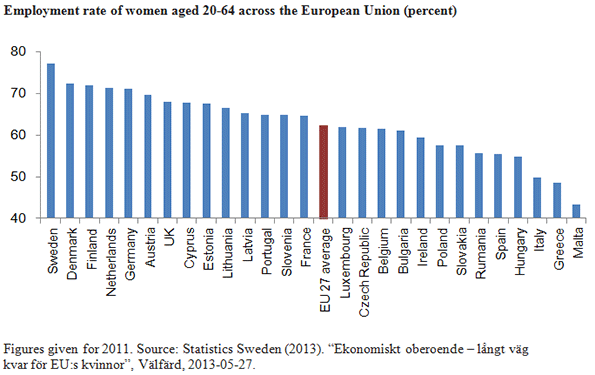
    The European Union has set the goal to achieve an employment level of 75 percent amongst women. So far, only Sweden exceeds this ambition with an employment level of fully 77 percent. Denmark, Finland, the Netherlands, Germany and Austria follow closely behind. In these five countries seven out of ten women working age are employed. It doesn’t seem a coincidence that these northern European nations share similar cultural and political attributes. The expansion of welfare states has historically encouraged womens’ entry into the workforce. Still today public childcare encourages women to invest time at work, whilst high taxes make it difficult to live on only one salary.

    Overall, the Eastern- and Central European countries have a lower share of women working, since it is more common with housewives. The three former Soviet states Estonia, Lithuania and Latvia are in particular interesting to look at. Not only are they Eastern European, and strongly committed to low taxes and free markets, but they also share Nordic cultural attributes. The three Baltic states have a respectably high level of two thirds of women in employment. This is somewhat higher than the European average, and considerably more so than in parts of Southern Europe. In Malta and Greece, fewer than half of the women work. In Italy exactly half of them do.

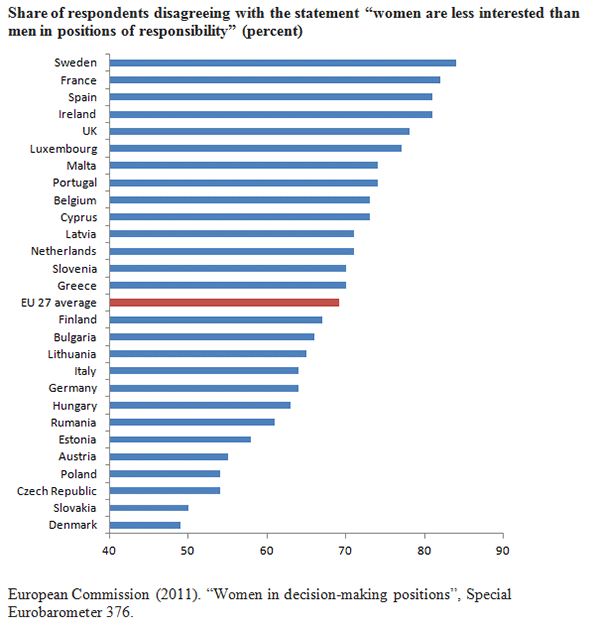
    Northern and Western European countries also tend to have more equal gender attitudes. A special edition of the Eurobarometer has focused on the issue of women in decision-making positions. One key indicator is how many disagree with the statement “women are less interested than men in positions of responsibility”. Sweden again stands out, with 84 percent of the public disagreeing with this notion. Although culturally and politically similar Denmark is found at the other end, with only 49 percent disagreeing with this idea, the overall trend is clear. The general publics in Nordic and Western European countries more strongly reject the notion that women are less interested in reaching positions of responsibility while Southern-, Eastern-, and Central European countries are found at the opposite end of the spectrum.

    We would expect to find many more women in top positions in the egalitarian Nordic nations, as well as Germany, the Netherlands and other similar countries. And indeed we do. At least when it comes to politics, the public sector and company boards. All too often the analysis stops here. But it is important to realize that representation on boards is a poor measure of women’s progress in the private sector of many European countries. Many boards in Nordic nations for example have relatively formal roles, meeting a few times a year to supervise the work of the management. The select few who end up on the boards – many of whom reach this position after careers in politics, academics and other non-business sectors – enjoy prestigious jobs.  They are however not representative of those taking the main decisions in the business sector. The latter role falls on executives and directors. Public sector managers tend to have less overall power, working within the scope of large bureaucratic structures.

    Chief executives and directors in the private sector are responsible for taking much of the crucial decisions in the business world. One typically only reaches a high managerial position after having worked hard in a certain sector, or successfully started or expanded a firm as an entrepreneur. The share of women reaching this position is a good proxy of women’s opportunities in the business world as a whole.

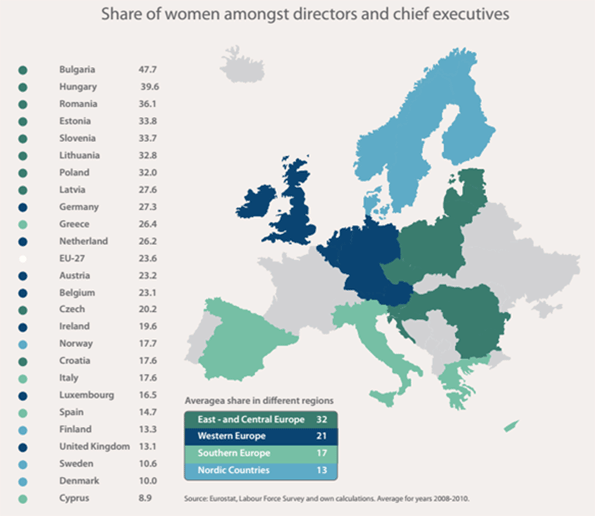
    Astonishingly, the data show that the gender equal Nordic nations all have lower levels of women at the top of businesses than their less progressive counterparts. In Sweden and Denmark, only one out of ten directors and chief executives in the business world are women. Finland and the UK, two other nations with large public sector monopolies, fare only slightly better.

    In contrast, in the average Eastern- and Central European country fully 32 percent of the directors and chief executives are women. This can be compared to 21 percent in Western European countries, 17 percent in Southern European nations and merely 13 percent in the otherwise egalitarian Nordic nations. In Bulgaria, with lower than EU-average levels of female work participation, and not a bastion of egalitarian attitudes, women fill almost half the positions.

    It should be noted that other measures of the share of women at top of businesses supports this general trend. Eurostat for example also publishes a broader measure of business leaders, including also middle-managers. In the Baltics Estonia has the lowest share of women in these positions, 36 percent. Lithuania and Latvia fare better with 39 and 45 percent respectively. In Sweden the share is 35 percent and in Denmark 28 percent. Based on interviews with 6 500 companies around the world, the firm Grant Thornton estimates that around four out of ten managers in the three Baltic nations are female, compared with around a quarter in the Nordic nations. The overall picture is clear: fewer women in the Nordic nations reach the position of business leaders, and even fewer manage to climb to the very top positions of directors and chief executives.

    How can egalitarian Nordic countries, in most regards world leaders in gender equality, have the lowest rates of female directors and chief executives, whilst the nations in Eastern- and Central Europe are leaders in the same regard? I have previously touched upon this perhaps unexpected relation in the Swedish book “Att Spräcka Glastaken” (Breaking the glass window), a short report in English co-authored with Elina Lepomäki for Finnish think tank Libera and also in a column for the New Geography.

    Key here is the nature of the welfare state. In Scandinavia  female dominated sectors such as health care and education are mainly run by the public sector. The lack of competition has not only reduced the overall pay, but also lead to a situation where individual hard work is not rewarded significantly (wages are flat and wage rises follow seniority, according to labour union contracts, rather than individual achievement). Some opportunities for entrepreneurship do exist, as private competition has been allowed in particularly the Swedish welfare sector in recent years. But overall, the Nordic political systems still create a situation for many women where their job prospects are mainly   limited to the public sector . Women in Scandinavia can of course become managers within the public sector, but their wages and influence in these positions are typically more limited compared to in private enterprises.

    The former planned economies in Eastern- and Central Europe are well behind in terms of female employment and attitudes. But they have also since the times of socialist economies had systems where women who are employed work almost as many hours as the men. During recent years the nations have transitioned to market economies, in many regards more free-market systems than in other European countries. Employed women have continued to invest heavily in their workplaces in the former planned economies.

    The situation is quite different in the Nordic welfare states, where high taxes and public benefits create incentives for women to work, but often to work relatively few hours. For example 10 percent of the employed women in Latvia and Lithuania, and 14 percent in Estonia, work part time. In Sweden, the share is fully 41 percent. To put it differently, the average employed man in the Scandinavia works between 16 percent (Finland) and 27 percent (Norway) hours more than the average woman. In Lithuania the same gap is 13 percent, and in Latvia and Estonia merely 7 percent. Bulgaria is unique as the only European Union nation where women actually work more (1 percent more) hours than men. Women in Eastern- and Central Europe reach managerial positions by working hard and, contrary to the men, staying away from alcohol and other social ills.

    To reach the top of the business world, high employment and gender equal values are not enough. These factors must be complemented with political structures that allow for competition and entrepreneurship, as well as systems where women in their careers are encouraged to invest the time needed to climb the career ladder. It is quite telling that the Baltic nations, as well as other Eastern- and Central European countries, manage to outperform the rest of Europe in their share of female directors and chief executives. They do so by having systems with limited public monopolies and smaller differences between hours worked by men and women. It is equally telling that the Nordic nations underperform in the same regard, as their Social Democratic systems encourage many women to work, but hinder them from reaching the top of the business world. The map of gender equality in Europe is more complex than it might appear at a first glance.

    Dr. Nima Sanandaji has written two books about women’s carreer opportunities in Sweden, and has recently published the report “The Equality Dilemma” for Finnish think-tank Libera.

  • Derailing Europe’s Bike Trains

    In a fit of what now appears to have been madness, over the last ten days I attempted to live the life of a small plastic figure in an architect’s model community. I wheeled my bike through railroad stations, and took eco-friendly cycle lanes. The goal was to use only a combination of trains and my bicycle to attend a series of meetings in France, Belgium, and the Netherlands. I hoped that the harmonious state of the European Union, not to mention the environmental friendliness of both trains and bikes, would allow me to whiz between Bordeaux, Paris, Brussels, and Amsterdam and then pedal the last kilometers to my hotels. Is this not the dream of European planners who have banned cars from many historic downtowns, and annually vote some €40 billion a year in railroad subsidies?

    Like many utopian schemes, my model week of travels worked better on paper than in practice. I made a large loop from Geneva to Bordeaux, Paris, and Amsterdam, and stopped long enough in many other cities to ride around the “centreville”. When it was over, I came to the conclusions that European rail transport, and perhaps even the larger European Union, remain Balkanized, and that taking a bicycle on a business trip involves the same logistical planning as departing on a Crusade.

    While getting on and off thirty trains (on the weekends I made detours to historic sites), I learned that many European railroad companies hate bicycles, especially on crack express trains, and that bikes are largely exiled to insignificant “milk” trains that go nowhere at slow speeds.

    More distressing, national borders — largely in disuse on auto routes across Europe — are alive and well whenever you attempt to bring a bicycle across state lines on a train, as that opens up the possibilities of more fees for rail companies, or at least the chance for conductors to deliver nationalistic rants.

    Between Amsterdam, Brussels, Lille and Geneva, for example, I paid out more than $60 just to bring along a bike, although on many trains I had to stand with it in the vestibule. The EU’s motto, “Unity in Diversity,” might as well read, “What makes you think you can put your bike there?”

    Herewith is a not-at-all comprehensive guide to bike-training around Europe. Be particularly mindful if you believe the Community is a happy jamboree of continentals singing hymns to Brussels:

    France: Bikes are allowed on some high speed TGV trains (Train à Grande Vitesse), but only after a passenger has physically gone to a station and paid for a reservation. Online bike reservations are not possible (that would make it too easy).

    Local TER trains (Transport Express Régional) welcome bikes aboard at no extra charge and have convenient hooks and bike carriages. Except for a few long distance “Intercités” trains, TER is local, which is why it took twelve hours and numerous train changes to travel with a bike from Geneva to Bordeaux, the first leg of my journey.

    I changed in Bellegarde, Lyon, and Saint-Pierre-des-Corps before heading to Bordeaux. Later, I made whistle stops in La Rochelle, Poitiers and Tours. Nearly all the cities on my route were a delight to see on a bike, as, of course, was Paris, which is as bike-friendly as any large city, although Parisian cyclists ride as though they inhabit some wild Expressionist painting.

    Belgium: I went from Paris to Lille and then across Belgium on several trains, all of which took my bike, but few of which had any place to store it.

    Nor is the French fee paid to transport a bike recognized in Belgium. So much for the common market. Belgium imposes its own set of arcane rules for passengers trying to sneak a bicycle across the border.

    Even though I had passes for the trains and my bike, there was always some reason I ran afoul of the Belgian conductors, who in torrents of Flemish, French, or English would berate me for the temerity of traveling in their country.

    Mao would have called these encounters “struggle sessions,” and I grew to dread being asked for “self-criticism” every time I boarded a Belgian train. A few of the conductors were kindly, but some in Flanders were so bitter over what appeared to be nothing that I wondered if their rage wasn’t part of a larger crackup, maybe one involving the entire country?

    I did love my rides around Brussels, Antwerp and Ypres, but was shocked at the contrast between wealthy (Germanic) Flanders and depressed (French-speaking) Wallonia.

    Flanders has wealthy farms, an industrial base, global trade via the Rhine, inflowing tourist dollars from Bruges and Ghent, and the European Union in Brussels.

    Wallonia is the dowager of a forgotten Belgian empire (maybe lost in the Congo?) — with abandoned coal mines, lots of subsidies from the north, lazy union work rules, and a sense that the future isn’t what it used to be. It does not even have Brussels, which floats along the uneasy divide: linguistically part of Wallonia; legally attached to Flanders.

    If the Flemish politicians are anything like their train conductors, I can easily imagine them throwing the Walloons off at the next station, with a long lecture about their failures as an economic entity or their lack of sufficient documentation.

    The Netherlands: The Low Countries are celebrated for their bicycle culture; bikes in Amsterdam careen like split atoms. That affection ends at the doors of the train, on which bikes are a regulated industry.

    I loved biking across the bridges over Amsterdam canals, especially at night when the Christmas lights were lit and the city had the feel of a Venetian carnival. Nevertheless, on the rails, a bike became an albatross, subject to myriad rules about the difference between a “national” and “international” bike pass, and regulations that prohibit bikes on certain trains during rush hours.

    Because of a tunnel fire, my bike and I were waylaid in the Hague’s damp air for more than an hour. When finally rerouted to Gouda and Rotterdam, I was told in a scolding manner that I would have to get off the trains for another two hours during peak travel times, even though the cars were empty. So much for those newspaper articles about modest Dutch royalty tooling around the country on their bikes.

    It took almost eight hours to travel with the bike from Amsterdam to Lille, France. These cities are three hours apart on high-speed trains, although none of those trains allow bicycles.

    ***

    The answer to these frustrations, of course, is for me to buy a folding bicycle — although a good one costs more than $1500 — if I wish to persist in the dream of getting around Europe by train with a bike.

    A “folder” may be worth it, however, because European cities are best seen over handlebars. Sadly, while a folding bike can be snuck aboard fast trains as “normal luggage,” the other, perhaps larger problem of the European bike-train dream is that international train journeys have become the travel choice largely of the expense-account crowd.

    For example, one-way train fare from Geneva to London is $350, but don’t even think about taking along a bicycle. Or, you might get it from Geneva to Paris on a TGV (add $15 more to the ticket), but Eurostar’s bike policies (add another $35) are more arcane than the Treaty of Westphalia: Bikes over a certain size go as registered luggage, but sometimes travel on different trains, making connections convoluted.

    So fly, rent a car, sit in traffic, and sleep in motels near auto route interchanges. In other words, so long as you don’t try to see the continent with a bike and by train on the same trip, or on a budget, the state of the European empire is fine.

    Matthew Stevenson, a contributing editor of Harper’s Magazine, is the author of Remembering the Twentieth Century Limited, a collection of historical travel essays. His new book, Whistle-Stopping America, was recently published.
    Flickr photo by K Paulinka: Bike Storage at Leiden train station parking lot, Netherlands.

  • Moving to the Heart of Europe

    Europe’s demographic dilemma is well known. Like East Asia and to a lesser degree most of the Western Hemisphere, Europe’s birth rates have fallen so far that the population is becoming unable to replenish itself. At the same time, longer  life spans have undermined the poulation’s ability to withstand a growing  old age dependency ratio, challenging the financial ability (and perhaps even willingness) of a smaller relative workforce in the decades to come. The EU-27 (excluding Croatia) over 65 population is projected by Eurostat to increase 75 percent relative to its working age population (15-64) between 2015 and 2050, more than either the 60 percent increase the UN projects in the United States and Japan (though Japan’s current ratio is much higher than the EU or the US).

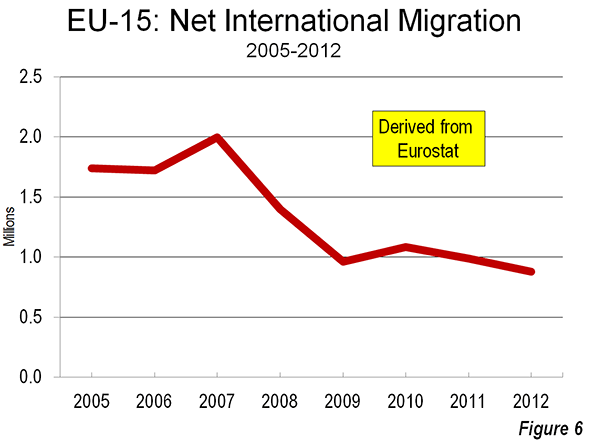
    This problem could be partially addressed by international migration, which could increase the size of labor force required to support expensive social welfare commitments. Our analysis of available Eurostat data (European Commission) data indicates that international migration to the European Union (EU) is strong. Further, migration has been shifting with the changing economic fortunes of EU nations, led by strong growth in the “heart of Europe” but slowing growth along much of the periphery of the former EU-15.This suggests that strong economic growth may be the key to solving, or at least ameliorating,  Europe’s looming demographic crisis.

    All EU-15 Nations have Attracted Migrants

    Since the 2004 enlargement of the European Union, now at 28, with the recent addition of Croatia, the former EU-15 has attracted millions of international migrants, including many from the newer entrants to the original fifteen memnbers. Eurostat data indicates that nearly 11 million people more people moved to these nations between 2005 and 2012 than moved away.

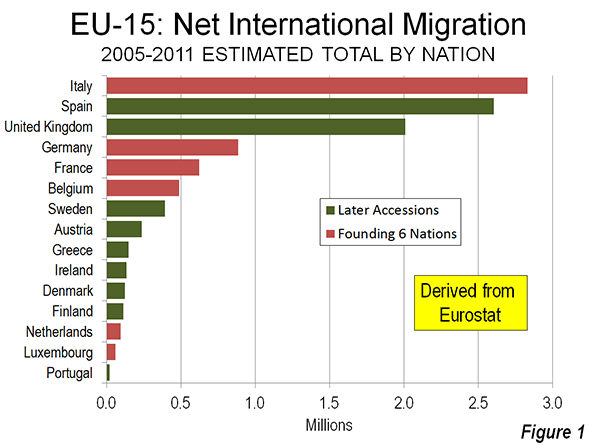
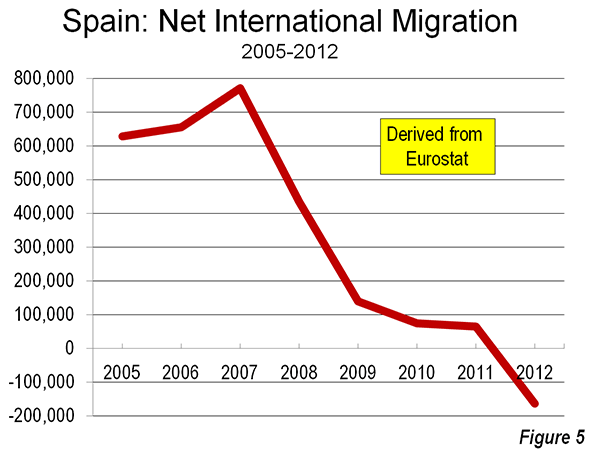
    The changes are stunning. All 15 nations have had net international migration gains since 2005. The leader is Italy, which has added a net 2.8 million international migrants, the equivalent of 4.7 percent of its population. This is more than Italy’s total population gain between 1975 and 2000. Spain has added 2.6 million net international migrants, the equivalent of 5.6 percent of its population. The United Kingdom added 2.0 million international migrants, the equivalent of 3.2 percent of its population.  

    Deep in the Heart of Europe

    Perhaps most surprising are that gains the heart of Europe, six nations that established the European Coal and Steel Community in the early 1950s, which was to become today’s European Union (Belgium, France, Germany, Luxembourg, Italy, and the Netherlands) (Figure 1).

    Germany and France had net international migration of 885,000 and 625,000 respectively. In both countries this was equal to one percent of the population. However, Belgium had the largest relative addition of international migrants. Its 490,000 net increase was equal to four percent of its population.

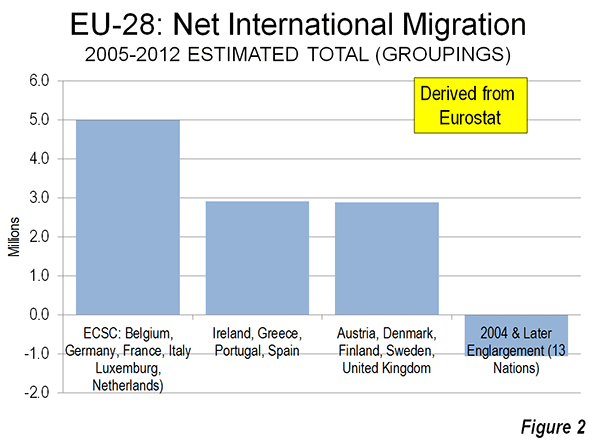
    Overall, the six founding nations of the European Union attracted a net 5.0 million international migrants 2005 to 2012. This is more than the population of all urban areas in the six nations except for Paris, Milan and the Rhine-Ruhr.

    Five additional economies, the United Kingdom, Austria, Sweden, Denmark and Finland added a net 2.8 million international migrants. Even Portugal, Ireland, Greece and Spain, despite their fragile economies, posted substantial gains, adding 2.8 net international migrants (Figure 2).

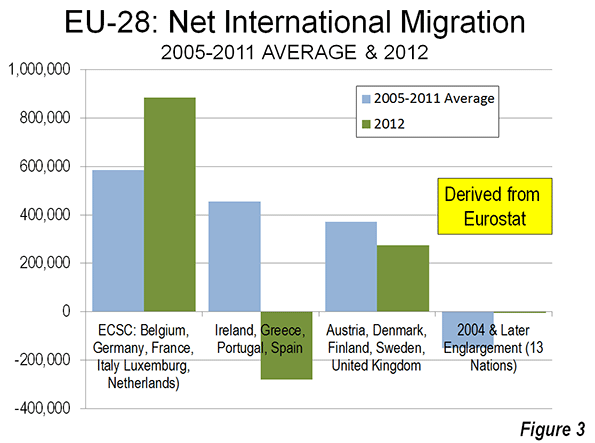
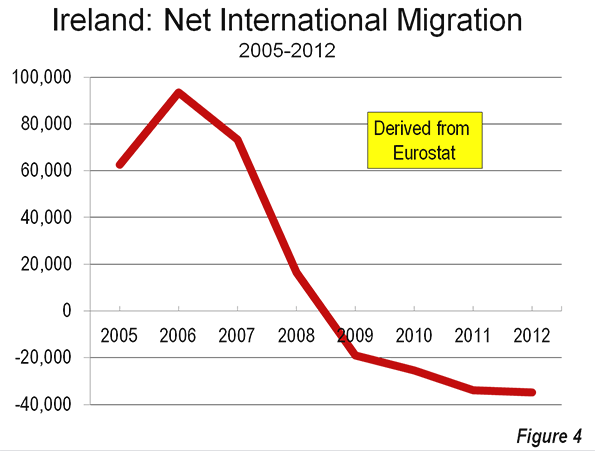
    The PIIGS Minus Italy

    Five nations have been designated the PIIGS by the international financial community, due to their financial reverses. These include Portugal, Ireland, Italy, Greece and Spain. All, except Italy, have seen their international migration rates fall precipitously. Between 2005 and 2011, these four nations combined added an average of 450,000 net international migrants. By 2012, they lost more than 275,000 net international migrants. In contrast, Italy, one of the EU founders, continued its strong trend, adding approximately 365,000 net international migrants in 2012, up from its 2005 to 2011 average of 350,000.

    The six founding members picked up some of the “PIIGS minus Italy” losses. In 2012, these nations added nearly 885,000 net international migrants, which is well above their 585,000 average for 2005 to 2011. The other five nations (United Kingdom, Austria, Sweden, Denmark and Finland) fell to a 275,000 net international migration gain in 2012, compared to their 2005-2011 average of 370,000.

    The new 13 members did much better than before, losing only 5,000 net international migrants in 2012. Their average from 2005 to 2011 was a 150,000 loss (Figure 3).

    Ireland and Spain

    Spain and Ireland illustrate the connection between declining economies and declining international migration.

    The Irish Times noted in a recent article that the latest data from the European commission indicates that Ireland now has the worst net international outmigration rate in the European Union. Just six years ago, the Times reports, Ireland’s net international in migration rate was the highest in Europe. Over the past four years (Figure 4), Ireland has lost approximately 35,000 net international migrants annually (Ireland’s housing bubble and the resulting national financial crisis are described in Urban Containment and the Housing Bubble in Ireland).

    Spain’s decline in net international migration has been every bit as spectacular. At its peak, Spain was attracting a net international migration approaching 800,000. Last year, Spain lost 165,000 international migrants (Figure 5).

    The 13 New Members

    The net international migration gains in Europe’s heart have not been good news for Eastern Europe, where the newer European Union members are located. Overall, these nations lost approximately 1,050,000 international migrants between 2005 and 2012, though as noted above, the loss was minimal in 2012. This more recent improvement may be the result of weak economic conditions in many western and southern European countries.

    Romania and Lithuania were the biggest losers. Romania lost nearly a net 1,000,000 international migrants, equal to nearly five percent of its population. Lithuania did even more poorly, losing 300,000 international migrants, nearly 10 percent of its population. Both nations lost overall population.

    Migration and Economic Growth

    Despite the resurgence of growth in the heart of Europe, the financial crisis has taken a toll. As in the United States, migration has fallen significantly, as many of the economic opportunities have dried up. By 2012, the net international migration to the EU-15 had been reduced to 900,000 from approximately 2 million in 2007. As throughout history, the demand for international migration is driven principally by the aspirations for a better quality of life. As a result, migration will tend to be greater where there is a wider gulf between the employment and economic opportunities in receiving countries than in countries that lose migrants.

    Wendell Cox is a Visiting Professor, Conservatoire National des Arts et Metiers, Paris and the author of “War on the Dream: How Anti-Sprawl Policy Threatens the Quality of Life.

    Photo: Genoa, Italy (by author)