Tag: Europe

  • New Zealand Has Worst Traffic: International Data

    Three decades ago, the Texas Transportation Institute (TTI) at Texas A&M University began a ground-breaking project to quantify traffic congestion levels in the larger urban areas of the United States. The Urban Mobility Report project was begun under Tim Lomax and David Shrank, who have led the project over the first 30 annual editions. Perhaps the most important contribution of this work to the state of transportation knowledge is TTI’s "travel time index," which measures the extent to which peak period traffic congestion as to travel times.

    Of Highway Expansion and Maternity Wards

    The TTI data has been invaluable. One important contribution has exposed a fallacious interpretation of the “induced traffic” effect, which holds that there is no point in expanding roadways because they will only be filled up by new traffic. As if more maternity wards would increase the birth rate, the argument goes that we “can’t build our way out of congestion.” In fact the TTI data, which measures at the comprehensive urban area level (and the only reliable level), says we can.

    I recall a 1980s City Hall meeting with a Portland Commissioner, who admiringly cited Phoenix for not having built a Los Angeles style freeway system. I remarked that if there was anything worse than Los Angeles with its freeways, it would be Los Angeles without its freeways. Then, Phoenix was the 35th largest urban area in the nation, yet had the 10th worst traffic congestion. The situation soon was improved, after Phoenix voters authorized funding for the largest recent freeway expansion program and now Phoenix ranks 37th in traffic congestion, despite having more than doubled in population (now the 12th largest urban area).

    The lesson repeated itself in traffic clogged Houston, which led Los Angeles in traffic congestion in three of the first four years of the Annual Mobility Report. Under the leadership of visionary Mayor Robert Lanier, freeway and arterial expansions were built, and Houston dropped to rank 10th in traffic congestion despite having since added more residents than live in Portland. Meanwhile, Portland, with its densification and anti-automobile policies has been vaulted from the 47th worst traffic congestion in 1985 to 6th worst in 2012, which is notable for the an urban area ranking on only 23rd in population.

    Houston’s roadway expansions cleared the way for a Los Angeles run of 26 straight years as the nation’s most congested urban area, with little prospect of improvement.

    The Travel Time Index Goes International

    TTI’s traffic congestion ratings were adopted internationally. INRIX, a Seattle based automobile navigation services company was first, providing virtually the same measure for urban areas in North America and Western Europe. More recently, Tom Tom, an Amsterdam based automobile navigation services company issued its own Tom Tom Traffic Index, providing by far the most comprehensive international coverage, adding Australia, South Africa and New Zealand.

    Tom Tom has just produced its results for the second quarter of 2013. Looking globally, Los Angeles does not look so bad; it didn’t even make the top 10 most congested, outpaced (or perhaps better underpaced) by urban areas in Western Europe and Canada.  

    Higher Income World Urban Areas

    Tom Tom produced data for 122 urban areas in the higher income United States, Western Europe, Canada, Australia and New Zealand. This included nearly all urban areas with more than 1,000,000 population, and some smaller. It might be expected that the “sprawl” of US urban areas, and their virtual universality of automobile ownership, as well as the paucity of transit ridership in most metropolitan areas would set the US to to the nether world of worst traffic congestion. This is not so, and not by a long shot.  

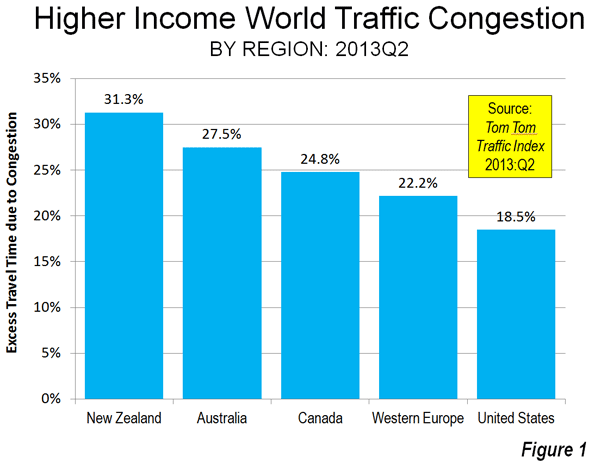
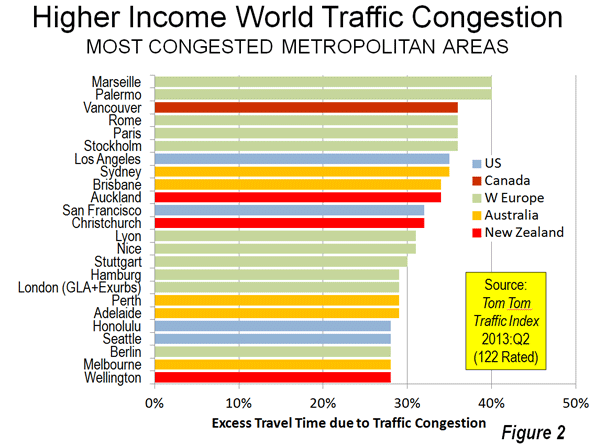
    1. New Zealand: The trophy goes to, of all places, New Zealand (Figure 1).  The average excess time spent in traffic in the three urban areas of New Zealand rated by Tom Tom was 31.3%. This means that the average trip that would take 30 minutes without congestion would take, on average, approximately 40 minutes in the three urban areas of New Zealand. This is stunning. New Zealand’s urban areas are very small. The largest, Auckland, has a population of approximately 1.3 million, which would rank it no higher than 25th in Western Europe, 35th in the United States and 4th in Canada and Australia. Christchurch and Wellington are among the smallest urban areas (less than 500,000 population) covered in the Tom Tom Traffic Index, but manage to rank among the 20 most congested (Figure 2). Christchurch and Wellington have little in freeway lengths.

    2. Australia: Second place is claimed by Australia. The average trip takes 27.5 percent longer in Australia because of traffic congestion. All five of Australia’s metropolitan areas with more than 1,000,000 population are among the 20 most congested urban areas in the higher income world. In the case of four urban areas (Sydney, Brisbane, Perth and Adelaide), every larger US urban area has less traffic congestion. Melbourne is the exception, but is still “punching well above its weight,” with worse traffic congestion than larger Chicago, Dallas-Fort Worth, Houston, Toronto, Philadelphia, Miami, Atlanta, Washington, Riverside-San Bernardino and Boston.

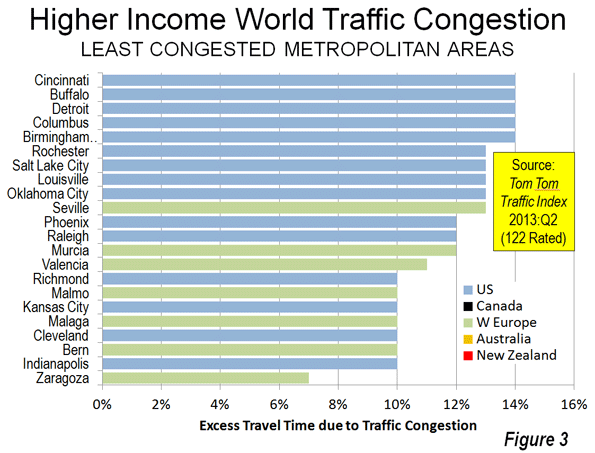
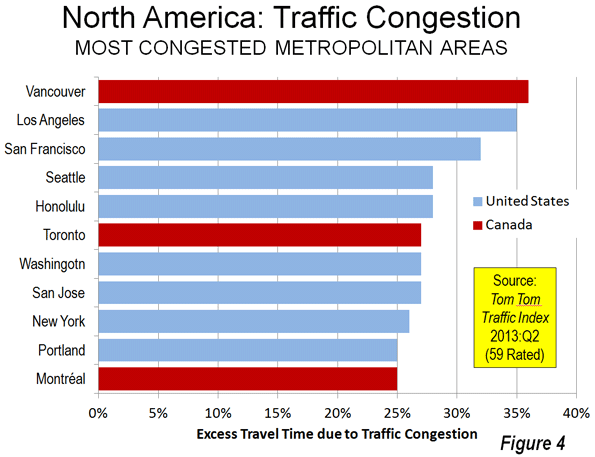
    3. Canada: Canada is the third most congested, with an excess travel time of 24.8 percent. Vancouver ranks as the third most congested urban area (36 percent excess travel time) in the higher income world, and has displaced Los Angeles as suffering the worst traffic congestion in North America. This is a notable accomplishment, since Los Angeles has more than five times the population, is more dense and only one-third as many of its commuters use transit to get to work. None of the other five largest urban areas in Canada (Toronto, Montréal, Ottawa, Edmonton and Calgary) is rated among the 20 most congested in the higher income world (Figure 3). Toronto is tied for 6th worst in North America with Washington (DC-VA-MD) and San Jose (Figure 4).

    4. Western Europe: Fourth position in the congestion sweepstakes is occupied by Western Europe, where the excess travel time averages 22.2 percent. Marseille (France) and Palermo (Italy) are tied with the worst traffic congestion in the higher income world, with excess travel times of 40 percent. Excluding Christchurch and Wellington, Marseille and Palermo are among the smallest urban areas among the most congested 20, though their large and dense historic cores complicate travel patterns. Rome, Paris, Stockholm and Rome, all with strong transit commute shares, are tied with Vancouver for the third worst traffic congestion (36 percent excess travel time). Other Western European entries to the most congested 20 rankings are London, Nice and Lyon in France and Stuttgart, Hamburg and Berlin in Germany. Western Europe contributes only 11 of its 54 rated urban areas to the most congested 20 list (the most 20 most congested list includes 24 urban areas because of a five way tie for 19th).

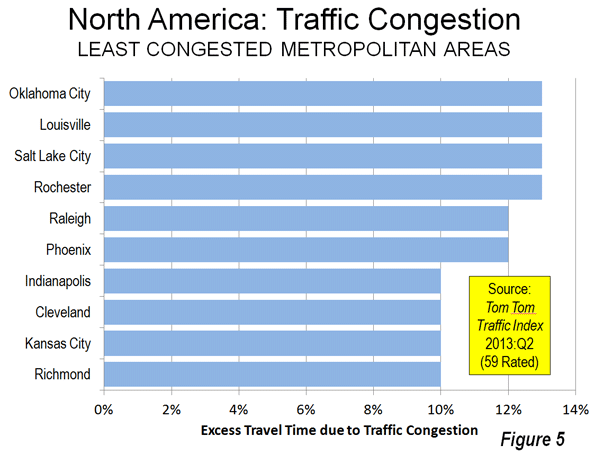
    Unlike New Zealand, Australia and Canada, Western Europe has representation in the 20 least congested urban areas (Figure 5), taking seven of the 22 positions (A three way tie at the top places increases the total to 22). The least congested urban area in Zaragoza in Spain (seven percent excess travel time), itself a small urban area of approximately 700,000, while similarly small Bern in Switzerland, Malaga in Spain and Malmo in Sweden are tied with four US urban areas in the second least congested position (10 percent excess travel time).

    5. United States: The United States is the least congested in these rankings with an excess travel time of 18.3 percent. Even after losing its top North American ranking to Vancouver, Los Angeles continues to be the most congested urban area in the United States, with an excess travel time of 35 percent. San Francisco (32 percent), Seattle, and much smaller Honolulu (tied at 28 percent) are also in the most congested 20. Only four of the 53 rated US urban areas is in the most congested 20.

    The US dominates the least congested 20 list, with 15 urban areas. Richmond, Kansas City, Cleveland and Indianapolis share the second least congested position with three Western European urban areas (10 percent excess travel time). Phoenix, which was formerly one of the most congested in the US, is also on the list, ranking as the 12th least congested in the higher income world and the 5th least congested urban area in North America.

    Less Traffic Congestion: Lower Densities and Less Employment Concentration

    The Tom Tom traffic congestion rankings are further indication of the association between higher population densities and more intense traffic congestion. But there is more to the story. Residents of the United States also benefit because employment is more dispersed, which tends to result in less urban core related traffic congestion. Lower density and employment dispersion are instrumental in the more modest traffic congestion of the United States, including such large urban areas as Dallas-Fort Worth (the fastest growing high income world metropolitan area with more than 5,000,000 population), Houston, Miami and even roadway deficient Atlanta.
     

    Wendell Cox is a Visiting Professor, Conservatoire National des Arts et Metiers, Paris and the author of “War on the Dream: How Anti-Sprawl Policy Threatens the Quality of Life.

    Photo: Freeway in Marseille (by author)
  • Playing Musical Chairs with World Economies

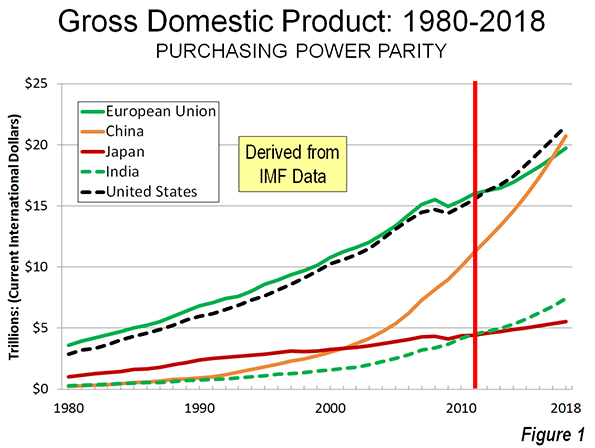
    The world’s largest economies seem engaged in something like the children’s game of “musical chairs.” For years, the United States has been the world’s largest national economy, though in recent decades the integrated economy of the European Union has challenged that claim given that the region   includes four of the ten top national economies, Germany, the United Kingdom, France and Italy. The most recent data, reflecting the deep European recession, indicates that the top position has been retaken by the United States.

    The International Monetary Fund (IMF) has released its semi-annual World Economic Outlook Database for October 2013. Information is provided for 189 country-level geographies, from 1980 to the present, with projections to 2018. Despite the economic malaise, the IMF data shows the US gross domestic product, adjusted for purchasing power parity (GDP-PPP), to be greater than that of the combined 28 member European Union (EU). This development, however, is at least partially due to accounting revisions, which are described below.

    2012 Gross Domestic Product (Purchasing Power Parity)

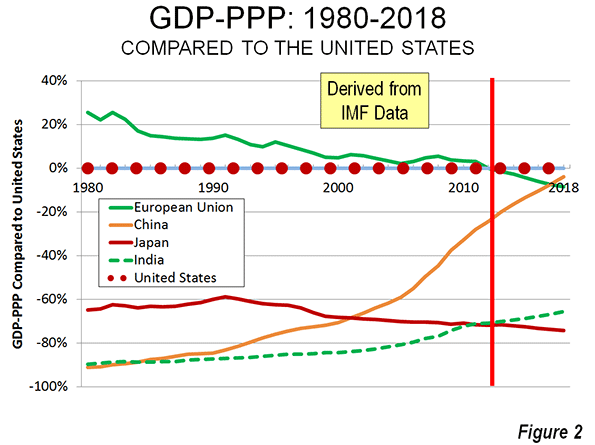
    The new data shows the United States to have a 2012 GDP-PPP of $16.245 trillion (current international dollars), two percent above the EU’s $15.933. This difference is relatively minor – the equivalent of Maryland’s GDP. In 2011, the EU led the US by a small margin, before the accounting methodology change. The IMF expects the US lead to be lengthened to approximately 10 percent by 2018. For comparison, in 1980, the same 28 EU economies had a GDP nearly one-quarter larger than that of the United States (Figures 1 and 2). However, it must be noted that in 1980, the European Union had only nine members and had an economy 8 percent smaller than that of the US.           

    China’s reduced, but still strong economic growth has propelled it to a GDP-PPP of $12.3 trillion, reaching 75 percent of the US figure. By 2018, the IMF expects China to reach 96 percent of the US GDP. If the IMF projected GDP increase rates of China and the US were to continue, China would be a larger economy than the United States by 2020. While this may be seem to be occurring sooner than expected, it is consistent with the expectation of former IMF economist Arvind Subramanian, in his book Eclipse: Living in the Shadow of China’s Economic Dominance. The scale of Chinese economic miracle that started under Deng Xiaoping can be seen by the fact that in 1980 its GDP was barely 10 percent of the US economy (See Ronald Coase and Ning Wang, How China Became Capitalist).

    India’s economy also continues to progress. Now the world’s fifth largest economy, India’s GDP-PPP is estimated at $4.7 trillion. By 2012, India’s economy had reached 29 percent of that of the United States, nearly triple the 1980 figure. IMF expects India to close the gap by another five percentage points by 2018.

    Japan has fallen to the fifth largest economy, at approximately $4.58 trillion. Japan had grown strongly after World War II, having reached 35 percent of the US economy by 1980. A number of experts, such as Harvard’s Ezra Vogel, expected that Japan would continue to close the gap with the United States. But Japan’s ascendency stopped by 1991, when it reached a size 41 percent of the US economy. In the subsequent economic slide, Japan’s economy fell to 28 percent of the US by 2012. IMF expects another two point drop by 2018.

    Gross Domestic Product per Capita (Purchasing Power Parity)

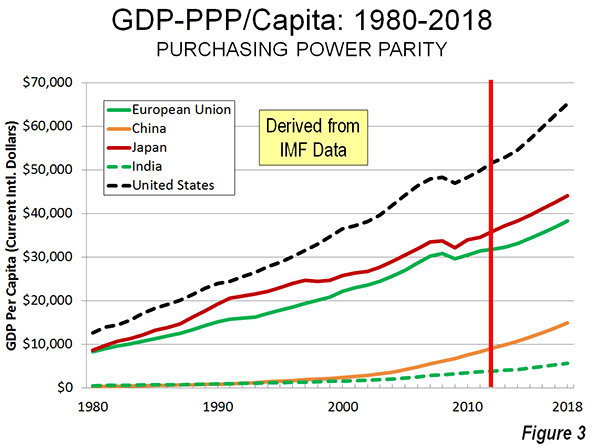
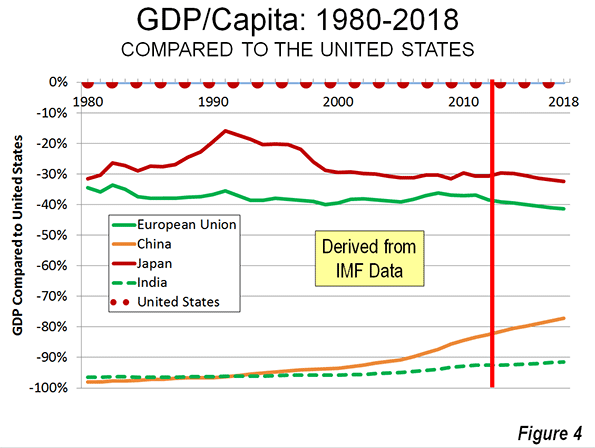
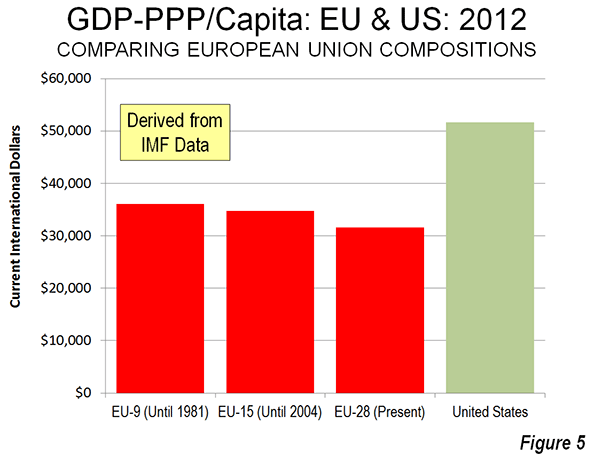
    The United States remains dominant in personal affluence among the world’s largest economies. In 2012, the US GDP-PPP per capita was $51,700. The European Union had a GDP-PPP of $31,600 in 2012, but is declining relative to the United States. In 2012, the EU GDP per capita was 61 percent of the US figure. This is down from a peak of 66 percent in 1982. IMF projects a further three percentage point loss by 2018 (Figures 3 and 4). The GDP-PPP per capita of the nations in the 9 nation European Union of 1980 was higher, at $36,100 in 2012 (Figure 5).

    Despite China’s potential for becoming the world’s leading economy by the beginning of the next decade, its huge population makes the GDP per capita much lower. In 2012 China’s GDP per capita was $9,100, about 18 percent of the US figure. This is, however, far higher than the 1980 figure of 2 percent. IMF expects China’s GDP per capita to rise to $14,900 by 2018, 23 percent of the US figure. 

    India’s GDP per capita was $3,800 in 2012, or seven percent of the US GDP per capita. India’s progress has been rapid, though   strongly overshadowed by China. India’s GDP per capita was 70 percent higher than China’s in 1980, but now China’s is now 60 percent higher. However, India has gained five percentage points on the US since 1980.

    Japan’s GDP per capita stood at 69 percent of the US figure in 2012 ($35,900), down significantly from 1991, when Japan’s GDP per capita reached 84 percent of the US level. IMF projects about a 1.5 percentage point further decline by 2018.

    Accounting Revision

    As is noted above, the accounting changes implemented by the United States have changed the world rankings and their prospects

    Data in the IMF’s last release (March 2013) placed the European Union slightly ahead of the United States in GDP-PPP. The United States is the first country to fully implement internationally agreed upon changes to national accounts (United Nations’ System of National Accounts 2008).  The IMF summarizes the revisions and its impact on the US economy as follows:

    “…expenditures on research and development activities and for the creation of entertainment, literary, and artistic originals are now treated as capital expenditures. Furthermore, the treatment of defined-benefit pension plans is switched from a cash basis to an accrual basis. The revisions increase the level of GDP by 3.4 percent and boost the personal savings rate.”

    The US Department of Commerce, Bureau of Economic Analysis indicates that Europe will convert to the new methodology in 2013 and it is to be expected that other nations will quickly follow.

    Before the accounting revision IMF data predicted that US would not pass the EU until 2015. Further, the previously lower GDP figures predicted that China would pass the United States just two years later (2017). China may have to wait to assume the top chair, but perhaps not. It all depends on how fast China converts to the new accounting and the impact of the revision on GDP figures.

    An Uncertain World

    Of course, economic projections cannot be “taken to the bank.” The world economy is volatile and uncertain and more so now that in more stable times.

    The US economy continues to sputter along with lagging growth. The European economy is doing even more poorly. Mixed signals continue to be heard from China, where astronomic growth rates are being replaced, at least for the moment, by more modest ones. President Xi Jinping says that China can create sufficient employment for its growing urban workforce with a 7.2 percent growth rate (See: “China Needs 7.2% Growth to Ensure Employment” in The Wall Street Journal) – a rate that would be the envy of each of the world’s strongest economies.

    The big high income world nations also have reason to envy India. According to the Organization for Economic Cooperation and Development (OECD), the economy of India “clocked a low growth rate of 4.4 percent” in the April to June quarter. The OECD characterized India’s immediate economic prospects as “weak,” yet India’s growth rate is far above those of the US, EU and Japan.

    The Bank of Japan (BOJ), the nation’s reserve bank, is optimistic about the nation’s new growth-seeking policies under “Abenomics” (named after Prime Minister Shinzo Abe). But the BOJ predictions of economic growth at 1.5 percent in 2014 and 2015 are favorable only in the light of Japan’s anemic recent growth.

    All of these predictions, combined with accounting changes, paint a blurred picture. This is the nature of a world economy that the IMF refers to as being stuck in “low gear.”

    Wendell Cox is a Visiting Professor, Conservatoire National des Arts et Metiers, Paris and the author of “War on the Dream: How Anti-Sprawl Policy Threatens the Quality of Life.

    —-

    Photo: Bank of China (right) and Peace Hotel, Shanghai (by author)

  • The Dutch Rethink the Welfare State

    When the Netherlands’ newly coronated king made his first annual appearance before parliament, he turned some heads when he addressed the deficiencies of the Dutch welfare state.   “Due to social developments such as globalisation and an ageing population, our labour market and public services are no longer suited to the demands of the times”, the king said in a speech written by Liberal prime minister Mark Ruttes cabinet. “The classical welfare state is slowly but surely evolving into a ‘participation society’”, Willem-Alexander continued. By this he meant that the public systems should start encouraging self-reliance over government dependency.

    It is worthwhile to reflect on the challenges faced by the Dutch welfare system. In a knowledge based economy, influenced by strong global competition and dynamic economic development, public policy must encourage thrift, education and build-up of social capital. Discouragingly high taxes and encouragingly high benefits are no way of doing so. Such policies are therefore likely to become even greater obstacles to social and economic development as they are today.

    Concern over the welfare state is not new in the Netherlands. 

    During the beginning of the 1980s the Netherlands ranked as a top spender in terms of welfare policy. Whilst the US and the UK allocated some 22 and 27 percent respectively of GDP to welfare spending, the Netherlands spent fully 40 percent – the same level as the famously generous Swedish public system.  But since then the pattern has been to reduce the welfare state. Indeed as most OECD-countries public spending rose significantly from the 1980s a  report from the OECD notes that the Netherlands, alongside Ireland, gradually scaled theirs down. A combination of economic growth, tightening of welfare state generosity and privatization of sick-pay led to a decline in public social spending in these two countries. In 1980 public social spending was 25 percent of GDP in the Netherlands, much higher than the OECD-average of 16 percent.

    In the beginning of the 2000s the average OECD-country had expanded its welfare state, so that public social expenditure had reached 21 percent of GDP – whilst the Netherlands had reduced its share to the same level. According to another study, benefit expenditure was reduced from 27 to 22 percent of GDP in the Netherland between 1980 and 2001, compared to the EU15 average which rose from 21 to 24 percent during the same period.

    Although the Netherlands does not lie in Scandinavia, there are significant similarities between this advanced European nation and the Nordic countries. The similarities go beyond the fact that the Dutch are tall and blond, and live in a small trade-dependent nation. Shared cultural traits and political beliefs can explain why the Dutch adapted similar welfare policies as the Nordic nations. Similarly to as in Denmark and Sweden, the Netherlands has with time reformed its system, for example by introducing legislation which increases employer’s responsibility for the provision of sickness benefits. In some ways the Dutch have been even keener to reform than the Nordic countries.

    Privatisation of social security and a shift from welfare to workfare have been coupled with the introduction of elaborate markets in the provision of health care and social protection. Not only other European welfare states, but in some regards even the US, can learn much from the Dutch policies of combining a universally compulsory Social health insurance scheme with market mechanisms. Netherlands has, similarly to Denmark, moved towards a “flexicurity” system where labour market regulations have been significantly liberalized within the frame of the welfare system. Taxes in the country peaked at 46 percent of GDP in the late 1980s, but have since fallen to ca. 38-39 percent. The Netherlands has moved from being a country with a large to a medium-sized welfare system, something that still cannot yet be said about culturally and politically similar Sweden and Denmark. The Dutch seem to have been earlier than their Nordic cousins in realizing that overly generous welfare systems and high taxes led to not only sluggish economic growth, but also exclusion of large groups from the labour market. 

    Societal challenges are not difficult to find in the Netherlands, at least not if we look at the difficulty to integrate foreign-born individuals and those with low skills. These problems are shared with other European welfare models, not least the Scandinavian ones. However, the Netherlands overall continues to rank highly  in terms of societal measures such as good school results, high life expectancy, strong civic participation and high life satisfaction. Reforming the welfare state to a smaller size, and introducing more market mechanism within the system, have clearly not lead to a social disaster as some would like to believe.

    The Dutch continue to support the welfare society. This does however not mean supporting an overly generous “cradle to grave” system, with demands that everybody have similar living standard regardless of their individual achievements. As shown in the book “Contested Welfare States: Welfare Attitudes in Europe and Beyond”, Netherlands ranks at second place, following closely after Switzerland, in having the most limited support for the idea that government should be responsible for peoples’ life prospects. A likely reason is that whilst the Dutch are in favor of welfare policies in general, they believe in fostering individual responsibility within the system. The “participation society” that the Dutch king recently spoke about has thus already gained ground.

    There is a strong case to be made that the Dutch can benefit in going further in reducing the size of the state, introducing market reforms and liberalizing the labour market. Such changes would indeed be in line with OECD recommendation. Recently even the IMF recommended the nation to continue structural reforms to enhance growth potential. In addition, considerable savings seem to be possible in the Dutch welfare state, in areas such as health care and education. Luckily, the country can rely on previous positive experience with reforms.

    There is a good chance that the Netherlands will continue on a long-term route towards smaller government and greater prosperity. This does not mean abandoning the idea of public welfare for its citizens but focusing more on enabling people to take care of themselves. The positive experience of past changes, coupled with the realization that change is needed, can catalyze change. If change indeed happens, it will likely not occur over-night. Continuous small steps towards change are more likely. The direction of European nations such as the Netherlands might not excite a US audience, but perhaps there is a lesson to be learned about the value of pragmatic and steady reforms? 

    Dr. Nima Sanandaji has written several books and reports in Sweden, Finland and the UK about subjects such as urban development, entrepreneurship and women’s career opportunities.

  • Is America Flying Europe’s Flag?

    Consider the recent government shutdown as a disagreement about how much influence Europe should have on the continuing American revolution. Who would have predicted that, more than 237 years after the United States threw off the English yoke, disagreement over European approaches to life and government would be strong enough to shutter the democratic experiment, or downgrade the nation’s credit? And yet, Congress is divided, as it was in 1797, between Royalist Republicans and Jacobin Democrats, arguing about which model of government best suits the young and restless American republic.

    Never far from the lips of Tea Party stalwarts is the accusation that the Obama administration is bent on importing European socialism to the fair shores of free enterprise.

    The Republican right sees supporters of the health care act, immigration reform, and deficit spending as the equivalents of English levelers, idle Greek pensioners or French syndicalists. They fear that as these ideas anchor in the lee of the Statue of Liberty, it will perhaps soon be rededicated as Our Lady of Communal Redistribution, Occupational Safety, and Bureaucratic Oversight.

    Democrats, too, have fears inspired by their transatlantic neighbors. Many believe that only additional legislation can keep the United States from turning into another constitutional European monarchy, rife with income inequality, sweetheart tax breaks for the aristocracy, and enough gated suburban Downton Abbeys to impress even the noble lordships on Fox & Friends.

    I spend much of my time shuttling between Europe and the US, and thought it might be useful to see if there is any rationality in the fear that the Monroe Doctrine might no longer be strong enough to hold off creeping European influence. Here’s a short, idiosyncratic list, not at all definitive, of a few of the divisions between the continents:

    Store Hours: In many European countries, shops are closed whenever management has the sense that someone might want to buy something. In Italy and in parts of France it is not uncommon to find restaurants that close for lunch, and few establishments in Europe are open between Saturday afternoon and Monday lunchtime. In the US, AM/PM and 24/7 set the retail bar.

    Vacations: Europeans live for them. They take time off for Christmas, New Year’s, Easter, and a raft of saint days, not to mention their entitled four weeks of work leave and the occasional long weekend or bank holiday. By contrast, Americans fear time off from work more than they fear trade unions or, well, family vacations.

    Political parties: In the US, third or independent parties hint at irredentist change. In Europe, most countries have dozens of political parties, from communists, socialists, and greens on the left to near fascists on the right. Nevertheless, neither multiparty Europe nor two-party America can escape parliamentary paralysis, in part because both are dealing from insolvent decks.

    Suburbanization: Around many European cities suburbs have never taken root, and it is not unusual for the last stop on the metro (as in Munich or Geneva) to leave passengers in the wild. In the US, major cities have the qualities of a sprawling suburb, where cars are needed to shop or get to school. Even Spanish Harlem now has a Target.

    Churches: Except for the spread of Islam in countries like the United Kingdom and France, organized religion is on the wane in Europe. I bike a lot in France, and pass dozens of shuttered churches that appear to have neither a congregation nor a priest. Italians love the papacy a lot more than they do morning mass. In the US, however, many new churches need lots for overflow parking.

    Religion: Americans have married their love of promotion, organization, and public faith to create all sorts of new sects and churches, and with them religious academies, summer camps, bible study groups, cable channels, and ecclesiastical conferences. In Europe, the established religions — Protestant, Catholic, Orthodox, and Judaism — hold the most sway; the only holy rollers are Bentleys.

    Television: In America, the village square is its community of television programs, which have now wormed their presence into portable handsets. There, gossip, information, advertisements and entertainment are shared at all hours. In England, France, and Germany — to name a few — the daily newspaper remains competitive.

    Lunch: In the US — as Gordon Gekko says in Wall Street — the business lunch is for wimps, while in Europe you still count yourself lucky if the noontime meal lasts less two hours.

    Dinner: Americans take their suppers (standing up) with Coke Zero in front of the TV, while Europeans take their evening meals (seated) in the company of wine.

    Getting Around: Usually I drive more on a two week trip to the States than I do all year in Europe, which has buses, trains, and bike lanes across most countries and cities. In Switzerland I often go to a small mountain village where 36 trains stop daily at its tiny station. For comparison, the city of Houston has two trains a day.

    Militarism: Save for the British hanging on to their lancer regiments, Europe’s armies are home guards and dads’ armies. The US, meanwhile, is dispatching aircraft carriers to the seven seas and branding its navy (at least on Monday Night Football commercials) as “a global force for good.”

    Adultery: The French may still disconnect their cell phones between the hours of five and seven PM (“cinq à sept,” as the phrase has it), but an extramarital affair will never cost anyone a job or political office. Even the lascivious French politician Dominique Strauss-Kahn is plotting his comeback. In the US, adultery is a bigger barrier to political office than foreign birth.

    Sex: In the US it is welcome as a sales agent — Mad Men Über Alles — but somewhat less forgiven when it mixes with politics. If only Anthony Weiner had the good sense to confine his online dalliances to a reality show (The Onanist?), he would be accepting an Emmy Award for best actor. Because he chose the stage of politics, he was seen as Pee-wee Herman running for mayor from the back of a virtual theater.

    Marriage: Americans marry to have children. Europeans have children so that later they can get married.

    Education: Most European universities, except for those in the UK, are free, provided you can make the grades. In the US, acceptance and graduation rates are more a function of capital allocation. Americans choose their aristocracy from privately-funded academies — costs at many four-year colleges are approaching $250,000 — while Europe prefers a meritocracy that combines public universities blended with a fading aristocracy.

    Healthcare: Although many Americans think all medicine in Europe is socialized, few countries have the equivalent of Britain’s National Health Service. Obamacare most closely resembles the Swiss system, which requires all citizens to buy health insurance from private companies, although in Switzerland deductibles are so high (to reduce premium prices) that most families never see a dime back from their insurance payments, unless they are dragged by a truck.

    Transatlantic Balance Sheet: I would say that the US fosters more inventive thinking, creative entrepreneurs and capital markets. And it is always open for business (including on Christmas).

    Europe has better public schools, infrastructure, railroad networks, and work-life equations. Of course, it has many drawbacks. No continent can fight wars for four hundred years or have an Iron Curtain down its middle and not have residual side affects, notably unresolved ethnic conflicts and crammed cemeteries.

    But the next time you have to work through lunch or vacation, ask yourself if you would rather be weathering the economic crisis in Detroit, or on a Mediterranean beach.

    Flickr photo: Brussels, by Eszter Hargittai

    Matthew Stevenson, a contributing editor of Harper’s Magazine, is the author of Remembering the Twentieth Century Limited, a collection of historical travel essays. His new book, Whistle-Stopping America, was recently published.
  • Is Scandinavia Female Friendly?

    Scandinavia is often hailed as the best place on the planet for women. Yet in reality — despite being frontrunners in gender equality — Nordic countries have not been so successful when judged by women’s career progress.

    A few years ago Professor Alison Wolf, director of Public Services Policy and Management at King’s College, remarked: “the statistics are clear: among young, educated, full-time professionals, being female is no longer a drag on earnings or progress”. Her view is supported by the research of demographer Andrew Beveridge, who has shown that full-time working single women in New York aged 21-30 years went from earning 19 percent less than their male counterparts in 1970 to having the same median income in 2000. Five years later a 17 percent wage gap resurfaced, this time to the favor of the young women. Similar trends have been shown for many metropolitan areas in the US.

    Even when we include smaller cities and the countryside, it is clear that the glass ceiling has been broken by US singles. The latest figures show that the average single American women aged 22-30 earns $27,000 annually, eight percent more than the average single man in the same age group. In the UK figures from the Office for National Statistics show that young women have 2 to 3 percent higher hourly wages than young men.

    Nordic nations are characterized by early labor market entry of women, the least gender-biased attitudes in the world and a culture where men take much of the responsibility for care of children and household work. The emergence of a large public sector has historically played an important role in women’s entry into the labor market. One reason is that many women have found jobs in the public sector. Another is that public services such as childcare facilitate the combination of work and family life. But in the long run, women’s career success has been hampered by the fact that the labor market entry of women has been so intimately connected with public sector monopolies.

    In 1998 the International Labour Organization noted that an unusually gender-segregated labor market had developed in Nordic countries, since many women worked in the public rather than the private sector. The report concluded: “in terms of differences amongst industrialized countries, several studies comment on how Nordic countries, and in particular Sweden, have among the greatest inequalities”. A similar conclusion is reached by Swedish economists Magnus Henrekson and Mikael Stenkula in their paper “Why are there so few female top executives in egalitarian welfare states?”.

    Sweden is a case in point. Much of the progress that women are making throughout the world relates to their success in higher education. Women make up the majority of university students in Sweden. But although Sweden has fully tax-financed higher education, calculations by the OECD show that a young Swedish women opting for higher education will only earn the equivalent of 5,000 U.S. dollars more than if she would have worked right after high school – over her entire lifespan. In the U.S. the corresponding increase in earnings is $75,500. Swedish women who work for public sector monopolies, and monopolies often have a negative premium, as education is simply not sufficiently rewarded to compensate the income lost while in school.

    But change is coming, albeit slowly, in the Nordic nations. Between 2007 and 2011 the share of female Swedish entrepreneurs rose from 18 to 22 percent, partially due to greater opportunities for private businesses in female dominated welfare services such as education and health care. The majority of the new firms in these sectors, which have been opened up for private business as previous public monopolies have been replaced by voucher systems, are run by women. Studies show that increased competition from private firms also pushes up wages and reduces sick-leave for employees.

    The gender equal Nordic societies clearly have the potential to be world leaders also when it comes to women’s success in the business sector. The question is what policies will be used to reach that goal. The state mandated affirmative action which has been in place in Norway has not yet produced a ripple effect – only benefiting a handful of powerful women often filling positions in many boards.

    The market approach taken in Sweden seems a wiser way. Perhaps there is also a good lesson here for the UK. While women do thrive in the private service sector in Britain, women’s entrepreneurship is, similarly to Nordic nations, hampered by public monopolies on welfare services. Opening up these services for private businesses can create a much needed boost for women owned businesses. Reducing women’s reliance on the welfare systems thus seems central for promoting gender equality.

    Dr. Nima Sanandaji has written two books about women’s carreer opportunities in Sweden, and has recently published the report “The Equality Dilemma” for Finnish think-tank Libera.

    Creative commons photo “Flags” by Flickr user miguelb.

  • Is Portugal Facing a “Shortage Of Japanese”?

    So, about the slow growth/debt connection: I’ve done a quick and dirty mini-RR for the period 1950-2007 ……focusing only on the G7……and if you look at it, you see that most of the apparent relationship is coming from Italy and Japan……And it’s quite clear from the history that both Italy and (especially) Japan ran up high debts as a consequence of their growth slowdowns, not the other way around.” – Paul Krugman, Reinhart-Rogoff, Continued

    Despite so much intense debate about the ailment from which Portugal suffers, and the mountain of sacrifices currently being borne by the Portuguese people one fact has gone virtually unnoticed in amongst all the noise – for the first time, at least in the modern era, Portugal’s working age population has started to shrink. Demography and its possible impact on economic growth is a topic which has been largely ignored by practitioners of economic science in recent decades as population growth has by-and-large been on an upward trend. However, as we enter a new period in human history, one in which the upward trend has shifted towards stagnation or even in some cases towards long run decline, the economic and financial implications of this transformation can no longer be ignored. As Nobel economist Paul Krugman indicates in the above quote, some countries have large debt simply because they have low growth.

    So what is the common thread that runs through these low-growth high-debt countries? Could it be decelerating labour force growth and eventual labour force contraction? The cases of Italy and Japan are well known. In the case of Portugal, it will be argued here, demographic trends can not only explain a significant part of the slow economic growth the country experienced during the first decade of this century, they can also help us understand the depth of the current recession. More important still, we need to think about the consequences of this continuing lose-lose dynamic for the country’s future in both the short and much longer term.

    Economists didn’t always take the view that population dynamics were irrelevant to economic performance. The 1930s gave birth to a serious debate about the possible problem that would arise if many decades of strong population growth were followed by population stagnation and then decline, a debate which was provoked by the fact that birthrates in a number of countries fell below replacement level for the first time in human history during the economic depression. And among the names of those economists who took the problem seriously enough to think and write about it was none other than John Maynard Keynes.

    There are, indeed, several important social consequences already predictable as a result of a rise in population being changed into a decline. But my object this evening is to deal, in particular, with one outstanding economic consequence of this impending change; if, that is to say, I can, for a moment, persuade you sufficiently to depart from the established conventions of your mind as to accept the idea that the future will differ from the past.” J.M. Keynes, Eugen Rev. 1937 April; 29(1): 13–17.

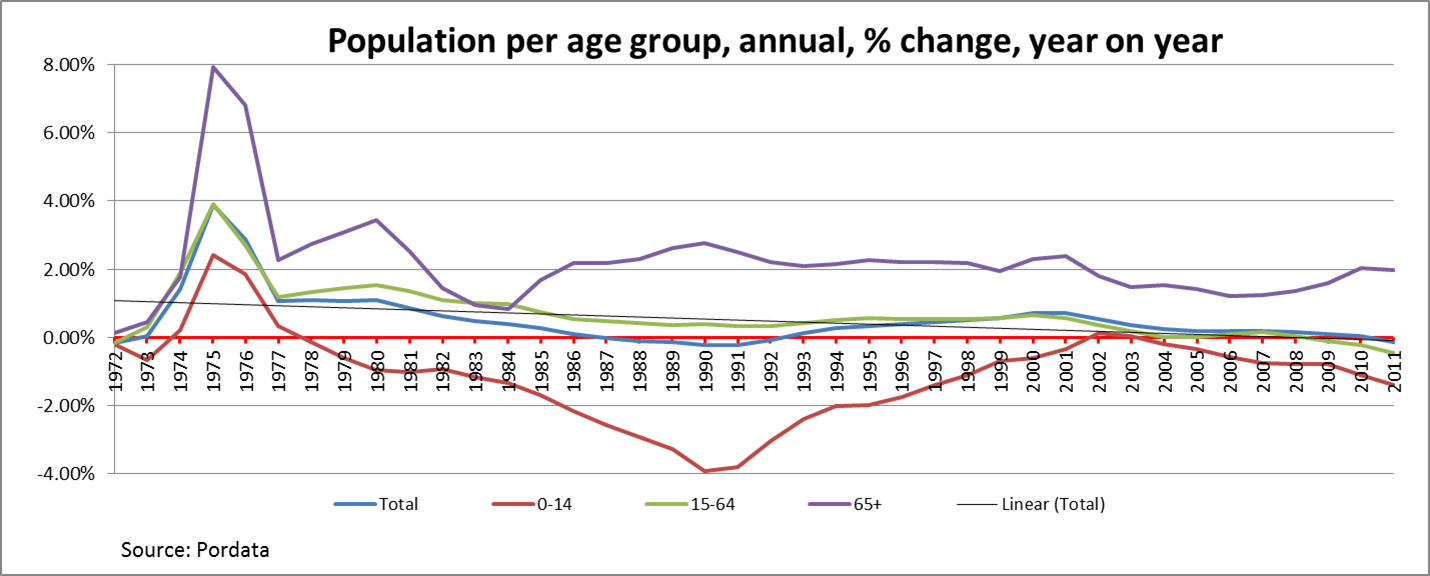
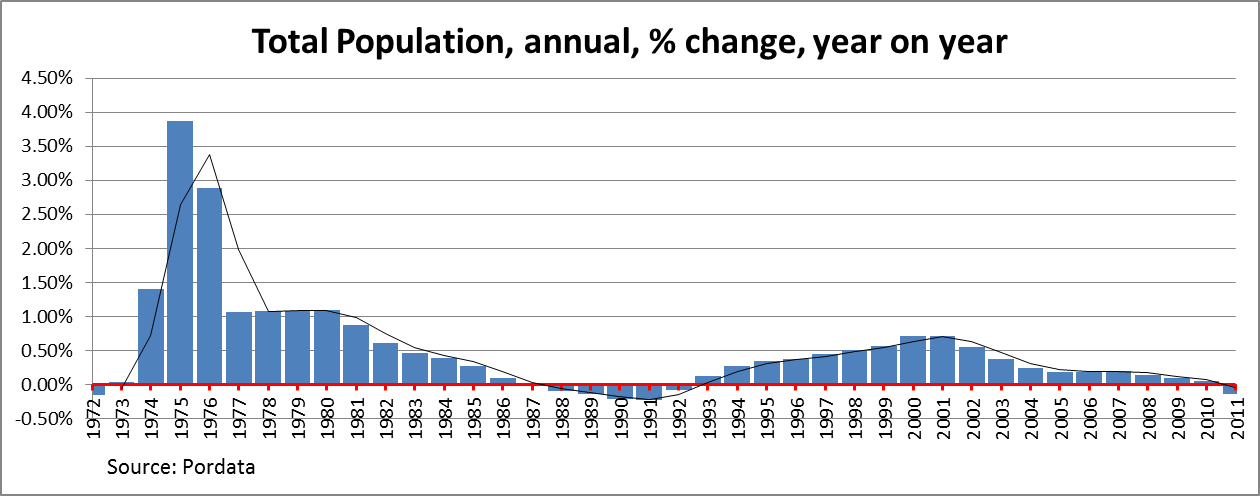
    While the phenomenon has arrived largely unnoticed Portugal’s total population has long been near to stationary.

    As can be seen in the above chart, Portugal’s population has been struggling to find growth momentum since the mid 1980’s (the first time numbers actually dipped downwards) but the years 2010/2011 seem to mark a more fundamental turning point, since it was in that time interval that Portugal’s population started on a long, and possibly irreversible, path of decline. Having long had a total fertility rate of below 1.5 this was a more than predictable outcome, and one that should have been expected ever since the total fertility rate fell (and stayed) below the 2.1 replacement level in 1982.

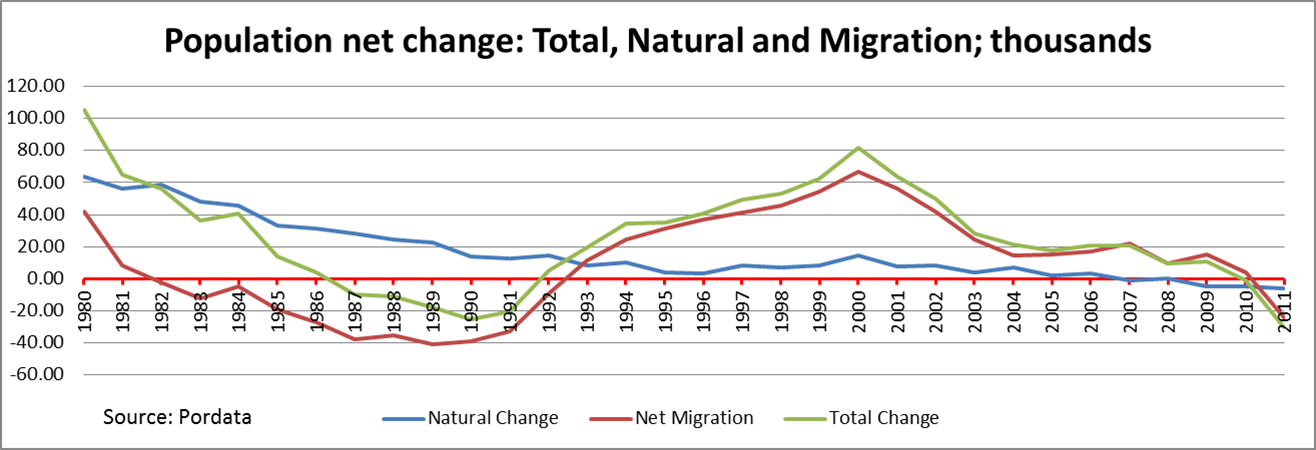
    As is well known, population change is comprised of two major components: natural growth and net migration. Natural growth, births minus deaths, became negative in 2007 and thereafter population growth has become exclusively dependent on having sufficient positive net migration. Up to 2010 this condition was satisfied given the continuing influx of immigrants into the country as can be seen in the chart below.


    However, since the onset of the 2008 recession, not only have the immigration flows reversed completely, but emigration has started to increase again, thus reanimating a trend that has been constantly present in Portuguese history over decades, even centuries. This is perhaps the most critical factor driving the recent population decline. In fact the decline would have occurred much earlier had it not been for the return of thousands of refugees from the Portuguese colonies in the 1974-1981 period.


    According to the European Commission’s 2012 Ageing Report, projections for the Portuguese population during the period 2010 – 2060 anticipated that population would peak in 2034, but as we have seen, the latest data show the population unexpectedly reached its peak in 2010 (total population, previous chart), the year in which the population began to decrease (a similar phenomenon seems to have occurred in Spain in 2012, with again a reversal in migrant flows in an otherwise stagnant population being the trigger). This fact that this turnaround comes as a surprise is clearly the result over optimistic assumptions on the net migration front since the numbers for natural growth are well known and change little (although birth numbers are now dropping in many EU countries under the impact of the long recession). Clearly the unexpected factor here is the severity of the recession from which the country is suffering and the size of the exodus of young people who are leaving.

    Just to highlight even more the speed with which all this is happening, in Japan, the interval between the beginning of the decline of the working age population and the beginning of total population decline was a full decade. In Portugal this interval was only two years.

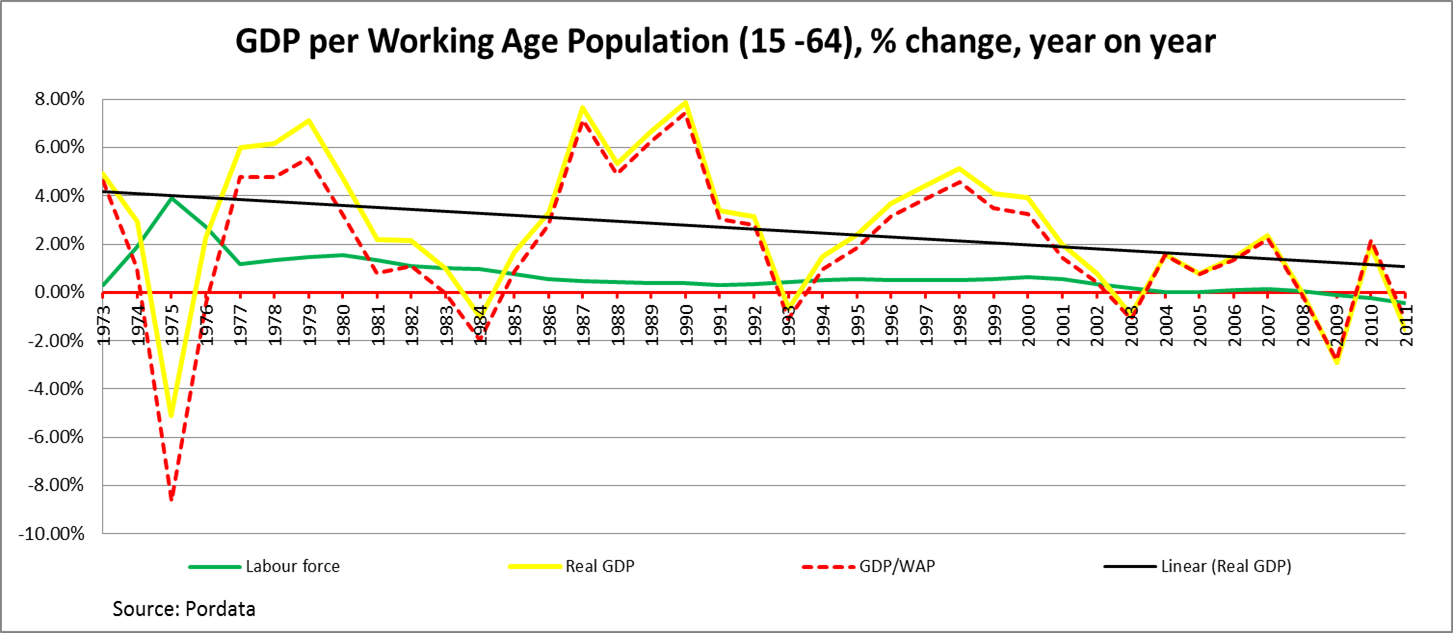
    Even more relevant than the decline in total population for the purpose of the present discussion is the decline in the working-age population. While the former gives us a good proxy for domestic consumption, it is the later which is important in terms of potential national output. All other things being equal a reduction in the working-age population means a reduction in output. Therefore, the most important detail to catch from the chart above is that the working-age population, defined as the population with ages ranging from 15-64, declined for the first time in Portugal between 2008 and 2009. As highlighted by both Daniel Gros and Paul Krugman if you want to compare economic growth performance as between countries with growing populations and those with declining ones the best indicator to use is undoubtedly GDP per Working Age Person (GDP/WAP).

    In the Portuguese case if we take this ratio and compare it with both Real GDP growth and Working Age Population change (my calculations VM), we can get an impression of how variations in the Working Age Population affect the economic growth of a country. Surprisingly or otherwise, the data for Portugal viewed graphically not only confirms the existence of the “workforce effect” – the relationship seen between Real GDP and GDP/WAP – but also suggests that Portugal has already passed the point where this effect is beginning to have a negative impact on GDP growth.


    As can be seen in the above chart, until 2008 the growth rate of Real GDP was always higher than the rate for GDP/WAP offering a strong suggestion that labour force growth was having a positive impact on GDP growth. It is noteworthy, however, that both in the period 1986 – 1991 and in the period 2003 – 2008, the growth rates of Real GDP and GDP/WAP almost overlapped. This phenomenon coincided with very low or zero rates of working age population growth and as such the “workforce effect” was mostly neutral. The first of these periods, 1986 – 1991, the stagnation in the workforce was the direct result of the increase in emigration that followed the entry of Portugal in the European Union. The second one coincides with the arrival of the turning point in long term WAP growth, as the size of the working age population irrevocably turns negative.

    Indeed, during this early period of emigration towards the EU Portugal’s total population decreased, as shown in the chart Population by age group (above, blue line), but at the time, since the population in general was much younger, and many more new labour force entrants were arriving at working age, the growth rate of the workforce remained slightly positive. In other words, there were still enough Portuguese entering the labour market to replace those who were leaving it (either to retire or to seek a future abroad). In the second period, 2003 – 2008, the large exit of Portuguese nationals, about 700,000 between 1998 and 2008 according to research by the now Economy and Employment Minister Álvaro Santos Pereira, was to some extent offset by an inflow of immigrants, but these were only sufficient in number to maintain the workforce at a stationary level.

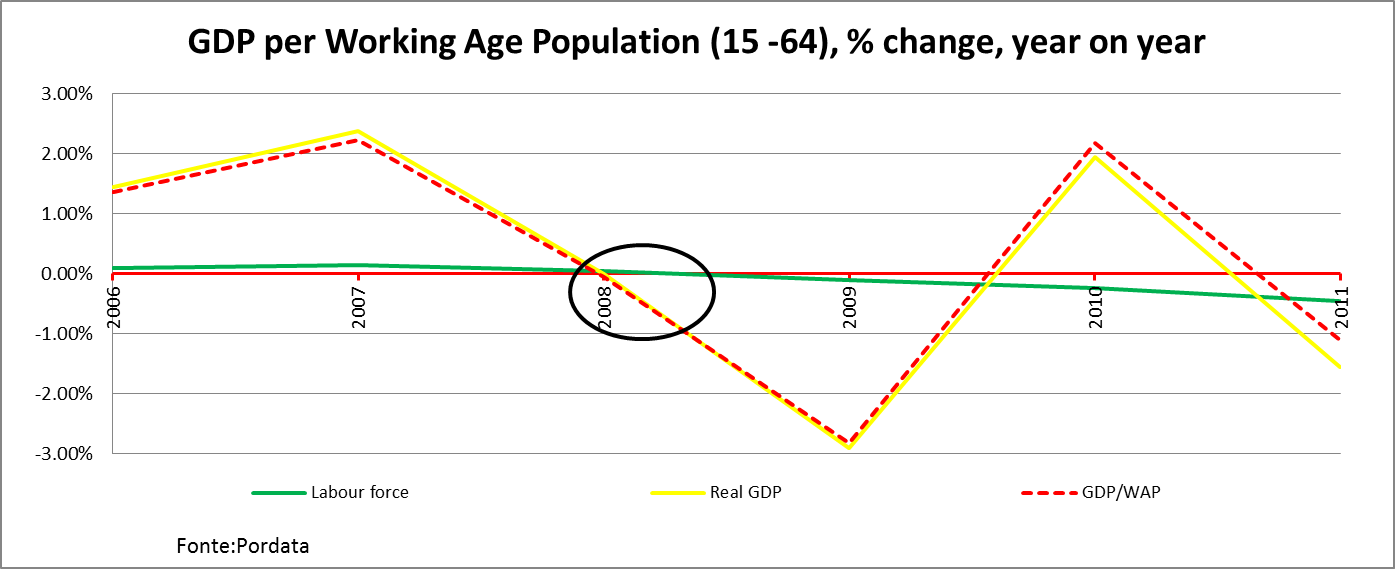
    All this calm and stability disappeared, however, after 2008 when the growth rate of Working Age Population turned negative, i.e. the labour force began to decline (see graph below). Where the growth rates of Real GDP and GDP/WAP overlap we can surmise that working age population change is having no effect on real GDP growth. Subsequently, however, the growth rate of GDP/WAP becomes higher than the growth rate of Real GDP and thus the “workforce effect” starts to act as a drag on the economy steadily bringing the potential overall growth rate down. In other words, Portugal is now suffering from a “Shortage of Japanese” as Edward Hugh has called the phenomenon, after Paul Krugman originally coined the term to describe the underlying problem which has been afflicting the Japanese economy since the mid-1990s.

    The fact that the three lines in the above chart happen to intersect at zero is perhaps just an unfortunate coincidence but is consequences are disastrous, since the downward trend that was already evident accelerated greatly after the onset of the recession. The resulting rise in unemployment not only caused a collapse in the immigration flow, it also led to a sharp increase in emigration. As a result workforce shrinkage intensified even further, as can be seen in the above chart by looking at the growing distance between the Real GDP and the GDP/WAP lines. That is, if the workforce had remained stationary the economy would be growing at similar rates to the GDP/WAP, i.e. above the current level as indeed happened in the period 2003 – 2008.

    Naturally, the argument can be advanced here that the recession is a cyclical phenomenon, and this is surely true, there is an ongoing cycle, but the argument being used refers to long term trends – a reversal in direction (or change of sign) for inputs from the labour force component brings down the overall trend growth rate making booms weaker and recessions deeper, all other things being equal. This would seem to be a simple conclusion which stems from elementary growth accounting theory. Naturally, there are other factors which contribute to growth, like multi factor productivity, but again other things being equal you would need more of this to achieve the same growth rate as before under conditions of weakening in the labour force growth component.

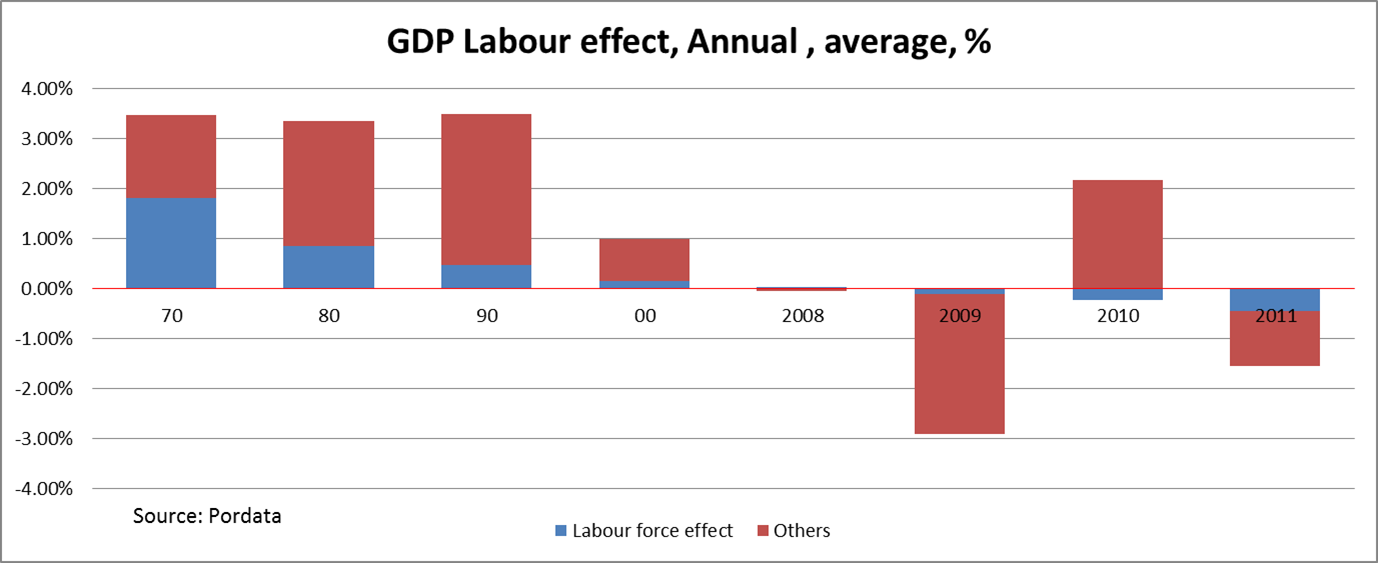
    Thus the argument is not that economic growth becomes impossible with a stagnant or slowly declining workforce, but simply that it becomes harder to achieve because it relies more on other factors, such as productivity and raising participation rates, but these change slowly over time, and more so in already developed countries. As such trend growth will surely steadily fall. This can be clearly seen in the following chart: while workforce growth was an important source of growth when Portugal was a developing country, its importance fell back as the workforce started to stagnate even as Portugal was approaching converge with other developed countries in terms of productivity. Other factors took over and increased their importance steadily as the economy started to converge with more advanced ones. Now that this catch up process seems to have come to a standstill as well the economy simply can’t growth, at least at rates considered normal. With a stagnant workforce, low growth or no growth is the new normal.


    Following standard growth accounting procedures, during the 1970s workforce growth accounted for more than half of Portuguese economic growth (see chart above, my calculations VM), and this contribution had fallen to only 16% in the first decade of this century. However, since 2008 not only has this contribution reversed sign but also the magnitude of the negative effect has begun to increase rapidly. Such that, by 2011 the “workforce effect” could be considered to explain more than 29% of the GDP decline. This “negative drag” will continue, and the effect possibly become greater, as the working age population shrinks further. Had the workforce remained stationary we could surmise the 2010 recovery would have been more pronounced and the 2011 recession wouldn’t have been so deep. This is the principal reason why official growth forecasts have been being constantly revised to the downside, and this will continue to happen until the models the forecasters use adequately incorporate the effects of population decline on economic growth. Adding insult to injury, ignorance of the existence of such effects recently led Portugal’s Prime Minister Pedro Passos Coelho to suggested young unemployed Portuguese resort to emigration as an escape route from the crisis, advice thousands have now followed thus making a bad situation even worse.

    Economic growth in Portugal appears to be on a long downward trend, a trend which will only be made worse by the onset of the decline in its working age population. Economic output is now at 2001 levels and thus we can now conclude that the last decade has been completely lost. More worryingly though, is that after such a bad start to this decade, it might not be unreasonable to conclude that this one is also in the process of being lost too.

    At best the economy will stagnate in the years to come but the possibility is there that it will continue to regress – especially if nothing is done to stem the outflow of young educated people – and by 2019 it might even be back somewhere in the 1990’s. This is scenario simply cannot be excluded since, in addition to all the other problems the country faces, a situation that would be in any circumstance challenging is now being aggravated by one more variable whose contribution cannot be easily reversed in the short term – the decrease in the working age population. More than the fact in itself, it is the speed at which this is happening which is alarming, and the fact that policymakers appear unaware of the problem. In analyzing the low Portuguese economic growth issue the decrease in the country’s working age population can no longer be ignored! Or at least it is hoped that this will be one of the outcomes of this short report.

    To return to where we started, Keynes concluded in his pioneering presentation that a stationary or slowly declining population could increase its standard of life while preserving the institutions society values most if, and only if, the process was managed with the necessary strength and wisdom. On the contrary, he argued, a rapid decline in population, of the kind that we are seeing in Portugal today, would almost inevitably result in a serious decline in living standards and a breakdown in highly valued social security mechanisms. The distinction Keynes drew some 80 years ago between rapid and managed rates of decline seems plausible, reasonable and highly relevant today. What we now need to see are urgent measures taken – initiated by the EU and the IMF – to counter the exodus which lies behind this dramatic decline which is occurring before our eyes, measures which at least try to decrease its speed, because once a process like this gains full velocity it will be very difficult to stop, and we have already seen it gather considerable traction. Ireland is a pointer and a great example to learn from, since it took that country more than a century to recover the population decline precipitated by the Great Famine which hit the country in the middle of the nineteenth century.

    Valter Martins is a self-taught economist and his research interests include demographics and its impact on economic growth. He holds a degree in International Business from University of Minho, Portugal and a Professional Diploma in Financial Advice (QFA) from Ireland.

  • America’s True Power In The NAFTA Century

    OK, I get it. Between George W. Bush and Barack Obama we have made complete fools of ourselves on the international stage, outmaneuvered by petty lunatics and crafty kleptocrats like Russia’sVladimir Putin. Some even claim we are witnessing “an erosion of world influence” equal to such failed states as the Soviet Union and the French Third Republic. “Has anyone noticed how diminished, how very Lilliputian, America has become?” my friend Tunku Varadajaran recently asked.

    In reality, it’s our politicians who have gotten small, not America. In our embarrassment, we tend not to notice that our rivals are also shrinking. Take the Middle East — please. Increasingly, we don’t need it because of North America’s unparalleled resources and economic vitality.

    Welcome then to the NAFTA century, in which our power is fundamentally based on developing a common economic region with our two large neighbors. Since its origins in 1994, NAFTA has emerged as the world’s largest trading bloc, linking 450 million people that produce $17 trillion in output. Foreign policy elites in both parties may focus on Europe, Asia and the Middle East, but our long-term fate lies more with Canada, Mexico and the rest of the Americas.

    Nowhere is this shift in power more obvious than in the critical energy arena, the wellspring of our deep involvement in the lunatic Middle East. Massive finds have given us a new energy lifeline in places like the Gulf coast, the Alberta tar sands, the Great Plains, the Inland West, Ohio, Pennsylvania and potentially California.

    And if Mexico successfully reforms its state-owned energy monopoly, PEMEX, the world energy — and economic — balance of power will likely shift more decisively to North America. Mexican President Pena Nieto’s plan, which would allow increased foreign investment in the energy sector, is projected by at least one analyst to boost Mexico’s oil output by 20% to 50% in the coming decades.

    Taken together, the NAFTA countries now boast larger reserves of oil, gas (and if we want it, coal) than any other part of the world. More important, given our concerns with greenhouse gases, NAFTA countries now possess, by some estimates, more clean-burning natural gas than Russia, Iran and Qatar put together. All this at a time when U.S. energy use is declining, further eroding the leverage of these troublesome countries.

    This particularly undermines the position of Putin, who has had his way with Obama but faces long-term political decline. Russia, which relies on hydrocarbons for two-thirds of its export revenues and half its budget, is being forced to cut gas prices in Europe due to a forthcoming gusher of LNG exports from the U.S. and other countries. In the end, Russia is an economic one-horse show with declining demography and a discredited political system.

    In terms of the Middle East, the NAFTA century means we can disengage, when it threatens our actual strategic interests. Afraid of a shut off of oil from the Persian Gulf? Our response should be: Make my day. Energy prices will rise, but this will hurt Europe and China more than us, and also will stimulate more jobs and economic growth in much of the country, particularly the energy belts of the Gulf Coast and the Great Plains.

    China and India have boosted energy imports as we decrease ours; China is expected to surpass the United States as the world’s largest oil importer this year. At the same time, in the EU, bans on fracking and over-reliance on unreliable, expensive “green” energy has driven up prices for both gas  and electricity.

    These high prices have not only eroded depleted consumer spending but is leading some manufacturers, including in Germany, to look at relocating production , notably to energy-rich regions of the United States. This shift in industrial production is still nascent, but is evidenced by growing U.S. manufacturing at a time when Europe and Asia, particularly China, are facing stagnation or even declines. Europe’s industry minister recently warned of “anindustrial massacre” brought on in large part by unsustainably high energy prices.

    The key beneficiaries of NAFTA’s energy surge will be energy-intensive industries such as petrochemicals — major new investments are being made in this sector along the Gulf Coast by both foreign and domestic companies. But it also can be seen in the resurgence in North American manufacturing in automobiles, steel and other key sectors. Particularly critical is Mexico’s recharged industrial boom. In 2011 roughly half of the nearly $20 billion invested in the country was for manufacturing. Increasingly companies from around the world see our southern neighbor as an ideal locale for new manufacturing plants; General Motors GM -0.96%Audi , Honda, Perelli, Alcoa and the Swedish appliance giant Electrolux have all announced major investments.

    Critically this is not so much Ross Perot’s old “sucking sound” of American jobs draining away, but about the shift in the economic balance of power away from China and East Asia. Rather than rivals, the U.S., Mexican and Canadian economies are becoming increasingly integrated, with raw materials, manufacturing goods and services traded across the borders. This integration has proceeded rapidly since NAFTA, with U.S. merchandise exports to Mexico growing from $41.6 billion in 1993 to $216.3 billion in 2012, an increase of 420%,while service exports doubled. MeanwhileU.S. imports from Mexico increased from $39.9 billion in 1993 to $277.7 billion in 2012, an increase of 596%.

    At the same time, U.S. exports to Canada increased from $100.2 billion in 1993 to $291.8 billion in 2012.

    Investment flows mirror this integration. As of 2011, the United States accounted for 44% of all foreign investment in Mexico, more than twice that of second-place Spain; Canada, ranking fourth, accounts for another 10%. Canada, which, according to a recent AT Kearney report, now ranks as the No. 4 destination for foreign direct investment, with the U.S. accounting for more than half the total in the country. Over 70% of Canada’s outbound investment goes to the U.S.

    Our human ties to these neighbors may be even more important. (Disclaimer: my wife is a native of Quebec). Mexico, for example, accounts for nearly 30% of our foreign-born population, by far the largest group. Canada, surprisingly, is the largest source of foreign-born Americans of any country outside Asia or Latin America.

    We also visit each other on a regular basis, with Canada by far the biggest sender of tourists to the U.S., more than the next nine countries combined; Mexico ranks second. The U.S., for its part, accounts for two-thirds of all visitors to Canada and the U.S. remains by far largest source of travelers to Mexico.

    These interactions reflect an intimacy Americans simply do not share with such places as the Middle East (outside Israel), Russia, and China. There’s the little matter of democracy, as well as a common sharing of a continent, with rivers, lakes and mountain ranges that often don’t respect national borders. Policy-maker may prefer to look further afield but North America is our home, Mexico and Canada our natural allies for the future. Adios, Middle East and Europe; bonjour, North America.

    This story originally appeared at Forbes.

    Joel Kotkin is executive editor of NewGeography.com and Distinguished Presidential Fellow in Urban Futures at Chapman University, and a member of the editorial board of the Orange County Register. He is author of The City: A Global History and The Next Hundred Million: America in 2050. His most recent study, The Rise of Postfamilialism, has been widely discussed and distributed internationally. He lives in Los Angeles, CA.

    NAFTA logo by AlexCovarrubias.

  • Swedish Lessons for Obama

    During his upcoming visit to Sweden, President Barack Obama will surely praise the nation’s combination of high living standards, few social problems, and high level of income equality. What he may not recognize — although he should — is that the astonishing social and economic outcomes in Sweden and other Nordic countries have more to do with a unique culture among homogenous populations than with simply following a recipe of social democratic policies.

    Sweden long has been admired by US intellectuals, particularly on the left. In 1976 Time Magazine described Sweden as a “country whose very name has become a synonym for a materialist paradise… No slums disfigure their cities, their air and water are largely pollution free… Neither ill‑health, unemployment nor old age pose the terror of financial hardship.” The praise has continued since then. Recently even Bruce Springsteen joined those in favor of the US adopting a Swedish style welfare state. The success of Nordic nations is often seen as the proof that large welfare states lead to good outcomes. Paul Krugman for example writes: “Every time I read someone talking about the ‘collapsing welfare states of Europe’, I have this urge to take that person on a forced walking tour of Stockholm.”

    A walk through Sweden’s history however paints a more nuanced perspective than the one Krugman and other praise-givers might suggest. Around 1870 the previously poor country could begin its route to prosperity, thanks to comprehensive market reforms. Between 1870 and 1936, the start of the social democratic era, the country had the highest growth rate in the industrialised world. Between 1936 and 2008, a period when Sweden was mainly controlled by the Social Democrats, the growth rate was only ranked 18th out of 28 industrialised nations. Also, it is vital to remember that the social democrats were initially highly pragmatic. Small government policies continued until the social democrats radicalized in the late 1960s.

    Sweden’s phenomenal growth can, besides business friendly policies, has much to do with the country’s unique history. Nordic countries were for a long period dominated by independent farmers who had great incentives to work hard in order to survive in the harsh and cold climate. The populations in these homogenous countries not only adapted very strong ethics relating to work and responsibility, but their culture also became characterized by social cohesion and high levels of trust.

    Early welfare state institutions, not least a public school system open for all social classes that emphasized discipline and academic knowledge, indeed promoted social mobility. It is vital to realize that the high level of income equality for which Sweden is envied for developed when the nation had relatively small welfare state. The rise of high tax policies occurred after Sweden had already grown equal.

    The cultural attributes that explain Nordic success work well also in the US, at least amongst the nation’s Nordic population. Today we can see that descendants of Scandinavians who live in the US (whose fore-fathers left well before the development of social democratic policies) have the highest levels of trust in the US. Americans of Swedish origin have the same poverty level as Swedes in their native country. The Americans however earn some 50 percent higher incomes than the latter.

    The period for which Sweden has been most envied by the US left is the massive state expansion that occurred mainly during the period following the second world war, a period when the tax rate increased by almost one percentage point annually over three decades. In particular the left is fascinated by the “third way policies”, a mix between capitalism and socialism, which followed radicalization of previously pragmatic social democrats in the late 1960s. This period, characterized by massive state involvement and effective marginal tax rates of sometimes 100 percent, was however anything but successful. Previously Sweden had thrived due to birth of new entrepreneurial firms, a phenomenon that almost stopped in 1970 and did not again start until significant market reforms where introduced during the 1990s and early 2000s.

    During recent decades the levels of economic liberty have again increased strongly in the Nordic countries (Norway, leaning on its oil-wealth, is somewhat slow to reform). The Nordic nations compensate for their high taxes and regulated labour markets by having introduced high levels of economic liberty in a wide range of other fields. Recently, even the taxes have been reformed. In 2000 total tax revenues in Sweden were over 51 percent of GDP. The level decreased somewhat during the following years of social democratic rule, to 48 percent in 2006. The current centre-right government has reduced them to 44 percent and is currently introducing new reductions of the tax burden.

    Rather than expand their welfare states, Nordic nations are again returning to the free market roots that have served them so well historically. This is perhaps an important lesson for Obama, Springsteen and Krugman, to ponder. There are indeed many smart elements in the Swedish welfare state, and the welfare states of other Nordic countries, that deserve admiration. An example is how public child care has encouraged women’s entry into the labor market. Another is Danish flexicurity that combines public safety nets with a liberal labour market. A third is partial privatization of social security in Sweden. A fourth — often ignored —  is the country’s dedication to fiscal conservatism even under the Social Democrats.

    There are also many areas in which some Nordic nations fail whilst others do significantly better. Norway continues to rely on systems with very generous public benefits, which deteriorate the work ethic. The other nations, which cannot rely on oil wealth, have learned their lesson and work towards strengthening incentives for work and entrepreneurship. Finland has kept a school system that is, thanks to academic discipline and knowledgeable teachers, able to educate well those who do not come from academic or middle-class families. Sadly, Swedish public schools, have, much like their US counterparts, moved towards progressive ideas and deterioration in teacher’s knowledge. The result is an inability to stimulate those who are not intrinsically motivated to learn to do so. Overall the Nordic nations also fail at integrating foreign-born, even those who come with higher education.  

    There is simply much to learn from Nordic nations. They have experimented with everything from implementing Milton Friedman’s idea of vouchers in welfare to implementing gender quotas in corporate boards. But aside from benefitting from the unusually strong norms related to work, trust and cooperation, Nordic societies are no exception to the rules of politics and economics. The same policies that hinder growth in the US (high taxes, lack of infrastructure, failing school policies) limit societal success in Scandinavia, whilst steps to encourage innovation, entrepreneurship, and work are proven to work equally well in both sides of the Atlantic.  

    Dr. Nima Sanandaji is a Swedish author of Kurdish-Iranian origin. He has written numerous books and reports about issues such as entrepreneurship, women’s career opportunities, integration, and welfare. Nima is the author of reports "The Swedish Model Reassessed" for Finnish think-tank Libera and "The surprising ingredients of Swedish success” for the Institute of Economic Affairs. Currently he is working on a book about the unique economic and cultural success of both the Nordic nations and the “new Nordic” countries in the Baltics.

  • America Hanging in There Better Than Rivals

    To paraphrase the great polemicist Thomas Paine, these are times that try the souls of optimists. The country is shuffling through a very weak recovery, and public opinion remains distinctly negative, with nearly half of Americans saying China has already leapfrogged us and nearly 60 percent convinced the country is headed in the wrong direction. Belief in the political leadership of both parties stands at record lows, not surprisingly, since we are experiencing what may be remembered as the worst period of presidential leadership, under both parties, since the pre-Civil War days of Franklin Pierce and James Buchanan.

    Yet, despite the many challenges facing the United States, this country remains, by far, the best-favored part of the world, and is likely to become more so in the decade ahead. The reasons lie in the fundamentals: natural resources, technological excellence, a budding manufacturing recovery and, most important, healthier demographics. The rest of the world is not likely to cheer us on, since they now have a generally lower opinion of us than in 2009; apparently the "bounce" we got from electing our articulate, handsome, biracial Nobel laureate president is clearly, as Pew suggests, "a thing of the past."

    But as the Romans used to say, don’t let the bastards get you down. After all, it’s not like our competitors are stealing the march on us. Start with Europe. Just a few years ago, writers like Jeremy Rifkin and Steven Hill were telling us that Europe was the "model" for the world. Expand the welfare state, curtail capitalist excess, provide a comfortable partner to the rising nations of the world, and, well, enjoy a long and comfortable early retirement.

    Now, that early retirement is quickly turning into a kind of senility. Not only is Europe continuing to age – particularly along its Southern rim – but the fiscal pressures of ultrahigh unemployment, approaching 30 percent or above, among the young and the costs of maintaining a strong welfare state could create what urban analyst Aaron Renn has labeled "a demographic Lehman Brothers."

    At the same time the near-collapse of the Southern-rim countries threatens the viability of Europe’s banks, including those in Germany. Increasingly, Germany lives largely so the rest of Europe can die more quickly. Like a prototypical science-fiction villain, Germany – with fewer children than it had in 1900 – relies increasingly on the blood taken from the decaying Southern rim countries. By 2025, Germany’s economy will need 6 million additional workers, likely from such countries as Spain, Italy, Greece and Portugal, to keep its economic engine humming, according to government estimates.

    Asian anemia

    What about our prime Asian competitors? Japan has been the sick man of Asia for more than two decades. It’s now desperate enough to unleash Bernanke-like money-printing policies to supply some desperately needed economic Viagra. With a weaker currency, and more money from the Tokyo exchange, there could be a temporary recovery, but Japan’s long term prognosis is not good.

    What Japan really needs is more animal spirits – particularly the kind that produce offspring. By 2050, according to UN estimates, Japan will have 3.7 times as many people at least age 65 than 15 and younger. By then, there will be 10 percent more Japanese over 80 than under 15. Without an unlikely embrace of immigration, Japan is destined to become the nation in wheelchairs.

    China poses a more serious challenge, but the Middle Kingdom appears headed toward what one analyst calls "the end" of its amazing and profound economic miracle. Growth, once projecting Chinese global preeminence, is slowing precipitously. The country now faces a growing rank of competitors from lower-wage countries poised to take market share from the Middle Kingdom.

    China faces growing political instability at the grass-roots level, a mountain of state-issued bad debt and a festering environmental crisis, which threatens long-term food supplies and could create massive health problems. China is rapidly aging. It will have 60 million fewer people under age 15 by 2050, while gaining nearly 190 million people at least 65, approximately the population of Pakistan, the world’s fourth-most populous country.

    The so-called BRICS (Brazil, Russia, India, China and South Africa), once the darlings of the investment banking set, all are facing slowing growth and rising political instability. It doesn’t help that most are either total or partial kleptocracies, dependent on commodity exports or cheap labor. This is not a solid foundation for ascendency as newer emerging nations – Myanmar, Indonesia, Vietnam – ramp up.

    ENERGY SHIFT

    On all these accounts, North America, including our Canadian and Mexican neighbors, looks best-positioned. The first, and, arguably, most important game-changer is the energy revolution that could realign the economic stars for decades to come. The shale oil and natural gas boom, as the Economist recently noted, is as illustrative of America’s future, and genius at reinvention, "as the algorithms being generated in Silicon Valley."

    The energy boom’s best aspect, besides the emergence of relatively cleaner natural gas, is making global tyrants, such as those ruling Saudi Arabia and Russia, nervous about their future place in the world. These worries alone should send a three-word message to our leaders: Go for it.

    But North America is not, like Russia, a one-trick pony. The U.S. remains the world’s leading food producer and exporter, sending out more of such critical commodities as soybeans, corn and wheat than any other country. After decades of decline, the U.S. industrial base is growing again, and, although job growth is likely to be limited, our manufacturing sector is already the most productive in the world. With the advantages of a decent legal order, a huge domestic market and available workforce, the U.S. has remained the largest recipient of foreign investment on the planet, roughly five times that so far accumulated in China.

    Technology can be a fickle industry, but at this point of the game, it’s fair to say the U.S. is winning that race. As potentially dangerous as the tech giants may become over time, the U.S. dominance in everything from software code (Microsoft) and design (Apple), search (Google), e-retailing (Amazon), and social networking (Facebook) is nothing short of astounding. We even lead in the coffee business (Starbucks) that keeps all those nerds typing code late into the night.

    Cultural influence

    Then there’s the matter of culture. For years, Asian, Third World and European cultural warriors have plotted to knock the U.S. off its pre-eminent perch. But the European film industry is a shadow of its once-glorious efflorescence; much the same can be said about the once-splendid Japanese cinema. To be sure, Chinese films, Korean pop stars and Bollywood are rising forces, but U.S. exports more than $14 billion annually in film and television. On a global level, no one can compete with Hollywood as a packager of images and dreams – and Silicon Valley’s control of new distribution technology could further boost this advantage.

    Finally, there’s the matter of demographics. The United States, like its competitors, is aging, but not as quickly as our prime rivals. The birth rate has slowed with the recession, but it’s likely to come back toward replacement levels in the years ahead as millennials enter their thirties en masse, and immigrants continue coming to the country. America should be the only one of the top five economies with a growing workforce over the next few decades.

    So, if things are so good, why do they seem so bad? Sixteen years of lackluster leadership has not helped – a succession of two spendthrift presidents, one a too-happy warrior with a weak sense of the limits of even an imperial power, and the other, a posturing and arrogant academic oddly disconnected from the fundamental grass-roots drive that moves his country’s economy. Yet I prefer to see it in a more positive light: If we can do better than our major competitors under such leadership, how great a country is this?

    Joel Kotkin is executive editor of NewGeography.com and Distinguished Presidential Fellow in Urban Futures at Chapman University, and a member of the editorial board of the Orange County Register. He is author of The City: A Global History and The Next Hundred Million: America in 2050. His most recent study, The Rise of Postfamilialism, has been widely discussed and distributed internationally. He lives in Los Angeles, CA.

    This piece originally appeared at The Orange County Register.

    USA map image by BigStockPhoto.

  • Major Metropolitan Areas in Europe

    Eurostat, the statistical agency of the European Commission (European Union) now designates metropolitan areas (Note) for the European Union (EU) and the European Three Trade Association (EFTA). The EU has 28 members, having just added Croatia, while the EFTA has 4 members. According to the latest data, there are 99 major metropolitan areas in Europe (those more than 1,000,000 residents).  Overall, Eurostat designates 305 metropolitan areas with more than 200,000 population.

    Europe’s Largest Metropolitan Areas

    London and Paris are by far the largest metropolitan areas in Europe. London’s population is approximately 13.6 million, of which approximately 24 percent live in the historical core of Inner London (the pre-1965 London County Council area). Paris has approximately 11.9 million residents, with 19 percent living in the historical core of the ville de Paris.

    The third and fourth largest major metropolitan areas are both in Spain. Madrid has a population of 6.4 million, more than half of which is in the historic core municipality. Barcelona ranks fourth largest, with a population of 5.4 million, with 30 percent living in the historical urban core municipality. In recent decades there has been substantial suburbanization in the valleys to the north of the city of Barcelona. Moreover, the Eurostat Milan metropolitan area definition could be too tight. The urbanization stretches into Como, Lecco and Varese and an argument could be made for inclusion of exurban Lodi and Pavia. These would raise Milan’s population to nearly that of Madrid.

    Germany has the other two metropolitan areas with more than 5 million residents, Essen (Ruhrgebiet or Rhine area) and Berlin. Both metropolitan areas have a population of 5.1 million. By some definitions, a Rhine-Ruhr metropolitan area would include Dusseldorf and even Cologne (Köln) and Bonn to the south. This wider area has a population of more than 11 million and would rank among the top three in Europe. Eurostat breaks this area into four metropolitan areas.

    Overall, approximately 1/3 of the metropolitan population lives in the historical urban cores of Europe’s 99 major metropolitan areas, with approximately 2/3 of living in the suburbs and exurbs (Figure 1). This percentage is somewhat smaller among the metropolitan areas with more than 5,000,000 population (30 percent). The 25 largest metropolitan areas are shown in the table, and all 99 metropolitan areas are listed in Europe: Major Metropolitan Areas & Historic Core Populations: 2010 to 2012.

    European Metropolitan Areas as Designated by Eurostat: Largest 25
    European Union (EU) and European Free Trade Association (EFTA)
    2010-2012 Estimates, with Historical Core Estimates
    Rank Metropolitan Area Nation Metropolitan Area (Millions) Year: Metropolitan Area Estimate Historical Core: Recent Year (Millions) Approximate % in Historical Core
    1  London   UK        13.614    2012             3.231    23.7%
    2  Paris   France        11.915    2012             2.204    18.5%
    3  Madrid   Spain          6.388    2012             3.284    51.4%
    4  Barcelona   Spain          5.357    2012             1.623    30.3%
    5  Ruhrgebiet (Essen)   Germany          5.135    2012             0.573    11.2%
    6  Berlin   Germany          5.098    2012             3.375    66.2%
    7  Milano   Italy          4.275    2012             1.242    29.1%
    8  Roma   Italy          4.234    2012             2.638    62.3%
    9  Athina   Greece          4.109    2012             0.664    16.2%
    10  Warszawa   Poland          3.272    2012             1.708    52.2%
    11  Hamburg   Germany          3.228    2012             1.734    53.7%
    12  Napoli   Italy          3.078    2012             0.959    31.2%
    13  Budapest   Hungary          2.985    2012             1.741    58.3%
    14  Brussels   Belgium          2.923    2012             0.166    5.7%
    15  Lisboa   Portugal          2.824    2012             0.548    19.4%
    16  Katowice   Poland          2.795    2012             0.308    11.0%
    17  München   Germany          2.727    2012             1.388    50.9%
    18  Stuttgart   Germany          2.692    2012             0.613    22.8%
    19  Manchester   UK          2.683    2012             0.503    18.8%
    20  Wien   Austria          2.636    2012             1.731    65.7%
    21  Lille – Dunkerque   France-Belgium          2.584    2012             0.227    8.8%
    22  Frankfurt am Main   Germany          2.575    2012             0.692    26.9%
    23  Praha   Czech Republic          2.521    2012             1.291    51.2%
    24  Valencia   Spain          2.513    2012             0.809    32.2%
    BY SIZE CATEGORY          
    Over 5,000,000 (6)       47.507              14.290    30.1%
    2,500,000 to 5,000,000 (18)       54.653              18.962    34.7%
    1,000,000 to 2,500,000 (75)     104.376              35.176    33.7%
    Total     206.536              68.428    33.1%
    Notes:            
    Metropolitan area estimates from Eurostat        
    Core estimates from multiple sources and is for 2008 or later      
    Historical Core: The smallest area corresponding or including the pre-automobile core for which data is readily available. In each case the historical core is the first named municipality (commune), except in London (where Inner London is used) and Antwerp (where the pre-1983 consolidation municipality is used).


    Enlargement Nations Compared to the EU-15 and EFTA

    The share of the population living in the historical urban cores is much higher in the generally less affluent nations that have been added to the European Union over the last decade. In the 13 enlargement nations, approximately 52 percent of the metropolitan area population lives in the historical urban core. By contrast, in the more affluent nations of the EU – 15 and the EFTA only 29 percent of the major metropolitan area population lives in the historical urban cores (Figure 2).

    To some degree, this difference is explained by the stronger central planning in metropolitan areas that developed in the more controlled economies in the enlargement nations before the fall of the Soviet Union. Planners were usually given larger geographical areas to control than has typically been the case in Western Europe, North America and Japan. The metropolitan areas of the enlargement nations also have substantially more dense principal urban areas, averaging 11,300 per square mile (4,300 per square kilometer), compared to 8,400 per square mile (3,200 per square kilometer) in the EU-15 and the EFTA.   

    Resurgence of the Historical Cores

    Western Europe’s historical cores experienced substantial population losses in the decades leading to 2000. This trend, similar to that in the United States, saw the population of Inner London drop 55 percent from its 1911 peak to its 1991 low. The ville de Paris lost more than one quarter of its population from 1921, a rate slightly greater than in the city of Chicago over the same years. Copenhagen lost 35 percent of its population. In the decades from the mid 20th century to 2000, virtually every major urban core municipality in Western Europe declined from its peak population, except for those that expanded their boundaries, combined with another municipality or had substantial greenfield space for suburban development within their city limits (such as Rome).

    Since 2000, as we see in the United States, many of the historical cores have begun adding population. Much of the increase has resulted from the international migration that has been spurred by the open borders of the EU’s enlargement (See: Examining Sprawl in Europe and America: Europeans are Moving to the Suburbs Too). Inner London has been a particular beneficiary of this trend, adding nearly 900,000 residents over the last two decades. Much of this gain is from international migration, as Inner London suffered a minus 1.5 percent annual domestic migration rate in the 2000s, less than that of New York City (1.8 percent), but more than that of Los Angeles County (1.4 percent). Inner London’s population remains 36 percent below its peak level of more than a century ago.

    Comparisons to the United States

    Europe has nearly twice as many major metropolitan areas as the United States. The total major metropolitan area population is also higher, at 207 million compared to 173 million in the United States. Yet the major metropolitan areas of the United States constitute a larger share of the urban population. Approximately 55 percent of the US population lives in a major metropolitan area, compared to only 40 percent in Europe. The share of major metropolitan areas in the historical urban cores is slightly higher in Europe, at 33 percent, compared to 27 percent in the United States.

    Growing Metropolitan Areas

    International migration, particularly from the enlarged EU, as well as the continuing shift from rural to urban areas has driven stronger growth throughout some metropolitan areas. Eurostat metropolitan area data is available from as early as 2003 and shows Madrid to be the fastest growing, at a 1.5 percent annual rate. Rome is not far behind, with a 1.4 percent annual rate. Brussels is growing at a 1.1 percent rate, while London, Prague and Valencia are adding 1.0 percent to their populations each year. While detailed Eurostat data is not available for earlier years in Milan, strong growth has been indicated. Even formerly moribund Vienna, which reached its population peak early in the 20th century, is growing at an unprecedented 0.8 percent annual rate.

    Other major metropolitan areas continue with slow growth or are even declining. Europe’s two largest conurbations, Essen and Katowice (the Upper Silesian metropolitan area of Poland) are losing population. Naples is simply not growing.

    Before beginning its metropolitan area estimation system, Eurostat designated similar areas as “larger urban zones.” This system continues, with considerable comparative information between areas. However, data is issued less frequently. Eurostat’s metropolitan area system, with its annual estimates and more consistent definitions is an important step forward.

    Wendell Cox is a Visiting Professor, Conservatoire National des Arts et Metiers, Paris and the author of “War on the Dream: How Anti-Sprawl Policy Threatens the Quality of Life.


    Note: Metropolitan areas are labor markets and always include both a principal urban area (contiguously built up area) and connected rural territory. Smaller urban areas may also be included. See: Definition of Terms used in The Evolving Urban Formseries.

    Photo: Belgravia, London (by author)