Tag: Europe

  • Should Uncle Sam Chase a Scandinavian Model?

    When American progressives dream their future vision of America, no place entices them more than the sparsely populated countries of Scandinavia. After all, here are countries that remain strongly democratic and successfully capitalist, yet appear to have done so despite enormously pervasive welfare systems.

    Paul Krugman, the current high priest of progressive economics, approves of Sweden’s high level of spending on benefits as an unadulterated economic plus. He says that Sweden, unlike other European states like France, thrives despite its high tax rate and notes that, while half of all children are born out of wedlock, those children have far less poverty than American children. Progressive pundit Richard Florida, for his part, claims that Sweden is the most creative place on Earth, just ahead of the U.S.

    Some even suggest America should adopt wholesale the Scandinavian system as a policy imperative. The Washington Post praises Sweden as the “rock star” of the financial crisis and lists five ways the U.S. could learn from Sweden. ThinkProgress lauds Sweden’s ability to achieve the world’s highest rate of “social progress” despite a lower per capita income than the U.S. Writer David Dietz, contributor to PolicyMic, sees countries such as Sweden, Norway and Denmark as models that can guarantee both future economic growth and a way for America “to regain its global edge and cement its economic dominance.”

    But before we all go out drinking aquavit, shouting “skol” and dyeing our hair blonde, it makes sense to recognize that not only is relatively small, historically homogenous Scandinavia an ill-suited role mode for a megapower like the U.S., but that, in many ways, the Nordic system may be far more limited than its admirers here might acknowledge.

    Of course, it’s not that there’s not something to learn from these or other countries. Certainly Europe’s chilly corner seems in much better shape than the rest of the continental mess. Given today’s circumstances, recent books extolling the EU as a model such as Stephen Hill’s “Europe’s Promise” or Jeremy Rifkin’s “The European Dream” seem just slightly absurd.

    In truth, Scandinavian countries have performed better than the dismal continental norm in large part because, with the exception of recession-wracked Finland, they have stayed out of Euro currency.

    But even those outside the Euro-destruct zone are not doing as well as widely asserted. Overall unemployment in Sweden, at 8.4 percent, is also higher than that of the U.S.

    Even Norway is underperforming. The last quarter its GDP grew .3 percent, down from an expected .8 percent. As long as mainland Europe is gripped by negative growth and record unemployment, export-oriented Scandinavian countries will continue to struggle.

    In addition, not all the reasons for Scandinavia’s relative health are those that would warm the heart of U.S. progressives. These countries, led by Sweden, have reformed many aspects of their welfare state, including such things as labor laws, and reduced taxes in ways that make them more competitive – and far less egalitarian than in the past.

    Another positive factor for Scandinavia lies in their exploitation of resources, something many progressives, notably green policy aficionados, tend to view with disdain. Sweden exports loads of iron ore to drive its economy and employs massive dams to drive hydropower, which accounts for 42.8 percent of their energy. Norway benefits from a gusher of oil and gas that, producing nearly 2 million barrels of oil per day, making it the 14th largest oil producer in the world despite having a population of 5 million. If anything, Norway can be a model socialist economy because its economic base resembles the Nordic enclave of North Dakota. Overall, the tiny country produces nearly 15 times as much oil per person than the U.S.

    There’s also the matter of scale. Demographically, Scandinavia’s population is microscopic compared to our far vast multi-ethnic Republic. Taken together the four Scandinavian countries – Finland, Denmark, Sweden and Norway – are home to barely 26 million people, far fewer than California and about the same as Texas. These hardy souls are widely dispersed. The population density of Norway and Finland is roughly half that of the U.S., while that of Sweden is one-third less.

    Sweden, to put things in perspective, has fewer people than Los Angeles County. Norway and Finland are less populous than Minnesota, which is about the closest thing we have to Scandinavia. The Minneapolis-Saint Paul region, with 3.6 million residents, would be by far the biggest urban area in the region. Overall American Nordics, including those of mixed ancestry, total 11 million, more than the population of Sweden, by far the region’s largest country.

    Scandinavia’s greatest strength may lie in its least political correct asset: its Nordic culture. Scandinavians’ traditional interest in education, hard work and good governance serves them well both at home and abroad. It’s not socialism that is primarily responsible.

    After all, America’s Scandinavians, although largely the descendents of poor immigrants also are pretty successful, earning more on average than their counterparts back home.

    A Scandinavian economist, for example, once stated to Milton Friedman: “In Scandinavia, we have no poverty.” To which the caustic Nobel Prize winner replied: “That’s interesting, because in America among Scandinavians, we have no poverty, either.” Indeed, the poverty rate for Americans with Swedish ancestry is only 6.7 percent, half the U.S. average which is on par with the poverty rate at home.

    Yet these cultural attributes, notes Swedish based commentator Nima Sanandaji, now appear to be eroding in part because of rising immigration. Long highly homogeneous, the Nordic countries – notwithstanding their liberal kumbaya rhetoric – are facing huge problems absorbing immigrants. Despite populations that are more than 90 percent native, there is growing unease about concentrations of largely Muslim immigrants around large cities like Copenhagen, Malmo and Stockholm.

    These immigrants are not doing remotely as well as those counterparts in the U.S. or Canada. Unemployment rates can reach as high as 80 percent among African and Middle Eastern immigrants in Scandinavia.

    In May, there was a major riot in Stockholm’s heavily Muslim, dense and highly planned inner suburbs. Many immigrants do not seem to embrace the Scandinavian ethos that having strong welfare system available does not mean people should take undue advantage of it.

    More troubling still, notes Sanandaji, who is of Swedish-Kurdish ancestry, many young Scandinavians also seem to be rejecting the old Nordic social compact. Increasing numbers of people under 40 are retiring early, citing disabilities and sickness.

    These trends point to serious problems for countries whose birthrates, despite widely praised natalist policies, are dropping and generally are below ours. With immigration growing ever more unpopular, further demographic decline in the Nordic countries seems inevitable.

    As a result, the Scandinavian welfare state faces challenges arguably far worse than those here at home. The Bank of Finland, for example, warns that an aging population and large public debt would cause a “risk that Finland will drift onto a path of fading economic growth, persistently high unemployment and deteriorating public finance.”

    To be sure, America faces many of these same problems, but it seems silly to look for solutions in a region of the world that is not only fundamentally different but also faces equal, or even greater challenges. Rather than adopt solutions forged in the Nordic cold, American progressives would do better to hone their prescriptions to meet the illnesses of the very different patient here at home.

    Joel Kotkin is executive editor of NewGeography.com and Distinguished Presidential Fellow in Urban Futures at Chapman University, and a member of the editorial board of the Orange County Register. He is author of The City: A Global History and The Next Hundred Million: America in 2050. His most recent study, The Rise of Postfamilialism, has been widely discussed and distributed internationally. He lives in Los Angeles, CA.

    This piece originally appeared at The Orange County Register.

  • Bruce Springsteen: The Wrecking Ball Strikes Europe

    It makes sense that the European continent would enthusiastically welcome Bruce Springsteen this summer on his Wrecking Ball Tour. Europe is in its second year of a prolonged recession, and its economic union looks like a failed savings and loan association. As he has in the past, the Boss is making The Grand Tour. Instead of gracing luxury hotel suites, though, he’s filling up the kinds of cost-overrun stadiums in Barcelona, Paris, Düsseldorf, and Cork that are one reason the European Union is starting to look like Youngstown.

    I caught the Wrecking Ball in the Geneva soccer stadium, known locally as La Praille, that was built at the cost of millions for the UEFA European championships in 2006. It has since stood largely empty, a symbol that local politicians are better at spending bread than putting on circuses.

    According to the stadium’s promoters, La Praille was to have played host to the local soccer team, FC Servette, which was “shackled and drawn” with bad debts just when the stadium was finished. Now the organizers are filling in with the odd rock concert, rugby friendlies, and the peripatetic longtime French rock and roller, movie star, and all around heartthrob Johnny Halliday, whose concert industry is the only thing standing between the EU and collapse.

    Not even the Boss and the E Street Band could fill La Praille, although they arrived with a multiplex cinema in tow and started the concert at the distinctly suburban hour of 7:30 p.m., mindful that Switzerland is intolerant of rockers making noise after 10:00 p.m. (the hour in some Zurich apartment buildings when “upright urinating” is shut down).

    The Boss’s handlers evidently taught him enough French (clearly not a subject pushed at Freehold Regional High School) so that when he came on stage he could say “bon soir” and “merci beaucoup” to a crowd so carefully dressed and well behaved that it could have been the summer jamboree of an international actuarial association.

    Those toward the front held aloft carefully lettered signs welcoming the Springsteen to Geneva. These placards were not of the heavy-metal variety, suggesting after-party wastage or death to American droners, but rather mild exhortations to the Boss for song requests, or slow dances in the dark.

    The Boss’s stage presence is much more upbeat than his lyrics. I am not sure anyone cared whether or not this town is “a death trap, it’s a suicide rap,” when he was cavorting with the crowd and mussing the hair of small children—Uncle Bruce from the Jersey Shore on his way around Europe.

    As you would expect, he was dressed for the concert in the apparel of a hardware store assistant—tight shirt and jeans—although, in a concession to his age (63), he had two large wrist bands and what looked like sensible shoes (I’m guessing maybe Rockports?). During the performance he was in perpetual motion around the stage, with that uptempo air of ’80s exercise guru Richard Simmons, and the same hypnotic effect on what in French are called “women of a certain age.”

    From where I was standing, the E Street Band was a thin black line on a stage of Nuremberg proportions. Fortunately, the Boss had his own multi-screen video feeds, and all around the stadium there were cameras and roadies, beaming the concert live to the Megatron screens that surrounded the stage.

    When I went on my toes to see Bruce or the band live, the E Streeters looked like porcelain miniatures in some Franklin Mint rocker collection (“…collect them all”).

    On the nearby silver screens, however, the Boss and his cohorts were the size of floats in the Macy’s Thanksgiving Day parade. At times I felt like I was squeezed into the world’s largest electronics store with all the televisions tuned to the E Street network.

    I confess that my middle-aged ears, even with the plugs they passed out at the main gate, could not pull down all the lyrics from the pulsing sound system. So I took it on faith that his girlfriend was pregnant, the plant was closing, and the Vietnam War wasn’t working out.

    Because English is not as widely understood in Switzerland as you might think, I suspect that some of the lyrics were lost in translation. For example, in Geneva, “working on the highway” is practically a white collar job. I can imagine local puzzlement at the thought that anyone holding “a red flag” and watching “the traffic pass me by” would lead to the contemplation that there is “a better life than this.” Around here traffic wavers get early retirement and full European social benefits.

    Nor are the American depressions that the Boss evokes equivalent to recent European hard times. Industrial America downsized and shipped the jobs to Asia (‘death to my hometown’) while the recession in Europe is the result of an overvalued currency and social costs for its aging population. Nobody is thinking ‘we gotta get out while we’re young,’ if the goal is to hang on until the state pension starts ‘treating us good.’

    I have no idea what the Boss is like at home. In person he sounds a little like Rocky Balboa saying “Yo, Adrian.” But his stage presence is magnetic, warm and empathetic. Because his wife, E Street band member Patty Scialfa, was tending home fires (‘Got a wife and kids in Baltimore, jack’), the Boss danced with a number of women from the front rows—did their signs have phone numbers?—and he let numerous fans share his mic.

    I was on my feet for four hours in what felt like a crowded elevator, waiting for the TV in the corner to play Born in the U.S.A. So, during the concert, I had time to reflect on the E Street corporate culture and came to the conclusion that Springsteen is an inclusive manager, something often missing in rigid, hierarchical European companies.

    The band looks happy, and Springsteen Inc. is very good at retaining key employees, even though on stage Stevie van Zandt looked like a jet-lagged pirate and Nils Lofgren hopped around like a chimney sweep.

    The irony of the concert is that it was held the night before the 4th of July, normally a moment, even overseas, when the United States can bask in its refracted glory. Before insurance premiums closed down the carousels, even Geneva had one of the largest July 4th parties abroad. Now, however, Swiss and American relations are at a low ebb.

    Like the rest of Europe, the Swiss “celebrated” the 4th with the news that the National Security Agency has tapped European Union phones, much the way the U.S. has used local airports for rendition flights and beaten up on local bankers and the euro.

    Nevertheless, the two flags of the so-called sister republics flew over the stage, ‘waitin’ on a sunny day,’ and the Boss closed with Thunder Road. When he belted out, ‘It’s a town full of losers/ And I’m pulling out of here to win,’ there was no hint as to whether he was eulogizing the American dream or European decline.

    Matthew Stevenson, a contributing editor of Harper’s Magazine, is the author of Remembering the Twentieth Century Limited, a collection of historical travel essays. His next book is Whistle-Stopping America.
    Flickr photo by Maripuchi: The Wrecking Ball Tour in Gijón, Spain, a few days before it arrived in Switzerland.

  • Will Europe Hit a Demographic Tipping Point?

    The best hope for the youth of France, according to a recent New York Times op-ed, is, well, to get out of France.  Youth unemployment in France is running at 26%.  No wonder some might believe their best opportunity lies elsewhere, including their old colony of New France (Quebec). 

    But this punishing level of unemployment is only slightly worse than the EU-wide rate of 23%. Countries like Spain and Greece have astonishing youth unemployment rates of nearly 60%. What does the future of these countries’ youth look like? Or their adults for that matter? Maybe it’s a future on another continent, including former colonies.

    Young people in France are starting to test the economic waters in Quebec. Fairly recently Spain became a place immigrants came to for opportunity, becoming one of the primary draws for immigrants for both Africa and Latin America. But now Spain is again seeing people leave for greener pastures in Latin America. It’s a similar case in Portugal, where tens of thousands of Portuguese natives have moved to their former colony of Angola in recent years.  

    In 1968 Paul Ehrlich’s doomsday tome The Population Bomb predicted mass starvation and civilizational collapse in much of the world due to overpopulation. But the more serious problem – particularly in traditionally higher-income countries – today is actually too few, not too many new people. The pivot to seeing this as the problem has come through something very basic: pension math. Across the developed world, public pension systems built on the assumption of continued population growth are now facing an actuarial day of reckoning as the bills come due while birth rates have plummeted.

    A society needs a total fertility rate – that is, the average number of children born to each woman – of 2.1 just to maintain its population without immigration. Some European countries like France (2.03) and the UK (1.98) are in reasonably good shape, but they are the exception. The total fertility rate in Greece is 1.43, in Germany 1.36, in Spain 1.36, in Portugal 1.30, and in Poland 1.30.  Much of southern and central Europe hovers near the so-called “lowest-low” rate of 1.3 in which the population is naturally being cut in half every 45 years.

    Simple birth rates alone have caused some to posit a societal going out of business sale in Europe. However, just as extrapolation of high population growth rates in the past led to wildly alarmist claims that proved false, so today we must be careful about not proclaiming Europe is doomed. But with the population on tap to be halved every generation, the runway to turn things around is difficult to conjure. And while we’ve seen many countries make the shift from high to low birth rates, there isn’t a huge track record of success in the other direction.

    It’s against this backdrop that Europe’s youth unemployment crisis must be seen.  Not only are Europe’s young facing short term pain from economic crisis, they also face the long term prospect of being a small population cohort that has to spend their entire working lives (when they eventually find jobs) paying for previous generations’ lavish retirement benefits never properly funded. Along with this, they are the ones who will likely bear the brunt of reduced pension payouts for themselves while the current and nearly retired are fully protected from cuts. This is on top of the massive official public sector debts that have been accrued, along with many years of pain from IMF and EU mandated austerity in a number of countries. Contracting demographics is like a “force multiplier” for unfunded liabilities, and this generation may never achieve the affluence – and buying power – of their parents.

    Immigration has been heralded as a solution to demographic issues, but this seems unlikely to bail Europe out. Unlike the US or Canada, European nation-states are built primarily on ethnic identities that make integration difficult no matter how progressive the policies.  Sclerotic economies and regulations that reward incumbents and large “national champion” firms while punishing entrepreneurs – immigrants are disproportionately entrepreneurial – don’t help.  With Europe having a large percentage of unassimilated and unemployed immigrants along with high native born unemployment rates, there has been social unrest all around. Immigrants have rioted, even in unlikely locales like Stockholm, while there has been an alarming rise in far right extremist groups among the native born.  Unlike immigrant-friendly North America, immigration has been as much problem as solution in Europe.

    So what exactly is in it for a young person in Greece, Italy, Spain, or apparently even France to stay home? Increasingly not a lot other than avoiding the difficulty involved in moving to another country far from home where the culture, language, etc. are different. That’s a daunting challenge to be sure, especially in a continent where people are very rooted, not just in their country, but often their town, though this can be reduced if they move to a former colony. But it appears we are seeing early signs of migration out of some European countries.

    It’s way too early to say what this will turn into, but if an exodus of the youth does take hold, it isn’t hard to imagine how this could hit a catastrophic tipping point in some countries. Facing unemployment, unfunded pensions, massive debts, austerity, and social unrest – as well as the prospect of getting stuck as the bag holder for all this – it isn’t hard to imagine a flight for the exits among the young. This would be like a demographic Lehman Brothers. Once confidence is lost, there’s a run on the bank, or in this case, a run for the exit.

    This is far from assured, of course. But it’s not an inconceivable outcome if things stay on the present course. Solving the nexus of issues around growth-euro-debt is critical for Europe, as is cracking the code on immigration. It seems unlikely birth rates will improve until these items are solved first. In the meantime, the US and Canada should be revisiting their own immigration laws to make sure they are poised to respond to – and benefit from – another wave of European economic refugees heads their direction.

    Aaron M. Renn is an independent writer on urban affairs and the founder of Telestrian, a data analysis and mapping tool. He writes at The Urbanophile.

    Photo by funtik.cat (Dasha Bondareva).

  • Angry Young Men

    “’Angry young men’ lack optimism.” This was the title of a BBC News story earlier this year, exploring the deeply pessimistic views that some young working class British hold about their own future. Two-thirds of the young men from families of skilled or semi-skilled workers, for example, never expect to own their own home. Angry young men, this time of immigrant origin, were also recently identified as the group causing riots in Swedish suburbs such as Husby. As Swedish Prime Minister Fredrik Reinfeldt noted, the riots were started by a core of “angry young men who think they can change society with violence”.

    The social unrest occurring in Western Europe is often ascribed to the lack of integration into society among immigrants. It is true that dependency of public handouts rather than self-reliance has become endemic in Europe’s well‑entrenched and extensive welfare states. In Norway for example, the employment rate of immigrants from Asia is only 55 percent, compared to 70 percent for the non-immigrant population. Amongst African immigrants the figure is merely 43 percent.  In neighboring Sweden, a recent government report noted that the employment rate of Somalians was merely 21 percent. This can be compared to 46 percent in Canada and 54 percent in the US for the same group. The low incentives for transitioning from welfare to work in Sweden and Norway compared to in Canada and the US explain at least part of this difference.

    But a failure of integration is hardly the sole explanation for the social unrest which extends well beyond immigrant youth. Why not add another relevant perspective to the puzzle, namely the increasing marginalization that some young men feel across the continent? This frustration is hardly an excuse for violence, but relates to important social phenomena which deserve to be explored, and targeted with the right policies.

    Youthful exclusion from the labor market constitutes a major challenge to European economies. Unemployment for European youth is in many countries more than twice the level of adult workers. The youth unemployment in advanced economies is, according to the International Labour Organization, estimated at an average level of 18 percent. Some countries, such as Switzerland, Austria and Germany, fare relatively well with a rate below ten percent. In others, such as the UK, France and Sweden, around one in five of the youth is unemployed. In Spain and Greece the share recently peaked at a rate of one in two.

    It is hardly news that youth who face unemployment have a tendency to become angry, and to translate this anger to violence. What has become increasingly evident is how much this situation pertains particularly to men. 

    To begin with we can see that a number of societal trends in particular favor women’s career opportunities. Girls tend to perform better in school, regardless of class, place of residence or ethnicity. Young women also, not only in developed countries but even globally, now constitute the majority of students in higher education. Another important change which in particular benefits women’s career opportunities is urbanization. Large cities attract talented young people like magnets. The attraction tends to be greatest for young women, who find employment and opportunities for entrepreneurship in the sprawling service sectors. Men who remain behind in less densely populated areas sometimes struggle to find both work and a spouse.

    As a whole, we have little reason to feel sorry for men in the labor market. Since women still take the primary responsibility for children and family, men can on average invest much more time on their careers and thus more often reach the top. But while some men succeed, others fall behind. Men end up dominating not only the top of society but also the bottom. After having failed in school, many men face rejection in both the labor market and the marriage market. They are left with little in terms of social capital, in terms of valuable know-how and established social networks.

    One reason for why frustration grows is that for men the link between success in work and success in finding a partner is very strong. Men without higher education for example face a higher chance of never becoming a parent, whilst men with higher degrees face the lowest chance (the relation is the opposite for women, where the individuals with higher education face the highest risk of remaining childless).  Extreme opinions, racism and violence are not uncommon among young men who feel they have little chance of making their way in society.

    We should of course stress individual responsibility. But awareness of the alienation felt by some young men has the danger of morphing into a considerable long-term problem, even in wealthy European nations. In previous generations, a considerable amount of “simple jobs" existed in manufacturing, forestry, agriculture and the like which were suited for young individuals with limited education. Today, such jobs are far less available.

    Part of the explanation is that technological changes and increasing global competition are pushing the labor market towards higher degree of specialization. Another reason is that policies in many modern countries, due in part to bureaucratic regulation, work to slow industrial development. Although industrial job growth is clearly possible and very promising in developed nations, many politicians wrongly believe that new industry has no future in rich Europe.

    The lacking interest to open up for growth in manufacturing is combined with the fact that education systems in countries such as the UK and Sweden are not good at encouraging students with low academic interest to ready themselves for manufacturing and other technical jobs – the situation is much different in for example Germany and Switzerland, with promising apprentice systems. In addition a strong social stigma has begun to become associated with not having a higher degree. This prompts individuals to choose even university courses that aid them little if any on the labor market, rather than take available simple jobs and climb the career ladder by developing practical knowledge.   

    Frustrated young men should never be excused in their acts of violence. But we must take their lack of hope seriously. Both policies and the education system should be reformed, so that the simple entry-level jobs that are suited for young men who lack academic skills or interest are opened up. Such policies would as an added bonus boost growth, employment and in particular benefit smaller cities and rural regions. We surely need ample policies to boost women’s’ career opportunities and entrepreneurship, but we should also recognize the challenges tied to the increasing marginalization for the men who feel little hope of progressing in society by following the rules.

    Dr. Nima Sanandaji is a Swedish author of Kurdish-Iranian origin. He has written two books about womens carreer opportunities in Sweden, and is upcoming with the report “The Equality Dilemma” for Finnish think-tank Libera.

    Husby riot photo by Wiki Commons user Telefonkiosk.

  • The Evolving Urban Form: The Rhine-Ruhr (Essen-Düsseldorf)

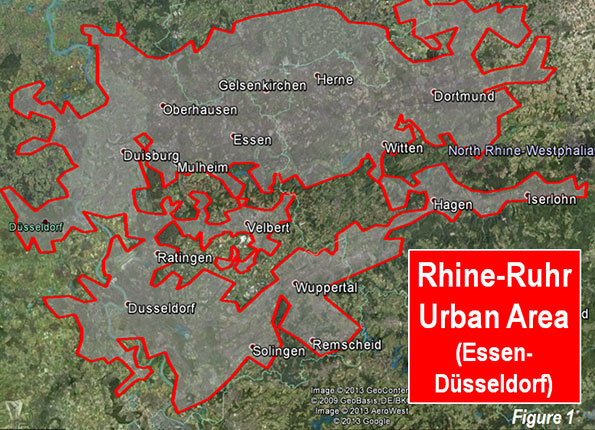
    Rhine-Ruhr, or Essen-Düsseldorf, is among the world’s least recognized larger urban areas (Figure 1).  Germany does not designate urban areas according to the international standard, and for that reason the Rhine-Ruhr does not appear on the United Nations list of largest urban areas. Yet, in reality this contiguous urban area is Germany’s largest urban area, a position as it has held since at least the end of World War II. The Rhine-Ruhr is the third largest urban area in Western Europe, trailing only Paris and London. The area was one of the strongest early urban industrial areas in the 18th century and continued as a major manufacturing and coal mining center through the first half of the 20th century.

    An Early Polycentric Urban Area

    The Rhine Ruhr is unusual in not having evolved around a single core municipality. The Rhine Ruhr has multiple core municipalities, which have grown together to form a conurbation, the second largest in the world following Osaka –Kobe – Kyoto. But the Rhine Ruhr is probably the most polycentric urban region in the world, with a minimum of eight older, large municipalities now linked by urbanization. These include Essen and Düsseldorf, which were until recently the two largest municipalities. In addition there are Dortmund, Duisburg, Bochum, Wuppertal, Gelsenkirchen and Oberhausen. Each of these eight municipalities reached a population of 250,000 or more by 1961.

    Like nearly all prewar municipalities in the high income world that had not expanded their boundaries, each of these has lost population since 1961. By 2011, the combined population of these eight municipalities was under 3.4 million, a reduction of 700,000 (Table) from their 1961 total (a 17% loss).

    Table
    Larger Rhine-Ruhr Municipalities: Population 1961-2011
      1961 2011 Change %
    Bochum      441,000      362,000     (79,000) -17.9%
    Dortmund      645,000      571,000     (74,000) -11.5%
    Duisburg      504,000      488,000     (16,000) -3.2%
    Dusseldorf      705,000      586,000   (119,000) -16.9%
    Essen      730,000      566,000   (164,000) -22.5%
    Gelsenkirchen      384,000      259,000   (125,000) -32.6%
    Oberhausen      258,000      210,000     (48,000) -18.6%
    Wuppertal      422,000      343,000     (79,000) -18.7%
    Total   4,089,000   3,385,000   (704,000) -17.2%


    Data for the balance of the urban area and the broader Rhine-Ruhr region (Note 1) is not readily available for 1961. As a result, this analysis considers the Rhine-Ruhr region to consist of the Dusseldorf, Arnsberg and Münster subregions of the state (lander) of North Rhine-Westphalia, which had a combined population of 11.22 million in 2011, up only modestly from 11.06 million in 1987. The urban area has a population of approximately 6.5 million residents, covering a land area of approximate 950 square miles (2,450 square kilometers). The urban density is approximately 6,800 per square mile (2,650 per square kilometers), less than that of Los Angeles (7,000 per square mile or 2,700 per square kilometer) or Toronto (7,600 per square mile or 2,900 per square kilometer).

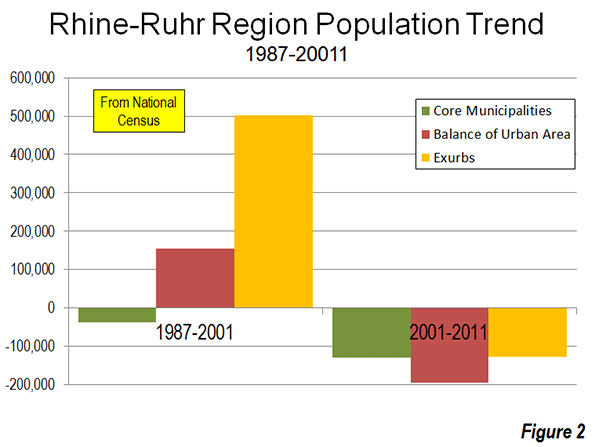
    Since 1987, the Rhine-Ruhr has added 161,000 residents, having gained 617,000 residents between 1987 and 2001, and losing 456,000 from 2001 to 2011. The eight older cities lost 170,000 residents from 1987 to 2011, while the balance of the urban area lost 42,000. The exurbs, outside the urban area have added 373,000 residents, and account for more than all of the modest growth since 1987. All three sectors lost population after 2001 (Figure 2).

    Slow Growth, Even for Germany

    The Rhine-Ruhr is located in the lander of North Rhine-Westphalia, which has the largest population in Germany. Its growth, however, has been glacial. Since 1961, the average annual growth rate of the lander was 0.2%. This is one third the growth rate of the other lander that constituted the former Federal Republic of Germany (West Germany).

    North Rhine-Westphalia’s performance is stellar compared to the lander of the former Democratic Republic of Germany (East Germany), which have fallen back to their 1961 population, having lost 10% of their residents since 1990. Germany itself lost more than 2 million people in the last decade, reflecting its well-below replacement fertility rate. Based upon this rate, Germany could lose more than the 5 million more residents projected by United Nations projectionsto 2050 (to 75 million).

    But even within the slow growth environment of North Rhine Westphalia, the  Rhine Ruhr region is falling behind as nearly all the growth has shifted elsewhere to the regions of the lander that surround other urban areas, Cologne (Köln), which includes the former West German capital of Bonn, and Aachen (which stretches into the Netherlands). Local authorities in the Ruhr Valley are forecasting a population loss of approximately 8 percent by 2030.

    The Setting

    The Rhine-Ruhr conurbation is organized around confluences of two rivers with the Rhine. The northern part of the urban area stretches from the west bank of the Rhine eastward along the Ruhr River Valley with the large municipality of Duisburg anchoring the West and Dortmund the East. The southern part of the urban area stretches along the Wupper River Valley starting at Düsseldorf and continuing eastward to south of Dortmund. The elevation at the two river junctions is less than 100 feet (40 meters). A transverse, low mountain range (Rhenish Massif) separates the northern and southern parts of the urban area (maximum elevation 800 feet or 300 meters), though much of the hilly area is urban.

    Transport

    Without a dominant, large center, the Rhine-Ruhr has a lower transit work trip market share – 18 percent – than would be expected for a European urban area of its size. This is well below the 30 percent share of Berlin and the approximately 35 percent shares of Madrid, Lisbon, and Stockholm, which are all smaller than the Rhine-Ruhr. Wuppertal is home to one of the icons of mass transit, the Wuppertal Monorail, which opened in 1901. The Monorail is suspended for much of its route above the Wupper River, with supports straddling the river (such a configuration would probably not be permitted to be constructed today in any high-income world metropolitan area because of environmental regulations).

    The Rhine-Ruhr’s polycentricity requires substantial reliance on its road system. The region is well served by an extensive freeway (autobahn) system consisting of at least four east-west routes and five north-south routes. Traffic congestion is worse than in most US urban areas, but the Rhine-Ruhr’s traffic flows better than in any metropolitan area of similar size in Europe, according to 2012 data from the INRIX Traffic Scorecard. The average peak hour delay is 14.8 percent compared to “free flow.” This is less than one-half the average delay in smaller Milan (30.2 percent) and well below Paris (27.8 percent) and London (26.1 percent). In 2005, the Rhine-Ruhr had the fifth highest rated freeway access among 30 surveyed international urban areas.

    Shrinking City

    Shrinking cities (where cities are defined as metropolitan areas or urban areas) have been unusual in the high income world (Pittsburgh and Liverpool are exceptions). Even as core municipalities have lost population, such as in Atlanta and Copenhagen, metropolitan areas have continued to grow. This is likely to change because of the severe national population declines forecast in a number of countries. The Rhine-Ruhr, and other similarly situated cities, will face serious challenges in retaining dynamic economies and delivering public services in the years to come for an aging population supported by a smaller work force.

    Wendell Cox is a Visiting Professor, Conservatoire National des Arts et Metiers, Paris and the author of “War on the Dream: How Anti-Sprawl Policy Threatens the Quality of Life.

    ———–

    Note 1: The entire Rhine-Ruhr and Cologne areas are considered by Germany to be the Rhine-Ruhr metropolitan area (ballungsräume). This article is limited to an area roughly conforming to the northern part of the ballungsräume. Eurostat defines a much smaller Düsseldorf-Ruhrgebiet metropolitan area that includes the Rhine-Ruhr urban area and most of the exurban area in this analysis. There is no international standard for the designation of metropolitan areas (labor markets).

    Note 2: INRIX classifies the Rhine-Ruhr as two areas (north and south). This is the population weighted congestion delay.

    Photo: Wuppertal Monorail

  • The Vatican Bank: In God We Trust?

    When the cardinals sent billowing white smoke from their conclave and elected Jorge Mario Bergoglio as Pope Francis I, little did the Catholic Church realize that two millennia of ecumenical liturgy might come unraveled on the heresy of offshore banking regulations. Among the many frustrations that drove Pope Benedict XVI to take early retirement was his role as guardian angel of the Institute for the Works of Religion (the formal title for the Vatican Bank), which can no longer get past compliance questions by answering that its beneficial owner is “the Almighty.”

    The financial inquisition results, according to Concordat Watch, recently included “…two blows to the reputation of the Vatican Bank… The US State Department for the first time listed the Vatican as potentially vulnerable to money laundering, a notch below those states for which it has solid proof of this.” The second revelation was that banking giant JPMorgan Chase had closed its papal account.

    Benedict XVI’s day job presumably encompassed giving the sacrament to the bank’s audit committee (made up of cardinals), and among the many attacks against the church the most successful have been those of global regulators who have had little patience accepting Vatican credit on faith.

    The bank is located in a tax haven — Vatican City, population 800, with a legal system on tablets — lets its managers come to work in robes and sandals, and has clients that deal in cash gathered on collection plates. Because of this, post-2008 regulators have looked upon the Institute as just another bolt-hole trafficking in black money, if not clearing the accounts of pharmaceutical sinners, bigamists, or Lutherans.

    Founded in 1942, at a time when the Catholic Church needed some latitude when transferring money between good and evil, the Institute has operated around the world as the cardinals’ piggy bank. Along with taking the deposits of Sunday’s offerings, it has also handled pay-outs of hush money to abused altar boys and booked advances against papal indulgences.

    In response to probing questions from the watchdogs — Who is the ultimate beneficiary? Do you know the source of the funds? — the cardinals who run the bank, sometimes with the help of lay bankers, have only had answers that led to further investigations.

    Imagine telling some pencil pusher from the European Central Bank, the Bank of Italy, or the US Federal Reserve that the shareholder of record is “one God in three persons.”

    Nor did Benedict XVI find much absolution in the press coverage of his bank, which treated the operation as little different from some Mafia numbers racket.

    Take, for example, a recent New York Times article that, in thirty paragraphs, managed to link the bank to the failed Banco Ambrosiano — whose former chairman, Robert Calvi, found eternal salvation in 1982 while hanging from Blackfriar’s Bridge — insurance fraud, front companies, suspicions of money laundering, Cuban payments, and management incompetence. In the last case, for example, the CEO was described as a “German aristocrat,” as if his days were spent quail hunting or chasing Sabine women.

    Amusingly, the Times’ reporters were unable to distinguish, on a visit to the headquarters, the bank managers from the security guards. (A correction was later published, but no picture of the dapper security personnel.)

    Nor did the paper of record show much numeric literacy, summing up the Vatican Bank’s accounts, in their entirety, as having in 2011 “20,772 clients, 68 percent of them members of the clergy, and $8.2 billion in assets under its management. The bank has said it has around 33,000 accounts.”

    As God’s credit union issuing debit cards and checkbooks to clergymen, it is doubtful that the bank manages $8.2 billion at its discretion for its clients (including 14,124 men and women of the cloth). More likely, the $8.2 billion in “assets” are liabilities, demand deposits due to its clients and not “under management.” I doubt that the average priest has savings at the bank of $400,000 and that the bank is investing such money in stocks and bonds.

    Nevertheless, the article varies little from other disparaging accounts about the bank that level charges of compliance heresy, and imply that its senior managers, including the fired president Ettore Gotti Tedeschi, are regulatory apostates.

    Part of the reason that the Vatican Bank earns such poor grades from international regulators, not to mention from the US State Department, is because the Institute is believed “vulnerable” to the risk of processing terrorist funds. The belief that the Vatican Bank is funneling money to al-Qaeda says more about the bonfires of the regulators than it does about Catholicism. The Catholic Church historically has had more in common with Homeland repression than it has with fifth columnists. To use the worn phrase, “know your client.”

    The degree to which international bank regulation is just an excuse for Regulatus Pax Americana can be discerned in a report by Moneyval — the monitoring committee of the Council of Europe — on the Vatican Bank’s efforts to recite its compliance rosaries. It concludes: “The Holy See has come a long way in a very short period of time and many of the building blocks of a system to combat money laundering and the financing of terrorism are now formally in place.”

    Perhaps the reason the cardinals went with Cardinal Bergoglio as their front man is because he looks like the last man at a conclave who would short derivatives, or know how to hedge (either in ecumenical or currency terms) the church’s overexposure to developing markets.

    In his first comments on the global financial crisis, the Argentine Jesuit attacked the “cult of money” and “ideologies which uphold the absolute autonomy of markets and financial speculation, and thus deny the right of control to States, which are themselves charged with providing for the common good.” Noble sentiments indeed, but not ones often heard from a bank chairman or a Vatican theologian, especially one wearing a triregnum.

    Francis I’s words are a long way from those of a predecessor, Leo X, who in 1513 wrote to his brother, the Duke of Nemours, “Since God has given us the papacy, let us enjoy it.” Or those of Leo’s Medici ancestor, Cosimo the Elder, who in the fifteenth century was approached by an archbishop to stop the clergy from gambling. “Maybe first,” said the Medici banker, “we should stop them from using loaded dice.”

    Unfortunately for the Pope and his financial acolytes, many international regulators are out to prove that all banks are processing payments for the devil. In the meltdown’s aftermath, a small unregulated bank is unusually suspect, especially when operating in a “sacerdotal-monarchical state established under the 1929 Lateran Treaty” and reporting to an abstract nominee with an ethereal address. Nor can it help that the bank is a market-maker in loaves and fishes.

    The best that the new Pope can hope for is that the regulators will dispense with a fiery auto-da-fé and instead accept the bank’s penance of its heresy and apostasy. Maybe the central bankers will allow the Vatican to grant itself an indulgence for all those spiritual options marketed in Sicily? High ranking clergy could even argue that, under the company’s accounting rules (as divined from scripture), origination revenue is recognized when the sin is committed, not when the soul is saved.

    After all, running a bad bank — as Citigroup, Bank of America, Goldman Sachs, and many other heathens know — is not a mortal sin.

    Matthew Stevenson, a contributing editor of Harper’s Magazine, is the author of Remembering the Twentieth Century Limited, a collection of historical travel essays. His next book is Whistle-Stopping America.
    Flickr Photo: security personnel in Vatican City, by Trishhhh

  • Bank Collapse in Cyprus: Which Way Now?

    Having run out of options to solve its bigger problems, European Union commissioners, in the spirit of famed bank robber Willy Sutton, have decided to go after depositors’ money on Cyprus for a simple reason: “That’s where the money is.” Will the current shake down of bank depositors on Cyprus save or sink the Euro? It stretches the imagination to fathom how putting bank depositors in play will comfort European Union bondholders or other EU banks.

    In exchange for $13 billion in bailout money for the Cyprus government, the EU has demanded that the local banking system, bloated with offshore deposits including many from Russia and Eastern Europe, pony up in the interests of Euro harmony.

    An island divided into Greek and Turkish spheres of influence, Cyprus was allowed into the EU, and later the Euro, as an early attempt to gloss over European ethnic fault lines and pump hot money into the sovereign debts of Greece and East European countries. Greek Cyprus is the tax haven of choice for Russian companies and oligarchs, many of whom register their worldwide assets under Cypriot holding companies and maintain huge deposits in the local banking system.

    Before the recent crisis, the Cypriot banking system held assets in its banks and fiduciary companies that amounted to more than five times the country’s gross domestic product.

    Business as usual in Cyprus meant that, with few questions asked locally, an overseas investor — including many from Serbia, Romania, and the Ukraine, as well as Russia—could set up a front company, open a bank account, and run his or her financial empire away from the long arm of any government accountants.

    The problem for the Cypriot banks wasn’t attracting deposits, it was finding a place to put them once they arrived by SWIFT (the international transfer system), the Fed Wire, or suitcases.

    Confusing their swelling balance sheets with the genius of J.P. Morgan, local bankers made several fatal mistakes. They lent their newfound money to the Greek government by buying its bonds, they invested in now-failing real estate deals, and they funded these long-term bets with deposits that could be withdrawn in less than ninety days.

    In justifying these strategies to clients, the Cyprus banks claimed that their long positions in Greek government bonds, denominated in Euros, came with an implicit EU guarantee, which also served as a reason to pay minimum rates on short-term deposits, and to bet the ranch on long-term Euro bonds. The Euro gave Cyprus cover for punting.

    In the era of the Greek drachma, German leader Angela Merkel would not have delayed a hair appointment to keep Greece solvent, let alone to save its lovechild in Nicosia, a Balkan money-changing city hard up against the border of the Turkish mercenary state in northern Cyprus. Still, even today, the Cypriot pyramid might have withstood the lazy stress test of a buoyant market.

    The first Cyprus rescue plan called for the island’s bank depositors (whose deposits totaled $82 billion at the peak) to cough up 10% of their wealth into the stabilization fund. That financial haircut, however, called also for a 7% trim from local clients, not just a shave for Russian oligarchs. Local Cypriots voted with their middle fingers.

    Although the inspiration to drain local bank accounts to offset subsidies from Brussels was attributed to EU bureaucrats, if not Merkel and French President François Hollande, the impulse for an open season on passbook savings comes from the worldwide assault on tax havens, led by the United States.

    In its search for money to balance it own mismatched accounts, the US has taken the position that the dollar, instead of an international commodity or method of exchange, is a national loyalty oath, and is imposing tax obligations on those that have some in their wallets. Even though the EU is more a tariff union than a functioning government, Brussels has warmed to the idea that bank depositors within its fragile borders are fair game for a fleecing.

    The revised Cyprus plan walked back from skimming all bank deposits, and shook down the depositors only of the two largest banks, the Bank of Cyprus and Laiki (Cyprus Popular) Bank. It demanded the sale of $500 million in the central bank’s gold, unsettling financial markets.

    While the heist was in the planning stage, all Cypriot banks were closed, to keep the hot money from turning into flight capital, once removed.

    The Bank of Cyprus will survive, barely, although Laiki is going belly up, which through the magic of bankruptcy laws will put its €24 billion in deposits at the disposal not just of local liquidators but also of EU “structural reformists,” who have more in common with Butch Cassidy and the Sundance Kid than with International Monetary Fund economists.

    The biggest losers are the Cyprus banks’ shareholders, bondholders, and depositors, who are being bled dry so that the Euro might live. Think of these write-downs as a pan-European tax, assessed mostly on shady front companies that don’t vote in German regional elections. Russian President Vladimir Putin isn’t thrilled that his offshore economy was chosen to make the world safe for par-value Spanish bonds.

    As a consequence, bank depositors will flee not just failing Mediterranean banks, but those in Milan, London, and Frankfurt. They will seek safety in gold, real estate, art, stock markets, and hedge funds, leaving money-center banks down the road to scramble for their liabilities (in the accounting world, deposits are something you owe).

    The bigger problem with the Cypriot financial collapse of 2013, though, is that it threatens to turn the EU into a divided nation — not unlike Cyprus itself — that may need to balance its books with offshore money and lax accounting.

    More than the crises of Italian elections or French unemployment, the Cyprus bank run threatens to pull apart the rickety architecture of a union that can no longer roll over its Eurobonds on what Willy Loman used: “a smile and a shoeshine.” Because of bad balance sheets in Cyprus, as well as in Spain, Italy, Ireland, and Greece, bondholders are no longer “smiling back” at the EU.

    German Chancellor Otto von Bismarck said in the late nineteenth century that “some damn thing in the Balkans” might drag Russia into war with Austria-Hungary, or with his Prussian confederation. In that instance, the murder of an Austrian archduke in Sarajevo shattered Europe into fragments that lasted for most of the twentieth century, a division that the EU and its Euro were designed to glue together.

    When the dust settles on Cyprus, the losers will be the local economy — headed for a double-digit recession — and Europe’s bank depositors, who in theory should be the backbone of a successful economic union.

    Matthew Stevenson, a contributing editor of Harper’s Magazine, is the author of Remembering the Twentieth Century Limited, a collection of historical travel essays. His next book is Whistle-Stopping America.
    Flickr photo by Leonid Mamchenkov taken in Limassol, Cyprus.

  • CSI Switzerland: Anatomy of an iPod Theft

    When my seventeen year old son was mugged this year, coming home on a late weekend tram, he lost his iPod along with his Beats headset. I felt sympathetic, but not shocked, that he had been shaken down, even though we live in a quiet village on the outskirts of Geneva.

    The city has been experiencing a crime wave—at least by the standards of the Swiss countryside—with about 700 house break-ins a month. Unemployment for youths under 25 in nearby France, about a mile from our house, is now more than 25%, but more than double that for illegal immigrants, for whom house burglaries in Geneva are one of the few growth industries.

    Nor is it unusual to hear that a teenager has had something stolen or been roughed up. In my son’s case he wasn’t badly hurt; he took some punches to the head. Most of his wounds were to his childhood sense of security.

    He reported the incident to the police, who picked him up at the tram crime scene, drove around looking for the muggers, and dropped him back at home. A few days later he filed a more substantial report with a detective, who promised to look at the security tapes on the tram. We expected the matter to end there.

    Under the sway of late-night television, I was for staking out the tram on weekend nights, a proposal my wife dismissed as worthy only of Charles Bronson (Yeah? Well, what if the cops can’t handle this?). My wife rolled her eyes.

    A few weeks later, however, the Geneva police called to say that they not only had apprehended the muggers—all local Swiss, not Lyonnais gangsters—but had gone to the house of one of them and found a stash of loot, including my son’s iPod and his Beats.

    Equally incredible, that night two detectives came to our house close to midnight and returned the robbed goods. The detectives explained to my son that he had the option to press charges against the three, and give testimony in court, which he agreed to do, and that he could claim damages from the incident.

    We showed up at the appointed hour and were led into a wood-paneled, sparely furnished courtroom, locally called “Le Tribunal des Mineurs.” The only police officers were sitting outside in a waiting room, next to one of the defendant’s parents.

    As if called to the principal’s office, the three attackers were seated on small chairs directly in front of the judge, who sat alone behind a long desk. They looked like other teenagers I see on the street — jeans, sneakers, varsity jackets, and vacant expressions — but without iPhones. Behind the defendants sat three lawyers, testament that the muggers came from some means.

    Dressed casually, without robes or a necktie, the judge began by asking my son what happened. In Swiss cases, the judge hears the witnesses and dictates a summary to a court reporter. There was no jury.

    My son went over how these three kids, about sixteen- or seventeen-years-old, had sat behind him on a bus, and followed after him when he changed to a tram. When they were the only ones left on the street car, they asked him for a cigarette (he said he didn’t smoke).

    When the tram reached the end of the line, my son chose to sit tight in the bright lights under the surveillance cameras, rather than to make a run for the doors. He’d been unable attract the attention of the driver. When he finally decided to make a break, the gang of three surrounded him, shoved him back into his seat, hit him with their fists, and made off with his gear.

    The judge asked my son what he did next, and he said, “I called 117” (the police). The judge responded quickly, “But how?” My son described how, when the kids sat down behind him on the empty train, he managed to slip his phone and wallet into his underwear. The judge almost whistled when he said, “Bravo.”

    Then he questioned the attackers professionally, sternly, and, often, incredulously. He asked them if the testimony was true, and they said it was. He asked if they wanted to “say anything to the victim.” From their three mouths came stuttered, awkward apologies.

    The judge ended the court session by asking the three muggers what they would do if they saw their victim on the street (my son chuckled when one said he would “shake his hand”). The three were forced to go on the record, before a judge, that they would do him no additional harm if they met by chance.

    The court reporter printed out the transcript, my son signed three copies, and the judge explained that because it was a juvenile court the sentencing would not be made public.

    As juveniles, the three will not be sentenced to jail, but to a court program dealing with youthful offenders. I can imagine them attending anger-management classes, unless they were part of some larger, more violent crime syndicate, although I doubt that is the case. The pros don’t roll their victims under security cameras and stash the loot in bedrooms decorated with soccer posters.

    When the judge excused us, he walked over to my son, and said, “It took courage for you to come here today.” He shook his hand.

    I felt as if it were 1935 and I was listening to a justice of the peace lecture three kids about delinquent behavior. He wasn’t looking to send them up the river, but he spoke for a society that does not condone personal violence, especially in public places against strangers. I sensed the three got his message. At least, they were forced to hear it.

    In the annals of crime, this mugging means nothing, except to those involved. The prosecution did nothing to reduce the wave of house burglaries; those are the work of gangs operating out of Lyon and elsewhere in France. But the Geneva judge treated this matter as if he had the fate of several lives in his hands, and, in my view, he handled those lives with professionalism and care.

    Matthew Stevenson, a contributing editor of Harper’s Magazine, is the author of Remembering the Twentieth Century Limited, a collection of historical travel essays. His next book is Whistle-Stopping America.
    Flickr Photo by Alain Rouiller- rouilleralain — a street in a village near Geneva.

  • Progessives, Preservation & Prosperity

    Conservatives often fret that Barack Obama is leading the nation toward socialism. In my mind, that’s an insult to socialism, which, in theory, at least, seeks to uplift the lower classes through greater prosperity. In contrast, the current administration and its core of wealthy supporters are more reminiscent of British Tories, the longtime defenders of hereditary privilege, a hierarchical social order and slow-paced economic change.

    The notion that the "progressives" are, in fact, closeted Royalists has been trotted out by a handful of Obama admirers, such as Andrew Sullivan, who calls the president "the conservative reformist of my dreams." Essentially, Sullivan argues, Obama has been a "Tory president," with more in common with, say, an aristocratic toff like British Prime Minister David Cameron than a traditional left-liberal reformer.

    The fundamental conservativism underlying the modern "progressive" marks the central thesis of an upcoming book by historian Fred Siegel, appropriately titled "Revolt Against the Masses." Siegel traces the roots of the new-fashioned Toryism to the cultural wars of the 1960s, when the fury of the "Left," once centered on the corporate elites, shifted increasingly to the middle class, which was widely blamed for everything from a culture of conformity to racism and support for the Vietnam War.

    Tory progressivism’s most-unifying theme, Siegel notes, includes the preservation and conservation of the landed order enjoyed by the British ultrawealthy and upper-middle classes. In the 19th century, Siegel notes, Tory Radicals, like William Wordsworth, William Morris and John Ruskin, objected to the ecological devastation of modern capitalism and sought to preserve the glories of the British countryside.

    They also opposed the "leveling" effects of a market economy that sometimes allowed the less-educated, less well-bred to supplant the old aristocracies, with their supposedly more enlightened tastes. "Strong supporters of centralized monarchical power, this aristocratic sensibility also saw itself as the defender of the poor – in their place," writes Siegel. "Its enemies were the middle classes and the aesthetic ugliness they associated with the industrial economy borne of bourgeois energies."

    Today, this Tory tradition lives on in contemporary Britain, where industry remains widely disparaged and land use tightly controlled. There is no more strident defender of preserving the space of the landed gentry than the leading Tory mouthpiece, The Daily Telegraph. All efforts are made to restrict the expansion of suburbs and new towns, all the better to preserve the British countryside for the better enjoyment of the gentry.

    As a result, Britain now suffers some of the world’s highest housing prices – even in the economically devastated north of the country. Unable to afford decent accommodations, notes author James Heartfield, some British families have been forced to live in old restrooms, garden sheds, even abandoned double-decker buses.

    Until recent decades, such an "enlightened" conservatism has been rare in America, with its strong tradition of upward mobility and vast landscape for development. As early as the 1950s, however, intellectuals, architects, planners and aesthetes have railed against the banality of suburbanizing, and democratizing, America, but the real turn towards gentry progressivism took place with the rise of the environmental movement in the 1970s.

    Rightfully alarmed by the deterioration of the environment at that time, early green activists made contributions to a remarkable cleanup of the nation’s air and water, something that widely benefited millions of Americans. But the movement also fell ever more prone to all manner of hysterias; at the first Earth Day, in 1970, some scientists predicted that, by the 1980s, people would not be able to walk outside without a helmet. Then followed a series of jeremiads about "limits of growth" associated with the depletion of critical minerals, "peak oil" and, finally, the call for radical steps to address climate change.

    All these causes, sometimes based on fact or somewhat overheated extrapolation, gradually diverted American progressives from their historic interest in economic growth and social mobility to a primary focus on environmental purity, whatever the social or economic cost. Their Tory-like policies have helped stunt economic growth, particularly in the blue-collar industrial and construction sectors, promoting, albeit unintentionally, ever-narrowing opportunity for all but a few Americans.

    Despite its opportunistic use of populist rhetoric, the Obama administration has presided over widespread economic distress – with the average household now earning considerably less than it did four years ago. This trend has worsened during the current "recovery," even as the Federal Reserve’s policies have generated record profits for corporate and Wall Street grandees.

    It has been a particular boon time for a new rising class of oligarchs from Silicon Valley, which has embraced Obama with money and technical expertise. Not surprisingly, the ultra-affluent coastal areas have become primary supporters of the administration, which in November won eight of the nation’s 10 wealthiest counties, many of them handily.

    The growing gaps between the "1 percent" and everyone else have been particularly marked in those regions under the most complete progressive control. The Holy Places of urbanism, such as New York, San Francisco and Washington, D.C., also suffer some of the worst income inequality.

    In these regions, the so-called "creative class" is courted by politicians, developers and corporate big-wigs. Meanwhile their putative political allies, in places like Oakland and parts of New York’s the outer boroughs, experience seemingly irrepressible permanent unemployment and, increasingly, rising crime. Perhaps the most outrageous example of the dual nature of the new progressive economy, notes Walter Russell Mead, can be seen in Detroit, where a shrinking, debt-ridden and dysfunctional city that fails its largely poor residents has generated $474 million since 2005 for well-connected Wall Street bond issuers.

    Under the progressive Tory regime, the best that can be offered the middle class is an outbound ticket to less-Tory-dominated, albeit often less culturally "enlightened" places, such as Texas, the Southeast or Utah. There, manufacturing, energy and agricultural industries still anchor much of the economy. Despite their expressions of concern for the lower orders, gentry progressives don’t see much hope for the recovery of blue-collar manufacturing or construction jobs, at least not in their bailiwicks. Instead they suggest that the hoi polloi seek their future in what the British used to call "service," that is, as caregivers, haircutters, dog walkers, waiters and toenail painters for their more-highly educated betters.

    Such kindness, however, is no replacement for the kind of broad-based economic growth that historically has promoted self-sufficiency and upward mobility, both in California and elsewhere. Due in large part to the new progressive policies, this is now increasingly out of reach for many in the middle class, as well as the increasingly Latino working classes. Indeed, a recent report from the Public Policy Institute of California reveals that class stratification in the state has expanded far faster than the national average.

    "We have created a regulatory framework that is reducing employment prospects in the very sectors that huge shares of our population need if they are to reach the middle class," notes economist John Husing. A onetime Democratic activist, Husing laments how, in progressive California, green energy policies have driven up electricity costs to twice as high as those in competitor states, such as Utah, Texas and Washington, and considerably above those of neighboring Arizona and Nevada. These and other regulatory policies, he suggests, are largely responsible for the Golden State missing out on the country’s manufacturing rebound, losing jobs, while others, not only Texas but also in the Great Lakes, have expanded jobs in this sector.

    Similarly, Draconian land-use regulations have not only kept housing prices, particularly on the coasts, unnecessarily high, but slowed a potential rebound in the construction sector, traditionally a source of higher-wage employment for less-than-highly educated workers. So, while Google workers are pampered and celebrated by the progressive regime, California suffers high unemployment and a continued exodus of working-class and middle-class families.

    Sadly, there currently is no strong counterweight to the new Tory ascendency. Until traditional social democrats awake to realities, or the GOP acknowledges the painful reality of class, America will continue to lurch towards the very Tory model that our forefathers had the wisdom to reject throughout most of our history.

    Joel Kotkin is executive editor of NewGeography.com and a distinguished presidential fellow in urban futures at Chapman University, and a member of the editorial board of the Orange County Register. He is author of The City: A Global History and The Next Hundred Million: America in 2050. His most recent study, The Rise of Postfamilialism, has been widely discussed and distributed internationally. He lives in Los Angeles, CA.

    This piece originally appeared in the Orange County Register.

    Photo by: conservativeparty

  • The Evolving Urban Form: Athens

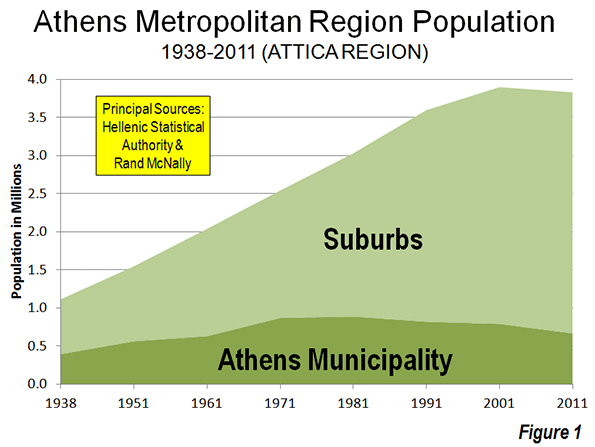
    Around the fifth century BCE, Athens may have been the most important city in the West. Like China’s Chang’an (modern Xi’an), the "on and off" capital of China, Athens has experienced many severe "ups and downs" throughout its remarkable history. At its ancient peak, Athens is estimated to have had more than 300,000 residents (historic population estimates vary greatly). At least one estimate indicates that Athens may have fallen to a population of under 5,000 by the middle 19th century. The city, now having evolved into the modern manifestation of the metropolitan area (Attica region), peaked at 3.9 million in the early 2000s, but its population has begun to drop again.

    Athens is the capital of Greece and located at the south end of the Attica peninsula, on the Aegean Sea. The core municipality of Athens is located approximately 5 miles (8 kilometers) from the historic port of Piraeus, from which ferries operate to the Greek Islands.

    Metropolitan Dispersion

    Like virtually all of the world’s metropolitan areas, population growth has been concentrated in the suburbs and exurbs for decades.

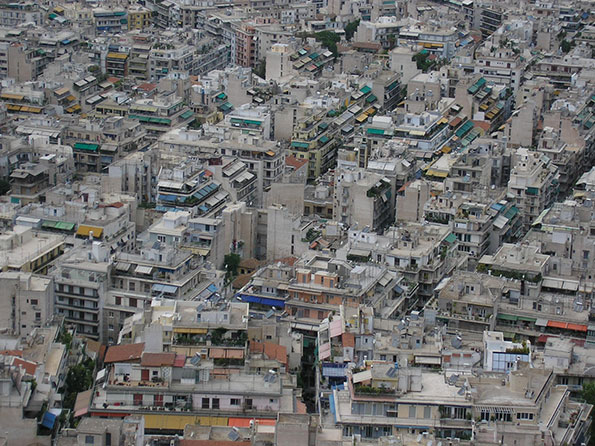
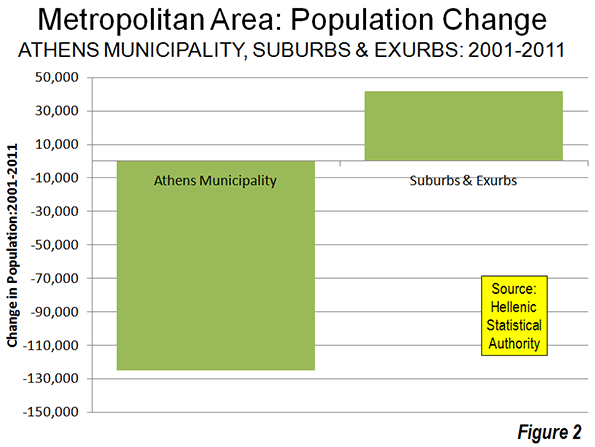
    The Athens municipality (the historic core city) peaked at 885,000 in 1981. At a population density of nearly 60,000 per square mile (23,000 per square kilometer), Athens once stood among the most dense municipalities in the world. However, the Athens municipality since has declined, with population losses in each of the three subsequent decades. Between 2001 and 2011, the population fell 125,000 to 664,000, a decline of 16%. The Athens municipality is still dense, however, at 44,000 per square mile (17,000 per square kilometer). The rest of the urban organism, as is usually the case, is considerably less so.


    Photo: Athens Core Density

    Since 1951, suburban and exurban Athens (see The Evolving Urban Form Series Definitions) has accounted for 95% of the growth in the metropolitan region, adding 2.2 million new residents, compared to approximately 100,000 for the Athens municipality. Since 1971, all of the population growth has been in the suburbs and exurbs (Figure 1).

    However, over the last decade, population growth has dropped across the entire Athens metropolitan region. Certainly, the low Greek fertility rate is a factor (see The Rise of Post-Familialism: Humanity’s Future?). Greece’s total fertility rate (average number of children per women of child bearing age) is approximately 1.5, according to Eurostat, well below the replacement rate of 2.1 not to mention the 2.3 Greek figure in the late 1970s. More recently, it is likely that the Greek fiscal crisis has contributed to an even lower rate of increase by reducing the previously flow of international migration as well as discouraging family formation among native Greeks.

    Athens growth slowed dramatically well before the financial crisis. Between 1991 and 2001, the Athens metropolitan region added approximately 300,000 new residents. But  between 2001 and 2011, the metropolitan region lost 67,000 residents. However, the suburbs and exurbs gained marginally, adding 58,000 residents, partially offsetting the loss in the Athens municipality (Figure 2). Even so, the suburban population increase was miniscule compared to the 330,000 gain of the previous decade (photo: North Suburban Athens).


    Photo: North Suburban Athens

    The Urban Area

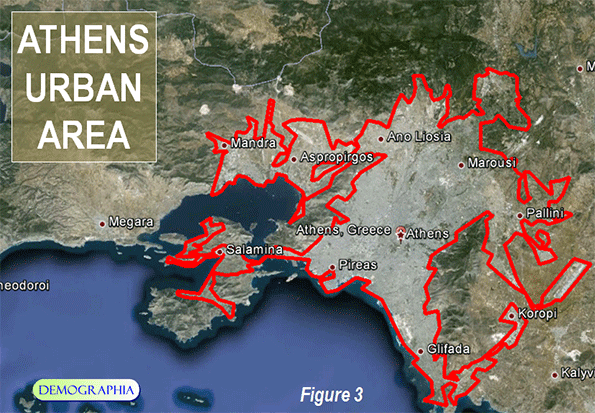
    Even with its slow and even negative growth, the  Athens urban area remains  among the most dense in the developed world (Figure 3). No major urban area in Western Europe, Japan or the New World (Australia, Canada, New Zealand and the United States) is as dense. The 2013 edition of Demographia World Urban Areasindicates that the Athens urban area has a population of 3.5 million (Note), living in a land area of 225 square miles (580 square kilometers), for a density of 15,600 per square mile (6,000 per square kilometer). This places Athens slightly ahead of London (15,300 per square mile or 5,900 per square kilometer), about double the density of Toronto or Los Angeles and more than four times that of Portland.

    As is typical around the world, the urban area of Athens exhibits a generally declining density from the core to the urban fringe. From the 44,000 per square mile (17,000 per square kilometer) Athens municipality density, the inner suburbs drop to approximately 20,000 per square mile (7,700 per square kilometer). This is still a high population density for inner suburbs, reflecting the fact that much of the area was developed before the broad achievement of automobile ownership (a similar situation is obvious in the inner ring suburbs of Paris). The outer ring suburbs have been more shaped by the automobile, yet have a density of 8,500 per square mile (3,300 per square kilometer), which still  is high by Western European standards (Figure 4).

    Affluence

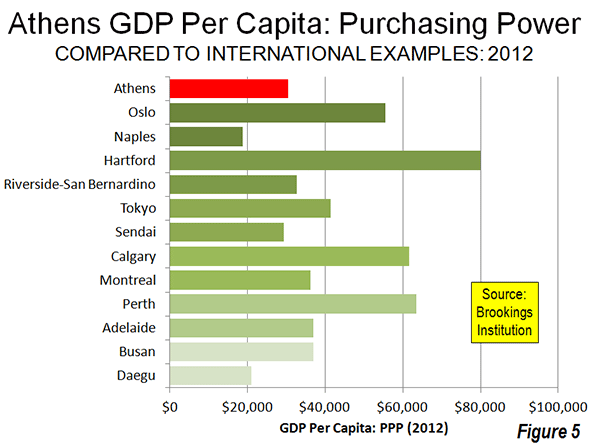
    Athens has below average affluence among the metropolitan regions of the developed world. According to data in the Brookings Institution Global Metro-Monitor, Athens had a gross domestic product, purchasing power parity adjusted (GDP-PPP) per capita of $30,500 in 2012. This trails the most affluent metropolitan regions around the more developed world. It is less than one-half the gross domestic product per capita of Hartford (US), the world’s most affluent major urban area ($79,900). The Athens GDP-PPP is approximately one-half that of regional leaders Perth (Australia) at $63,400, Calgary ($61,100), Tokyo ($41,400) and Busan (South Korea) at $36.900. Athens also ranks well below Western Europe’s most affluent metropolitan region, Oslo, at $55,500. Athens is also less affluent than the least major metropolitan areas with the lowest GDP-PPPs per capita in Australia (Adelaide), Canada (Montréal), and the United States (Riverside-San Bernardino). However, Athens has a higher GDP-PPP per capita than Sendai (Japan), Daegu (South Korea) and Naples (Figure 5), the least affluent major metropolitan areas in their respective geographies.

    Low Fertility, Declining Migration and An Uncertain Future

    Even as the national fertility rate dropped in the late 20th century, Athens continued to grow strongly due largely to international migration, especially from Albania. During the 1990s, virtually all of the population growth in Greece was the result of immigration, as the natural components of growth (births minus deaths) fell into decline. During the 2000s, immigration declined so severely that the nation lost population, most of it in the Athens metropolitan region (with the Athens municipality’s loss exceeding the nation’s) where the foreign born population has concentrated. Much of the decline in international migration resulted from the severe economic crisis.

    Athens typically exhibits the principal function of cities in civilization. When cities compete well by facilitating economic aspiration, they grow. When they do not, cities stagnate or fall into decline. For Athens, stagnation or decline seems the likely scenario in the foreseeable future.   

    Wendell Cox is a Visiting Professor, Conservatoire National des Arts et Metiers, Paris and the author of “War on the Dream: How Anti-Sprawl Policy Threatens the Quality of Life.

    —–

    Note: The difference between the metropolitan area and urban area population is the residents living in exurban areas (outside the urban area, but within the metropolitan area).

    Photo: The Acropolis (all photos by author)