Tag: Europe

  • The Transportation Politics of Envy: The United States & Europe

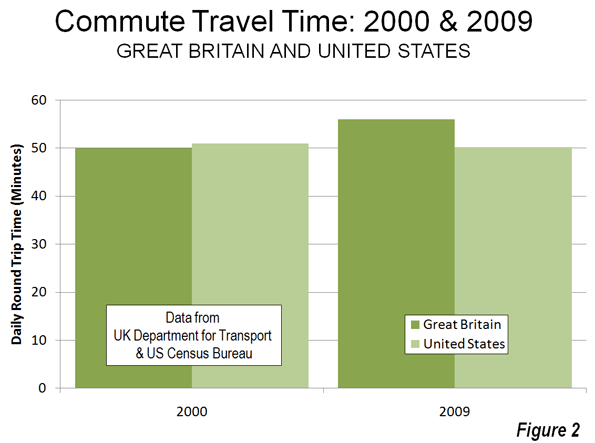
    The Department for Transport of the United Kingdom may be surprised to learn that the average round-trip commute in the nation is up to a quarter hour less than reflected in its reports. This revelation comes from an article in The Economist, ("Life in the Slow Lane") citing a survey indicating that the average commuter in the United Kingdom spends less than 40 minutes daily traveling to and from work in 2000. According to Regional Transport Statistics, published by the Department for Transport, the average commuter spent 50 minutes traveling to and from work in 2000. The UK government further indicates that the average commute time had risen to 56 minutes by 2009. The Economist relies on the much lower figure (and other similarly low estimates from other European nations) in fashioning an article criticizing transportation policy in the United States.

    Shorter US Commute Times: The Economist begins with the contention that the average work trip travel time in the United States is substantially greater than that of the number of European nations. The most reliable data says otherwise.

    The most comprehensive work trip data in Europe is maintained by Eurostat, the statistical agency of the European Commission. The Eurostat data indicates that average commute times in Europe are somewhat more than in the United States in metropolitan areas of similar size (Figure 1), when compared to the comprehensive data from the US Census Bureau. For example, among metropolitan areas of more than 5 million population, the daily round-trip average commute is under 58 minutes in the United States, less than the 64 minutes in Europe. European commute times are longer in all population categories (Note).
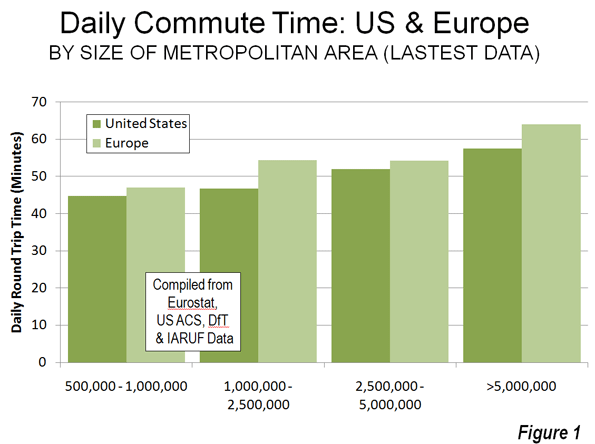
    Overall, the average round-trip travel time in the US metropolitan areas over 500,000 population is 23.6 minutes and 25.3 minutes in the European metropolitan areas.

    Moreover, there are indications that the US trend is favorable, at least in comparison to the United Kingdom. Between 2000 and 2009, UK government data shows average round trip commute times to have increased six minutes, while US government data indicates a decline of nearly one minute (Figure 2).
    The US: Less Traffic Congestion:  The Economist then asserts that traffic congestion is worse in US metropolitan areas than in Europe. According to The Economist:

    …with few exceptions (London among them) American traffic congestion is worse than western Europe’s. Average delays in America’s largest cities exceed those in cities like Berlin and Copenhagen.

    The reality is the opposite, according to the INRIX Traffic Scorecard and a more correct rendering of the point above would have been:

    … with few exceptions (Los Angeles among them) western Europe’s traffic congestion is worse than America’s. Average delays in some of western Europe’s smallest cities exceed those in cities like Atlanta, Houston and Dallas-Fort Worth.

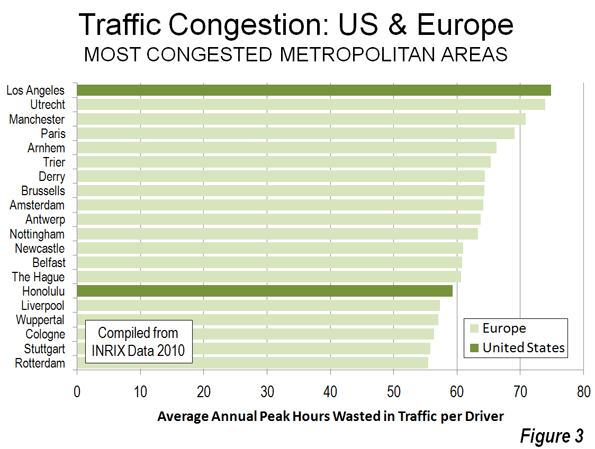
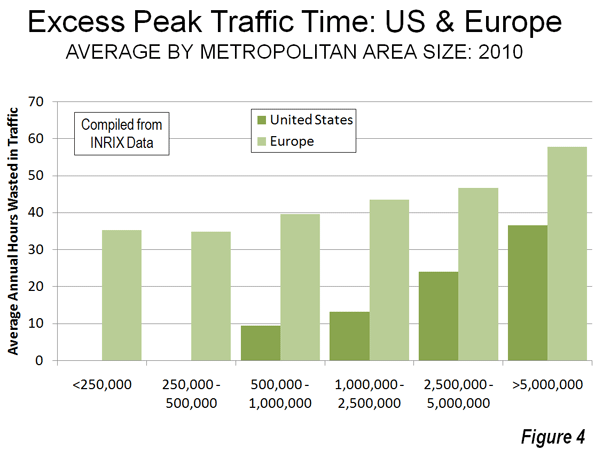
    INRIX compared 2010 peak period traffic delays in metropolitan areas of the United States and Europe. As with commuting time, the average travel delay per driver was greater in Europe than in the United States in every population classification. While Los Angeles has the worst congestion the approximately 200 metropolitan areas (one-half in the US and one-half in Europe), the next 13 worst were in Europe (Honolulu ranks 15th) and 18 of the worst 20 were in Europe (Figure 3). The third worst ranking US metropolitan area was San Francisco, at 28th, while Washington was 29th. Only seven of the 50 most congested metropolitan areas were in the United States. Of course, anyone who has driven extensively in the metropolitan areas of the US and western Europe knows that congestion is generally far worse in Europe, a fact confirmed by the INRIX data.
    Indeed, traffic congestion in the smallest European metropolitan areas (under 500,000) was worse than in the largest US metropolitan areas, those with over 5 million (There were no US metropolitan areas with less than 500,000 population in the INRIX data, see Figure 4). Those automobile-oriented, highly suburbanized banes of urban planning, Atlanta, Dallas-Fort Worth and Houston all ranked in the middle, between 90th and 110th. At least 75 European metropolitan areas had worse traffic congestion than all three.
    High-Speed Rail Envy: Finally, The Economist decries the lack of high-speed rail in the United States, noting that:

    The absence of true high-speed rail is a continuing embarrassment to the nation’s rail enthusiasts.

    It is hard to imagine a more pathetic standard for evaluating public policy than "satisfying rail enthusiasts."  It is well known that that governments from Washington to London, Athens and Lisbon are in serious financial difficulty. It is a time for limiting public expenditures to matters of genuine priority. That does not include high speed rail.

    The intercity road and airport systems are principally financed by users, in contrast to the operating subsidies and intense (100 percent) capital subsidies required by high-speed rail. This is evident in California with its now $65 billion first line that has more than doubled in real cost in a decade. It is also evident, closer to home for The Economist, where the controversial HS-2 high-speed rail proposal from London to Manchester and Leeds could easily double in cost (to £65 billion), based upon the best international research. Astoundingly, a doubling of cost would be a bargain for Britain’s taxpayers compared to two previous high-speed rail failures in the same corridor (See: The High Speed Rail Battle of Britain). The recurring environmental justifications ring hallow due to the high costs and the three generations or more it would require in California and the United Kingdom to eliminate the first gram of greenhouse gas.

    Transport policy could be improved in the United States, as well as in Europe. However, the starting point must be facts, not fancy, and certainly not envy.

    ——-

    Note: this analysis includes all data available for metropolitan areas in the United States (metropolitan statistical areas) and Europe (larger urban zones, the closest equivalent to US metropolitan areas). US data is complete, covering all 100 metropolitan areas with more than 500,000 population and is from the United States Census Bureau. European data is principally from Eurostat (94 larger urban zones and three from other sources). Paris data is from IAURIF (Institut d’aménagement et d’urbanisme de la région Île-de-France). Newcastle-upon-Tyne and Leeds data is from the UK Department for Transport.  Data is not available for a number of metropolitan areas with more than 500,000 population in Europe.
  • United States: Less Congestion than Europe per INRIX

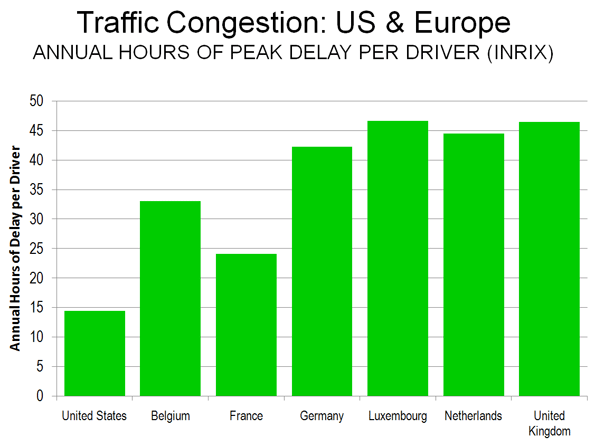
    A new international report indicates that traffic congestion in the United States is far better than in Europe. The report was released by INRIX, an international provider of traffic information in 208 metropolitan areas in the United States and six European nations.

    The report shows that the added annual peak hour congestion delay in the United States is roughly one-third that of Europe. The rate of France was somewhat less than twice the rate of the US and rates in Luxembourg, the United Kingdom, Germany and the Netherlands were three times as high.

    In the United States, peak period traffic congestion adds 14.4 hours annually per driver. This compares to an average delay per year of 39.5 hours for the European nations. Luxembourg, the United Kingdom, the Netherlands and Germany had the greatest lost time, at from 42 to 47 hours. Again, France scored the best in Europe, at 24.1 hours of lost time in traffic per year (Figure).

    Among individual metropolitan areas. Los Angeles had the greatest peak hour delay, at 74.9 hours annually. Utrecht (Netherlands), Manchester (United Kingdom), Paris, Arhem (Netherlands) and Trier (Germany) second through sixth in the intensity of traffic congestion, all with 65 or more hours of delay per driver per year.

    These findings are consistent with international data indicating that traffic congestion tends to be more intense where there are higher urban population densities.

  • Double Digit Ridership Increase Leaves London-Paris-Brussels High Speed Rail Behind Projections

    The Eurostar, the high speed rail service that links London with Paris and Brussels remains more than 60 percent below its ridership projections as of 2010, according to recently released ridership information. This is despite a double digit (12 percent increase in ridership between 2009 and 2010.

    According to a Parliamentary inquiry, consultants projected that Eurostar ridership would reach nearly 25 million passengers by 2006. As of 2010, ridership still languishes below 10 million, at 9.5 million. Rosy ridership and revenue estimates have often occurred with major infrastructure projects, especially rail projects, as has been documented in research by Flyvbjerg et al.

    In 2009, the government of the United Kingdom has assumed £5.2 billion in debts of the builder/operator of the high-speed rail Channel Tunnel link to St. Pancras Station. This is in addition to the £1.7 billion that had been granted by the government to the builder/operator to extend the line.

  • Curbing Euro-Envy

    Times are tough in the newspaper business. For example, The New York Times used to have a robust fact-checking department. Either the staff has been laid off or maybe they can’t keep up with the errors, either of which could explain the op-ed piece “Europe Energized.”

    Hill’s piece is classic cheerleading. He would have us believe that Europe has significantly reduced its reliance on oil, as its governments have enticed the citizenry out of cars and into mass transit and planes. Starting with the contention that Europe has the same standard of living as the United States, he indicates that Europe has made much greater progress in reducing energy use and carbon emissions.

    In fact, Europe does not enjoy the same standard of living as the United States. In 2009, the gross domestic product (purchasing power parity) was approximately one-third less ($14,000 less). For most households in Europe and the United States, that is a not an inconsequential amount of money. One reason for Europe’s lower rates of energy consumption is its historically lower income levels.

    Hill claims substantial reductions in oil consumption relative to the United States. However, Europe has not sworn off oil. Indeed, according to International Energy Agency (IEA) data, Europe’s oil consumption per capita dropped only marginally more than that of the United States between 1980 and 2006. Nor has Europe done a better job of becoming more energy efficient. Measured in tons of oil equivalence, the United States has reduced its per capita energy consumption more than Europe since 1980, again based upon IEA data. It is, of course, easier to reduce oil consumption with near static population growth.

    EU data indicates that mass transit’s market share in Europe has been declining for decades (like in the United States). Further, despite all the new high speed rail lines, cars and airplanes have accounted for the greatest travel increases. In 1995, airplanes carried a slightly smaller volume (passenger kilometers) than passenger railways, including high speed rail. By 2008, airlines were carrying 37% more passenger kilometers than rail, despite a huge expansion of high speed rail. Since 1995, at least 15 passenger kilometers have been traveled by car for every additional passenger kilometer traveled by rail, high speed or not. Meanwhile, Europe’s truck dependent freight system is less fuel efficient than America’s, which relies to a greater degree on freight railroads.

    None of this is to suggest that Europe does not lead the United States in some fields. There is no question that cars get much better mileage in Europe. By 2020, new cars are scheduled to achieve more than 60 miles per gallon, which is near double the US expectation. Europe is leading the way in automobile fuel efficiency and is demonstrating the massive extent to which improved fuel efficiency can accomplish tough environmental goals.

    Yet, curiously, no interest has been expressed by the Euro-Envious to implement European highway speed limits. Recently, Italy raised maximum speeds on some roads to 93 miles per hour, France, Austria, Denmark, Slovenia and others have 81 mile per hour limits and there are no speed limits on much of the German autobahn system. No US speed limits are this high.

    Having happily lived both within the pre-1200 (AD) boundaries of Paris and the urban fringes of four major US urban areas, it seems that both sides of the Atlantic have their strengths and weaknesses. Detailing them requires getting the facts right.

  • NGVideo: Reviving Plotlands

    Everybody knows we urgently need to build more homes in Britain, but how, when and where will this happen? WORLDbytes interviewed Ian Abley, an architect and manager of Audacity at the plotlands in Dunton, Essex where from the 1920s East End working class couples built cheap homes themselves. Could we do this now? Ian Abley argues we should collectively break the Town & Country Planning law of 1947 which made buying and building on redundant farmland, like the plotlands, illegal.

    More information and related resources are available here.

    This video and its description are derived from original content by WORLDbytes.org with the express permission of their authors. To see the original full-length video, visit this page.

  • Paris Mayor Sides with Cars

    Paris Mayor Bertrand Delanoë has spent much of his first term in implementing measures to restrict car use. Delanoë took many lanes of road traffic away from cars and turned them into exclusive bus and taxi lanes. This had virtually no effect on public transport use, according to University of Paris researchers who also found as a result that traffic congestion worsened, greenhouse gas emissions increased and overall cost to the Paris economy of more than $1 billion annually.

    Now the Mayor is establishing a car hire program that will make electric cars available throughout the ville de Paris at electric charging stations. Initially 4,000 cars will be involved in the “Autolib” program. London Mayor Boris Johnson has announced plans for a similar program. These are healthy developments and a further reflection that preferred lifestyles can continue, while still reducing greenhouse gas emissions.

  • We Sneezed, They Got Pneumonia

    Don’t worry about China taking over the US economy. Despite what all the talking heads on TV and the radio talk shows are saying, there isn’t another country out there that hasn’t been hammered at least as badly as we have by the financial meltdown. The problem with any other country attacking the US dollar, for example, is that they are all holding a lot of US dollars. You probably remember last year they were worried about the fact that we import so many goods that we have big “trade imbalances” – meaning that we buy more of their goods than they buy of ours.

    Now remember this: we pay for those imports with dollars. So, again, if the dollar is worth less (or worthless) then they are not going to be getting as much for their imports. Raising the price of their goods, that is, simply charging more dollars won’t do them any good either. We’re in a recession, and Americans are tightening their belts. Demand for imported goods, like demand for all goods except luxury goods, is price sensitive. The more they charge, the less we buy. According to an article on CNN.com, our belt tightening has ended the “Road to riches for 20 million Chinese poor.”

    Furthermore, it’s in the best interest of countries around the world that the US dollar stays strong. The door does swing both ways. According to Jack Willoughby at Barrons.com, “European banks provided three-quarters of the $4.7 trillion in cross-border loans to the Baltic countries, Eastern Europe, Latin America and emerging Asia. Their emerging-markets exposure exceeds that of U.S lenders to all subprime loans.”

    To support all of that exposure, the European Central Bank has been obtaining dollars from the U.S. Federal Reserve in currency swaps. The value of these swaps, where dollars are exchanged for other currency at a fixed and renewable exchange rate, went from $0 to $560 billion this year.

    And the Federal Reserve printing presses keep rolling along.

  • European Housing Woes

    While the decline in housing prices in America has been making news for some time now, less attention has been paid on this side of the Atlantic to the downturn in European housing. The housing market in Europe, much like that of the United States, “soared during the first half of this decade, rising far beyond the levels that you’d expect, based on traditional economic factors.”

    The fallout from the bubble is beginning to look the same, if not worse. According to Newsweek, over the first six months of 2008, housing prices in several European nations, including the United Kingdom, Spain, Sweden, and Norway, have fallen “at a faster rate than is occurring in the United States.” According to one analyst interviewed by Newsweek, the European downturn is still in an “early stage”.

    Eastern Europe is also seeing major fallout from deflation of the real estate bubble. According to Reuters, nations such as Bulgaria, Romania, and the Baltic republics of Latvia, Estonia, and Lithuania, have seen property prices plummet as easy access to credit has dried up. A Bulgarian property agent interviewed by Reuters reported that “No-one is buying. Everything has frozen”. The credit crunch has led to fears of “a wave of bank and currency crises,” which might necessitate IMF bailouts of several Eastern European nations. In the past two weeks Hungary and Ukraine have been bailed out, with the IMF providing loans “totaling $32 billion, in exchange for belt-tightening.”

    A recent report on European housing by Stratfor argues that the housing bubble faced by Europe was larger than that seen in the United States, and in correcting could lead to a “long-term deflationary spiral”. The report points out that in addition to facing overheated housing markets, Europe, over the long-term, faces a “poor demographic situation,” with a birth rate well below replacement level. According to Stratfor, this situation “will dampen the demand for housing in the long term and possibly create a deflationary spiral in the housing market”.

    Not all analysts are so gloomy, with some arguing that “the practice of giving mortgages to less credit-worthy buyers,” never reached the same levels in Europe, and that while prices did boom, there is not a “vast glut of never-lived-in houses sitting vacant on the market,” which should help to mitigate the situation. Regardless of the severity, it appears clear that Europe is set to face a continued period of real estate value contraction.