Tag: Financial Crisis

  • The Precariat Shoppe

    The precariat is a term coined to describe the segment of the population that lives without security or predictability. These days it often refers to the former American middle class that’s currently experiencing reduced circumstances. There’s always been a precariat, but it usually includes a minor subset of the population that no one really likes or cares about. Indentured Irish servants, black slaves, Jewish and Italian sweatshop workers, Mexican field hands, Puerto Rican cleaning ladies… It’s a long list. People are up in arms now because the “wrong people” have fallen in to the precariat that didn’t used to “belong” there. There’s been a sudden realization that sometimes the structure of the economy itself institutionalizes their personal decline. Shocking! I’m not a political animal so I’ll leave those discussions to others to hash out. Instead, I’m interested in how people adapt to the circumstances they find themselves in.

    We’re all familiar with the ice cream man whose truck rolls around with the happy music playing on hot summer days. This one is in Detroit – and it’s an ice cream lady. She bought an old delivery vehicle, did a bit of hand painting, fitted it with chest freezers, and opened for business. It’s a fast, low cost, and flexible way to get a business off the ground even in the most challenging economic environments.

    The ubiquitous food truck fills the gap between the cost, complexity, and risk of opening a brick and mortar restaurant vs. working for someone else. A well constructed food truck isn’t necessarily cheap, but it’s within the reach of many more people than anything in a building. This one is in Los Angeles.

    Here’s a twist on the mobile shop theme that’s a direct result of rising commercial rents. This woman ran a successful second hand clothing boutique for many years and was driven out when her shop rent hit $5,400 a month. You have to sell a lot of schmatta to make that nut. Now she follows various fairs and pubic gatherings with her merchandise in a repurposed school bus. She goes directly to where her customers are most likely to find her. As I’ve heard many times from shopkeepers around the world – it’s not how much money you earn, it’s how much you have left over after all the thieves are paid.

    Here’s a mobile veterinary clinic. Dogs, cats, horses… As the cost of a medical degree, insurance, and real estate have skyrocketed even doctors are taking a long hard look at the whole medical office building situation. The transition from a practice with a full team of professionals to a solo gig in a tricked out custom van can be described as a positive lifestyle change, but it’s almost certainly about money.

    I stumbled on this mobile grocery store complete with fresh produce, real bread, and dairy products. The offerings and prices were substantially better than what can be found at the alternative in this location – a classic food desert where people without access to a car have little choice but to buy low quality industrial food-like products at inflated prices at gas stations.

    Down the street I found a similar grocery truck. I chatted with the family that runs the business. There was a need in the community to bring in groceries as well as an opportunity to make money. The usual chain stores on the main arterial road don’t always work well for either customers or potential shopkeepers. The trucks do. They arrive exactly when and where they’re needed and stock what people want. I noticed health department certificates and Weights and Measures seals. Both trucks were Grade A.

    Here’s a mobile woodworker’s tool shop. These are specialty items not typically found in most hardware stores. This man has a relationship with various brick and mortar lumber yards who find his presence good for business. Social media alerts customers of his schedule. Mobile shops have the ability to specialize and cover a wider territory more economically than a stationary establishment burdened with overhead and a limited static customer base.

    The irony here is that all around the parking lots that host occasional mobile vendors are empty buildings that once housed chain pharmacies, banks, and such. Sometimes new buildings are constructed to house updated versions of the same stores in the same town. Sometimes there’s simply less need for physical operations as activity migrates to the interwebs. But repurposing the vacated spaces is hard. The size, configuration, and cost of these places is fundamentally at odds with the creation of new small scale mom and pop enterprises. The numbers don’t add up. I’ve had nearly everyone I talked to tell me some version of the same story. The combination of expenses, regulations, and the culture of distant corporate management is all agressively hostile to their efforts. And taking on a single employee is often the difference between making money and failing within the first year.

    Here’s one example of the challenges of opening a brick and mortar shop even if you have a generous budget. A prosperous California winery decided to open a tasting room in town to promote its products. The building had been a family paint store since the 1950s. The 2008 financial crash forced it to close. The new owners gave the old nondescript concrete block building a designer facelift. But it was a bumpy road. The climate controlled warehouse in the back was subject to a design review board that spent months rejecting the proposed color of the structure. White was preferred by the owner since it reflected heat most effectively. Evidently pure white was not in keeping with the character of the community. There was a back and forth with the oversight committee over various shades of off white, beige, and creme anglaise. Each time the committee rejected a color the process had to start all over again which delayed the opening of the shop by several weeks – which all costs money.

    The fire marshal insisted on the installation of this bit of plumbing that cost $65,000. I can’t think of anything more flammable than 1950s era paint – not even wine – yet somehow the building managed not to burn for sixty odd years. But no new business could open in this spot until this valve was installed. And then there was the requirement that each seat and stool in the tasting room have a corresponding parking spot on site while not interfering with the ability of a giant fire truck to completely encircle the entire property.

    Here’s the other end of the spectrum. A mother and daughter sell cold drinks at a busy bus stop from an ice chest. Totally ADA compliant!

    But the award for creative entrepreneurial capitalism goes to this mobile video game kiosk that regularly parks outside a San Francisco bar on weekend evenings. Comfortably liquified patrons settle in to folding chairs and play electronic games on the sidewalk. Free! (But please keep the tips coming.) It’s been in the same spot for so long the bar owners must not mind. This is how you work a side hustle when you’re part of the precariat.

    This piece first appeared on Granola Shotgun.

    John Sanphillippo lives in San Francisco and blogs about urbanism, adaptation, and resilience at granolashotgun.com. He’s a member of the Congress for New Urbanism, films videos for faircompanies.com, and is a regular contributor to Strongtowns.org. He earns his living by buying, renovating, and renting undervalued properties in places that have good long term prospects. He is a graduate of Rutgers University.
  • The Futility of Annual Top 10 Predictions

    In every recent year, a black swan event has made top 10 lists appear quaintly naive and unimaginative. Our list is probably no better.

    This time of year, top 10 predictions are all the rage. These lists can be interesting and entertaining but how useful are they really?

    This question goes to the heart of forecasting. How futile or how useful is an attempt to forecast the economy, or technology, or world events for the next twelve months? There are three answers.

    First, not futile and somewhat useful. Projecting the trends of 2016 into 2017 is a useful exercise to identify their linear logical trajectories and end points. For example, the automation of many job functions will continue as long as robotics and artificial intelligence make progress. Or, North Korea’s ability to deliver a nuclear warhead on a long-range missile will continue to improve if unchecked.

    Second, futile and not that useful. When a desirable trend, say a decline in unemployment, is identified, policy makers will attempt to reinforce it. When an undesirable trend becomes obvious, they will work to counter it. However in both cases, the intervention can be either effective or counterproductive. It can either reinforce or roll back the trend. Human tinkering means that few trends are truly linear or logical beyond the near-term. There may be a slowdown in the spread of automation. There may be an agreement to stop North Korea’s nuclear ambitions.

    Third, neither futile nor useful but somewhat irrelevant. While forecasters are focusing their sights on the high probability of a, b and c, there are always bigger low-probability events brewing under the surface. In fact, the most important event in any given year, the one event that shakes things up and that has wide long-lasting ramifications, is usually one that few people foresaw at the beginning of that year.

         •  In 2016, Brexit and the victory of Donald Trump. A large majority of experts gave either event a low probability.

         •  In 2015, the massive refugee influx into Europe. The numbers were rising in previous years but no one saw the surge coming.

         •  In 2014, the sudden rise of ISIS after it conquered large territories in Syria and Iraq. President Obama had famously dismissed them as the JV team a few months earlier.

         •  In 2013, the Boston Marathon bombing and Edward Snowden’s revelations.

    And so on. If you look at it by decade, the most important events of the 1990s and 2000s were the collapse of the Soviet Union and the 9/11 terror attacks. Neither featured in top ten lists in any year but both had an enormous impact and repercussions that are still rippling around the world.

    So instead of a list of top 10 higher probability predictions, we should consider a list of lower probability events each of which, were it to occur, would have a very large impact on the future of politics, economics, science etc. As extensively argued by Nassim Taleb, black swan events often have a much greater impact on the future.

    Here is one attempt to compile such a list, with the caveat admission that it is only marginally better if at all than other lists and that the most important event of 2017 will likely be something else.

    Low Probability high impact events

    In no particular order:

         •  A major cyberattack that paralyzes the electric grid, payment exchanges, the stock market and/or other infrastructure. Until repaired, this would wreak havoc on daily life and the economy and would hit GDP for several quarters. It would also lead to new security measures and the attendant spending by corporations and governments.

         •  Putin removed from power. This has a low probability but it is not impossible. Referring to Putin, George Friedman recently wrote that “Russia must be led by a magician who can make small things appear large.” Through ways not always approved in the West, Putin has managed to spread Russia’s influence despite economic deterioration. But Russia has large demographic and economic challenges which could get worse after his departure.

         •  Another financial crisis starting in Europe or in emerging markets. Though regulation and oversight have increased since 2008, there was no deep overhaul of the cultural mindset at many leading financial institutions. The world is awash with credit and emerging markets are considerably weaker now than in 2008. If nothing else, moral hazard created by the bailouts means that the next crisis could be as severe as the last one, with little appetite in the public for saving the banks one more time.

         •  A joint Russia-NATO military operation against ISIS and a settlement of the Syrian war. ISIS has lost much territory in 2016 but is still effective at orchestrating terror attacks in other countries. During the campaign, Donald Trump vowed to hit them hard.

         •  A sharp economic slowdown in China. China has been a huge engine of growth for over two decades lifting its own economy and boosting commodity-based countries such as Brazil, Russia and the OPEC countries. Chinese demand also helped maintain strong demand for American and European goods at a time when growth in Western economies was sluggish or nonexistent. At the same time, China’s low-cost manufacturing and capital flows into the US lowered inflation and interest rates. A marked China slowdown could throw all of the above in reverse, lifting interest rates in the US and Europe and depressing demand for finished goods and commodities.

         •  Political turmoil in Saudi Arabia and/or Iran. Both countries have vast oil reserves and are the leading power brokers in the Middle East. Destabilization in either would have important near and long-term consequences.

         •  A coup d’état or populist revolt in an OECD country. OECD member Turkey experienced an aborted military takeover in 2016. Could it happen elsewhere? Highly improbable but not necessarily 100% out of the question, as far as black swans are concerned.

         •  The price of oil at $20 or $90 per barrel. Today oil is trading near $55 and a decline to $40 or a rise to $65 are neither here nor there in terms of their lasting impact. But a $30 to $40 rise or drop would certainly shake things up. It is not difficult to construct either scenario, improbable as it may be. For a drop, imagine China and/or the US economy weakening while production from Iran, Iraq, Libya and US shale producers surges back. For a rise, consider emerging markets recovering with a stronger India while turmoil in the Middle East threatens some production.

         •  A major terrorist attack with thousands of casualties. Unfortunately, this one will have to feature on the list every year for the foreseeable future. Though it has a low probability, its occurrence anywhere would shock and reshape the world for the several decades that follow.

         •  On the positive side, there will continue to be advances in science and medicine. Because positive developments tend to build on the previous years’ progress, they are by their nature incremental, and are therefore unlikely to generate surprise shock or awe headlines.

    These are all low probability but not zero probability events. And the impact of each would be far greater than that of any higher probability event featuring in many top 10 predictions for 2017.

    Sami Karam is the founder and editor of populyst.net and the creator of the populyst index™. populyst is about innovation, demography and society. Before populyst, he was the founder and manager of the Seven Global funds and a fund manager at leading asset managers in Boston and New York. In addition to a finance MBA from the Wharton School, he holds a Master’s in Civil Engineering from Cornell and a Bachelor of Architecture from UT Austin.

    Photo: Edvard Munch [Public domain or Public domain], via Wikimedia Commons

  • Obama’s not so glorious legacy

    Like a child star who reached his peak at age 15, Barack Obama could never fulfill the inflated expectations that accompanied his election. After all not only was he heralded as the “smartest” president in history within months of assuming the White House, but he also secured the Nobel Peace Prize during his first year in office. Usually, it takes actually settling a conflict or two — like Richard Nixon or Jimmy Carter — to win such plaudits.

    The greatest accomplishment of the Obama presidency turned out to be his election as the first African American president. This should always be seen as a great step forward. Yet, the Obama presidency failed to accomplish the great things promised by his election: racial healing, a stronger economy, greater global influence and, perhaps most critically, the fundamental progressive “transformation” of American politics.

    Racial healing

    Rather than stress his biracial background, Obama, once elected, chose to place his whiteness in the closet and identified almost entirely with a particular notion of the American black experience.

    Whenever race-related issues came up — notably in the area of law enforcement — Obama and his Justice Department have tended to embrace the narrative that America remains hopelessly racist. As a result, he seemed to embrace groups like Black Lives Matter and, wherever possible, blame law enforcement, even as crime was soaring in many cities, particularly those with beleaguered African American communities.

    Eight years after his election, more Americans now consider race relations to be getting worse, and we are more ethnically divided than in any time in recent history. As has been the case for several decades, African Americans’ economic equality has continued to slip, and is lower now than it was when Obama came into office in 2009, according to a 2016 Urban League study.

    The economic equation

    On the economy, Obama partisans can claim some successes. He clearly inherited a massive mess from the George W. Bush administration, and the fact that the economy eventually turned around, albeit modestly, has to be counted in his favor.

    Yet, if there was indeed a recovery, it was a modest one, marked by falling productivity and low levels of labor participation. We continue to see the decline of the middle class, and declining life expectancy, while the vast majority of gains have gone to the most affluent, largely due to the rising stock market and the recovery of property prices, particularly in elite markets.

    At the same time, Obama leaves his successor a massive debt run-up, doubling during his watch, and the prospect of steadily rising interest rates. Faith in the current economic system has plummeted in recent years, particularly among the young, a majority of whom, according to a May 2016 Gallup Poll, now have a favorable view of socialism. Economic anxiety helped spark not only the emergence of Bernie Sanders, but later the election of Donald Trump.

    Read the entire piece at the Orange County Register.

    Joel Kotkin is executive editor of NewGeography.com. He is the Roger Hobbs Distinguished Fellow in Urban Studies at Chapman University and executive director of the Houston-based Center for Opportunity Urbanism. His newest book, The Human City: Urbanism for the rest of us, was published in April by Agate. He is also author of The New Class ConflictThe City: A Global History, and The Next Hundred Million: America in 2050. He lives in Orange County, CA.

    Photo: The Official White House Photostream (originally posted to Flickr as P012109PS-0059) [CC BY 2.0 or Public domain], via Wikimedia Commons

  • A Capital Improvement and Revitalization Idea for Detroit

    You may have heard that Detroit is in the midst of a modest but enduring revival in and around its downtown. Residents and businesses are returning to the city, filling long-vacant skyscrapers, prompting new commercial development and revitalizing adjacent old neighborhoods. As a former Detroiter I’m excited to see the turnaround. After so many false starts, Detroit’s post-bankruptcy rebound seems very real.

    However, there seems to be a growing awareness that the city’s current revival has its limits. On one hand, what’s happening now in Detroit could be considered a rather elongated recovery for the city instead of growth, as the city races to catch up with cities that have had a 20-year head start on urban revitalization. One could argue that the Motor City is slowing losing its taint, and the investment that’s coming to the city now is investment that never left, or never left at such a scale, in other cities. Maybe its reclamation rather than revitalization.

    But more broadly speaking, there’s a sentiment that the city’s revival hasn’t been inclusive. In a majority-black city, startlingly few African-Americans appear to be involved in the rebound, either as developers, homebuyers or even consumers of new amenities. Because of this, two vastly different kinds of fears seem to trouble much of the city’s black community — the revitalization could burn through the city like a wildfire and lead to widespread displacement, or the rebound could peter out before it has a chance to transform even more of the city.

    How can that be? Maybe because people and businesses are coming back not because of an economic change in the city, but a socio/cultural one. Detroit is still the Motor City, and that won’t change anytime soon. Detroit will remain the headquarters of American auto production and be a key manufacturing center for generations to come, and it will continue to ride the wave of manufacturing ebbs and flows. That’s why I say the economy is driving little of what’s happening in Detroit today. The Big Three are only eight years away from a true existential threat, and are still in the process of righting the ship. By my eyes, Detroit still hasn’t found a new economic raison d’etre that could vault it into the next phase of its development.

    As the fears that drove white and middle-class flight from the city from the 1960’s onward recede into the distant memory, many people are willing to reconsider Detroit and return.

    Detroit is at an interesting juncture in its history. After 125 years of focusing on its national and global economic prominence and leaving city-building behind, maybe now Detroit can focus on being a thriving, livable city. For everyone. There is an opportunity for Detroit to build on its rich urban design legacy to include more of the city, and more of its people, in its revival. There is an opportunity to set the stage for good — even innovative — urban development in the Motor City as the city continues to search for a new economic catalyst.

    I believe the city should undertake a capital improvement/revitalization plan that utilizes its grand arterial streets — Gratiot, Woodward Grand River and Michigan avenues — and Grand Boulevard, the parkway necklace around the city’s inner core, as assets and foundations for growth. After that, the city could extend similar improvements to the locations where the arterial streets intersect with the defunct Detroit Terminal Railroad, further out from the city center. Finally, the improvements could be extended even further outward to Detroit’s other boulevard necklace, Outer Drive, near the city limits. Just as interstate highway development had the net impact of opening up outer bands of suburbia to city residents, this plan could open up languishing parts of the city for revitalization.

    Here’s the five-phase process:

    • Transform Gratiot, Woodward, Grand River and Michigan avenues into true boulevards — landscaped medians, streetscaping, wide sidewalks, bike lanes, etc. — from their sources in downtown Detroit to their intersections with Grand Boulevard.

    • Establish public squares where each new boulevard intersects with Grand Boulevard.

    • Develop a connected greenway along the path of the former Detroit Terminal Railroad.

    • Extend boulevard treatment along Gratiot, Woodward, Grand River and Michigan avenues to a new terminus at Outer Drive.

    • Complete and connect Outer Drive where necessary, and establish new public squares where the boulevards intersect with Outer Drive.

    Each step of the plan would include zoning changes along the affected areas with the intent of increasing residential and commercial development choice, and send a signal that the city is ready for transformation.

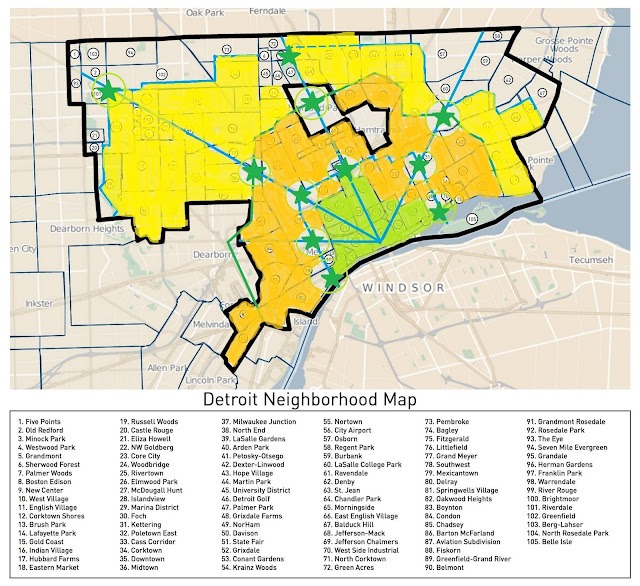
    Here’s how this project would look conceptually, looking at the entirety of Detroit:

    image of detroit

    First, please excuse my crude Microsoft Paint illustration. Hey, it serves its purpose. Second, let’s consider the broad areas of the city highlighted in various colors. The green areas are the downtown and downtown-adjacent areas that have been experiencing a pretty significant rebound over the last 5-10 years. In fact, you could say that revitalization took hold there with the opening of the Comerica Park baseball stadium in 2000 and the Ford Field football stadium in 2002. This area also includes the Midtown area north of downtown that includes Wayne State University and a host of city cultural institutions. The orange areas are the parts of the city that capture the dystopian imagination of Detroit. This area is quite — but not totally — abandoned, where much of the city’s older residential and industrial treasures have been lost. There’s still some intact neighborhoods that have a solid walkable foundation, but they’re often disconnected from each other by some serious abandonment. The yellow areas are the areas that might be described as imperiled; they could soon look like the orange zone if action isn’t taken, and in fact some parts of it (like the Brightmoor neighborhood, on the far west side, are quite abandoned already). The gray or uncolored areas on the far northeast and northwest edges of the city represent the most stable residential neighborhoods of the city, but they, too, are threatened by the challenges experienced by the rest of the city.

    When you hear Detroiters expressing concern that downtown revitalization isn’t reaching the neighborhoods, they often come from the yellow and gray/uncolored areas, with fewer and fewer voices coming from the relatively open orange areas. Viewed this way it can be understood that people see the city’s rebound as having a low ceiling; there is a half-empty quarter that sits between them and the promise of revitalization.

    My idea is to utilize strategic infrastructure investment and zoning reform to attract new development to key corridors, utilizing the city’s radial network. The radial blue lines on the map emanating from their intersection downtown represent (clockwise, from the left) Michigan, Grand River, Woodward and Gratiot avenues. The blue line that connects them, just outside the green revitalization area, is Grand Boulevard. The blue line that connects the radial streets further out is Outer Drive. The green stars represent public squares or plazas that could be built, and the light green circles indicate an approximate extent of impact outward from the squares or plazas. The green line that serves as the dividing line between the yellow and orange areas is the Detroit Terminal Railroad, and it would become a connecting trail.

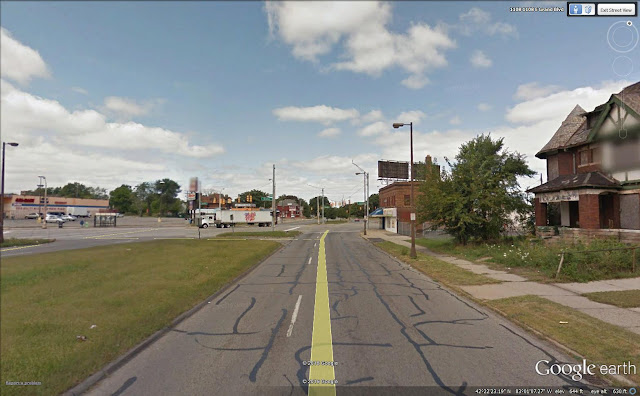
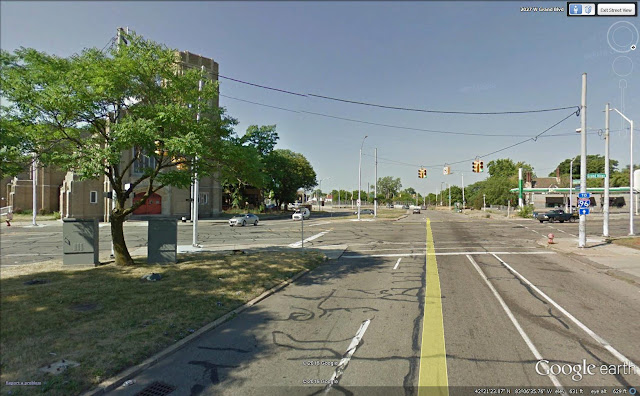
    Detroit was blessed early on with an excellent radial street system, but it quickly abandoned it as growth took hold in the early 20th century. Detroit missed an opportunity for grand public spaces at the same time that other cities were incorporating them into their urban fabric — and those public spaces became the foundation for their rebound. Consider this image, where Grand River Avenue intersects with Grand Boulevard:

    google image of grand river avenue intersecting with Grand Boulevard

    Or, worse yet, where Gratiot Avenue and Grand Boulevard meet:

    google image of Gratiot Avenue and Grand Boulevard

    This was a missed opportunity for Detroit to have majestic entryways into neighborhoods beyond the city center. This was also a missed opportunity to develop areas that could become more mixed use and multifamily in character, as opposed to the dominant single-family home city that Detroit is today.

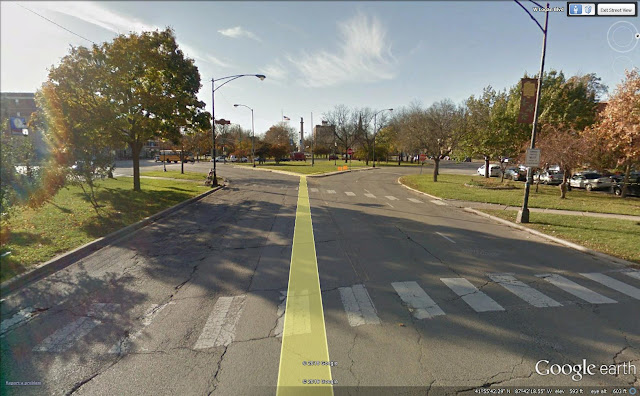
    If Detroit had the foresight 100 years ago to make strategic infrastructure investments, it could have put in place something like Chicago’s Logan Square, located at Milwaukee Avenue and Logan Boulevard (also a radial street and boulevard intersection):

    google image of Chicago's Logan Square

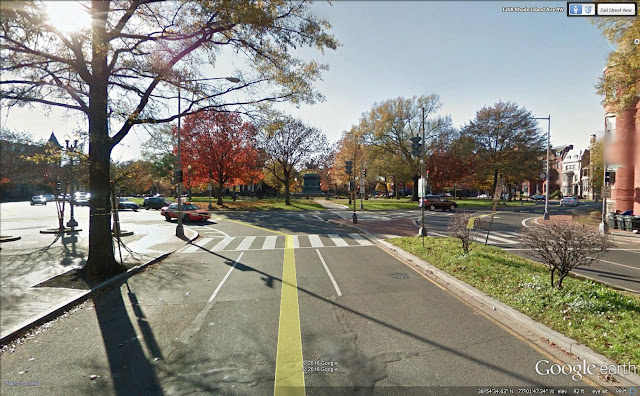
    Or Logan Circle, in Washington, DC:

    google image of Logan Circle

    The public squares on the radial avenues could have the effect of drawing development and revitalization outward from the city center, as has happened in Chicago and DC. This could continue outward to the DTR trail and Outer Drive, if the city sees success in such a measure, finds the appropriate resources and desires to extend it further.

    Detroit should certainly see the merits of such an investment. The city renovated and rededicated a new Campus Martius Park in 2004, and it has become a focal point for downtown revitalization.

    Without a doubt, this would be a costly measure, maybe even a folly for a city just out of municipal bankruptcy and still struggling to provide basic city services. that’s why I would envision this as a long term proposal, perhaps a 10-year project.

    That’s the basis of the idea. I’ll follow up with more details soon.

    Top photo: detroit.curbed.com

    Pete Saunders is a Detroit native who has worked as a public and private sector urban planner in the Chicago area for more than twenty years.  He is also the author of “The Corner Side Yard,” an urban planning blog that focuses on the redevelopment and revitalization of Rust Belt cities.

  • The Incompetence Hypothesis to Explain the Great Recession

    Seeking an understanding of the Great Recession, I am finding that most of the 2008 financial crisis and its aftermath can be explained by incompetence. In the final weeks of writing a book on the systemic failure in US capital markets, I had to re-read the Securities and Exchange Commission (SEC) Inspector General’s 2009 report on their failure to stop Bernard Madoff despite having received credible evidence of a Ponzi scheme. The inspector concluded that it did not have anything to do with the fact that an SEC assistant director was dating (and later married) Madoff’s niece; or that Madoff had held a Board seats at important financial regulators.* Despite eight substantive complaints and two academic journal research reports over 16.5 years about problems with Madoff’s investments, Madoff was never caught. In the end he turned himself in, admitting to a $64 billion Ponzi scheme. The inspector’s conclusion: incompetence.

    In economics, ‘interest’ – whether it be self-interest or interest group pressure – is the ‘safe’ explanation for outcomes that are detrimental to the public. If interest group pressure (or even populism) is behind a bad policy decision, then it is not a ‘mistake.’ Rather, it is an intentional, rational decision as described by Chicago School economist and Nobel laureate George Stigler. However, if a policy decision is the result of bad judgment, then Stigler cannot explain it. Brazilian economist Luiz Carlos Bresser-Pereira suggests that the relevant variable in this case is incompetence. Incompetence is an independent explanatory variable; it cannot be explained in rational or historical terms.

    Incompetence arises from three sources: 1) ignorance, 2) arrogance, or 3) fear. Policy advisors and regulators may be guilty of applying theories second-hand but with great authority and self confidence. They may be ignorant of the complexities of economic theory and they may apply abstract economic theories inappropriately to specific policy problems. For example, they allowed banks to engage in a wide range of investments under the financial theory of ‘diversification.’ That theory works for portfolios but not for businesses, which need to specialize to realize the gains from their comparative advantage. Financially derived theories like this were applied automatically, transformed into a series of clichés.

    ‘Diversification’ in a portfolio of financial investments lets you increase the returns while reducing the risk. But in business it means ‘splintering’ which destroys performance capacity and increases risk. Financial institutions are tools to be used in furthering the efforts of the broad economy: the more specialized financial institutions become, the greater their performance capacity. Increased productivity from specialization comes with better quality as businesses become more adept at their specific products and services. The differences in natural aptitudes and abilities produce economic benefits when tasks are matched to capabilities. The more experience a worker has at performing a task, they more efficient they become in doing the work. As management guru Peter Drucker wrote: ‘Organizations can only do damage to themselves and to society if they tackle tasks that are beyond their specialized competence.’

    An example of an economic theory applied arrogantly is Washington’s constant fawning over ‘free market solutions’ when the rules, regulations and court decisions covering capital markets fill the bookshelves of law offices around the world. There is no such thing as a free market – no economist of value believes that the perfectly competitive market exists. The Wall Street Bailout is a good example of the third source of incompetence – fear. Consider this description of the exchange between Treasury Secretary Henry Paulson, Federal Reserve Chairman Ben Bernanke and the senior legislators from the House and Senate on Thursday, September 18, 2008:

    Sen. CHRISTOPHER DODD: Sitting in that room with Hank Paulson saying to us in very measured tones, no hyperbole, no excessive adjectives, that, "Unless you act, the financial system of this country and the world will melt down in a matter of days. "
    JOE NOCERA: Bernanke said, "If we don’t do this tomorrow, we won’t have an economy on Monday."
    Sen. CHRISTOPHER DODD: There was literally a pause in that room where the oxygen left.
    Inside the Meltdown, Frontline February 17, 2009, WGBH Educational Foundation, Boston. 

    Regardless of the source of the incompetence, the visible results are 1) failure to take correct strategic policy decisions, and 2) failure to adopt well-designed reforms.

    Policy decisions are the day-to-day management decisions that usually produce immediate results. In monetary policy, for example, these would be interest rate decisions. Interest rate policy decisions need to be made at the right time and to move rates in the right direction.

    Reforms produce medium-term outcomes that may or may not require legislative approval. The Dodd-Frank Act, which was supposed to reform Wall Street and protect Main Street, in reality created very little change but suggested that financial regulators reform their own rules. Poor reforms may be the result of incompetent designs and not just pressure from interest groups, although this also happens.

    Bresser-Pereira’s analysis offers one more alternative explanation for the cause of bad policy and reforms. Between interest and incompetence lies ‘confidence building.’ It is simply doing what is expected in an effort to gain the confidence of financial supporters. If we substitute “Goldman Sachs” for “United States” and “Wall Street” for “developed countries” in this quote from Bresser-Pereira, then his description of ‘confidence building’ is as true of Washington, D.C. as it is of Brazil:

    ‘They do not limit themselves to seeing the United States and, more broadly, the developed countries, as richer and more powerful nations, whose political institutions and scientific and technological development should be imitated. No, they see the elites in the developed countries both as the source of truth and as natural leaders to be followed. This subordinate internationalism ideology, already called ‘colonial inferiority complex’ and entreguismo**, is as detrimental to a country as old-time nationalism. What I am singling out as a major source of incompetent macroeconomic policies is the uncritical adoption of developed countries’ recommendations.’

    If we say that bad policy decisions are always rational, motivated by interest, then we must conclude that policy-makers are ‘dishonest, protecting their own interest or those of their constituencies rather than the public interest’ (Bresser-Pereira).  If this view were always true, then the world would look more like communist Russia in 1980 than the way it does today. How would entrepreneurs and consumers have financed not only the invention but the proliferation of microchips, cell phones, and personal computers that have made the world safer and easier to navigate; how would they have discovered and made widely available artificial hearts, HIV medications and targeted cancer therapies? Since 1981, the number of poor people in the world declined for the first time in history, by 375 million. Global life expectancy was 68 in 2014, up from 61 in 1980; infant mortality is down to 49.4 per 1000 live births in 2014 from 80 in 1980. Yet as a result of the havoc wrecked upon the global economy in 2008 by incompetent regulators, policy makers and bankers, global unemployment grew from 20 to 50 million while falling incomes combined with rising food prices to raise the number of undernourished people in the world by 11%.

    A solution, from this perspective, lies in cleaning house of the incompetent staff from Washington to Wall Street and improving recruiting methods to build competence for the future.

    * Madoff has a seat on the Board of the International Securities Clearing Corporation, one of the predecessor organizations to the Depository Trust and Clearing Corporation, the world’s largest post-trade processing center. Madoff was also Chairman of the NASDAQ, and had seats on the Boards at the National Association of Securities Dealers (now the Financial Industry Regulatory Authority – the same organization that failed to act on a referral letter from the SEC to stop R. Allen Stanford’s Ponzi scheme.
    **Brazilian Portguese roughly translated as ‘appeasement’ or ‘submission.’

    For more information:
    Luiz Carlos Bresser-Pereira, Latin America’s quasi-stagnation, in A Post Keynesian Perspective on 21st Century Economic Problems, Elgar, UK. http://www.bresserpereira.org.br/
    The World Factbook 2013-14. Washington, DC: Central Intelligence Agency, 2013.
    https://www.cia.gov/library/publications/the-world-factbook/index.html

    Susanne Trimbath, Ph.D. is CEO and Chief Economist of STP Advisory Services. Dr. Trimbath’s credits include appearances on national television and radio programs and the Emmy® Award nominated Bloomberg report Phantom Shares. She appears in four documentaries on the financial crisis, including Stock Shock: the Rise of Sirius XM and Collapse of Wall Street Ethicsand the newly released Wall Street Conspiracy. Dr. Trimbath was formerly Senior Research Economist at the Milken Institute. She served as Senior Advisor on United States Agency for International Development capital markets projects in Russia, Romania and Ukraine. Dr. Trimbath teaches graduate and undergraduate finance and economics.

  • Seven Years Ago, Wall Street was the Villain. Now it Gets to Call the Shots

    The recent passage by Congress of new legislation favourable to loosening controls on risky Wall Street trading is just the most recent example of the consolidation of plutocratic power in Washington. The new rules, written largely by Citibank lobbyists and embraced by the Obama administration, allow large banks to continue using depositors’ money for high-risk investments, the very pattern that helped create the 2008 financial crisis.

    This move was supported largely by the establishment in each party. Opposition came from two very different groups: the Tea Party Republicans, who largely represent the views of Main Street businesses, and a residue of old-line progressive social democrats, led by Massachusetts Senator Elizabeth Warren.

    Support for big finance is no surprise from Republicans, who are used to worshipping at the altar of Wall Street. But the suborning of “progressivism” to Wall Street has been a permanent feature of this administration. From the onset of his presidential run, Barack Obama had strong ties to Wall Street grandees. New York Times Wall Street maven Andrew Ross Sorkin noted in 2008 how Obama had “nailed down the hedge fund vote”.

    The ultra-rich so backed the president that, at his first inaugural, noted one sympathetic chronicler, the biggest problem for donors was finding parking space for their private jets. Since then, despite occasional flights of populist rhetoric, the president has kept close ties with top financial firms, including the well-connected Jamie Dimon, chairman of JP Morgan, often called Obama’s “favourite banker”. He appears to have been instrumental in getting Democrats to support the recent loosening of financial controls on big banks.

    These Wall Street connections have continued to play dividends for the president, in terms of contributions. The financiers benefited from Obama’s choice of financial managers, such as former treasury secretary Tim Geithner, widely known as a reliable ally of the financial sector. (He liked to explain his support by equating its importance to that of the technology and manufacturing industries.) To no sensible person’s surprise, Geithner, when he left the Treasury last winter, found his reward by joining a large private equity firm. (By way of completing the circle, Geithner’s successor, Jacob Lew, used to work for Citibank.)

    The Justice Department has also been cosy with the plutocracy. Attorney general Eric Holder allowed Wall Street a kind of “get out of jail free card” by failing to launch tough prosecutions of the grandees. In contrast to the situation under previous administrations, both Republican and Democratic, the financial plutocrats have not been forced to pay for their numerous depredations. Instead, most prosecutions have been aimed at low-level traders, Ponzi schemers or inside traders.

    So if you still think 2008 and the financial crisis changed everything, still think of it as a progressive triumph, think again. Instead of the brave new world of reformed finance, what’s been created in the US is something close to a perfect world, policy-wise, for the plutocrats. The biggest rewards have come from an economic policy, backed by the Federal Reserve and the administration, that has maintained ultra-low interest rates. This has forced investors into the market, at the expense of middle-class savers, particularly the elderly. The steady supply of bond purchases has essentially given free money to those least in need and most likely to do damage to everyone else.

    The results make a mockery of the Democrats’ attempts to stoke populist sentiments. In this recovery, the top 1% gained 11% in their incomes while the other 99% experienced, at best, stagnant incomes. As one writer at the Huffington Post put it: “The rising tide has lifted fewer boats during the Obama years – and the ones it’s lifted have been mostly yachts.” If this had occurred during a Republican administration, many progressives would have been horrified. But Democrats, led by New York senator Charles Schumer, Wall Street’s consigliere on the Hill, have been as complicit as Republicans in coddling Wall Street. Democrats, for example, despite their rhetoric about inequality and fairness, have refused to challenge the outrageous discount on taxes for capital gains as opposed to income. A successful professional making $300,000 a year is often taxed at rates twice as high as the rate paid by hedge fund investors, venture capitalists, tech entrepreneurs and Wall Street stock jobbers.

    At the same time, the Obama years have been something of a disaster for Main Street, where most Americans work. A 2014 Brookings report revealed that small business “dynamism”, measured by the growth of new firms compared with the closing of older ones, has declined significantly over the past decade, with more firms closing than starting for the first time in a quarter of a century.

    Small banks, long a critical source of funding for small businesses, have also been pummelled by the very regulatory regime that also allows mega-banks to enjoy both “too big to fail” protections as well as their sacred right to indulge their most cherished risk-oriented strategies. In 1995, the assets of the six largest bank holding companies accounted for 15% of gross domestic product; by 2011, aided by the massive bailout of “ big banks”, this percentage had soared to 64%.

    These trends do much to explain what happened in the recent midterm elections, which saw a massive shift of middle- and working-class voters, especially whites, to the Republicans. Increasingly, Americans suspect that the economic system is rigged against them. By a margin of two to one, according to a 2013 Bloomberg poll, adults feel the American Dream is increasingly out of reach. This pessimism is particularly intense among white working-class voters and large sections of the middle class .

    The other major cause for the Democratic demise in November was the low turnout among minority voters. They certainly have ample reason to be indifferent. Both African American and Latino incomes have declined during the current administration, in large part because neither group tends to benefit much from the appreciation of stocks and high-end real estate.

    In caving in to Wall Street and its economic priorities, members of both parties have demonstrated where their primary loyalties lie. Amid the obscene levels of compensation going to the financial grandees, it seems the ideal time for politicians, right or left, to challenge Wall Street’s control of Washington. High finance has so devastatingly rocked the world of the middle and working classes. Voters, it might be thought, now need leaders who will take these grandees down a notch or two.

    This piece first appeared at The Guardian.

    Joel Kotkin is executive editor of NewGeography.com and Roger Hobbs Distinguished Fellow in Urban Studies at Chapman University, and a member of the editorial board of the Orange County Register. His newest book, The New Class Conflict is now available at Amazon and Telos Press. He is author of The City: A Global History and The Next Hundred Million: America in 2050. His most recent study, The Rise of Postfamilialism, has been widely discussed and distributed internationally. He lives in Los Angeles, CA.

    Wall Street bull photo by Bigstockphoto.com.

  • 10 Steps to Financial System Stability: Lessons Not Learned

    Recently, BloombergView writer Michael Lewis called attention to tape recordings made by a Federal Reserve Bank of New York bank examiner who was stationed inside Goldman Sachs’ offices for several months during 2011-2012. She released the tapes to This American Life who aired her story on September 26, 2014. Every media article I’ve seen on this begins with a prelude warning how complicated and hard to follow the story will be. Regular readers of New Geography are several steps ahead in their understanding of these causes and consequences of the financial crisis. If you are new here, you can follow the links in this piece to earlier NG articles.

    Central to the theme of the story is the release of a 2009 report by Columbia University professor David Beim on why the Federal Reserve – especially the New York office which was supposed to be watching the banks – failed to act to prevent the crisis. Beim listed about a dozen “Lessons Learned” by bank supervisors after the financial crisis. In this article, we list the Lessons not Learned before the financial crisis. These lessons come from decades-old studies of financial regulation from around the world. If any US policy makers had paid attention in school, we would have avoided the global financial collapse of 2008. The United States – which was at the center of that storm – had been preaching these steps to emerging market nations for decades. Unfortunately, they just were not following them for us. In the fall of 1998, those emerging market economies seriously threatened the financial stability of the West. In the fall of 2008, it was the West that brought the threat upon itself and the rest of the world.

    Four Policies, Five Tasks and One Idea

    Policies not implemented

    1. Have private, independent rating agencies: US rating agencies were technically independent because they were not owned by the government. However, with the creation by the Securities and Exchange Commission (SEC) of the “Nationally Recognized Statistical Rating Organization” or NRSRO designation, three big credit rating agencies were the only ones accepted for use to meet regulatory requirements – they were issuing 98% of all credit ratings. This gave a government imprimatur to selected businesses, creating undue reliance by financial markets globally. By 2008, the “NRSRO” term appeared in more than 15 SEC rules and forms (not including those directly used for NRSROs), plus rules in all 50 states. NRSROs are also referenced in 46 Federal Reserve rules and regulations. Even though the SEC sanctioned and required the use of the NRSROs they had no say in the process used to establish the ratings.

    Despite even pseudo-independence from the government, the NRSROs were not independent of the financial institutions that paid them to issue credit ratings. The government sanction gave them more power to wield against – or in favor of – the banks and companies they rated. They made money consulting for the same firms, resulting in pressure to rate bonds higher than they should have been rated.

    2. Provide some government safety net but not so much that banks are not held accountable:  Many banks – and all of the New York Feds “primary dealers” – achieved “too big to fail” status through the Wall Street Bailout Act. A few were allowed to fail in the months leading up to the passage of the Bailout – most notably Lehman Brothers – in what amounted to the federal government picking winners and losers without accountability. The Federal Deposit Insurance Corporation was nearly bankrupted in late 2009, removing the safety net that protected depositors. The FDIC was so depleted by the epidemic of collapsing banks, they eased the rules on buyers of failing banks, opening the door for hedge funds and private investors to gain access to “bank” status – and the protections that go with it. At the end of September 2009, the FDIC’s fund was already negative by $8.2 billion, a decrease of 180% in just three months. FDIC is projected to remain negative over the next several years as they absorb some $75 billion in failure costs just through the end of last year.

    At the same time, bailed-out banks, brokers and private corporations received additional financial support from the Federal Reserve in a move unprecedented in US history. Billions of dollars in loans were made to the banks without proper documentation. The lack of transparency in the process used by the Treasury to decide who would receive bailout funds and what the recipients have done with the hundreds of billions of dollars was the subject of a GAO audit we wrote about in 2011.

    3. Allow very little government ownership and control of national financial assets: Four years after the crisis, the U.S. Treasury still owned more than half of American International Group, Inc., (AIG). AIG was the world’s largest insurance company – giving the government ownership in international financial assets, too. The U.S. government took ownership positions in virtually every major financial institution during the bailout, plus some non-banks that had lending arms (like General Motors Acceptance Corporation). The GAO audit of the Fed shows we loaned money to and took ownership stakes in a slew of non-regulated businesses like Target and Harley Davidson. The lack of transparency in these transactions is dangerous. Austrian Economist Ludwig von Mises warned decades earlier that market data could be “falsified by the interference of the government,” with misleading results for businesses and consumers.

    4. Allow banks to reduce the volatility of returns by offering a wide-range of services: Until the passage of the Dodd-Frank Wall Street Reform and Consumer Protection Act in 2010, banks were restricted to buying securities defined as investment grade by the NRSROs. Given what we now know about these ratings and the actual riskiness of some AAA-rated investments, the requirement actually made bank investments more dangerous. The process followed in the years (even decades) leading up to the collapse of credit markets was not one that would meet the definition of “unrestricted.” Although there appeared to be a wide range of activities available to US banks, the restriction on credit ratings would eventually increase volatility by concentrating risk instead of dispersing it. Just because a bank can deal in a particular investment does not mean that they should.

    The steps outlined here are a comprehensive program, not a menu of options.  There is no sense allowing banks wide latitude to make risky investments if proper supervision and enforcement is not in place. That leads us to the next steps: the necessary tasks for prudent regulation.

    Tasks Not Taken

    Ten years before the most recent financial crisis (1998), the international financial system had already entered a new era. Speaking at the Western Economics International Association in 2001, Lord John Eatwell said, “The potential economy-wide inefficiency of liberalised financial markets was indisputable.” Eatwell had been writing about these problems for decades.

    5. Require financial market players to register and be authorized: US regulators failed to act on establishing registration for hedge funds, failed to establish requirements for registering who can issue collateralized mortgage obligations (mortgage-backed securities), and failed to act on loopholes in regulations prohibiting insurance companies like AIG from issuing credit default swaps through subsidiaries – the list goes on. Dodd-Frank established the Financial Stability Oversight Council to designate “Systemically Important Nonbank” – yet another government imprimatur for unregulated entities. Instead of making sure only authorized businesses perform financial activity they are only making sure those big financial firms are bailed-out faster in the future.

    6. Provide information, including setting standards, to enhance market transparency: There were no standards for issuing derivatives. Nor for collateralized debt like the mortgage-backed bonds where there was no link from homes/real estate. Because the financial issuers had no standard for reporting changes in ownership to land offices who keep track of liens on homes (usually county-level property office), probably one-third of the bonds the Fed is buying in their monthly “quantitative easing” purchases are truly worthless.

    7. Routinely examine financial institutions to ensure that the regulatory code is obeyed: Without registration and standards, of course, they can be no surveillance by any regulator. Congress admitted that while “most of the largest, most interconnected, and most highly leveraged financial firms in the country were subject to some form of supervision” it proved to be “inadequate and inconsistent.” The story described to This American Life by Carmen Segarra is not news – it is only one more in a long history of problems.

    8. Enforce the code and discipline transgressors: Despite existing rules allowing regulators to prohibit offenders from engaging in future financial activity, only minimal fines have been issued.  “Too big to fail” practices allow regulators to “look the other way” on money laundering and other issues that put our national security at risk. According to the Special Inspector General’s Quarterly Report (September 2012), the “Treasury [is] selling its investment in banks at a loss, sometimes back to the bank itself” allowing even banks who have the ability to pay to get out of the program for less than they owe. Those responsible for creating the situation that required the Bailout have not been called to discipline. Quite the contrary, many were paid elaborate bonuses at the same time their financial institutions were receiving bailout funds.

    9. Develop policies that keep the regulatory code up to date: More than a decade before the crisis, Brooksley Born raised enormous concerns over derivatives in the US – including credit default swaps – during her tenure as chair of the Commodity Futures Trading Commission (1996-1999).  Both the SEC and the Federal Reserve Board objected to her ideas.  On June 1, 1999, Congress passed legislation prohibiting such regulation, ushering in a long period of growth in the unregulated market. Five years after the financial crisis began, rules are still not implemented. AIG became subject to Federal Reserve supervision only in September 2012 when they bought a savings and loan holding company. By October 2, 2012, AIG had been notified that it is being considered for the “systemically important” designation – the “too big to fail” stamp of approval for everything they do.

    One Way Out

    Which leads us to one old idea that every student who ever took economics 101 should remember:

    10. Create specialized financial institutions: In the context of what we know about the policies and tasks that support financial stability, only one additional factor needs to be considered, and that is an old theory on the economic gains from specialization. In The Wealth of Nations, Adam Smith told us that the bigger the market the greater the potential gains from specialization. With equity markets alone reaching a global value of $46 trillion, the potential gains are enormous.

    Peter Drucker made this point on specialization in 1993 in his prophetic book “Post-Capitalist Society.” While diversification is good for a portfolio of financial investments, in large systems it means “splintering.” In a system as large as financial markets, diversification “destroys the performance capacity.” If financial institutions are tools to be used in furthering the efforts of the broad economy, then as Drucker writes “the more specialized its given task, the greater its performance capacity” and therefore the greater the need for specialization.

    The rise of the financial sector has been tied to economic expansion throughout our modern business history. The more robust the flow of finance, the more robust is the potential for economic activity. Greater efficiency in capital markets can lead directly to greater efficiency in industry. Our economy, our livelihood and our well-being are inextricably related to finance at home and around the world. It is now necessary to return to the basics and recognize the long run value of economically efficient specialization. We are living in the post-capitalist society described by Drucker. US regulators have been overly focused on the financial theory of portfolio diversification, ignoring the economic importance of gains through specialization. Drucker’s forecast was accurate: “Organizations can only do damage to themselves and to society if they tackle tasks that are beyond their specialized competence.”

    None of this is to say that our long-term failure is guaranteed. What happens next will be an experiment on a grand scale. The Financial Crisis Inquiry Commission concluded: “The captains of finance and the public stewards of our financial system ignored warnings and failed to question, understand, and manage evolving risks within a system essential to the well-being of the American public.” Carmen Segarra did not tell us anything new: hopefully what she told us – and what ProPublica and others are writing about it – will help a wider public to understand the problem.

    Susanne Trimbath, Ph.D. is CEO and Chief Economist of STP Advisory Services. Dr. Trimbath’s credits include appearances on national television and radio programs and the Emmy® Award nominated Bloomberg report Phantom Shares. She appears in four documentaries on the financial crisis, including Stock Shock: the Rise of Sirius XM and Collapse of Wall Street Ethicsand the newly released Wall Street Conspiracy. Dr. Trimbath was formerly Senior Research Economist at the Milken Institute. She served as Senior Advisor on United States Agency for International Development capital markets projects in Russia, Romania and Ukraine. Dr. Trimbath teaches graduate and undergraduate finance and economics.

    Wall Street bull photo by Bigstockphoto.com.

  • Apocalypse Soon? Uneasiness with The Economy

    Seven in 10 Americans say the country is on the wrong track. Americans are unhappy, worried and pessimistic, and their spending is down according to a University of Michigan report. But the same report shows that consumer sentiment is up. Consumer confidence is up, according to the Conference Board, and our own Consumer Demand Index indicates that spending plans are up.

    What accounts for this dichotomy? Perhaps it could be the normalcy bias, a desire for “normalcy” so strong as to feed a willingness to overlook contrary evidence. Or perhaps our uneasiness is an example of the “wisdom of crowds”, James Surowiecki’s theory that in aggregate, opinions of a wide cross-section of people are more accurate than those of experts.

    Frankly, I’m uneasy, unhappy, worried, and pessimistic.

    The protracted and uneven recovery from the Great Recession has led most Americans to conclude that the US economy has undergone a permanent change for the worse, according to a new national study by scholars at Rutgers University. Seven in 10 Americans now say the recession’s impact is permanent, up from half in 2009 when the recession officially ended.

    Despite sustained job growth and lower levels of unemployment, most Americans do not think the economy has improved in the last year or that it will in the next. Just one in six Americans believe that job opportunities for the next generation will be better than theirs have been; five years ago, four in 10 held that view.

    Much of the pessimism is rooted in direct experience. Fully one-quarter of the public says there has been a major decline in their quality of life owing to the recession, and 42% say they have lower salary and less savings than when the recession began, while just 30% say they have more.

    The public also paints an extremely negative picture of American workers as unhappy, underpaid, highly stressed, and insecure about their jobs. Americans are also pessimistic about the future, and sharply critical of Washington policymakers. Only a quarter think economic conditions in the United States will get better in the next year, and just 40% believe their family’s finances will get better over the next year.

    The Economy gets a downgrade: The updated budget and economic outlook recently released by the nonpartisan Congressional Budget Office (CBO) contained good news about
    corporations, but bad news about the rest of the economy. According to Harry Stein of the Center for American Progress, the CBO now estimates that the economy will grow even more slowly than it expected in its previous economic outlook. It now expects that wages and salaries will comprise a smaller portion of that reduced economic pie.

    The report suggests that troubling long-term trends in our economy are getting worse. Those trends include the stagnation of middle-class wages, which has gone on for over a decade. In addition, during the last 50 years overall employee compensation – including health and retirement benefits – has fallen to its lowest share of national income in more than 50 years, while corporate profits have climbed to their highest share.

    Yet corporations are paying a much smaller portion of the total federal tax burden than they did in the past: about 10% today, vs. 30% in 1953.

    While this is not an immediate emergency, since the annual budget deficit is very low right now, deficits will become unsustainable in the future, according to the CBO.

    But there is a crisis for middle-class and low-income families right now: stagnant wages are not keeping up with rising expenses. American productivity has increased, but those gains are not making it to low- and-middle wage workers.

    There has not been a real deleveraging: For several years, media headlines have been filled with references to a “deleveraging,” or a reduction in the level of US debt. But while the US financial system and banks are better capitalized, there has been no deleveraging in the broader economy. Consider these three points, courtesy of BlackRock investment strategist Russ Koesterich:

    • US household debt remains high: Thanks to a significant write-off of mortgage debt, the debt burden of US consumers has been modestly reduced. By most measures, however, household debt levels are still too high. The past several years have witnessed a huge surge in student and auto loans. Overall, US household debt still stands at 103% of disposable income.

    • Fueled by cheap credit, corporations have been adding new debt. Since the third quarter of 2010, corporate debt has increased every quarter. Over the past six quarters, corporate debt has been growing at an average annualized rate of around 9.5%, well above the pre-crisis average of 7.5%.

    • Federal government debt has exploded. Outside of debt held by the Social Security Trust Fund, federal debt has risen by roughly $7.3 trillion over the past six years, an increase of 140%.

    The net result is that non-financial debt has actually risen significantly since the financial crisis. Six years ago, notes Koesterich, non-financial debt was around 227% of GDP. Today, it’s at a record 250%.

    Does rising non-financial debt matter for the economy and for investors? Long-term, the answer is yes: implications include slower growth, a persistent headwind for consumers and vulnerability to even a modest rise in interest rates (this is particularly true for the federal government).

    This is not a real economic recovery: Wages have been stagnant since the start of the supposed recovery. Real household income has fallen by 7%.

    • The S&P 500 has increased 196% in five years; stock market valuations have been higher only three times in history: 1929, 1999, and 2007. But average Americans are not participating in the markets’ gains. They have instead parked record levels of cash ($10.8 trillion) in no-interest bank and money market accounts.

    • The economy has added a few million jobs, but 11 million people have permanently left the labor market.

    • The Federal Reserve balance sheet was $900 billion before the 2008 financial crisis; today it stands at $4.4 trillion. The correlation between that increase and the stock bubble is self-evident. So is the true purpose of quantitative easing: to save Wall Street, not Main Street.

    • The housing market is worse for real people than it was in 2009. The national home price increase — 25% just since 2012 — has been centered in the usual speculative markets, aided and abetted by the Fed’s easy money, managed by the Wall Street hedge funds, and exacerbated by late-arriving flippers, who now account for 34% of all home sales. Mortgage rates have been falling for the past year, home builders have been reporting soaring confidence about the future, and the National Association of Realtors keeps predicting a surge in home buying any minute now.

    Yet as analyst James Quinn points out, mortgage applications are in free fall, new home sales are at 1991 levels, and existing home sales are falling. Home prices have peaked and are beginning to roll over.. Home sales will be stagnant for the next decade, he predicts.

    This will not end well: Crashes are coming, concludes Quinn. Quantitative easing will cease come October, unless the Fed and Wall Street can manufacture a new crisis to cure by printing more money. By every valuation measure, he writes, stocks are overvalued by at least 50%. By historical measures, home prices are overvalued by at least 30%.

    Ten-year Treasuries are yielding 2.4%, while true inflation is north of 5%. With real interest rates deep in negative territory, the bond market is even more overvalued than stocks or houses. These simultaneous bubbles have been created by the Federal Reserve in a desperate attempt to keep this debt laden ship afloat. Their solution to a ship listing from too much debt has been to load it down with trillions more in debt. The ship is taking on water rapidly.

    We had a choice, says Quinn: “We could have bitten the bullet in 2008 and accepted the consequences of decades of decadence, frivolity, materialism, delusion and debt accumulation. A steep sharp depression which would have purged the system of debt and punishment of those who created the disaster would have ensued. The masses would have suffered, but the rich and powerful bankers would have suffered the most. Today, the economy would be revived… Instead, the Wall Street bankers won the battle and continue to pillage and loot the national wealth while impoverishing the masses.

    Discontent among the masses grows by the day. When the stock, bond and housing bubbles all implode simultaneously, all hell will break loose in this country. It will make Ferguson, Missouri look like a walk in the park.”

    I fear he may be right; so like I said, I’m uneasy.

    Dr. Roger Selbert is a trend analyst, researcher, writer and speaker. “Growth Strategies” is his newsletter on economic, social and demographic trends. He is economic analyst, North American representative and Principal for the US Consumer Demand Index, a monthly survey of American households’ buying intentions.

    Flickr photo by Brendan Murphy, The last sunset on earth, taken “somewhere close to the ends of the earth – White Cliffs in NSW”.

  • Are Law School Grads the Future’s Paralegals?

    According to recent figures, in the United Kingdom paralegals already make up (as a mean average) 44 percent of all fee earners in solicitors firms, and are on track to outnumber solicitors in firms within a decade. In the US, the Bureau of Labor Statistics projects a 16.7 percent growth in paralegal jobs between 2012 and 2022, adding 46,200 positions. Jobs for attorneys are expected to grow only about 10 percent during that period.

    Before the recent economic downturn, paralegals were either employees looking for further work experience, recent graduates working as paralegals for a short period of time to improve their expertise, or those who specifically wished to pursue a long-term careers as paralegals. Now, a new type of candidate is beginning to emerge: that of the accomplished law graduate who cannot secure a permanent job as a lawyer due to the vast number of suitable candidates. Legal firms are motivated to employ these academically gifted candidates as paralegals, because it means they can get employees who will work diligently for a much lower rate than young lawyers.

    Employment vacancies at legal firms are scarce in today’s economic climate. A vast number of UK legal graduates now leave university without training contracts. These graduates often seek alternative jobs within the legal profession, such as paralegal work. The situation of US law school graduates improved in 2013, but not by much, says The Wall Street Journal, which reports that things are looking up for the class of 2014, too, though finding full-time work remains a challenge.

    Many law school graduates have found themselves in this unfortunate employment predicament. For instance, Bar Professional Training Course graduate Georgina Blower described to The Guardian how “After finishing bar school without a pupillage in 2009, I got a paralegal job with a car manufacturer in a town outside London. I was one of the lucky ones, with most people on my course struggling to get any sort of legal-related work”. Despite being unable to acquire a training contract, Blower highlighted the benefits of working as a paralegal, describing it as “… good general experience… All you can do is keep stacking things in your favour and hope it all pays off.”

    Fellow graduate Charlotte Dalley offers a similar viewpoint. She graduated from the University of Chester with a 2.1 Law (LLB) degree and since 2013 has been working as a Trainee Solicitor for Gillhams Solicitors. The position has enabled Dalley to assist seasoned partners and more senior associates “with all aspects of private client work including the preparation of wills, probate and the administration of estates,” as well as gain “some valuable experience in dealing with residential and commercial property transactions”. In this way, paralegal work offers graduates the opportunity to acquire beneficial legal skills from which they can profit in the future.

    Even graduates who are fortunate enough to have secure routes to jobs as lawyers can see the benefits of paralegal work for boosting their long term career prospects. Leontia McArdle started working as a paralegal at international firm DLA Piper, despite having already secured a training contract at the firm. She found that; “When I was doing my application forms for training contracts, I thought it would really help if I had more experience in a law firm… I started applying for paralegal positions to confirm my interest and to show it was definitely the career I wanted”.

    By drawing on examples such as these, The Institute of Paralegals has been eager to demonstrate the benefits of working as a paralegal for law graduates. Legal firms, they say, prefer training contract candidates who have prior experience, “because the world of full-time, permanent work in a professional environment is something that most trainee solicitors have not previously experienced. They therefore sometimes need a “settling in” as they adjust to life as a worker and not a student. Paralegals have already had gone through that process – at somebody else’s expense!”.

    Ultimately, due to these trends, more legal graduates are seeking paralegal work. So much so that research suggests the number of people working as paralegals may continue to increase in the UK by over 20 percent in the next four years. This is predominantly due to the fact that legal firms are reluctant to hire more junior lawyers, yet the number of law graduates seeking employment continues to increase. In these circumstances, gaining employment as a paralegal permits graduates to work within their chosen field, develop professional relationships with employers and clients, and consolidate their knowledge of various aspects of legal work. All of this can prove beneficial not just while entry-level recruitment is flat, but throughout their long term legal careers.

    Bradley Taylor is a freelance writer from Derby, England. He enjoys writing across a variety of topics including law, travel and food. Follow Bradley on Twitter @BradleyTaylor84.

    Flickr photo by Stephanie Pakrul.

  • Searching Out The Half-Full Glass

    There is a shiny, brittle skin to the economic recovery that conceals an unhealthy flesh underneath. It is tempting to call this condition a glass half empty. But seeking the healthy and the fit in nontraditional places has become a quest for more and more Americans who are leading us down a pathway that diverges, from the mainstream towards a new future. Out of earshot of the mainstream media and off of Main Street, there is a glass half full.

    The official storyline of the economic recovery began in 2009 almost as soon as the stock market lost half its value, and masses of unemployed people listened to cheery reports that the recession was over, even as unemployment surged to 10%. With waning confidence in our institutions and leaders to guide us, people seemed genuinely at a loss to define a shared future of abundance and beauty. Since then, insidious corrosion has eaten away our traditional sources of optimism. In a sea change, the focus of many people is slowly shifting away from that glossy promotional veneer back towards person-to-person relationships and rebuilding moral capital one transaction at a time.

    For many employees, a fulfilling career is a lost dream, traded instead for salary and benefits. In this phase of the curve it is still an employer’s market, and most employers manipulate the terror over loss of job to their advantage. Working hours are now pretty much 24/7 for many people, taking work home on weekends; answering business emails and phone calls at all hours of the day and night.

    Today’s workers are jumpy and work far harder, for less than they had made in the before-times.
    Many employers, starved for profit in recent years, finally took what little profit they had in 2013, sharing little or none with the hardworking employees who had helped them to regain their economic footing. Those workers at the top who sweated the worst of it divided meager earnings among themselves, leaving little for the rest of the workforce.

    Mainstream America bravely soldiers on, making 2004 wages, but with 2014 expenses. We are presented with more stuff to buy, more media to consume, and more gadgets to worship. Experiences that were once fundamentally outside of the mainstream economy – one’s college years, for example – are now a big business. There seems to be no refuge from the insistent, shrill attempts to monetize everything. It is easy to feel pessimistic and just a little debased, and to begin feeling dissident urges. Under our noses, however, another America lurks.

    This is an America which hasn’t bought into the “too big to fail” system, and it has at least two demographic bases. The first is the portion of the millennial generation that has seen the damage done to their elders, and is now waiting it out, sneering at “suits” and instead creating its own economy out of localized, small moves. It operates with a healthy disregard for the establishment system. This group is in its first historical phase of creating its own food and shelter, carefully selecting strains of sustenance from local sources and operating a kind of “starting over” effort at the basic need level of the Maslow hierarchy. Food and shelter first, they reason; rebuilding a new system will come later.

    It’s a generation that has suffered from what philosopher Henri Lefebvre called the reproduction of the space of production in their youth. This somewhat laborious phrase cites the space of production – the factory floor – as the model upon which all the rest of our space has been molded. School, said Lefebvre, is molded upon the factory floor, where students are taught to memorize and obediently regurgitate facts to their teacher/boss. Business leaders, anxious to produce workers, insist upon teaching to standardized tests, to reproduce the results they expect upon graduation. Education is replaced with being taught the business culture.

    What Millennials reject is not so much the establishment itself, but rather the manager-worker relationship that has seeped into every corner of daily life, driven by the pressure for higher profits and faster throughput. What looks to boomers as sloth (because we are conditioned to respect this pace of production) is to them a form of dissent.

    It’s too soon to tell whether the millennial generation, like the boomers before it, will eventually succumb to the corporate world. Allied with them, however, are the new, immigrant Americans; people who have come to our shores to seek a new place to live and work. To the rest of the world, America is still the land of the free. People are escaping terrible conditions in cities like Cairo, Rio and Istanbul, and even more frustrating powerlessness in cities all around the world. To these new arrivals, many from non-OECD countries, America still represents opportunity.

    New arrivals are treated with suspicion by a xenophobic, fear mongering media precisely because they are correctly viewed as not-yet properly conditioned. Those immigrants who buy into the promise of wealth may perpetuate a realm that is corporate-dominated, but many others may not. Our genius is our open borders, and as a nation of immigrants America has always renewed itself with their diversity.

    A future of abundance and beauty must begin with small moves: a foundation upon which moral capital can be rebuilt. If integrity and trust can be found in simple transactions between individuals, then progress can indeed be made. It is here that a glass half full can be found, and it is here that the social space of America is being re-made. Dying strip malls are being replaced by farmer’s markets; vacant glass towers are being replaced by warehouse-based laboratory startups and home offices, just to name a few examples. This new generation, and these new immigrants, are proving that America is all right after all, and can rebuild itself without the worst trappings of the 20th century corporate world.

    These are small, unglamorous trends. If they occur without “help” from Wall Street or without government regulation, are they dissent? Then so be it. Good people can bring to society a sense of uncorrupted – dare one say humanistic? – values. Our half-full glass should include a re-creation of space on a new model: space modeled not on production, but rather upon a shared and positive vision of the future.

    Richard Reep is an architect and artist who has been designing award-winning urban mixed-use and hospitality projects, domestically and internationally, for the last thirty years . He is Adjunct Professor for the Environmental and Growth Studies Department at Rollins College, teaching urban design and sustainable development, and is president of the Orlando Foundation for Architecture. He resides in Winter Park, Florida with his family.

    Flickr photo by khersee: Warehouse — waiting to be repurposed?