Tag: Financial Crisis

  • Ethics, Banking And The Coin of the Realm

    Many years ago, I wrote for a New York investment bank whose name has been semi-obscured by the epidemic of shotgun marriages on Wall Street in the intervening decades. Thus, the news that Goldman Sachs enabled the miserable financial accounting habits of Greece did not surprise me, nor, I feel sure, anyone who ever worked for one of the banks. As many characters on “The Wire” put it over five years of exquisite television, “All in the game, yo.” Or, in the words of a previous era’s television icon — JR Ewing, Texas oilman on “Dallas” — “Once you give up your ethics, the rest is a piece of cake.”

    The New York Times account of a team of Goldman bankers parachuting into Athens last November was unusual in one way: the fact that the assault was led by the bank’s president. That indicates the priority attached to the possibility that a sovereign nation’s economy might go the way of Lehman Brothers, with Goldman’s DNA on the corpse. What financial resources did he have in his briefcase? I wonder. It can’t have been US taxpayer money — Goldman had already paid that back.

    No, Goldman offered the same kind of solution, ultimately refused, that had worked many times in the past, which the Times described as “a financing instrument that would have pushed debt from Greece’s health care system far into the future, much as when strapped homeowners take out second mortgages to pay off their credit cards.”

    Legal? Probably. Ethical? Well…

    You remember “Ethics.” It’s defined in the Oxford English Dictionary as the “science of morals; moral principles or code.” Some science. I once had to go from office to office at the bank for a CEO speech on the topic, to be delivered at the Harvard Business School. I heard story after story about how the bank’s morals were routinely tested, ranging from the ridiculous to the sublimely ridiculous, to the frontiers of illegality.

    To be fair, some bankers still felt bound by institutional standards, in part because they still operated under a commercial bank charter, which meant they were more tightly regulated than pure investment banks. For example, the bankers were precluded by bank policy from making political contributions to state and municipal politicians to underwrite bond issues — so-called pay-to-play — which put them at a big disadvantage in competition to Wall Street’s classic buccaneers. The separation of commercial and investment banking, embodied in the Depression-era Glass-Steagall Act, is something many in government and the financial industry would like to restore.

    But generally speaking, rules were meant to be bent, if not broken. In finance, doing things you might have trouble explaining to your own mother is business as usual. The ethical line that defines what’s right is often very close to the line that defines what’s legal. The bigger problems are posed by the line that separates what’s right from what’s profitable. Bankers always have their feet firmly planted on a slippery slope.

    At times, the distinctions are trivial. For example, among the people I met at work, there was the old Middle Eastern hand who kept a bottle of Scotch in his desk in Riyadh for clients who dropped by to talk business on evenings during Ramadan. Islam and Saudi law forbid locals to drink, but, hey, at least they only indulged after they were done praying for the day.

    My acquaintance’s day job consisted of arranging deals that circumvented the Islamic strictures against charging interest. This is achieved by transmuting loans into discrete purchases and sales at precise intervals and prices that happen to track market interest rates during the elapsed time. It had been common practice when doing business with oil-rich Muslims for decades, but you could see a degree of moral fudging that could easily snowball.

    Today’s headlines on the crisis in Greece — and its ethical dimensions — echo the ethical quandaries faced by bankers in days gone by. There was the time that a world-renowned hedge fund operator wanted to speculate against the currency of another European country that today has massive credit problems of its own, and he wanted our bank to take some of his positions. The bank was big enough so that these positions could be disbursed throughout its book, and thereby escape notice prematurely. You do your client’s bidding, right? But what do you do when the central bank of the target country is also your client? Do you warn them? Do you refuse to act on behalf of one client when its interests are opposed to those of another? This is where the “science of morals” becomes the “art of morals,” and it is abstract art: you can see anything you want to see on the canvas. Besides, the speculator wouldn’t be attacking the currency if the country were better run.

    In a case which probably came close in mechanics to the transactions in the current crises in Greece, a huge economy’s huge bank, or maybe it was a too-big-to-fail industrial company, or maybe it was the Treasury of the nation itself (the distinctions have been blurred by the mists of time) wanted to move its regulatory obligations forward and thereby delay embarrassment or financial catastrophe until the future. Sound familiar? No? Then you haven’t been reading the papers.

    In this instance, explicit reporting deadlines had to be bridged, and the true health of a nation’s finances was at risk, at least insofar as accounting rules can be counted upon to define fiscal risk. The upright bankers did what any ethical beings would do. They insisted that the nation’s Finance Minister give an explicit nudge and wink, so that the bank’s complicity would have legal cover if the transaction ever came to light.

    This month’s Greek situation follows this template. Loans become swaps or other transactions that escape rules on lending, and circumvent deadlines. The problem is always pushed off into the future. This is an established tradition. Speaking about sovereign debt, Walter Wriston at Citibank used to say that you pay off a Treasury bill by selling another Treasury bill. Today you pay off a Treasury bill by calling it something else and selling that, if that’s what your customer wants. Rules, credit limits, due diligence, regulations, laws…these are just words. A rose may be a rose, but if you don’t want the wrong people to notice the smell, call it something else.

    At the dawn of the contemporary banking culture (the mid-1990s – so last century) a trader at Bankers Trust, another one of those institutions whose name has disappeared, was caught on tape saying, “What Bankers Trust can do for Sony and IBM is to get in the middle and rip them off, make a little money. Funny business, you know? Lure people into that calm and then just totally f— ‘em.”

    F— ‘em? He says that as if it’s a bad thing. American banking has now tracked the full trajectory from Nicholas Biddle, president of the Second Bank of the United States, and thorn in the side of Andrew Jackson, to his descendant Sydney Biddle Barrows, known as the Mayflower Madam, who ran a New York City call-girl ring in the 1980s. She famously said, “Clients don’t pay you to be with them, they pay you to go away”. Well, yes. Banks are there to serve your needs, and then they leave. But when the urge returns, they are just a phone call away.

    Henry Ehrlich is co-author of the forthcoming Asthma Allergies Children: A Parent’s Guide, and editor of the upcoming companion website AsthmaAllergiesChildren.com. Bankers Trust and “Dallas” quotations fromThe Wiley Book of Business Quotations, edited by Henry Ehrlich.

  • Blame Their Parents, Not Us

    We appreciate Pete Peterson’s attention to our work, but in responding to his complaint that we are denigrating Generation X and underrating its civic participation, we should begin at the beginning, define our terms, and give credit where credit is due. In writing our book, Millennial Makeover: MySpace, YouTube, and the Future of American Politics, we borrowed heavily from the thinking of and acknowledged our intellectual debt to Neil Howe and the late William Strauss, the founders of generational theory. In their seminal books, Generations (1992) and The Fourth Turning (1997), Strauss and Howe described the four generational archetypes – Idealist, Reactive, Civic, and Adaptive – that have cycled throughout Anglo-American history. Stemming from the way each generation was reared by its parents, each generational type develops a characteristic set of attitudes and behaviors that is broadly similar regardless of where in American history it appears.

    It is the attitudes and behaviors of these archetypes, not our biases or disdain for Generation X, that underpin our comments. Those same archetypical attitudes and behaviors also shape the statistics that Peterson cites both selectively and somewhat out of context in his New Geography posting.

    One of Peterson’s contentions is that members of Generation X currently participate in voluntary or non-profit activities to at least the same extent as Millennials do. He cites a survey conducted by the National Conference on Citizenship (NCOC) to prove his point. It is clear, however, that the NCOC itself places great hope in the Millennial Generation, entitling a section in its reports, “The Emerging Generation: Opportunities with the Millennials” and stating that “In the 2009 Civic Health Index, Millennials emerge as the ‘top’ group for volunteers.”

    While the NCOC statistics do indicate that Millennials lead the way in civic engagement, to be fair the overall differences between the X and Millennial Generations are not large. What most distinguishes Millennials from other generations is the type of community activities in which they are involved. Not surprisingly, given the lower incomes normally associated with entry level jobs and the fact that the Great Recession has hit them to a far greater extent than other generations, Millennials are more likely than older generations to volunteer rather than make financial donations. While a plurality of those in all generations say they both volunteer and donate financially, Millennials are substantially more likely to engage solely as volunteers. Among those who only volunteer, Millennials do so at 3.25 times the rate of Baby Boomers, 2.6 times that of seniors, and 1.3 times more than members of Generation X. In effect, at least in the current economy, Millennials have more time than money.

    As Peterson points out, when respondents were asked whether they had increased their civic participation in the past year, Gen-Xers led the way with 39% answering “yes” surpassing Millennials (29%), Boomers (26%), and seniors (25%). He dismisses the possibility that this might reflect improvements in previously low engagement levels among Gen-Xers, but actually it does. According to the U.S. Department of Education in 1984, when all of them were Gen-Xers, only a quarter (27%) of high school students participated in community service. Twenty years later, when all high school students were Millennials about three times as many (80%) did so. It could be argued that this increase occurred simply because by 2004 students were required to be active in their communities while they weren’t previously. But, for whatever reason, Millennials better seemed to internalize the lessons about community service to which they were exposed in high school. In 1989, 13% of those participating in the National Service organizations like the Peace Corps and Teachers Corps were from Generation X, about the percentage contribution of the generation to the U.S. population at that time. In 2006, 26% of National Service participants were Millennials, twice their percentage in the population.

    Peterson also maintains the voting turnout of Generation X equals that of Millennials when the two generations were of similar age. To demonstrate this he compares youth turnout in the 1992 and 2008 presidential elections. According to CIRCLE, a non-partisan organization that studies and attempts to increase the political participation of young people, 18-29 years did indeed vote at similar rates in 1992 when those of that age were Gen-Xers (50%) and in 2008 when that age group consisted primarily of Millennials (52% overall and 59% in the competitive battleground states in which the Obama and McCain campaigns concentrated their efforts).

    What Peterson did not do is to report on what occurred in all of the elections between 1992 and 2008. This provides more nuanced data that is generally more favorable to Millennials. For example, in 1996, when again all young voters were members of Generation X, youth electoral participation fell to 37%, the lowest of any year for which CIRCLE reports data. Youth voting began to steadily increase starting in 2000 as the first Millennials attained voting age until, in 2008, it reached the highest level since 1972.

    But, Peterson’s biggest unhappiness with those of us who “gush” about the Millennials really seems to be his belief that we extol them for partisan reasons. It is true that Millennials lean heavily to the Democratic Party. They supported Barack Obama against John McCain by a greater than 2:1 margin (66% vs. 32%) and, according to Pew, last October identified as Democrats over Republicans by 52% vs. 34%. They are also the first generation in at least four to contain more self-perceived liberals than conservatives.

    We certainly don’t hide the fact that we are life-long Democrats, something we clearly pointed out in the introduction to our book even as we made every effort to be evenhanded in our examination of American politics. That evenhanded examination suggests that as a civic generation, at this point in American history, it is hard to imagine most Millennials being anything other than Democrats. Civic generations, like the Millennials, favor societal and governmental solutions to the problems facing America. At least since the New Deal, the Democratic Party has had more affinity for such approaches than the GOP. It is for this reason that the GI Generation (Tom Brokaw’s Greatest Generation) became lifelong Democrats in the 1930s and why we believe most Millennials now see themselves as Democrats and vote that way. For Peterson to wish that were different won’t make it so.

    But, in the end, all generational archetypes play key roles in the mosaic of American life. In truth, no generation is somehow “better” or “worse” than another. When the civic GI Generation served America so nobly and effectively in World War II, members of the idealist Missionary Generation like Franklin D. Roosevelt inspired it and it was commanded in battle by great generals from the reactive Lost Generation such as Dwight Eisenhower and George Patton. America now faces a new set of grave issues. It will take the concerted efforts of all generations to confront and resolve them.

    Morley Winograd and Michael D. Hais are fellows of the New Democrat Network and the New Policy Institute and co-authors of Millennial Makeover: MySpace, YouTube, and the Future of American Politics (Rutgers University Press: 2008), named one of the 10 favorite books by the New York Times in 2008.

  • Memo To Obama: Banks Are Beautiful

    In his search for what Theodore Roosevelt called “a good, safe menace,” President Barack Obama has settled on the nation’s largest commercial banks, which as late as last year’s bailouts were still considered the best hope for economic salvation.

    At first Obama was content to rail about the filthy lucre of banker bonuses. Then he got the idea of maybe hitting the bonus babies with special taxes. But the reason that the Secretary of the Treasury is often the former chairman of Goldman Sachs is because the bank is one of the instruments that keeps the government afloat.

    Maybe President Obama didn’t get that memo, but he’s paying the banks’ bonuses, and they are paying his. The President needs the American banking system much in the way that the banking system needs the government as its biggest client.

    In his best imitation of William Jennings Bryant, who didn’t want the American experiment to be crucified on a “cross of gold,” the President has proposed a populist uprising against the bankers, not to mention a restoration of the Glass-Steagall Act and a tax on bank assets to recoup the taxpayer money lost in the crash.

    In attacking the money changers Obama would seem to be on safe ground. Who doesn’t despise an industry that got fat on mortgages and home equity, went bust, found redemption with easy government bailout money, and then celebrated by paying out bonuses from taxpayer contributions?

    It’s easy to imagine the President leading a Million Man March into the temples of Citibank or Bank of America to demand penance for the wages of so many sins. The Democrats may have gotten Massachusetts all wrong, but how can they not benefit from igniting a few bonfires against the vanities of Wall Street?

    The problem with a Banker Crusade is that once the ramparts are breached at castles like that of Goldman Sachs, what will become evident is that the entire American government can be understood as a failed S & L — those savings banks of shame that in the 1980s found their vaults filling up with suspect asset pools, if not whitewater.

    Like the government today, S & Ls lived beyond their means on other-people’s money, invested in bad assets, and resorted to phony accounting to cover up the losses… until the taxpayers were sent the bill for the overdrafts.

    The root cause of the S & L crisis in the 1980s was the decision of the Reagan administration to deregulate savings banks (they were no longer limited to plain vanilla mortgages), but still allow them to keep their federal insurance for deposits up to $100,000.

    Under this no-lose formula, banks could borrow nearly unlimited amounts of money in federally-insured deposits, and then lend out the funds to themselves, their cronies, or any get-rich-quick scheme that happened to send a prospectus to the bank’s board. S & Ls threw money at race horses, private planes, wine cellars, and even a few Senators, including John McCain.

    When the borrowers went broke and the banks failed, the government bailed out the depositors, and the grubstakers moved on down the trail. As Warren Buffett quipped, “In the 1980s, it was the bankers who were wearing the ski masks.”

    In the end, the government paid out something like $500 billion to cover the depositors with federal insurance.

    Fast forward to the U.S. government balance sheet in 2010, over which President Obama presides as the chief credit officer. As I read the annual report, the government is losing about $1.6 trillion a year, liabilities are $14 trillion and growing, and some of the nervous depositors are thinking of lining up at the front doors (or voting Republican).

    The deposits funding the American dream come from government bonds and securities, some of which have been sold to overseas investors. Of the $14 trillion in liabilities on the balance sheet, more than $3 trillion is held abroad, much of it in Asia and especially China.

    More troubling for the country’s Banker-in-Chief is that the government-as-bank — instead of lending its borrowed money against hard assets such as railroads, schools, wharves, hospitals — has put out the money to fund what the brochures might call Lifestyle Loans (“At American Security, you can live like there is no tomorrow”).

    At least 1980s S & Ls had a few houses and planes to repossess. All the U.S. government now shows in its loan bags is a trillion-dollar budget deficit, off balance sheet liabilities (another $1 trillion) to pay for the wars in Iraq and Afghanistan, multi-trillion dollar obligations to the depositors of Fannie Mae and Freddie Mac, and the coupons (with a present value of about $41 trillion) awarded to its citizens for Medicaid, Medicare, and Social Security redemptions.

    As a pyramid scheme, those numbers are hard to beat. The public debt is already equal to the gross domestic product, and government borrowings are projected by 2015 to rise to $20 trillion.

    Lost in the presidential outrage against the commercial lenders is one reason why so many of them are flush with money, even in bad times: banks, notably investment banks, earn huge spreads brokering debt for the American government.

    What put the government into the savings-bank business?

    After 2001, when the economy stalled, the strategy to keep the good times rolling was to encourage lower margin requirements for investment banks, home mortgages, and consumers, who were patriotically encouraged to spend the equity in their homes at places like Wal-Mart. (“When the going gets tough, the tough go shopping.”)

    To fund this asset bonanza (although it was based on dubious collateral), the government turned to the investment banks, which packaged, securitized, swapped, stripped, and laundered mortgage-backed securities until stock and real estate markets had doubled in value.

    The bubble burst not just because of rapacious bankers, but in part because the government’s voracious need for funding dried up liquidity for the leveraged banks. To be sure, the likes of Lehman and A.I.G. had bad loans galore, but the financial crisis is also about an electronic run at banks competing with the government to find funding.

    Ironically, banker greed pales in comparison to that of the U.S. Congress, which through the last decade pushed home ownership (thanks to the subprimers at Fannie and Freddie) as a way to spread the word of electoral happiness. Bad debtors got jumbo mortgages, and members of Congress got re-elected.

    In the current market, Obama manages a balance sheet that looks a lot like Citibank’s: it limps along, based on federal guarantees, and most of the collateral (consisting of subprime mortgages and used B-52 bombers) has little resale value on eBay.

    What bank would not want as its best customer a major industrial country that needs $14 trillion every year to balance its books?

    One percent of $14 trillion is $140 billion, a figure that roughly equates to the annual income of the banks that President Obama is now threatening to penalize. Would he prefer that they stop rolling over government debt?

    Listening to Obama rail against the banking fraternity, I can’t help but recall the high moral tone that starts the movie, Butch Cassidy and the Sundance Kid, which can be viewed as a cautionary tale on the moral hazards of (unauthorized) bank bonuses.

    In the opening scene, Butch is casing out a bank that he is thinking about robbing. The guard signals to him that it’s closing time. Before leaving, Butch asks, “What happened to the old bank? It was beautiful.”

    The guard answers: “People kept robbing it.”

    To which Butch responds: “Small price to pay for beauty.”

    In time, that may become the President’s reconsidered view of the banker bonuses.

    Matthew Stevenson is author of Remembering the Twentieth Century Limited and An April Across America.

  • The Fate of Detroit – Revisited Green Shoots? The Changing Landscape of America

    During the first ten days of October 2008, the Dow Jones dropped 2,399.47 points, losing 22.11% of its value and trillions of investor equity. The Federal Government pushed a $700 billion bail-out through Congress to rescue the beleaguered financial institutions. The collapse of the financial system in the fall of 2008 was likened to an earthquake. In reality, what happened was more like a shift of tectonic plates.

    *******************************************************

    By May of last year, when the first of this series appeared, it was clear that the American auto industry was about to fundamentally change. It has been just eight months and the changes have already been monumental. In 2009, China overtook America as the largest market for automobiles in the world. Sadly, America will never see that title again.

    Industry CEOs flew into Washington, DC on their private jets asking for billions in federal hand-outs. They were chastised and embarrassed for their greed and insensitivity by politicians who have mastered that fine art of public outrage. GM’s CEO Rick Wagoner was publicly fired. The next day, GM put all eleven corporate jets on the market causing the resale market for G-5s to collapse overnight.

    Since then, GM has entered and exited bankruptcy and senior debt holders were wiped out so the government could give ownership of GM to the UAW, in contravention of all existing bankruptcy laws. A thousand dealers were summarily terminated without compensation, or a hearing. The Saturn brand was snuffed out and the Saab brand will follow unless a miracle occurs – an unlikely prospect. Pontiac and Hummer have already been terminated.

    Chysler is now owned by Fiat, the government and the UAW. It too wiped out 1,000 loyal dealers without compensation, or a hearing. Chrysler sales, down 36%, were the worst since 1962. The company is on life support. The Italians will attempt to resuscitate the ailing brand with a fuel efficient Fiat 500 and curvaceous Alfa-Romero. Chrylser called on Lee Iacocca to help them recover in the 1980s. This time, they may need Sophia Loren to coax buyers back into the showroom.

    Ford did not take TARP bail out money and the public responded by buying Ford products. While their sales were down 15%, they gained market share because GM and Chrysler sales were down 30% and 36% respectively. Sales in December were actually up 33% from a year ago. Ford dumped loser Volvo to the Chinese automaker, Geely, who coveted the domestic dealer network. Expect to see Chinese cars in an auto mall near you sooner rather than later.

    Clunkers
    Government showed its ignorance of the automible industry by sponsoring a Cash for Clunkers program. They will claim it was a great success, selling 677,842 new cars, but critics will remind that it cost $3 billion dollars. Edmunds.com reports that all but 125,000 sales would have taken place anyway. So taxpayers forked over about $24,000 per car for 125,000 sales. The National Highway Transportation Board reported that 20,000,000 barrels of oil will be saved over 20 years but critics will remind that we import that much in just two days. In addition, the cost to administer a program that lasted just six months was $100,000,000. The government was loathe to mention the top two brands purchased in the Cash for Clunkers progran were Honda and Toyota, not American brands.

    Electrics
    As promised, the government supported the move to electric vehicles. The U.S Department of Energy gave Tesla Motors a loan of $465 million to build the $87,900 electric Karma in California. Tesla claims it has sold 1,000 cars. That means Tesla sales represent a little over one hundredth of one percent of the domestic car business. The financial wisdom of such a loan would be questionable if it were not for the equally stunning announcement that Fisker would receive $529 million from the DOE to build its $100,000 electric car – in Finland. Al Gore is a shareholder of Fisker. Honda, which sells the $20,000 Insight hybrid vehicle and achieved just 25% of forecasted sales. If Honda has trouble selling a $20,000 electric hybrid, one wonders how many $100,000 electrics Fisker and Tesla models must be sold to repay our billion dollar loan.

    Winners
    The surprise winner of the last year was Korean car manufacturer, Hyundai. With a potent combo of great styling, affordable pricing on its Kia brand and new upscale products, Hyundai sales increased a surprising 10%. They project a 17% increase in 2010. Hyundai is doing so well it may spin off its own luxury brand, Genesis, as Toyota did so successfully with Lexus. The new Equus luxury sedan is about the same size as a large Mercedes, BMW or Lexus but $25,000 less. This basic formula worked to establish the Lexus and Infiniti brands in 1989. Expect it to be repeated by Hyundai in the near future.

    Green shoots
    Even though it has relinquished its title as top dog to the Chinese, there are signs of life in the American automobile industry. Buick is the top brand in China and is resurgent in our domestic market. The new Buick Lacrosse and Regal are superb automobiles. Chevy rests its hopes on a trio of new attractive products like an all electric Volt, a retro-styled Camaro and the 40 MPG Cruze. Cadillac released a new fleet of gorgeous CTS and SRX models and announced a new full-size XTS is on the way. Cadillac will get its own stunning version of the Volt called the Converj. And Government Motors (GM) announced it will invest a billion dollars to create the fuel efficient trucks of the future in time for the economic recovery.

    At Ford, they hope the 2011 Ford Focus will be a huge success. This small car is a move upscale for Ford. It has great styling and amenities, a higher price tag and therefore higher profits. Will Ford be able to sell an expensive small car to replace the profitable SUVs like the Explorer and Expedition?

    Chrysler’s future is much murkier. A mini Fiat 500 is coming but the Alfa-Romeros have been delayed. The new Jeep Grand Cherokee and the Chrysler 300 are attractive, but the Chysler Lancia is simply weird. Chrysler revealed a new 200C EV, a surprise all electric concept. Will these models be enough to save Chrysler? We will see.

    The car business is changing. Green Shoots, as our president likes to muse. We hope he is correct.

    ***********************************

    This is the seventh in a series on the Changing Landscape of America.

    Robert J. Cristiano PhD is a successful real estate developer and the Real Estate Professional in Residence at Chapman University in Orange, CA.

    PART ONE – THE AUTOMOBILE INDUSTRY (May 2009)
    PART TWO – THE HOME BUILDING INDUSTRY (June 2009)
    PART THREE – THE ENERGY INDUSTRY (July 2009)
    PART FOUR – THE ROLLER COASTER RECESSION (September 2009)
    PART FIVE – THE STATE OF COMMERCIAL REAL ESTATE (October 2009)
    PART SIX – WHEN GRANNY COMES MARCHING HOME – MULTI-GENERATIONAL HOUSING (November 2009)

  • Connecting Facts to Forecast 2010

    Anyone can figure out the State of the Union by taking a good look around. I mean, I was born in the afternoon – but not yesterday afternoon – I don’t need four days of press coverage and a long speech by the President to tell me that Americans are suffering.

    This time of year, though, everyone is looking for some hint of what is to come. Even the most rational among us are tempted to seek out some prediction of the future. Economists often rate high on the list of seers sought out by most Americans – right up there with stock brokers, Dionne Warwick’s Psychic Friends Network, and Joan Quigley (White House astrologer to the Reagans).

    In this article, I’ll give you a few of my own predictions and then invite you to tell me the subject areas you want predicted. When pressed for my vision of the future, I like to add up what I already know to arrive at what I think will happen. Here’s an example:

    1. Consumer debt is about $2.5 trillion + The Federal Government Bailout commitment topped out at $12.8 trillion = American consumers, no matter how voracious their appetite for debt and foreign goods, are not the problem and cannot be the solution.

    See how it works? I confess I learned to do this while working with Mike Milken on the Global Conferences at his Milken Institute in Santa Monica, California. He called it taking the “view from 35,000 feet.” It entails taking two or more pieces of information that most people don’t hold in their heads at one time and trying to see how the ideas are connected. Here’s another one:

    2. The eight largest bank holding companies decreased lending year-over-year in the first and second quarters of 2009 + Domestic deposits are growing at double digit rates = Too Big to Fail has created monster institutions that do not have to respond to market forces or consumer demands.

    The largest bank holding companies in order of commercial banking assets are JPMorgan Chase, Bank of America, Citigroup, Wells Fargo, PNC Financial Services Group, US Bancorp, Bank of New York Mellon, and Suntrust. That you may not have a “Suntrust” branch on the corner in your town tells you something about how big the first seven are. These banks are so big that they aren’t even using the excess reserves that the Federal Reserve Bank is making available to them – they just let it sit in the Federal Reserve accounts earning zero interest. They are no longer simply U.S. banks, subject to controls by the Fed’s monetary policy actions. They can reach out for funding across the world – including funding from sovereign wealth funds controlled by governments from China to Kuwait.

    Here’s one more, just to get the ball rolling. Then, I’ll turn to your questions and see if we can manage a few more predictions for 2010 and beyond, just using the facts as we know them today.

    3. The Federal Reserve System more than doubled the money in the banking system virtually overnight (from $984 billion on September 17, 2008) and kept it at that level ever since ($2,249 billion as of last week) + the third quarter 2009 increase in economic activity (output or gross domestic product) only got us back to where we were at the same period in 2007 = There’s enough money building up in the banking system to meet the definition of “inflation”: too much money chasing too few goods.

    The rise in GDP, while it may signal the technical end of the recession, does not put an end to the financial stress we are suffering. In the seven years before the technical beginning of the recession, the U.S. economy was growing at more than five percent each year. Basically, that means the recent recession put us about $1 trillion in the hole to economic prosperity. The much-touted improvement in the economy in the third quarter of 2009 was about $90 billion. At this rate, it will take 11 quarters (nearly 3 years) to catch up. That’s why so many economists are more pessimistic than many politicians.

    For the rest of 2010, I invite you to submit comments below or drop me an email with two or three facts that you would like to see connected. I’ll take on the challenge of finding the connections, the relationships and interpreting the signals for what those facts might mean for you and the economy in the coming months.

    Susanne Trimbath, Ph.D. is CEO and Chief Economist of STP Advisory Services. Her training in finance and economics began with editing briefing documents for the Economic Research Department of the Federal Reserve Bank of San Francisco. She worked in operations at depository trust and clearing corporations in San Francisco and New York, including Depository Trust Company, a subsidiary of DTCC; formerly, she was a Senior Research Economist studying capital markets at the Milken Institute. Her PhD in economics is from New York University. In addition to teaching economics and finance at New York University and University of Southern California (Marshall School of Business), Trimbath is co-author of Beyond Junk Bonds: Expanding High Yield Markets.

    Photo: Vermin Inc

  • The Fed: Reappoint Captain Smith?

    The debate surrounding the re-appointment of Ben Bernanke as Chairman of the Board of Governors of the Federal Reserve (the Fed) is not without historical parallel.

    Just recall the RMS Titanic: It was April 14, 1912, when White Star’s “unsinkable” RMS Titanic, the largest and newest passenger liner in the world, was steaming from Southampton and Ireland to New York. The ship was traveling through a part of the North Atlantic where icebergs had been reported. The highly decorated Captain Edward J. Smith had rerouted the Titanic a bit to the south, but was aware that there were icebergs in the area. Urgent reports were radioed to the Titanic from other ships in the vicinity. These reports were not delivered to Captain Smith.

    Nonetheless, Captain Smith was confident enough that he ordered the ship to continue at its normal speed and apparently saw no reason to be on the bridge through the evening. The story is familiar to everyone. Just before midnight, lookouts spotted an iceberg dead ahead. The ship could not be steered away in time to avoid a collision that fatally wounded the Titanic.

    Unsinkable Economy: In the middle of the decade, the American economy, too, was steaming into dangerous waters. Yet the Fed, the nation’s financial watchdog, missed it big and makes one wonder if its website’s claim that it provides the nation with a safe, flexible and stable monetary and financial system is a line they borrowed from Conan O’Brien.

    The country thrust at near full speed into an abyss of phony mortgage debt in late 2008, which plunged the nation and the world into the worst economic downturn since the Great Depression.

    Ben Bernanke had taken over as Chairman of the Board of Governors of the Federal Reserve Bank in early 2006, but his late arrival does not excuse his role, or that of the Fed. Bernanke had long been involved in leading economic roles, immediately before as Chairman of President Bush’s Council of Economic Advisors and before that as a member of the Board of Governors of the Federal Reserve (from 2002 to 2005). There is no indication that Bernanke did anything to sound a serious alarm while in these positions.

    Signs of Trouble: Yet the signs were clear. How could it be that the urgent radio reports were not forwarded to Captain Smith? It might have been expected that he or a deputy might be checking frequently with the radio operators. Perhaps the failure resulted from the belief that the Titanic was unsinkable.

    Similarly, the warnings of the housing bubble were clear, if only someone had been looking. There is no indication that Ben Bernanke, in any of his capacities, understood the extreme threat that the housing bubble had to the economy or its perverse nature. Many of the nation’s leading economists, Bernanke included, continued to look only at national averages, completely missing the point that a dangerous concentration of far greater intensity plagued many specific markets. These far more severe bubbles represented a far greater threat to financial stability than would have been the case if the national averages had been representative.

    Captain Smith was well aware of the dangers of icebergs and knew that they were in the area. Presumably, Ben Bernanke knew – or should have known – of the dangers of an unprecedented housing bubble and of the dangers it could create for the economy. Perhaps he thought the US economy was unsinkable.

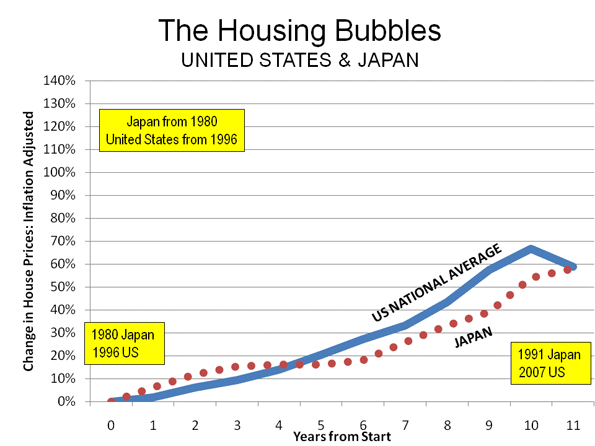
    How Bad It Was: It’s not like this was a bubble without precedent. Bernanke and the Fed should have been alarmed that the American housing bubble was equal in its overvaluation to the fabled housing bubble in Japan that hobbled that economy for many years (Figure 1).

    But the problem was even bigger. During the housing bubble, the economic community, Bernanke and the Fed were afflicted with a myopia that prevented looking beyond national average house prices. But those few willing to “dirty their hands” and look further found even more troubling developments.

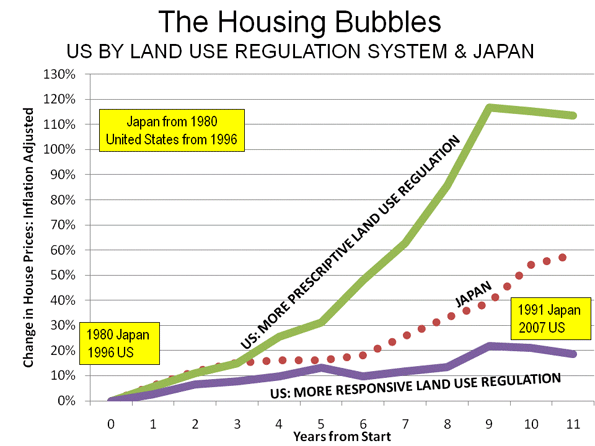
    In 2005, eventual Nobel Prize winner Paul Krugman pointed out that the housing bubble was limited to only part of the market; what he called the “zoned zone.” The “zoned zone” refers to what I have been calling the areas with “more prescriptive” land use regulation (also called “growth management” or “smart growth”). These are the types of intensive interventions that reduce the supply of land for development, raise its costs and provide an open invitation to speculators seeking short term, but occasionally enormous profits. It is important to note that not all land regulation produces such results, but that the regulation typical of the bubble markets did exactly that.

    This was missed by Bernanke and the Fed. In the more prescriptively regulated markets house prices had risen at double the national rate and double the Japanese bubble rate. In other areas (what Krugman called “flatland” and I call “more responsively regulated” markets), house prices rose at one-third the average rate (Figure 2).

    This concentration meant that the bubble in the more prescriptive markets was far more unstable and threatening. In the end, at least 85% of the gross value increase occurred in the more prescriptive markets, with particular concentrations in California, Florida, Phoenix and Las Vegas. When the bubbles in these markets burst, it ravaged the national mortgage finance industry even in the face of far more reasonable prices elsewhere in the country.

    Wandering in the Wilderness: That Chairman Bernanke still does not understand this dynamic was amply illustrated by his recent Atlanta speech to the American Economic Association, in which he claimed that the easy money policies of the Fed had little to do with the Great Recession. Instead he blamed lax regulation that permitted “exotic mortgages.” Moreover, it is clear that neither he nor the Fed have managed to scratch below the surface of the bubble in specific markets and its ability to create enormous havoc on the national and world economy.

    A Bully Pulpit: What could Bernanke and the Fed have done? First of all, they could have sounded the alarm about the profligate lending that has reduced this nation’s “soundness of banks” rating to 108th out of 133, just behind Tanzania, and seven places behind Bangladesh and 21 behind Nigeria. Second, Bernanke and the Fed could have bothered to suggest corrective actions to prevent development of the unsustainable values in the “zoned-zone.” At a minimum, Bernanke and the Fed could have used their bully pulpit in hopes of sparing the nation and the world an unnecessary financial catastrophe.

    The Rescuer: Of course, Chairman Bernanke has earned high marks for his work to avoid a depression. If Captain Smith had somehow survived the ordeal caused by his misjudgments, however, White Star probably would not have awarded him another command.

    Wendell Cox is a Visiting Professor, Conservatoire National des Arts et Metiers, Paris. He was born in Los Angeles and was appointed to three terms on the Los Angeles County Transportation Commission by Mayor Tom Bradley. He is the author of “War on the Dream: How Anti-Sprawl Policy Threatens the Quality of Life.

  • MILLENNIAL PERSPECTIVE: Vintage Fashion & The Twice-Around Economy

    One impact of the recession has been a fundamental change in consumer clothing purchase patterns. Luxury retailers’ losses have been second-hand retailers’ gains. Internet marketers have also been uniquely positioned to benefit.

    Instead of buying new goods, more shoppers are turning to second-hand bargains. Thrift stores, with their low prices, are rising in popularity. As an added bonus, shoppers can walk away with vintage goods that might be worth more than their price tags indicate, because most thrift stores do not check the labels on goods and price them accordingly. (I cannot resist mentioning that I personally recently found a Free People skirt for $5.95 at Goodwill. Still attached was the original store tag: $144.00. )

    Even small vintage boutiques that cater to a higher-end shopper — in Los Angeles, for example, Decades, Resurrection, and The Way We Wore — are actually faring quite well during these difficult economic times. More clothing is available for purchase by vintage store owners as people scramble to come up with extra cash. This allows the stores to choose from a larger selection, and consequently, have greater control over the quality and quantity of their stock. More clothing also equals a faster turnover of goods, keeping the racks refreshed. This means the stock of the store is more appealing to frequent customers who are most likely to make purchases.

    According to an employee at a San Francisco location of Buffalo Exchange, a nationwide, youth-oriented second-hand chain, “More people have definitely been trying to sell [to us], but the number of customers has surprisingly increased as well.” This is partially due to the quicker rotation of stock, but also because customers are searching for high quality clothing at lower prices. Vintage fashion items are usually made out of sturdier fabrics and have superior construction to today’s clothing. For consumers who want affordable clothing that will last, vintage presents a great alternative.

    Consumers are not the only ones with their eyes turned toward vintage fashion. Designers have recently been evoking the 1930s and 1940s in their newest lines, drawing parallels between the current economic recession and the Great Depression. Although reminding consumers of the Great Depression might seem like a poor marketing strategy, it also carries the message that the times will improve and the economic crisis will resolve just as the Great Depression did. The association of vintage items and longevity is also a boon, in that it makes their designs appear more like investments.

    As this designer interest suggests, the trend is fueled by more than pure economics. Vintage items contain elements of nostalgia. To those people who actually lived during the period in which the goods were manufactured, they often call back positive memories. More significant from a marketing viewpoint, for those who are not old enough to have experienced the actual decade in which their vintage product was created, vintage still recalls what they perceive as more prosperous times in our nation’s history.

    The notion that items can last despite the events of the time is part of a movement against the current cynicism towards the “disposable” culture. Vintage clothing is recognized as sturdy in an age of “planned obsolescence” with products made cheaply to intentionally break down and need replacement. Anything that has survived this long is viewed as a good investment over the inferior merchandise of today.

    Along with a rejection of the throw-away culture is a rejection of the mass-produced, seen-everywhere culture. The older a piece of clothing is, the less likely it is that other similar pieces have survived. It’s one of the few inexpensive ways to find unique, possibly even designer, clothing. There’ s also a counter-cultural element in not following the corporate legacies of stores like Macy’s, but instead creating new looks that differ from what current designers decide is in fashion.

    The search for vintage clothing is about finding something completely original and rare that no longer exists, or does so only in small amounts. And what better tool speaks to finding unusual niches than the internet?

    The internet has become an option where pricing has leveled out between the extremes of bargain hunting and pricey boutiques. This equilibrium of price has been achieved in part by the abundance of information available on the internet, not just about vintage fashion, but about how to price it correctly. The search features on sites such as eBay allow users to easily compare similar pieces of vintage fashion and determine if it is overpriced or not as unique as it might be perceived in a vintage store window.

    Perhaps the most important innovation in the online realm of vintage fashion is the website etsy.com, which allows individuals to set up their own shops and sell handmade and vintage goods. What differentiates Etsy from competitors such as Amazon and eBay is the interface: consumers feel as if they are breezing through individual shops as they enjoy aesthetically appealing layouts and large high quality photographs. This ability to create personalized shops aimed at an audience searching for handmade and vintage items is the perfect resource for those searching for a venue in which to resell their thrift store finds and make them appeal as affordable and unique clothing.

    The downside is the difficulty to determine authenticity in a virtual world. Unlike porcelain and glass, there is no simple black-light test to figure out the age of a fabric. On the other hand, online information abounds in relation to authenticating vintage fashion in general.

    As the economy spins, fashion does as well: past to present, cast-off to coveted, retail to thrift shop. With the addition of the internet, yesterday’s twice-arounds may become tomorrow’s thrice-arounds.

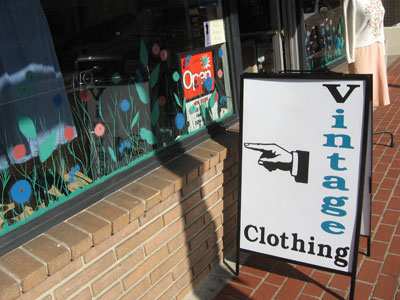
    Photos of Elsewhere Vintage in Orange, California by Elizabeth Iverson.

    Elizabeth Iverson is a freshman at Chapman University in Orange, California. She is currently studying Film Production and wishes to pursue a career in the entertainment industry.

  • Stop Coddling Wall Street!

    By all historical logic and tradition, Wall Street’s outrageous bonuses—almost $20 billion to Goldman Sachs alone—should be setting a populist wildfire across the precincts of the Democratic Party. Yet right now, the Democrats in both the White House and Congress seem content to confront such outrageous fortune with little more than hearings and mild legislative remedies—like a proposed new bank tax, which, over the next decade, seeks to collect $90 to $100 billion. This amounts, on an annual basis, to about half of this year’s bonus for Goldman’s gold diggers alone. It’s speaking loudly and carrying a stick made of paper mache.

    But this should come as no surprise, really. Postmodern Democrats are generally more concerned about the fate of the polar bears than real people on Main Street.

    One reason may be that Democrats increasingly collect the bulk of contributions from the very financial sector that they have bailed out and coddled since taking office. However, more substantially, the Democrats—including many “progressives”—seem more comfortable with big business and high finance than their erstwhile working- and middle-class constituencies. For this, we need the Democratic Party?

    Somewhere outside Nashville, the shade of Andrew Jackson, the founder of the modern Democratic Party, is stirring uncomfortably. So, too, are the remains of Harry Truman and Franklin Roosevelt, Jackson’s heirs to the leadership of the Party of the People.

    Faced with highway robbers like those at Goldman Sachs, Jackson would have threatened to seize their assets and, if they protested, hang them from the highest tree. Franklin Roosevelt would have made political mince meat out of these outrageous “economic royalists.” Harry Truman would have uttered an earthy expletive and sought to cut them down to size. Truman hated phonies and elitists; today’s Democrats Party is lousy with them.

    Now we see the very abandonment of the idea of the Democratic Party opposing concentrations of power. Historically, Democrats took on the largest and most powerful institutions of society. Jackson made his critical battle against the government-run Bank of the United States, which he considered a means “ to grant titles, gratuities, and exclusive privileges, to make the rich richer and the potent more powerful.”

    In his time, Franklin Roosevelt battled big business, which largely hated him, by seeking to create a more equal distribution of wealth. He tried to save homeowners and farmers from the banks; speculators wiped out in 1929 did not enjoy banner years for a long time to come. Truman fought not for big banks and major companies, but for programs that spread capital to the middle class, whether for college loans or mortgages.

    Now we have the postmodern Democratic Party of Barack Obama. The new party has little use for populism of any kind—it prefers to legislate from on high, whether on financial reform, climate change or land-use policy, from what it considers its superior knowledge. If your factory or business is shut down as a result, it’s you who better learn to evolve.

    We will see this same mind-set in action with the administration’s proposal for a cap-and-trade program. It may end up doing little for the environment, but a lot of traders, well-connected corporate CEOs, and academic consultants will be made even richer. Draconian “green” policies that boost subsidies and energy prices may not be what Americans want—climate change ranks near the bottom of popular concerns—but such an approach fits neatly the agendas of Harvard faculty, Wall Street, and the mainstream media. That is, those who matter.

    The rotten economy remains detestable but the stimulus program is working fine for their key constituencies. Stocks are up, many hedge funds are doing well, university research coffers are bulging. Meanwhile, taxpayers are employing ever-more unionized public employees, whose often-insane pensions are consuming many local government budgets.

    Many Americans who work for themselves are enraged, but they lack a credible channel for expressing it. The Republicans are largely discredited by their disgraceful performance over the last decade, up to and including the initial Bush-Paulson bailout. The Republicans presided as easily as the Democrats over the disastrous financialization of the economy; by the mid-2000s, finance accounted for some 41 percent of all American profits—three times the percentage in the 1970s.

    But for now, populists are in retreat in Washington. Last week, Byron Dorgan of North Dakota announced his retirement from the Senate. Dorgan, friends tell me, was disgusted with Obama’s focus on health care and climate change at a time when the economy was unraveling and Americans were losing their jobs. He also knew that the president’s mounting unpopularity in Middle America posed a profound threat to his own reelection prospects.

    Dorgan will be missed. His voice would have been set against the coddling of Wall Street. He supported reinstating the 1933 Glass-Steagall Act, which put a barrier between banks and investment houses. He also opposed “too big to fail” policies and was ready to attack the administration’s “cap-and-trade” scheme, which he considered a large giveaway to Wall Street traders.

    Dorgan’s departure leaves only a handful of genuine populists in Congress, including Jon Tester from Montana, James Webb of Virginia, as well as our resident socialist, Vermont’s Bernie Sanders. They may well be at last willing to take on the battles that Jackson, Roosevelt, and Truman would have fought against “interests.”

    Right now for every populist, there are several gentry Democrats—epitomized by the likes of New York Senator Charles Schumer and his sidekick, Kirsten Gillibrand—who will do Wall Street’s bidding on the Hill. Erstwhile populists may find some allies among independent-minded Republicans but, for the most part, the GOP is too blinded by ideology or too well bought to curb the big investment houses.

    So in the end, another crop of 35-year-old Wharton and Harvard MBAs gets to spend their multimillion-dollar windfalls. Maybe if you live in New York, perhaps a few shekels might fall your way. After all, these people have kids to nanny, dogs to walk, apartments to decorate, and toenails to be painted.

    These bonuses simply remind us of our outrage. Jackson, Roosevelt, and Truman would have understood the opportunity for the Democratic Party presented by this egregious, undeserved windfall. Truman in particular would have detested the academically oriented “progressives” who explain away excess and look for new ways to harry independent smaller businesses. As he once quipped, “There should be a real liberal party in this country, and I don’t mean a crackpot professional one.”

    Yet that’s exactly the kind of Democratic Party we have now: one that shames the legacy of Truman, Roosevelt, and Jackson and looks the other way while the Treasury is raided and the economy works mainly for the benefit of the least deserving.

    This article first appeared at TheDailyBeast.com

    Joel Kotkin is executive editor of NewGeography.com and is a distinguished presidential fellow in urban futures at Chapman University. He is author of The City: A Global History. His next book, The Next Hundred Million: America in 2050, will be published by Penguin Press February 4th.
  • New Geography Top Stories of 2009

    As we bring to a close our first full calendar year at NewGeography.com, we thought readers may be interested in which articles out of more than 350 published enjoyed the widest readership. It’s been a solid year of growth for the site; visits to the site over the past six months have more than tripled over last year and subscribers have increased by a factor of six. The list of popular articles is based both on.readership online and via RSS.

    15. Joel Kotkin’s piece, Numbers Don’t Support Migration Exodus to “Cool Cities”, makes the case that places considered “cool” by many in media and economic development circles are actually losing net migrants to other U.S. regions. In almost every case, he argues, your local resources are better spent focused on skills upgrades for your local residents or hard and soft infrastructure upgrades for industries already successful in your region. This article originally appeared on Forbes.com

    14. The British Labour Party is no example for American Progressives. Legatum Institute Senior Fellow Ryan Streeter’s piece just in time for the 4th of July, View from the UK: The Progressive’s Dilemma, dissects Britain’s high social spending, increasing debt load. Streeter contends that the UK is danger of mortgaging its future.

    13. Breaking down Obama’s first year and looking forward. In two equally popular pieces from this fall, Joel Kotkin outlines a five point plan to improve Obama’s presidency (Obama Still Can Save His Presidency which originally appeared in Forbes.com. In the second piece he takes encouragement from signs that the President may be retuning his policy back towards America – “a big, amazingly diverse country with an expanding population” – and away from the “Scandinavian Consensus” model (Is Obama Separating from His Scandinavian Muse?) . This article originally appeared on Politico.com.

    12. State of the economy June 2009. Susanne Trimbath says it may be a while before the average citizen will actually see tangible improvements in the economy. As is often the case, Susanne’s predictions have turned out so far to be all too accurate.

    11. Questioning the stimulus plan. In February’sStimulus Plan Caters to the Privileged Public Sector, Joel Kotkin calls the stimulus plan “a massive bailout and expansion of the public-sector workforce as well as quasi-government workers in fields like health and education” yet “as little as 5% of the money is going toward making the country more productive in the longer run – toward such things as new roads, bridges, improved rail and significant new electrical generation.” This article originally appeared in Forbes.com

    10. Is California’s economic malaise leaking into Oregon? After years of strong migration flows of former Californians heading to Oregon, Joel Kotkin and California Lutheran University economist Bill Watkins point out that the state’s oppressive tax policies and red tape may be leaking into Oregon as well in California Disease: Oregon at Risk of Economic Malady. The article originally appeared in The Portland Oregonian.

    9. Tracking housing decline. Wendell Cox broke down the comparative national housing market in two widely read pieces. In the first he points out that the downturn can be broken into two phases, one mirroring the explosive growth in many overvalued markets, and another second phase were markets are declining across the board: Housing Downturn Moves Into Phase II. In the second, Wendell uses his median multiple calculation for the 49 largest metropolitan regions to show that prices in many place still have much farther to fall to reach historic norms: Housing Downturn Update: We May Have Reached Bottom, But Not Everywhere.

    8. Public debt is looming. Susanne Trimbath lists public debt levels of the most highly leveraged sovereign nations and explains why this debt and the credit default swaps purchased against it could create a looming public catastrophe: The Next Global Financial Crisis: Public Debt.

    7. Washington, DC is flourishing in the recession. NYU Professor and urban commentator Mitchell Moss explains how Washington is the one city benefiting from the government stimulus. He argues this is stimulating the DC economy, from increased lobbyist activity to web designers benefiting from the government’s new interest in digital communications: Washington, DC: The Real Winner in this Recession.

    6. Californa’s Decline. Three equally widely read pieces track the drastic shift in California from economic vibrancy to stagnancy: Kotkin’s “Death of the California Dream which ran first in Newsweek and The Decline of Los Angeles from February on Forbes.com. The third piece by economist Bill Watkins examines California’s domestic migration net losses using an old coal mining metaphor: In California, the Canary is Dead.

    5. Housing Affordability Rankings. The most read housing piece this year was Wendell Cox’s release of his annual housing affordability rankings based on median multiple calculations (ratio of median housing price to median household income in a given market). “Housing Prices Will Continue to Fall, Especially in California” lists median multiple calculations for each metropolitan region in the U.S. of more than 1,000,000 population.

    4. Detroit as a model for urban renewal. In a widely linked piece across the blogosphere, Aaron Renn points out that the decline in Detroit could be a platform for residents to get creative with urban re-development. This piece is full of stunning imagery of formerly dense neighborhoods now full of greenspace that sent me on a two hour Google Earth binge exploring the area. Detroit: Urban Laboratory and the New American Frontier.

    3. ”Alternative” Geography. New Geography publisher Delore Zimmerman’s run down of odd and quirky maps that redefine borders of the U.S. proved very popular on social bookmarking sites. “Borderline Reality”: “Sometimes maps can inspire and motivate us by helping to more fully understand the geography of our economic and demographic challenges and opportunities. Perhaps most importantly thematic maps tell a story about places.”

    2. Portland isn’t a model for every community. Easily our most widely discussed, shared, and linked piece this year was Aaron Renn’s “The White City.” The piece sparked a fair amount of criticism with some looking to poke holes in the racial breakdowns and others taking the piece as an affront to liberal politics instead of an examination of urban planning policy. Many of the most vehement critics failed to address the central point of the piece: Portland is a unique place with a unique disposition and composition, yet it is held up by many community leaders in other regions as the ultimate in public policy. Instead of holding up Portland as a model, cities and regions need to do a better job of looking at themselves and defining policy based upon local community identity. Be who you are.

    1. Best Cities Rankings. Overall, our most read content at New Geography this year was the Best Cities Rankings, released in April with Forbes. Our rankings are purposefully focused just on a combination of measures of one metric, employment change. We leave out all of the more qualitative measures thinking that all contribute to the output of a shifting employment landscape.

    Where are the Best Cities for Job Growth? (Summary Piece)
    2009 How We Pick the Best Cities for Job Growth
    All Cities Rankings – 2009 New Geography Best Cities for Job Growth

    It’s been a good year at New Geography, one of steady growth and, we believe, increased influence. We welcome your comments, participation, and submissions. Thanks for reading.

  • How California Went From Top of the Class to the Bottom

    California was once the world’s leading economy. People came here even during the depression and in the recession after World War II. In bad times, California’s economy provided a safe haven, hope, more opportunity than anywhere else. In good times, California was spectacular. Its economy was vibrant and growing. Opportunity was abundant. Housing was affordable. The state’s schools, K through Ph.D., were the envy of the world. A family could thrive for generations.

    Californians did big things back then. The Golden State built the world’s most productive agricultural sector. It built unprecedented highway systems. It built universities that nurtured technologies that have changed the way people interact and created entire new industries. It built a water system on a scale never before attempted. It built magnificent cities. California had the audacity to build a subway under San Francisco Bay, one of the world’s most active earthquake zones. The Golden State was a fount of opportunities.

    Things are different today.

    Today, California’s economy is not vibrant and growing. Housing is not affordable. There is little opportunity. Inequality is increasing. The state’s schools, including the once-mighty University of California, are declining. The agricultural sector is threatened by water shortages and regulation. Its aging, cracking, highways are unable to handle today’s demands. California’s power system is archaic and expensive. The entire state infrastructure is out of date, in decline, and unable to meet the demands of a 21st century economy.

    Indications of California’s decline are everywhere. California’s share of United States jobs peaked at 11.4 percent in 1990. Today, it is down to 10.9 percent. In this recession, California has been losing jobs at a faster pace than most of the United States. Domestic migration has been negative in 10 of the past 15 years. People are leaving California for places like Texas, places with opportunity and affordable family housing.

    California’s economy is declining. Those of us who live here can all see it. Yet, Californians don’t have the will to make the necessary changes. Like a punch-drunk fighter, sitting helpless in the corner, California is unable to answer the bell for a new round.

    Pat Brown’s California – between 1958 and 1966 – crafted the Master Plan for Higher Education, guaranteeing every Californian the right to a college education, a plan that has served the state very well. That system is threatened by today’s budget crisis and may be on the verge of a long-term secular decline. California was a state where people said yes, a state where businesses could be created, grow, and prosper. Some of these businesses were run by Democrats, others Republicans but all celebrated a culture of growth and achievement.

    Today’s California is a state where building a home requires charrettes with the neighbors, years in the planning department, architects, engineers, and environmental impact studies – we built the transcontinental railroad in three years, faster than a builder can get a building permit in many California communities. People here dream of a green future but plan and build nothing. There’s big talk about the future, but California now turns more and more of our children away from college, and too many of our least advantaged children don’t even make it through high school.

    Once, California was a political model of enlightened government. Now it’s a chaotic place where everyone has a veto on everything; a state where people say no; a state where business is wrapped up in bureaucracy and red tape; a state our children leave, searching for opportunity; a state with more of a past than a future.

    Some things have not changed. California’s physical endowment is still wonderful. The state is blessed with broad oak-studded valleys, incredible deserts, magnificent mountains, hundreds of miles of seashore, and an optimal climate. California’s location on the Pacific Rim situates the state to profit from growing international trade with the dynamic Asian economies. California didn’t change, Californians changed. Californians have forgotten basics that Pat Brown knew instinctively.

    How did California get to this point? How did it move from Pat Brown’s aspirational California to today’s sad-sack version? What did Pat Brown know in 1960 that Californians now forget?

    First thing: Pat Brown knew that quality of life begins with a job, opportunity, and an affordable home. Other Californians in Pat Brown’s time knew that too. His achievements weren’t his alone. They were California’s achievements.

    It seems that California has forgotten the fundamentals of quality of life. Instead, the state has embraced a cynical philosophy of consumption and denial. The state’s affluent citizens celebrate their enjoyment of California’s pleasures while denying access to those less fortunate, denying not only the ticket, but the opportunity to earn the ticket. At best California offers elaborate social services in place of opportunity.

    Today, too many Californians don’t rely on the local economy for their income. For them, quality of life has nothing to do with jobs, opportunity, or affordable homes. Many see the creation of new jobs as bad, something to be avoided. They see no virtue in opportunity. They have theirs, after all. It is their attitude that if someone else needs a job, let them go to Texas; if people are leaving California, so much the better.

    They see someone else’s opportunity as a threat to them. Perhaps the upstarts will want a house, which might obstruct their view. They see economic growth as a zero sum game. Someone wins. Someone loses.

    This type of thinking is unsustainable. Opportunity is not a zero sum game. It may be a cliché, but it is true, that if something is not growing it is dying. Many of the things that make California the place it is are not part of our natural endowment. The Yosemite Valley is part of the state’s natural endowment, but the Ahwahnee Hotel is not. Monterey, Santa Barbara, San Francisco, the wine countries, and California’s many other destinations were made possible and built because of economic growth. Will California add to this impressive list in the 21st century?

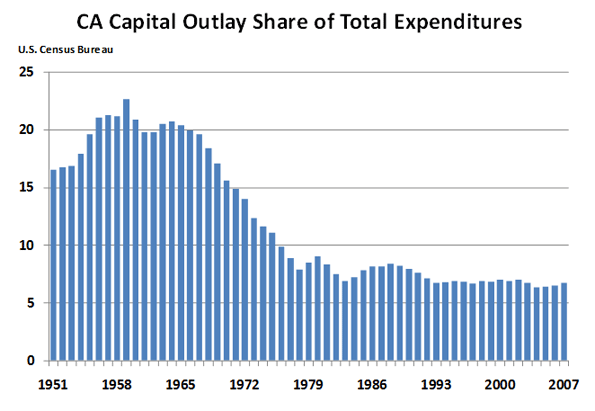
    Not likely. Today, we are not even maintaining our infrastructure. Infrastructure investment’s share of California’s budget has declined for decades. In Pat Brown’s day California often spent over 20 percent of its budget on capital items. Today, that number is less than seven percent. It shows.

    Pat Brown also knew that with California’s natural endowment, all he had to do was build the public infrastructure and welcome business, business will come. Too many today act as if they believe that business will come, even without the infrastructure or a welcoming business climate. Indeed, many Californians – particularly in the leadership in Sacramento – seem to think that business will come no matter how difficult or expensive the state makes doing business in California. This is just not true.

    California needs to embrace opportunity and economic growth. It is necessary if California is to achieve its potential. It is necessary if California is to avoid a stagnant future characterized by a bi-modal population of consuming haves and an underclass with little hope or opportunity and few choices, except to leave.

    Bill Watkins is a professor at California Lutheran University and runs the Center for Economic Research and Forecasting, which can be found at clucerf.org.