Tag: Financial Crisis

  • Honest Services From Bankers? Increasingly Not Likely

    Once you understand what financial services are, you’ll quickly come to realize that American consumers are not getting the honest services that they have come to expect from banks. A bank is a business. They offer financial services for profit. Their primary function is to keep money for individual people or companies and to make loans. Banks – and all the Wall Street firms are banks now – play an important role in the virtuous circle of savings and investment. When households have excess earnings – more money than they need for their expenses – they can make savings deposits at banks. Banks channel savings from households to entrepreneurs and businesses in the form of loans. Entrepreneurs can use the loans to create new businesses which will employee more labor, thus increasing the earnings that households have available to more savings deposits – which brings the process fully around the virtuous circle.

    As U.S. households deal with unemployment above 10% as a direct result of the financial crises caused by excessive risk-taking at banks, one bank, Goldman Sachs, posted the biggest profit in its 140-year history. According to Nobel laureate economist Joseph Stiglitz at Columbia University, Goldman’s 65% increase in profits is like gambling – the largest growth came from its own investments and not from providing financial services to households and businesses.

    Under fraud statutes created in 1988, Congress criminalized actions that deprive us of the right to “honest services.” The law has been used generally to prosecute fraudsters and potential fraudsters – from Jack Abramoff to Rod Blagojevich – whenever the public does not get the honest, faithful service we have a right to expect.

    The theory of “honest services” was used in one of the best known U.S. cases of financial misbehavior – Jeff Skilling of Enron – who has been granted a hearing early next year with the U.S. Supreme Court on the subject. Prosecutors won the original 2006 conviction on the strategy “that Skilling robbed Enron of his ‘honest services’ by setting corporate goals that were met by fraudulent means amid a widespread conspiracy to lie to investors about the company’s financial health.” The U.S. Attorney argued that CEO Skilling set the agenda at Enron. In this case, the fraud and conspiracy were means by which corporate ends were met.

    Skilling’s defense attorney admitted in his appeal before the 5th Circuit in April that his client “might have only bent the rules for the company’s benefit.” The appeal was not granted – a move by the court that is viewed as an overwhelming success for the prosecution. The application of the theory of “honest services” to the Skilling case – targeting corporate CEOs instead of elected officials – has been the subject of debate which may explain why the Supreme Court agreed to hear the arguments.

    Regardless of the outcome of that or other cases on the subject, the fact remains that bankers are doing better for themselves than they are for American households. This is the number one complaint we have about banks today. If I had to summarize the rest of what bothers us about banks, I would start with the fact that they are secretive. They take advantage of a very common fear of finance to convince consumers that they know what’s good for you better then you do.

    Next in line is the fact that they have purchased Congress. Banks have access to the halls of power that – despite 234 years of egalitarian rhetoric – ordinary voters can never achieve. Finally, we resent banks because we are required to use their services, like a utility, to gain access to the American Dream.

    Financial services contribute about 6 percent to the U.S. economy. Manufacturing and information industries use financial services, but the industry increasingly depends on itself: recall the portion of Goldman’s earnings growth coming from using its own investment services. According to the latest data from the Bureau of Economic Analysis, the financial services industry requires $1.27 of its own output to deliver a dollar of its final product to users. Despite the fact that our economic reliance on financial services has been creeping up steadily since 2001, they remain one of the least required inputs for U.S. economic output – only wholesale and retail trade have less input to the output of other industries.

    So, why did Congress vote them nearly a trillion dollars worth of life-support bailout money at the expense of taxpayers? Why did Wall Street get swine flu vaccine ahead of rural hospitals and health care workers? Why did they get the bailout without accountability? By making banks account for what they did with the money, congress could have 1) prohibited spending on bonuses and lavish retreats; 2) ensured improved access to credit for small and medium enterprises; and 3) provided transparency to taxpayers on who got how much and what they did with it. Need more reasons to demand honest services from a banker? Try this list:

    1. Congress raised the FDIC insurance to $200,000 to make depositors comfortable leaving money in banks; then the banks passed the insurance premium on to customers – including those that never had $200,000 cash in the bank in their lives and probably never will. Seriously, how much money do you have to have before it makes sense to have $200,000 in cash in a savings account earning 0.25%?
    2. Banks can borrow at 0% from the Fed yet they raise the interest rates they charge even their best customers. The bank I use for my company willingly lent me $10,000 last year to open a new office and approved a $7,000 credit card limit. Last month they sent me a letter saying they are raising the interest rate by +1.9 percentage point – though I have never missed a payment deadline.
    3. The banks can use our deposits to purchase securities issued by the Federal government, which are yielding better than 3 percent. They pay us about 0.25 percent yet still find it necessary to tack on a multitude of fees – which amount to 53 percent of banks’ income today, up from 35 percent in 1995.

    For now, Brother Banker skips along as lively as a cricket in the embers. But remember this: Marie Antoinette didn’t know anything about the French revolution until they cut off her head. Matt Taibbi, in a recent Rolling Stone article called Goldman Sachs a “great vampire squid wrapped around the face of humanity, relentlessly jamming its blood funnel into anything that smells like money.” We are at risk for leaving the virtuous circle behind and entering a vicious circle of spiraling inflation. A massive increase in government debt is being paid down by printing more money. Between July 2008 and November 2008, the Federal Reserve more than doubled its balance sheet from $0.9 trillion to $2.5 trillion. A year later, there is no evidence that they are trying to rein it in. As Brother Banker fails to provide honest services, a briar patch of a different kind may be waiting around the corner.

    Susanne Trimbath, Ph.D. is CEO and Chief Economist of STP Advisory Services. Her training in finance and economics began with editing briefing documents for the Economic Research Department of the Federal Reserve Bank of San Francisco. She worked in operations at depository trust and clearing corporations in San Francisco and New York, including Depository Trust Company, a subsidiary of DTCC; formerly, she was a Senior Research Economist studying capital markets at the Milken Institute. Her PhD in economics is from New York University. In addition to teaching economics and finance at New York University and University of Southern California (Marshall School of Business), Trimbath is co-author of Beyond Junk Bonds: Expanding High Yield Markets.

  • GOP Needs Economic Populism

    You would think, given the massive dissatisfaction with an economy that guarantees mega-bonuses for the rich and continued high unemployment, that the GOP would smell an opportunity. In my travels around the country — including in midstream places like suburban Kansas City and Kentucky — few, including Democrats, express any faith in the president’s basic economic strategy.

    Ask a local mayor or chamber of commerce executive in Kentucky or Kansas City about the stimulus, and at best you get a shrug. Many feel the only people really benefiting from Obamanomics are Wall Street grandees, public employees, subsidized “green” companies and various other professional rent seekers.

    It’s not surprising, then, that most Americans — upward of 60 percent — feel the country is headed in the “wrong direction.” Most of these malcontents are not zealots such as those you might find at a tea party. They are more akin to villagers watching in horror as two armies, each fighting in their name, wage war on each other, leaving desolation in their wake.

    Yet it’s unlikely that the independent-minded will move to the GOP until the party comes up with a credible economic plan that addresses popular concerns. One big problem lies in the very nature of the Republican Party. Since Theodore Roosevelt, the party has devolved into a de facto shill for large corporate interests. One notable exception, to some extent, was Ronald Reagan, whose rise challenged the hegemony of some in the corporate establishment, first in California, when he was governor, and later nationally.

    Republicans may now find it convenient to rail against the Troubled Asset Relief Program, but it’s something many supported under George W. Bush. Even now, most are loath to fight excessive pay and bonuses at places like Goldman Sachs. Instead, it’s populists like North Dakota Democrat Byron Dorgan and Vermont independent Bernie Sanders who seem most outraged by the massive rip-off of taxpayers.

    Republicans also do not seem sympathetic to pro­posals by former Fed chief Paul Volcker and others to break up “too big to fail” banks or reimpose distinctions between investment and mainstream banks. If anything, this illustrates that for all the rhetoric about self-sufficiency and small business, they remain more attuned to Wall Street and K Street than Main Street.

    Yet there may be new opportunities for Republicans on the economic front. This winter, the focus of political debate will shift from health care to energy legislation. Whatever the negatives associated with President Barack Obama’s proposals, Republicans’ long-standing inability to reform clearly flawed health care systems has undermined their credibility. The health insurance industry and right-wing ideologues may applaud their efforts, but it’s unlikely to impress the many middle- and working-class Americans for whom the current system is not working.

    In sharp contrast, the coming debate over energy and climate plays to the weaknesses of the Democrats. All the administration’s talk of reducing our “addiction” to foreign energy can be painted as fraudulent, since the powerful green lobby will militate against developing our country’s huge natural gas and other fossil-fuel deposits, as well as nuclear power.

    In the past election, some of the few good moments for John McCain came in the wake of his embracing a nationalistic, growth-oriented “Drill, baby, drill” agenda. This approach remains popular not only with conservatives but also with moderates and independents, particularly in energy-producing states.

    Obama’s climate change proposals offer an additional opportunity. The mainstream media remain slavishly tied to the Al Gore warming thesis, but skepticism toward the anti-carbon jihad is building via the Web. In recent months, Gallup, Pew and Rasmussen have reported reduced enthusiasm for radical steps to battle climate change. Right now, this seems to be a major concern for barely one in three Americans.

    Yet the “cap and trade” proposals could prove a boon to some of the very corporate interests — on Wall Street and among utilities — still considered core supporters by some Republicans. GOP leaders seem simply incapable of comprehending the discreet charm that Timothy Geithner’s collusive capitalism holds for many corporate chieftains. In this, they resemble the boyfriend who ignores the implications of finding someone else’s Jockeys on his girlfriend’s bed.

    Sadly, those who do tend toward populism, like current front-runners Mike Huckabee and Sarah Palin, appear too socially regressive to appeal to the suburban independents who will decide the elections in 2010 and 2012. Americans may yearn for an economically populist alternative, but not if they think it will bring back the Inquisition.

    In the end, economic populism, not social conservatism, can transform Republicans into something other than a scarecrow party. And they could make this strategy work, if they only had a brain.

    This article originally appeared at Politico.com.

    Joel Kotkin is executive editor of NewGeography.com and is a distinguished presidential fellow in urban futures at Chapman University. He is author of The City: A Global History. His next book, The Next Hundred Million: America in 2050, will be published by Penguin Press early next year.

  • Report from Orlando: The Spirit Rocks On

    By Richard Reep

    “In hard times, people turn to God or alcohol” jokes Bud Johnson of Constructwire, a database that tracks planning and construction projects nationwide. Johnson, 50, is an industry veteran and has never seen a recession like this in his career. “This is an exceptionally broad-based downturn,” he says, “and Orlando has been hit harder than most in the South, what with your only real industries being housing and tourism.” Both industries have been trapped like mammoths in a glacier as the credit market stays stubbornly frozen in a modern banking Ice Age.

    At the bottom of the glacier, however, the meltwater continues to flow, and bars and liquor stores seem to be thriving. With 10 new ABC stores open this year, this privately held Orlando-based liquor retailer is doing just fine, enabling many of us to stay sane, if not sober, while waiting for The Recovery. The alchoholic spirits are not the only mood-shifting business doing well in these hard times. Sacred space may not be exactly booming, but religious buildings are being built at a more comfortable pace than nearly any other building type in Central Florida.

    “Ecclesiastical architecture is falling at a rate close to that of a paper airplane, while my other building types have the glide ratio of a rock,” says Peter Kosinski, the architect responsible for the renovation of St. James Cathedral in downtown Orlando. With most other projects on hold, including a share of churches, Kosinski Architecture has still seen most of his religious work proceed, despite the Great Recession. Funding largely comes from donations, and for secular not-for-profits cultural outfits like United Arts, giving has evaporated. Spiritual needs, however, seem to be drawing a steady stream of money to expand or add to temples, churches, synagogues, and other sacred spaces to meet a growing demand in the Central Florida area.

    If the credit Ice Age is a part of a great karmatic rebalancing, it was long overdue and has hit especially hard in our overheated, consumer-driven culture. The cynics, who knew the cost of everything and the value of nothing, drove sacred space largely underground as new subdivisions engorged Orlando with not a square inch reserved for community worship. Religious uses simply don’t fit the profit model of late capitalism, and while our older neighborhoods are dotted with small, walk-to churches, not a cross can be found in the landscape of most newer developments. To the development industry, collective religious worship represents someone else’s unprofitable land sale.

    Cobbling together 15 or 20 acres therefore became a new art form for many evangelical pastors as the late 20th century saw the rise of the megachurch. These huge, Sunday-traffic-nightmares offer sophisticated audio/visual Christian themed entertainment in an arena setting, a perfect way for many to fulfill their spiritual needs. Others, stuck in these vast residential tracts devoid of sacred space, use the house-church method, gathering in groups of 8 or 10 at a member’s residence, taking heart in what Pope Gregory the Great (an early leader) stated: “The real altar of God is the mind and the heart of the just.” And some do both.

    Either way, the religious needs of the people of Central Florida are expanding, and the sanctuaries, temples, synagogues, and mosques are noticeably busier. The 2-year-old Guang Ming Temple, housing the local Renzai Humanist Buddhists, is experiencing a surge in attendance locally. Temple Director Chueh Fan confirms that there is a strong need for a communal spiritual facility. “We feel the hardship of people right now,” she states. “Although the Asian community here is stable, we have been growing over the last 2 years. And we are a middle-sized temple; there are some much bigger in other states.” Guang Ming offers Dharma classes in Spanish, English, Vietnamese and Chinese, and class enrolment is growing quickly.

    Other clerics, such as Reverend Reginald Dunston, also see a need for more religious-based education, and are planning new schools as well as sanctuaries. “Agape Word Ministry is planning a bible-based school,” he explains, “as an alternative to the schools in the area.” Other pastors, such as Jeff Cox of Salem Lutheran Church in Bay Hill, agree that it is important to expand their offerings to include a religious-based education. Education is the one tangible asset that a community is willing to purchase from a house of worship, and while most religions in America struggle for relevance, their schools remain in demand.

    Christianity, exploding in a pluralism not seen since the Reformation, is especially sensitive to its status as the dominant American religion. While over 4,000 new churches open nationwide annually, another 3,700 close, according to David T. Olson in his 2008 book “The American Church in Crisis.” This is near status quo, despite population growth, suggesting a shift away from collective religious worship for many. Hispanics, traditionally more observant, are building megachurches at a far faster clip than non-Hispanics, pointing to a loss of interest in collective Christianity for the majority of the population.

    Locally then, the house of worship is entering a phase of experimentation as new forms, such as megachurches, are tried; it is discarded altogether by the house-church movement; and it is growing in some religions such as Buddhism, with their new temple, and Judaism, with the construction of the new JCC South Campus on Apopka Vineland Road. The mainline Christian denominations that dominate downtown’s skyline serve less and less as a model for new buildings as malls are repurposed, warehouse buildings are adapted, and more novel programs and designs are tried.

    Hindu, Jain, and Muslim traditions are also represented in Orlando, and generally playing to full houses. The Masjid Al-Haqq mosque on West Central Boulevard on a Friday afternoon was brimming full, with more worshippers arriving by car and by foot. Collective spiritual worship of all forms is clearly a rising force within Orlando, and space on pews, benches, chairs and prayer mats are at a premium.

    Missing from many lives, crucial to others, religion is at an odd crossing in Central Florida’s history. To balance empty pocketbooks, some people are filling their cups with booze but others are also imbibing a perhaps long-delayed return to spirituality. This return, however, is marked by a mosaic of multiple religions, rather than a return to the few mainstream denominations that characterized early Orlando’s growth. If Bud Johnson is right, and this surge in spirituality lasts through The Recovery, Orlando will see a boom in new religious architecture that might make up for lost time, creating a revival in sacred space in the Central Florida landscape.

    Richard Reep is an Architect and artist living in Winter Park, Florida. His practice has centered around hospitality-driven mixed use, and has contributed in various capacities to urban mixed-use projects, both nationally and internationally, for the last 25 years.

  • Executive Bonuses: The Junta In The Boardroom

    Public companies and their management boards are run with all the democratic coziness of banana republics. The object of the junta is to transfer the wealth of the shareholders into the bonuses and stock options of the management. As they used to say in China, “business is better than working.”

    Amidst the outcry over excessive executive pay, it is worth noting that, in the caudillo management culture of many public corporations, there is nothing more annoying than a shareholder with an interest in the company that he or she partly owns. The most dreaded corporate day of the year is that of the annual meeting, when outside consultants are hired to screen bothersome questions and choreograph the happy gathering.

    During the meeting itself the greatest scorn is reserved for nosy shareholder questions about executive compensation and board composition, neither of which is deemed to be in the sphere of shareholder influence.

    The annual meeting ends with the appointment of outside auditors, a few planted questions, and — for those meetings held at some remote subsidiary, to keep activist shareholders from showing up — a trip to a regional airport.

    Archaic company by-laws explain why it will be nearly impossible for various regulators to cap the amounts that companies pay to executives. In short, the shareholders work for the managers, not the other way around. (If Goldman Sachs has so much extra cash, why don’t they raise the dividend?)

    Start with board composition, which is usually the domain of one executive: the chairman and chief executive officer. In a functioning system of corporate governance, the jobs would be separate. Chief executives would not also be assigned the job of monitoring their own performance, which is now the case in most public U.S. companies. Good European companies have a supervisory board, which oversees the performance and pay of the senior management.

    In the U.S., not only do foxes run the chicken coops, they get to eat most of the eggs and then write off the meals on their expense accounts.

    Most chairmen/CEOs stack their board and compensation committees with party-line stalwarts, who vote in favor of excessive pay packages in the hope that the recipient or one of his friends will not forget the favor. To break such a back-scratching system should be relatively easy, especially in companies regulated by the Securities and Exchange Commission. Simply mandate that management cannot sit on its own board of directors.

    Cumulative voting or proportional representation of the shareholders is another way to start breaking the management oligopoly of board composition. Board seats could also be allocated to representatives of retired personnel (who built the company) and those who now work in the company.

    Another way to limit excessive pay packages is to impose a binding ratio that caps executive pay based on the compensation of the company’s lowest paid workers. At the moment, CEOs in big public companies have packages that pay them more than a thousand times that of their employees’ lowest wages.

    J.P. Morgan thought the boss should only be paid twenty times the salary of the average company employee. Such an idea might not cap fat cat bonuses, but it would certainly improve the minimum wage.

    How then to claw back executive pay when the big bosses bet the ranch on something like sub-prime mortgages and lose?

    For starters, boards independent of management self-interest will be less forgiving when executives ruin a company or even turn in mediocre results. That so few banking executives were fired after the Great Collapse of 2008 is testament to the lack of shareholder representation on most boards of directors. Who fires the CEO when he reports to himself?

    Next, mandate that incentive compensation like stock options only be paid into segregated retirement accounts, which ought to align performance with long-term success.

    In financial services, the reward for failure should be just that: failure. In the recent crisis, deposed chairmen and chief executives were marched into the sunset with multi-million dollar severance packages. Remember the $64 million sayonara given to Citigroup’s Charles Prince, about the time the company’s shares lost $275 billion in market capitalization?

    A side affect of the government bailouts was to comfort bad managers. But while these corporate executives were pinning medals on their own chests (very much in the tradition of Latin strongmen), the reason given for the sweetheart loans, especially to banks, was to protect depositors. Under this variation of mutual assured destruction, financial institutions with a large depositor base can never be put to the wall, which gives them an effective government guarantee.

    To replace this kind of dependence on bankers who can gamble with deposits without consequences, there needs to be a mechanism that will protect depositors while allowing the larger financial companies to fail.

    For example, depositors could be given the option of buying deposit insurance — privately funded insurance, unlike that offered by the Federal Deposit Insurance Corporation — much in the way that air travelers buy accident insurance. That the FDIC caps out at $100,000 is neither here nor there. Under this scheme, insurance would be available for all amounts, large and small. It would be paid for in the market, not given as a government gift.

    When customers deposited money somewhere, they would decide if they wanted to insure the deposit or not. Those that wanted coverage would pay for it. Those that wanted to reply on their bank’s full faith and credit would leave their money uninsured and hope they have not found the next Lehman Brothers.

    Publishing rates on deposit insurance, much like posted interest rates, would be yet another indicator of a company’s financial health, much like the credit default swaps that are traded in institutional markets.

    The goal is to alert customers to good banks and bad ones, and to make clear that the bad ones will be allowed to fail, which is nature’s way of telling executives that they are overpaid.

    My last modest proposal is to encourage reconstituted boards of directors to auction off the positions of senior management.

    At the moment, managers justify their self-worth with a lot of encomiums about how big salaries and bonuses are necessary to insure that “we get the best people.”

    From what I can see, all that the big salaries insure is that companies keep a lot of mediocre executives, many of whom, judging by recent performance, then spend their time buying wine and sprucing up their vacation homes. Remember what was said, in Henry Ehrlich’s book of business quotations, about the compensation policies of Harold Geneen at ITT: “He’s got them by their limousines.”

    Under my revised system, top executives would be required to show the board that they have, in writing, a comparable offer from a competing firm (baseball works like this). As well, under the auction system, boards could entertain bids by senior executives to fulfill the roles of senior management.

    Clearly, chief executives have a good time in their corporate jets and swank hotel suites, which might lower what other senior managers would need every month to handle the top jobs.

    My guess is that a number of competent executives could be found willing to do the jobs of Fortune 500 CEOs, and for a lot less than what the current occupants charge the companies for their services (the average is over $10 million). Something tells me that Citigroup could have found a CEO for less than the $38 million that it paid to Vikram Pandit in 2008. Maybe it should have looked on eBay?

    Matthew Stevenson was born in New York, but has lived in Switzerland since 1991. He is the author of, among other books, Letters of Transit: Essays on Travel, History, Politics, and Family Life Abroad. His most recent book is An April Across America. In addition to their availability on Amazon, they can be ordered at Odysseus Books, or located toll-free at 1-800-345-6665. He may be contacted at matthewstevenson@sunrise.ch.

  • Fixing the Mortgage Mess: Why Treasury’s Efforts at both Ends of the Spectrum Are Failing

    To get a better idea why the Obama Administration’s efforts to stem the home foreclosure crisis have failed at both ends of the problem, you need only go back to that great scene in Frank Capra’s classic, “It’s A Wonderful Life,” where protagonist George Bailey (Jimmy Stewart) is on his way out of Bedford Falls with his new bride and high school crush, the former Meg Hatch (Donna Reed). The newlyweds are heading toward the train station to leave on their honeymoon when Meg notices a commotion outside the Bailey Bros. Building & Loan Association, founded by George’s revered but now deceased father, Henry, and Henry’s bumbling brother, Billie.

    The “commotion” is actually a run on the bank. George – bless his heart, and with the full encouragement of the new Mrs. Bailey – hops out of Ernie’s cab to see if he can quell the growing crowd assembling outside the locked doors of the Building & Loan. With his usual calm George assesses the situation, asks Uncle Billie to unlock the doors to let the gathering mob into the Building & Loan, and then proceeds to talk (most of) them out of closing their accounts and being refunded the value of their shares.

    George patiently explains to his anxious Association members that he can’t give each of them 100% of the value of their Bailey Brothers Building & Loan Association shares because the funds from those shares have already been loaned out to worthy borrowers so they can afford to build or buy houses in the community. States George from behind the teller counter:

    “…you’re thinking of this place all wrong. As if I had the money back in a safe. The, the moneys not here. Well, your money’s in Joe’s house…that’s right next to yours. And in the Kennedy’s House, and Mrs. Macklin’s house, and a hundred others. Why, you’re lending them the money to build, and then, they’re going to pay you back as best they can. Now what are you going do? Foreclose on them?”

    Just as George appears to be making progress, however, a now former Association member comes running into the Building & Loan pronouncing that Old Man Potter (Lionel Barrymore), who owns the bank and every other business in Bedford Falls, is offering to buy Bailey Brothers Building & Loan shares at 50 cents on the dollar (in an obvious effort to take advantage of the situation by running George Bailey out of business). Saving the day, and confirming that George has indeed made a life-changing decision in his choice of mates, the new Mrs. Bailey, with $2,000 in cash in her purse for their honeymoon, offers the money to the anxious Association members filling the building lobby. George then adroitly parses out their honeymoon money in the smallest increments he can persuade folks to accept under the circumstances.

    The scene tells us much about what went wrong with the residential real estate market nationwide. It is more than merely nostalgic to long for such elegant simplicity in the manner in which deposited funds were invested in things such as home mortgages. However, the only thing quainter than that scene in “It’s a Wonderful Life” is the idea of a bank or other financial institution originating, owning, and servicing the same mortgage. And therein lies the rub for efforts by the Treasury Department to help right the residential mortgage ship of state through the Making Home Affordable mortgage modification program and the Legacy Asset Recovery program.

    The root the problem lies with the complete disconnect between those who actually own the notes secured by the vast majority of residential mortgages in this country and those who “service ” those mortgages. Right now there is little if any incentive for those servicers to participate in the Treasury Department’s mortgage modification initiative (the Making Home Affordable mortgage modification program or “MHAP”), originally projected to foster the modification of 2.5 million mortgages but having resulted in only a fraction of that number in modified mortgages. This is at least in part because the fee structure under the existing servicing agreements does not adequately compensate the servicer for the amount of effort required to accomplish a mortgage modification. Further, there’s no clearly and easily identifiable “owner” of the notes that are secured by the underlying mortgages putting pressure on the servicers to modify these mortgage

    The national mega-banks that have received the lion’s share of Treasury’s multi-trillion bail-out of the banking industry have been, by far, the worst offenders in not embracing and implementing this program. And the problem can’t easily be fixed because it is structural in nature, the by-product of a system ironically intended to keep credit flowing into the residential sales market. For example, in Treasury’s recently released Servicer Performance Report through September 2009, Bank of America had modified under the MHAP only 11% of its approximately 876,000 home mortgages delinquent by 60 days or more (thereby making them eligible for modification under MHAP).

    The structural problems prevail at the investor-end of this morass as well. After much Congressional rhetoric and even more Wall Street teeth-gnashing over mark-to-market legislation late in 2008 that would have forced the holders of mortgage-backed securities (“MBS”) to mark down the value of their mortgage loan portfolios based on reductions in the underlying collateral value, Congress declined to take such action. The Legacy Asset Recovery program (so-called by Treasury because, quite honestly, who wants to invest in “toxic” assets), the investment component of Treasury’s Public-Private Investment Program or “PPIP,” pairs private capital with Treasury capital and then makes up the difference with federal low-cost debt. This program is intended to mitigate potential risks and rewards for these new equity participants by halving the amount of private equity that must be raised (since half of the total equity is provided by the government) and providing all of the required debt. As with any program whose purpose is to encourage private investments in bad debts – recalling the RTC program from the early 90s – potential profit is directly correlated to discounting the Legacy Asset purchasing entity can achieve in negotiations with the MBS holders.

    Regrettably, the assumptions underpinning the theory quickly prove not to be reasonable. At its core, the problem is that, in order for this initiative to work, the MBS holders need to do that one thing they’ve absolutely refused to do thus far: Take any losses.

    MBS holders are betting on their ability to hold onto their mortgage pools for as long as it takes for the excess housing inventory in the marketplace to get absorbed. They are also waiting for the end of the recession (perhaps around the corner but perhaps not) to turn into a full-fledged economic recovery, so that underlying real estate values start to catch up to portfolio values.

    Will this strategy work? Likely not if there’s a slow, largely jobless recovery that doesn’t support the housing market. As of now, the most recent projections for economic recovery in the real estate sector are looking to 2013. In the meantime, Treasury’s programs at both ends of the mortgage crisis will have done very little to stem foreclosures or stabilize capital flows to the housing market.

    Compounding the structural infirmities of these two “recovery” programs is that job growth is most likely to come first in states that have relatively few problems (Washington, D.C.-Metro Area; Great Plains; Texas) and will be far slower in many of the most troubled states, notably California, Michigan and Ohio, and parts of the Northeast. Hindsight being 20/20, rather than focusing so much attention and so many resources on helping the financial industry, which has been by far the largest recipient of Washington’s largess, the focus should have been on job preservation and job creation. The links, after all, between mortgage performance, housing values, and employment are undeniable.

    Peter Smirniotopoulos, Vice President – Development of UniDev, LLC, is based in the company’s headquarters in Bethesda, Maryland, and works throughout the U.S. He is on the faculty of the Masters in Science in Real Estate program at Johns Hopkins University. The views expressed herein are solely his own.

  • Commercial Real Estate Bust of 2010

    Coming soon to a market near you: a bust in commercial real estate that will make the subprime mortgage crisis look like a picnic. The other shoe drops in 2010.

    Federal Deposit Insurance Corporation Chairman Sheila Bair told a Senate committee on October 14 that commercial real estate loan losses between now and the end of 2010 pose the most significant risk to U.S. financial institutions. Although you can’t read it online, on October 7, 2009 Wall Street Journal reporters Lingling Wei and Maurice Tamman (Eastern edition, pg. C.1, Fed Frets About Commercial Real Estate) reported on a presentation prepared by an Atlanta Fed real-estate expert who is worried “about the banking industry’s commercial real-estate exposure.”

    Since July, the Federal Reserve has been pumping billions of dollars into commercial-mortgage-backed securities (CMBS, same things as the residential-MBS I’ve written about before in this space, only for shopping malls instead of houses). To accomplish this, the Fed uses the Term Asset-Backed Securities Loan Facility or TALF program. It is one of several alphabet-soup programs the Fed is using to pass a couple of trillion dollars to the stock market through private corporations (not just regulated banking institutions). For example, between March and July 2009, Harley-Davidson Inc. and other non-banks raised $65 billion in sales of bonds backed by everything from motorcycle loans to credit card debt. The Fed made $35 billion in TALF loans to investors buying those securities, which sparked a market rally. That market rally, however, is not in the commercial real estate market – it’s in the securities market. Since its inception, TALF has put between $2 billion and $11 billion per month into the securities market.

    TALF lends money to anyone willing to buy CMBS (or student loans, car loans, etc.). The Fed reasons that, as long as banks can move loans off their books by repackaging and selling them as bonds, they will make more loans. So they justify giving money to non-banks to buy the bonds because the money will go to the banks. Get it?

    Unfortunately, as vacancy rates rise, banks are increasingly reluctant to make new commercial real estate loans. This is obviously the case since Office of Thrift Supervision deputy director Timothy Ward told Congress this week that they will be issuing guidelines on doing loan workouts. A loan work out is what industry experts call “extend and pretend” – extend the terms and pretend like they are paying you. CRE loans, furthermore, are shorter in duration than home mortgages – typically 5 years instead of 30 years. That means a lot of loans will be coming due before the economy picks up enough to fill all those offices with rent-paying businesses. The value of commercial mortgages at least 60 days behind on payments jumped sevenfold in September – to $22.4 billion – or almost 4 percent of all commercial mortgages repackaged and sold as bonds. That’s about the same as the 90 day past-due rate seen for all residential mortgages (including those not sold off by the banks) in the first quarter of 2009.

    As of October 14, 2009, the TALF balance is $43.2 billion and growing. From what we are hearing now, it may not be enough.

  • Crash in High-end Real Estate or a Roller Coaster Recession? :

    During the first ten days of October 2008, the Dow Jones dropped 2,399.47 points, losing trillions of investor equity. The Federal Government pushed TARP, a $700 billion bail-out, through Congress to rescue the beleaguered financial institutions. The collapse of the financial system was likened to an earthquake. In reality, what happened was more like a shift of tectonic plates.

    *******************************************

    In September 2009 the Fed proclaimed “The Recession is Over.” President Obama said his Stimulus Package saved the US economy and his international actions have “brought the global economy back from the brink.” Vice-President Biden declared, “The Stimulus Package worked beyond my wildest dreams.” I feel so much better. Living in California, I must have missed these events.

    If the recession is over, why is unemployment in California 12.2%? (Functional unemployment, the real number, is closer to 16%). In decimated areas like the Central Valley, unemployment is at Great Depression levels of 26%. If the economy was saved, why do our homes continue to lose value? And it is not just “our homes” that are impacted. Treasury Secretary Timothy Geithner was forced to rent out his Larchmont, N.Y., home after it failed to sell. President Obama’s Chicago home, purchased for $1.65 million with a $1.3 million jumbo mortgage at the height of the real-estate bubble is now worth less than $1.2 million according to an estimate by Zillow.

    The recession may be over but Americans are now experiencing The Roller Coaster Recession. Like a roller coaster chugging its way up to the top, home values climbed between 2002 and 2007. Beginning in the fall of 2007, home values declined, first slowly but inexorably until they bottom out and began to climb again. Have we bottomed out? The Atlantic screamed, “Home sales soared 11% in June”.

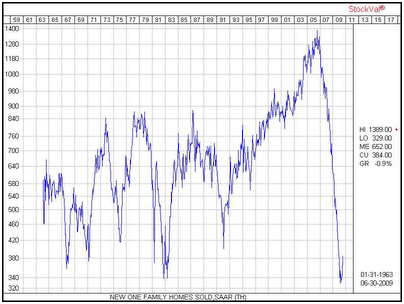
    Not so fast. Like the cars in a roller coaster, the first cars will begin to climb out while the last cars are still screaming downward at top speed. The Commerce Department reported sales in August rose a tepid .07% in August. What they did not highlight is that new home sales of 429,000 are at historical off the chart low compared to the last 50 years (see chart below).

    Such is the case with the Roller Coaster Recession. In California’s roller coaster ride the first car, The Inland Empire, crested the top in 2007. When pink slips were issued, these homeowners did not have deep pockets to sweat it out. All of their savings had been plowed into their down payment. When values declined, they had no staying power. They were gone in the first wave of foreclosures.

    Meanwhile, the rear car, Coastal California, continued to climb in value seemingly immune to the problems inland. The reason was staying power. The residents of tony Corona Del Mar were able to dump their third car, the Range Rover to keep solvent. When that ran out, Coastal California tapped their savings and finally used their equity lines to maintain their high mortgage payments while they waited for a buyer. But it is 2009 and the buyers have not materialized. More Jumbo Loans are falling behind in their payments. Watch the 60-day delinquency rate on prime Jumbo Loans. According to First American Core Logic, Jumbos in default jumped to 7.4% in May versus 4.9% for conforming loans

    Like our proverbial roller coaster, now it’s the turn for the first cars to rise. As the Inland Empire seems to have bottomed, Coastal California is still racing downward. There are 200 homes for sale between $1.5 and $3 million in ritzy Corona Del Mar. Even with a hefty 25% down payment, a $2 million property will require a $1,500,000 mortgage. Today’s lenders will require proof that the borrower can afford the $7,500 per month mortgage payment. They will demand a W-2 or 2008 tax return showing at least $22,500 per month in income to support a 30% housing expense ratio.

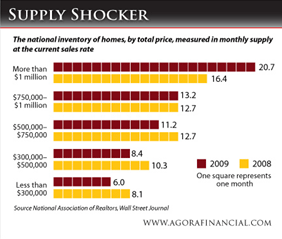
    The reality is there simply are not enough buyers earning $250,000 per year to buy up the 200 homes in Corona Del Mar. The current inventory will take 17 months to sell out but, as the recession continues, more homes are posting For Sale signs each month. Coastal California has not yet seen their bottom and they are still heading down at a rapid pace.

    Our national leaders may proclaim the end of the recession, but Californians have no reason to party. The Stimulus Package that shipped $50 billion to California was a one-time windfall that delayed but did not end California’s structural $26 billion budget deficit.

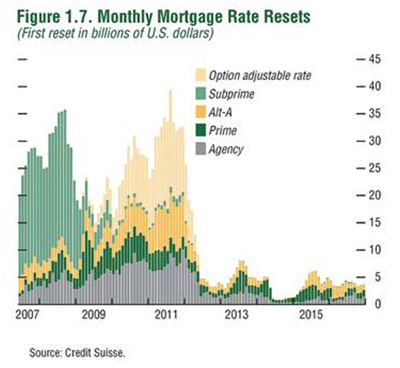
    Add to that the “Mortgage Armageddon” that is scheduled to hit next February. As the sub-prime mortgage defaults subside, the Option ARMS (adjustable rate mortgages) and Prime ARMs will begin to reset in early 2010 (see chart). This is not a working class but primarily a middle and upper-class problem. It is more a coastal than inland crisis; in New York terms, more Larchmont and less exurbia.

    There is a problem, however, with dinging the rich. They are the very folks expected to spend in our consumer-driven economy and invest in new ventures. If they have to re-route more dollars to mortgage payments, they not going to be able to help the economy.

    The Roller Coaster Recession will see more rises and dips before a sustainable recovery comes to California and other high-priced marekts. Those in the first car, like The Inland Empire, have nearly completed their ride. Any remaining dips will be minor in drop and brief in duration. But the genteel folks in the last car, in places like Coastal California, have another precipitous drop in front of them. This may come as a surprise to those believing the headlines that the recession was over. The wild ride for many is hardly over yet.

    ***********************************

    This is the fourth in a series on The Changing Landscape of America. Future articles will discuss real estate, politics, healthcare and other aspects of our economy and our society.

    Robert J. Cristiano PhD is a successful real estate developer and the Real Estate Professional in Residence at Chapman University in Orange, CA.

    PART ONE – THE AUTOMOBILE INDUSTRY (May 2009)
    PART TWO – THE HOME BUILDING INDUSTRY (June 2009)
    PART THREE – THE ENERGY INDUSTRY (July 2009)

  • Perspective on G-20: Don’t Trip on those Green Shoots

    Everywhere you look – from the White House to Wall Street – they are painting a sunny picture of recovery, free from any gloomy ideas. Bernie Madoff is in jail, Goldman Sachs is repaying their bailout money, and everywhere they look they see “green shoots.”

    Yet according to the Congressional Budget Office (CBO), the US economy and federal government are headed for doom. We are on a completely unsustainable path economically and financially. The CBO updated their forecasts after our June piece on the State of the Economy. In their updated Budget and Economic Outlook, CBO clearly concludes that the current rate of high spending and low revenues has the nation on an unsustainable fiscal course. Unemployment won’t drop below 5% until 2014. As a result, according to the latest country risk rankings by Euromoney magazine [http://www.euromoney.com, subscription required for full access] Canada, Australia and most of Scandinavia have passed the US as safer places to invest in business.

    These predictions of doom are, in fact, based on the best-case scenario of 3 percent economic growth next year and 4 percent the year after that; plus the expiration of tax cuts and no new stimulus or bailout packages. Whether we call it a Panic, a Depression, a Recession or a Downturn, it all means the same thing. The nomenclature has been softened over the decades to remove that ever so gloomy feeling folks get when things are bad. If you still have a job, you know someone who has been laid off, had their hours cut, etc. I just received my first new piece of business since February. Things are tough everywhere you look.

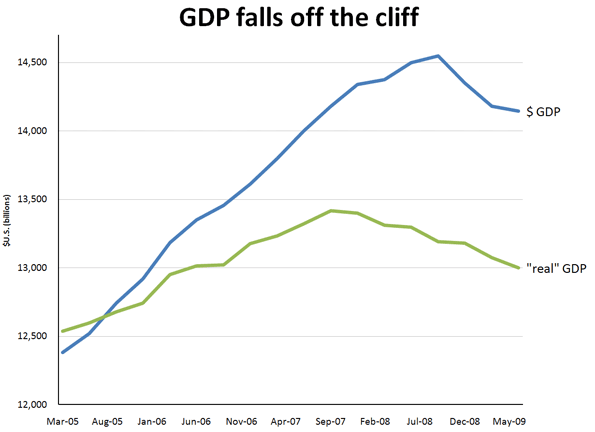
    GDP this year ($14,143 billion) is about where it was two years ago in actual dollar terms ($14,180 billion, third-quarter 2007). Accounting for inflation in consumer prices, our economy is closer to the level it was at the end of March 2006 or even back to the end of 2005. Actual dollar GDP peaked in September 2008 but I prefer the regular “real” GDP, adjusted for changes in what a dollar will buy you, which peaked in the third quarter of 2007 – we live in the real world, using real dollars to pay for real things.

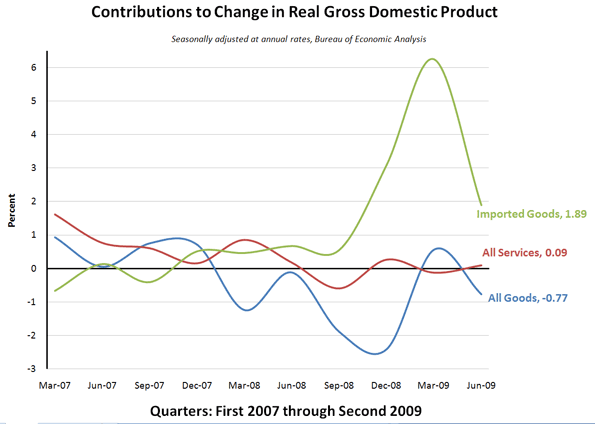
    The importance of changes in the real-dollar economy become most obvious when we consider international trade, which has been on the minds of the leaders of the G-20 nations in Pittsburgh this week. The fact that US consumers sustained and even increased their demand for imported goods until the onset of the global recession and in the face of a declining dollar lends credence to President Obama‘s plan to discuss what the world, not just what the US, can do to “lay the groundwork for balanced and sustainable economic growth.”

    On the one hand, our consumption of imported goods contributed to ours and the world’s economic growth. This fuels concern over whether or not the US can keep the promise to not impose new trade barriers before the end of 2010 and the world’s willingness to continue to buy our debt in the form of US Treasury bonds. At the same time, as Kansas City Federal Reserve Bank President Thomas Hoenig said last week in a speech I attended in Omaha, we need the world’s consumers to continue buying US goods in order to maintain our position as the “industrial leader of the world.” It’s a delicate balance, at best.

    The late 2007 nose dive in the “real” economy exposed the trouble brewing on the housing front, when we became aware of the explosion in credit derivatives, and when many of us started warning people about the insanity taking place in U.S. bond markets. No matter how you measure it, we would need about a 3 percent increase in GDP by next summer just to get back to where we were the last time everyone felt good about their money.

    Data from Bureau of Economic Analysis; author’s calculations
    So, why are we hearing such a positive spin on the economic news? One reason is the lack of understanding among reporters – most of them probably studied literature or journalism in college – not finance or economics. New York Times economics reporter Edmund L. Andrews is a perfect example. He just published a book describing “how he signed away his life for a toxic loan to buy a house in Silver Spring that he couldn’t really afford.” The Washington Post reviewer called the book “bright and breezy.” No gloom there!

    At the same time that he was signing the papers for an outsized mortgage, Andrews was writing articles like this gem from September 1, 2007 – just as the real economy was perched on the edge of the cliff – where he reports on Federal Reserve Bank Chairman Ben Bernanke saying he will “prevent chaos in the mortgage markets from derailing the economy.” The stock market climbed nearly 1 percent that day to close at 13,357.74 – it closed at 9,820.20 last Friday. Yet, Mr. Andrews still has a job with the New York Times – unlike millions of his readers – writing about topics like troubled mortgages.

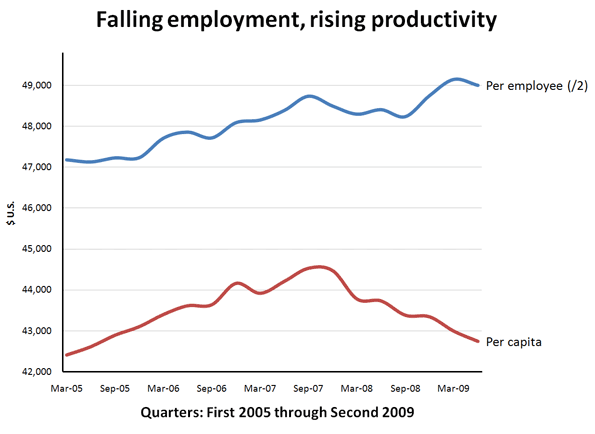
    Data from Bureau of Economic Analysis and Census Bureau. Per employee divided by 2 for scale.

    But what about the recent stock market rise? We should not be surprised if business profits are up: fewer people working means that the output per worker has been increasing since the end of 2008. GDP per capita (per person in the population), on the other hand, has been decreasing since the end of 2007 – an indication of a falling standard of living.

    The next few months are a time to focus, concentrate, plan, and follow-through. We are at a turning point comparable to the beginning of the Industrial Revolution and the system of capitalism that financed it. By frantically printing money and creating credit through bank bail-outs, the Federal Reserve and the Treasury are boosting the stock market by pumping in about $150 billion a month into corporate securities, increased auto sales (with government rebates) and home sales (with government first-time buyer tax credits).

    The problem is that these three pieces – banking, cars and homes – are not the whole economy, and, since they depend on government debt, none of these “green shoots” are sustainable on their own. Keep your eye on the big picture (the Kiplinger Recovery Index is a handy one-stop) – and don’t relax until all the indicators are green.

    Susanne Trimbath, Ph.D. is CEO and Chief Economist of STP Advisory Services. Her training in finance and economics began with editing briefing documents for the Economic Research Department of the Federal Reserve Bank of San Francisco. She worked in operations at depository trust and clearing corporations in San Francisco and New York, including Depository Trust Company, a subsidiary of DTCC; formerly, she was a Senior Research Economist studying capital markets at the Milken Institute. Her PhD in economics is from New York University. In addition to teaching economics and finance at New York University and University of Southern California (Marshall School of Business), Trimbath is co-author of Beyond Junk Bonds: Expanding High Yield Markets.

  • New Feudalism: Does Home Ownership Have a Future?

    In mid August, as we were beginning to feel a pulse in the nation’s housing market, an academician and housing expert from the University of Pennsylvania named Thomas J. Sugrue wrote an article in the Wall Street Journal proposing that, for many people, the new American Dream should be renting.

    Sugrue is writing a book on the history of real estate in America, a tome I cannot wait to read because it will apparently illustrate how epic events in our nation’s history have shaped and molded our real estate market, hence our lives. He quotes builder William Levitt, considered the father of affordable suburban mass housing, saying “no man who owns his own house and lot can be a Communist.”

    That was said during the Cold War and McCarthy era: Levitt was marketing his wares, playing off the public’s fears like any good salesman. And for many politicians – from Herbert Hoover to Bill Clinton and George W. Bush – expanding ownership of homes remained critical to the nation’s identity.
    But is all this changing? The Obama Administration seems at best ambivalent about homeownership. It seems determined to put more resources into rental housing while promulgating policies that may coerce Americans out of the suburban single family homes and back into dense, multifamily urban housing.

    This would mark a major change in what we usually consider the American dream. Enabling home ownership is like crack cocaine for politicians: the impetus for the Great Recession of 2008 may well have been formed on the day President Bill Clinton launched National Homeownership Day in 1995. And I remember sitting terrified in front of the television post 9/11 when President George W. Bush reassured us that America was strong and would recover. Our housing market is strong, he said, a theme that would echo throughout his presidency. Seeing two by fours go up and mortar flying gave Americans a sense of calm, of rebuilding.

    The attacks of 9/11 almost brought down our economy. The housing market helped prop it up.

    Most of us still love our homes. Sugrue quotes a Pew survey that faintly echoes the national health care debate: nine out of ten homeowners view their homes as a comfort in their lives. He seems to argue we should change everything for ten percent. To be sure, as he suggests, for some home ownership has become a source of panic and despair: 53,000 people packing a Save the Dream fair at Atlanta’s World Congress Center. Georgia’s housing market has been hit hard – 338,411 homes went into foreclosure in May and June, 2009.

    But it’s not just Georgia. Since the second quarter of 2006, housing values across the nation have plummeted to values roughly equivalent to post 9/11. We are not immune even here in Texas, with one of the nation’s strongest large state economies: our prices are soft, down anywhere from five to 20%, and buyers want deals. Go north to Little Elm; you might think you are in Atlanta. Homes may not be selling for thirty cents on the dollar as they are in Phoenix, but a house in the trophy community of University Park listed for $999,000 recently, sold in the mid $800s. The owner of a Preston Hollow mansion not too far from George W. Bush turned down a $38 million dollar offer two years ago, insulted. He recently sold his nine-plus acre property for $28 million.

    And just one week ago I spoke with an Allen, Texas home builder who told me that current tough love lending standards were keeping a lot of people out of the jumbo market – that is, halting them from buying million dollar homes. When you have to put down 30%, he said, that’s $300,000 on a million dollar home. If homes are not appreciating, he said, smart people say, why do we want to tie up that much money in our homestead?

    Yet we have been here before. Half of all U.S. mortgages were in default during The Great Depression, although it’s true far fewer people owned homes. This is when Herbert Hoover and Franklin Roosevelt created government programs to help save homeowners from foreclosure. I remember my grandmother telling me how Mr. Roosevelt saved her home in 1932 – she voted Democratic in every election because of it until the day she died in 1966. In 1938, Fannie Mae was created to buy mortgages on the secondary market, an effort to stimulate credit.

    After World War II, when the government made home loans accessible for thousands of GIs returning from the wars, home ownership rates climbed like the staircases in a suburban colonial. Now more than two-thirds of Americans own their homes.

    The government’s role in shaping this industry has been pretty explicit. Government programs gave us those first FHA loans that got many of us on the housing track, out to the suburbs, allowing people to leave more congested, and often dangerous, inner cities. Government is the hand that keeps the mortgage industry in motion, like a giant conveyor belt of money. But the hand might be pushing us where we shouldn’t go.

    This is certainly true for many in the communities traditionally underserved in the housing market. The government tried to fix this through creation of the Department of Housing and Urban Development, and by pushing Fannie Mae to underwrite loans to “riskier” buyers. The result: in 2006, Sugrue writes, almost 53% of blacks and more than 47% of Hispanics got sub-prime mortgages.

    Those were the loans that were packaged to spread the risk, and sold off as securities. Very lucrative for banks, who always make out like bandits either way, our federal government stood in the background as a silent backer. An appraiser I interviewed recently told me that Fannie Mae will now be ordering appraisals on loans before they buy them.

    You mean, I said, they weren’t doing this before?

    Then there’s the former sub-prime mortgage lender, now turned real estate agent. You, I scolded, how could you approve a school teacher for a loan on a $400,000 house? Shame on you. Well, he told me, if I would have denied her the loan, she could have come back at me for discrimination, or she would have just gone to someone else. So I made the loan and took my commission.

    Yet for all this, I am bullish on home ownership. I think it gives homeowners a sense of security, a blanket of protection that may or may not be a mirage. Economists, who see the world in a “cash nexus”, do not understand this; planners, believing they know a better way, don’t realize that a rental apartment in a dense development does not usually provide our peaceful havens from the cruel world like a single family home or a townhouse that we have a stake in.

    Homeownership may be precarious, but it does provide a greater sense of permanency for families and communities. Home ownership also stimulates the economy. Consumers never buy as much as they do the first few days in a new home – countless trips to Lowes, Home Depot, Bed, Bath & Beyond, the Container Store. A tenant or landlord may buy for their place, but perhaps never with the care and fervor that comes with homeownership. Apartments are built with, at the most, 30 year life spans. I’ve seen enough Section 8 housing to tell you – you don’t want to live in them at the end of their life-cycle. Apartments are considered temporary, places for people who are in transition or not really sure they are going to stay, one reason why they drive higher crime rates.

    Homes are more permanent. Children thrive with structure and feel more secure coming home to a familiar place day after day. Children who live in homes score higher on standardized tests. They may eventually move from one home to another, but will always come back to it and show a friend – that is the house where I grew up.

    Home ownership also forges financial security. Mortgages are like forced savings accounts. Pay your mortgage and in 30 years you’ll have an asset that could cushion your retirement. Either you will own your home outright, or you will have equity to supplement your income when you sell and downsize. The problems came when we started using our homes as slot machines or banks. Home equity lines of credit were illegal in Texas until 1997 as a consumer protection, and the banking industry led the charge to loosen that law with a constitutional amendment. In Texas, the total of all mortgage debt on your home (including HELOCs) is limited to 80% of the home’s fair market value, among other stipulations.

    What we need now is not to move against homeownership but return to more basic fundamentals that seemed to work just fine for 50-plus years. The cost of a house should reflect more of people’s ability to pay. But do we want to be a nation of renters? My bet is no.

    Candace Evans is the Editor of DallasDirt, a Dallas-based real estate blog for D Magazine Media Partners.

  • Rome Vs. Gotham

    Urban politicians have widely embraced the current concentration of power in Washington, but they may soon regret the trend they now so actively champion. The great protean tradition of American urbanism – with scores of competing economic centers – is giving way to a new Romanism, in which all power and decisions devolve down to the imperial core.

    This is big stuff, perhaps even more important than the health care debate. The consequence could be a loss of local control, weakening the ability of cities to respond to new challenges in the coming decades.

    The Obama administration’s aggressive federal regulatory agenda, combined with the recession, has accelerated this process. As urban economies around the country lose jobs and revenues, the D.C. area is not merely experiencing “green shoots” but blossoming like lilies of the field.

    To be sure, the capital region has been growing fat on the rest of America for decades, but its staggering success amid the recession is remarkable. Take unemployment: Although the district itself has relatively high rates, unemployment in Virginia and Maryland – where most government-related workers live – has remained around 7% while the nation’s rate approaches 10%.

    The reason is obvious: an explosion of government amid a decline in the private sector. Factories may be closing in Michigan, tech jobs and farms may be disappearing in California, but the people who grease the skids of the ever-expanding federal machine seem to be doing just fine.

    This is most evident at the top of the job market. The capital region now boasts the healthiest technology employment picture in the nation. Virginia has the highest proportion of tech workers in the nation. Maryland ranks fifth, and the district itself is seventh.

    The area also continues to enjoy continued growth in the lucrative professional and business service jobs category. Over the past year, according to latest estimates by www.jobbait.com, the D.C. area was the only region in the nation to enjoy growth in this field.

    Signs of Washington’s ascent abound. The local real estate market appears to be on the mend even as others suffer continued strong declines in values and rising foreclosures. Hotel prices, dropping virtually everywhere else, look to be rising as well.

    Occupancy rates, falling in most places, actually increased during the first half of 2009, as did revenues, which have taken a nosedive elsewhere. In New York prices have plunged – even the mighty Waldorf has been slashing rates.

    In many ways, the economic disasters in New York and other cities have proved a boon for Washington. Wall Street’s demise, for example, has been D.C.’s gain as the locus of financial power leaves New York for the Treasury, Fed, White House and the finance-related congressional committees. K Street is the new Wall Street, where you play for the really big stakes.

    This shift may soon spread beyond the financial sector. Want to get into the energy business? You can bypass Houston and head to the Energy Department and Environmental Protection Agency – they are the ones handing out subsidies and grants to “deserving” applicants. Thinking of expanding your city to accommodate new middle-class families? The people at the Departments of Transportation and Housing and Urban Development have their own ideas on how your cities and regions should grow.

    Manufacturing might be important to your economy, but Washington – a region with virtually no history of productive industry – generally regards factories as polluters, greenhouse gas emitters and labor exploiters. If you have enough lobbyists you might be able to hang on, but don’t really expect much in the way of positive help.

    Some “progressives” may like this model – after all, it originated in Europe, the supposed fount of all that is enlightened. Since the 18th century, Europe’s urban history has been largely dominated by great imperial centers – London, Paris, Moscow and Berlin – that treat other cities like something akin to poor relations.

    Even today European cities and localities tend to have far less control over their destiny than in the U.S. Zoning, planning decisions and even economic strategy often originate from the center, as does the power to tax and spend. For decades, Europe’s legacy of ancient urban privilege – so critical in emerging out of the dark ages – has ebbed before the increasing power of the national capitals. More recently the super-capital of Brussels, like Washington, thrives in hard times that are decimating other European urban economies.

    The great European capitals rose largely because they also served as the domicile of princes, bureaucrats and, until recent times, the clerical establishment. Other cities might have enjoyed a boom – such as Manchester during the industrial revolution – but, ultimately, hierarchy served to concentrate power in the great capital cities.

    In contrast, American cities and communities traditionally have retained control over planning, development and other critical growth factors. Equally important, American cities, noted the great sociologist E. Digby Baltzell, were not dominated by aristocracy but were “heterogeneous from top to bottom.” Urban growth came primarily not by central design but as a result of the often ruthless schemes and lofty aspirations, often ruthlessly expressed, of local political and business leaders.

    For example, the quintessential American city, New York, started as a commercial venture. As early as the mid-17th century 18 languages were spoken on Manhattan Island (population of 1,000) and numerous faiths practiced. In early New Amsterdam, the counting house, not the church or any public building, stood as the most important civic building.

    Even after the Dutch were pushed out by the more powerful British military, the bustling island city – renamed New York – retained its fundamentally commercial character. It served briefly as the nation’s capital, but its power grew from its port and its immigrants. The city’s entrepreneurial spirit and social mobility startled many Europeans. As the French consul to New York complained in 1810, “The inhabitants…have in general no mind for anything but business. New York might be described as a permanent fair in which two-thirds of the population is constantly being replaced; where huge deals are being made, almost always with fictitious capital; and where luxury has reached alarming heights.”

    This entrepreneurial pattern also drove the growth of New York’s many competitors – first the great industrial cities such as Cleveland, Chicago and Detroit and, later, West Coast metropolises like Los Angeles, the San Francisco Bay area and Seattle. More recently, there has been a similar spectacular rise of formerly obscure places like Dallas, Houston, Atlanta and Miami.

    Through much of this time Washington barely registered among the ranks of American urban centers. Despite early expectations that Washington would become “the Rome of the New World,” it lagged behind other American cities through much of the 19th century. The city was widely reviled as a fetid, swampy place with atrocious cuisine – hog and hominy grits were its staples – that offered little in the way of commerce, industry or culture. Even its great buildings were compared to “the ruins of Roman grandeur.”

    The First World War, the Depression and then the Second World War each boosted Washington’s status but hardly into the first rank of cities. Few entrepreneurs were attracted to a city dominated by regulators, clerks and lawyers. The cultural center lay in New York and Boston – and later Los Angeles. The Bay Area, Massachusetts and later Texas evolved into the primary technological centers.

    Not until the 1960s did Washington begin to emerge as something like a traditional national capital, with a large permanent population of well-educated and cultured citizens as well as a robust economy based on the defense industry and the expanding welfare state.

    But the financial crisis of 2008 has set the stage for an unprecedented growth of the region, with a Democratic president and majority seemingly determined to expand federal mandates into every crevice of community life. There is an eagerness to use federal authority in unprecedented ways that could bring federal influence into virtually every minute decision made in an urban area.

    This concentration of power is also bad news for urban economies, including New York’s. As New York University’s Mitchell Moss has observed, Gotham may be losing its perch as the true national financial center. But other cities also should take note of the trend. Polycentric sprawling cities like Los Angeles, Dallas, Houston, Phoenix and Atlanta soon may find themselves forced to reorganize themselves along lines preferred by federal urban “experts.” Hard-pressed industrial cities may find new environmental restrictions on ports and other key infrastructures an impediment to a much-needed renaissance.

    American cities are at a critical moment. Our competitive, commercial urban tradition certainly has its flaws, but it also has produced the advanced world’s most dynamic roster of modern cities and regions. Ceding the power of urban planning to Washington will cripple the American city – except, of course, for the one that reigns as locale for imperial control.

    This article originally appeared at Forbes.

    Joel Kotkin is executive editor of NewGeography.com and is a presidential fellow in urban futures at Chapman University. He is author of The City: A Global History. His next book, The Next Hundred Million: America in 2050, will be published by Penguin early next year.