Tag: Financial Crisis

  • Asian Manufacturers : Is Turnabout Fair Trade?

    When the British troops laid down their arms at Yorktown, Virginia, a colonial band played “The World Turned Upside Down,” a popular air marking the absurdity of the occasion. Now the American economy is turned upside down, and the small businesses that once fortified it have exchanged places with Asian manufacturers that America once sought to protect. No man’s enlightenment is complete without the deepening amazement that comes with having seen such a reversal.

    In the case of the US economy, it happened in a piecemeal fashion — with Fair Trade laws playing a pivotal role — that was all the more insidious for being deliberate. The national agenda that was followed was intended to prevent the fragile nation states of the world from going communist.

    As a kid, I had a zoomed-in view of the transition. My father was part of it, as president of a company that attempted an end run around the nation’s Fair Trade laws, which, for those too young to remember, specified the minimum retail price at which a product could be sold. These laws were intended to protect small mom and pop businesses from being bankrupted by chain stores during the Great Depression. And they largely succeeded in their mission. Main Street thrived because outfits like Wal-Mart were prohibited from rolling back prices.

    Needless to say, the Fair Trade laws weren’t fair to consumers, who were forced to pay virtually the same price for goods sold at linoleum-floored outlets like Wal-Mart as they did at marbled emporiums like Saks Fifth Avenue.

    The complexity of the market, which created gray areas in the laws and made their enforcement difficult, was seized on by my father as an opportunity. He bought surplus stock from well-known manufacturers, re-labeled it, and sold it for considerably less. His private label, “Amcrest,” is still remembered fondly by smart shoppers as having been an economical way to buy everything from mouthwash and undergarments to watches and refrigerators. The brand became so big that the government sued my father and nearly put him out of business.

    End of story? Not quite. Shortly after the government filed suit, someone at the State Department had a bright idea. While the government would not permit my father to continue to buy surplus output from American manufacturers, it encouraged him to do the same thing…from manufacturers in the Far East.

    The State Department considered this an act of enlightened self-interest along the lines of the Marshall Plan. Experts opined that it would save Japan and Taiwan, and possibly the rest of Asia, from falling into the communist orbit. After all, China and North Viet Nam had already fallen to communism. Singapore was toying with the ideology. Who could say where it would pop up next? People like my father would bring jobs and prosperity to Japan and Taiwan, and the grateful citizenry would form vibrant democracies and become bastions of anti-communism. Nobody ever imagined that these once backward nations would someday be eating our lunch – and our dinner.

    The U.S. policy further allowed manufacturers in these nations to sell their wares largely free of American tariffs. So what began as a trickle of surplus output became a flood of finished goods. At the beginning, most of the stuff was simply cheaply made. But it didn’t take long for Japan to learn the gospel of quality from the American engineer Edward Deming, whom American manufacturers shunned.

    Japan moved up the value chain. My father was among the first to begin importing Sony TVs, which were leagues better than American sets. South Korea followed Japan’s arc. Taiwan, too, stepped up, though it did so with industrial policies that targeted the software and microprocessor industries.

    As these trends were taking shape, the U.S. was hit with high inflation. By the 1970s, most states decided to repeal their Fair Trade laws, setting Wal-Mart on a trajectory to become the nation’s largest corporation. Later, under pressure from Wal-Mart and others, Taiwanese businessmen moved their factories to China, where they could turn out the same umbrellas and Tupperware at one tenth the cost.

    Taiwan didn’t suffer. It went on to manufacture the first IBM desk-top computer, and to found Taiwan Semiconductor, whose chips run most of Dell’s products. By the mid nineties, Taiwan, no bigger than New Jersey, had a larger store of foreign currency reserves than the United States did.

    Wal-Mart and other American firms that were committed to low cost production then lobbied the U.S. to permit China to join the World Trade Organization. This would allow China to sell its wares in America without tariffs. Once China was accepted as a member, American-based factories found themselves unable to compete with the cheap goods that flooded in from the Middle Kingdom. To survive, they, too, moved their production and jobs there.

    By the new millennium, the government policy that had begun years earlier to prevent nations like Japan, South Korea and Taiwan from going communist had been turned upside down. The economic forces that our policies unleashed effectively mandated that all production take place in China, a communist country that has no interest in democracy, freedom or human rights. The transplantation into China of millions of American jobs and thousands of U.S. industries that once paid taxes to the U.S. Government has forced that government to borrow from China, now America’s largest creditor, just to meet expenses.

    Ironically, China is providing a significant amount of the money needed to bail out our sick economy. The U.S.’s high unemployment, tottering banks and vast trade and government deficits actually mirror conditions in Japan and Taiwan after World War II, conditions that our own government believed to be fertile ground for communism.

    It is as if the points of the compass were reversed, and the United States was suddenly in the grip of antipodal forces intent of turning our world upside down. And what’s left of our treasure is falling fast from our pockets, and into the iron rice bowl of a communist dictatorship.

    Tim Koranda is a former stockbroker who now works as a professional speechwriter. He can be reached at koranda@alum.mit.edu.

  • The New Radicals

    America’s ”kumbaya” moment has come and gone. The nation’s brief feel-good era initiated by Barack Obama’s stirring post-partisan rhetoric–and fortified by John McCain’s classy concession speech–has dissolved into sectarian bickering more appropriate to dysfunctional Iraq than the world’s greatest democratic republic.

    Yet little of the shouting concerns the fundamental economic issue facing the U.S. today: the decline of upward mobility and income growth for the working and middle classes. Instead we have politicos battling over two versions of ”trickle down” economics.

    The Democrats seem bent on installing a permanent ruling mandarinate alongside a small financial aristocracy. The Republicans, meanwhile, simply want to help the rich hold onto as much of their money as possible.

    Neither approach will improve prospects for the vast majority of Americans. The Bush Administration policies of low taxes–for the upper classes–and less regulation helped engender a massive asset bubble unsupported by economic fundamentals. This ultimately drove up both the current account and federal deficits and led to the severe Great Recession.

    The Obama ”trickle down” is, sadly, not all that different from the Bush-Paulson strategy. Like its predecessor, it endorses the bailout of giant financial institutions as the linchpin of its economic policy. It is, simultaneously, profoundly anti-democratic and anti-capitalist.

    Other aspects of the Obama policy seem likely to prop up Wall Street traders at the expense of the rest of us. The administration’s big ”cap and trade” proposals could prove more advantageous to well-heeled ”carbon traders” than to the environment. The other big winners may be Silicon Valley venture capitalists, who– increasingly bereft of their own ideas for making money–hope to cash in on Washington-subsidized energy schemes.

    Of course, not all Democrats have sold out. Sens. Byron Dorgan, D-N.D., and John Tester, D-Mont., have expressed opposition to bailing out ”too big to fail” institutions. New York Attorney General Andrew Cuomo has been fearless in unveiling the enormous Wall Street bonuses–over $32.6 billion last year– handed out as firms suffered $81 billion in losses and almost drove the world economy to ruin.

    Unfortunately, these are exceptions. Illinois Sen. Dick Durbin recently admitted that the banks remain ”the most powerful lobby on Capitol Hill,” adding that they ”frankly own the place.”

    So far in 2009 the Democrats have netted nearly 60% of all campaign contributions that have come from the financial industry, now the largest sector in terms of donations. The biggest donations have gone to such influential Democrats as Sen. Charles Schumer and his sidekick, newly appointed Sen. Kirsten Gillibrand, from New York; Sen. Chris Dodd D-Conn., and Majority Leader Harry Reid D-Nev. Schumer, the Street’s leading vassal in Congress, has emerged as the rising star in the Democratic leadership. If Majority Leader Reid loses his seat–as is now possible, according to polls in Nevada–Wall Street’s main man could well end up a future Majority Leader.

    Some Democrats try to have it both ways, playing populists for the peanut galleries but getting cozy with the industry when it matters. Massachusetts Rep. Barney Frank, the House Financial Services Chairman, talks tough but has a history of friendly relations with financial powerhouses. One of Frank’s own top assistants, Michael Pease, just went to work for the biggest winner since taking TARP bucks, Goldman Sachs. As left-winger blogger Glenn Greenwald put it recently: ”The only way they can make it more blatant is if they hung a huge Goldman Sachs banner on the Capitol dome and branded it onto the foreheads of leading members of Congress and executive branch officials.”

    In the end the faux populist Democrats end up with policies that make Ronald Reagan’s ”trickle down” seem downright Leninist. Harry Truman once quipped that ”There should be a real liberal party in this country, and I don’t mean a crackpot professional one.” Sadly, it’s increasingly the latter.

    The hypocrisy should open a path for the Republicans as wide as the Grand Canyon. But the ill-named Party of Lincoln still seems to think that the path to power lies in the tired old formula of ultra-patriotism, guns, abortion and religious rectitude. Screaming ”socialism” may awaken the spirits of some on the old right, but it’s hard to make a convincing case when George Bush socialized banking and grew the deficit.

    You certainly can’t trust big-business conservatives to stop bonuses for the TARP babies, particularly the 25 financial firms deemed ”too big to fail” by the likes of Ben Benanke. Give GOP big-business leaders higher stock prices, and they will follow you anywhere. Only a few–such as Sen. Charles Grassley, R-Iowa,–have shown they are truly serious about the free market or defending the interests of the regular taxpayer.

    Given this sad political picture, the best hope now is to build an alternative perspective that focuses on the basic economic issues. This would not be the media celebrated movement of moderates–Democrats-lite and Republicans-lite–who seek kumbaya through compromise. It would, instead, require a radical third tendency–neither strictly left or right–that would draw on long-term American priorities and values.

    These new radicals would focus on basic issues like improving infrastructure, and primary education and bolstering the nation’s productive economy. Their inspiration would come from a long tradition of federal successes–from the Homestead Act and the WPA to the Interstate Highway and the space program. They would view the financial crisis not as an imperative for protecting the well-connected but for financial reform, decentralization and innovation.

    Such an approach would address what the British author Austin Williams calls our ”poverty of ambition.” Americans historically have rejected a future constrained by entrenched hierarchies. Most, I believe, would support spending money and paying taxes, if it was spent to achieve big things that would lead to a greater, more widespread prosperity and opportunity.

    Just imagine if the upward of $1 trillion spent guaranteeing Goldman Sachs and Citigroup executives giant paydays had instead gone into roads, bridges, subways, buses, port development, skills training, energy transmission lines and basic scientific research. And imagine if instead of protecting Citigroup and Bank of America, we encouraged stronger local banks and solvent financial entrepreneurs to fill the breach left behind by gross failures.

    Such an approach may seem extreme, but it might have wide appeal. We know, for example, that the TARP bailout is widely unpopular. Indeed, according to one survey taken earlier this year, Americans oppose continuing bailouts for banks by better than 2 to 1.

    As I travel the country, I find anger is deepest among business owners who find securing loans increasingly difficult nearly a year after the original bailout. Even as the economy slowly recovers, this anger will become more pronounced with the coming bonuses doled out to those at bailed-out firms. As Sen. Grassley puts it: ”My people ask, ‘When are these people going to be put in jail?”’ Instead we’re paying for them to stay at the Ritz.

    This article originally appeared at Forbes.

    Joel Kotkin is executive editor of NewGeography.com and is a presidential fellow in urban futures at Chapman University. He is author of The City: A Global History. His next book, The Next Hundred Million: America in 2050, will be published by Penguin early next year.

  • Is the Stage Set for Another Housing Bubble?

    Both the world and the nation remain in the midst of the greatest economic downturn since the Great Depression. But with all the talk of “green shoots” and a recovery housing market, we may in fact be about to witness another devastating bubble.

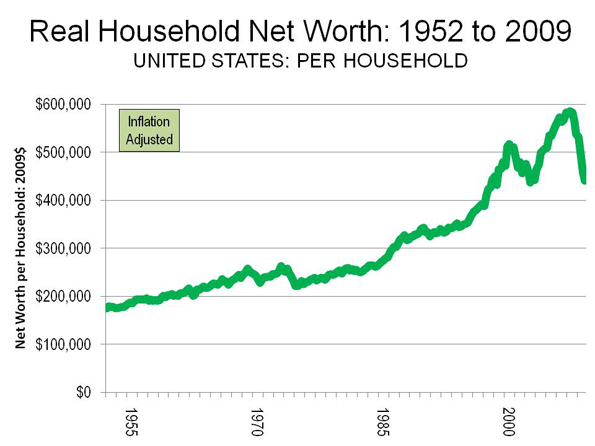
    As we well know, the Great Recession was set off the by the bursting of the housing bubble in the United States. The results have been devastating. The value of the US housing stock has fallen 9 quarters in a row, which compares to the previous modern record of one (Note). This decline has been a driving force in a 25 percent or a $145,000 average decline (inflation adjusted) in net worth per household in less than two years (Figure 1). The Great Recession has fallen particularly hard on middle-income households, through the erosion of both house prices and pension fund values.

    This is no surprise. The International Monetary Fund has noted that deeper economic downturns occur when they are accompanied by a housing bust. This reality is not going to change quickly.

    How did the supposedly plugged-in economists and traders in the international economic community fail to recognize the housing bubble or its danger to the world economy? It is this failure that led Queen Elizabeth II to ask the London School of Economics (LSE) “why did noboby notice it?”. Eight long months later, the answer came in the form of a letter signed by Tim Besley, a member of the Monetary Policy Committee of the Bank of England (the central bank of the United Kingdom) and Professor Peter Hennessey on behalf of the British Academy.

    The letter indicated that some had noticed what was going on,

    But against those who warned, most were convinced that banks knew what they were doing. They believed that the financial wizards had found new and clever ways of managing risks. Indeed, some claimed to have so dispersed them through an array of novel financial instruments that they had virtually removed them. It is difficult to recall a greater example of wishful thinking combined with hubris.

    The letter concluded noting that the British Academy was hosting seminars to examine the “Never Again” question.

    Among those that noticed were the Bank of International Settlements (the central bank of central banks) in Basle, which raised the potential of an international financial crisis to be set off by a bursting of the US housing bubble. Others, like Alan Greenspan, noticed, telling a Congressional Committee that “there was some froth” in local markets. Others, across the political spectrum, like Nobel Laureate Paul Krugman, Thomas Sowell and former Reserve Bank of New Zealand Governor Donald Brash both noticed and understood.

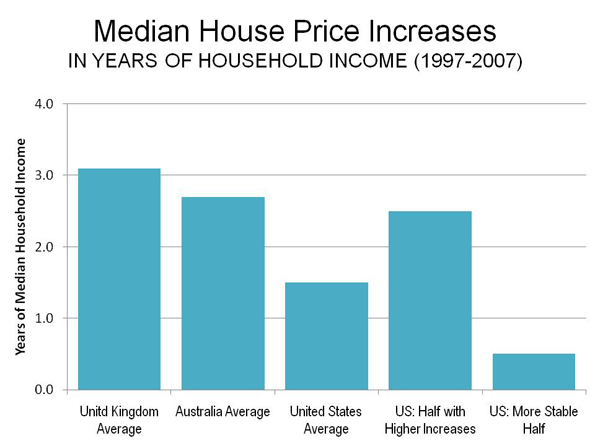
    Missing the Housing Market Fundamentals: The housing market fundamentals were clear. With more liberal credit, the demand for owned housing increased markedly, virtually everywhere. In all markets of the United Kingdom and Australia, house prices rose so much that the historic relationship with household incomes was shattered. The same was true in some US markets, but not others (Figure 2).

    On average, major housing markets in the United Kingdom experienced median house prices that increased the equivalent of three years of median household income in just 10 years (to 2007). The increases were pervasive; no major market experienced increases less than 2.5 years of income, while in the London area, prices rose by 4 years of household income. In Australia, house prices increased the equivalent of 3.3 years of income. Like the UK, the increases were pervasive. All major markets had increases more than double household incomes.

    Based upon national averages, the inflating bubble appears to have been similar, though a bit more muted in the United States, with an average house price increase equal to 1.5 years of household income. But the United States was a two-speed market, one-half of which experienced significant house price increases and the other half which did not. In the price escalating half, house prices increased an average of 2.4 times incomes. The largest increases occurred in Los Angeles, San Francisco and San Diego, where house prices rose the equivalent of 5 years income. In the other half of the market, house prices remained within or near historic norms relative to incomes. A similar contrast is evident in Canadian markets. In some, house prices reached stratospheric and unprecedented highs, while in others, historic norms were maintained.

    Underlying Demand: Greater Where Prices Rose Less: The difference between the two halves of the market was not underlying demand. Overall, the half of the markets with more stable house prices indicated higher underlying demand than the half with greater price escalation. Overall, the housing markets with higher cost escalation lost more than 2.5 million domestic migrants from 2000 to 2007, while the more stable markets gained more than 1,000,000 (Calculated from US Bureau of the Census data).

    The Difference: Land Use Regulation: The primary reason for the differing house price increases in US markets was land use regulation, points that have been made by Krugman and Sowell. This is consistent with a policy analysis by the Dallas Federal Reserve Bank, which indicated that the higher demand from more liberal credit could either manifest itself either in house price increases or in construction of new housing. Virtually all of the markets with the largest housing bubbles had more restrictive land use regulation.

    These regulations, such as urban growth boundaries, building moratoria and other measures that ration land and raise its price collaborated to make it impossible for such markets to accommodate the increased demand without experiencing huge price increases (these strategies are often referred to as “smart growth”). In the other markets, less restrictive land use regulations allowed building new housing on competitively priced land and kept house prices under control. The resulting price distortions leads to greater speculation, as has been shown by economists Edward Glaeser and Joseph Gyourko.

    A Wheel Disengaged from the Rudder: The normal policy response of interest rate revisions had little potential impact on the price escalating half of the housing market, because of the impact of restrictive state, metropolitan and local housing regulations. These regulations materially prohibited building on perfectly suitable land and thus drove the price up on land where building was permitted. So, while Greenspan and the Fed saw the “froth” in local markets, they missed its cause. The British Academy letter to the Queen is similarly near-sighted. Restrictive land use regulation has left central bankers in a position like a ship’s captain trying to steer a massive vessel with a wheel that is no longer connected to the rudder

    The Bubble Bursts: When teaser mortgage rates expired and other interest rates reset, a flood of foreclosures occurred, which led to house price declines that negated much of the housing bubble price increases in the United States. The most significant of these took place in restrictive markets, especially in California and Florida. By September of 2008, the average house had lost nearly $100,000 of its value in the more restrictively regulated half of the market, and averaged $175,000 in these “ground zero” markets. These losses were unprecedented and far beyond the ability of mortgage holders to sustain. This led to “Meltdown Monday,” when Lehman Brothers collapsed and the Great Recession ensued.

    By comparison, the losses in the more stable half of the market were modest, averaging approximately one-tenth that of the price escalating half.

    Can We Avoid Another Bubble? The experience of the Great Recession underscores the importance of having a Fed and other central banks that not only pay attention, but also understand. This requires “getting their hands dirty” by looking beyond macro-economic aggregates and national averages.

    This does not require an increasing of authority of the Federal Reserve or other central banks. As Donald L. Luskin suggested in The Wall Street Journal, we “don’t want the Fed controlling asset prices.” All we really need is for the Fed and other central banks to notice and understand what is going on, not only in housing, but in other markets as well.

    A public that depends upon central banks to minimize the effect of downturns deserves institutions that are not only paying attention, but also understand what is driving the market. The Fed should use its bully pulpit, both privately and publicly, to warn state and local governments of the peril to which their regulatory policies imperil the economy.

    There are strong indications that future housing bubbles could be in the offing. Not more than a year ago, the state of California enacted even stronger land use legislation (Senate Bill 375), which can only heighten the potential for another California-led housing bust in the years to come, while reducing housing affordability in the short run. There is a strong push by interest groups in Washington to go even further (see the Moving Cooler report), making it nearly impossible for housing to be built on most urban fringe land. This is a prescription for another bubble, this time one that would include the entire country, not just parts of it.


    Note: Quarterly data has been available since 1952 from the Federal Reserve Board Flow of Funds accounts


    Wendell Cox is a Visiting Professor, Conservatoire National des Arts et Metiers, Paris. He was born in Los Angeles and was appointed to three terms on the Los Angeles County Transportation Commission by Mayor Tom Bradley. He is the author of “War on the Dream: How Anti-Sprawl Policy Threatens the Quality of Life.

  • One Step for Short-term Economic Stimulus, and One Giant Leap (backward) for U.S. Energy Sustainability

    The “cash for clunkers” (or CARS) program that was widely predicted to be extended by the Congress has been, if nothing else, a clear public relations win for the Obama Administration. It may also be, at least for the short-term, a shot in the arm for the beleaguered American auto industry (including domestic dealerships of foreign car companies, like Honda and Toyota). But the program’s extension may also be bad news for anyone who was hoping that candidate Obama’s campaign promises to fix our domestic energy policy would translate into something resembling a robust make-over.

    Don’t get me wrong; I am a huge fan of President Obama. And I am generally very supportive about what the Administration is trying to do. The President’s agenda is nothing if not ambitious, or may be better described as audacious. In no particular order, President Obama is seeking to fix the environment, reform the healthcare system, overhaul banking and financial services regulations, reverse a downwardly spiraling national and global economy, repair race relations in America, and get drivers to cease texting and talking on their cell phones while driving.

    And yet, one of President Obama’s greatest strengths may also be his greatest weakness: The willingness and ability to compromise, as it is the fundamental nature of compromise that the outcome will inevitably be less than ideal. This consequence of compromise can be seen clearly in the President’s efforts to secure Congressional approval of an additional $2 billion in funding for the CARS program.

    The initial concept behind CARS was elegant in its simplicity: give owners of “gas-guzzlers” (i.e. automobiles with highly inefficient internal combustion engines) a monetary incentive to trade their fuel inefficient vehicles for highly fuel-efficient replacements. The auto industry – albeit more centered in Tokyo than Detroit on this point – clearly is producing numerous passenger vehicles capable of achieving a combined city/highway rating of 30 miles-per-gallon (mpg) or more. Yet there remain a number of registered motor vehicles in the U.S. with substantially less than 18 mpg ratings under the program (any vehicle with a mpg rating above that is not worthy of the “clunker” moniker).

    If this was the Administration’s original goal for the CARS program, the $1 billion authorization could have had a considerable impact on fuel consumption. Assuming the maximum rebate of $4,500 on every trade-in, almost a quarter of a million (222,222 to be exact) fuel-inefficient vehicles would have been voluntarily taken off America’s roads. Great idea! Triple that program funding amount to $3 billion, coupled with the same lofty goal, and two-thirds of a million fuel inefficient cars would have been swapped out for highly fuel efficient cars. If the average driver puts 12,000 miles per year on a car, and the average improvement in fuel efficiency is 12 mpg (i.e. from 18 mpg to 30 mpg) the program would save 1,000 gallons of gas per car, per year, or 666,666,000 gallons of gas annually.

    If only this purpose – to incentivize drivers to purchase only the most fuel efficient vehicles – had remained the thrust of the CARS program. However, it seems that the elegant simplicity behind the CARS concept became intertwined in the “since the government now owns GM and Chrysler don’t you think we should do something to spur domestic car sales” debate. All of a sudden, light trucks (the product type on which the Big Three hung their hats and, subsequently, on which they were hung by their collective petard) became eligible provided they are more fuel-efficient than the millions of light trucks already registered and on domestic highways. So, instead of a rising fleet of truly efficient cars we now see sales of new SUVs of all sizes and dimensions, and not just the recently introduced hybrid versions, being allowed a “cash-for-clunkers” rebate. All that is necessary is for the trade-in vehicle to qualify under CARS and the newly purchased SUV achieve a paltry 18 combined mpg.

    In other words, the concept behind the initial legislation appears to have quickly devolved from “let’s incentivize the best consumer behavior possible when it comes to fuel efficiency” to “let’s get people to buy passenger cars, SUVs, and light trucks.” The Hummer H3, for example, with an MSRP of less than $45,000 (the maximum MSRP allowed under CARS), and a combined city/highway mpg of 18, could qualify for the rebate program (hoping the irony is not lost on anyone that a vehicle, the Humvee, that was the exclusive product of a publicly owned entity, the Defense Department, ended up being the product of another publicly owned entity, GM).

    There’s no doubt that CARS was wildly successful in its public debut, so much so that the $1 billion in federal rebate funds were projected to run out within the first 30 days of the program’s roll-out. Car dealerships and automakers were as ecstatic in their praise for the program as they were vociferous in their clamor to seek the additional $2 billion in Congressional funding. However, the pace at which the CARS rebates were utilized strongly suggests that the cash-for-clunkers program would have been equally successful even if Congress had stuck to the original premise of the program: To get car owners to trade in the worst mpg offenders for the exemplars of fuel efficiency. Instead, Congress and the Administration have botched the chance to make a real, lasting difference, while spending $3 billion in the process.

    So here are the “outcomes” of CARS thus far: According to cars.com, the top ten fuel-efficient cars sold in the U.S. range from the Honda Fit (32 combined mpg) to the Toyota Prius (46 combined mpg). However, based on statistics tracked by jalopnik.com, of the top ten new vehicles purchased using CARS rebates only two, the Toyota Prius (#1 in fuel efficiency and #4 in most-purchased) and the Honda Fit (#10 in fuel efficiency and #9 in most-purchased), are on both lists (see the table below). In fact the list of the most-purchased vehicles using CARS rebates appears to be comprised of more lower-priced cars (e.g. the Chevy Cobalt and Hyundai Elantra) and cars that were already very high-volume sellers before the economic downturn (e.g. Toyota Camry and Corolla).

    Ten Most-Purchased Vehicles Using CARS Rebate*

    Ten Most Fuel-Efficient Vehicles Sold in the U.S.**

    1

    Toyota Corolla

    1

    Toyota Prius 48/45/46 mpg

    2

    Ford Focus FWD

    2

    Honda Civic Hybrid 40/45/42 mpg

    3

    Honda Civic

    3

    Smart Fortwo 33/42/36 mpg

    4

    Toyota Prius

    4

    Nissan Altima Hybrid 35/33/34 mpg

    5

    Toyota Camry

    5

    Toyota Camry Hybrid 33/34/34 mpg

    6

    Hyundai Elantra

    6

    Volkswagen Jetta TDI 30/41/34 mpg

    7

    Ford Escape FWD

    7

    Ford Escape Hybrid*** 34/31/32 mpg         

    8

    Dodge Caliber

    8

    Toyota Yaris 29/36/32 mpg

    9

    Honda Fit

    9

    MINI Cooper/Clubman 28/37/32 mpg

    10

    Chevrolet Cobalt

    10

    Honda Fit 28/35/31 mpg

    *as posted on jalopnik.com Aug. 7th

    **as posted on cars.com Aug. 7th, city/hwy/combined mpg                             

    *** also includes Mercury Mariner/Mazda Tribute Hybrid

    Inasmuch as Congress has already approved the additional $2 billion for the CARS program – without improving the fuel efficiency goals the program incentivizes – then why don’t we at least be honest about it and just add the $3 billion CARS price tag to the federal auto industry bailout. Sadly, as it stacks up now, claiming that this program is all about fuel efficiency or domestic energy policy is a sham.

    Peter Smirniotopoulos, Vice President – Development of UniDev, LLC, is based in the company’s headquarters in Bethesda, Maryland, and works throughout the U.S. He is on the faculty of the Masters in Science in Real Estate program at Johns Hopkins University. The views expressed herein are solely his own.

  • Green Jobs Can’t Save The Economy

    Nothing is perhaps more pathetic than the exertions of economic developers and politicians grasping at straws, particularly during hard times. Over the past decade, we have turned from one panacea to another, from the onset of the information age to the creative class to the boom in biotech, nanotech and now the “green economy.”

    This latest economic fad is supported by an enormous industry comprising nonprofits, investment banks, venture capitalists and their cheerleaders in the media. Their song: that “green” jobs will rescue our still weak economy while saving the planet. Ironically, what they all fail to recognize is that the thing that would spur green jobs most is economic growth.

    All told, green jobs constitute barely 700,000 positions across the country – less than 0.5% of total employment. That’s about how many jobs the economy lost in January this year. Indeed a recent study by Sam Sherraden at the center-left New America Foundation finds that, for the most part, green jobs constitute a negligible factor in employment – and will continue to do so for the foreseeable future. Policymakers, he warns, should avoid “overpromising about the jobs and investment we can expect from government spending to support the green economy.”

    This is true even in California, where green-job hype has become something of a fetish among self-styled “progressives.” One recent study found that the state was creating some 10,000 green jobs annually before recession. To put this into context, the total state economy has lost over 700,000 jobs over the past year (more than 200,000 in Los Angeles County alone). Any net growth in green jobs has barely made a dent in any economic category; only education and health services have shown job gains over this period.

    More worrisome, in terms of national competitiveness, the green sector seems to be going in the wrong direction. The U.S.’s overall “green” trade balance has moved from a $14.4 billion surplus in 1997 to a nearly $9 billion deficit last year. As the country has pushed green energy, ostensibly to free itself from foreign energy, it has become ever more dependent on countries such as China, Japan and Germany for critical technology. Some of this is directly attributable to the often massive subsidies these countries offer to green-tech companies. But as New America’s Sherraden puts it, this “does not augur well for the future of the green trade balance.”

    Nor are we making it any easier for American workers to gain from green-related manufacturing. Some of America’s “greenest” regions are inhospitable for placing environmentally oriented manufacturing facilities. For example, high taxes and regulatory climate have succeeded in intimidating solar cell makers from coming to green-friendly California; a manufacturer from China told the Milken Institute’s Ross DeVol that the state’s “green” laws precluded making green products there.

    Attempts to put windmills in Nantucket, Mass., the Catskills and Jones Beach in New York and other scenic areas have also been blocked by environmentalist groups. Transmission lines, necessary to take “renewable” energy from distant locales to energy-hungry cities, often face similar hurdles. Solar farms in the Mojave desert might help meet renewable energy quotas but, as wildlife groups have noted, may not be so good for local fauna.

    And then there is the impact of green policies on the overall economy. Green power is expensive and depends on massive subsidization, with government support levels at roughly 20 times or more per megawatt hour than relatively clean and abundant natural gas. Lavishing breaks for Wall Street investors and favored green companies also may be harmful to the rest of the economy. A recent study on renewable energy subsidies on the Spanish economy found that for every “green” job created more than two were lost in the non-subsidized economy.

    So how do we build a green economy that is sustainable without massive subsidies? First, governments need to learn how to say no to some environmentalists. Green jobs and renewable energy can not be fully developed without affecting somebody’s backyard. Windmills will have to be built in some scenic places; transmission lines may mar somebody’s “view-shed.”

    Arguably, the thing that would spur green jobs and domestic industries most would be economic growth. Environmentalists long have been cool to growth, since they link it to carbon production and other noxious human infestations. As an official at the Natural Resources Defense Council put it, the recession has “a moment of breathing room.” Disaster may be still looming, but bad times add a few more moments to our carbon clock.

    Long term, though, I would argue hard times may prove harmful for the environmental cause. Even with subsidies, many renewable energy projects are now on hold or being canceled across the country. Slackening energy demand, brought on by a weak economy, has undermined the case for new sources of energy generation; what looked attractive with oil prices at $140 a barrel and headed higher looks at $70 less so.

    Similarly, hard-pressed homeowners and businesses don’t constitute the best market for new, often expensive “green” products. A growing economy, which would drive up energy prices, could spur a more sustainable interest in alternative energy from firms that now only do so for public relations concerns. At the same time, cash-rich consumers could more afford to install energy-saving home insulation or rooftop solar panels. A strong economy would also spur sales of new energy-efficient appliances and cars.

    This process would go more quickly if government relied less on mandates, which tend to scare serious investors, and turned toward incentives. With the right tax advantages, energy efficiency could become a positive imperative for companies.

    There’s also an unappreciated political calculus at work. A persistently weak economy undermines support for the green agenda. For the first time in 25 years, according to a Gallup poll, more people place higher priority on economic growth than on the environment.

    Furthermore, more people now feel claims about global warming are “exaggerated.” Early this year, Pew reported that global warming ranked last among the top 20 priorities of Americans.

    Ultimately, environmentalists need to realize that the road to a green economy does not lie in promoting hysteria, guilt and self-abnegation while ignoring prohibitive costs and grim economic realities. Green enthusiasts should focus on promoting a growing economy capable of generating both the demand and the ability to pay for more planet-friendly products. After all, the economy needs green jobs less than green jobs need a thriving economy.

    This article originally appeared at Forbes.

    Joel Kotkin is executive editor of NewGeography.com and is a presidential fellow in urban futures at Chapman University. He is author of The City: A Global History. His next book, The Next Hundred Million: America in 2050, will be published by Penguin early next year.

  • “Cash For Clunkers” Doesn’t Utilize Junkyard Efficiency

    My father owned and operated a junkyard in Tucson for a number of years, and I learned a lot about the auto recycling industry helping around the office and as a delivery driver. So as a junkyard enthusiast, the “Cash For Clunkers” program naturally caught my interest lately. Though it looks to be the product of good intentions, I don’t think the legislation understands that junkyards already comprise an efficient, well developed recycling system for salvaging vehicles, with a beneficial result for the environment overall. I’m skeptical that quickly scrapping so many government-defined “clunkers” and replacing them with new, fuel-efficient models will have a substantial environmental benefit, because the plan has the potential to waste many useful materials in these cars.

    A junkyard may appear to be little more than a landfill for old cars if you’re just driving by, but in fact, to succeed, it must function as a highly efficient recycling operation. Junkyards sell parts to other junkyards, mechanics, and directly to consumers, and attempt to make as much of a profit as possible from each part on every car in their inventories.

    There is also a network of scavengers who travel around to junkyards gathering large core items, like alternators and starters, and a number of precious metals in small amounts that most don’t even recognize as in our cars. (Catalytic converters, for example, contain platinum and palladium, which are quite valuable when salvaged.) But a car needs to sit on the lot for a considerable period of time for this recycling process to work itself through. Parts from a car are usually sold one at a time over a period of months or even years; scavengers work on their own schedules. A scavenger may only come by a junkyard a few times a year to core out a particular metal or gather the useful components. Meanwhile, the junkyard needs to be selling parts off the car for it to be financially worth keeping in the inventory. A car is only sent off to be crushed for scrap metal when it no longer retains enough value to justify filling the space on the lot.

    If the Cash For Clunkers program is successful, it has the potential to throw a wrench into the system. The program’s rules require that the engine of a trade-in car be destroyed with an injection of sodium silicate so that the car won’t be resold and put back on the road. The rules seem to encourage the immediate crushing and shredding of the trade-in cars, but should they remain on junkyard lots, their inventory value would take an immediate hit with a non-functioning engine (the most valuable part of the car). To what degree the value decreases depends on the extent of the engine damage, the demand for the particular engine, and the age of the engine.

    A genuine old clunker would be likely to have a well used, and therefore less valuable engine, but then, the “clunker” program nickname (its official title is the “Car Allowance Rebate System”) is something of a misnomer. To be eligible for the program, cars must fall into certain categories of fuel inefficiency, be less than 25 years old, and worth less than $4500. This includes a number of models from the nineties. A working engine in many of the models targeted for the program is likely to have fewer miles on it, and therefore a higher inventory value, than a more traditionally defined clunker.

    But engine issues aside, if the program succeeds in taking a large number of particular models off the road, it could have an even more drastic effect on the junkyard value of those models, simply by lowering the demand for their parts. If there are only a few of a given model on the road, few consumers will buy parts for them from junkyards. Many junkyards are picky about which models they purchase for inventory, and won’t even bother with a model if there is little or no demand for its parts. So if Cash For Clunkers leaves some car models without junkyard value, those models would start going directly to the crusher, taking many of their valuable components with them. The scrap metal from crushed cars is used to make things like rebar and fence posts, so it isn’t as though the scrap winds up in the landfill. But it’s still a waste for precious metals and other valuable components to be crushed down with the low-end materials for low-end product.

    And even beyond the metals, something mundane like a plastic glove box has its own environmental impact. The overall junkyard process, where cars without “street” value become parts donors for cars still in use, prevents a great deal of after-market manufacturing of glove boxes and all the other parts that wear out or get damaged in cars on the road. If entire models are abruptly taken off the road, devalued at the junkyard, and crushed, it means that many new glove boxes must be manufactured – both for the new cars replacing the model, and for any other models and even makes still on the road for which that model of glove box, or stereo, or steering column fits (and many parts are surprisingly versatile this way). That could mean a boost in manufacturing, sure – but it also means an environmental impact that offsets some of the gains from the new fuel-efficient car that replaces the clunker.

    Cash For Clunkers is scheduled to end November 1, so it’s unlikely to have a long-term effect on the auto recycling industry beyond burdening it with a glut of devalued inventory. But so far the program is popular, and may be expanded or set a precedent for future programs. If this happens it could take a toll on the junkyards and their ability to recycle effectively. If there are suddenly millions of brand new car models on the road, there would be a period of hardship for the auto recycling industry, as the new cars would be running well, with any repairs done mostly under warranty at the dealerships with new parts. This whole scenario could also, by extension, tax the junkyard consumer base of low income, self-sufficient individuals whose cars are older, skillfully maintained, and perhaps most importantly, paid off.

    It’s beyond my pay rate to comprehensively evaluate the net difference in environmental impact between manufacturing and selling new, fuel-efficient cars for these quick “clunker” trade-ins and letting the older models stay on the road. But a legitimate evaluation would clearly involve more complex factors than a simple comparison of fuel efficiencies. Yet it’s clear that the program doesn’t appear to insert any innovative solutions into an already dynamic and effective recycling system. Even if it has some positive outcomes, it doesn’t look like Cash For Clunkers will utilize the industry’s full potential for environmental benefit.

    Perhaps its primary motive lies elsewhere, in its attempt to jump-start the auto industry with a “green” marketing gimmick. But in the process we may have reaped some unintended damage on a sometimes unsightly but remarkably environmentally resourceful industry.

    Andrea Gregovich lives in Anchorage, Alaska. She has written a novel about a junkyard called Martyred Cars and is looking for a publisher.

  • Forget Second Stimulus; We Need Economic Vision

    As the American economy slowly heals, the Obama administration will no doubt claim some credit for its $787 billion stimulus — and perhaps even suggest doubling down for a second stage. Republicans, for their part, will place their emphasis on the “slow” part of the equation and persistent high unemployment, blaming the very same stimulus program.

    Whatever the politics, no new stimulus should be considered unless it deals with the fundamental illness undermining the country’s long-term economic prospects. Such a stimulus would address the country’s essential problem: persistent overconsumption amid underproduction.

    Neither party wants to address this issue because neither chooses to understand it. From the very beginning, the Obama administration has viewed the stimulus as a political issue, not an economic one. This became clear to me even before the election when I asked Obama’s campaign economic adviser, Austan Goolsbee, about “the goal” of the president-to-be’s program.

    All I got for my trouble was vague political rhetoric about improving the economy. Though some parts of the stimulus, such as extending health and unemployment benefits, were clearly justified, the whole program never sought to address the roughly $800 billion annual imbalance between American consumption and production.

    Instead, we have witnessed a grab bag of political handouts — Chicago machine politics on a grand scale — designed to placate key Democratic constituencies. Most have gone to what my old teacher Michael Harrington described as “the social-industrial complex” consisting of the education industry, social service providers and the various government bureaucracies.

    As a recent New America Foundation report makes clear, precious little has gone to the productive side of the economy that determines the country’s competitiveness and creates many high-paying blue-collar jobs. Infrastructure, a critical component of any productivity-enhancing strategy, has accounted for barely 10 percent of the package.

    The results have not been pretty for the productive sectors of the economy. Construction workers now have higher than 19 percent unemployment; jobs in this sector have fallen during the past year in 333 out of 352 metropolitan areas, with more than 200 plunging by double digits. Meanwhile, the hard-pressed manufacturing sector suffers more than 12 percent unemployment.

    Why this disinclination to fund the tangible parts of the economy? One reason may be that those working in construction and manufacturing — both blue-collar workers and white-collar professionals — do not wield the same influence in this law review administration as college professors, Service Employees International Union-organized workers or unionized teachers.

    One also senses that some militant environmentalists in the administration may be less than enthusiastic about anything associated with the entire carbon-creating part of the economy. Certainly, new factories, natural gas facilities, roads, ports and waterways don’t fit the professed passion of the president’s own science adviser, John Holdren, for the gradual “de-development” of the U.S. and other advanced economies.

    Even prospects for the auto industry — the one manufacturing sector that the administration has effectively annexed — are threatened by plans to enact policies that will “coerce” Americans out of their cars. This amounts to trying to “save” an industry by destroying it.

    For sectors not under government control — warehousing, fossil fuel energy, home construction and agriculture — the administration’s “green” regulatory regime could boost costs at the worst possible time. As a result, the coming recovery once again may be consumption-led and fail to improve our overall competitiveness. The biggest beneficiaries will most likely be Chinese manufacturers, German and Japanese automakers and, because of a lack of sufficient domestic alternatives, energy producers from Venezuela and the Middle East to Russia.

    If they had a collective IQ over 50, the still largely discredited Republicans could run strongly against this economic scenario. Yet, for the most part, they seem incapable of putting the national interest ahead of Wall Street’s profits and corporate excess.

    So no matter how much the conservatives complain, Obamanomics most likely will end up with results remarkably like those of Bushonomics: more consumption, less production, expanding public debt, asset inflation on Wall Street and a slowly declining middle-class standard of living. The only real difference will lie in who gets to rob the public — instead of pharmaceutical and oil companies, we get Gorite “renewable” energy traders and well-connected “green” venture capitalists.

    Americans need to place a pox on both these flawed models. We need a totally new approach that focuses on key productivity-enhancing investments such as improved transportation infrastructure — new roads, bridges, ports and waterways to meet the demands of an expanded economy for a growing population. We should be looking at modern equivalents of the New Deal electrification program, the GI Bill, the Eisenhower highway and the space program.

    Clearly, an infrastructure that is inadequate today will be utterly useless in 2050, when there are projected to be at least 100 million more Americans. Already, our energy-generating capacity in some parts sputters like that of a Third World country. Commodity exports, such as grains, unable to reach foreign markets because of a lack of rail cars and adequate waterways, are left to rot and feed rats.

    This is not the way to prepare ourselves for ever greater competition from countries such as China, India and Brazil. Americans must demand a program that, while perhaps financially painful now, will make it possible for our progeny to enjoy a prosperous future rather than a declining one.

    This article first appeared at Politico.

    Joel Kotkin is executive editor of NewGeography.com and is a presidential fellow in urban futures at Chapman University. He is author of The City: A Global History. His next book, The Next Hundred Million: America in 2050, will be published by Penguin early next year.

  • The Dollar: Running on Reserve

    During the recent financial crisis, I didn’t meet anyone else who was invested in stocks and bonds. I guess I was the only one. Everyone else was holding “cash,” as they often quietly boasted. But even if your money is kept under a mattress, cash is best understood as a zero-coupon bond, in most cases drawn against an overdrawn nation-state.

    Cash may be king, but the sovereign looks more temporary than a Romanov heir living in a rented villa in the south of France.

    The risk comes about because, in order to be held in any amount, money has to be deposited in banks, of course, which during the crisis wiped away more investor capital than did Bernie Madoff. (At the end of 2006 Citigroup had a market cap of $273 billion; today it is $16 billion. And at least it stayed in business.)

    Before getting into the ability of the Obama administration to spend and borrow further, and the wisdom of those who hoard cash, a bit of perspective:

    Paper money had its origins as bills of acceptance. The bearer of the circulating note could present documents at a warehouse and collect (should no cash be on hand) bales of cotton or coffee.

    Subsequently, governments decided that they, too, ought to be in the wealth creation game, and they began issuing national currencies. Literally and figuratively, depending on what was stirred into the vats of the paper companies, the deals amounted to money for old rope.

    In some societies, bondholders (that is, all those with folding money in their wallets) demanded convertibility of currency into silver or gold. In countries off a gold or peg standard, however, money amounts to little more than an unsecured loan to a national government, which today is the best way to think of the American dollar.

    During Reconstruction, the divide in the United States was between those that demanded a currency exchangeable into gold (Wall Street banking houses) and those that wanted convertibility into silver, if not wheat, corn, or sorghum (farmers).

    Not surprisingly, despite the eloquence of William Jennings Bryan, the gold interests defeated the farm lobby, which made it impossible for loans to be repaid with cheap — that is, inflated — dollars.

    The American money supply became a function of gold purchases and production, if not hostage to the fortunes of price fixes, corners, and oligopolists, who loved nothing more than to squeeze the economy into periods of recession. Deflation, when general prices fall, is a banker’s best friend, as it takes that much more “real” money or hard assets to repay a loan denominated in gold-backed dollars.

    The strength of the American dollar was confirmed in the 1944 Bretton Woods conference in Washington, which both fixed the international price of gold and the supremacy of the greenback. Suddenly the dollar was as good as gold. Why mine or buy gold when you can print it?

    Nothing other than the U.S. government’s promises restricted the amount of dollars that could be issued into world markets. No world central bank actually monitored the ratio of circulating currency and gold reserves, and few with dollars ever went to the Treasury to swap cash for gold ingots.

    The costs of the Vietnam War and the Great Society forced the dollar off the gold standard in 1971. To pay for the guns and butter, Washington increased the money supply (printed dollars). The only monetary constraint was the supply of ink and paper.

    For a while trade partners continued to accept payment in dollars, believing that the U.S. economy was stronger than any other. The dollar might have “floated” in relation to other currencies, but at least it wasn’t the Russian ruble or the Argentine peso.

    The problem with floating currencies is that they are susceptible to runs should the issuing country run up budget or trade deficits. Why should anyone lend money to a bad business just because the enterprise is a country with a flag?

    As U.S. deficits increased, global investors edged away from the dollar into the German mark, the Japanese yen, the Swiss franc, the Euro, and more recently baskets of Asian currencies.

    Which brings us to today. Only goodwill (defined both as an accounting term and as political deference to military might) now supports the U.S. dollar as a reserve currency, which is what allows the United States to issue dollar-denominated bonds in world money markets.

    It is this borrowing capacity that allows the Obama administration to bailout the banking industry, offer to pay for universal health care, fight colonial wars in the Middle East, stimulate the economy, send billions to Egypt and Israel, buy out General Motors, and subsidize every windmill start-up company in Nancy Pelosi’s home district. (Madoff’s problem was that he failed to set himself up as a country. He otherwise understood deficit spending.) But the shell game requires full faith in the dollar.

    For those riding out financial storms by “sitting on cash,” here is what’s under your seat: in recent months U.S. federal debt has grown to $11.3 trillion, almost equivalent to gross domestic production. About one quarter of this indebtedness, or $2.8 trillion, is held abroad, and China and Japan hold just under half of those assets (liabilities to Uncle Sam).

    Elsewhere on the American balance sheet is another $11.4 trillion in household debt, an annual trade deficit of about $725 billion, and a federal budget deficit that is estimated in 2009 to be approaching $1.8 trillion. That’s if the economy grows at 3 percent.

    Off-balance sheet risks, what accountants call contingent liabilities, include about $10 trillion in new bailout guarantees (Fannie Mae, Bear Stearns, Countrywide, and whatever the administration launches as its New Deal of the Day). None of the above includes the unfunded liabilities of Social Security ($41 trillion), which, by comparison, make the shares of Lehman Brothers and AIG look like Scottish bonds held for widows and orphans.

    The geese laying the golden eggs of U.S. financial stability are the printing presses of the U.S. Treasury, and, for now, those collecting them in their Easter baskets include a number of countries and regions perhaps tiring of American arrogance, if not of the drop in the dollar’s value. Who would blame such popular targets of moral abuse as China, Russia, Switzerland, Arabia, or Latin America for dumping their dollar-denominated assets?

    All that lies between the U.S. dollar and a financial Armageddon is the Faustian house of credit cards under which Asian economies invest their trade surpluses in U.S. Treasury instruments — to keep the dollar strong, their own currencies weak, and purchases brisk between the likes of Wal-Mart and the Asian Greater Co-Prosperity Sphere.

    Sooner than we think, China and Japan, like all nervous creditors, may send the United States a letter, suggesting that, henceforward, if Washington needs to borrow money, the bonds be issued in renmimbi, yen, or a basket of Asian currencies (a Pacific Euro).

    Wall Street bankers did the same to the farm interests in the late nineteenth century, when they insisted that debt be based on a gold standard, as opposed to “free silver.” President Obama may be as eloquent as William Jennings Bryan. But at that point he will need to use all his oratory for the business of selling junk bonds.

    Matthew Stevenson was born in New York, but has lived in Switzerland since 1991. He is the author of, among other books, Letters of Transit: Essays on Travel, History, Politics, and Family Life Abroad. His most recent book is An April Across America. In addition to their availability on Amazon, they can be ordered at Odysseus Books, or located toll-free at 1-800-345-6665. He may be contacted at matthewstevenson@sunrise.ch.

  • Follow the Money: Special Inspector General for the Bailout

    The House Committee on Oversight and Government Reform held a critically important hearing on July 21 titled “Following the Money: Report of the Special Inspector General for the Troubled Asset Relief Program (SIGTARP).” Sadly the mainstream media under reported the meeting. They focused on Federal Reserve Chairman Ben Bernanke telling the House Financial Services Committee “don’t worry,” but missed Special Inspector General (SIG) Neil Barofsky telling the Oversight Committee all the really sexy stuff: Conflicts of Interest, Collusion, and Money Laundering.

    Bernanke likes to tell us his Federal Reserve could take on a Super-Cop role, but the truth is quite the opposite. Reviewing the SIG report, Oversight Committee Chairman Edolphus Towns (D-NY) described it as “a wake-up call to the Treasury and the Fed that our financial system cannot be run behind closed doors.”

    Back in October 2008, Congress passed a bill to relieve the suffering caused by the Subprime Crisis. The Troubled Asset Relief Program (TARP) gave Treasury the authority to “purchase, manage and sale $700 billion of toxic assets, primarily troubled mortgages and mortgage-backed securities.” Within days, then Treasury Secretary (and former head of Goldman Sachs (NYSE: GS)) Hank Paulson unilaterally decided to take the money but to do something completely different with it – that is bail out his good-old friends on Wall Street.

    Representative John J. Duncan, Jr. (R-TN) noted that the banks that got TARP bailout money didn’t use it to help homeowners but to buy other banks, increase investments in China, improve their balance sheets and, now, report huge profits. This is not merely something that bothers grousing Republicans. Representative Dennis J. Kucinich (D-OH), one of the house’s most radical left members, called the TARP bailout program “one bait-and-switch after another…This is an ongoing fraud and deception on the American people.”

    We are committed to neither political party but agree that TARP has done precious little to help homeowners or the Main Street economy while performing wonders for Wall Street. There should be no surprise now that only 325,000 homeowners have been helped instead of the 4,000,000 we were promised.

    Since the October 2008 switcheroo, our elected officials in Congress have not been trying to stop Treasury or even rein the TARP beneficiaries. Real-Life Super Cop SIG Barofsky told the House Oversight Committee, “Treasury takes the position that it will not even ask TARP recipients what they are doing with the taxpayers’ money.” In some bizarre logic that only a Washington-insider could understand, they seem to think that if they don’t ask, they don’t have to tell.

    Not surprisingly Treasury is left trying to discredit SIG Barofsky’s report. According to Chairman Towns, the Rogue Treasury has “requested legal opinion from the Department of Justice challenging the Special Inspector General’s independence.” Representative Jason Chaffetz (R-UT) discretely pointed out that there is a distinct danger that the Secretary of the Treasury will try to stop Barofsky’s request for additional allocations to keep SIGTARP operations running past mid-2010. Representative Dan Burton (R-IN) called Treasury’s actions “blatant attempts to intimidate Barofsky to keep this information from the public.”

    Early news reports focused on just one number from the report: the potential for the government to spend $23 trillion to fix the financial system. Sadly the media ignored the most sinister – and more obvious to anyone who read even the summary of the report or merely watched SIG Barofsky’s testimony – issues raised in the report. Here are the ones that give me indigestion:

    • Treasury refuses to follow recommendations requiring fund managers to gather the information necessary to screen their investors for organized crime syndicates or terrorists. (page 183). In my 20+ years in financial services, one rule sticks in my mind: “Know Your Customer.” It means that you never do business with anyone you can’t vouch for, because financial intermediaries, like banks and brokers, must stand behind every transaction they put in the system – even if their customer defaults. So why is it that we are now funneling trillions of dollars through financial intermediaries who are not required to gather enough information from their investors so we can be sure we aren’t funding terrorism?
    • SIG Barofsky said that “Blackrock (NYSE: BLK) may have incredible profits under contracts with both Federal Reserve and Treasury.” Representative Marcy Kaptur (D-OH) suggested that SIG Barofsky “look at the people involved, not just companies like Blackrock” because the same people who created the subprime crisis are now working for the Federal Reserve on the bailout. They have the same staff investing government programs and private money without any “separating wall” to prevent conflicts of interest.
    • It appears that Treasury, the New York Federal Reserve and even Presidential Economic Advisor Larry Summers may be passing information to their friends that can be used for financial gain, giving positions in bailout programs to business associates, and engaging in “too cordial relationships” with bailout recipients, according to Representative Darrell Issa (R-CA), Ranking Minority Member of the Oversight Committee.
    • Treasury is “picking winners and losers” in the public/private partnership programs in a completely opaque process. SIG Barofsky calls this potentially “devastating to the public’s view of government.” People are hungry for information, too: The SIG’s website has received 12 million hits by people interested in getting copies of testimony and reports.
    • TARP is no longer a $700 billion bailout. “Treasury has created 12 separate programs involving Government and private funds of up to almost $3 trillion…a program of unprecedented scope, scale, and complexity” according to SIGTARP’s quarterly report to Congress.
    • Treasury and the Federal Reserve have ignored recommendations to stop relying on rating agency determinations. (page 184) They continue to rely on rating agencies – the same ones who made tragic misjudgments over the past two years – in making determinations about the prices we will pay for the purchase of “troubled assets” or “legacy assets” or whatever name they decide to apply to the junk bonds in the hands of private banks. By relying on the rating agencies (who played a role in the crisis by rating junk bonds as triple-A credits), the bailout programs run the risk of being “unduly influenced by improper incentives to overrate.”
    • Representative Dan Burton (R-IN) suggested that Treasury Secretary Geithner is deliberately attempting to keep information from the public. SIG Barofsky has been unable to get more than one meeting with Treasury Secretary Geithner since January 2009 – and then only for a few minutes. This arrogance is not new to the current Administration’s Treasury. Representative Issa says the Oversight Committee was twice promised data on the value of TARP assets from former Treasury employee (and former Goldman Sachs (NYSE: GS) employee) Neel Kashkari. That data was “never forthcoming.”
    • Treasury has “repeatedly failed to adopt recommendations essential to providing basic transparency and accountability.”

    Representative Issa concluded that SIG Barofsky has given us the facts; now it’s up to Congress to take action. In closing Chairman Towns said that if Treasury doesn’t turn over information voluntarily, Secretary Geithner will be brought before the Committee to answer. “I can now understand why the Treasury Department would like to rein in the SIGTARP. But we are not going to let that happen.”

    I can think of 23 trillion reasons why the Treasury Department will fight him all the way. And just as many why we taxpayers should not like Tim Geithner and the rest of the insider crowd getting away with the murder of the American economy.

    Susanne Trimbath, Ph.D. is CEO and Chief Economist of STP Advisory Services. Her training in finance and economics began with editing briefing documents for the Economic Research Department of the Federal Reserve Bank of San Francisco. She worked in operations at depository trust and clearing corporations in San Francisco and New York, including Depository Trust Company, a subsidiary of DTCC; formerly, she was a Senior Research Economist studying capital markets at the Milken Institute. Her PhD in economics is from New York University. In addition to teaching economics and finance at New York University and University of Southern California (Marshall School of Business), Trimbath is co-author of Beyond Junk Bonds: Expanding High Yield Markets.

  • The Blue-State Meltdown and the Collapse of the Chicago Model

    On the surface this should be the moment the Blue Man basks in glory. The most urbane president since John Kennedy sits in the White House. A San Francisco liberal runs the House of Representatives while the key committees are controlled by representatives of Boston, Manhattan, Beverly Hills, and the Bay Area—bastions of the gentry.

    Despite his famous no-blue-states-no-red-states-just-the-United-States statement, more than 90 percent of the top 300 administration officials come from states carried last year by President Obama. The inner cabinet—the key officials—hail almost entirely from a handful of cities, starting with Chicago but also including New York, Los Angeles, and the San Francisco area.

    This administration shares all the basic prejudices of the Blue Man including his instinctive distaste for “sprawl,” cars, and factories. In contrast, policy is tilting to favor all the basic blue-state economic food groups—public employees, university researchers, Silicon Valley, Hollywood, Wall Street, and the major urban land interests.  

    Yet despite all this, the blue states appear to be continuing their decades-long meltdown. “Hope” may still sell among media pundits and café society, but the bad economy, increasingly now Obama’s, is causing serious pain to millions of ordinary people who happen to live in the left-leaning part of America.

    For example, while state and local budget crises have extended to some red states, the most severe fiscal and economic basket cases largely are concentrated in places such as New York, New Jersey, Illinois, Pennsylvania, Michigan, Oregon, and, perhaps most vividly of all, California. The last three have among the highest unemployment rates in the country; all the aforementioned are deeply in debt and have been forced to impose employee cutbacks and higher taxes almost certain to blunt a strong recovery.

    The East Coastdominated media, of course, wants to claim that we have reached “the twilight” of Sunbelt growth. This observation seems a bit premature. Instead, traditional red-state strongholds such as the Dakotas, Idaho, Texas, Utah, and North Carolina, dominated the list of fastest-growing regions recently compiled for Forbes by my colleagues at www.newgeography.com.

    When the recovery comes, job growth also is most likely to resurge first in the red states, while the blue states continue to lag behind. For reasons as diverse as regulatory policy, aging infrastructure, and high levels of taxation, blue states continue to be more susceptible to recessions than their red counterparts.

    This assumption is borne out by an analysis of economic cycles by the website JobBait.com, which has found that since 1990 the states most vulnerable to economic downturns include the Great Lakes states of Michigan, Illinois, Ohio, and New York as well as Connecticut and California. Those most resistant have been generally red bastions such as the Dakotas, Nebraska, and Texas, and resource-rich states such as Alaska, Montana, New Mexico, and Wyoming.

    This suggests that even the hardest-hit red states, notably Florida and Arizona, are likely better positioned in the long term for a recovery. A generation of out-migration may be slowing down temporarily due to the recession, but many people moved to places such as Arizona, Florida, Texas, and Georgia over the first seven years of the decade; in contrast, the high-tax blue states, including New York, New Jersey, and California, lost 1,100 people every day between 1998 and 2007. Most of them headed to the red states.

    “When the economy comes back,” notes veteran California-based economist and forecaster Bill Watkins, “there will be a pent-up demand. People will compare and move to the places that are affordable and don’t have the fundamental tough tax and regulatory structures.”

    Devolution in Blue

    These demographic and economic trends will have a long-term political impact. The net in-migration states—almost all of them red—will gain new representatives in Congress after the next census while New York, Pennsylvania, Michigan, and perhaps even California could see their delegations shrink.

    In fact, amidst the Blue Man’s current political ascendency, the devolutionary process is likely to continue. Its roots are very deep, and will prove more difficult to reverse than media and policy claques suggest. In historic terms, blue states’ relative decline represents one of the greatest shifts of political and economic power since the Civil War.

    In the modern period that starts with the end of the Second World War, the states that are now blue were also, to a large extent, the best. They included the undisputed centers of finance, industry, culture, and education. Blue-state politicians also dominated both parties, either directly or behind the scenes.

    In contrast, the Red Man was disdained. As late as the 1940s, Los Angeles—still then very much in its red period—as well as Houston, Dallas, Charlotte, and Phoenix, were all not listed on the Social Register, the ultimate list of the socialite elite. You might visit Texas or invest in its oil, buy Los Angeles real estate, or winter in Scottsdale, but these were not places of consequence. These cities were not for civilized, serious people.

    Yet demographic forces changed this balance of power forever. In sharp contrast to Europe, often the preferred model for the Blue Man, the United States’ population exploded in the postwar era. This expansion could not be comfortably accommodated in the old cities.

    New demographics and timing shaped America’s urban patterns in largely unforeseen ways. Urban theorist Ali Modarres notes that America’s population over the second half of the 20th century grew by 130 million, essentially doubling, while the populations of France, Germany, and Britain together increased by 40 million, or 25 percent.

    In Europe slower population growth meant that planners could accommodate expansion through gradual expansion of existing cities. In contrast, America’s huge growth could only be accommodated by creating new places and vastly expanding others. This led to the growth of suburbs everywhere, but the bulk of expansion took place in vast emerging metropolitan areas such as Los Angeles, and later Phoenix, Dallas, Houston, Atlanta, Miami, and Las Vegas.

    This trend held up through much of the past decade. Nevada’s s population grew at four times the national increase of 8 percent while Arizona expanded three times as much and Florida twice the average. In contrast, growth in the blue states of the Northeast and Midwest generally stood well behind the national average.

    More important still, the new regions experienced a broad entrepreneurial explosion that reshaped the whole economy. In many cases, this growth came directly at the expense of the blue states. When major companies relocated they tended to leave places like New York, Pittsburgh, Cleveland, and Chicago for the burgeoning red cities.

    In 1950 Atlanta did not rank among America’s most important economic centers; 50 years later it stood among the most popular cities for large corporations and their subsidiaries. The same could be said for places like Houston, Dallas, and Charlotte. It was the quintessential American story, evidence, as Marxist scholar William Domhoff observed, that America’s “open class system is almost the opposite of a caste system.”

    Blue Man Economics

    Today two principles now drive the political economy of the blue states—and so shape the Obama administration today. The first one is the relentless expansion of public sector employment and political power. Although traditional progressives such as Franklin D. Roosevelt, Harry Truman, Fiorello La Guardia, and Pat Brown built up government employment, they never contemplated the growth of public employee unions that have emerged so powerfully since the 1960s.

    Public sector employees initially played a positive role, assuring that the basic infrastructure—schools, roads, subways, sewers, water, and other basic sinews of society and the economy—functioned properly. But as much of the private economy moved out of places such as New York, Illinois, and, more recently, California, public sector employment began to grow as an end to itself.

    Some blue-state theorists, columnist Harold Meyerson among them, have identified this new, highly unionized public sector workforce not so much an adjunct to the middle class but its essence. This has become very much the reality in many core blue regions—particularly big cities like New York, Chicago, and Detroit—as the private-sector middle class has drifted to the suburbs or out to the red states.

    Even before the recession these public-sector unions and their lavish benefits had become a major burden for blue states and cities. In California alone state pensions are now $200 billion underfunded. San Francisco has more than 700 retirees or their survivors earning pensions in excess of $100,000 per year. In New York, despite Mayor Michael Bloomberg’s occasional utterances about the city’s expanding pension system being “out of control,” city contributions to the pension system have grown fivefold under his watch. They now consume roughly one in ten dollars in the city budget.

    The only way to pay for these expenditures rests on the second key blue economic principle—the notion of an ever expanding high-end “creative economy.” This conceit is based on the notion that tangible things matter little and that, as former Wired magazine editor Kevin Kelly put it, “communication is the economy.”

    New York pioneered the idea that the economy could depend totally on the efforts of the talented few, mostly those on Wall Street but also those in the media and other “creative” industries. This formula has been widely accepted since New York Mayors John Lindsay and Ed Koch allowed New York City’s public sector to expand, often with borrowed money.

    Sadly this focus has tended to leave little room for a diverse economy that might employ an expanding, upwardly mobile middle class. Instead, companies and employees in these high-value industries tend to dominate almost all the attention of blue-state policy makers.

    Since this class had less need than traditional industries for basic infrastructure, a confluence of interest has emerged between the post-industrial elites and the public employees. Money raised from the monied post-industrial elite would essentially buy social peace by funneling largesse not into improving the roads, subways, or ports but into the pockets of the public employees.

    The Great Delusion and Its Blue-State Victims

    This elite strategy has served to bifurcate most blue states into an affluent core and a rapidly declining periphery. For example, California, a state whose shift from red to blue has given some heft to “progressives” everywhere, has experienced an increasing gap between a small sliver of wealthy metropolitan residents along the coast and an increasingly marginalized interior populated largely by middle- and working-class Hispanics.

    And then there is the imposition of increasingly stringent environmental regulation. This has hit hardest the essential sectors of the non-“creative class” economy such as manufacturing, warehousing, and agriculture. Basic industries depend more than finance or “creative” ones on reasonably priced energy and land, access to raw materials, and a sane regulatory regime. “In California,” notes economist Watkins, “everything has priority over the economy.”

    You can see the effects clearly in California. Climate change regulations work to constrain new construction of homes, particularly suburban single-family homes. Manufacturing industries, even relatively “clean” ones, make easy targets for carbon-hunting regulators. A recent Milken Institute report found that between 2000 and 2007 California lost nearly 400,000 manufacturing jobs, all this while industrial employment was growing in major competitive rivals such as Texas and Arizona.

    Trucking firms, saddled with harsh new deadlines to shift to cleaner vehicles, also are going out of business. Like manufacturers, many of these have historically been sources of upward mobility for largely Latino entrepreneurs and workers.

    Perhaps the most searing disaster is unfolding in the rich Central Valley. Large areas are about to be returned to desert—due less to a mild drought than to regulations designed to save obscure fish species in the state’s delta. Over 450,000 acres have been allowed to go fallow. Nearly 30,000 agriculture jobs—mostly held by Latinos—were lost just in May. Unemployment, 17 percent across the Central Valley, reaches to more than 40 percent in some towns such as Mendota.

    “We are getting the sense some people want us to die,” notes native son Tim Stearns, a professor of entrepreneurship at California State University at Fresno. “It’s kind of like they like the status quo and what happens in the Central Valley doesn’t matter. These are just a bunch of crummy towns to them.”

    A similar process of secular decline can also be seen in the peripheries of other blue states such as upstate New York, which has ranked near the bottom of job growth nationwide over the past 40 years. But nowhere has this occurred more completely than in Michigan.

    Under the leadership of Governor Jennifer Granholm, Michigan has sought to reinvent itself from an industrial powerhouse to a center of the “creative economy.” For much of her first term, Granholm focused on such inanities as promoting a “cool cities” program, following the notion that creating places for the terminally hip would help turn around her state’s economy.

    Yet in the end, Michigan stands at the worst end of almost every calculator, with the highest unemployment and rates of out-migration, and the worst cities for business. Its per capita income, which was 16th in the nation shortly before Granholm ascended as governor, has now dropped to 33rd, the lowest since the federal government has been keeping records.

    Detroit now suffers a 22 percent unemployment rate, the highest of any major city. Nearly one in three residents is on food stamps. But the pain goes well beyond Motor City. Altogether Michigan communities account for a remarkable six of the nation’s ten worst job markets, according to the most recent ForbesNew Geography survey.

    Waiting for Obama

    Many in the true blue states greeted Barack Obama’s election like the coming of a Messiah who would redress these serious problems. After all, it is widely believed in blue states that the red-state barbarians had looted the Treasury for their clients in the energy, industrial, home-building, pharmaceutical, and defense industries. Now the blue states, and their industries, would get payback. A vast expansion of public infrastructure, more emphasis on basic industry, and incentives for new entrepreneurial ventures could now help rapidly declining areas in the blue states.

    Yet hopes that Obama would emphasize such basic infrastructure now have been dashed. Instead, the stimulus has been largely steered to social service providers, “green” industries, and academic research. One reason, as we now know, is that feminists saw such an approach as too favorable to “burly men” who might not have been among the president’s core fan base.

    Sadly, many of those “burly men,” particularly the unemployed, still reside in the blue states. They might not be in the places inhabited by the post-industrial elites but they do live in the hardscrabble neighborhoods, industrial suburbs, and small towns from Michigan and upstate New York to California’s vast interior.

    Another group that may be unexpectedly hurt by the Obama policies will be the middle and upper middle classes in blue states. Already burdened by high rates of taxation locally and higher costs for everything from housing to education, these hardy souls—making more than $125,000 to $250,000 a year—now are about to find themselves heaped in with the “rich.” Higher federal tax rates, as proposed by the administration, could prove disastrous for many blue-state middle-income families.

    The Chicago Model: Obama’s ‘Closed Circle’

    This skewed allocation of resources reflects the administration’s roots in contemporary Chicago. It derives from a pattern of rewarding core constituencies as opposed to lifting up the whole economy.

    The financial bailout reflects one part of this. Money lavished on bankers and lawyers, most of them in New York and Chicago, represents relief to what is now a core Obama constituency. Indeed the whole Troubled Asset Relief Program mechanism is being run by what Simon Johnson, a former chief economist at the International Monetary Fund, has described as a “wonderfully closed circle.”

    This approach, notes University of Illinois political scientist Dick Simpson, comes naturally for an administration dominated by veterans of the Chicago machine. Politicians in the Windy City do not worry much about opposition—49 out of 50 aldermen are Democrats—and follow policies adopted by the small central cadre.

    Once the message is set upon, notes Simpson, Chicago Mayor Richard M. Daley operatives such as David Axelrod set about spinning things. This system is ideal for cultivating both media skill and political discipline during election season—something so evident in Obama’s brilliant campaigns against first Hillary Clinton and then John McCain, Simpson observes.

    But machine politics do not necessarily work out so well for the rest of the population. “The principle problem is that the machine is not subject to democracy,” notes Simpson, who remains hopeful for the Obama presidency. “There’s massive patronage, a high level of corruption . . . There’s a significant downside to authoritarian rule. The city could do much better.”

    To be sure, there has been considerable gentrification in Chicago, as in many cities. Chicago’s “revival” also has been a classic case of blue-state economics, driven largely by a now fading real estate boom, the financial industry, a growing college and university population, and tourism. But overall, from the point of view of most middle and working class residents, Chicago’s political system has proved inefficient and costly. This can be seen in demographic trends that show Chicago as the only one of few large U.S. cities to lose population. At the same time, the middle class, particularly those with children, continue to flee to the suburbs. Roughly half of all white families (as of 2005) leave when their children reach school age.

    Is There Hope for Blue America?

    Ultimately, waiting for Obama will not revive the blue states. Instead the best prospect lies in blue states healing themselves. Fortunately, there are some tentative signs of unrest. The same regime failure that stuck to Republicans in the wake of the Bush presidency soon may be felt by Democrats burdened with the failed legacy of Illinois Governor Rod Blagojevich, New Jersey Governor Jon Corzine, or New York Governor David Paterson. Even Illinois, the president’s home state, could go Republican, suggests political scientist Simpson, if the Republicans put up a viable, middle-of-the-road candidate.

    Powerful signs of mounting resistance have emerged in the most important state of all, California. The massive rejection of the budget agreement last spring was a blow to not only its architects, Governor Arnold Schwarzenegger and the Democrats in the legislature, but the general conventional wisdom that holds increased taxes as the key to addressing the state’s budget problem.

    Even in deep blue Los Angeles, the public sector machine built around onetime union organizer and current Mayor Antonio Villaraigosa has lost some recent battles, including an attempt to create a public sector union monopoly over the city’s solar industry. There is now greater appreciation of soaring public sector pension obligations as groups like the California Foundation for Fiscal Responsibility expose lists of public employees enjoying mega-pensions.

    Similar efforts have started in other states, and with private-sector pensions being cut around the country, anger over the emerging privileged class of public workers may well gain traction. Ultimately, more people in blue states will begin to realize that their states need to learn again how to compete against both their red counterparts and the rest of the world.

    There is no intrinsic reason blue states should continue to decline. They have created much of the industrial enterprise, technological innovation, and cultural vitality that made the United States the world’s preeminent country. The prospects for these places can certainly be brighter than they are today.

    This article originally appeared at the American.

    Joel Kotkin is executive editor of NewGeography.com and is a presidential fellow in urban futures at Chapman University. He is author of The City: A Global History. His next book, The Next Hundred Million: America in 2050, will be published by Penguin early next year.

    *State map courtesy of Mark Newman: http://www-personal.umich.edu/~mejn/election/2008/