Tag: Financial Crisis

  • Some Implications of Detroit’s Bankruptcy

    There’s been so much ink spilled over Detroit’s bankruptcy that I haven’t felt the need to add much to it. But this week the judge overseeing the case ruled that the city of Detroit is eligible for bankruptcy. He also went ahead and ruled that pensions can be cut for the city’s retirees. Meanwhile, the city has received an appraisal of less than $2 billion for the most famous paintings in the Detroit Institute of the Arts.

    A couple of thoughts on this:

    First, every city in America should be doing a strategic review of its assets, and moving everything it doesn’t want turned into de facto debt collateral into entities that can’t be touched by the courts. In the case of the DIA, the city owns the museum and the collection. Hence the question of whether or not art should be sold to satisfy debts. If it were typical separately chartered non-profit institution, this wouldn’t even be a question.

    At this point, I’d suggest cities ought to be taking a hard look at whether they own assets like museums, zoos, etc. that should be spun off into a separate non-profit entity. Keep in mind, the tax dollars that support the institutions can continue flowing to it. But this does protect the assets in the event of a bankruptcy.

    In the case of Detroit, it seems inevitable that at least some art work will be sold. Given that worker pensions are going to be cut, it would be pretty tough to say no to selling art. Assuming this is the case, post-sale the museum should be spun off as a separate entity to hopefully reboot its standing the museum world. As the trustees of the group that operates it have been adamantly opposed to any sale, one would hope other museums would not hold any violations of industry standards against them for, particularly if they acquire ownership of the building and artwork away from the city afterward. The city of Detroit doesn’t need to be in the museum business anyway. It has bigger fish to fry.

    Secondly, public sector employees will have to start rethinking their approach to retirement benefits. The current mindset has been to grab as much as you can anytime you can because the taxpayer will always be forced to cover the promises no matter what. As the actual results in Central Falls, RI and now this show, that’s no longer a good assumption.

    Detroit’s workers don’t have lavish pensions as these things go. But they weren’t shy about abusing the system either. They in effect looted their own pensions by taking out extra, unearned “13th checks”. They also used pensions funds to give a guaranteed 7.9% annual rate of return on supplemental savings accounts workers were allowed to establish. All told these “extra” payments drained about $2 billion out of the pension system.

    This was not something the city did through an arm’s length transaction. As the Detroit Free Press reported, Mayor Dennis Archer was alarmed by the practice and wanted to stop it. But “the city doesn’t control its pension funds, which have been largely administered by union officials serving on two independent pension boards.” So he tried to amend the city’s charter to stop the practice. According the Free Press, “Archer backed an effort to block the payments through a proposed new city charter, which actually passed in August 1996. Enraged, several city unions and a retiree group sued and won. Archer tried again to block payments through a ballot initiative, called Proposal T, but it failed.”

    The unions could brazenly loot their own pension plan because they felt rock-solid assurance that the taxpayers would ultimately be required to make them whole. This bankruptcy is showing that may not be the case after all. It should serve as a warning to unions everywhere not to get too aggressive with their shenanigans.

    They’ll of course appeal the judge’s ruling and may win. But the Michigan constitution says pensions are a contract right. The very definition of bankruptcy is that you can’t pay what you’re contractually obligated to. Bankruptcy is all about breaking contracts. The bondholders have contracts that are not supposed to be impaired too, after all. I’m a fan of local government autonomy as you know, but as Steve Eide rightly points out, any freedom worth its name is freedom to fail. If cities and their various constituencies don’t suffer the consequences of their mistakes, they should be heavily micromanaged from on high.

    When individuals fail, we have a safety net (unemployment insurance, for example). Plus we have personal bankruptcy to give people a fresh start. We don’t even worry about whether the person is at fault for their own position or not. We provide that backstop regardless. But that backstop doesn’t allow people to go on living like they did before as if nothing happened. Similarly, cities in trouble shouldn’t be abandoned, but they need to realize that there are genuine consequences for failure. A realization that failure has consequences for pension holders as well as the taxpayer should hopefully promote healthier decisions about how retirement benefits should be offered, funded, and administered.

    Aaron M. Renn is an independent writer on urban affairs and the founder of Telestrian, a data analysis and mapping tool. He writes at The Urbanophile, where this piece originally appeared.

  • Manufacturing, Exports, and the R&D X-Factor

    A recent visit by President Obama to an Ohio steel mill underscored his promise to create 1 million manufacturing jobs. On the same day, Commerce Secretary Penny Pritzker announced her department’s commitment to exports, saying “Trade must become a bigger part of the DNA of our economy.”

    These two impulses — to reinvigorate manufacturing and to emphasize exports — are, or should be, joined at the hip. The U.S. needs an export strategy led by research and development, and it needs it now. A serious federal commitment to R&D would help arrest the long-term decline in manufacturing, and return America to its preeminent and competitive positions in high tech. At the same time, increasing sales of these once-key exports abroad would improve our also-declining balance of trade.

    It’s the best shot the U.S. has to energize its weak economic recovery. R&D investment in products sold in foreign markets would yield a greater contribution to economic growth than any other feasible approach today. It would raise GDP, lower unemployment, and rehabilitate production operations in ways that would reverberate worldwide.

    The Obama administration is proud of the 2012 increase of 4.4 percent in overall exports over 2011. But that rise hasn’t provided a major jolt to employment and growth rates, because our net exports — that is, exports minus imports — are languishing. Significantly, the U.S. is losing ground in the job-rich arena of exported manufactured goods with high-technology content. Once the world leader, we’ve now been surpassed by Germany.

    America’s economic health won’t be strong while its trade deficit stands close to a problematically high 3 percent of GDP (and widening). Up until the Reagan administration, we ran trade surpluses. Then, manufacturing and net exports began to shrink almost in tandem.

    Our past performance proves that we have plenty of room to grow crucial manufacturing exports, and even eliminate the trade gap. The rehabilitation should begin with a national commitment to basic research, which in turn boosts private sector technology investment. The resulting rise in GDP would be an important counterbalance to a slightly higher federal deficit.

    Just-completed Levy Economics Institute simulations measured how a change in the target of government spending could influence its effectiveness. The best outcomes came about when funds were used to stoke innovation specifically in those export-oriented industries that might yield new products or cost-saving production techniques. When a relatively small stimulus was directed towards, for example, R&D at high tech manufacturing exporters, its effects multiplied. The gains were even better than the projections for a lift to badly needed infrastructure, which was also considered.

    Economists haven’t yet pinpointed a percentage figure that reflects the added value of R&D, but there’s a strong consensus that it is significant. Despite the riskiness of each research-inspired experiment, R&D overall has proven to be a safe bet. Government-supported research tends to be pure rather than applied, but, even so, when aimed to complement manufacturing advances, small doses have a good track record.

    Recognition that R&D outlays bring quantifiable returns partly explains why the federal National Income and Product Accounts have recently been altered to conform with international standards. NIPA will now treat R&D spending as a form of fixed investment. This will be a powerful tool to help reliably gauge its aftermath.

    Private sector-based innovation has also proved to be far more likely to occur when it is catalyzed by a high level of public finance. (For amazing examples, check out this just-released Science Coalition report.) Contractors spend more once government has kicked in; productivity rises and prices drop.

    The prospect of a worldwide positive-sum game is far more realistic than the “currency wars” dynamic so often raised by the media. Overseas buyers experience lower prices and the advantages of novel products. Domestic consumers, meanwhile, enjoy higher incomes and more employment, with some of the earnings spent on imports.

    An export-oriented approach faces multiple barriers. Anemic economies across the globe could spell insufficient demand. Another challenge lies in the small absolute size of the America’s export sector.

    But the range of strategic policy options for the U.S. is limited. A rapid increase in research-based exports is the only way we see to simultaneously comply with today’s politically imposed budget restrictions and still promote strong job and GDP growth.

    Instead of stimulating tech-dependent producers, though, we’ve been allowing manufacturing to stagnate and competitiveness to erode. Public R&D spending as a percentage of GDP has dropped, and is scheduled for drastic cuts under the sequester.

    Sticking with the current plan means being caught up in weak growth and low employment for years. Jobs are being created at a snail’s pace, with falling unemployment rates largely a reflection of a shrinking workforce.

    For our R&D/export model, we posited a modest infusion of $160 billion per year — about 1 percent of GDP — until 2016. We saw unemployment fall to less than 5 percent by 2016, compared with CBO forecasts that unemployment will remain over 7 percent. Real GDP growth — instead of hovering around 3.5 percent, by CBO estimates, on the current path — gradually rose to near 5.5 percent by the end of the period.

    We need this boost. It’s urgent that we bring down joblessness and grow the economy. A change in fiscal policy biased towards R&D shows real promise as a viable way to help rescue the recovery.

    Dimitri Papadimitriou is president of the Levy Economics Institute of Bard College, a professor at Bard, and a widely published economist. His policy positions include a past vice-chairmanship of the Trade Deficit Review Commission of the U.S. Congress. This article originally appeared under the title “The U.S. Economy Needs an Exports-Led Boost,” at Reuters.Com.

    Photo by Lawrence Jackson: President Obama at the ArcelorMittal Steel factory in Cleveland, Ohio; November 2013.

  • Viewing McJobs From the Flip Side

    The headline read, “We Have Become a Nation of Hamburger Flippers: Dan Alpert Breaks Down the Jobs Report.” Seems that Alpert, the managing partner of New York investment bank Westwood Capital, LLC, was unhappy that most of the jobs created in July were for low-wage workers.

    Albert wasn’t alone. Plenty of people have been complaining that most of the recently-created jobs have been for low-wage workers. These people have apparently forgotten who it was that lost jobs in the Great Recession: It was low-wage workers. College educated people were hardly impacted at all, especially those that headed households and had several years of work experience.

    The recession hit less educated, and therefore low-wage, workers far more than it hit high-human-capital workers, and the discrepancy persists, even as analysts complain about hamburger-flipping jobs.

    The July unemployment rate for college graduates was only 3.8 percent, down from 3.9 percent the previous month. By contrast, the unemployment rate for people with less than a high school diploma was 11 percent in July, up from 10.7 percent in June, even though more than 270,000 of these workers left the workforce.

    The July unemployment rate for high school graduates without any years of college was unchanged from June at 7.6 percent, while unemployment for those with some college fell from 6.4 percent in June to 6.0 percent in July.

    So, even though we are hearing some complaints about the composition of new jobs, college educated people and people with some college were apparently better off at the end of July than they were at the beginning of the month. The less educated were not better off. Indeed, it looks as if many were worse off.

    The disparity is worse if you look at labor force participation rates. The rate for people with less than a high school education is only 45 percent. Over half don’t even try to find work.
    The labor force participation rate climbs as education increases. It’s 59 percent for high school graduates, 67.3 percent for people with some college, and 75.5 percent for college graduates.
    We need more hamburger-flipper jobs.

    With an unemployment rate of only 3.8 percent for college graduates, it seems that it would be difficult to fill many more of these jobs. Given the relative unemployment rates, it’s unavoidable that hamburger-flipper jobs will continue to dominate new job numbers.

    I calculated how many jobs it would take to create a three percent unemployment rate for everybody. We’d need 870,000 jobs for people with less than a high school education, 1,689,000 high-school-graduate jobs, 1,116,000 for people with some college, and only 417,000 college-graduate jobs.
    That’s assuming no change in labor force participation rates. The numbers gets a lot larger if you want to improve labor force participation rates.

    Suppose the target was a three percent unemployment rate, and labor force participation for everyone was at the 75.5 percent rate that it is for college graduates. In that scenario, we’d need to create 7,783,000 jobs for people without a high school diploma, 15,421,000 jobs for people with a high school diploma, 8,165,000 jobs for people with some college, and still only 417,000 jobs for college graduates.

    A lot has been made of the increasing income inequality in America. Part of it is due to higher wages for higher education. Another major reason is that the percentage of those who are working is smaller among lower-educated people, and bigger among those with more education. We could go a long ways toward reducing American’s inequality by putting more of our least advantaged people to work.
    I’d say we need a lot more hamburger flipping jobs, and I’m not about to complain because we are creating lots of them.

    Flickr photo by Jeremy Brooks

    Bill Watkins is a professor at California Lutheran University and runs the Center for Economic Research and Forecasting, which can be found at clucerf.org. A slightly different version of this article ran in the Orange County Register.

  • The Cities That Are Stealing Finance Jobs From Wall Street

    Over the past 60 years, financial services’ share of the economy has exploded from 2.5% to 8.5% of GDP. Even if you believe, as we do, that financialization is not a healthy trend, the sector boasts a high number of relatively well-paid jobs that most cities would welcome.

    Yet our list of the fastest-growing finance economies is a surprising one that includes many “second-tier” cities that most would not associate with banking. To identify the cities making the biggest gains, we ranked metropolitan statistical areas’ employment growth in the sector over the long-term (2001-12), mid-term (2007-12) and the last two years, as well as momentum.

    Best Cities for Jobs in Finance Industries

    New High-Fliers

    Tops on our list among the 66 largest metro areas is Richmond, Va., where financial sector employment has grown an impressive 12% since 2009. This reflects the presence of large banks such as Capital One Financial , the area’s largest private employer with 10,900 jobs, and SunTrust Banks , which employs 4,400. The insurer Genworth Financial is based in Richmond, and Wells Fargo and Bank of America also have sizable operations there. Along with the Northern Virginia metropolitan statistical area (an area encompassing the state’s suburbs of Washington, D.C., including Fairfax, Arlington, Loudoun and Prince William counties), which is No. 7 on our list, the Old Dominion is quietly becoming a major financial power.

    In once-gritty Pittsburgh, which places second on our list, financial services is now the largest contributor to the regional GDP, according to the Allegheny Conference. Long seen as a backwater, the area has begun to lure the kind of highly trained workers used by financial firms, leading Rust Belt analyst Jim Russell to joke, “Pittsburgh is becoming the new Portland.” Financial employment there has grown nearly 7% since 2009. The strongly reviving local economy spans everything from energy to medical technology.

    Like Pittsburgh, some of the areas doing well in financial services are also thriving generally. These include such Texas high-fliers as No. 3 Ft. Worth-Arlington, where financial services employment has expanded over 12% since 2007, as well as No. 4 San Antonio-New Braunfels. And it is not real estate that is driving this boom—in Fort Worth, for example, the “real estate and rental and leasing” sub-sector of financial services shed jobs over the last five years while the “finance and insurance” subsector expanded almost 20%.

    Some metro areas that aren’t exactly setting the world on fire are scoring in the financial job sweepstakes. Jacksonville, Fla., ranks fifth on our list and St. Louis, MO-IL ranks eighth. In St. Louis, financial sector employment is up 6.4% since 2007 by our count, and the number of securities industry jobs has increased 85% to 12,000 over that span, according to the Wall Street Journal.

    What’s Driving Dispersion of Financial Services?

    The largest traditional financial centers appear to be losing their edge. New York, home to by far the largest banking sector with 436,000 jobs, places a meager 52nd on our list of the cities winning the most new jobs in the sector. Big money may still be minted in Gotham, but jobs are not. Since 2007 financial employment in the Big Apple is down 7.4%.

    The next four biggest financial centers are also doing poorly. San Francisco-San Mateo ranks 37th – remarkably poor given that San Francisco placed first overall on our 2013 list of The Best Cities For Jobs. Meanwhile Boston-Cambridge-Quincy ranks 44th (despite notching a strong 17th place ranking on our overall list), Los Angeles-Long Beach is 47th, and Chicago-Joliet-Naperville is 57th.

    So what gives here? A key factor is cost-cutting. As firms look to move back office and some sales functions to less expensive locales, the traditional financial centers are losing out. Between 2007 and 2012, New York, Boston, Los Angeles, Chicago and San Francisco lost a combined 40,000 finance jobs.

    In addition to lower rents in the cities that rank highly on our list, workers come cheaper, too: the average annual salary for securities industry jobs in St. Louis is $102,000, according to the Wall Street Journal, compared with $343,000 in New York.

    This trend is not just limited to the high-profile investment banks and brokerages. Insurance, the quieter and tamer part of the financial services sector (it has roughly the same number of jobs today as it did in 2001 and 2007), has seen an exodus of jobs into these lower-cost regional markets as well. Illinois-based insurance giant State Farm, for example, recently signed mega-leases in Dallas, Phoenix and Atlanta.

    Manufacturing And Energy Drive Changes

    The manufacturing revival in the Rust Belt and the Midwest is creating financial sector jobs in midsized cities (those with overall employment totaling 150,000 to 450,000).  Tops on that list is Ann Arbor, Mich., followed by Green Bay, Wisc., No. 16 Grand-Rapids-Wyoming, Mich., and No. 19 Madison, Wisc. Among small cities, Owensboro, Ky., ranks first, followed by No. 3 Kankakee-Bradley, Ill., No. 5 Clarksville, Tenn.-Ky., No. 11 Bloomington-Normal, Ill., and No. 13 Michigan City-La Porte, Ind. With low commercial and industrial market costs and available workforces, these regions could prove attractive to manufacturers re-shoring U.S. operations.

    The top of the financial services rankings for midsized and small cities is also liberally sprinkled with places where hot energy economies are driving employment in all sectors. The midsized list features Bakersfield-Delano, Calif., in third place, the Texas towns of El Paso and McAllen-Edinburg-Mission in fifth and ninth place, respectively, and No. 10 Lafayette, La. Our small cities ranking includes the Texas towns of Odessa (2nd), Midland (fourth) and Sherman-Denison (10th), and Cheyenne, Wyo. (14th). More economic activity will continue to flow to these regions both as they grow and as their suppliers move closer to reduce costs.

    What The Future Holds

    Historically financial services clustered in big cities, but increasingly cost is leading financial institutions to focus on smaller metropolitan areas. With the connectivity of the Internet and growth of educated workforces in many smaller metros, it has become increasingly possible for financial firms to locate many key functions outside of the traditional money centers.

    Some places can boast advantages beyond just lower costs. Jacksonville, and Miami-Kendall (No. 13 on our big cities list) benefit from the huge demand for financial advisers in Florida. The Sunshine State ranks fourth in the number of financial advisors, and this seems likely to grow as at least some of the expanding ranks of down-shifting boomers — some with decent nest eggs– head down south to retire or start second careers. This demographic trend could also benefit Phoenix, which already hosts substantial operations of Bank of America, JPMorgan Chase and Wells Fargo.

    Perhaps no low-cost metro area has greater long-term advantages than Salt Lake City, 12th on our list. The unique linguistics skills of the largely Mormon workforce have attracted big financial firms such as Goldman Sachs, who need people capable of conversing in Lithuanian, Chinese or Tagalog. Salt Lake City, with 1,400 employees, is the investment bank’s sixth largest location in the world.

    “We consider Salt Lake a high leverage location,” notes Goldman managing director David W. Lang. “There’s a huge cost differential and you have a huge talent-rich environment.”

    As we saw in manufacturing and information sectors, the financial services industry appears to be undergoing a profound geographic shift. Once identified largely with such storied locales as Wall Street, Chicago’s LaSalle Street or San Francisco’s Montgomery, the financial sector — like much of the economy — is dispersing, perhaps even more rapidly. Over time, this could accelerate the process of economic decentralization that has been occurring, fairly steadily, for the better part of a half century.

    Best Cities for Jobs in Finance Industries

    Joel Kotkin is executive editor of NewGeography.com and a distinguished presidential fellow in urban futures at Chapman University, and a member of the editorial board of the Orange County Register. He is author of The City: A Global History and The Next Hundred Million: America in 2050. His most recent study, The Rise of Postfamilialism, has been widely discussed and distributed internationally. He lives in Los Angeles, CA.

    Michael Shires, Ph.D. is a professor at Pepperdine University School of Public Policy.

    This piece originally appeared at Forbes.com.

    Downtown Richmond photo by CoredesatChikai.

  • The Vatican Bank: In God We Trust?

    When the cardinals sent billowing white smoke from their conclave and elected Jorge Mario Bergoglio as Pope Francis I, little did the Catholic Church realize that two millennia of ecumenical liturgy might come unraveled on the heresy of offshore banking regulations. Among the many frustrations that drove Pope Benedict XVI to take early retirement was his role as guardian angel of the Institute for the Works of Religion (the formal title for the Vatican Bank), which can no longer get past compliance questions by answering that its beneficial owner is “the Almighty.”

    The financial inquisition results, according to Concordat Watch, recently included “…two blows to the reputation of the Vatican Bank… The US State Department for the first time listed the Vatican as potentially vulnerable to money laundering, a notch below those states for which it has solid proof of this.” The second revelation was that banking giant JPMorgan Chase had closed its papal account.

    Benedict XVI’s day job presumably encompassed giving the sacrament to the bank’s audit committee (made up of cardinals), and among the many attacks against the church the most successful have been those of global regulators who have had little patience accepting Vatican credit on faith.

    The bank is located in a tax haven — Vatican City, population 800, with a legal system on tablets — lets its managers come to work in robes and sandals, and has clients that deal in cash gathered on collection plates. Because of this, post-2008 regulators have looked upon the Institute as just another bolt-hole trafficking in black money, if not clearing the accounts of pharmaceutical sinners, bigamists, or Lutherans.

    Founded in 1942, at a time when the Catholic Church needed some latitude when transferring money between good and evil, the Institute has operated around the world as the cardinals’ piggy bank. Along with taking the deposits of Sunday’s offerings, it has also handled pay-outs of hush money to abused altar boys and booked advances against papal indulgences.

    In response to probing questions from the watchdogs — Who is the ultimate beneficiary? Do you know the source of the funds? — the cardinals who run the bank, sometimes with the help of lay bankers, have only had answers that led to further investigations.

    Imagine telling some pencil pusher from the European Central Bank, the Bank of Italy, or the US Federal Reserve that the shareholder of record is “one God in three persons.”

    Nor did Benedict XVI find much absolution in the press coverage of his bank, which treated the operation as little different from some Mafia numbers racket.

    Take, for example, a recent New York Times article that, in thirty paragraphs, managed to link the bank to the failed Banco Ambrosiano — whose former chairman, Robert Calvi, found eternal salvation in 1982 while hanging from Blackfriar’s Bridge — insurance fraud, front companies, suspicions of money laundering, Cuban payments, and management incompetence. In the last case, for example, the CEO was described as a “German aristocrat,” as if his days were spent quail hunting or chasing Sabine women.

    Amusingly, the Times’ reporters were unable to distinguish, on a visit to the headquarters, the bank managers from the security guards. (A correction was later published, but no picture of the dapper security personnel.)

    Nor did the paper of record show much numeric literacy, summing up the Vatican Bank’s accounts, in their entirety, as having in 2011 “20,772 clients, 68 percent of them members of the clergy, and $8.2 billion in assets under its management. The bank has said it has around 33,000 accounts.”

    As God’s credit union issuing debit cards and checkbooks to clergymen, it is doubtful that the bank manages $8.2 billion at its discretion for its clients (including 14,124 men and women of the cloth). More likely, the $8.2 billion in “assets” are liabilities, demand deposits due to its clients and not “under management.” I doubt that the average priest has savings at the bank of $400,000 and that the bank is investing such money in stocks and bonds.

    Nevertheless, the article varies little from other disparaging accounts about the bank that level charges of compliance heresy, and imply that its senior managers, including the fired president Ettore Gotti Tedeschi, are regulatory apostates.

    Part of the reason that the Vatican Bank earns such poor grades from international regulators, not to mention from the US State Department, is because the Institute is believed “vulnerable” to the risk of processing terrorist funds. The belief that the Vatican Bank is funneling money to al-Qaeda says more about the bonfires of the regulators than it does about Catholicism. The Catholic Church historically has had more in common with Homeland repression than it has with fifth columnists. To use the worn phrase, “know your client.”

    The degree to which international bank regulation is just an excuse for Regulatus Pax Americana can be discerned in a report by Moneyval — the monitoring committee of the Council of Europe — on the Vatican Bank’s efforts to recite its compliance rosaries. It concludes: “The Holy See has come a long way in a very short period of time and many of the building blocks of a system to combat money laundering and the financing of terrorism are now formally in place.”

    Perhaps the reason the cardinals went with Cardinal Bergoglio as their front man is because he looks like the last man at a conclave who would short derivatives, or know how to hedge (either in ecumenical or currency terms) the church’s overexposure to developing markets.

    In his first comments on the global financial crisis, the Argentine Jesuit attacked the “cult of money” and “ideologies which uphold the absolute autonomy of markets and financial speculation, and thus deny the right of control to States, which are themselves charged with providing for the common good.” Noble sentiments indeed, but not ones often heard from a bank chairman or a Vatican theologian, especially one wearing a triregnum.

    Francis I’s words are a long way from those of a predecessor, Leo X, who in 1513 wrote to his brother, the Duke of Nemours, “Since God has given us the papacy, let us enjoy it.” Or those of Leo’s Medici ancestor, Cosimo the Elder, who in the fifteenth century was approached by an archbishop to stop the clergy from gambling. “Maybe first,” said the Medici banker, “we should stop them from using loaded dice.”

    Unfortunately for the Pope and his financial acolytes, many international regulators are out to prove that all banks are processing payments for the devil. In the meltdown’s aftermath, a small unregulated bank is unusually suspect, especially when operating in a “sacerdotal-monarchical state established under the 1929 Lateran Treaty” and reporting to an abstract nominee with an ethereal address. Nor can it help that the bank is a market-maker in loaves and fishes.

    The best that the new Pope can hope for is that the regulators will dispense with a fiery auto-da-fé and instead accept the bank’s penance of its heresy and apostasy. Maybe the central bankers will allow the Vatican to grant itself an indulgence for all those spiritual options marketed in Sicily? High ranking clergy could even argue that, under the company’s accounting rules (as divined from scripture), origination revenue is recognized when the sin is committed, not when the soul is saved.

    After all, running a bad bank — as Citigroup, Bank of America, Goldman Sachs, and many other heathens know — is not a mortal sin.

    Matthew Stevenson, a contributing editor of Harper’s Magazine, is the author of Remembering the Twentieth Century Limited, a collection of historical travel essays. His next book is Whistle-Stopping America.
    Flickr Photo: security personnel in Vatican City, by Trishhhh

  • CEO Bonuses: Who Pays the Price?

    Because so many chief executives of failed or mediocre companies have walked away with millions in bonuses and swag bags, both Switzerland and the European Union recently voted to put a cap on corporate bonuses, limiting them to a small multiple of base salary. What prompted the acceptance of the “Minder Initiative”—named after the independent parliamentarian who sponsored the referendum — is a string of stunning business losses that had no affect on the bonuses paid to the sitting executives.

    Swissair went bankrupt in 2001, although not before it could pay out a $10 million bonus to its grounded chairman. The chief executive of the Swiss pharmaceutical giant, Novartis, was recently offered a $78 million sendoff. The Swiss bank, UBS AG, appears regularly in the headlines as the poster-child of bad loans ($40 billion absorbed by the government), LIBOR rate rigging ($1.5 billion in fines), and other dim practices (a so-called rogue trader lost $2.3 billion in London), although the losses are never enough to drain the bonus pool.

    The architect that turned the once-staid UBS into an off-track betting parlor, chairman Marcel Ospel, regularly paid himself CHF (Swiss Francs) 24 million in annual salary, something that Swiss voters had in mind, along with the Novartis proposal, when casting their votes with Minder. After the vote, UBS quietly offered an incoming executive a $28 million sign-on bonus — something the law, when enacted, will prohibit.

    In the US, corporate activists and some regulators want shareholders to have a “say on pay” of the top CEOs, or for Congress to tax away paycheck windfalls. So far, most reforms have been non-binding.

    Members of the business community, nevertheless, resent the intrusion of state or federal bureaucracies into their corner offices. In their minds, salaries are best left to compensation committees and captive boards of directors, which are free to rain money on a handful of senior executives, some of whom are chairmen of the same boards that dole out their pay.

    According to the latest estimate, Fortune 500 CEOs have to scrape by with compensation that averages $12 million a year and that is 380 times the pay of the average worker. In 1965, this ratio stood at 24 times and in 1990 it was 71 times.

    Meanwhile, real American wages have been declining since 1974, and per capita average income in the country is about $27,000, just above the poverty line of $21,000. The median income for American households is about $50,000 a year. The reason most American corporations reward senior management and stiff the rest of the work force is because many public companies are little different from banana republics.

    In theory, the shareholders elect the board, and the board watches their interests, a mandate that includes signing off on the top salaries. In practice, shareholders, even big ones, have little say in who is put on the board, especially if the CEO is also chairman. In those cases, board members serve at the whim of the same CEO. Often such an approval rating depends on voting the prince a big salary, along with big bonuses and stock options.

    Under the new Swiss law and other corporate reform proposals, shareholders are given the right to approve the top pay packages in a company. This sounds democratic enough, except that most corporate proxy votes turn out results that would be familiar to commissars in the Soviet Union.

    One reason is that many mutual and pension funds, which own the large positions in many public companies, are required by charter to vote with management or, if they disagree, to sell the positions. It’s unusual for a large institutional shareholder to both hold on to a position and vote against management. So letting shareholders approve top compensation will not keep managers from pocketing $50 million pay envelopes.

    The usual justification for multimillion-dollar rewards is that the company has performed well “in the market” or “exceeded the budget forecasts.” Of course, meeting such a benchmark explains a bonus of $250,000, not necessarily one of $20 million. Yes, the CEO has responsibilities and “duties of care,” but if the board were to auction off the position of CEO in most companies, it’s likely that they would find many qualified takers for $1 million a year.

    The truism about salaries—“You don’t get what you deserve; you get what you negotiate”—does not apply to the C-suite, which gets what the board is dumb enough to give away almost blindly. They go along with the lavish payouts based on similar compensation paid by competitors.

    Because of this mutual-remuneration self-congratulatory circle, salaries have skyrocketed, even if stock prices have remained flat or plummeted. General Electric’s CEO has earned $54 million in the past five years, while the company’s stock went from $37 to $7 and back up to $23 a share. As the Death of Salesman line goes, “No man only needs a little salary.”

    Ex-Treasury Secretary Robert Rubin pulled down $126 million from 1999 to 2009 as a top Citigroup senior executive, but when it went bust said that he had no responsibility for the bank’s creditworthiness. He confessed, “My great regret is that I and so many of us who have been involved in this industry for so long did not recognize the serious possibility of the extreme circumstances that the financial system faces today.” But he didn’t give back any of the money. Rubin’s boss, Charles Prince, left the chairmanship of Citi with about $80 million in his pockets, even though the company went to the wall the moment he was out the door.

    The goal should not be just to limit CEO pay, but to increase average wages and salaries, and think of increasing the dividend, especially in companies eager to throw millions at the boss. Stock options and profit sharing could be allocated equally to all employees, and not simply reserved as corner-suite perks.

    Likewise, cumulative voting of board directors allows smaller blocks of shareholders to elect a representative (you put all of your votes on one candidate).

    Many top CEOs live in a bubble of private jets and pillowed suites, and are accountable to only a handful of cronies—certainly not the vote of the employees or the shareholders. They thrive in the cozy confines of oligopoly — think of a golf club lounge — in which a corporation’s success is due only to the top managers, not to the shareholders’ capital or to the workers.

    Why not have a companywide plebiscite on the chief executive every two years? The Greeks knew that war was too important to be left to the generals, and had their soldiers elect them.

    Employees, pensioners and shareholders all ought to have seats at the table. The Chinese garment workers in sweat shops who stitch together all those sailor suits that are sold at vast markups might be less inclined to pay Ralph Lauren $66 million a year than the board in New York would.

    Minder’s law and its clones in the EU or, were legislation to come about, in the US, won’t solve the problem on their own. Rather than passing legislation that sounds good in the headlines (The Economist: “Fixing the Fat Cats”) but achieves little reform at the office, the most significant recovery for the ransoms paid to many senior executives would be to overhaul how boards of directors are established and operated — to make them legally accountable for the company’s performance and representative of all stakeholders, including the work force. Keep in mind that when salesman Willy Loman asked for a golden parachute, he only needed fifty dollars “to set his table.”

    Flickr photo by World Affairs Council of Philadelphia: Former Citigroup Director and executive Robert Rubin. Is that the size of his bonus?

    Matthew Stevenson, a contributing editor of Harper’s Magazine, is the author of Remembering the Twentieth Century Limited, a collection of historical travel essays. His next book is Whistle-Stopping America.
  • The Age of Bernanke

    To many presidential idolaters, this era will be known as the Age of Obama. But, in reality, we live in what may best be called the Age of Bernanke. Essentially, Obamaism increasingly serves as a front for the big-money interests who benefit from the Federal Reserve’s largesse and interest rate policies; progressive rhetoric serves as the beard for royalist results.

    Overall, the impacts of ultralow interest rate, cash-machine policies of Fed Chairman Ben Bernanke trump everything else. The presidential stimulus was, at best, modestly effectively, and certainly did little to turn around the fortunes of most Americans or spark much economic growth. Unemployment remains stuck at around 8 percent and 8.5 million workers have exited the labor force.

    But the Bernanke policies have succeeded in reshaping the economic landscape in ways that, while good for the plutocracy and Wall Street, are not particularly positive for the vast majority of Americans.

    Economic Losers

    Many of the biggest losers in the Bernanke era are key Democratic constituencies, such as minorities and the young, who have seen their opportunities dim under the Bernanke regime. The cruelest cuts have been to the poor, whose numbers have surged by more than 2.6 million under a president who has promised relentlessly to reduce poverty.

    Things, of course, have not too great for the middle-age and middle-class – more of them now supporting both aging parents and underemployed children. Median income in America is down 8 percent from 2007, and dropping. Things, in reality, are not getting better for anyone but the most affluent.

    A particular loser has been small business. As we enter the sixth year since the onset of the Great Recession, and nearly four years after the "recovery" officially began, small business remains in a largely defensive mode. Critically, start-up rates are well below those than following previous downturns in 1976 and 1983. The number of startup jobs per 1000 – a key source of job growth in the past – over the past four years is down a full 30 percent from the Bush and Clinton eras. New firms – those five years or younger – now account for less than 8 percent of all companies, down from 12 percent to 13 percent in the early 1980s, another period following a deep recession.

    With demand and growth still weak, small business enters the new year with among the lowest expectations of any large economic sector. As Gallup points out, one in five small companies expects to lower its employee count, one in three expect to decrease capital spending and almost as many expect to be in more severe cash-flow troubles by the end of the year.

    This decline of small-business sentiment constitutes arguably the biggest reason for our poor job-creation numbers. If small business had come out of the recession maintaining just the rate of start-ups generated in 2007, notes McKinsey, the U.S. economy would today have almost 2.5 million more jobs than it does.

    Smaller Banks

    One source for this decline lies in the difficulties faced by smaller community banks, which tend to be those most likely to lend to entrepreneurial firms. Jeff Ball, chairman-elect of the California Bankers Association and founder of Whittier-based Friendly Hills Bank, suggests the Fed’s policies – as well as growing regulatory policies – has led to an unprecedented concentration of financial assets in the hands of a few large "too big to fail banks" while the number of smaller community banks has been shrinking.

    "Everywhere you turn there’s a ‘gotcha’ from the regulators," Ball notes. "The big banks can deal with the regulations far more easily than the community banks. And because some banks are perceived as ‘too big to fail,’ there’s easier access to credit, and they are perceived to be better to invest in."

    So, who have been the big winners in the Age of Bernanke? The very people who were supposed to be the bête noires of the age of Obama: the large financial institutions. In 2013, the top four banks controlled more than 40 percent of the credit markets in the top 10 states, up by 10 percent from 2009 and roughly twice their share in 2000. At the same time, since the passage of the Dodd-Frank financial regulations, there are some 330 fewer small banks. Under the current regime, the oligopolization of the credit markets will continue apace, as much, or even more, than if Mitt Romney had won the presidency.

    Higher Profits

    Under these circumstances, it’s not surprising that large financial institutions and hedge fund have enjoyed close-to-record profits under Obama. This fall, for example, Wells Fargo and JP Morgan announced record profit. And despite widespread condemnation their executives have continued to enjoy outsized compensation, often greater than under George W. President Bush.

    Unlike smaller firms, or the middle class, the big financial institutions have feasted like pigs at the trough, with the six largest banks borrowing almost a half-trillion dollars from Uncle Ben Bernanke’s printing press. While millions of Americans have lost homes and much of their net worth, there has been not a single high-level prosecution by the Obama administration of the grandees of the very financial giants at the heart of the mass misery.

    Even the nascent housing recovery – which could create wealth for the middle class – appears largely to be creating opportunities for wealthy investors. In California, as well as other hard-hit real estate markets, such as in Florida, Arizona and Nevada, private investors constitute a large portion of buyers. The big private-equity firm Blackstone recently announced plans to buy $100 million in homes every week.

    These wildly divergent results between the hoi polloi and the financial elites do not seem to bother our "organizer in chief," particularly with re-election behind him. Instead, the Bernanke regime seems to be cementing a strong alliance of convenience between the government sector – which needs low interest rates to keep funding itself – and those with the easiest access to cheap money.

    Some observers, such as former Clinton Administration advisor Bill Galston, suggest we could see the emergence of a closer political alliance between big business and the public sector interests. Democrats, he suggests, have a natural alliance with larger firms, not only in the financial industry, while small-business lobbies remain "a building-block of the Republican base."

    New Corporatism

    This new corporatism that is becoming an integral part of the supposedly middle-class oriented Democratic Party. Close Obama advisers, like disgraced investment banker and political fixer Steven Rattner, Obama’s czar for the auto bailout, justify collusional capitalism, both in China and in America’s "too big to fail" regime.

    The reality remains that, rhetoric aside, corporate cronyism remains at the core of this administration and, sadly, the once-proudly populist Democratic Party. After his confirmation, we can expect former Citigroup profiteer Jacob Lew to follow Treasury Secretary Timothy Geithner, working along with Bernanke, to make sure the big Wall Street firms continue to thrive – even if the rest of us don’t.

    All this is reminiscent of something out of the declining days of the Roman Empire. The masses get bread (food stamps) and circuses, with virtually all of Hollywood and much of the media ready to perform on cue. The majority, losers in the Bernanke economy, lack the will and, maybe, the attention span to realize what is happening to them.

    "The Roman people are dying and laughing," the fifth-century Christian writer Salvian wrote. Like America today, entertainment-mad Rome suffered from a declining middle class, mass poverty and domination by a few wealthy patricians, propped up by a compliant government. Unless Americans of both left and right wake up to reality, our civilization could suffer a similar inexorable decline in the Age or Bernanke.

    Joel Kotkin is executive editor of NewGeography.com and a distinguished presidential fellow in urban futures at Chapman University, and a member of the editorial board of the Orange County Register. He is author of The City: A Global History and The Next Hundred Million: America in 2050. His most recent study, The Rise of Postfamilialism, has been widely discussed and distributed internationally. He lives in Los Angeles, CA.

    This piece originally appeared in the Orange County Register.

  • Is the Acela Killing America?

    Has the finance industry trainjacked America?

    By all accounts the Acela has been a success. Thought it is far from perfect and constitutes moderate speed rail for the most part, it seems to have attracted strong ridership. A midday train was totally packed on both the BOS-NYC leg and NYC-DC leg the last time I rode it. I didn’t see an empty seat anywhere. Which is pretty amazing given how much more expensive it is than the regional, and frankly not that much faster. It does seem to have accomplished its mission of more closely linking Boston, New York, and Washington.

    The question is, is that actually a good thing? Or has the improved connectivity the Acela brings had unforeseen negative consequences? I believe you can make an argument that the Acela has actually helped birth the stranglehold the finance industry has over federal fiscal and monetary policies, and thus has hurt America.

    I don’t have time to fully develop that here, but to anyone who has been following any of the many excellent sites tracking the financial crisis over the last few years, it is obvious.

    There is now a near merger between Wall Street and K Street. During the financial crisis, the government and the Fed have kept Wall Street well supplied with bailouts and nearly free access to capital that allows them to literally print risk free profits by recycling in the free loans into interest bearing government debt, all while Main St. businesses and homeowners have borne the full brunt of a credit crunch, state and local governments fiscally starve, and infrastructure funds dry up. Finance industry insiders have now obtained a near lock on the position of Treasury Secretary. When a president like Bush dares to appoint someone with actual industrial experience, Wall Street’s displeasure is made manifest, and it generally succeeds in undermining him. New laws like Dodd-Frank strangle new entrants to the field while enshrining the privileged status of the too big to fail. The fact that it allows government to seize these “systematically important financial institutions” shows not the industry’s weakness but its strength, as big banks de facto function as instrumentalities of the state, but with profits privatized and losses socialized. Not a single major figure in the events causing the financial meltdowns has gone to jail or even been prosecuted (only a collection of ponzi schemers and insider traders who, despite their criminality, had no systematic impact – the crisis blew up their scams, their scams did not cause the crisis). The list goes on.

    The geographic proximity of New York to Washington, with quick trips back and forth on the Acela, facilitates this. Clearly, you could get back and forth on the shuttle without it, but given the Acela’s popularity, it does seem to have some big benefits in shrinking the distance between New York and DC. I’d argue this has been unhealthy for America. If true high speed rail ever came to the NYC-DC corridor, who knows what might happen?

    Perhaps you don’t agree and will feed me to the dogs for this post. But I think it’s very clear that transportation networks have vast impact on the structure of society, not just how people and goods get from Point A to Point B. The interstate highway system is proof of that. Indeed, advocates of high speed rail (and I’ve been a qualified one myself, supporting it clearly in the Northeast Corridor but being skeptical about most others) boast of the positive transformational effects of HSR as one of the reasons to build it. But as with the interstate highway system, we need to be aware of the hidden risks as well.

    The Acela is perhaps living proof that high speed rail can reshape America. It is literally helping rewrite the geographic power map of America. Unfortunately, at this point don’t think that’s been a good thing.

    This piece originally appeared at The Ubanophile.

  • The Swaps of Damocles

    "Privileged people don’t march and protest; their world is safe and clean and governed by laws designed to keep them happy…." Michael Brock in John Grisham’s The Street Lawyer (Doubleday, 1998).

    "There can be nothing happy for the person over whom some fear always looms…” Cicero, Tusculan Disputations 5.62, via Wikipedia.com

    If you were fearful after Wall Street decimated your life-savings in September 2008 then you should know that the sword of Damocles remains above your head.

    Absolutely nothing of any significance has changed. Not rules, laws or regulations. Not government oversight or external auditing. Nothing. What happened to our financial well-being in the Fall of 2008 can happen again tomorrow. If anything is being done, it is being expertly designed to make things worse for Main Street and better for Wall Street. When the tech bubble burst in March 2000, the Federal Reserve dropped dollar bills from helicopters and inflated the housing market. At least that time around, it was obvious where the next bubble would come. In an effort to hide the inflation this time around, the Fed is pumping money into dark corners of finance where it will eventually impact everything everywhere.

    First, a quick recap: During 2007, mortgage-backed bonds began failing faster than actual mortgages. Wall Street wrote bonds faster than Main Street needed mortgages – two bankruptcy judges estimated that one-third of the bonds didn’t have mortgages backing them.

    Meanwhile, insurance companies like AIG were writing credit default swaps even faster – some say there were as many as 15 swaps for every bond (by value). In 2008, AIG was unable to pay off on the credit default swaps (like insurance contracts) they wrote for the Wall Street bankers. The bankers had named themselves beneficiaries and they began cashing in – again – when the whole thing went up in flames.

    Then-Secretary of the Treasury Hank Paulson went to Congress and said the world would end if taxpayers did not give him $750 billion to bailout the banks. Congress said, “Sure, why not, you seem like a nice guy” and the Wall Street Bailout was signed into law by George W. Bush on October 1, 2008. In the months that followed, we learned that the Federal Reserve topped off the Wall Street tanks with trillions more dollars – a lot of which went to foreigners and private companies not under their regulatory purview. Since then, Federal Reserve Chairman Ben Bernanke has been dropping dollar bills out of helicopters by buying more and more mortgage un-backed bonds from Wall Street because – well, no one is quite sure why he is doing this.

    Eventually, Senator Chris Dodd (D-CT) and Representative Barney Frank (D-MA) got their names attached to a new public law, which President Obama signed on July 21, 2010 – about two years after the bailout – that was supposed to reform Wall Street and protect Consumers. Five months after the signing, Sen. Dodd announced his retirement (not long after it was made public that he and several Senators received very friendly terms on a mortgage from sub-prime mortgage bond King Angelo Mozilo of Countrywide). Rep. Frank will not seek reelection in November 2012. Neither Dodd nor Frank planned to be around when the bill is actually effective. You see, a lot of Dodd-Frank was only to require that someone else do studies, write reports and propose rules. Less than half of the rules were required to be written before Rep. Frank leaves office – Dodd left office before any action was required under the public law with his name on it.

    Both Dodd and Frank are retiring with full pensions, but the same cannot be said about the public law with their names on it. As of September 21, 2012, about as many Dodd-Frank rules have been proposed as there are mortgages backing those mortgage-bonds the Fed is buying. According to a review by New York law firm Davis Polk (as of September 4, 2012):

    • Of the 398 total Dodd-Frank rulemaking requirements:
      • 131 (32.9%) have final rules
      • 135 (33.9%) have proposed rules
      • 132 (33.2%) have not yet been proposed
    • Of the 247 rulemaking deadlines that have passed:
      • 145 (61.2%) have been missed
      • 31 (13%) have not even had proposals
        Source: http://regreformtracker.aba.com

    So far as I was concerned, the only actual success of Dodd-Frank came from an amendment which required the Federal Reserve to disclose exactly to whom they gave the bailout money  – information on 21,000 transactions valued at $16 trillion that Fox News, Bloomberg and Rolling Stone Magazine sued to get after the Chairman and Vice Chairman of the Fed refused to reply to questions from Congress. Turns out the Fed officials went from sins of omission to sins of commission – Bloomberg reported in December that they hid billions of dollars in loans from the mandated reports. Despite now knowing that the Federal Reserve is giving money to unregulated companies with no means of retrieving it, the U.S. public – outside of a faithful few Occupy Wall Street protestors still out there – have failed to notice or react. Hence, nothing has changed that would prevent a repeat of the events that precipitated the 2008 bailouts from occurring again tomorrow.

    “But wait! That’s not all!” as they say in late-night TV infomercials. More than ignoring the law, more than delaying the reforms, Wall Street is now actively working to get new laws written to exempt themselves from Dodd-Frank – which, we thought, was specifically written to reform their activities. On September 19, H.R. 2827 was passed by Congress to exempt from any Dodd–Frank rulemaking the very activity that is bankrupting some US cities and states and counties.

    The law they are now exempted from is the one that would require them to accept legal responsibility for putting the best interests of the municipalities and taxpayers first – a blanket requirement for fiduciary duty that already exists but is consistently ignored by the “survivors of Wall Street survivors of the financial crisis” as they are called by William D. Cohan, author of the New York Times bestseller House of Cards: A Tale of Hubris and Wretched Excess on Wall Street. Cohan emphasizes that bribing clients like Jefferson County is not new – although it seems evident that the problem may be more wide spread now than ever before in US history. Jefferson County (AL) may be the best known – bankruptcy followed on the heels of bribes and billions of dollars worth of toxic swap deals. The Wall Street banks not only bribe officials to commit municipal taxpayers to financial obligations they can never repay, they also pay competing banks so they can charge higher fees and interest rates. This breaches the simple trust you are entitled to expect even from used car salesmen (in states with “Lemon Laws”) – but no such protection is afforded anyone who has to deal with Wall Street.

    In the end, we are all required to deal with Wall Street. This is a danger more real, and more imminent, than anything the world may ever have faced. It is as if we have been told that an asteroid the size of Texas is barreling toward Earth and Ben Bernanke hit the button that launched the nuke — that missed. It’s still coming. Wall Street remains unreformed and consumers of financial services remain unprotected.

    Susanne Trimbath, Ph.D. is CEO and Chief Economist of STP Advisory Services. Dr. Trimbath’s credits include appearances on national television and radio programs and the Emmy® Award nominated Bloomberg report Phantom Shares. She appears in four documentaries on the financial crisis, including Stock Shock: the Rise of Sirius XM and Collapse of Wall Street Ethics and the newly released Wall Street Conspiracy. Dr. Trimbath was formerly Senior Research Economist at the Milken Institute. She served as Senior Advisor on United States Agency for International Development capital markets projects in Russia, Romania and Ukraine. Dr. Trimbath teaches graduate and undergraduate finance and economics.

  • How California Lost its Mojo

    The preferred story for California’s economy runs like this:

    In the beginning there was prosperity.  It started with gold.  Then, agriculture thrived in California’s climate.  Movies and entertainment came along in the early 20th Century.  In the 1930s there was migration from the Dust Bowl.  California became an industrial powerhouse in World War II.  Defense, aerospace, the world’s best higher education system, theme parks, entertainment, and tech combined to drive California’s post-war expansion.

    Then, in the evening of November 9th, 1989, the Berlin Wall came down.  On December 25, 1991, the Soviet Union was dissolved.  The Cold War was over.  America responded by cutting defense spending and called the savings the Peace Dividend.

    California paid that peace dividend.  A huge portion of California’s military industrial complex was destroyed.  The aerospace industry was downsized, never to come back.  Hundreds of thousands of well-paying manufacturing and engineering jobs were lost.

    The ever-resilient California bounced back though.  Tech, driven by an entrepreneurial culture and fed by California’s great universities drove California’s economy to new heights.

    Then, there was the dot.com bust.  A mild national recession was much more painful for a California dependent on its tech sector.  Eventually California recovered.  California’s tech sector and climate, aided by a housing boom, restored California’s prosperity.

    The housing boom was followed by a housing bust.  Again, California paid a high price, and unemployment skyrocketed to 30 percent above the national average.

    Today, California is recovering.  Its tech sector is once again bringing prosperity to the state.  Furthermore, California’s green legislation is providing the motivation for a brave new future of economic growth and environmental virtue.

    The story is true through the Peace Dividend.  California did pay a high price for the collapse of the Soviet Union.  California’s defense sector did begin a decline, and it never recovered.  But, defense recovered in other places, as the country expanded defense spending by 21 percent in the 2000s.  The United States has constantly been engaged in wars and conflicts for over a decade.  On a real-per-person basis, the United States is spending as much on defense as it has at any time since 1960. 

    But when it comes to the present, the narrative falls down.  Defense has rebounded, but not in California.  California’s defense sector is small and declining, not because of a permanently smaller U.S. defense sector, but because of something about California.

    California’s tech sector did boom after the collapse of California’s defense sector, but that doesn’t mean that California recovered.  In fact, much of California never recovered.  It’s the aggregation problem. 

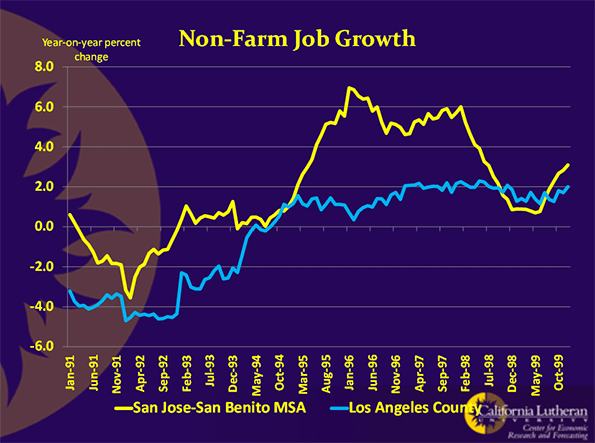
    The 1990s’ recovery was largely a Bay Area recovery.  Los Angeles hardly saw any uptick in employment.  Here is a chart comparing Los Angeles County’s jobs growth rate with the San Jose Metropolitan Statistical Area (MSA): 

    San Jose probably had California’s fastest growing job market in the 1990s.  Los Angeles was not the states slowest.  Still, the differences are striking.

    A few years ago, a couple of my graduate students looked at California data from 1990 through 1999.  They divided California into two regions, the Bay Area and everywhere else.  The Bay Area was defined as Sonoma, Marin, Napa, Solano, Contra Costa, Alameda, Santa Clara, Santa Cruz, San Mateo, and San Francisco counties.  Using seven indicators of economic growth, they performed relatively simple statistical tests to see if the two geographies experienced similar economies.  The indicators were employment, wages, home prices, bank deposits, population growth, construction permits, and household income.

    By every measure except population growth, the Bay Area outperformed the rest of the state.  The exception was probably due to commuters to the Bay Area, given that region’s exceptionally high housing prices. 

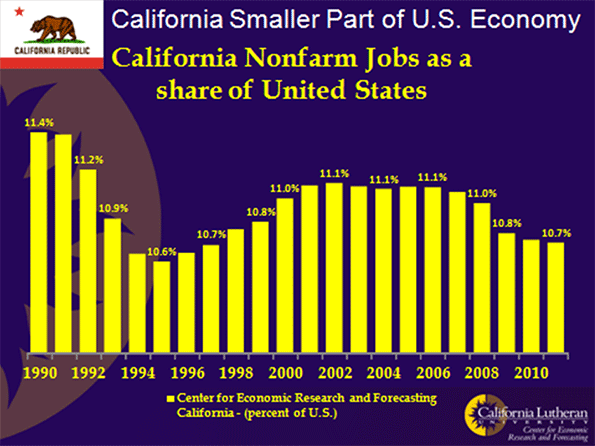
    Some economists will tell you that California saw faster-than-national job growth from the mid 1990s until the great recession.  This is another aggregation problem.  The claim is technically true, but only in the sense that California had a higher proportion of the nation’s jobs in 2007 than it did in 1995.  If you look at annual data, you will see that California’s share of the nation’s jobs only grew from 1995 through 2002.  Since then, California’s share of United States jobs resumed its decline:

    In reality, California never recovered from the dot.com bust.  California, perhaps the best place on the planet to live, couldn’t keep up in a housing boom.  Something was wrong.

    California had lost its mojo. 

    Opportunity is now greater outside California than inside California.  For almost 150 years, California was as widely known for its opportunity as it was for its sunshine.  The combination was like a drug.  George Stoneman, an army officer destined to become California’s 15th governor, spoke for millions when he said "I will embrace the first opportunity to get to California and it is altogether probable that when once there I shall never again leave it." 

    They did come to California, and they made an amazing place.  Opportunity-driven migrants are different than other people.  They take big risks to leave everything they know for an uncertain future in a new place.  They are confident, bold, and brash.   California became just as confident, bold, and brash.  The Anglo-American novelist Taylor Caldwell spoke the truth when she said "If they can’t do it in California, it can’t be done anywhere."

    That was then.  Today, California can’t even rebuild an old Hotel.

    The Miramar Hotel is a partially-demolished eyesore beside the 101 Freeway in Montecito, just south of Santa Barbara.  The Hotel’s initial structure was built in 1889.  Over the years, it was expanded to a 29 structure luxury hotel and resort.  In September 2000 it was closed for renovations which were expected to take 18 months.  That was when the fighting started.  Community groups, neighbors, and governments all had their own idea of what the Miramar should be.  Two owners later, and after millions of dollars, the future to the Miramar is still uncertain.

    The Miramar Hotel is a case study of what is wrong with post-industrial California, precisely because it should have been easy, and because it is not unique.  Everything is hard to do in California.  The state that once moved rivers of water hundreds of miles across deserts and over or through mountain ranges can’t rebuild a hotel.

    The situation will get worse.  California has become the place people are leaving.  The following chart shows that for 20 years more people have left California for other states than came to California from other states:

    California’s population is still increasing because of births and international immigration. 

    Two decades of negative domestic migration has taken its toll.  Millions of risk-taking, confident, bold, and brash people have left California.  They took California’s mojo with them.

    That seems pretty clear when you look at some statistics:  California’s unemployment is way above the national average.  With only about 12 percent of the nation’s population, California has over 30 percent of the nation’s welfare recipients.  San Bernardino has the nation’s second highest poverty rate among cities over 200,000.

    Sometimes though, aggregated data can hide California’s weakness, and some, representing the always-present constituency for the status quo, use these data to deny that California’s future is any less golden. 

    Most recently, those representing the constituency for the status quo have used California’s aggregated jobs data to argue that all is well in California.  They argue that California’s tech sector is leading California to a new golden future.

    Year-over-year data confirm that, through August 2012, California gained jobs at a faster pace than the United States.  Once again, though, that growth is largely confined to one industry and one geography.  California’s tech sector is recovering, and amidst a generally weak recovery, it appears strong enough to generate pretty impressive aggregated results.  If we disaggregate California’s data, we will find that there is not just one California.  There is a rich and mostly coastal California, with a few smaller inland counties on the San Francisco-Lake Tahoe corridor.  Another California is very poor and mostly inland.

    Here’s a list of California’s poorest counties by poverty rate:

    County

    Poverty Rate

    Child Poverty Rate

    Rank

    Del Norte

    23.5

    30.6

    3

    Fresno

    26.8

    38.2

    1

    Imperial

    22.3

    31.8

    6

    Kern

    21.4

    30.3

    10

    Kings

    22.5

    29.7

    5

    Madera

    21.7

    31.7

    8

    Merced

    23.1

    31.4

    4

    Modoc

    21.9

    32.5

    7

    Siskiyou

    21.5

    30.7

    9

    Tulare

    33.6

    33.6

    2

    Here’s a list of California richest counties by poverty rate:

    County

    Poverty Rate

    Child Poverty Rate

    Rank

    Calaveras

    11.1

    18.3

    10

    Contra Costa

    9.3

    12.7

    4

    El Dorado

    9.4

    11.6

    5

    Marin

    9.2

    10.9

    3

    Mono

    10.8

    15

    8

    Napa

    10.7

    14.7

    7

    Placer

    9.1

    10.7

    2

    San Mateo

    7

    8.5

    1

    Santa Clara

    10.6

    13.3

    6

    Ventura

    11

    15.3

    9

    There are some big differences here.  The percentage of Fresno’s children living in poverty is four and half times the percentage of San Mateo children living in poverty.  In fact, the data for California’s poorest counties looks like third-world data.

    When disaggregated, the job-growth data shows the same story.  Through 2012’s second quarter, jobs in the San Jose MSA were up 3.6 percent on a year-over-year basis.  In Los Angeles, jobs were up only 1.1 percent, while in Sacramento they were up only 0.6 percent.  For comparison, U.S. jobs were up about 1.3 percent for the same time period.

    You can perform this analysis for all types of data.  When the data are disaggregated, the story is always the same.  It’s telling us that California needs to get its mojo back, and the current tech boom is likely not to be enough for its recovery.

    Bill Watkins is a professor at California Lutheran University and runs the Center for Economic Research and Forecasting, which can be found at clucerf.org.

    Unemployment photo by BigStockPhoto.com.