Tag: Financial Crisis

  • The Panic of 2008: How Bad Is It?

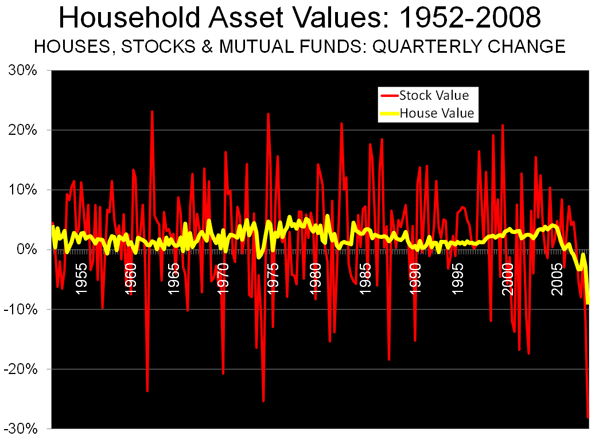
    Just how bad is the current economic downturn? It is frequently claimed that the crash of 2008 is the worst economic downturn since the Great Depression. There is plenty of reason to accept this characterization, though we clearly are not suffering the widespread hardship of the Depression era. Looking principally at historical household wealth data from the Federal Reserve Board’s Flow of Funds Accounts of the United States, summarized in our Value of Household Residences, Stocks & Mutual Funds: 1952-2008, we can conclude it’s pretty bad, but nothing yet like the early 1930s.

    But this Panic of 2008 is no picnic. And in some key areas, notably housing, it could be even worse than what was experienced in the Great Depression.

    Housing: It all started with the housing bubble that saw prices in some markets rise to unheard of levels, principally in California, Florida, Phoenix, Las Vegas and the Washington, DC area. Mortgage lenders, unable to withstand the intensity of losses in these markets caused by declining prices, collapsed like a house of cards. This precipitated the Lehman Brothers bankruptcy on Meltdown Monday (September 15, 2008) and a far broader economic crisis since that time.

    Before the bubble, housing had been a stable store of wealth (equity or savings) for Americans. According to federal data, the value of the US owned housing stock increased in every year since 1935. The bursting of the housing bubble, however, brought declines in both 2007 and 2008, the longest period of housing value decline since between 1929 and 1933. The value of the housing stock was down 20 percent from its peak at the end of 2008. In some markets the losses amounted to more than double this amount. By comparison, the 1929 to 1933 house value decline was 27 percent. However, only one Great Depression year (1932) had a larger single-year decrease than 2008.

    Indeed, between 1952 and 2006, the value of the housing stock never declined for more than a three month period. The bubble changed all that. The value of the housing stock has now fallen eight straight quarters. An investment that has been safe for most middle class Americans – the house in the suburbs – suddenly experienced the price volatility usually associated with the stock market, as is indicated in the chart below.
    The resulting losses have been substantial. By the end of 2008, the value of the housing stock has fallen $4.5 trillion. In Phase I of the housing downturn, before Meltdown Monday, the largest losses were concentrated in the markets with the biggest “bubbles,”. But since that time the market has entered a Phase II decline, while a more general decline has characterized housing markets around the country in the fourth quarter of 2008. The decline continues.

    California, the largest of all the states, has been particularly hard hit. New data for both the San Francisco and Los Angeles areas show price drops of approximately 10 percent in January, 2009 alone, as prices fall like the value of a tin-pot dictatorship’s currency. This decline, it should be noted, has spread from the outer ring of these areas – places like the much maligned Inland Empire region and the Central Valley – into the formerly more stable, and established, areas closer to the larger urban cores, which some imagined would be safe from such declines.

    Sadly, there may well be some time before house price stability can be achieved. To restore the historic relationship between house prices and household incomes to a Median Multiple (median house price divided by median household income) of 3.0 would require another $3 trillion in losses, equating to a more than 15 percent additional loss. Losses are likely to be greater, however, not only in the “ground zero” markets of California and Florida but also other hugely over-valued markets, such as Portland, Seattle, New York and Boston. Of course, these are not normal times, and an intransigent economic downturn could lead to even lower house values than the historical norm would suggest.

    Stocks and Mutual Funds: As noted above, stocks and mutual funds have been inherently more volatile than housing values. According to Federal Reserve data, the value of these holdings fell 24 percent over the year ended September 30. Based upon later data from the World Federation of Exchanges, we estimate that the value declined sharply after September 15, and at December 31 stood at 45 percent below the peak.

    The household value of stocks and mutual funds has declined for five consecutive quarters, as of December 2008. There was a more sustained drop over six quarters in 1969-1970, although the decline in value was less than the present loss, at 37 percent. A larger decline (47 percent) was associated with the four quarter decline of 1973-1974. Comparable data is not available for household stocks and mutual fund holdings before 1952. The less complete data available indicates that the gross value of common and preferred stocks fell 45 percent from 1929 to 1933. As late as 1939, a decade after the crash, the loss had risen to 46 percent, indicating both the depth and length of the Great Depression.

    The present downturn seems on course at a minimum to break the post-depression loss record with an overall decline at 55 percent as of February 20. This would correspond to a household loss of $8 trillion from the peak.

    Consumer Confidence: The Conference Board’s Consumer Confidence Index reached an all time low of 25.0 in February, down a full one-third in a month. Even with its gasoline rationing, the mid-1970s downturn saw a minimum Consumer Confidence Index of 43.2. Normal would be 100; as late as August of 2007, consumer confidence was above 100. Consumer confidence is important. Where it is low, as it is today, there is fear and even people with financial resources are disinclined to spend. Confidence is a major contributor to economic downturns, which is why they used to be called “panics.” Restoring confidence is a requirement for recovery.

    Government Confidence: If there were a federal government index of confidence, it would probably be near zero. This is demonstrated by the trillions that both parties in Washington have or intend to throw at banks, private companies and distressed home owners to stop the downturn. Never since the Great Depression have things become so bad that Washington has opened taxpayer’s checkbooks for massive financial bailouts.

    How Much Wealth has been Lost: The net worth of all US households peaked at $64.6 trillion in the third quarter of 2007, according to the Federal Reserve Board. Since that time, it seems likely that the housing, stock and mutual fund losses by the nation’s households could be as high as $12 trillion – $4 trillion in housing and $8 trillion in stocks and mutual funds. This is a major loss and is unlikely to be recovered soon. Yet it makes sense to consider these losses in context. Unemployment is far lower than in the 1930s, when it reached 25 percent, and the Dust Bowl is not emptying into California (indeed, more than 1,000,000 people have migrated from California to other states this decade).

    Born Yesterday Jeremiahs: It is fashionable to suggest that the current economic crisis is the result of over-consumption and an unsustainable lifestyle. The narrative goes that the supposed excesses of the 1980s and 1990s have finally caught up with us. In fact, however, even with the huge losses, the net worth of the average household is no lower than in 2003 and stands at 70 percent above the 1980 figure (inflation adjusted). This may be a surprise to “born yesterday” economic analysts.

    The reality is that the country achieved astounding economic and social progress since World War II. The reality remains that even after the losses we are not, objectively speaking, experiencing Depression-like conditions. Critically, the answer to the question, “Are you better off today?” in 1950, 1960, 1970, 1980, 1990 and even 2000 is “yes”. This is a critical difference with the situation in the 1930s when the country overall was much poorer, and far less able to withstand such punishing losses.

    Beware the Panglossians: Even so, it seems premature to predict that the economy will turn around soon. Some Panglossian analysts predict recovery later in the year or in 2010 seem likely to miss the mark by years. Remember analysts – particularly those tied to both the real estate and stock sectors – who have discredited themselves with their past cheerleading. In addition, the international breadth and depth of this crisis cannot possibly be fully comprehended at this time. Last week the Federal Reserve predicted a declining economy over the next year.

    And even when the recovery starts, it is likely to be slow because of the public debt run up to stop the bleeding. When the recovery begins, the nation and the world will have to repay the many trillions in bailouts one way or the other. This can take the form of higher taxes, inflation, rising real interest rates or, if you can imagine, all three.

    How Bad Is It? Bad Enough. The present downturn is not as serious as the Great Depression. Nonetheless, the Panic of 2008 is without question, the most serious economic downturn since the Great Depression. The real question is whether the government will react as ineffectively as it did back then, and prolong the downturn well into the next decade.

    Wendell Cox is a Visiting Professor, Conservatoire National des Arts et Metiers, Paris. He was born in Los Angeles and was appointed to three terms on the Los Angeles County Transportation Commission by Mayor Tom Bradley. He is the author of “War on the Dream: How Anti-Sprawl Policy Threatens the Quality of Life.

  • Housing Bail Out Part Deux: Just Another Financial Con Job

    Last night I wrote about the Obama Administration’s housing bail out. But, I hate to say, there’s more to tell you – and it’s actually worse. In addition to the giveaways to mortgage holders, we also have to consider the federal government effectively offering to give a credit default swap (CDS, remember those?) to the banks. If one of the lucky homeowners that get a loan modification defaults on their mortgage because home prices fall again in the future, the federal government will make good to the bank for them. There are some differences between this and a real CDS, though – the banks won’t have to pay a premium for the insurance. The federal government is selling CDS for $0. Nice. We taxpayers are putting up $10 billion for this piece.

    Then there are the plans to “Support Low Mortgage Rates by Strengthening Confidence in Fannie Mae and Freddie Mac.” There’s that word again: confidence. In a con game, the con man isn’t the one who is confident; he is the one who gives you confidence. You are so confident that you are making a good decision that you give him all your money to be part of his scheme. If you still have any questions about confidence schemes, watch “The Music Man” again.

    The Treasury nationalized Fannie and Freddie (F&F) last year – they are now owned by the federal government. If you need more “confidence” than that in the strength of F&F then you should consider moving to another country. Under the assumption that “too big to fail” makes sense, the new Bailout plan is increasing the size of F&F’s mortgage portfolios by $50 billion – along with corresponding increases in their allowable debt outstanding. This part of the Homeowner Affordability and Stability Plan will cost $200 billion, an amount that goes beyond the $2.5 trillion cost of the Financial Stability Plan and the $700 billion in the Emergency Economic Stabilization Act/TARP and the $800 billion Stimulus Plan. The new $200 billion in funding, according to the Treasury’s plan, is being made under the Housing and Economic Recovery Act.

    If you can remember back that far, the Housing and Economic Recovery Act was signed into law by the former and largely unmissed resident of the White House back in July 2008 to clean up the subprime mortgage crisis before any of the other bailout money was committed to clean up the subprime mortgage crisis. This legislation established the HOPE for Homeowners Act of 2008 which spent $300 billion to (1) insure refinanced loans for distressed borrowers, (2) reduce principle balances and interest charges to avoid foreclosure, (3) provide confidence in mortgage markets with greater transparency for home values, (4) be used for homeowners and not home flippers or speculators (5) increase the budget at the Federal Housing Administration so they can monitor that all this happens, (6) end when the housing market is stabilized and (7) provide banks with more ways and means to stop foreclosing on delinquent homeowners. Three million homes were foreclosed last year despite this legislation or any of the other bills that passed before and after it.

    Each new bill carries with it an increase in the limit on the national debt. The most recent Stimulus Package increased it from $11.315 trillion to $12.104 trillion effective February 17, 2009. The actual debt is currently at $10.8 trillion and rising. With only $1.3 trillion between the actual debt and the limit, Timmy Geithner’s pals back at the Federal Reserve will have to keep the printing presses running overtime.

    The “new” Homeowner Affordability and Stability Plan is just a rehash of every old financial sector bailout plan. The definition of insanity, according to a quote attributed to Albert Einstein, is doing the same thing over and over again and expecting different results. Here we go again.

    Susanne Trimbath, Ph.D. is CEO and Chief Economist of STP Advisory Services. Her training in finance and economics began with editing briefing documents for the Economic Research Department of the Federal Reserve Bank of San Francisco. She worked in operations at depository trust and clearing corporations in San Francisco and New York, including Depository Trust Company, a subsidiary of DTCC; formerly, she was a Senior Research Economist studying capital markets at the Milken Institute. Her PhD in economics is from New York University. In addition to teaching economics and finance at New York University and University of Southern California (Marshall School of Business), Trimbath is co-author of Beyond Junk Bonds: Expanding High Yield Markets.

  • Death of the California Dream

    For decades, California has epitomized America’s economic strengths: technological excellence, artistic creativity, agricultural fecundity and an intrepid entrepreneurial spirit. Yet lately California has projected a grimmer vision of a politically divided, economically stagnant state. Last week its legislature cut a deal to close its $42 billion budget deficit, but its larger problems remain.

    California has returned from the dead before, most recently in the mid-1990s. But the odds that the Golden State can reinvent itself again seem long. The buffoonish current governor and a legislature divided between hysterical greens, public-employee lackeys and Neanderthal Republicans have turned the state into a fiscal laughingstock. Meanwhile, more of its middle class migrates out while a large and undereducated underclass (much of it Latino) faces dim prospects. It sometimes seems the people running the state have little feel for the very things that constitute its essence — and could allow California to reinvent itself, and the American future, once again.

    The facts at hand are pretty dreary. California entered the recession early last year, according to the Forecast Project at the University of California, Santa Barbara, and is expected to lag behind the nation well into 2011. Unemployment stands at roughly 10 percent, ahead only of Rust Belt basket cases like Michigan and East Coast calamity Rhode Island. Not surprisingly, people are fleeing this mounting disaster. Net outmigration has been growing every year since about 2003 and should reach well over 200,000 by 2011. This outflow would be far greater, notes demographer Wendell Cox, if not for the fact that many residents can’t sell their homes and are essentially held prisoner by their mortgages.

    For Californians, this recession has been driven by different elements than the early-1990s downturn, which was largely caused by external forces. The end of the Cold War stripped away hundreds of thousands of well-paid defense-related jobs. Meanwhile, the Japanese economy went into a tailspin, leading to a massive disinvestment here. In South L.A., the huge employment losses helped create the conditions conducive to social unrest. The 1992 Rodney King verdict may have provided the match, but the kindling was dry and plentiful.

    This time around, the recession feels like a self-inflicted wound, the result of “bubble dependency.” First came the dotcom bubble, centered largely in the Bay Area. The fortunes made there created an enormous surge in wealth, but by 2001 that bust had punched a huge hole in the California budget. Voters, disgusted by the legislature’s inability to cope with the crisis, recalled the governor, Gray Davis, and replaced him with a megastar B-grade actor from Austria.

    Yet almost as soon as the Internet bubble had evaporated, a new one emerged in housing. As prices soared in coastal enclaves, people fled to the periphery, often buying homes far from traditional suburban job centers. At first, it seemed like a miraculous development: people cheered as their home’s “value” increased 20 percent annually. But even against the backdrop of the national housing bubble, California soon became home to gargantuan imbalances between incomes and property prices. The state was also home to such mortgage hawkers as New Century Financial Corp., Countrywide and IndyMac. For a time the whole California economy seemed to revolve around real-estate speculation, with upwards of 50 percent of all new jobs coming from growth in fields like real estate, construction and mortgage brokering.

    As a result, when the housing bubble burst, the state’s huge real-estate economy evaporated almost overnight. Both parties in the legislature and the governor failed miserably to anticipate the impending fiscal deluge they should have known was all but inevitable.

    To many longtime California observers, the inability of the political, business and academic elites to adequately anticipate and address the state’s persistent problems has been a source of consternation and wonderment. In my view, the key to understanding California’s precipitous decline transcends terms like liberal or conservative, Democratic and Republican. The real culprit lies in the politics of narcissism.

    California, like any gorgeously endowed person, has a natural inclination toward self-absorption. It has always been a place of unsurpassed splendor; it has inspired and attracted writers, artists, dreamers, savants and philosophers. That’s especially true of the Bay Area—ground zero for California narcissism and arguably the most attractive urban expanse on the continent; Neil Morgan in 1960 described San Francisco as “the narcissus of the West,” a place whose fundamental asset was first its own beauty, followed by its own culture of self-regard.

    At first this high self-regard inspired some remarkable public achievements. California rebuilt San Francisco from the ashes of the great 1906 fire, and constructed in Los Angeles the world’s most far-reaching transit system. These achievements reached a pinnacle under Gov. Pat Brown, who in the 1960s oversaw the expansion of the freeways, the construction of new university, state- and community-college campuses, and the creation of water projects that allowed farming in dry but fertile landscapes.

    Yet success also spoiled the state, incubating an ever more inward-looking form of narcissism. Even as the middle class enjoyed “the good life” — high-paying jobs, single-family homes (often with pools), vacations at the beach — there was a growing, palpable sense of threats from rising taxes, a restless youth population and a growing nonwhite demographic. One early expression of this was the late-1970s antitax movement led by Howard Jarvis. The rising cost of government was placing too much of a burden on middle-class homeowners, and the legislature refused to address the problem with reasonable reforms. The result, however, was unreasonable reform, with new and inflexible limits on property and income taxes that made holding the budget together far more difficult.

    Middle-class Californians also began to feel inundated by a racial tide. This was not totally based on prejudice; Californians seemed to accept legal immigration. But millions of undocumented newcomers provoked fear that there were no limits on how many people would move into the state, filling emergency rooms with the uninsured and crowding schools with children whose parents neither spoke English nor had the time to prepare their children for school. By 1994, under Gov. Pete Wilson, the anti-immigrant narcissism fueled Proposition 187. It was now OK to deny school and medical services to people because, at the end, they looked different.

    Today the politics of narcissism is most evident among “progressives.” Although the Republicans can still block massive tax increases, the predominant force in California politics lies with two groups — the gentry liberals and the public sector. The public-sector unions, once relatively poorly paid, now enjoy wages and benefits unavailable to most middle-class Californians, and do so with little regard to the fiscal and overall economic impact. Currently barely 3 percent of the state budget goes to building roads or water systems, compared with nearly 20 percent in the Pat Brown era; instead we’re funding gilt-edged pensions and lifetime guaranteed health care. It’s often a case of I’m all right, Jack — and the hell with everyone else.

    The most recent ascendant group are the gentry liberals, whose base lies in the priciest precincts of San Francisco, the Silicon Valley and the west side of Los Angeles. Gentry liberalism reflects the narcissistic values of successful boomers and their offspring; their politics are all about them. In the past this was tied as much to cultural issues, like gay rights (itself a noble cause) and public support for the arts. More recently, the dominant issue revolves around environmentalism.

    Green politics came early to California and for understandable reasons: protecting the resources and beauty of the nation’s loveliest landscapes. Yet in recent years, the green agenda has expanded well beyond that of the old conservationists like Theodore Roosevelt, who battled to preserve wilderness but also cared deeply about boosting productivity and living standards for the working classes. In contrast, the modern environmental movement often adopts a largely misanthropic view of humans as a “cancer” that needs to be contained. By their very nature, the greens tend to regard growth as an unalloyed evil, gobbling up resources and spewing planet-heating greenhouse gases.

    You can see the effects of the gentry’s green politics up close in places like the Salinas Valley, a lovely agricultural region south of San Jose. As community leaders there have tried to construct policies to create new higher-wage jobs in the area (a project on which I’ve worked as a consultant), local progressives — largely wealthy people living on the Monterey coast — have opposed, for example, the expansion of wineries that might bring new jobs to a predominantly Latino area with persistent double-digit unemployment. As one winegrower told me last year: “They don’t want a facility that interferes with their viewshed.” For such people, the crusade against global warming makes a convenient foil in arguing against anything that might bring industrial or any other kind of middle-wage growth to the state. Greens here often speak movingly about the earth — but also about their personal redemption. They have engaged a legal and regulatory process that provides the wealthy and their progeny an opportunity to act out their desire to “make a difference” — often without real concern for the outcome. Environmentalism becomes a theater in which the privileged act out their narcissism.

    It’s even more disturbing that many of the primary apostles of this kind of politics are themselves wealthy high-livers like Hollywood magnates, Silicon Valley billionaires and well-heeled politicians like Arnold Schwarzenegger and Jerry Brown. They might imagine that driving a Prius or blocking a new water system or new suburban housing development serves the planet, but this usually comes at no cost to themselves or their lifestyles.

    The best great hope for California’s future does not lie with the narcissists of left or right but with the newcomers, largely from abroad. These groups still appreciate the nation of opportunity and aspire to make the California — and American — Dream their own.

    Of course, companies like Google and industries like Hollywood remain critical components, but both Silicon Valley and the entertainment complex are now mature, and increasingly dominated by people with access to money or the most elite educations. Neither is likely to produce large numbers of new jobs, particularly for working- and middle-class Californians.

    In contrast, the newcomers, who often lack both money and education, continue in the hierarchy-breaking tradition that made California great in the first place. Many of them live and build their businesses not in places like San Francisco or West L.A., but in the increasingly multicultural suburbs on the periphery, places like the San Gabriel Valley, Riverside and Cupertino. Immigrants played a similar role in the recovery from the early-1990s doldrums. In the ’90s, for example, the number of Latino-owned businesses already was expanding at four times the rate of Anglo ones, growing from 177,000 to 440,000. Today we see signs of much the same thing, though it often involves immigrants from the Middle East, the former Soviet Union, Mexico or South Korea. One developer, Alethea Hsu, just opened a new shopping center in the San Gabriel Valley this January — and it’s fully leased. “We have a great trust in the future,” says the Cornell-trained physician.

    You see some of the same thing among other California immigrants. More than three decades ago the Cardenas family started slaughtering and selling pigs grown on their two-acre farm near Corona. From there, Jesús Sr. and his wife, Luz, expanded. “We would shoot the hogs through the head and sell them off the truck,” says José, their son. “We’d sell the meat to people who liked it fresh: Filipinos, Chinese, Koreans and Hispanics…We would sell to anyone.” Their first store, predominantly a carnicería, or meat shop, took advantage of the soaring Latino population. By 2008, they had 20 stores with more than $400 million in sales. In 2005 they started to produce Mexican food, including some inspired by Luz’s recipes to distribute through such chains as Costco. Mexican food, notes Jesús Jr., is no longer a niche. “It’s a crossover product now.”

    Despite the current mess in Sacramento, this suggests some hope for the future. Perhaps the gubernatorial candidacy of Silicon Valley folks like former eBay CEO Meg Whitman (a Republican), or her former eBay employee Steve Wesley (a Democrat), could bring some degree of competence and common sense to the farce now taking place in Sacramento. Sen. Dianne Feinstein, who’s said to be considering the race, would also be preferable to a green zealot like Jerry Brown or empty suits like Los Angeles Mayor Antonio Villaraigosa or San Francisco’s Gavin Newsom.

    But if I am looking for hope and inspiration, for California or the country, I would look first and foremost at people like the Cardenas family. They create jobs for people who didn’t go to Stanford or whose parents lack a trust fund. They constitute what any place needs to survive: risk takers who are self-confident but rarely selfish. These are people who look at the future, not in the mirror.

    This article originally appeared at Newsweek.

    Joel Kotkin is executive editor of NewGeography.com and is a presidential fellow in urban futures at Chapman University. He is author of The City: A Global History and is finishing a book on the American future.

  • Responsible Home Buyers, Why Be Frugal?

    I was laying in bed this morning, listening to discussions of the Homeowner Affordability and Stability Plan, the 2009 version of a Homeowner Bailout. (The 2008 version was spent on the banks.) I listened closely because I had to decide if it was worth getting out of bed to earn the money to pay my mortgage or not. Like all those bankers that got a bailout, I was wondering if it might be worth more to me to default on my mortgage than to pay it. I mean, what if the only people getting bailed out are the ones who truly screwed up? Being right doesn’t mean being rich and I didn’t want to miss out.

    I realized that I’d have to get out of bed and get to the office anyway if I was going to make sense of this Plan. Radio sound bites are no substitute for real research. Timmy Geithner put several documents up on his website. Much like his plan to print $2.5 trillion, it’s still more rhetoric than reality but at least this time they included lots of number, so I’m happy to rifle through it.

    Step one in the Fact Sheet is “Refinancing for Up to 4 to 5 Million Responsible Homeowners to Make Their Mortgages More Affordable.” The Plan offers an example of a family with a $207,000 30-year fixed rate mortgage at 6.5%. The house value has fallen 15% to $221,000 so they have less than the 20% home equity needed to qualify for current mortgage rates (close to 5%). The lower interest rate would save this homeowner $2,300/year in mortgage payments.

    First of all, this homeowner’s monthly mortgage payment is $1,308 –about 8.6% of all mortgages fall into this range. About 60% of mortgages are below that level. If the mortgage is too much bigger than that, they are into “jumbo” territory in a lot of areas, so we’ll say this plan is directed at the lower 60%. The example of a $260,000 home is a little pricey – the median new home in 2008 was $226,000 and the median existing home price was $202,000.

    The lower price isn’t just because home prices are falling. The US median has never been higher than $247,900 except in places like New York and California. But the median home price has not skyrocketed in vast swaths of middle-class, middle-America. Finally, reducing your payments by $2,300 in a year means a monthly savings of about $200 – enough to cover a northern winter utility bill.

    If they reach the 4 million homeowners that they say they will, that’s 5.3% of all homeowners. But only 1.19% of all mortgages are in foreclosure and only 1.83% are 90 days past due. Maybe they are going to help the slow-pays, because 6.41% of all mortgages have some past due payments. President Obama specifically said that he was doing this to help regular, middle-class homeowners. That should not mean those who have homes worth more than the national median.

    Then there’s this 15% drop in home value in Geithner’s example. The national median fell 8.6% from 247,000 at the beginning of 2007 to $225,700 in the third quarter of 2008 (latest available from HUD). In the West, where California homes have a higher median than middle-America, the median new home price rose from $320,200 in 2007 to $414,400 at the end of 2008. That’s a whopping 29.4% increase in the median price for a new home! Eastern US median home prices did fall, but by 12.6% not 15%. Still, I wouldn’t be hard pressed to find a city or two or three where home prices fell by 12%. But it doesn’t appear that they will be middle-class homes in middle-America. Existing home prices have fallen across the board. But only in the West did these prices fall at an alarming rate. The average for the other regions was only 8.7%.

    Median Existing Home Price
    Period*
    US
    Northeast
    Midwest
    South
    West
    2007 219,000 279,100 165,100 179,300 335,000
    2008 191,600 246,800 152,500 167,200 253,600
    % change
    12.50% 11.60% 7.60% 6.70% 24.30%
    * 2008 is for September, latest available from HUD. 2007 is full year figure.

    Let’s look at the rest of the bill: “A $75 Billion Homeowner Stability Initiative to Reach Up to 3 to 4 Million At-Risk Homeowners.” This part is for those with adjustable-rate mortgages (“have seen their mortgage payments rise to 40 or even 50 percent of their monthly income”) and excludes those slow-pays (“before a borrower misses a payment”) that appear to be getting help from Part One. This Part is only available to those who have a high mortgage-to-income ratio and/or whose mortgage balance is higher than the current market value. Under the “Shared Effort to Reduce Monthly Payments” the federal government would step in to make some of your interest payments after the bank can’t reduce your interest rate any further.

    There’s nothing here that says you’ll have to pay the government back that money – ever. But if the interest rate reduction isn’t enough, and having the government make some of your interest payments still doesn’t get you down to a mortgage payment that is no more than 31% of your income (one of the definitions of affordable), then the government will even pay down some of your principal.

    But wait, that’s not all you get! If you and your bank can work out a deal here’s what else Uncle Obama will throw in for you:

    If you take this action
    The government pays Your Bank 
    The government pays You
    Do a loan modification
    $1,000
    Reduced interest costs and principal balance
    Do it before you miss a payment
    $500
    $1,500
    Stay current
    $3,000 (over 3 years)
    $5,000 (over 5 years)

    Wow! I’m really beginning to regret being a responsible person. I comment on Part 3 of the plan tomorrow. But this is really discouraging. I’m ineligible because I bought responsibly, before the Stimulus Bill gave out incentives to buy. I suspect there are about 70 million households out there just like me. Trillions of dollars running around the economy and all I can see is that the responsible majority will be paying for it while irresponsible bankers, brokers and home buyers benefit.

    To tell you the truth, I need a tissue…

    Read Part II of this look at the Housing Bailout.

    Susanne Trimbath, Ph.D. is CEO and Chief Economist of STP Advisory Services. Her training in finance and economics began with editing briefing documents for the Economic Research Department of the Federal Reserve Bank of San Francisco. She worked in operations at depository trust and clearing corporations in San Francisco and New York, including Depository Trust Company, a subsidiary of DTCC; formerly, she was a Senior Research Economist studying capital markets at the Milken Institute. Her PhD in economics is from New York University. In addition to teaching economics and finance at New York University and University of Southern California (Marshall School of Business), Trimbath is co-author of Beyond Junk Bonds: Expanding High Yield Markets.

  • Housing Downturn Moves Into Phase II

    The great housing turndown, which started as early as 2007, has entered a second and more difficult phase. We can trace this to Monday, September 15, 2008 just as October 29, 1929 – “Black Tuesday” – marked the start of the Great Depression. September 15 does not yet have a name and the name “Black Monday” has already been taken by the 1987 stock market crash. The 1987 crash looks in historical perspective like a slight downturn compared to what the world faces today.

    On September 15 – let’s call it “Meltdown Monday” – the housing downturn ended its Phase I and burst into financial markets leading to the most serious global recession since the Great Depression. Indeed, International Monetary Fund head Dominique Strauss-Kahn now classifies it a depression.

    Phase I claimed its own share of victims; Phase II seems likely to hit many more.

    Phase I of the Housing Downturn

    Whether in depression or recession, parts of the United States housing market were already in a deep downturn well before September 15. Phase I of the housing downturn started when house prices reached an unprecedented peak in some markets and began fell into decline. By September of 2008, house prices in the “ground zero” markets of California, Florida Las Vegas, Phoenix and Washington, DC had dropped from 25 percent to 45 percent from their peaks. These markets represented 75 percent of the overall lost value among the major metropolitan areas (those with more than 1,000,000 population).

    The Varieties of House Price Escalation Experience: In Phase I, the house price escalation and subsequent losses were far less severe in other major metropolitan areas. This depended in large part to the degree of land use controls – such as land rationing (urban growth boundaries and urban service limits), building moratoria, large lot zoning and other restrictions on building routinely – that helped drive prices up to unsustainable levels. This effect, cited by a number of the world’s most respected economists, was exacerbated by the easy money policies adopted by mortgage lenders.

    On the other hand, in the “responsive” land use regulation areas, the market (people’s preferences) was allowed to determine where and what kind of housing could be built. In these areas housing prices rose far less during the housing bubble and fell far less during Phase I of the housing downturn.

    Leading to the International Financial Crisis: These radically differing house price trends set up world financial markets for ”Meltdown Monday.” The easy money led to a strong increase in foreclosure rates, an inevitable consequence of households having sought or been enticed into mortgage loans that they simply could not afford. Yet it was not foreclosure rates that doomed the market. It was rather the unprecedented intensity of those losses in particular markets.

    Foreclosures were not the problem: Foreclosures happened all over. Foreclosure rates rose drastically in California and the prescriptive markets, but had relatively less impact in the responsive markets of the South and Midwest, where house prices changed little relative to incomes.

    Intensity of the losses was the problem. The problem lay largely in the scale of house value losses in some markets, particularly the most prescriptive ones. Lenders faced foreclosure and short sales losses on houses that had lost an average of $170,000 in value in the ground zero markets. In the responsive markets, on the other hand, average house value losses were less than one-tenth that, at $12,000 per house (http://www.demographia.com/db-hloss.pdf).

    By the end of Phase I of the housing downturn, house value losses in the prescriptive markets had reached nearly $2.3 trillion, accounting for 94 percent of the total losses in major metropolitan markets (those with more than 1,000,000 population). If the market had been allowed to operate in these markets, the losses in the prescriptive markets could easily have been one-fifth this amount. Most likely the mortgage industry and the international economy might have been able to handle such losses, sparing the world the current deep financial crisis.

    True, the housing bust would not have happened without the easy money. Neither easy money nor prescriptive land use regulation were sufficient in themselves to send the world economy into a tailspin. But together they conspired to create the conditions for “Meltdown Monday”.

    Phase II of the Housing Downturn

    The Panic of 2008: By September 15, the “die had been cast.” The holders of mortgage debt could no longer sustain the losses that were occurring in the ground zero markets. This led to the Lehman Brothers bankruptcy and then to a financial sector that seems to be accelerating faster than the taxpayers can pick up the pieces. The ensuing “panic” – a 19th century synonym for a severe economic downturn – has led to millions of layoffs, decreases in demand across the economy and taxpayer financed bailouts around the world. Many have seen their retirement funds wiped out. Others have lost their jobs. American icons, such as General Motors and Bank of America have been relegated to begging on Washington’s K Street.

    Housing Downturn Broadens and Deepens: The panic has now brought about a new phase in the housing downturn – what I label Phase II. In Phase II, a deteriorating economy starts to kick the bottom out of the rest of the housing market. With evaporating confidence in the economy and the drying up of demand, house prices have begun a free-fall in virtually all markets, regardless of the extent to which their prices had bloated.

    Our analysis of National Association of Realtors data shows this. In almost all markets house price declines accelerated during the fourth quarter of 2008 (the first quarter following Meltdown Monday). In just three months, median house prices fell an average of more than 12 percent in the major metropolitan markets. In the ground zero markets, house prices dropped 14 percent, with the average loss from the peak exceeding 40 percent. In the responsive markets, prices fell 11 percent, approximately double the previous reduction from the peak (See Table).

    Thus, the difference is that in Phase I, house price declines were in proportion to the previous price escalation. In Phase II, the percentage declines are generally similar without regard to the house price increases.

    House Price Deflation from Peak
    By Phase of the Housing Downturn
    PRESCRIPTIVE LAND USE MARKETS
    RESPONSIVE LAND USE MARKETS
    Factor
    Ground Zero
    Other
    All
    ALL MARKETS
       
    Prices: To Phase I
    -31.70%
    -11.10%
    -20.80%
    -5.90%
    -17.90%
    Prices: To Phase II
    -41.40%
    -21.40%
    -30.80%
    -16.60%
    -28.00%
     
    Prices in Phase II
    -14.20%
    -11.60%
    -12.60%
    -12.40%
    -14.20%
     
    Loss per House: To Phase I
    ($193,800)
    ($42,400)
    ($96,300)
    ($12,200)
    ($66,900)
    Loss per House: To Phase II
    ($253,000)
    ($81,800)
    ($142,700)
    ($34,200)
    ($104,800)
     
    Loss per House in Phase II
    ($59,200)
    ($39,400)
    ($46,400)
    ($37,900)
    ($59,200)
     
    Gross Losses (Trillions): To Phase I
    ($1.82)
    ($0.46)
    ($2.29)
    ($0.16)
    ($2.44)
    Gross Losses (Trillions): To Phase II
    ($2.40)
    ($0.99)
    ($3.39)
    ($0.44)
    ($3.82)
     
    Gross Losses (Trillions): in Phase II
    ($0.58)
    ($0.52)
    ($1.10)
    ($0.28)
    ($1.38)
       
    Phase I: To September 2008          
    Phase II: To December 2008          
    Major Metropolitan Markets (over 1,000,000 population)      
    For markets by classification see: http://www.demographia.com/db-hloss.pdf    

    Recession or Depression?

    It’s critical to note that the decline is by no means as deep as in the 1930s. On the other hand, there is no indication that conditions are going to improve markedly in the short run. Millions of households who saw their retirement accounts devastated are likely to curb consumption for years to come. The key question is whether we are in the equivalent of 1933, in the pit of the downturn, or in the equivalent of the late 1930s, soon to begin a long, slow climb out.

    For housing though, this is a depression. Never before over the last half-century have house prices fallen as they have in the prescriptive markets during Phase I of the housing downturn. And since the bust, during Phase II, overall price declines are on a par with the worst years of the Great Depression. “Meltdown Monday” has incited a downward spiral whose course will be the topic of future commentaries on this site.

    The classifications of the major metropolitan markets and price declines for each market are shown in http://www.demographia.com/db-hloss.pdf.

    Also see: Mortgage Meltdown Graphic: http://www.demographia.com/db-meltdowngraphic.pdf

    Wendell Cox is a Visiting Professor, Conservatoire National des Arts et Metiers, Paris. He was born in Los Angeles and was appointed to three terms on the Los Angeles County Transportation Commission by Mayor Tom Bradley. He is the author of “War on the Dream: How Anti-Sprawl Policy Threatens the Quality of Life.

  • Oregon Fail: With Hard Times Ahead for Business and Real Estate, It’s Time to Look Small

    There is something about Oregon that ignites something close to poetic inspiration, even among the most level-headed types. When I asked Hank Hoell recently about the state, he waxed on about hiking the spectacular Cascades, the dreamy coastal towns and the rich farmlands of the green Willamette Valley.

    “Oregon,” enthused Hoell, president of LibertyBank, the state’s largest privately owned bank, from his office in Eugene, “is America’s best-kept secret. If quality of life matters at all, Oregon has it in spades. It is as good as it gets. It’s just superb.”

    As developer Shelly Klapper, a rare skeptic in the Beaver State, reminded me: “This is a state that buys its own hype.”

    Hype or not, however, Oregon is hurting – something that’s clear to even the most self-respecting narcissist. Over the past year, Oregon’s economy has fallen off a cliff just about as fast as any state in the union.

    A year ago, things seemed very different. Sunbelt boom states like California, Arizona and Nevada were already heading into deep recession, but green Oregon seemed oddly golden. Both its small cites and one big town, Portland, were outperforming the national norms. Oregonians saw their state as better – not only in terms of green and good, but also in terms of basic job growth.

    But since last winter, Oregon’s unemployment rate has soared from barely 5.5% to well over 8%, the sixth worst in the nation. Indeed, according to a recent projection by the University of California at Santa Barbara (UCSB), Oregon’s jobless rate could reach close to 10% by the end of the year.

    Well into 2010, Oregon’s overall economy will shrink more rapidly than the nation’s as a whole, notes UCSB forecaster Bill Watkins. He traces a sharp downturn there to many factors, including one of the toughest regulatory regimes in North America.

    In tough times, companies generally expand in localities that are friendly to commerce – say, states like Texas or nearby Idaho. Few would rate Oregon highly in that regard.

    “Oregon is mostly a place that focuses on the enjoyment of its space, and that makes [it] very vulnerable in these conditions,” Watkins says.

    The other big problem has to do with a lack of economic diversity. Oregon has been through tough times before. For much of its history, the state’s economy depended largely on harvesting its vast forests. Then, in the 1980s, the state developed a green bug, and decided it shouldn’t chop down Mother Nature for a living.

    In the ensuing decade, Oregon pioneered tough land-use regulations, curbing industries that relied on forest products and declaring war on suburban sprawl. Its main city, Portland, became the poster child of the “smart growth” movement by forcing up density, building an extensive light-rail system and restoring its urban core.

    Although widely praised, these stringent regulations also drove up land prices and, ironically, prompted many middle-class residents to move away, including across the border into Washington. Businesses, rather than cluster in the state’s core, continued to migrate to the outer rings; in the relatively healthy year of 2005, for example, barely 10% of Portland’s office space growth took place in the central district.

    “We give lip service to the economy here,” admits Klapper, a longtime Portland entrepreneur and a former official with the Port of Portland. “But, really, business is not a priority here.”

    For a while, Klapper notes, the tech sector seemed to offer the solution. In the ’80s and ’90s, chip makers fleeing even higher costs in California flooded into Oregon, which was proudly dubbed the “Silicon Forest.” In an unusual move, the state provided tax breaks to the chip makers, which helped. The state’s suburbs also proved attractive to tech workers who could afford a far better quality of life there, in terms of schools and housing, than they could in the Golden State.

    But as regulations tightened and costs to businesses and families increased, even the high-tech industry began to fade. Always a political bellwether state, Oregon has moved inexorably left, increasingly dominated by both its public sector and the particularly strong green movement. Semiconductor expansion soon started to go south – or in this case, further east (to Idaho) or across the Pacific to Asia.

    Only one thing remained to drive the economy: housing. A torrent of Californians were heading north – cashing out of the overpriced Bay Area, Sacramento and Los Angeles – and buying new homes in Oregon. Some sophistos sashayed their way into trendy places like Portland’s Pearl District, but many others looked to the charming smaller towns of the Willamette Valley and central Oregon.

    “When all else failed, it was people moving here that kept us going,” says Klapper, who was a major investor in the Pearl District renaissance. “California became our biggest industry.”

    This dependence turned into a debilitating addiction. When in 2007, the great California housing bubble collapsed, the inflow of people and dollars dropped off. Meanwhile, the remnants of lumber industry fell victim to the housing bust.

    Nowhere are the effects of this clearer than in Bend, a spectacular town of 75,000 located amid volcanic peaks in the center of the state. Californians had considered Bend a favorite spot for second homes and relocation. About a year ago, notes real estate appraiser Steve Pistole, prices were rising 2% a month, while those in Portland were “only” rising 8% a year.

    But to visit Bend now is to be in the eye of the housing hurricane, with nearly deserted housing tracts, woefully empty hotels and residential second-home developments. Unemployment in the housing arena, according to the UCSB, could reach 15% next year.

    We can also expect a further slide in housing prices. Oregon’s bubble, notes analyst Wendell Cox, inflated later than California’s, so prices, which have dropped more than 10% in the last year, could fall by that much or more in the next.

    Yet despite all these problems, many Oregonians remain optimistic. Some of this seems, at least fundamentally, a reflection of ideology. The inevitable huge surge of “green jobs” promised by the Obama administration has long been an article of faith in the state; it seems something like a story we’d tell our children to put them to sleep. State officials, for example, speak wistfully of replacing a recently shuttered Korean-owned Hynix chip plant with a facility to make solar panels.

    The bad news is this: 49 other states – some of which don’t pose such strong regulatory challenges – also hope to bring home some of these green jobs. So if business logic applies, the new factories that manufacture wind turbines, propellers or solar panels will end up in states like North Dakota or Texas, which have been the most successful, thus far, at attracting other manufacturing jobs.

    So what trail should Oregon blaze now? Pistole, the real estate appraiser, says it may be time to think small. Places like Bend, he notes, already attract former Silicon Valley veterans who like living close to trout streams, hiking trails and golf courses.

    “There is no magic bullet for Oregon,” says Pistole, who himself moved from California just three years ago. “But there could be lots of onesies, twosies, mom-and-pops. People still want to live here. We have to make it synergistic to live where you want and still make money. That’s the way we need to go.”

    Some entrepreneurs, like 38-year-old Michael Taus, are already setting up such small shops, some of them in their homes. A recent arrival from Los Angeles, Taus made it big as one of the founders of Rent.com, which was sold to eBay in 2005. He’s only lived in Bend for a few months, but he has already launched his own start-up and consults for several other local firms.

    Taus believes others of his generation will want to establish businesses in Oregon, lured by both its lifestyle and affordability. Some of the new business may be in software, Taus says, but others could sprout in specialty agriculture, wood products and other industries.

    “People are here for a reason. There’s a good amount of talent, and you can get more here,” he says earnestly. “There’s a great potential. We just have to get down to business.”

    This article originally appeared at Forbes.

    Joel Kotkin is executive editor of NewGeography.com and is a presidential fellow in urban futures at Chapman University. He is author of The City: A Global History and is finishing a book on the American future.

  • The Recession: Fuzzy Thinking Delays A Recovery

    I keep hearing how the current recession will end in 2010 because the average United States recession from 1854 to 2001 has been 17 months. This is silly for a variety of reasons.

    One reason is that there is no average recession. Post-World War II recessions have lasted from a minimum of six months to a maximum of only 16 months. If we were to apply the “average recession” logic to post World War II recessions, the current recession, which the NBER — the National Bureau of Economic Research — says started December 2007, would have ended 10 months later, last October.

    Another reason is that few previous recessions have been accompanied by the financial sector collapse that we witnessed in September. Worldwide experience indicates that recessions associated with financial sector panics tend to be longer than those without panics.

    Since 1854, five United States recessions have been accompanied by financial panics. These are the recessions of 1857, 1873, 1893, 1907, and 1929. The average duration of these recessions was 31 months. The 1907 recession was the shortest, at only 13 months. The 1873 recession was the longest, at 65 months. For comparison, the 1929 recession was 43 months. Interestingly enough, J.P. Morgan was instrumental in ending the financial panics of the two shortest recessions, 1893 and 1907.

    If we were to engage in the same sort of fuzzy thinking as the “average recession” analysis applied to “financial Panic” recessions, and assuming we use the NBER recession start date of December ‘07, the current recession could be expected to end 31 months later in July 2010. Is that too long for you? You could use the average 20th Century recession accompanied by a financial panic length. That is 28 months, so maybe the recession will end in April 2010.

    Maybe we should look at foreign data? The point is that if you play this game long enough, you can find a date you like.

    Finally, the method of dating recessions changed with the 2001 recession. The new method is much more likely to declare an economy in recession. If the old method had been used — if previous criteria were applied to the current situation — I believe the recession would have commenced no sooner than July 2008. Recent data revisions increase my confidence that the NBER was wrong when they said the recession commenced in December 2007. If you have the wrong start date, any “average recession” method will be wrong.

    The facts are that we have a serious recession accompanied by a financial panic and continuing massive job losses. The correct way to analyze the current recession is to recognize that it was accompanied by financial panic, and that means we had a regime shift from a good equilibrium to a bad equilibrium.

    Game theory tells us that we can have multiple Nash Equilibria to certain games. A Nash Equilibrium is one where knowing your opponent’s decision you would not change your decision.

    Bank runs provide an excellent example. Suppose you have a bank that does not have deposit insurance. Most of the time things plug along. People make deposits, borrow, and the like. Everybody is happy with their decisions. Call this the good equilibrium. However, in the event of a bank run, everyone wants to participate in the run, because those who do not end up loosing. Call this the bad equilibrium. Furthermore, nothing real has to change. We can switch from the good equilibrium to the bad equilibrium on unfounded rumors.

    The financial panic we witnessed last September was exactly like a bank run. In an amazingly short time, we switched from a good equilibrium to a bad equilibrium. The bad news is that we have no idea how to switch from a bad equilibrium to a good equilibrium. It will surely happen, but we don’t know how to cause it. We don’t know what will cause it. We can’t predict when it will happen.

    We do know that a lot of assets need to change hands. These include financial assets, auto factories, and homes. Recessions are periods when assets are reallocated to better uses.

    Current policy, with its obsessive pursuit of bailouts, seems to be focused on delaying those reallocations. That will delay the recovery. So-proposed government efforts to limit the impact will be ineffective, if not counterproductive. That is why I don’t see any reason to expect a recovery in 2009.

    Bill Watkins, Ph.D. is the Executive Director of the Economic Forecast Project at the University of California, Santa Barbara. He is also a former economist at the Board of Governors of the Federal Reserve System in Washington D.C. in the Monetary Affairs Division. All recession dating data in this article is from the NBER website.

  • Dubai, Mumbai, Shanghai : Destiny or Hype?

    The assonant phrase “Dubai, Mumbai, Shanghai or Goodbye” was credited to Andrew Ross Sorkin of the New York Times in late 2007 at the beginning of the financial crisis on Wall Street. For years, New York, London and Tokyo held sway as the world’s financial capitals. Then the tectonic plates of the financial world began to move and these new cities were going to be the prime beneficiaries.

    Global shifts of financial power are not uncommon in history but they are dramatic. In the 15th Century, we saw the rise of Western Civilization. In the 19th Century, we experienced the emergence of the United States of America, followed by the rise first of Russia, Germany and Japan, and then China and India.

    The question now: has the time of London, New York and Tokyo come to an end? The basis for this assertion certainly exists. In 2008, the United States trade deficit with China topped $246 billion. In this new century, just eight years old, the United States trade deficit sent $1.4 trillion to China. This pattern alone would seem to secure Shanghai’s future preeminence.

    So it would also seem for Dubai. Crude oil hit $147/barrel in July, 2008. At that level, western democracies were sending $1 trillion per year to the Persian Gulf in exchange for 20 million barrels of oil. Dubai claimed possession of the tallest building in the world when the Burj Dubai topped 165 floors. This title, along with the world’s largest airport, world’s tallest hotel, and world’s tallest apartment are just a few of the superlatives used to describe Dubai.

    India’s trade surplus with the United States grew to $80 billion in 2008 as their economy exploded. An Indian car company shocked the world by purchasing legendary marquees Jaguar and Land Rover from Ford Motor Company. Mumbai was working towards becoming a true contender.

    At the beginning of the financial crisis “Dubai, Mumbai, Shanghai or Goodbye” did seem to identify the future locus of job openings in the financial world. Look at some of the records once owned by United States companies and who owns them today:

    • Tallest building : Dubai
    • Largest publicly traded company : China
    • Largest passenger airplane : Europe
    • Largest investment fund : Abu Dhabi
    • Largest movie industry : India
    • Largest casino : Macao
    • Largest shopping mall : Dubai

    So it looked in 2008. It is now early 2009. Lehman Brothers is gone. Wachovia was swallowed by Wells Fargo. Merrill Lynch was eaten by Bank of America. Citicorp lost 90% of its equity and struggles for its own survival. The Fed has pumped $700 billion to rescue the system and fears it may take $2 trillion to finish the job. The CEOs of General Motors and Chrysler publically beg Congress for a bailout as their share prices hit 60-year lows. Wall Street has lost 40% of its value in less than six months.

    London is no better off. The British pound has hit a 23 year low. The Royal Bank of Scotland required a $142 billion bailout to stave off collapse. Lloyds Banking Groups slid 42% in value to its lowest levels since the 80s. Jim Rogers, chairman of Singapore-based Rogers Holdings, said in an interview with Bloomberg Television, “I would urge you to sell any sterling you might have. It’s finished. I hate to say it, but I would not put any money in the U.K.”

    Tokyo fell from financial power in the 1990s and never recovered. They steered clear of the subprime fiasco, holding just $8 billion of the world’s $1 trillion subprime portfolio. Yet Japan has not been immune: Toyota suffered its first operating loss in 71 years. Its export-centered economy is now reeling.

    Yet if the old standbys are reeling, it now seems that the new guys are not as ready for prime time as was widely believed. The price of crude oil tumbled from $147/barrel in July 2008 to $32/barrel in December and the global economy was rocked. The loss of revenue had differing impacts worldwide.

    Suddenly the new players in the game seemed weaker. Russia, whose cost of production in the frozen tundra of Siberia is more than $60/barrel, lost its swagger. Prime Minister Putin became silent and Russia’s Backfire bombers stopped flying sorties to the American coastline. Russia is effectively bankrupt.

    But the biggest impact was in the Middle East. The drop in oil prices eliminated $839 billion per year from the income ledgers of the Persian Gulf alone. Some in the Middle East can tolerate the temporary loss of revenue. The Abu Dhabi sovereign wealth fund, for example, already held $850 billion in surplus and the cost of producing a barrel of oil remains just $4/barrel.

    But what of the new financial center of the Middle East? Dubai has seen its global market of new condominium buyers evaporate. Prices have collapsed and there is no end in sight. Price declines of 40% have been reported in the last two months. The mighty Burj Dubai, proud symbol of Dubai, has seen its values plummet 50% in the last two months. Sales in Dubai have simply come to a halt. More than half of the construction projects in the United Arab Emirates – worth $582 billion – were put on hold in 2008 according to the Dubai Chronicle. Look for further weakening in 2009.

    The impact on China has been arguably the most dramatic. More than 10,000,000 Chinese have been thrown out of work in the last 90 days. This is a new phenomenon in China, which has experienced 9% growth for years. Thousands of factories have been closed and civil unrest is rising. China has raised 400,000,000 people out of poverty in just one generation by moving them from villages into the cities. There are 24 million new workers added to the labor market each year. A slowdown in their export-driven industry will have a disastrous effect on these new workers.

    India has not been as adversely impacted as the western economies. Like Japan, India was not a player in the subprime mess. But this economic immunity did not protect the people of Mumbai from terrorist attack. Its global importance made it an attractive target to Islamic terrorists. On November 26th, 2008, eighty innocent people were killed in a series of coordinated attacks on Mumbai.

    So will the tectonic plates keep shifting? Will the financial power return to New York, London and Tokyo? Or will new financial power centers emerge? As of now the financial crisis has humbled everyone. Who will emerge when the bleeding stops is something we still cannot predict.

    Robert J. Cristiano Ph.D. has more than 25 years experience in real estate development in Southern California. He obtained financing from the Middle East following the collapse of the savings & loan industry in the early 90s and has become an expert on that region. He is a resident of Newport Beach, CA.

  • Fool Me Once, Geithner, Shame on You, Fool Me Twice…

    Treasury Secretary Timothy Geithner revealed the new “Financial Stability Plan” on February 10, 2009. It’s thick with “why we need it” and thin on “exactly what it is.” He told Congress that he would open a website to disclose where all the bailout money was going. When asked if he would reveal where the first $350 billion went, he was a little vague on the details.

    Senator Grassley (R-IA) asked him at the confirmation hearings about the Maiden Lane LLCs and the money he passed out to private, non-regulated companies. His written response then was “Confidentiality around the specific characteristics and performance of individual loans in the portfolio is maintained in order to allow the asset manager the flexibility to manage the assets in a way that maximizes the value of portfolio and mitigates risk of loss to the taxpayer.” In other words, he wouldn’t say. When asked “What specific additional disclosure would you support?” Tim’s response was “If confirmed, I look forward to working with you and with Chairman Bernanke on ways to respond to your suggestions and concerns.” Variations on the “If confirmed, I look forward to working on it” answer was cut and pasted into his 102 page written responses 104 times, or more than once per page.

    Back in 2008 when the big bailout bucks were being passed around, we (and Congress) were led to believe that this was all being done to fix problems in housing and mortgage markets. Speaker of the House Nancy Pelosi (D-CA) said this in her speech on the floor before the vote: “We’re putting up $700 billion; we want the American people to get some of the upside. …[we] insisted that we would have forbearance on foreclosure. If we’re now going to own that [mortgage-backed securities] paper, that we would then have forbearance to help responsible homeowners stay in their home.” Three million homes went into foreclosure last year.

    Speaker Pelosi went on to tell us that the bill would include “an end to the golden parachutes and a review and reform of the compensation for CEOs.” Excuse my cynicism but Tim Geithner took a $500,000 walk-away bonus when he left the Federal Reserve Bank of New York, the maximum earnings allowed under President Obama’s suggested compensation cap; but that was on top of his $400,000 salary which would put him over the limit. Obama appointee Deputy Secretary of State Jacob Lew took home just under $1.1 million last year as a managing director at Citi Alternative Investments, a unit of Citigroup, which so far took $45 billion in bailout money.

    So, let’s add this up. Tim hides $330 billion from us while he’s at the Fed, refuses to tell Congress who it went to, refuses to tell Congress who Paulson gave the money to, and takes more than his share of compensation.

    Now he wants us to believe that Treasury can “require all Financial Stability Plan recipients to participate in foreclosure mitigation plans.” Fool me once, shame on you. Fool me twice, shame on me. I, personally, don’t believe a word of it. And neither should you. It’s all baloney, bogus, phantom. They are paying lip service to the American taxpayers so you won’t send those faxes to Congress or throw shoes at the new President. They are passing the money to the same Democratic big wigs that paid for their election campaigns – just as they did in the past to the Republicans. Tim is shoveling more money to the same private companies that he previously sent freshly-printed Federal Reserve notes. Now he can also pass out Congressionally-approved money. While Congress struggled with spending $800 billion to directly stimulate economic activity in the US, Tim thumbed his nose at them by presenting a plan to spread around more than $2.5 trillion that won’t require their approval. That’s the way it is and I think it would be a very bad idea to stop him.

    Yes, you read that right. I said it would be a bad idea to stop. I’m a fan of NASCAR racing. When a driver begins to lose control of the car and is sailing head first into a concrete wall at 190 miles per hour there is only one way to save it – stand on the gas. Your every instinct is to hit the brakes, to stop the car before you slam into the wall. But if you hit the brakes you’ll lose traction and control. By pressing down on the gas, you put power to the wheels which (hopefully) are still in contact with the track – with traction comes control and you can steer away from the wall. Oh, but it isn’t easy! Every cell in your monkey-cousin brain will scream: “Slam on the brakes!”

    So, it’s like the economy is heading for the wall. And Tim has decided to hit the gas – another $100 billion for the banks, $1 trillion for private capital to put in junk bonds, $1 trillion for private investors to spend on junk loans, $600 billion for Fannie and Freddie’s debt – yet only $50 billion to reduce mortgage payments for “middle class homes” in foreclosure.

    But even if we avoid hitting the wall, that doesn’t mean we don’t need to change the course. For years I have argued we need to fix the race track and improve the aerodynamics of the cars so they won’t head into the wall in the first place. I would insist that broker dealers have to deliver what they sell. I would prohibit the sale of derivatives in excess of the underlying assets. But that’s technical stuff, like requiring roof flaps in NASCAR (little flaps that come up when the car spins backwards to keep it from going airborne). It would prevent the really bad wrecks, but then no one would tune in on Sunday if there weren’t any wrecks, right?

    Enjoy the show as Tim tries to keep from crashing into the wall. But don’t be fooled that he is fixing anything. Even if he pulls the economy out this time, the track is still broken and the cars are still not aerodynamically sound. They’ll wreck it again – as they did in 1981 (inflation so high that Treasury bonds paid 19%), in 1987 (October stock market crash of 23% was worst of all time), in 1991 (junk bond collapse and credit crunch) and in 2000 (the dot.com bust).

    This will keep happening until we take the time to understand the real causes and put in real solutions. The solution is not now and has never been to throw money at it. This is the “junkie cousin” approach that Amy Poehler (Saturday Night Live) compared to the Original Bailout package: “It’s like you lend $100 to your junkie cousin to pay his rent. And when you run into him at the racetrack next week, you lend him another $50.”

    At what point do you “get it” that your cousin is gambling away the money you lent him for the rent, that this is not really helping your cousin to kick junk? The solution is not throwing money around but accounting for all the money already out there (including the stocks, bonds and derivatives). It’s not more regulation, it’s enforcing rules that are already on the books. Real solutions take real work. I’m not hopeful that the US government and markets are willing to do the work. So, I’ll make sure I’m wearing a helmet with my seat-belt buckled for the next crash, say just around 2017.

    Susanne Trimbath, Ph.D. is CEO and Chief Economist of STP Advisory Services. Her training in finance and economics began with editing briefing documents for the Economic Research Department of the Federal Reserve Bank of San Francisco. She worked in operations at depository trust and clearing corporations in San Francisco and New York, including Depository Trust Company, a subsidiary of DTCC; formerly, she was a Senior Research Economist studying capital markets at the Milken Institute. Her PhD in economics is from New York University. In addition to teaching economics and finance at New York University and University of Southern California (Marshall School of Business), Trimbath is co-author of Beyond Junk Bonds: Expanding High Yield Markets.

  • Housing Price Bubble: Learning from California

    In a letter to The Wall Street Journal (February 6) defending California’s greenhouse gas (GHG) emissions policies, Governor Arnold Shwarzenegger’s Senior Economic Advisor David Crane noted that California’s high unemployment is the result of “a bust of the housing bubble fueled by easy money.” He is, at best, half right.

    The “bust of the housing bubble” occurred not only because of “easy money,” but also because of the very policies California has implemented for decades and is extending in its battle against GHG emissions.

    The nation has never had a housing bubble like occurred in California. The Median Multiple (median house price divided by median household income) in California’s coastal metropolitan areas had doubled and nearly tripled over a decade. Housing costs relative to incomes reached levels twice as high as those experienced in the early 1990s housing bubble, which was bad enough.

    This is all the more remarkable because even before the bubble the Median Multiple in the Los Angeles, San Francisco, San Diego and San Jose metropolitan areas was already elevated at 1.5 times the historic norm.

    “Easy money,” by itself, does not explain what caused the unprecedented housing bubble in California. If “easy money” were the sole cause, then similar house price escalation relative to incomes would have occurred throughout the country.

    Take, for example, Atlanta, Dallas-Fort Worth and Houston. These are the three fastest growing metropolitan areas in the developed world with more than 5,000,000 population. Since 2000, these metropolitan areas have grown from three to 15 times as fast as Los Angeles, San Francisco, San Diego and San Jose. While 1,800,000 people have moved out of the four coastal California metropolitan areas to other parts of the country, 700,000 have moved to Atlanta, Dallas-Fort Worth and Houston from other parts of the country. This is where the demand would have been expected to produce the bubble. But it did not. House prices remained at or near historic norms and average house prices rose one-tenth that of the California coastal metropolitan areas.

    These three metropolitan areas were not alone. Throughout much of the nation, in metropolitan areas growing both faster and slower in population than coastal California, house prices simply did not explode relative to household incomes.

    In touting “smart land use” as a strategy for greenhouse gas emissions, Crane misses the other half of the equation. Indeed, it is so-called “smart land use” (“smart growth”) that intensified the housing bubble in California. “Smart land use” involves planners telling the market where development will and will not occur. In the process it ignores the price signals of the market. Owners of land on which development is permitted naturally and rationally raise their asking prices, while owners of land not so favored can expect little more than agricultural value when they sell. The result is that the land element of housing prices exploded, fueling the unprecedented bubble. Restrictions on supply naturally lead to higher prices, whether in gasoline, housing or anything else.

    California has placed restrictions on development with a vengeance. For nearly four decades, California has woven a tangled web of land use restrictions that have made the state unaffordable. When the demand rose in response to the “easy money” the land use planning systems were unable to respond and a rapid escalation in housing prices followed. The same thing occurred in other areas with excessive land use regulation, such as Las Vegas, Phoenix, Seattle, Portland, New York, Washington and Miami, though the house price escalation was not so extreme as in coastal California.

    On the other hand, where land use still allowed a free interplay of buyers and seller (consistent with rational environmental requirements), the housing bubble was largely avoided. Average house prices in Atlanta, Dallas-Fort Worth and Houston rose only one-tenth that of Los Angeles, San Francisco, San Diego and San Jose.

    When the bubble burst, the far higher house prices naturally tumbled more than in other areas. The price was paid well beyond California and the other “smart land use” markets around the nation. From Washington to Wall Street to Vladimir Putin and Chinese Premier Wen at Davos, everyone knows that the international finance crisis was precipitated by the US mortgage meltdown.

    It all might not have occurred if there had been no “smart land use” markets with their exorbitant and concentrated losses. Overall, the “smart land use” markets represent little more than 30 percent of the nation’s owned housing stock, yet produce more than 85 percent of the housing bubble values at their peak. California style “smart land use” intensified the overall mortgage losses by more than five times. If the losses had been more modest, there might not have been anything like the current mortgage meltdown. With more modest losses, the world financial system might have been able to handle the damage without catastrophe, just as it did with the “dot-com” bubble earlier in the decade. The many households that have lost much of their life savings or retirement income would not be facing the future with fear. And even personally frugal taxpayers of the world would not be the principal stockholders in failing banks.

    California needs to wake up and face the reality. The intensity of the housing bubble was of its own making. More “smart land use” is just what California does not need. This is the lesson the rest of the nation needs to learn rather than repeat.

    Sources:
    David Crane letter to the editor: http://online.wsj.com/article/SB123381050690451313.html
    Domestic migration data: http://www.demographia.com/db-metmic2004.pdf
    Analysis of the housing bubble: http://www.heritage.org/Research/Economy/wm1906.cfm
    House price losses by peak Median Multiple: http://www.demographia.com/db-usahs2008y.pdf
    Las Vegas Land Market Analysis: http://www.demographia.com/db-lvland.pdf
    Phoenix Land Market Analysis: http://www.demographia.com/db-phxland.pdf

    Wendell Cox is a Visiting Professor, Conservatoire National des Arts et Metiers, Paris. He was born in Los Angeles and was appointed to three terms on the Los Angeles County Transportation Commission by Mayor Tom Bradley. He is the author of “War on the Dream: How Anti-Sprawl Policy Threatens the Quality of Life.