Tag: Financial Crisis

  • Libor: Is The City of London Fixed?

    Having worked inside banking, do I think that banks colluded to post an artificial London interbank offered rate, otherwise known as Libor? For those not in the brotherhood, that acronym is a compendium of average borrowing prices from sixteen large banks, pronounced either as lee-boar or lie-bore. Before turning to conspiracy theories, let’s review the facts of a scandal that began more than four years ago, and are so murky that I, for one — despite twenty-five years in international banking — have a hard time grasping.

    In 2008, around the time of the September panic, Barclays and perhaps other large banks began obfuscating the true costs of their interbank borrowing, and submitted rates to the “fix” (in all senses of the word) that were less than their actual cost of funds. Why?

    Few creditors wanted to take a chance on leaving their deposits in large European or American banks, especially since so many, such as Lehman, Merrill Lynch, Countrywide, and the UK’s Northern Rock were shuttering their branch windows.

    Only by paying over the market rates could banks like Barclays fund their bloated balance sheets of subprime assets. (Big banks in 2008 were more like pyramid schemes.) If the market got wind of their true borrowing costs, it would have eroded what little confidence was left in the banking system. Barclays and the British government concocted (shall we say colluded?) to post rates to the Libor “fix” that did not reflect the bank’s actual cost of borrowing funds.

    As in Olympic scoring, when setting the Libor the highs and lows are thrown out, leaving the financial world with an approximation of what big banks pay to borrow from each other. When big banks actually trade with each other, however, they have to pay what they agree to with their creditors, not the Libor rates printed in the Wall Street Journal.

    In 2008, Barclays was paying over Libor. The British government was helping it to cover its wobbly funding tracks in the interest of showing the financial world that London banks were solid and creditworthy.

    Before this shell game, there was the another leg of the current scandal. From about 2005 onward, Barclays and others had been posting artificially high interbank borrowing costs, so that borrowers across the world would be paying higher benchmark rates on their loans and derivative contracts, valued in the trillions of dollars.

    The reasons are easy to calculate. Imagine that the world’s big banks can borrow from each other at 2%, but that they secretly agree to establish a Libor benchmark rate of 2.5%. The fifty basis points are pure profit to anyone funding loans at 2%, and then charging a margin on top of 2.5%.

    If true, Libor’s three-card Monte could have drained a reported $22 billion from unwitting borrowers. Nevertheless, while cabalistic traders were feathering their plush-carpeted nests, global regulators were also willing accomplices to the large banks in these rigged markets.

    After the crash, institutions like the Bank of England and the Federal Reserve Bank were desperate to recapitalize the banking system. The presumed results would be to improve the profitability of the banks, and make them less dependent on state funding.

    In fixing Libor, both high and low, Barclays probably thought it was doing the king’s bidding. No wonder its $39-million-a-year Chairman Bob Diamond expected a knighthood rather than a pillory.

    If much of this finagling happened between 2005 and 2008, why are bankers now heading to jail for aiding and abetting their senior managements or the regulators? Why now the moral outrage, Senate hearings, presidential soundbites, indictments, hair shirts, resignations, and headlines that the banks have yet again stolen our money?

    Although in theory banks are credit institutions, at least according to their charters, in reality they are political interest groups that occasionally grant loans.

    Among the oldest arguments in American politics are those that center on whether the US should have national or just state banks, and whether the circulating currency should be tethered to some commodity (gold, silver, toasters) or allowed to float unhinged on world money markets, as they now do (Nixon ended the dollar’s convertibility in 1971).

    Another divisive political argument has been whether banking and money should be beholden to big city interests (for example, robber baron J.P. Morgan) or to agricultural concerns (Andrew Jackson had them in mind). Morgan got rich on deflation when money was tied to gold; the farmers won with inflation because they could repay their loans with cheaper dollars.

    In Europe, the similar divide is between the propertied and working classes. In the Libor scandal, Barclays is synonymous with the remittance men in the House of Lords, living off coupons.

    Now on both continents, the political question is whether the financial system should be geared toward stimulus (cheaper money) or austerity (debt reduction; gold standards). In the US. election, Romney speaks for the hard money men while the Obama administration, like French President François Hollande, believes in fiat money with the revolutionary passions of Marat and Robespierre.

    Because both political blocs have their constituents and henchmen, Libor bankers are walking the plank for constricting the money supply, and spendthrift politicians are being turned out of office, charged with debasing the paper currency.

    Although the fine print of the outrage is obscure, Libor is at the subconscious center of the 2012 election and the future of Europe. No wonder headline writers and prosecutors are rounding up the usual banking suspects.

    The soundbite storyboards are perfect for a prime-time, election-season docudrama, starring greedy bankers, virtuous senators, victimized home owners who were bilked out of billions in a scam hatched in City of London pubs and carried out in corner offices.

    On the campaign trail the President could be heard to imply that plutocratic, Republican supporters of Mitt Romney are hand-in-black-glove with the rate fixers. The message is clear. The reason the world’s economies are in recession is not incompetent economic policies, but collusion between Wall Street and its UK counterpart, the City of London.

    In other words, the banking system has fulfilled its historic political mandate: to give every presidential election “a good, safe menace,” so that nervous voters can cast their ballots to keep the moneychangers away from the temples of democracy, even though they need a billion in soft money to light the altar candles.

    Flickr Photo by Garry Knight – The Dragon from the City of London’s coat of arms, cast as a statue.

    Matthew Stevenson, a contributing editor of Harper’s Magazine, is the author of Remembering the Twentieth Century Limited, a collection of historical travel essays. His next book is Whistle-Stopping America.
  • Enjoying the Kool-Aid in Omaha

    I left Santa Monica for Omaha less than 3 months before the collapse of the global financial infrastructure in September 2008. The impending problems in housing and credit markets – obvious from early 2007 and exacerbated by the pile-on effect of derivatives gone wild – were increasingly in the bank of my mind. I made the decision to leave the dense urban population center of southern California and head to a place where —as recently described in an episode of The Walking Dead – there is a small population and lots of guns. I figured if the world was going to fall apart (something short of being over-run by zombies but worse than a minor recession) I’d rather not be sitting with my back to the ocean and no boat.

    Omaha has turned out to be blessed. The farm economy is strong. It is home to 5 of the Fortune 500: ConAgra, Berkshire Hathaway, Union Pacific, Peter Kiewit Sons’ and Mutual of Omaha Insurance all call Omaha home. Best of all, Omaha is home to Warren Buffett – the Oracle of Omaha and financial genius of Wall Street, one of the world’s richest men, head of legendary Berkshire Hathaway and, best of all for me, patron of the arts, humanities, community and politics in Nebraska.

    We all hail Uncle Warren’s beneficence but we may not want to look too closely at where the money comes from – like the 15 percent return he’s earning on the $5 billion investment he made in Goldman Sachs the week before they got a $10 billion bailout; or the fact that Berkshire Hathaway was the largest shareholder in American Express Co. when they received $3.4 billion from Uncle Sam. Nebraska may be a red state but Buffett has chosen Democrats, like retiring Senator Ben Nelson, to service his economic agenda. According to data from the Federal Election Commission, Uncle Buffett’s political contributions go almost exclusively to Democrats. I could write a whole story just on what Ben Nelson has done for Nebraska, but to conserve space, let me just say “Cornhusker Kickback” – you get the picture. We have more roads, bridges, and military contractors than can likely be required in a state with a population of 2 million – about the same as the population of Manhattan. This in a place where rush hour means there is a car in front of you and you can see more than 12 cars on either side of the road – compare that to Los Angeles (see photos above). The one electoral vote from Nebraska that went to Obama in 2008 is the one that includes Uncle Buffett’s house.

    Author Peter Schweizer (Reason March 2012) describes Buffett using a “bootleggers and Baptists” comparison that’s too close to Immanuel Kant’s “Private vice, public virtue” dichotomy to be accurate. I think Uncle Buffett is much more open about his vices. He does his good works in public but clearly   publically influences his politicians. Buffett made that $5 billion investment in Goldman Sachs on September 23, 2008 – a week before Senator Nelson voted “aye” on the bailout that greatly enhanced Goldman’s value and protected it from the massive losses which would have resulted from the need to raise capital by liquidating assets at collapsing market prices. The Wall Street Bailout not only gave Goldman Sachs an infusion of capital but it also covered the credit default swap payments that Goldman Sachs demanded from American International Group (AIG) as it was going into bankruptcy.  Goldman’s share of the AIG bailout was $2.5 billion in credit default swap payments, plus $5.6 billion in payments from the Federal Reserve Bank of New York and another $4.8 billion as “vig” for lending securities to AIG. That’s enough to cover the dividend payments to Buffett for 14 years with enough left over to pay back the principle. Ten percent rate of return with zero risk – not the risk/reward tradeoff I learned about in college.

    Most Omaha residents know Buffett’s political savvy and appreciate his understated style. Ben Nelson does. He bragged at a Chamber of Commerce meeting that he took advice from Warren before he voted for the Wall Street Bailout. He completely ignored the irony: a Senator asks a banker for advice on a bank bailout, the banker encourages the senator to payout $750 billion of taxpayer money to banks. This is something much less benign than drinkin’ likker on Saturday night and singin’ in the choir on Sunday morning.

    Ben Nelson is among the members of congress who invested in shares of Berkshire Hathaway before passing the Bailout that Benefited Buffett – a move that would probably have gotten them fired from Berkshire Hathaway. The very fact that Buffett was reported as saying something so banal as “I’d never be so brave as to try to influence congress” is all you need to hear to know that he’s not telling the truth. According the Congressional testimony of former- Special Inspector General for the Troubled Asset Relief Program (SigTARP) Neil Barofsky, and a report from the Government Accountability Office, the TARP bailout program was rigged. Firms with “political connections,” were more likely to get TARP funds. This was reported to Congress at hearings and reported here in 2009:

    “Treasury, the New York Federal Reserve and even Presidential Economic Advisor Larry Summers may be passing information to their friends that can be used for financial gain, giving positions in bailout programs to business associates, and engaging in ‘too cordial relationships’ with bailout recipients.”

    We may object to Warren Buffet’s manipulations on moral ground but residents of Omaha and Nebraska get to enjoy his largess. The procession of bailouts is anathema to many here. Uncle Buffett may live halfway from Wall Street but he is an insider in the classic sense. His huge bets on municipal bonds mean he needs to work to keep cities and counties from bankruptcy. In March 2008, just months after credit markets began to seize up, Buffett told CNBC he had “written 206 transactions in the last three weeks” which were default swaps on municipal bonds – the financing used by cities, counties and states to fund everything from building schools to running services. Since that means Buffett will have to payout if the municipalities experience “credit events” (like missing bond payments), he has the incentive to push for another bailout. The virtue? The bailout will also benefit the millions of people who live and work in places like Detroit, Illinois, and Jefferson County, Alabama. The vice? He controls enough bank stock to have managed a refinance for those municipalities without siphoning off significant premiums for profit. Buffett is willing to pay to get a government that caters to profligate cities and offers bailouts to companies in his industry, too. Buffett hosts a fundraiser for Obama’s political campaign and Obama names a tax-reform after Buffett – one hand washes the other, all done in the bright sunshine of Sunday morning.

    There is no denying that Buffett is smart with his money. In the same way, it would be foolish to suggest that he does this for some personal gratification instead of for profit. His long-hailed strategy of “value investing” has now gone by the wayside in favor of a strategy that can only be described as “grab the profit while you can but don’t stray too far from the government teat.”  When the music stops Uncle Buffett will get bailed out, again, by his good friend Uncle Sam.

    So I’m not disagreeing with the point being made by Shweitzer and others that “America’s favorite billionaire plays politics to make money.” I’m not even disagreeing that this is bad for America. In fact, I side with Nebraska’s Republican Governor Dave Heineman when it comes to the doings of Buffett and Nelson: If it’s bad for America in the short run, it can’t be good for Nebraska long term. I don’t agree with what Buffett and Nelson have been doing for Nebraska but I am enjoying the benefits. And maybe that’s your answer – move into their neighborhoods, enjoy the protection, but whatever you do – don’t drink the Kool-Aid.*

    *Wikipedia cites a reporter from the Washington Post who wrote about seeing “’packets of unopened Flavor Aid’ scattered in the dust in Guyana….”, not actual Kool-Aid. (Source: Krause, Charles A. (Dec. 17, 1978). "Jonestown Is an Eerie Ghost Town Now.") As an aside, Kool-Aid was invented in the 1920s by a Nebraska mail-order entrepreneur.

    Susanne Trimbath, Ph.D. is CEO and Chief Economist of STP Advisory Services. Dr. Trimbath’s credits include appearances on national television and radio programs and the Emmy® Award nominated Bloomberg report Phantom Shares. She appears in four documentaries on the financial crisis, including Stock Shock: the Rise of Sirius XM and Collapse of Wall Street Ethics and the newly released Wall Street Conspiracy. Dr. Trimbath was formerly Senior Research Economist at the Milken Institute. She served as Senior Advisor on United States Agency for International Development capital markets projects in Russia, Romania and Ukraine. Dr. Trimbath teaches graduate and undergraduate finance and economics.

    Lead Photo: 7:15pm May 21, 2011, Santa Monica Freeway, Eastbound © STP Advisory Services, LLC

  • Commanding Bureaucracies & ‘The New Normal’

    Prior to the fifteenth century, China led the world in technological sophistication. Then, it went into a period of long decline. Here’s what Gregory Clark had to say about it in Farewell to Alms:

    … When Marco Polo visited China in the 1290s he found that the Chinese were far ahead of the Europeans in technical prowess. Their oceangoing junks, for example, were larger and stronger than European ships. In them the Chinese sailed as far as Africa.

    The Portuguese, after a century of struggle, reached Calicut, India, in the person of Vasco da Gama in 1498 with four ships of 70-300 tons and perhaps 170 men. There they found they had been preceded years before by Zheng He, whose fleet may have had as many as three hundred ships and 28,000 men. Yet by the time the Portuguese reached China in 1514, the Chinese had lost the ability to build large oceangoing ships.

    Similarly Marco Polo had been impressed and surprised by the deep coalmines of China. Yet by the nineteenth century Chinese coalmines were primitive shallow affairs, which relied completely on manual power. By the eleventh century AD the Chinese measured time accurately using water clocks, yet when the Jesuits arrived in China in the 1580s they found only the most primitive methods of time measurement in use, and amazed the Chinese by showing them mechanical clocks. The decline in technological abilities in China was not caused by any catastrophic social turmoil. Indeed in the period after 1400 China continued to expand by colonizing in the south, the population grew, and there was increased commercialization.

    China’s technological decline is a fascinating topic, with lessons for us today.

    Right now, the United States is approximately six million jobs short of our pre-recession high, even though we’re almost three years into a recovery. We have about the same number of jobs as we had in 2000. That is worth saying again. On net, the United States has seen no job growth in over a decade, even though we’ve recently seen some slow job growth — slow relative both to past recoveries, and to potential.

    Prospects for improved growth are not good. Already, the Federal Reserve has all but promised to keep I low interest rates through 2013. This is a sure sign that its 300+ economists don’t anticipate significant improvement soon.

    Some observers are claiming that this is ‘the new normal,’ and we have to get used to a future of slower growth. These people are doing us a disservice. The United States still has all of the economic potential it ever had. Our job growth is unacceptably low because of our policy choices.

    Bad policy is not a partisan issue. The disastrous Sarbanes-Oxley was passed during the George W. Bush administration, as was the irresponsible expansion (subsidizing prescription benefits) of the by-then-obviously-troubled Medicare program. The supposedly free-market administration instituted a tariff on steel imports, presided over an increase in government spending as a percentage of gross product, and ran persistent federal budget deficits. Finally, in a panicked reaction to the September 2008 financial crisis, it created the TARP program, a program that exacerbated our financial sector’s existing moral hazard problems.

    The current administration has dramatically expanded the size and scope of government. Today, total government spending is over 35 percent of gross national product. This exceeds that of World War II. Federal debt, as a percentage of GNP, will soon surpass that of World War II, and no decline is in sight. The Dodd-Frank Act does not address any of the problems that caused the 2008 financial crisis, while imposing huge regulatory burdens on financial firms. The healthcare restructure imposes another large regulatory burden while failing to address the fundamental problem: consumption of medical services and payment for medical services have become separated.

    Our bureaucracies are growing at the expense of the private sector. For evidence, look at Joel Kotkin’s piece on the relative prosperity of the Washington DC area, a region that has boomed throughout the recession. Similarly, the Sacramento Bee recently ran an article on the 200,000 plus people trying to get a job with the State government.

    When government bureaucracies become very large, they attract people directly through working conditions, benefits and pay packages, job security, and power. The bureaucracy becomes the place where important decisions are made, and talented people want to make important decisions. Dealing with bureaucracy also becomes a major growth industry. Financial institutions need more compliance officers to stay out of trouble with the regulators. Pharmaceutical companies need people to navigate the approval process for new drugs. Companies across America need specialists to help them comply with employment and environmental regulations. When profits become dependent on regulatory compliance, the best and brightest become employed in facilitating compliance, or finding ways around it. Production suffers as a result.

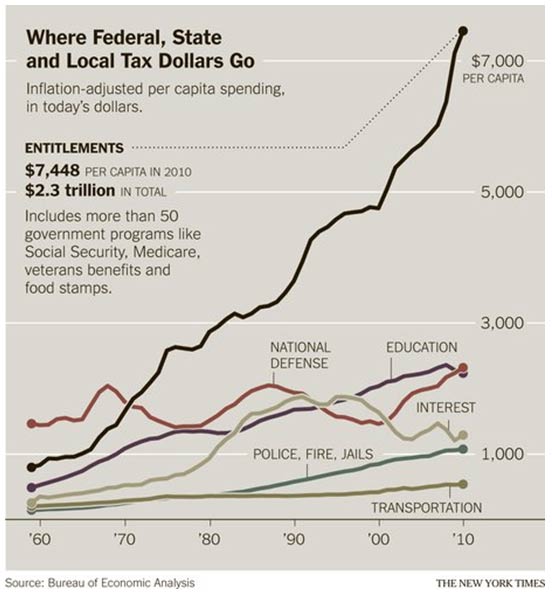
    Some would argue that government is the source of prosperity. Outside of the relatively small government necessary to ensure property rights, this is not true. As the following chart from the New York Times shows, most of government’s increased spending has gone to transfer payments.

    What’s to be done? I’ve argued elsewhere that legal immigration should be increased. That can be done immediately, and it would have immediate impacts. Repeal of Sarbanes-Oxley and Dodd-Frank would also have immediate benefits. Redoing healthcare in such a way that consumption of medical services would be tied to the payment of medical services would help, too. Increasing United States carbon-based energy production would provide an immediate boost.

    In the longer run, government’s share of the economy needs to decline. The least painful way would be to cap inflation-adjusted total government spending, and keep it capped while the economy grows, allowing governments share to decline to, say, 2000 levels. This would require changes to Social Security and Medicare benefits.

    Which brings us back to China. It appears that a large centralized bureaucracy was a significant contributor to China’s decline. It did this through three channels: Central bureaucracies imposed inefficiencies on the economy (just as we saw in the failed USSR). Bureaucracies are also risk averse, which limited China’s upside potential. And, like other bureaucracies, it attracted the best talent.

    This is not to say that the United States is 14th century China, and about to enter into an extended period of decline. But it is to say a cause of the United States sub-par economic performance is its large and growing central bureaucracy.

    Photo by IvanWalsh.com: Museum of Ancient Architecture, Beijing, China

    Bill Watkins is a professor at California Lutheran University and runs the Center for Economic Research and Forecasting, which can be found at clucerf.org

  • The Next Public Debt Crisis Has Arrived

    In July of 2009, while the smoke from the global financial bonfire was still thick in the air, I wrote for this website about another crisis of massive proportions just looming on the horizon: the Global Crisis in Public Debt.

    Three years later, the news of defaults, bankruptcies, debt forgiveness requests, receiverships, and bailouts are in the news every day. Across the globe, sovereign entities – from US cities to European nations – are suffering under staggering debt loads, decimated revenues and intense pressure from the very capital markets that they should be able to turn to for refuge. Last month, Jefferson County, the largest in Alabama, moved forward with their bankruptcy proceedings over the objections of the Wall Street banks. Suffolk County in New York declared a financial emergency. The Financial Times has an interactive map showing all but 12 U.S. states with budget shortfalls for 2012. Eleven U.S. cities, counties and villages have filed bankruptcy since 2008, plus 21 municipal non-government entities (e.g., utilities, hospitals, schools, etc.), according to the Pew Center on the States.

    This crisis for cities, states and nations, like so many other financial crises, has its root in the free flow of credit that existed during the preceding economic boom years. The market prices of assets rose steadily. Rising valuations, especially based on improving revenues from robust economic activity, led to rising income streams for governments. This encouraged governments to borrow more, perhaps often to expand services – and the bureaucracy required to deliver them – and sometimes to improve infrastructure and make capital investments.

    At the same time, rising market prices for financial assets encouraged more savers and investors into the market. In the US, the flow of cash to Wall Street was further encouraged by favorable tax treatment for the earnings on retirement savings and municipal bonds. The steady influx of new money produced an increasing supply of investable funds, which drove demand for sovereign and municipal debt (in addition to the mortgage-backed securities).

    This process was driven more by the financial services industry than the real economy. As of March 5, 2012, the Federal Reserve Bank of New York reported more than $5,000,000,000,000 ($5 trillion) in overnight securities financing – that’s money that makes money but nothing else – that’s more than 20% of US GDP sitting around, not creating jobs, not building infrastructure, just sitting. Since the investment of securities financing is virtually all done electronically, it creates very few jobs. What it does produce is a boost in revenues for bankers – which they can translate into often lavish bonuses.

    The financial sector also adds to its profits from issuance fees, trading fees, underwriting fees, etc. Then there’s “Market Risk Trading,” a euphemism for letting anyone buy a contract to gamble on the probability that Greece won’t be able to repay their debt or that you will miss a mortgage payment. Anyone can buy that contract, even the arsonist next door who has a say in whether or not Greece gets access to capital. In the end it is the borrowers who will suffer the consequences because they will be unable to refinance their debt and the gamblers who will win by withholding financing in anticipation of the insurance payout.

    At the end of June 2009, only Italy, Turkey and Brazil were covered by more credit default swap contracts than JP Morgan Chase and Bank of America.   Goldman Sachs, Morgan Stanley, and Wells Fargo Bank all had more credit derivate coverage than the Philippines.   

    Entered the Top 1,000 for credit default swaps after 2009

    Reference Entity

    Debt as %GDP

    CDS* as %Debt

    Australia

    30.3%

    11.2%

    New Jersey

    7.8%

    11.2%

    New Zealand

    33.7%

    8.6%

    Illinois

    6.8%

    8.2%

    Texas

    3.4%

    6.6%

    Kingdom of Saudi Arabia

    9.4%

    3.8%

    Lebanese Republic

    137.1%

    2.4%

    Arab Republic of Egypt

    85.7%

    1.0%

    *CDS are credit default swaps, financial contracts that pay off if the named (reference) entity experiences a credit event like a ratings downgrade or a missed payment.
    [Abu Dhabi also appears in the 2012 list of the top 1,000 entities named in credit default swaps at DTCC, but debt and GDP data are not available.]

    What was a potential default problem in 2009 has become reality in 2012. In 2009, gross credit default swaps outstanding for the debt of Iceland were equal to 66 percent of GDP, and around 18 percent for Portugal. As these countries struggle with their debt, the global banks – primarily the US banks – sell credit derivatives and stand to collect enormous payments – whether or not the defaulting countries receive any support or bailouts from international donor organizations. The reason is that most credit derivatives contracts pay out on “credit events.” A “credit event” can be something as simple as a downgrade from Moody’s or Standard and Poor’s – whose managers testified before Congress that credit rating changes can be bought. Standard & Poor’s executives admitted in 2008 that they were being forced to relax rating requirements to improve revenues. If, for example, $69 billion worth of credit derivative payoffs are available on a Greek default then how much could the owner of a credit swap afford to pay for a rating change?

    The absurdity of rating Egypt more credit worthy than Australia is only part of the story. The sad fact is that Wall Street banks can sell more credit risk protection than there is credit risk. If all the public debt of a country is $1 billion, it means that country has borrowed $1 billion in public capital markets.  But   Wall Street banks are buying and selling more credit risk insurance than there is credit risk. This is the same problem I wrote about in 2008 that we saw in the Treasury bond market – when you sell more bonds than exist these trades are called “naked” sales or “phantoms”. A similar problem in stocks contributed to the 2008 crash.

    There are more cities, counties, states and nations in financial trouble   According to the Bank for International Settlements, there were $615 trillion in Over-The-Counter (OTC) derivatives contracts outstanding worldwide at the end of 2009. That’s about 9 times global GDP.  In other words, the entire world would have to work for 9 year just to produce enough to pay off the derivatives – before we had a dime left over to pay off the original debts.

    In this environment, the sovereign debt crises may produce something scarier than anything we have experienced in the past. The use of credit derivate products has increased the chance of a default turning into a global catastrophe. It won’t be enough to pay off the debt owed by one of these sovereigns. That payoff will be magnified by the value of the credit derivatives. These derivatives will have a multiplier effect on every sovereign debt default or “credit event.” The table at the end of this article only includes the credit derivatives warehoused with the Depository Trust and Clearing Corporation in the US – there is no source of information on the real magnitude.

    A crisis in sovereign debt would cause problems not just within those nations, states or cities but also for the global financial institutions who sell default protection through the credit derivatives markets. The bankruptcy of Jefferson County (AL) threatens to take down muni-bond insurer Syncora Guarantee (who, by the way, is suing JPMorgan Chase over losses in mortgage-backed securities saying that JPMorgan Chase misrepresented the loans to obtain the insurance). Another such institution was Ambac Financial Group, Inc., which I described in an article published here months before the original prediction of the global crisis in public debt. Ambac – like Berkshire Hathaway – was in the business of guaranteeing the payments of public debt (and mortgage backed securities). Ambac filed for bankruptcy in November 2010.  With Ambac gone, Berkshire is next in line to pay because of Warren Buffett’s credit default swaps.

    Policy makers have had few options available across the globe to combat this crisis. The European Union Commission is attempting to control the amount of credit insurance being sold by limiting the sale of “naked” credit default swaps.  A proposal was approved by the European Parliament on November 15, 2011 to restrict the sale of credit insurance to any buyer who “does not have ownership of the underlying government debt.”    The limited regulation passed by the EU Parliament allows the sale if the buyer has ownership in something vaguely related to the sovereign debt – like allowing the purchase of swaps on Italian government debt if the buyer owns shares of an Italian bank. French President Sarkozy said in January that he would propose “special levies on naked credit default swaps.”  The imposition of fines or taxes (levies) has not eliminated similar activity in stock and bond markets in the US, though it is at least a start which is more than US regulators have done.

    Meanwhile, Federal Reserve Chairman Ben Bernanke and Treasury Secretary Timothy Geithner continue to load the helicopter with dollar bills to finance the payouts with freshly-minted U.S. dollars. They sell us the fantasy of free-market capitalism while laying down a labyrinth of financial rules and regulations allowing a dozen or so politically connected banks to reap the rewards while avoiding the risk of failing, US financial institutions have been placing losing bets through unregulated derivatives markets only to be bailed out as “systemically important” – a euphemism for “too politically connected to fail.” The rest of the world is taking steps to stop the damage. When will the US government step up to the plate?

    Sovereigns named in most credit default protection*
    2009 2012 2009 2012
    Sovereign Entity Debt % GDP Debt % GDP CDS % Debt CDS % Debt CDS change 2008 to 2012*** Region
    REPUBLIC OF ICELAND 23.0% 130.1% 315.2% 40.4% -2,322,155,904 Europe
    REPUBLIC OF ESTONIA 3.8% 5.8% 206.7% 193.4% 844,012,716 Europe
    UKRAINE 10.0% 44.8% 194.5% 28.9% -23,102,981,592 Europe
    REPUBLIC OF KAZAKHSTAN 9.1% 16.0% 144.0% 57.5% -3,440,253,859 Europe
    REPUBLIC OF BULGARIA 16.7% 17.5% 100.6% 112.5% 4,163,215,975 Europe
    REPUBLIC OF LATVIA 17.0% 44.8% 92.4% 62.3% 3,369,945,521 Europe
    BOLIVARIAN REPUBLIC OF VENEZUELA 17.4% 38.0% 80.7% 45.9% 5,646,959,440 Americas
    STATE OF QATAR 6.0% 8.9% 76.4% 55.4% 5,040,787,988 Europe
    RUSSIAN FEDERATION 6.8% 8.7% 72.7% 55.7% 4,966,368,803 Europe
    REPUBLIC OF TURKEY 37.1% 42.4% 56.1% 32.5% -43,726,859,566 Europe
    REPUBLIC OF LITHUANIA 11.9% 37.7% 42.7% 28.8% 3,438,691,822 Europe
    REPUBLIC OF PANAMA 46.4% 41.7% 36.7% 37.1% 989,207,525 Americas
    REPUBLIC OF THE PHILIPPINES 56.5% 49.4% 36.6% 28.8% -10,157,402,334 Asia Ex-Japan
    REPUBLIC OF PERU 24.1% 21.9% 34.1% 41.1% 7,324,285,482 Americas
    ROMANIA 14.1% 34.0% 31.2% 20.6% 6,566,917,982 Europe
    REPUBLIC OF CHILE 3.8% 9.4% 30.9% 21.2% 2,719,694,915 Americas
    IRELAND 31.5% 209.2% 28.2% 22.5% 27,767,560,886 Europe
    UNITED MEXICAN STATES 20.3% 37.5% 23.7% 20.2% 50,658,161,703 Americas
    REPUBLIC OF SLOVENIA 22.0% 45.5% 22.5% 23.0% 3,206,639,043 Europe
    REPUBLIC OF HUNGARY 73.8% 76.0% 21.6% 47.1% 37,403,179,311 Europe
    REPUBLIC OF SOUTH AFRICA 29.9% 35.6% 21.5% 24.6% 17,010,145,334 Europe
    ARGENTINE REPUBLIC 51.0% 42.9% 18.7% 17.2% -2,448,737,614 Americas
    FEDERATIVE REPUBLIC OF BRAZIL 40.7% 54.4% 18.2% 13.0% 14,703,918,548 Americas
    PORTUGUESE REPUBLIC 64.2% 72.1% 15.9% 25.2% 39,897,746,989 Europe
    REPUBLIC OF COLOMBIA 48.0% 45.6% 15.9% 14.9% 1,221,052,625 Americas
    SLOVAK REPUBLIC 35.0% 44.5% 12.8% 19.3% 5,533,166,393 Europe
    KINGDOM OF SPAIN 37.5% 68.2% 11.9% 16.9% 101,554,412,387 Europe
    REPUBLIC OF KOREA 32.7% 22.9% 11.8% 20.0% 22,088,912,724 Asia Ex-Japan
    REPUBLIC OF CROATIA 48.9% 60.5% 11.5% 19.9% 5,612,474,098 Europe
    HELLENIC REPUBLIC (Greece) 90.1% 165.4% 11.1% 13.6% 34,488,989,840 Europe
    REPUBLIC OF INDONESIA 30.1% 24.5% 11.0% 16.1% 13,723,880,843 Asia Ex-Japan
    MALAYSIA 42.7% 57.9% 9.7% 7.8% 4,044,633,137 Asia Ex-Japan
    KINGDOM OF DENMARK 21.8% 46.9% 9.3% 17.2% 12,665,229,924 Europe
    STATE OF FLORIDA 3.2% 17.9% 8.1% 16.8% 2,787,096,121 Americas
    REPUBLIC OF AUSTRIA 58.8% 103.3% 7.9% 21.3% 38,904,764,846 Europe
    REPUBLIC OF ITALY 103.7% 120.1% 7.9% 14.6% 171,818,588,038 Europe
    KINGDOM OF THAILAND 42.0% 45.6% 7.1% 6.5% 1,675,447,429 Asia Ex-Japan
    SOCIALIST REPUBLIC OF VIETNAM 38.6% 54.5% 6.4% 5.9% 3,717,696,305 Asia Ex-Japan
    CZECH REPUBLIC 29.4% 39.9% 6.0% 11.5% 7,793,110,452 Europe
    REPUBLIC OF POLAND 41.6% 56.7% 5.9% 9.7% 25,523,188,448 Europe
    REPUBLIC OF FINLAND 33.0% 49.0% 5.7% 17.3% 12,868,084,419 Europe
    THE CITY OF NEW YORK ** 7.5% 4.3% 8.4% 3,555,950,000 Americas
    STATE OF NEW YORK 4.2% 24.8% 4.3% 5.3% 1,215,398,707 Americas
    KINGDOM OF SWEDEN 36.5% 36.8% 4.1% 15.0% 15,665,446,384 Europe
    KINGDOM OF BELGIUM 80.8% 99.7% 3.9% 15.1% 49,607,728,521 Europe
    STATE OF ISRAEL 75.7% 74.0% 3.4% 7.0% 7,093,224,168 Europe
    STATE OF CALIFORNIA 3.9% 18.3% 3.2% 12.7% 8,068,160,000 Americas
    FEDERAL REPUBLIC OF GERMANY 62.6% 81.5% 2.1% 4.5% 75,770,481,300 Europe
    KINGDOM OF NORWAY 52.0% 48.4% 1.6% 6.3% 5,953,647,323 Europe
    KINGDOM OF THE NETHERLANDS 43.0% 64.4% 1.6% 5.3% 19,494,129,128 Europe
    PEOPLE’S REPUBLIC OF CHINA 15.7% 16.3% 1.5% 3.7% 49,294,027,432 Asia Ex-Japan
    FRENCH REPUBLIC 67.0% 85.5% 1.5% 6.8% 108,226,300,245 Europe
    UNITED KINGDOM OF GREAT BRITAIN
    & NORTHERN IRELAND
    47.2% 79.5% 1.2% 3.6% 51,470,774,560 Europe
    JAPAN 170.4% 208.2% 0.1% 0.8% 67,160,972,268 Japan
    UNITED STATES OF AMERICA 60.8% 69.4% 0.1% 0.2% 19,471,174,892 Americas
    *List from Depository Trust and Clearing Corporation. [www.dtcc.com] Dubai was also on this list, but debt and GDP data were not available.
    **2012 GDP for City of NY was calculated by subtracting all other MSA output from state GDP.
    *** Lower totals may indicate that some credit default swap contracts have been paid off.
    Countries in Italics had not failed to meet their debt repayment schedules before 2008 (Reinhart and Rogoff 2008); Thailand and Korea received IMF assistance to avoid default in the 1990s.


    Susanne Trimbath, Ph.D. is CEO and Chief Economist of STP Advisory Services. Dr. Trimbath’s credits include appearances on national television and radio programs and the Emmy® Award nominated Bloomberg report Phantom Shares. She appears in four documentaries on the financial crisis, including Stock Shock: the Rise of Sirius XM and Collapse of Wall Street Ethics and the newly released Wall Street Conspiracy. Dr. Trimbath was formerly Senior Research Economist at the Milken Institute. She served as Senior Advisor on United States Agency for International Development capital markets projects in Russia, Romania and Ukraine. Dr. Trimbath teaches graduate and undergraduate finance and economics.

    Treasury Department photo by BigStockPhoto.com.

  • This Is America’s Moment, If Washington Doesn’t Blow It

    The vast majority of Americans believe the country is heading in the wrong direction, and, according to a 2011 Pew Survey, close to a majority feel that China has already surpassed the U.S. as an economic power.

    These views echo those of the punditry, right and left, who see the U.S. on the road to inevitable decline.  Yet the reality is quite different. A confluence of largely unnoticed economic, demographic and political trends has put the U.S. in a far more favorable position than its rivals. Rather than the end of preeminence, America may well be entering  a renaissance.

    Just survey the globe. The European Union’s prolonged crisis will likely end in further decline. Aging Japan has long passed its prime, its market share receding in everything from autos to high tech.  China’s impressive economic juggernaut has slowed down, and the Middle Kingdom faces increased social instability, environmental degradation and a creaky one-party dictatorship.

    While the U.S. has its challenges, it is positioned to achieve a more solid long-term   trajectory than its European and Asian rivals. What it lacks, however, is a strong political leadership capable of seizing this opportunity.

    Resources

    Energy constitutes the biggest ace in the hole for the U.S. For almost half a century, an enormous fossil fuel bill that still accounts for 40% of the nation’s trade deficit has hampered economic growth. Now that situation is changing rapidly.

    Due to vast new finds and improved technology to exploit them, the U.S. is now the world’s largest producer of natural gas and could emerge as the leading oil producer by 2017. Reserves of natural gas — a clean-burning fuel — are estimated at 100 years supply and could generate more than 1.5 million new jobs over the next two decades.

    The U.S. agricultural sector is also booming, with exports reaching a record $135.5 billion in 2011. With global demand increasing, sustained growth  will continue across America’s fertile agricultural regions.

    Manufacturing

    The other big game changer is manufacturing. As President Barack Obama recently acknowledged, this is America’s “moment” to seize the industrial initiative. U.S. manufacturers have expanded their payrolls for two straight years, and they have increased production while Japan, Germany, China and Brazil have scaled back.

    A recent survey of manufacturing CEOs revealed that 85% believed production could shift soon from overseas. Both foreign and domestic manufacturers are alarmed about rising wages and labor unrest in China. Some important Japanese, German and Korean companies also have concerns about China’s policies that favor local firms and abscond with investor’s technology.

    Foreign Investment

    Rising foreign investment reflects the new American competitiveness. Since 2008 foreign direct investment to Germany, France, Japan and Korea has stagnated; in 2009 overall investment in the E.U. dropped 36%.

    In contrast, in 2010 foreign investment in the U.S. rose 49%, mostly coming from Canada, Europe, and Japan. Industrial investment rose $30 billion just between 2009 and 2010, while investment in the energy sector more than tripled to $20 billion.

    The Information Sector

    In the information sector, American domination continues to mount, contrary to predictions of decline over the past two decades. Although high-tech manufacturing has shifted largely to Asia, Americans rule the increasingly strategic software sector.   American-based companies, who constitute more than two-thirds of the world’s 500 largest software companies, including  nine of the top ten.

    Outside the U.S., there are no significant equivalents of Apple, Google, Microsoft, Amazon and Facebook. Hollywood, for its part, rules the entertainment world, producing 40% of world’s audiovisual exports, a dominion that troubles China’s President Hu Jintao, who recently complained  that the “cultural fields” represent “the focal area” for Western “infiltration”.

    Demographics

    The Great Recessionhas slowed population growth everywhere, but the U.S. maintains the   youngest and most vibrant demographic profile of any advanced country. Between 1980 and 2010, the U.S population expanded by 75 million to over 300 million. In contrast many European countries, including Germany, have suffered stagnant growth, while in Russia and Japan populations have already started declining.

    The disastrous fiscal implications of slow or negative population growth are evident in Greece, Spain and Italy, all of which suffer among the world’s lowest fertility rates. Rapid aging also will soon catch up with Germany. By 2030, Germany will have 48 retirees for every 100 workers — that’s barely two workers per retiree. The numbers are even worse in Japan: 53 retirees for every 100 workers by 2030.

    Political Factors

    Given the ineptitude of the last two administrations, enthusiasm about America’s political system is hard to justify. But our constitutional systems of laws and checks on central power remain a critical advantage. Immigration has declined with the recession, but the U.S. can expect to welcome religious and political exiles — such as Middle Eastern Christians displaced by   the “Arab Spring” — as well as Greeks and Irish fleeing Europe’s economic decline.

    Many from Russia and China are seeking to immigrate to the United States, Canada or Australia in order to protect property or just live a freer life. Indeed, among the 20,000 Chinese with incomes over 100 million Yuan ($15 million), 27% have already emigrated and another 47% have said they were considering it, according to a report by China Merchants Bank and U.S. consultants Bain & Co. published in April.

    Needed from Washington: A New American Strategy

    Sadly no leading politician or political party seems ready to   embrace the country’s new strategic advantages.  Many on the left may find the very notion distasteful, having    swallowed declinism with their academic mother’s milk. The president himself dislikes the notion of American “exceptionalism.” Many key Obama backers like SEIU boss Andy Stern and former auto czar Steven Rattner, embrace the superiority of China’s authoritarian system. Others embrace Europe and even Japan as models for an aging superpower.

    Worse still: Some Obama policies work against the well springs of national resurgence.   Threats to raise income taxes on families making over $250,000 directly threatens the aspiring entrepreneurial class more than the real “rich” whose fortunes are protected by low capital gains taxes and family trusts. Most critical: The administration’s hostility to fossil fuel represents a direct threat to the country’s greatest new source of advantage and threatens to strangle America’s recovery in its infancy.

    Not that the Republicans are any less clueless. Many reject the infrastructure needed by an expanding economy — ports, roads, bridges as well as worker training and support for basic research — as mere “pork.” Budget restraint and fiscal discipline are important, but preparing the country for more rapid economic growth requires an active, supportive government.

    Republicans also tend to view immigration as something akin to a hostile invasion. Yet many key industries — notably manufacturing and high tech — rely heavily on immigrant entrepreneurship, intelligence and work values. Running against immigration constitutes an assault on the nation’s increasingly diverse demographics.

    So this is where we now sit.  With all the essential elements for a strong, sustained recovery place, the big question is whether we will find political leaders capable of tapping this country’s phenomenal potential.

    This piece originally appeared at Forbes.com.

    Joel Kotkin is executive editor of NewGeography.com and is a distinguished presidential fellow in urban futures at Chapman University, and contributing editor to the City Journal in New York. He is author of The City: A Global History. His newest book is The Next Hundred Million: America in 2050, released in February, 2010.

    Photo from BigStockPhoto.com.

  • Citibank, Citizen Wriston, And The Age of Greed

    Robert Sarnoff , the CEO of RCA before it was absorbed by GE, once said, “Finance is the passing of money from hand to hand until it disappears.” That process is very clearly defined in The Age of Greed by Jeffrey Madrick. It recounts, in concise terms, how a few dozen individuals—some in the private sector, some in government–brought us to our current economic pass, in which finance seems to have been completely detached from life. Names from the past come back, and their crimes are explained. Ivan Boesky, Michael Milken, and Dennis Levine look guiltier in the retelling than they did in the newspapers at the time. And in this telling, the philosopher king of the new finance was Walter Wriston, CEO of Citicorp.

    I wrote for Wriston and other senior managers of Citibank from 1980 through his retirement in 1984, and for his successors through 1991. My colleagues and I were charged with helping Wriston make the case that the financial regulatory regime that was put in place during the Depression was obsolete. Let me make it clear: I was a footnote, although I occasionally run into old acquaintances who still shake their fingers at me.

    Madrick’s Wriston is by far the book’s most compelling character. As with all the other subjects, there’s a smattering of armchair Freud, although most of the political figures who make appearances here escape their two minutes on the shrink’s couch. Wriston’s psyche was more interesting than the insecurities of Ivan Boesky and Sandy Weill, to name just two; his university-president father Henry Wriston despised the New Deal as it was happening, and imparted that attitude to the son. Henry then remarried too quickly after Walter’s mother died for the son’s taste, and they became estranged.

    But there’s more to Wriston than you read in Madrick. He was a restless intellect, impatient with field of diplomacy he had studied for before World War II, and after taking a job in banking, which he once wrote seemed like, “the embodiment of everything dull,” found a vehicle for exerting his imagination, and then for fulfilling his ambitions. The First National City Bank, later to become Citibank and Citicorp, and then Citibank again, had inspired imperial dreams before. Through a series of mergers it became the biggest bank in the biggest city in the country. When trade followed the flag around the world, Citibank’s precursors were right there with it. During the Roaring Twenties, Charles Mitchell dreamed of a “bank for all”, the forerunner of Wriston’s vision of one-stop banking, although Mitchell’s stewardship ended with a trial (and an acquittal) after the stock market crash and the Pecora hearings in the early ‘30s. While the bank had social register threads running through its history—when Wriston started the president was James Stillman Rockefeller, descended both from the Stillmans and the Rockefellers, married to a Carnegie—the patrician elements always had hungry outsiders around to push the envelop of banking practice. When Rockefeller was chairman, he had a president named George Moore, and Wriston was his protégé. However, Moore was too frisky for Rockefeller, and when a successor was chosen, it was Wriston.

    Wriston hung a portrait of Friederich Hayek on the wall of his office. He was a reader. When Adam Smith became the Holy Ghost of the Church of Deregulation, Wriston’s top writer (and later my boss) was the man who actually edited The Wealth of Nations for the Great Books. When I was new there, I asked one of the bigshot corporate bankers which great thinkers he liked to quote in his speeches. He answered, “The only person who can get away with that is Walt Wriston, and I’m not sure he can.” Wriston’s ambition may have been shaped by philosophy, but he achieved it with tactics and strategy that sprang from a contrary nature as much as by the force of his ideas, and Madrick recounts that. He wanted his bank to be valued like a growth stock, and promised analysts 15% a year return on equity—not a recipe for safety and soundness.

    Whether it was inventing financial instruments to get around interest rate restrictions, making outsize bets on railroad bonds and New York City bonds, creating the Eurodollar market, blitzing the country with credit cards, or wholesale lending to developing countries to recycle petrodollars, Wriston had a knack for making money when the economy was right and then challenging the government to deregulate in time to accommodate his losses. Personally, I think that before the bank was too big to fail, it was too big to succeed.

    Looked at now, there’s something quaint about these investments. At least they had to do with real things, like trains, oil, municipal governance, and the ostensible aspirations of people in emerging markets, although they were mostly oligarchs and autocrats. In Madrick’s account, Wriston was dismissive of the government’s capacity to efficiently recycle petro-dollars, among many other things, and contended that his loan officers knew more about their corporate customers than anyone else did, which would enable them to safely make riskier loans than capital standards would permit. We all know how that turned out.

    Wriston was a real visionary. To underscore his then-revolutionary idea that information about money was as important as money itself, he bought a transponder on a satellite to carry the bank’s data stream, and then put a satellite on the cover of the annual report. Theoretically, all that proprietary information made it hard to hide bad news about a company’s finances or a country’s; executives and prime ministers beware of poor management! He was undoubtedly the first bank CEO to anticipate what Moore’s Law—quantifying the exponential growth of computing power—would mean to business and society. Unfortunately, that power is exactly what enables the hollow finance we have today.

    Reading Madrick’s book was like watching my life pass before my eyes, including the parts I slept through, and it certainly brought me up to date on events that happened long after my eyes glazed over.

    It reminded me that when Wriston ran it, Citibank was fun to work for, as jobs in tall buildings went. My closest colleagues were well-educated and witty refugees from college faculties. The bank’s historian worked closely with us, and we learned the secrets that never made it into the deadly official history, such as the fact that one of Wriston’s predecessors kept a house in Paris, where he was known among the haute couturiers as le bonbon, or that when the Titanic went down, some hard-money banker had written to customers that there was good news—the loss of all the paper currency aboard would strengthen the dollar. Wriston set the tone: History counted, an attitude that wouldn’t survive the cost-cutting that came later. Wriston was renown for his sharp needle, but when I found myself in his office with the portrait of Hayek staring down, he seemed to enjoy the relief from the routine pressures of his job. I always had some kind of bleeding heart question based on current events, and he always had a sharp, witty retort.

    He was also a citizen. When the City of New York had its own financial collapse in 1975 (“Ford to City: Drop Dead”), Wriston represented the commercial banks on the committee charged with rescuing the city’s finances. One of the bank’s economists assigned to work with him saw the beating Wriston took every day at the hands of the municipal unions and asked why he carried on. He answered, “Because I live here.” I wish some of the new financiers who have benefited from the work Wriston did would exhibit some evidence that they felt that way about the city. About the country. About the world.

    Photo: Bigstockphotos.com; the old Citibank and newer Citicorp buildings.

    Henry Ehrlich no longer writes for bankers, although he still likes money. He is editor of
    www.asthmaallergieschildren.com, and co-author of Asthma Allergies Children: a parent’s guide.

  • The U.S. Needs to Look Inward to Solve Its Economy

    Over the past months as the global economy heads for another recession, U.S. lawmakers have done their best to deflect blame by focusing on various external forces including the most popular straw-man of the day: China’s currency.

    Almost every year for the last few years, Congress and the White House have pressed China to revalue its currency, the renminbi. And every time this happens, China responds that it will do what it always does: let it appreciate gradually, at about 5% per year as it has done for the last several years.

    With the APEC Summit in Honolulu last month, Obama and the White House strategically — and perhaps with an eye to the coming re-election campaign —prodded at China and also managed to further deflect America’s problems by focusing attention on the Eurozone Crisis. Timothy Geithner, tailoring his speech for the Asia-Pacific audience, said Europe needs to “move quickly as instability hurts the U.S. and Asia.”

    Geithner, the godfather of “too big to fail” from his days at the New York Fed, is an expert at delivering economic policy speeches that do not address America’s problems head-on. He is the mouthpiece of American weakness and misdirection, and has been recently seen so not only in China, but in Europe where people scoff, understandably, at the very idea of his giving advice to the bedraggled Eurozone.

    The fact is that, right now, the US cannot dictate the conditions of economic gain. Although still the world’s largest economy by far, the US can no longer impose its mantra of ‘free-trade’ on the rest of the world.  Instead it needs to take an honest look at the reality of the 21st Century global marketplace to better assess what it can do to improve its situation. The following suggestions might be a good start:

    Forget About Economic and Political Ideologies

    Many Americans, including politicians, are under the impression that certain ‘isms’ are magic bullets for prosperity while other ‘isms’ hold prosperity back. For instance, conservatives like to use the talking point that ‘socialism’ will destroy America. Similarly, many of those on the left protest against as what they see as ‘capitalism’ leading to widening inequality. Being for or against a particular ‘ism’ does nothing to improve the economic situation but only serves to inflame rhetoric and kill policies that could potentially help the U.S. economy.

    One example is domestic government investment. Conservatives detest any kind of public spending proposal as ‘socialism’, even if public funds would be used for practical things like improving roads or public schools. On the other side, those on the left confuse high-level collusion between the financial sector and federal government with free-enterprise, which it is not.  Geitner is not a capitalist, but a collusionist. He is no more a free-market capitalist than he is a Maoist.

    Stop Blaming China

    Nothing else debunks the validity of mainstream political and economic ideologies better than China’s rise to economic prominence. Still considered a ‘communist’ state by Cold-War minded individuals, China’s development would be best described as a gradual evolution in policy decisions rather than a static, ideologically-based approach. To be sure, the Communist Party desire to stay in power remains paramount. But this leads to policies designed to keep the economic engine humming as a way to maximize social stability.

    Despite its advances, China still has tremendous obstacles to overcome including a still very low per-capita GDP and an environment polluted from industrial development. Yet it is the height of hypocrisy for the U.S. government to call out China on its currency manipulation and intellectual property theft when U.S. companies have benefited enormously from China’s opening up of the past three decades. This also has allowed U.S. consumers buy coveted products at low prices.

    Of course, politicians at the Federal level (and even some Republican Presidential candidates) talk tough on China to score brownie points with voters. But meanwhile local state and city governments as well as prominent business leaders continue to send delegations to China in droves to promote cooperation and trade. Yes, China’s competitive cost of labor and lack of regulations has had a direct impact on the loss of jobs in the U.S. Unfortunately forcing China to float its currency will not reverse this trend as manufacturing jobs move to lower cost locales, and will continue to do so, perhaps to other countries.

    Acknowledge That Not All Regulation Is Created Equally

    Conservatives love to point the blame for economic malaise on government regulation. This argument is only half correct. For one thing there is not enough regulation on large banks in terms of how they divert investments when huge recent profits can be traced largely to fiscal largesse from Washington. Large banks received huge stimulus injections from the Federal Reserve during QE I and II, but did not invest enough of that money into the domestic economy. Instead, investment banks were free to take that money wherever maximum returns were to be had. That’s fine for an investor who has made his own way, but when the bank profits have stemmed from taxpayer largesse, some other priorities should creep in.

    At the state and local municipal levels, regulation is perhaps the greatest roadblock to restoring economic prosperity. Crippling state and local taxes, along with outdated zoning regulations – such as restrictions on something as simple as running a business from one’s own home – slow enterprise formation. This is not to mention the cost of obtaining permits from various authorities and the constant threat of lawsuits. Clearly the pendulum – at least in some states such as California – has swung too far in the wrong direction. Unfortunately, given ubiquitous budget shortfalls across state and local levels, it is unlikely that local governments will be willing to decrease taxes and fees when they are in desperate need of revenue generation.

    Reassess the American Social Contract

    Conservatives balk at any mention of social programs, yet they fail to acknowledge that American corporate institutions no longer play the role they once did in promoting social stability. Across the board, businesses are understandably cutting retirement and healthcare benefits just in order to survive. America’s broken social contract is perhaps the greatest obstacle to restoring prosperity and economic growth.

    Politicians are under the impression that high-taxes and runaway government spending are the primary cause for economic malaise. The reality is that America’s economy lags because individual spending is paralyzed due to increased costs of living across the board. The costs of housing, healthcare, and higher education have all increased in the past 10 years while wages and job opportunities have stagnated. This paralyzes risk-taking and investment in new businesses. Not only that, the presence of large oligopolies in everything from high-tech and cellular phones to food processing work to reduce competition from  entrepreneurial upstarts.

    Conclusion

    The U.S. needs to stop looking at external factors as the source of its problems. Instead, American leaders should look inwards and take an honest assessment of the current problems resulting from the changes in the world over the past 20 years.

    Unfortunately, no one on either side of the political aisle seems willing to step forward and lead the country out of its predicament. The Republican presidential contenders continue to waste time bickering about irrelevant social issues while President Obama jet sets around the world trying to allay doubts about the country’s decline.

    America needs a concrete plan to get up and running again. This will mean more regulation at the macro level and less regulation at the lower levels. It will mean that Americans need to be confident that basic needs like housing and healthcare are taken care of so they can get on with starting businesses and creating employment. Education needs to promote trade skills and remove the stigma that expensive college degrees are mandatory for future prosperity.

    Until these things happen, the U.S. economy will be stuck in its rut.

    Adam Nathaniel Mayer is an American architectural design professional currently living in China. In addition to his job designing buildings he writes the China Urban Development Blog.

    Photo courtesy of Bigstockphoto.com

    .

  • Suppressing the News: The Real Cost of the Wall Street Bailout

    No one really knows what a politician will do once elected. George “No New Taxes” Bush (George I to us commoners) was neither the first nor will he be the last politician to lie to the public in order to get elected.  It takes increasing amounts of money to get elected. Total spending by Presidential candidates in 1988 was $210.7 million; in 2000 it was $343.1 million and in 2008, presidential candidates spent $1.3 billion. Even without adjusting for inflation, it’s pretty obvious that it takes A LOT MORE MONEY now. For those readers who are from the Show Me state, $210.7 million in 1988 is equivalent to roughly one-third of the buying power used by Presidential Candidates in 2008.

    When Texas Governor and presidential hopeful Rick Perry told Iowan voters in early November, “I happen to think Wall Street and Washington, D.C., have been in bed together way too long,” it made headlines for Reuters and ABC . But that’s not news; that’s advertising. News, according to Sir Harold Evans, is what somebody somewhere wants to suppress. News Flash: The average member of Congress who voted in favor of the 2008 Bank Bailout received 51 percent more campaign money from Wall Street than those who voted no – Republicans and Democrats alike. That’s according to research by Center for Responsive Politics and was reported as news by the OpenSecrets.org blog on September 29, 2008.

    In other news fit to be suppressed, the Federal Reserve "provided more than $16 trillion in total financial assistance to some of the largest financial institutions and corporations in the United States and throughout the world." This was revealed in an audit of the Federal Reserve released in July 2011 by the Government Accountability Office. All the goods and services produced in the United States in the last twelve months are worth about $14 trillion – Ben Bernanke and Timothy Geithner spent more than that to bailout Wall Street in twelve months! This is news, news that Bloomberg and Fox Business Network had to file lawsuits to get access to and that Bernanke and Geithner want to suppress.

    The answer to the differences in the value of the bailouts – it was “only $1.2 trillion” according to Bernanke – can be found in the GAO’s audits.  The latest audit of the TARP, released November 10, 2011 makes it clear: “In valuing TARP …, [Office of Financial Stability] management considered and selected assumptions and data that it believed provided a reasonable basis for the estimated subsidy costs …. However, these assumptions and estimates are inherently subject to substantial uncertainty arising from the likelihood of future changes in general economic, regulatory, and market conditions.” [emphasis added]. TARP is under Treasury – which is run by Geithner – and is headed up by Timothy Massad, formerly of Cravath, Swaine & Moore LLP in New York …[still following this?]…, who represents Goldman Sachs, Morgan Stanley, etc. as underwriters for (among other things) European public debt. Cravath, Swaine & Moore advised Citigroup on their repayment of TARP funds and Merrill Lynch in their orchestrated takeover by Bank of America.

    The dispute about the cost of the bailout is not the stuff of conspiracy theories. This is basic finance and economics,  not accounting. In accounting, debits and credits balance at the end of the day; in finance, you get to assume rates of return, costs of capital, etc., etc. – a lot of stuff that has much room for judgment. It is in the area of judgment that Bernanke and Geithner are able to make their numbers look smaller than those added up by Bloomberg and Fox. The GAO, on the other hand, should have no dog in this fight and therefore should (we live and hope) give us the right stuff to work with. GAO says (in a nice way) that Geithner has been fiddling with the numbers.

    The GAO had been recommending to Congress that they get audit authority over the Federal Reserve System at least since 1973. They finally got that authority in the Wall Street Reform Act of 2010 – about the only piece of that legislation that has so far resulted in anything of substance. The Center for Responsive politics also did an analysis of the campaign contributions for Senators who opposed the financial regulatory reform bill in 2010. Those opposing the reforms got 65 percent more money from Wall Street banks than those voting for the bill.

    For politicians, it doesn’t matter who votes for them. They will figure out what they need to say to get the money to get the votes to get elected. What they need most – and what makes them Wall Streetwalkers – is the money. The big donors don’t care who they give to, as long as the one they give to gets elected. According to Federal Election Commission data, Warren Buffett gives money almost exclusively to Democrats; Donald Trump likes to spread it around between the parties, as do Goldman Sachs employees. But that’s only the money that can be traced back to a source, unlike the opaque donations given to PACs and SuperPACs.

    The revolving door between Wall Street and Washington swings both ways. When John Corzine departed Goldman Sachs he left Hank Paulson in charge in 1999. Investment Dealers’ Digest reported that Corzine left Goldman “against a backdrop of fixed-income trading losses.” Corzine won a Senate seat in 2000 (D-NJ).  He was then elected Governor of New Jersey in November 2005, where he put forth Bradley Abelow for state Treasurer. Abelow worked with Corzine at Goldman and was a former Board member at the Depository Trust and Clearing Corporation, the world’s largest self-regulatory financial institution. Together, Corzine and Abelow later went on to run MF Global into bankruptcy. Both have been invited back to Washington, the first time a former Congressman has been called to testify before a Congressional Committee. Wherever they get started, Washington and Wall Street tend to end up in bed together.

    It’s this kind of knowledge that makes me question why I should vote at all. Congressmen from both parties are generally for sale. Even with self-described liberals in Congress, right-wing conservatives could get approval for everything they want – free-for-all-banking and the US military engaged in active combat.  It’s the taxpayers – the mothers, fathers and families of service men – who suffer. Sure, Barack Obama took more money from Wall Street than John McCain – but it was only $2 million more, hardly enough to run one ad campaign in a big state.

    Then I pause and remember what my mentor, Rose Kaufman, from the League of Women Voters of Santa Monica told me: if you don’t vote, you open the door for someone to take away your right to vote.  The benefit of living in a democracy with freedom of the press is that you can find out all those things that Washington and Wall Street “want to suppress.” Whether or not we have good choices among the presidential candidates, we have choices.  It’s better than nothing.

    Susanne Trimbath, Ph.D. is CEO and Chief Economist of STP Advisory Services. Her training in finance and economics began with editing briefing documents for the Economic Research Department of the Federal Reserve Bank of San Francisco. She worked in operations at depository trust and clearing corporations in San Francisco and New York, including Depository Trust Company, a subsidiary of DTCC; formerly, she was a Senior Research Economist studying capital markets at the Milken Institute. Her PhD in economics is from New York University. In addition to teaching economics and finance at New York University and University of Southern California (Marshall School of Business), Trimbath is co-author of Beyond Junk Bonds: Expanding High Yield Markets. She participated in an Infrastructure Index Project Workshop Series throughout 2010.

    Follow Susanne on Twitter @SusanneTrimbath

    Photo by Kay Chernush for the U.S. State Department

  • Occupy Wall Street: About D@%& Time!

    "Privileged people don’t march and protest; their world is safe and clean and governed by laws designed to keep them happy. I had never taken to the streets before; why bother? And for the first block or two I felt odd, walking in a mass of people, holding a stick with a placard…" Michael Brock in John Grisham’s The Street Lawyer (Doubleday, 1998).

    I’ve been waiting for three years for Americans to get out in the street and protest the actions that created the Financial Crisis that sparked the Great Contraction. As ng.com frequent commenter Richard Reep put it back at the beginning: “What happened to people’s outrage? Where are the torch-bearing citizens marching on Washington?” If some third-world leader had pillaged the national treasury on their way out of town the way Hank Paulson did – with the full and enthusiastic support of New York Fed chief and now Treasury Secretary Timothy Geithner – when he convinced Congress to spend $750 billion to bailout the Wall Street banks, there would be angry mobs, riots and possibly UN Peacekeepers.

    Three years later, all we can muster is a sort of hippy sit-in – but I’ll take it! It’s better than letting it run over us, drip-by-drip, until there is no middle in our increasingly bifurcated economy.

    Let me summarize what 99% of Americans should protest. It started in the early 2000s with good intentioned policies directed toward leveling the playing field by re-designing consumer credit ratings to allow more Americans to own homes. The move was embraced by Mike Milken and his followers as a way to further the cause of The Democratization of Capital – oddly enough, an idea born out of the outrage of the Watts Riots of August 1965.

    Republicans and Democrats alike joined in the movement and a great boom in home prices was born. Expanding homeownership opportunities, especially for minorities, was a fundamental aim of the Bush Administration’s housing policy, one strongly supported by Democrats in Congress. Then everyone got greedy, including wanna-be real estate moguls who started flipping houses instead of working for their living.

    Banks that were writing mortgages soon turned to securitization – bundling mortgages into bonds called mortgage-backed securities – so they could use the proceeds to lend more money to subprime borrowers. The banks were collecting fees at every step. They charged fees for making the mortgage loan and for putting together the bond deal; then they charged commissions for trading the bonds. The interest paid on the bonds was high because the interest charged on the mortgages was high – after all, these were less-than-credit worthy borrowers by traditional standards.  The banks wanted to be compensated for taking the risk – even though they were selling the risk to someone else. It was all about making money on money and eventually demand overtook supply. But that didn’t stop Brother Banker!

    According to a story on PBS (originally aired November 21, 2008), managers at Standard & Poor’s credit rating agency were pressured to give mortgage bonds triple-A ratings in the pursuit of ever higher fees. In essence, the banks paid credit rating agencies to get triple-A ratings for their mortgage bonds so that insurance company and pension fund money could be added to the scheme. Insurance companies and pension funds are highly regulated in order to protect investors who rely on them for compensation in disasters and retirement.

    If the bank couldn’t get the top credit rating for some mortgage bonds, they turned to selling an unregulated kind of insurance called Credit Default Swaps. The swaps became so popular that people who didn’t even own the bonds were buying the swaps. Eventually, there were more credit default swaps than there were bonds – and the banks were making fees on top of fees with no incentive to stop. In the end, there was more money to be made in mortgage defaults than mortgage payoffs and some banks even stopped taking mortgage payments to force the defaults. It was a little like the failing businessman who burns down his own shop because he can make more on the insurance than he can trying to sell it.

    When the swaps came due, companies like AIG collapsed under the pressure of the payments – and American taxpayers were left holding the bag. Using your insurance and pension benefits to create their bonfire, Wall Street staged a weenie-roast! Two years ago you could have purchased all the common stock of Lennar Homebuilders for $1.2 billion – but if they went bankrupt you could collect $40 billion on the swaps. (The European Union fixed this problem in their markets – the US did not.) Like any Ponzi scheme, this one also required that “new money” continue to flow in so that the early investors could receive payouts – hence the need to get your benefit money invested in these things. When Uncle Sam took 80% ownership of AIG in Hank Paulson’s bailout scheme, again approved by our current administration’s financial geniuses, the US Treasury in combination with the Federal Reserve provided an unlimited source of new money. THAT is what you should be protesting today because it can – and probably will – happen again.

    Critics of the protesters like to equate Wall Street with all the companies that create jobs. This ignores how the stock market works. The only time that a company gets money from its stock is in the initial public offering. Those shares are mostly sold to syndicates, underwriters, and primary dealers, not the general public. What happens day in and day out on Wall Street is simply stirring the pot. When the company’s stock goes up, it is the next seller and his broker that make money, not the company. The stock market should have everything to do with jobs. When households have excess earnings – more money than they need for their expenses – they make savings deposits or investments in the stock market through banks. Banks channel savings from households to entrepreneurs and businesses. Entrepreneurs use the money to create new businesses which employ more people, thus increasing the earnings that households have available for savings and investment, which would bring the process fully around the virtuous circle. But Wall Street doesn’t exactly do that anymore. It just makes jobs for Wall Street.

    The other argument is that the problem isn’t Wall Street, it’s the government. Anyone who thinks that only one or the other is to blame doesn’t understand how politics is financed. According to the MAPLight.org’s analysis, Senator Barack Obama’s presidential campaign received more money in 2007-2008 from Wall Street than anyone else, but it was only $2 million more than the $22,108,926 that went to Senator John McCain.

    Blame the government and blame the Wall Street banks that sponsor their political campaigns – they are blaming each other anyway. The occupy protestors – with the possible exception of the violent black band anarchists – are not the perpetrators we need to put in handcuffs.

    The sad fact is that nothing in Washington, D.C. or Wall Street, NYC has changed since that day in September 2008 when Hank Paulson told Congress that the world would end if they didn’t give him $750 billion to spread around Wall Street. For many people, like a Michael Brock, it takes a life-changing event to make you look at the truth all around you. Fixing our broken financial markets requires systemic reform of a great scale.  

    I think a lot of people who joined the 2008 tea parties – myself included – thought we were mounting a petition against bank bailouts and the misuse of public funds. The U.S. Government Accountability Office audit of the Federal Reserve, released in July 2011, proves that petition failed. Call your Representative, write to your Senator, and show up for the #Occupy or Tea Party events in your city. Like Michael Brock, you may find yourself savoring the exercise in civil protest.

    A version of this article appeared in the Omaha World Herald on November 4, 2011.

    Susanne Trimbath, Ph.D. is CEO and Chief Economist of STP Advisory Services. She participated in an Infrastructure Index Project Workshop Series throughout 2010. Her training in finance and economics began with editing briefing documents for the Economic Research Department of the Federal Reserve Bank of San Francisco. She worked in operations at depository trust and clearing corporations in San Francisco and New York, including Depository Trust Company, a subsidiary of DTCC; formerly, she was a Senior Research Economist studying capital markets at the Milken Institute. Her PhD in economics is from New York University. In addition to teaching economics and finance at New York University and University of Southern California (Marshall School of Business), Trimbath is co-author of Beyond Junk Bonds: Expanding High Yield Markets

    Occupy Wall Street Photo by Paul Stien.

  • The Die-Hard Recession Heads Off The Charts

    “By 1970, the governments of the wealthy countries began to take it for granted that they had truly discovered the secret of cornucopia. Politicians of left and right alike believed that modern economic policy was able to keep economies expanding very fast — and endlessly. That left only the congenial question of dividing up the new wealth that was being steadily generated.”

    Those words, from a Washington Post editorial more than twenty-five years ago, echoed the beliefs not only of politicians and the press, but of mainstream economics professionals resistant to the idea that growth in a market economy would ever stagnate over a protracted period.

    And some of the data did fit nicely. Through several recessions and recoveries, inflation-adjusted GDP rose almost in tandem with a line of predicted growth expectations. But in November 2007, something changed. Real GDP dropped down from what was expected by more than 11 percent, and, as this summer’s data has shown, it hasn’t returned to its pre-recession trend.

    The unusual slump has provoked a stream of commentary that attempts to define the problem, but it hardly matters whether the downturn is identified as the second dip of a ‘double-dip’ recession, a continuation of the ‘Great Recession’, a fast-moving slowdown, a slow nosedive, a long-term stall-out, or a confirmation that the economy has entered a Japanese-style ‘lost decade’. Growth during the 21st century is following a different trend line than it did in the 20th, and employment is also responding in new, different ways from earlier post-World War II recessions.

    A range of additional data also indicates that what we’re hearing is not the regular breathing of an economy as it contracts and expands. Annual growth rates and quarterly moving averages — when examined starting in the mid 1970s, as Greg Hannsgen and I did at the Levy Economics Institute — show a steady decline beginning in 2000.

    And the employment numbers make the case yet again. Look at the graph below, with separate lines for the past six recessions. It traces employment-to-population ratios, beginning with the first month of each recession. These ratios are used to measure, among other things, how well a nation utilizes its workforce— a kind of labor drop-out rate.

    You can see at a glance that the pink line indicating the current recession — yes, that one down near the bottom of the chart — is an outlier in the group. It shows that by the 43rd month of the downturn, the ratio stood at just over 58 percent, meaning that 58 percent of the population was employed. That figure is 4.6 percent less than at the recession’s start, when more than 62 percent were working. And it means that this employment decline is steeper, deeper, and longer than in any of the previous five recessions by a long shot.

    Even in the two worst recoveries during the past forty years, this ratio never before declined by more than three percent. By the time the five recessions were this far along, employment had returned either to pre-recession levels, or to a distance from the recession’s start that was, at worst, two percent, compared to the current more than four percent.

    Together, this data makes the case that we’re in a prolonged slump that’s highly unusual, and requires action that’s far more aggressive than the usual responses. Job creation should be the government’s urgent, first priority. The nation needs to recognize just how perilous the employment disaster is — and what a marked departure this recession is from any we’ve seen in the modern era.

    Dimitri B. Papadimitriou is president of the Levy Economics Institute of Bard College, and executive vice president and Jerome Levy Professor of Economics at Bard.

    Photo by mangpages: Recession 1