Tag: Financial Crisis

  • Citizen Bloomberg – How Our New York Mayor has Given Us the Business

    This piece originally appeared in the Village Voice.

    After a charmed first decade in politics, Mayor Mike Bloomberg is mired in his first sustained losing streak.

    His third term has been shaky, marked by the Snowpocalypse, the snowballing CityTime scandal, the backlash to Cathie Black and “government by cocktail party,” and the rejection by Governor Andrew Cuomo of his plan to change how public-school teachers are hired and fired. With just a couple more years left in office, Bloomberg is starting to look every one of his 70 years.

    Soon, he’ll be just another billionaire.

    The mayor’s legacy is remarkably uncertain—largely because he’s done his best to keep New Yorkers in the dark about what it is he’s really set out to do in office.

    In part, this is because the mayor has been far more effective at selling his Bloomberg brand than in getting things done. But it’s also because what he has done—remaking and marketing New York as a “luxury city” and Manhattan as a big-business monoculture—he prefers to discuss with business groups rather than the voting public.

    Withholding information while preaching transparency is a Bloomberg trademark. He aggressively keeps his private life private—meaning not just his weekends outside the city at “undisclosed” locations, but also his spending, his charitable giving, and his privately held business.

    New Yorkers who have received city, campaign, or Bloomberg bucks in one form or another and who expect to do business again in the future agreed to speak anonymously with the Voice about the mayor’s personality, the intersection of his political and private interests, and the goals he aims to achieve.

    Several sources agreed to speak only after hearing what others had said. “It’s Julius Caesar time,” said one source. “There’s lots of knives, but no one wants to be first.” Others refused to be quoted, but encouraged me to give voice to their complaints—which sometimes diverged but often built into a sort of Greek chorus, an indictment of Bloomberg’s mayoralty from those who have seen it in practice, and are vested in it.

    “Hanging out with a billionaire does bad things to your brain,” a source said. “It makes you think you’re right.”

    The candidate who first ran in 2001 on his private-sector résumé and a deluge of advertising never did bother telling voters much about his agenda.

    He pledged in that first run not to raise taxes and to step away from the daily running of his private company if elected to public office, but he brushed aside both vows after the election. In the case of his business, he claimed to have kept his word until his own testimony in a lawsuit unsealed in 2007 showed that he’d been far more active than he’d previously acknowledged.

    The vast redevelopment schemes he unveiled in office were never mentioned on the stump.

    New Yorkers have no trouble picturing Giuliani’s New York, or Dinkins’s “gorgeous mosaic,” or Koch’s “How’m-I-doing?” New York, or Beame’s bankruptcy, or Lindsay’s “Fun City.”

    After two full terms and change, what do you call Bloomberg’s New York? In many ways, the mayor has been merely a caretaker.

    While Bloomberg has called himself the “education mayor,” his claimed success with the public schools has been exposed as largely accounting tricks.

    When asked to describe the boss’s vision for the city, aides and allies tack post-partisanship on to a checklist of Bloomberg LP buzzwords: transparency, data-driven results, and a CEO fixed on the bottom line. Pressed for actual accomplishments, the city’s post-9/11 resurgence usually is mentioned first.

    The attack and its economic fallout played key roles in all three of Bloomberg’s runs, though the story has less to do with strong leadership than with good timing and salesmanship.

    The attack itself, along with his opponent Mark Green’s fumbled response to it, helped put Bloomberg over the top in 2001. The ensuing Fed-sponsored low-interest-rate bubble inflated New York’s markets just in time to help rescue the mayor from record-low approval ratings and ensure his re-election in 2005. When that bubble finally burst in 2008, the Wall Street meltdown became the public rationale for the “emergency” third term.

    “Post-partisanship” has always meant the party of Bloomberg, a convenient handle for a lifelong Democrat who left the party to avoid a contested primary in New York. After the presidential plotting that occupied most of his second term fell short (the big hit that began his losing streak), Bloomberg aimed for a soft landing with a nakedly undemocratic “emergency” bill to allow himself a third term. Instead, it alienated New Yorkers and wrecked his expensively built reputation as a “post-political” leader in the process.

    Transparency has always been something Bloomberg has preferred to pitch rather than practice. In his 1997 business memoir, Bloomberg on Bloomberg—a sometimes valuable guide to the mayor’s approach—he notes that “if public companies change what they’re doing midstream, everyone panics. In a private company like Bloomberg, the analysts don’t ask, and as to the fact that we don’t know where we’re going—so what? Neither did Columbus.” It’s a philosophy Bloomberg brought with him to City Hall.

    “Data-driven”? It’s hard to credit that when crime numbers are artificially deflated by re-classifying rapes as misdemeanors, NYC-reported public school gains disappear when compared to outside measures, and when the city’s 65 percent graduation rate is undercut by state tests showing only 21.4 percent of city students are ready for college.

    “Bloomberg’s data-driven shtick,” said one source voicing a sentiment repeated by several others, “means no one will tell him anything’s failed.”

    As the city’s “CEO,” Bloomberg has managed only to track the ups and downs of Wall Street and the national economy. It’s a strictly replacement-level performance.

    New York went through its rainy-day reserves this year and, with the federal stimulus money spent, now faces $5 billion budget holes in each of the next three fiscal years. The coming budget crunch, says Manhattan Institute fellow Sol Stern, stems in large part from the mayor’s penchant for awarding generous contracts to teachers and other public-sector workers that also add to the pension bills the mayor has at times written off as “fixed costs.”

    Pushing the idea that the city, like a corporation, has a bottom line, Bloomberg diverts attention from the fundamental issue every mayor faces: what the city ought to be doing.

    So what kind of New York has Bloomberg tried to produce?

    The “buck-a-year mayor” offered his business success and vast wealth as his main credentials for running New York. In office, he has envisioned a big-business-friendly city supporting a New Deal welfare state.

    To make that work, he’s promoted “knowledge workers” as New York’s distinguishing resource, the way that waterways, rail lines, and manufacturing facilities were for industrial cities.

    The mayor has often described that group (which, not coincidentally, matches the profile of Bloomberg terminal subscribers) as “the best and brightest,” with no irony intended. The city now acts as its own advertisement to draw in members of the so-called “creative class” who are as likely to work in ICE (Ideas, Culture, Entertainment) as in the city’s traditional FIRE (Finance, Real Estate, Insurance) base. In his typical salesman’s formulation, Bloomberg often suggests that the only alternative to courting that crowd and their wealthy employers would be a cost-cutting race to the bottom.

    How else to pay for the array of services the city provides if not by building a safe and beckoning environment for elites and their Ivy-educated service class to live and work in, unmolested by an untidy big city?

    That promised environment is the vastly expanded and uninterrupted Midtown Central Business District, a coveted goal of the business and real estate communities for nearly a century—if one viewed with suspicion farther south on Wall Street, where Bloomberg effectively ceded control of Ground Zero to a succession of bumbling governors, a major reason that it’s taken a decade for the Trade Center site to even begin rising back up.

    Bloomberg has used a series of mega-plans including his Olympics bid, historic citywide rezoning changes, and pushing the sale of Stuyvesant Town to cut down what remained of working- and middle-class Manhattan. Gone, going, or forcibly shrinking are the Flower District, the Fur District, the Garment District, the Meatpacking District, and the Fulton Fish Market. Even the Diamond District is being nudged out of its 47th Street storefronts and into a city-subsidized new office tower.

    “If New York is a business,” the mayor said in 2003, “it isn’t Walmart—it isn’t trying to be the lowest-priced product in the market. It’s a high-end product, maybe even a luxury product. New York offers tremendous value, but only for those companies able to capitalize on it.”

    (Perhaps oddly, the mayor is a big booster of Walmart’s push to open stores in the city. Earlier this month, he defended the big-box store’s $4 million donation to a city summer job program, snapping at a Times reporter, “You’re telling me that your company’s philanthropy doesn’t look to see what is good for your company?” Asked how Walmart fits into the mayor’s vision, Deputy Mayor Howard Wolfson told me on Twitter that it “fits into the strategy of creating jobs and capturing tax $$ here that are currently going to NJ and LI.”)

    But even as Wall Street has revived, ordinary New Yorkers haven’t benefited from the promised trickle-down.

    Middle-class incomes in New York have been stagnant for a decade, while prices have soared, with purchasing power dropping dramatically. Never mind Manhattan—Queens taken as its own city would be the fifth most expensive one in America. While unemployment in the city has dropped below 9 percent, through June the city had replaced only about half of the 146,000 jobs lost during the recession—and the new jobs have mostly been in low-paying retail, hospitality, and food services positions, according to the Drum Major Institute for Public Policy. Poorly paid health care and social-service jobs, often subsidized by the city, make up 17.4 percent of all private-sector jobs as of 2007, a nearly one-third increase since 1990. Only 3 percent of the private-sector jobs in New York are in relatively high-paying manufacturing positions as of 2007, a figure that’s in the low double digits in Los Angeles, Chicago, and Houston. And the jobs expected to appear over the next decade are also clustered at the bottom of the pay scale.

    A Marist Poll this year showed a striking 36 percent of New Yorkers under 35 intending to leave in the next five years, with 61 percent of that group citing the high cost of living. New York State already leads the nation in domestic out-migration—and New York City has had more than twice the exit rate of struggling upstate locations like Buffalo and Ithaca. More New Yorkers left the city in every year between 2002 and 2006 than in 1993, when the city was in far worse shape, with sky-high crime rates and an economy on the verge of collapse.

    Despite the mayor’s recruiting efforts, people with bachelor’s degrees continue to leave the city in greater numbers than they arrive here, with Brooklyn alone declining by 12,933 such citizens in 2006, according to the Center for an Urban Future, with many of those leaving discouraged by New York’s high costs, and the low quality of the public education available to their children.

    Mike Bloomberg thinks everyone’s dream is to come to the city with an MBA and find an inefficiency to exploit and become a billionaire, or at least get a good job with one, argued three unrelated sources who have worked with the mayor, all of whom asked not to be quoted directly on the mayor’s view of himself. His idea that everyone’s dream is to be on Park Avenue, say those sources, has alienated and insulted outer-borough “Koch Democrats.” Their dream is a house, and Mike Bloomberg diminishes that dream because he thinks everyone wants to be him.

    As Bloomberg memorably put it while floating his candidacy in early 2001: “What’s a billionaire got to do with it? I mean, would you rather elect a poor person who didn’t succeed? Look, I’m a great American dream.”

    Without an impressive public-school system, Bloomberg’s vision for New York falls apart. But the public-school “miracle” the mayor touted for years has proven all pitch and no payoff.

    Despite a massive 40 percent hike in per-pupil spending during Bloomberg’s first two terms, along with a 43 percent boost in teacher pay, the “historic” gains the mayor trumpets failed to register at all on the gold-standard national tests taken by the same students. When new state leaders put an end to the state’s easily gamed tests, what was left of the city’s years of paper gains disappeared.

    The ever-rising test scores Bloomberg had relentlessly promoted fell almost all the way back to the mundane levels that had prevailed when the mayor took control of the system in 2002. The incredible success he’s claimed in closing the achievement gap between black and Hispanic students and their white and Asian peers that’s vexed generations of educators disappeared entirely by some measures.

    Without high-quality schools to produce a cadre of well-educated citizens attractive to employers, Bloomberg’s implicit social contract with New Yorkers—that courting big businesses will help the little guy—breaks down, and the city’s appeal to those businesses is seriously tarnished, along with its long-term appeal to employees with children.

    “Bloomberg yoked his education agenda to his ambitions for higher office,” said Stern, who had initially backed both mayoral control of the schools and Bloomberg’s education agenda. “He recognized that the way he was going to prove [to voters nationwide] that he’d given more bang for the buck was through test scores, while at the same time he was also introducing cash incentives to principals and teachers for getting the scores up.” (That program was quietly shuttered this month after a city-commissioned study found the payments had no impact on student performance.)

    “So he invited the corruption,” Stern said, adding that he expects a numbers-juicing scandal to hit before Bloomberg leaves office. New Chancellor Dennis Walcott, responding to reports of grade-tampering in the city and a nationwide wave of such scandals, announced his own investigation this month, but it remains to be seen if the school system can fairly probe itself, and with the mayor’s reputation hanging in the balance.

    Asked in 2007 how New Yorkers could register their discontent with the schools now that he was presumably term-limited out of office, Bloomberg cracked, “Boo me at parades.”

    Some New Yorkers have taken him up on that, but more significantly they’ve also stopped caring enough to vote.

    The mayor has indeed governed as the city CEO he promised to be in 2001, redefining public life so that businesses are “clients,” citizens “customers,” and Bloomberg the boss entrusted with the city’s well-being, with no need to consult with the board before acting.

    After 1.9 million New Yorkers took to the polls in the 1989 and 1993 contests between Dinkins and Giuliani, less than 1.5 million voted in 2001’s nail-biter, and just 1.3 million turned out in 2005, when the outcome was never in doubt. Bloomberg nonetheless spent $84.6 million running up the score in a 19-point win intended to make him look “presidential.” In 2009, the mayor, responding to internal polls showing most New Yorkers wanted him out, broke the $100 million mark to project inevitability and discourage voters from showing up at all. Despite perfect weather on election day, three out of every four voters didn’t bother to participate. Just 1.2 million New Yorkers voted in an election that Bloomberg won by only 50,000 votes—collecting the fewest winning votes of any mayor since 1919, when there were 3 million fewer New Yorkers and women didn’t have the franchise. For the first time, Bloomberg’s spending failed to translate into popular support.

    As the city’s electorate shrank around him—even as its population grew by more than a million people between 1990 and 2010, Bloomberg’s political stature swelled. The voters who just stayed home allowed the mayor to hold on to power despite an outnumbered base of the city’s social and financial elites and the technocratic planners they often bankroll, a political and governing coalition last seen 40 years ago under fellow party-switcher John Lindsay.

    “My neighbors [in Manhattan] don’t vote in city primaries,” said a source. “They vote in presidential elections where their vote is useless. They’ve privatized their lives. Private schools, country houses, Kindles instead of libraries, cars instead of trains.”

    In exchange for Citizen Bloomberg’s benighted leadership, we’ve accepted a staggering array of conflicts of interest. The mayor’s fortune renders obsolete the “traditional” model of interest groups buying off politicians. He not only does the reverse, buying off interest groups to advance his political agenda but also uses his fortune to staff and support his business. At the same time, he builds the Bloomberg brand that supports it all: Bloomberg LP, the Bloomberg Family Foundation, Bloomberg Terminals, Bloomberg News, Bloomberg View, Bloomberg Government, Bloomberg Law, Bloomberg Markets—not to mention Mayor Bloomberg.

    The mayor wrote his own rules in a remarkably deferential 2002 agreement with the city’s toothless Conflict of Interest Board, and then ignored them when it was convenient, continuing to be regularly involved in his company’s affairs and acting in city matters where Bloomberg LP or Merrill Lynch (which until recently owned 20 percent of Bloomberg LP) had a stake.

    Top-level City Hall workers, favored legislators, and others have moved freely between City Hall and the mayor’s private interests, keeping it in the “Bloomberg Family.” Bloomberg LP is now run by former Deputy Mayor Dan Doctoroff, while the Bloomberg Family Foundation’s approximately $2 billion endowment is controlled, on a “volunteer” basis, by Deputy Mayor Patti Harris. The prospect of a private Bloomberg jackpot job is on a lot of minds around City Hall and throughout New York.

    Craig Johnson, the former state senator who lost a re-election bid after bucking his party to back the mayor in supporting charter schools, was hired this month by Bloomberg Law. “I wasn’t about to let him go to some other company,” Bloomberg said, all but winking. “I was thrilled to see my company hired him. I didn’t have anything to do with that.”

    Beyond the $267 million he spent in three mayoral runs, he documented nearly $200 million more in “anonymous” charitable contributions. And that cool half-billion is just the spending Bloomberg has chosen to disclose.

    Harris, now City Hall’s highest-paid official, came to the administration from Bloomberg LP. Through her control of Bloomberg’s ostensibly anonymous donations passed through the Carnegie Foundation to local institutions, she’s served as the Medici Mayor’s chief courtier—working for the city while using his private fortune to rent the silence, and occasionally the active assent, of its cultural groups on his behalf. That city giving dropped precipitously when Carnegie was replaced by the new Bloomberg Family Foundation, also run by Harris, which is now spreading cash to potential Bloomberg constituencies nationwide.

    As Bloomberg explained in 1997, when Harris worked for Bloomberg LP:  “Her sole job is to decide which philanthropic activities are appropriate for our company and to ensure we get our money’s worth when we donate time, money, and jobs. One of Patti’s questions is, ‘When does helping others help us?’… Not only does Patti commit our dollars, she also follows, influences, and directs how our gifts are used, ensuring our objectives are met.”

    Elsewhere in his memoir, he adds: “Peer pressure: Its impact in the philanthropic world is hard to overstate.”

    Meanwhile, Bloomberg News, supported by income from his sophisticated “Bloomberg terminals,” has grown to employ about 2,500 journalists, and at some of the best rates in the industry.

    After offering up vague statements about avoiding conflicts of interests—no easy task when the boss is a potential presidential candidate, mayor of the nation’s biggest city, and one of that city’s wealthiest men—Bloomberg View debuted in May with a remarkable opening editorial. The editors conceded that they didn’t know yet what their principles would be—”We hope that over time a general philosophy will emerge”—but they were confident they would end up aligned with the “values embodied by Mike Bloomberg, the founder of Bloomberg LP.”

    In June, brand-name Bloomberg pundit Jonathan Alter launched into an exceptionally vitriolic attack on charter school detractor and former Bloomberg education adviser-turned-foe Diane Ravitch. The piece ran with no acknowledgment of the evident conflict of interest in taking shots at perhaps the most prominent critic of Citizen Bloomberg’s education policies, under the Bloomberg View banner.

    Bloomberg seems to view himself as congenitally above such conflicts, explaining in Bloomberg on Bloomberg, “Our reporters periodically go before our sales force and justify their journalistic coverage to the people getting feedback from the news story readers…. In return, the reporters get the opportunity to press the salespeople to provide more access, get news stories better distribution and credibility, bring in more businesspeople, politicians, sports figures and entertainers to be interviewed…. Most news organizations never connect reporters and commerce. At Bloomberg, they’re as close to seamless as it can get.”

    Speaking of seamless, in 2000 Bloomberg rolled out a new city section, just in time for the boss’s run. Jonathan Capehart, brought in from Newsday, ended up doing double duty as candidate Bloomberg’s policy tutor and his host in different corners of the city, according to former Times reporter Joyce Purnick’s biography of the mayor, Mike Bloomberg: Money, Power, Politics. When the mayor-elect reached out to Al Sharpton on election night to tell him “things will be different with me as mayor,” it was Bloomberg News employee Capehart who placed the call.

    Much as City Hall staffers dream of a Bloomberg job as the big payoff for their loyal labors, few reporters will go out of their way to tweak a potential employer, let alone one who frequently lunches with their current boss. And especially one whose long-rumored ambition is to buy the Times one of these days—a buzz that the mayor’s camp hasn’t discouraged, Berlusconi comparisons be damned. (The Italian prime minister and Ross Perot are two of Bloomberg’s neighbors when he weekends in Bermuda).

    Along with Berlusconi, other comparisons heard in various conversations about Bloomberg included his Trump-like leveraging of his name (“It would be me and my name at risk. I would become the Colonel Sanders of financial information services…. I was Bloomberg—Bloomberg was money—and money talked”), his Hearst-like seduction of legislators with private jet rides and self-serving party-jumping, and his Rockefeller-like use of his private fortune on behalf of the state GOP, though for very different reasons.

    The lifelong Democrat who became a Republican to dodge the mayoral primary has also given millions to the state GOP (as well as $250,000 to the Republican National Committee in 2002, and $7 million in support of the 2004 Republican convention in Manhattan). The cash shipments continued even after the mayor left the party in 2007 to hitch his star to the misleadingly named “Independence Party”—run in the city by crackpot cultist Lenora Fulani.

    While Bloomberg’s support for the GOP dwarfed the money he channeled to the Independence Party, both received just a drop from his enormous bucket of cash—which still made Bloomberg easily the state Republicans’ biggest patron, his table scraps their feast. The party repaid that support in part with their ballot line in 2009, two years after he’d left the party, to go along with his “Independence” line, which proved crucial to his 2001 and 2009 wins, and would have been key had his presidential plans moved forward.

    His Albany cash, though, has often failed to pay off. Perhaps that’s because Bloomberg hasn’t been willing or able to salt the state’s interest groups and leadership class as thoroughly as he has the city’s—his political persuasiveness and popularity have always been coterminous with his cash. In each of his terms, major aims—Far West Side development, congestion pricing, and teacher hiring—have been simply abandoned in the capitol without so much as a vote. Those losses came despite dealing with three weak governors before Cuomo, whose dramatic ascent has left the mayor further diminished. (One of Bloomberg’s rare wins in the state capitol, mayoral control of the city schools, was actually given to him by Assembly Speaker Sheldon Silver, the mayor’s most frequent Albany foil—who had withheld the same gift from Mayor Giuliani.)

    Given Citizen Bloomberg’s success in buying off the city’s opinion makers, cultural institutions, community groups, and organized protesters, it’s no wonder the mayoralty began to feel too small for him, and he spent the bulk of his second term trying to leverage it into the presidency. While his signature congestion-pricing plan failed in the city, it succeeded in landing him on the cover of Time. He followed up by a nationwide victory tour with then-Chancellor Joel Klein and well-compensated occasional sidekick Sharpton to tout the school system’s “amazing results.”

    The master salesman, who talked of transparency while keeping his own cards down, used his fortune to establish at City Hall the “benevolent dictatorship” he saw at Salomon and then employed in his private business: “Nor did so-called corporate democracy get in the way. ‘Empowerment’ wasn’t a concept back then, nor was ‘self-improvement’ or ‘consensus,’ ” Bloomberg writes in his business memoir. “The managing partner in those days made all the important decisions. I suspect that many times, he didn’t even tell the executive committee after he’d decided something, much less consult them before. I’d bet they never had a committee vote. I know they never polled the rest of us on anything. This was a dictatorship, pure and simple. But a benevolent one.”

    But dictatorships never last. “Once Bloomberg leaves a room, it doesn’t exist to him,” said one source, skeptical that the mayor would care about maintaining his influence after he exits office. But given the value of his name, he is taking care to be sure that it isn’t damaged in the exit process.

    Campaign filings released last Friday show the lame duck nonetheless spent $5.6 million on TV and direct mail spots promoting himself in March and April. And after failing to groom a successor, the mayor has belatedly been trying to institutionalize parts of the Bloomberg way.

    “The administration is finally trying to do systematic reform, that’s what [Stephen] Goldsmith is here for,” a source said, referring to the former Indianapolis mayor who emerged as a star of the 1990s “reinventing government” movement, and signed on for Bloomberg’s third term as a deputy mayor. “I think he’s really frustrated. He complains a lot about lawyers.”

    While Police Commissioner Ray Kelly reportedly mulls a Republican run, buzz has been building that Bloomberg will support City Council Speaker Christine Quinn, his Democratic partner in changing the term-limits law, as his successor. A slush-fund scandal left her damaged, but a third term she and the mayor pushed through bought her time to recover, along with a chip to cash with him. Mayor Koch last month outright said that Bloomberg had told him he was backing Quinn, before Koch dialed back his words later the same day.
    But some of the Bloomberg-for-Quinn hype has come from operatives with reason to find a new patron once the billionaire exits office. The mayor, meanwhile, has reason to want a pliant speaker in his final years.
    “Even if he does back her,” a source noted, “he’s not giving her $100 million for a campaign, or to wield as mayor. Once he’s gone, it’s done.”

    Contact Harry Siegel at hsiegel@villagevoice.com

    Photo courtesy of Be the Change, Inc. :: Photo credit Jim Gillooly/PEI
  • The Costs of Smart Growth Revisited: A 40 Year Perspective

    “Soaring” land and house prices “certainly represent the biggest single failure” of smart growth, which has contributed to an increase in prices that is unprecedented in history. This  finding could well have been from our new The Housing Crash and Smart Growth, but this observation was made by one of the world’s leading urbanologists, Sir Peter Hall, in a classic work 40 years ago. Hall led an evaluation of the effects of the British Town and Country Planning Act of 1947 (The Containment of Urban England) between 1966 and 1971. The principal purpose of the Act had been urban containment, using the land rationing strategies of today’s smart growth, such as urban growth boundaries and comprehensive plans that forbid development on large swaths of land that would otherwise be developable.

    The Economics of Urban Containment (Smart Growth): The findings of Hall and his colleagues were echoed later by a Labour Government report in the mid-2000s which showed housing affordability had suffered under this planning regime. Author Kate Barker was a member of the Monetary Policy Committee of the Bank of England, which like America’s Federal Reserve Board, is in charge of monetary policy. Among other things, the Barker Reports on housing and land use found that urban containment had driven the price of land with "planning permission" to many multiples (per acre) above that of comparable land where planning was prohibited. Under normal circumstances comparable land would have similar value.

    Whether coming from the left or right, economists have demonstrated that prices tend to rise when supply is restricted, all things being equal.  Certainly there can be no other reason for the price differentials virtually across the street that occur in smart growth areas. Dr. Arthur Grimes, Chairman of the Board of New Zealand’s central bank (the Reserve Bank of New Zealand), found the differential on either side of Auckland’s urban growth boundary at 10 times, while we found an 11 times difference in Portland across the urban growth boundary. 

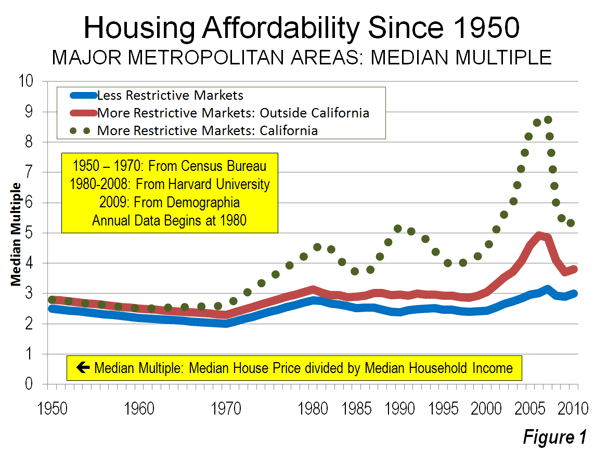
    House Prices in America: The Historical Norm: Since World War II, median house prices in US metropolitan areas have generally been between 2.0 and 3.0 times median household incomes (a measure called the Median Multiple). This included California until 1970 (Figure 1). After that, housing became unaffordable in California, averaging nearly 1.5 times that of the rest of the nation during the 1980s and 1990s (adjusted for incomes). Even after the huge price declines from the peak of the bubble, house prices remain artificially high in Los Angeles, San Francisco, San Diego and San Jose, with median multiples of six or higher.

    William Fischel of Dartmouth University examined a variety of justifications for the disproportionate rise of California housing prices and dismissed all but more restrictive land use regulation. He noted that "growth controls (restrictive land use regulations) have the undesirable effect of raising housing prices." Throughout the rest of the nation, more restrictive land use regulations have been present in every market where house prices rose substantially above the historic Median Multiple norm, even during the housing bubble. No market without smart growth has ever reached these heights.

    Setting Up for the Fall: Excessive Cost Increases in Smart Growth Markets: The Housing Crash and Smart Growth, published by the National Center for Policy Analysis, examined the causes of house price increase during the housing bubble. The analysis included all metropolitan areas with more than 1,000,000 population. It focused on 11 metropolitan areas in which the greatest cost increases occurred (the "ground zero" markets), comparing them to cost increases in the 22 metropolitan areas with less restrictive land use regulation (Note 1).

    • Less Restrictively Regulated Markets: In the less restrictively regulated markets, the value of the housing stock rose approximately $560 billion, or 28 percent from 2000 to the peak of the bubble (Note 2). In nearly all of these markets, the Median Multiple remained within the historical range of 2.0 to 3.0 and none approached the high Median Multiples that occurred in the "ground zero" markets.
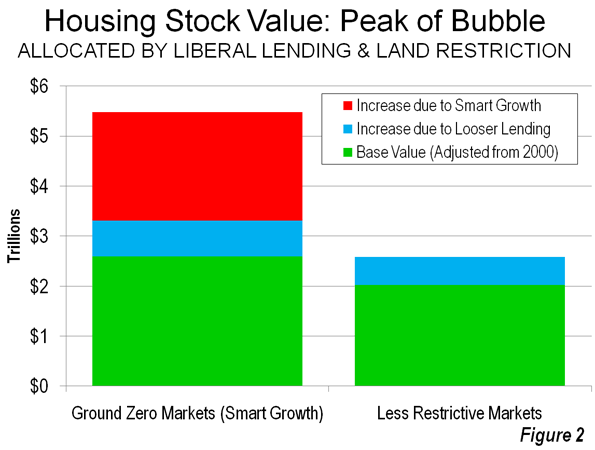
    • Ground Zero Markets The value of the housing stock rose $2.9 trillion from 2000 to the peak of the bubble in the "ground zero" markets, all of which have significant land use restrictions (Note 3). The 112 percent increase in the "ground zero" markets was four times that of the less restrictively regulated markets. The Median Multiple rose to unprecedented levels in each of the "ground zero" markets, peaking at from 5.0 to more than 11.0, four times the historic norm.

    The 28 percent increase in relative house value that occurred in the less restrictively regulated markets (those without smart growth) is attributed to the influence of loosened lending standards. The excess above 28 percent, which amounts to $2.2 in the "ground zero" markets is attributed to to the supply restricting strategies of smart growth (Figure 2).

    The Fall: Smart Growth Losses

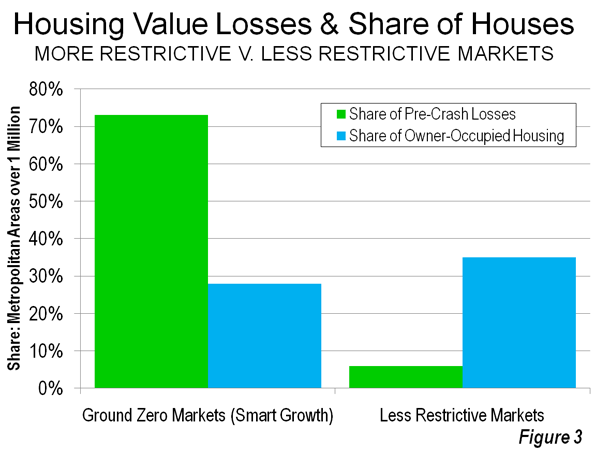
    The largest house price drops occurred in the markets that had experienced the greatest cost escalation, both because prices were artificially higher but also because prices in smart growth markets are more volatile.  The "ground zero" markets, with only 28 percent of the owner occupied housing stock, accounted for 73 percent of the pre-crash losses ($1.8 trillion). Thus, much of the cause of the housing crash, which most analysts date from the Lehman Brothers bankruptcy (September 15, 2008), can be attributed to these 11 metropolitan areas.

    By contrast, the 22 less restrictively regulated markets accounted for only six percent ($0.16 trillion) of the pre-crash losses. These 22 markets represented 35 percent of the owned housing stock (Figure 3).

    If the losses in the ground zero markets had been limited to the rate in the less restrictively regulated markets (the estimated impact of cheap credit), losses would have been $1.6 trillion less (Note 4). The Great Recession might not have been so "Great."

    Economic Denial and Acknowledgement: In his writing forty years ago, Dr. Hall noted that English planners denied the connection between the unprecedented house price increases and urban containment. This same denial also informs smart growth advocates today. This is perhaps to be expected, because, as Hall noted 40 years ago, an understanding of the longer term consequences would have undermined support for these policies.

    To their credit, some advocates recognize that smart growth raises house prices. The Costs of Sprawl – 2000¸ a volume largely sympathetic to smart growth, also indicates that urban containment strategies can raise housing prices. The only question is how much smart growth raises house prices. The presence of urban containment policy is the distinguishing characteristic of metropolitan markets where prices have escalated well beyond the historic norm.

    The Social Costs of Smart Growth: Moreover, the social impacts of smart growth are by no means equitable. Peter Hall says that the "less affluent house-owner … has paid the greatest price for (urban) containment" (Note 5). He continues: "there can be little doubt about the identity of the group that has got the poorest bargain. It is the really depressed class in the housing market: the poorer members of the privately-rented housing sector." Finally, Hall laments as well the impact of these policies on the "ideal of a property owning democracy."

    Hall’s four decades old concern strikes a chord on this side of the Atlantic. Just last week, a New York Times/CBS News poll found that nine out of ten respondents associated home property ownership with the American Dream. Planning needs to facilitate people’s preferences, not get in their way.

    ——–

    Note 1: The housing stock value uses a 2000 base, which adjusts house prices based upon the change in household incomes to the peak.

    Note 2: The underlying demand for housing was substantial in some of the less restrictively markets, which is illustrated by the strong net domestic migration to metropolitan areas such as Atlanta, Austin, Dallas – Fort Worth, Houston, Raleigh and San Antonio. At the same time, some more restrictive markets (smart growth) that hit historically experienced strong demand were experiencing huge domestic outmigration, indicating little in underlying demand. This includes Los Angeles, San Francisco, San Diego and San Jose. Demand, however is driven upward in more restrictively metropolitan areas by speculation which, according to the Federal Reserve Bank of Dallas is attracted by supply constraints.

    Note 3: The 11 "ground zero" metropolitan markets were Los Angeles, San Francisco, San Diego, San Jose, Sacramento, Riverside-San Bernardino, Las Vegas, Phoenix, Tampa-St. Petersburg, Miami and the Washington, DC area.

    Note 4: The pre-crash losses in the 18 other restrictively regulated markets were $0.5 trillion. These markets accounted for 37 percent of owner occupied housing in the metropolitan areas of more than 1,000,000 population, compared to 35 percent in the less restrictively regulated markets, yet had losses three times as high.

    Note 5: The Containment of Urban England also indicates that new house sizes have been forced downward by the planning regulations (see photo at the top of the article).

    Photograph: New, smaller exurban housing in the London area (by author)

    Wendell Cox is a Visiting Professor, Conservatoire National des Arts et Metiers, Paris and the author of “War on the Dream: How Anti-Sprawl Policy Threatens the Quality of Life

  • Enterprising States: Hard choices now, hard work ahead: State Strategies to Renew Growth and Create Jobs

    This is an excerpt from "Enterprising States: Creating Jobs, Economic Development, and Prosperity in Challenging Times" authored by Praxis Strategy Group and Joel Kotkin. The entire report is available at the National Chamber Foundation website, including highlights of top performing states and profiles of each state’s economic development efforts.

    Read the full report.

    Read part one in this series.

    America has the world’s largest economy, the world’s leading universities, the most robust entrepreneurial culture and many of its biggest companies—yet many see this as a diminishing advantage.31 Stagnation, many predict, will extend into the foreseeable future because the economy’s low-hanging fruit has disappeared and so the pace of innovation has slowed; by this argument we are now on a “technological plateau” that will make further growth challenging.32 The United States remains a leader in global innovation, but better-funded, higher-performing hubs of innovation are emerging among determined competitors, notably China.

    In contrast, we believe America’s prospects for competing with other countries are better than commonly assumed, and we are convinced that our strategy for the future is unlikely to be found elsewhere. Unlike our major competitors, we enjoy a huge base of natural resources—such as food and energy—which are likely to become ever more in demand as countries like China and India grow their economies. Most important of all, the United States, particularly in contrast with Europe and East Asia, enjoys relatively youthful demographics, promising an expanding workforce, new consumers and a new flood of entrepreneurs.

    Yet our demographics and resources require intelligent policies that fit our particular situations. As a young country, we will have to find employment for an additional 20 million Americans in this decade. Slow growth, which could be accommodated in rapidly aging Japan or Germany, is not an option for the United States. We will also need to harness all forms of energy, from renewables to fossil fuels. Today, half of our trade deficit consists of energy, and yet we have the oil and gas resources to supply the vast majority of our needs. As we invest in renewables for the long run, the country needs to use the resources that are readily available in order to reduce the deficit and spark job growth.

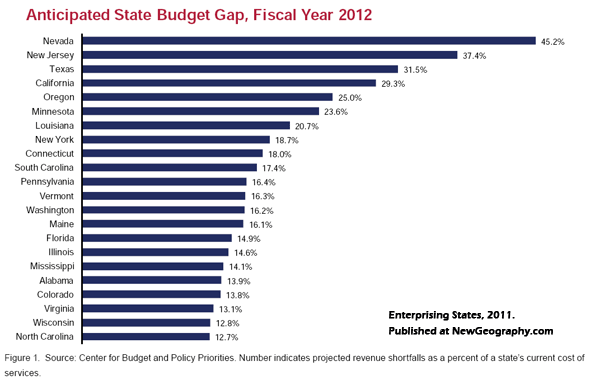
    Our ability to compete, particularly on the state level, could be compromised by an inability to address our budgetary challenges. According to the Center on Budget and Policy Priorities, states are struggling with budget shortfalls for fiscal 2012 that add up to $112 billion. The most recent Fiscal Survey of the States anticipates considerably more financial stress in the states as the substantial funding made available by the American Recovery and Reinvestment Act of 2009 will no longer be available.

    Most states have already taken actions to streamline and downsize government to meet the new economic realities. This has proven to be challenging given the increased demand for state services during the national recession. Surely, more redesign, streamlining and reform is on the way. To recoup lost revenue, states have taken such actions as eliminating tax exemptions, broadening the tax base, and in some cases increasing rates as well as raising a number of fees. Low tax rates by themselves are not a silver bullet for growth, but it has become clear that outdated state tax systems can undercut economic vitality.

    States are the fulcrum of change in key areas of education, infrastructure, energy, innovation and skills training—something that was confirmed on many fronts in the first Enterprising States study. States and localities are far better positioned than the federal government to foster strategic investment, regulations, taxes and incentives that encourage private sector prosperity. In large part, this is because they are more responsive to local conditions.

    Equally important, a diversified portfolio of opportunity agendas implemented by the individual states will go a long way toward renewing growth and prosperity in the national economy.

    New Era of Leadership by the States?

    As the 2010 Enterprising States study was being completed, the states were implementing sweeping changes to deal with a growing number of challenges. Since then twenty-nine new governors have started their terms. Governors of every state, along with their legislative counterparts, are taking steps to grow their states’ economies, create jobs and compete globally. They want to help businesses prosper, to produce an educated and skilled workforce, and to provide other essential services and infrastructure that foster the entrepreneurship and innovation that will lead to greater productivity and competitiveness.

    The dramatic shortage of job opportunities has driven up the unemployment rate, pushed a large number of workers into part-time jobs, increased underemployment problems, and reduced the number of people who were expected to be active participants in the labor force. There is universal agreement that we need policies and programs that create jobs now, alongside investments to lay the foundations for long-term economic growth. “To keep the American dream of widely shared prosperity alive,” one commentator has argued, “we need to choose entrepreneurship and competition over the vested interests of the status quo.”

    Restoring confidence in the economy by creating a meaningful and compelling plan for moving forward is a top priority for elected officials as well as leaders from business, education, and labor groups throughout the country.

    There is also a stark recognition among the states that solving their fiscal problems is directly connected to creating an economic climate that will foster job creation. Any state with a budget tilting towards insolvency is in a weak position to make and maintain investments in its workforce and economic infrastructure. A state’s fiscal health also has immediate consequences by affecting its credit rating and, thereby, the cost of borrowing money. Unfunded pension obligations, viewed historically as soft debt, are now being considered together with the total value of state bonds to come up with a credit rating.

    Many governors and state legislatures are attempting to strike a balance between budget cuts that could hold back the recovery by putting more people out of work, and spending cuts and government reforms that would create a more business-friendly environment, leading to greater business confidence, private-sector investment and job creation. How this balance is achieved depends on each state’s unique set of circumstances and available assets. Moreover, at their core, these debates reflect the fundamental tensions between the two major visions of American progress, namely: creating equality of condition by boosting wages, improving working conditions, and guaranteeing basic services, and creating equality of opportunity, by creating the conditions whereby individuals can elevate themselves through industry, perseverance, talent, and righteous behavior.

    As noted in The Economist, private capital is mobile and it goes where government works. So while political considerations and ideological rationalizations certainly do influence the mix of austerity measures and public investments, the real opportunity today is for states to redesign government for the 21st century. That means cutting programs that do not spur economic growth and shifting resources, where possible, to those existing or planned programs that will.

    While spending cuts will help control deficient budgets, so will increased revenue brought by economic growth. As states enact budget austerity measures, what job creation initiatives are surviving or receiving increased investment? What are the new priorities for job creation? How are states balancing cuts with critical job-creating initiatives that will stimulate innovation, build infrastructure, provide skills training, and unleash the dynamism of small business?

    Job-Centric States Are Redesigning Government and Investing in Opportunity

    Determining where to cut and where to invest40 is the central challenge of the day. States must carry out short-term strategies to jump-start and/or sustain an as-of-yet lackluster recovery, and cut costs to make state government more efficient and to avoid financial calamity. Simultaneously, though, they must craft and invest in innovations and structural solutions that will foster long-term economic growth while reining in taxes and regulations that stifle job creation.

    In most states, revenues remain stubbornly down from where they were before the recession, and job growth is proving to be more elusive than in most previous recoveries. The strategies now being planned or undertaken by each state are based on their unique sets of interests, resources and capabilities, aligned with the opportunities that they see on the horizon and believe are conceivably within their grasp. Yet all states “will likely need a new network of market-oriented, private-sector-leveraging, performance-driven institutions”41 to restore and revitalize their economies.

    The 2011 Enterprising States study highlights state-driven initiatives to 1) redesign government, including measures to deal with excessive debt levels that inhibit economic growth and job creation, and 2) forward-looking, enterprise-friendly initiatives whose primary goal is to create the conditions for job creation and future prosperity.

    The policy initiatives and programmatic efforts are related to the five policy areas that were included in the original Enterprising States report.

    • Entrepreneurship and Innovation
    • Exports, International Trade and Foreign Direct Investment
    • Workforce Development and Training
    • Infrastructure
    • Taxes and Regulation

What’s different in 2011 and for the foreseeable future is that for many states the imperative for change is real. The choice is simple. To remain a job-creating, fiscally robust economy, states will either change on their own or change will continue to be forced upon them.

Investing In Opportunity

States are taking a hard look at making investments in and implementing initiatives to create and sustain high-growth, higher-wage, 21st century industries.States play a key role in the higher education landscape, so there is considerable support for and investment in programs that educate the future talent pool and foster collaboration between business, education and government on science and technology, technology transfer and entrepreneurial programs. As states evaluate their return on investment, performance-based funding has become a best practice for aligning colleges and universities as partners in workforce preparation and sources of opportunity, growth, and competitive advantage.

High-growth start-ups are the best generators of new jobs, accounting for nearly all net job creation in America in the last twenty-plus years. They are also the firms most likely to raise productivity, a basis for economic growth. They also create jobs that did not previously exist, and solve problems in a way that makes a difference in people’s lives.

States have stepped up their efforts to help companies scale up and grow in order to capture growing domestic and international markets. A number of states have established or expanded seed and growth-stage financing funds. Some have implemented economic gardening programs deliberately designed to focus on expanding existing second-stage companies that have viable growth opportunities. Several states have undertaken initiatives to fix deficiencies in the market that inhibit private-sector investment and entrepreneurial activity. Tax credits for angel investors and state-backed venture capital funds are just two examples.

Companies with a global reach that bring together multiple technologies or complex expertise—such as advanced manufacturing, investment banking, construction and engineering, and natural resources—are likely to drive the nation’s global competitiveness in the next few years, along with more focused technology companies that are part of complex virtual networks.44 For that reason, several states are implementing, and having considerable success with, programs to help companies expand into global markets by assisting in the development of a customized international growth plan. And, some states have made significant headway using focused and purposeful strategies to attract foreign direct investment.

Public-private partnerships and privatization initiatives for economic development and the provision of infrastructure are proliferating throughout the states. Building funds and bonding programs that involve private-sector investors are now widely used to construct specialized facilities for research, demonstration, and technology transfer in key economic sectors. Building on the lessons of the past, states have become considerably more adept at avoiding what Robert Fogel has called “hothouse capitalism,” in which government assumes much of the risk while private contractors and financiers take the profit.

While unemployment remains high, many currently available jobs go unfilled. America faces a shortfall of almost two million technical and analytical workers in the coming years, a situation that stands to thwart economic growth.45 Painfully cognizant of this dilemma, many states are establishing workforce training and development programs that address structural unemployment problems and the mismatch between available jobs and the skills of the existing workforce. The goal is to align training and academic programs with in-demand regional occupations, and to add greater flexibility to workforce training programs that have left some re-trainable individuals slipping through the cracks.

Forward-looking states are modernizing their education and workforce training initiatives by developing people-focused approaches that help and train workers in navigating their careers, provide assistance for entrepreneurs, make lifelong learning loans, and offer wage insurance plans. The goal is to empower people to find better jobs and/or to create new ones. Plainly, making America more globally competitive is vital, but the increasingly obvious gap in our economic discussions is an agenda for making Americans more personally competitive. In this view, forging a new economics for the Individual Age will require rethinking our economy from the bottom up in order to realize future growth and prosperity.

Finally, because energy issues, both current and future, have become such critical factors in business and for economic growth, states are getting serious about policies, initiatives and investments to provide clean, secure, safe and affordable energy tailored to regional, state and local resources. These include renewable energy standards, investments in research, development and commercialization of energy technologies and processes, and the establishment of new financing authorities to build the infrastructure that will extract and transport energy to the places where it will fuel new growth.

Redesigning Government

The fiscal situation of many states has caused them to reconsider the level of services they are providing and, certainly, the way that they deliver them. According to the Government Accountability Office, “Because most state and local governments are required to balance their operating budgets, the declining fiscal conditions shown in our simulations suggest the fiscal pressures the sector faces and foreshadow the extent to which these governments will need to make substantial policy changes to avoid growing fiscal imbalances.”

In The Price of Government: Getting the Results We Need in an Age of Permanent Fiscal Crisis, David Osborne and Peter Hutchinson contend that Industrial Age government is just not up to the tasks and challenges at hand. Centralized bureaucracies, hierarchical management, rules and regulations, standardized services, command-and-control methods, and public monopolies are simply not aligned to Information Age realities. Today, government must be restructured and prepared for rapid change, global competition, the pervasive use of information technologies, and a public that expects quality and has lots of choices.

The keys, according to Osborne and Hutchinson, are to 1) get rid of low-value spending, 2) move money into higher-value, more cost-effective strategies and programs and 3) motivate all managers to find better, cheaper ways to deliver results. In sum, government needs to provide incentives, expect accountability, and allow the freedom to innovate.48
Government redesign efforts that are now underway or in the planning stages often follow the simple guidelines outlined above. Yet various approaches are now being used by state governments, including:

  • Consolidation, reorganization, or elimination of agencies, boards and commissions.
  • Regionalization of governance to decentralize decision-making and to customize and align service delivery with local circumstances.
  • Streamlining and modernizing bureaucratic processes to increase productivity and improve service delivery, often by deploying services online.
  • Experimenting with charter agencies that commit to producing measurable benefits and to saving money—either by reducing expenditures or increasing revenues—in exchange for greater authority and flexibility.

Steps to curb spending and reform taxation in the states have varied widely. States with the most serious fiscal problems are laying off workers, imposing hiring freezes, reducing spending for education and health care and ending or curtailing social services. Aid to local governments has been cut. For many states, current obligations for public pension funds and health insurance costs are unaffordable and future obligations represent a
looming financial disaster. Cuts, concessions and larger contributions from employees are now a necessary part of balancing the state’s checkbook.

Taxes and tax policies vary considerably among the states. To make up for lost revenues, most states have taken such actions as eliminating tax exemptions, broadening tax bases, and in some cases increasing rates as well as raising a number of fees. States have enacted increases in all of the major taxes they levy, including personal income taxes, general sales taxes, business taxes, and excise taxes. However, many states did reduce business taxes with new credits or expanded existing credits to encourage investment and growth in targeted industries.
Uncertainty, above all, is the antagonist of growth, investment, and job creation. States that cannot rid themselves of onerous DURT49 (delays, uncertainty, regulations and taxes) are in peril of putting the heaviest burdens on new and small businesses and on entrepreneurs, the real job creators in a growing economy. In a tight economy these considerations become more stringent for entrepreneurs and companies that are making economic decisions simply because the levels of uncertainty and the stakes are so much higher. Eliminating employment regulations and time-consuming processes that place unreasonable burdens on business can have a significant impact on job creation.

Moreover, the competitive identity of a state today relies increasingly on the degree to which the actions of the private, public and civic sectors are aligned with and corroborate the identity claimed or brand promise. A story must be backed up by actions: to simply proclaim an enterprise-friendly environment is no longer adequate.
States that are doing it right today are responsive and are taking a cooperative, supportive approach to dealing with new and existing companies. Their attitude and operating systems are customer-centric and their emphasis is on streamlining processes for obtaining permits, licenses, and titles.

Many state governments across the country are adopting a fast-track approach to achieving a better balance between the requirements of regulation and the need for new jobs and industry, so that that results have a higher priority than rules. This is the mindset that must guide the interface between government and business.
operating budgets, the declining fiscal conditions shown in our simulations suggest the fiscal pressures the sector faces and foreshadow the extent to which these governments will need to make substantial policy changes to avoid growing fiscal imbalances.”

In The Price of Government: Getting the Results We Need in an Age of Permanent Fiscal Crisis, David Osborne and Peter Hutchinson contend that Industrial Age government is just not up to the tasks and challenges at hand. Centralized bureaucracies, hierarchical management, rules and regulations, standardized services, command-and-control methods, and public monopolies are simply not aligned to Information Age realities. Today, government must be restructured and prepared for rapid change, global competition, the pervasive use of information technologies, and a public that expects quality and has lots of choices.

The keys, according to Osborne and Hutchinson, are to 1) get rid of low-value spending, 2) move money into higher-value, more cost-effective strategies and programs and 3) motivate all managers to find better, cheaper ways to deliver results. In sum, government needs to provide incentives, expect accountability, and allow the freedom to innovate.48

Government redesign efforts that are now underway or in the planning stages often follow the simple guidelines outlined above. Yet various approaches are now being used by state governments, including:

  • Consolidation, reorganization, or elimination of • agencies, boards and commissions.
  • Regionalization of governance to decentralize • decision-making and to customize and align service delivery with local circumstances.
  • Streamlining and modernizing bureaucratic processes • to increase productivity and improve service delivery, often by deploying services online.
  • Experimenting with charter agencies that commit • to producing measurable benefits and to saving money—either by reducing expenditures or increasing revenues—in exchange for greater authority and flexibility.

Steps to curb spending and reform taxation in the states have varied widely. States with the most serious fiscal problems are laying off workers, imposing hiring freezes, reducing spending for education and health care and ending or curtailing social services. Aid to local governments has been cut. For many states, current obligations for public pension funds and health insurance costs are unaffordable and future obligations represent a
looming financial disaster. Cuts, concessions and larger contributions from employees are now a necessary part of balancing the state’s checkbook.

Taxes and tax policies vary considerably among the states. To make up for lost revenues, most states have taken such actions as eliminating tax exemptions, broadening tax bases, and in some cases increasing rates as well as raising a number of fees. States have enacted increases in all of the major taxes they levy, including personal income taxes, general sales taxes, business taxes, and excise taxes. However, many states did reduce business taxes with new credits or expanded existing credits to encourage investment and growth in targeted industries.
Uncertainty, above all, is the antagonist of growth, investment, and job creation. States that cannot rid themselves of onerous DUR (delays, uncertainty, regulations and taxes) are in peril of putting the heaviest burdens on new and small businesses and on entrepreneurs, the real job creators in a growing economy. In a tight economy these considerations become more stringent for entrepreneurs and companies that are making economic decisions simply because the levels of uncertainty and the stakes are so much higher. Eliminating employment regulations and time-consuming processes that place unreasonable burdens on business can have a significant impact on job creation.

Moreover, the competitive identity of a state today relies increasingly on the degree to which the actions of the private, public and civic sectors are aligned with and corroborate the identity

States that are doing it right today are responsive and are taking a cooperative, supportive approach to dealing with new and existing companies. Their attitude and operating systems are customer-centric and their emphasis is on streamlining processes for obtaining permits, licenses, and titles.

Many state governments across the country are adopting a fast-track approach to achieving a better balance between the requirements of regulation and the need for new jobs and industry, so that that results have a higher priority than rules. This is the mindset that must guide the interface between government and business.

Read the full report, including highlights of top performing states and profiles of job creation efforts in all 50 states.

Praxis Strategy Group is an economic research, analysis, and strategic planning firm. Joel Kotkin is executive editor of NewGeography.com and author of The Next Hundred Million: America in 2050

  • Enterprising States: Recovery and Renewal for the 21st Century

    This is an excerpt from "Enterprising States: Creating Jobs, Economic Development, and Prosperity in Challenging Times" authored by Praxis Strategy Group and Joel Kotkin. The entire report is available at the National Chamber Foundation website, including highlights of top performing states and profiles of each state’s economic development efforts.

    Read the full report.

    Read part two in this series.

    Restoring Growth and Upward Mobility: A Call to the States

    Over a year and a half into the recovery, the condition of the American economy is far from satisfactory. For the vast majority of Americans, conditions have improved only marginally since the onset of the Great Recession. Unemployment remains high, job creation meager, and American workforce participation has dropped to near record depths — the lowest rate in a quarter of a century.

    Not surprisingly, this spring’s Washington Post-ABC poll revealed that far more Americans feel the economy is getting worse than getting better. There seems to be what the New York Times described as “a darkening mood” among Americans about the future. Confidence in the Federal Reserve’s policies on the money supply has eroded among economists, as few benefits have accrued to smaller businesses and middle-class households.3 Times are particularly tough for entry level workers, including those with educations, and have been worsening since at least the mid-2000s.

    This stress is felt keenly by state and local officials, even in areas that aren’t suffering from the highest rates of indebtedness or pension liabilities. Without pension reform, the state of Utah, for example, would have seen its contributions to government workers’ pensions rise by about $420 million a year, an amount equivalent to roughly 10 percent of Utah’s spending from its general and education funds. The states often must deal with declining revenues at a time when the demand for services caused by the recession has increased. And, unlike the federal government, states can neither print their own money nor buy their own bonds.

    In the past, states could look to Washington for assistance. Now, whatever the intentions or real achievements of the stimulus package, future increases in federal spending seem likely to be meager at best. The 2010 election effectively ended the nation’s experiment with massive fiscal stimulus from Washington. Indeed, leaders of both parties, President Obama, and perhaps most importantly the capital markets, now acknowledge that deficit reduction will be a priority in the coming years.

    This presents a new, and perhaps unprecedented, challenge for the states. With Washington effectively forced to the sidelines, states will now have to address fundamental economic issues relating to growth and employment on their own. Most will have to do so without significantly increasing their own spending.

    For many states, the short-term prognosis is dire. Altogether, 44 states and the District of Columbia are projecting budget shortfalls for 2012 amounting to $112 billion. The upcoming fiscal year, according to the Center on Budget and Policy Priorities, will be “one of the states’ most difficult budget years on record. Retiree benefits for state employees add yet another strain, with the states facing a $1.26 trillion shortfall.”

    As a result, states and localities increasingly find themselves forced to impose tough, even draconian cuts in spending. This affects not only newly minted conservative Republicans, but new liberal Democratic governors such as California’s Jerry Brown and New York’s Andrew Cuomo. The only real debate now is how much to rely on taxes and how much on cuts in spending to address the fiscal issues ahead. One casualty: infrastructure spending, which was boosted by the stimulus, now seems to be winding down as well.

    This report will try to address the nature of this dilemma and suggest ways to best deal with it. Although we agree with the notion of fiscal probity, ultimately, states can deal with the fundamental problems only by spurring growth and upward mobility. This will not only create new revenues, but also dampen the demand for social services.

    A state can neither cut nor tax itself into prosperity. Weak public infrastructure combined with low taxes has failed through history to create strong state economies, as was long the case in the Southeast. But at the same time many large states—California, New York, Illinois—have raised taxes and spending and have suffered a strong out-migration of middle class citizens and jobs for decades.

    Now, faced with enormous deficits, there is a temptation to reduce those very “crown jewels,” such as the California public university system, into what University of California President Mark Yudof describes as “tatters.” In trying to balance their budgets, states run the risk of undermining their own long-term recoveries.

    The great danger that looms here, in our estimation, is not bankruptcy. Rather, it is long-term stagnation, in which growing demands for social services, combined with weak revenues. foster pressure for more taxes, reduced services or a deadly combination of both. This represents something of a existential problem in a country where the prospect for a better future has long been a hallmark.

    The founders of the republic understood the critical importance of maintaining this aspiration, and European observers were struck by the remarkable social mobility in America’s cities. In the 19th century, American factory workers and their offspring had a far better chance of entering the middle or upper classes than their European counterparts. In politics and in daily life, expansion of opportunity was seen as essential to the American experiment. Writing in 1837, one Whig lawyer in Pittsburgh suggested, “If you deny the poor man the means to better his condition . . . you have destroyed republican principles in their very germ.”

    Today, this traditional faith is being sorely tested in much of the country. Although both stock prices and corporate profits have rebounded, little has been done that has stimulated employment. Large companies may be sitting on large caches of cash, in part due to low interest rates and a buoyant stock market, but capital remains scarce for the small businesses that create most of America’s new jobs. Indeed, entrepreneurial growth, as the Kauffman Foundation recently found, has now slowed down among most segments of the population.

    Of course, there have been remarkable stories of wealth creation and success despite these hard times. But even in Silicon Valley—home to such high-fliers as Google, Apple and Facebook—the overall impact on jobs has been minimal. Of the nation’s 51 largest metropolitan regions, San Jose, the Valley’s heartland, has suffered the largest net loss of jobs over the past decade of any major metropolitan region outside Detroit. The San Francisco area suffered job losses only slightly lower, on a percentage basis, than hard-hit Cleveland.11 Due in part to financial controls, investment in promising new companies has become ever more undemocratic, with the bulk of new money pouring into firms like Facebook coming not from public markets, but from a small, well-heeled cadre of private investors. Venture-backed technology companies, notes Intel co-founder Andy Grove, now find it expensive to “scale” their operations and add employees in California or even the United States. As a result, he suggests, companies tend to indulge in “an undervaluing of manufacturing” that erodes employment. This contrasts with, for example, China, where job creation is considered “the number one objective of state economic policy.”

    Much the same can be said of New York, where the paper economy has been boosted by Fed policy but the creation of middle-income jobs continues to lag. New York City’s current financial boom—Wall Street pay hit a new record in 2011—simply reinforces a level of income inequality that is the highest in the nation. Unemployment in the toniest Manhattan precincts reaches barely five percent, while it’s 20 percent in working-class Brooklyn. Not surprisingly, the city’s distribution of wealth is now twice as unequal as in the rest of the nation. It may seem a model recovery on Wall Street, but it is less so on the streets of the nation’s premier city.

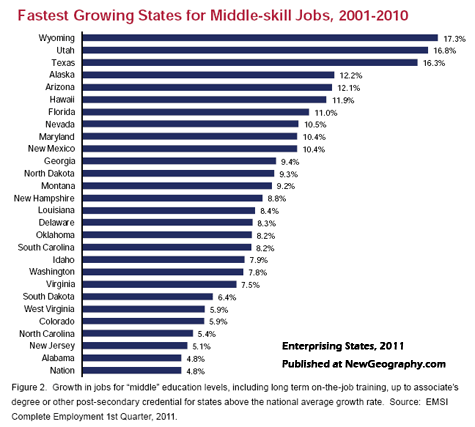
    In contrast, the states that have fared best in creating middle-class jobs have been either those close to the expanding federal government, another major beneficiary of the stimulus, or those that have attended to more basic industries, such as energy production, agriculture and manufacturing. These industries have propelled widespread expansions in the Great Plains, parts of the Intermountain West, Alaska and Texas.

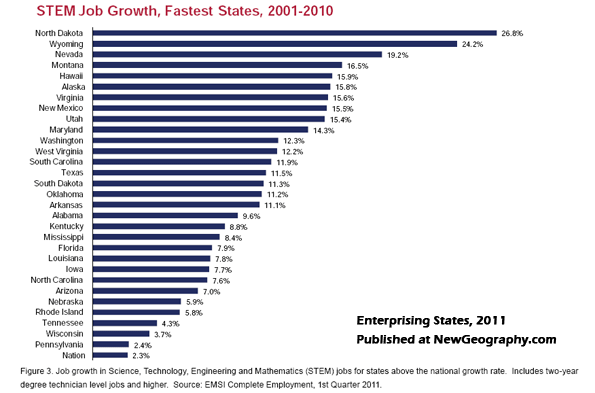
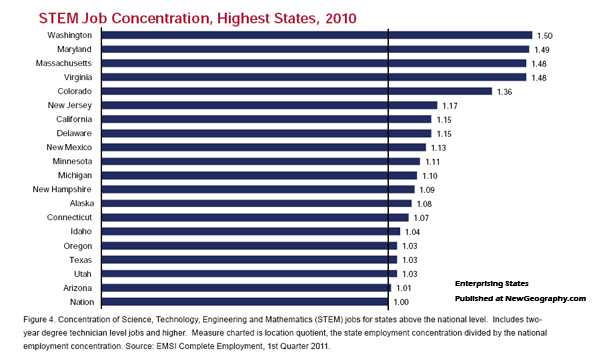
    More interestingly, many of these states have also experienced a surge in STEM—science, technology, engineering and mathematics—related employment. In some states, this has come as a result of continuing state investment in education and training; in most cases, these states have simply tended to create a business-friendly atmosphere for companies of all sorts. They have also generally kept housing costs low, something critical to young families.

    Perhaps the best way to look at our evolving economy is not so much from the point of view of companies or industries, but of individuals. States often focus on their largest employers, but those companies have been cutting jobs for the past decade. Since 2000, large corporations—which employ roughly one-fifth of American workers— have stopped hiring, as they did in the previous decade, and actually reduced their payrolls by nearly three million while adding 2.4 million jobs abroad.

    Andrei Cherny, an Arizona Democrat writing in the journal Democracy, suggests that “both progressives and conservatives have offered little in the way of new answers as their long-held orthodoxies run headlong into new realities.” Cherny admits that the stimulus and the Fed’s strategy of loose money—what he calls “government by hot check”—failed to address the needs of the nation’s large class of small entrepreneurs.

    Left out of the equation are the small businesses that, according to the Bureau of Labor Statistics, employ half of all workers and create 65 percent of all new jobs. Most of these firms are small, under-capitalized, and run by single proprietors or families.

    In this environment, notes economist Ying Lowery, “Business creation is job creation.” The states that will do best are those that create the conditions to lure and retain those who start companies or who are selfemployed. Policies that target managers of hedge funds, venture firms, or large corporations have their place, but the real action—particularly in a world of ever-changing technology and declining long term employment—lies in the movement of individuals.

    Under these conditions, where individuals migrate or decide to settle will have a critical impact on which states or regions grow. Three dynamic population segments— educated workers, immigrants and downshifting boomers—illustrate the factors that drive their migration patterns. In many ways they represent the “canaries in the coal mine”; where they go is generally where the air is good for entrepreneurship.

    The movement of educated workers has become a much discussed topic among pundits and economic developers in recent years. One common assumption is that “the best” migrants tend to move to “hip and cool” locales, generally on one of the coasts. These workers then form the core of growing industries and, more importantly, new ones. Yet the evidence tells a somewhat different, perhaps surprising, story. An analysis of recent Census data on the migration of educated workers finds that the biggest net growth has taken place not in New York, San Francisco and Boston, but in places like Nashville, Houston, Dallas, Austin, and Kansas City. Indeed, many of the leading “creative class” states, notably California, Massachusetts and New York, fared considerably worse than regions in states such as Missouri, Kansas, Texas and Tennessee in terms of net migration numbers.

    These location choices have to do with how individuals make decisions: people move primarily for reasons related to jobs, family, and housing. An analysis of the migration of educated workers, for example, reveals that, for the most part, these workers are moving away from expensive, dense regions to more affordable, generally less dense places. This migration also tends to parallel moves to those states that generally impose fewer regulatory burdens on business.

    Perhaps even more surprisingly, we see a similar pattern in minority and immigrant entrepreneurship. These groups now constitute a growing percentage of business startups. Overall, according to the Kauffman Foundation, foreignborn immigrants in 2010 constituted nearly 30 percent of all new businesses owners, up from 13.4 percent in 1996. This has also been the one outstanding segment of the population whose entrepreneurship rate has grown throughout the current recession.

    As with the case of educated migrants, minority entrepreneurs tend to establish themselves in less expensive, more business-friendly, and generally less heavily regulated metropolitan regions. A recent survey of minority migration and self employment by Forbes found that the best conditions for non-white entrepreneurs were in metropolitan areas in Georgia (Greater Atlanta), Tennessee (Nashville), Arizona (Phoenix), Oklahoma (Oklahoma City), and several Texas cities (Houston, Dallas, San Antonio and Austin). In contrast, most regions in California and the Northeast, outside of the Washington, D.C. metropolitan area, did quite poorly.

    Jonathan Bowles, president of the New York-based Center for an Urban Future, has traced this poor performance to a myriad of factors including sky-high business rents, which stymie would-be entrepreneurs in minority communities. “[Entrepreneurs] face incredible burdens here when they start and try to grow a business,” Bowles suggests. “Many go out of business quickly due to the cost of real estate and things like high electricity costs. It’s an expensive city to do business in without a lot of cash.”

    Boomers are unique compared to traditional senior populations. According to the Kauffman Foundation, they tend to be more likely to start businesses than are younger age groups. In 1996, people between 55 and 64 years of age accounted for 14 percent of entrepreneurs; in 2010 they represented 23 percent.

    Less is known about the migration of aging boomers, a large segment of the population, but evidence so far suggests that they, too, are moving to such states. According to AARP, most boomers prefer to stay close to where they live—mostly in suburbs—or where their children tend to move, that is, to the low-regulation states of the South and West.

    States can draw on these migration patterns in developing their economic policies. Generally, people migrate to states with jobs, and states with population gains generally produce more employment than those with slower growth. Indeed, despite the great disruptions of the mortgage crisis, regions such as Orlando, San Bernardino-Riverside and Las Vegas all recorded double-digit employment gains over the last decade.

    More recent developments suggest that future growth may depend on several critical factors. It is clear, for example, that investments in education—for example in Austin, Raleigh-Durham and parts of the Great Plains—have paid off by attracting both individuals and industries, and have made these areas among the healthiest employment markets in the country. Some of these states have suffered less fiscal distress than states elsewhere in the nation, and have benefited from their educational investment through hard times. Investments in community colleges may prove to be particularly essential, since their role in providing skilled workers has been critical in many states.

    States that have invested in new infrastructure such as ports, airports, roads and improved transit tend to have a leg up on others that have failed to do so. Even relatively low-tax states such as Texas have invested heavily in recent years in roads and port facilities, which are critical to industries locating there. Even during the recession, many industries—from manufacturing and environmental firms to health care and information technology—have had trouble hiring skilled workers. States are responding by creating job-oriented training programs in states like Ohio, New York, Tennessee, Washington and Wisconsin, which have all established technical institutions separate from community colleges. Tennessee alone has 27 such “technical centers” offering one-year certificates for certain jobs.

    Overall, as Delaware Governor Jack Markell has pointed out, businesses generally do not want to eliminate government, but rather want it to be useful for economic growth. Markell, who has done some considerable budgetcutting himself, believes that the focus needs to be on expanding the economy, which will requires improvements not only in schools, but in transportation infrastructure that will make the free market work better.

    Perhaps even more important has been creating a favorable business climate. California, for example, possesses the greatest basic economic attributes of any state: a mild climate, location on the Pacific Rim, a world-class university system, and a legacy of strong infrastructure investment. Yet today, despite the presence of leading global industrial zones such as Hollywood and Silicon Valley, as well as the country’s richest agricultural sector, California’s unemployment remains well above the national average and job growth has remained relatively tepid. After many years in denial, even some of the state’s most progressive politicians realize that something is amiss. In a remarkable development, for example, California leaders including Lieutenant Governor Gavin Newsom recently visited Texas to learn from the large state that has fared best during the long recessionary period. Given the political gap between Californians like Newsom, a former mayor of San Francisco, and Texas Governor Rick Perry, this represents something of a “Nixon in China” moment.

    This is not to say that California, or any other state, should draw its economic policy from another state. Those states that attempt to use tax incentives to “lure” industries with no overwhelming need to relocate — as shown in recent findings about Illinois incentives to movie-makers — are often disappointed. In many cases, the incentive game becomes a classic “race to the bottom,” in which the benefits of new jobs often prove transitory. Since the 1990s, just two percent of job growth and decline has been due to businesses relocating across state borders, yet the costly practice of using unfocused tax expenditures to poach companies continues.

    Nor can states reliably predict which industries will need more workers over the long term. In the 1990s, economist Michael Mandell predicted that cutting-edge industries like high-tech would create 2.8 million new jobs; in reality, notes a 2010 New America Foundation report, they actually shed 68,000.30 Each state and each region has its own peculiar economic DNA. States with exportable products—for example the Great Plains or the Upper Midwest—may need to focus on ways to get their output efficiently to market. Already affordable, they may also choose to increase their attractiveness to high value-added companies and educated individuals by boosting their education systems and making their metropolitan regions more congenial to well-educated migrants.

    In other states such as New York or Massachusetts, the economy is focused on intangible exports like financial services and software. Making themselves more affordable for both individuals and companies may be the best way for states to improve competitiveness. Over the long term, no state economy can sustain its people if it only focuses on the “luxury” sectors; the large number of unemployed and underemployed workers will drain state resources. As those state resources become more limited, decisions about how to structure tax incentives or where to place education and infrastructure investments must be based upon a deep understanding of this economic DNA. Strategic investments will limit wasteful spending and maximize impact in the economic sectors where a state is most likely to grow.

    Ultimately, there is only one route to sustainable state economies, and that is through broad-based economic growth. The road to that objective can vary by state, but the fundamental goal needs to be kept in mind if we wish to see a restoration of hope and American optimism about the future.

    Read the full report, including highlights of top performing states and profiles of job creation efforts in all 50 states.

    Praxis Strategy Group is an economic research, analysis, and strategic planning firm. Joel Kotkin is executive editor of NewGeography.com and author of The Next Hundred Million: America in 2050

  • Diagnosing New Inflation Symptoms

    It’s been more than three years since the Great Recession began, and it’s no longer debatable that the federal spending in its wake did not provoke inflation. Years of forecasts by fiscal conservatives about the result of government expenditures have proved to be wrong. After three fiscal stimulus packages, core inflation — which excludes the volatile prices of oil and commodities— remains very much in check. The core rate is the most reliable guide to future inflation, and it has not trended upward.

    Headline inflation, however, the rate that does include these two, has increased. Is the recent uptick in gas and food prices a game-changer on inflation? Does it mean that predictions of an inflation tsunami were well-founded? And what’s the best course to follow now?

    Many commodity prices have made double and triple digit gains over the past year. The changes are more than a blip — cotton futures, for example, have risen 162 percent— even if the cost of oil continues to decline. These prices are notoriously subject to rapid change for reasons that don’t reflect the structure of the U.S. economy. Factors can include Middle East politics, weather, activity in the developing world, and, most significantly today, speculative profiteering.

    Gold and other commodities have become a hot destination for players — money managers — as these markets have become the rare opportunity for high returns. In the absence of federal regulation and supervision, the low interest rates that are so crucial to business growth and to the vast majority of Americans have been allowed to feed into the permissive speculative superstructure.

    The run-up has clearly impacted the poor and the hungry in the undeveloped world. In academic and policy circles, there’s a high level confidence that commodities account for only a small share of GDP in wealthy countries, and so aren’t of concern as long as core inflation is under control. At the Levy Institute, in contrast, our research shows that even in the developed world expensive food, energy, and materials can crowd out other household purchases. Consumer budgets can be hurt even before serious headline inflation appears.

    If commodity prices were to continue to climb broadly and sharply, the Federal Reserve could face the prospect of a serious episode of cost-push inflation, similar to what we saw in the 1970s and ’80s. Fed Chairman Ben Bernanke might find himself occupying the chair of Paul Volcker in more ways than one.

    This kind of inflation is caused neither by the effects of low interest rates on the broader economy, nor by government spending. And, as with any symptom of ill health, the cause dictates the appropriate treatment. So if Bernanke’s response was to raise interest rates dramatically in the hope of abating inflation to some arbitrarily low target, it would be a risky mistake. An interest rate rise would be a serious danger to growth and job creation. Business and labor are far too fragile to deal with a double whammy from rising gas and food prices coupled with monetary policy tightening.

    A better response would be ‘watchful waiting’, a phrase seen in the December 1996 minutes of the FOMC (Federal Open Market Committee) meeting. A commodity price inflation could remain at least somewhat isolated.

    Higher commodity prices will be used as an excuse to charge that the Fed’s supposedly lax policy has unleashed an inflationary flood of cash throughout the economy. But the Fed’s so-called ‘easy money’ is parked at the Fed itself, as bank reserves, since banks are not lending. This can’t cause inflation either. Logic hasn’t stopped newly re-branded Republican presidential candidate Newt Gingrich, who recently admonished that “The Bernanke policy of printing money is setting the stage for mass inflation.”

    Those who purchase securities for long-term investment evidently disagree. Bond traders aren’t anticipating an inflationary surge. Just look at the yield spread between inflation-indexed and non-indexed Treasury securities of the same maturity. It has remained almost constant over the past year. In other words, buyers who want their returns insulated from inflation are paying only slightly more for protection than they were last year. That flatness — the unwillingness to pay a premium for inflation insurance — indicates that long-term bond buyers haven’t revised their inflation forecasts.

    Also unlikely to revise their predictions: inflation doom-drummers, even as energy prices level, and wages, another inflation indicator, are by no means jumping. Like eons of ‘the-end-is-nigh’ prognosticators, they don’t exactly have a great track record. Back in spring 2008, a frenzied Glenn Beck urged Fox viewers to “Buy that coat and shoes for next year now.” Some of his Washington cohorts are coy about inflation’s estimated time of arrival. Republican House Majority Leader Eric Cantor, for example, tells us that “fears” of “future” inflation are “hanging over the marketplace.” Others, like former Pennsylvania Senator Rick Santorum, say its already arrived (Obama brought it). The accusations continue despite a lengthy stretch of the lowest inflation rates in modern U.S. history, even with the current commodities rise.

    Paul Ryan (R-WI) has been hailed as both a truth sayer and a soothsayer on the economy. He recommends that the Federal Reserve raise interest rates now to head off inflation “before the cow is out of the barn”, ignoring the pain this would cause families and businesses. Here’s my recommendation: Don’t trust predictions about the future from those who’ve misread the present, and been very wrong in the past.

    Dimitri Papadimitriou is President of the Levy Economics Institute of Bard College, and Executive Vice President and Jerome Levy Professor of Economics at Bard College.

    Photo by Deb Collins (debs-eye): Beurs van Berlage, built by Hendrik Berlage between 1896 and 1903 as the commodities exchange in Amsterdam.

  • A Requiem for “High-Speed Rail”

    In the interest of maintaining some balance and perspective on what the Administration proudly calls "President Obama’s bold vision for a national high-speed rail network," at InnovationBriefs we have tried to offer our readers a range of different points of view. It is in this spirit that we present below two commentaries. The first contribution is by Matt Dellinger, author of the highly praised book, "Interstate 69: The Unfinished History of the Last Great American Highway" and a frequent contributor on transportation topics to the progressive website, Transportation Nation. The second contribution is by Ron Utt, Senior Research Fellow at the conservative Heritage Foundation, whose analyses of transportation policy have been a longstanding feature of that Foundation’s work.

    Along with our two commentators, we do not question the merits of intercity rail transportation— an integral and essential part of this nation’s economy, culture and history over the past century and a half. Readers of Steven Ambrose’s history of the transcontinental railroad, Nothing Like It In the World, can only marvel at the indomitable spirit and entrepreneurial energy that drove the creation of the continental rail network. Rail transportation has been intimately woven into the social and economic fabric of this nation ever since. Nor do we forget the huge contribution that private railroad companies have made, and continue to make, to maintaining and growing the nation’s rail network. By investing billions of private dollars, they have made the US freight rail system the envy of the world. Lastly, we believe that intercity passenger rail servic is essential in densely populated heavily traveled corridors, in particular the Northeast Corridor, where road and air traffic congestion will soon be reaching levels that will threaten its continued growth and productivity. In sum, we are not mindless opponents of rail transportation.
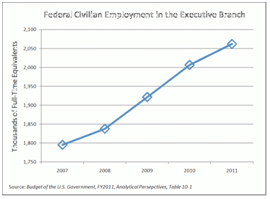
    Rather, along with Messrs. Dellinger and Utt, and many other responsible observers inside and outside the railroad community (including notably, Michael Ward, Chief Executive Officer of CSX, the nation’s third largest freight railroad), we take issue with the Obama Administration’s lofty but misleading rhetoric of "high-speed rail." Instead of representing its initiative for what it really is: a program of incremental improvements to the existing rail infrastructure, the Administration has tried to create the impression that it has embarked on a bold and revolutionary program of building a continent-wide high-speed rail network, a legacy reminiscent of President Eisenhower’s Interstate Highway Program.

    As Dellinger and Utt point out, the recently announced spate of awards funded out of the $2.4 billion rejected by Florida’s Gov. Rick Scott will hardly lead to bullet trains speeding from coast-to-coast at 250 mph. These grants, along with most of the earlier awards, will support engineering and planning studies, incremental upgrades in the facilities of freight railroads and modest improvements in existing passenger rail service. For example, the latest list includes a study to replace Amtrak’s Baltimore Tunnel; development of Missouri’s and West Virginia’s state rail plans; final design of the New Jersey Portal Bridge; and modest corridor improvements in Amtrak service in Connecticut, New York and Washington State.

    The above-mentioned $300 million worth of awards was announced on April 8, just a few hours before agreement was reached on a short-term continuing resolution that would cut $1.5 billion in unobligated HSR money. It also preceded by three days the release of a GAO report criticizing the lack of transparency in the Administration’s HSR grant selection process (GAO-11-283). Citing the GAO findings, Rep. John Mica, Chairman of the House Transportation and Infrastructure Committee blasted the Administration in a strongly worded press release. "In the name of high-speed rail, the Administration has squandered limited resources on dozens of slow-speed rail projects across the country," Mica said. "I cannot imagine a worse beginning to a U.S. high-speed rail effort. …It is critical that there be transparency for why these projects were selected in the first place and why any future projects will be selected."

    Had the objective and the selection criteria of the $10 billion program been stated candidly from the outset as an effort to modestly upgrade existing intercity passenger rail services, the White House would have spared itself this criticism and the attendant ridicule of "ObamaRail" and "the Railroad to Nowhere." As it is, the Administration dug itself into an even deeper hole with a quixotic and hardly credible pledge of "making high-speed rail accessible to 80 percent of Americans in 25 years." A promise that was made without any hint as to how this ambitious plan would be paid for and against a background of the House Republicans’ announced intention to totally eliminate federal support for high-speed rail beginning next year. Without further congressional appropriations, the President’s dogged pursuit of the $53 billion high-speed rail initiative will simply collapse.

    As Matt Dellinger pointedly concluded, "If High-Speed Rail ever happens, future Americans might not remember the President who circulated the maps and funded the studies. They’ll remember the President who figured out how to pay for it all."

    Matt Dellinger: "How Much High Speed Rail will $2.4 Billion Buy?" Transportation Nation

    Ronald Utt: "The Death of a High Speed Rail Program," National Review Online

    Ken Orski has worked professionally in the field of transportation for over 30 years.

    Photo by narent23

  • The End of the Line: Ambitious High-speed Rail Program Hits the Buffer of Fiscal Reality

    A well-intentioned but quixotic presidential vision to make high-speed rail service available to 80 percent of Americans in 25 years is being buffeted by a string of reversals. And, like its British counterpart, the London-to-Birmingham high speed rail line (HS2), it is the subject of an impassioned debate. Called by congressional leaders “an absolute disaster,” and a “poor investment,” the President’s ambitious initiative is unraveling at the hands of a deficit-conscious Congress, fiscally-strapped states, reluctant private railroad companies and a skeptical public.

    The $53 billion initiative was seeded with an $8 billion “stimulus” grant and followed by an additional $2.1 billion appropriation out of the regular federal budget. But instead of focusing the money on improving rail service where it would have made the most sense— in the densely populated, heavily traveled Northeast Corridor between Boston and Washington— the Obama Administration sprinkled the money on 54 projects in 23 states.

    Some of the awards are engineering and construction grants but many more are simply planning funds intended to plant the seeds of future passenger rail service across the country. Only two of the projects could be called truly “high-speed rail” because they would involve construction of dedicated rail lines in their own rights-of-way where trains could attain speeds of 120 mph and higher. The remaining construction money will be used to upgrade existing freight rail facilities owned by private railroad companies (the so-called Class One railroads) to allow “higher speed” passenger trains to run on track shared with freight carriers.

    Many of the proposed improvements will result in only small increases in average speed and in marginal reductions in travel time. For example, a $1.1 billion program of track improvements on Union Pacific track between Chicago and St. Louis is expected to increase average speeds only by 10 miles per hour (from 53 to 63 mph) and to cut the present four-and-a-half hour trip time by 48 minutes. A $460 million program of improvements in North Carolina will cut travel time between Raleigh, NC and Charlotte, NC by only 13 minutes according to critics in the state legislature.

    Shared-track operation has raised many questions in the minds of the intended host freight railroad companies. Railroad executives are concerned about safety and operational difficulties of running higher speed passenger trains on a common track with slower freight trains and they are determined to protect track capacity for future expansion of freight operations. Their first obligation, they assert, is to protect the interests of their customers and stockholders. This has led to protracted negotiations with state rail authorities in which the private railroads are fighting Administration demands for financial penalties in case passenger train operations fail to achieve pre-determined on-time performance standards. In some cases, negotiations have hit an impasse causing the Administration’s implementation timetable to fall behind. In other cases, freight railroad companies have reluctantly given in, not wishing to alienate the White House or fearing its retaliation.

    A serious blow to the presidential initiative was delivered by a group of three determined, fiscally conservative governors who rejected billions of dollars in grant awards because they were concerned that the proposed passenger rail services could require large public subsidies to keep the passenger trains operating. In the U.S. federal system, the governors and state legislatures have the final say concerning construction and operation of public transportation services within state boundaries. The refusal of the governors of Wisconsin, Ohio and Florida to participate in the White House HSR program thus took much wind out of the sails of the Administration initiative.

    Perhaps the most serious blow was delivered by Governor Rick Scott whose state of Florida was supposed to host one of the Administration’s showcase projects: an 86-mile true high-speed rail line, built in its own right-of-way in the median of an interstate highway between the cities of Tampa and Orlando. A score of international rail industry giants converged on Florida in the expectation of participating in a rich bonanza of contract awards and a chance to bid on a future rail extension from Orlando to Miami.

    But they came to be disappointed. A study conducted by the libertarian think tank, the Reason Foundation, convinced Governor Scott that the project could involve serious cost overruns and the risk of continuing operating subsidies. This caused the Governor to decline the federal grant, thus putting an effective end to the project. A last-minute effort by rail supporters to challenge the Governor’s decision was stopped in its tracks when the state supreme court upheld unanimously his right to veto the project.

    This left the Administration with just one true high-speed rail project: California’s proposed 520-mile high-speed rail line connecting Los Angeles with Northern California’s San Francisco Bay area and Sacramento. The origin of this venture dates back to 2008 when voters approved a $9.95 billion bond measure as a down payment on the $43 billion system. Since then the project became mired in multiple controversies. One relates to a lack of a clear financial plan, another to what critics, including the state’s official “peer review” panel, claim to have been overly optimistic forecasts of construction costs, ridership and revenues. Then came a report raising questions about the escalating price tag for the project which now is estimated at $66 billion. This is occurring in a state that is staggering beneath a $26 billion deficit.

    In the face of fierce opposition that developed in the wealthy Bay Area communities lying in the proposed path of the rail line, the sponsoring agency, the California High-Speed Rail Authority, decided to start construction in the sparsely populated and economically depressed Central Valley, where land is relatively cheap, unemployment is high and community opposition was expected to be minimal. The decision was spurred by demands from the Obama Administration that its $3.6 billion grant result in a rail segment that has “operational independence.” The first 123-mile stretch, to be built between Fresno (pop. 909,000) and Bakersfield (pop. 339,000), was quickly derided by critics as a “railroad to nowhere.” Even in the low-density Central Valley, the expected disruption caused by the project to communities, farms and irrigation systems has stirred political opposition. Its future – as indeed the fate of the entire $43-66 billion (take your pick) venture – is shrouded at this point in uncertainty.

    The same can be said of President Obama’s high-speed rail initiative as a whole. Just as the proposed £32 billion high-speed rail link between London and Birmingham has been called an “expensive white elephant” and a “vanity project,” so the White House high-speed rail initiative is being criticized as a “boondoggle” and derided as a monument to President Obama’s ambition to leave behind a lasting legacy à la President Eisenhower’s Interstate Highway System. Editorial opinion of major national newspapers has turned critical as have many influential columnists and other opinion leaders. A number of senior congressional leaders – including the third-ranking Republican in the House, Majority Whip Kevin McCarthy, and the chairman of the influential House Transportation and Infrastructure Committee, John Mica, have likewise openly criticized the initiative as wasteful and poorly executed.

    Even elected representatives from states that would potentially benefit from the government’s largesse have been skeptical about plans for high-speed rail in their states. “Blindly committing huge sums of money to this project will not make it worthwhile, and to do so at this time would be premature and fiscally irresponsible,” wrote one member of the congressional delegation from the state of New York. Members of the North Carolina legislature have introduced a bill to bar the state department of transportation from accepting $460 million in federal high-speed rail funds, pointing to the meager trip time savings resulting from the proposed rail projects and the potential need for operating subsidies.

    As this is written, Capitol Hill observers give the high-speed rail program only a small chance of obtaining additional congressional appropriations in Fiscal Year 2012 and beyond. A March 15 report in which the congressional House Committee on Transportation and Infrastructure discusses its views of the forthcoming Fiscal Year 2012 transportation budget, the Obama Administration’s proposed $53 billion high-speed rail program is not even mentioned. Turning off the spigot of federal dollars next year would effectively starve out the Administration’s rail initiative.

    The President’s proposal came at a most inopportune time, when the nation is recovering from a serious recession and desperately trying to reduce the federal budget deficit and a mountain of debt. In time, however, the recession will end, the economy will start growing again, and the deficit will hopefully come under control. At that distant moment in time, perhaps toward the end of this decade, the nation might be able to resume its tradition of “bold endeavors” — launching ambitious programs of public infrastructure renewal.

    That could be an appropriate time to revive the idea of a high-speed rail network, at least in the densely populated Northeast Corridor where road and air traffic congestion will soon be reaching levels that threaten its continued growth and productivity. For now, however, prudence, good sense and the common welfare dictate that we, as a nation, learn to live within our means.

    Ken Orski has worked professionally in the field of transportation for over 30 years.

  • The Deconstruction of Barack Obama

    The first two years of the Obama Administration have been historic and eventful. The first openly liberal president in a generation has dramatically increased government spending and intervention in the nation’s economy. The federal deficit soared to $1.65 trillion dollars and 35% of Americans now receive some type of government assistance.

    The President seems to view the American economy through the prism of an academician. His vision of America held that his New Economy would be supported by the troika of plentiful Green jobs, new federal employment, and a revitalized and robust union based economy.

    Give him credit. President Obama has held true to his vision even if the economy, and the American people, did not.

    The “Green Jobs” of Mr. Obama’s new economy have not materialized despite huge government incentives. The president’s New Energy for America plan called for a federal investment of $150 billion over the next decade to catalyze the private sector to build a clean energy future.

    Obama’s plan is to:

    • Provide short-term relief to American families facing pain at the pump
    • Help create five million new jobs by strategically investing $150 billion over the next ten years to catalyze private efforts to build a clean energy future.          
    • Within 10 years save more oil than we currently import from the Middle East and Venezuela combined    
    • Put 1 million Plug-In Hybrid cars – cars that can get up to 150 miles per gallon – on the road by 2015, cars that we will work to make sure are built here in America
    • Ensure 10 percent of our electricity comes from renewable sources by 2012, and 25 percent by 2025
    • Implement an economy-wide cap‐and‐trade program to reduce greenhouse gas emissions 80 percent by 2050

    The President’s plan called for renewable energy to supply 10% of the nation’s electricity by 2012, rising to 25% by 2025. The problem with his vision was that America was already generating 11.4% of its electricity from renewable sources when he delivered his speech. Ironically, most renewable energy comes from hydro-power, a source disdained by many greens. (US Energy Information Administration, Electric Power Monthly, June 2010.). T. Boone Pickens’s plan to build wind farms across the Great Plains was the most publicized private response to Obama’s vision never materialized. The U.S. Chamber of Commerce reported on March 10th that 351 “shovel ready” energy projects were stalled nationally due to “a tangle of state and local regulations”. These 351 projects were to create 1.9 million jobs and infuse the economy with “a $1.1 trillion short-term shot in the arm”. William Kovacs, senior vice-president of the chamber said, “In fact, there weren’t any shovel ready projects.”

    In the end, the outpouring of new technologies and jobs in the new “green” economy simply never materialized. 

    Indeed, despite the grand vision of a Green economy, America remains deeply dependent on others for its energy.

    The second leg of Obama’s troika was new government employment. He was successful in signing his health care reform into law but delayed implementation to 2014. The 2010 election that changed 63 House seats to the Republicans, has acted to unwind much of this legislation. If not repealed outright, Obamacare will likely face starvation from Republican cuts in funding necessary to implement the 2,900 page law with its hundreds of new federal regulations. Federal civilian employment in the president’s 2012 budget, will be 15 percent higher in 2011 than it was in 2007. This effort is also likely to be stymied.

    Union workers, the third leg of Obama’s troika, were well served in the first two years of the Obama Administration. The United Auto Workers inherited ownership in General Motors and Chrysler, and obtained federal protection of their relatively high wages and Cadillac health care benefits.  Had GM and Chrysler been allowed to enter Chapter 11 bankruptcy, it’s likely both would have been drastically reduced. Under the health reform act, union workers received exemptions from taxation for their Cadillac health care plans – unlike those of private companies.

    According to the most recent Employer Costs for Employee Compensation survey from the U.S. Bureau of Labor Statistics, as of December 2009, state and local government employees earned total compensation of $39.60 an hour, compared to $27.42 an hour for private industry workers – a difference of over 44 percent. This includes 35 percent higher wages and nearly 69 percent greater benefits. (Adam Summers Reason Foundation – Comparing Private Sector and Government Worker Salaries May 10, 2010).

    Will union members be able to hold their ground or be forced into major concessions during the coming deconstruction? State governors like Christie (NJ), Daniels (IN), Kasich (OH), and now Governor Walker of Wisconsin are taking on the unions head-on for the first time in generations. New conservative majorities in state house around the country are deconstructing collective bargaining agreements, above market wage gains, and Cadillac fringe benefits. Labor’s gains, and political clout, may have peaked in 2008. 

    Will President Obama adhere to his academician’s vision of the New Economy or will he be forced to succumb to the realities of the coming Great Deconstruction? Congress is arguing whether it can afford $4 billion in cuts to a $3 trillion budget in order to avoid an imminent government shutdown.

    Overlooked and more momentous is that for the first time since World War II, both houses of Congress – and some in both parties – are debating how to enact massive cuts in government spending. This is the beginning of the Great Deconstruction. Like the proverbial snowball rolling downhill, the $4 billion cuts of March 2011 could eventually canonball into hundreds of billions of actual spending reductions as the federal government deconstructs.

    The Government Accounting Office released a report on March 1st entitled ‘Opportunities to Reduce Potential Duplication in Government Programs, Save Tax Dollars, and Enhance Revenue.’ The report identified $200 billion in annual waste from duplicative federal programs. The agency found 82 federal programs to improve teacher quality; 80 to help disadvantaged people with transportation; 47 for job training and employment; and 56 to help people understand finances. Finding ways to cut billions in federal spending is not be the problem. Finding politicians with the political will to withstand the barrage of criticism from impacted constituents is another matter.

    The Great Deconstruction has already begun. Will President Obama, clearly a savvy politician, recognize this inexorable reality of this gathering force, leap in front of it, and claim ownership? Or will he stick to his academician’s vision and allow the snowball of deconstruction to roll over him? 

    Robert J Cristiano PhD is the Real Estate Professional in Residence at Chapman University in Orange, CA and Head of Real Estate for the international investment firm, L88 Investments LLC. He has been a successful real estate developer in Newport Beach California for thirty years.

    Other works in The Great Deconstruction series for New Geography
    Deconstruction: The Fate of America? – March 2010
    The Great Deconstruction – First in a New Series – April 11, 2010
    An Awakening: The Beginning of the Great Deconstruction – June 12, 2010
    The Great Deconstruction :An American History Post 2010 – June 1, 2010
    A Tsunami Approaches – Beginning of the Great Deconstruction – August 2010
    The Tea Party and the Great Deconstruction – September 2010
    The Great Deconstruction – Competing Visions of the Future – October 2010
    The Post Election Deconstructors – Mid-term Election Accelerates Federal Deconstruction – November 2010
    The State Government Deconstructors – November 2010

  • From the Great Moderation to the Great Stagnation

    For much of the past decade, I was a proponent of the thesis that that the American economy had entered a “great moderation,” where expansions lasted longer and recessions were fewer, shorter and milder. Productivity had seemingly reached a permanently high plateau; inflation seemed tamed. The spreading of financial risk, across institutions and around the world, seemed to have reduced the odds of a crisis.

    Events of the past 30 months have put that thesis to rest.  I gave my mea culpa in Growth Strategies #1039 (October 2009), and also explained why we would instead be experiencing slow growth, high unemployment, low productivity growth, and higher taxes for the foreseeable future. That future has come to pass, and will continue to play out for years to come.

    Where does the economy go from here? Profits are up, the markets are up. Inflation and interest rates are still tame. How to reconcile rising profits, a robust stock market, and other positive indicators with unprecedented bankruptcies, foreclosures, underwater mortgages, business failures, unemployment and underemployment? The “working” economy has decided to move ahead and do fine and just leave millions behind. The future would be bright for many, okay for some and dark for many, and recommend being in the first group. 

    What about the overhang of debt and toxic assets? We seem to have opted for a long and slow process of rationalization, rather than a short, sharp and fast one. That means years of mixed messages and mixed trends: the good, bad and ugly.

    The Shattered American Dream

    A national survey of workers who lost their jobs during the Great Recession, conducted by two professors at Rutgers University, paints a gloomy view of the economic prospects for ordinary Americans.

    More than 15 million Americans are officially classified as jobless. The professors at the John J. Heldrich Center for Workforce Development at Rutgers have been following their representative sample of workers since the summer of 2009. The report on their latest survey, just out this month, is titled: “The Shattered American Dream: Unemployed Workers Lose Ground, Hope, and Faith in Their Futures.”

    Over the 15 months that the surveys have been conducted, just one-quarter of the workers have found full-time jobs, nearly all of them for less pay and with fewer or no benefits. As the report states: “The recession has been a cataclysm that will have an enduring effect. It is hard to overstate the dire shape of the unemployed.”

    Nearly two-thirds of the unemployed workers who were surveyed have been out of work for a year or more. More than a third have been jobless for two years. With their savings exhausted, many have borrowed money from relatives or friends, sold possessions to make ends meet and decided against medical examinations or treatments they previously would have considered essential.

    Older workers who are jobless are caught in a particularly precarious state of affairs. As the report put it:

    We are witnessing the birth of a new class — the involuntarily retired. Many of those over age 50 believe they will not work again at a full-time “real” job commensurate with their education and training. More than one-quarter say they expect to retire earlier than they want, which has long-term consequences for themselves and society. Many will file for Social Security as soon as they are eligible, despite the fact that they would receive greater benefits if they were able to delay retiring for a few years.

    There is a fundamental disconnect between economic indicators pointing in a positive direction and the experience of millions of American families fighting desperately to fend off destitution. Some three out of every four Americans have been personally touched by the recession — either they’ve lost a job or a relative or close friend has. And the outlook, despite the spin being put on the latest data, is not promising.

    No one is forecasting a substantial reduction in unemployment rates next year.
    Carl Van Horn, the director of the Heldrich Center and one of the two professors (the other is Cliff Zukin) conducting the survey, said he was struck by how pessimistic some of the respondents have become — not just about their own situation but about the nation’s future. The survey found that workers in general are increasingly accepting the notion that the effects of the recession will be permanent, that they are the result of fundamental changes in the national economy.

    Fundamental Changes

    Fundamental changes in the American workforce are taking place, and they hold tremendous implications for employers and employees alike. According to an Annual Workforce Trends Study commissioned by Yoh, a human resources firm, 80% of employers expect the size of their non-employee workforce (defined as consultants, independent contractors, temporary employees, and project teams) to stay the same or increase within the next year, even as the economy regains its footing.

    This new, temporary workforce presents issues for employers who will need to manage, compensate, and motivate workers who no longer view themselves as employees committed to a single employer. At the same time, for employees, this new workforce ushers in a new era of free agency, and holds vast implications for how they will build careers in a flexible work environment, where knowledge and skill trump seniority and security.

    Employers’ protracted reliance on a non-employee workforce as the US emerges from a severe recession represents a marked change from past economic recoveries when employers would add temporary talent before transitioning to full-time employees. Historically, temporary employment has served as a bellwether for permanent hiring, but these findings suggest that something much more substantial is occurring to overall workforce composition. Employers are saying that the recent recession has fundamentally changed their employment strategies and led to a “just-in-time” hiring strategy that will make temporary employees an even greater pillar of the American economy.

    The transformation of the workforce composition will have significant implications for both employers and employees. Employers now have the flexibility to quickly adjust the size of their workforce depending on project load.

    Employees, meanwhile, will have to overcome the stigma associated with “temporary talent.” Now that it’s here to stay, “temporary” workers might find themselves engaged in projects for longer periods of time, frequently transitioning into new opportunities and gaining access to jobs that were perhaps previously filled with full-time employees.

    The Great Stagnation

    Tyler Cowen of George Mason University is author of the e-book The Great Stagnation: How America Ate All The Low-Hanging Fruit of Modern History, Got Sick, and Will (Eventually) Feel Better. Cowen argues that in the last four decades, the growth in prosperity for the average family has slowed dramatically in the United States relative to earlier decades and time periods. Cowen argues that this is the result of a natural slowing in innovation, and does not expect a return to prosperity until new areas of research dramatically improve productivity growth.

    Part of Cowen’s core point is that up until sometime around 1974, the American economy was able to experience rapid growth by harvesting low-hanging fruit. There was cheap land to be exploited. There was the tremendous increase in education levels during the postwar world. There were technological revolutions occasioned by the spread of electricity, plastics and the car.

    But that low-hanging fruit is exhausted, Cowen continues, and since 1974, the United States has experienced slower growth, slower increases in median income, slower job creation, slower productivity gains, slower life-expectancy improvements and slower rates of technological change. Cowen argues that our society, for the moment, has hit a technological plateau.

    Is Cowen right? In my view he overlooks the growth of government over the last 40 years as an economic drag. Creative individuals and companies would be a lot more innovative if taxes were lower, regulations fewer, and the system of patents more reasonable.

    If stagnation is to be the new normal, we just can’t afford it. We are a nation, an economy, a society, based on growth. America needs to grow   We must therefore constantly replace, replenish, invent, create, innovate.

    For a long time I have been worried that the US was going the way of Europe: slow growth, high taxes, overregulation, high unemployment and underemployment, debt, deficits and little prospect of change. But perhaps we may have to worry instead is going the way of South America: an oligarchy of prosperous elites, and a great mass of the undereducated, under-skilled and underemployed, with little prospect of hope, change or opportunity.

    If you think I overstate the case, consider the disconnect between the people and governing classes. Only a minority of Americans express confidence in major institutions, according to Gallup. Only a minority of Americans believe that the federal government has the consent of the governed (Rasmussen).  In my view this disconnect may be an even bigger issue than stagnation.

    Dr. Roger Selbert is a trend analyst, researcher, writer and speaker. Growth Strategies is his newsletter on economic, social and demographic trends. Roger is economic analyst, North American representative and Principal for the US Consumer Demand Index, a monthly survey of American households’ buying intentions.

    Photo by Martin Deutsch

  • Mortgage Meltdown: How Underwriting Went Under

    The White House remedies for the mortgage meltdown were presented on Friday. Congress will debate the life extension, death, or rebirth of federal mortgage entities Fannie Mae and Freddie Mac during the coming weeks.

    When the noise has died down, don’t expect substantial change. But those who hope for genuine financial reform should, nonetheless, listen carefully not only to what Washington says, but to whom it says it. Will the new guidelines call on traditional home-loan bankers to make traditional loans? Or will we hear a shout-out to the investment bankers/mortgage traders who designed the mess?

    In any new financial structure for home loans, the single most important issue will be the ratio of debt to assets that the government will expect lenders to show.

    During the real estate boom, lenders were willing — and able — to provide mortgage brokers with financing for 100 percent or more of the value of a property with the expectation that real estate prices would rise. We witnessed the triumph of the trader over the banker: Profit relied on the sale or refinancing of the asset. For a mortgage originator or securitizer with no plans to hold on to the mortgage, what really matters has been the ability to place it, not the depth of the underwriting or the long-term financial prospects of the home resident.

    A traditional banker, on the other hand, might feel safe with a capital leverage ratio of twelve to one, with careful underwriting to ensure that the borrower would be able to make payments. With equity at risk, something close to that level of underwriting would be essential.

    The trader-think model virtually eliminated mortgage underwriting. What we saw instead has been succinctly described by L. Randall Wray in a Levy Institute Brief: “Property valuation by assessors who were paid to overvalue real estate, credit ratings agencies who were paid to overrate securities, accountants who were paid to ignore problems, and monoline insurers whose promises were not backed by sufficient loss reserves…” Much of the activity didn’t even appear on the balance sheets. Mortgage brokers arranged for finance, investment banks packaged the securities, and the shadow banks — the managed money — held the securities.

    The debt to assets ratios for mortgages climbed. Investment bankers consolidated their liabilities into a single financial market that could have been called the Mortgages & More Shoppe. Mortgage-backed securities were included with commercial banking, and with other financial services where acceptable capital leverage ratios are much higher than for traditional home loans. (For money managers, capital leverage ratios can be 30 to 1 and up to several hundred, with even higher unknown and unquantifiable risk exposures.)

    Income flows took a backseat. Except for the home resident, that is. Because ultimately, all of these financial instruments came to rest on the shoulders of some homeowner trying to service her mortgage out of annual income flows which boiled down to, on average, five dollars worth of debt and only one dollar of income to service it.

    “In an ideal world,” Wray added, “A lot of the debts will cancel, the homeowner will not lose her job, and the FIRE (finance, insurance, and real estate) sector can continue to force 40 percent of… profits in its direction. But that is not the world in which we live. In our little slice of the blue planet, the homeowner missed some payments, the securities issued against her mortgage got downgraded, the monoline insurers went bust, the credit default swaps went bad when AIG failed, the economy slowed, the homeowner lost her job and then her house, real estate prices collapsed, and, in spite of its best efforts to save [the system], the federal government has not yet found a way out of the morass.”

    Whatever the fate of Fannie Mae and Freddie Mac, the coming federal recommendations need to lift underwriting standards up from that morass and back onto solid ground. According to January’s Financial Crisis Inquiry Commission report, about 13 million US homes have already or will soon face foreclosure. The investment bank traders who securitized those mortgages, with a few notable exceptions, have overwhelmingly escaped such suffering. Financial reform should change that equation by demanding a traditional, appropriate ratio of assets to debts in the real estate markets.

    Dimitri B. Papadimitriou is President of The Levy Economics Institute of Bard College. He recently co-edited, with L. Randall Wray, The Elgar Companion to Hyman Minsky. He blogs at Multiplier Effect.

    Photo by Foxtongue