Tag: Financial Crisis

  • Brown’s California Budget Proposals: a Big Step in the Right Direction

    I admit it. I had low expectations for Jerry Brown’s third term as governor. After seeing his budget proposal, I’m ready to reconsider my expectations. I think it is a great effort, and it deserves the support of all of us tired of seeing our state reduced to laughing stock.

    Being an economist, I first went to the Economic Outlook section of the Proposed Budget Summary. This is where governors put in rosy expectations and forecasts, thus enabling a multitude of fiscal sins. I was shocked to find a realistic and sober economic analysis. In fact the U.S. and California GDP projections were lower than ours, and we are among the least optimistic forecasters in America. There is no smoke here. There are no mirrors. It is apparent to me that if Brown is to be surprised, he only wants good ones.

    This may be the most honest forecast accompanying a proposed budget that Californian’s have seen in decades.

    The realistic economic forecast leads, reasonably, to lower budget revenue assumptions, lower by billions of dollars. With more realistic revenue assumptions, Brown forecasts a larger budget problem than did his more easily deluded predecessor.

    Then, Brown demonstrates that he’s learned some things over his lifetime in politics. He splits the budget problem in half, proposing cuts for half of the problem and proposing extending temporary taxes for the other half. Predictably, the dinosaurs in both parties howled.

    The howling was all for show.

    The Democrats can’t possibly believe that they can solve California’s budget problems by raising taxes. California is already one of the United States most difficult places to establish and maintain a business, burdened as it is by an expensive soup consisting of delay, uncertainty, regulation, and among the nation’s highest marginal tax rates. Increasing taxes to solve the deficit would only further weaken California’s already ailing economy, ultimately resulting in lower state revenues and new budget shortfalls. It would be a self-reinforcing death spiral.

    The Republicans are, if anything, even more disingenuous. After telling us for months, on a national level, that allowing temporary tax cuts to expire is a tax increase, they now want us to believe that extending a temporary tax is a tax increase. I have news for them. People aren’t that stupid. If allowing temporary tax cuts to expire is a tax increase, allowing temporary taxes to expire is a tax cut. Extending the temporary taxes is simply not cutting taxes. Calling it a tax increase insults our intelligence. Reducing revenues when the budget is so imbalanced would be irresponsible.

    Then, there is the composition of the cuts. Deciding where to cut government spending is extremely difficult. Cutting any spending is going to hurt someone, which means that every nickel has a constituency. Here again, Brown showed his savvy by exempting K-12 education, placing himself in the calculated intersection of economic virtue and political expediency.

    If I was going to prioritize government spending by its impact on future government budgets, I would prioritize those spending items that prevented future costs and increased future revenues. Given the high social and government costs associated with failed educational outcomes–teen pregnancies, high crime, low productivity–there is a strong practical incentive to improve educational outcomes. To the extent that K-12 educational spending improves outcomes, preserving that spending makes strong economic sense, though the research is far from conclusive that spending does improve educational outcomes.

    Politically, preserving K-12 spending is probably necessary if Brown is to have a successful governorship. Schwarzenegger provides the counter example. His governorship was doomed after the 2005 special election. Each of Schwarzenegger’s 2005 proposals had merit, but by bringing all of them to the voters at one time, he committed the tactical error that destroyed his governorship. He allowed the enemies of each proposal to band together, and they mugged him.

    When the dust settled, Schwarzenegger was as badly beaten as any of his action-film opponents. The Terminator became Arnold, and Arnold didn’t look very tough. He abandoned any real effort to deal with California’s budget issues, searching instead for a legacy built on imposing a green wish list of environmental regulation.

    In contrast, Brown showed his street smarts and sidestepped the problem of fighting too many constituencies. Like an aging martial artist, he channeled their energy to his benefit. Instead of fighting the powerful K-12 education lobby, he can count on them helping him convince California voters to extend the temporary taxes. They know what a failure to extend the temporary tax means for them- and their children.

    I do have one problem with Brown’s proposal. I see the cuts as a down payment on California’s budget issue, and the expiration of the temporary taxes as the due date for the balance. I would have preferred to have the due date come in Brown’s term, say in three years instead of five. As it is, if the temporary taxes are extended, Brown has put the budget problem behind him, and he has no incentive to finish the job. That will be up to the next governor.

    But by putting the budget behind him, Brown will be free to deal with California’s other big problem, its economy. California, with all its natural advantages and former economic glory, has managed to become one of the Unites States basket cases, with extraordinary unemployment, decimated real estate markets, and an accelerating stream of businesses and individuals leaving the state. If Brown can deal as adroitly with the economy as he has with the budget, he can go down as one of California’s great governors — with a legacy more akin to his father Pat Brown than the one Jerry accumulated in his first two terms.

    Bill Watkins is a professor at California Lutheran University and runs the Center for Economic Research and Forecasting, which can be found at clucerf.org.

    Photo by Troy Holden

  • The Next Urban Challenge — And Opportunity

    In the next two years, America’s large cities will face the greatest existential crisis in a generation. Municipal bonds are in the tank, having just suffered the worst quarterly performance in more than 16 years, a sign of flagging interest in urban debt.

    Things may get worse. The website Business Insider calculates that as many as 16 major cities — including New York, Los Angeles, Chicago and San Francisco — could face bankruptcy in the next year without major revenue increases or drastic budget cuts. JPMorgan Chase’s Jamie Dimon notes that there have already been six municipal bankruptcies and predicts that we “will see more.”

    Big cities face particularly steep challenges. Many, notes the Manhattan Institute’s Steve Malanga, have extraordinarily generous compensation systems for their public employees. New York City, for example, owes nearly $65 billion in municipal debt, as well as a remarkable $122 billion for unfunded pension obligations.  President Barack Obama’s hometown of Chicago has it even worse: Its total public pension liability adds up to roughly $42,000 per household.

    This all should give some pause to the relentless hoopla about the country’s supposed “urban renaissance.” The roots of the current economic crisis lie deep in urban economies, where employment growth that has lagged even in good times.  During the last economic expansion, urban job growth was roughly one-sixth that of suburbs and one-third that of smaller communities.

    Population flows are also less favorable than commonly perceived.  Even since the onset of the Great Recession, the vast majority of urban regions have seen population continue to grow more robustly in the suburbs than in the urban core. Similarly, the largest increases in the much-coveted educated population continue to be in smaller, less dense urban areas such as Raleigh-Durham, Austin and Nashville and away from the largest, densest regions such as New York or Los Angeles.

    True, many cities now boast more residential complexes, often built from abandoned office and industrial space, but there are few new office towers outside the public sector. Stadiums, convention centers, luxury hotels and other ephemera may gain public notoriety, but they have done little to boost the private sector economic base  as can be seen in the lack of growth in places like downtown Cleveland, Detroit and Baltimore. In contrast, job growth has flourished  in low-density regions in suburban rings, particularly in fast-growing metropolitan regions of the South , particularly in Texas and Intermountain West locales such as Salt Lake City.

    Initially, the Great Recession was widely held to have reversed this pattern. As private sector growth retrenched, companies pulled out of newer offices in suburbia, sometimes consolidating in downtown office. The Bush-Obama stimulus also bailed out the two sectors — finance and government — that drive employment in most inner cities. Meanwhile, suburbs, with their collections of small companies that have little political heft and depend more on home construction, suffered greater drops in occupancies.

    This urban tilt was, until recently, reinforced by political trends. After the 2008 election urban interests had secured a degree of political power unprecedented in recent history. The White House was occupied by a confirmed urbanite who found suburbs “boring” and had little connection with small town residents. The president stocked his EPA, Housing, Transportation and Education bureaucracies with pro-urban advocates who shared his vision to re-densify a country that has been steadily dispersing for half a century.

    At the start of the Obama presidency virtually every critical committee post in the House was controlled by urban Democrats led by Speaker Nancy Pelosi — such old lions as Henry Waxman, Barney Frank and Charles Rangel. In concert with an urban-focused White House, they constructed a stimulus tilted toward key urban interests: public employees, large universities, mass transit and high-speed rail systems.

    Now the cities’ political ascendency has come to an end. Suburban and small town voters, who represented a large majority of the electorate, shifted heavily the November toward the GOP. Unlike the city-focused old Congress, the new GOP dominated House’s primary loyalty is to the metropolitan periphery as well as smaller cities and towns.

    This shift will affect big cities across the country. Urban land speculators counting on a national  high-speed rail speed  and expanded rail transit networks to boost central cores now face a Congress more concerned with roads than ultra-expensive new trains. You can also forget the hundreds of millions ascribed for “smart growth” plans, which, in essence, seek to direct development and housing towards high-density urban areas.

    Even more serious for cities will be the fiscal fallout from the new order in Washington. Pushed by the Tea Party base, the GOP-led Congress will unlikely provide bailouts to fiscally challenged states and cities. This will hit those big cities — New York, Los Angeles, San Francisco and Chicago, –  located in heavily indebted states — New York, California and, arguably the worst of the pack, Illinois — the hardest.

    There is widespread concern, bordering on panic, about how potential cutbacks in state spending could further savage already strapped city budgets. In California, for example, Governor Jerry Brown’s proposed scaling back of state redevelopment funds was described in the Los Angeles Downtown News as a “budget bomb” for the city’s widely hyped but already tottering downtown renaissance.

    Yet these challenges also present an opportunity for cities. As one prominent urban booster, Brookings’ Chris Leinberger, has pointed out in a recent radio interview (KPCC-FM-NPR), many of the nation’s cities no longer require the assistance deemed necessary back in the ’60s and ’70s. As they have developed somewhat stronger downtown cores, lowered crime rates and reduced “white flight,” the stronger urban cores are better positioned now, though perhaps less so than the boosters believe,  to succeed on a market-oriented basis.

    Even setbacks, like the largely failed condo boom, can turn into an advantage. No longer commanding high prices from the never-quite-materialized hordes of affluent “empty nesters,” the new units could provide a stock of lower-cost housing for the younger, educated and childless demographic attracted to urban core. Although most millennials consider suburbs their ultimate destination, a sizable number, roughly one in five, rank an urban center as their “ideal” location.

    Cities need to break their reliance on outside help from a country that is, for the most part, not dense or urban. Future urban progress cannot rely on Washington’s largesse or diktats. Instead cities need to focus on how to create a greater competitive advantage in the demographic and employment marketplace. Rather than obsessing over government-driven employment, they have to create conditions that will lead to job creation in the private sector, particularly from the oft-neglected and usually politically impotent small business sector.  These include such things as relaxing some regulations, including taxes on home-based businesses, incubator centers and more consistent standards on building construction.

    City governments will need to shift their priorities away from ephemera and concentrate on such basics as improving schools, promoting entrepreneurial growth and nurturing sustainable middle class neighborhoods. The current shift in political power away from cities may be painful at first, but it could prove the elixir that will turn the urban renaissance fantasy into something closer to reality.

    This piece originally appeared in Forbes.

    Joel Kotkin is executive editor of NewGeography.com and is a distinguished presidential fellow in urban futures at Chapman University, and an adjunct fellow of the Legatum Institute in London. He is author of The City: A Global History. His newest book is The Next Hundred Million: America in 2050, released in February, 2010.

    Photo by asterix611

  • Coalition of the Unwilling

    This week the UK government announced an ”end to anti-car policies” reversing the guidance to local authorities to dissuade citizens from using their cars in favour of public transport. Charges for parking will be reined in, they promise.

    It should be good news. The comically-named ”traffic calming” schemes put in place by the outgoing government were deeply unpopular. Still, we are getting used to taking our announcements from the new coalition government with a pinch of salt.

    Before the election Housing Minister Grant Shapps backed demands from the Housebuilders’ Federation for a ‘right to build’. That might seem unnecessary, but in Britain the planning laws are so prohibitive that owning land extends no right to build upon it. Instead planning authorities extend permission to build where it meets the terms of the local plan.

    The impact of Britain’s planning laws has always been a problem, but for the last thirteen years the ‘local plan’ has been hi-jacked by anti-growth campaigners from the Campaign to Protect Rural England, the Urban Taskforce and the massed ‘NIMBY’ campaigners of the Tory Shires.

    The new local government minister Eric Pickles explained that the net effect of the planning system’s strangle hold on house building was that ”we’re at rock bottom”: ”1924 was the last time we built this little number of houses”. His Labour predecessor Nick Raynsford had ”done more damage than the Luftwaffe”, said Pickles, exaggerating a little, but making his point (Sunday Times, 12 September 2010).

    So what about the changes? Grant Shapps’s published policy does include the words ”right to build” – but they are heavily hedged about:

    ”provided that [the new homes and buildings] conform to national environmental, architectural, economic and social standards, conform with the local plan, and pay a tariff that compensates the community for loss of amenity and costs of additional infrastructure’ (Open Source Planning, Page 3).

    All of which sounds pretty much as bad as it was before. What right to build, you might ask? Indeed the words ‘right to build’ feature just once in the document, as quoted above, in the executive summary. There is a question mark, too, over who it is that has the right to build. ”Communities”, according to Shapps, and the government have the right, but just how these ”communities” are defined is not clear. More likely they will be the same planning authorities as before. In that case the only developers that get a look in will be the powerful and well-connected like Tesco or Barratt Homes – those who are in a position to meet the municipal fathers’ demands for baksheesh… or ”planning gain” as it is known in the UK.

    Coalitions are new to Britain (apart from one shaky Liberal-Labour government in the seventies). But with neither David Cameron’s Conservative Party, nor the deeply demoralised Labour Party of Gordon Brown winning enough votes to command a majority in the House of Commons, Cameron had to turn to Nick Clegg’s minority Liberal Democrats.

    This arrangement seems to suit Cameron. Cameron became leader on a pledge to lose the ”nasty party” image the Conservatives had after years of office in the 1980s. His method is a mirror image of Tony Blair’s repositioning of the Labour Party as a centre party by distancing it from its socialist roots. First we had a Labour government that was against socialism. Now we have a Conservative-led government that is shy about capitalism.

    Sidelining the old-school Thatcherite, free market Tories in favour of his friends in the public relations, media and volunteer sector, Cameron seems obsessed with changing the party brand.Although this did not work in the election, the advantage of an alliance with the Liberal Democrats means that he can ditch whatever fundamentalist free market doctrines whenever convenient on the grounds that ”coalition government is compromise”.

    The net effect is a government that keeps sounding as if it is going to do something decisive, but then doesn’t.

    The greatest challenge has been the state of the public finances. Britain’s government debts are astonishing: one trillion pounds sterling, or 68.2 per cent of GDP. Since most of the debt was contracted under Labour’s watch, the coalition government has the moral high ground. The Labour coalition says that the cuts announced in the public sector put the recovery in danger because they are too far, too fast. They stand by ”counter-cyclical” spending, but Labour has little mainstream credibility in terms of the country’s finances.

    For the left, though, balancing the capitalists’ books is hardly the issue. They are looking forward to a re-run of the campaign against the Thatcher public spending cuts of the 1980s. The protests and banners all seem to reinforce the idea that the government is indeed planning to rein in public spending, but it is not. As former Tory Minister John Redwood has pointed out, the planned cuts are not even cuts at all, but a limit on spending growth.

    Cameron’s government had to sound tough on public spending, because the bond traders were in fear of Britain’s debt rating being marked down, and the wider impact of a loss of confidence. With both Greece and Ireland’s finances in trouble, the British government needed to promise stability.

    But the same city traders are just as determined that the spending party should carry on, even if the volume is turned down to avoid scaring the neighbours. For years Britain’s ”private sector” has been dependent on extraordinary boosts of government cash. Under the outgoing government’s Private Finance Initiative, public institutions like hospitals and schools were allowed to raise funds by issuing their own bonds, debt that was not reckoned in the official accounts. Then Gordon Brown’s banking bailout found government buying up failing banks like Royal Bank of Scotland.

    Despite their fawning support for austerity Britain’s City traders still expect to be looked after. The Bank of England’s emergency policy to meet the shortage of credit in the economy is called ”quantitative easing”. In practice it means that the government trades government bonds for the banks’ own toxic debts, while bond traders make money on the commission.

    Even the one controversial cut in public spending turns out to be something more like a gift to the banks. The government says that they will let universities charge fees approaching the market rate, and that students will no longer be subsidised. Since those who made the decision all got to go to university for free, the backlash was understandable – the kind of rioting Saturnalia that Britons indulge in from time to time (“off with their heads!“ shouted student rioters when they chanced upon the Prince of Wales’s limousine and mobbed it, while running from the police).

    To moderate the impact of the fees, though, the government has promised to expand the student loans scheme, where the State lends the money, and then recovers it later, through the tax system. For the banks, what could be more perfect? Here is a tranche of debt created overnight, guaranteed by a government that undertakes to recover it on their behalf: More of a subsidy to the City of London than a cut in government spending.

    Though the Conservatives are thought of as ”Thatcher’s Children”, they behave much more like their ”New Labour” predecessors. The tough talk is for show.

    Nowhere is this proto-New Labour approach clearer than on energy policy. Although Energy Minister Chris Huhne has acknowledged that Britain faces severe electricity shortages – he fails to ascribe the problem to its proximate cause, the failure to build enough coal-powered power stations.

    Huhne’s solution, though, will make things worse. Not more coal-powered stations, but a government imposed increase on tariffs for fossil-fuel generated power, and a special allowance for renewable energy. Of course, renewable energy on any normal pricing system would be uneconomic. Britain’s latest windmills even had to be heated up to stop them freezing solid this winter. The net effect of Huhne’s proposal: no fix for the energy shortage, and more expensive electricity.

    These policies have had disastrous, even lethal, results. According to the latest figures, excess winter deaths in the UK are in the region of 25 000, most of them the elderly, often hastened along by fuel poverty. With Huhne’s proposals, those numbers are set to increase, as electricity becomes something of a luxury to the poor.

    At least in this area, the Tories are “conservative”. The tradition of the poor freezing to death in wintertime is being restored, and so too may be the old class system that allows the City to enrich itself as the expense of everyone else, including the taxpayers.

    James Heartfield is the author of Let’s Build: Why we need five million new homes, a director of Audacity.org, and a member of the 250 New Towns Club.

    Photo by Chris Devers

  • 2011: Jobs Vs The Deficit

    The roadmaps showing the way out of our 1.4 trillion dollar federal deficit almost always begin at the same starting points. During 2010, it became taken-for-granted that today’s record-setting red ink is a result of unrestrained government spending — especially stimulus spending. And the idea that the economic upturn in jobs and growth will begin with deficit reduction has become widely perceived as ‘common sense’.

    The December release of the federal debt panel’s Simpson-Bowles report crystallized a mass re-set of priorities, with politicians and pundits freely equating solutions to ‘the deficit crisis’ with economic recovery. While conservatives and liberals reacted differently to the report’s specifics, the assumption that immediate deficit reduction would be healthy and virtuous was largely accepted. The president has also pledged to follow this path.

    The media, meanwhile, geared up with a national debt counseling forum. November ended with three out of four of the lead columns in the Washington Post providing advice on the subject. US News and World Report called on the president to get busy and “name a deficit Czar”. Deficit reduction? There’s an app for that. A prominent New York Times feature titled “You Fix the Budget” included an interactive Iphone/Ipad application that urged readers to “Make your own plan and share it online”. Jobs and growth have inspired no such apps thus far.

    Are congressional free-spending ways really the problem? Counter-intuitive though it may seem, the strongest evidence indicates that the deficit is tied to many political expenditures that are mandated and locked in place, and not to any ‘spending spree’.

    Consider the sharp increase in expenditures for SNAP (the old “food stamps” program), or for unemployment benefits. While the guidelines to qualify for these benefits have stayed roughly the same, payments have ballooned — in the case of SNAP, 72 percent from 2007 to 2009, as detailed in a report from The Levy Economics Institute of Bard College. The federal government did not choose to increase this spending. And the financial threshold for receiving benefits was not lowered. But many more families slid out of the middle class and into the safety net. As the economy tanked, the recession itself automatically triggered increased federal outlays, which in turn fed the deficit.

    In other words, the system is performing as we originally intended, and hoped, that it would. Like a truck engine suddenly expected to haul a much heavier load, the federal budget is burning more gas… and by doing so, is able to continue uphill, carrying individuals, families, and businesses out of financial disaster.

    If calls to drastically reduce the deficit succeed, and federal spending is radically turned down now, the result will be comparable to cutting the engine’s fuel supply. The roll back downhill will be swift, horrific, and potentially out of control.

    For a glimpse of how deficit slashing could play out, take a look at Portugal. Already, there are signs that recent austerity measures will actually increase its government’s fiscal deficit, a consequence of falling tax revenue and rising social needs as a result of increased unemployment. Portugal’s central government lost ground in the first nine months of this year as its deficit rose by about $280 million, even as actions to restrain it were set in motion. The pursuit of yet more deflationary spending cuts and tax increases could continue the vicious cycle.

    Crisis-related spending, whether oriented toward businesses or households, has been trashed as costly. But shouldn’t it be obvious that business and household income and spending help the private sector, which needs to thrive for the economic growth we need?

    Liberal think-tanks are not alone in their view that running deficits is a logical and necessary response to a severe recession. Even David M. Walker, former CEO of the Peter G. Petersen Foundation, an anti-deficit think tank dedicated to austerity, has joined Lawrence Mishel of the Economic Policy Institute in acknowledging that the United States must address “jobs now and deficits later”; Mishel and Walker have called for two years of elevated deficits.

    And the public does not disagree, despite the Tea Party street-theater shows. In this autumn’s CBS News Poll, 54 per cent saw the Economy/Jobs as the nation’s most important problem, compared to 3 per cent for the Budget Deficit/National Debt; the CNN/ Opinion Research Corp figures were almost the same. Fox News and Bloomberg polls also showed that concerns about the economy and jobs considerably — by about 20 per cent — trumped the deficit and spending.

    Gestures to counteract deficits with measures such as the pay-freeze on federal salaries, or with anti-earmark legislation, are purely symbolic at best and, in the case of salaries, counterproductive.

    Similarly, calls for the deficit to be pegged to no more than 21 percent of Gross Domestic Product, as in the Simpson-Bowles report, or 20 percent, as suggested by Representative Mike Pence (R-Indiana), make no sense, and provoke one simple and as yet unanswered question: Why?

    We are indeed in a crisis. But the crisis is jobs, and the solution is to grow the economy. Deficit reductions would have a negative impact on both. The deficit hawks who demand chicken feed-sized cuts have yet to provide data — let alone logical arguments — that show how these cuts could lead to job creation and growth.

    The deficit should not be treated as the main problem when it is, in reality, only the product of a poorly functioning economy. There are many good reasons that a reasonable deficit reduction plan should be early on the agenda when the US economy is once again strong. But the austerity measures being floated today range from meaningless to ludicrously dangerous. There is no reason that this so-called crisis needs to be acted on while the economy is weak. In deficit reduction — as in navigating turns in the road — timing is everything.

    Photo by Premshree Pillai

    Dimitri B. Papadimitriou is President of The Levy Economics Institute of Bard College. He recently co-edited, with L. Randall Wray, The Elgar Companion to Hyman Minsky.

  • General Motors’ IPO: Deal Or No Deal?

    Those who are looking for a feel-good stimulus story, notably members of the Obama administration, cite the recent initial public offering (IPO) in which the federal government sold off 28 percent of its General Motors shares for about $15 billion.

    When the government-owned shares went public, President Obama said: “American taxpayers are now positioned to recover more than my administration invested in GM.” From the headlines and sound bites, you might think that the government was in the money on the $49 billion that the Troubled Asset Relief Program invested in GM during the dark days of the Great Recession.

    To believe that the U.S. government made money on its GM investment is to imagine that former republics of Yugoslavia will get back together so that they can restart the production lines of the Yugo.

    In the GM story, there have been many winners and losers on the road from bankruptcy to IPO. For the most part, the losers include investors, bondholders, taxpayers, and the 65,000 workers laid off so that, in the showroom of American politics, the bailout money could look like a rebate.

    The winner was the United Auto Workers union, which delivered Ohio and Michigan to the Obama campaign in the 2008 election. Without the union’s support in 2012, the president’s handling and maneuvering ability in the electoral college might resemble the torque on a Chevy Vega.

    The GM that went bankrupt in 2008 was not just a car company; it was also an unfunded pension plan, a bad bank (partial ownership of General Motors Acceptance Corporation or GMAC), and a health maintenance organization notable for padded bills.

    As it hit the crash wall, GM had negative equity, $88 billion in losses since 2004, 92,000 workers, 500,000 retirees, and 22% of a domestic car market that had shrunk to 13 million cars a year.

    What sleight of an accountant’s hand turned the originator of the Chevy Nova into an emerging juggernaut (maybe one with “soft Corinthian leather?”) that the market now values at $51 billion?

    Instead of letting GM go through Chapter 11 liquidation, and winding up the company according to bankruptcy laws, the U.S. government stepped in and allocated the spoils according to political rather than legal precedents. In theory, the move was designed to “protect American jobs.” What did these jobs cost?

    The immediate losers were GM shareholders (largely wiped out), and the holders of $95 billion in corporate bonds, now worth about $0.30 on the dollar.

    If you check the price of GM shares today, you will see them trading at around $34 a share. “Not bad,” I can hear you saying, recalling GM at $22 or even $8. But these are the new Government Motors shares; the old ones, which your grandfather owned, are trading for less than $1 on penny stock exchanges. Maybe the certificates are selling at flea markets?

    In the restructuring, the new owners of GM became the U.S. (61%) and Canadian (12%) governments, and the United Auto Workers (17.5 %), whose generous health and retirement packages would have been watered down or lost in a commercial liquidation.

    In the bankruptcy, the UAW retirees were moved ahead of the bondholders to the front of the disassembly line, no doubt because their rust-belt votes count more in presidential elections than those of bi-coastal hedge funders.

    Stakes in the new GM were granted to the union in lieu of cash due on health care and other benefits, which survived the reorganization. In the recent IPO, the unions netted $3.4 billion for a third of their stake.

    Other options thrown into the car deal included the $17 billion given to GMAC, whose losses became a ward of the state, and whose profits go to the hedge fund, Cerberus. It’s been renamed Ally Bank, just so you won’t associate its bad debts with the GM bailout. (“Test drive the new Ally… from zero to $17 billion in six point four seconds.”)

    GM was also allowed to carry forward $45 billion in Net Operating Losses through bankruptcy, a deduction rarely, if ever, granted to other scrapped companies. Clunkers for cash? The company also got a $6.7 billion loan, at below market rates.

    And finally, to promote Chevy Volts, buyers of the new hybrid electric car are given $7500 in federal tax credits. Maybe Ford dealers can match the subsidy on their hybrids by throwing in a set of snow tires?

    The new GM is allowed to operate with an unfunded pension liability, which remains on the books to the tune of about $30 billion. Mark that claim to market (those accounting rules that did so much to collapse the likes of Merrill Lynch), and GM’s IPO stake is hardly worth $15 billion.

    The contrived GM liquidation also kept the auto maker from dumping about $14 billion in promises onto the Pension Benefit Guaranty Corporation, a nominally private company — the board, however, consists of the secretaries of Labor, Commerce, and Treasury — that, with government benedictions, backs up politically correct pension payments.

    There is almost no way to know the total losses that can be attributed to the government’s GM restructuring. But, clearly, the government played Three-card Monte with the company’s bad assets, and kept the good ones for themselves. On Wall Street — the object of so much government venom — this is called “asset stripping.”

    Little wonder that everyone, including its government shareholders, are now upbeat about GM’s prospects. Morningstar writes: “GM can break even at near-depression-like sales volume, and it is selling more units in the U.S. with four brands than old GM did with eight brands in 2009.”

    At the time of GM’s IPO, President Obama sounded like Mr. Goodwrench: “Just two years ago, this seemed impossible. In fact, there were plenty of doubters and naysayers who said it couldn’t be done, who were prepared to throw in the towel and read the American auto industry last rites.”

    What he might have said is this: “We hosed the shareholders and suckered the bondholders down to $0.30 on the dollar. We propped up GMAC with $17.5 billion and then buried the losses in bad bank accounting. We leaned on the accountants to keep $45 billion in Net Operating Losses. We learned something from Bernie Madoff and are letting GM continue to carry $30 billion in unfunded pension liabilities. We dumped GM’s health care obligations, for shares, into a union trust. The rest we moved off the lot. Home run.”

    The government originally threw $49 billion at GM’s cash guzzling problems and then forced another $100 billion on the market in losses. In exchange thus far, it has recouped $15 billion, for about half of it stake in the new GM.

    In Washington, that might pass for a good deal. It might also seem fair in a remake of The Godfather (“The Corleone Family wants to buy me out? No, I buy you out, you don’t buy me out.”) Elsewhere, it sounds like a lemon.

    Photo of Classic Cadillac 2 by Shiny Things: “For-sale Cadillac parked in Morro Bay. How tempting is that?”

    Matthew Stevenson is the author of Remembering the Twentieth Century Limited, a collection of historical essays. He is also editor of Rules of the Game: The Best Sports Writing from Harper’s Magazine. He lives in Switzerland.

  • Catching up to the Fed

    It’s hard to believe that it’s been nearly two years since we first wrote about the game of “hide the ball” that Junkmeister Ben Bernanke is playing. Finally, Congress is getting some admissions out of the Federal Reserve about the gusher of cash that was opened up when the insides fell out of Wall Street’s Ponzi scheme. Remember, you read it here first! Trillions of dollars were funneled to private, non-regulated companies. According to the New York Times article, the release of documents on 21,000 transactions came about as a result of a provision inserted by Senator Bernard Sanders (I-VT) into the Restoring American Financial Stability Act of 2010. I covered the hearing in March 2009 when Bernanke told Senator Sanders he would not reveal who got the money – but I wrote three months earlier about the deal brokered between the Treasury and the Federal Reserve to circumvent a Congressional prohibition on lending to non-regulated companies. Sanders called it a Jaw Dropper by the time he saw the actual documents.

    Lest you think that all is hunky-dory because the money is being paid back, don’t forget the old adage: “It takes money to make money.” Everyone that borrowed had the opportunity to make money on the money they got at (virtually) no cost. In the interim, small businesses, homeowners, student borrowers, etc. are paying enormously high interest rates for the little credit they can get. The profits go to Brother Banker.

    The Federal Reserve released papers on $12 trillion, about half of the $23 trillion distribution estimated by Special Inspector General Neil Barofsky. Despite admitting to pumping an amount equal to about the entire annual national output into the economy in the form of cash – belying the real decline in the output of goods and services – Ben Bernanke told 60 Minutes recently that he was “100% certain” that inflation is not going to be a problem. Makes you wonder what else they’re hiding.

    Inform Yourself:
    Click here for the Federal Reserve Press release.

    Click here for Regulatory Reform Transaction Data from the Federal Reserve website.

    Click here for an internet article with additional links to original sources and media coverage (thanks to Dennis Smith for providing the original article).

  • The Financial Crisis Continues to be an Inside Job

    Over the weekend I saw the documentary movie Inside Job with a friend who is not a financial markets expert. After the show, I told her I was relieved to see that the movie covered the majority of the causes of the collapse of the financial markets in 2008. Part of my relief was from thinking that everything would be better now that “everyone” knows the facts. Then my friend pointed out that there were only six people in the audience – obviously “everyone” wasn’t seeing this movie!

    The movie did a good job of covering virtually everything I’ve been writing about at NewGeography since 2008. They did leave out the part where Goldman Sachs and other Wall Street banks were issuing mortgage-backed bond without writing mortgages. This is totally understandable. It’s very difficult to show what doesn’t exist in video. It’s easy enough to show homes in foreclosure — but what pictures and video can you use to show that there aren’t any mortgages behind bonds, especially when the bonds that aren’t even printed on paper? The pictures of hookers, strippers and cocaine make the movie ominous enough and have a certain visual appeal that producers look for in a story.

    Inside Job included lots of stuff on who is funding the academic studies being used to justify wrecking the financial markets. They present more on the serious academic fraud in the crisis than I was aware of. I first posted Tweets about Duke University back in June 2009. A couple of Duke University professors published a research report about a model they developed that justifies manipulating stock prices and corporate votes. What I Tweeted was: “It should be illegal to write this crap.” Duke University’s research center is funded by a wide selection of the bailed out financial institutions. Your tax dollars at work!

    The point I try to raise — perhaps loudly because it’s a little self-interested coming from me — is that the perpetrators of the financial crisis are funneling billions of dollars to the academics who will write anything they are told for the sake of continued funding. In the meantime, those who are willing to take the adverse position are relegated to the Daily Show (no offense, Jon).

    Then I sat through Inside Job and I saw this segment on former Federal Reserve Board of Governors member and current professor at Columbia University Business School Frederic Mishkin. Before the crisis, Mishkin took money from the Chamber of Commerce in Iceland to write a report about the “Stability” of their banking system. The source of the funding was not disclosed in the published report (an academic no-no). Then, after Iceland’s banks completely collapsed, Mishkin changed the name of the paper on his resume to the “Instability” of Iceland’s banking system. This was shocking to me, as I didn’t realize how deeply the desire to deceive ran among these guys. Mishkin resigned from the Federal Reserve Board in the middle of the crisis – yes, even the rats will abandon a sinking ship.

    Last week, Mishkin was on CNBC’s Squawk Box (a chuckle-head fest about how to make money on the day’s stock trades) pontificating about Fed monetary policy. CNBC is no stranger to corrupting academics to support their bad habits. Inside Job included examples of a slew of academic economists taking money from Wall Street to write papers justifying the systemic failures. Here’s an example they didn’t have. Someone recently sent me a study penned by professors at the University of Oklahoma Price Business School. The study concluded that naked short selling (the practice of selling shares you don’t own and can’t borrow) is beneficial for making financial markets more efficient. (If you don’t know what short selling is, here’s a five minute video that explains it in a light-hearted way.) Insane, right? No reasonable person would agree that it is good for markets if you can sell things that don’t exist – yet it happens every day, even in the market for US government securities. It takes fewer than 6 degrees to connect the dots. The University of Oklahoma’s Price College of Business is named for major donor Michael Price. Price is “personal friend” of CNBC personality Jim Cramer. For more on Jim Cramer’s ties to Naked Short Selling follow @deepcapture on Twitter and check out the March 12, 2009 episode of the DailyShow.com.

    I was getting very discouraged about continuing to write about the causes of the crisis, since no corrective actions are being taken. A lot of work remains to educate the public about the issues and to come up with solutions. The old political ways are too corrupt to work anymore. It seems like we keep covering the same territory without progress, but I’m inspired by the closing line of Inside Job: “Some things are worth fighting for.”

    Susanne Trimbath, Ph.D. is CEO and Chief Economist of STP Advisory Services. She will be participating in an Infrastructure Index Project Workshop Series throughout 2010. Her training in finance and economics began with editing briefing documents for the Economic Research Department of the Federal Reserve Bank of San Francisco. She worked in operations at depository trust and clearing corporations in San Francisco and New York, including Depository Trust Company, a subsidiary of DTCC; formerly, she was a Senior Research Economist studying capital markets at the Milken Institute. Her PhD in economics is from New York University. In addition to teaching economics and finance at New York University and University of Southern California (Marshall School of Business), Trimbath is co-author of Beyond Junk Bonds: Expanding High Yield Markets.

    Photo by carlossg

  • California Suggests Suicide; Texas Asks: Can I Lend You a Knife?

    In the future, historians may likely mark the 2010 midterm elections as the end of the California era and the beginning of the Texas one. In one stunning stroke, amid a national conservative tide, California voters essentially ratified a political and regulatory regime that has left much of the state unemployed and many others looking for the exits.

    California has drifted far away from the place that John Gunther described in 1946 as “the most spectacular and most diversified American state … so ripe, golden.”  Instead of a role model, California  has become a cautionary tale of mismanagement of what by all rights should be the country’s most prosperous big state. Its poverty rate is at least two points above the national average; its unemployment rate nearly three points above the national average.  On Friday Gov. Arnold Schwarzenegger was forced yet again to call an emergency session in order to deal with the state’s enormous budget problems.

    This state of crisis is likely to become the norm for the Golden State. In contrast to other hard-hit states like Pennsylvania, Ohio and Nevada, which all opted for pro-business, fiscally responsible candidates, California voters decisively handed virtually total power to a motley coalition of Democratic-machine politicians, public employee unions, green activists and rent-seeking special interests.

    In the new year, the once and again Gov. Jerry Brown, who has some conservative fiscal instincts, will be hard-pressed to convince Democratic legislators who get much of their funding from public-sector unions to trim spending. Perhaps more troubling, Brown’s own extremism on climate change policy–backed by rent-seeking Silicon Valley investors with big bets on renewable fuels–virtually assures a further tightening of a regulatory regime that will slow an economic recovery in every industry from manufacturing and agriculture to home-building.

    Texas’ trajectory, however, looks quite the opposite. California was recently ranked by Chief Executive magazine as having the worst business climate in the nation, while Texas’ was considered the best. Both Democrats and Republicans in the Lone State State generally embrace the gospel of economic growth and limited public sector expenditure. The defeated Democratic candidate for governor, the brainy former Houston Mayor Bill White, enjoyed robust business support and was widely considered more competent than the easily re-elected incumbent Rick Perry, who sometimes sounds more like a neo-Confederate crank than a serious leader.

    To be sure, Texas has its problems: a growing budget deficit, the need to expand infrastructure to service its rapid population growth and the presence of a large contingent of undereducated and uninsured poor people. But even conceding these problems, the growing chasm between the two megastates is evident in the economic and demographic numbers. Over the past decade nearly 1.5 million more people left California than stayed; only New York State lost more. In contrast, Texas gained over 800,000 new migrants. In California, foreign immigration–the one bright spot in its demography–has slowed, while that to Texas has increased markedly over the decade.

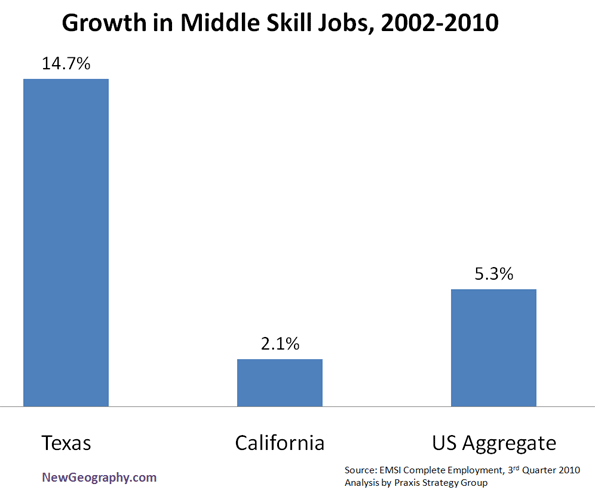
    A vast difference in economic performance is driving the demographic shifts. Since 1998, California’s economy has not produced a single new net job, notes economist John Husing. Public employment has swelled, but private jobs have declined.  Critically, as Texas grew its middle-income jobs by 16%, one of the highest rates in the nation, California, at 2.1% growth, ranked near the bottom. In the year ending September, Texas accounted for roughly half of all the new jobs created in the country.

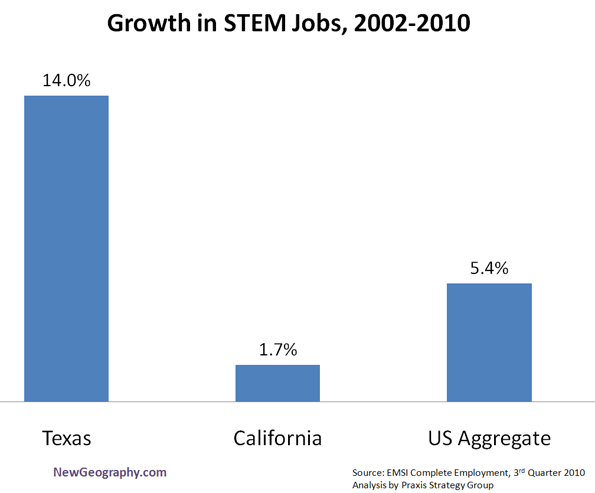
    Even more revealing is California’s diminishing preeminence in high-tech and science-based (or STEM–Science, Technology, Engineering and Mathematics) jobs. Over the past decade California’s supposed bulwark grew a mere 2%–less than half the national rate. In contrast, Texas’ tech-related employment surged 14%. Since 2002 the Lone Star state added 80,000 STEM jobs; California, a mere 17,000.

    Of course, California still possesses the nation’s largest concentrations of tech (Silicon Valley), entertainment (Hollywood) and trade (Port of Los Angeles-Long Beach). But these are all now declining. Silicon Valley’s Google era has produced lots of opportunities for investors and software mavens concentrated in affluent areas around Palo Alto, but virtually no new net jobs overall. Empty buildings and abandoned factories dot the Valley’s onetime industrial heartland around San Jose. Many of the Valley’s tech companies are expanding outside the state, largely to more business-friendly and affordable places like Salt Lake City, the Research Triangle region of North Carolina and Austin.

    Hollywood too is shifting frames, with more and more film production going to Michigan, New Mexico, New York and other states. In 2002, 82% of all film production took place in California–now it’s down to roughly 30%. And plans by Los Angeles County, the epicenter of the film industry, to double permit fees for film, television and commercial productions certainly won’t help.

    International trade, the third linchpin of the California economy, is also under assault. Tough environmental regulations and the anticipated widening in 2014 of the Panama Canal are emboldening competitors, particularly across the entire southern tier of the country, most notably in Houston. Mobile, Ala., Charleston, S.C., and Savannah, Ga., also have big plans to lure high-paid blue collar jobs away from California’s ports.

    Most worrisome of all, these telltale signs  palpable economic decline seem to escape most of the state’s top leaders. The newly minted Lieutenant Governor, San Francisco Mayor Gavin Newsom, insists “there’s nothing wrong with California” and claims other states “would love to have the problems of California.”

    But it’s not only the flaky Newsom who is out of sync with reality. Jerry Brown, a far savvier politician, maintains “green jobs,” up to 500,000 of them, will turn the state around. Theoretically, these jobs might make up for losses created by ever stronger controls on traditional productive businesses like agriculture, warehousing and manufacturing. But its highly unlikely.

    Construction will be particularly hard hit, since Brown also aims to force Californians, four-fifths of whom prefer single-family houses, into dense urban apartment districts. Over time, this approach will send home prices soaring and drive even more middle-class Californians to the exits.

    Ultimately the “green jobs” strategy, effective as a campaign plank, represents a cruel delusion. Given the likely direction of the new GOP-dominated House of Representatives in Washington, massive federal subsidies for the solar and wind industries, as well as such boondoggles as high-speed rail, are likely to be scaled back significantly.  Without subsidies, federal loans or draconian national regulations, many green-related ventures will cut as oppose to add jobs, as is already beginning to occur. The survivors, increasingly forced to compete on a market basis, will likely move to China, Arizona or even Texas, already the nation’s leader in wind energy production.

    Tom Hayden, a ’60s radical turned environmental zealot, admits that given the current national climate the only way California can maintain Brown’s “green vision” will be to impose “some combination of rate heights and tax revenues.”  Such an approach may help bail out green investors, but seems likely to drive even more businesses out of the state.

    California’s decline is particularly tragic, as it is unnecessary and largely unforced. The state still possesses the basic assets–energy, fertile land, remarkable entrepreneurial talent–to restore its luster. But given its current political trajectory, you can count on Texans, and others, to keep picking up both the state’s jobs and skilled workers. If California wishes to commit economic suicide, Texas and other competitors will gladly lend them a knife.


    This article originally appeared at Forbes.com.

    Joel Kotkin is executive editor of NewGeography.com and is a distinguished presidential fellow in urban futures at Chapman University. He is author of The City: A Global History. His newest book is The Next Hundred Million: America in 2050, released in February, 2010.

    Employment data from EMSI.

    Photo by {Guerrilla Futures | Jason Tester}

  • The State Government Deconstructors

    The results of the mid-term election of 2010 will be written over the next two years. Can the Republicans really make good on their promise of fiscal discipline? A glimpse of our future federal budget may be seen in the fiscal actions (and inaction) of America’s governors. Most states are struggling to balance budgets in troubled economic times with projected shortfalls nationwide of more than $100 billion for Fiscal Year 2012. Federal bail-outs are no longer an option. The hard choices are tax increases, reduction of services or innovative fiscal solutions like deconstruction. These bold and innovative governors, or “Deconstructors,” are what Alexander Hamilton had in mind when he wrote in The Federalist that “energy in the executive is a leading character in the definition of good government.”

    New Jersey Governor Chris Christie was the first Deconstructor to emerge. He wasted no time when he was sworn into office in January of 2010, declaring a fiscal state of emergency and freezing billions of spending. This week he announced 1,200 more public workers will get the axe come January. Governor “Wrecking Ball” is attracting plenty of national attention.

    Governor Mitch Daniels of Indiana has an approval rating today over 70%. This Deconstructor, a former U.S. Office of Management and Budget Director, inherited a $600 million deficit and within a year turned it into a $300 million surplus. Four years later, the state had a $1.3 billion surplus. In 2008, “The Blade” as he is called, ushered through the legislature a bill that cut property taxes on the average house by more than 30%, making Indiana one of the nation’s lowest property tax states.

    Along the way, Daniels decertified the public service unions. Within a year, 92% of government employees quit paying their union dues. He reduced the number of state employees by 14% to a level last seen in 1982. He leased the Indiana Toll Road to foreign investors for $3.85 billion, which he sequestered in an escrow account, where it can only be used for road construction. Today, Indiana is one of nine states with a triple-A bond rating and, it is creating jobs. Despite only 2% of the national population, Indiana generated 7% of all new jobs created in the U.S. last year.

    Mr. Daniels predicted that Americans would come to realize how much of what government now does “we can get by without.” He questions, “will the public sector be the servant, the enabler of the free economy…or will they be the master?” “Some of the anger out there now”, he said, “is directed not just at Wall Street but government employees and their unions.” In August 2010, The Economist wrote of, “his reverence for restraint and efficacy,” adding, “He is, in short, just the kind of man to relish fixing a broken state — or country.”

    Another Deconstructor is Governor Bob McDonnell of Virginia. Since taking office in 2010, Governor McDonnell converted a $1.8 billion deficit into a $200 million surplus. He overhauled Virginia’s pension system, saving $3 billion over 10 years. He imposed an immediate, statewide hiring freeze that covers all noncritical areas of state government. He saved $20 million per year by cutting and consolidating boards and agencies. State employees, who experienced a wage freeze for four years, identified $28 million is savings and will be rewarded with an $83 million bonus this year.

    Governor Haley Barbour of Mississippi inherited a budget deficit of $720 million deficit when he took office and created a surplus without raising taxes. Today Mississippi runs on less money than required two years ago, a lesson Barbour says the federal government needs to learn. Barbour championed serious tort reform. “We’ve gone from being labeled as a judicial hellhole and the center of jackpot justice to a state that now has model legislation,” says Charlie Ross, a Republican who chairs the state Senate Judiciary Committee. He increased funding for education and job training. The reward for his success is talk that Barbour may be a candidate for President in 2012.

    West Virginia Governor Joe Manchin, a Democrat, was elected to take Senator Byrd’s place in the Senate. As governor, he was routinely described as a penny-pincher and a tightwad. Manchin has been so focused on controlling state spending when an employee quit, he refused to allow new hires without his direct permission. West Virginia had a budget surplus last year while other states fired cops, fireman and teachers. The Charleston Gazette called the governor, “Penny wise and pound foolish,” but others praised his budget discipline. Conservative CATO Institute gave Manchin an A for his money management.

    What do these Deconstructors have in common? Despite the Great Recession, they each created a budget surplus. They did so by deconstructing the state government (and state deficits) they inherited. They used bold ideas (selling the toll road) and innovation (decertifying the unions) to do what others said cannot be done.

    The success of these deconstructors should offer some hope for badly managed states like California, Illinois, New York, and Michigan. The question is whether politicians in Sacramento, Springfield, Albany, or Lansing are ready to learn from these early deconstructors or will continue to bankrupt their states. Crunch time is approaching now since, thanks to the election, there is likely little appetite in Washington to bail these states out of their morass.

    **************************

    The Great Recession of 2007 – 2012 will be followed by a period during which budget deficits, unfunded obligations and credit restraints force tremendous change to the core structure of governments worldwide. This period will come to be known as THE GREAT DECONSTRUCTION.

    Robert J Cristiano PhD is the Real Estate Professional in Residence at Chapman University in Orange, CA and Head of Real Estate for the international investment firm, L88 Investments LLC. He has been a successful real estate developer in Newport Beach California for twenty-nine years.

    ¬¬¬
    Other works in The Great Deconstruction series for New Geography
    Deconstruction: The Fate of America? – March 2010
    The Great Deconstruction – First in a New Series – April 11, 2010
    An Awakening: The Beginning of the Great Deconstruction – June 12, 2010
    The Great Deconstruction :An American History Post 2010 – June 1, 2010
    A Tsunami Approaches – Beginning of the Great Deconstruction – August 2010
    The Tea Party and the Great Deconstruction – September 2010
    The Great Deconstruction – Competing Visions of the Future – October 2010The Post Election Deconstructors – Mid-term Election Accelerates Federal Deconstruction – November 2010

  • The Post Election Deconstructors

    Mid-term Election Accelerates Federal Deconstruction

    The mid-term election of 2010 has already been labeled a political earthquake. It was more like a shift of tectonic plates than a mere earthquake, and its results may be felt for decades. The landmark election signaled the beginning of deconstruction at the federal level in the United States. The Young Guns of the Republican Party (Representatives McCarthy, Cantor and Ryan) will lead a freshman class of 65 new members of Congress on a budget crusade to rein in government spending. Their first act will be to return federal spending to 2008 levels. There will be many acts to follow. These Congressmen will follow the lead of the “Deconstructors” who began deconstruction at the state level earlier this year.

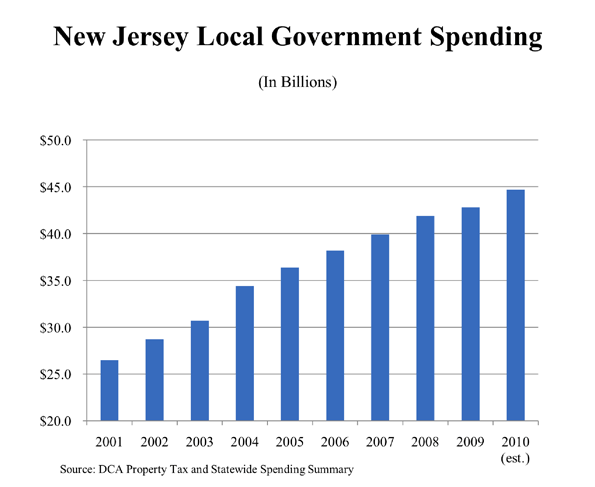
    Republican Governor Chris Christie was sworn into office in January of 2010 in a blue state election shocker. He wasted no time declaring a fiscal state of emergency. New Jersey had raised taxes 115 times in eight years and increased spending from $26 billion in 2001 to $45 billion when Christie took office. The state had a $10 billion deficit and had exhausted its borrowing capacity. Christie slammed on the brakes and froze $2.2 billion of spending. He refused to raise taxes. Christie tackled the Teachers unions, forced the Democratic legislature to impose pension reform, and even cancelled the $10 billion ARC tunnel between New Jersey and New York, the most costly public works project in the United States. Governor Christie has emerged as the first Deconstructor.

    California’s inconsistent governor, Arnold “The Terminator” Schwarzenegger may be forced to become “The Deconstructanator” before he leaves office. Faced with a $19 billion deficit, Arnold was forced to furlough 200,000 government workers. His plan for three day a month furloughs, equivalent to a 14% pay cut, was upheld by California’s Supreme Court. Six labor unions and 37,000 workers settled with Arnold accepting pension reform over furloughs. Further Deconstruction is inevitable.

    Newly elected Governor Brown will not have revenues from housing and dot.com bubbles to sustain the largess of his legislators. On October 23rd, the LA Times reported California shed 37,300 jobs in September. According to the state Employment Development Department, local government absorbed 32,400 of the job losses in September. The public employee layoffs are just beginning as cities and counties join the state in austerity measures. Where the private sector absorbed the brunt of the layoffs in 2008 and 2009, and Obama’s Stimulus bill insulated the public sector in 2010, the next wave will decimate the public employees of California.

    With the mid-term election mandate, federal bail-outs are no longer a viable solution to balance state budgets. Dozens of states have projected budget shortfalls of more than $100 billion for Fiscal Year 2012. Joining California in the state fiscal train wreck category are Illinois, Michigan and New York. Illinois has a budget of $26 billion that is $13 billion in the red. Despite its huge deficit, Illinois legislators increased state spending by 15% this year based on wishful projections that revenues will increase by 17%. Michigan is not far behind with a $4 billion deficit and a budget that was only balanced with $1 billion from the federal government.

    New York has a FY 2012 deficit of $13.5 billion. Its state government is dysfunctional and in denial. Newly elected Governor Cuomo has presented vague plans to solve New York’s misery. E.J. McMahon, executive director of the conservative Empire Center for New York State Policy said, “Cuomo’s budget proposals boil down to vague pledges of reducing costs and rooting out inefficiencies.” Cuomo is no Deconstructor and he will not be able to hide from New York’s fiscal reality. Where rationale fiscal management has long been ignored, Greek-like austerity measures and Deconstruction are inevitable.

    Not All States are Mismanaged

    Rhode Island was in dire straits last year with a $60 million deficit, declining revenues and unemployment at 12%. Governor Donald Carcieri realized the only way out of financial trouble was to make tough choices and embrace “fiscal responsibility.” He trimmed the state workforce through layoffs, attrition and leaving jobs unfilled. A classic deconstructionist, he streamlined and combined offices and agencies. He raised the retirement age for state pensions, cut benefits, and negotiated better contracts with unions and health care providers.

    Another Deconstructor is Governor McDonnell of Virginia. When McDonnell was swept into office with Governor Christie in 2010, Virginia had a $1.8 billion deficit. Virginia’s state budget had grown by 73.4% between 2000 and 2009, much faster than its population and inflation. Since taking office, Governor McDonnell converted the deficit into a $200 million surplus. He overhauled Virginia’s pension system saving $3 billion over 10 years. He imposed an immediate, statewide hiring freeze that covers all noncritical areas of state government. He cut and consolidated boards and agencies saving $20 million per year.

    Deconstruction Goes Global

    Global Deconstruction began in 2010 as a result of reduced worldwide government revenues caused by the prolonged Great Recession. No nation is exempt, including the US. Some like Germany have opted for fiscal discipline, helping to maintain Europe’s strongest economy. The Greeks ignored the crisis and rioted in response to the austerity plan imposed by the European Union. Yet despite their displeasure, austerity is an imposed reality Greek workers cannot avoid.

    The French responded characteristically with paralyzing civil strikes in response to the Sarkozy government increasing the retirement age from 60 to 62. The French unions are adamantly opposed to any change to the pension system. Sarkozy said he would shore up the pension system with “new levies on France’s highest earners and on company profits”. (France 24 International News October 5, 2010)

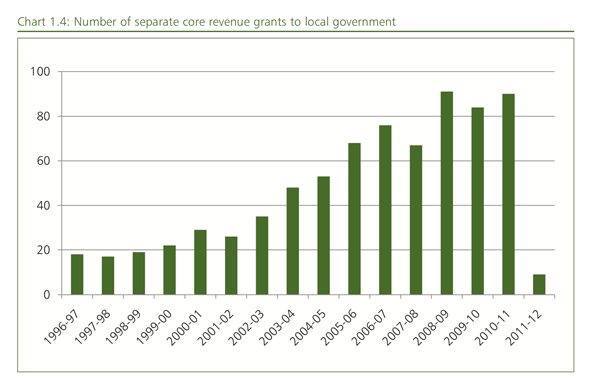
    In England, the response to the fiscal realities of the Great Recession have been draconian cuts which will cost 490,000 public sector jobs 2015. The cuts of $128 billion over 4 years made on “Axe Wednesday” represent 4.5% of their 2014-2015 GDP, equivalent to $650 billion in cuts to the US budget. (Chart 1.4 – SPENDING REVIEW 2010 Presented to Parliament by the Chancellor of the Exchequer by Command of Her Majesty October 2010). The BBC will see its funding cut by 360 million pounds, the budget of all its national radio services combined. Hundreds of London based diplomats will see their jobs disappear. Even the sacrosanct defense budget will receive cuts of 8%. (FT.com Daniel Pimlott October 20, 2010).

    Deconstruction is not limited to Europe. In Russia, Nikolai Volgin, president of the National Assembly of Labour and Social Policy Specialists, said he anticipates widespread layoffs this year, with as many as 1.5 million more people losing their jobs. Russia already has 8 million unemployed. Volgin said, “I do not rule out that there may be 9 to 9.5 million jobless in the country.” If Volgin’s predictions are correct, Russia will see an unemployment rate of 12 to 12.7 percent in 2011.

    Even Cuba has felt the chilling winds of deconstruction. President Raul Castro startled his people in August by stating 20% of Cuban workers may be redundant. He announced they will eliminate 500,000 state jobs in March of 2011 and allow some workers to work for themselves. Cubans are allowed to sell their own fruits and vegetables for the first time. The Cuban workforce is 5.1 million and 95% work for the state. Castro’s deconstruction will effect 10% of all Cuban workers.

    The difficult deconstruction occuring both at home and abroad is just in its earliest stages. Those countries and regions that take the opportunity to reform themselves will be the ones who will emerge with greater prosperity after the Great Deconstruction.

    Robert J Cristiano PhD is the Real Estate Professional in Residence at Chapman University in Orange, CA and Head of Real Estate for the international investment firm, L88 Investments LLC. He has been a successful real estate developer in Newport Beach California for twenty-nine years.

    ¬¬¬

    Other works in The Great Deconstruction series for New Geography
    Deconstruction: The Fate of America? – March 2010
    The Great Deconstruction – First in a New Series – April 11, 2010
    An Awakening: The Beginning of the Great Deconstruction – June 12, 2010
    The Great Deconstruction :An American History Post 2010 – June 1, 2010
    A Tsunami Approaches – Beginning of the Great Deconstruction – August 2010
    The Tea Party and the Great Deconstruction – September 2010
    The Great Deconstruction – Competing Visions of the Future – October 2010