Tag: Financial Crisis

  • Modifying Loans and the Decision-Makers

    A recent editorial in The New York Times lamented the latest housing market woes, this time resulting from various banks’ disregard for, or inattentiveness to, a legal foreclosure process. As the article correctly states, “It is hard to be shocked.”

    Further fueling uncertainty is of immediate concern, adding another layer of doubt to what may end up proving to be a formerly nascent recovery. While President Obama is calling for more thorough analysis to determine if foreclosure or modification is more prudent, and a provision in the Dodd-Frank bill authorizes government aid for troubled homeowners to assist with legal services, neither gets to the heart of the problem.

    Homeownership is not an inalienable right, and should be reserved for those who are in the financial position to shoulder the burdens that come with the supposed pride. The banks reviewing loan applications should be the final bastion of culpability in assessing prospective buyers’ financial wherewithal.

    This creates a moral conflict in many cases, as banks make money by lending money. In the interest of financial stamina, however, the banks have overlooked the simple fact that they only make money by lending money if the borrowers can pay them back. While there will always be some percentage of borrowers that fail to pay back their loans, it is all too well documented now that those levels are excessively high in today’s economic environment.

    Most troubling is the realization that many bank REO departments (for “real estate owned,” the class of property that goes back to lenders upon unsuccessful foreclosure auctions) are not staffed by real estate minds. While it is not fair to make a wholesale categorization of REO departments nationwide as real estate deficient, there are multiple cases where simple real estate fundamentals are unknown.

    Examples here include law firms, architecture firms and real estate advisory firms being engaged to teach real estate 101 to national banks’ REO departments. There have been cases where those making the decisions between lending or not lending, or foreclosure or modification, are unable to effectively comprehend sale and purchase agreements, site plans and floor plans, inspection reports or market analysis documents. This is not to suggest that these are bad people. But, as clerks, statisticians and analysts who are not educated or trained in the intricacies, or even general principles of real estate, they simply do not get it. How can such fragile issues with widespread economic and social ramifications be addressed by anything less than experts?

    In other words, these last bastions of culpability are unable to perform the simple tasks that even a reasonably responsible borrower should comprehend. Banks are in the business of making money, and that, in and of itself, is not a crime in a capitalist economy. But they should at the very least properly train those who are making decisions on lending millions upon millions of dollars to aspiring, whether ready or not, homeowners.

  • Cruising Into Student Debt

    I once calculated that, for the cost of four years of education at a private American university, a student could take 105 cruises around the world. For the comparison, I chose only cruises that cost about $1,900, as who wants to go through college stuck with an inside cabin? As I imagine it, Cruise College (school motto: “Go Overboard on Learning”) even has some similarities to the landlocked undergraduate experience.
    For all I know it may exist, given that higher education is one of the few growth sectors in the U.S. economy.

    Despite the decline of American business, private colleges, state universities, night schools, and for-profit continuing education have boomed.

    Harvard College will get about 30,000 applications for the 1,700 places in next year’s freshman class. At the same time, there’s a strong demand for education at community colleges in economically depressed places, as laid–off workers retool for new jobs.

    Beyond colleges with bricks and mortar boards, there is also the flourishing world of online universities, which flash their pop–up banners each time you log onto the Internet. (“Welcome to Faber College: Knowledge is Good.”)

    “For profit universities” offer master’s in business administration or degrees in philosophy in exchange for computer clicks and (prepaid) tuition. But you don’t need an online degree from Ace’s Accounting and Appraisal Academy to understand that there are hidden costs.

    For years one of the hottest stocks on Wall Street has been Apollo Group, Inc., an education corporation that markets its degree under the flagship of the University of Phoenix.

    Its campuses (not to mention leafy computer servers, for online students) are spread across the country and operate in forty states. Among other theorems, Phoenix postulated that continuing educators like their “campus” to be near Interstate exits, and that students usually only will drive twenty minutes to attend class. (It was Mark Twain who said, “Never let college get in the way of the evening commute.”)

    Apollo’s stock went public in the 1990s, and reached a pre-crash high of $91 a share, before Wall Street reduced its grade to about $50. Still, it’s a billion dollar company with strong growth, and the University of Phoenix is larger than nearly all state universities, not to mention the Ivy League, with some 470,000 enrolled students.

    Faithful to its name, Phoenix believes in the redemption of the American spirit, and it attracts its students with the promise that more degrees will lead them out of their doldrums. Courses are practical, borrowing from the school of knocks.

    To “take this job and shove it,” Americans need new skills — as nurses, IT programmers, whatever — and Phoenix (“the drive-thru university”) markets classes at convenient times and places.

    The reality of online education, however, is more subtle, as students are not the instruments of a new enlightenment so much as the pipeline of subprime student debt. They are recruited not for their mastery in art or football, but for their ability to fill out bank forms that let Phoenix, like any for-profit school, tap into the vast subsidized gold mine of federal student loan programs.

    Imagine, one day, stickers on the back of their Volvos that read “Subprime State.”

    For-profit university cheerleaders and even the federal government often brag about the low default rates on student loans. The reason the loans stay current, long after students have flunked out of astrology, is because it’s impossible to walk away from the tuition bills.

    Neither a bankruptcy nor an incomplete allows a student an escape from lenders intent on debt collections. (John Blutarksy: “Christ. Seven years of college down the drain.”) Better yet, the ultimate guarantor of the loans is the U.S. government. Knowledge may be Good, but government-backed debt is better.

    According to the New York Times, the default rate on student loans was about 7 percent in 2008, the most recent year for which data are available; “In the 2008-9 award year, students at for-profit schools represented 26 percent of borrowers — but 43 percent of defaulters. The median federal loan debt for students earning associate degrees at for-profit institutions was $14,000.”

    There is an online Student Loan Debt Clock, which reports outstandings of $855 billion, more than the credit card debt in the United States. It goes up about $3,000 a second, which is 5,684 luxury cruises an hour.

    It could be argued that traditional universities have similar Faustian (he coached at Notre Dame) bargains with their students. In exchange for about $200,000, which funds all sorts of professorial sabbaticals and vague courses (“Proust, Prufrock, and Pederasty”), students get undergraduate degrees that can be redeemed for yet more study at the graduate level… should they want to find interesting jobs.

    Statistically, an undergraduate degree provides, on average, $50,000 more per year in salary than does a high school diploma, although it is about a wash, were you to invest the tuition money into an S&P stock fund. Engineers are paid more than poets; state universities offer better “returns” than private colleges. It’s hard to date a cheerleader at an online university.

    Is Cruise College a better deal than the great American undergraduate experience? I can only speak from personal experience, which is limited. I have only gone on one cruise, while I spent six years in the waters of American and European universities. My quick take: The cruise had better floor shows, but I preferred the college library. The food was about the same. Overall, it would be hard to distinguish those who were drunk at fraternity parties from those merely seasick on board.

    And at least the students at Cruise College, for their job networking practicum, can mix with retired American executives.

    Because I am a child of mid-century suburbia, I believe in the good of a college education. On the walls of my childhood room were the pennants of various schools, and we covered our grammar school books with the names of great universities. In high school, we laughed at the Woody Allen line: “I was thrown out of there during my freshman year, for cheating on my metaphysics final. You know, I looked within the soul of the boy sitting next to me.”

    I loved a lot about my university experiences — the seminars, my friends, and something the cafeteria staff called “Chicken Eugène.” Still, I have no doubt that learning has many paths and that, for some, cruising would work as well as Princeton or Cal State. And for universities to be the instruments of financial sleights-of-hand, as opposed to teaching the great books, seems as distorted as the sermons of Elmer Gantry.

    Herman Melville wrote: “A whale ship was my Yale College and my Harvard.” I never read Moby-Dick in college, but I heard that it was a quite a cruise.

    Photo by Jonathan Blundell

    Matthew Stevenson is the author of Remembering the Twentieth Century Limited, winner of Foreword’s bronze award for best travel essays at this year’s BEA. He is also editor of Rules of the Game: The Best Sports Writing from Harper’s Magazine. He lives in Switzerland and has two children at universities.
  • Health Care: Booster Shot for Jobs?

    As a former health care human resources executive, I’m often drawn to the local hospital in whatever city I’m visiting. A city’s health care environment reflects its social, cultural and economic state. Because the local medical center complex is often the largest employer in town, it would seem that strong fiscal returns would be rewarded to those cities that strategically aligned their economic development efforts to capitalize on growing this sector. Unfortunately, the health industry has historically been viewed as a local disaster, replete with quality of care issues, bureaucratic inefficiencies and high costs.

    While the spiraling costs, the inefficiencies, and the future of reform are often talked about, little attention is given to health care jobs as springboards to enliven local and regional economies. The steady parade of doctors, nurses, technicians and support staff at our medical establishments provide cities with a huge multiplier effect on nearby housing, restaurants and retail businesses. The trickle-down effect spreads outward to hospital manufacturers, suppliers, pharmaceutical companies, and other ancillary firms that serve as the lifeblood of a functioning health care system. The economic activity of the medical business extends well beyond hospital walls; it’s a high-octane job engine, with the buying power of health professionals helping to sustain struggling communities.

    With current U.S. unemployment rates stagnating at high levels, the robust quantity of workforce activity resonating through hospital corridors is good news for our nation’s cities and regions. According to the U.S. Department of Labor, 1.7 million new jobs have been added to the health care sector since 2001. This figure includes employment gains in health insurance, construction, pharmaceuticals, biotech, the life sciences and other complementary fields. More impressively, the DOL estimates that by 2018 there will be a 21% employment increase in health practitioners (1.6 million jobs) and a 29% increase in health care support roles (1.1 million jobs). Health care also currently boasts the lowest unemployment rate of any industry, and salaries average a respectable $43,700.

    Cleveland, Ohio, is a prime example of a city that has undermined its economic potential by permitting dubious redevelopment efforts – centered on sports complexes and museums – to overshadow assets such as the Cleveland Clinic and the University Hospitals Health System, which together encompass 51,000 employees.

    Like most Rust Belt cities, Cleveland sorely needs an infusion of jobs outside of the long diminished blue collar sector. It could build collaboratively on its health care niche, creating complementary clusters of medically related firms in the life sciences and health information systems that would bring new opportunities and life to the area. The city’s world-class medical establishments could supply the ideal springboard for branding Cleveland as a global medical hub, rather than as the home of the Cleveland Cavaliers and the Rock and Roll Hall of Fame museum.

    One Cleveland-area organization, BioEnterprise, is taking the lead in fueling the growth and commercialization of health care companies in the bioscience sector. A collaborative effort between top medical and higher education institutions in the region, BioEnterprise is a promising attempt to alleviate Cleveland’s persistent difficulties in generating jobs and economic growth.

    The potential economic impact of new health related establishments is also gaining attention in Shawnee, Kansas, where the Economic Development Council is pursuing plans for a Biosciences Development District to attract high-paying job opportunities. And in Solano County, California, local leaders have made savvy use of existing infrastructure, new capital investments and local tax policies to fuel growth in the emerging medical sciences corridor between Sacramento and San Francisco.

    To build a successful future around health care jobs, cities must make creative use of their local and regional assets. For example, a four-year medical school in Spokane, Washington, according to a recent report entitled “America’s Next Great Academic Health Center,” would support more than 9,000 new jobs by 2030 and generate nearly 1.6 billion in new economic activity for the area.

    Here’s a concept of a model for job creation and economic growth: the Medical District Oriented Development (MDOD). These multidisciplinary districts would consist of a cluster of complementary stakeholders: health care entities (hospitals and medical centers, imaging facilities, community health centers, and private and specialty clinics); durable equipment manufacturers and providers, and pharmaceutical and life science research institutions. Livable communities, these districts would include housing, retail, and transportation options operating on the fringe of the medical campus setting.

    Unlike the much discussed Transportation Oriented Development paradigm, MDODs would not be faced with the “cart before the horse” issue; there wouldn’t be a question of whether to create demand before building the infrastructure or vice-versa. The magic behind MDODs would be a health care sector that already possesses a mature yet growing cadre of physicians, nurses, technicians and researchers who would serve as a captive audience for new development initiatives.

    In Sacramento, the U.C. Davis Medical Center campus possesses many of the building blocks of a successful medical district. As the flagship safety-net hospital for Northern California, the Medical Center has successfully collaborated with local task forces and associations to support the redevelopment of nearby neighborhoods, bringing new jobs to the immediate area. It has also spawned new workforce housing, restaurants and other amenities in an area that has faced hard times.

    In addition to collaboration between municipalities and medical institutions, and leveraging a region’s local assets, what else can cities do to manifest economic prosperity through health care centers? Chip and Dan Heath, the bestselling authors of Switch: How to Change Things When Change Is Hard, note that successful transformations begin when this question is asked: What’s working now and how can we do more of it? For city leaders, the question becomes: How can we capitalize on the booming health care sector through new investments in multidisciplinary medical districts, including housing and transportation options?

    When cities and regions choose to create synergies between their communities and their medical campuses, the prognosis is promising for an economic cure.

    Photo: Christiana Care health workers submit Magnet Recognition Program documents to the American Nursing Credentialing Center.

    Michael P. Scott is an associate with Centro, Inc, a Denver-based consulting firm focused on the future of our city centers. He can be reached at michael@becentro.com

  • The Tea Party and The Great Deconstruction

    Some say a Second American Revolution has begun. In the first American Revolution, American militiamen at the Old North Bridge in Concord, Massachusetts, fired the Shot Heard Round the World at British Redcoats on April 19, 1775.

    The Shot Heard Round the World in the Second American Revolution was the surprise election of Scott Brown, again in Massachusetts, on January 19, 2010. The bullets fired were ballots as a Tea Party-backed candidate captured the “Kennedy seat” in the US Senate. The militiamen of 2010, riding pickup trucks rather than horses, call themselves the Tea Party, named after an act of insurrection against the out of touch establishment of King George.

    Since January of 2010 the Tea Party has swept Republican establishment politicians from office in Massachusetts, New Jersey, Pennsylvania, Alaska, Delaware, Utah and Florida. Like King George, the establishment does not plan to go quietly. Governor Crist continues to run as an independent in Florida. Senator Murkowski announced she would run as a write-in candidate in Alaska.

    Americans who joined the Tea Party movement believe our government has grown too big. In this they have broad support that extends beyond the 50% coalition that elected George Bush. Part of the key to their successes to date has been steering clear of divisive social issues and concentrating on fiscal ones.

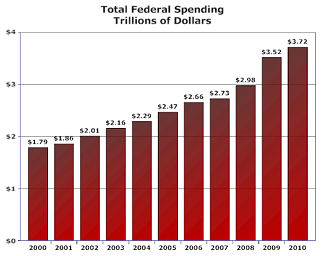
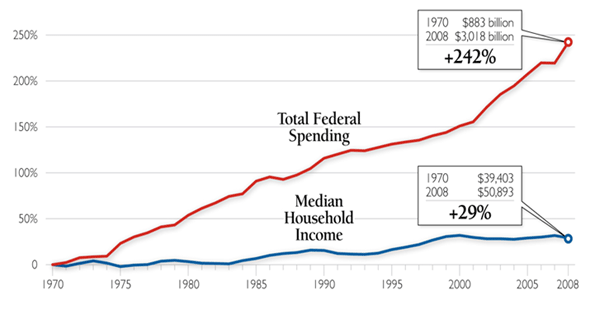
    Like a majority of Americans, Tea Parties are alarmed that government spends too much (Chart from Heritage Foundation) and does so with borrowed money. They understand that our children and grandchildren will be forced to pay for today’s reckless spending. As a result they have gone to the polls in record numbers to make their voice heard. They want the spending to stop and if the politicians do not listen, they will throw them out as their forefathers displaced King George. It does not appear that the politicians are listening. Despite the boisterous town hall meetings of 2009 and a string of primary upsets in 2010, politicians discount the public sentiment. Democratic Congressman Tom Perriello of Virginia recently said, “If you don’t tie our hands, we’ll keep stealing.”


    Source: Heritage Foundation

    What kind of America does the Tea Party want?

    The Tea Partiers have watched the federal budget double under Bush and Obama at a time hen they have had to cut back on their own family expenditures. (Chart from the Cato Institute) They want a smaller, less intrusive government and most importantly, a government that lives within its means. The Tea Party wants an end to trillion dollar deficits. Where the two political parties accept trillion dollar deficits, The Tea Party demands draconian change in our system of governance. They recognize the need for the coming Great Deconstruction.

    The Cato Institute has offered a website dedicated to downsizing the federal government. Cato outlines clear and concise methods to reduce spending and deconstruct the various departments of government as the Tea Party is demanding. Cato’s author, Chris Edwards, envisions the elimination of entire branches of the federal government by “devolving” various programs to the states.

    The annual savings proposed by the Cato Institute study total more than $400 billion per year. Some call the recommendations draconian and outrageous. Yet the savings represent just 11% of current spending – a critical way to adjust to the new realities of the deconstruction.

    The Second American Revolution may have begun. If it is so, and America earns its independence from trillion dollar budget deficits and professional politicians, the future of America may look very much like Cato study has proposed. No matter what the outcome of the elections in November of 2010, the future will look very different than today as the Great Deconstruction comes to pass.

    ***************************

    Robert J Cristiano PhD is the Real Estate Professional in Residence at Chapman University in Orange, CA and Head of Real Estate for the international investment firm, L88 Investments LLC. He has been a successful real estate developer in Newport Beach California for twenty-nine years.

    Other works in The Great Deconstruction series for New Geography

    Other works in The Great Deconstruction series for New Geography
    Deconstruction: The Fate of America? – March 2010
    The Great Deconstruction – First in a New Series – April 11, 2010
    An Awakening: The Beginning of the Great Deconstruction – June 12, 2010
    The Great Deconstruction :An American History Post 2010 – June 1, 2010
    A Tsunami Approaches – Beginning of the Great Deconstruction – August 2010

  • Why Housing Will Come Back

    Few icons of the American way of life have suffered more in recent years than  homeownership. Since the bursting of the housing bubble, there has been a steady drumbeat from the factories of futurist punditry that the notion of owning a home will, and, more importantly, should become out of reach for most Americans.

    Before jumping on this bandwagon, perhaps we would do well to understand the role that homeownership and the diffusion of property plays in a democracy. From Madison and Jefferson through Lincoln’s Homestead Act, the most enduring and radical notion of American political economy has been the diffusion of property.

    Like small farmers in the 19th century, homeowners–and equally important, aspiring homeowners–now represent the core of our economy without which a strong recovery is likely impossible.  Houses remain as a financial bulwark for a large percentage of families, the anchor of communities, and, increasingly, home-based businesses.

    The reasons given for abandoning the homeownership ideal are diverse.  Conservatives rightfully look to diminish the outsized role of government in promoting homeownership.  Some suggest  that Americans would be better off  putting their money into things like the stock market or boosting consumer purchases.

    New-urbanist intellectuals like the University of Utah’s  Chris Nelson predict  aging demographics will lead masses to abandon their homes for retiree communities and nursing homes.   The respected futurist Paul Saffo predicts that as skilled laborers move from Singapore to San Francisco to New York and London, there is little need to “own” a permanent place. In the brave new future, he suggests, we will prefer time-sharing residences  as we flit from job to job across the global economy.

    Some of the greatest hostility towards homeownership increasingly comes from the progressive left, some of whom are calling for the total elimination of the homeowner mortgage interest deduction.  “The Case Against Homeownership,” recently published in Time,  encapsulates the current establishment’s  conventional wisdom: that homeownership is by nature exclusionist, “sprawl” promoting and responsible for “America’s overuse of energy and oil.”

    Yet for all the problems facing the housing market, homeownership–not exclusively single-family houses–is not likely to fade dramatically for the foreseeable future. The most compelling reason has to do with continued public preference for single-family homes, suburbs and the notion of owning a “piece” of the American dream.   This is why that four out of every five homes built in America over the past few decades, notes urban historian Witold Rybczynski, have less to do with government policy than “with buyers’ preferences, that is, What People Want.”

    What we are going through now is not a sea change but a correction from insane government and business practices.   The rise in homeownership from 44% in 1944 to nearly 70% at the height of the bubble reflected a great social democratic achievement. But by the mid-2000s government attempts to expand ownership–eagerly embraced by Wall Street speculators–brought in buyers who would have historically been disqualified.

    In some markets, prices exploded as people moved up too quickly into ever more expensive housing. Housing inflation was further exacerbated by “smart growth” policies, which limited new home construction in suburban areas and instead promoted dense, “transit oriented” housing with limited market appeal and economic logic.

    Rather than artificially constraining supply and protecting irresponsible borrowers,   we should let nature take its course. Home values need to readjust historic balance between incomes and prices. Over the past 60 years, notes demographer Wendell Cox, it took two to three years or less of median household income to purchase a median-priced home. At the peak of the boom, that ratio had ballooned to 4.6.

    The disequilibrium was the worst in regions like Los Angeles, Las Vegas, San Bernardino-Riverside and Miami. At the peak of the bubble, between 2006 and 2008, according to the National Homebuilders Association- Wells Fargo “Housing Opportunity Index,” barely 2% of families with a median income households in Los Angeles could afford to buy a median priced home; even in the traditionally affordable Riverside area, the number was roughly 7%. In Miami, barely 10% could afford such a purchase; in Las Vegas, often seen as one of the cheaper markets, only 15%.

    What a difference a market correction makes. The affordability number for Los Angeles is now 34%, 17 times better than two years ago, while Riverside is now near 70%. Miami’s affordability picture has improved to over 60% while in Las Vegas, it’s back over 80%.

    These lower prices–not Wall Street or federal gimmickry–will lure new buyers to the places that some new urbanists   have predicted will be “the next slums.” Already there’s evidence in places like Miami of a renewed interest in now-affordable suburban single-family homes while condos stay empty  or become rentals.

    Of course without a return to robust job growth, particularly in the private sector, the home market– and pretty much all mainstream consumer purchases–will remain weak. No matter how low prices get, people worried about losing employment do not constitute a promising new market for homes.

    But over the longer run most Americans will seek to purchase homes –whatever the geography. Increasingly this will be less a casino gamble, and more  a long-term lifestyle choice.  As America adds upwards of 100 million more Americans by 2050, the demand will stare us in the face.

    As boomers age, the two big groups that will drive housing will be the young Millenial generation born after 1983 as well as immigrants and their offspring. Sixty million strong, the millenials are just now entering their late 20s. They are just beginning to start hunting for houses and places to establish roots. Generational chroniclers  Morley Winograd and Mike Hais, describe millenials in their surveys as family-oriented young people who value homeownership even more than their boomer parents. They also are somewhat more likely to choose suburbia as their “ideal place to live” than the previous generation.

    These tendencies are even more marked among immigrants and their children. Already a majority of immigrants live in suburbia, up from 40% in the 1970s. They are attracted in many cases by both jobs and the opportunity to buy a single-family home. For an immigrant from Mumbai, Hong Kong or Mexico City, the “American dream” is rarely living in high density surrounded by concrete; if they wanted that, they could have stayed home.

    Over coming generations, changes in family and work life will make single-family homes, townhouses and other moderate-to-low density housing more attractive.  Contrary to the anonymity predicted by most futurists, your chosen place is becoming more important, as evidenced by numerous suburban and small town downtown revivals as well as growing local volunteerism.

    Equally important, multi-generational households are on the rise back to 1950s levels–in part due to immigrant lifestyle preferences. People are staying put; even before the bubble burst, mobility had dropped to the lowest level in over a half century. With the rise of new technologies allowing for dispersed work, the single family home increasingly houses not only residents, but part and full-time offices.

    Barring a long-term permanent recession or a national planning regime aimed at curbing single-family home construction, these factors should lead to a new surge in home buying starting later this decade. It may be too late to save many who overextended themselves in the bubble, but this resurgence could do much to propel our anemic economy, restoring the home to its rightful place one of the cornerstone not only of the American dream, but of our democracy.

    This article originally appeared at Forbes.com.

    Joel Kotkin is executive editor of NewGeography.com and is a distinguished presidential fellow in urban futures at Chapman University. He is author of The City: A Global History. His newest book is The Next Hundred Million: America in 2050, released in February, 2010.

    Photo by Wootang01

  • Time to Hate Those HOAs (again).

    The foreclosure crisis has been devastating for millions of Americans, but it has also impacted many still working as before and holding on to their homes. Even a couple of empty dwellings on a street can very quickly deteriorate and become a negative presence in the neighborhood, at the least driving down prices further, sometimes attracting crime. Untended pools can allow pests to breed. Many animals have been abandoned and shelters report overflowing traffic. The resulting impacts on local governments have been particularly visible, as property tax assessments have fallen and revenues have also gone south.

    Less obvious is the impacts on home owner associations [HOAs], whose revenues have also taken a hit, albeit for rather different reasons. For the most part, HOA dues are not a function of the value of the home but rather the need to cover the costs of maintaining the common interests of the association: landscaping, security and so forth. These tend to be fixed, even if the values of the homes collapse, and may even rise if dwellings are empty and untended.

    Many HOAs, especially in the newer metropolitan areas like Phoenix and Las Vegas where foreclosures have been most concentrated, have taken a beating because the number of households paying into the association has been depleted, quite badly in some instances. The problem seems, from press reports, to cover the economic spectrum. Low-income first-time buyers may stop paying their dues as an economy measure, while more affluent owners are more likely to have pulled cash from their home and are walking away from their debts. There are also thousands of empty homes that were purchased as investments at the height of the boom and may have never even been occupied.

    The foreclosure debacle is now old news, but the HOA situation is receiving attention because association boards are now aggressively trying to recoup their debts, even from those who have walked away from their mortgages. The debt, they argue, is attached to the individual, not to the dwelling, and is being turned over to collection agencies. Now, this is hardly a novelty. Municipalities have been turning household utility debts over to third parties for years, often with some success, and without a murmur of protest. So why is it different if HOAs do it?

    The answer is that HOAs are extremely unpopular with two vocal constituencies. The first is the academic community, and its hostility is part of the professional opprobrium that is heaped on gated communities, privatization and pretty much anything connected with suburban development. Interestingly, while the design aspects of gated communities have caught the attention of planners and urbanists, relatively few have focused on the dimension of governance. Those that have written on the topic have tended to be critical of private clubs that are seen to exist at the expense of the municipal collective. For what its worth, I don’t think I’ve ever known of an academic colleague who lived in an HOA, in contrast to the bulk of my students, who live in one or grew up there.

    The second constituency is more rowdy. Academics just disdain HOAs, but this group is committed to exposing them as a vast conspiracy to subvert the American way of life. This may sound like another version of contemporary “Teamania” but it is has been around for at least the past decade, during which time I’ve been monitoring Internet posts and the like. To this group, any restriction on personal freedom — from the color of one’s drapes or exterior paintwork through the display of the national flag — is clearly anathema.

    Early this year, my research on neighborliness in HOAs was covered in the local paper, and by the end of the day there were dozens of online posts. In response to the basic finding — that there is little fundamental difference between HOA and traditional neighborhoods — we received a torrent of angry responses. With a single exception, they all dismissed the findings out of hand, using an example of someone’s experience (rarely their own) to prove the point, at least to their satisfaction. One reader even tracked down my email address in order to demand an assurance that no public funds were used to promote this nonsense.

    Like much in contemporary American politics, this leaves me confused. I don’t understand why an exclusive residential association, freely entered into, with explicit rules that are presented at the outset, offering services-for-cash, is un-American. After all, this is in contrast to a municipality that levies taxes for services from which one cannot opt out (if one has no children in the schools, for instance) and which may not be available to all (such as public transport), and which could easily be seen as a redistributive institution, an example of that socialism we keep hearing so much about.

    For the record, I am happy to pay my property taxes for services I don’t receive — its just part of the social contract. Nor do I live in an HOA. But I can understand why our research indicates that most people who live in them do prefer them (and, for example, often move from one HOA to another). Rather than displaying the angst of those who seem to get nervous if anyone tries to step on their toes, these residents embrace belonging to a small polity in which they have a voice. And we should remember that rules, like fences, make good neighbors. As these neighborhoods become more diverse, traditional and non-traditional households alike can find reassurance in the behavioral conformity demanded of neighbors by an HOA.

    This brings us back to the recent stories about management boards ‘hounding’ those who have not paid their dues. Similar accounts have shown up for years, and the thrust is always the same: punitive, out-of-control boards attack those already in financial distress. There is clearly a lot of the latter to go round, but it’s hard to see why HOAs are much different than any other organization that is looking at a handful of bad debts. Are the HOAs the victims here? Absolutely not. Many embraced the housing bubble, and permitted speculators to buy in, even though they had no intention of living in the properties. At the height of the madness, up to one third of all housing transactions in Phoenix were initiated by out-of-state buyers who drove up home prices precipitately, and eventually caused the median house price to double. This has since corrected. All CC&Rs (the rules of the HOA) that I have seen dictate however that the purchaser must live in the property and that rental units are not permissible. So, like all the other players, the HOA boards liked the price increases so much that they ignored their own rules and looked the other way, a lapse for which they are now paying the price.

    Still, it would be a mistake compounding a mistake to climb on the anti-HOA bandwagon, now joined by the ACLU, which has recently joined the fray over a fight about a homeowner’s right to fly the Gadsden flag (motto: “Don’t step on me”). Libertarians should recognize that no-one has ever been forced to live in an association and that whipping up the wrath of state legislatures to control HOAs is a bad idea: it encourages even more government intervention, and it messes with the neighborhood, a form of governance that the vast majority rightly supports, even in HOAs.

    Andrew Kirby has written about HOAs on several occasions, including the 2003 edited volume “Spaces of Hate”. He most recently wrote about ‘The Suburban Question’ on this site in February.

    Photo by monkiemag

  • The Disappearance of the Next Middle Class

    Every week we read that yet another major housing project has been turned down by the Courts here in New Zealand because of the need to protect “rural character” or “natural landscapes”. This may well have profound short and long-term consequences for the future of our middle class, as it does for the same class in countries around the advanced world.

    Every week a multitude of smaller developers abandon their projects because Councils’ compliance costs and development contributions make the projects unviable – even if the land were free. And it’s not.

    The New Zealand Institute of Economic Research says the ten-year norm for New Zealand is 26,000 new dwellings built per year. Statistics New Zealand reported only 16,000 dwelling consents issued in 2009. The NZ Property Investors Federation says we are building only 7,000 dwellings a year.

    Some say the Property Investors Federation figures are too low given that Statistics New Zealand’s figures for the year to date suggest we shall issue between 13,000 and 11,000 consents this year, and that the “slippage” between consents and finished dwellings cannot be that great.

    However, this is rather like wondering whether you are driving towards a concrete wall at 100 mph or only 80 mph.

    Any current year estimates confirm we are on a slippery slope to catastrophe.

    Unemployment, especially among young unskilled males is on the rise. Given these dreadful build-rates, should we be surprised, since these workers depend on construction for economic opportunity?

    And why don’t we recognize the cause and do something about it?

    First let’s look at the statistics. A Google search under “construction multipliers” turns up statements such as “building 1,000 houses generates 2,300 permanent full time jobs”. Another will say “Every dollar spent in the sector has a multiplier effect between 2.1 and 2.8.” These “low multiplier” statistics seldom spell out what is meant by “the construction sector”, and most are annual figures, and focus on “permanent full time jobs”. But the construction sector generates a multitude of short-term contracts that presumably slip through the net.

    These low “construction” multipliers are reinforced by a post-modernist ideology that tries to persuade us that housing is an unproductive activity that takes productive rural land out of production and hence undermines the economy. This is the old “primary” industry myth, further reinforced by the quaint animist notion that subdivision causes “death by a thousand cuts”. The surveyors are out there wielding their long knives and watching the Earth Mother bleed to death.

    Smart Growth planners claim the “urban sprawl” that grew around our cities during the post-war decades was the terrible price paid for housing the baby boomers and must be replaced with Smart Growth (or perhaps more accurately, Dense Thinking).

    We have lost sight of the fact that those prosperous decades were actually in large part the result of those large-scale suburban developments.

    US economists generally explain the post-war boom as being driven by the work force switching from weapons to washing machines.

    In New Zealand we used to attribute those golden years to micro-management of the economy, and to import licensing in particular. In reality, our real genius was probably introducing the capitalized family benefit which led to our own “Levittown builders” such as Fletcher Construction and Neil Housing.

    Back in the late sixties, while reading for my thesis in urban development economics, I read a report on the drivers of the post-war boom in America, during the twenty years from 1945 – 1965. Wildavsky’s Oakland Project focused on behavioural analysis rather than econometrics.

    The authors concluded that the suburban development boom laid the foundations for the long-term development of the post-war American middle class.

    An equivalent thought experiment would now read something like this:

    • We begin with a clean greenfields site, presumably being farmed, or just open space of some kind.
    • A developer decides the land is well located for a new 1,000 lot residential development and hires consultants or staff to prepare an application. The process alone takes five to six years and provides unproductive employment for a host of highly paid professionals.
    • The project is then killed off by either the Council or the Courts.

    In a sensible world, as prevailed in the post war years, the project would move on to the next stage:

    • The land development teams move onto the site and start the final surveys, road-building, drainage and stormwater schemes, landscaping, and street-crossings, all required before the builders drive their first profile-pegs into the ground.
    • Then teams of contractors start building the houses, which will have been designed by architects, draughtsmen or architectural designers, and then processed through a simple consenting procedure.
    • The teams of carpenters, glaziers, plumbers, painters, roofers, stoppers, electricians and plumbers all move in to finish the houses ready for occupancy. A gang of maybe ten drain-layers could lay the drains for the 1,000 houses over a five year sales-and-build period – say 20 contracts a year.
    • These teams use products and materials cut from forests, mined from quarries, processed in mills, or produced in factories, or recycled products, all requiring employed labour.

    So after a few years the 1,000 homes may be built and occupied. The analysts in the sixties suggested the 1,000 houses would generate say 5,000 direct contract-jobs over those early years.

    However, they recognized that the real economic activity would continue for another fifteen years or more. The same happens today.

    • As the families move into the houses they buy kitchen equipment, drapes and light fittings, bookshelves, plasma TVs, computers, artworks and wine cellars and so on.
    • The owners lay paving, build decks, plant gardens, and landscape the property.
    • The gardens require lawn mowers, chain saws, hedge trimmers, nursery plants, and barbecues.
    • Then up go the Gazebos, the dog kennels, the play houses, the extra rooms, and so on.
    • And then come the swimming pools, spa pools, home offices, sleep-outs, and solar heaters.

    Many of these improvements are produced by the “sweat-equity” of the DIY owners and are a major means of increasing household wealth and well-being. They arealso a potent form of saving, provided the owners are investing in tangible improvements and not over-priced land.

    These suburban on-site improvements go on forever. Consequently, even today there are about 80,000 certified “alterations” a year in New Zealand – and many more that don’t get near a permit.

    All these activities create jobs for the people who make the spa pools, the plasma TVs, the gardening tools, the cars, and the Gazebos.

    After several years from start up the properties are likely to require a gardener once a week, and maybe a housekeeper one or two days a week, and baby sitters, and whatever else the modern family needs to manage its work-life balance. These are the on-site ‘jobs’, but the families also need teachers, doctors, day-care providers, retail staff and so on and so on.

    The sixties report concluded that every 1000 houses would generate a total of 40,000 contracts and jobs. Which seems outrageous until you divide the 40,000 by the fifteen to twenty years, which comes back to the multipliers of 2.0 to 2.6.

    The sixties thought-experiment reminds us that by driving our residential build-rate from 24,000 a year to a no more than 13,000 a year, and probably much fewer, we are turning off the boiler that regenerates our middle class.

    It also explains why an economy with a low “build-rate” is unlikely to enjoy full employment.
    Those suburbs were not “a sad price to pay for our post war housing” but were the economic driver of “the long summer of content” so well described by Bill Bryson in “The Thunderbird Kid.”

    So why are we allowing our institutions to destroy the ability to regenerate our own suburban middle class?

    Whatever happened to genuine sustainable development? Sustainable for middle class people and families too.

    Owen McShane is Director of the Centre for Resource Management Studies, New Zealand.

    Photo by pie4dan

  • Flexible Forecasting: Looking for the Next Economic Model

    Last autumn I gave a talk in California’s San Fernando Valley. I was the last of three economists speaking that day, and I watched the other economists’ presentations, each a rosy forecast of recovery and imminent prosperity. So, I was a bit nervous when it was my turn to speak, because I had a forecast of extended malaise. People don’t like to hear bad news, and they do blame the messenger. In the end, I was relieved. No tomatoes, no catcalls.

    That’s how things went last fall and winter. Many economists confidently predicted a rapid recovery, while my group’s forecasts were pretty dismal: weak economic growth with little if any job creation. Today, many of those same economists’ forecasts are far closer to ours. Why?

    Part of the problem is the fact that macroeconomics is an unsettled discipline. We have lots of macroeconomic models, none of which is adequate for all states of the world all the time. Each provides insight, but no single model can cope with the awesome complexity of the world. A large part of the art of forecasting is determining which model is most applicable to the current situation; which ones include insights that are dominant today.

    The problem is exacerbated when economists become excessively committed to a particular model. This isn’t religion or politics, it’s forecasting. It is hard enough. There is no reason to handicap yourself by excessive fealty to some model or doctrine.

    There was another problem that resulted in the change of tune. The world changed in September 2008. We call it a regime shift. It’s a move from one (good) equilibrium to another (bad) equilibrium. Statistical models that worked well in the old regime don’t work in the new regime. We hustled to adjust our models, but admitted that with limited experience in the new regime, we were less confident in our forecasts.

    The problem with a regime shift is that it is similar to a change in the rules of a game. Old relationships don’t hold anymore. Football is an example: If you changed the rules to allow five downs instead of four, nobody would predict punts on fourth down.

    Some economists didn’t recognize the regime shift. They went about their business using the same old models in a new world. Comments about the length of a typical recession or about how sharp declines are followed by rapid recoveries were clear signals that the speaker didn’t understand the situation.

    Some economists were fooled by the stimulus. The rules of accounting cause government spending to be reflected as an increase in economic activity. Stimulus plans such as Cash for Clunkers and tax credits for home purchases moved the timing of transactions, artificially reinforcing the direct spending impacts. Similarly, bailouts and foreclosure prevention programs postponed the recognition of losses.

    Many interpreted the resulting increase in last winter’s reported activity as permanent, but that could not be. We were not building anything or laying the groundwork for sustained prosperity. Instead, we were just continuing the previous decade’s consumption binge. The banks had failed, but the government had stepped in. It became the mother of all banks, borrowing from future citizens and other countries to fuel today’s consumption.

    Regime shifts that lead to a bad equilibrium appear to be similar to bank runs. There need be no basis for panic, but a panic can guarantee the demise of a bank. The result of a panic on a bank ends there. The bank is failed, gone. There may or may not be a contagion effect on another bank.

    A panic can also guarantee an economic decline. But our economy is different than a bank. It can’t fail, in the sense that we can’t shut it down and walk away. We’re all still here after a regime shift. We’re stuck with a mess.

    We did have a mess after September 2008. All of a sudden, everyone’s wealth had declined, a lot. Businesses, consumers and governments were over-leveraged. Risk aversion had increased, perhaps to remain high for decades. Our understanding of economic risks had changed. We had discovered black swans – rare and unexpected outliers — in our system.

    The problem with regime shifts is that we don’t know how to initiate or cause them. We see shifts to bad regimes, and we can see their self-fulfilling nature. Can there be some self-fulfilling process that leads to a shift to a better regime? I hoped so, and I hoped that Obama’s election would initiate such an event. Our forecasts aren’t based on hope though, and it’s just as well that we didn’t forecast that his election would generate a spontaneous recovery.

    Today, enough time has passed that even the most slowly adapting forecasters are forced to confront the post-2008 data and the government’s failed economic efforts. As forecasters confront these facts, their forecasts are becoming increasingly gloomy. Now, forecasts of protracted malaise or even a double-dip recession are increasingly common. Why?

    Because we borrowed to extend a consumption binge, and we compounded that error with omissions and perverse policy.

    The stimulus’s omissions are glaring. We didn’t significantly invest in infrastructure that would improve our future growth. We failed to address the weaknesses in our education sector that fuel increasing inequality, sentence many to a life of hopelessness, and permanently constrain our economic growth. We did nothing to encourage small business’s growth; in an example of perverse policy, we are actually creating a new regulatory regime that favors large companies.

    Then there were the actions that will probably restrain future economic growth. The minimum wage was raised. We had health care reform, but we didn’t address the real problem: the fact that the health care consumer pays an insignificant portion of the bill at the time of consumption. We had financial reform that failed to address the fundamental problems of too-big-to-fail, and we protected risky activities, increasing the regulatory burden and crippling the ability of small banks. We halted much of our offshore drilling.

    Looking forward, there is little reason for optimism. We’re considering huge increases in our energy costs through greenhouse gas regulation. We have a massive tax increase scheduled at the end of the year.

    While a double-dip recession is not the most likely outcome, we can’t reject the possibility. More likely, we face a long slow struggle to overcome ourselves and restore real prosperity. The forecasters’ consensus appears to be moving toward accepting that reality.

    Flickr photo of Petra’s Yoga Poses Around The World

    Bill Watkins is a professor at California Lutheran University and runs the Center for Economic Research and Forecasting, which can be found at clucerf.org.

  • Ownership Subsidies: Dream Homes or Disasters?

    Home ownership has been considered an integral part of the American Dream for as long as anyone can remember. Now it has come under scrutiny, notably in a June Wall Street Journal piece by Richard Florida, which claims that that home ownership reduces employment opportunities for young adults, since it limits their mobility. To support ownership, others — particularly Wendell Cox — have argued that home ownership levels do not correlate with the economic productivity of cities, and cite the rapid suburban development in the Sunbelt as evidence that home ownership is as valuable as ever.

    My inclination is that the truth lies somewhere in between the two sides of the debate. For the sake of simplicity, I’ll refer to them as New Urbanist supporters versus Smart Growth opponents (I realize these are broad generalizations). While they disagree on the merits of home ownership, there’s an interesting point of agreement: both sides oppose subsidies to homeowners. I’d argue that both sides should focus on getting the issue of discontinuing subsidies onto the national agenda.

    Like many 20-something young professionals, I have no aspirations towards home ownership. I ditched my car when I moved out of the suburbs, and I refuse to sign a lease that lasts more than three months. This affords me the flexibility that my life as a freelancer requires. If I were in a profession that didn’t call for a great deal of mobility, perhaps home ownership would be appealing. When North America was a manufacturing powerhouse, most people were in that situation. But an increasingly dynamic labor market requires an increasingly mobile workforce… to an extent.

    For those of us in the 18-30 demographic who work in fairly mobile industries, home ownership isn’t necessarily as big a hindrance as Florida suggests. There are people like me who work in volatile industries and simply can’t be tied down to one city, but we’re in the minority. For the majority, it really depends on the location. If your home is within commuting range of a major city, it should be possible to find work in your field without uprooting.

    But jobs come before home ownership in order of priority. In a scenario where state and local governments create a fiscal climate inhospitable to economic growth, rather than chase cheap housing, people migrate to the strongest economic region (for example, the Sunbelt).

    While home ownership isn’t going to be obsolete any time soon, in decaying cities like Detroit and Buffalo, and in towns far from urban centers, it can be a major hindrance to finding a job. Home owners invest a large amount of their net worth in their homes, and it becomes difficult to simply abandon unsellable homes and pay rent in a new city, though this does happen. There are roughly 90,000 abandoned homes in Detroit alone. Old manufacturing and resource town centers are especially vulnerable, since their economies typically lack the diversity to attract new employment opportunities. This isn’t a fault of government policy, but an unavoidable economic reality.

    Incentives such as the omnibus of initiatives created by the Bush administration’s Ownership Society led to an increase in home ownership levels. But no good can come of home owner subsidies; they lead to inflated prices and distorted patterns of urban development. A survey of first time homeowners in 2009 by Keller Williams Research found that 10% of first time home buyers were primarily motivated to purchase a home because of the $8000 tax credit. A further 4% were primarily motivated by low interest rates. This may seem trivial, but it should be pointed out that the average age of first time US home buyers has decreased to 26. That is a full 8 years younger than in the UK, where the average age is on the upswing. While higher home costs in the UK (partially due to more stringent land use regulations) are probably a major factor, one cannot help but think that the First Time HomeBuyers Tax Credit and subsidized mortgages contributed.

    Subsidies for home ownership are incongruent with the ideological underpinnings of both New Urbanists and Smart Growth opponents (who are mainly conservatives and libertarians). Some Smart Growth opponents are likely to be in favor of these subsidies, since they buy the rationale behind the Ownership Society model. Namely, they believe that ‘pride of ownership’ leads to flourishing communities. On this point, they are probably correct. But the ‘pride of ownership’ argument is based on the ‘broken window theory’ that blight leads to an increase in crime. Ownership Society partisans argue that since owners have more of an incentive to maintain their homes, high home ownership rates should lead to less crime. There is quite a bit of evidence to support this theory. Then again, apartment renters do not control yards or frontage, so the ‘pride of ownership’ argument seems far less relevant with respect to high density development.

    Both sides should take a time out to get the issue of ending housing subsidies on the national agenda. In the wake of a major recession caused partly by misguided housing and mortgage policies, this is an issue that could gain traction with the electorate. The two sides will have plenty of time — and issues — to fight over later.

    “Mid-Century Suburban Home,” Paradise Palms Home, Las Vegas, Nevada by Roadsidepictures

    Steve Lafleur is a public policy analyst and political consultant based out of Calgary, Alberta. For more detail, see his blog.

  • How Obama Lost Small Business

    Financial reform might irk Wall Street, but the president’s real problem is with small businesses—the engine of any serious recovery. Joel Kotkin on what he could have done differently.

    The stock market, with some fits and starts, has surged since he’s taken office. Wall Street grandees and the big banks have enjoyed record profits. He’s pushed through a namby-pamby reform bill—which even it’s authors acknowledge is “not perfect”—that is more a threat to Main Street than the mega-banks. And yet why is Barack Obama losing the business community, even among those who bankrolled his campaign?

    Obama’s big problems with business did not start, and are not deepest, among the corporate elite. Instead, the driver here has been what you might call a bottom-up opposition. The business move against Obama started not in the corporate suites, but among smaller businesses. In the media, this opposition has been linked to Tea Parties, led by people who in any case would have opposed any Democratic administration. But the phenomenon is much broader than that.

    The one group that has fared badly in the last two years has been the private-sector middle class, particularly the roughly 25 million small firms spread across the country. Their discontent—not that of the loud-mouthed professional right or the spoiled sports on Wall Street—is what should be keeping Obama and the Democrats awake at night.

    Small business should be leading us out of the recession. In the last two deep recessions during the early 1980s and the early 1990s, small firms, particularly the mom and pop shops, helped drive the recovery, adding jobs and starting companies. In contrast, this time the formation rate for new firms has been dropping for months—one reason why unemployment remains so high and new hiring remains insipid at best.

    Here’s one heat-check. A poll of small businesses by Citibank, released in May, found that over three quarters of respondents described current business conditions as “fair or poor.” More than two in five said their own business conditions had deteriorated over the past year. Only 17 percent said they expect to be hiring over the next year.

    It’s not hard to see the reasons for pessimism. Entrepreneurs see bailed-out Wall Street firms and big banks recovering, while getting credit remains very difficult for the little guy. In addition, many small businesses are terrified of new mandates, in energy or health, which makes them reluctant to hire new people. Small banks—not considered “too big to fail”—fear that they will prove far less capable of meeting new regulatory guidelines than their leviathan competitors.

    The small business owners I’ve spoken to—like most of the public—generally don’t seem convinced about the effectiveness of the stimulus, even if the administration claims it helped us avert an economic “catastrophe.” Barely one fourth of voters, according to a recent Rasmussen poll, think it helped the economy.

    Obama’s troubles with the bigger firms are more recent. Initially, President Obama wowed the big rich, leading The New York Times to dub him “the hedge fund candidate.” By the time he won the election, he enjoyed wide support from the Business Roundtable, the Silicon Valley venture community and other titans.

    Initially, big business was happy with Obama’s stimulus plan, and more or less was ready to acquiesce to both his health-care reforms and cap and trade. After all, most large companies generally provide some health coverage to their employees. For Wall Street, cap and trade represents just one more wonderful way to arbitrage their way to more profits.

    Of course, some corporate titans will remain loyal to the White House. Take the lucky folks from Spanish- based Abengoa Solar, who are now getting $1.45 billion in federal loan guarantees for an Arizona solar plant that will create under 100 permanent jobs while providing expensive, subsidized energy to perhaps 70,00 homes. If this is stimulus, it’s less jarring than a decaf from Starbucks. Also let’s dismiss those on Wall Street who whine about the administration’s occasionally tough anti-business rhetoric. Wolves should have thicker skins. The Obama administration and Congress have delivered softball financial reform dressed up as major progressive change. They should be grateful, not petulant.

    But there’s clearly something more serious than hurt feelings at play here. The pain felt by small businesses is hitting the big boys, too. After three straight bad years, small businesses buy a lot less stock, business services, and equipment. Big companies can hoard their money and sport big profits, but ultimately they have to sell to consumers and small firms. Maybe that’s something that the media moguls—who after all have to sell to the hoi polloi—have been picking up on, too.

    This has led some Obama allies, like GE’s Jeffrey Immelt, to grouse that Obama does not like business, and vice versa. “Government and entrepreneurs are not in sync,” he explained to reporters in Europe. So, too, has Ivan Seidenberg, the head of the once Obama-friendly Business Roundtable, who denounced the administration recently for creating “an increasingly hostile environment for investment and job creation here in this country.”

    Among businesses of all sizes, there is now a pervasive sense that the administration does not understand basic economics. This is not to say they believe Obama’s a closet socialist, as some more unhinged conservatives claim. That would be an insult to socialism. Obama’s real problem is that he’s a product, basically, of the fantastical faculty lounge.

    For the most part, university professors do not much value economic growth, since they consider themselves, like government workers, a protected class. Many, particularly in planning and environmental study departments, also embrace the views of the president’s academic science adviser, John Holdren, who suggests Western countries undergo “de-development,” which is the opposite of economic growth.

    Of course, such ideas, if taken seriously, have economic consequences. You want to see the future? Come to California, where the regulatory stranglehold is killing our economy. Subsidizing favored interests also is not a winning strategy. There’s simply not enough money to maintain a federal version of Chicago-style baksheesh. The parlous state of Obama’s home state of Illinois—which manages to make even California or New York appear models of prudent management—demonstrates the futility of the subsidize-the-base game.

    The worst part is that none of this was necessary. A stimulus plan that helped workers and communities by recreating a WPA for the unemployed youths might have gained wide support on Main Street. Credits for hiring, reductions in payroll taxes or a regulatory holiday for small firms also might have bolstered business confidence. Business people, particularly at the grassroots level, would also like to see a return for the detested TARP in a freer flow of credit for their firms. They are not so much hostile to Obama as puzzled by his inability to address their needs.

    But for now, the stimulus is widely seen as a wasted opportunity and proof of Washington’s enduring incompetence. As a result, roughly 80 percent of Americans, according to Pew, say they don’t trust the federal government to do the right thing, which does not bode well for a second round of pump-priming.

    This leaves business turning back to the Republicans. Not because most see them as competent or even intelligent; GOP rankings are also at a low ebb. Business owners across the spectrum are forced to embrace the “party of no” because Obama and the Democrats have given them so little to say “yes” to.

    This article originally appeared in The Daily Beast.

    Joel Kotkin is executive editor of NewGeography.com and is a distinguished presidential fellow in urban futures at Chapman University. He is author of The City: A Global History. His newest book is The Next Hundred Million: America in 2050, released in February, 2010.

    Official White House Photo