Tag: Financial Crisis

  • Economics: Green Shoots & Immigration

    A year ago we were hearing all about green shoots. Analysts claimed to find them everywhere.

    Today, we never see the term. In fact, there seems to be a growing malaise. By the end of June the first quarter’s Gross Domestic Product (GDP) estimate was revised downward a full half a percent, to 2.7 percent. Pundits are depressed. Our President and Secretary of the Treasury are telling the world that the United States cannot lead the world to sustained economic growth. Our Vice President announced that “there’s no possibility to restore eight million jobs lost in the Great Recession.” Our stock markets are down and volatile. Risk premiums have soared.

    What happened?

    Reality happened. The green shoots were always ephemeral, the result of massive government spending increases or temporary government programs. We had housing stimulus programs. We had Cash for Clunkers. We had foreclosure programs. We had bailouts.

    The increased spending and the various programs had an impact. Because of the way GDP is calculated, an increase in government spending results in an increase in GDP, but that is today’s GDP, not tomorrow’s. Tomorrow’s economic growth is a result of investment today, investment in physical capital, technology, and human capital.

    To the extent that government spending detracts from those investments, the growth we saw was cannibalized from the future. For example, the housing stimulus programs served only to change the timing of real estate purchases. Sales fell when the programs ended.

    Even worse, some programs resulted in temporary GDP growth, but were actually detrimental to long-term economic growth. The Cash for Clunkers program destroyed capital, since perfectly good cars were crushed. The foreclosure prevention programs delayed the needed decline in home ownership rates.

    The bailouts prevented assets from being transferred to more productive uses. Bailouts are inefficient, and they prolong periods of economic weakness. Uncertainty and risk premiums remain elevated, holding investment to a minimum, limiting short-term and long-term economic growth. They also leave a hangover of debt, which limits future growth.

    None of the programs addressed the underlying problems of the current economic circumstances, or paved the way for sustained economic growth. The immediate problem was that businesses, consumers, and governments were over-leveraged after September 2008’s asset-value collapse. The longer-term problem was insufficient investment, a result of years of credit-fueled consumption.

    What was needed was investment. What was provided was more credit-fueled consumption. You might be able to borrow your way to prosperity, but to do that you better be investing the borrowed funds. We didn’t do that. Instead we used the government as a bank to increase consumption. Credit-based consumption is not the way to long-term prosperity, regardless of who does the borrowing.

    And, while it appears that most of the decline in asset values has ended, over-leverage is still with us. Indeed, the increase in government leverage makes it more difficult to employ effective government intervention, government investment in productivity-enhancing capital and technology, and investment tax credits.

    Add to these factors the millions of American households, employed and unemployed, that remain over-leveraged. Millions of consumers have been unemployed for months, and many of those still working are uncertain about their future employment. Those who have the income to do so are attempting to pay down debt, and to reduce consumption in the process. The consumer is not likely to soon be a source of rapid economic growth.

    So, we have most or all of the problems of a year ago, but now, because of increased government debt, we have fewer options. Even worse, we now have new problems that were not present in September 2008.

    Today, sovereign default risks are significant and increasing. While potential sovereign debt problems in Europe have received a great deal of attention, the problems are not limited to the continent. Japan continues to have very high debt and deficits. Several U.S. states could also default. A failure of an American state is likely to have impacts very similar to the failure of a small European country.

    I don’t believe that the failure of a country is the most likely outcome, however. Instead, expect to see more international bailouts, just as you can expect to see the federal government bailout several American states.

    Our options are limited, but we do have one option that would provide immediate and sustained economic growth without increasing leverage. That option would be a massive increase in immigration.

    The initial benefits of a new wave of immigration would be seen remarkably quickly. Housing demand would increase, leading to renewed vigor in our real estate markets and the construction industry. Our inner cities would be renewed, as they always have been by immigration waves. New business formations would soar. The tax base would increase, helping to fund debt repayment and baby-boomer retirements.

    Many would oppose such an immigration increase. They worry about increasing job competition, unemployment, crime, and even more demand on welfare programs.

    These fears are misplaced. Criminals are easily sorted out by effective screening processes. People don’t migrate for welfare benefits, but if this is a concern, it is easy to deny immigrant access to social programs for some number of years after immigration. Similarly, people don’t migrate to be unemployed, and unemployment benefits can be denied to immigrants.

    People migrate to more effectively use their human and physical capital, their technology, and their labor. Effectively, immigration would provide new capital, technology, and labor. This is exactly what we need, and it is free. Immigration has served America well in the past. It can serve us well today.

    Red and Green, photo by Rupert Maspero

    Bill Watkins is a professor at California Lutheran University and runs the Center for Economic Research and Forecasting, which can be found at clucerf.org.

  • The Myth of the Back-to-the-City Migration

    Pundits, planners and urban visionaries—citing everything from changing demographics, soaring energy prices, the rise of the so-called “creative class,” and the need to battle global warming—have been predicting for years that America’s love affair with the suburbs will soon be over. Their voices have grown louder since the onset of the housing crisis. Suburban neighborhoods, as the Atlantic magazine put it in March 2008, would morph into “the new slums” as people trek back to dense urban spaces.

    But the great migration back to the city hasn’t occurred. Over the past decade the percentage of Americans living in suburbs and single-family homes has increased. Meanwhile, demographer Wendell Cox’s analysis of census figures show that a much-celebrated rise in the percentage of multifamily housing peaked at 40% of all new housing permits in 2008, and it has since fallen to below 20% of the total, slightly lower than in 2000.

    Housing prices in and around the nation’s urban cores is clear evidence that the back-to-the-city movement is wishful thinking. Despite cheerleading from individuals such as University of Toronto Professor Richard Florida, and Carole Coletta, president of CEOs for Cities and the Urban Land Institute, this movement has crashed in ways that match—and in some cases exceed—the losses suffered in suburban and even exurban locations. Condos in particular are a bellwether: Downtown areas, stuffed with new condos, have suffered some of the worst housing busts in the nation.

    Take Miami, once a poster child for urban revitalization. According to National Association of Realtors data, the median condominium price in the Miami metropolitan area has dropped 75% from its 2007 peak, far worse than 50% decline suffered in the market for single family homes.

    Then there’s Los Angeles. Over the last year, according to the real estate website Zillow.com, single-family home prices in the Los Angeles region have rebounded by a modest 10%. But the downtown condo market has lost over 18% of its value. Many ambitious new projects, like Eli Broad’s grandiose Grand Avenue Development, remain on long-term hold.

    The story in downtown Las Vegas is massive overbuilding and vacancies. The Review Journal recently reported a nearly 21-year supply of unsold condominium units. MGM City Center developer Larry Murren stated this spring that he wished he had built half as many units. Mr. Murren cites a seminar on mixed-use development—a commonplace event in many cities over the past few years—as sparking his overenthusiasm. He’s not the only developer who has admitted being misled.

    Behind the condo bust is a simple error: people’s stated preferences. Virtually every survey of opinion, including a 2004 poll co-sponsored by Smart Growth America, a group dedicated to promoting urban density, found that roughly 13% of Americans prefer to live in an urban environment while 33% prefer suburbs, and another 18% like exurbs. These patterns have been fairly consistent over the last several decades.

    Demographic trends, including an oft-predicted tsunami of Baby Boom “empty nesters” to urban cores, have been misread. True, some wealthy individuals have moved to downtown lofts. But roughly three quarters of retirees in the first bloc of retiring baby boomers are sticking pretty close to the suburbs, where the vast majority now reside. Those that do migrate, notes University of Arizona Urban Planning Professor Sandi Rosenbloom, tend to head further out into the suburban periphery. “Everybody in this business wants to talk about the odd person who moves downtown, but it’s basically a ‘man bites dog story,’” she says. “Most retire in place.”

    Historically, immigrants have helped prop up urban markets. But since 1980 the percentage who settle in urban areas has dropped to 34% from 41%. Some 52% are now living in suburbs, up from 44% 30 years ago. This has turned places such as Bergen County, N.J., Fort Bend County, Texas, and the San Gabriel Valley east of Los Angeles into the ultimate exemplars of multicultural America.

    What about the “millennials”—the generation born after 1983? Research by analysts Morley Winograd and Mike Hais, authors of the ground-breaking “Millennial Makeover,” indicates this group is even more suburban-centric than their boomer parents. Urban areas do exercise great allure to well-educated younger people, particularly in their 20s and early 30s. But what about when they marry and have families, as four in five intend? A recent survey of millennials by Frank Magid and Associates, a major survey research firm, found that although roughly 18% consider the city “an ideal place to live,” some 43% envision the suburbs as their preferred long-term destination.

    Urban centers will continue to represent an important, if comparatively small, part of the rapidly evolving American landscape. With as many as 100 million more Americans by 2050, they could enjoy a growth of somewhere between 10 million and 20 million more people. And in the short run, the collapse of the high-end condo market could provide opportunity for young and unmarried people to move into luxurious urban housing at bargain rates.

    But lower prices, or a shift to rentals, could prove financially devastating for urban developers and their investors, who now may be slow to re-enter the market. And for many cities, the bust could represent a punishing fiscal blow, given the subsidies lavished on many projects during the era of urbanist frenzy.

    The condo bust should provide a cautionary tale for developers, planners and the urban political class, particularly those political “progressives” who favor using regulatory and fiscal tools to promote urban densification. It is simply delusional to try forcing a market beyond proven demand.

    Rather than ignore consumer choice, cities and suburbs need to focus on basic tasks like creating jobs, improving schools, developing cultural amenities and promoting public safety. It is these more mundane steps—not utopian theory or regulatory diktats—that ultimately make successful communities.

    This article originally appeared in the Wall Street Journal.

    Joel Kotkin is executive editor of NewGeography.com and is a distinguished presidential fellow in urban futures at Chapman University. He is author of The City: A Global History. His newest book is The Next Hundred Million: America in 2050, released in Febuary, 2010.

    Photo by miamism

  • G-20 Summit: There is No One Size Fits All

    There is one thing you need to remember as you listen to the debate about economic and fiscal policy at the G-20 Summit this weekend in Toronto: There is No One-Size-Fits All. There is not even a “One-Size-Fits Twenty.”

    Back in 2001, I summarized the few things about finance and economics that most scholars agree will support a growing economy and healthy capital markets:

    “Four strategies can be shown to generally promote stable national financial systems: 1) having independent rating agencies; 2) having some safety net; 3) minimizing government ownership and control of national financial assets; and 4) allowing capital market participants to offer a wide-range of services.”

    As of today:

    1) Our rating agencies are independent of government, but not from the financial institutions who buy the ratings (who also buy the government, but I’ll leave that story to Matt Taibbi over at Rolling Stone …); 2) we bankrupted the Federal Deposit Insurance Corporation in late 2009, before the end of the recession (and that doesn’t even count all the bailouts of Wall Street and Main Street); and 3) the government took ownership positions in all US major financial institutions during the bailout.

    I’ll come back to #4 to another time – Congress has vowed to ruin even that one before the 4th of July recess by passing the Wall Street Reform Act.

    The United States delegation to the G20 Summit consists of President Obama, his economic advisor Larry Summers and (your friend and mine) Treasury Secretary Tim Geithner. At least one of them should know better than to go around insisting that every nation at the meeting should have the same policy as the United States: damn the torpedoes, full speed ahead! In other words, just as Federal Reserve Chairman Ben Bernanke is firing up the helicopters, keep dropping dollar bills on the economy until something starts growing. In a letter sent to the G-20 leaders in advance of the Summit in Toronto, they made it clear that the rest of the G-20 countries should do the same. While President Obama writes in the letter that the G-20 should “commit to restore sustainable public finances in the medium term” the underlying context is that there should be more fiscal stimulus in the short term.

    I’m not the only economist to have said this before: When it comes to developing robust capital markets and a vibrant economy, there is no “one size fits all”. This lesson should be familiar to the US delegation. To make it clear, let’s look at the numbers.


    2000

    2001

    2002

    2007

    2008

    2009

    Consumer Inflation Rate

    Canada

    2.7%

    2.5%

    2.3%

    2.1%

    2.4%

    0.2%

    France

    1.7%

    1.7%

    1.9%

    1.5%

    2.8%

    0.4%

    Germany

    1.5%

    2.0%

    1.4%

    2.3%

    2.6%

    0.0%

    United Kingdom

    2.9%

    1.8%

    1.6%

    4.3%

    4.0%

    2.2%

    United States

    3.4%

    2.8%

    1.6%

    2.9%

    3.8%

    -0.4%


    Economic Growth Rate

    Canada

    5.2%

    1.8%

    2.9%

    2.7%

    0.4%

    -2.5%

    France

    3.9%

    1.9%

    1.0%

    2.3%

    0.4%

    -2.2%

    Germany

    3.2%

    1.2%

    0.0%

    2.5%

    1.3%

    -5.0%

    United Kingdom

    3.9%

    2.5%

    2.1%

    3.0%

    0.7%

    -4.8%

    United States

    3.7%

    0.8%

    1.6%

    2.0%

    0.4%

    -2.4%

    The numbers in question are 2007 through 2009, those associated with the current recession. I include 2000-2002 in the table to show what happened in the last recession, for a little perspective. The players in question are US, UK, France and Germany – I include Canada as a courtesy because they are the host country for the summit,. The first thing you’ll notice is that the US is the only one among the group that did not see positive prices increases last year – hence, their continued willingness to employ the cash-dropping helicopters.

    French Finance Minister Christine Lagarde is outspoken this week on the subject of getting the federal budget under control in France instead of expanding economic stimulus programs: she believes what’s best for France is to get the deficits under control, which means reducing the budget and not more spending. On this one, I’m with Minister Lagarde: Vive La Différence!

    There’s one more thing you need to know about economic growth and that is this: It takes more than a 2.4% increase to make up for a 2.4% decrease. Think of this way: if you start at 1,000 and reduce by 50%, you are left with 500. Now, at 500 if you get a 50% increase, you are only back to 750. To get from 500 back to 1,000, you need a 100% increase. As I wrote back in January: “At this rate, it will take 11 quarters (nearly 3 years) to catch up.” More government spending, however, will not provide a healthy long-term solution.

    Susanne Trimbath, Ph.D. is CEO and Chief Economist of STP Advisory Services. She will be participating in an Infrastructure Index Project Workshop Series throughout 2010. Her training in finance and economics began with editing briefing documents for the Economic Research Department of the Federal Reserve Bank of San Francisco. She worked in operations at depository trust and clearing corporations in San Francisco and New York, including Depository Trust Company, a subsidiary of DTCC; formerly, she was a Senior Research Economist studying capital markets at the Milken Institute. Her PhD in economics is from New York University. In addition to teaching economics and finance at New York University and University of Southern California (Marshall School of Business), Trimbath is co-author of Beyond Junk Bonds: Expanding High Yield Markets.

    Photo by carlossg

  • China’s Urban Challenge: Balancing Sustainable Economic Growth and Soaring Property Prices

    Today, Beijing seeks to balance strong economic growth and soaring prices amidst a severe global crisis and debt turmoil in advanced economies. The challenge is colossal – to provide urban space for more than 600 million people in the coming decades.

    For months, the famous hedge fund wizard, James Chanos, has been predicting a severe Chinese property slump. As he puts it, “Dubai times 1,000 – or worse,” with the “potential to be a similar watershed event for world markets as the reversal of the U.S. subprime and housing boom.”

    The contrarian investor Chanos made his fortune on Wall Street by foreseeing the collapse of Enron and other high flying companies whose stories were “too good to be true.” He is not the only skeptic on China, but certainly one of the most prominent and articulate. And yet, China’s real estate market is very different from those of the U.S. or Dubai.

    In Dubai, the problem had to do with too much leverage. In China, consumers buying residential properties are required to put down 30 percent before taking out a mortgage. For a second home, the down payment is 50 percent, irrespective of their net worth. Home purchase is predicated on affordability.

    In the pre-crisis U.S., perverse incentives were magnified by low interest rates, sometimes minimal down payment and loans to those with poor credit histories. Excessive debt was sliced, repackaged and securitized into mortgages. Banks and ratings agencies engaged in unethical conduct. Appropriate regulatory oversight was absent.

    In the long-run, the containment of rapid price increases is vital for China’s economic growth and social cohesion. In the short-run, volatile price fluctuations are difficult to avoid in the large urban centers. These large agglomerations are evolving into “global cities”, which are driven not just by local conditions, but by global trade and investment.

    Soaring prices
    In “China bubble” predictions, Chinese property markets are typically portrayed as unitary or homogeneous. Yet, there is huge variation among cities and regions. In 2009, the urban GDP per capita was highest in Shenzhen reaching almost US$13,800 USD, whereas in Hefei it was about US$6,100.

    Until recently, the concern for the soaring prices in the property markets has been focused primarily on the high-end segment of the first-tier cities. Since the 1980s, the economic ripple effect of the successful first-tier cities – such as Shenzhen, Beijing, and Shanghai – has been spreading into new generations of Chinese cities.

    By the early 2000s, second-tier cities – from Suzhou and Shenyang to Chengdu and Chongqing – attracted significant attention with investments from global corporate giants. Third-tier cities – from Ningbo and Fuzhou to Wuxi and Harbin – have been following in the footprints, while inspiring still others, such as Kunming and Hefei.

    Yet for the most part soaring prices characterize primarily residential properties – almost exclusively the high-end segment of the most prosperous first-tier cities.

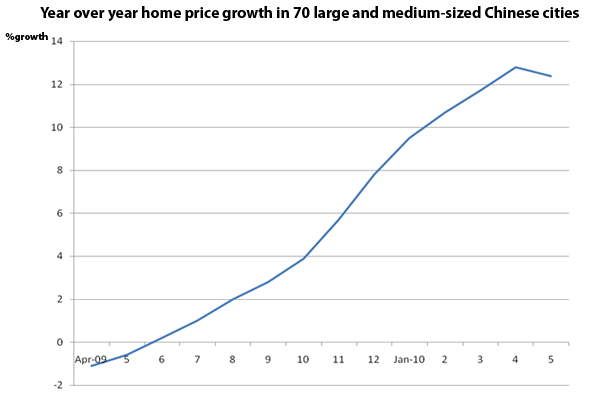
    In March, property prices in 70 Chinese cities soared by a record 11.7 percent from the previous year. In response, the government rolled out a series of measures to curb the domestic housing market amid concerns over asset bubbles.

    In early May, the People’s Bank of China raised the reserve requirement ratio for major banks by half a percentage point. Property stocks were expected to face further decline. Following Beijing and Shenzhen, the Shanghai municipal government released regulations for the property sector to curb housing speculation and soaring prices.

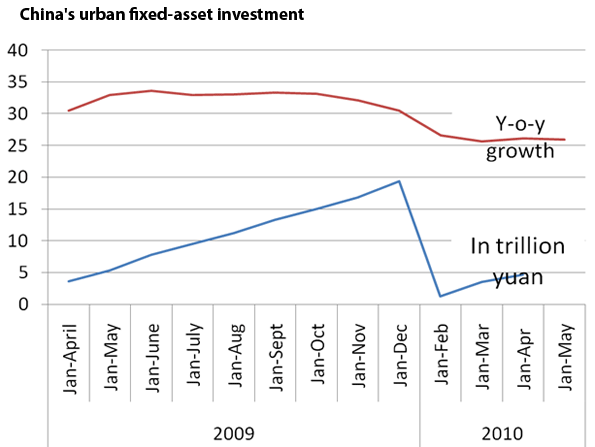
    Some observers worried that tightening policies may deter property developers from starting new projects and purchasing land, thereby cutting the supply and pushing up prices next year. And yet, despite these measures, housing prices rose 12.8 percent in April from a year earlier. At the same time, China’s urban fixed-asset investment increased by 26.1 percent year-on-year to $684.63 billion. The growth rate was 4.4 percentage points lower from the same period of 2009.

    As public concern over “skyrocketing housing prices” continued to simmer, the real estate tycoon Ren Zhiqiang was hit by a shoe at a forum in Dalian. The attacker was fuming over soaring housing prices.

    Last month, home prices in 70 Chinese cities rose by 12.4 percent year-on-year. The growth rate was 0.4 percentage points lower than in April, as property sales in first-tier cities (including Beijing, Shanghai and Shenzhen) contracted following the string of government measures. New home prices rose 15.1 percent year-on-year, down 0.3 percentage points from April.


    In a bid to curb soaring prices, the government has tightened scrutiny of developers’ financing, curbed loans for third-home purchase, raised minimum mortgage rates and tightened down-payment requirements for second-home purchases.

    By early summer, new home sales in Beijing were down 70 percent. Property transactions in Shanghai slumped around 70 percent and in Shenzhen by 62 percent month-on-month in May.

    Why have prices soared so frantically and what could be done about it?

    Toward new developments and new business models
    In the West, the great urban centers – from Paris to New York City and Tokyo – evolved into great metropolises in a century or two. In China, the first-tier cities – such as Shenzhen, Beijing, and Shanghai – are morphing into global cities in barely decades.

    Understandably, the residents of the first-tier cities would like to own an apartment in their home city. However, these cities also attract the wealthy across China, prosperous investors in East Asia and multinational property companies worldwide.

    Additionally, the high price-to-rent ratios have been driven by speculation, the desire for long-term investment, and few investment instruments.

    Even buyers contribute to soaring prices. To facilitate the marriage of their son or daughter, parents are often willing to devote their savings to real estate. As the young couple and their parents put income and savings into a purchase of a single apartment, excessive prices are driven even higher.

    In addition to great demand, the soaring prices reflect supply dilemmas. Currently, residential real estate development is geared to high-end and high-margin properties, which ensure a significant cash flow for cities. In the leading cities, the direct and indirect GDP contribution by real estate can amount to some 25-35 percent of the GDP; in other cities, this contribution is relatively higher. Ironically, luxury developments support local incomes, which maintain economic growth nationwide.

    As long as high-end real estate offers high margins where affordable housing does not, regional governments, which possess the land rights, have an incentive to prioritize luxury projects.

    The government seeks to sustain real estate market development and thus to support growth critical for China’s economy. It also seeks to ensure affordable housing vital to Chinese people. As debt problems are escalating in the West, reconciling these goals – economic growth and affordable housing – poses a difficult challenge.

    A shift towards affordable mass-market – reportedly only 10 percent of total residential sales – is critical. In the current business model, high margins come from a very narrow high-end segment of the market. This made sense in the early days of Chinese real estate when only few wealthy people could afford a home.

    Today, far more Chinese are able and willing to acquire a home. A new era requires a new business model, which can be based on the broad middle-class segment of the market.

    Conclusion: China is not Japan déjà vu
    In China’s property markets, some argue that the risks are now so great that a decade of little or no growth, as Japan experienced in the 1990s, can no longer be dismissed. They see parallels with Japan in the late 1980s, when authorities responded to the export slump caused by the revaluation of the yen after the 1985 Plaza Accord. As Tokyo adopted a low interest rate policy to boost an expansion in domestic demand, it also created conditions for a massive economic bubble.

    Yet, contemporary China’s situation is very different. First of all, in China, there remains a large shortage of residential property that meets new living standards.

    In Japan, property price increases were more than 30 percent in the latter half of the 1990s. In China’s prosperous coastal cities, they have been around 12 percent in 2003-2009.

    In Japan, the health of the banks deteriorated rapidly with the asset bubble. In China, the share of non-performing loans declined from almost 20 percent to less than 2 percent in the 2000s.

    In Japan, the asset bubble occurred after the eclipse of the high-growth era. Instead of a potential growth rate of 3-4 percent, China, assuming stability in the international and domestic operating environment, may enjoy relatively high growth for another decade or two. In such circumstances, even rapid price fluctuations in the first-tier cities can be tolerable, even if they are not preferable.

    Ultimately the difference between Japan and China is reflected by demand. Japan in the 1980s was already highly urbanized and its city population was plateauing. In China, the situation is very, very different.

    Today, there are some 360 million urban residents in China. In the next three decades, the figure is expected to grow to 970 million. What Beijing is trying to achieve is unique in history – to create urban space to more than 610 million people, within a single generation.

    In such an environment, periods of overheating will occasionally be accompanied by dramatic price increases.

    China, the urbanization rate is about 45 percent, whereas in Japan and other advanced countries it is more than 80 percent. As these nations reflect very different levels of economic development and different levels of individual prosperity, their real estate markets are different as well.

    Despite its rapid pace of expansion, China’s real estate is still at a very preliminary stage. The marketplace is so colossal that there are no precedents, no simple models.

    Yet the prospects for a robust growth remain intact. The key will be not to allow that growth to become threatened by a property bubble – while providing affordable housing for the rapidly-expanding new middle-class.

    Dr. Dan Steinbock is Research Director of International Business at India, China and America Institute (USA) and Senior Fellow at Shanghai Institutes for International Studies (China). The brief is part of the author’s ongoing project on emerging megapolises worldwide. A highly abbreviated version of the brief has been published by China Daily, China’s leading English-language daily in May.

    Photos and Illustrations: Dan Steinbock and China’s National Bureau of Statistics

  • Stimulus, Spending and Animal Spirits: How to Grow the Economy

    The most fanatical Keynesians are losing their composure. Brad DeLong, a prominent Berkeley economist and Keynesian, is virtually yelling that “We Need Bigger Deficits Now!”, emphasis his. Paul Krugman does DeLong one better, calling proponents of fiscal responsibility madmen.

    They are following the gospel of John Maynard Keynes, who famously advocated government deficits to pay people to dig holes, increasing demand and therefore economic activity. This is, to be polite, bunk.

    It is worse than that actually. The logic implies that any government expenditure funded by debt will result in sustained economic growth. The result has been a stimulus plan that completely lacks coherence. Instead, we have a hodgepodge of spending initiatives that provide a temporary illusion of growth, but that will leave us with little that is long-term, except for huge hangover of debt which will be a drag on economic activity for years.

    Keynesian stimulus theory comes about because of what is called a liquidity trap, a situation where the interest rate is zero, because no one wants to invest. The logic is that you can spend your way out of a liquidity trap; that by spending, government can increase sales. Eventually the increased sales will cause businesses to invest, driving interest rates up.

    It is an article of faith among Keynesian economists that if the stimulus is big enough, it will generate sustained long-term growth. Call this the Tinkerbell Principle. You only have to believe in animal spirits to have expectations of a better future.

    Consequently, when the spending doesn’t achieve the desired result, Keynesians always call for more deficit spending, just as we see in the above-linked DeLong and Krugman arguments. And, when that doesn’t work, like a broken record, they will call for more, but there can never be enough.

    There is a case to be made for expectations, but they need to be rational. The recession was similar to a bank run, which can kill a bank, even when there is no initial weakness to generate the run. In this case, we had a run on the world’s financial system. Call it a regime shift from a good equilibrium to a bad equilibrium.

    Can government spending alone bring us back to a good equilibrium? It can if you believe in animal spirits, but I don’t.

    I believe that people are not excessively stupid. Economists call this concept rational expectations, the idea that most people can see obvious consequences most of the time.

    I believe that people spend out of wealth: the value of the assets they hold and the present value of future income. This may not be an easily calculated number, but people keep track of it. It is something like a fielder’s response when a batter hits a ball. This is a complex problem, but fielders respond instantly. The fielders are moving in the correct direction at the correct speed to intercept the ball while the bat is still in motion.

    Finally, I believe that people try to smooth consumption. That is, they like to eat a little every day rather than go without for several days and binge on other days.

    Let’s analyze typical deficit-financed government spending programs using these beliefs. Somebody is going to have to repay the debt someday. It can be the person who receives the money, some other person who is currently working, or some future worker.

    If the person who receives the money is the one who must repay it, she will normally save it. Her wealth has not changed, she knows that she will have to repay the money, and she’s not excessively stupid. She’ll want the money there when she needs it. We saw this with the Bush “tax rebates.” Consumers saved the rebates, and the administration did not see the consumption boost they had anticipated.

    There is another possibility though. She could be what we call ‘liquidity constrained’, holding no cash and unable to borrow. Her wealth is still unchanged, but she wants to smooth consumption — keep it at a relatively steady level — so she may spend some or all of the money. However, this implies that her future spending stream will be reduced. We’re taking from tomorrow’s economy to support spending today. This may be justifiable on humanitarian grounds, but it doesn’t generate sustained long-term economic growth.

    Suppose it is another worker who will repay the government debt. His wealth has just decreased. He’ll spend less, and, also being a consumption smoother, he’ll start spending less right now. Again, there is nothing here to generate sustained long-term economic growth.

    Finally, suppose it is some future worker who will repay the debt. He or she will enter life or the workforce with a debt. I’ll ignore the ethical implications of enabling increased consumption by current citizens by imposing, without consent, debt on future workers; instead, I’ll stick just to the economics.

    Our future worker starts a career, absent some other endowment, with a negative net worth. Over the course of his career he’ll spend and invest less than if he had started with a zero net worth. Again, this is not a prescription for sustained long-term economic growth.

    What we have to face is that by borrowing to consume now, we are taking away from the future. This is just not the way to achieve sustained long-term economic growth.

    So what to do if you are a politician who thinks something must be done?

    The liquidity trap comes about because no one wants to invest. What government should do in response is try to increase demand for investment. This would increase economic activity now and in the future. Increased demand for investment can be created by investing in public capital that makes private capital more productive, and by lowering the cost of borrowing.

    When the government borrows and invests the money in projects that increase private capital’s productivity, it is increasing the return to capital. Increasing returns to private capital increases the demand for private capital and investment. Current and future economic activity is increased.

    We have lots of examples of these types of investments, including canals, dams, highways, public utilities like the Tennessee Valley Authority, and more.

    The other approach to increasing investment is to lower the interest rate. This is difficult to do directly when the interest rate is zero, but the government can achieve the same result another way. An investment tax credit effectively lowers investors’ borrowing costs.

    So, if the government is going to actively stimulate the economy, it would be far better to invest in public capital that improves the returns to private capital. It will also help to provide a meaningful investment tax credit. Consumers could then rationally expect their future income stream, hence their wealth, to improve. With increased wealth their spending will increase, and we will be on our way to sustained long-term economic growth.

    Flickr photo “Búho Real” by sıɐԀ ɹǝıʌɐſ

    Bill Watkins is a professor at California Lutheran University and runs the Center for Economic Research and Forecasting, which can be found at clucerf.org.

  • Time to Dismantle the American Dream?

    For some time, theorists have been suggesting that it is time to redefine the American Dream of home ownership. Households, we are told, should live in smaller houses, in more crowded neighborhoods and more should rent. This thinking has been heightened by the mortgage crisis in some parts of the country, particularly in areas where prices rose most extravagantly in the past decade. And to be sure, many of the irrational attempts – many of them government sponsored – to expand ownership to those not financially prepared to bear the costs need to curbed.

    But now the anti-homeowner interests have expanded beyond reigning in dodgy practices and expanded into an argument essentially against the very idea of widespread dispersion of property ownership. Social theorist Richard Florida recently took on this argument, in a Wall Street Journal article entitled “Home Ownership is Overvalued.”

    In particular, he notes that:

    The cities and regions with the lowest levels of homeownership—in the range of 55% to 60% like L.A., N.Y., San Francisco and Boulder—had healthier economies and higher incomes. They also had more highly skilled and professional work forces, more high-tech industry, and according to Gallup surveys, higher levels of happiness and well-being. (Note)

    Florida expresses concern that today’s economy requires a more mobile work force and is worried that people may be unable to sell their houses to move to where jobs can be found. Those who would reduce home ownership to ensure mobility need lose little sleep.

    The Relationship Between Household Incomes and House Prices

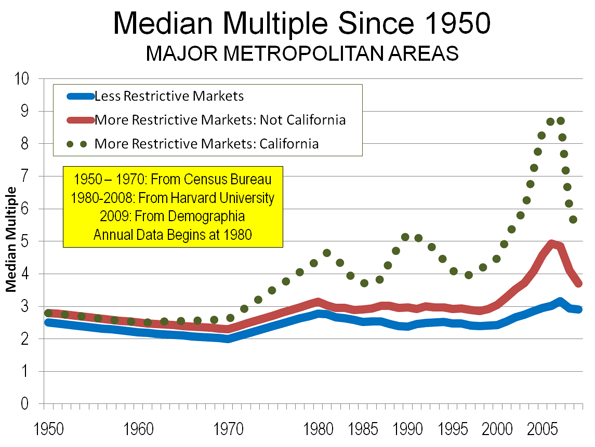
    It is true, as Florida indicates, that house prices are generally higher where household incomes are higher. But, all things being equal, there are limits to that relationship, as a comparison of median house prices to median house prices (the Median Multiple) indicates. From 1950 to 1970 the Median Multiple averaged three times median household incomes in the nation’s largest metropolitan areas. In the 1950, 1960 and 1970 censuses, the most unaffordable major metropolitan areas reached no higher than a multiple of 3.6 (Figure).

    This changed, however, in some areas after 1970, spurred by higher Median Multiples occuring in California.

    William Fischel of Dartmouth has shown how the implementation of land use controls in California metropolitan areas coincided with the rise of house prices beyond historic national levels. The more restrictive land use regulations rationed land for development, placed substantial fees on new housing, lengthened the time required for project approval and made the approval process more expensive. At the same time, smaller developers and house builders were forced out of the market. All of these factors (generally associated with “smart growth”) propelled housing costs higher in California and in the areas that subsequently adopted more restrictive regulations (see summary of economic research).

    During the bubble years, house prices rose far more strongly in the more highly regulated metropolitan areas than in those with more traditional land use regulation. Ironically many of the more regulated regions experienced both slower job and income growth compared to more liberally regulated areas, notably in the Midwest, the southeast, and Texas.

    Home Ownership and Metropolitan Economies

    The major metropolitan areas Florida uses to demonstrate a relationship between higher house prices and “healthier economies” are, in fact, reflective of the opposite. Between August 2001 and August 2008 (chosen as the last month before 911 and the last month before the Lehman Brothers collapse), Bureau of Labor Statistics data indicates that in the New York and Los Angeles metropolitan areas, the net job creation rate trailed the national average by one percent. The San Francisco area did even worse, trailing the national net job creation rate by 6 percent, and losing jobs faster than Rust Belt Pittsburgh, St. Louis, and Milwaukee.

    Further, pre-housing bubble Bureau of Economic Analysis data from the 1990s suggests little or no relationship between stronger economies and housing affordability as measured by net job creation. The bottom 10 out of the 50 largest metropolitan areas had slightly less than average home ownership (this bottom 10 included “healthy” New York and Los Angeles). The highest growth 10 had slightly above average home ownership (measured by net job creation). Incidentally, “healthy” San Francisco also experienced below average net job creation, ranking in the fourth 10.

    Moreover, housing affordability varied little across the categories of economic growth (Table).

    Net Job Creation, Housing Affordability & Home Ownership
    Pre-Housing Bubble Decade: Top 50 Metropolitan Areas (2000)
    Net Job Creation: 1990-2000 Housing Affordability: Median Multiple (2000) Home Ownership: Rate 2000
    Lowest Growth 10  7.4%                                2.8 62%
    Lower Growth 10 14.9%                                3.1 63%
    Middle 10 22.8%                                3.2 64%
    Higher Growth 10 30.9%                                2.6 61%
    Highest Growth 10 46.9%                                2.9 63%
    Average 24.7%                                2.9 62%
    Calculated from Bureau of the Census, Bureau of Economic Analysis and Harvard Joint Housing Center data.
    Metropolitan areas as defined in 2003
    Home ownership from urbanized areas within the metropolitan areas.

    Home Ownership and Happiness

    If Gallup Polls on happiness were reliable, it would be expected that the metropolitan areas with happier people would be attracting people from elsewhere. In fact, people are fleeing with a vengeance. During this decade alone, approximately one in every 10 residents have left for other areas.

    • The New York metropolitan area lost nearly 2,000,000 domestic migrants (people who moved out of the metropolitan area to other parts of the nation). This is nearly as many people as live in the city of Paris.
    • The Los Angeles metropolitan area has lost a net 1.35 million domestic migrants. This is more people than live in the city of Dallas.
    • The San Francisco metropolitan area lost 350,000 domestic migrants. Overall, the Bay Area (including San Jose) lost 650,000, more people than live in the cities of Portland or Seattle.

    Why have all of these happy people left these “healthy economies?” One reason may be that so many middle income people find home ownership unattainable is due to the house prices that rose so much during the bubble and still remain well above the historic Median Multiple. People have been moving away from the more costly metropolitan areas. Between 2000 and 2007:

    • 2.6 million net domestic migrants left the major metropolitan areas (over 1,000,000 population) with higher housing costs (Median Multiple over 4.0).
    • 1.1 net domestic migrants moved to the major metropolitan areas with lower house prices (Median Multiple of 4.0 or below).
    • 1.6 million domestic migrants moved to small metropolitan areas and non-metropolitan areas (where house prices are generally lower).

    An Immobile Society?

    Florida’s perceived immobility of metropolitan residents is curious. Home ownership was not a material barrier to moving when tens of millions of households moved from the Frost Belt to the Sun Belt in the last half of the 20th century. During the 2000s, as shown above, millions of people moved to more affordable areas, at least in part to afford their own homes.

    Under normal circumstances (which will return), virtually any well-kept house can be sold in a reasonable period of time. More than 750,000 realtors stand ready to assist in that regard.

    Of course, one of the enduring legacies of the bubble is that many households owe more on their houses than they are worth (“under water”). This situation, fully the result of “drunken sailor” lending policies, is most severe in the overly regulated housing markets in which prices were driven up the most. Federal Reserve Bank of New York research indicates that the extent of home owners “under water” is far greater in the metropolitan markets that are more highly restricted (such as San Diego and Miami) and is generally modest where there is more traditional regulation, such as Charlotte and Dallas (the exception is Detroit, caught up in a virtual local recession, and where housing prices never rose above historic norms, even in the height of the housing bubble). Doubtless many of these home owners will find it difficult to move to other areas and buy homes, especially where excessive land use regulations drove prices to astronomical levels.

    Restoring the Dream

    There is no need to convince people that they should settle for less in the future, or that the American Dream should be redefined downward. Housing affordability has remained generally within historic norms in places that still welcome growth and foster aspiration, like Atlanta, Dallas-Fort Worth, Houston, Indianapolis, Kansas City, Columbus and elsewhere for the last 60 years, including every year of the housing bubble. Rather than taking away the dream, it would be more appropriate to roll back the regulations that are diluting the purchasing power and which promise a less livable and less affluent future for altogether too many households.

    Note. Among these examples, New York is the largest metropolitan area in the nation. Los Angeles ranks number 2 and San Francisco ranks number 13. The inclusion of Boulder, ranked 151st in 2009 seems a bit curious, not only because of its small size, but also because its advantage of being home to the main campus of the University of Colorado. Smaller metropolitan areas that host their principal state university campuses (such as Boulder, Eugene, Madison or Champaign-Urbana) will generally do well economically.

    Photograph: New house currently priced at $138,990 in suburban Indianapolis (4 bedroom, 2,760 square feet). From http://www.newhomesource.com/homedetail/market-112/planid-823343

    Wendell Cox is a Visiting Professor, Conservatoire National des Arts et Metiers, Paris. He was born in Los Angeles and was appointed to three terms on the Los Angeles County Transportation Commission by Mayor Tom Bradley. He is the author of “War on the Dream: How Anti-Sprawl Policy Threatens the Quality of Life.

  • The Downside of Brit-Bashing

    Obama may be spanking BP’s brass today. But the other crisis—Europe’s economic mess—reminds us why it’s important that the U.S. and U.K. stick together.

    The controversy over the BP spill threatens to drive US-UK relations to a historic low point. When recently in London, several people worried that the President may be engaging in “Brit-bashing” at the expense of our historically close ties. This theme has been widely picked up in the UK press.

    “It’s the gushing geyser of Obama’s anti-British rhetoric,” screams Melanie Phillips this week in the Daily Mail,” that now urgently needs to be capped.” Indeed, however much President Obama wants to beat up the Tony Hayward, who certainly deserves to be both tarred and feathered, he might want to consider how “Brit-bashing” may not be in our long-term interest. This is particularly true at a time hat the world’s other big crisis—the collapse of the euro—offers a unique opportunity to shore up our now beleaguered “special relationship.”

    The British Empire may be little more than a historical relic, but the current euro crash could make those old ties between mother country and her scattered former colonies, including America, more alluring. After a decade marked by sputtering movement towards greater integration with Europe, the United Kingdom, particularly its beating heart—London—might be ready to drift away from the continent and back towards America and Canada and the rest of the world beyond.

    This process will be accentuated by the fact that while Europe’s population and economy, particularly on its southern and eastern tiers, seems set to decline even further, the future of North America—largely due to mass immigration and its large resource base—continues to appeal to British investors and companies. In addition, the rise of other parts of the world, notably Russia, India and China, suggests that Britain’s future, like that of North America, rests increasingly outside of Europe.

    Social forces in Britain today will accentuate these trends. In London today you do hear many European languages, but the big money you see around posh places in Mayfair more often speaks not Italian or French, or even German, but Hindi, Arabic , Russian and, increasingly, Chinese. London today is not so much a British city as a global one, with a percentage of foreign-born residents—roughly one-third—equivalent to that of such prominent American multi-racial capitals as New York or Los Angeles.

    Just take a look at the over 200,000 people who became UK citizens last year, up from barely 50,000 annually a decade earlier. The EU accounted for barely three percent of the total; all of Europe, including the former Soviet bloc, represented eight percent. In contrast the biggest source of new subjects was from the Indian subcontinent—roughly 30%—and Africa, which provided another 27 percent.

    This ethnic transformation—much like the one taking place and widely celebrated by Obamanians in the United States—helps tie Britain, despite its proximity to the continent, more to the rest of the world. The UK may not be ready for its own version of Barack Obama, but a post-European future seems increasingly likely through ties of both blood and money. To be sure, in the coming year the level of immigration may decline under the Tories, whose party competes for voters with nativist groups. But economics—and the disastrous state of the Euro—may prove an even larger factor in the country’s transformation.

    Already there is growing concern that the sovereign debt issues of places like Greece, Spain, Italy and Portugal—the so-called swilling PIGS—could force Britain, with its already weak economy, to raise interest rates and cut its budgets more than might be advisable. Last month London’s FTSE 100 has lost fifteen percent of its value as a result of the euro crisis, a steep fall made only marginally tolerable by the even worse results on the continent. Future euro-moves could prove even more threatening. Wide ranging attacks on financial speculation, so popular in an increasingly hegemonic Germany, are like a gun aimed at Britain’s economic core. After all, the UK’s exports are built not around cars, steel or fashions but its role as the world’s banker, consultant and business media center. “The euro zone,” complains one columnist in the right-leading Daily Telegraph, “may be leading us into a double-dip recession.”

    But declining euro-enthusiasm is not limited to those considered conservative “nutters” by Britain’s continentally-minded sophisticates. You don’t have to be an unreconstructed Thatcherite to resist tying the country to the future feeding of widely irresponsible “Club Med” countries or kowtowing to Berlin. Rather than the Germans and their PIGS, Britain may be better off linking with both the BRIC countries—Brazil, Italy, India and China—as well as a rebounding North America.

    As the ultimate capitalist entrepot, Britain’s trump lies in being hugely attractive to Americans. In this respect, beating up BP, however justified, may also be squandering an opportunity to solidify a relationship that is needed on so many fronts from battling Islamic extremism—the Brits and the Canadians are our only strong reliable allies—to preventing German-style controls over the global entrepreneurial economy.

    Herein lies our opportunity. Although not “anti-European,” Britons tend to be “deeply skeptical about the institutions of the European Union,” notes Steve Norris, a former MP, onetime chairman of the ruling Conservative party and two times that party’s candidate for Mayor of London. As he puts it: “The British do not want a federal Europe in which significant powers pass from sovereign parliaments to Brussels.”

    Although Labour also resisted rapid integration into Europe, the current government under the new Prime Minister David Cameron, Norris notes, has made it clear that it is even more resistant to this trend. This may prove an embarrassment to Cameron’s historically Europhile deputy prime minister, the Liberal Independent’s Nick Clegg, but the movement away from Europe seems increasingly inevitable.

    For one thing, the future of the euro may depend on expanding Brussels’ control of member nation’s budgets, something few British MPs of any party are likely to embrace. Attempts by France and Germany to expand the power of Brussels to save the Euro are likely to chase away even the most devoted Europhiles in Britain.

    All this is good news for a strengthened US-UK alliance—something that should not be threatened by excessive “Brit bashing.” For all its many shortcomings, Great Britain remains one of the globe’s great outposts of both civilization and dynamic market capitalism. Its economic power may be a shadow of what it once was, but its cultural, political and role as a transactional center keep the place globally relevant.

    A Britain both more Atlanticist and global also can play a more positive role by adding its weight to ours in slowing a shift to protectionism, battling terrorism and in resisting the now ballyhooed trend towards state-based capitalism. And that would bode well for Britain itself, allowing the country to play to fundamental strengths that derive from its unique historical legacy.

    This article originally appeared in The Daily Beast.

    Joel Kotkin is executive editor of NewGeography.com and is a distinguished presidential fellow in urban futures at Chapman University. He is author of The City: A Global History. His newest book is The Next Hundred Million: America in 2050, released in Febuary, 2010.

    Photo by Public Citizen

  • L.A.’s Economy Is Not Dead Yet

    “This is the city,” ran the famous introduction to the popular crime drama Dragnet. “Los Angeles, Calif. I work here.” Of course, unlike Det. Sgt. Joe Friday, who spoke those words every episode, I am not a cop, but Los Angeles has been my home for over 35 years.

    To Sgt. Friday, L.A. was a place full of opportunities to solve crimes, but for me Los Angeles has been an ideal barometer for the city of the future. For the better part of the last century, Los Angeles has been, as one architect once put it, “the original in the Xerox machine.” It largely invented the blueprint of the modern American city: the car-oriented suburban way of life, the multi-polar metropolis around a largely unremarkable downtown, the sprawling jumble of ethnic and cultural enclaves of a Latin- and Asian-flavored mestizo society.

    Yet right now even the most passionate Angeleno struggles to feel optimistic. A once powerful business culture is sputtering. The recent announcement of Northrop Corp.’s departure to suburban Washington was just the latest blow to the region’s aerospace industry, long our technological crown jewel. The area now has one-fourth as many Fortune 500 companies as Houston, and fewer than much-smaller Minneapolis or Charlotte, N.C.

    Other traditional linchpins are unraveling. The once thriving garment industry continues to shift jobs overseas and has lost much of its downtown base to real estate speculators. The port, perhaps the region’s largest economic engine, has been mismanaged and now faces severe threats from competitors from the Pacific Northwest, Baja, Calif., and Houston. Although television and advertising shoots remain strong, the core motion picture shooting has been declining for years, with production being dispersed to such locations as Toronto, Louisiana, New Mexico, Michigan, New York and various locales overseas.

    Once a reliable generator of new employment, over the past decade L.A. has fared worse than any of the major Sun Belt metros–including hard-hit Phoenix–losing over 167,000 jobs between 2000 and 2009. Historic rival New York notched modest gains, while the rising big metro competitors, Dallas and Houston, enjoyed strong and steady growth. L.A. may not be Detroit, and probably never will be, but its once proud and highly diversified industrial base is eroding rapidly, losing one-fifth of all its employment since 2004. In contrast to the rest of the country, unemployment still continues to rise.

    To give you an idea how much L.A. has sunk, look to this year’s Forbes best city rankings, which measures both short- and mid-term job growth. Once perched in the upper tier of major cities, Los Angeles now ranks a pathetic 59th out of 66 large metro areas, far below not only third-place Houston and fourth-place Dallas but also New York and even similar job-losing giants like San Francisco and Philadelphia.

    It takes a kind of talent to sink this low given L.A.’s vast advantages: the best weather of any major global city, the largest port on this side of the Pacific, not to mention the glamour of Hollywood, the Lakers and one of the world’s largest and most diverse populations of creative, entrepreneurial people.

    Jose de Jesus Legaspi, a prominent local developer, pins much of the blame for this on what he describes as “a parochial political kingdom”–with Antonio Villaraigosa, mayor since 2005, wearing the tinsel crown. A sometimes charming pol utterly bereft of economic acumen, Villaraigosa is a poor manager who is also highly skilled at self-promotion. His idea of building an economy revolves around subsidizing downtown developers and pouring ever more funds into the pockets of public sector workers. No surprise then that L.A. suffers just about the highest unemployment rate of any of the nation’s 10 largest cities outside Detroit. One in five county residents receive some form of public aid.

    But the real power in L.A. today is not so much Villaraigosa but what the Los Angeles Weekly describes as a “labor-Latino political machine,” whose influence extends all the way to Sacramento. These politicians represent, to a large extent, virtual extensions of the unions, particularly the public employees.

    The rise of the Latino-labor coalition does stir some pride among Hispanics, but it has proved an economic disaster for almost everyone who doesn’t collect a government paycheck–L.A.’s city council is the nation’s highest paid–or subsidy. Although perhaps not as outrageously corrupt as the Chicago machine, it is also not as effective. L.A.’s version manages to be both thuggish and incompetent.

    According to an analysis by former Mayor Richard Riordan, the city’s soaring pension liabilities will grow by an additional $2.5 billion by 2014, by which date the city will probably be forced to declare bankruptcy.

    So is the city of the future doomed for the long term? Not necessarily. Although Latino politicians and “progressive” allies strive to derail entrepreneurialism, our grassroots remains stubbornly entrepreneurial. This is particularly true of Latino and other immigrant businesspeople in Los Angeles. In 2006, for example, roughly 10% of the foreign born population was self-employed, almost twice the percentage of the native born.

    To be sure, much of this activity takes place in smaller area municipalities–Burbank, Glendale, Lynwood, Monterey Park–that are mercifully outside the reach of the City of Los Angeles, which accounts for somewhat less than half of L.A. County’s 10 million people. But as Legaspi, who came to L.A. from Zacatecas, Mexico, in 1965, points out, ethnic enterprises–Armenian, Iranian, Israeli, Korean, Chinese as well as Mexican and Salvadoran–continue to thrive even within the city limits. You rarely find in L.A. the kind of desolation found in dying cities like Detroit or Cleveland or even large swaths of New York or Chicago.

    All this suggests there’s still hope for Los Angeles to blossom further as a hub for international trade, global culture and fashion. But to achieve that goal the city needs a government that will nurture its grassroots rather than stomp or extort them. “Los Angeles is a potential great world city, but it needs to be ruled like a world city,” Legaspi points out. Until that happens, our putative city of the future will exist more as dreamscape than reality.

    This article originally appeared in Forbes.com.

    Joel Kotkin is executive editor of NewGeography.com and is a distinguished presidential fellow in urban futures at Chapman University. He is author of The City: A Global History. His newest book is The Next Hundred Million: America in 2050, released in Febuary, 2010.

    Photo by k.landerholm

  • An Awakening: The Beginning of the Great Deconstruction

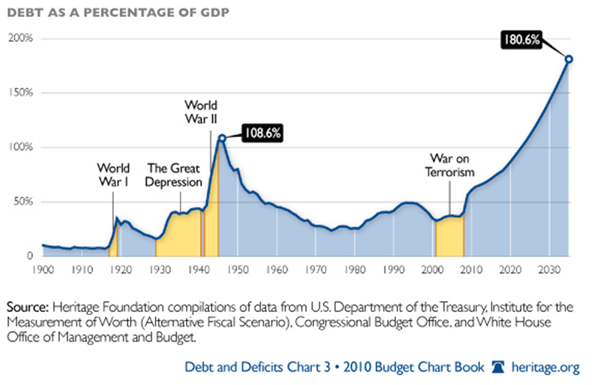
    The federal debt climbed above $13 trillion this month. An easier way to define the national debt is to comprehend that we each owe more than $39,000 to the Chinese, Japanese, and Arabs of the Persian Gulf. The budget deficit will exceed $1.5 trillion this year and forty-seven states are running deficits. California has a $19 billion deficit and its legislature’s landmark response was to pass a law banning plastic bags. Our cities are in worse shape. The former mayor of Los Angeles, Richard Riordan, says that a bankruptcy by that city is inevitable. At the same time, the United States’ Congress voted themselves a 5.8% pay increase. It is no wonder why Americans are nervous.

    Americans are stressed out because of debt, according to an Associated Press-GfK poll. They are trimming their debt at the fastest rate in more than six decades, according to the Federal Reserve. The average amount owed on credit cards is $3,900, the poll said. That’s down from $5,600 last fall and $4,900 last spring. Household debt fell 1.7 percent last year to $13.5 trillion, according to the Fed. It was the first annual drop, based on records going back to 1945. As Americans get their own house in order, the approval rating for Congress has fallen to an all time low. The public will likely make them pay for their angst in November.

    The American people are about a year ahead of the politicians. The spending by Washington, Sacramento, Los Angeles, and by politicians in general, is unsustainable. The people understand that it must be changed. As Senator Tom Coburn (OK) told me last week, either we change our ways or they will be changed for us. Leaders like Senator Coburn will begin The Great Deconstruction. The nation can no longer afford the government it has created.

    The Department of Energy was created by President Carter in 1977 after an OPEC embargo caused gas lines and rationing. In 1977, America imported 33% of its oil. The DoE’s goal was to eliminate our dependence on imported oil. The DoE budget for 2010 was $26.4 billion. It employs 116,000 workers. We now import 66% of our oil. America can no longer afford such an inefficient bureaucracy. Bureaucracies like the DoE that have lost sight of their purpose must be deconstructed.

    Senator Coburn is preparing legislation to rescind $120 billion in 2010 spending by rescinding 2010 budget increases, consolidating 640 duplicative governmental agencies, returning unspent appropriations and cutting wasteful spending. A few examples:

    • Congress has a discretionary budget of $4.7 billion per year. They voted themselves a 6% increase in 2010. Coburn wants this increase rescinded for a saving of $250 million.
    • The Department of Education spends $64.2 billion per year. They spend $1 billion each year administering 207 separate programs at 13 different federal agencies to “encourage” students to take math and science.
    • The Department of Agriculture owns 57,523 buildings. More than 4,700, valued at $900 million, are vacant. Despite this vacant space they spend $193 million per year renting an additional 11 million square feet.

Our politicians have perfected the art of spending money, or as we now know, wasting money. Last year, they loaded spending bills with $11 billion of earmarks – after spending $860 billion on a Stimulus Bill. A new breed of politician, like Senator Coburn, will begin the long process of deconstruction.

There is precedent for deconstruction. In 1945, federal spending ballooned to $106 billion, $93 billion of which was for defense. The deficit jumped from $40 billion in 1938 to $253 billion in 1945. A Democrat President and a Republican Congress established the Commission on Organization of the Executive Branch of the Government in 1947. President Truman put a former Republican President, Herbert Hoover, in charge. It became known as the Hoover Commission. It created the structure of government that exists today and generated savings of $7 billion at the time. A total of 273 recommendations were presented to Congress in a series of nineteen separate reports. A 1955 study concluded that 116 of the 273 recommendations were fully implemented and that another 80 were mostly or partly implemented. By 1949, the federal budget had fallen to $40 billion.

It will come to be known as The Great Deconstruction because it must occur at every level of government. Federal spending is unsustainable. Moody’s is already speculating that we may lose our AAA rating. The states are in crisis with 46 in deficit. The press is referring the California as a “failed state” and “our Greece”. The $860 billion Stimulus Bill sent approximately 30% to the states to support their public employees. But it was a one-year fix. This year, the states are burning through their reserves and next year, they will be forced to cut services, raise taxes, or both. Connecticut, the wealthiest state on a per capita basis with personal income of $54,397 in 2009 (Department of Commerce) saw its Fitch rating lowered from AA+ to AA. Connecticut needs to borrow $956 million to close a budget gap this fiscal year and it borrowed $947.6 millionto cover last year’s deficit.

The cities are no better off with many states raiding their reserves. Many cities are exploring municipal bankruptcy, Chapter 9, as a way out of unsustainable contracts. The Great Deconstruction will take a decade or more. Like the Hoover Commission before it, this process will transform the role of government, and the image of government as it transforms the cost of the people’s business.

***************************************************

The Great Deconstruction is a series written exclusively for New Geography. Future articles will address the impact of The Great Deconstruction at the national, state, county and local levels.

Robert J. Cristiano PhD is the Real Estate Professional in Residence at Chapman University in Orange County, CA and Director of Special Projects at the Hoag Center for Real Estate & Finance. He has been a successful real estate developer in Newport Beach California for twenty-nine years.


Other works in The Great Deconstruction series for New Geography

The Great Deconstruction :An American History Post 2010 – June 1, 2010
The Great Deconstruction – First in a New Series – April 11, 2010
Deconstruction: The Fate of America? – March 2010

  • The Suburban Exodus: Are We There Yet?

    For many years, critics of the suburban lifestyles that most Americans (not to mention Europeans, Japanese, Canadians and Australians) prefer have claimed that high-density housing is under-supplied by the market. This based on an implication that the people increasingly seek to abandon detached suburban housing for higher density multi-family housing.

    The Suburbs: Slums of the Future?

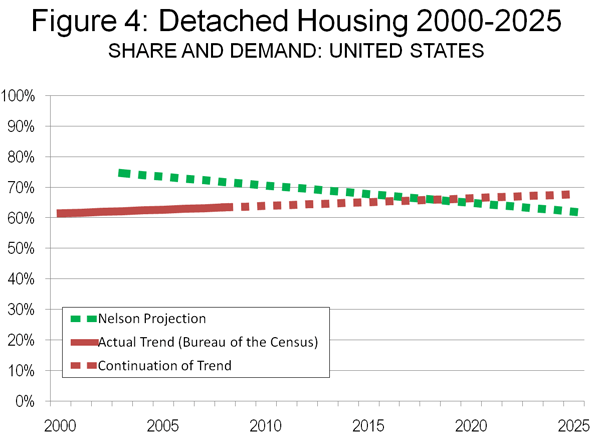
    The University of Utah’s Arthur C. (Chris) Nelson, indicated in an article (entitled “Leadership in a New Era“) in the Journal of the American Planning Association. that in 2003, 75% of the housing stock was detached and 25% was attached, including townhouses, apartments, and condominiums. By 2025 he predicts that only 62% of consumer will favor detached homes, (Note 1). He also predicts a major shift in consumer preferences from housing on large lots (defined as greater than 1/6th of an acre) to smaller lots (Note 2). This, he suggests, would create a surplus of 22 million detached houses on large lots.

    This predication is largely made on the basis of “stated preference” surveys which the author, Dr. Emil Malizia of the University of North Carolina (commenting on the article in the same issue), and others indicate may not accurately reflect the choices that consumers will actually make. Dr. Nelson’s article has been widely quoted, both in the popular press and in academic circles. It has led some well-respected figures such as urbanist and developer Christopher Leinberger to suggest in an Atlantic Monthly article that “many low-density suburbs and McMansion subdivisions, including some that are lovely and affluent today, may become what inner cities became in the 1960s and ’70s—slums characterized by poverty, crime, and decay.”

    The Condo Market Goes Crazy

    Misleading ideas sometimes have bad consequences. The notion that suburbanites were afflicted with urban envy led many developers to throw up high-rise condominiums in urban districts across the country. Sadly for these developers, the Suburban Exodus never materialized, never occurred. As a result, developers have lost hundreds of millions, if not billions of dollars and taxpayers or holders of publicly issued bonds could be left “holding the bag” (see discussion of Portland, below).

    This weakness has been seen even in the nation’s strongest condominium market, New York City, where one developer offered to pay purchaser’s mortgages, condominium fees and real estate taxes for a year as well as closing costs.

    But the damage is arguably worse in other major markets which lack the amenities and advantages of New York.

    Take, for example, Raleigh (North Carolina), where low density living is the rule (the Raleigh urban area is less dense than Atlanta). The News and Observer reports that the largest downtown condominium building (the Hue) “considered a bold symbol of downtown Raleigh’s revitalization,” has closed its sales office and halted all marketing efforts. The development’s offer of a free washing machine, dryer, refrigerator, and parking space were not enough to entice suburbanites away from the neighborhoods they were said to be so eager to leave.

    This is not an isolated instance. Around the nation, condominium prices have been reduced steeply to attract buyers. New buildings have gone rental, because no one wanted to buy them. Other buildings have been foreclosed upon by banks; and units have been auctioned. Planned developments have been put on indefinite hold or cancelled.

    Miami: Of Little Dubai and Cadavers

    Miami’s core neighborhood (downtown and Brickell, immediately to the south) has experienced one of the nation’s most robust condominium building booms. More than 22,000 condominium high rise units were built between 2003 and 2008. Miami could well have more 50-plus story condominium towers than any place outside Dubai.

    As a result, Miami has suffered perhaps the most severe condominium bust in the nation. According to National Association of Realtors data, the median condominium price in the Miami metropolitan area has dropped 75% from peak levels (2007, 2nd Quarter). By comparison, the detached housing decline in the metropolitan area was 50%; the greatest detached housing price decreases among major metropolitan areas were from 52% to 58% (Riverside-San Bernardino, Sacramento, San Francisco and Phoenix).

    The most recent report by the Miami Downtown Development Authority indicates that 7,000 units still remain unsold. The Brickell area is home to the greatest concentration and largest buildings and has the highest ratio of unsold units at 40%.

    Icon Brickell (see photograph above) may be the largest development in the core. Icon Brickell consists of three towers, at 58, 58 and 50 floors and a total of nearly 1,800 units. Despite opening in 2008 and offering discounts of up to 50%, barely one-third (approximately 620) of the units have been sold, according to the Daily Business Review, which also reported on May 13 that the developer had transferred control of two of the towers to construction lenders.

    One building, Paramount Bay, was referred to by The New York Times as a “47-story steel and glass cadaver” with a lobby “like a mortuary.” A real estate site indicates that only one of the buildings 350 units has been sold.

    More recently sales have inched up in the core but due not to any suburban exodus. According to The Miami Herald, huge discounts that have lured Europeans, Canadians, and Latin Americans to the core. The real estate and consulting firm Condo Vultures notes that more than 1,000 of the sales are to a few bulk buyers, a market segment some might refer to as “speculators.”

    The latest data from the US Bureau of the Census confirms that there is no fundamental shift away from detached housing in the Miami area, as housing trends point toward more detached housing. In 2000, 48.1% of residents in the Miami metropolitan area lived in detached housing. By 2008, the figure had risen to 49.2% (Figure 1). Essentially, the Suburban Exodus remains a mirage.

    Portland: Gift Certificates for Distressed Developers

    If developer greed was the motive in Miami, government subsidies have been the driving force in Portland. The city of Portland will soon have issued nearly $450 million in urban renewal bonds, provides 10-year tax property tax forgiveness, and reduced development fees, which the Portland Development Commission (PDC) has called “gift certificates” for developers (Note 3).

    Gift certificates have not been enough to cure Portland’s sickly downtown condominium market. The Oregonian reported that prices were down, on average, 30% over the year ended the first quarter of 2010. Remarkably prices in the much ballyhooed Pearl District are plummeting even more than those in the rest of the Portland area. According to DQ News, the median sale price of a house in the Pearl District dropped four times the average in Multnomah County and an even greater six times decline relative to suburban counties over the past year.

    There is more. Just this year, the Pearl District has seen its Eddie Bauer, Adidas, and Puma stores close.

    One condominium building the Encore, is reported to have sold only 17 of 177 units. A recent auction of units at the largest building in the city, the John Ross brought prices “far below the replacement cost” according to The Oregonian’s Ryan Frank, who noted that “it will likely be years before there’s a new high-rise condo built.” Late last year, the Pearl District’s Waterfront Pearl was reported to have sold only 31% of its units and had not sold a unit for a year.

    The Portland Development Commission itself has become part of the condominium bust story. PDC had indicated it was considering relocating its offices to a new 32-story mixed use tower (Park Avenue West), which was to have included condominiums, offices, and retail stores. For more than a year, the proposed 32-story tower has been an unsightly hole in the ground, with construction suspended. PDC decided to stay put in its older, less expensive offices. Even before PDC decided not to locate in Park Avenue West, the developers eliminated the plans for 10 floors of condominiums, doubtless because it made no economic sense to add to an already flooded market.

    In Portland, like in Miami, the fact remains that suburbia has not been abandoned. Despite the high density over-building in the Pearl District and elsewhere in the core, detached housing has become even more popular in the region. According to data from the Bureau of the Census, the share of households living in detached housing in the Portland metropolitan area rose from 63.7% in 2000 to 64.5% in 2008 (Figure 2).

    High-Rise Condos: Slums of the Future?

    To say that the high-rise condominium market has fallen on hard times would be an understatement. The condo bust in New York has become so acute that Right to the City, a coalition of community organizations has called upon “the City to acquire the tax delinquent buildings through tax foreclosure and convert vacant units into permanently affordable housing for low-income New Yorkers.” In a report entitled People without Homes and Homes without People: A Count of Vacant Condos in Select NYC Neighborhoods, Right to the City points out that there are more than 4,000 empty condo units in 138 buildings, with owners delinquent on nearly $4 million in taxes to the city.

    Owners of new condominiums around the nation who paid pre-bust prices for their units may not be inclined to stay around if they are surrounded by less affluent renters who have been attracted by desperate building owners and lenders.

    Are these dark towers of discounting the slums of tomorrow? Only the data and time will tell and it’s too early to know, but preliminary findings show little of the predicted shift toward higher density living (Figure 3). Certainly national data indicates, if anything, a slightly strengthening market for detached, rather than attached housing (Figure 4).

    • Between 2000 and 2008, the share of households living in detached housing rose from 61.4% to 63.5%.

    • A similar trend is shown by the national building permits data. Between 2000 and 2009, 75.2% of residential building permits in the United States were for detached housing. This is up strongly from 69.6% in the 1990s and nearly equals the highest on record (the 1960s), when 77.7% of residential building permits (housing units) were detached houses.


    Looking at the data, there remains little evidence that the stated preferences on which the predictions relied have been translated into the reality of a shift in preferences toward smaller lots in cores or inner ring suburbs. Domestic migration continues to be strongly away from core counties to more suburban counties. Core cities are growing less quickly than suburban areas. Exurban areas are growing faster than central areas, including inner suburbs.

    Clearly, the Suburban Exodus has not begun and there is little reason to believe that it will anytime soon.


    Note 1: In estimating the 2003 share of detached housing (75%), Dr. Nelson uses “one-unit structures” data from the 2003 American Housing Survey Table 2-3. US Bureau of the Census American Housing Survey personnel responded to my request for clarification, indicating that “one-unit structures” includes … single detached housing units, mobile homes, and single attached housing units (such as a townhouse).” Thus the 75% detached estimate is high because it includes mobile homes and single attached housing. As is indicated above, data from the US Bureau of the Census data indicates that the share of detached housing of detached plus attached housing in 2000 was 61.4%. This figure, coincidentally, is virtually the same as the 62% Dr. Nelson predicts for 2025.

    Note 2: The assumption that consumers prefer small lot detached housing may not be sufficiently robust and may even be exaggerated. Dr. Nelson appears to principally rely on research by Myers and Gearin (2001) (in the journal Housing Policy Debate) for concluding that consumers prefer small lot rather than larger lot detached housing, defining small lot development as 1/6th of an acre or less or less than 7,000 square feet. Yet neither figure appears in Myers and Gearin. Moreover, a National Association of Home Builders commenter (also in Housing Policy Debate) questions how its data was characterized by Myers and Gearin in justifying a finding of preference for smaller lots (the survey is unpublished). Without access to the original surveys referenced in Myers and Gearin, it is impossible to judge what respondents may have had in mind as the dividing line between large lots and small lots.

    Note 3: This characterization was on the Portland Development Commission website (accessed January 2, 2007). It was cited in our report, Zero Sum Game: The Austin Streetcar and Development and subsequently removed from the website. A large share of Portland’s urban renewal bonds are insured by Ambac Financial Corporation, which has reported losses exceeding $1 billion in the last two quarters. Ambac indicated that it has “insufficient capital to finance its debt service and operating expense requirements beyond the second quarter of 2011 and may need to seek bankruptcy protection.” Ambac was the insurer of State of Nevada bonds to build the Las Vegas Monorail, which has already entered bankruptcy and is unable to pay its bonds.

    Wendell Cox is a Visiting Professor, Conservatoire National des Arts et Metiers, Paris. He was born in Los Angeles and was appointed to three terms on the Los Angeles County Transportation Commission by Mayor Tom Bradley. He is the author of “War on the Dream: How Anti-Sprawl Policy Threatens the Quality of Life.

    Photo: Icon Brickell, Miami