Tag: Financial Crisis

  • China’s Housing Bubble: Quality Research Required

    It is extremely difficult to find reliable reporting on the intensity of the housing bubbles across China, but this article from the China Post of June 1, 2010 “Economist sees housing market bubble”, appears to be realistic.

    It states that in 2009 the average house price to average annual household income in China was 9.1 times earnings and that it rose to 11.15 during the first two months of 2010. Beijing and Shanghai are reported to have exceeded 20 times average household earnings during early 2010. These figures are from Yao Shujie, head of the School of Contemporary Chinese Studies at the University of Nottingham.

    The article noted that last week, Chinese real estate services company E House China released figures suggesting that house prices to incomes nationwide in 2009 were 8.03 times incomes, but those in Beijing, Shanghai, Hangzhou and Shenzhen were over 14 times household incomes.

    Recently, Wendell Cox of Demographia, working with the South China Post, estimated that the Median Multiple (median house price divided by median household income) for Hong Kong was 10.4 – as reported in this New Geography article Unaffordable Housing in Hong Kong. Because sufficiently reliable data is now available from Hong Kong, it will be included within the Annual Demographia International Housing Affordability Surveys going forward.

    As the Annual Demographia International Housing Affordability Surveys clearly illustrate, house prices do not exceed three times gross annual household incomes in normal markets.

    Rather remarkably, in researching and reporting on the China Housing Bubble, there has been no discussion of the land ownership differences of China and western countries.

    Freehold land is not available in China. The land is leased for a remarkably short term of 70 years. Instead of conventional ground leases in the west where ground rentals are paid, Chinese Local Governments demand an upfront payment of capitalized rental. On this basis, the land interest should be a wasting asset over the term of the lease.

    Rather remarkably – this appears not to be the case in China, where the buying public have convinced themselves (no doubt with encouragement from real estate agents and developers) that at the end of the term of the ground lease, Local Government will simply “gift” the land to home owners!

    On the sound income to house price measure, China’s housing bubble is clearly the worst in the world. When the unsatisfactory and uncertain land ownership issue is factored in as well, it is particularly concerning.

  • An American History Post 2010: The Great Deconstruction

    There is a great battle brewing – the proverbial paradox of the immovable object versus an irresistible force. The battle lines are drawn. On one side is the Greatest Generation, Americans over 60, middle class and mostly white. Mainstream media calls them The Tea Party and worse.

    On the other side is President Barack Obama and a younger generation of progressive Democrats who see the need for an ever more expansive government. The battlefield is spending and debt. The Greatest Generation, following World War II, bought homes with a 30-year mortgage and 20% down, and paid off those mortgages accumulating trillions in equity along the way. The Credit Card Generation – epitomized by both George W. Bush and his Democratic successor – nurtured the zero down, no doc, adjustable rate mortgage that allowed millions of homebuyers, who could not afford to purchase a home, to buy one. The bursting of the housing bubble cost trillions in lost equity and resulted in 2.8 million foreclosures in 2009.The figures tell the story.

    Spending

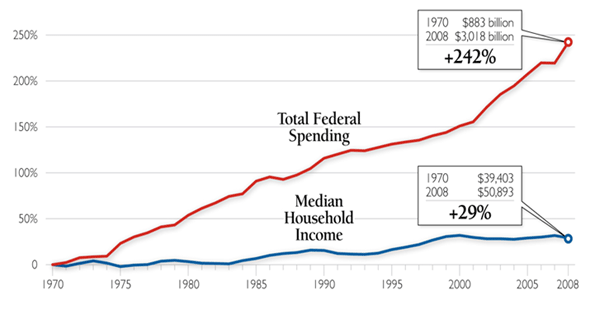
    According to the Office of Management & Budget (OMB), Federal spending has grown more than eight times faster than Household Median Income. Since 1970, middle-income Americans’ earnings have risen 29 percent, but federal spending has increased 242 percent (Percentage Change of Inflation-Adjusted Dollars, 2009). The Greatest Generation believes that spending by Washington politicians has grown out of control. They understand it is not a Republican or Democrat issue. They opposed the $800 billion TARP Bailout under Bush as much as Obama’s $800 Stimulus Bill. They opposed the trillion dollar Healthcare Bill recently enacted into law despite a clear majority opposed to its passage. They recognize that Social Security and Healthcare comprise huge unfunded obligations that will be passed on to their grandchildren.


    Source: Heritage Foundation

    Debt

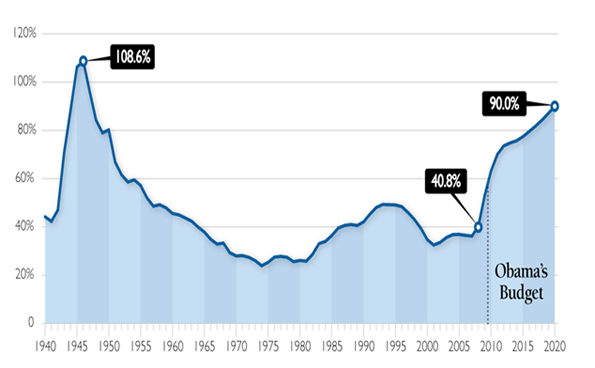
    Since World War II, publicly held debt as a percentage of the economy (GDP) has remained below 50%. In 2008 when President Obama took office, it was 40.8 percent, nearly five points below the post-war average. According to the OMB, Obama’s budget would more than double this figure to 90 percent of Gross Domestic Product by 2020, levels not seen since World War II. (Greece’s debt level of 150% precipitated their meltdown). By 2020, Americans will spend more on interest payments on the Federal debt than on military spending. The Greatest Generation believes these debt levels to be unsustainable.


    Source: Heritage Foundation

    An Unsustainable Path

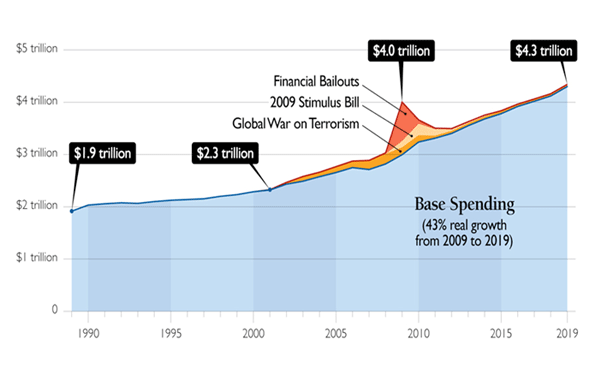
    In 1990, the federal budget was less than $2 trillion. Ten years later the federal budget was just $2.3 trillion. By 2010 the budget exploded to $4 trillion. The Obama budget projects a 43% growth to $4.3 trillion by 2019 according to the OMB. This massive increase over the $2.9 trillion budget Obama inherited in 2008 is not due to emergency spending alone but an intentional structural growth in government. Federal revenues have not kept pace with spending. The U.S. government was forced to borrow $1.5 trillion to pay its bills last year. The national debt is projected to increase from $13 trillion to $20 trillion by 2020 (Inflation-Adjusted Dollars, 2009). The path is unsustainable.


    Source: Heritage Foundation

    While the classic paradox of the immoveable object versus the irresistible force can never be solved, this battle will be settled at the ballot box in 2010 and 2012 when Americans determine the path their country will follow in the 21st Century. If the Greatest Generation prevails, many incumbent politicians will find themselves out of a job as collateral damage. A new wave of politicians will begin The Great Deconstruction.

    New Jersey Governor Chris Christie may be the prototype of this new generation of politicians. He was elected to deconstruct the dysfunctional government of New Jersey, an economy that resembles Greece. Christie inherited the nation’s worst state deficit — $10.7 billion out of a $29.3 billion budget. Christie is doing something unusual, honoring his campaign promises and acting like his last election is behind him. Christie epitomizes the politician the Greatest Generation craves, one willing to lose his job.

    Christie has already declared a state of emergency, signed an executive order freezing spending, and cut $13 billion in spending – in just two months. His first budget included 1,300 layoffs, cut spending by 9%, and privatized government services. The deconstruction of New Jersey has begun. New Jersey may be an unlikely place for The Great Deconstruction to begin, but it is a harbinger of things to come.

    The Great Deconstruction is a series written exclusively for New Geography. Future articles will address the impact of The Great Deconstruction at the national, state, county and local levels.

    Robert J. Cristiano PhD is the Real Estate Professional in Residence at Chapman University in Orange County, CA and Director of Special Projects at the Hoag Center for Real Estate & Finance. He has been a successful real estate developer in Newport Beach California for twenty-nine years.

    Other works in The Great Deconstruction series for New Geography
    The Great Deconstruction – First in a New Series – April 11, 2010
    Deconstruction: The Fate of America? – March 2010

  • Currency Crisis: Fool’s Gold, The Euro, The Pound and The Dollar

    Lost in the obituaries of the Euro — the European currency — is the extent to which the continent remains a fractured reservoir of national monies. To be sure, the Euro circulates in the larger economies of Western Europe, notably France, Germany, Italy, Spain, and the Netherlands. But as a traveling European, I also have in my wallet Polish złoty, Czech crowns, Serbian dinars, Swiss francs, and British pounds, testaments to the nationalist sentiment that every country should have it own money. (Which is similar to the notion that every country should have its own airline, no matter how much it costs.)

    Countries, like Poland, which are in the European Union, have their currency pegged to the Euro, but because of local budget deficits, they stick with their old notes. Countries like Britain and Switzerland cling to their currencies out of distrust for the common currency. In theory, what they lose in terms of trading convenience, they gain in the coin of economic independence.

    By holding on to the pound, Britain partially sidestepped the recent financial crisis in Europe; London was only on the hook as a member of the common market, not in the currency union.

    At the same time, Britain, as the only issuer of pounds, was left to deal with its own banking crisis without the mutual assistance of Germany and France, one reason why the United Kingdom has such high borrowing obligations.

    Which is better, national money that floats on international markets — the pound is a good example — or a transnational currency like the Euro?

    The rap now against the Euro is that the European Union lacks the authority to impose fiscal discipline in member states. Countries within the Union, it is feared, can borrow to their budget deficit’s content, given that any country in the monetary union enjoys an implicit guarantee from the rest of the pact. For example, Greece could fund its deficit with debt that was issued at rates that equated Greek risk with that of Germany.

    Now that this mug’s game is up, the stronger members of the European Union will only let the weaker names borrow in exchange for surrendering a degree of fiscal and budgetary independence. Will that be enough to save the Euro?

    In answering, it is useful to recall what money is: a zero-coupon bond, issued by an organization, company, or government. Currency may represent value, but underneath the crisp paper it is a sovereign loan. The dollar bill is best understood as the world’s smallest government bond.

    Before there was fiat money, the currency that circulated was either coins or bank drafts, passed around to settle transactions in local markets. The stronger currencies were those of silver or gold, or negotiable instruments issued by a solid creditor, such as a Florentine bank or a London merchant.

    In the early days of the American republic, circulating specie included Peruvian coins (valued for their silver) and Spanish dubloons, sometimes mined in Mexico.

    Now, instead of a private script, money is a national instrument, based on the full faith and credit of sovereign governments, which, as everyone knows, are run by profligate spenders. (If you owned a bank, would you put Nancy Pelosi on the credit committee?)

    Anyone holding U.S. dollars is betting that the Congress will not bankrupt the country with medical, retirement, and national security schemes. In Europe, the Euro gamble is that the large governments, and by extension the European Union, will honor their obligations, many of which were drawn to fund retirement plans that kick in at age sixty-two or to subsidize corporate elephants like the Airbus.

    To be sure, the Euro will survive its current crisis, because neither France, Italy, nor Germany — the big engines of the continental economy — want to rerun the political consequences of a fractured Europe. But just because the Euro will remain in circulation does not mean that it will trade at an exchange rate of €1 = $1.50.

    Keep in mind that Europe is gleeful at the decline of the Euro against the U.S. dollar, which, measured in Europe, has been at an artificially low exchange rate for the last few years. The weak dollar and the strong Euro meant that U.S. industry and exporters had a competitive advantage against European companies. Now that advantage is less pronounced.

    For fun, have a look at the Big Mac Index of The Economist, which prices the global hamburger in world currencies. For the Euro zone, a Big Mac costs $4.62 versus $3.58 for the same happy meal in the United States. China’s triple-decker only costs $1.83, a statistic that is a good measure of the extent to which China keeps its currency, the yuan, artificially low.

    Exchange rates are the new tariffs. In the bad old days of Senator Smoot and Congressman Hawley — co-authors of the 1930 tariff bill that so prolonged the Depression — countries sought competitive trade advantages by slapping on tariffs and import quotas to protect national industries.

    Even today, tariffs protect local farmers and manufacturers from low-priced international competition, but they are considered “unfair,” the trade equivalent of gunboat diplomacy.

    Instead of enacting tariffs, governments now play the game of currency manipulation, and, to use a 1930s expression, “beggar their neighbors” by driving down the value of their money’s exchange rates in international markets. Central banks generally accomplish this by failing to defend, i.e., purchase their currency in world markets.

    Two of the very best currency manipulators are the U.S. and China, one reason for their economic success. The U.S. let the dollar fall after the 2008 crisis, which gave American exporters an advantage over European competitors. The price of European products in the U.S. went up about 25 percent.

    For years China has fueled its economic miracle by pegging the yuan at low exchange rates to the dollar, to make sure that, no matter what the industry, it would be selling the equivalent of Big Macs that cost $1.83.

    In the Euro collapse over the potential Greek default, many see an end to the European common currency. But that will happen only if German taxpayers get tired of bailing out pensioners throwing darts in Dublin or the café klatch on Mykonos.

    In the meantime, by letting its currency fall by twenty percent against the dollar, Europe has shown that it understands the power politics of international exchange rates and that it is willing to take on the Americans and the Chinese at the shell game of cheaper money.

    What’s the risk? The problem in the manipulation racket is that investors can have a hard time judging when a currency is being depreciated for a reason — to stimulate jobs, say — or when it’s broke. The wheelbarrow money of Weimar was bust while the Euro is just overvalued. In most cases, the vital sign of a currency’s health is its rate of inflation, and for the Euro right now it’s negligible.

    For all that diplomatists busy themselves over questions like Israeli settlements and Iranian sanctions, the issue of exchange-rate parity is rarely discussed in world councils.

    The story of unfettered money rarely has a happy ending. Breton Woods, which pegged many currencies to the dollar, and the greenback to gold, was signed in 1944 and broke down in 1971, when Richard Nixon unilaterally took the U.S. off the gold standard.

    Since then, world money has traded like over-the-counter options, even when it’s backed by less collateral than most subprime packages. My own view is that currencies should be pegged to baskets of global commodities, including gold and silver. But governments, like Greece today, or even the U.S., hate the idea of external limits on their ability to raise and spend money.

    Italy was among those countries that thought the 1971 U.S. withdrawal from the gold standard set a dangerous precedent for economic stability. But its warnings went unheeded, and prompted an undeleted response from President Nixon, who on the White House tapes was heard to say, “I don’t give a shit about the lira,” words that might express how many investors will come to think about paper money.

    Latent print developed on US Currency ($1 bill) using fluorescent magnetic power. http://www.flickr.com/photos/jackofspades/1376867166/

    Matthew Stevenson is the author of Remembering the Twentieth Century Limited and editor of Rules of the Game: The Best Sports Writing from Harper’s Magazine. He lives in Switzerland.
  • California is Too Big To Fail; Therefore, It Will Fail

    Back in December I wrote a piece where I stated that California was likely to default on its obligations. Let’s say the state’s leaders were less than pleased. California Treasurer Bill Lockyer’s office asserted that I knew “nothing about California bonds, or the risk the State will default on its payments.” My assessment, they asserted, “is nothing more than irresponsible fear-mongering with no basis in reality, only roots in ignorance. Since it issued its first bond, California has never, not once, defaulted on a bond payment.”

    For good measure they labeled as “ludicrous” my comment that the Governor and Legislature may not be able to solve the budget problem next year because “debt service is subject to continuous appropriation. That means we don’t even need a budget to make debt service payments.”

    The Department of Finance was also not amused. They resented my prediction that California is on the verge of a default of its bond debt. They insisted that the state has

    “multiple times more cash coverage than we need to make our debt service payments.“

    “There are three fail-safe mechanisms in place to ensure that debt service payments are made in full and on schedule.”

    “Going back as far as the Great Depression, California has never — ever — missed a scheduled payment to a bondholder or a noteholder. Not during the recession of the early 1980s. Not during the collapse of the defense industry in the early 1990s. Not during the dot-com collapse of the early 2000s. And not now. And we, along with the Treasurer and the Controller, will continue to ensure that this streak will never be broken.”

    I am not alone in being taken to the state woodshed. More recently, Lloyd C. Blankfein, Chairman of the Board and CEO of Goldman, Sachs & Co. received this letter from Lockyer’s office, a letter that was ridiculed by The Financial Times’ Spencer Jacob here.

    Once you get past the name calling, California has two arguments. One argument is that California has never defaulted; therefore it will never default. This is, of course, absolutely absurd, insulting our intelligence. Every person, corporation or other entity that has ever defaulted on a loan has been able to say, at least once, that they have never defaulted. As they say in finance: Past performance is not a guarantee of future performance.

    California’s second argument is that it has both a constitutional requirement to meet certain debt payments and the cash to do so.

    That’s nice.

    I have no idea what a constitutional requirement to meet debt payment means, but it doesn’t mean that California will always pay its bills. California has a constitutional requirement to have a balanced budget every June. That constitutional requirement is ignored almost every year. It was ignored last year. It will be ignored this year. It will be ignored next year, unless the Feds have bailed out California, relegating the state’s legislature to rubber-stamp status.

    California’s constitutional requirement to meet debt payments will mean nothing when the state’s financial crisis comes. It won’t mean anything if a debt issue or rollover can’t be sold. It won’t mean anything if the state has no cash, and banks refuse to honor California’s vouchers.

    The relevant analysis begins with the recognition that California is too big to fail, which means it will fail.

    Since there is no procedure for a state to file bankruptcy, the solution to California’s financial crisis will be chaotic. What does it look like when the government of the world’s eighth largest economy can’t pay its employees, or pay its suppliers, or meet its obligations to school districts, counties, cities or other local government agencies?

    It looks ugly, ugly enough to have huge economic ramifications far beyond California’s borders. It looks ugly enough to mean that California is too big to fail, and that’s why we will have a financial crisis.

    Once something (a bank, a car manufacturer, a state) is too big to fail it has perverse incentives. A moral hazard is created because of the free insurance. In California’s case, the moral hazard is exacerbated by a system that assigns responsibility to no one. The super-majority requirement means that both parties will escape blame, and the required cooperation of the legislature will absolve the governor. The governor will blame the legislature. The Republicans will blame the Democrats. The Democrats will blame the Republicans. The citizens will blame the political class. Talking heads will blame an allegedly fickle electorate. Everyone will point fingers, but the blame will not settle on anyone.

    In the end, blame will not matter. No one in a position of power in California has the incentive to make the tough decisions needed to avoid a crisis. So, no one will. Indeed, at this point everyone has an incentive to not make any hard decisions. A bailout from the Feds will be a wealth transfer from the citizens of other states to California’s citizens. The incentive is to drag things out, to appear to be working on the problem, to maximize the eventual windfall.

    I’d love to see California’s political class show some leadership, step up, and effectively deal with the state’s financial problems, but that really is unlikely, requiring as it will, tough decisions on spending priorities and taxes and foregoing a windfall. Ultimately, money usually trumps character.

    Bill Watkins is a professor at California Lutheran University and runs the Center for Economic Research and Forecasting, which can be found at clucerf.org.

    Photo by pirate_renee

  • How Tough Times May Lead to Better Architecture

    By Richard Reep

    While Ben Bernanke fantasizes about the Recovery, most people in the building industry – especially in overbuilt Florida – will correct this gross error immediately and emphatically. The recession may be over for the Fed Chairman, but unemployment in the design and construction professions is probably in the 25-30% range, matching that of the Great Depression.

    Even so, tiny glimmers of light shine in what many design professionals call the “microeconomy” of building – small commercial renovations, house additions, tenant improvements, and other projects normally too small to even be counted. Although they lack the whallop, or the profits of big stuff – hotels, hospitals, or new towns – these do count, and are anecdotally turning towards local vernacular design and even contemporary architectural design as a strategy to beat the system, possibly pointing the way for the future.

    Architectural styles are a slow-moving parade of fashions, too often divorced from climate, regional characteristics, or the cultural backgrounds of those who choose them. For most commercial and residential architecture that sprang up around neighborhoods, a mix of Victorian and Spanish Mediterranean styles seemed to be universally implemented by developers trying to please the largest quantity of people in the shortest period of time. Homes with terra cotta tiles and beige arches seemed to lurk behind bland Victorian Main Streets that sprouted everywhere from Montana to Alabama, betrayed by skin-tight fixed windows and paper-thin detailing. As branding elements, these styles nationalized what was once regional and climate-specific design.

    Once again, we seem to be repeating history. In the 1870s and 1880s, suburbs began in many cities, and for the first time homeowners could choose custom-designed houses rather than production homes. Relative peace and prosperity begat a rush to consumerism matched only by our recent ambitions, and the Victorians became well known for an architecture and interior design style that promoted fussy detailing, the display of ornate and exotic materials, and homes overlaid with a frenzy of patterned wood siding, stained glass, carved woodwork, and high-pitched rooflines so that even the roof shingles could be a place to show off wealth. Furniture makers and material suppliers invented new products to feed the demand for consumer goods.

    Yet this all crashed right at the turn of the 20th century, mostly because of the economic transitions suffered going back to the Panic of 1893. Suppressed until that time, modernism came out as a style in the Edwardian era that was much more sensitive to the modest budgets of homeowners building in the 20th century. Even Frank Lloyd Wright, whose career was famously independent of the vagaries of fashion, conceded that affordability was part of the appeal of his style – his “usonian” architecture reveled in simplicity and he took low-budget commissions to prove that good design need not be cluttered with doodads.

    Today, after a similar consumerist run-up, residential architecture is suffering from a similar hangover, as we recover from the granite countertops and carved stone lions of the pre-recession era. These egregious displays of affluence may be gone for a long, long time. But people are still going about the business of adjusting their homes and businesses to suit their needs – and there is a steady microeconomy of residential and small commercial construction.

    Cost, however, is the single overriding factor in most small projects today, and a focus on localism favors the budget. For one thing, a region’s vernacular style usually responds best to the climate, and typically employs materials that can be locally sourced – no stone from Chinese quarries is necessary. In Florida, for example, the vernacular style suspends the floor over a crawl space and includes deep roof eaves extending over the walls – both in response to the combination of harsh sun and heavy rains that task the building envelope. The benefit of this style is lower construction cost (gone are all the elaborate carved woodworking pieces, the high rooflines with multiple dormers and turrets) and also lower energy costs.

    Other clients are waking up to the simple fact that contemporary architecture costs less. Like the Edwardians before who developed a taste for the modern, owners building homes and additions in today’s economy have a newfound simplicity in their styles. With a few choice materials around the entry, some simple, strong lines, and a restrained approach to details, contemporary architecture is making a comeback in the residential market. Midcentury modern, a residential style all but forgotten in the McMansion era, was particularly suited to the returning GIs after World War 2 who desired a home but possessed the most modest of budgets. This affordability is the key driving factor to the rise of this style, and is also a naturally “green” architectural style because of what it does without. Modernist Mies Van Der Rohe’s dictum “less is more” can mean here that less ornament and fussy detailing means more money in the owner’s pocketbook at the end of the day.

    Even more interestingly, house additions and remodeling still seems to exist in this economy. Owners are taking advantage of the construction market’s reduced material costs, are building in more home offices, and enlarging their homes to accommodate a multigenerational lifestyle – parents living at home, or grown children living at home. Larger family clusters within single residences point to reduced mobility, and an evolving, relatively easy re-densification of suburbs that have been winnowed by a plethora of empty nesters.

    This new respect for budget has some naturally green outcomes, as families cluster together to save money and energy, and home offices save commuting. By adapting a home in a budget conscious way, taking advantage of vernacular architecture and developing a taste for simple, clean design, many owners are unconsciously working with sustainable strategies already. If sustainability means the preservation of future generation’s choices, then by conserving money and aggregating closer together, owners have already implemented their own sustainability policy.

    Green design should be seen as a grassroots response to the local climate, rather than a prescriptive code forced down from above. And it can produce a magnificent architecture in a timeless style. No federal program or international design guru can impact this like the microeconomy; instead people are making pragmatic choices, and once again discovering that the local vernacular architecture has a lot of good, commonsense clues about how to live a sustainable lifestyle.

    Richard Reep is an Architect and artist living in Winter Park, Florida. His practice has centered around hospitality-driven mixed use, and has contributed in various capacities to urban mixed-use projects, both nationally and internationally, for the last 25 years.

    Photo by cliff1066™

  • Guns, Guts, And Geithner

    Calls for more bank regulators remind me of a regulatory go-round with an erratic European bank chairman to whom I once reported. Almost eighty years old, with a failing memory and a fondness for mid-day Martinis, he once interrupted a luncheon to call his wife and ask that she send his revolver over to the bank.

    At one time in his life he might have had a license to carry a firearm, but the permit had long expired. He wanted the great equalizer on this particular afternoon because the television was full of possible terror threats against financial interests, and he figured, after his second highball, that outside agitators might rush the corporate dining room.

    The meal continued, and in due course his chauffeur arrived carrying a white plastic bag, which looked like it was packing lunch more than heat. The chairman removed the pistol, checked it for ammunition, and tucked it into the waistband of his Savile Row suit, as if he had made a loan against a Maltese Falcon.

    News of the lock-and-load chairman circulated around the bank, and eventually reached the ears of the board of directors and the regulators, who, as part of their mandate, had to insure the fitness of the chairman to serve in his capacity. I was present when the regulators were informed that the bank had a chairman who was eighty years old, had no memory, and was loaded not just with booze but for bear.

    Regulators are being celebrated everywhere today as the champions of free markets and fair competition. You might think that they had earned a track record in this regard and — for example, in this instance — would have questioned the chairman’s ability to remain in office.

    Instead, even after they heard about his piece and judged his inability to understand the business of the bank, the regulators did nothing to change the composition of the board. They took the position that there was nothing that they could do, and left him on the job for another few years, during which time the gun would come and go in his briefcase, and occasionally fall on to the conference room table when he was searching for a document. It brought new meaning to the corporate phrase, “Let’s stick to our guns.”

    Does my experience necessarily mean that all banking regulators, notably those charged with implementing financial reform, will be slow on the draw when it comes to cleaning up Dodge City’s balance sheets?

    In general, regulators tend to be recent college graduates who are padding their resumes until going to business or law school, or they are career bureaucrats, immersed in one or two minor regulatory issues. Most miss the big picture, as nearly every regulator did in reviewing the balance sheets of A.I.G., Merrill Lynch, or Washington Mutual. For better or for worse, financial profits — to regulators challenged to understand the strike prices of futures contracts — look like magic.

    The problem with entrusting them with the health of the financial system is that few, at least in my experience, understand anything about how banks, brokerage businesses, and hedge funds operate or how they make money.

    As the ideal regulator, look no further than Treasury Secretary Timothy Geithner, who now is pushing financial reform as hard as he once peddled deregulation and “market solutions” for most banking problems.

    Geithner owes his financial expertise to political expedience, first to that of Henry Kissinger and his associates, and later to presidents Clinton and Obama, all of whom take the view — to use the phrase of historian Richard Hofstadter — that they came to office to defend property as opposed to democracy.

    Had Geithner been a claims adjuster in the arson division of Geico, he might have been less inclined to believe that Wall Street was doing “God’s work.”

    Think, too, of the iconography of Goldman Sachs, which within the last three years has gone from the “culture of success” to America’s most wanted. In between, depending on the country’s mood, it was either the stock pond for Treasury secretaries or in need of a bailout. All the while, the regulators no more understood Goldman’s businesses than did their counter-parties, who were loading up on subprime while the partners went short.

    Despite the high moral tone of Senator Dodd’s proposals to fit bankers with bespoke hair shirts, the challenge of the proposed new financial regulations is how Congress can dress up yet more loopholes and shop them as reforms.

    What Congress will pass is lofty legislation that promises to unleash “consumer watchdogs,” with Volker Rules against proprietary trading and denunciations of derivatives, and it will extend the amount of time that homeowners can live in a house on which the mortgage is in default. Even better, members of Congress will finally have a good safe menace, Wall Street greed and ruin, to run against in November 2010.

    In exchange for the effigy, many of the proposals could have been written by bank lawyers, as these “reforms” subsidize, rather than challenge, bank earnings. Banks love nothing more than a guarantor of bad loans. My feeling is that, whatever the particulars of the federal financial reform package, it will use government dollars to bailout underwater consumers and feed banking bottom lines, much the way health care reform could well have been called the Insurance Industry Full Employment Act of 2010.

    Rather than buy into the prowess of regulators, time and effort should be spent in setting guidelines that will allow the market to ensure the health of good financial institutions or the failure of bad ones. The effect of most regulations, however, is to prop up speculation, if not bad banks, in the interest of preserving “the system” (which sounds a lot like Michael Corleone’s “family”).

    For example, if the financial reform bill did nothing more than require that all banks and bank-like companies maintain 20 percent of their risk assets in capital that is liquid and available within seventy-two hours, it might constrain economic growth. But few banks would fail. Nor would be they be in a position to pay out fat bonuses, as most would have returns on equity like those of hardware stores.

    What wiped out many banks in the recent financial crisis was inadequate capital and mismatched balance sheets. At its risk peak, Lehman had assets thirty-one times its capital, so even a small down move in markets made it insolvent. Even now, Goldman’s balance sheet is more that of a pyramid scheme than a bank.

    A second proposal might mandate the close matching of all financial assets and liabilities, so that future Lehmans could not fund mortgage-backed securities (with the tenors of underlying loans extending to thirty years) using ninety-day commercial paper. Mortgages are fine if they have a cushion of capital and are match funded.

    To protect credit card consumers, cap the interest charged on credit cards to five percent more than three-month interbank borrowing rates, and require that once every two years consumers “clean up” their outstanding balances. The mall will be less crowded, but the banks will not swell with bloated profits.

    The limits of bank regulators could be seen even in fifteenth century Florence, where a financial reformer asked Cosimo the Elder to help stop gambling in the clergy. In response, the head of the Medici clan said: “Maybe first we should stop them from using loaded dice.”

    Matthew Stevenson is the author of Remembering the Twentieth Century Limited, and editor of Rules of the Game: The Best Sports Writing from Harper’s Magazine.

  • Goldman Profited from Crisis – Shocking!

    If someone is just finding out last week that Wall Street is profiting from the crisis it created, then I have only one question for them – “what rock have you been living under for the last two years?”

    I’ve been shining a bright light on this since I first joined NewGeography.com to cover finance. From one of my first articles in November 2008, where I explained the nuances of financial innovations – “Who stands to gain? … Citigroup, Goldman Sachs, JP Morgan and Morgan Stanley …. You can do the math from there.” – to recent blogs on the impact of stimulus and bailout spending – “Goldman Sachs … even got transaction fees for managing the Treasury programs that funded the bailouts.” – I hope that it has been more obvious than painful that you have to take personal responsibility for your finances because you can’t rely on Wall Street to do it for you.

    Last week, the SEC charged Goldman Sachs with civil fraud. On Friday, a group of investors filed a lawsuit against Goldman’s executives for behaving in an “unlawful” manner and for “breaches of fiduciary duties” – meaning they were reckless with other people’s money. Goldman is also being sued by the Public Employee’s Retirement System of Mississippi for lying about the real value of $2.6 billion in mortgage-backed securities (MBS). I remind you that there’s a good chance that Goldman (and other Wall Street banks) were and are selling MBS that don’t have mortgages behind them – as I like to put it, there’s no “M” in their “BS”.

    In a nauseating twist to the story, AIG (according to sources for the Business Week article) insures Goldman’s board again investor lawsuits – so AIG may be paying the costs of defending Goldman’s executives in addition to any fines or settlements on the cases. AIG is still on bailout life support from US taxpayers. In December 2009, the Federal Reserve Bank of New York took $25 billion worth of AIG preferred stock as partial payback for the $182.3 billion bailout.

    Even less shocking to readers of NewGeography.com should be the story that the SEC lawyers were busy surfing the internet for pornography when they should have been preventing this stuff from happening in the first place. I wrote an article last February about bailed-out Wall Street bankers spending taxpayer money on prostitutes. Those SEC staffers will need to be up to date on all things unholy when they head for the door that leads them to more lucrative jobs on Wall Street.

    Like the arsonist who gets the insurance payoff after burning down his own house, the Wall Street bankers profited from transaction fees in creating the crisis, profited from the bailout payoffs funded by the U.S. taxpayers and they continue to profit from their credit derivatives as the whatever was left standing begins to collapse around us. Like most Americans, I think I’d get some sense of satisfaction from seeing someone in handcuffs over what has been done to the value of our savings and the global reputation of our capitalist system.

  • Goldman’s Failure to Disclose

    The big news in finance this week is that Goldman Sachs got busted – finally – for fraud related to those mortgage-backed bonds. At the heart of the Securities and Exchange Commission charges is the accusation that Goldman Sachs failed to disclose conflicts of interest it had on some mortgage investments. One of the charges that Michael Milken plead guilty to in the 1980s was the failure to disclose. “This type of non-disclosure has [not since] been the subject of a criminal prosecution,” according to his website. The charges against Goldman are for civil fraud. The difference between civil and criminal cases is that civil cases are usually disagreements between private parties; criminal cases are considered to be harmful to society as a whole. The judge in the Milken case found that his failure to disclose resulted in $318,082 of financial damage. The SEC is charging that Goldman’s failure to disclose resulted in a $1 billion loss to investors. The former resulted in criminal charges, the later in civil. One has to wonder, given Milken’s 10-year sentence for a relatively small dollar-valued infraction, what would be appropriate in this case.

    The only criminal case related to the financial crisis that has been brought against any Wall Street executive so far was against two Bear Stearns hedge fund managers. They were found not guilty in November of “falsely inflating the value of their portfolios.” Theirs was a crime of commission not omission – they were charged with actively lying to investors and not with failing to disclose information. The closest situation that might result in criminal fraud charges for failure to disclose will be if the Justice Department pursues charges against Joseph Cassano, the AIG accountant who failed to disclose information about the magnitude of the losses AIG had insured. Federal prosecutors have been investigating this since at least April 2009 – information about investigations is not made public, including if the investigation has been dropped, so we don’t know for sure that there aren’t charges in the pipeline.

    All this Wall Street activity that resulted in the US taxpayers forking over $3.8 trillion in bailout money – it’s really hard to imagine that some good-guy-with-a- badge somewhere can’t figure out who harmed our society as a whole.

  • Financial Reform or Con Game?

    The news that Goldman Sachs is facing civil fraud charges from the Securities and Exchange Commission came just days before a Washington Examiner story reported that Goldman Sachs, in the company’s annual letter to shareholders, reassured investors that the financial regulatory reform being voted on this week in Congress will “help Goldman’s bottom line.” Yikes!!

    Since the autumn of 2008, all things concerning financial regulation have been moving very rapidly. I often find it impossible to stay in front of it. The legislation is barely made public before it is changed–they even change bills in the days after they are passed. This makes it really hard for the ordinary citizen or even an informed researcher to clearly see where there bill is finally.

    Ultimately, this reminds me of a con game I’ve seen played on the streets in New York called Three-card Monte. It requires very fast hands to effectively manipulate the cards. As the professional con artist rapidly moves three cards – two aces and the queen of hearts – around the table, he challenges you to keep your eye on the queen. You are encouraged by the con and his shill – the co-conspirator among the audience – to place a bet on your ability to keep up with the movements. Of course, you can’t win because the game is fixed. But – and here’s why Goldman’s joy at the financial regulatory reform makes me nervous – you will think that you can win when you see the shill winning.

    Everybody and their brother have gone on record with some argument for or against the current version of financial regulatory reform in Congress this week. The question most often asked is: Will it end “too big to fail?” In my view, it is not the size of the firms but the size of the risks that are the real problem. While I don’t mind losing $5 on a street corner, all Americans mind losing $3.8 trillion in the Bailout.

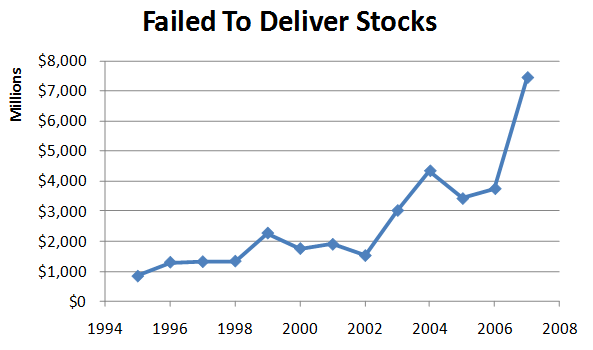
    Here’s the heart of the problem. There is something going on back-stage at Wall Street called the centralized clearing and settlement system. I worked in it in the US and have studied and consulted to the system in the rest of the world. The system we have in the US was exported around the world thanks to the United States Agency for International Development. The system is designed to let all the stocks and bonds traded on the stock exchanges be paid for electronically. To expedite the process – known as settling trades in stocks, bonds and all the other financial instruments – the system accepts an electronic “IOU” for the shares until the real financial papers can be delivered. It requires that the money be paid immediately. The problem is that the system permits dealers to sell more stocks and bonds than exist without any incentive to deliver on time. The centralized settlement system simply holds the “failed to deliver” open indefinitely in the form of an electronic IOU. The value of the IOUs in the system has risen dramatically since 2001.


    Source: Public data, available in annual reports of Depository Trust and Clearing Corporation and its subsidiaries.


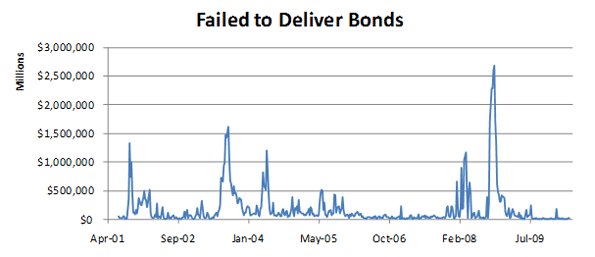
    Source: Public data, available from the Federal Reserve Bank of New York.

    Notice the relationship of the timing of the spike in the bond failures to the financial crisis: the 17 primary dealers reporting to the New York Federal Reserve Bank failed to deliver about $2.5 trillion worth of US Treasury securities for 7 weeks in late 2008 – no fines, no sanctions; worst of all, very little press coverage.

    This is the core of the problem – both in practice and in theory. This means supply is infinite – there is no limit to how many bonds can be sold because no one is enforcing delivery. In reality, no one should be able to sell more US Government bonds than the US Government has issued. That’s a problem in the practices supported by the system. The theoretical problem is that all financial instruments, including the bonds issued by city and state governments,, are being sold without any attachment to the real assets. This damages not only buyers in the stock market, but also the companies and governments who are trying to raise the money needed to keep delivering the services that we depend on them to provide.

    The practice of allowing the delivery of electronic IOUs in place of shares of stock or Treasury bills is a process that rewards financial manipulation instead of allocating resources to productive uses – the activity that capital markets should be doing. All the Congressional and the Administration talk about Wall Street reform is to centralize more trades into the existing settlement system – the one with the trillion-dollar hole in it! Someone has convinced them that the centralized system can easily track and account for positions – the actual statistics present a very different picture.

  • The Great Deconstruction – First in a New Series

    History imparts labels on moments of great significance; The Civil War, The Great Depression, World War II. We are entering such an epoch. The coming transformation of America and the world may be known as The Great Deconstruction. Credit restrictions will force spending cuts and a re-prioritization of interests. Our world will be dramatically changed. There will be winners and losers. This series will explore the winners and losers of The Great Deconstruction.

    ***

    The phrase, The Great Depression, was coined by British economist Lionel Robbins in a 1934 book of the same name. Its unexpected onset followed years of speculative growth during which economist Irving Fisher famously proclaimed, “Stock prices have reached what looks like a permanently high plateau.” The depression can be traced to the stock market crash of Black Tuesday, October 29, 1929, when stocks lost $14 billion in a single day. During the Great Depression that, followed, unemployment soared to 25%, a drought turned the farm belt into a dust bowl and international trade plummeted by two-thirds. The worldwide slump did not end until the advent of World War II.

    A similar, albeit less catastrophic, stock market collapse occurred in 2008. Following the speculative rise of a housing bubble, trillions of dollars in home equity and stock value were wiped out and 15 million Americans were left looking for work. Paul Krugman, columnist for the New York Times, labeled the worst downturn in nearly a century, The Great Recession. The Dow fell from a peak of 14,093 in October of 2007 to 6,626 in March of 2009. While Wall Street recovered half of its losses thanks to TARP, an $800 billion financial rescue package for the banks, Main Street has lagged behind. Home equity fell by $5.9 trillion. Housing starts plummeted from 2,075,000 in 2005 to 306,000 in 2009 decimating the construction industry. Foreclosure notices went out to 2.8 million homeowners in 2009 and 4,000,000 are projected for 2010. Eight million jobs have been lost and despite an $800 billion stimulus package, unemployment remains at 9.7%. Under-employment, the real jobless number, has reached 17%. Diversion of agricultural water to protect an endangered species in California and a severe drought has brought bread lines to the famously fertile Imperial Valley.

    Like the Great Depression before it, this recession will leave permanent scars on the people. The depression experience made our parents forever frugal. The Greatest Generation became savers, amassing trillions in home equity, stocks and savings accounts. In contrast, their spoiled and coddled children, the Baby Boomers, became the generation of instant gratification. Easy credit and home equity credit lines meant flat screen TVs, vacations, jewelry and jet-skis could be acquired instantly and paid for later. The Baby Boomers entered Congress, the state house and local government with the same attitude: buy now and pay later. Their largesse was fueled by a bubble mentality. Even though the Dot-Com Bubble burst in the late 90s, it was followed by the Housing Bubble of the 00s and a seemingly endless stream of revenue. A spending frenzy ensued with equity rich homeowners offered home equity lines of credit and credit cards with $100,000 limits.

    It wasn’t just consumers who went wild. In many states, such as California, so did the Legislature. In 1999, California rewarded its public employees with generous pensions (SB 400) that allowed retirement at age 50 with 90% of salary – for life. The California Legislative Analyst’s Office estimated the cost of SB 400 at $400 million per year. In 2009, the actual cost was $3 billion. The pension drain contributed to the $20 billion state deficit that California now faces. A Stanford Institute for Economic Policy Research report estimates California’s unfunded pension obligation at $500 billion.

    Cities in California matched SB 400, as did counties and municipal agencies, and it led to similar economic results. On April 6th, the City of Los Angeles announced furloughs for public employees, a 40% pay cut, effective immediately to help plug a $500 million deficit. Vallejo, a small city of 120,000 that generously paid its City Manager $600,000 per year and its firemen, $175,000, was forced to file for Chapter 9 Municipal Bankruptcy once the Great Recession dried up their honey pot.

    The problem has consumed municipal government across the nation. The Center on Budget and Policy Priorities recently estimated budget deficits for cities and counties would reach $200 billion this year. Detroit, with a $300 million deficit, has proposed leveling and returning huge sections of the decaying city to farmland.

    At the Federal level, the Obama Administration projects deficits of $1 trillion per year as far as the eye can see. The unfunded obligations for Social Security and Medicare are a staggering $107 trillion. Congressional Budget Office Director Douglas Elmendorf said, “U.S. fiscal policy is unsustainable, and unsustainable to an extent that it can’t be solved through minor changes. It’s a matter of arithmetic.”

    Elmendorf said fixing the problem will require fundamental changes and government would need to make changes in the large programs, Medicare, Medicaid and Social Security and the tax code, to get the deficit under control.

    When the Credit Card is Denied …

    Such deficits simply cannot be ignored. There will be an intervention. It may come from outside if China, Japan and the Saudis stop buying our debt. It could come from our children who may object to being forced to repay debt they did not spend. It will more likely come from our parents, The Greatest Generation, in the form of a credit intervention. Our parents may intervene, like they did back in the 60s when the Boomers experimented with sex, drugs and rock n roll. When some of us lost control, it was our parents who intervened and straightened us out. They may be forced to intervene once again. this time at the ballot box in November 2010. The Greatest Generation may send the politicians packing, impose order where chaos has reigned, and cut up the credit cards used by their spoiled and coddled Baby Boomer children. Have you noticed who attends the Tea Party rallies? They are retired, educated, tax paying middle class Americans – they look a lot like our parents.

    Deconstruction will take many forms and will encompass all that we know. Private industry has already shed 8 million jobs. The firing of private employees was low hanging fruit. Once untouchable social programs will be forced to disappear. Sacred cows will be slaughtered. Pet programs will be defunded. Even the military may have to learn to live with less. Further changes imposed will cut deep, reaching the union protected public employees and their constitutionally protected pensions. Just as General Motors was forced to abandon its venerable Pontiac brand along with Saturn, Saab and Hummer, unions will lose many of the benefits they obtained the last ten years. There will have to be changes to Medicare, Medicaid and even Social Security.

    We learned something from the health care fiasco. If we treat seniors, our parents, fairly and honestly, they will make the sacrifice. They were upset with the unfairness of the Cornhusker Kickback and the Louisiana Purchase. They became furious when Cadillac health care plans of union members received different treatment than theirs. Treated fairly, our parents will be part of the solution.

    Fifteen million Americans are looking for work. The jobs will not return soon. Thirty-three states have deficits that must be resolved by law. It will not happen without major sacrifice and draconian job lay-offs of public employees at the national, state, and local levels. The furloughs in Los Angeles only portend things to come. The Great Deconstruction has already begun.

    ***************************************

    The Great Deconstruction is a series written exclusively for New Geography. Future articles will address the impact of The Great Deconstruction at the national, state, county and local levels.

    Robert J Cristiano PhD is the Real Estate Professional in Residence at Chapman University and Director of Special Projects at the Hoag Center for Real Estate & Finance. He has been a successful real estate developer in Newport Beach California for twenty-nine years.