Tag: Financial Crisis

  • Financial Crisis: Too Late to Change?

    A travelling salesman is driving down a country road when he runs over a cat. Seeing a farmhouse nearby, he approaches to confess this unfortunate situation to the pet’s owner. When a woman answers the door, he says, “I’m sorry, but I think I just ran over your cat.” She asks him, “Well, what did it look like?” “Oh, m’am,” he replies, “I completely ran over it, so it was very awful, just a smear on the road…” “Oh, no,” she interrupts, “I mean, what did it look like before you ran over it.”

    Congress and the Administration are trying to find ways to spend more money in their quest to stimulate the economy. But just like that travelling salesman, they are working with the picture after the wreck – and they can’t seem to focus on what things looked like before it happened. In other words, they are so happy to be spending money without restraint that they have neglected to figure out how we got into this mess in the first place. We all know that the problem started in the financial sector – I don’t know anyone who would disagree with that. In fact, the banks were the first to get money from the federal government – the October 3, 2008 act of Congress that will forever be known as The Bank Bailout.

    Sadly nothing is different than it was on September 17, 2008 – the day that your 401k turned into a 201F. The now officially “to big to fail” banks are no more restrained in their activities today than they were in the days, weeks, months and years leading up to the crisis. If anything, they are a little freer because now they are all “banks” with a federal guarantee for ever more risk-taking behavior without consequences.

    Becoming a bank means that the money they hold can be protected by the Federal Deposit Insurance Corporation (FDIC). The FDIC has been “so depleted by the epidemic of collapsing financial institutions” that analysts thought it would be forced to borrow money from the Treasury before the end of 2009. Since January 1, 2010, another 41 banks have failed. To hold the wolves at bay, the FDIC board eased the rules on buyers of failing banks, opening the door for hedge funds and private investors to gain access to “bank” status – and the protections that go with it. At the end of the third quarter of 2009, the FDIC’s fund was already negative by $8.2 billion, a decrease of 180 percent in just three months (from July to September 2009). According to the Chief Financial Officer’s report, the FDIC projects that the fund “will remain negative over the next several years” as they absorb some $75 billion in failure costs through the end of 2013. Taking their lead from Congress – that is a policy of robbing the future to pay off the past – the FDIC is proposing that banks pre-pay their insurance fees for the next three years.

    There is no relief in sight, either. Just this week, a case of “insider trading” in New York was dismissed because the deal involved credit default swaps which – as I explained here last March – payoff losses “like” insurance but not regulated like insurance and which are bought and sold “like” securities but not regulated like securities. Although they are at the root of the causes of the financial crisis, not one new rule, regulation or law has been implemented to stop this nonsense from continuing. If you look at who’s in charge of figuring out what went wrong – and making recommendations on how to prevent it from happening again – you will find the Financial Crisis Inquiry Commission consists of political appointees who “have consulted for legal firms involved in lawsuits over the crisis.”

    That’s not reassuring. A Commission composed of members who earn their livelihood from financial institutions – including those that precipitated the crisis – is unlikely to solve or have any incentive to discover the mystery of the causes of the greatest financial collapse in the history of the world. This group is part of the problem – not the solution.

    Eighteen months after Wall Street roasted weenies on the bonfire of your 401k, the one noticeable difference is that the stock market is higher than it was on that fateful day in 2008. Unfortunately, this version of “economic recovery” is being driven by the financial services industry instead of the real economy. As rising stock prices encourage more savers and investors into the stock market, they create an increasing supply of investable funds in the hands of the banks – who remain as free to speed down our financial highways today as they were when they ran over the economy like that poor cat on a country road, leaving nothing but a stain on the pavement.

    Susanne Trimbath, Ph.D. is CEO and Chief Economist of STP Advisory Services. Her training in finance and economics began with editing briefing documents for the Economic Research Department of the Federal Reserve Bank of San Francisco. She worked in operations at depository trust and clearing corporations in San Francisco and New York, including Depository Trust Company, a subsidiary of DTCC; formerly, she was a Senior Research Economist studying capital markets at the Milken Institute. Her PhD in economics is from New York University. In addition to teaching economics and finance at New York University and University of Southern California (Marshall School of Business), Trimbath is co-author of Beyond Junk Bonds: Expanding High Yield Markets.

    Photo by David Reber’s Hammer Photography

  • A Big Company Recovery?

    After the release of the 2009 fourth-quarter GDP estimate, some forecasters are now predicting a rapid recovery in 2010. Certainly, the fourth-quarter growth rate was impressive, particularly following the modest pickup reflected in the third-quarter results and the terrible results of the previous several quarters. Implicitly, these optimistic forecasts are based on the assumption that the United States economy has been fundamentally unchanged by the recession.

    I suppose an assumption that the economy has been fundamentally changed in a good way could motivate a positive forecast, but I’ve not seen anyone make that argument. If someone does, I’d like the chance to debate them. We certainly haven’t addressed the too-big-to-fail problem, the bank health issue, or Fed-induced moral hazard problem created by Greenspan’s repeated easing in response to market declines.

    On the other hand, we are promised increased regulation for many sectors and higher taxes. I’d like to know which sectors, besides legal and accounting perhaps, were the winners, and how they are poised for imminent booms.

    If the economy is unchanged, we would expect to see economic growth in small businesses, and a recovery in real estate markets and construction. I don’t see how that happens. I have a hard time seeing how the flow of capital to small businesses can be restored soon, and imagining a near-term robust real-estate and construction recovery is even harder, while foreclosures are still climbing and homeownership rates still high.

    Given these facts, most forecasts these days are, unsurprisingly, more modest. Forecasts of tepid economic growth with slow job gains are typical. Some are more pessimistic, anticipating a new slowdown brought about by increasing taxes or new financial crises.

    Certainly, the United States faces continued economic challenges. When one looks more closely at the past-two-quarter’s GDP estimates, it is difficult not to conclude that they were elevated by temporary factors, such as home-buying incentives, auto buying incentives, and inventory changes.

    Other data compel one to even less sanguine conclusions. Bank charge-offs, driven by weak real estate markets and weak economic activity, are still climbing, hitting new records every quarter. Jobs are still being lost, albeit at slower rates than those disastrous rates we saw in 2009’s first half. Residential foreclosures are still climbing. Many commercial real estate markets appear to be collapsing. Normalized TED spreads, the cost of an incremental increase in risk, are still high, implying continued risk aversion among market participants.

    The human costs of this recession have been even greater. About 15 million Americans are unemployed, over half of whom have been unemployed for 19 weeks. That doesn’t include the almost-five-million discouraged workers who have left the job market, or the over-nine million who are underemployed, involuntarily working at jobs below their capabilities or part time.

    The employment numbers are sobering, but they don’t do justice to the personal costs those without gainful work are enduring. The average unemployment duration is now about 30 weeks. Many of our new workers and long-term unemployed will never see their careers recover. Instead, they will toil at jobs below their abilities, earning lower salaries than would have been the case without the recession.

    For the rest of us, these workers represent underutilized human capital, perhaps even a financial burden. They imply slower long-term economic growth and suggest our economy has undergone a fundamental change.

    The magnitude and duration of unemployment are not the only changes we’ve seen. It appears that, for the next decade at least, the potential growth of small business has changed, for the worse.

    Many of our banks are essentially zombies, existing, but incapable of serving an economic purpose, and I see no initiative to fix the banks. Small businesses need financial intermediation to grow. They cannot grow without an active and vigorous banking sector. Big business, with its direct access to capital markets, does not need financial intermediation. It can grow without an active and vigorous banking sector.

    Big business also operates, if it is big enough, with a free insurance policy against failure. Some big businesses are not big enough to be considered too big to fail, but many of them are large enough to attract or lobby for subsidies or government protection.

    Small businesses, on the other hand, are on their own. No one insures or subsidizes small business. Few even notice when a small business fails.

    Big businesses are also likely to benefit from an increased regulatory environment. Proportionately, the compliance burden is far less for larger businesses than small businesses. Regulation often serves as a tax on entrepreneurs, but a boon for big company bureaucrats.

    Yet we cannot expect big business to rescue or re-invent the economy since they have little stake in pushing the envelope on innovation. Big businesses tend to be bureaucratic and risk averse. They do not innovate.

    However, small businesses are key to economic innovation and growth. There is a reason that the computer business is dominated by relatively young firms such as Microsoft and Google, instead of IBM. There is a reason that the old, protected, United States automobile companies couldn’t compete when the younger and more nimble, Japanese manufacturers entered the market with the higher-quality and more fuel efficient products.

    If the balance between large and small companies has been changed, fundamentally and at least semi-permanently, we are in big trouble. As our small firms are being stymied, the fundamental potential United States economic growth rate has shifted down, and the “natural” unemployment rate has shifted up. That is, we can expect slower growth and higher unemployment that we have become accustomed to in the past-unless somehow economic policy again favors entrepreneurs over corporate and government bureaucracies.

    Bill Watkins is a professor at California Lutheran University and runs the Center for Economic Research and Forecasting, which can be found at clucerf.org.

    Photo by Angela Radulescu

  • The Myth of the Strong Center

    At the height of the foreclosure crisis the problems experienced by some so-called “sprawl” markets, like Phoenix and San-Bernardino-Riverside, led some observers to see the largest price declines as largely confined to outer ring suburbs. Some analysts who had long been predicting (even hoping for) the demise of the suburbs skipped right over analysis to concoct theories not supported by the data. The mythology was further enhanced by the notion – never proved – that high gas prices were forcing home buyers closer to the urban core.

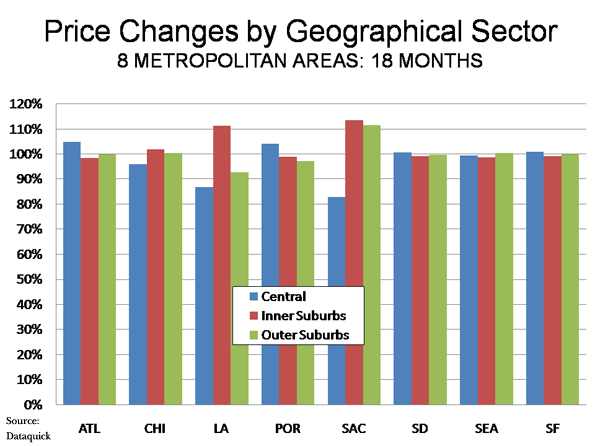
    Yet a summary of the trends over the past 18 months show only minor disparities between geographies within leading urban regions. Overall house prices escalated similarly in virtually all areas within the same metropolitan areas and the price drops appear to have also been similar. This is in contrast to a theory that suggests that huge price drops occurred in the outer suburbs while central city prices held up well.

    Summary of 18 Month Subarea Price Declines: This is indicated by a review of 8 metropolitan areas: Los Angeles, the San Francisco Bay Area, San Diego, Sacramento, Atlanta, Chicago, Portland and Seattle (see end note), for which subarea data is readily available (see table). On average, central area median house prices (all houses, including condominiums), fell 3% in relation to the overall metropolitan area average. Inner suburban areas experienced a 3% gain relative to metropolitan area prices, while outer suburban areas changed at the metropolitan area average. In actual price reduction terms, core areas declined 28.8%, inner suburban areas declined 25.7%, and outer suburban areas declined 27.1%. The overall average metropolitan area decline was 27.2%. There was, however, considerable variation in the figures by metropolitan area (see figure below).

    MEDIAN HOUSE PRICE CHANGES BY GEOGRAPHICAL SECTOR
    8 Metroplitan Areas
    CALIFORNIA MARKETS Central Inner Suburbs Outer Suburbs Overall
    Los Angeles -45.3% -30.0% -41.5% -37.1%
    San Francisco Bay -38.0% -39.1% -38.6% -38.6%
    San Diego -36.5% -37.4% -37.0% -36.9%
    Sacramento -53.6% -36.3% -37.5% -44.0%
    OTHER MARKETS
    Atlanta -11.6% -17.0% -15.8% -15.8%
    Chicago -21.0% -16.3% -17.5% -17.8%
    Portland -10.0% -14.5% -15.7% -13.5%
    Seattle -14.2% -14.7% -13.2% -13.7%
    AVERAGE -28.8% -25.7% -27.1% -27.2%
    Estimated from Data Quick information
    California Markets: July 2008 to January 2010
    Other Markets: 2008-2nd Quarter to 2009-4th Quarter

    Where Central Area Losses were Greatest: Over the past 18 months, central areas posted the largest losses in three of the areas. Further, in each of these areas, the smallest price drops were experienced in the inner suburbs.

    • Sacramento had the steepest central area relative price decline. Central area prices declined 37% relative to inner suburban prices, where the smallest losses occurred. The central area price loss averaged 53.6%, compared to the overall metropolitan area loss of 44.0%. The inner suburbs experienced the smallest loss, at 36.3%.
    • Los Angeles also had a steep central area relative price decline. Central area prices declined 45.3%, compared to the overall metropolitan area loss of 37.1%. The inner suburbs experienced the smallest loss, at 30.0% while outer suburbs lost 41.5%.
    • Chicago’s greatest losses also occurred in the central area, but were of a much smaller magnitude. Central area prices declined 21.0%, compared to the overall metropolitan area loss of 17.8%. The inner suburbs experienced the smallest loss, at 16.3%. The outer suburbs lost 17.5%.

    Where Suburban Losses were the Greatest: In two areas, the central area price losses were the least, Atlanta and Portland. Yet, the magnitude of these losses was modest. It is interesting to note that the metropolitan areas with the smallest relative losses in the central areas pursued radically different policies with respect to development. Portland’s “smart growth” policies favor central development at the expense of suburban development, while Atlanta’s more liberal policies do not attempt to steer development to the core.

    • Atlanta’s greatest price declines occurred in the inner suburbs, which experienced a loss of 17.0%, slightly more than that of the outer suburbs (15.8%). In comparison, the central area price drop was the least, at 11.6%, The metropolitan area loss was 15.8%.
    • Portland’s greatest price declines occurred in the outer suburbs which experienced a 15.7% loss, compared to the inner suburbs, at 14.5. The lowest decline was in the central area at 10.0%. The metropolitan area loss was 13.5%.

    Little Difference in Some Markets: There was little difference in the price declines among geographic sectors in three of the metropolitan areas. In the San Francisco Bay area, San Diego and Seattle, the differences between central, inner suburban and outer suburban price declines were all within a 2% range.

    Core Condominium Market Crisis

    However, core area markets where condominiums predominate indicate substantial difficulties in some of the metropolitan areas. These markets are generally only a small part of central cities, principally around downtown areas or major centers. For example, in the Portland area, the core condominium areas ring the downtown area and include the Pearl District and the South Waterfront District. The central area, which encompasses the entire city of Portland, however, is much larger and has a much larger share of detached housing.

    Demand has been so weak in the core condominium markets that substantial price reductions have occurred and a number of buildings have been forced to sell units at auction. Other buildings have given up altogether on selling and have rented condominiums. Some of the price drops, especially in Atlanta, Portland and Seattle are far greater than occurred overall in the respective metropolitan markets. The condominium implosion has not received nearly the level of attention in the national or local media that was accorded the housing bubble and collapse itself.

    Portland: A local television station video indicates that Portland’s condominium market is in crisis. A report in The Oregonian indicates that the downtown area has a “glut” of condominiums and that February sales prices averaged 30% below list. A luxury new 15-story building in the Pearl District (The Wyatt) is now being leased instead. Units at The Atwater in the South Waterfront district were auctioned, with minimum bid prices more than 50% lower than list. The John Ross, also in the South Waterfront District, is Portland’s largest condominium project and will be auctioning its units. Minimum bid prices average 70% below the previous top list prices. The smallest units have a minimum bid price of $110,000. By comparison, over the past year, the median house price in the Portland metropolitan area has dropped approximately 10%.

    Atlanta: Atlanta has a “vast oversupply” of condominiums. The uptown (including Atlantic Station) and Buckhead markets of Atlanta appear to be experiencing some of the worst market conditions in the nation. The prestigious Mansion on Peachtree, a combination hotel and condominium development, was unable to sell 75% of its residences and was recently sold in foreclosure at approximately $0.30 on the dollar. The winning auction bids at The Aqua condominium in Uptown averaged 50% below the last asking price. In Atlantic Station, units at The Element were auctioned at substantial discounts. Among conventional sales, condominium price reductions of up to 40% have been reported. One building has offered discounts of $100,000 per bedroom. Some new buildings have been converted to rentals, while planned projects have been placed upon hold.

    Seattle: Things are little better in Seattle. The overbuilt downtown area condominium market has experienced a median price decline of 35% over the past year. Units at The Gallery in tony Belltown were auctioned off at minimum prices 50% below the last list prices (which had already been discounted). Units at The Brix, on Capitol Hill, attracted bids at auction averaging 30% below previous list prices. Later this month, unsold units at 5th & Madison will be auctioned, at minimum prices below 50% of previous list. For comparison, median house prices in the Seattle metropolitan area declined 6% over the past year.

    Chicago: The downtown area of Chicago has been among the most vibrant condominium markets for more than a decade. However, in 2009, condominium sales fell to the lowest level since 1997. At current sales rates, the downtown area has a supply of more than five years, with annual sales of less than 600 and more than 3,000 units available or under construction.

    Los Angeles: Few markets have seen as many condominium buildings planned as downtown Los Angeles, and few have seen so many put on hold. A recent issue of the Los Angeles Downtown News lists approximately 50 downtown condominium projects. More than three-quarters of the projects have been scaled back, have had construction slowed or are on “hold.” The market has been so weak that a number of developers have taken losses by auctioning condominium units that they have not been able to sell conventionally.

    San Diego: The downtown San Diego condominium is substantially overbuilt. Developers have leased units that were to have been sold and there is virtually no construction of new units.

    Rental Conversions: Even these grim reports, however, may mask an even bigger problem. It is estimated that more than 20,000 condominiums units are completed or nearly completed, but are not listed for sale in Miami. In what is by far the nation’s strongest condominium market, Manhattan, more than 6,000 condominium units are completed or nearly completed, but not listed for sale.

    In core cities, few issues have been as divisive as the conversion of rental units to condominiums. But, now the opposite is now occurring – condominiums are being converted into apartments for rent: This is trend that undermines markets in a way that cannot be measured by median prices, since it replaces generally high-paying condo owners for generally less flush renters. This puts those who bought at higher prices in these markets at a particular disadvantage.

    Conclusion: Overall, contrary to the mythology developed early in the bubble, suburbs and even exurbs have generally performed about as well as closer in markets. The big imponderable will be the future of the core condominium market, which is experiencing significant financial reverses largely ignored by the national media.


    Note: As used in this article, the Los Angeles metropolitan area is the Los Angeles-Riverside Combined Statistical Area, the San Francisco area is the San Francisco-San Jose Combined Statistical Area and all other metropolitan areas are the corresponding metropolitan statistical areas. http://demographia.com/db-prdistr2010.pdf>Subareas defined.

    Photograph: Condominium construction, Atlanta, weekend of the Lehman Brothers collapse.

    Wendell Cox is a Visiting Professor, Conservatoire National des Arts et Metiers, Paris. He was born in Los Angeles and was appointed to three terms on the Los Angeles County Transportation Commission by Mayor Tom Bradley. He is the author of “War on the Dream: How Anti-Sprawl Policy Threatens the Quality of Life.

  • Scenario Two: An Optimistic view of the United States future

    This is the second in a two part series exploring a pessimistic and an optimistic future for the United States. Part One appeared yesterday.

    A positive assessment of US prospects rests on at least seven propositions. First, the current crisis is not inherently more threatening than many others, most notably the Civil War, the Great Depression, and two World Wars. Quality leadership, building on the resilient political and economic institutions of the country, will prove sufficient to bring about needed sacrifices and transformations. We have seen this many times in the past from the Progressive Era to the New Deal, the Second World War and the winning of the Cold War, which was a uniquely bipartisan triumph.

    Second, despite the ongoing problems of racial inequality and tensions about immigration, the United States has been uniquely successful in having peacefully achieved a truly multi-racial and multi-ethnic state. It has welcomed waves of diverse immigrants, and integrated them into a broader, ever changing society. This process has culminated symbolically and literally in the election of a multi-racial president, Barack Obama.

    Third, economic corruption and financial crises have been recurring phenomena, and the nation has emerged out of these because of the sheer magnitude of talent and natural resources. This has been aided by a deep entrepreneurial capacity and willingness to take risks, and, overall, a willingness of most to work hard to improve life for themselves and their families.

    Fourth is the existence of a large and literate population, willing to work, certainly the world’s finest university system and research establishment, over and over again engendering innovations that create future economies: e.g., the computer revolution. American secondary education is still in need of great improvement, but the US University remains a beacon to talent from around the world.

    Fifth, despite the noise and uproar, despite the continuing clash between the traditional and the modern or secular, the nation, through its independent courts and helped by governmental decentralization, e.g. the Federal system, the country remains the freest society in human history. Despite the appearance of power of the religious right under the Republicans since the 1970s, serious erosion in freedom of thought has been kept to a minimum. Similarly, the cult of political correctness, although annoying, has become, if anything, less potent and increasingly the butt of jokes.

    Sixth, and perhaps most important, we have to consider demography. Despite current unemployment and despite the imminent retirement of the baby boomer generation, the United States, alone among the richest economies, will continue to have a relatively favorable ratio of wage earners to the elderly. This will enable us to afford social security and Medicare. The new generation – known as millennials – will constitute a large source of new labor, innovation and entrepreneurs needed to propel our economy.

    Finally, there are a few positive trends, including modest recovery in housing and in auto sales, hints of some pulling back from the out-sourcing of services, and continuing innovation and marketing of new products and services. On the political side, although the current anti-incumbent mood will likely reduce Democratic margins in Congress and in several states in 2010, the sheer lunacy of the “tea party“ activists, many of them unreconstructed “know nothings” may actually hurt the Republican party more than the Democrats. People are constantly being reminded why, for all the failings of the Democrats, they tossed the Republicans from power in the first place.

    An optimistic scenario rests on the historical precedent of muddling through crises and then creating new waves of innovation in products and services, and on the presence of a large labor force willing and able to work. A vital question is whether the President and Congress will have the courage to ask voters to make short-term sacrifices: higher income taxes on the rich and reduced subsidies to entrenched interests across the board that will be needed to restore fiscal health. And finally there is the big question, are the American people ready to do with less today to build a better future for the next generation?

    Richard Morrill is Professor Emeritus of Geography and Environmental Studies, University of Washington. His research interests include: political geography (voting behavior, redistricting, local governance), population/demography/settlement/migration, urban geography and planning, urban transportation (i.e., old fashioned generalist).

    Photo: elycefeliz

  • Scenario One: A Pessimistic Forecast for the United States

    This is the first in a two part series exploring a pessimistic and an optimistic future for the United States. Part Two will appear tomorrow.

    I’m an old (76) 1950s type liberal, and have lived to see the election on the nation’s first mixed-race president, as well as some remarkable social change in the general status of women and ethnic minorities. The United States has a remarkable heritage of entrepreneurship and resilience in its democratic institutions. Yet there are cogent reasons to be fearful and pessimistic about our capacity to maintain our preeminence, at least in the medium run (10-15 years). I obviously hope I’m wrong, and look forward to attempts to undermine my thesis – including, tomorrow, my own.

    Consider the numbers 17, 49 and 60. Seventeen is the real unemployment rate, not the “official” ten, when we take into account those dropping out of the labor force, or giving up. Forty-nine is the real percentage of home ownership, in our “ownership” society, not the 68 percent from the census. For mighty Los Angeles, the real number is 44 percent. The difference is the stupendous number of households whose equity in the house is less than they owe on the mortgage. This house of cards has increasingly been the engine of national growth. Sixty is the number of votes in the US Senate needed to stop a filibuster, and together with inept leadership, is responsible for the absurd failure of Congress and the effective collapse of collegial democracy.

    Economists say we are in a recovery. What recovery? The small increase in house sales is due to temporary incentives, but including speculators buying up homes, many foreclosed, for yet greater inequality. The main gains in jobs, not fully offsetting wider losses, are in temporary construction tied to government-funded projects. The growth in jobs and the economy in the last 20 years has been in services, stuff we do for each other, and the main fuel has been the pyramiding of house values. That is over. How can we restore growth through more consumption if the majority of the population no longer has the resources to invest or spend?

    By far the most destructive accomplishment of almost 30 years of restructuring has been the reestablishment of extreme inequality, the emergence and power of the ultra-rich, both “progressive” and conservative in orientation, to levels last seen before the Great Depression.

    But perhaps the greater root of our malaise, and perhaps the downfall of the American Empire, lies in excessive globalization and the loss of our capacity to make stuff, the outsourcing of, first, manufacturing and now even of services. It is instructive that this is the same story of imperial Rome, although long dependent on its empire, by the time of its collapse it imported virtually everything from its tributary states. Its finances could no longer pay the Army which was largely made up of people from outside Italy.

    I’d agree that the main hope in the economic arena is via the small entrepreneur, but they face the immense monopolistic power of ever-larger global capital. I’m proud to live in Seattle, which at least dared to fight back, as in the one and only US general strike, in 1919, and in the WTO protests in 1999. Perhaps this is not so surprising since Seattle still makes things: planes (Boeing), ships (Todd) and trucks (PACCAR).

    The saddest irony is that even as maybe half of us celebrate a Black president, we have utterly failed to follow up on the political civil rights gains on the 1960s to incorporate Black Americans into the mainstream economy. The status of the Black male is, relatively, worse in 2009 than it was in 1969. I would not be surprised to see a reprise of the 1960s race riots. But it is also relevant to reflect on the declining state of the white male, suffering increased drop-out rates from high school, declining enrollments in college, all in the face of reduced job opportunities for the less skilled and educated, plus competition from immigrants, legal and illegal. Is it any wonder that both nativism and populism is rising anew?

    One might dare to believe that large Democratic majorities in Congress would give us hope for effective responses to this national malaise. But I’d say the current Congress rivals the infamous 80th congress that Harry Truman excoriated, for its “do nothingness”. On the surface we can correctly observe that the Republican party, increasingly conservative, is more than willing to wreck the country in order to regain power.

    But part of the problem is that we no longer have a conservative and a liberal party, in an economic sense. We have two bourgeois parties, with the “new” Democratic Party increasingly dependent on the wealthy educated elite as well as well-paid public workers, it long ago abandoned the working class and did nothing to constrain globalization and the rise of the toxic financial practices. Thus we should not be surprised that the populist know-nothing uprising could bring to power large numbers of proudly uneducated folks.

    In the final analysis for this pessimistic scenario, the underlying culprit is the inexcusable failure of the US educational establishment, the astounding incapacity of our public and private schools to teach people to think and reason. And part of the reason for this incapacity is the excessive power of religion, which values belief over reason, in our culture. And this is why decadent Europe – aging and tax-burdened – could come out of this recession and malaise better than the United States. Perhaps we’ll see a reverse migration of surplus underemployed young Americans returning to their aging historic motherlands!

    Richard Morrill is Professor Emeritus of Geography and Environmental Studies, University of Washington. His research interests include: political geography (voting behavior, redistricting, local governance), population/demography/settlement/migration, urban geography and planning, urban transportation (i.e., old fashioned generalist).

    Photo: hz536n

  • Deconstruction: The Fate of America? – The Changing Landscape of America

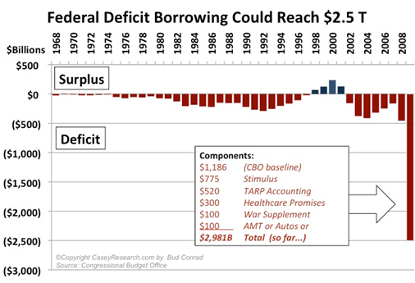
    America is at a crossroads. Its current path is unsustainable. The deficit for fiscal year ending Sept. 30, 2009 was $1.42 trillion. The National Debt is $12.5 trillion with the debt ceiling just raised to $14.9 trillion. The National Debt has increased $4 billion per day since September 28, 2007. The Obama Administration projects trillion dollar deficits for years to come. It has bailed out GM and Chysler, the banks “too big to fail” , and state governments that cannot manage their budgets. They have given away billions for clunkers and caulkers, and rewarded homeowners who bit off more than they can chew. We owe China $894 billion, Japan $764 billion and the Oil Exporters another $207 billion. It is uncertain how long foreigners will continue to finance our debt.

    There comes a breaking point at which the financial model is unsustainable and can no longer continue. For you and I, it is called bankruptcy. If we screw up financially, we are forced to declare bankruptcy. The courts offer protection until we can get our house in order but we are forced to stop spending. We solve our problems under Chapter 7 (liquidation) or Chapter 11 (reorganization).

    DECONSTRUCTION

    Cities can also be forced into Chapter 9 municipal bankruptcy. The City of Vallejo, California, population 120,000, filed for bankruptcy in 2008 after its politicians went fiscally berserk, paying the city manager $400,000 per year and its fireman an average annual wage of $175,000. Cleveland, Ohio declared bankruptcy in 1979 after defaulting on $15 million of bonds. (Seems trivial in this era of trillion dollar deficts). New York City avoided bankruptcy in 1975 when the teachers union forked over $150 million at the eleventh hour. These cities were forced to remedy their reckless spending.

    States cannot declare bankruptcy. Nor can they print money like the federal government. The Legislative Analyst’s Office estimates California has unfunded pension obligations of $237 billion. California is flirting with junk bond status. If it loses its credit rating, it will no longer be able to fund its bloated operations. The Golden State then will become the first failed state. They will be forced to dismantle their regulatory bureacracy. California has over 500 agencies and many are overlapping. They have 250,000 state employees. Thousands will lose their jobs as the financial community imposes cuts the legislature will not make. Such down-sizing will become known as deconstruction. California may be the first state to deconstruct its government services but it will not be the last. The Pew Center for the States reported that state governments have more than a trillion dollars in unfunded pension obligations.


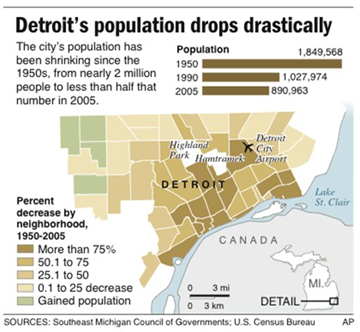
    There is no better example than the City of Detroit. Once the home of Henry Ford and the American automobile industry, Detroit has fallen on hard times. Its population has fallen from nearly 2 million residents to less than 900,000 today. With a budget deficit of $300 million per year, Detroit can no longer provide basic services to its own residents. There are 33,500 empty homes and 91,000 vacant residential lots. More than 300,000 buildings are vacant or in shambles. It is estimated that 40 square miles of Detroit lies abandoned.

    Twelve years ago, British urban historian Sir Peter Hall wrote in “Cities in Civilization” that Detroit “has become an astonishing case of industrial dereliction; perhaps, before long, the first major industrial city in history to revert to farmland.” Hall may have been prescient. This week, Mayor David Bing released the “Neighborhood Revitalization Strategic Framework,” a landmark document that suggests that vast sections of Detroit be razed and returned to farmland, open space and nature. The report suggests the first organized and orderly deconstruction of a major American city.

    The report envisons replacing entire neighborhoods with “Naturescapes” (meadows), “Green Thoroughfares” and “Village Hubs” that require fewer city services. But, it will require hundreds of millions of federal aid to finance such a major transformation, money the federal government no longer has to give.

    In an era of trillion dollar federal deficits, there are no longer easy solutions. The shift of tectonic plates caused by the Great Recession have exposed hopelessly unsustainable city and state budgets. Swollen payrolls, duplicative agencies and inefficient municipal services can no longer be afforded. The deconstruction of government services seems inevitable.

    In five years, will Detroit remain a cratered landscape of vacant buildings, broken promises, and smashed dreams? Or will a smaller, safer, more efficient city evolve out of its ruins? If deconstruction is successful in Detroit, it could serve as a model for many other governments as well, from City Hall to state capitols and all the way to the most bloated disaster of all, Washington, DC.

    ***********************************

    During the first ten days of October 2008, the Dow Jones dropped 2,399.47 points, losing 22.11% of its value and trillions of investor equity. The Federal Government pushed a $700 billion bail-out through Congress to rescue the beleaguered financial institutions. The collapse of the financial system in the fall of 2008 was likened to an earthquake. In reality, what happened was more like a shift of tectonic plates.

    ************************************

    This is the eighth ninth in a series on The Changing Landscape of America written exclusively for New Geography

    Robert J. Cristiano PhD is a successful real estate developer and the Real Estate Professional in Residence at Chapman University in Orange, CA.

    PART ONE – THE AUTOMOBILE INDUSTRY (May 2009)
    PART TWO – THE HOME BUILDING INDUSTRY (June 2009)
    PART THREE – THE ENERGY INDUSTRY (July 2009)
    PART FOUR – THE ROLLER COASTER RECESSION (September 2009)
    PART FIVE – THE STATE OF COMMERCIAL REAL ESTATE (October 2009)
    PART SIX – WHEN GRANNY COMES MARCHING HOME – MULTI-GENERATIONAL HOUSING (November 2009)
    PART SEVEN – THE FATE OF DETROIT: GREEN SHOOTS? (February 2010)
    PART EIGHT – THE FAILED STATE OF CALIFORNIA (March 2010)

  • Jerry Brown: Machiavelli Or Torquemada?

    For more than one-third of a century Jerry Brown has proved one of the most interesting and original figures in American politics–and the 71-year-old former wunderkind might be back in office in 2010. If he indeed wins California’s gubernatorial election, the results could range from somewhat positive to positively disastrous.

    Brown is a multi-faceted man, but in political terms he has a dual personality, split between two very different Catholic figures from the 15th century: Machiavelli and Tomas de Torquemada. For the sake of California, we better hope that he follows the pragmatism espoused by the Italian author more than the stern visage of the Grand Inquisitor.

    Like a good Jesuit, Brown certainly can be flexible. Back in 1978, for example, he worked against Howard Jarvis’ Proposition 13, which capped real estate taxes. But once the measure was passed, Brown embraced it as his own. Indeed, he was so enthusiastic about the tax-cutting measure that Jarvis actually voted for Brown’s re-election late that same year. A month after the vote a Los Angeles Times poll revealed most Californians thought Brown actually supported 13.

    Brown also has shown his flexibility by throwing even loyal allies under the bus. Elected largely due to the electoral coalition constructed by his father, Edmund G. “Pat” Brown, Brown made a point of tweaking and restraining the expanding bureaucracy largely created by his father. He also took on the University of California and the welfare bureaucracy as well as agriculture, residential real estate and manufacturing giants.

    This Oedipal battle reflected Brown’s personal crankiness. He came into office, recalled top aide Tom Quinn, “questioning the values of the Democratic Party.”

    Ascetic and even monk-like, he rejected his father’s “build, build, build” philosophy and embraced E. F. Schumacher’s “small is beautiful” ideology. Like the 15th-century Florentine Catholic monk Girolamo Savanarola, he came to rid Sacramento of suberbia and luxuria.

    Brown was also ahead of his time. His early embrace of green politics–particularly energy conservation and renewable fuels–foreshadowed that of later Democrats, particularly Barack Obama. His strong outreach to Latinos and other minorities expanded his political base among California’s fastest-growing populations.

    Yet Brown understood that economic prosperity–not civil rights or environmental zealotry–was key to political ascendancy. Eastern journalists dismissed him as “Governor Moonbeam,” but they ignored his Machiavellian skill in recognizing and reaching out to rising economic forces, notably the high-tech entrepreneurs in the Silicon Valley and across Southern California. The growth of this sector, along with rising trade with Asia and the military boom after the Soviet invasion of Afghanistan, set the pace for the state’s strong rebound from its early 1970s doldrums.

    But Brown’s inquisitorial side surfaced again as he prepared a second run–he had made a charmingly eccentric assault in 1976–for the White House. Perhaps the prospect of facing a man of infinite flexibility, Bill Clinton, pushed him over the top, but Brown re-invented himself as a high-octane and, at times, shrill populist.

    After some years in the political wilderness, he reemerged in 1998 as Mayor of Oakland, a tough job even in good times. Although he remained predictably arrogant and aloof, the job of managing a working-class city seemed to have brought him to his senses. Like the ideal politician in The Prince, Brown governed with something approaching strategic precision, pushing economic development, embracing the police and supporting new infrastructure spending.

    Brown’s newfound reputation as a canny realist helped him win the election as attorney general in 2006. Yet once back in statewide politics, the inquisitorial side found expression. Convinced about the impending threat of global warming, Brown used his new powers to push the Gorite agenda with the passion of a Torquemada.

    Although Brown was not quite torturing heretics, he certainly applied the legal equivalent of thumbscrews to anyone–developers, cities, counties–who did not follow his prescriptions about “carbon neutrality.” Even proposals for sensible, relatively dense “in fill” development were turned aside in favor of utopian, economically unsustainable ideas about forced density and transit friendliness.

    Today, with California’s economy is in tatters–its unemployment well over 12%–and Brown’s crusade seems likely to make it worse. Onerous regulation threatens everything from the construction of new single-family homes to new employment tied to anything that releases demon carbon–including manufacturing, oil drilling and large-scale agriculture.

    All this has made Brown widely feared in much of California’s fractured, traumatized business community. Even worse, he has emerged as the standard-bearer of the public employee unions, the very force whose political power and pensions are bringing the state to the verge of economic ruin. The fact that Brown’s campaign is funded largely by these unions makes it, at least on the surface, unlikely to challenge the hegemony of our putative “civil servants.” They are said to be ready to spend up to $40 million on “independent” campaigns to help beat back any chance of a GOP victory.

    This is worrisome given Brown’s role in fostering the expansion of public-sector unions during his term, a group whose ascendancy has become arguably the single biggest factor in the state’s precipitous decline during his last gubernatorial reign. As author Steven Greenhut has pointed out, unfunded pension liabilities in excess of $50 billion are one key element driving the state toward ever more depressed bond ratings and possible bankruptcy.

    Under normal circumstances, Brown’s ties to the public sector, his fickle nature and his dubious accomplishments would spell political doom. But amazingly, Brown’s long, if mixed, record might actually prove an advantage against his most likely opponent, former eBay executive Meg Whitman, who is running as an outsider.

    The problem for Whitman or any GOP candidate lies with the miserable legacy of another nominally Republican outsider, Arnold Schwarzenegger. The Terminator’s record of ineptitude and empty blather stands as a mega-advertisement against inexperience. Compared to the former body builder’s amateurish blundering, Brown’s wealth of knowledge of government looks appealing.

    Whitman, or her main challenger Insurance Commissioner Steve Poizner, also must struggle with a Republican Party out of sync with an increasingly multi-racial and socially liberal state. As long-time political analyst Allan Hoffenblum notes, for the first time there is not one congressional, state senate or assembly district with a GOP majority.

    So in the end, California’s fate may end up resting on which Jerry Brown emerges after the election. If he continues on his inquisitorial assault on carbon-creators, you can pretty much expect California’s middle class to continue diminishing while the state’s aspirational appeal ebbs ever further. The state could end up resembling Kevin Starr’s description of his native San Francisco– “a cross between Carmel and Calcutta.”

    But given his history, Brown could still surprise us. Stuck with responsibility for a decaying economy and fiscally burdened by the voracious public unions, Brown could do a “Nixon in China,” imposing controls on pensions and salaries. He could recognize that “green jobs” can not save California from the abyss and that a new “era of limits” must apply to the public sector as well as the rest of us. With the passionate climate-change constituency shrinking, he might even decide to accept a modicum of carbon heresy as a necessary evil.

    Brown should heed Machiavelli’s advice for rulers to be “merciful and not cruel” and “proceed in a temperate manner with prudence and humanity.” If in his old age Brown adopts the Italian writer’s credo of tactical flexibility, reason and tolerance, the Golden State may yet revive itself, and with it restore the legacy of its most storied political family.

    This article originally appeared at Forbes.com.

    Joel Kotkin is executive editor of NewGeography.com and is a distinguished presidential fellow in urban futures at Chapman University. He is author of The City: A Global History. His newest book is The Next Hundred Million: America in 2050, released in Febuary, 2010.

    Photo: Troy Holden

  • The Failed State of California – The Changing Landscape of America

    The Golden State is not so golden anymore. California is broke. With a $20 billion dollar deficit and tax revenues down 27% from last year, Governor Schwarzenegger looks to Washington D.C. for a bail-out to rescue the state from financial ruin. Like the executive passing a beggar on a street corner, Washington looks the other way. Unemployment is statistically 12.3%, but functionally, it runs closer to 20% of the work force. Nowhere is unemployment more tragic than in the Central Valley, the fruit and vegetable producer of the world. The unemployment rate in arguably the most fertile land on the planet is near 30% as residents line up in bread lines to feed their families. How did this happen? What happened to the Golden State?

    California is a victim of its own success.

    For decades following WWII, people flooded into the golden state in search of weather, opportunity and the good life. California delivered. Under Governor Pat Brown in the 1960s, California had wonderful weather, plentiful water, new highways, and the best public school systems in America. Every student had access to a strong community college system and top students were guaranteed admission to the University of California. Agriculture, Hollywood, aerospace and construction provided more jobs than workers.

    The 1970s brought harbingers of California’s future. The environmental movement muzzled a robust real estate industry with alphabet agencies like AQMD, CEQA, EIR and CCC. Building moratoriums raised home prices along the coast. Aggressive land use controls pushed development inland creating urban sprawl and long commutes as residents sought affordable housing inland. Governor Jerry Brown quipped, “If we do not build it, they will not come” and shut down highway construction, public school construction and added layers of new regulations. The people came anyway.

    The collapse of the Soviet Union in 1989 dealt California a cruel blow. The peace dividend meant the end for many high paying aerospace jobs and defense contracts. The recession that followed was felt far deeper than in the rest of the country. California climbed out of its recession led by wave after wave of new millionaire software developers during the dot com revolution.

    In 2001, the dot come bubble burst. The politicians in Sacramento, emboldened by an endless supply of money from the dotcommers to state coffers, spent over $100 billion while revenues fell to just $70 billion. They ran up a $38.2 billion deficit in 2002 under Governor Gray Davis – more than the other 49 states combined. The people recalled Davis in 2003 and replaced him with the Terminator, Arnold Schwarzenegger.

    The politicians learned nothing.

    California survived the bursting dot com bubble with yet another round of real estate escalation (the housing bubble) that lifted home prices by 20% per year. Spending escalated in line with home prices. More regulations were added to burden industry. Taxes were raised. Tuition increased. California added “The Global Warming Solutions Act of 2006” as if California alone could stem global warming. In response to 9-11, politicians passed SB 400, a feel good law that allowed cops and fireman to retire at 50. It was budgeted to cost “just $400 million” per year. Last year it cost $3 billion. Then, they passed SB183 the next year, applying the same benefits to non-safety state employees like billboard inspectors. When the housing bubble burst in 2007, California found itself with a $20 billion deficit – again.

    This time, California will not climb out so easily. Federal regulators, implementing the Endangered Species Act that was invented in California, diverted water from the farms of the Imperial Valley to the ocean to protect the engendered Delta Smelt. This tiny fish, with no commercial value, threatens the well being of tens of thousands of agricultural workers and contributes to unemployment figures worse than the Great Depression. California’s schools now rank 49th in the nation. They no longer generate the brilliant minds that fueled past economies. California’s 11.6% income tax has forced many high income earners to no income tax states like Florida or Nevada. The housing industry that created 212,960 units in 2006 was only able to build 36,000 units in 2009.

    Former state librarian and California historian Kevin Starr talks about the potential of California being the nation’s first failed state. John Moorlach, Orange County Supervisor says, “We better start talking about this. What are we going to do when the entity (state government) above us crumbles? I think we are already technically bankrupt.” He should know: Orange County went bankrupt in 1994. The City of Vallejo, population 120,000, was forced into bankruptcy in 2008 by commitments by its politicians to pay its City Manager $400,000 per year and its fireman an average of $175,000 annually.

    The biggest obstacle facing California’s recovery is a dysfunctional pension system created by politicians indebted to the public employee unions. The pension obligation is now $17 billion per year. California has 260,000 state employees and 38,000 are paid more than $100,000 per year. The University of California employs another 250,000 and 19,000 are paid over 100,000 annually. These generous salaries have been converted into lifetime annuities. The Legislative Analyst’s Office estimates the unfunded pension obligations of California to total $237 billion. In an era of retiring baby-boomers, this trajectory is clearly unsustainable. With tax receipts down, huge pension obligations and a state budget deficit of $20 billion, the vast majority of municipalities in California are suffering deficits and facing the prospect of Chapter 9 municipal bankruptcy.

    A train wreck is coming.

    Schwarzenegger, once the Terminator but now a Termed-Out lame duck, told the Sacramento Press Club, “No single issue threatens the fiscal health of this state more than our exploding pension obligations. Over the last 10 years, our pension costs have gone up by 2,000 percent from $150 million per year to $3 billion a year (for state government workers). That means hundreds of billions in unfunded liabilities and it means the $3 billion we are spending now will go up to $10 or $12 billion.”

    In October, state Treasurer Bill Locker told lawmakers they needed to reform the pension system or “it will bankrupt the state.” The California Public Employees’ Pension System chief actuary has described the current pension system as “unsustainable.” Adam B. Summers, a policy analyst at the Reason Foundation and author of “California Spending By The Numbers: A Historic Look At State Spending From Gov. Pete Wilson to Gov. Arnold Schwarzenegger” warns, “I think we are starting to approach a tipping point.”

    Do the politicians in Sacramento want to do something about the train wreck that is coming? The answer as of now is clearly no. There is no evidence that they are willing to curtail spending and reform the pension laws that cover 500,000 state employees. They know the State of California cannot go bankrupt under existing laws. However, if they will not act, the people may act for them. Just as they did in 2003 with the recall of Gray Davis, the people are taking the initiative. They are sponsoring the Citizens Power Initiative to curtail the ability of unions to use payroll deductions for campaign purposes. Another initiative would make California’s full-time legislature part-time. In the meantime, the California economy continues to grind to a halt. Will the people of California shock the nation like the people of Massachusetts did with the election of Scott Brown? Or will the unions buy another election and drive the Golden State over the edge, making it the First Failed State?

    ***********************************

    During the first ten days of October 2008, the Dow Jones dropped 2,399.47 points, losing 22.11% of its value and trillions of investor equity. The Federal Government pushed a $700 billion bail-out through Congress to rescue the beleaguered financial institutions. The collapse of the financial system in the fall of 2008 was likened to an earthquake. In reality, what happened was more like a shift of tectonic plates.

    ************************************

    This is the eighth in a series on The Changing Landscape of America written exclusively for New Geography

    Robert J. Cristiano PhD is a successful real estate developer and the Real Estate Professional in Residence at Chapman University in Orange, CA.

    PART ONE – THE AUTOMOBILE INDUSTRY (May 2009)
    PART TWO – THE HOME BUILDING INDUSTRY (June 2009)
    PART THREE – THE ENERGY INDUSTRY (July 2009)
    PART FOUR – THE ROLLER COASTER RECESSION (September 2009)
    PART FIVE – THE STATE OF COMMERCIAL REAL ESTATE (October 2009)
    PART SIX – WHEN GRANNY COMES MARCHING HOME – MULTI-GENERATIONAL HOUSING (November 2009)
    PART SEVEN – THE FATE OF DETROIT: GREEN SHOOTS? (February 2010)

  • Why Millennials are Economic Liberals and What to Do About It

    The Obama administration celebrated the anniversary of the passage of the American Recovery and Reinvestment Act, or economic stimulus, by pointing out the gradual recovery of the United States economy has resulted in “saving or creating two million jobs.” But young Americans continue to bear the brunt of what is still America’s worst recession since the Great Depression.

    From December 2008 to December 2009, the employment of 16-24 year olds in the U.S. fell by 1.78 million, or a third of the total estimated drop in employment of 5.4 million. Only 41% of Millennials are working full time, a drop of 9 percentage points in the last few years, even as the proportion of older workers employed full time remained fairly stable.

    The experience with hard times of Millennials, born 1982-2003, is one of the main reasons why they strongly support the classic liberal solution of effective government intervention in the economy. Recent Pew research, for example, indicates, that far more than older generations, a large majority of Millennials (71%) agrees that the government should guarantee that every citizen has enough to eat and a place to sleep. Millennials are also the only generation in which a majority (54%) disagrees with the contention that if something is run by the government it is usually inefficient and wasteful and a plurality (49%) rejects the belief that the federal government controls too much of our daily lives.

    A recent study by UCLA professor Paola Giuliano, and her colleague Antonio Spilimbergo, clearly documents the impact of recessions on people who are between 18 and 25, “during which most beliefs on how society and the economy work are formed.” Their research found that individuals who experienced recessions much milder than our current Great Recession during these formative years believe that “luck rather than effort is the most important driver of individual success, support more government redistribution, and have less confidence in institutions.” Other research shows that people who think luck is the primary driver of success are more willing to increase taxes to pay for a more activist government. Giuliano and Spilimbergo’s findings support the observation that lies at the heart of William Strauss and Neil Howe’s generational cycle theory, namely that the “values, attitudes and world-views” acquired during this period of early socialization “become fixed within individuals and are resistant to change.”

    The research of Giuliano and Spilimbergo also suggests that the Millennial Generation’s economic liberalism comes with a healthy dose of skepticism about the ability of institutions to help them meet their profound economic challenge. To fully restore Millennial confidence, government will need to take effective action to deal with the economy and reaffirm America’s tradition of economic mobility and rising middle class incomes. Beyond whatever short-term benefits President Obama’s stimulus program has provided, longer term more structural changes in the economy will need be made — starting with education.

    Higher education remains an important antidote to low wage employment in such economic circumstances, but only if students complete their chosen field of study. Yale economist Lisa Kahn has found that “the labor market consequences of graduating from college in a bad economy are large, negative and persistent,” resulting in lower wages, in less prestigious jobs for extensive periods of time. Her research suggests that even college graduates fortunate enough to get a job still suffer a 6 to 7 percent initial loss in income for every one percent drop in employment. Even though the differential diminishes over time, her research found such unlucky graduates still experiencing a statistically significant 2.5% loss of wages fifteen years later.

    Even so, those who get a four year college degree earn on average 35% more than those who leave college without getting a degree. Getting one or two years of post-secondary education and receiving an associate’s degree from a community college or a certificate from a career college also boosts wages above what they would have been without such a degree. One Florida study found that holders of certificates in particular occupations such as health care or IT earned 27% more than those who attended, but failed to complete, college. Associate degree holders earned 8% more than those who had no post-secondary education.

    One major reason students aren’t able to get a degree or certificate is that three-fourths of associate degree or certificate seekers end up working to help cover their education and living costs. Meanwhile federal support for higher education has failed to keep up with rising costs so that more and more students find themselves financing their education with student loans of one type or another. In Indiana, for instance, 62 percent of those who do manage to graduate carry student loan debt averaging $23,264 per student. The loan burden in that state is even higher for graduates of for-profit, private colleges who leave school with an average debt burden of $32,650.

    Increasing Pell Grant funding and the value of college tuition tax deductions are two steps government could take to address this problem. Reforming the student loan program to eliminate subsidies to banks as President Obama has advocated, and including student loans under any consumer protection agency that might be created as part of financial regulatory reform would also help address this problem that would fit with Millennial’s liberal perspectives.

    The other major reason students fail to complete their post-secondary education is the inadequate preparation for college, especially in math and science, they receive in high school. This is something that parents of Millennials will tolerate no longer. As Neil Howe points out, “when these Gen-X “security moms” and “committed dads” are fully roused, they can be even more attached, protective and interventionist than Boomer [parents] ever were. . .They will juggle schedules to monitor their kids’ activities in person. . . [and] will quickly switch their kids into – or take them out of – any situation according to their assessment of their youngsters’ interests.”

    These “stealth-fighter parents” have already begun to move one of the largest and most consistently poorly performing school districts in the country, Los Angeles Unified, forcing the district to grant them more say in school curriculum and governance. Their success led California’s usually dysfunctional legislature to pass a “parent trigger” law empowering a majority of parents in a demonstrably failing school attendance area to fire the principal and half the teachers as part of a turnaround initiative. Congress should incorporate this very interventionist idea into its reauthorization of the framework federal education law when it comes up for renewal this year. It should also expand funding for the Obama administration’s innovative Race to the Top initiative, which rewards schools that improve student learning performance rather than simply subsidizing mediocrity.

    All of these ideas will be resisted by those who believe that individual success is solely based upon effort and initiative and don’t believe in the efficacy of government efforts to revive the economy. Others with a stake in the status quo will argue against some of these ideas. But Millennials, whose lifetime of liberal economic beliefs have been forged by their experience with the Great Recession, will resist entreaties from those who offer only laissez faire economic policies or who try to delay dealing with these problems. They want government to act quickly and effectively, before they and their siblings are doomed to never enjoy the American Dream.

    Morley Winograd and Michael D. Hais are fellows of the New Democrat Network and the New Policy Institute and co-authors of Millennial Makeover: MySpace, YouTube, and the Future of American Politics (Rutgers University Press: 2008), named one of the 10 favorite books by the New York Times in 2008.

  • Olympic Games: Greece’s Gold Medal For Debt

    Although I cannot imagine that it will have much appeal in the ratings beyond C-Span 2, a terrific new reality program, Euro Bomb, could be produced around the survival of the Greek economy.

    The founder of both the ancient and modern Olympic games is in the midst of a debt crisis that threatens not just to send a few bondholders off the island, but has the potential to blow up the European Union’s currency zone.

    The first indication of a problem with Greeks bearing debts was when the yield on the country’s sovereign debt soared past seven percent; in Germany, similar paper pays only three percent, although, in theory, both countries are members in good standing of the Euro zone, and thus have an implicit guarantee from the community.

    Greece joined the European Union in 1981, embraced the Euro in 2002, and staged the summer Olympics in 2004, steps that were intended to lead the country out of its Balkan past. Alas the only Greek medal was for the cost overrun, leaving Athens with garlands of high-priced debts.

    Then it turned out that the Greek government had cooked the books that report the country’s budget deficit. It was actually 13 percent of Gross Domestic Product (GDP), as opposed to the 3 percent that Athens had been reporting to Brussels. As late as 2009, Greek Prime Minister George Papandreou was assuring voters (some of whom were in the streets) that there was no need for austerity programs or budget cutbacks.

    Issuing phony financial statements has been a Greek sport of Olympian dimension since the time of Socrates. But the consequence of the latest illusion has been that the European Union is now confronted with the invoice for its continuing unity.

    For Greece, the choices are stark, but clear. It can default on its debts and get bounced from the European Union; it can cut public expenditures and watch the streets fill up with unemployed public sector workers; or it can throw itself on the mercy of the European Union or the International Monetary Fund (IMF), which would put in place a stabilization fund to keep the country afloat.

    The hard decisions are for the European Union, which, if it bails out Greece, could be forced to do the same, at a later date, for Portugal, Spain, Italy, Ireland, and possibly the United Kingdom, all of which took to borrowing as if it were pitchers of sangria.

    To be sure, the European Union could deliver Greece to the IMF, the vulture that normally descends on the roadkill of bankrupt countries. In recent years, the IMF has picked through the ruins of Argentina, Turkey, South Korea, and Mexico, and then returned them to the investment community, minus a few state assets and plus a lot of unhappy voters.

    But what does it say about the financial stability of the European Union — remember all the press releases about the United States of Europe and its standing as a global economic zone? — if Brussels cannot clean up the Greek mess, which only represents two percent of the European economy.

    Further, in weighing options for Greece, there is the specter of the political rivalry between the French president, Nicholas Sarkozy, and the IMF President, Dominique Strauss-Kahn, who is thinking of running for the French presidency in 2012 as the Socialist candidate.

    President Sarkozy has an Olympian-sized ego, and the last thing he wants is to run against someone who could claim that he, not Sarko, had saved the European Union.

    Without the full faith and credit of the international financial community, the European Union (read the taxpayers of Germany) might not want to bail out the Greeks, who are perceived as lounging at the beach on the dole while the bail-posters trudge off to a factory in Dortmund.

    Plus, the numbers in the great Greek unraveling are substantial: $20 billion is needed by April. National debt is approaching 100 percent of GDP ($380 billion), while the country has a budget, trade, and current account deficit, and a contracting economy. And these numbers are nothing when compared with the debts in Portugal, Spain, and Italy.

    The central weakness of the Euro zone is that it has a common currency and a European Central Bank, but none of the political control that normally comes with monetary responsibility.

    Decisions on the issuance of debt, on budget deficits, and public spending are made in each EU country, not Brussels, which thus finds itself as a lender of last resort in an economic zone over which it has only moral suasion (and very little cash).

    Normally when a country tanks, its currency depreciates, which stimulates exports and promotes recovery. (This explains some of the American recovery.) But Greece is tied to the Euro, which remains overvalued in relation to the dollar, so things like tourism and exports are expensive.

    For the moment, the United States feels itself to be above the Greek crisis. Even the dollar has rallied in the wake of Greek illiquidity. But writing in the Financial Times, the historian Niall Ferguson makes the point that “a Greek crisis is coming to America.”

    His argument is that the projected budget deficits and international borrowings of the Obama administration give the United States Greek-like financial qualities, such as debt equal to GDP, and that it is only a matter of time before vulture capitalists come to roost in Washington, concluding, “Yet even a casual look at the fiscal position of the federal government (not to mention the states) makes a nonsense of the phrase ‘safe haven.’ US government debt is a safe haven the way Pearl Harbor was a safe haven in 1941.”

    While waiting for an international rescue, the Greek government can rail against hedge-fund speculators (who went short the country), international banks (who sold them all this expensive, junk-grade paper), and world capitalism (which is treating Greece as if it were the beach house of the Lehman brothers).

    Or, in the spirit of reality television, it can invoke the economic philosophy of Alexis Zorba, aka Zorba the Greek, whose idea of a bailout package involved a lot of grilled lamb and ouzo. “No more fooling around, not in this place,” he said. “We’ll pull our pants up and make a pile of money.”

    Matthew Stevenson is author of the recently published Remembering the Twentieth Century Limited. He lives in Europe.