Tag: Florida

  • Angry Gran: Mobile Game or Demographic Game-Change?

    “Angry Gran” was one of the top mobile app games of 2012 globally. In it, the gamer assumes the persona of a grandmother gone rogue: Angry Gran is angry and needs money! Whack your enemies like piñatas until the cash comes flying out… The objective? Support Gran’s ‘active’ and ‘financially savvy’ retirement by assaulting unsuspecting passers-by with various weapons. If the assault succeeds, Gran steals their money and the gamer’s score rises; if the assault fails, Gran sprains her back and the gamer’s progress is delayed. Given the aging global demographic, one wonders if this sense of humour is best categorized as fiction, or as paradoxical truth?

    Gran gone rogue – an emerging trend? – In Japan, there’s more truth than fiction to angry Gran (and, presumably, Gramps). Its elderly population is 23% of the total; that’s the highest in the world. The National Policy Agency notes that the overall crime rate has fallen steadily, with the exception of offenses committed by the elderly. Theft offenses by the elderly increased 98% in the past eight years, from about 17,000 to more than 34,000. Previously, it was suggested that elderly offenders committed non-violent offenses due to loneliness, social isolation and poverty. But a more brutal streak is emerging, too: Elderly offenders of assault-related crimes increased a startling 570%, from 348 to 2,337.

    In 2008, Japan’s Ministry of Justice dedicated an entire section to elderly offenders in its annual white paper on crime, that is now a regular feature. In recognising the need for additional analysis, the Ministry cited an increase in the proportion of elderly offenders in each stage of the criminal justice system, which was disproportionately higher than the increase in the elderly within the total population.

    While the numbers are low, the rate of increase in elderly offenders raises a chilling prospect. Will an aging demographic result in a “geriatric crime wave”? It does not seem to be the case in the US: the national increase in elder arrests has not been disproportionate to increases in the national crime rate. Contribution to the national crime rate by the elderly remains low, with swings in, for example, the US murder rate largely accounted for by the percentage of young adults 15 – 29 years old.

    But Japan’s situation is not isolated. Other countries also show divergences from the usual age-crime assumptions. In Korea, the number of elderly sex offenders aged 61 or older increased by more than 50% in three years, beginning in 2008.

    In a 1990s report from Canada’s correctional services, 72.8% of older offenders were first time offenders admitted late in life; their rate of sexual crimes, homicide and manslaughter was double that of young offenders. In the Netherlands, older age groups were also over-represented in organized crime offenses, where 33% were over 40, and 76% over 30.

    Health and a swinging hatchet: Declining elderly disability – Florida, which is demographically similar to Japan, offers other insights. Between 1980 and 1998, there was a marked increase in elderly offenders committing forcible sex offenses, robbery and aggravated assault. The nature of such crimes indicates that these elderly offenders are not frail, but rather, somewhat able-bodied.

    Data remains scarce, but within a similar time frame across the US, severe disability among those 65 years and older declined approximately 25%. Studies also show that better childhood health reduces the risk factors for old-age disability and other serious illnesses. The future Gran who was born in the 1970s may eventually be quite sprightly in comparison to the one born in the 1920s.

    So the likelihood that Gran is healthy enough to grab the hatchet and swing it with full force has increased. It was recently reaffirmed that personality characteristics which predict criminal activity in young people may apply to older people, as well. Late-life stressors such as loneliness and caregiving situations gone bad are specific to older offenders, and, equally worrying are the onset of age-related mental illness, and the lack of early detection and management. For instance, family members have almost no recourse against an elderly relative who owns a firearm. Yet in a study of elderly charged with violent offenses and referred for psychiatric evaluation in South Carolina, 78.3% used guns and 40.7% of victims were family members – and nearly half of the perpetrators presented with dementia.

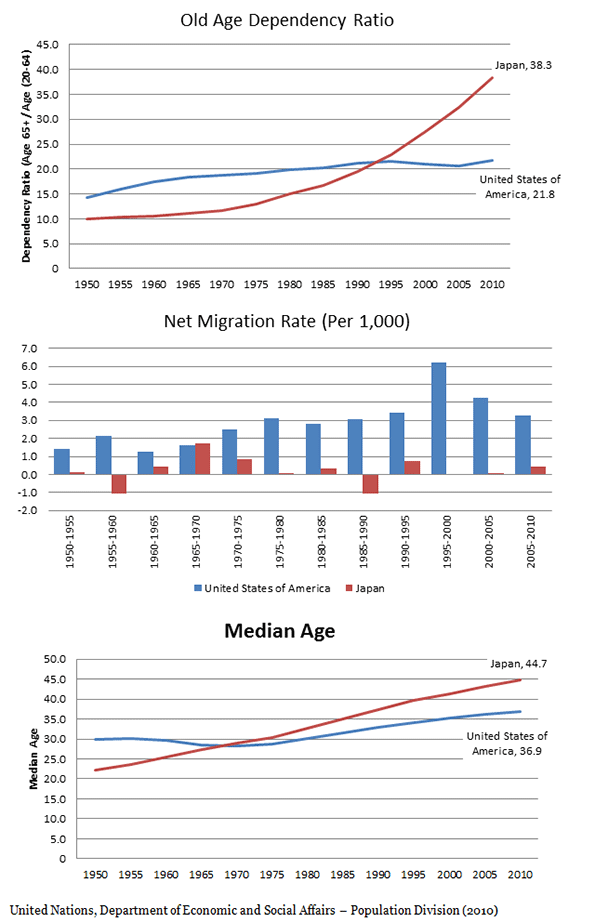
    We’re not Japan – In 2011, Wendell Cox and I wrote about aging global demographics. The differences between the US and Japan were notable. Currently, Japan’s old age dependency ratio (the ratio of those aged over 65 to those from 20 – 64) is 76% higher than that of the US. But the US median age continues to rise: At 36.9 years it is currently only 8 years lower than Japan’s 44.7 years. Given the aging global demographic, migration is unlikely to offset these rises indefinitely. In the coming years, will age-crime assumptions be challenged in the US too?

    The Future: An Aging Criminal Class? – Sixteen percent (246,600) of the US prison population is age 50 and older. The burgeoning elderly prison population has been attributed to longer prison sentences, brought on by more punitive sentencing principles during the 1970s and onwards. Yet there appear to be few studies on elderly or older prisoner release, rehabilitation and recidivism.

    And stemming the inflow of older offenders into prisons is also necessary. In Florida, admissions of offenders over 50 increased 205%, from 1,130 in 2000 to 3,452 in 2010 – from just 4.4% to almost 10% of total admissions. Despite an increased need to dedicated research on the behaviour and characteristics of older groups, a proportion of whom will reoffend in their golden years, the current work focuses largely on juveniles. In Japan, 25% of offenders in their late 40s become repeat offenders within 10 years of their first conviction, almost five times more frequently than those who are first convicted in their early 20s.

    Little is understood about what motivates the Colt-wielding Granny or Gramps. Older offenders present new challenges for justice systems, and for society as a whole. The opportunity now is to prevent criminal acts by the elderly. Discussion and analysis of geriatric crime is very much warranted.

    Emma Chen was a Senior Strategist at the Centre for Strategic Futures, Singapore. She is currently pursuing postgraduate studies.

  • Petraeus’s Turf: The South Tampa Scene

    Bimbo eruptions are never fortunate occurrences, least of all for the bimbos involved. When they occur in South Tampa, they carry the sordid spectacles to new frontiers. A gentle but feisty cultural mix of blue-collar, white-collar, and varied ethnicities stretches between Old Tampa Bay and Hillsborough Bay on a peninsula tipped with MacDill Air Force Base. Local reactions in Tampa to the news vortex that now surrounds General David Petraeus will likely range from shock, to “meh,” to a certain pride in being in the spotlight, and to the addition of yet another notorious figure to Tampa’s colorful history.

    Tampa has always played in the shadow of New Orleans, with a good music and ethnic food scene, and a quirky local culture that isn’t quite mainstream American and isn’t quite Caribbean. A somewhat white bread version of New Orleans, Tampa has a local parade and festival that occurs the first week of February, but instead of Mardi Gras, Tampa’s party honors the apocryphal José Gaspar, a pirate who reportedly operated out of Tampa Bay.

    A spicy cultural mix to be sure, but it is meek and heavily regulated compared to the out-of-control scene in New Orleans. Perhaps the city’s overbearing white leadership has something to do with this; no one wants to be responsible if things get really wacky. Gasparilla is a kind of Mardi Gras you can take your kids to, perhaps in deference to Florida’s reputation as a family vacation destination.

    Cuban cigars, once made in Tampa by the case, linked the city to male hedonism early in its history, and this link has been reinforced ever since. Once home to Cuba’s freedom fighter, José Marti, Tampa’s Cuban heritage has faded from its fierce past glory as well. By the 1980s, the Miami Cuban community’s brash voice had taken over. “Yellow-rice Cuban” had become a putdown, implying one was from Tampa instead of Miami.

    The city itself started as a Caribbean freight port in the 1880s. Teddy Roosevelt and his Rough Riders stopped for provisions in Tampa along their way. A young British war correspondent, Winston Churchill, rode with Roosevelt into nearby Ybor City to sample a local bordello, before sailing on to Cuba. The city’s colorful past traditions includes military scandals that even date back to the straight-laced Victorian era.

    South Tampa blossomed as a streetcar suburb in the early part of the 20th century, and when Plant’s Hotel failed in the Great Depression, it was converted to a private college. The bay shore was sculpted into a 4-1/2 mile linear public park, still one of the most beautiful civic spaces in America. This boulevard reads like a spicy historical narrative of the city, with uniquely styled, Edwardian-era houses giving way to newer homes and condominium towers as one travels its length. Along this road, the magnates that helped build Tampa made their homes: Hugh Culverhouse, a tax lawyer who started the Tampa Bay Buccaneers, lived one condominium away from legendary George Steinbrenner Jr., who came to town to manage his shipping concerns when he wasn’t hollering at the Yankees.

    MacDill Air Force Base started as a training base for B-26 pilots during World War II. The bomber was so hot and difficult to handle that it was nicknamed the widow-maker, and its reputation gave MacDill its first catchphrase: “One a day in Tampa Bay.” Conviviality between town and base became an instant tradition, along with the town’s reputation for hosting a good time for all. And this reputation did not go away after the war.

    In the meantime, the infill neighborhoods behind the affluent waterfront residences acquired a unique flavor. Not quite as tropical as Miami, the over-scaled flora — huge banana trees, traveler’s palms, figs – are interwoven with gorgeous craftsman-style bungalows with deep, shady porches and high windows to let hot air escape. Like Boston, the little neighborhoods and districts of South Tampa are distinct, colorful, ‘hearty and vibrant. Along South Howard Avenue, a string of commercial and restaurant properties marks a definite dividing line between old and new.

    Bern’s Steakhouse dominates South Howard, where stars like Johnny Carson would stop and tuck into a prime rib when in Florida. Bern’s is emblematic of Tampa itself: a proud, independent, homegrown restaurant, known for its excellent food, but ungracefully crammed underneath an interstate overpass and about as charming on the outside as a warehouse. Inside, the fifties era red velvet and gold leaf decor conjure up visions of a Parisian brothel.

    Back behind Bern’s lies Parkland Estates, a quiet, depression-era neighborhood where Santos Trafficante Jr. retired in the 1960s. Considered the last of the old-line mafia dons, with territory stretching far into Cuba, the Trafficante family lived in his modest, blond brick home. While Tampa may seem remote from the action, it actually was an active territory for syndicates that reportedly controlled road construction and other businesses. And Tampa was the location for scenes in Good Fellas, a source of pride to many Tampa natives.

    By the time Trafficante died, however, Joe Redner had overtaken him in notoriety, operating a string of strip clubs and striking a highly visible profile in the city’s business and political circles. Never quite accepted enough to win his many bids for mayor, yet still a persuasive leader, Redner’s success may have had something to do with MacDills presence. Prurient behavior, tolerated but never quite accepted, gives Tampa a decidedly old-world flavor in the South’s entrenched white Protestant mainstream culture.

    MacDill still has a strong influence on South Tampa, employing some 3,000 people and actively participating in community projects. Its open house days, hugely popular, are a source of patriotic pride among locals, as are the jets flying overhead. Otherwise lacking a presence on the national scene, Tampa hosts the United States Central Command, with top military brass acting as local heroes. MacDill is immediately surrounded by base housing and service workers, but it’s pressed up next to high-net-worth neighborhoods for those who prefer the quiet anonymity of South Tampa to flashy, overheated South Florida.

    This week, as a warrior fell in Tampa, the event was fawned over by spotlight-hungry locals. The spectacle diminished not one, but multiple institutions, beginning with the FBI, the CIA, and the Army. What Taliban bullets could not do, our own culture did.

    Richard Reep is an architect and artist who lives in Winter Park, Florida. His practice has centered around hospitality-driven mixed use, and he has contributed in various capacities to urban mixed-use projects, both nationally and internationally, for the last 25 years.

    Flickr photo: by amanderson2: A very tame pirate ship in Gasparilla, 2010.

  • The Rise of the Third Coast

    In the wilds of Louisiana’s St. James Parish, amid the alligators and sugar plantations, Lester Hart is building the $750 million steel plant of his dreams. Over the past decade, Hart has constructed plants for steel producer Nucor everywhere from Trinidad to North Carolina. Today, he says, Nucor sees its big opportunities here, along the banks of the Mississippi River, roughly an hour west of New Orleans by car.

    “The political climate here is conducive to growth,” Hart explains as he steers his truck up to the edge of a steep levee. “We are here because so much is going on in this state and this region. With the growth of the petrochemical and industrial sectors, this is the place to be.” Already, some 500 people are working on the project. When completed in 2013, the plant—which is expected to process more than 3.75 million tons of iron ore a year—will create about 150 permanent jobs immediately. Another 150 are expected after a second development phase.

    Nucor isn’t alone in coming to Louisiana, or to the vast, emerging region along the Gulf Coast. The American economy, long dominated by the East and West Coasts, is undergoing a dramatic geographic shift toward this area. The country’s next great megacity, Houston, is here; so is a resurgent New Orleans, as well as other growing port cities that serve as gateways to Latin America and beyond. While the other two coasts struggle with economic stagnation and dysfunctional politics, the Third Coast—the urbanized, broadly coastal region spanning the Gulf from Brownsville, Texas, to greater Tampa—is emerging as a center of industry, innovation, and economic growth.

    The Gulf area long lacked industry. Even when the Spaniards and the French ruled it, the Gulf was a planters’ region, and its economy was largely dependent on exports of indigo, sugar, and cotton. The economy also relied on the slave labor that made such exports possible, a state of affairs that continued until the Civil War. After the war, the region therefore lost much of its economic influence as growth shifted to the rail-dominated east-west axis, though the construction of the Panama Canal eventually helped New Orleans and Mobile, Alabama, again become busy ports. Developing slowly, the Third Coast’s agricultural economy was dominated largely by tenant farmers, who in 1930 constituted more than 60 percent of the agricultural producers in an arc from Texas to Georgia.

    The Gulf region also suffered from vulnerability to natural disasters. In 1900, more than a century before Katrina, the deadliest hurricane in American history all but destroyed Galveston, Texas. In 1927, the Great Mississippi Flood inundated a 27,000-square-mile area, much of it in Texas, Mississippi, and Louisiana. And then there was the hot and humid climate, especially miserable in those pre-air-conditioning days.

    What Joel Garreau, in his landmark book The Nine Nations of North America, writes about the South as a whole—that it became a “region identified with stagnation—backward, rural, poor and racist, a colony of the industrialized north, enamored of an allegedly glorious past of dubious authenticity”—applied with particular force to the Gulf Coast, whose major cities, especially New Orleans, were seen as hopelessly corrupt and decadent. It’s no surprise that for much of the last century, the region exported people, particularly those with skills, to other parts of the United States.

    So it’s particularly striking that the region’s steady economic growth is now attracting so many people. Over the past decade, Texas and Florida have ranked first and second among the states in net domestic immigration, combining for a gain of roughly 2 million people. Together, Houston and Tampa have gained more than 1.5 million people over the course of the decade; in fact, in 2008 and 2009, net domestic migration to Houston was the highest of any major metropolitan area. An examination of migration flows to Houston, New Orleans, and Tampa by Praxis Strategy Group, where I work as a senior consultant, shows that many of their new citizens are coming from the East and West Coasts, especially New York and California. Also over the past decade, Houston has attracted as many foreign immigrants, relative to its population, as New York has—a considerably higher rate than in such historical immigration hubs as Chicago, Seattle, and Boston, though still lower than in San Francisco, Los Angeles, and Miami.

    What’s more, the Third Coast is winning the battle of the brains. Over the past decade, according to the Census Bureau, 300,000 people with bachelor’s degrees have relocated to Houston. Between 2007 and 2009, as demographer Wendell Cox has chronicled, New Orleans—which had hemorrhaged educated people for the previous few decades—enjoyed the largest-percentage gain of educated people of any metropolitan area with a population of over 1 million. The New York Times reported in 2010 that Tulane University, the city’s premier higher-education establishment, had received nearly 44,000 applications, more than any other private school in the country. The largest group of applicants came not from Louisiana but from California, with New York and Texas not far behind.

    Thanks to all this immigration, the population of the Third Coast has grown 14 percent over the past decade, more than twice the national average. The growth continued even when the Great Recession struck in 2008. Between 2008 and 2011, Houston grew by 6.7 percent, according to census estimates, while New Orleans expanded by 6.9 percent; over the same period, the nation’s population increased by only 2.5 percent. New Orleans, the biggest population loser in the first half of the last decade, is now the fastest-growing U.S. metropolitan region. Many smaller cities in the region—Brownsville, Gulfport, Lafayette, and Baton Rouge, for example—have also grown faster than the national average. Overall, the Gulf region is expected to be home to 61.4 million people by 2025, according to the Census Bureau.

    Many of the region’s new arrivals are attracted by the low cost of living. The median home-price-to-income ratio in Houston, Tampa, and New Orleans is roughly one-half that of New York, Los Angeles, San Francisco, or San Jose. Over the last decade, Houston boasted the highest growth in personal income of any of the country’s 75 largest metropolitan areas.

    The region’s most dramatic appeal, however, is its remarkable employment growth. Between 2001 and 2012, the number of jobs along the Third Coast, according to Economic Modeling Specialists International (EMSI), increased by 7.6 percent, well over three times the national growth rate. The vitality of the Third Coast persisted even during a brutal recession, with four metropolitan areas—Houston, Corpus Christi, Brownsville, and New Orleans—gaining jobs between 2008 and 2012, even as the nation’s job rolls shrank by 3.6 percent. Of the three states that have recovered all the jobs lost during the recession, two—Texas and Louisiana—are on the Third Coast.

    The region’s job-creation engine is powered by the growth of basic industries: manufacturing, energy, and agricultural commodities. The region from south Texas to Florida now bristles with scores of new steel plants, petrochemical facilities, and factories producing everything from airplanes to canned food. Along with the Great Plains and the Intermountain West, the Gulf Coast has enjoyed a huge boost from energy and other commodity growth. Over the past decade, Texas alone has added nearly 200,000 oil- and gas-sector jobs, with an average salary of about $75,000. Thanks largely to expansion in energy, manufacturing, and engineering services, Houston now boasts a considerably higher per-capita concentration of STEM jobs—those relating to science, technology, engineering, or mathematics—than Chicago, Los Angeles, or New York, according to an analysis by EMSI.

    The magazine Site Selection says that four of the Gulf states are among the nation’s 12 most attractive states to investors: Texas topped the list, with Louisiana ranking seventh, Florida tenth, and Alabama 12th. Texas and Louisiana also ranked first and third among the 50 states in terms of new plants built or being constructed. “There’s been a drastic change in the business climate here,” says Chris McCarty, director of the University of Florida’s Bureau of Economic and Business Research. “A lot of regulations have been moved aside, and there’s a big push by the state to get out of the way.”

    Energy is the key driver. The Third Coast already accounts for roughly 28 percent of the nation’s oil and gas employment, despite the federal crackdown on offshore drilling after the 2010 Deepwater Horizon disaster. The region boasts new shale plays, such as those now being developed in northern Louisiana, and massive crude reserves, which follow the arc of the Gulf Coast from Brownsville to New Orleans.

    The future for American energy is bright. According to the consultancy PFC Energy, the United States is on course to surpass Russia and Saudi Arabia as the world’s leading oil and gas producer sometime during this decade. With the Atlantic and Pacific coasts either banning or sharply curtailing energy production, the Gulf’s pro-business, right-to-work states have emerged as the likely staging ground for this energy resurgence. Here, unlike in California or New York, support for energy development tends to be highly bipartisan. Third Coast Democrats—such as Louisiana U.S. senator Mary Landrieu, New Orleans mayor Mitch Landrieu (her brother), and Houston mayor Annise Parker—can be as ferocious in their defense of the industry as any Republican. “Texas and Louisiana understand the oil business,” says Ralph Phillip, vice president of a Valero oil refinery located just a few miles from the rising Nucor steel plant. “They understand what this industry is all about and expect you to manage the risks. If you want to do a permit in California, they won’t return your call. But here they want everything to work.”

    Not only does the energy industry employ people and pay them well; the effect works in reverse, too, with a growing pool of skilled workers offering companies like Nucor and Valero a compelling reason to expand into the Third Coast. “When you are building a petrochemical facility, you have a great need for skills in such things as maintenance and construction,” Phillip points out. “If you open up in another part of the country, you have to bring in people to run things. Here, the skills are all over the Gulf.”

    Another important part of the region’s economy is exports, since trade patterns are shifting away from the Atlantic and Pacific coasts and toward the Gulf. Since 2003, the Third Coast’s total exports have tripled in value, and its share of total American exports has grown from roughly 10 percent to nearly 16 percent. Last year, trade reached record levels at the Port of New Orleans, says Donald van de Werken, director of the U.S. Export Assistance Center in that city. Louisiana has become a dominant player in the agricultural-export industry, with half of the nation’s grain exports going through the state’s ports. Houston now ranks as the top port in the United States in terms of total value of exports; New Orleans ranks fifth.

    The trends favoring the Third Coast will accelerate further once the $5.25 billion Panama Canal expansion is completed in 2014, as I pointed out in Forbes last year. The wider canal will be able to accommodate Asian megaships, which are currently forced to dock in California. That will open the Gulf to more Pacific trade, since most northeastern and West Coast ports have been reluctant to make the necessary capital investments to capture it. China’s abandonment of the Maoist ideal of self-sufficiency and its growing willingness to rely on imports of food and other items represent a huge opportunity for the region.

    When Garreau published Nine Nations 30-some years ago, he predicted that as growth kicked in, the Gulf region would “clot” into an archipelago of cities similar to the Boston–New York–Washington megalopolis, or to the band stretching from San Diego through Los Angeles and San Francisco to Portland and Seattle. If he proves right, Houston will be the hub of this new system, much as New York anchors the East Coast and Los Angeles the West.

    The greater Houston metropolitan area is one of the fastest-growing in the country; its population, now 6 million, is expected to double over the next 20 years. Houston is also the nation’s third-largest manufacturing city, behind New York and Chicago. Over the past decade, the city and its surrounding communities have added almost 20,000 heavy-manufacturing jobs, the most of any metropolitan area in the United States. Further, Houston has the third-largest representation of consular offices, after Los Angeles and New York, and it hosts more Fortune 500 companies—22, as of 2011—than any city other than Gotham. Over the past half-century, says Federal Reserve economist Bill Gilmer, Houston has consolidated its position as the center of the global fossil-fuel industry. In 1960, Houston was home to just one of the nation’s large energy firms, ranking well behind New York, Los Angeles, and even Tulsa; by 2007, 16 such companies were headquartered in Houston, more than in those three cities combined.

    The burgeoning health-care industry is also finding a home in Houston, especially at the Texas Medical Center—“the largest medical complex in the world,” its website boasts. Like so many things in Houston, this cluster of 48 nonprofit hospitals, colleges, and universities owes its existence largely to the energy industry. According to its chief executive, Richard Wainerdi, the center benefits from “probably the biggest confluence of philanthropy in the world, and a lot of it is oil money.” Every day, 160,000 people enter the vast campus, equal in size to Chicago’s downtown Loop; its office space, now over 28.3 million square feet, exceeds not only that of downtown Houston but also that of downtown Los Angeles. The figure is expected to surpass 41 million square feet by the end of 2014, making the center the seventh-largest business district in the nation.

    Houston’s solid business climate empowers entrepreneurs. Between 2008 and 2011, according to a study by EMSI, the number of self-employed workers grew more quickly in Houston than in any other large metropolitan area. Greater numbers of educated workers are coming, too: Houston’s total increase in people with bachelor’s degrees over the past decade bested Philadelphia’s, was three times that of San Jose, and was twice that of San Diego. “I don’t get the pushback I used to get” from potential recruits, says Chris Schoettelkotte, who founded Manhattan Resources, a Houston-based executive-recruiting firm, 13 years ago. “You try to find a city with a better economy and better job prospects than us!”

    Though Houston has always been a good place to do business, it continues to suffer from a bad cultural image. In 1946, journalist John Gunther described Houston as a place “where few people think about anything but money.” It was, he added, “the noisiest city” in the nation, “with a residential section mostly ugly and barren, a city without a single good restaurant and of hotels with cockroaches.” The miserable city that Gunther described no longer exists, but residents on the other two coasts have been slow to acknowledge that development, despite Houston’s first-class museums and lively restaurant scene. “Let’s face it, we have a bad reputation,” says L. E. Simmons, a legendary Houston energy investor. “But the good news is, it keeps the stylish opportunists out. It makes us kind of an urban secret.”

    Houston’s cultural weakness—more perceived than real these days—has long been New Orleans’s strong suit. Yet the Big Easy’s long-standing appeal to artists, musicians, and writers did little to dispel the city’s image as merely a tourist haven, and a poor one at that. The problem, as Hurricane Katrina made all too plain, was a corrupt city plagued by enormous class and racial divisions and one of the lowest average wages in the country. The city’s urban core continues to endure one of the highest violent-crime rates in the nation.

    Though energy is responsible for much of New Orleans’s recent economic growth, the city has also begun attracting the information industry. Since 2005, New Orleans’s tech employment has surged by 19 percent, more than six times the national average. And at a time when movie production has dropped nationally, Louisiana has nearly tripled its production of motion pictures, from 33 per year in 2002–07 to 92 per year in 2008–10.

    East of New Orleans, Mobile has a different strength: manufacturing. Nearly 1.5 million cars and trucks are made within four hours of the city. In fact, the Third Coast, together with the adjacent southeastern manufacturing belt, is now competing with the Great Lakes as the center of the automotive industry. And Tampa, with robust population growth and Florida’s largest port—including a container terminal expanding from 40 acres to 160 acres—is poised perfectly to take advantage of any opening of Cuba, a country with which the city has had a long economic relationship.

    The region’s ascendancy, however, faces significant impediments. Gilmer says that the greatest risk to growth comes from Washington, especially if a second-term Obama administration cracks down even more aggressively on offshore oil development. Federal regulators’ reluctance to let drilling resume in the wake of the BP oil spill ruined hundreds of New Orleans–area businesses. Potentially strict new controls on extracting gas by means of hydraulic fracturing could slow the energy boom further, which in turn would derail the expansion of petrochemical and other manufacturing facilities.

    Perhaps more troubling are social problems, some the legacy of centuries of underdevelopment. Despite the influx of skilled and college-educated workers, Third Coast states continue to lag in college graduation rates and the percentage of their adult populations with college degrees. Of the 18 metropolitan areas across the Third Coast, only two—Tallahassee and Houston—have a higher percentage of college grads than the national average of 30 percent. When you rank states by their students’ proficiency in math and science, only one Third Coast state—Texas—sits near the middle of the list. Efforts to reform public education—notably, Louisiana’s new statewide voucher program and aggressive expansion of charter schools—offer some hope of addressing these weaknesses. In a new report, government efficiency expert David Osborne describes New Orleans’s reforms as a “breakthrough.” The results, he says, are “spectacular: test scores, graduation rates, college-going rates, and public approval have more than doubled in five years.” He adds, “I believe this is the single most important experiment in American education today.”

    And the obstacles facing the Third Coast today aren’t so different from those that once confronted other American economic dynamos. In the nineteenth century, New York was seen as a hopelessly corrupt sewer. In the early twentieth century, Los Angeles was dismissed as superficial and equally corrupt, with only one industry: fantasy. Few would make those claims today.

    It is much the same with the Third Coast. Weather, education, and, in some places, a legacy of corruption still present considerable challenges to its ascendancy. But if the region can surmount these challenges—and it appears to be succeeding at this—the Third Coast could become one of the major forces in twenty-first-century America.

    Joel Kotkin is executive editor of NewGeography.com and is a distinguished presidential fellow in urban futures at Chapman University, and contributing editor to the City Journal in New York. He is author of The City: A Global History. His newest book is The Next Hundred Million: America in 2050, released in February, 2010.

    This piece originally appeared at The City Journal.

    New Orleans photo by Bigstock.

    Joel Kotkin is a City Journal contributing editor and the Distinguished Presidential Fellow in Urban Futures at Chapman University.
  • Superstorm Sandy & The Beachfront Bailout

    Deadline reporters, especially in weather broadcasts from the surf line, have been wailing about “this enormous storm” or “the unfolding tragedy.” What they might also say is that hurricanes are a munificent windfall for newspapers, television stations, the federal government, construction unions, and politicians seeking reelection. In addition to classifying storms from one to five on the Saffir-Simpson scale, going forward it might also be possible to grade hurricanes as profit centers, or by the surge levels that they generate in reelection campaigns.

    By all (usually breathless) accounts, Hurricane Sandy delivered a wide band of damage and destruction to areas stretching from North Carolina to Maine. Along with a death toll now approaching 50, a 13 foot storm surge in New York harbor inundated parts of lower Manhattan and Brooklyn, and millions of residents around New York, New Jersey, Maryland, and Pennsylvania lost power in their homes. The aftermath, unlike the legacy of Hurricane Katrina, however, is that the waters which flooded Manhattan’s streets, tunnels and subways are receding with ebb tides, although the damage from surging waves and fallen trees is widespread, especially across New Jersey.

    Although the storm will have cost the Mid-Atlantic region some $45 billion in cleanup costs, not to mention the loss of work days for many, even this perfect storm not seen in “a millennium” did not rack up the apocalypse that was predicted as Sandy “barreled” up the coast on its “rendezvous with destiny” in Atlantic City. From the teeth of the storm in New Jersey, my sister reported only an epic loss of cable and Internet.

    The reasons storms rarely appear as they are cast on television is because, instead of acts of nature with a lot of wind and rain, hurricanes are now best understood as political spectacles, somewhere between nominating conventions and state lotteries.

    Take the federalization of the disaster business. Previously storm damage and the costs of clean up were the responsibilities of states and municipalities, who in the first place made the decisions to allow homeowners to build houses and businesses on barrier islands, sand dunes, and low-lying waterfront property.

    For much of the twentieth century, insurance companies refused to write flood or hurricane policies for stilted houses perched precariously on Cape Hatteras or wherever, which angered wealthy political donors, who equate their life successes with owning beachfront property.

    Enter the federal government into the realm of disaster indemnification, when Congress passed the National Flood Insurance Program in 1968, to mandate that vulnerable home owners in potential flood zones purchase adequate insurance that private companies were refusing to cover. Think of it as Obamacare for beachfront homes.

    Although the legislation was designed to cover the undue risks of shore properties, it also gave the political parties a mechanism that would allow (for all those waterfront contributors) a building boom on hurricane-exposed barrier islands.

    At a time when global warming has increased the intensity and frequency of major storms and hurricanes (which are nature’s teapots blowing off steam), we are living with the fallout of an earlier era, when the federal government doubled down by writing insurance for beachfront condos from Maine to Texas.

    After the 2000 recount election came the transformation of Florida into a swing state in presidential elections, insuring that claim adjusters would reach hurricane damage zones as fast as FEMA’s first responders. Before the 2004 election arrived, four more hurricanes had passed over Florida. In their wake came billions in federal aid relief, just to insure that neither awnings nor chads would be floating in the wind.

    As powerful as hurricanes may be, they are no match for the construction lobbies, something I learned in the 1980s when writing about the National Hurricane Center in Coral Gables, Florida.

    The then-director, Neil Frank, a man of ebullience and integrity, showed me a slide show on the back of his office door, explaining that it was folly to allow construction on Gulf and Atlantic barrier islands. That was thirty years ago, and since then cities of flimsy beachside construction have risen along the dunes.

    What I admired about Frank was his passion for hurricane preparedness. He had walked the beaches of Biloxi, Mississippi in 1969, after Hurricane Camille, and measured that surge at 25 feet—something he then extrapolated to other beaches around the United States, including Atlantic City. But in urging a ban on beachfront buildings, he was shouting into an ill wind.

    Not only was the federal government complicit in allowing places like Myrtle Beach to become housing projects (the poet Robert Watson called it “white Harlem by the sea”), it also assumed that its job performance could be measured by the number of blankets and water bottles that reached those crazy enough to “ride out” a major storm in their seaside mobile homes.

    No doubt this is the Katrina Effect in American politics: The truism that if a big storm hits, the best place for the president probably isn’t dockside in San Diego, playing Otis Redding tunes on a guitar. Nevertheless, it means that the federal government (not exactly a profit center these days) is on the hook for the rescues, the clean up, and the insurance claims.

    The sad reality of Hurricane Sandy is that, despite all the Weather Channel epithets that it was “the storm of the century,” a lot of it was ordinary. It wasn’t even technically a hurricane when it came ashore near Atlantic City. What made it destructive was its size, and that it arrived late in the hurricane season and, by chance, merged with other Atlantic and Canadian storm systems. Imagine, however, if it had been one of Neil Frank’s dreaded Category 4 storms?

    Undoubtedly, President Obama would love to turn Hurricane Sandy into a backdrop for reelection spots that show him compassionate to his fellow Americans in times of need. The problem is that neither Wall Street underwater nor the flooded roulette tables in Atlantic City makes an ideal photo op or headline (“President Vows: We Will Not Let This Stop Us From Gambling!”). And I doubt he wants to campaign as the Claims-Adjustor-in-Chief.

    Photo: MTA New York City Transit, Bus on the Move. Morningside Heights, 125th and Broadway, October 28, 2012, as Hurricane Sandy approached New York City.

    Matthew Stevenson, a contributing editor of Harper’s Magazine, is the author of Remembering the Twentieth Century Limited, a collection of historical travel essays. His next book is “Whistle-Stopping America”.
  • Florida: When Your Best (Place) Just Ain’t Good Enough

    Real estate broker Coldwell Banker handles corporate relocations for a large portion of our middle class. It recently released a survey of Suburbanite Best Places to Live. While it’s easy to dismiss as a sales tool for their realtors, the survey provides a fascinating glimpse of middle class, suburban preferences, influenced by our current economy. Coldwell Banker’s top honors go to Cherry Hills Village, Colorado, a suburb of Denver. Suburbs of Seattle, New York City, Washington, DC, and other prominent cities feature strongly on Coldwell Banker’s list, which highlights places that are sprinkled evenly throughout the United States. Notably missing are any communities in Florida.

    For a state with sunshine, beaches, and low taxes, Florida just doesn’t have the chops to get even one community onto the top 100 list.

    Weather, evidently, has little to do with our middle class’s desirable locations. Frigid Whitefish Bay, just south of Milwaukee, captured spot #100. Situated along the shore of Lake Michigan, this suburb of 14,000 doesn’t exactly have the kind of weather that makes people flock to the beach. Instead, it offers residents a strong sense of community, heritage, and a culture that values education and family. If you move here, you’ll find yourself within a suburban community with a high homeownership ratio, an educated population, and a quality of life that includes short commutes, low crime rates, close conveniences, and a tendency to eat at home.

    Suburban living has maintained a strong appeal for middle-class Americans due to the popularity of many of the factors on which Coldwell Banker based its rankings. While socialites prefer more urban, dense lifestyles (which is another list that Banker recently produced), suburbanites prefer backyards and quieter neighborhoods away from the hustle and bustle of the city; they don’t need to be near the action. Florida has all these things in abundance, except when compared to… almost everywhere else.

    Windermere, Florida’s top ranked suburb, came closest, ranking just below Whitefish Bay and a couple of others. Like most suburbs on the list, Windermere is on the periphery of a large metropolitan area (Orlando), and contains conveniences, good schools, parks, and recreation facilities.

    For much of its history, Florida represented the suburban American dream. The net benefits included an affordable cost of living and upward mobility, and Florida’s growth has consisted almost entirely of suburban densities. No one can accuse Florida developers of building communities that people didn’t want – the product was carefully researched to fit the market.

    In the late period of the boom, urban options were also developed, in the belief that a new demand for socialite “downtown” style living would emerge. Townhomes and condominiums rose in Florida’s primary and secondary urban markets. Even tertiary cities like Sanford, a historic agricultural town north of Orlando, begot a six-story condo. Those who migrated from Chicago and the dense Northeast now had a diverse set of choices, from rural to urban, with something to please everybody.

    It is perhaps this dilution of the market that has made Florida’s star fade a bit in relation to the national constellation of suburbs. If East Grand Rapids, Michigan (Coldwell Banker’s #8) can outrank the hundreds of suburbs around Tampa, Miami, Jacksonville, Tallahassee, and Orlando, there’s something else going on besides beauty.

    One thing that many of the top 100 have in common is a strong public education system. Florida, which has refused to invest in education, may now be harvesting the bitter fruit of this stubborn negligence. The state’s primary growth today continues to be in retirees who are uninterested in supporting education, and who control a large part of the state’s political power.

    Another aspect that the top 100 suburbs offer is safety. “Safety is a priority,” states the opening page of this survey, but it simply isn’t something that most people associate with the Sunshine State. A state that doesn’t offer a strong sense of personal safety isn’t going to rank highly, no matter what else is being offered. With two out of the ten most dangerous cities in the country, Florida seems more like the wild West than a suburbanite’s dream come true.

    Increasing public safety and public education are two efforts that government can do best, most people agree. Florida has spiraled downward on both fronts. The state’s leadership, by cutting taxes during the worst part of the recession, haven’t exactly helped the situation. With Florida’s new home sales up, the state’s economists are whistling a happy tune, convinced that the worst is over. But what Coldwell Banker is telling Florida is a different, darker story.

    Florida’s best offerings are attracting a population less interested in the core values stated in the Coldwell Banker survey – safety, good education, a sense of community – and so we continue to get more of the same. More population that reinforces Florida’s lack of investment in community, more population reluctant to put money into education, and more population that is quick to move somewhere else at the earliest opportunity seem to be Florida’s fate. This represents a lost opportunity to those who wish to see Florida make gains in these spheres – education, community, and safety. And it represents a lost opportunity to match up a truly beautiful place with truly involved people.

    Corporations seeking to relocate and recruit good people pay attention to these surveys. Florida’s low taxes may lure a few more down south, but if corporations need to attract and retain top talent, this survey points to where they are likely to go, regardless of the incentives our state has to offer.

    Places like Whitefish Bay, Wisconsin; Rossmoor, California; and Haworth, New Jersey will continue to gain in the type of population that share these same values. The middle class, fighting its way back from a threatened extinction, isn’t likely to take a chance on a place that has a rapidly degrading quality of life. Until Florida’s culture starts caring about the quality of its community, safety, and education, our state will continue to grow without flourishing as a place where people desire to be.

    Richard Reep is an architect and artist who lives in Winter Park, Florida. His practice has centered around hospitality-driven mixed use, and he has contributed in various capacities to urban mixed-use projects, both nationally and internationally, for the last 25 years.

    Bigstock photo: Florida Housing

  • Localism As An Anti-Depressant

    Are we heading into a new era of local solutions?

    Western economists and governments usually measure the health of the job market by unemployment percentages, with unemployment defined as less-than-full-time employment. But the reality for many Americans today is more akin to the rest of the world. Dad may not have a full-time job, but instead works several part-time jobs – auto mechanic when there are customers, store clerk on the weekends, and perhaps furniture repair guy for the neighborhood. Mom probably has a few part-time jobs also: housekeeper at a nearby hotel, caterer, and babysitter. Children old enough to work may do odd jobs.

    This kind of economy may be more prevalent than economists think. It breeds neither hope nor health, especially since most remember the before-times.

    Active resistance to this dark vision likely means more local solutions to economic problems. Instead of the turnaround coming from above, it may instead come from below. Big oil, big finance, and their floundering politicians are not the place to look for answers anymore. This may come as no surprise to anyone who has watched the last four years worth of turmoil, but the media, which is caught up in this game, is missing a much bigger story.

    A good example from recent history is the turnaround performed by Boston’s North End neighborhood. Before World War II, this neighborhood was a classic immigrant community, and considered unhealthy, dangerous, and poor. After the war it was blacklisted by bankers who refused mortgages for home buyers, and the North End was cut off by the Central Artery highway running through the city. It became Boston’s odd, leftover district.

    But a mysterious thing happened to the North End. The nation’s great urbanist, Jane Jacobs, visited it in 1959 with the director of the Boston Housing Authority, who wanted to show her the neighborhood before it was razed in the name of urban renewal. What she saw was a vibrant, robust street life, beautifully restored buildings, tenements that had been repurposed for middle-income flats, and a sense of pride in the neighborhood. After researching the area, she discovered it had the lowest crime rate, disease rate, and mortality rate in the city. Jacobs successfully staved off the bulldozers, and the North End still exists as one of the most picturesque neighborhoods in America today.

    Because the North End was cut off by institutional investors, the neighborhood became economically introverted. Construction work was done on a cash or barter basis, and people made slow, incremental changes to their residences as the money became available. Instead of relying on banks for big credit infusions, North Enders relied on themselves.

    By the standards of mainstream economists like Paul Krugman, the economy seems to be unraveling. A different way to view this phenomenon is to see it as multiplexing: different channels are being created. When only one channel is effectively being considered, other channels are developed without much scrutiny.

    Tippy Perez is a typical example of someone who has tuned in to a local economic channel. As a paralegal for a large Orlando corporation with thousands of employees, Ms. Perez had job security, benefits, and the signature suburban lifestyle of the mainstream economy. Last year, however, she quit her job. “It was a dead-end job that wasn’t worth the fight anymore,” she stated. Between uncertain job security and the increasingly vicious corporate politics that come with the territory at such a large firm, her mainstream economy job simply could not hold her. After she quit Ms. Perez began a neighborhood pet-sitting service. Within a few months her home-based business has taken off, and she will never look back.

    It’s busy and demanding, and lacks such mainstream amenities as a 401K, vacation, and sick leave, and Ms. Perez left a fine professional career for the service industry. This move, however, has much greater appeal to her because she can regulate the pressure. The income, although smaller, comes with less stress. Corporate downshifters starting bike shops and farms have been around for some time, but those are usually stories of escape from an urban location. Ms. Perez is part of an increasing population that has chosen to stay in the same place, but to downshift out of the mainstream into the local economy, sometimes as local as the immediate neighborhood.

    Food trucks are another example. The restaurant world, so overrun by big brand franchises and chains, has been seriously challenged by a new form of dining with little overhead and a spicy, independent spirit. The popularity of these trucks comes from the fatigue we are suffering from the high prices and industrialized food production typical of so many restaurants today. Alert neighborhood organizations are combining food truck rallies with local farmers’ markets and other events to create new forms of public involvement. Without the regulatory burden that comes with public accommodations, food trucks are a sign of this new economy.

    The hallmark of each of these phenomena is its localism. As in the North End, no one is waiting for the big banks to come in and fix things. Instead, people are turning local needs into opportunities at a scale that is small enough that outside help is not needed. Under our very noses, a new economy is being born. Our towns and cities will adapt to this form long before it is noticed by the mainstream. The ingenuity and ambition of individuals will be the factors that bring us out of the Millennial Depression, and create a new economy for the future.

    Richard Reep is an architect and artist who lives in Winter Park, Florida. His practice has centered around hospitality-driven mixed use, and he has contributed in various capacities to urban mixed-use projects, both nationally and internationally, for the last 25 years.

    Flickr photo: Boston’s North End by P Medved

  • Will Servants’ Quarters Come Back, Too?

    As the Great Recession enters its fourth summer, America continues to separate into the multiple economic strands that characterized an earlier day. Our cities, built mostly since the 1930s, poorly accommodate this lack of unity, and will require radical revision if our class divisions continue to deepen.

    Back in the era of the streetcar suburbs, at the turn of the 20th century, we also experienced a tiered, multiple economy. The post-Victorian prosperous middle class had carved itself new residential beltways around inner core cities – the so-called “suburbs”. The look and the form of these old residential beltways is fondly remembered by some, so much so that they are imitated in some new developments today. Tall houses tight to the street with service alleys and front porches marked America’s urban form in this era, and can be seen in much of the literature promoting traditional town planning.

    Examining the original homes more closely yields some surprises, for they were radically different than our homes of today. The differences aren’t apparent from the outside, which is perhaps not important to the planners who wish to reinstitute this kind of design. Turn-of-the-century houses accommodated two economies by dedicating the first two floors to the middle-class family who owned the home (usually white), while the attic or basement had a separate entry and stair to the kitchen, dedicated to the staff (usually from an immigrant or ethnic minority group).

    This two-tiered economy was considered natural and acceptable at the time. Domestic labor was an inexpensive and ingrained part of the American middle class experience. The staff often came and went via the service alleys, and the streetcars were often built to connect the housekeepers, butlers, and cooks to the city, while father commuted into town on his own.

    Cities were also two-tiered, with bands of low-income service housing interwoven between more prosperous neighborhoods. Winter Park, Florida, where I live and work, is a good example of this. Tony Park Avenue is a shopping street that runs north-south through the city beside a pretty chain of lakes. Surrounding those lakes are houses built as second homes for wealthy families from Chicago and elsewhere in the Midwest.

    On the west side of Park Avenue, within a short walk of those homes, sits one of those bands: Hannibal Square, a neighborhood where many of the domestic service workers lived. Tiny homes on 25 foot lots still exist, sandwiched together, out of sight of the promenading Winter Park set across the railroad tracks. This city form was repeated with many variations throughout the South. The word “segregation” comes closest to identifying this double economy, with all the inequality that it implies.

    In Winter Park’s post-World War II era, as Florida boomed, many of the grand old bungalows with attic apartments emptied out, and were sold to owners looking for permanent, year-round residences. This new generation used these structures differently. A combination of upward mobility, opportunity, and a new sense of unity in the decade of conformity made it unfashionable to have servants in one’s own home. By 1954, separate but equal was banished forever in schools. Housing was undergoing a similar evolution. Throughout the 1960s the two-tiered home was phased out, and many thought staff quarters and the upstairs-downstairs subculture was gone forever.

    Economic pressure, meanwhile, on neighborhoods like Hannibal Square became fierce. Original residents, now retired, saw their home values appreciate. A few sold out – much to the chagrin of their children, who felt a neighborhood allegiance and resented the gentrification and loss of identity of their community. Cities like St. Petersburg, Florida, that have a similar geography to Winter Park, are still experiencing severe strains in race relations as they cope with this dark vestige of a two-tiered economy.

    Yet by the turn of this century our housing forms had shown measurable progress indeed. Segregated staff quarters were largely things of the past. Suburban residents, whether from Hannibal Square or upper Winter Park, were competing in the same large job marketplace, freed from the caste system of servant and served.

    Nostalgia for the urban form that flourished in a two-tiered economy stems from a romantic notion about the simplicity of these times, and, at least for the prosperous, life certainly was simple. But adapting the architecture of 1905 to the residential market of the start of this century has been a selective process.

    Shady, narrow streets, white picket fences, and front porches where neighbors could sit and wave to passers-by are trademarks of yesteryear which developers — and buyers — wanted to see replicated. Where servant’s quarters used to be, interior square footage was regained for home theaters, home gyms, game rooms, play rooms, and family rooms, now that a domestic servant was not required. These rooms respond to our contemporary culture’s increasingly private, plugged-in world, but are at odds with the outward urban form that emulates an “eyes on the street” culture swept away by the car. Home prices skyrocketed partly because buyers were demanding the interior amenities that they craved, as well as exterior amenities that they were being taught to appreciate.

    Meanwhile, our economy was dis-unifying into strands that economist Paul Krugman so aptly nicknamed The Great Unraveling. We thought we were progressing, but it is a bitter truth that the world can, after all, regress.

    Should this multi-tiered economy harden into a physical form, it could likely resemble that of the previous century, a form that we thought we had put away for good. It would be sadly ironic if neo-traditional neighborhoods, created to resemble the forms of the old two-tiered economy, are to now be remodeled to accommodate the “new” two-tiered economy.

    Richard Reep is an architect and artist who lives in Winter Park, Florida. His practice has centered around hospitality-driven mixed use, and he has contributed in various capacities to urban mixed-use projects, both nationally and internationally, for the last 25 years.

    Flickr Photo by Bob Carney. Neo-traditional homes – large homes on very small lots in Urbana, Maryland

  • Megalopolis and its Rivals

    Jean Gottman in 1961 coined the term megalopolis (Megalopolis, the Urbanized Northeastern Seaboard of the Unites States) to describe the massive concentration of population extending from the core of New York north beyond Boston and south encompassing Washington DC. It has been widely studied and mapped, including by me. (Morrill, 2006, Classic Map Revisited, Professional Geographer).  The concept has also been extended to describe and compare many other large conurbations around the world.

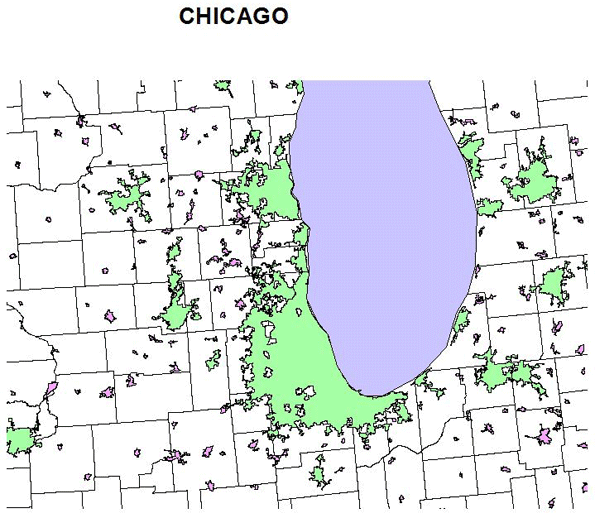
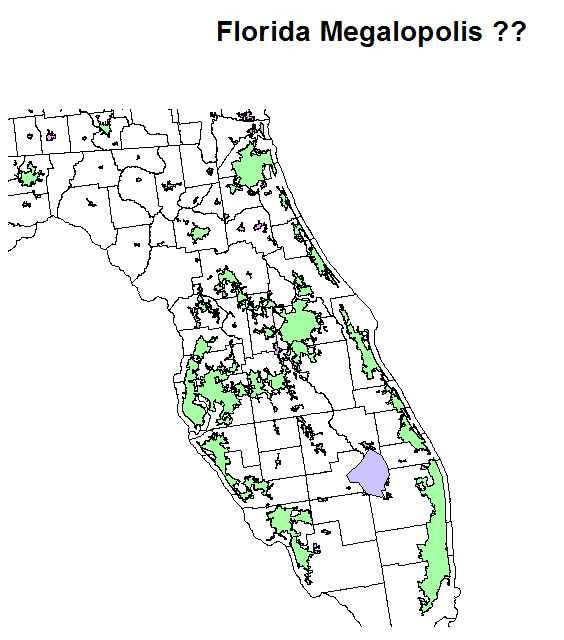
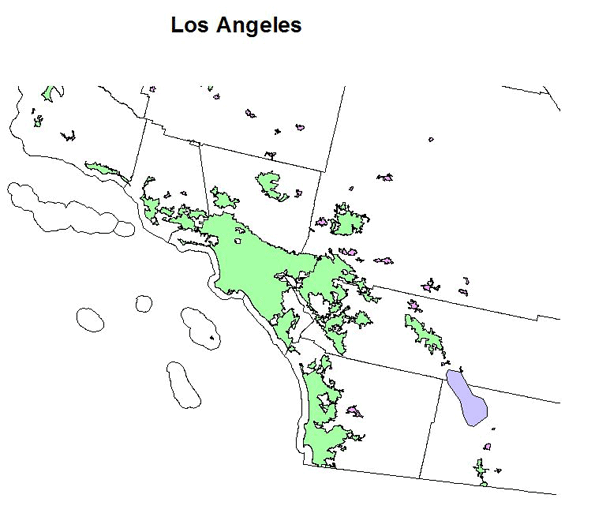
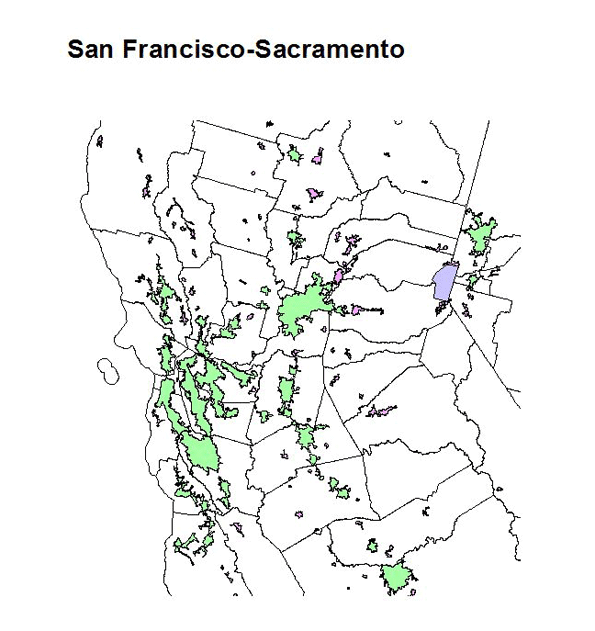
    Maybe it’s time to see how the original has fared?   And what has happened to other metropolitan complexes in the US, most notably Los Angeles, San Francisco, Chicago and should we say Florida?


    Table 1 summarizes the population of Megalopolis from 1950 to 2010 and Table 2 compares Megalopolis with other US mega-urban complexes.  Megalopolis grew fastest in the 1950s and 1960s, with growth rates of 20 and 18.5 percent. The  northeast has since been outpaced by the growth in other regions, but growth was still substantial in the last decade. Megalopolis added almost 3 million people, by 6.8 %, to reach an amazing 45.2 million.

    Table 1: Growth of Megalopolis 1950-2010
    Year Population Change % Change
    2010 45,357 2,983 7
    2000 42,374 5,794 15.8
    1990 36,580 2,215 6.4
    1980 34,365 360 1.2
    1970 34,005 5,436 18.5
    1960 29,441 4,910 20
    1950 24,534

    From Table 2 I note four major subregions of Megalopolis: Boston, New York, Philadelphia and Washington, DC. New York is still the biggest player, but the locus of growth over time has shifted South. This reflects the increasing world importance of Washington, DC. New York’s almost 20 million may not surprise, but the fact that greater Boston has grown to almost 9.5 million may be more surprising.  The Washington-Baltimore area grew by far the fastest at almost 15 percent (not much sign of shrinkage of government!). In contrast New York, Boston and Philadelphia’s growth was relatively paltry.

    Table 2: Megalopolis and Its Rivals
    Place
    2010 Pop
    2000 Pop
    Change
    % change
    Megalopolis
      New York 19,923 19,209 717 3.7
      Boston   9,445 8,967 478 5.3
      Philadelphia 8,415 76,781 773 9.5
      Baltimore-Washingt 7,403 7,681 960 14.9
    All 45,181 42,302 2,888 6.8
    Chicago 10,817 10,305 512 5
    Los Angeles 12,151 11,789 362 3.1
      Central 903 857 46 5.4
      North 928 634 294 46
      East 2,884 2,105 475 37
      South 3,543 3,210 337 10.4
    All Los Angeles 20,404 18,599 1,810 9.8
    San Francisco-Sacramento
      San Francisco 7,330 6,946 384 5.5
      Sacramento 3,171 2,604 572 22
    All San Francisco-Sacramento 10,501 9,550 951 10
    Florida
      Miami 6,027 5,311 716 13.5
      Tampa 4,818 3,894 974 25.3
      Orlando 2,915 2,193 722 33
      Jacksonville 1,483 1,191 2,242 24.5
    All Florida 15,243 12,544 2,699 21.5

    Greater Los Angeles is the second largest conurbation, with some 20.4 million, growing by 1.8 million, and 10 percent from 2000. In the table I distinguish between the core Los Angeles urbanized area and the satellite urbanized areas west, north, south and east. The core LA area grew by only 3 percent, while the spillover areas to the north and east had astonishing growth, at 46 and 37 percent over the decade.  These include several places with a fairly long history, such as Riverside and San Bernardino, San Diego and Santa Barbara, but many are rapidly growing large suburbs and exurbs, a spillover of growth from the Los Angeles core. Much of the fastest growth has been in  Mission Viejo, Murietta-Temecula, Indio, Lancaster, Santa Clarita and Thousand Oaks.

    For greater San Francisco, I distinguish two subregions, the Bay area of San Francisco-San Jose (west) and Sacramento (central valley).  Some might consider these totally distinct, but they have become one in a conurbation sense, as evidenced by commuting patterns. Many people live in the less costly Central Valley area but commute to the expensive Bay Area cities. Together, the conurbation is now 10.5 million, up 10 percent from 2000. The central valley (Sacramento) portion grew far more rapidly than San Francisco-San Jose (22 percent compared to 5.5 percent).  

    Compared to its rivals the Chicago conurbation has grown less rapidly but is still large, with a population of 10.8 million in 2010 , growing 512,000 (5 percent) since 2000.  Chicago and Milwaukee are the well-known core cities, but there are also less well known components with far faster growth such as Round Lake-McHenry and West Bend, WI.   

    Florida

    The more interesting and difficult conurbation to try to define is what might be called the Florida archipelago. Greater Miami has long been recognized as a conurbation, but I contend that virtually all the urbanized areas of the state are in effect a complex web of urban settlement, with little clear demarcation. This is in part a reflection of   rapid and expansive  growth.  Nevertheless it makes sense to recognize four sub-regions, centered on Miami, Tampa-St. Petersburg, Orlando and Jacksonville. 

    Together these areas have reached an astonishing 15.2 million, up 2.7 million or 21.5 percent in one decade.  Because settlement is spread across the state in such a web-like fashion with no single dominant center, they constitute a newish form of urban concentration. Besides the well-known centers such as   Miami, Tampa-St. Petersburg ), Orlando and Jacksonville,  there are many satellite cities, often quite large. These include North Port, Cape Coral  encompassing older Ft. Meyers, Bonita Springs, Kissimmee, Palm Bay-Melbourne, Palm Coast-Daytona, and Port St. Lucie.  An interesting but hard to answer question is how much of Florida’s phenomenal growth is a result of transfer of people and accumulated wealth from the North (and especially from the original Megalopolis).

    The United States is a large and diverse country, with many other giant cities and a vast countryside. But it is important to realize the importance of these megalopolitan areas, with an aggregate population of 102.6 million, one third of the nation’s population.

    What’s next? Look for the rise of now just somewhat smaller conurbations such as Houston, Dallas, Atlanta, Minneapolis, Seattle, Phoenix, and Denver. In terms of numbers and rates of growth Texas is a front runner, but its stars do not coalesce into a megalopolis, at least not yet. The belt of urban growth from Atlanta, through Greenville, SC, Charlotte to Raleigh-Durham is also a likely future conurbation candidate.

    Richard Morrill is Professor Emeritus of Geography and Environmental Studies, University of Washington. His research interests include: political geography (voting behavior, redistricting, local governance), population/demography/settlement/migration, urban geography and planning, urban transportation (i.e., old fashioned generalist).

  • Floribec : Quebec in the Tropics

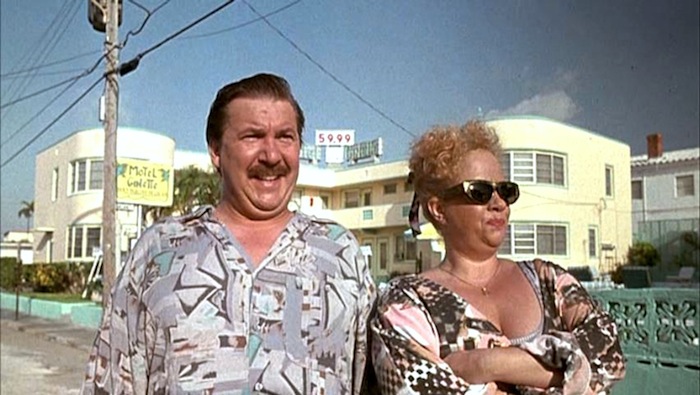
    Floribec has been part of the collective imagination of the Quebecois for nearly 50 years. Over time, a movie, a novel, advertisements and news reports played an important part in establishing the greater Miami region as the destination of choice for Quebec tourists. Floribec began as a result of tourism and it later evolved into a transnational community. After visiting southeast Florida, some Quebec tourists decided to take up permanent residence there and to make their living providing services in French to other French-speakers. Motels, restaurants, convenience stores, lawyers, and other services for winter residents appeared, creating a Floribecois community, where the lifestyle and economy were largely based on the ever-present Quebecois tourists, visiting for a week or for several months. The result was a French-speaking community outside Quebec, distinct from other French-speaking communities in North America. However, the survival of the declining community is now in jeopardy.

    The Origins of Floribec 

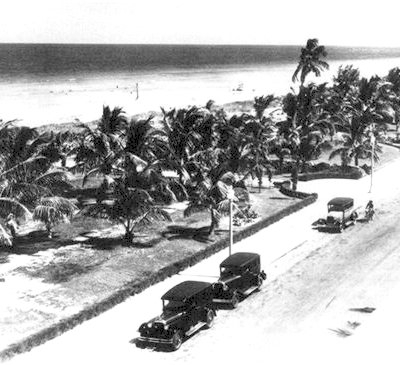
    Ocean Drive (Miami) sometime in the 1940's

    Ocean Drive (Miami) sometime in the 1940’s

    It is hard to pinpoint the origin of the word "Floribec" but it appears to have been adopted in the 1970s by Quebec residents wintering in Florida and made official in a study by Louis Dupont in the 1980s. According to him, French Canadians began immigrating to Florida in the 1930s. This immigration came in the wake of spending by the United States government, which, in an effort to resolve the 1929 economic crisis, undertook to build a network of canals through the marshland in southeast Florida and, notably, to open the Intercoastal Waterway, a navigable canal hundreds of kilometres long. At the same time, the government was also attempting to develop the infrastructure for tourism. Thousands of Americans travelled to the "Sunshine State" to work on this vast construction site. Among them were Franco-Americans from New England, some accompanied by their French-Canadian cousins. Once the construction work was completed, rather than going home, many of the French-Canadian workers took up permanent residence in the Miami region, particularly in Surfside, on the Atlantic coast, and in North Miami. After the Second World War, there were 67,000 French-Canadian and Franco-American families living in the State of Florida. These new permanent residents of Surfside and North Miami and of Sunny Isles generally found work in the tourist industry because Florida, especially Miami, was the holiday destination of a growing number of wealthy French-Canadians. This initial wave of Quebecois mass migration to Florida began at the end of the war and continued until 1960.

    Establishment of the Floribecois Community 

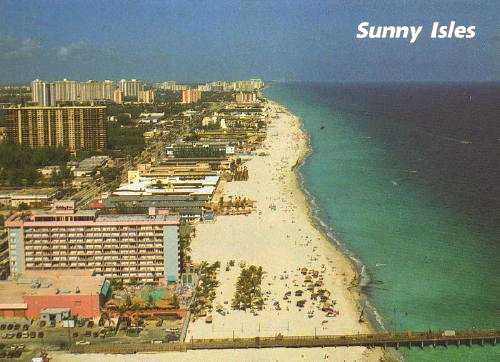
    Postcard of Sunny Isles, before the arrival of the giant hotels

    Postcard of Sunny Isles, before the arrival of the giant hotels

    The period from 1960 to 1970 saw a second wave of French-Canadian, mainly Quebecois, migration to the Miami region, with the appearance of a new type of immigrant: the investor. Two of the factors contributing to increased immigration were the liberating effect of the Quiet Revolution and the growth of wealth in Quebec. The fact that these two phenomena occurred simultaneously appears to have encouraged the people of Quebec to look beyond their borders. Expo 67 and a number of other Quebec cultural events made the rest of the world more aware of the province and, as well, the people of Quebec used this period of cultural vitality to increase their travel to foreign destinations. 

    At the same time, the tourist industry was experiencing rapid development in Florida with the arrival of the major airlines, the construction of the United States freeway system, and the north-south shift of economic and political power, which sparked phenomenal growth in the cities of the Sun Belt, including Miami. Miami Beach and its suburbs of Surfside and Sunny Isles became the favourite seaside destinations of the Quebecois. Recognizing the opportunity the situation presented, the Floribecois set up businesses in the area to cater mainly to Quebecois tourists, building French-language motels, restaurants, bars, convenience stores, and various other services to meet their needs. 

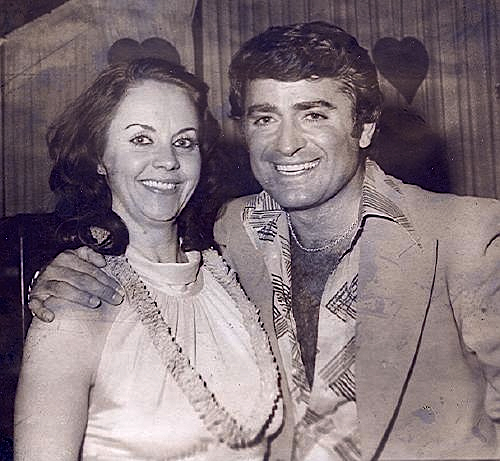
    Gemma Cossette with popular singer Michel Louvain

    Gemma Cossette with popular singer Michel Louvain

    From the 1970s onward, most businesses were established in Surfside and Sunny Isles, especially along Collins Avenue, whose location less than a kilometre from the beach offered increased customer traffic. The favourite tourist destination of the Quebecois was now affordable and there was no longer any language barrier. During this period, the Thunderbird, Suez, Waikiki and Colonial hotels were familiar to any Quebecois who travelled regularly to Florida, and even to those who were merely thinking of going there. Cultural life was vibrant because of the continued presence of such artists as Gilles Latulippe and other popular Quebec comedians and singers, who performed to sold-out audiences in the most popular hotels. The localization of these cultural activities in the gathering places of Quebecois tourists would serve to establish the physical boundaries of Floribec as a transnational tourist community.

    Floribec’s Shift Northward 

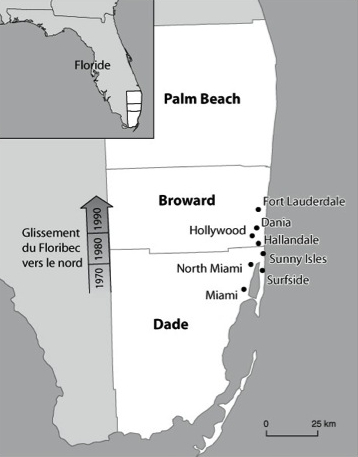
    Map showing location of concentrations of Quebec residents in Florida


    Map showing location of concentrations of
    Quebec residents in Florida

    The Floribecois communities in Surfside and Sunny Isles moved in the 1980s because, as had been the case in the Mafia era of 1920-1930, Miami once again became an international money-laundering centre for the drug trade, as well as being the scene of major racial conflicts. The city gained the status of unofficial capital of Latin America, not only because it had become a hub of the Latin-American banking system, but also because its downtown attracted hundreds of thousands of Cubans, Nicaraguans, Columbians and others. This continual influx of migrants led to a major exodus of WASP’s (White Anglo-Saxon Protestants), who moved north to the neighbouring counties of Broward and Palm Beach, leaving Dade County to the Hispanic population. Many Quebecois tourists and immigrants also left Dade County at that time.

    Floribec’s Glory Years 

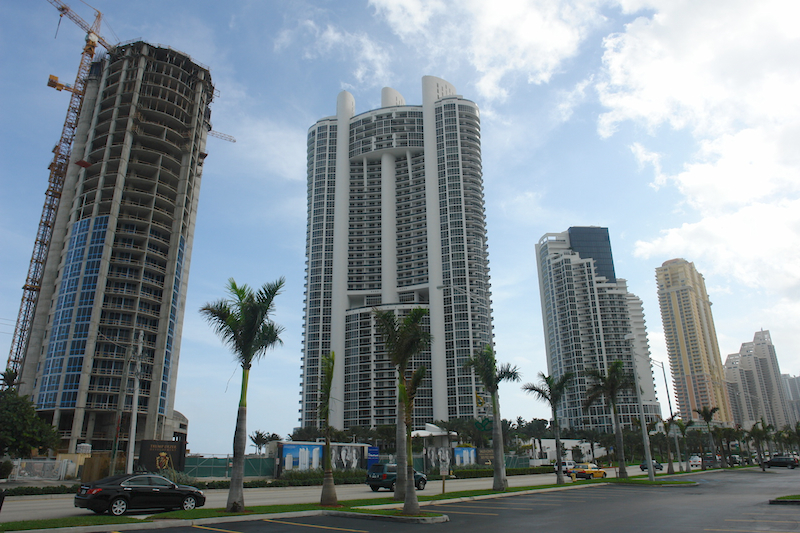
    Giant hotels replaced small motels

    Giant hotels replaced small motels

    For all intents and purposes, the Floribecois areas in Surfside and Sunny Isles disappeared in the early 1990s. The small, modest hotels, motels, and apartment buildings, where many Quebecois lived, were torn down and replaced by luxury high-rise condominiums up to 30 storeys high, some of them owned by Donald Trump. 

    The changes to that area explain why the neighbouring cities of Hallandale, Hollywood and Dania experienced such considerable growth during this period. They had not suffered from the demolition associated with urban sprawl and, for this reason, they became the southernmost destinations to which Quebecois tourists could travel affordably. The small, reasonable motels so popular with the majority of Quebecois tourists remained. It was here, in a well-defined area, that the Floribecois community really took root again and where it continued to be possible to carry on everyday life in French.

    Floribec’s Current Configuration

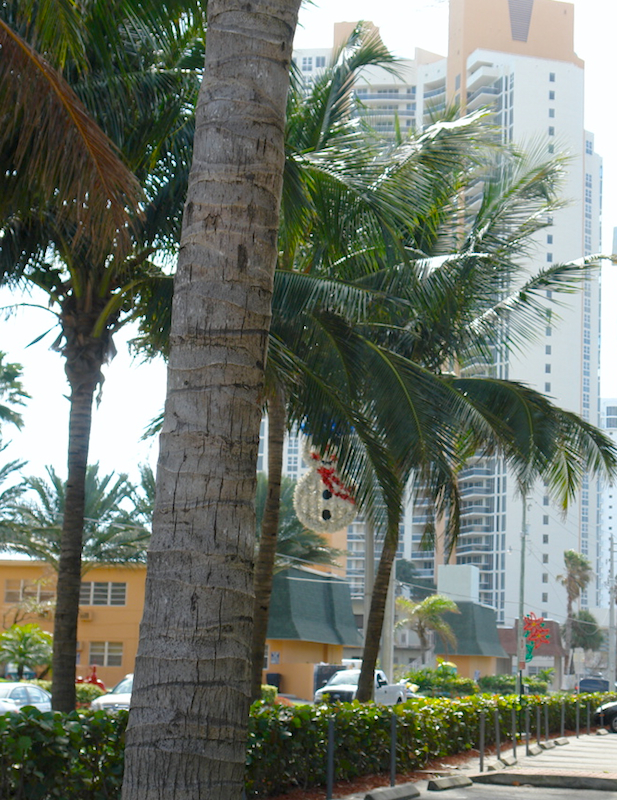
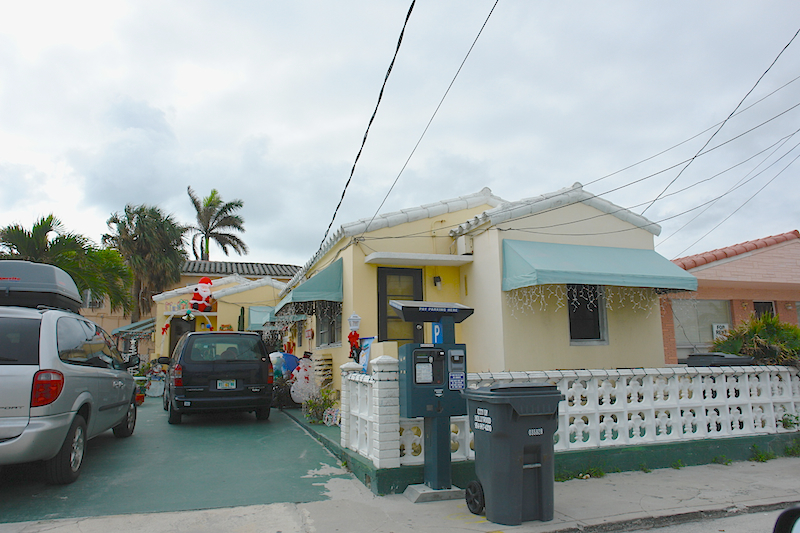
    Christmas decoration hanging discreetly from a palm tree

    Christmas decoration hanging discreetly from a palm tree

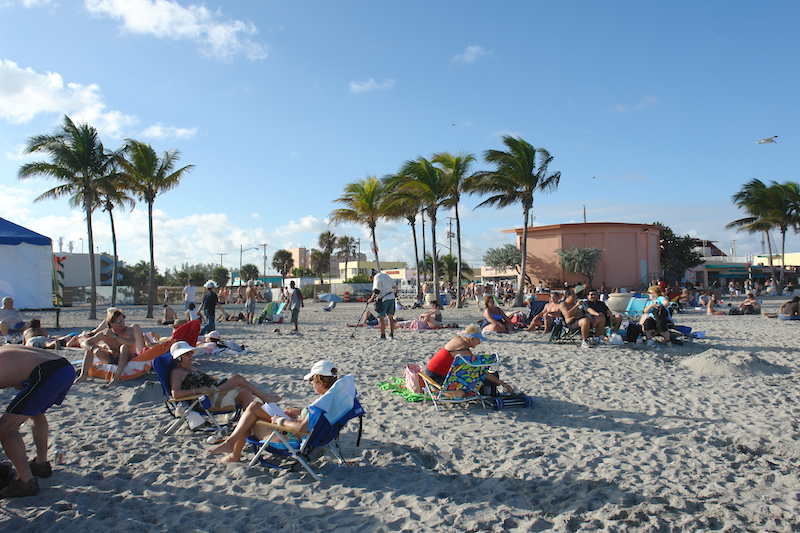
    Like numerous other seaside resorts, Floribec has a recreational business district (RBD) where the main tourist services are located. In the Floribecois RBD, there is a pedestrian walkway along the beach, the Broadwalk, and perpendicular to it, a main artery, Johnson Street. Depending on the season, restaurants, specialty food stands, candy shops and souvenir shops line these two streets in the RBD. The beach is the location of the sites most vital to Floribec life, namely the Broadwalk itself and the Johnson Street stage, as well as social institutions like the famous Frenchie’s Café.  Only a few kilometres from the RBD, other very popular Floribecois motels, including Richard’s Motel, branches of the Caisse populaire Desjardins and the National Bank of Canada, Lacroix Real Estate AgencyAu Coq restaurant, and other services are grouped together along U.S. Highway 1. Beyond the Hollywood-Dania-Hallandale corridor, the Floribecois population and its landmarks are soon swallowed up by the greater community. 

    It is important to note that Quebec is an integral part of the Floribecois community. The ongoing relationship with Quebec is sustained by the seasonal influx of thousands of tourists, often called "snowbirds", and the ready access in Florida to Quebec newspapers and radio, the main Quebec television programs, and the Internet, which also makes on-line banking possible. All of the regular and ongoing media and tourist contact between Quebec and Floribec make the latter a "transnational community" whose existence is largely dependent on the many connections it maintains with Quebec.

    Floribec in Decline? 

    Enjoying the beach...

    Enjoying the beach…

    Floribec has changed considerably since 2000. While Quebecois tourists continue to travel to southeast Florida, and the Quebecois culture and everyday living in French no longer dominate the scene around Johnson Street, as they did in the 1990s. People still gather on the beach but the tourists and immigrants live elsewhere, often at some distance from the ocean. Three factors may explain this erosion: 1) pressure from Miami’s continuing urban sprawl; 2) the negative image local political authorities have of the Floribecois; 3) competition from numerous tourist destinations that are as affordable as Florida, such as the Dominican Republic, Mexico and Cuba, which attract an increasing number of Quebecois.

    Miami‘s urban sprawl

    The purchase and demolition of Floribecois motels by rich local and Latin-American land developers has expanded beyond the cities of Surfside and Sunny Isles. Due to the shortage of available land, the trend has now reached Hollywood. For example, a huge luxury hotel complex was built only a few kilometres from the Broadwalk, which is also being rebuilt, and Floribecois motels located on Hollywood Beach have been demolished to build luxury condominiums. It is Hollywood’s turn to face the phenomenon of urban high-rise construction and tourist gentrification; it may be fighting a losing battle. 

    A veritable Quebecois


    A veritable Quebecois

    Negative image of the Floribecois

    The socio-economic class to which the Floribecois belong troubles Hollywood City Hall. In strictly economic terms (daily spending, property taxes, etc.), it is not in the municipality’s interest to encourage the Floribecois to remain in the area. Nor does the caricature of the Floribecois presented in Quebec films and the local media help to reassure the city councillors. While the City of Hollywood welcomed the economic benefits associated with French-speaking residents in the 1980s, it now fears that these same people may tarnish the city’s image and it feels that Hollywood should follow the example of neighbouring municipalities who are moving to attract a higher class of tourist. The city has already taken the first step by demolishing one of Floribec’s most significant institutions, Frenchie’s Café, at the corner of the Broadwalk and Johnson Street, along with the adjacent small businesses. Since the demolition, the Floribec atmosphere, so appreciated by tourists, is much less vibrant than it was in the 1990s. Although there are still many Quebec tourists on the beach, fewer services are available to them in French, quite a different situation that in Floribec’s glory days. The only time that the Floribecois now flock to this subtropical area of the country is in January, when the annual festival, Canada Fest, brings together Floribec businesses and Quebec singers. Annual attendance at this cultural event is about 100,000 visitors. However, it is increasingly difficult to find signs of Floribec’s existence. While some insist that all is well, it would appear that Floribec’s days are numbered. At the very least, it seems that Floribec has lost its heart and soul.

    Competition in the tourist trade

    The increased number of affordable tourist destinations adds to the pressure on Floribec. Because those who love Florida enjoy temperatures of 25º C or above, the West Indies, the Caribbean and Mexico are harming the Floribecois economy. Le Soleil de la Floride, a monthly newspaper established in 1983, has reason to continually boast the merits of the Sunshine State, pointing out how familiar and safe a destination it is. However, there is no doubt that sun-seekers, especially those who do not travel south by car (single people or couples), are being lured away by the Dominican Republic, Cuba or Mexico. Direct flights from Montreal and Quebec to Cancun, Acapulco, Punta Cana, Varadero, and many other destinations are rapidly growing in number to meet demand, making vacations in these tropical and exotic areas accessible, often at a lower cost than an extended stay in Florida.

    Heritage in Danger? 

    Image from the movie «La Florida» (George Mihalka, 1993) starring Rémy Girard and Pauline Lapointe

    Image from the movie «La Florida» (George Mihalka, 1993) starring
    Rémy Girard and Pauline Lapointe

    Floribec constitutes an interesting chapter in the history of modern Quebec and it represents an intriguing and unique pocket of French-speaking America. This transnational community came into being as a result of people patronizing numerous businesses and other community-building venues situated in a relatively small geographical area on the Atlantic coast. These sites played an essential role as centres of community life for French-speakers who were living in or visiting the greater Miami area. Today, certain community practices formerly associated with Floribec can still be found; however, they are dispersed over a much wider area and signs of any Quebecois presence in the Florida landscape are increasingly difficult to discern.

    Rémy Tremblay is Canada Research Chair on Knowledge Cities, Université du Québec à Montréal

    ——–

    This piece is courtesy of the Encyclopedia of French Cultural Heritage in North America.

    ——–

    Bibliography

    CORTÈS, G. E FARET, L. (dir) (2009) Les circulations transnationales. Paris, Armand Colin, 244 p.

    DUPONT, L. (1982). Le déplacement et l’implantation de Québécois en Floride. Vie française, 36 (10-11-12), p. 23-33.

    GILBERT, A., LANGLOIS, A. et R. TREMBLAY (à paraître) Habiter Floribec. Voisinage et communauté. Revue internationale d’études canadiennes.

    LEVITT, P. (2001). The Transnational Villagers, Berkeley et Los Angeles, University of California Press.

    MORISSONNEAU, C. (1983). « Le peuple dit ingouvernable du pays sans bornes: mobilité et identité québécoise », dans Dean Louder et Éric Waddell (dir.), Du continent perdu à l’archipel retrouvé: le Québec et l’Amérique française, Sainte-Foy, Presses de l’Université Laval.

    TREMBLAY, R. (2003) « Le déclin de Floribec », Téoros, 22 (2).

    TREMBLAY, R. (2006). Floribec. Espace et communauté, Ottawa, Presses de l’Université d’Ottawa.

    TREMBLAY, R. (2008) Le Floribec éphémère, dans Dean Louder et Éric Waddell (dir.), La Franco-Amérique : traces et enracinement, Québec, Septentrion.

    TREMBLAY, R et O’REILLY, K (2004) « Les communautés touristiques transnationales. » Revue de Tourisme/Tourism Review, 59 (3).

  • The Return of the Monkish Virtues

    “[The author of Leviticus] posits the existence of one supreme God who contends neither with a higher realm nor with competing peers. The world of demons is abolished; there is no struggle with autonomous foes, because there are none. With the demise of the demons, only one creature remains with ‘demonic’ power – the human being. Endowed with free will, human power is greater than any attributed to humans by pagan society. Not only can one defy God but, in Priestly language, one can drive God out of his sanctuary. In this respect, humans have replaced demons…..[The author of Leviticus] also posits that the pollution of the sanctuary leads to YHWH’s abandonment of Israel and its ejection from the land….Israel pollutes the land; the land becomes infertile; Israel is forced to leave.” – Jacob Milgrom, Leviticus


    “Pollution ideas are the product of an ongoing political debate about the ideal society. All mysterious pollutions are dangerous, but to focus on the physical danger and to deride the reasoning that attaches it to particular transgressions is to miss the lesson for ourselves…. Pollution beliefs trace causal chains from from actions to disasters…Pollution beliefs uphold conceptual categories dividing the moral from the immoral and so sustain the vision of the good society.” – Mary Douglas and Aaron Wildavsky, Risk and Culture


    “Celibacy, fasting, penance, mortification, self-denial, humility, silence, solitude, and the whole train of monkish virtues; for what reason are they everywhere rejected by men of sense, but because they serve to no manner of purpose; neither advance a man’s fortune in the world, nor render him a more valuable member of society; neither qualify him for the entertainment of company, nor increase his power of self-enjoyment? We observe, on the contrary, that they cross all these desirable ends; stupify the understanding and harden the heart, obscure the fancy and sour the temper. We justly, therefore, transfer them to the opposite column, and place them in the catalogue of vices.” – David Hume, An Enquiry Concerning the Principles of Morals

    The era of the 100 watt incandescent light bulb came to an end in America on January 1st. Lower wattages will soon join them in a phaseout over time. As I noted previously, this will mean factory shutdowns in the United States and the migration of the light bulb manufacturing industry to China. The most common replacement type bulbs, compact fluorescents, are not “instant on,” generally fail to provide a proper light spectrum, contain poisonous mercury, and burn out sooner than advertised. CFL boosters claim none of these are real problems and that CFLs are a slam dunk for benefit/cost reasons, but the cold reality is that despite significant promotion, they never received widespread consumer adoption voluntarily. Given how eagerly consumers slurp up even bona fide more expensive products like Apple computers when they are perceived to be superior, I’m inclined to think the consumers are on to something. I’ve tried out CFLs myself and thought they basically sucked.

    The supposed rationale for imposing an inferior product that did not receive the desired traction in the the marketplace is to prevent climate change. I went searching to try to find exactly what the impact of light bulbs on greenhouse gas emissions was and have found it quite difficult to obtain. The various sites touting CFLs all note the high output of CO2 from electricity generation generally, how much CO2 changing this or that bulb will save, etc, but as for what a wholesale elimination of light bulbs would achieve, that’s harder to find.

    According to the EPA, residential electricity accounted for 784.6 million metric tons of CO2 in 2009, or 11.8% of total US human greenhouse gas emissions. How much of that is from light bulbs? It’s not broken out in the EPA’s report (even the detailed version), but I’ll attempt an estimate of aggregate CO2 savings. (If someone has a direct link to this information, please let me know).

    The Guardian reported that an Australian incandescent ban would save that country 800K tons of CO2 emitted per year and a UK ban would save 2-3 million tons. It also reported that China could save 48 million tons per year by banning incandescents.

    The US is bigger than Australia and the UK, but similarly advanced developmentally. China is a bigger emitter than the US, has far more people, is less advanced developmentally, and is a bigger user of coal for electricity generation. However, all three countries project similar per capita emissions reductions from incandescent elimination. If the US savings were at the upper end of their range, it would have CO2 savings of around 15 million tons a year. That’s only 0.2% of total US greenhouse gas emissions. Even if the US saved the same 48 million tons as China, it’s only 0.7%. I’d be skeptical of anyone claiming the US would save a lot more CO2 per capita than these. Some maybe, a lot, no.

    In short, swapping out incandescent light bulbs is not going to be a major contributor to solving the problem of climate change. I’m not aware of anyone claiming it is. So why pass a law that is unpopular in many quarters and cram CFLs and other type of bulbs consumers haven’t chosen to buy on their own down their throats? It seems to be a purely provocative move of a mostly symbolic nature with little real substance that is sure to only harden opposition to the real changes we need to make to actually make material reductions in GHG emissions. (One might say the same of other items like mandatory recycling or banning plastic grocery bags).

    The answer is that the symbolism is the substance.

    The sad reality is that rather than make policy cases based on benefit/cost or other technical considerations, for political or personal reasons sustainability advocates have decided to model their cause on the template of religion. In it we have an Edenic state of nature in a fallen state because of man’s sin (pollution) for which we will experience a coming apocalyptic judgement (damage from climate change). Thus avoiding the consequences becomes fundamentally a problem of sin management. The proposed sin management solution is again taken from traditional Christianity: confession and repentance, followed by penance, restoration to right standing with God (nature), and committing to a holier life.

    There are two basic problems with this. The first is that while the religion template taps in to a deep psychological vein in the human spirit – some have suggested humanity may even carry a so-called “God gene” – most people already have a religion and aren’t likely to convert to a new one without a major outreach effort.

    But more importantly, the notion of penance, and perhaps of asceticism more generally, has never sold with the public, even in more religious eras. David Hume (a vigorous religious skeptic it should be noted) referred to the values resulting from this lifestyle as the “monkish virtues” and noted that they have “everywhere rejected by men of sense.” Or as Carol Coletta put it more recently, people don’t want to be told to “eat their spinach.”

    It strikes me that while perhaps environmentalists don’t really want to force a particular lifestyle on people, there is a fundamental desire to see people engage in some sort of public penance for our environmental sins. I believe this to be the root logic underlying a lot of feel-good (or perhaps more accurately, “feel-bad”) initiatives like getting rid of incandescent light bulbs. It is a form of penance and embrace of the monkish virtues.

    I can’t help but notice that even Christianity itself has moved away from promoting the monkish virtues. While things humility are of course still preached and expected to be modeled, modern Christianity mostly rejects the notion of an ascetic life. Most Evangelical churches actually preach that God wants humans to be happy. The idea is of a God who wants us to be unselfish, but not unhappy. A not insignificant number of churches actually preach the so-called “prosperity gospel” in which God will provide earthly blessings to His followers. In the Catholic tradition, monasticism itself has been in decline for some time. (I liken the reports of upticks in interest in joining monasteries as similar to the perennial “return of the suit” articles in fashion magazines).

    Whether these theological points are accurate or not is beside the point of this article. They appear to be attractional. For example, well-known prosperity gospel preacher Joel Osteen runs the largest church in the United States, with over 40,000 attending weekly.

    What might the environmental movement have looked like based on a different template? I’ll refer again to the work of Bruce Mau. If you’ve ever seen him present on this topic, he likes to start by noting that if we brought the entire world up to US standards of living, it would take four Earth’s worth of resources given our current technologies and approaches to make it happen. He thinks that’s a good thing, because the patent impossibility of that “takes that option off the table.” He then goes on to talk about all the super-cool new stuff we are going to have to invent and scale up to address the challenges of the future. If you haven’t, I might suggest getting his book Massive Change, which I reviewed a while back. It’s difficult to come away from one of Mau’s books or lectures without being excited about the possibilities of the future.

    I don’t think Mau has any different view of the fundamentals of climate change than your typical orthodox environmentalist. But his approaches to solutions (which are admittedly not always short term practical action plans) and the sales job on them is very different. As a designer, he knows he needs to create something that’s aspirational and attractional in order to get people to want it. It’s a shame too few people have followed that lead.

    The monkish virtues are just never going to sell. Perhaps you can get a room full of the sustainability in-crowd to buy into it, or even focus on top level political success as with the bulb ban. But ultimately I think this is self-defeating.

    In the short term I’d suggest ending any efforts to impose direct consumer mandates. I don’t think that’s where the money is, so to speak, in GHG reductions. Instead, let’s focus on the producer side of the equation in ways that are largely transparent to consumers and don’t involve significant costs. More fuel efficient vehicles might be one. Replacing coal with natural gas is another possibility. (The EPA report I linked earlier cited this as a big contributor the decline in GHG emissions in recent years). New technologies are clearly needed and should perhaps be invested in even though as we know this will lead to many failures along the way.

    As the financial crisis in Greece and elsewhere shows, people rarely confront structural problems, no matter how serious, until the crisis actually comes. At least if “austerity” (a monkish virtue if ever there was one) is the major part of the proposed solution.

    If an environmental equivalent of austerity is required to save the planet, then I’m afraid we should prepare for the deluge. I personally don’t think we’re at that point, given that we’ve had huge gains in energy efficiency for many decades now while our lifestyles have actually improved. More of that, not the promotion of monkish solutions like CFL lightbulbs, is what it will really take to drive further environmental improvements.

    PS: If you don’t think people are really promoting or embracing monkish lifestyles in support of environmentalism, read this article from the Guardian about people giving up on daily showers. Or think about the people trying to completely go “off the grid.” Even if CFLs don’t fit for you, clearly there are plenty of examples. I pick CFLs because they are an institutionalization of monkish virtues, not just the passion of the small minority, which has always been the case.

    Aaron M. Renn is an independent writer on urban affairs based in the Midwest. His writings appear at The Urbanophile, where this essay originally appeared.

    Photo by BigStockPhoto.com.